66 614 résultats
1 S. 8vo. "Dem armen Vogel bin ich gleich geworden, | Den man erbarmungslos im Käfig hält, | Wie er sich auch nach seiner schönen Welt | hinweg sehnt aus dem herbstlich kalten Norden [...]". - Nachdem Oelschläger in den Kriegsjahren 1859 und 1866 als bayerischer Offizier gedient hatte, widmete er sich danach ausschließlich dem schriftstellerischen Beruf und lebte abwechselnd in Leipzig, Cannstatt und Weimar, wo er ins Kuratorium für das Goethe-National- Museum berufen wurde. Zu seinen bekanntesten Werken gehören "Gedichte", "Wunderliche Leute", die "Novellen in Octaven", "Engel Kirk", "Die Kunst im Hause" "Ovids Elegien der Liebe" und "Des Musäos Gedicht von Hero und Leander".
2 SS. auf Doppelblatt. Folio. Titel mit eh. Widmung: "Der liebenswürdigen Frau Irene Steinberg-Frank zur freundl. Erinnerung". - Domanig-Roll war als Textdichter zahlreicher Wienerlieder u. a. für die Komponisten Rudolf Kronegger, Karl Föderl und Ludwig Gruber tätig; auch war er Mitarbeiter des vom Chordirigenten Eduard Kremser herausgegebenen Werkes "Wiener Lieder und Tänze".
Je 1 S. auf 1 Bl. 8vo. Zusammen unter Passepartout, gerahmt. Gesamtgröße 247:322 mm. An Paul Lindau: "Freundlichen Dank, lieber Lindau, für Ihren liebenswürdigen Brief. Ja, ich muß mich oft entschuldigen, daß ich steinalt bin. Also bitte! Die beifolgenden Zeilen dürfen Sie, wenn Sie wollen, für das Wilbrandtsche Gedenkbuch verwenden [...]". Das Gedicht "Immerhin" mit vier Strophen zu je vier Zeilen: "Die Sonne geht auf und unter / Schon lange vieltausendmal, / Noch immer eilen so munter / Die Bächlein in's blühende Thal [...]". Bei dem "Gedenkbuch" handelt es sich um den noch im selben Jahr bei Cotta erscheinenden Band "Adolf Wilbrandt. Zum 24. August 1907 von seinen Freunden. Mit drei Bildnissen von Franz Lenbach und einer photographischen Aufnahme von Erwin Raupp". Als Herausgeber zeichneten die "Freunde von Adolf Wilbrandt". - Etwas lichtrandig, sonst tadellos erhalten. Mit geringfügigen Transkriptionsfehlern abgedruckt in: Wilhelm Busch: Sämtliche Briefe. Band II: Briefe 1893 bis 1908 (Hannover 1969), S. 267.
1813(LCPCSCI-0004)(L'art d'obtenir le blu indigo dans un très rare opuscule en édition originale. Un exemplaire tel que paru, à toutes marges, non rogné et non coupé, dans sa brochure d'origine. Avec un envoi autographe de l'auteur) PUYMARTIN Jean-Pierre-Casimir DE MARCASSUS (Baron DE). (Toulouse 1757-1841) "INSTRUCTION SUR L'ART D'EXTRAIRE L'INDIGO CONTENU DANS LES FEUILLES DU PASTEL...". 1813, Paris, Imprimerie Impériale. 1 volume in-8° (214x138 mm) (dimensions pages 214x138 mm) 42 pp. (y compris faux-titre et titre), (1) f. b. (A-B8, C6) Brochure violacée de l'époque. Edition Originale, très rare. Rares et infimes brunissures, petits manques de papier au dos, mais superbe exemplaire tel que paru, à toutes marges, non rogné et non coupé, dans sa brochure violacée d'origine. Avec un envoi autographe de l'auteur au Sous-Préfet d'Aoste sur la première couverture. L'auteur perfectionna l'art d'extraire l'indigo du pastel (du latin "pasta", pâte) ou isatis tinctoria, afin d'obtenir une matière colorante pour l'industrie. En 1812 il devint directeur d'une fabrique d'indigo fondée à Toulouse. (LCPCSCI-0004) (550,00 €) (www.cepays-ci.com)
Small 4to. 1 p. The first poem is describing what has to be written into a diary ("a little bit of lust [...] a little bit of play and dance"), the second uses "eyes" metaphorically for "windows" through which the sunlight enters the heart: "In streets and alleys you are alone [...] carry your luck and your pain in your heart [...] and happiness and dreams and love and pain and lust [...] carry it along in your chest [...]. - Somewhat dusty, edges slightly frayed, otherwise in fine condition.
4to. French manuscript on paper. (3) pp. on 6 ff. Typescript: (18) pp. on 18 ff. Several drafts for Valéry's introduction to Martin Hürlimann's photo book "La France, architecture et paysages" (Zurich/Paris 1927), which was later published as part of Valéry's essay-collection "Regards sur le monde actuel" (Paris 1931). One of the typed pages re-uses a letter from 17 January 1927. - This beautiful ensemble of a manuscript and typescript with annotations and numerous corrections offers a rare insight into Paul Valéry's writing process. The text is an attempt at a profound characterization of France as a nation and its people. Both the manuscript and the typescript comprise several versions of only a few paragraphs of the long introduction. The recurring first phrase of the manuscript is: "La France est le pays du monde où les considérations de la forme, le souci singulier de la forme en soi ait persisté, et même se soit imposé dans les temps modernes" ("France is the one country in the world where questions of form, the singular concern for form in itself, have persisted and even imposed themselves in modern times"). The unsystematically numbered typescript represents passages that are more descriptive of France as a country, trying to establish links between the people and their historical and natural environment. The different versions of the poetic first phrases depict France as harmonious in its geographical diversity: "La terre de France est remarquable par la netteté de sa figure, par les différences de ses parties, par l’équilibre général de cette diversité de régions qui se conviennent et se complètent. Une sorte de proportion assez heureuse existe dans ce pays entre la plaine et la hauteur, entre la montagne et la mer, entre l'étendue intérieure et le développement des côtes, et sur les côtes mêmes, entre les plages, les roches, les falaises [...]." - A beautiful condensation of Valéry's patriotic sentiments is a sentence added by hand to one of the typed pages: "La France tombe, se reléve, se restreint, reprend sa grandeur, redéchire soi-même se reconcentre" ("France falls, rises again, restrains herself, regains her greatness, tears herself apart again, refocuses"). Valéry revised and extended this phrase for the final version. - Stronger browning of the typescript and occasional tears. The first page of the manuscript is dust-stained, showing several minor tears. With editing marks in crayon. Regards sur le monde actuel (Paris: Stock, Delamain et Boutelleau, 1931), pp. 103-144.
2 SS. Folio. Lied für Singstimme und Klavierbegleitung ("Ob ich dich liebe? frage die Sterne") mit unterlegtem Text nach Karl Herlossohn, am Schluß Nachschrift an seinen Kompositionslehrer Wilhelm Cläpius (1801-68): "[Heinrich] De Marchion läßt Sie herzlich bitten, ihm das vorstehende Liedchen so rasch als möglich zu instrumentiren (aber in E oder Es dur), da er es doch schon am Mittwoch in der Probe singen, und daher die Stimmen ausgeschrieben haben muß. Sie haben wohl die Güte und nehmen das Nachspiel auch zum Vorspiel, damit das Lied einen ordentlichen Eingang hat. Nehmen Sie nur nicht übel daß ich Sie schon wieder belästige. Wenn das Liedchen fertig ist, bringen Sie's mir wohl [...]". - "Gumbert ließ sich 1842 in Berlin als Gesangspädagoge, Korrepetitor und Kompositionslehrer nieder und entfaltete eine ungewöhnlich fruchtbare Tätigkeit als Bühnen- und Liederkomponist sowie als Musikschriftsteller, Rezensent, Textdichter und Übersetzer" (MGG V, 1111). - Einige hinterlegte Randeinrisse; im ganzen wohlerhalten.
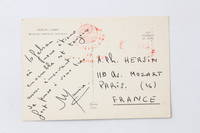
197470633Ispahan 22 novembre 1974 | 14.90 x 10.20 cm | une carte postale
194487922Paris s.d. (ca 1944) | 13.50 x 18 cm | deux pages et demi sur un bifeuillet
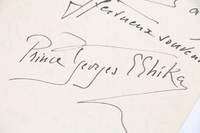
194487922Paris 1944. Fine. Paris s.d. ca 1944 13.50 x 18 cm deux pages et demi sur un bifeuillet Autograph letter signed by Prince Georges Ghilka 31 lines in black ink on a double sheet with letterhead from the Majestic Hotel in Paris probably addressed to René-Louis Doyon who devoted in 1944 a biography to Isabelle Eberhardt entitled ""Au pays des sables Isabelle Eberhardt"". Fold mark inherent to the mailing. Prince Georges from the House of Ghika a princely family of Romania of Albanian origin married in Paris in 1910 the most famous Amazon of All Paris Liane de Pougy. René-Louis Doyon sent his work to his friend the prince who thanks him for it: ""Nous avons lu votre livre et c'était délicieux comme une causerie avec vous une causerie qui emporte dans ces pays aimés du soleil et d'Isbelle Eberhardt que vous vous plûtes à citer. Merci encore pour ce grand plaisir que vous nous avez donné."" We read your book and it was delightful like a conversation with you a conversation that carries one away to those beloved lands of sun and of Isabelle Eberhardt whom you took pleasure in quoting. Thank you again for this great pleasure you have given us. unknown
197470633Ispahan Isfahan 1974. Fine. Ispahan Isfahan 22 novembre 1974 14.90 x 10.20 cm une carte postale Autograph postcard signed by Maurice Béjart addressed to André-Philippe Hersin on the verso of a photographic reproduction showing the trembling minarets of Isfahan. The choreographer sent this postcard from Iran where he created in 1971 under the patronage of Empress Farah Pahlavi his ballet Golestan The Rose Garden and in 1974 at the Shiraz festival his ballet Mallarmé III to music by Pierre Boulez. It would also be during this period that Béjart is said to have converted to Islam after meeting Dariouche Safvate eminent Kurdish Sufi musician. unknown
5 SS. Tinte auf Papier. Geheftet. Qu.-Folio. Psalm 26, komponiert für Singstimme und Klavierbegleitung: "Richte mich o Ewiger". - Stadler zählte zu den prominentesten Persönlichkeiten des Wiener Musiklebens an der Wende vom 18. zum 19. Jahrhundert; er war mit Mozart, Haydn, Beethoven und Schubert befreundet und verfasste zahlreiche Schriften über Mozart, dessen Nachlass er gemeinsam mit Georg Nikolaus Nissen ordnete. - Im Rand eigenh. Echtheitsbestätigung (um 1880) durch den Komponisten Josef Venantius von Wöss (1863-1943): "Comp. von Hrn. Abbé Max. Stadler. / Des unsterblichen Tondichters eigene Handschrift" sowie "Autograph". Sehr selten; seit 1950 kein einziges Autograph des Komponisten im Handel nachweisbar.
190885189Toulon 30 Mars 1908 | 13.50 x 21.50 cm | 8 pages sur deux doubles feuillets + une enveloppe
180185841Charenton 1801 | 15 x 22.80 cm | un feuillet composé deux papiers encollés
197684675Paris 11 Octobre 1976 | 21 x 29.50 cm | une page recto verso
197684900Fleury-Mérogis 2 Décembre1976 | 21 x 29.50 cm | une page recto verso
195388024Saint-Jean-Cap-Ferrat 29 Août 1953 | 21 x 27 cm | une page
197884596Paris s. d. [1978] | 14.50 x 20.50 cm | une feuille
197986609Rhodes Octobre 1979 | 21 x 10 cm | une carte postale
196678869Paris 17 novembre 1966 | 20.70 x 13.50 cm | une page sur un feuillet, enveloppe jointe
190673701Cormeilles-en-Vexin 22 août 1906 ou 1908 | 12.60 x 17 cm | une feuille
190079011s. l. [Paris] s. d. [ca 1900] | 12.50 x 8.40 cm | une carte rédigée des deux côtés
190779804s. l. [Paris] s. d. [ca. 1907-1908] | 11.50 x 16 cm | 2 pages 1/2 sur un double feuillet
190479913s. l. [Paris] s. d. [ca 1904] | 11.50 x 16 cm | une page sur un double feuillet