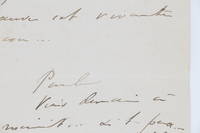
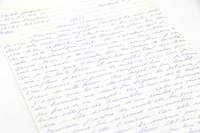
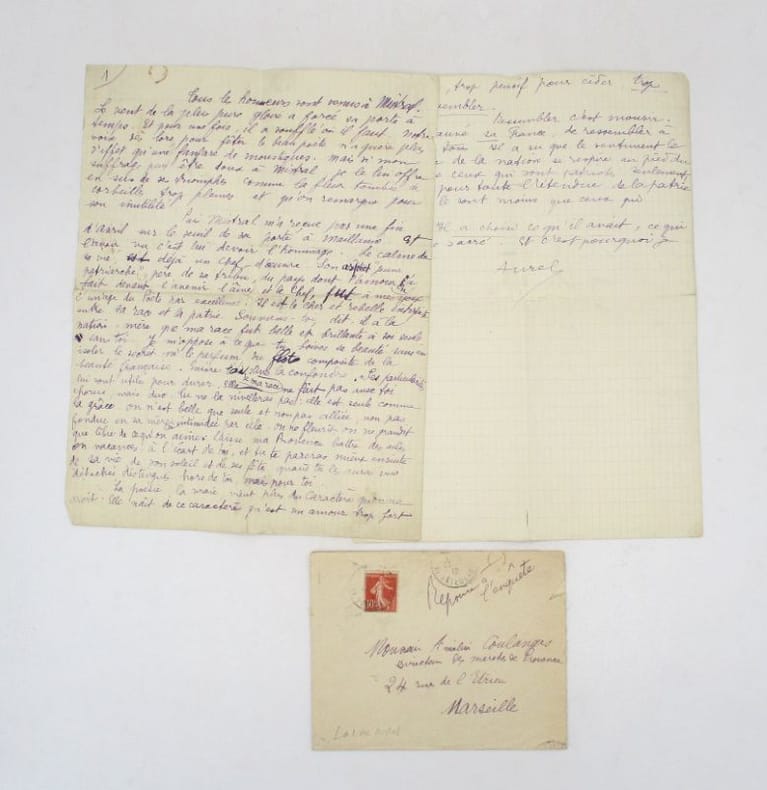
AUREL (Aurélie de FAUCAMBERGE, pseud.)Livre Rare Book
66 618 résultats
23318Paris, 23 janvier 1912. In-4, 1 pp. 1/2 (infimes froissements et taches).
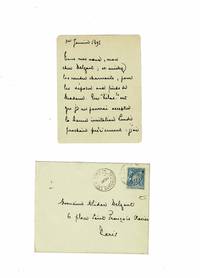
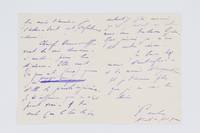
189276270Paris 1892. Fine. Paris 1er janvier 1892 8.80 x 11.40 cm une carte recto-verso et une enveloppe Autograph letter signed by Stéphane Mallarmé addressed to Alidor Delzant written on both sides in black ink. With envelope. Alidor Delzant was a lawyer collector and bibliophile. A friend of the Goncourts he devoted a work to them and served as secretary and testamentary legatee to Edmond. Charming letter in which the poet sends his wishes to his friend for the new year: ""Tous mes voeux mon cher Delzant ; et veuillez les rendre charmants pour les déposer aux pieds de Madame."" ""All my wishes my dear Delzant; and please make them charming to lay them at Madame's feet."" unknown
189276270Paris 1er janvier 1892 | 8.80 x 11.40 cm | une carte recto-verso et une enveloppe
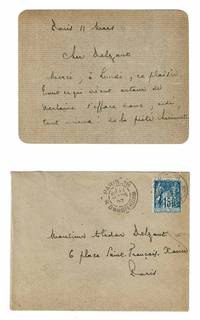
189776330Paris 1897. Fine. Paris 11 mars 1897 11.40 x 8.80 cm une carte recto-verso et une enveloppe Autograph postcard signed by Stéphane Mallarmé addressed to Alidor Delzant written on both sides in black ink. Envelope enclosed. Alidor Delzant was a lawyer collector and bibliophile. Friend of the Goncourts he devoted a work to them and was secretary and testamentary legatee of Edmond. ""Tout ce qui vécut autour de Verlaine s'efface donc aidé tant mieux ! de la piété charmante et tendre de Madame Delzant. La gloire du Poëte se fait toujours solitaire."" ""Everything that lived around Verlaine thus fades away helped so much the better! by the charming and tender piety of Madame Delzant. The Poet's glory always stands alone."" Delzant had announced to Mallarmé the death of Eugénie Krantz Verlaine's last mistress. Delzant's wife had frequented her during visits to the sick at Bonsecours hospital in Montrouge. unknown
189776330Paris 11 mars 1897 | 11.40 x 8.80 cm | une carte recto-verso et une enveloppe
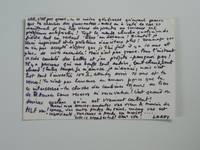
197070299Sommières 1970. Fine. Sommières s. d. circa 1970 15 x 10 cm une carte postale Autograph postcard signed by Lawrence Durrell addressed to Jani Brun written in black felt-tip pen on the verso of a view of the banks of the Vidourle at Sommières. Admirable and humorous confession by the writer to his young lover: ""Tout le monde cherche quelqu'un de fidèle tout en restant 'libre' en échange ! Bientôt je serai impuissant et le problème n'existera plus !"" ""Everyone is looking for someone faithful while remaining 'free' in return! Soon I will be impotent and the problem will no longer exist!"". Durrell reflects on his numerous feminine conquests ""Pour l'instant je suis comblé de belles et j'en profite - pourquoi pas !"" ""For now I am overwhelmed with beauties and I'm taking advantage of it - why not!"" and gives precious advice to his addressee who had chosen to remain independent despite the writer's entreaties: ""Tu n'es pas heureuse en amour parce que tu es intéressée - tu cherche sic des combines toujours au lieu de te donner sans réserve ni réservation ! C'est quand on deviens sic esclave qu'on est vraiment heureux !"" ""You are not happy in love because you are self-interested - you are always looking for schemes instead of giving yourself without reserve or reservation! It's when one becomes a slave that one is truly happy!"" After many years spent in Greece Egypt and Rhodes the traveler-writer Lawrence Durrell was forced to flee Cyprus following popular uprisings that led the island to its independence from the British crown. Rich only in a shirt and a typewriter but crowned with the success of his novel Bitter Lemons of Cyprus he arrived in 1956 in France and settled in the Languedoc village of Sommières. In the ""maison Tartès"" his large house surrounded by trees he wrote the second part of his work his monumental Avignon Quintet devoted himself to painting and received his illustrious friends including the couple Henry Miller and Anaïs Nin violinist Yehudi Menuhin London publisher Alan G. Thomas and his two daughters Penelope and Sappho. Among the olive trees and under the Mediterranean sun he met in the mid-1960s the young and sparkling ""Jany"" Janine Brun a thirty-something from Montpellier of devastating beauty who worked at the Department of Antiquities at the Sorbonne in Paris. She was nicknamed ""Buttons"" in memory of their first meeting when the young woman wore a dress covered with buttons. Henry Miller also fell under the charm of ""Buttons"" praising her beauty and eternal youth in exceptional unpublished letters. The three companions spent memorable Parisian evenings of which we retain precious autograph traces through their epistolary exchanges. Recommended by Durrell she made numerous trips notably to England from where she received extensive correspondence from the writer as well as original works of art signed with his artistic pseudonym Oscar Epfs. unknown
197070299Sommières s. d. [circa 1970] | 15 x 10 cm | une carte postale
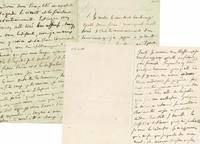
190078899s. l. Paris 1900. Fine. s. l. Paris s. d. ca. 1900 12.30 x 16.50 cm 1 page1/2 sur un double feuillet Autograph manuscript letter by Renée Vivien signed ""Pauline"" addressed to Natalie Clifford Barney and written in black ink on a double sheet with the poetess's silver monogram letterhead. A very charming letter evoking the flowers so dear to Renée ""Tout-Petit que j'aime je t'envoie des pensées toutes blanches. Garde-les dans ta chambre auprès de toi où sont mes vraies pensées tu le sais."" ""Little one I love I send you pansies all white. Keep them in your room near you where my true thoughts are you know."" as well as a gift from her ""tout petit chéri"" ""dear little one"": ""J'adore mes tablettes tu te rappelles les tablettes des deux petites joueuses de flûte - seulement elles les ont perdues et moi je ne veux pas perdre les miennes. J'ai écrit dessus en grec J'aime Natalie ! Cela m'a fait tant de plaisir ! - quelle bonne et jolie pensée tu as eue là ! -"" ""I adore my tablets do you remember the tablets of the two little flute players - only they lost them and I don't want to lose mine. I wrote on them in Greek I love Natalie! It gave me such pleasure! - what a good and lovely thought you had there! -"" Renée Vivien's Hellenist passion was born from her encounter with Eva Palmer during their stay in the United States where she accompanied Natalie Clifford Barney. This beautiful twenty-six-year-old redhead who it is said had translated all of Plato's Symposium with the Amazon gave Renée her first lessons in ancient Greek and awakened in her the passion for the poetess Sappho that never left her thereafter. It was at the end of 1899 and through Violette Shillito that Renée Vivien - then Pauline Tarn - made the acquaintance of Natalie Clifford Barney ""this American more supple than a scarf whose sparkling face shines with golden hair sea-blue eyes and implacable teeth"" Colette Claudine à Paris. Natalie who had just lived a summer idyll with the sulfurous Liane de Pougy who had initiated her into sapphism paid only discreet attention to this new acquaintance. Renée however was totally captivated by the young American and would relate this love at first sight in her autobiographical novel Une Femme m'apparut: ""I evoked the already distant hour when I saw her for the first time and the shiver that ran through me when my eyes met her eyes of mortal steel her sharp blue eyes like a blade. I had the obscure presentiment that this woman was giving me destiny's order that her face was the dreaded face of my future. I felt near her the luminous vertigo that rises from the abyss and the call of very deep water. The charm of peril emanated from her and attracted me inexorably. I did not try to flee her for I would have escaped death more easily."" ""Winter 1899-1900. Beginning of the idyll. One evening Vivien is invited by her new friend to Mme Barney's studio Natalie's mother 153 avenue Victor-Hugo at the corner of rue de Longchamp. Natalie ventures to read verses of her own composition. When Vivien tells her she loves these verses she replies that it is better to love the poet. A response quite worthy of the Amazon."" J.-P. Goujon Tes blessures sont plus douces que leurs caresses Two years of unequal happiness followed punctuated by Natalie's recurring infidelities and Renée's pathological jealousy whose letters oscillated between passionate declarations and painful mea culpa. ""Renée Vivien is the daughter of Sappho and Baudelaire she is the flower of evil 1900 with fevers broken flights sad voluptuousness."" Jean Chalon Portrait d'une séductrice In 1901 came an important rupture that would last almost two years; Renée despite Natalie's solicitations and the intermediaries she sends to win her back resists. ""The two friends saw each other again and it was in August 1905 the pilgrimage to Lesbos which constituted a disappointment for Natalie Barney and remained without consequence. . unknown
190078899s. l. [Paris] s. d. [ca. 1900] | 12.30 x 16.50 cm | 1 page1/2 sur un double feuillet
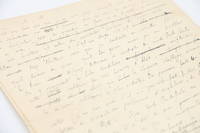
191388289Londres 1913. Fine. It is no longer a question of conquering the world; but of pacifying it. Work let us work together for world peace. Londres 12 décembre 1913 20 x 25.50 cm en feuillets Complete autograph manuscript in French by Anatole France 7 pages in black ink on 7 leaves and a signed autograph note on a bifolium. Complete and extensively corrected speech by Anatole France on the occasion of a banquet given in his honor in London. The future Nobel Prize winner for Literature delivers a passionate appeal for peace between nations and an ode to England - its philosophy literature and politics - less than a year before WW1. The writer offered this manuscript with a signed note: Keep dear colleague and friend keep these leaves of paper if they are of any value to you. Anatole France London December 12 1913. Anatole France's English biographer witnessed this speech which foreshadowed the absolute necessity of a close relationship between France and England based on their long and rich relationship: ""In December 1913 the Master paid a brief but memorable visit to this country. The central event of his sojourn in London was the banquet given in his honour at the Savoy Hotel. On this occasion it was apparently decided in those remote and exalted circles where such decisions are made that the socialist should be ignored his turn was to come later with the Fabians but that honour could and should be paid to the man of genius the foremost man of letters of the day. The feast was therefore presided over by a peer the late Lord Redesdale himself a gifted writer. The company was numerous and distinguished. . Monsieur France though an inimitable talker is not a speaker and on this occasion he read his discourse. All that I now remember of it was the rich deliberate music of the voice that uttered it and the words which he repeated with strange insistency: 'Travaillons de concert a la paix du monde''Let us work together for the peace of the world.' This was in December 1913. The exhortation thus reiterated seemed even then to be fraught with ominous significance and now looking back over the years of horror that were so soon to follow one wonders whether this old man with his strange inscrutable eyes and musical melancholy voice had somehow seen the shadow of the coming catastrophe."" J. Lewis May Anatole France the man and his work: an essay in critical biography p. 98-99. The manuscript contains numerous crossed-out and rewritten passages and shows the genesis of the writing of this beautiful speech: M.M. I am not sure that I am not dreaming. Welcomed with this splendid cordiality by so many men whose names works and thoughts represent so much greatness strength and beauty. . Your compatriots have authored masterpieces of this kind for two centuries. Need I remind you of Richardson and Fielding Swift and Daniel Defoe Walter Scott Dickens and Thackeray George Elliott . the novel is in England in its favorite soil like the apple in Normandy and the orange in Valencia. Why It takes a large volume or a single word to explain it. Well let's say it in a word. This word Lord Redesdale gave us a foretaste of it. It is that the novel is intimate cordial and familiar by nature and that the English has a familiar intimate and cordial spirit. Gentlemen I am not dreaming: it is a banquet I see the shining cups and the benevolent faces of the guests. And I can understand why you invited me. I am a symbol an allegory for you. I represent at this table the French literati just as at the festivals of the French Revolution the citizen Momoro represented the goddess Reason. Without being a goddess or particularly reasonable this idea puts me at ease and I won't quibble too much with you about the choice of your symbol. I tell myself that perhaps you didn't mind having a Frenchman at your table who having the weakness to write at least had the merit which you greatly value of never d unknown
191388289Londres 12 décembre 1913 | 20 x 25.50 cm | en feuillets
4to. 1 page. For a consul general: "Triolet || Le premier jour du mois de Mai | Fut le plus hereux de ma vie. | Fanchin || So eben dacht ich heut am ersten Mai | An Fanchins hochberühmtes Triolet, | Und wie die Jahre längstens schon vorbei | Da Sylvien ich sah am ersten Mai. | Da brachte mir Dein Both des Blattes Reih | Die im Geschenk des Buchs an mich besteht, | Drum sende ich Dir heut am ersten Mai | Als Dank für den Quatrain dies Triolet [...]". - A fine fair copy, probably intended as a gift.
58129o.J. Ohne Ort (Hannover, Fackelträger-Verlag), 1975, Fol. (33 x 26 cm). 3 Radierungen in Orig.-Flügelmappe mit Titelschild.
Oblong folio. Title page, 2 pages. In ink; some performance markings in crayon. No. 2 ("Den Wirbel schlag ich oft so stark") from his opus 194b (Zwei Lieder für Bass oder Bariton mit Pianoforte), with underlined text after words by Karl August Candidus.
1823759401823. Fine. s. d. ca 1823 12 x 18.20 cm Six pages sur deux feuillets rempliés Almost entirely unpublished handwritten letter from the painter Eugène Delacroix to the love of his youth the mysterious Julie now identified as being Madame de Pron by her maiden name Louise du Bois des Cours de La Maisonfort wife of Louis-Jules Baron Rossignol de Pron and daughter of the Marquis de La Maisonfort Minister of France in Tuscany patron of Lamartine and friend of Chateaubriand. 90 lines 6 pages on two folded leaves. A few deletions and two bibliographical annotations in pencil on the upper part of the first page no114. This letter is one of the last to his lover in private ownership all of Delacroix's correspondence to Madame de Pron being kept at the Getty Research Institute Los Angeles. Only nine of the ninety lines of this unpublished letter were transcribed in the Burlington Magazine in September 2009 alongside the long article by Michèle Hanoosh Bertrand and Lorraine Servois whose research finally revealed the identity of the famous recipient. Sublime love letter from twenty-four-year-old Eugène Delacroix addressed to his lover Madame de Pron twelve years his senior who unleashed the liveliest passion in him. This episode of the painter's youth then considered the rising star of Romanticism for a long time remained a mystery in the biography of Delacroix who was careful to preserve the anonymity of his lover thanks to various pseudonyms: Cara the Lady of the Italians and even Julie as in this letter in reference to the famous epistolary novel Julie ou la Nouvelle Héloïse by Rousseau. For obvious reasons Delacroix did not sign his name on any of the letters in correspondence with the lady. A great figure of the legitimate aristocracy the recipient of this feverish letter is Madame de Pron daughter of the Marquis de La Maisonfort Minister of France in Tuscany patron of Lamartine friend of Chateaubriand. Her beauty was immortalized in 1818 by Élisabeth Vigée-Lebrun who painted her portrait in pastel with an oriental hairstyle. Delacroix and Madame de Pron met in April 1822 when the portrait of the latter's son Adrien was commissioned a pupil at the Lycée Impérial now Lycée Louis-le-Grand. Delacroix had been commissioned for the portrait by his close friend Charles Soulier Madame de Pron's lover who despite himself served as an intermediary for Delacroix. In the absence of Soulier who had gone to Italy the painter and the young women established an intense romantic relationship. The portrait commission became a pretext for their tender meetings in his studio on rue de Grès while no trace of the child's painting has been found to this day. Their adventure lasted a little over a year but it was one of the most intense passions of the artist's life. Our letter undoubtedly corresponds to the last throes of their relationship in the month of November 1823. After one of their visits at the end of a hiatus of several months Delacroix writes to her again under the influence of emotion: I come home with a shaken heart what a wonderful evening! . Sometimes I say to myself: why did I see her again In the calm sanctuary where I lived even in the middle of the invisible places that I had formed . I managed to silence my heart. Madame de Pron had indeed decided to bring an end to their intimate relationship see her letter from 10 November 1823: I want sweet friendship . I do not want to torment you Getty Research Institute. Losing all discernment and with blind devotion Delacroix attempts to revive their affair: Make me lie prove to me that your soul is indeed that of the Julie that I once knew since mine has regained its charming emotions and its worries. But the painter runs into Soulier and General de Coëtlosquet also lovers of Madame de Pron. Delacroix had narrowly avoided a final disagreement with Soulier who had almost seen a letter from Madame de Pron in h unknown
182375940s. d. [ca 1823] | 12 x 18.20 cm | Six pages sur deux feuillets rempliés
8vo. Title page and 1 page on bifolium. "In memory of Mrs. Hedwig Stenger". - Some parts with small traces of moisture.
190679020Paris 1906. Fine. Paris 3 mars 1906 12.40 x 16.80 cm 3 pages 1/2 sur un double feuillet Autograph letter signed ""Paule"" from Renée Vivien addressed to Natalie Clifford Barney and written in purple ink on a double sheet with violet letterhead and address of 23 avenue du Bois de Boulogne. Transverse folds inherent to posting. Charming letter allowing hope for an appeasement in Renée Vivien's amorous ubiquity who seems to have finally chosen Hélène de Zuylen: ""Je t'envoie des vers. Les aimes-tu Ils ne me plaisent qu'à moitié c'est déjà beaucoup ! Tu as oublié que tu voulais te tuer pour moi. A part ce léger détail tu as été parfaite Mon amie t'aime je t'adore tout est parfaitement ordonné . N'est-ce pas que mon amie est parfaitement bonne et charmante Je l'aime tant d'une façon si poignante si simple et si bête. ce qui est après tout la meilleure façon d'aimer !"" ""I am sending you verses. Do you love them They only half please me that's already a lot! You have forgotten that you wanted to kill yourself for me. Apart from this slight detail you have been perfect My friend loves you I adore you everything is perfectly ordered . Is it not true that my friend is perfectly good and charming I love her so much in such a poignant simple and silly way. which is after all the best way to love!"" One senses here however a still very deep attachment of the Muse of violets to the Amazon: ""Je baise tes mains d'autrefois et tes mains d'aujourd'hui Et je t'aime plus que je ne sais le dire."" ""I kiss your hands of yesteryear and your hands of today And I love you more than I know how to say."" It was at the end of 1899 and through the intermediary of Violette Shillito that Renée Vivien - then Pauline Tarn - made the acquaintance of Natalie Clifford Barney ""cette Américaine plus souple qu'une écharpe dont l'étincelant visage brille de cheveux d'or de prunelles bleu de mer de dents implacables"" ""this American more supple than a scarf whose sparkling face shines with golden hair sea-blue pupils implacable teeth"" Colette Claudine à Paris. Natalie who had just lived a summer idyll with the scandalous Liane de Pougy who had initiated her into sapphism paid only discrete attention to this new acquaintance. Renée however was totally captivated by the young American and would relate this thunderbolt in her autobiographical novel Une Femme m'apparut: ""J'évoquai l'heure déjà lointaine où je la vis pour la première fois et le frisson qui me parcourut lorsque mes yeux rencontrèrent ses yeux d'acier mortel ses yeux aigus et bleus comme une lame. J'eus l'obscur prescience que cette femme m'intimait l'ordre du destin que son visage était le visage redouté de mon avenir. Je sentis près d'elle les vertiges lumineux qui montent de l'abîme et l'appel de l'eau très profonde. Le charme du péril émanait d'elle et m'attirait inexorablement. Je n'essayai point de la fuir car j'aurais échappé plus aisément à la mort."" ""I evoked the already distant hour when I saw her for the first time and the shiver that ran through me when my eyes met her eyes of mortal steel her sharp blue eyes like a blade. I had the obscure presentiment that this woman was giving me destiny's order that her face was the dreaded face of my future. I felt near her the luminous vertigos that rise from the abyss and the call of very deep water. The charm of peril emanated from her and attracted me inexorably. I did not try to flee from her for I would have escaped death more easily."" ""Hiver 1899-1900. Débuts de l'idylle. Un soir Vivien est invitée par sa nouvelle amie dans l'atelier de Mme Barney mère de Natalie 153 avenue Victor-Hugo à l'angle de la rue de Longchamp. Natalie s'enhardit à lire des vers de sa composition. Comme Vivien lui dit aimer ces vers elle lui répond qu'il vaut mieux aimer le poète. Réponse bien digne de l'Amazone."" ""Winter 1899-1900. Beginning of the idyll. One evening Vivien i unknown
190679020(Paris) 3 mars 1906 | 12.40 x 16.80 cm | 3 pages 1/2 sur un double feuillet
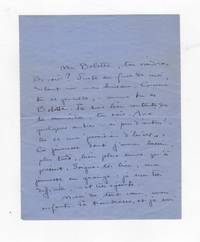
193574177s. l. Paris 1935. Fine. s. l. Paris s. d. circa 1935 17.70 x 22.50 cm 2 pages sur un feuillet Fine autograph letter signed by Colette to her friend Bolette Natanson. Two pages written in ink on blue paper. Horizontal folds inherent to the mailing of the letter. As ever protective and maternal with her friend Colette compliments her: ""Comme tu es gentille - comme tu es Bolette"". Nineteen years her senior she praises the youth of ""her child"": ""Tu es ma 'provision d'hiver' la jeunesse dont j'aurai besoin plus tard bien plus encore qu'à présent. Soigne-toi bien ma jeunesse en grange"". Having grown up from early childhood in artistic circlesshe was the daughter of Alexandre and the niece of Thadée Natanson the founders of the celebrated Revue BlancheBolette Natanson 1892-1936 formed friendships with Jean Cocteau Raymond Radiguet Georges Auric Jean Hugo and Colette. Passionate about dressmaking she left Paris for the United States with Misia Sert a close friend of Coco Chanel and was employed at Goodman. With her husband Jean-Charles Moreux they opened in 1929 the gallery Les Cadres on boulevard Saint-Honoré and moved in the company of numerous artists and intellectuals. Their success was immediate and they multiplied commissions: the fireplace for Winnaretta de Polignac the decoration of the Château de Maulny the arrangement of Baron de Rothschilds townhouse the creation of frames for the industrialist Bernard Reichenbach and finally the design of the shopfront for Colettes beauty institute in 1932. Bolette Natanson also framed the works of her distinguished painter friends: Bonnard Braque Picasso Vuillard Man Ray André Dunoyer de Segonzac and others. Despite this dazzling ascent she took her own life in December 1936 a few months after the death of her father. unknown
193574177s. l. [Paris] s. d. [circa 1935] | 17.70 x 22.50 cm | 2 pages sur un feuillet
190578939s. l. Paris 1905. Fine. s. l. Paris s. d. ca. 1905 12.50 x 16.70 cm 4 pages sur un double feuillet Autograph letter signed ""Pauline"" and ""P.M.T."" by Renée Vivien addressed to Natalie Clifford Barney and written in black ink on a double folio with silver-violet letterhead and the address 3 rue Jean-Baptiste Dumas. Transverse fold inherent to mailing. Very fine love and reproach letter written after the long two-year separation and probably upon return from Mytilene Lesbos: ""Est-ce vraiment pour moi que tu restes demain Tout-Petit . Qui le saura jamais . Ce doute que le passé justifie un peu entrave mes plus hautains élans et fait de moi la créature misérable et triste que je suis."" ""Is it really for me that you stay tomorrow Little One . Who will ever know . This doubt which the past somewhat justifies hampers my most haughty impulses and makes me the miserable and sad creature that I am."" Renée weakened by Natalie's infidelities struggles to trust her again ""Je ne puis croire en toi"" ""I cannot believe in you"" but continues despite her suffering to be entirely devoted to her: ""Tu m'as dédaignée alors que tu aurais été pour moi la révélation miraculeuse - Tu m'as dédaignée. Et aujourd'hui tu t'étonnes de ne point me trouver telle que tu m'aurais rêvée toi qui n'as pas pris le soin de me façonner à ta guise ! Ecoute. Tu es comme un potier qui voyant à ses pieds un argile informe le repousserait et qui plus tard voyant un de ses élèves en fait une statue imparfaite exhalerait en termes amers sa colère et son dédain."" ""You scorned me when you would have been for me the miraculous revelation - You scorned me. And today you are surprised not to find me as you would have dreamed me you who did not take the care to shape me to your liking! Listen. You are like a potter who seeing at his feet an unformed clay would push it away and who later seeing one of his students make an imperfect statue from it would exhale in bitter terms his anger and disdain."" Torn between pain and desire Renée nevertheless calls for her lover: ""Viens demain à minuit.si tu peux. si tu veux. si Ilse n'en décide pas autrement et si ton caprice te le permet."" ""Come tomorrow at midnight.if you can. if you want. if Ilse doesn't decide otherwise and if your whim allows it."" These reunions would not last however: torn between Baroness Hélène de Zuylen and Natalie Renée would chain together travels; in turn to Holland Germany Switzerland and Venice she would confide her hesitations to Kérimé Turkhan-Pacha her epistolary companion from the Bosphorus. It was at the end of 1899 and through Violette Shillito that Renée Vivien - then Pauline Tarn - made the acquaintance of Natalie Clifford Barney ""cette Américaine plus souple qu'une écharpe dont l'étincelant visage brille de cheveux d'or de prunelles bleu de mer de dents implacables"" ""this American more supple than a scarf whose sparkling face shines with golden hair sea-blue eyes implacable teeth"" Colette Claudine à Paris. Natalie who had just lived a summer idyll with the sulfurous Liane de Pougy who had initiated her into sapphism paid only discreet attention to this new acquaintance. Renée on the other hand was totally captivated by the young American and would relate this love at first sight in her autobiographical novel Une Femme m'apparut: ""J'évoquai l'heure déjà lointaine où je la vis pour la première fois et le frisson qui me parcourut lorsque mes yeux rencontrèrent ses yeux d'acier mortel ses yeux aigus et bleus comme une lame. J'eus l'obscur prescience que cette femme m'intimait l'ordre du destin que son visage était le visage redouté de mon avenir. Je sentis près d'elle les vertiges lumineux qui montent de l'abîme et l'appel de l'eau très profonde. Le charme du péril émanait d'elle et m'attirait inexorablement. Je n'essayai point de la fuir car j'aurais échappé plus aisément à la mort."" ""I evoked the already distant hour when unknown
190578939s. l. [Paris] s. d. [ca. 1905] | 12.50 x 16.70 cm | 4 pages sur un double feuillet
180785067Skierniewice 14 septembre [1807] | 19 x 22.50 cm | 2 pages et demisur une double feuille
197684696Fleury-Mérogis 1976. Fine. Fleury-Mérogis 31 Décembre 1976 21 x 29.50 cm une page recto verso Autograph letter dated and signed by Jacques Mesrine dated Friday December 31st 1976 approximately 70 lines in blue ink on one recto verso page addressed to his love of the time Jeanne Schneider thanks to whom the manuscript of Instinct de mort was discreetly smuggled out of prison. Jacques Mesrine then incarcerated at Fleury-Mérogis prison wondered about the difficulties he might encounter if his Instinct de mort were to appear soon and with which sufficiently courageous publisher it could be edited: ""Je vais voir avec mon avocate pour les ""presses de la cité"" car je crois que l'on peut tirer un trait sur Simone. De toute façon il sera publié par celui acceptera d'en courir le risque"" ""I'm going to see with my lawyer about the ""presses de la cité"" because I think we can draw a line under Simone. In any case it will be published by whoever will accept to run the risk"" He also advised his beloved on her working conditions: ""Au sujet de ton boulot. j'espère que tu as discuté avec ta patronne car les horaires ne sont pas légaux. ne te laisse pas faire à ce sujet. Vis à vis du procureur tu es obligé de travailler. cela ne veut pas dire être esclave au boulot."" ""About your job. I hope you discussed with your boss because the hours are not legal. don't let yourself be taken advantage of on this subject. With regard to the prosecutor you are obliged to work. that doesn't mean being a slave at work."" and worried about the future of his daughter Sabrina: ""Demain j'espère la visite de la puce. je vais avoir une très sérieuse conversation avec elle au sujet de l'avenir. Car elle ne fait rien en classe. donc le mieux pour elle est de travailler pour obtenir un CAP en quelque chose. Elle veut jouer les adultes. alors il va falloir qu'elle se conduise en adulte."" ""Tomorrow I hope for a visit from the little one. I'm going to have a very serious conversation with her about the future. Because she does nothing in class. so the best thing for her is to work to get a vocational certificate in something. She wants to play at being an adult. so she'll have to behave like an adult."" Public enemy No. 1 evoked the coming new year: "".l'année nouvelle qui s'annonce. que nous réservera-t-elle. je l'ignore mais rien de bon si la logique se fait loi. cela ne m'empêchera pas de garder mon moral."" "".the new year that is coming. what will it hold for us. I don't know but nothing good if logic becomes law. that won't stop me from keeping my morale up."" Jacques Mesrine alone in his cell on the evening of December 31st New Year's Eve ended this beautiful letter with affectionate thoughts for Jeanne Schneider: ""Ce soir j'ai la tête un peu vide. tu comprends mais j'ai le coeur plein de toi et c'est cela qui compte. je vais me mettre dans les draps et penser à toi. Ton vieux voyou pose de tendres bécots sur tout ce qui est toi. Bonne nuit chaton. Te quiero."" ""Tonight my head is a bit empty. you understand but my heart is full of you and that's what counts. I'm going to get into the sheets and think of you. Your old rogue places tender kisses on everything that is you. Good night kitten. Te quiero."" and with this humorous note: "".tu connais cette blague : c'est une femme condamnée à mort. arrivée devant la guillotine elle embrasse le verre que l'on vient de lui servir. Le procureur demande : ""elle est folle que fait-elle"". L'avocat lui répond ""elle embrasse son dernier rhum"" Pas mal hein. un petit sourire ma puce."" "".do you know this joke: it's a woman condemned to death. arrived in front of the guillotine she kisses the glass that has just been served to her. The prosecutor asks: ""is she crazy what is she doing"". The lawyer replies ""she's kissing her last rum"" Not bad eh. a little smile my darling."" Rare and very beautiful letter from Jacques Mesrine in which we see him preoccupied with his daughter's future where he sho unknown