Pierre AutizeLivre Rare Book
66 618 résultats
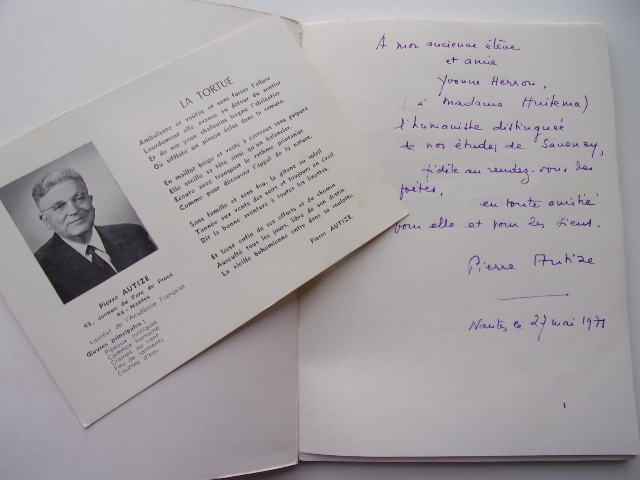
CZC-8227Bel envoi autographe à " Yvonne et Pierre Huitema, 27 mai 1971. Pierre Autize " volume broché, 19x14, très bel état intérieur, exemplaire à l'état neuf, 87pp. Edition Nicolas Imbert, Niort, 1971 Pierre Autize était un pseudonyme. Il s'appelait Duclos (né à St Pompain, deux-Sèvres, en 1912) mais son prénom était Roland. Il était professeur de Lettres à Nantes au collège Jules Verne. Il est d’abord le « poète de l’humaine condition » et ce n’est pas sans raison que Bernard Aurore l’a dit «poète-paysan ». De son terroir du Bas-Poitou, et donc de l’humanité, il a dit les peines, les joies, le dur labeur qui était celui de ses parents, de ses ancêtres. De sa famille il a retracé le parcours difficile, la vie ingrate qui n’ont pas, pour autant, laissé le citadin qu’il a toujours été insensible au travail de l’homme, aux injustices de la société, à la solitude. ref/1
CZC-4859ÉCLATS DE VERTS Poésie-graphisme Manoelle Miquel Regnauld avec un envoi de l'auteur en page de garde ! vol, broché, 21x15cm, couverture petits défauts, bel état int. 90pp Edition Bénévent 2005 ref/c2/3
CZC-4859ÉCLATS DE VERTS Poésie-graphisme Manoelle Miquel Regnauld avec un envoi de l'auteur en page de garde ! vol, broché, 21x15cm, couverture petits défauts, bel état int. 90pp Edition Bénévent 2005 ref/c2/3
1996107027Paris Nizet, coll. "Trait d'union" 1996 1 vol. broché in-8, broché, couverture à rabats, 324 pp. Édition originale. Exemplaire enrichi d'un envoi autographe signé de Lucette Finas à Nathalie Sarraute. Quelques rousseurs.
1996107027Paris Nizet, coll. "Trait d'union" 1996 1 vol. broché in-8, broché, couverture à rabats, 324 pp. Édition originale. Exemplaire enrichi d'un envoi autographe signé de Lucette Finas à Nathalie Sarraute. Quelques rousseurs.
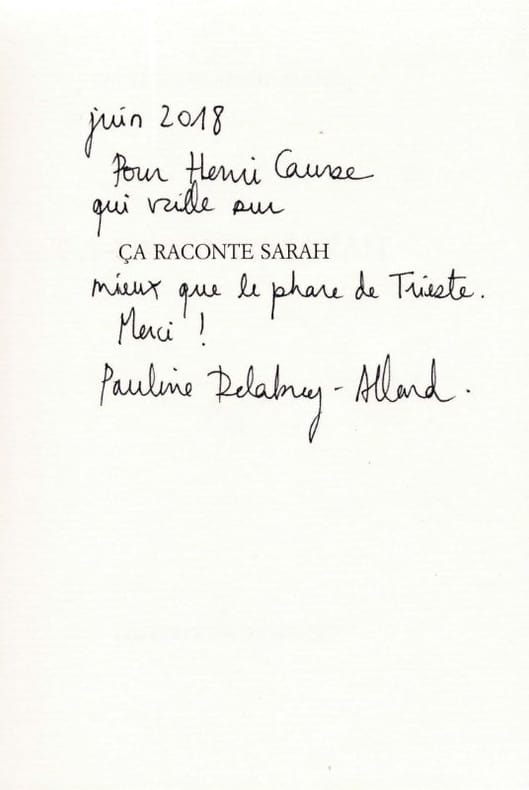
2018118375Paris Editions de Minuit 2018 1 vol. broché in-8, broché, non coupé, 188 pp. Edition originale du premier livre de l'autrice (née en 1988). Un des 27 exemplaires sur vergé de Scheipen (seul grand papier), et parmi ceux-ci l'un des 7 hors commerce (ex. n°IV), avec un bel envoi autographe signé de l'autrice à Henri Causse, directeur commercial des éditions de Minuit. En parfait état.
2018118375Paris Editions de Minuit 2018 1 vol. broché in-8, broché, non coupé, 188 pp. Edition originale du premier livre de l'autrice (née en 1988). Un des 27 exemplaires sur vergé de Scheipen (seul grand papier), et parmi ceux-ci l'un des 7 hors commerce (ex. n°IV), avec un bel envoi autographe signé de l'autrice à Henri Causse, directeur commercial des éditions de Minuit. En parfait état.
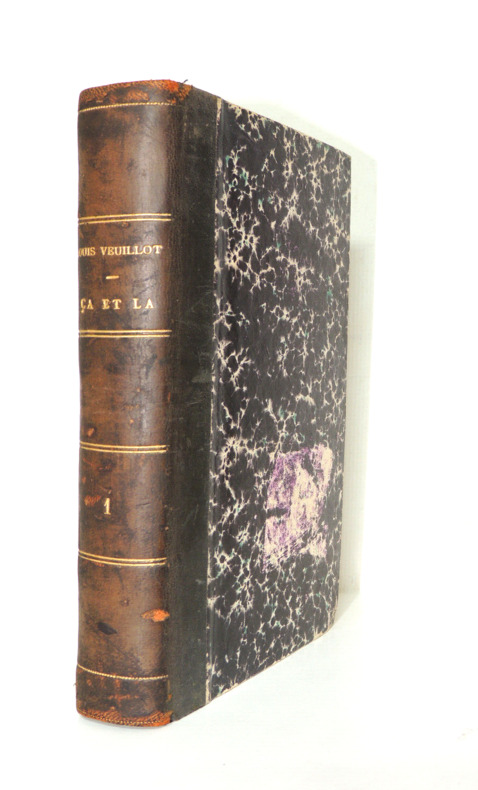
CZC-10141Joint une lettre autographe datée de 1889. " Monsieur, la demande d'adjonction d'un cogérant est formulé dans ma requête pour être autorisé aux deux éditions. J'ai pu glisser le nom de M. Sayez, que je présente au Ministre pour cet emploi l'enfant du fouet. C'est d’ailleurs un très galant homme et parfaitement responsable..J'ai l'honneur de vous adresser l'instance de M. Sayez..nous avons besoin de toute votre obligeance pour arriver en temps opportun....Je me réserve Monsieur, d'aller vous remercier de la bonne grâce.." Tome I, du mariage et de chamounix - Étude de Bourgeois - Résurrection d'une ville - La vie de château - Du progrès - L’hôtel de Hareng Couronne - Des miracles - Le battage de Penvenant. vol in8, 180x130, relié demi cuir, frottements, bon état intérieur, 471pp. Paris Victor Retaux 1896 ref 18b
CZC-10141Joint une lettre autographe datée de 1889. " Monsieur, la demande d'adjonction d'un cogérant est formulé dans ma requête pour être autorisé aux deux éditions. J'ai pu glisser le nom de M. Sayez, que je présente au Ministre pour cet emploi l'enfant du fouet. C'est d’ailleurs un très galant homme et parfaitement responsable..J'ai l'honneur de vous adresser l'instance de M. Sayez..nous avons besoin de toute votre obligeance pour arriver en temps opportun....Je me réserve Monsieur, d'aller vous remercier de la bonne grâce.." Tome I, du mariage et de chamounix - Étude de Bourgeois - Résurrection d'une ville - La vie de château - Du progrès - L’hôtel de Hareng Couronne - Des miracles - Le battage de Penvenant. vol in8, 180x130, relié demi cuir, frottements, bon état intérieur, 471pp. Paris Victor Retaux 1896 ref 18b
1984114482Paris L'Ecole des Loisirs, coll. "Neuf" 1984 1 vol. relié in-12, cartonnage illustré, 107 pp., dessins en noir. Edition originale avec un envoi autographe et un dessin original au crayon signé de Yak Rivais à Rolande Causse. Très bon état.
1984114482Paris L'Ecole des Loisirs, coll. "Neuf" 1984 1 vol. relié in-12, cartonnage illustré, 107 pp., dessins en noir. Edition originale avec un envoi autographe et un dessin original au crayon signé de Yak Rivais à Rolande Causse. Très bon état.
455680Editions Balbec Paris 1987 In-4 ( 295 X 215 mm ) en feuilles sous couverture blanche muette et emboîtage de toile grise de léditeur.EDITION ORIGINALE de la version initiale du premier chapitre du "Voyage au bout de la nuit" cette version établie par Jean-Pierre DAUPHIN, reprend le premier état du texte retrouvé sous une forme dactylographiée, avant les corrections de l'auteur. Le texte de cette première version est suivi, ligne à ligne, de celui la version définitive ( parue en octobre 1932 ). Pour des raisons de droit, cest lunique édition de cette version ( pas même reproduite dans La Pléiade ). En outre, cette édition est ornée de 12 gravures originales sur cuivre de Thomas GOSEBRUCH, dont une sur double page ( en 1982, il avait déjà réalisé une suite de 18 gravures illustrant Voyage au bout de la nuit, mais tirée à seulement 15 exemplaires ). Tirage limité à 105 exemplaires numérotés sur vélin de Rives, signés par lartiste.Un des 70 exemplaires ( N°20 ). On joint le n°1 de novembre 2006 du magazine Krabo. Très bel exemplaire.
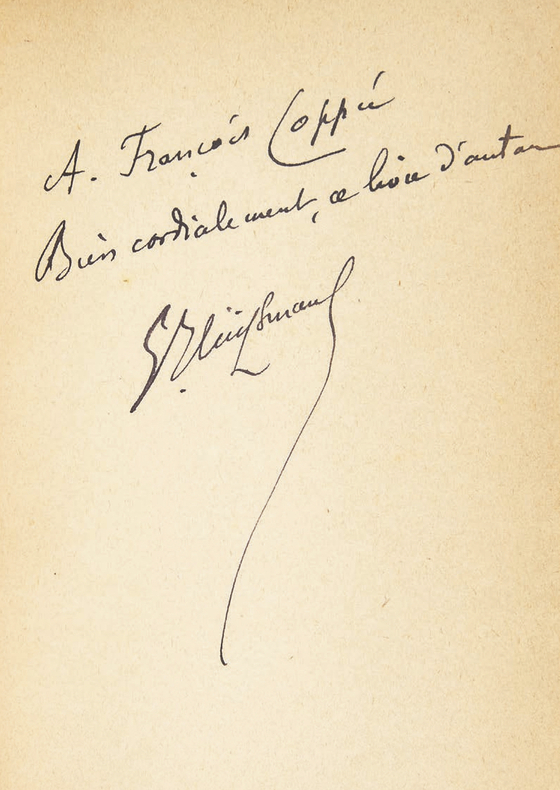
1894YQV-18In-16 (137 × 95 mm) de 139-[3] pp. et un portrait de l’auteur par A. Delattre gravé à l’eau-forte en frontispice ; demi-basane maroquinée tabac avec coins, dos à nerfs, couverture conservée (le dos n’a pas été préservé), non rogné, tête dorée (reliure légèrement postérieure).
1838AMA-36“jeudi” [1838–. 2 pp. in 8°.
23321Saint-Raphaël, 6 décembre 1901. In-4, 2 pp. (infimes rousseurs et déchirures marginales).
193323671933 Paris Le Divan 1933 in81=, broché, 112 pp pp, envoi autographe bon exemplaire, edition originale, un des 30 exemplaires num sur vergé de montval
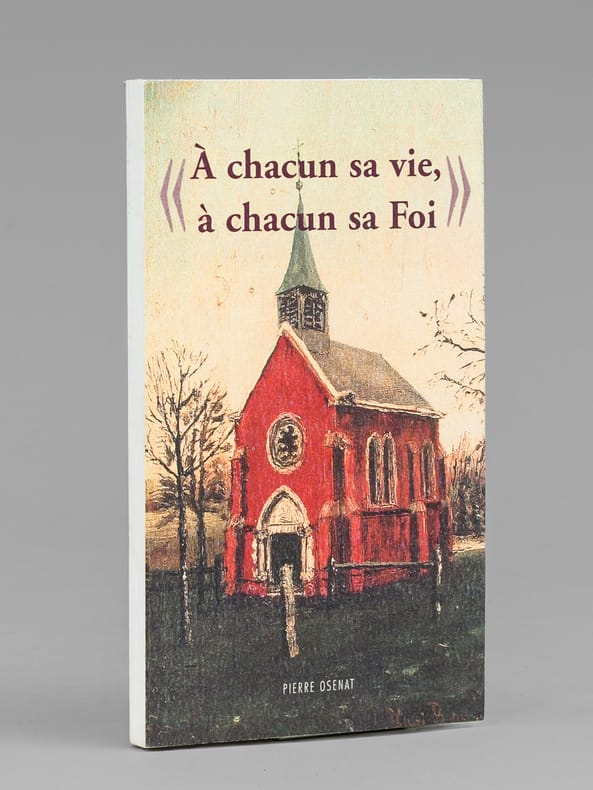
2005701411 vol. in-8 br., s.n. [ Pierre Osenat ], Imprimeur-Conseil AGM, Millau, 2005, 83 pp.
Madrid, Ediciones Fax, 1933. 4to.; 127 pp. Ejemplar con envío autógrafo del autor. Cubiertas originales
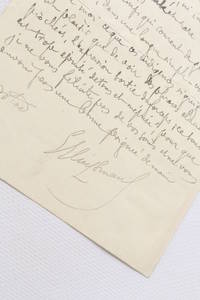
188863597Paris 1888. Fine. Paris 20 juin 1888 12.40 x 16.70 cm un feuillet Autograph letter signed addressed to Jacques Le Lorrain from Joris-Karl Huysmans 30 lines written in black ink on 2 pages. Manuscript correction by the author. Fold inherent to the letter's mailing. Remarkable letter with sometimes obscure remarks where Huysmans emphasizes the importance and rarity of the writing craft at work in the novel Nu by the cobbler-poet Jacques Le Lorrain. « In these times when people rush books in simple language - you know as well as I what these indigences mean - it is a pleasure to see elucidated sentences labored over expression delivered with forceps ». Sharp as usual Huysmans positions himself as a fierce defender of literary writing experienced as labor which contemporary production seems to be abandoning: « this concern is too exhausted by all and despised for me not to congratulate you on your care ». Accustomed to receiving works from his colleagues Huysmans endeavors to highlight the innovative particularities of each author he receives: « Many pages are truly curious. Lorgeral on the grass closing his eyes listening to the voices - it's fresh and absolutely accurate. The scene of Juliette's armpit kissing. This work so well explained of man's jealousy for the child are particular original corners of this book whose very scrupulous style has captivated me. ». The author Huysmans distinguishes himself here always attentive to the right measure necessary according to him for literary expression: « you have managed to enhance the language to make it neither powerless nor inert. And I know how difficult and rare that is! » unknown
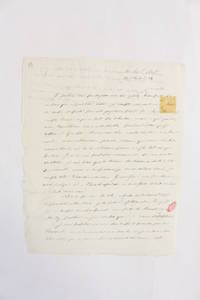
1805669741805. Fine. 10 Floréal 13 30 avril 1805 18.50 x 23.10 cm une feuille Stendhal's autograph letter addressed to his sister Pauline. 28 lines written with a fine writing in black ink. First name ""Pauline"" from the hand of the sender at the bottom of the letter. Inventory number ""36"" in ink from another hand. Two small traces of stamp and stamp a small tear restored in the bottom margin of the page. A few tiny folds inherent in the enveloping of the letter. Rare and beautiful letter of Stendhal addressed to his sister Pauline in which all the sensitivity of the young man and his love for the dramatic art shows more than twenty years before his big romantic successes. This letter comes from the correspondence between Henri Bayle here twenty-two years with his sister Pauline three years younger. This true epistolary liaison which quickly took the form of a ""diary"" - Pauline's answers were rare - is an essential milestone in the constitution of the intellectual journey of the future Stendhal. Our letter of a great lyricism testifies to the strength of the bond uniting the young writer and his sister: ""Let's shake each other my good friend. We will never find anyone who loves Pauline as Henry nor will Henry ever find a more beautiful soul than Pauline. ""The use of the third person and a lover vocabulary erects the young woman to the rank of alter ego a sister-soul and even perfect mistress. The young Henri is then precisely under the yoke of a devouring passion for the actress Melanie Guilbert whom he met during his declamation classes at Dugazon: "" I'm going to be bored perhaps by my dark sadness. I know very well that the seriousness of ardent passions is not pleasant. "" Contrasting with this passionate relationship Pauline symbolizes reason and balance a figure that Henri like a pygmalion can fashion at leisure. In good tutor he advises: ""Learn by heart roles. About declamation I will teach you a thousand things. I'm bringing you a Gil Blas and a Tracy. ""We understand here worship Stendhal devoted to the theater from his earliest years both as a player as a playwright the fund of its archives to the Grenoble Library contains nearly 700 sheets of blanks:"" I am in despair at not being able to wear you Beanies. But wait maybe someday will come . as Ulino says. ""This passion for theater Henry intends to pass it to his sister:"" We will work like hell during the time that I stay in Grenoble. ""In total opposite view with the education of women in his time he put a point of honor that Pauline is an educated person; In several letters moreover we find injunctions from the brother ordering his sister to give up needlework in favor of the reading he recommends. Truly obsessed with theater and convinced that he will become an author of successful comedies he works tirelessly: ""I am told a room where I will not be free and where I can not just declaim. Try to disturb this arrangement. ""Years before writing great novels that make her famous Stendhal already understands that loneliness is for him a source of creation and says:"" A lonely is jealous of his freedom. It is his greatest good as that of all men. "" unknown
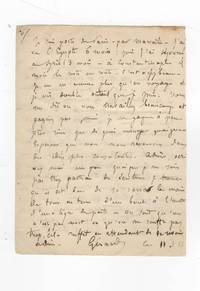
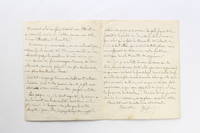
184475148Paris 1844. Fine. Paris 11 février 1844 10.40 x 13.60 cm quatre pages sur deux feuillets Three autograph letters signed by Gérard de Nerval 2 pages signed «Gérard» Théophile Gautier 1 page and a third unsigned letter 1 page penned by a certain «Robert» cf. Nerval's letter Louis Desessart Théophile Gautier's appointed publisher co-published Nervals play Léo Burckart with Barba in 1839. Following financial difficulties he was forced to take refuge «in that sad and charming city of Brussels». The three friends wrote this letter from Paris where they had reunited following Nervals long journey to the East: «I spent six months in Egypt; then three months in Syria four months in Constantinople and the rest en route. Its quite beautiful. I only enjoy myself while traveling and try to live twice as much as I can.» This journey deeply impressed Théophile Gautier who would only travel to Turkey and Egypt years later: «I am in Paris and wish I were in Cairo from where Gérard is returning.» The exoticism of distant lands starkly contrasts with the melancholy and severity of Europe: «How sad Paris is when one returns from sunlit countries.» Nerval And in Paris far from dreams of escape life means toil and melancholy: «We are like sick people who are never comfortable anywhere. I think the good times are gone and the golden hours of the past when we spoke such wise follies will never return. Whats the point of living if we must work and cannot see our friends or write to them or do anything we would like» Gautier The two writers express great compassion for their friends Belgian exile with Brussels appearing as the capital of spleen: «What! Youre still in that sad and charming city of Brussels! . Brussels is even darker poor fellow!» Nerval This joint letter was in fact initiated by «Robert»: «Isnt it true my dear friend that Im quite skilled at making you forget my faults . as a way of making it up to you Im sending you the autographs of two of your . comrades your fondest memories two men of fame who despite all their affection and friendship for you would never have written a word had I not trimmed their quills and handed them paper like sulky children and told them: write at once at once to the exile you love most.» unknown
186562589Biponti Deux-Ponts 1865. Fine. Biponti Deux-Ponts Vendredi 12 mai 1865 13.20 x 20.80 cm 1 page sur un feuillet remplié Autograph letter signed by Charles Baudelaire written in ink and addressed to his mother. A few underlinings deletions and authorial corrections. This letter was first published in Charles Baudelaire Dernières lettres inédites à sa mère in 1926. Former collection of Armand Godoy no. 197. A precious letter from Baudelaire's Brussels period during the poet's voluntary exile at the end of his life. « Il est douteux que j'habite quelque part à Paris. Je crois que j'habiterai surtout une voiture dans laquelle je ferai si je peux toutes mes courses en un ou deux jours. » Haunted by Paris the city of vice and creditors he dreads this brief return. His exile in Brussels is in his eyes a sign of failure and ever since arriving in Belgium he has delayed his return to France. Yet weary of the flat country he despises he mocks its inhabitants: « On est lent ici. » The poet like the seventeen-year-old student who once promised his mother he would get back on track now vows: « Me voici en mesure d'accomplir tous mes plans. Je ne sais comment t'exprimer ma reconnaissance ; et je crois que la meilleure manière sera d'exécuter mes promesses. » Literally obsessed with this sacred mother « who haunts his heart and his mind » the « grateful son » sees himself as incapable of fulfilling his poetic destiny without her undivided attention. unknown
194875175Antibes 1948. Fine. Antibes 9 mars 1948 21.80 x 27 cm 2 pages sur un feuillet Unpublished autograph letter signed by André Breton addressed to Gaston Puel; two pages on one leaf written in blue ink with fine and careful handwriting numerous underlinings. Foxing and marginal adhesive traces. A very fine letter imbued with benevolence in which the Pope of Surrealism shares his numerous and time-consuming occupations with his young correspondent while reassuring him about his talent and future. Gaston Puel began corresponding with André Breton at the Liberation. They had never met at the time of this letter written four years later: « Je suis heureux que vous ayez pensé à m'adresser votre photographie. C'est un grand pas de fait pour rompre la distance et il ne se peut guère que nous ne nous rencontrions bientôt. » ""I am happy that you thought to send me your photograph. It is a great step towards breaking the distance and it can hardly be that we will not meet soon."" The two writers seem very close as evidenced by Breton's paternal and reassuring tone: « Ne parlez pas comme à regret de ceux qui avancent : vous en êtes et j'en sais bien peu qui soient si loin que vous déjà. Ce que vous m'écrivez - pas seulement cette fois - est toujours pour moi de haute importance. » ""Do not speak regretfully of those who advance: you are among them and I know very few who are already as far along as you. What you write to me - not just this time - is always of great importance to me."" A tireless worker Breton here shares his frustration and weariness with Puel: « Mais il faut continuer à vivre et pour cela se réserver une part de solitude qu'avec angoisse aussi je vois diminuer chaque jour. » ""But one must continue to live and for that reserve a share of solitude which I also see diminishing each day with anguish."" Gaston Puel then 24 years old had been participating for some time in the activities of the surrealist group around Joë Bousquet André Breton and René Char. His mentor here predicts a clear future for him: « Mon cher Ami je souhaite très vivement que vous preniez une part active à la rédaction de « Néon ». Il suffirait d'une très légère transposition de ton pour que les pages que vous m'adressez puissent y trouver place et en constituer un des éléments primordiaux. Il en va naturellement de même pour « Supérieur inconnu » si cette revue peut voir le jour. » ""My dear Friend I very much wish that you would take an active part in the editing of 'Néon'. It would only require a very slight transposition of tone for the pages you send me to find their place there and form one of its primordial elements. The same goes naturally for 'Supérieur inconnu' if this magazine can see the light of day."" This latter review meant to reconcile and unite the conservatives and innovators of surrealism would only come to light forty-eight years later under the impetus of Sarane Alexandrian. Gaston Puel would indeed join the editorial team of Néon but would eventually turn away from the surrealists - while maintaining his friendship with Breton - in 1950. unknown
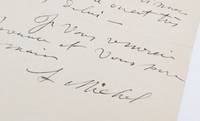
188683952s. l. Paris 1886. Fine. Letter to the Tiger: ""Before returning to the cage"" s. l. Paris 7 août 1886 13.20 x 19.20 cm 3 pages sur un bifeuillet Autograph signed letter from Louise Michel addressed to Georges Clemenceau; three pages written in black ink on a bifolium of white paper. Transverse creases inherent to posting. Fine letter from Louise Michel to Clemenceau one of her most important supporters before yet another incarceration: « Il faut avant de rentrer en cage . que je vous demande le grand service de faire entrer à l'hospice mon cousin le petit Dacheux à qui vous avez bien voulu faire avoir sa dispense d'âge. » ""Before returning to the cage . I must ask you the great favor of having my cousin little Dacheux admitted to the hospice for whom you were kind enough to obtain his age exemption."" The former communard has indeed just been sentenced to four months in prison for having given a speech in favor of the Decazeville miners alongside Jules Guesde Paul Lafargue and Étienne Susini. But for now it is the condition of her cousin Lucien Dacheux that concerns her: « Son genou étant de plus en plus malade on l'envoie en congé de deux mois mais il faut qu'il entre à l'hospice s'il ne veut pas rester estropié. De plus on n'a pu lui donner une mécanique pour son genou et en même temps le médecin lui disait que c'était indispensable - peut-être pourra-t-il en avoir une au Val de Grâce - je le recommande bien à vous et au citoyen Lafont - J'irai vous voir pour cela et une autre chose du même genre avant le 12 mais s'il était possible de faire entrer avant à l'hospice le petit Lucien Dacheux je serais bien heureuse car il sera tout à fait estropié et incapable de continuer son service où on est très content de lui. » ""His knee being increasingly ill they are sending him on two months' leave but he must be admitted to the hospice if he doesn't want to remain crippled. Moreover they couldn't give him a mechanism for his knee while at the same time the doctor told him it was indispensable - perhaps he could get one at Val de Grâce - I recommend him highly to you and to citizen Lafont - I will come to see you about this and another matter of the same kind before the 12th but if it were possible to have little Lucien Dacheux admitted to the hospice beforehand I would be very happy because he will be completely crippled and unable to continue his service where they are very pleased with him."" Louise Michel met Clemenceau in October 1870 when he was mayor of Montmartre and she was assistant schoolmistress. From their first meeting was born a strong friendship that lasted until Louise Michel's death. Clemenceau never ceased to support her particularly during her banishment to Nouméa and they maintained an extensive correspondence. A moving letter testimony to the unwavering devotion of the former communard and to the great friendship that united Louise Michel to Georges Clemenceau. unknown
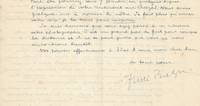
189463596Paris 1894. Fine. Paris 8 février 1894 10.60 x 13.50 cm un feuillet remplié Autograph letter of Joris-Karl Huysmans signed to Camille Mauclair 44 lines written in black ink 3 pages on a folded sheet handwritten correction of the author. Two restorations using strips of paper in high and low fold of the letter the second band very slightly affects a word of the text a fold inherent in the enveloping of the letter. A long and beautiful letter in which all Huysmans' respect and interest are shown for the writings of the young Symbolist generation. Both author and literary critic Huysmans embodies a central figure for young poets like the 22-year-old Camille Mauclair who sends him one of his first poetic collections: "" The chapter on the symbol is perfect ; it is certainly the first time that we explain and with such lucidity we put things back in place. "" Heart of the symbolism and the poetic fiber of Huysmans the music of the language is particularly honored both in the lyrics and in the author's writing: "" the pieces on death on sensuality are woven into the most vivid language . and the fine writer who found the cold and ethereal absentee who wrote such sentences: ""we strive to determine our true ghost in the tumult of appearances "". "" Introduced by the mention of the myth of Narcissus Symbolist figure par excellence the letter shows the philosophical questions that underlie the movement. « Narcissus is God - It is not very beautiful to contemplate the soul . It is true that you in a melancholy return on the vanity of being have shown in a vibrant page the actors of ourselves as we are. The mystical evocations direct to Satan and more ambiguous to God echo the literary conversion of Huysmans who in 1894 prepares the writing of En Route the first part of his trilogy during direct ""black book"" that is there : ""Ah! the damn God! Really that makes me dream of a literature that feeds less his Satan as you say to a literature of humility! "" Accustomed to digressive theoretical reflections on literature Huysmans concludes his letter with: "" At bottom I am stupid to quibble over ideas because in short all the ones we express and that we will make are already in d ' other times and they are more or less new depending on whether they are more or less forgotten but what is not done before you what you own is the way to coat them. And that's where I admire you wholeheartedly because those are your sentences. "" unknown