66 618 résultats
188863597Paris [20] juin 1888 | 12.40 x 16.70 cm | un feuillet
18056697410 Floréal 13 [30 avril 1805] | 18.50 x 23.10 cm | une feuille
184475148Paris 11 février 1844 | 10.40 x 13.60 cm | quatre pages sur deux feuillets
AMA-313 pp. in 4°
186562589Biponti Vendredi 12 mai 1865 | 13.20 x 20.80 cm | 1 page sur un feuillet remplié
194875175Antibes 9 mars 1948 | 21.80 x 27 cm | 2 pages sur un feuillet
AMA-3210 janvier 1924. 1 p. in folio
1922AMA-152s.d. [1922]. 2 pp. in 4°, sur papier quadrillé.
1925AMA-153s.d. [1925]. 6 pp. in 8° à l’italienne, sur papier rose, quelques rousseurs.
AMA-5833 pp. in 8°.
AMA-90s.d. 3 pp. in folio.
1923AMA-454s.d. [1923]. 1 p. in 8°.
AMA-5982 pp. in folio.
188683952s. l. [Paris] 7 août 1886 | 13.20 x 19.20 cm | 3 pages sur un bifeuillet
189463596Paris 8 février 1894 | 10.60 x 13.50 cm | un feuillet remplié
187183318Mardi 7 novembre [1871] | 13.30 x 20.80 cm | 2 pages sur un feuillet double
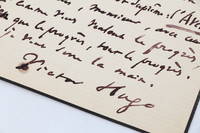
1871833181871. Fine. « So that justice finally be done for women » Mardi 7 novembre 1871 13.30 x 20.80 cm 2 pages sur un feuillet double Autograph letter signed by Victor Hugo to Léon Richer two pages in black ink on a double sheet framed in black. Crosswise folds inherent to envelope inserting. A central tear at the junction of the two sheets. Published in uvres complètes de Victor Hugo Ollendorff 1905. Manuscript housed in a blue half morocco chemise and slipcase marbled paper boards marbled paper slipcase signed Boichot. A magnificent and important letter to Léon Richer one of the first male feminist activists considered by Hubertine Auclert as the ""father of feminism"" and later regarded by Simone de Beauvoir as its ""true founder"". This deeply humanist text is a compendium of Victor Hugo's campaign for the abolition of capital punishment and the female attainment of social equality and civil rights. « Mardi 7 novembre 1871 Monsieur on m'a demandé d'urgence mon intervention pour les condamnés à mort. L'accomplissement de ce devoir a retardé ma réponse à votre excellente lettre. Vous avez raison de compter sur moi pour affirmer l'avenir de la femme. Dès 1849 dans l'Assemblée nationale je faisais éclater de rire la majorité réactionnaire en déclarant que le droit de l'homme avait pour corollaires le droit de la femme et le droit de l'enfant. En 1853 à Jersey dans l'exil j'ai fait la même déclaration sur la tombe d'une proscrite Louise Julien mais cette fois on n'a pas ri on a pleuré. Cet effort pour qu'enfin justice soit rendue à la femme je l'ai renouvelé dans les Misérables je l'ai renouvelé dans le Congrès de Lausanne et je viens de le renouveler encore dans ma lettre au Rappel que vous voulez bien me citer. J'ajoute que tout mon théâtre tend à la dignification de la femme. Mon plaidoyer pour la femme est vous le voyez ancien et persévérant et n'a pas eu de solution de continuité. L'équilibre entre le droit de l'homme et le droit de la femme est une des conditions de la stabilité sociale. Cet équilibre se fera. Vous avez donc bien fait de vous mettre sous la protection de ce mot suprême : l'Avenir. Je suis Monsieur avec ceux qui comme vous veulent le progrès rien que le progrès tout le progrès. Je vous serre la main. Victor Hugo » ""Tuesday november 7 1871 Sir I have been urgently asked to intervene on behalf of those sentenced to death. The fulfillment of this duty has delayed my reply to your excellent letter. You are right to count on me to defend the future of women. As early as 1849 in the National Assembly I made the reactionary majority burst into laughter by declaring the rights of man as natural counterparts to the rights of woman and the rights of children. In 1853 in my Jersey exile I made the same declaration on the grave of an outlaw Louise Julien but this time people didn't laugh they wept. I renewed this effort to finally do justice to women in Les Misérables I renewed it in the Congrès de Lausanne and I've just renewed it again in my letter to Le Rappel which you are kind enough to publish. I would add that every single one of my theatrical works aims to dignify women. As you can see my plea for women is long-standing and persevering and no other has ventured to continue with this endeavor. Balance between men's rights and women's rights is one of the conditions of social stability. This balance will be achieved. I commend you for placing yourself under the protection of this supreme word: the Future. I am Sir with those who like you want progress nothing but progress the whole of progress. I shake your hand. Victor H Although this letter focuses primarily on advocating for women's rights it begins with the death penalty: I have been urgently asked to intervene on behalf of those sentenced to death. The fulfillment of this duty has delayed my reply to your excellent letter. Shortly after the Paris Commune the October 1871 pages of Hugo's diary la hardcover
AMA-294Paris, le lundi 30 juillet 1877. 10 pp. in 8°, réparation à deux feuillets.
185488937s. d. [mai 1854] | 13.9 x 21.7 cm | une page sur un feuillet
41202Paris : Fourbis, 1994. Un volume 16x20,7cm broché de 58 pages. Edition originale avec un envoi autographe signé de l’auteur. Bon état.
191382418Paris 1913 | 13.30 x 21 cm | une carte
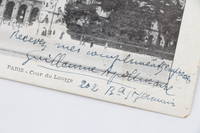
191382418Paris 1913. Fine. Paris 1913 13.30 x 21 cm une carte Unpublished autograph signed postcard by Guillaume Apollinaire addressed to the Dijon art historian Marcel Mayer. Two pages written in black ink on a photographic postcard depicting the courtyard of the Louvre. Charming letter praising the attachment to their roots of the "".fameux Flamands-Espagnols Hollandais et Bourguignons que j'admire tant"" ""famous Flemish-Spanish Dutch and Burgundians whom I admire so much"" and informing his correspondent of the writing and forthcoming publication of a ""petit livre sur Rude"" ""little book on Rude"" that Guillaume Apollinaire will not fail to send him. Fine autograph signature with the autograph address of 202 Boulevard Saint-Germain. unknown
193770612Londres 26 décembre 1937 | 17.90 x 22.90 cm | une feuille
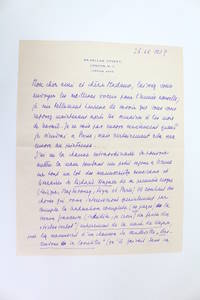
193770612Londres London 1937. Fine. Londres London 26 décembre 1937 17.90 x 22.90 cm une feuille Signed autograph letter to Alfred Cortot and his wife about Richard Wagner's manuscript collection: ""I was lucky enough to be able to acquire the entire lot one day before Bayreuth sent a trusted buyer"". London 26 December 1937 17.9x22.9cm one leaf. Autograph letter signed by Stefan Zweig to Alfred Cortot two pages on one sheet written in violet ink. An outstanding autograph letter in which the avid collector informs his friend Alfred Cortot of his acquisition of unpublished manuscripts of Wagner. Alfred Cortot himself owes his career as a conductor to his early discovery of the German composer. Cortot shared with Zweig his ""almost tyrannical bewitchment suffered with as much intoxication as fervor"" for the composer. Zweig who spoke of his collection as ""more worthy of surviving me than my own works"" The World of Yesterday: Memories of a European 1942 recounts for his friend the details of this incredible discovery of hundreds of forgotten leaflets including Wagner's intimate correspondence handwritten scores and excerpts from opera librettos including The Flying Dutchman The Sublime Fiancée or Bianca and Giuseppe Die Feen Das Liebesverbot The Ban on Love and a lost orchestral version of Rule Britannia. In December 1937 as he fled the Nazi regime and settled in London Zweig became fascinated by the archives of a time when intellectual Europe was living in perfect syncretism. The writer takes a nostalgic look at the manuscripts of Wagner who like him spent his youth travelling through the capitals of Europe: ""I was extraordinarily fortunate to be able to get my hands on a whole lot of Richard Wagner's musical and literary manuscripts from his early period Leipzig Magdeburg Riga and Paris during a short stay in Vienna"". Among these precious manuscripts is the extremely rare orchestral arrangement of the patriotic song Rule Britannia which had been missing for more than sixty years. Sharing his passion for Wagner with his friend the pianist Cortot Zweig announced his discovery with the wonder so familiar to collectors when faced with an exceptional find: "". the manuscript is the only one of its kind in the world that has been preserved. It contains things that will be of special interest to you for example the complete translation 60 pages of the French version unpublished I believe of the text of the ""Liebesverbot"" entirely in Wagner's hand as well as the manuscripts of a vaudeville song ""Descendons la Courtille"" which he performed in his darkest moments . almost thirty pieces of the highest interest and precisely from the rarest period. All this was hidden for 50 years in a private collection and I was lucky enough to be able to acquire the entire lot one day before Bayreuth sent a buyer"". The letter is a fascinating account of Zweig's parallel life which had earned him a reputation as an accomplished collector. His collection also inspired one of his most beautiful short stories The Invisible Collection die Unsichtbare Sammlung and a pioneering essay in the Deutscher Bibliophilen Kalender The Autograph Collection as an Art. His hundreds of historical musical and literary autographs from the Middle Ages to the 20th century were carefully catalogued and collected in the library-museum of his house in Kapuzinerberg: ""In this library a 'place of worship' he also exercises a real activity as an expert in autographs . . The library will attract a number of distinguished scholars sometimes accompanied by their assistants who will not hesitate to return to work there quietly for days or even weeks at a time"" Stefan Zweig le voyageur des mondes Serge Niemetz. With this acquisition Zweig sees the dream of every collector come true. After two years of exile in England Zweig returned to Vienna in time to purchase these exceptional documents from Bayreuth's emissaries who had already built up unknown
Madrid, Imprenta de José Rodríguez, 1858. 4to.; 32 pp., 2 hs. Con envío autógrafo del autor. Cubiertas mudas en papel.