859 259 résultats
Zusammen 26½ SS. auf 16 Bll. 4to und 8vo. Mit 1 eh. adr. Kuvert. Vertraute Briefe an die junge Sängerin Diet Kloos-Barendregt (1924-2015), die Celan im August 1949 auf der Terrasse des Cafés Dupont kennengelernt hatte, wo ihr die "Memoires d'une âne" von Sophie de Ségur vom Schoß gefallen waren. Der 29-jährige Dichter und die 25-jährige Musikstudentin aus Dordrecht waren ins Gespräch gekommen: über ihren Widerstand gegen die deutschen Besatzer, ihre Gefangenschaft und den Mord an ihrem Ehemann Jan Kloos, der im Jänner 1945 in Amsterdam standrechtlich erschossen worden war; über die Ermordung von Celans Eltern, über die Zwangsarbeit und seine Flucht aus Rumänien. Nach ihrer Rückkehr entspann sich ein knapp einjähriger Briefwechsel, von dem zwar nicht ihre eigenen Briefe, dafür aber die hier vorliegenden Celans erhalten geblieben sind. - "Ich weiß nicht, wie spät es jetzt ist, jedenfalls ist es noch Nacht, das heißt es ist noch dunkel, wenn es auch schon Morgen ist - wieviel Uhr also? Umsonst, ich kann es nicht sagen, denn meine Uhr steht still, mein valet de chambre ließ sie gestern beim Aufräumen des Zimmers fallen, ich habe also, wenn ich so sagen darf, keine Zeit - endlich! und die Glocken der Kirchen geben nur schlechten Bescheid, sie sind zu zahlreich [...] sie stimmen nicht überein, ihre Glockenschläge folgen rasch aufeinander, es ist, wenn Du willst, dreißig oder zweiunddreißig Uhr, eine Stunde aus verschiedenstem Silber, ein aufmerksames, hellhöriges Ohr könnte unterscheiden, helles und deutliches von dunklem, undeutlichem Silber trennen und so die Zeit erfahren, aber mein Ohr ist träge, absichtlich, damit meine Hand umso reger wird, wenn mir endlich die Zeit abhanden gekommen ist. All das ist ein Glück für mich, der ich doch mit meiner Zeit nichts Rechtes anzufangen weiß - was tat ich bislang, wenn ich Zeit hatte? Ich wartete auf die Zeit [...] Alles ist zu schwer, weil alles zu leicht ist" (23. VIII. 1949). - "Was ich brauche, was ich so dringend brauche, eben deshalb, weil ich so oft von mir weg muß, auf Reisen gehen muß - und wie unbequem ist dieses Reisen: ich selber bin dabei reglos, wechsle nicht den Ort, die Welt aber saust unter meinen Füßen vorbei! - was ich also brauche, ist das Gefühl, daß es bei all diesem Hin und Her einen Ausgangspunkt gibt, der, wenn er auch nie wieder erreicht werden kann, dennoch bestehen bleibt - ein solcher Ausgangspunkt wären meine Gedichte, wenn ich sie in Sicherheit wüßte, sauber abgedruckt und gebunden" (6. IX. 1949). - "Ich bin im Begriffe, mein Leben anders, hoffentlich besser einzurichten als bisher und meinen, in den letzten Wochen etwas deutlicher werdenden Jahren Rechnung zu tragen. Ich glaube, Du hast mal die Linien meiner Hand angesehen, Diet; so wirst Du Dich vielleicht erinnern, daß meine Lebenslinie zweimal abreißt, um sich in zwei voneinander getrennten kleineren Linien fortzusetzen. Nun, mir will scheinen, daß ich gerade da stehe, wo dies zum zweitenmal geschieht, wo ich mich von mir selber abspalte, Gott weiß zu welchem Zweck. Immer weniger gleiche ich dem verspielten Knaben, der ich so gern war, und - verzeih - ich verschmerze das Unwiederbringliche schwerer als es einem erlaubt sein mag, der zu wissen glaubt, wie ein Auge im Dunkel strahlt" (21. IX. 1949). - "Und über allem, schwebend und dabei doch so lastend, der Alltag, die Rundfahrt durch die Welt des täglichen Brotes. Und unter allem, verborgen, kaum hörbar, aber quälend auf unterirdische Art, der Traum von der Unendlichkeit, nie verwirklicht, kaum geahnt, unerreicht. Und dazwischen: Ich, Paul Celan, ein Mann, der vielleicht doch noch ein Baum wird, wenn der Abend es will [...]" ("Dienstag abend", wohl 29. XI. 1949). - Im linken Rand gelocht und teils mit kleineren Randläsuren, sonst gut erhalten. Paul Celan: Du mußt versuchen, auch den Schweigenden zu hören. Briefe an Diet Kloos-Barendregt. Handschrift - Edition - Kommentar, hg. von P. Sars u. L. Sprooten (Frankfurt a. M., 2002). P. Sars (Hg.), "Alles is te zwaar, omdat alles te licht is". De brieven van Paul Celan aan Diet Kloos-Barendregt. Übs. von C. O. Jellema (Amsterdam, 1999).
56 to 125 mm (height) and 82 to 135 mm (width). On laid paper. Complete set of templates for the illustrations of his book "Wanderung. Aufzeichnungen von Hermann Hesse. Mit farbigen Bildern vom Verfasser", published by S. Fischer in 1920. Most of the watercolors have inscribed titles such as "Farmhouse", "The Bridge", "Rectory", "Trees", "Rainy Weather", etc. - Includes the 1949 edition of "Wanderung" with autogr. inscription. - Slight foxing (more extensive in some specimens); marked for reproduction.
8vo. 3¼ pp. on bifolium. Apparently to the French aesthete, Symbolist poet, art collector and dandy Robert de Montesquiou (1855-1921), who had been the inspiration both for des Esseintes in Joris-Karl Huysmans' "À rebours" (1884) and for Baron de Charlus in Proust's "À la recherche du temps perdu" (1913-27), discussing his attending a conference and a novel by Gabriele D'Annunzio: "Vous 'ne doutez pas' comme disent les gens du monde, que je ne souhaite - sans guère l'espérer - d'être en état d'assister à la Conférence. Je serais heureux de me rendre compte par moi-même ce qu'en penserait la Petite (non, la Grande!) Mademoiselle. Elle a toujours eu un faible pour nous (ce qui est son fort!) Et le merveilleux roman de d'Annunzio me semble par son sujet convenir merveilleusement à l'instruction des enfants confiés à Miss Winter. Je vois là le thème tout indiqué pour les représentations de théâtre jouées au naturel entre frère et sœur. Vous voyez que je ne fais pas comme les gens qui font semblant de ne pas connaitre l'existence des enfants dont on ne leur a pas notifié la venue au monde. Je n'ai pas moins ressenti de cette omission, au tort de mes sentiments, d'une façon cruelle et durable 'car enfin mon respect et mon obéissance semblent dignes à mes yeux d'une autre récompense'. Mais cela ne m'empêche pas de les admirer tout de même beaucoup ! Votre très dévoué | Marcel Proust"'. - Slightly browned and spotty; small collection stamp on p. 1.
8vo. (8), 141, (3) pp. With one page of advertisements at rear as issued. Original fawn-coloured wrappers lettered in red and blue. Housed in a custom red cloth clamshell case. A literary touchstone of Faustian horror for the industrial age: presentation copy of the first English edition, inscribed on both the cover and the title-page, to "William Slafford, with the Author's Compliments". - "The date upon the front cover was originally 1885, but the last figure was altered by the pen into 6. It had been intended to publish the book in December 1886, 'but when it was ready the bookstalls were already full of Christmas numbers, etc., and the trade would not look at it' (Mr. Charles Long-man in Balfour's Life, ii. 14). The publication was therefore postponed till January 1886. Charles Scribner's Sons, New York, issued an edition dated 1886" (Prideaux). - Spine and corners creased, lower spine rubbed, light soiling and a faint blindstamp to rear wrapper, binding a touch delicate. In all a fine copy. Prideaux 17.
- John Murray, London 1877, 13x19cm, relié. - "I do not think anything in my scientific life has given me so much satisfaction as making out the meaning of the structure of heterostylous flowers" (Darwin, Autobiography) First edition. One of the 1250 copies printed. 15 engravings and 38 tables in the text. Complete with the index and the publisher's catalogue at rear. Publisher's binding by Simpson & Renshaw. Rare and precious autograph inscription by Charles Darwin on the title page: "With the compliments of the author." Charles Darwin wrote three major books on plant reproduction. The most important titled The Different Forms of Flowers concludes more than 40 years of studies on floral biology. This seminal work is one of the first scientific tests of the theory of evolution. Darwin demonstrates here how the astonishing structural variety of flowers historically results from natural selection; the immobility of plants and their need for pollen vectors (animals, wind, water) leading to floral adaptation. A rare, inscribed copy of this seminal work on plant reproduction, adaptation, and evolution. See more on this subject: [FRENCH VERSION FOLLOWS] "I do not think anything in my scientific life has given me so much satisfaction as making out the meaning of the structure of heterostylous flowers" (Darwin, Autobiography) Edition originale imprimée à 1250 exemplaires. 15 gravures et 38 tableaux in-texte. Notre exemplaire est bien complet de l'index et du catalogue de l'éditeur in-fine. Reliure parfaitement restaurée de l'éditeur en pleine percaline verte avec reprises de teinte, dos lisse ornés de roulettes dorées en tête et en pied, double encadrement estampé à froid sur les plats, contreplats et gardes de papier gris-brun marginalement éclaircis, reliure signée Simpson & Renshaw. Rousseurs éparses. Légère et discrète mouillure marginale en tête des cent premiers feuillets. Quelques annotations manuscrites au crayon. Rare et précieux envoi autographe de Charles Darwin en tête de la page de titre : "With the compliments of the author." "Voici un livre sur les différentes formes de fleurs dans les plantes de la même espèce. Que le lecteur se défie de la simplicité de ce titre, il porte dans ses flancs de graves problèmes de biologie, ébranle des conceptions physiologiques, admises comme certaines jusqu'ici, et refait une science dans ses parties principales. Aux premiers pas faits avec Ch. Darwin dans les régions nouvelles où ce livre nous introduit, on perçoit, non seulement ce sentiment particulier que l'on éprouve en abordant l'inconnu, mais l'étrangeté des faits révélés nous impressionne moins que l'effondrement de conceptions commodes et classiques qui se fait dans notre esprit." (Amédée Coutance, préface de l'édition originale française) Charles Darwin a écrit trois livres majeurs sur la reproduction des plantes, dont le plus important, The Different Forms of Flowers, conclut plus de 40 ans d'études sur la biologie florale. Cette uvre fondamentale est une des premières mises à l'épreuve scientifique de la théorie de l'évolution. Darwin y démontre comment l'étonnante variété structurelle des fleurs est le résultat historique de la sélection naturelle ; l'immobilité des plantes et leur besoin de vecteurs polliniques (animaux, vent, eau) entraînant une adaptation florale. « The wonderful diversity of the means for gaining the same end [cross-fertilisation] ... depends on the nature of all the previous changes through which the species had passed, and on the more or less complete inheritance of the successive adaptations of each part to the surrounding conditions »(Darwin, The different forms of flowers on plants of the same species, p. 258) « La merveilleuse diversité des moyens pour parvenir à une même fin [fécondation croisée] ... dépend de la nature de tous les changements antérieurs par lesquels l'espèce est passée, et de l'héritage plus ou moins complet des adaptations successives de chaque partie à les conditio
- S.n., S.l. S.d. (Circa 1930), relié. - Original collage by Max Ernst made from different colored stamps, in the shape of a bird of prey with spread wings. The claws were drawn by the artist in pencil. Framed in a green mat, the collage in postcard format was originally placed on the twelfth plate of the enclosed album that belonged to Paul Eluard. The stamps that we were able to identify were produced between 1906 and 1913. The collage was probably made in the late 1920s or early 1930s. To our knowledge, it is the only bird of its kind made by Ernst from stamps, and it was most likely specifically created by the artist to pay tribute to his friend Eluard and his passion for cartophily. Werner Spies (Max Ernst - Loplop, 1997) also points out the presence of butterflies in other Eluard postcard albums, made using the same technique: "with their bodies and wings cut out of stamps, their legs and antennae added in ink". The eagle chosen by Ernst echoes a beautiful poem by Eluard entitled "La Malédicition [The Curse]": "An eagle, on a rock, contemplates the blissful horizon. An eagle defends the movement of the spheres. Soft colors of charity, sadness, gleams on the gaunt trees, lyre in spider web-star, men who under all skies are alike are as silly on earth as in heaven. And the one who drags a knife in the high grass, in the grass of my eyes, of my hair and of my dreams, the one who carries in his arms all the signs of shadow, fell, speckled with azure, on the four-colour flowers." (Mourir de ne pas mourir - 1924 with a frontispiece portrait of Eluard by Ernst) Throughout the poem, the bird of prey symbolizes the poet; in the collage it could be a self-portrait of Max Ernst. His friends frequently found his features similar to birds. The choice of an eagle motif could also be a political reference to Max Ernst's German origins. In any case, the creation of this collage coincides with the birth of Loplop, "the superior of birds", an alter ego of Max Ernst created after the whimsical figure of Ferdinand Lop. "Like a mannequin, Loplop successively "tries on" various subjects that must be placed in the general context of an ever-changing creation. This leading figure embodies all genres by abolishing the boundaries between them. Characters, landscapes, flowers-shells, scenery and dramatic elements often appear simultaneously. The Loplop series is dedicated to mixing: combining and associating different motifs is one of the essential goals of surrealism, which tends to broaden the field of representation by disturbing the mind and the senses. [...] The identification with Loplop may have concerned only Max Ernst and been part of his personal mythology, but his Surrealist friends very quickly saw in this bird an alter ego of Max Ernst. Several sources testify to this, including a 1926 poem by Paul Eluard entitled Max Ernst: "Devoured by feathers and subjected to the sea / He let his shadow pass in flight / Of the birds of freedom" (W. Spies, op. cit.) It is also known that Max Ernst was very familiar with Eluard's postcard albums and used the embossed ones to make his famous "fottages" (W. Spies, op. cit., pp. 71-72). Werner Spies goes further and states that Max Ernst contributed to the making of Eluard's albums (ibid, p. 32). This splendid bird collage that he offered him and its presence in our album therefore take on their full meaning here. It is not only a homage to Eluard's collection (using stamps as a reference to the art of epistolary correspondence), but especially a token of fraternal friendship between two prominent figures of Surrealism. Included: Exceptional album constituted by Paul Eluard, with 498 postcards artistically set on 83 pages. It is the only album in private hands from the famous collection of the poet. The others are now part of the French Musée de la Poste [Postal Service Museum]. This album was exhibited at the Musée du Jeu de Paume in 2008 along with the Max Ernst collage. Eluard's collectio
8vo. 146, (6) pp. Publisher's half vellum with red batik paper covers; gilt title to spine and upper cover. Top edge green. Stored in custom-made red half morocco clamshell case with gilt spine title. De luxe issue of the first edition: no. 20 of 50 numbered copies, printed specially for the author and signed "Hermann Hesse". On the front free endpaper Hesse penned an additional inscription to the Austrian gynecologist Josef von Halban (1870-1937): "Für Herrn / Hofrat Dr. J. Halban / von s. ergebenen / Herrmann Hesse". - The regular issue of the first edition was published in 6000 copies; within Hesse's own lifetime the total press run would number 150,000 copies. Today the book counts among "the most widely read works of the 20th century - including translations, the press run is in the double-digit millions" (cf. KNLL). - Binding a little toned as common; interior very clean. An appealing copy. Mileck II, 43. Waibler E 170. Kliemann/Silomon 41. WG² 122. KNLL VII, 802.
Large 8vo (145 x 229 mm). In German. 1½ pp. (30 lines in pencil on blue squared paper). To his friend Robert Klopstock, a medical student and fellow sufferer of tuberculosis: "Dear Robert, just a few words, the lady waits. From the report given by Miss Irene I was under the impression that the worst was over and that a hospital could therefore be ruled out. But if you feel that a hospital might be able to give you any ease, even the slightest, we could try it after all (service at your place is undoubtedly very poor), it would not be a supplication at all, I would approach my colleague and have him intercede quite proudly or, which might be even better, go to Prof. Münzer. So let me know. I have received a message today from Dr. Hermann, but a very brief and unclear one, mentioning a slight flu; I shall visit him tomorrow. How high is the fever? Indeed, I had already answered your letter when Miss Irene called here yesterday. The fever made the whole matter even less important than it had been already; the answer lies with me" (transl.). - Irene Bugsch, the daughter of Aladár (Alexander) Bugsch, one of the owners of the Matliary Sanitarium, belonged to Franz Kafka's circle of friends (which also included her sister Margarete and Robert Klopstock) during his half-year stay (18 December 1920 to ca. 26 August 1921) in the Tatra mountains. Then 26 years old, she applied at the Dresden Academy of Arts, an endeavor in which she received support from Kafka. The connection to Egmont Münzer (1865-1924), professor at the University of Prague since 1907, has been mediated through Kafka's cousin Robert (1881-1922), who was related to Münzer through his wife. Otto Hermann was one of the physicians whom Kafka consulted in Prague. H. Wetscherek (ed.), Kafkas Letzter Freund. Der Nachlaß Robert Klopstock (Wien, Inlibris, 2003), no. 25. Published in part (omitting five lines) and with departures in M. Brod (ed.), Kafkas Briefe 1902-1924 (Frankfurt/M., S. Fischer, 1958), pp. 419f.
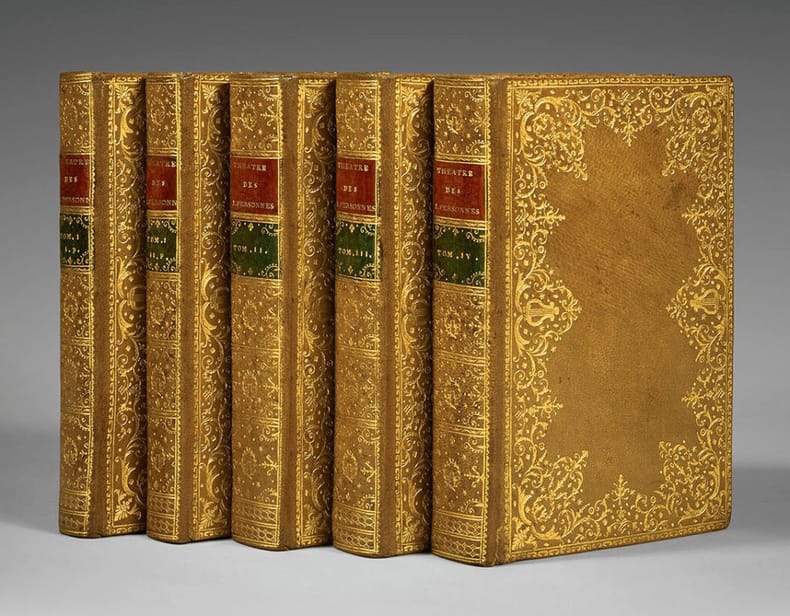
LCS-18183Exemplaire de présent royal. Paris, Panckoucke, Hôtel de Thou, 1779-1780. 4 tomes reliés en 5 volumes in-8. Plein maroquin citron, somptueuse dentelle dorée aux oiseaux et à la lyre autour des plats, dos lisses ornés du fer aux oiseaux, pièces de titre et de tomaison en maroquin rouge et vert, filet or sur les coupes, roulette intérieure dorée, tranches dorées. Superbes reliures parisiennes de l’époque attribuables à Derôme le Jeune réalisées selon les instructions de l’auteure. 200 x 128 mm.
Red dyed leather with giltstamped ornaments. Resting on four silver plated brass feet. 17.7 x 18 x 18 cm. Contains 127 written cards, 150 x 150 mm. Unique, splendidly presented collection of 127 birthday cards, personally inscribed by notable Austrian and German writers and artists including Thomas Mann, Hermann Hesse, Marie von Ebner-Eschenbach, and Arthur Schnitzler. - The elaborate red morocco casket, a masterpiece from the Wiener Werkstätte in the shape of a little house with a curved roof in the Asian style, was commissioned by the Viennese publisher Robert Mohr for the 60th birthday of his possibly most important author, the Viennese humorist Eduard Pötzl (1851-1914), celebrated on 17 March 1911. The design agrees in many details with that of a postcard box created in 1906 by Koloman Moser and Josef Hoffmann for the "Imperial and Royal Military Mail in Bosnia-Herzegovina" (WW Archive, MAK Vienna, see below). While its present counterpart is only stamped "Wiener Werkstätte", it departs from Moser's highly characteristic design merely in the four dented olive-shaped feet which replace the legs and in the ornamental gilt dots along the gable, used in place of a row of tiny balls, for which reason the design can be attributed to Moser with a high degree of certainty. The postcard box was realised only in late 1910 or early 1911, more or less simultaneously with the present coffer, at a time when Moser had already left the Wiener Werkstätte - which explains why Hoffmann was named as the executive artist. - The interior of the lid bears the publisher's gilt dedication with the date of the jubilee. To facilitate the removal of the loosely stored cards, the front of the box folds down upon opening - a characteristic feature of the Viennese tradition of box-making. All birthday greetings are inscribed on pre-printed square cards bordered by triple rules incorporating the date of Pötzl's 60th birthday. Among the many other noted contributors who form a Who's Who not only of the Viennese literary and art scene in the first decade of the 20th century are Peter Altenberg, Raoul Auernheimer, Hermann Bahr, Vincenz Chiavacci, Felix Dahn, Josef Engelhart, Franz Karl Ginzkey, Max Kalbeck, Alexander Roda Roda, Peter Rossegger, Felix Salten, Hugo Salus, Richard Schaukal, and Jakob Wassermann. - Trained for the law, the sometime civil servant Eduard Pötzl soon entered the world of journalism, editing the widely circulated "Neues Wiener Tagblatt", writing courtroom reports, satires of Viennese society, short stories, and humoristic sketches (cf. Giebisch/Gugitz, p. 305f.). He is commemorated by an honorary gravesite in Vienna's Central Cemetery and a street named after him in the city's 18th district. - Hinge very slightly misadjusted; insignificant stain to front of the lid, otherwise impeccable. Cf. Wiener Werkstätte archive, MAK Vienna: model no. BL 428; inv. no. KI 12564-8 (design), WWF 100-65-1 (contemporary photograph).
- Denoël & Steele , Paris 1936, 15x22,5cm, broché sous chemise et étui. - Mort à crédit [Death on Credit] Denoël & Steele | Paris 1936 | 15 x 22,5 cm | in original wrappers with custom chemise and slipcase First edition, one of 47 numbered copies on Imperial Japan, the tirage de tête. Copy presented in the publisher's chemise and slipcase, at first glance reserved for the copies on Japan, in half red shagreen and marbled paper boards. "At the publisher's request, L.-F. Céline removed several phrases from the book; the phrases have not been replaced. They appear in blank in the book" explains a note on the back of the dedication page. Our copy contains, as do all except for the hors commerce copies, some blank spaces scattered throughout the text. The deletion of a word, a phrase or a few lines is thus accentuated by the vacant spaces in the body of the text. Far from an official censorship, these "holes" are the work of Céline himself who, seeing himself reproached by Denoël for certain passages that are too salacious, had the genius idea of replacing the mundane details of certain frolicking with much more eloquent marks, which give free reign to the reader's imagination. A true pornographic reinterpretation of Diderot's address to Sophie Volland: "everywhere there will be nothing read only I love you", Céline's silent invitation to his readers is much more powerful that the literary witticism that it replaces. Thus, from one of the first cuts: "One evening on the wall there was a scandal. Un sidi monté He was finished! Yes, that was certainly Vitruvius. Commenting on this", mysterious and suggestive veil posed on what is, in reality, the description of a paedophile rape, of which readers will only become aware in 1981, in the second edition of the Pléiade, when the cut passages will be finally restored. With simple and fair editorial caution, Céline has produced a real work within the work, since the main subject of the deleted passages is precisely "voyeurism", the key theme of Célinienne work, and it is exacerbated with this self-censorship. We can even doubt that Robert Denoël was really responsible for this censorship, as media-efficient as it is semantically relevant, and which Céline himself promoted: "With the full text of the novel, it is simple: we were going straight to proceedings for offenses against good morals. We had missed the Goncourt. We would not miss the penalty." (Note the skillful parallel between recognition and justice). But it is no doubt at the heart of the work itself that we find a subliminal evocation of the complicity of the two whipped companions: "The two of us, Robert and I, it was time to climb on the kitchen stove to attend the show... It was well chosen as a perch... We were plunging right onto the page..." What happens on the so-called "page" [slang for "bed"], remains in the void of the book's page, but the reader hears Louis-Ferdinand's laughter in echo because, like the silence that follows Mozart, the "blanks" that are sprinkled throughout Mort à Crédit are still Céline's. Extremely rare and very beautiful copy of the tirage de tête. [FRENCH VERSION FOLLOWS] Édition originale, un des 47 exemplaires numérotés sur japon impérial, tirage de tête. Exemplaire présenté sous chemise et étui de l'éditeur, a priori réservés aux exemplaires sur japon, en demi chagrin rouge et plats de papier marbré. « À la demande des éditeurs, L.F. Céline a supprimé plusieurs phrases de son livre ; les phrases n'ont pas été remplacées. Elles figurent en blanc dans l'ouvrage. » précise une note au revers de la page de dédicace. Notre exemplaire comporte en effet, comme tous les exemplaires, à l'exception des Hors Commerce, quelques espaces blancs parsemés dans le texte. Suppression d'un mot, d'une phrase ou de quelques lignes dont l'absence est ainsi accentuée par ces places vacantes dans le corps du texte. Loin d'une censure officielle, ces « trous » sont l'uvre de Céline lui-même q
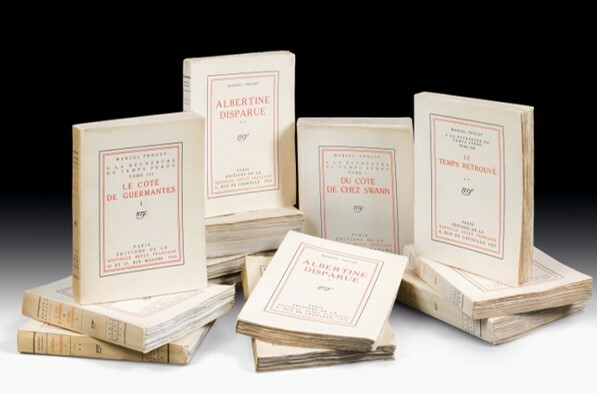
YTB-113Paris, NRF Gallimard 1919-1927. 13 volumes in-4, exemplaire conservé broché, tel que paru. 217 x 165 mm. Le chef-d’œuvre de Marcel Proust et l’une des œuvres majeures de la littérature universelle. EDITION ORIGINALE, à l’exception du premier volume Du côté de chez Swann d’abord paru chez Grasset et seul paru chez cet éditeur, DE La Recherche. En Français dans le texte, 342. Chacun des volumes est ici réimposé en format in-4 sur vergé Lafuma-Navarre et réservé aux Bibliophiles de la Nouvelle Revue Française. Du côté de chez Swann, 1919, exemplaire n°109. A l'ombre des jeunes filles en fleurs, 1918, exemplaire n° 104. Le Côté de Guermantes I, 1920, exemplaire n° CX. Le Côté de Guermantes II. Sodome et Gomorrhe I, 1921, n° CX. Sodome et Gomorrhe II, 1922, 3 volumes ; le second volume exemplaire n° XXXVI, les deux volumes autres non numérotés. La Prisonnière, 1923, 2 volumes, chacun exemplaire n° C. Albertine disparue, 1925, 2 volumes, chacun exemplaire n° CI. Le temps retrouvé, 1927, 2 volumes, chacun exemplaire n° XLII. SUPERBE EXEMPLAIRE SUR GRAND PAPIER, CONSERVE BROCHE, TEL QUE PARU.
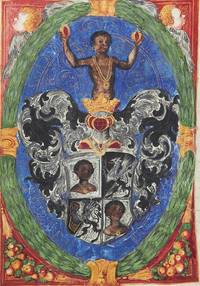
166935491669. Manuscript on vellum folio c. 240 × 300 mm. Sewn in contemporary limp vellum. Final leaf with contemporary notarial certification signature stamp and remnant of wax seal. Some wear and light soiling but a well-preserved and striking copy. With a large finely illuminated coat of arms in vivid colours and burnished gold framed by green palm fronds and flanked by angels incorporating distinctive Moor's head motifs. With a large finely illuminated coat of arms in vivid colours and burnished gold framed by green palm fronds and flanked by angels incorporating distinctive Moor's head motifs. Manuscript on vellum folio c. 240 × 300 mm. Sewn in contemporary limp vellum. 8 leaves. <p><br /> Imperial ennoblement diploma featuring depictions of Black African figures-an unusual and well-documented example of African representation in early modern European aristocratic identity.<br /> <p><p><br /> This lavishly illuminated imperial diploma issued by Emperor Leopold I on 6 May 1668 confirms the noble status of Georg Adam Christoph and Jakob Moren as members of the knightly nobility rittermäßiger Reichs- und erbländischer Adel of the Holy Roman Empire and its Hereditary Lands. It reaffirms earlier ennoblements of the family in 1514 and 1557 and grants the recipients revised arms and the right to use the territorial predicates von oder zu Sunnegg und Morberg following the extinction of the line of their cousin Hieronymus Moren. The present manuscript is an authenticated official copy certified on 4 April 1669.<br /> <p><p><br /> Of particular interest is the large full-page coat of arms likely painted by a professional court illuminator. Richly coloured and heightened with gold the quartered shield includes two fields with black imperial eagles and two with bust-length portraits of dark-skinned men in three-quarter profile adorned with gold earrings and chain necklaces. Above the shield rises a bare-chested crowned Black man holding a red orb in each hand and emerging from a coronet. The rendering is highly individualized and unambiguously emphasizes African phenotypic features. The composition is framed by a laurel cartouche flanked by angels and fruit.<br /> <p><p><br /> The surname Moren or Mor and the heraldic iconography leave little doubt that the family was of Moorish origin-or at least claimed such ancestry as part of its noble identity. While Moor's heads appear elsewhere in European heraldry they are typically stylized emblems representing conquest exoticism or religious symbolism. The Moren arms are distinct: they include multiple prominently placed depictions of Black African men-not as abstract symbols but as individualized and repeated figures in both crest and escutcheon. Their dignified and central presence-together with the family name-suggests an intentional genealogical claim rather than a purely symbolic motif. The route by which the Moren ancestor entered Habsburg service is uncertain but likely occurred via Spain or Italy in the late 15th or early 16th century.<br /> <p><p><br /> The Moren family retained noble status over successive generations with branches in Tyrol Styria Carinthia and Upper Austria and remained listed in official registers of the Austrian nobility into the 20th century. Among their later descendants was Therese von Mor zu Sunnegg und Morberg 1871-1945 a painter trained in Vienna Munich and Paris and active in several artists' associations. The family's heraldic identity-with its explicit visual reference to African ancestry-remained remarkably consistent making this diploma not only a legal instrument of nobility but a rare and compelling record of Black lineage within the early modern European aristocracy.<br /> <p><p><br /> Reference: Genealogisches Taschenbuch der adeligen Häuser Österreichs. 1907. Zweiter Jahrgang 1906/07 pp. 278-310. Wien: Otto Maass' Söhne.<br /> <p>. unknown
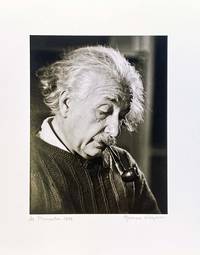
19802611New York: np 1980. First edition. Clamshell box. Fine. EXTREMELY RARE COMPLETE SUITE OF SEVEN LARGE SILVER PRINTS FROM EINSTEIN'S FAMOUS PHOTO SHOOT AT PRINCETON WITH ROMAN VISHNIAC. Each print is signed by Vishniac and dated "At Princeton 1942" in his hand below the image and numbered on the back. "One day Vishniac decided to visit Albert Einstein at Princeton to offer greetings from mutual friends in Berlin. Uninvited he hoped Einstein would pose for a portrait but Einstein had little interest. Vishniac recalled:<br /> <br /> It was a singular experience. An idea had suddenly come to him and the room was filled with the movement of the great man's thought. I waited several minutes and then when I saw that he did not intend to say anything more to me and that he was off in a world of his own I started taking pictures.<br /> <br /> Einstein later admitted that a Vishniac photograph taken that day was his favorite portrait" Encyclopedia of Twentieth-Century Photography. <br /> <br /> Vishniac provided details about this portolfio in a letter to an original recipient the letter is not included here explaining:<br /> <br /> The size of the edition's limitation is uncertain due to my age and only spare time to make them. The most expensive portfolios - Ansel Adams Kertesz - are limited in large numbers I can never measure up - 999 1001 and similar. <br /> <br /> The originality of Portfolio "Einstein" consists of its special character. It is made not to get images but the feeling that you are present during the creativity by the Great Man. All pictures are made with "hidden camera" method.<br /> <br /> The value of this portfolio is great and can hardly be estimated today. <br /> <br /> Princeton/New York: 1942 negatives; 1980 silver prints. Elephant folio clamshell box approx. 17x21 in. housing seven silver prints. Image size: approx. 10.25 x 13.25 in.; with matte 16x20 in. A few minor blemishes to box. Photos in fine condition. RARE. np unknown
4to. 3 pp. on bifolium. With autograph address. In French. Beautiful juvenile letter to his half-brother Alphonse, thanking him for a "beautiful edition of Juvenal" and promising to study so as to achieve good grades. Baudelaire, then a 12-year-old schoolboy at the Collège Royal de Lyon, had received gifts and awards for his good performance, although he must "shamefully admit" that he "obtained these advantages without much effort". Therefore, he promises to improve: "this year I want to cram heavily so that if I do not succeed, I shall have nothing for which to blame myself". He describes the excitement of receiving the awards and gifts that motivated him: "It is really nice to hear your name proclaimed for an award, to which you add this sentence 7 times nominated! Nominated in all subjects! And then it's your mother or father who crowns you! [...] With these prizes, one accumulates book after book, and then the gifts of the parents and then those of the brother too. Because they are beautiful". Finally, he explains with the help of three sketches the gift of a phenakistiscope that he had received from his stepfather Jacques Aupick: "This word is as strange as the invention. [...] It is a cardboard box in which there is a small mirror that is placed on a table between two candles. There is also a handle to which a cardboard circle with small holes all around is adapted. On top of it we add another cardboard drawing, the drawing turned towards the mirror. Then one makes turn, and one looks by the small holes in the mirror where one sees very pretty drawings". The phenakistiscope was the first widespread animation device that created a fluent illusion of motion. It was invented in 1832, only one year before the young Charles Baudelaire received this novelty from his stepfather. - A fascinating letter that provides a valuable insight into Baudelaire's childhood. Good grades without much effort is a fitting summary of his school career. While his high intelligence and intellectual precociousness were obvious, he was also erratic in his studies and was often scolded for idleness. - Traces of folds. With a tear from breaking the seal and minor tears to the folds but no text loss. Some browning and somewhat creased overall. Published in: Correspondance (Pléiade), vol. I, p. 21; Exposition Baudelaire, Petit Palais 1968 (no. 37).
Oblong 4to. 1¾ pp. Hofmannsthal's early draught for the lovers' duet between Sophie and Octavian, from Act II of the "Rosenkavalier", after the silver rose is presented: both lovers sing twelve lines each which oppose and yet complement each other: "Sophie. Dahin muss ich zurück / Dahin und müsst ich völlig sterben auf dem Weg [...]". - "Octavian. Ich war ein Bub / Wars gestern oder wars vor einer Ewigkeit [...]". As evidenced by the caption, this is the "addendum to page 6" (of the libretto) which Richard Strauss had requested and Hofmannsthal had supplied with his letter of June 26. It was used for the final version of the opera, albeit in an abridged and revised form. The present text corresponds to the suggestions which Strauss made in his letter to Hofmannsthal written on July 9, 1909 for a revised version of Act II. - A precious document of the collaboration between Strauss and Hofmannsthal on what remains one of the most successful operas of the 20th century. - Provenance: from the collection of Strauss's biographer Willy Schuh.
LCS-18391Bel exemplaire provenant de la bibliothèque Charles Hayoit. Paris, La Vogue, 1886. Grand in-8 de 103 pp. Relié en maroquin rouge décoré, plats ornés d’encadrements de filets dorés avec fleurons d’angles, dos à nerfs orné de fleurons dorés, encadrements intérieurs de filets dorés, doublures et gardes de soie moirée rose, double filet doré sur les coupes, tranches dorées sur témoins, couvertures rouge saumon imprimées conservées. Reliure dans le genre de Huser, mais non signée. 221 x 137 mm.
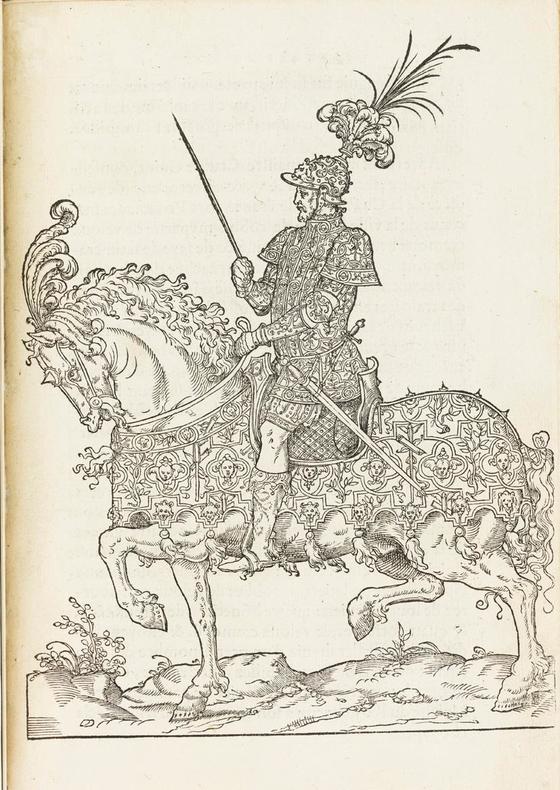
1549YTB-17Paris, Rosset, 1549. [ENTREE DU ROY HENRI II]. C'est l'ordre qui a este tenu a la nouvelle et joyeuse entrée, que le Roy treschretien Henry deuzieme de ce nom. Suivi de : C'est l'ordre et forme qui a este tenu au Sacre & Couronnement de treshaulte & tresillustre Dame Catharine de Medicis, Royne de France. Deux ouvrages en 1 volume in-4 de (38) ff. et 11 gravures, (12) ff., le dernier blanc. Maroquin aubergine, riche décor aux armes et chiffre du roi Henri II frappées or sur les plats avec fleurs de lys et chiffre H couronné, dos à nerfs orné de filets or et à froid, filet or sur les coupes, triple filet or intérieur, tranches dorées. Reliure du XIXè siècle. 227 X 160 mm. EDITION ORIGINALE RARE ET PRECIEUSE DU « plus beau livre d'Entrée des rois de France qui ait été publié » (Ruggieri, 245). EDITION ORIGINALE DU SACRE ET COURONNEMENT DE LA REINE CATHERINE DE MEDICIS. Fairfax Murray French, 150 ; Du Colombier, Jean Goujon, p. 67-71, planche LVI-LVII ; Vinet, 471 ; Picot Rothschild, IV, 3114 ; Mortimer French, 202l ; Watanabe,1602. RELATION DE L'ENTREE SOLENNELLE A PARIS D'HENRI II EN ET DE CATHERINE DE MEDICIS EN 1549, deux ans après l'avènement du roi qui succédait à son père François Ier, mort en 1547. LE PREMIER OUVRAGE DECRIT LA CEREMONIE DE L'ENTREE, LE SECOND RELATE LE SACRE DE LA REINE, SIX JOURS AUPARAVANT, A SAINT-DENIS. En marquant la liquidation de la succession de François Ier, l'événement revêtait une importance politique considérable. LA VILLE DE PARIS LUI DONNA UNE SOLENNITE PARTICULIERE, N'EPARGNANT AUCUN EFFORT POUR EN SOULIGNER LE CARACTERE MAJESTUEUX : LES DECORS ET LES EDIFICES FURENT DESSINES ET CONSTRUITS SOUS LA DIRECTION DES PLUS GRANDS ARTISTES, SANS DOUTE Jean Cousin, Jean Goujon et Philibert de l'Orme. La coutume des entrées solennelles de souverains dans une ville, et principalement dans une capitale, remonte à la plus haute Antiquité et s'est poursuivie pratiquement à toutes les époques. Sauf quelques exceptions, ce n'est qu'à partir de 1515, lors de l'Entrée de Charles-Quint à Bruges, que celles-ci auraient donné lieu à des relations imprimées illustrées (von Arnim, Fünf Jahrhunderte Buchillustration, p. 91). CE BEAU ET RARE LIVRE ILLUSTRE CONSERVE LE SOUVENIR DES PLUS BELLES DECORATIONS ARCHITECTURALES DU SEIZIEME SIECLE ET DECRIT LA MAGNIFICENCE DE CETTE ENTREE ROYALE. Le texte, attribué à Hardouyn Chauveau par une inscription ancienne dans l'exemplaire Soleinne, serait dû, selon V.L. Saulnier, Les Fêtes de la Renaissance, I, pp. 31-59, au traducteur de Serlio, de Vitruve et de l'Hypnerotomachia Poliphili, l'écrivain Jean Martin, assisté, pour les inscriptions sur les monuments, du poète Thomas Sebillet. LES ONZE PLANCHES SUR BOIS, HORS ET DANS LE TEXTE, QUI DECORENT L'OUVRAGE, EN PARTIE SIGNEES D'UNE CROIX DE LORRAINE, ONT ETE ATTRIBUEES AUX PLUS GRANDS ARTISTES. PAR LA PERFECTION DE LEUR GRAVURE ET L'ELEGANCE DE LEUR DESSIN, EXEMPLES PARFAITS DU STYLE HENRI II DANS SON EXPRESSION PARISIENNE LA PLUS RAFFINEE, ELLES PASSENT POUR L'UN DES CHEFS-D’ŒUVRE DE L'ILLUSTRATION FRANÇAISE DU SEIZIEME SIECLE. La question reste évidemment ouverte de savoir si ces gravures traduisent les dessins ayant servi à élever les monuments de la réception ou si elles en restituent seulement l'aspect. La décoration de ces planches comporte à deux endroits au moins, au pont de Notre-Dame et à la construction flanquant le Beautreillis, le monogramme de Diane de Poitiers ; son emblème, le croissant, qui pourrait passer pour un motif décoratif, figure à plusieurs autres endroits, mais sur ces deux constructions son chiffre s'étale complaisamment à côté, voire à la place, de celui du roi ; le texte mentionne les monogrammes au H du roi mais reste muet sur ceux de sa maîtresse, âgée de cinquante ans, qui figurait dans le cortège de la reine sous son nouveau titre de duchesse de Vale.
LCS-18342Entièrement mis en couleurs à l’époque et conservés dans leur cartonnage du XVIIe siècle. Amsterdam, Dirck Pietersz, 1617. In-4 : 3*4, A2B-2H4 2I6 ; pp. (12), 126 ff. ornés de 125 gravures à mi-page. 125 double-pages avec une fable imprimée sur la page de droite et la gravure illustrant la fable en regard. [Relié avec] : II- Vondel, Joost van Den. Den Gulden Winckel der Konstlievende Nedelanders. Amsterdam, Dirck Pieterz, [1613]. A-V4 ; lvs. (1-4), 5-78, (2), soit 78 ff. ornés de 74gravures, (2) ff. Les 4 premiers ff. ont été coupés au niveau de la marge latérale sans manque de texte. Soit deux ouvrages reliés en un volume in-4. Qq. déchirures marginales restaurées, qq. mouillures. Cartonnage bleu du XVIIIe siècle, dos lisse avec étiquette pour le titre en papier, non rogné. Reliure du XVIIIe siècle. 196 x 149 mm.
Large 8vo (162 x 232 mm). X, 488, (6) pp. Inscribed by Kafka and other friends to the philosopher Hugo Bergmann, Prague, 18 December 1905. Publisher's original cloth (a little rubbed, spine rebacked with original printed spine, hinges professionally restored). First edition. The title-page has a presentation inscription to the 21-year-old Hugo Bergmann on the day of his doctorate in philosophy: "Zur Erinnerung an unser gemeinschaftliches Streben" ("In memory of our common endeavours"). Written in the hand of the Prague intellectual Berta Fanta, the presentation is signed by her and six other members of their friendship circle: Bergmann's former classmate Franz Kafka, Dr. Max Lederer, Ida Freund, Oskar Pollak, his uncle Leopold Pollak, and Emil Utitz. - Berta Fanta (1865-1918) led a well-known Prague literary and philosophical salon, attended variously by Albert Einstein, Kafka, Brod, Bergmann (who was to marry Fanta's daughter Else), Rudolf Steiner and others. Ida Freund (1868-1931) was Fanta's sister. Like Bergmann, the jurist Max Lederer had been a student of the philosopher Anton Marty and shared the circle's interest in the philosophy of Franz Brentano. The art historian Oskar Pollak (1883-1915) had been succeeded by Kafka as rapporteur of the literary arts section Prague's Charles University in 1903. Kafka's classmate Emil Utitz (1883-1956) would defend his own PhD in 1906. He went on to teach philosophy and psychology at Rostock and later at Halle; after his deportation to Theresienstadt, he was head of the ghetto library. - The recipient Hugo Bergmann (1883-1975) had been a schoolfriend of Kafka's, and was close to Max Brod, whom he introduced to Zionism. Bergmann emigrated to Israel in 1920, where he was director of the Jewish National Library and a professor, and later dean, of the Hebrew University in Jerusalem. In his reminiscences of Kafka, published and reprinted in various journals from 1969 onward, Bergmann describes this presentation volume, adding that "a graphologist would undoubtedly signalize the fact that, while the others wrote their signatures in a column, one underneath the other, Kafka set his own name apart from the others, to one side" (cf. Bergmann 1972, p. 745). - The book forms the principal work of the German philosopher Busse, a classic of the turn-of-the-century discussion over the relationship of mind and body, when psychology was emancipating itself as a discipline independent from philosophy. The numerous pencil annotations in Bergmann's characteristic shorthand show that he read the volume closely. Kafka, Kritische Ausgabe: Briefe 1900-1912 (Frankfurt, 1999), p. 381. S. H. Bergmann, "Erinnerungen an Franz Kafka - Recollections of Franz Kafka - Kitay zikaron", in: Exhibition Franz Kafka 1883-1924. Catalogue (Jerusalem 1969), pp. 5-20/5-10, illustrated on p. 23. The same, "Erinnerungen an Franz Kafka", in: Universitas 27 (1972), p. 739-750, at p. 745.
4to. 1 page. A fine quotation from the highly regarded Chinese intellectual, who "once called himself the Chinese answer to German Goethe and this appraisal was widely accepted. Zhou Yang said: 'You are Goethe, the Socialism New Era Goethe'" (Wikipedia). - In this particular quotation Moruo regards the young generation as the foundation for world peace and calls upon the Chinese youth to organise themselves as well as the young Chinese scientists to work for their country. - On headed paper ("Comite du peuple Chinoise da la paix mondiale"); from the collection of the Hungarian writer Simon Gy Ferenc and mounted in his original collectors map with collector's stamp.
1 p. 8vo. Fine draft designed for an illustrated edition of "Feuilles d'Automne" ("Autumn Leaves") for which no record exists, entitled "La prière de la jeune fille" (The prayer of the young girl), signed "Victor Hugo prière pour tous" and the name of the artist Elise Boulanger.
10 ff. of ms., with an additional f. of notes. 11 ff. altogether, written in ink on one side only, narrow folio format (c. 35 x 17 cm). Complete manuscript of the famous "Hoplopoiia" section of Kazantzakis's Iliad translation: a pivotal part of the 18th book (rhapsody sigma) of Homer's epic. Kazantzakis and the scholar J. T. Kakridis collaborated on this metrical translation from classical Greek into the modern demotic language over a 14-year period. When it was privately printed in 1955, the controversial effort was hailed as "'living' poetry, through which the modern Greeks will be able to grasp much of the vigour, the passion, and the values of the heroic world of the Iliad" (C. A. Trypanis, The Classical Review 8 [1958], p. 280). The "Hoplopoiia", or the "Making of Armor for Achilles", is one of the most famous parts of Homer's poem: After the death of Patroclus has convinced Achilles to re-enter battle and avenge his friend, his mother Thetis seeks out the smithing god Hephaistus, who fashions a new set of armour for him, among which is a magnificently wrought shield. The detailed description (ekphrasis) of this shield, which takes up most of the present ms., is regarded as one of the paramount passages in Western literature: starting from the center and moving outward, the shield shows first the heavenly bodies (Earth, sky and sea, the sun, the moon and the constellations), then a city at peace (a wedding; a lawsuit; council) and at war (opposing armies; the gods; an ambush); country life (ploughing and reaping; vintage; a herd of cattle attacked by lions; a sheep farm); dancing youths and maidens; and finally, the all-enclosing ocean stream. In essence, the shield offers a physical encapsulation of the entire world: the various layers of this microcosm present a series of contrasts, antitheses that show the basic forms of a civilized, essentially orderly life. Leading up to Achilles's return to battle and one of the bloodiest parts of the Iliad, the Shield Ekphrasis also provides a moment of calm before the storm. - Traces of horizontal folds. Numerous revisions, corrections, and insertions in ink and pencil; caption "Iliada 18 (S. 368-618)" broadly underlined in red crayon. In the final page of notes (written on the reverse of a leaf on which the beginning of the translation has been struck out), Kazantzakis states that this version is not to be considered final and will require revisions as to orthography and accentuation. While the present ms. was probably composed and revised over a period of several years (the variations in pen type and ductus pointing to at least three main stages), the statement that work had been ongoing for three years suggests a time frame around the year 1944. Includes Certificate of Authenticity, issued by Spanos Rare Books, Athens.
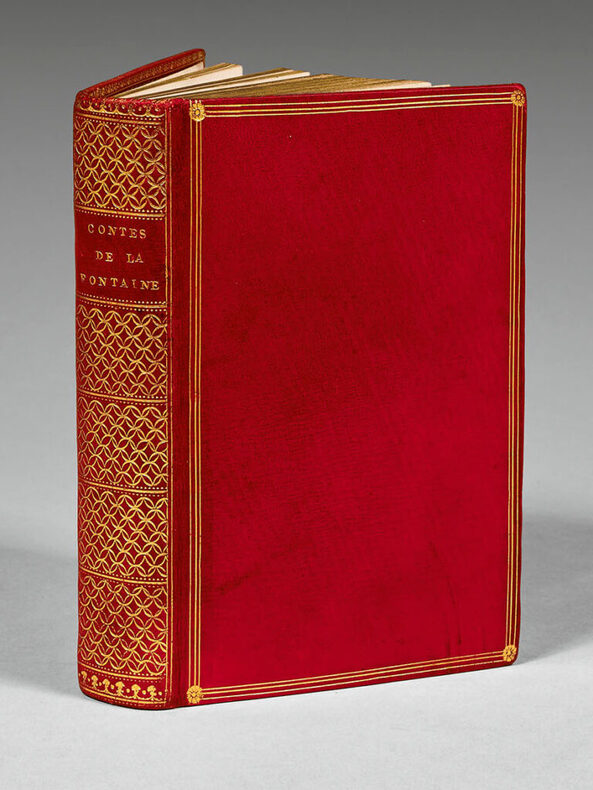
LCS-186409L’un, décrit sous le n° 814 de son catalogue de vente, provenait des bibliothèques du Marquis de Ganay et de MM. Bocher. Vendu 5300 F à la vente Rahir de 1935, il fut revendu 450000 FF (68500 €) en mai 2000, il y a 16 ans. Le second, celui présenté ici, le plus précieux fut vendu 6000 F à la même vente Rahir du 20 mai 1937 (n° 1430). Amsterdam, Henry Desbordes, 1685. 2 tomes en 1 volume petit in-8 de: I/ 1 frontispice, (8) ff., 236 pp.; II/ (4) ff., 216 pp., 58 figures. Qq. piqûres sans gravité. Maroquin rouge, dos sans nerfs orné à la grotesque, filet tranches dorées. Reliure ancienne de Derome le jeune. 158 x 98 mm.
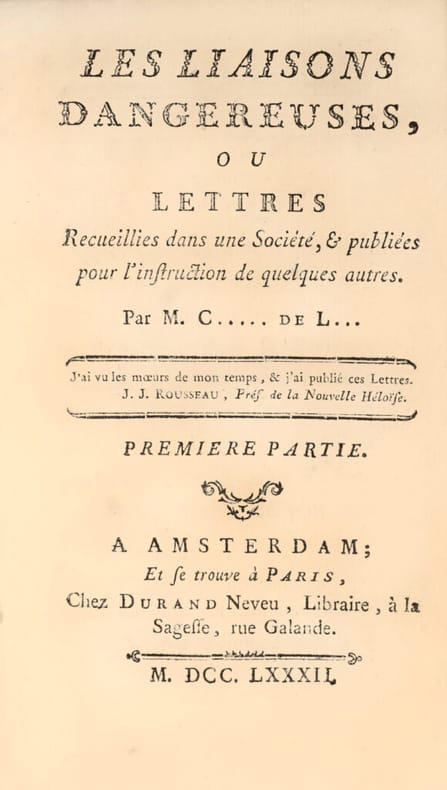
LCS-18468Le plus bel exemplaire du tirage A passé sur le marché depuis plusieurs décennies revêtu d’une reliure de l’époque particulièrement élégante. A Amsterdam, et se trouve à Paris, Durand Neveu, 1782. 4 parties en 2 volumes in-12 de 248 pp. pour le tome I; 242 pp., (1) f. bl. pour le tome II; 231 pp. pour le tome III; 257 pp., (1) p. pour le tome IV. Veau fauve marbré, filet à froid d’encadrement, dos à nerfs, pièces de titre et de tomaison respectivement en maroquin rouge et olive, tranches marbrées. Reliure de l’époque. 164 x 97 mm.