Montaigne, Michel de.Livre Rare Book

859 132 résultats
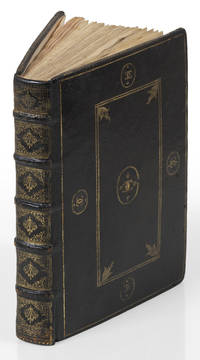
1595YTB-7Paris, Abel L'Angelier, 1595. LA PRECIEUSE EDITION ORIGINALE COMPLETE DES ESSAIS DE MONTAIGNE EDITEE PAR MARIE DE GOURNAY, « FILLE SPIRITUELLE » DE L’AUTEUR. ELLE FIXE LE TEXTE DEFINITIF DE CE MONUMENT DE LA LITTERATURE DE LA RENAISSANCE. L’édition originale, parue en 1580, possédait les deux premiers Livres ; le troisième Livre parut en 1588. Tchemerzine, IV, 876 et III, 460 ; Sayce, 7a ; Philippe Desan, Bibliotheca Desaniana, 21 ; Le Petit, 102-105 ; Picot, Catalogue du Baron J. de Rothschild, I, 141 ; Bulletin Morgand et Fatout, 8961 ; En Français dans le texte, n°73. PRECIEUX EXEMPLAIRE AVANT LES CARTONS POSSEDANT LE FEUILLET D’ERRATA ET BIEN COMPLET DE LA CELEBRE PREFACE DE MONTAIGNE « C’est icy un livre de bonne foi » que l’on ne rencontre que dans les exemplaires édités par Abel L’Angelier.
LCS-A64«Ce livre a figuré à l’exposition «Dix siècles de livres français » (Lucerne, 9 juillet – 2 octobre 1949) sous le n° 383 du catalogue». Parigi 1762. Appresso Durand. In-8. Veau blanc, armoiries aquarellées sur fond de paillons roses sous mica, sur le plat supérieur, chiffre entrelacé et doré frappé sur fond de paillons roses sous mica sur le second plat, d’un semé de fleurettes dorées et de pièces de maroquin rouge, brun, havane, dos à faux nerfs orné de pièces de maroquin citron, brun et vert, coupes décorées, doublures et gardes de tabis bleu, tranches dorées. Reliure de l’époque de Louis-François Lemonnier reçu maître en 1737 devint garde de la communauté en 1756. 202 x 132 mm.
4to. 40 pp. Important working manuscript with reading notes of de Sade from Livy and concerning the history of the Etruscans. Many paragraphs are underlined or circled. Notes and insertions in the margins reveal repeated readings. Notes are in chronological order. - Having returned from Italy in 1776, Sade was jailed at Vincennes as early as 1777. There, he worked on the redaction of his Travel in Italy. For this purpose, he collected details, read old and modern writers, historians, travellers, and philosophers, including Livy. Even though his work had progressed, Sade abandoned his project of a travel narrative around 1782.
8vo. 4 pp. In French. Turgenev had read the first part of Tolstoy's new novel 1805 ['War and Peace'], which appeared in instalments between 1863 and 1869. He found it boring and cold, and complains of the lack of historical sense and of its lack of poetry: "Que c'est ennuyeux et froid, quelle recherche de la petite bete, quel manque absolu de sens historique, d'imagination et meme de poesie (chose etrange chez lui). C'est un peintre de miniatures qui a voulu faire un grand tableau d'histoire - et il s'est casse le nez […]". He adds that Merimee views Tolstoy's 'The Cossacks' in a similar light; Turgenev himself considered The Cossacks to be the best story written in the Russian language. He describes life in Baden and the musical matinees given each Sunday by the Viardots. He has purchased land in Baden and will build a house there (near his beloved Pauline Garcia Viardot). - This important letter is apparently unpublished. In spite of his criticism of Tolstoy in this letter, Turgenev altered his opinion of 'War and Peace' after he read the work in its final revised version in 1866, and he later promoted it extensively in France and Germany.
- Mame et Delaunay-Vallée & Levavasseur, Paris 1830, 13x21,5cm, 2 volumes reliés. - BALZAC Honoré de Scènes de la vie privée [Scenes from Private Life] Mame et Delaunay-Vallée & Levavasseur, Paris 1830, 130 x 215 mm (5 1/8 x 8 7/16 "), 2 volumes, 19th-century half sheep The rare and sought-after first edition. Contemporary Romantic half light-brown sheep over marbled paper boards, spine with gilt arabesques and blindstamped typographic motifs, title and volume labels in navy blue sheep renewed, gilt garlands to head and foot, marbled endpapers and pastedowns, a remboitage. Occasional light spotting. Handsome autograph inscription signed by Honoré de Balzac: "à Monsieur Leroy comme un témoignage de la reconnaissance de l'auteur. Avril 1831. De Balzac [to Monsieur Leroy as proof of the author's thanks. April 1831]". An outstanding political, inscription to Henry Leroy, the dedicatee of the last Letter on Paris, published in Le Voleur and witness, in the days after the July Revolution, to Balzac's electoral hopes, which would prove a profound influence on his writing. Beyond the political gesture, the gift of this Scenes from Private Life to help satisfy his political ambitions underlines, right from the start of his political engagement, the pre-eminence of the literary project over political action for the author of The Human Comedy. Though he considered the July Monarchy a betrayal, it gave Balzac the opportunity to make good on a long-held ambition, that of political participation. As far back as 1819, he had written to his sister: "If I am mighty ...I could have other things beside literary fame; it is good to be a great man and a great citizen, to boot." The change in the eligibility conditions offered the author the opportunity of being a part of writing History, with a capital H. Balzac, "following in the footsteps of his model Chateaubriand, wanted to be both a thinker and a politician" (cf. P. Baudouin in Balzac et le Politique). The realization of this ambition came about through the publication of the Letters on Paris, 19 articles published in Le Voleur between September 1830 and March 1831, which concluded with the famous An Inquiry into the policy of two Ministers. Never signed, these articles represent the most significant of Balzac's political works and have therefore been the subjects of a great many studies and commentaries. Each of the Letters is symbolically addressed to a correspondent, giving only their initials and home town. Though they were long considered fictitious, most have today been identified, and are drawn mostly from those close to the author and powerful political figures. Thus, it was following Letter XVI on the 26 February 1831 that Samuel Henry Berthoud, the addressee, suggested that Balzac stand as a candidate in his district. Keen on the idea, Balzac officially announced his candidature in his Letter of the 15 March and then, still acting on Berthoud's advice, addressed his Letter XIX of the 29 March to M. L*** à Cambrai. The name behind the asterisks is that of the lawyer Henry Leroy, whose key support in Cambrai Balzac hoped to secure. Balzac's main political hopes were centered on Cambrai, whose elites he wanted to win over, while Berthoud, the editor in chief of the Cambrai Gazette, would take care of promoting his popularity among the ordinary folk. "M. de Balzac is not only a famous writer, he is perhaps moreover a talented commentator. One hardly needs to mention to back up that statement the famous Letters on Paris, published in Le Voleur, in which one can see at work a sure judgement and a lucid precision...What's more, M. de Balzac is also engaged with a popular political publication which should help significantly to spread, among the poorer classes, both education, and even more importantly: healthy ideas." Having written this, he then contacted his friend and champion: "Come to Cambrai as soon as you can. We will bang the big drum for you, the Société d'émulation serving as
257481350. <blockquote><p>This work takes its place on the lineage of great early works along with the Arthurian tales</p><p> </p><p>These are exceptionally early witnesses to this most important literary text the most popular secular work of the entire Middle Ages</p><p> </p><p>Appearances of this seminal text are uncommon only a handful having reached the market in decades</p><p> </p><p>Linguistic variations suggest a non-Parisian scribe; evidence of re-use in the 17th century from manuscript markings</p></blockquote><p>video width=""1920"" height=""1080"" mp4=""https://cdn.raabcollection.com/wp-content/uploads/20231204130246/Roman-de-la-Rose.mp4""/video</p><p> </p><p>The influence of the Old French allegorical poem the Roman de la Rose ripples through the Middle Ages into the Renaissance even into Modernity attracting the attention and inspiring the works of Chaucer Dante and C. S. Lewis. Lewis even stated that in cultural importance it ranks second to none except the Bible and the Consolation of Philosophy Allegory of Love 1936 p. 157.</p><p>The Roman de la Rose according to Lewis was an important step in the development of Western literature and thought. He wrote in the above work “We have seen how… in the hands of a great poet the Arthurian story treated in terms of courtly love produced the first notable examples of psychological or sentimental’ fiction… The radical defect in Chrétien’s poetry is that these two kinds of interest lie side by side in it without being really fused. The emotions of Lancelot and Guinevere are not really illustrated save in a very shallow sense by their adventures; their adventures are not really explained by their emotions.â€</p><p><img class=""alignnone wp-image-25764 size-post-window"" src=""https://cdn.raabcollection.com/wp-content/uploads/20231204140340/Roman-B-1-e1667227860712-1600x744.jpg"" alt="""" width=""1600"" height=""744"" /></p><p>This defect of emotional appeal of the primacy of love is rectified per Lewis in Roman de la Rose. “But the whole truth about Guillaume author of the Roman is missed until we see that he is more of a realist than Chrétien Chretien de Troyes fl. c. 1160–1191 was the author of some of the fundamental texts of Arthurian lore. Of the two things that he found in Chrétien it was the fantastic that he rejected and the natural that he used.â€</p><p>The great success then of the Roman de la Rose was fairly novel use of allegory to highlight the emotional journey of love as it would have appeared to someone at that time and in a courtly setting.</p><p><img class=""alignnone wp-image-25765 size-post-window"" src=""https://cdn.raabcollection.com/wp-content/uploads/20231204140328/Roman-A-1-e1667227983201-1600x752.jpg"" alt="""" width=""1600"" height=""752"" /></p><p><strong>Summary of the Romance of the Rose:</strong></p><p>In 1230 Guillaume de Lorris began the dream-vision poem a first-person narrative describing the efforts of a young man stricken by the arrows of the God of Love to obtain his beloved the Rose. Guillaume’s Amant Lover wished to tell the reader all that he knew of love and the poem describes a dream in which Amant is taken by Oiseuse Leisure into a pleasure garden where he meets the allegorical figures of Deduiz Pleasure Deliz Delight Cupid and others finally catching sight of and falling in love with the Rose. He is held back by the figures of Dangier Danger Honte Shame Mal Bouche Scandal and Jalousie Jealousy who imprison the Rose in a castle after Amant attains a kiss from the Rose.</p><p>Death claimed Guillaume before he was able to conclude his work. He is only remembered to us through a mention by the poem’s successive author Jean de Meun a friend of Dante who resumed the poem around 1275 adding around 17700 more lines to the approximately 4000 extant lines. There are therefore 2 authors for this same work separately themselves by a relatively great span of time each with his own milieu and sensibilities.</p><p>Both authors use the allegory to examine philosophical cruces emerging in the 13th century through scholasticism such as free will and determinism optics and the adjusting social orders which put mendicant friars in positions of increasing power. However Jean’s vision for how the Lover relates to his beloved— what he is prepared to do— diverges from Guillaume’s.</p><p>Jean provides a mirror for the turn from chivalric romances and courtly love which guided Guillaume. Jean’s social and political commentary sees the Lover deceiving and achieving the Rose in a way that that shifts away from the idealized and innocent sensuality of the first part of the poem to a biting satire on contemporary society blended with an overt realization of sexuality. Jean’s Amant makes war on the castle debates with Reson Reason Nature and Genius and finally enters the inner chamber of the Rose. His advice to the lover includes sections on how a man should keep his mistress study the arts ignore any infidelities offer flattery but never advice and how a lady might keep her male lover use false hair make up and perfume avoid getting so drunk you fall asleep at dinner only have intercourse in the dark to hide imperfections of the body and avoid poor men and foreigners - except very rich ones.</p><p>caption id=""attachment_25767"" align=""alignnone"" width=""1600""<img class=""wp-image-25767 size-post-window"" src=""https://cdn.raabcollection.com/wp-content/uploads/20231204140309/Roman-D-1-e1667228165675-1600x828.jpg"" alt="""" width=""1600"" height=""828"" /> Notes from use in the 17th century/caption</p><p><strong>The Manuscript & the Manuscript Tradition:</strong></p><p>Manuscript scholars have attempted to calculate the survival rate of medieval texts. Usually this calculation is done by comparing the catalogues of library books with known copies. Earlier in 2022 a team at the University of Antwerp has applied statistical principals usually used for tracking wildlife to estimate that approximately 9% of medieval manuscripts have survived to present day.</p><p>Johns Hopkins University and the Bibliotheque nationale de France have listed 324 known manuscript copies of the Roman de la Rose from the 13th 14th and 15th centuries exceeding the number of manuscripts of the works of Dante and Chaucer. With the suggestion of an original 3600 copies of the Roman de la Rose based on the 9% survival rate we are looking at what remains of a medieval best-seller. Yet few of these reach the market.</p><p><strong>Medieval manuscript poem</strong> 14th century France consisting of 2 double-sided folia from the Roman de la Rose from key sections of this great manuscript see “further details†below for a detailed entry and the Johns Hopkins system of categorization. There are manuscripts notations from use in the 17th century likely as binding.</p><p>This fragment opens with Friend’s advice to the lover to guard that Scandal doesn’t see him approach the castle where the Rose is kept. If the lover is spotted by Scandal he should not show hatred or rancor towards him ‘de hayne ne de racune’ because “a wise man covers his bad humour… those who deceive deceivers do a good deed and all lovers at least the wise ones should do so†‘sages hommes son maul talent ceuvre. cil fet bone euvre qi les decheveeurs decoivent…faire le doivent tretuit amans au mains li sage.†The scribe of this text has stricken through a line of his text “si sachies que cil fet bone euvre†which he was a repeat of two lines above. Jean de Meun’s jaded narrative has Friend giving the lover the advice to “serve and honor†Scandal and all his lineage ’tout son lignage’ because it is “no sin to trick those who are tainted by trickery†‘De ceus bouler nes pas pechies qi de bouler sont entechies’. And Scandal is indeed a boulierre a trickster. Friend goes on to explain the shameful tricks that Scandal’s bad mouth plays on men to steal— money and reputation. Friend warns that Old Woman and Jealousy also guard Bel Acueil Warm Welcome the lover’s companion who has also been taken into the castle. Through false courtesy bribes and weeping— even false weeping— will be needed for Amans to make his way through the castle.</p><p><img class=""alignnone wp-image-25768 size-post-window"" src=""https://cdn.raabcollection.com/wp-content/uploads/20231204140257/Roman-E-1-e1667228257297-1600x856.jpg"" alt="""" width=""1600"" height=""856"" /></p><p>At this point the fragment breaks off and resumes nearly a thousand lines later. The break in lines from one folio to the next from lines 7301-7379 to 8415-8575 occurs because of the way the book was put together. Large leaves of vellum were folded in half to create bifolia which were in turn nested into one another to create gathering of folios or pages in a modern sense. Since the folded bifolia were still attached a loose bifolia will contain text that jumps from one folio to the next. This is to say that the text on a bifolium will not follow sequentially unless it is the very center of the quire.</p><p>We reenter the narrative as Friend is telling of an idyllic time which slides slowly towards Jean de Meun’s cynicism but also with a great statement of the primary of love over earthly physical power and domination — “No king or prince had yet committed any crime by robbing and seizing from another. All were accustom to being equal and no one wanted any possessions of his own. They knew well the saying neither lying nor foolish that love and lordship never kept each other company nor dwelth together. The one that dominates separates them†“N’encor n’avoit fet roy ne price Meifet qui lautrui tout et pinche Testuit pareil estre souloient Ne riens propre avoir ne vouloient. Bien savoient ceste parole Qui nest mencongiere ne fole Conques amour et seignourie Ne sentrefirent compaignie Ne ne demourerent pas ensemble: Cil qui mestrie les dessemble’. Immediately following this the relationships between a jealous husband and frivolous wife is examined. Jealousy laments his own marriage and the bygone days of women like the Grecian Penelope of Homer’s Odysseya who waited loyally on Odysseus’s return.</p><p><strong>A Note on the Rarity:</strong></p><p>The text is far from common on the market with the vast Schoenberg database listing only ten codices appearing at auction since the 1970s and only three of those of the fourteenth century: Christies' 7 June 2006 lots 23 and 31 once Phillipps MS. 2838 and 4185 now both Senshu University Japan; and another in the same rooms 9 July 2001 lot 12; Sotheby's 17 June 1997 lot 6 once Phillipps MS. 129; Drouot 16 December 1994 lot 1; another in the same rooms 9 December 1992 lot 371; Ader Picard Tajan in Paris 16 September 1988 lot 152 this previously in Sotheby's New York sale of Carleton Richmond's library in 1981; the Astor copy sold in Sotheby's 21 June 1988 then Beck collection and stolen; Christie's 25 June 1980 lot 232 once Phillipps MS. 4357 now in the Ferrell collection; another sold in Ader Picard Tajan in Paris 20 May 1980 lot 60; and that sold in Sotheby's 13 July 1977 lot 48 to Peter Ludwig and thence to the Getty Museum. Fragments seem to come to the market even less frequently with the last examples in Christie's 30 May 1984 lot 200 a small miniature trimmed to its edges from a manuscript of the second half of the fourteenth century; Alde Libraire Giraud Badin 8 June 2012 a fourteenth-century leaf most probably the missing first leaf of Columbia University Plimpton MS. 284; and two fifteenth-century bifolia recovered from bindings sold through Dreweatt’s 6 July 2017 lots 34 and 35.</p><p><img class=""alignnone wp-image-25769 size-post-window"" src=""https://cdn.raabcollection.com/wp-content/uploads/20231204140244/Roman-F-1-e1667228424857-1600x828.jpg"" alt="""" width=""1600"" height=""828"" /></p><p><strong>The Scribe and His France:</strong></p><p>While the parent manuscript of the present leaves was probably a Parisian product and made for an aristocratic audience in the early 14th century the scribe of the manuscript probably came from farther afield than the ÃŽle-de-France.</p><p>Comparing the paleographic style the manuscript is similar to a manuscript at Oxford Bodleian MS Selden Supra 57 composed in 1348 in Paris arriving in the Bodleian Library in 1659. However a comparison of a sampling of 10 lines from both manuscripts reveals an interesting linguistic difference between the Parisian manuscript and the fragments here.</p><p>Lines 7307-7316 Selden Sura 57 on left fragment on right with differences in bold.</p><p><strong>Nene fetes chiere neisune/ ne faites chiere neysune</strong></p><p>De <strong>haine</strong> ne de rancune;/ de <strong>hayne</strong> ne de rancune ;</p><p>Et se vous ailleurs l'<strong>encontrez</strong>/et se vous ailleurs <strong>lencontres</strong></p><p>Nul mautalent ne li <strong>montrez</strong>:/nul mautalent ne li <strong>monstres</strong> :</p><p>Sages hons son mautalent <strong>cueure</strong>/ sages hommes son mautalent <strong>ceuvre</strong></p><p>Si <strong>sachiez</strong> que cil<strong> font bonne eur</strong>e/ si <strong>sachies</strong> que cil <strong>fet bone euvre</strong></p><p><strong>Qui</strong> les <strong>deceveours</strong> decovient;/ <strong>qi</strong> les <strong>decheveeurs</strong> decoivent;</p><p><strong>Sachiez ainsi fere</strong> le doivent/ <strong>sachies</strong> <strong>qu’ainssi</strong> faire le doivent</p><p><strong>Trestuit</strong> <strong>amant</strong> au <strong>mainz</strong> li sage./ <strong>tretuit amans</strong> au <strong>mains</strong> li sage.</p><p>Male Bouche et tout son linage/ Male Bouche et tout son lignage</p><p>We can examine another stylistically manuscript from Central France likely Paris in the 4th quarter of the 14th century London British Library MS Add. 42133.</p><p>Lines 7307-7316: Add. 4233 left Selden Sura 57 middle fragment right with differences in bold.</p><p>Nene fetes chiere <strong>nisune</strong>/ Nene fetes chiere <strong>neisune</strong>/<strong> ne faites</strong> chiere <strong>neysune</strong></p><p>De hayne ne de racune/ De <strong>haine</strong> ne de rancune;/ de hayne ne de rancune ;</p><p>Et se vous ailleurs lencontrez/Et se vous ailleurs l'encontrez/et se vous ailleurs <strong>lencontres</strong></p><p>Nul <strong>maltalent</strong> ne li monstrez/ Nul mautalent ne li montrez:/nul mautalent ne li <strong>monstres</strong> :</p><p>Sages hommes son <strong>maltalent</strong> cueure/ Sages hons son mautalent cueure/ sages hommes son mautalent <strong>ceuvre</strong></p><p>Si sachiez que cil font bonne <strong>oeure</strong>/Si sachiez que cil font bonne <strong>eure</strong>/ si sachies que cil fet bone <strong>euvre</strong></p><p>Qi les <strong>deceveurs</strong> decoivent/ <strong>Qui</strong> les <strong>deceveours</strong> decovient;/ qi les <strong>decheveeurs</strong> decoivent;</p><p>Sachiez quainsi fere le doivent/ Sachiez ainsi fere le doivent/ sachies qu’ainssi faire le doivent</p><p><strong>Tretuit</strong> amant au mains lo sage/ <strong>Trestuit</strong> amant au <strong>mainz</strong> li sage./ tretuit <strong>amans</strong> au mains li sage.</p><p>Male Bouche et tout son <strong>linguage</strong>/ Male Bouche et tout son <strong>linage</strong>/ Male Bouche et tout son <strong>lignage</strong></p><p><img class=""alignnone wp-image-25770 size-post-window"" src=""https://cdn.raabcollection.com/wp-content/uploads/20231204140228/Roman-G-1-e1667228920615-1600x832.jpg"" alt="""" width=""1600"" height=""832"" /></p><p>Comparing the fragment of the Rose with the other dated and located copies of the same text invites out the linguistic diversity of Old French the pre-Modern French in use from the 8th to 14th centuries. “Old French†is somewhat of an umbrella term housing the attested dialects that comprised the linguistic landscape of the Francophone region. The French spoken in the Paris region at this time is known as Francien in Champagne it is Champeniose Picard is Picardie Normans spoke Normand and the French of England is often called Anglo-Normand. These are only a sampling from the five linguistically distinct regions in the overarching region of langue d’oil France roughly the distinction between Northern France where they say oui for yes and Southern France where they say oc for yes. A simplified map of the langues de oil are represented below:</p><p>While some differences in the orthography of the Rose texts can be due to the lack of standardization in spelling in this period the differences can help us better understand the most likely profile of the scribe and can likely rule out a Parisian scribe who would have been native in the Francien-dialect. We begin to suspect that the scribe of these fragments was more likely to have come from a region outside of Paris. The data suggests Hainaut Orleans Indre-et-Loire or Ardennes as likely regions with overlap of the linguistic features. Two of these areas Hainaut and Ardennes are geographically close north and northeast of Paris while Indre-et-Loire and Orleans are further southwest from Paris.</p><p>Though inconclusive we can begin to paint a picture of our writer: a talented scribe arriving in Paris and adapting the Parisian style of writing but never losing his regional flare or maybe he was commissioned by a family of one of these areas and was delighted for the opportunity to produce a manuscript in his own dialect rather than Francien.</p><p><strong>Further details:</strong></p><p>Jean de Meun section of Roman de la Rose in Old French with regional features from outside of Paris <strong>illuminated manuscript on parchmen</strong>t northern France mid-fourteenth century Two large leaves each with double column of 40 lines of an early gothic French vernacular hand with lines 7301-7379 and 8415-8575 of the poem with one-line initials offset in margins 2-line initials in gold on blue and dark-pink grounds heightened with white penwork but with an apparent quire signature ""VII'"" at foot of verso of second leaf recovered from an account book binding that dated ""1622"" and ""1623"" and so with some stains cockled areas later scrawls discoloration to outer surfaces of that binding and holes but overall in good and presentable condition each leaf approximately 330 by 225mm. written space 226 by 167mm. These are exceptionally early witnesses to this most important literary text the most popular secular work of the entire Middle Ages. Manuscript notations from use in the 17th century likely as binding.</p><p>Provenance: Recently discovered in an American collection.</p><p><strong>Johns Hopkins Standardized Section Headings:</strong></p><p>Folio 1</p><p>1. Amans Lover and Amis Friend discuss the situation Amis assuring Amans that the situation is not desperate; no prison can hold Bel Acueil Warm Welcome once he has awarded Amans a kiss J3b 1-99 Lines 7204-7302</p><p>2. Amis counsels Amans to play nice with Male Bouche Slander J3c 1-66 7303-7368</p><p>3. Amis counsels Amans to be sweet to Vielle Old Woman and Jalousie J3d 1-32 7369-7400</p><p>Folio 2:</p><p>1. Amis Friend observes that things have not always been so; during the golden age love was sincere and loyal not rapacious J3o 1-96 lines 8323-8418</p><p>2. Amis interrupts himself to note that love is incompatible with domination beginning an account of a jealous husband Jalous Jealousy J3p 1-18 8419-8436</p><p>3. Amis in the voice of the husband berates his wife for carrying on when he goes off on business and for paying attention to young men J3q 1-94 8437-8530</p><p>4. Jalous laments that he should have followed the advice of Theofrastus and never married: whether a women is ugly or beautiful she will betray her husband J3r 1-42 8531-8572</p><p>5. All women can be seduced; women like Penelope or Lucrece no longer exist J3s 1-72 8573-8656<br />See Also:</p><p>Price Michael “‘Lost’ Medieval Literature Uncovered by Techniques Used to Track Wildlife†Science Feb. 17. 2022</p><p>Solly Meilan “How Much Medieval Literature Has Been Lost Over the Centuries†The Smithsonian March 8 2022</p><p><img class=""alignnone wp-image-24867 size-post-window"" src=""https://cdn.raabcollection.com/wp-content/uploads/20231204144901/Folder-site-10-1600x1327.jpg"" alt="""" width=""1600"" height=""1327"" /></p> hardcover
- Grasset &Nrf, Paris 1913-1927, 12,5x19cm pour le premier volume & 13x19,5cm pour le second & 14,5x19,5cm pour les suivants, 13 volumes brochés. - First edition for Du Côté de chez Swann without the table of contents and with the publisher's catalog in-fine, copy of the first issue with the typographical error to "Grasset", only present in the very first copies. First edition on current paper, one of the very rare first copies without mention for A l'ombre des jeunes filles en fleurs, only about 500 copies were printed because the next 2,000 copies have a false statement on the cover, label "majoration temporaire cinquante pour cent" pasted on the back. First editions numbered on pur fil paper, the only grands papiers (deluxe copies) with the reimposed in-quarto Tellière ones, for the other volumes. Discreet restorations on the spine and joints of the first volume, two warped spines, a few rare foxings mainly on volume IV, good overall condition. This complete collection of In Search of Lost Time includes the following titles: Du Côté de chez Swann, A l'ombre des jeunes filles en fleurs, Le Côté de Guermantes (2 volumes), Sodome et Gomohrre (3 volumes), La Prisonnière (2 volumes), Albertine disparue (2 volumes) and Le Temps retrouvé (2 volumes). Precious set, increasingly rare as issued. [FRENCH VERSION FOLLOWS] Édition originale pour Du côté de chez Swann sans la table des matières et avec le catalogue de l'éditeur in-fine, exemplaire de première émission avec la faute typographique à Grasset, seulement présente dans les tous premiers exemplaires. Édition originale sur papier courant, un des très rares premiers exemplaires sans mention pour A l'ombre des jeunes filles en fleurs, il n'en n'a été tiré qu'environ 500 exemplaires car les 2 000 exemplaires suivants présentent une mention fictive sur la couverture, étiquette «?majoration temporaire cinquante pour cent?» encollée sur le dos. Éditions originales numérotées sur pur fil, seuls grands papiers avec les réimposés, pour les volumes suivants. Discrètes restaurations au dos et mors du premier volume, deux dos gauchis, quelques rares rousseurs principalement sur tome IV, bel état général. Cette collection complète de à la recherche du temps perdu comprend les titres suivants?: Du côté de chez Swann, à l'ombre des jeunes filles en fleurs, Le Côté de Guermantes (2 volumes), Sodome et Gomorrhe (3 volumes), La Prisonnière (2 volumes), Albertine disparue (2 volumes) et Le Temps retrouvé (2 volumes). Précieux ensemble de plus en plus rare tel que paru.
- Alliance typographique (M.J. Poot & Cie), Bruxelles 1873, 12,5x18,5cm, relié sous étui. - Une saison en enfer [A Season in Hell] Alliance typographique (M. J. Poot & Cie) Bruxelles 1873 | 12,5 x 18,5 cm | full morocco and custom slipcase First edition published with a small number of copies and at the author's expense. Binding in full black morocco, spine in five compartments with blind tooled fillets, gilded date to spine, abundant and intricate blind tooled fillets on the covers, red calf paste-down endpapers, all edges gilt, silk followed by marbled endpapers, original covers and spine preserved, black morocco slipcase in stripes with marbled paper boards and beige felt interior, outstanding binding signed Semet & Plumelle. Anecdotal and insignificant foxing affecting the margins of three leaves. Of great rarity, the first edition of Une saison en enfer is a major bibliophilic piece on several counts: the only book published at Rimbaud's will, then a young unknown 19-year-old poet, this discreet volume published at the author's expense was never paid for by Rimbaud. The printer, therefore, kept almost the entire print, which was then forgotten in the workshop (Arthur Rimbaud obtained only a dozen copies offered to his friends). The stock was found in 1901 by a bibliophile who retrieved the 425 copies in beautiful condition and destroyed the rest, damaged by humidity. The curious composition of the work is also a surprising peculiarity of this precious edition: the absence of an endpaper and title page or final pages (the text begins ex abrupto after the cover and finishes in the same way), the 17 blank pages inserted far and wide in the book, and, of course, the misprints and spelling errors that are peppered through the text are also curiosities studied by exegetes. Sought after and collected very early on by bibliophiles, this mythical edition has been bound by the greatest French binders namely Pierre Lucien Martin, Semet & Plumelle, Paul Bonet or Georges Leroux. A very beautiful copy set in an outstanding blind tooled full morocco binding by Semet & Plumelle. [FRENCH VERSION FOLLOWS] Edition originale publiée à petit nombre et à compte d'auteur. Reliure en plein maroquin noir, dos à cinq nerfs orné de caissons à froid décorés d'un jeu de filets à froid, date dorée en queue, plats ornés d'un dense et riche décor de filets à froid, contreplats de box rouge, gardes de soie moirée noire, gardes suivantes de papier peigné, couvertures et dos conservés, toutes tranches dorées sur témoins, étui en demi maroquin noir à bandes, plats de papier caillouté, intérieur de feutrine beige, superbe ensemble signé Semet & Plumelle. D'une grande rareté, l'édition originale d'Une saison en enfer constitue une pièce bibliophilique majeure à plusieurs titres : seul livre édité par la volonté de Rimbaud, alors jeune poète inconnu de dix-neuf ans, ce discret volume publié à compte d'auteur ne fut jamais payé par Rimbaud. L'imprimeur conserva donc presque intégralement le tirage qui fut oublié dans l'atelier (Arthur Rimbaud en obtint seulement une dizaine d'exemplaires offerts à ses amis). Le stock fut retrouvé en 1901 par un bibliophile qui récupéra les 425 exemplaires en belle condition et détruisit le reste, détérioré par l'humidité. La curieuse composition de l'ouvrage constitue également une particularité étonnante de cette précieuse édition : l'absence de page de garde et de titre ou de pages conclusives (le texte débute ex abrupto après la couverture et finit de même), les 17 pages blanches intercalées de loin en loin dans le livre, et bien sûr les coquilles et fautes d'orthographe qui émaillent le texte sont autant de curiosités étudiées par les exégètes. Christophe Bataillé y consacre un important article dans la Revue d'histoire littéraire de la France (2008/3 -Vol. 108) et conclut qu'une volonté éditoriale et peut-être auctoriale préside à cette surprenante mise en page. Recherchée et collectionnée très tôt par les
1518102<p>THE UNIQUE PROOF COPY OF AN EXTREMELY RARE BOOK OF HOURS BY THE ATELIER OF GERMAIN HARDOUIN PRINTED ON VELLUM WITH THE ILLUSTRATIONS FROM JEAN PICHOIRE AND THE MASTER OF THE APOCALYPSE OF THE ROSE'S ATELIER AND FINELY ILLUMINATED IN PARIS BY THE MASTER OF NICOLAS DE LA FONS<br />.</p><p>FROM THE COLLECTIONS OF ULRICO HOEPLI & HANS PETER KRAUS BOOK OF HOURS USE OF ROMAN CHURCH.</p><p>Hore divine virginis Marie secundum usum Romanum cum aliis multis folio sequenti notatis una cum figuris Apocalipsis et destructio sic Hierusalem et multis figuris Biblie insertis. Ad colophon: Parisius noviter impressum opera Germani Hardouyn commorantis ante Palatium regis ad intersinium sic dive Margarete ca. 1518. Paris Germain Hardouin 1518</p><p>8vo 170 x 110 mm 17th century brown calf gilt fillets and floral tools a central piece on which is stamped the monogram TCC a similar monogram with the only CC interlaced is gilt on the sides of the gilt frame ff. 84 signature a-k8 l4 not printed in this copy almanac for date 1518-1532 printed on 31 lines text in Latin Germain Hardouin printer device #1 the same device used by Guillaume Eustace from the MASTER OF THE APOCALYPSE ROSE Renouard 434 with the "E" of the crest and the name in the cartouche except the "G" deleted PRINTED ON VELLUM.</p><p>18 FULL-PAGE AND 22 SMALLER WOODCUTS ILLUSTRATING THE GOSPELS AND THE PRAYERS TO SAINTS ALL ILLUMINATED. HEAD-LETTERS ILLUMINATED IN BLUE RED AND GOLD.</p><p>UNIQUE COPY of an illuminated book of hours. Only 2 complete copies of this edition are recorded at BIBLIOTHÈQUE NATIONAL DE FRANCE and NEWBERRY LIBRARY and three uncomplete copies recorded HARVARD UNIVERSITY UNIVERSITY OF VERMONT HOWE LIBRARY COLLEGE OF SAINT BENEDICT/SAINT JOHN'S UNIVERSITY AND CLEMENS LIBRARY/ALCUIN LIBRARY but none of them belongs to this unique variant.</p><p>"RARISSIMUS" Tenschert op. cit.</p><p>The uniqueness of this copy is marked by different features as:</p><p>• lack of signature marks printed on the leaves</p><p>• a different set-up of metalcuts; in some cases different miniatures in others a different positioning within the printed text as well as with a different text in the cartouche under the illustration which is occasionally cropped and replaced by hand by a new version.</p><p>The cartouche under some miniatures has been erased and handwritten with a different text ILLUSTRATIONS: 18 Full page illuminated illustrations on a written cartouche: • Germain Hardouin Device From Guillaume Eustace from the Master of the Apocalypse Rose • Planetary man in the form of a Skeleton after Vostre's bloodletting man from Pichores Workshop • St. John the Evangelist on Patmos German style for Hardouin in -8° allongé ca. 1516 • Jesus Healing the ear of the servant • The Original Sin of Adam and Eve Master of the Apocalypse Rose style for Hardouin 1503 • Annunciation German style for Hardouin in -8° allongé ca. 1516 • Visitation German style for Hardouin in -8° allongé ca. 1516 • Nativity German style for Hardouin in -8° allongé ca. 1516 • Annunciation to the Shepherds German style for Hardouin in -8° allongé ca. 1516 • Adoration of the Magi Master of the Apocalypse Rose style for Hardouins 1503 • Presentation in the Temple Master of the Apocalypse Rose style for Hardouins 1503 • Flight into Egypt Master of the Apocalypse Rose style for Hardouins 1503 • Coronation of the Virgin Master of the Apocalypse Rose style for Hardouins 1503 • Job and his tormentors for Hardouin ca. 1515 • Crucifixion for Hardouin ca. 1515 • Pentecost Master of the Apocalypse Rose style for Hardouins 1503 • King David and Bathsheba bathing for Hardouin ca. 1515 • Assumption of Mary Immaculate with death watching for the opposite border German style for Hardouin in -8° allongé ca. 1516</p><p>22 small metalcuts illustrating the Gospels and the Prayers: • Luke the Evangelist room small pictures Pichore style for Hardouin ca. 1505 • Matthew the Evangelist small images Pichore style for Hardouin ca. 1505 • Mark the Evangelist small pictures Master of the Apocalypse Rose style for Hardouin ca. 1503 • Holy Mary small pictures Master of the Apocalypse Rose style for Hardouin ca. 1503 • Saint Barbara beheaded small pictures Master of the Apocalypse Rose style for Hardouin ca. 1503 • Holy Trinity three miniatures Apocalypse Cycle – Pichore workshop • Annunciation small pictures Master of the Apocalypse Rose style for Hardouin ca. 1503 • San Micheal small pictures Master of the Apocalypse Rose style for Hardouin ca. 1503 • Saint John the Evangelist • Saints Peter and Paul • St. James small pictures Master of the Apocalypse Rose style for Hardouin ca. 1503 • Saint Lawrence small pictures Master of the Apocalypse Rose style for Hardouin ca. 1503 • St. Sebastian small pictures Master of the Apocalypse Rose style for Hardouin ca. 1503 • St. Nicholas small pictures Master of the Apocalypse Rose style for Hardouin ca. 1503 • Saint Agatha of Sicily • St. Mary Magdalene • Saint Margaret • Santa Barbara repeated • Jesus • San Claudius small pictures Master of the Apocalypse Rose style for Hardouin ca. 1503</p><p>TEXT: • Front Page with Hardouin printer device • Tabula • Gospel Lesson and St John Passion • Hours of the Virgin HV o Matin Lauds Prime Third Sixth Ninth Vesper Compline • Hours of the Holy Cross • Hours of the Holy Spirit • Hours of the conception of Holy Mary • Penitential Psalms and Litany • Eve of the dead • Mass of Holy Mary • Prayers</p><p>CONDITION: occasional vellum flaws restored never affecting text or illuminations the corner of two pages strengthened inconsequential spotting or stains in margins overall a fine copy remarkably well-preserved.</p><p>PROVENANCE: I. TCC & CC monograms 17th-century on the covers attributable to the original client of the binding.</p><p>II. URLICO HOEPLI 1847-1935 one of the dominant figures in the European old books trade across the last two centuries paper ex-libris "H" pasted at inside front board</p><p>III. 1940's ex-libris not identified with the initials S.B. pasted on front flyleaf</p><p>IV. HANS PETER KRAUS 1907-1988 without doubt the most successful and dominant rare book dealer in the world in the second half of the 20th-century paper ex-libris "H.P.K" pasted at inside front board</p><p>V. LIBRAIRIE PINAULT Paris cutting taken from their sale catalogue 38 1971 The volume is housed in a very attractive 18th-century red velvet binding embroidered with silver thread and emblazoned. REFERENCES: Renouard ICP II 1848; Van Praet I p. 112 n°135; Bohatta 1027; Lacombe 290; Brunet Heures V 1638 n°251 ; Philippe Renouard Les marques typographiques parisiennes des XVe et XVIe siècles 1828 #434 ; HERIBERT TENSCHERT Herausgegeben von Heribert Tenschert 2015 vol VII 124.2 including plates provenances but not this unique proof ; Isabelle Delaunay Artistic exchanges between handwritten and printed books of hours produced in Paris doctoral thesis ss. The direction of F. Joubert Pairs IV 2000 p. 98 fig. 130 254 fig. 327 296 380.</p><p>HEURES DE GERMAIN HARDOUYN ILLUMINATED BY THE MASTER OF NICOLAS DE LA FONS</p><p>The style of the illuminator of this BOOK OF HOURS can be recognized in the edition of the Loups Ravissans printed for ANTOINE VÉRARD around 1504 Paris BnF. Rés. Vélins 2258. We recognize the expressionless looks of the illuminated figures with large black pupils lot of white in the eyes and heavy eyelids. On mainly flat illuminations the folds are highlighted by a thicker line often black. WE notice as our artist is very respectful and faithful to the engravings. His style can be seen in several BOOKS OF HOURS. In Paris Hours BnF. lat. 1387-1376 in the Announcement to the shepherds and the Presentation in the Temple he was inspired by engravings from the Thielman Kerver series printed from 1497. Two iconographic themes are peculiar: Saint Gemme and the Virgin handing over to Canon Arnoul the text of the prayer "Missus est Gabriel" themes represented by the MASTER OF ETIENNE PONCHER in the hours Paris BnF. lat. 18017. The two artists collaborate in the HEURES DE LYON Bm. Ms. 5997. In this last manuscript our artist is again inspired by engravings for the Presentation in the Temple Simon Vostre from 1496 and for the Betrayal of Judas Kerver from 1497. Here too he demonstrates originality by representing the Meal at Emmaüs Isabelle Delaunay Artistic exchanges between handwritten and printed books of hours produced in Paris doctoral thesis ss. The direction of F. Joubert Pairs IV 2000 p. 98 fig. 130 254 fig. 327 296 380. His activity as an illuminator of engravings continued into the 16th century. He was responsible for illuminating the HOURS FOR THE USE OF ROME Nicolas Higman for Simon Vostre around 1512 for the same use those of Gillet Hardouin around 1516 and again for the use of Rome those of Guillaume Le Rouge around 1510 H. Tenschert I. Neetekoven Horae BMV 158 Stundenbuckdrucke der Sammlung Bibermühle 1490-1550 Tenschert 2003 vol. 1 cat. 49 and vol. 2 cat. 77 86. We recognize its light gray walls dotted with small darker gray lines. He also illuminates the HOURS OF BRUSSELS Bibl. royal ms. 15079 F. Lyna The main painting manuscripts of the Royal Library of Belgium t. III 2nd part expanded reed. Brussels 1989 notice 341 pl. CXI a prayer book composed at the beginning of the 16th century Paris Bibl. Mazarine Far. 8 the HOURS FOR PARIS use Ms. Lat. 10562 and those of the same use Lat. 18032. Very interesting is the BOOK OF HOURS FOR THE USE OF ROME in Milan Biblioteca Nazionale Braidense AC. VIII 28 illuminated in Paris around 1507 for NICOLAS DE LA FONS. The name of the owner is designated by an inscription in capital letters on five lines alternately in blue and gold ink under the miniature of Saint Nicholas. NICOLAS DE LA FONS originally from Saint-Quentin in Aisne presented himself as "Esleu du Vermandois" a position he held from 1507. He was a wealthy officer who was entrusted with the distribution of the collection of aid in his site in Vermondois and the recruitment of war personnel. IT IS AFTER THIS MANUSCRIPT THAT WE CAN NAME THE ILLUMINATOR OF THE PRESENT "MASTER OF NICOLAS DE LA FONS". A skilful and firm hand compositions stripped of all details a reduced and dull palette and painting mainly in flat areas characterize his style. In the list of his sponsors we include ANNE LA ROUTYE who entered the Hôtel-Dieu in Paris at the age of 14 in 1505 who approached our artist for the addition of two miniatures in a BOOK OF HOURS PARISIAN from the mid-15th century Sydney University Library Ms. Additional 58 see P.R. Monks Patrons and Devotion. The University of Sidney's Hours of Anne de la Routye Sydney 1995 pl. XXIII XXIV.</p><p>Dr. Isabelle Delaunay</p> Germain Hardouin hardcover
LCS-18335Précieux et bel exemplaire provenant des bibliothèques Eugène Paillet et Robert Hoe. A Paris, chez Antoine de Sommaville & Augustin Courbé, 1643. Avec privilège du Roy. In-4 de (8) ff. y compris le frontispice, 121 pp. et (1) f. de privilège. Le privilège est daté du 30 janvier 1643, et l’Achevé d’imprimer à Rouen pour la première fois, aux depens de l’Autheur, par Laurens Maurry, ce 20, jour d’octobre 1643. Plein maroquin rouge, triple filet doré encadrant les plats, dos à nerfs orné, double filet or sur les coupes, roulette intérieure, tranches dorées sur marbrures. Reliure signée de Thibaron-Joly. 229 x 171 mm.
1 p. 8vo. Framed. First verse of the eighth session of the poem "La Prière pour tous" ("The prayer for all of us") without the third and last verses: "Quand elle prie un ange est debut [...] / [...] caressant ses cheveux des plumes de son aile [...] / venu pour l'ectouer sans / que l'enfant l'appelle / esprit qui tient le livre / où l'innocente épèle [...]". Includes two small sketches with the name of the artist Camille Roqueplan. - Formerly folded; uniformly browned, linenbacked, tiny holes from the acidic ink.
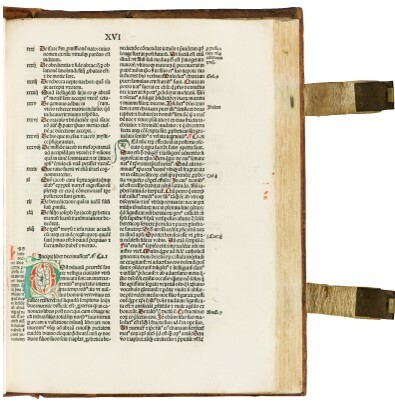
YTB-1Basel, Johannes Amerbach, Idibus februariis [13 II], 1490. In-folio de 268 ff. sign. a10, b-o8, p-y A-K8.6, L-O6.8, veau rose estampé à froid sur ais de bois, dos à nerfs, tranches lisses, fermoirs. Reliure de l’époque. 318 x 225 mm. PRECIEUSE EDITION INCUNABLE ILLUSTREE DE L’UN DES PLUS GRANDS LIVRES DE LA LITTERATURE DE TOUS LES TEMPS, LA SECONDE SORTIE DES PRESSES D’AMERBACH. Goff A. 1244 ; BMC III ; 752 ; Hain 2066 ; Gesamtkatalog 2888 ; Schreiber 3394. “The idea of international law was partly derived from the book; Grotius cites St Augustine. Both Luther and Calvin took Augustine as the foundation of Protestantism next to the Bible itself” (PMM, 3 (for the 1467 edition)). « La Cité de Dieu est l’apologie du Christianisme, écrite par Saint-Augustin (354-430) vers la fin de sa vie. C’est à la fois une philosophie de la société humaine dans son devenir historique, une métaphysique de la société et une interprétation de la vie individuelle et sociale, à la lumière des principes fondamentaux du Christianisme. La Cité de Dieu est, selon l’opinion universelle, l’œuvre qui exprime le mieux la personnalité multiple d’Augustin, à la fois exégète, métaphysicien, psychologue et théologien. Ce qu’il avait fait dans Les Confessions pour l’individu, Augustin le fait dans La Cité de Dieu pour la société humaine. Cette histoire a exercé une influence profonde sur toutes les époques et sur tous les individus curieux et inquiets de leur propre destin. De Bossuet à Balbo, tous ceux qui se sont à nouveau penchés sur le problème de l’histoire, se sont tournés vers Saint-Augustin ; c’est pourquoi, malgré le développement des sciences théoriques, « la Cité de Dieu » reste encore un livre vivant, qui ne cesse de trouver des lecteurs ». “ His work of the City of God marks the transition of Christianity from adolescence to maturity. It influenced radically the theology and philosophy, the political doctrines and economic precepts of the Middle Ages.” Cette très précieuse édition incunable est imprimée en caractères gothiques, sur double colonnes, le texte sur 54 lignes, encadré des commentaires de Thomas Waleys et Nicolas Trivet sur 65 lignes, avec quelques caractères en grec. Elle reprend l’édition donnée le 13 février 1489 par Amerbach. Une grande et belle figure gravée sur bois (197 x 142 mm) attribuée au maître de Haintz-Narr représente Saint Augustin rédigeant son ouvrage, alors que s’opposent à ses pieds la Cité de Dieu à la Cité de Satan. SUPERBE EXEMPLAIRE, GRAND DE MARGES ET DE PARFAITE FRAICHEUR, DE CET IMPORTANT ET RARE INCUNABLE ILLUSTRE. Le grand bois est peint en coloris chaleureux et chatoyants par une main contemporaine ainsi que la première initiale. De grandes initiales sur 6 ou 9 lignes finement peintes. L’ensemble de l’exemplaire est entièrement rubriqué en rouge et bleu alterné. L’exemplaire décrit dans le catalogue du British Museum (III. 752) et acheté en octobre 1867 était incomplet du premier feuillet de titre, illustré du grand bois. Johann Amerbach (ca 1445-1513) est l’un des principaux imprimeurs bâlois. Formé à Venise, il collabora avec J. Von Pforzheim, J. Petri et J. Froben, ainsi qu’avec A. Koberger. Il publia son premier ouvrage daté en 1478, avec J. Reuchlin. Son De Civitate Dei, avec les commentaires de Thomas Valois (1287-1350) et Nicolas Triveth (1258-1354), a fait l’objet de deux éditions. La première, datée du 13 février 1489, est identique à la seconde de 1490. Le grand bois gravé du maître de Haintz-Narr, est formé de deux parties, il représente Saint Augustin assis à son pupitre et, dans la partie inférieure, Jérusalem et Babylone. CIBN, I, A-688 ; BMC, III, 752 (pour un exemplaire mesurant 309 x 213 mm) ; GW, 2888 ; Lokkös, p. 43, n° 53 ; Arnim (M. Von), Katalog der Bibliothek Otto Schäfer, I, n° 23 ; Schreiber, 3394. Est reliée avec, du même auteur : DE TRINITATE. (Basel), Johannes Amerbach, 1490. In-folio de 86 ff. a-c8, d-l8.6, m6. SECONDE EDITION SORTIE DES PRESSES DE J. Amerbach ; l’originale ayant été publiée à Strasbourg pas après 1474. Exemplaire rubriqué à l’époque en rouge et en bleu. CIBN, I, A-721 ; BMC, III 753 ; GW, 2928 : Lokkös, p. 44, n° 56. INTERESSANTE RELIURE DE L’EPOQUE, SORTANT D’UN ATELIER DU SUD DE L’ALLEMAGNE. Sur la tranche inférieure est portée la mention « Augu° de civi. e De Trini » ; dos restauré.
51-4213Frankfurt : Theordoro de Bry 1596 1617. 2 volumes in one. Folio. 24 x 34.4 cm. Old vellum binding spotted. Part V: Engraved title and frontispiece map of New Spain portrait of Christopher Columbus and 22 half-page engravings. Collation: Engraved title page 92pp. repeated title page XXII plates double page folding map of Hispaniae Novae. blank. Part VI: Engraved title and frontispiece folding plan of Cusco Peru and 28 half-page engravings; lacking the map in the 6th part . Collation: 108pp. incl. engraved title page engraved double page bird's eye view of Cusco repeated title page with change to cartouche 28 engraved plates. Waterstaining to the upper corner of most text pages in Part V but not affecting the plates; light waterstaining to the plates in the top margin of Part VI not affecting the text pages.Engraved heraldic bookplate with lions dragon and metal helmuts.Title within engraved ornamental border; initials; headpieces and tailpieces.Roman numeral date on t.p. contains apostrophi.Engraved title page repeated before plates: verso blank: "Praefatio" contains portrait of Columbus with 11 lines of text p. 1: "Secvndi libri svmma et argvmentvm" p. 3: "Novae novi orbis historiae liber secundvs" p. 5-72.Map has title: Hispaniae novae sive Magnae recens et vora descriptio 1595.Signatures: a-hⴠiⶠA-Fⴠ-E1 and F2; F4 is blank.V. Benzoni's History continued. Americae pars quinta nobilis & admiratione plena Hieronymi Benzoni . secundae sectionis Historiae Hispanorum tum in Nigrittas servos suos tum in Indos crudelitatem Gallorumque piratarum de Hispanis toties reportata spolia. Frankfurt: Theodore de Bry "1595" but c. 1617. Blank leaves i6 and F4 . 2 engraved titles engraved portrait of Columbus with thirteen lines of text beneath engraved folding map of New Spain 22 engraved plates.Bry records and illustrates the events surrounding Columbus's discoveries subsequent relations with the natives and the atrocities committed by the Spanish and the native populations. Many of the illustrations have assumed iconic status and the three maps one in each part are also important as landmarks in the mapping of the Americas. Church 157.VI. Benzoni's History concluded. Americae pars sexta sive historiae ab Hieronymo Benzono . scriptae sectio tertia. Frankfurt: Theodore de Bry 1596. Engraved titles LACKING the double-page engraved map of Western Hemisphere with double-page engraved view of Cusco. FIRST EDITION. Church 158.Réunion des rares cinquième et sixième tomes des « grands voyages » consacrés à l'Amérique en seconde édition publiée vers 1617. Le texte est celui de l'Historia del Mondo Nuovo par Girolamo Benzoni d'abord paru à Venise en 1565. Magnifique illustration gravée sur cuivre par Theodor de Bry comprenant un titre-frontispice répété une carte de la Nouvelle Espagne à double page un portrait de Christophe Colomb et 22 gravures à mi-page dans la cinquième partie ; un titre-frontispice répété un plan de Cuzco replié et 28 gravures à mi-page dans la sixième partie.Manque la carte dépliante comprise dans la sixième partie. Mouillures et légères rousseurs ; quelques restaurations de papier toutes marginales hormis sur la carte de la cinquième partie restaurée avec légers manques dans le pli vertical ; titre-frontispice initial doublé.OCLC Numbers: 823867817 and 823868224 digital only.Expertise by Expert Jean Lequoy Librairie Giraud-Badin Paris Frankfurt : Theordoro de Bry, 1596 [1617] hardcover
LCS-186120Exemplaire à grandes marges (hauteur 220 mm), de l’une des plus rares éditions incunables. Strasbourg, J. Gruninger, 1er juin 1497. In-4 de 112 ff. (mal ch. 116) (sig. A6 B-I6/4 K-X4/6 Y6) ornés de 117 bois gravés, 35-39 lignes, caractères romains (restaurations en marges des ff. 1 et 116 sans atteinte au texte). Reliure réalisée dans un parchemin du XIVè siècle. 220 x 153 mm.
LCS-1864020L’exemplaire en maroquin rouge aux armes de la duchesse de Gramont. Paris, chez l’auteur, 1765-1775. 6 volumes in-8. Collation conforme à Cohen. Maroquin rouge, triple encadrement de filets dorés sur les plats, armoiries au centre, dos lisses ornés aux petits fers, filet or sur les coupes, roulette intérieure, tranches dorées. Reliure de l’époque. 197 x 121 mm.
- Michel Lévy Frères, Paris 1868-1870, 11x18cm, 7 volumes reliés et une lettre montée sur onglet. - uvres complètes with an autograph letter: Les Fleurs du Mal - Curiosités esthétiques - L'Art romantique - Petits Poèmes en prose - Histoires extraordinaires - Nouvelles Histoires extraordinaires - Aventures d'Arthur Gordon Pym Michel Lévy Frères | Paris 1868-1870 | 11 x 18 cm 7 volumes bound in shagreen & one letter "Extremely important" edition according to Clouzot: "More and more sought after, rightly so, it includes in first edition: part of Fleurs du Mal, Petits Poèmes en prose, Curiosités esthétiques (except the two Salons), L'Art romantique (except Gautier and Wagner)." The Fleurs du Mal is in its third edition (the last version revised by the author) in part original with the correct date of 1868. Twenty-five poems from Fleurs du Mal are published here for the first time. Volume 1: Les Fleurs du Mal, volume 2: Curiosités esthétiques, volume 3: L'Art romantique, volume 4: Petits Poèmes en prose, volume 5: Histoires extraordinaires, volume 6: Nouvelles Histoires extraordinaires et volume 7: Aventures d'Arthur Gordon Pym. Half burgundy shagreen, spine in five compartments decorated with gilt fleurons, marbled paper plates, caillouté marbled endpapers, contemporary bindings. A very evocative letter quoting each work in progress from Charles Baudelaire signed "C. B." addressed to Auguste Poulet-Malassis has been mounted on the guards at the beginning of Fleurs du Mal. Four pages written in pencil on a double sheet dated 13 June 1859. This letter has been published in Les Lettres (Mercure de France, 1906). Baudelaire wrote to his publisher from Honfleur, where he had been with his mother since April 1859. She reserved two attic rooms in her house for her son and the proximity to the sea seems conducive to work: "You will tell me what you think of my Salon. And of my Gautier? In a short while, I will be able to deliver your Opium et Haschisch, and shortly thereafter, Curiosités complètes, which will be followed by Nouvelles Fleurs." The poet must work tirelessly to pay off his Parisian debts and in particular those contracted with the recipient of this letter: "Can I go to Paris without fear? Without worry? I am referring to the bill of 430 (430?). You would quarrel with De Broise, if you had a protest, and if I have one here, my mother would fling me out the door. However, I want to use the good work arrangement where I am until the end of the year." Rare and precious complete set in uniform contemporary binding of the famous first edition of his works. Preceded by Théophile Gautier's beautiful foreword paying tribute to his "impeccable" disciple enriched with a beautiful handwritten letter in which the Albatros talks of his works. [FRENCH VERSION FOLLOWS] Première édition collective en partie originale, «?extrêmement importante?» selon Clouzot ?: «?De plus en plus recherchée, à juste raison, elle comporte en édition originale ?: une partie des Fleurs du Mal, les Petits Poèmes en prose, les Curiosités esthétiques (sauf les deux Salons), L'Art romantique (sauf Gautier et Wagner).?» Les Fleurs du Mal est en troisième édition - et dernière voulue par l'auteur - en partie originale, à la bonne date de 1868. Vingt-cinq poèmes des Fleurs du Mal paraissent ici pour la première fois, l'édition totalisant à présent 151 poèmes (contre 100 pour l'édition de 1857). Volume 1?: Les Fleurs du Mal, volume 2?: Curiosités esthétiques, volume 3?: L'Art romantique, volume 4?: Petits Poèmes en prose, volume 5?: Histoires extraordinaires, volume 6?: Nouvelles Histoires extraordinaires et volume 7?: Aventures d'Arthur Gordon Pym. Reliures en demi chagrin bordeaux, dos à cinq nerfs ornés de fleurons dorés, plats de papier marbré, gardes et contreplats de papier caillouté, reliures de l'époque. Une très évocatrice lettre autographe citant toutes les uvres en cours de Charles Baudelaire signée «?C. B.?» et adressée à Auguste Poulet-Mala
- Gallimard, Paris 1950, 11,5x18cm, reliure de l'éditeur. - CAMUS Albert Les Justes [The Just Assassins] Gallimard, Paris 1950, 115 x 180 mm (4 1/2 x 7 1/16 "), publisher's paper binding First edition, one of the 1050copies numbered 1050 on alfa mousse paper. Publisher's paper binding with an original design by Mario Prassinos. A handsome and important inscription from Albert Camus to René Char: "à René Char, frère de ceux-ci, dont il a fait toute la route avec l'admiration et l'affection de son ami. / Albert Camus". [To René Char, brother of the undersigned, with whom he has been there all the way, with admiration and affection from his friend / Albert Camus.] The friendship between Albert Camus and René Char is among the most touching and most fruitful in French literature. There was nothing obvious to bring together the Algerian journalist and author and the Provençal poet, much less to suggest a mutual affinity. Camus had not come across Char's poetry and Char had no taste for novels, apart from those of Maurice Blanchot. Nonetheless, it is through their respective works that the two artists found out about each other and developed a mutual respect. So - before Camus and Char actually met - they had met through Caligula and Hypnos - both illustrating the poet's responsibility in the face of the violent world. "So in our darkness Beauty has no given space. All that space is for Beauty" (Char, Feuillets d'Hypnos). It is this mutual need for Beauty as a political response to the outrageousness of ideologies that united the two artists at the end of the war. Catalyst to their friendship, this first "acknowledgment" inaugurated a twelve-year correspondence, during the course of which their mutual affection grew and revealed an artistic convergence: "I believe that our brotherhood - on all levels - goes even deeper than we think and feel" (Char to Camus, 3 November 1951)."What a great and profound thing it is to detach oneself bit by bit from all that and all those who are worth nothing and to find little by little over the years and across borders a community of spirit. Like with many of us, who all at once feel ourselves finally becoming of 'the few'" (Camus to Char, 26 February 1950). These 'few' are a reference to a quotation from Gide: "I believe in the virtue of small numbers; the world will be saved by a few," whom Char and Camus tried to bring together in establishing the Empédocle review: "It is perhaps time that 'the few' Gide talked about came together," as Camus wrote to Guilloux in January 1949. They published writing by Gracq, Melville, Grenier, Guilloux, Blanchot, Ponge, Rilke, Kafka, and so on. However, internal dissension soon engulfed the review and they abandoned the project together. Their friendship, however, remained unblemished. The two men met regularly in Provence, where Char was from and - thanks to him - Camus' adopted home. They showed each other their manuscripts and confided in each other with their doubts: "The more I produce the less sure I become. Night falls ever thicker on the artist's path, his way. Eventually, he dies completely blind. My only hope is that there is still light inside, somewhere, and though he cannot see it, it continues to shine nonetheless. But how can one be sure? That is why one must rely on a friend, one who knows and understands, one who is walking that same path." They inscribed works to each other (the reprints of Feuillets d'Hypnos and Actuelles) and in each new copy wrote inscriptions in which they both reinforced their comradeship in arms and in spirit. "to René Char who helps me live, awaiting our kingdom, his friend and brother in hope," (manuscript of The Plague). "For Albert Camus, one of the very rare men I admire and love and whose work is the honor of our times. René Char," (Fureur et mystère) "[to René Char], fellow traveler, this guidebook to a mutual voyage into the time of men, waiting for noon. Affectionately, Albert Camus," (Actuelles I) "For Albert C
- Grasset, Paris 1913, 11,5x18,5cm, relié. - PROUST Marcel Du côté de chez Swann [Swann's Way] Grasset, Paris 1913, 115 x 185 mm (4 1/2 x 7 1/4 "), 20th-century half morocco First edition, second issue, on ordinary paper, with the printer's date of 8 November 1913, the typographic error to Grasset on the title page corrected and no index. Half grey morocco by Thomas Boichot with anthracite patches at corners, spine in six compartments, date at foot, covers and spine mounted on guards, top edge gilt, slipcase trimmed with grey morocco. A fine autograph inscription from Marcel Proust to Count Primoli: "Hommage d'attachement respectueux et bien vif [As token of my lively and respectful feelings]." Joseph Napoléon, Count Primoli (1851-1927), was the great nephew of Napoleon Bonaparte. Closely tied to the imperial family during the Second Empire, he was later a faithful visitor to his beloved aunt, Princess Mathilde's salon, held at her mansion in the rue de Berri. His refined and spiritual conversation were much admired there and - a passionate bibliophile - he also met some of the great writers of the age: Gustave Flaubert, Théophile Gautier, the Goncourt brothers and even Guy de Maupassant. It was also there that he got to know, from the 1890s on, the young Marcel Proust. The two men found a strong mutual sympathy and the Count, who was dedicated to strengthening literary and cultural ties between Rome (his city of birth) and Paris, invited the writer several times to visit the Italian capital. Proust never went, but in his eyes, Primoli's letters alone carried "a little of the charm of Rome" (letter from Proust to Primoli, early 1907, cited in: Pasquali C., Proust, Primoli, la moda, p. 26). On the occasion of the death of Princess Mathilde, who had made their meeting possible, in 1904, Proust wrote to the Count: "allow me to say only that I shed bitter tears with you, because I loved the Princess with an infinite respect - and because it gives me so much pain to think of you so unhappy, you who are so good and for whom one would wish with all one's heart happiness; with your sad and wounded heart, one wishes that every evil blow would spare you." (letter from Proust to Count Primoli, 4 January 1904, ibid., p. 21). When Swann's Way was published in November 1913, Count Primoli was one of the very first people to whom Proust presented a copy, as a letter of Proust's from early January 1914 attests, mentioning the present copy: "Dear Sir, When my book came out you were one of the very first people I thought of. From the first day we were sending out books, I kept questioning my valet: 'has Count Primoli's copy gone out?' He told it had and it was true. Just today, when I received your card (so amusing and pretty) in which you talk of the Mona Lisa's escort 'in the guise of a musician,' I said to my valet: 'Look, a card from Count Primoli.' He looked at it. 'What? The Count is in Rome? But I sent the book to Paris!' I had a moment of fury and disappointment. Perhaps your concierge has sent your copy on to Rome. But just to make sure, I'm sending a second copy to Rome. Only, I have none left of the first edition. You'll find one in Paris when you come back, it's been there for some time. I can only send you a copy of the second impression, which, by the by, has fewer grave mistakes than the first. But I am too sick and too unhappy at the moment to correct them all myself..." (ibid., p. 51). This copy, then, is the copy of the second issue that Proust send to Primoli in Rome and mentions in his letter. A fine witness to the friendly links between Marcel Proust and Count Primoli. [FRENCH VERSION FOLLOWS] Édition originale sur papier courant, exemplaire de seconde émission comportant le bon achevé d'imprimer du 8 novembre 1913, la faute typographique à Grasset corrigée sur la page de titre ainsi que l'absence de table. Reliure en demi maroquin gris anthracite à coins, dos à
- Charpentier & Fasquelle, Paris 1898, 13,5x19,5cm, relié sous étui. - Charpentier & Fasquelle | Paris 1898 13,5 x 19,5 cm | full morocco with custom slipcase First edition, one of the rare leading copies on Japan paper limited to 50 numbered copies and a few name-specific copies, the tirage de tête. Binding in full green morocco, spine in five compartments set with gilt stippling and adorned with double gilt panels decorated with gilt fleurons intheir centres, recolouring and discreet restoration to a joint, gilt roll tooling on the spine ends, frame of double gilt fillets on the boards brightened in the corners with a set of interlacings and gilt fleurons, iridescent green silk endpapers, frame of five gilt fillets and gilt floral motifs in the corners of the pastedown endpapers, covers preserved, top edge gilt, double gilt fillets on the leading edges, superb binding signed Gruel. Extremely rare and magnificent copy of the most popular play in French theatre, the tirage de tête set in a perfect binding in full morocco signed Gruel. [FRENCH VERSION FOLLOWS] Édition originale, un des rares exemplaires du tirage de luxe imprimé sur japon et limité à 50 exemplaires numérotés avec quelques exemplaires nominatifs, tirage de tête. Reliure en plein maroquin vert, dos à cinq nerfs sertis de pointillés dorés et orné de doubles caissons dorés décorés en leurs centres de fleurons dorés, reprise de teinte et discrète restauration à un mors, roulettes dorées sur les coiffes, encadrement de doubles filets dorés sur les plats agrémentés en angles d'un jeu d'entrelacs et de fleurons dorés, gardes et contreplats de soie moirée verte, encadrement de quintuples filets dorés et de motifs floraux dorés en angles sur les contreplats, couvertures conservées, tête dorée, doubles filets dorés sur les coupes, superbe reliure de l'époque signée Gruel. Rarissime et magnifique exemplaire de la pièce la plus populaire du théâtre français en tirage de tête établi dans une parfaite reliure en plein maroquin signée de Gruel.
München, Hyperion Verlag Hans von Weber, 1912. 4to. Bound uncut in a very nice, exquisite full morocco binding with five raised bands, gilt title and single gilt lines to spine. A single gilt line-border to boards. Top edge gilt. Minor wear along hinges. Internally very nice and clean, with only a few occasional very minor light brown spots. Printed on thick, heavy paper (Büttenpapier) with watermarks. With the bookplate of ""Feuerbacher Heide"" to inside of front board.
Milan, Por el Heredero de Pedromartir Locarni y Iuan Bautista Bidello, 1610. 8vo. In contemporary full limp vellum with title in contemporary hand to spine. Extremities with wear. Repair and a small hole to front board and missing vellum on upper outer corner of back board. Previous owner's name in contemporary hand to title-page. First 8 leaves lightly washed. Damp stain throughout, however mainly affecting pp. 169-340. The paper is still good and solid. A good copy in its original binding. [Blank], 16 ff, 722 pp, [blank]. [mispaginated between pp. 704-707, as called for].
825¾ SS. auf 550 Bll. Verschiedene Formate. Die umfangreiche Korrespondenzsammlung des niederländischen Literaturkritikers, Mäzens, Pädagogen und Bibliophilen Nicolaas Johannes Beversen erstreckt sich über mehr als vier Jahrzehnte und versammelt Briefe und Karten von über 90 Briefpartnern, mehrheitlich Schriftsteller und Maler, darunter Théophile de Bock, Pieter Cornelis Boutens, Colette, Georges Duhamel, Henri Fantin-Latour, Paul Fort, John Galsworthy, André Gide, Paul Herrmann, Ricarda Huch, Käthe Kollwitz, Melchior Lechter, F. T. Marinetti, Romain Rolland, Annie Salomons, G. B. Shaw, Stijn Streuvels, Arthur Symons und Émile Verhaeren. Meist geht es um Vorträge, zu denen Beversen einlädt, um Aufsätze und Beiträge, die er erbittet, und auch so manch Persönliches erfährt man - etwa von Ricarda Huch, die ein Jahr nach ihrer ihre Tochter Marietta nicht allein lassen möchte: "Meine Abneigung gegen Vorträge ist grundsätzlich", so heißt es etwa unterm 27. X. 1912, "und wird sich wohl nicht ändern. Außerdem habe ich noch schrecklich viel Arbeit mit meinem Buche, ganz abgesehen von einer Tochter, die ich nicht allein lassen könnte. Einstweilen muß ich also noch auf das Vergnügen einer Hollandreise verzichten". - John Galsworthy erläutert seine Einschätzung von Charles Dickens: "I safely received the MS. Yes, I'm afraid I do think Dickens - great as he was - was not what I call a poet. He could describe certain kinds of atmosphere well enough, such as the Essexmaster or the Thames in London, but there is lacking even from his best descriptions that which we find in Hardy or Turgenev or Coward. It's almost impossible to express the lack exactly. No, he was not a poet - though the greatest of all natural story tellers […]" (29. X. 1922). - Colette kündigt Beversen die Fertigstellung des zweiten Teils ihres Romans "La Naissance du Jour" (Revue de Paris 35/2, März-April 1928) sowie die Zusendung ihrer berühmten Portraitphotographie mit zwei Katzen (von Henri Manuel) an, die dank des Briefes auf 1928 datiert werden kann: "Ich habe drei Monate lang gearbeitet (an der zweiten Hälfte meines Romans (?) la Naissance du Jour) wie eine Unglückliche, mit unglaublicher Geduld und Mühe. Gestern Abend bin ich fertig geworden! (ich werde ins Kino gehen!) Und ich denke an Sie. Manuel wird ihnen das letzte Foto schicken, das zufällig gut ist, das heißt, dass die zwei Katzen darauf wunderbar sind. Selbstverständlich werde ich nach Den Haag kommen. Ich weiß weder wann noch warum [...]" (Paris, Frühjahr 1928; Übs. aus dem Frz.). In einem undatierten Brief berichtet Colette davon, dass sie sich von ihrem späteren dritten Mann Maurice Goudeket einen Artikel Beversens vorlesen bzw. übersetzen ließ (Paris, vor 1935). - André Gide wiederum versucht vergeblich das jüngste Werk des Diplomaten und Schriftstellers Paul Claudel, wohl "Partage de midi", für Beversen zu besorgen: "Unglücklicherweise ist das letzte Buch von Claudel nicht am Markt. Mit nur wenigen gedruckten Exemplaren befürchte ich, dass es heute durch die Gefallen, die er seinen Freunden damit getan hat, komplett vergriffen ist. Sie sind nicht der Einzige, der bedauert es nicht besorgen zu können [...]" (Paris, 6. I. 1907; Übs. aus dem Frz.). 10 Jahre später beantwortet Gide Fragen zum literarischen Nachlass des 1916 verstorbenen belgischen Dichters und Kritikers Émile Verhaeren: "Madame Verhaeren hat mir nie von den Reiseerinnerungen erzählt, auf die sie anspielen und ich bezweifle, dass V. diese jemals geschrieben hat. Allerdings werden zwei Bände von 'Konferenzen' (später) erscheinen. Ich weiß nichts von der Dossiersammlung die sie angesprochen haben. Ich warte also auf dieses Buch Ihres Freundes Valkhoff; er darf versichert sein, dass ich es mit herzlichster Aufmerksamkeit lesen werde [...]" (Cuverville, 15. XI. 1917; Übs. aus dem Frz.). Vermutlich bezieht Gide sich auf Pieter Valkhoffs "De Franse geest in Frankrijks letterkunde" (Leiden, 1917). - G. B. Shaw berichtet von der Vorbereitung eines Buches mit seinen zwei letzten Stücken "The Doctor's Dilemma" und "Getting Married" (16. XII. 1908), und Käthe Kollwitz beantwortet eine Reihe von Beversens Fragen zu ihrem Werk und erzählt von einer zwei Jahre zurückliegenden Reise nach Belgien und Holland: "Wir suchten die Grabstelle unseres Sohnes auf, der 1914 vor Dixmuiden fiel. Dann waren wir in Amsterdam und im Haag u. sahen die herrlichen Gemälde. Jetzt in diesem Jahr waren wir auf der entgegengesetzten Seite nämlich in Russland [...]" (3. VI. 1928). - Detaillierte Verlistung auf Anfrage.
CZC-8897rareté, notre exemplaire comporte en page de garde, l'ex dono manuscrit de Jean de la Fontaine ( photo) d’où provenance de la bibliothèque du célèbre fabuliste. Caroli de la Rue e societate jesu, Idyllia 88p, Rothomagi, Richard Lammemand, MDCLXIX, comprenant 6 planches gravées pleine page, culs de lampes et têtes de chapitre relié à la suite; Francisci Remondi Di Vionensis e societate iesv, Epigrammata, Elegiiae, et Orationes.237pp. Simonem Millangium, 1606 volume relié in16, 13x8cm, relié velin, très bon état intérieur. Paiement uniquement par chèque de banque, envoi sécurisé avec assurance après le délais d'encaissement d'environ 21 jours.
CZC-8897rareté, notre exemplaire comporte en page de garde, l'ex dono manuscrit de Jean de la Fontaine ( photo) d’où provenance de la bibliothèque du célèbre fabuliste. Caroli de la Rue e societate jesu, Idyllia 88p, Rothomagi, Richard Lammemand, MDCLXIX, comprenant 6 planches gravées pleine page, culs de lampes et têtes de chapitre relié à la suite; Francisci Remondi Di Vionensis e societate iesv, Epigrammata, Elegiiae, et Orationes.237pp. Simonem Millangium, 1606 volume relié in16, 13x8cm, relié velin, très bon état intérieur. Paiement uniquement par chèque de banque, envoi sécurisé avec assurance après le délais d'encaissement d'environ 21 jours.
Small 8vo. 206 pp. Contemporary half calf, with two labels to spine, stored in a two-piece leather slipcase. Rare first edition, self-published by Goethe and Merck in a very small press run. This first impression of the play about the maverick adventurer-poet Götz von Berlichingen contains the hero's famously profane "Swabian salute" unexpurged (p. 133); it was truncated in later editions. In spite of sluggish initial sales, the play enjoyed a sensational success, making the author instantly famous and calling forth severe criticism as well as praise. - Some brownstaining and fingerstaining. Provenance: handwritten ownership "Louis Prèschamps" (ca. 1880) on title-page; an old annotation on the final leaf has been removed. Acquired from the estate of the Frankfurt lawyer Wilhelm A. Schaaf (1929-2015), a specialist in economic, commercial and insolvency law. Hagen 46. WG² 6. Goedeke IV, 3, 143, 2. Kippenberg I, 348. Brieger 682. Hirzel A 33. Speck 712. Goethe-Bibliothek Meyer 23.