Livre Rare Book
19 868 résultats
948S. d. (2nde moitié du XVIe siècle - XVIIe siècle). UN IMPORTANT RECUEIL MANUSCRIT DE PIÈCES HISTORIQUES ESPAGNOLES CONCERNANT NOTAMMENT LE RÈGNE DE PHILIPPE II
- s.d. (ca 1823), 12x18,2 cm et 10x15,5cm, Six pages sur deux feuillets rempliés. - Unpublished handwritten letter to "Julie" (Louise de Pron): "Fool me if you want, I'll believe you, I want to believe you so much and I need it" [ca 1823] | 12 x 18,2 cm and 10 x 15,5 cm | six pages on two double leaves Almost entirely unpublished handwritten letter from the painter Eugène Delacroix to the love of his youth, the mysterious "Julie", now identified as being Madame de Pron, by her maiden name Louise du Bois des Cours de La Maisonfort, wife of Louis-Jules Baron Rossignol de Pron and daughter of the Marquis de La Maisonfort, Minister of France in Tuscany, patron of Lamartine and friend of Chateaubriand. 90 lines, 6 pages on two folded leaves. A few deletions and two bibliographical annotations in pencil on the upper part of the first page ("no114"). This letter is one of the last to his lover in private ownership, all of Delacroix's correspondence to Madame de Pron being kept at the Getty Research Institute (Los Angeles). Only nine of the ninety lines of this unpublished letter were transcribed in the Burlington Magazine in September 2009, alongside the long article by Michèle Hanoosh, Bertrand and Lorraine Servois, whose research finally revealed the identity of the famous recipient. Sublime love letter from twenty-four-year-old Eugène Delacroix, addressed to his lover Madame de Pron, twelve years his senior, who unleashed the liveliest passion in him. This episode of the painter's youth, then considered the rising star of Romanticism, for a long time remained a mystery in the biography of Delacroix, who was careful to preserve the anonymity of his lover thanks to various pseudonyms: "Cara", "the Lady of the Italians", and even "Julie", as in this letter, in reference to the famous epistolary novel Julie ou la Nouvelle Héloïse by Rousseau. For obvious reasons, Delacroix did not sign his name on any of the letters in correspondence with the lady. A great figure of the legitimate aristocracy, the recipient of this feverish letter is Madame de Pron, daughter of the Marquis de La Maisonfort, Minister of France in Tuscany, patron of Lamartine, friend of Chateaubriand. Her beauty was immortalized in 1818 by Élisabeth Vigée-Lebrun, who painted her portrait in pastel, with an oriental hairstyle. Delacroix and Madame de Pron met in April 1822 when the portrait of the latter's son, Adrien, was commissioned, a pupil at the Lycée Impérial (now Lycée Louis-le-Grand). Delacroix had been commissioned for the portrait by his close friend Charles Soulier, Madame de Pron's lover, who despite himself, served as an intermediary for Delacroix. In the absence of Soulier, who had gone to Italy, the painter and the young women established an intense romantic relationship. The portrait commission became a pretext for their tender meetings in his studio on rue de Grès, while no trace of the child's painting has been found to this day. Their adventure lasted a little over a year, but it was one of the most intense passions of the artist's life. Our letter undoubtedly corresponds to the last throes of their relationship, in the month of November 1823. After one of their visits at the end of a hiatus of several months, Delacroix writes to her again under the influence of emotion: "I come home with a shaken heart, what a wonderful evening! [...] Sometimes I say to myself: why did I see her again? In the calm sanctuary where I lived, even in the middle of the invisible places that I had formed [...] I managed to silence my heart". Madame de Pron had indeed decided to bring an end to their intimate relationship (see her letter from 10 November 1823: "I want sweet friendship [...] I do not want to torment you", (Getty Research Institute). Losing all discernment and with blind devotion, Delacroix attempts to revive their affair: "Make me lie, prove to me that your soul is indeed that of the Julie that I once knew, since mine has regained its charming
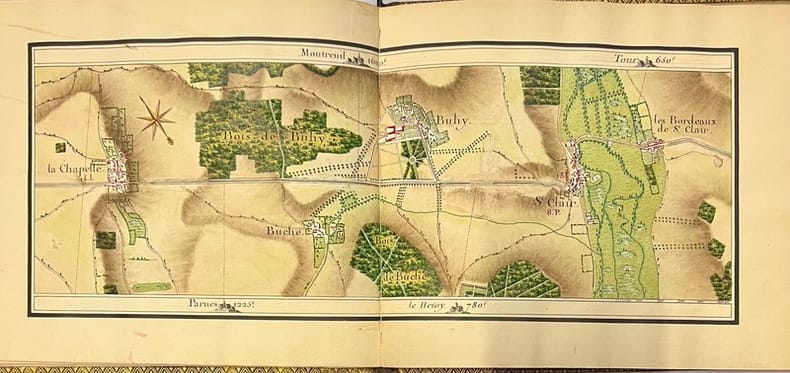
176943413, , 1769. Manuscrit in-8 oblong (23 x 20 cm), titre, table, remarques et 29 cartes à double page finement dessinées et aquarellées, maroquin vert, dos lisse orné, large dentelle dorée encadrant les plats, coupes filetées or, frise intérieure, gardes de soie rose, tranches dorées (reliure de l'époque).
173544793, , 1735-1756. 250 pièces manuscrites reliées en 1 vol. in-4, veau marbré, dos orné à nerfs et armes dorées en pied, pièce de titre en maroquin rouge, triple filet doré encadrant les plats (reliure de l'époque).
4to (167 x 235 mm). French manuscript on paper. (1 blank, 4), 75 ff. Cursive script in light brown ink, per extensum, left and right margins ruled in lead pencil. Contemporary unsophisticated cardboard with handwritten calligraphic title, date and a skilfully executed drawing of a grashooper to upper cover. Unpublished, highly interesting 17th century French manuscript about the history, religion, and topography of the Ottoman Empire, written to convey in brief the essentials of the Muslim world. Chapters include "Origine des Turcs et leurs conquestes", "De la Secte de Mahomet et des Loix et Polices des Turcs" (an extensive discussion of Islam and the Prophet), "Estat present de l'Empire des Ottomans" (on the Ottoman state), "Princes confinans avec l'Ottoman", "Princes pretendans sur cest Empire", "La maniere de faire une ligue contre les Ottomans", and "Moyen d'attaquer, abbatre et aneantir l'Empire des Turcs". At the end, the manuscript also mentions Arabia "on the Red Sea" and the port of Jeddah, "where the pilgrims of Mahomet disembark for Mecca". Further, the author discusses navigation of the Red Sea (dangerous at night) and the coast of the Arabian Peninsula, including the port of Aden, Ras Fartak, Norbat (Ash Shuwaymiyyah) opposite the Khuriya Muriya Islands, Muscat, the Kingdom of Ormuz and other places in the Gulf under Portuguese rule. - Occasional slight brownstaining, lower half of title-page defective and rebacked (apparently without loss), otherwise a well-preserved, well-legible manuscript, untrimmed in its original 17th century binding.
4to (160 x 222 mm). 90 pp. followed by 4 blank leaves (foliation: 1-39, 48, 50-51, 54-56, and 57-60 blank). Text written in Gujarati (or Hindi?) in black and red ink on paper, illustrated with 10 miniatures in polychrome pigments, including erotic subjects. Old title label "Manuscript Kamasutra Gujarat School" to verso of final leaf. Block-stitched. An Indian manuscript, possibly the Kama Sutra, including six illustrations showing couples engaged in love play and four more showing women only. - Some edge flaws; one leaf loose. Apparently not quite complete according to the contemporary leaf numbering, but still an uncommon, fairly early survival. - Provenance: Unidentified British collection, then in a French collection and subsequently bought by the industrialist and patron Pierre Bergé (1930-2017); acquired from the sale of his estate.
Oblong 4to (256 x 204 mm). Manuscript (ink on paper), 64 pp. with numerous illustrations in watercolours and pen-and-ink, mainly in Grisaille manner (iron tools as well as punch-marks and monograms). Contemporary coloured pink and turquoise papered boards with gilt cover borders and paper applications. All edges gilt. This uncommonly attractive manuscript from Waidhofen an der Ybbs, the centre of the Lower Austrian iron industry since the Middle Ages, depicts the products of the various local ironsmiths as well as their punch-marks in watercolours of superior quality, thus providing an invaluable a key to identifying extant iron tools. The illustrated tools include scythes, sickles, knives, hammers, pliers, compasses, wrenches and vices, saws, razors, locks and keys, axes and hatchets, spades, sabres, horseshoes, bells, lamps, guns and crossbows, files, nails, hooks, pots and pans, watering cans, spoons and ladles and many other specialist tools. - Dedicated to the 30-year-old Archduke Ferdinand (1793-1875), later (1835-48) Emperor of Austria as Ferdinand I, with illustrated dedicatory leaf following the title page: "Ihro Kais. Kön. Hoheit dem Kronprinz Ferdinand von Oesterreich bey Hochderselben Durchreise in der Commerzial-Stadt Waidhofen an der Yps, den 26. August 1823, in Ehrfurcht gewidmet vom Stadtmagistrat zu Waidhofen an der Yps" ("To his Imperial and Royal Highness the Crown Prince Ferdinand of Austria on the Occasion of His Passing Through the Commercial Town of Waidhofen Upon Ybbs on the 26th of August, 1823, Dedicated Reverently by the Town Council"). - Binding slightly rubbed and insignificantly stained in places. A fine document of Lower Austrian craft and trade history, important as a historical source.
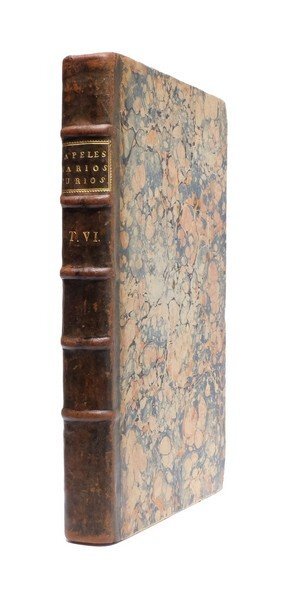
185935S.l., (XVIIIe siècle) 6 vol. in-folio, environ 2200 pages, veau brun marbré glacé, dos lisses cloisonnés et fleuronnés avec pièces de titre grenat, armoiries dorées au centre des plats, coupes filetées, tranches mouchetées (rel. de l'époque). Qqs petits défauts d'usage sans gravité.
4to (the tables measuring ca. 515 x 740 mm). - (Bound with) II: Copia de la carta remitida a s.e. en 16 de septiembre de 760, que acompaño al manifiesto, plan y demas documentos sobre renta. - (Bound with) III: Manifiesto de la renta de seda del reyno de Granada, executado de orden del Exmo. Sr. Marques de Esquilace del Consejo de S.M. su secretario de el de Hacienda y Superintendente general de todas Rentas Reales. 17 ff., 11 ff., plus 2 large folding tables ("Estado de los morales y moredas existentes en la Ciudad de Granada, ciudades, villas y lugares de su thesoreria" and "Plan general de los valores que produce la Real Hacienda de población del reyno de Granada"). Stored loosely in a modern folder. Impressive calligraphic presentation manuscript with an account of the history and 18th century state of the renowned silk production in Granada. Having belonged to the Marqués de Esquilache, Minister of Charles III, and signed in Granada by Pedro Paschio de Baños y Molina (1762), this beautiful copy was executed by a skilled calligrapher for the personal collection of the Marqués, probably by a calligrapher in Granada, where resided a number of professional scribes who produced elaborately decorated Cartas Ejecutorias (patents of nobility) for the Cancilleria. - Granada was known for centuries throughout the Mediterranean and beyond for the high quality of its silk: according to the German traveller Hieronymus Münzer in 1492, theirs was the best in the world. Its fame lasted to the end of the 19th century, when the German Imperial family still bought Granada silk. The cultivation of silk in Granada had been the main source of revenue for the Muslim Nasrid Kingdom of Granada; after its fall to the Catholic kings in 1492, it filled the coffers of the Spanish crown. Until the expulsion of the Moriscos in 1609 the production of silk remained mainly in their hands. Historians have argued that the steep hike of silk taxes ordered by Philip II led to the Morisco rebellion of 1568-71. The silk was traded from three exchanges (alcacerías), the main one situated in Granada, where since the period of Nazari rule Genovese traders were active and exported the silk throughout the Mediterranean and even to America. - This document testifies to the great interest that the Spanish kings took in the promotion, cultivation, and trade of silk in the second part of the 18th century. It is a beautiful document remarkable for the wealth of information it contains. In the best spirit of the Enlightenment, it meticulously records the number of mulberry trees in all localities of Granada, from the smallest to the largest, the number of additional trees that could be planted, the yearly expenses for juros (loans that the King had vouched to pay to certain individuals and religious institutions), and other items. - The document is addressed to the Marqués de Esquilache, minister of King Charles III, by Pedro Paschaio de Baños y Molina, director of the King's revenue in Granada. Paschaio, a member of a family of accountants, became very wealthy at the service of the crown. In 1752 he owned nine houses in the Macarena in Granada, six taverns, and lands. Born in 1691, he bought the post of mayor of the city of Granada in 1724. From this position he initiated his social ascent by organizing the visit of King Philip V to the city in 1730. By 1760 he was director of finances of Granada, an office which undoubtedly augmented his wealth. He financed several important religious buildings in Granada in the late Baroque style. - Professionally restored tears, almost invisible, to large folding tables; some minor oxidation to ink as expected, but overall in excellent condition. A. M. Gómez Román, "Moral aristocrática, filantropía y promoción en la figura de Pedro Pascasio de Baños", Cuadernos de Arte de la Universidad de Granada 36 (2005), pp. 139-149. J. Highet, "Silks from Islamic Lands", Asian Art, 6 March 2014. J. R. McNeill, The Mountains of the Mediterranean. An Environmental History (Cambridge, 1992), p. 226. Girón Pascual Rafael María, Las Indias de Génova. Mercaderes genoveses en el reino de Granada durante la edad moderna (Editorial de la Universidad de Granada, 2013).
4to (230 x 160 mm). Latin and Italian manuscript on vellum. 80 numbered ff., 21 lines. Headings and highlighted words in red; ruled throughout. Contemp. auburn calf, covers and spine elaborately gilt; all edges gilt; giltstamped supralibros "Iacobo Priolo" and date "MDLXXVIIII" on the covers. Wants ties. Interesting manuscript on the constitutional and legal history of the Venetian state, with many decrees regulating commerce, drafted in the age of Venice's great trade relationship with the East. The clean and well-legible manuscript, written in the classical humanist chancery style, was obviously prepared for members of the senate (signed at the end by the secretary, Giulio Zamberti, with the scribe's monogram). The decrees are arranged in chronological order, rater than by subject. The earliest dated decree is from the year 1351, but most date from the mid-16th century. The edicts regulated public life of the Venetian state, including civil servants' salaries, matters of commerce and trade, offices, criminal law, banishment, and other matters. The first leaf bears the dedication by the doge Nicolò da Ponte (in office 1578-85) to Jacopo Priuli, a member of one of the foremost modern-age families of Venetian patricians (producing two doges in the 16th century). The familiy, ennobled as early as 1297 and one of the richest in Venice, is also known for its patronage of the arts, commissioning several Tintoretto portraits. As a member of the senate, Jacopo would have been entitled to a private copy of the statues. The high quality of the binding with its rich arabesque ornamentation and wide ornamental borders on the covers reflects the importance of the patron family. - Engraved bookplate of Amadeo Svayer (Gottlieb Schweyer, 1727-91), a Venice-based German merchant and bibliophile who had assembled a huge and select library which after his death was almost entirely integrated into St Mark's library.
176844617S.l.n.d. (Yverdon, , 1768). Manuscrit de 4 pages in-4.
8vo (100 x 150 mm). 187 written pages on 175 unnumbered ff. (numerous otherwise blank pages ruled in red ink). German and occasional Latin manuscript on paper by at least three different hands in brown and red ink, written in a regular cursive hand. With gilt calligraphic frontispiece in micrography, 2 full-page portraits and 1 coat of arms, all in watercolour and gilt. Contemporary blindstamped calf, edges goffered and gilt, upper cover stamped "Adam Eckhart". Wants ties. Charmingly illustrated medical manuscript by several hands, all belonging to the late 16th or the earliest decades of the 17th century. The first part of the manuscript is a compendium of surgeon's recipes, mainly comprising ointments, powders, and bandages against stabbings and other bleeding wounds, as well as preparations against cramps and other conditions. The arrangement into several segments, each followed by a few blank pages, as well as a few scribal lapses suggest that this part was copied from an earlier manual and was intended to be expanded. The anonymous author of this compilation, possibly written as early as the late 16th century, makes no secret of his admiration for Paracelsus, to whom he dedicates a coloured double-page illustration showing the portrait, arms, and coffin of the great physician and alchemist. - This is followed by an extensive section captioned "Der barmhertzige Samariter" ("The Good Samaritan", fol. 55 ff.), signed at the beginning and end by Stephan Knauff - very likely the barber surgeon of this name based in Vianden near Trier, mentioned in 1634 in the miracle books of the Eberhardsklausen monastery (cf. P. Hoffmann, Publikationen der Gesellschaft für Rheinische Geschichtskunde, vol. 64, no. 824). - A full-page illustration at the end of the volume shows a priest with a cross and a Vanitas skull - apparently a self-portrait by Johann Martin Hecker, a native of Baden who served as chaplain in Fraulautern in the Sarre region. In a two-page postscript dated 29 December 1619 he dedicates the volume to his "good friend" Adam, very probably the Adam Eckhardt whose ownership is stamped to the upper cover. It may also have been the theologian Hecker who prefixed the volume with the highly decorative frontispiece: a single leaf from a slightly earlier catechetic manuscript, trimmed and pasted on fol. 3 ("Die sechs Hauptstuck christlicher Lehre, in unten verfassete stuck geschrieben, durch Martinum Dornbergern", dated 1608). The masterly calligram in micrography shows the Ten Commandments, Lord's Prayer, Apostles' Creed, etc. in the shape of a chalice, Eucharistic wafer, and Tablets of Law. The calligrapher Martin Dornberger is mentioned in the 1580 Book of Concord as a Lutheran verger in Hilpoltstein (Franconia). - Binding a little rubbed and warped, spine and hinges rubbed, upper spine-end a little chipped. Interior somewhat browned and stained with occasional light waterstains; several paper flaws to lower corners without loss to text. From the library of the Antwerp banker and bibliophile Jan Baptist Vervliet (1855-1942) with his bookplate to front pastedown.
17977617330 fructidor 1797 An V [16 septembre 1897] | 18.50 x 21.30 cm | 3 pages sur un double feuillet
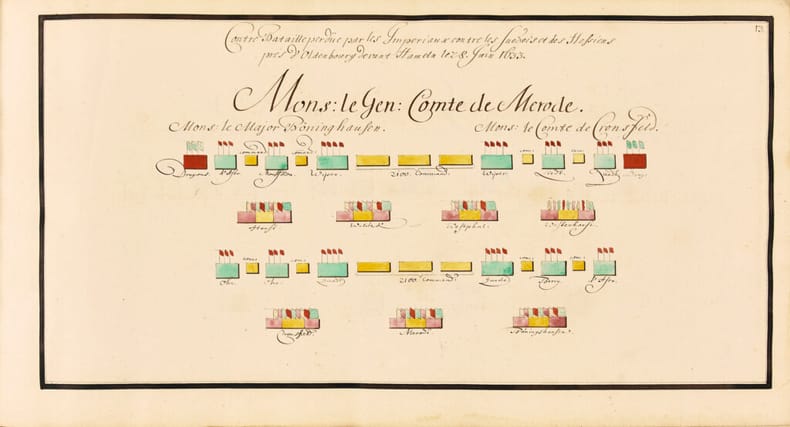
LCS-18055Album manuscrit illustrant la plupart des grandes offensives européennes du XVIIe et du début du XVIIIe siècle. Dresde, 1716. In-folio oblong. Manuscrit à l’encre et à l’aquarelle comportant un titre calligraphié, un index de 8 pages et 140 plans de batailles et plans des camps des armées (sur 153) illustrant les plus importantes batailles européennes livrées sur une période de presque un siècle. Chaque plan est inséré dans un liseré à l’encre noire. Marge inf. du titre restaurée, qq. taches. Demi-maroquin rouge moderne non rogné. 299 x 570 mm.
18086896726 mars 1808 | 20 x 24.80 cm | 3 pages 1/2 sur un double feuillet
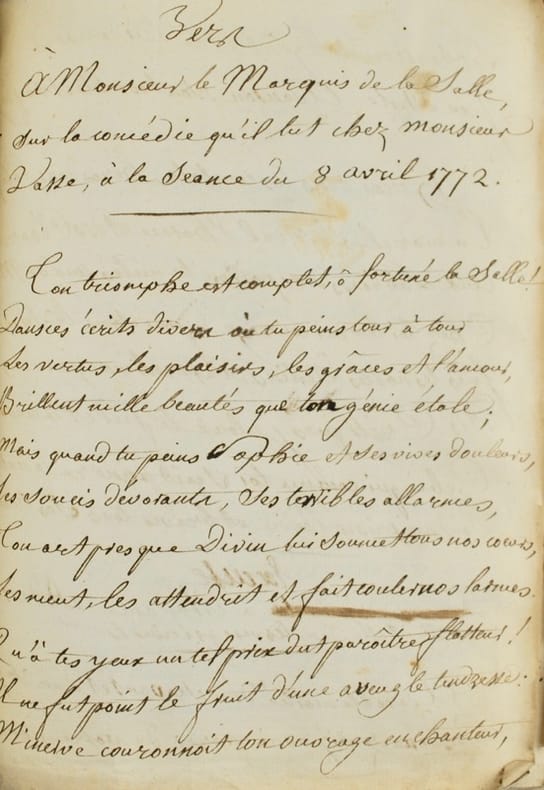
177410274, , [1774 ca]. Environ 300 pièces manuscrites reliées en 1 fort volume in-4, cartonnage brun, pièce de titre en maroquin rouge recueil divers, étiquette manuscrite à l'encre du temps sur le dos Chaos poétique 1774 (reliure de l'époque).
Folio (27,5 x 18,5 cm). (1 blank), (1), 66 pp. With 5 full-page and 2 half-page hand-painted religious illustrations and 9 hand-painted initials on a blue background, heightened with gold and silver. 18th c. gold- and blind-tooled vellum, each board with a blind ornamental centrepiece in a blind-tooled frame, within a larger frame of gold fillets, with a gilt floral design in each of the 6 spine compartments. A manuscript service book for the divine offices of the confraternity of Santa Maria di Passione (Santa Maria della Passione), remarkably illustrated and penned on vellum in a very fine and legible hand, largely imitating roman printing types. It contains seven illustrations, the five full-page examples showing the Virgin Mary: the Pietà, the Annunciation, Mary as the Woman of the Apocalypse, a Madonna and child, and the Assumption of Mary. The two approximately half-page tailpieces serve a more decorative function, representing of six putti on a garland with grape vines and a tree or shrub (laurel?) growing out of a gold vase (the fragments of red and black text on the vase are in mirror image and must have stuck to the paint). All illustrations are hand-painted with gouaches in striking colours. - A divine office, or liturgy of the hours, contains the official set of prayers for the eight canonical hours of the day: matins, lauds, prime, terce, sext, nones, vespers and compline. The day began with the matins at approximately 2 a.m. and ended at 7 p.m. with compline. Each of the offices in this manuscript begins with a hand-painted initial in gold on blue ground with silver foliage; the text of the matins contains an extra initial, bringing the total to nine. Apart from a detailed description and instruction for the offices, the manuscript also contains other instructions and rules to be observed by members of the confraternity, such as the rites for welcoming novices and pilgrims. - The first known mention of the confraternity of Santa Maria di Passione was in 1455; a set of rules ("Ordini riformati della compagniadi santa maria della passione al campanile dei reverendi canonici") has survived from 1565. The confraternity was located in Milan, in a building right next to - or even attached to - the basilica of Sant'Ambrogio called the Oratorio di Santa Maria di Passione. The basilica was built by St Ambrose in the 4th century, and during its long history it has hosted multiple religious communities, some simultaneously. Even after the damage done during the bombing of Milan by Allied forces in 1943, the building still shows this history in the many different chapels and the existence of two towers, one built for the canons located on the north side and one built for the monks on the south side of the basilica. The confraternity was disbanded near the end of the 18th century and the oratory, until then an autonomous building, was bought by the management of the basilica. The oratory was decorated with several frescos, which were auctioned off at the end of the 19th century, including three bought by the South Kensington Museum (now the Victoria and Albert Museum) in London. - Binding slightly soiled. With an owner's label "Sub tutela matris" (under protection of the [holy] mother) and an inscription in Dutch on the front pastedown: "Handschrift met geschilderde prenten. Italiaansch werk op perkament" ("manuscript with painted illustrations. Italian work on vellum"). The vellum leaves vary in colour from white to slightly toned. Illustrations, initials and text leaves generally in good condition except for the initials on pp. 7 and 31; illustration on p. 33 shows some minor soiling. A tear in p. 9 repaired with tape (but text remains legible), lower corners of the leaves show minor signs of wear, otherwise in good condition. Illustrated manuscript written in a very fine, legible hand. An attractive Italian manuscript that provides an insight into the day-to-day religious life of the members of the confraternity of Santa Maria di Passione in Milan and is supplemented with eye-catching, hand-painted illustrations and initials. Cf. A. Rovetta, "Oratorio di Santa Maria della Passione - Cenni storici", in: Oratorio della Passione in Sant'Ambrogio a Milano: Risanamento degli intonaci e restauro degli affreschi (Milan, 2004), pp. 10-17.
4to (190 x 248 mm). French manuscript, ink on paper. (2), IV, 190 (but: 189), (7) pp. (first leaf blank save for the ink borders, pp. 33-34 transposed before 27, p. 146 skipped, last text and last index page blank). With numerous ink drawings throughout, many full-page. Contemporary full calf with remains of a spine label ("Ev... Na..."). All edges red. An encompassing, finely executed manuscript on naval tactics, composed by an officer of the French navy, where this subject had long enjoyed special emphasis. The present manual contains 91 "evolutions", or techniques of seamanship and combat manoeuvres. It is unpublished in this form, but it draws heavily on and assimilates the classic works of Tourville (1693), Hoste (1697), Morogues (1763), and Bourdé de Villehuet (1765), often providing the section's source in the margin. As the anonymous author states in the preface ("Avertissement sur le suject de ce recueil"), he has compiled in this volume, at the suggestion of many younger navy officers and sailors, the sum of knowledge he acquired during his 36 years of service. The painstakingly prepared pen-and-ink illustrations show show fleet and battle formations as well as manoeuvres on the high seas and in coastal areas. With a detailed table of contents ("Table des evolutions co[n]tenues dans ce recueil") at the end. - Spine professionally repaired. A few light stains throughout, otherwise well preserved.
- 19 août 1915, 22,2x28,6cm, 2 pages sur un feuillet. - 19 August 1915, 22,2x28,6cm, 2 pages on a leaf. Autograph letter in German signed by the painter Franz Marc to his mother Sophie Marc (née Maurice); two pages in black ink. Trace of horizontal and vertical fold. Unpublished letter. Marc's wartime correspondence with his wife Maria has been published, with only a few letters to his mother (Franz Marc, Briefe, Aufzeichnungen und Aphorismen, Berlin, Paul Cassirer, 1920). Lengthy unpublished letter from Franz Marc to his mother during the First World War, written a few months before his death in Verdun. In the horror of the conflict, the future martyr of German expressionism recalls childhood images and tells horse stories from the front. Stationed on the Alsace front, the famed animal painter recounts a hilarious wild boar hunt improvised during a horseback ride, reminding him of an illustrated childhood tale: The Three Jovial Hunstmen by Randolph Caldecott (1880). Franz Marc reveals here an inspiration for his famous horses, which gave their name to the "Blaue Reiter" movement created in 1911 with Wassily Kandinsky. The horses in Caldecott's Huntsmen resemble Franz Marc's paintings from 1905-1910. This anecdote is also related to "hunting horses" sketched on the front, and a postcard sketch of the same "Jagende Pferde" sent to the poet Else Laske-Schüler in September 1915. The letter gives a glimpse of Franz Marc's daily life on the front. By a cruel irony of fate, he fought in the native region of his mother Sophie Marc née Maurice, born in 1847 in the Alsatian village of Guebwiller. When war broke out in August 1914, he joined the army hoping for a renewal of Europe like many fellow artists and intellectuals. Due to the circumstances of the war, the painter wrote his letter in German and not in French, as he was accustomed to do in his correspondence with his mother. His mother's influence was decisive in his aesthetic and spiritual approach: Marc's tireless quest for "purity" inherited from his Calvinist upbringing eventually led him to abstraction, already present in his sketches as he wrote this letter. He gives news of a future promotion, thanks his mother for sending him food and fills the page with the story of his miraculous hunt: "I have one more amusing story to tell: as I was riding out at dawn (before breakfast), I suddenly noticed a young boar (a wild boar) beside me in a ditch. I immediately called my fellow riders; he was surrounded - I already felt sorry for the poor animal, but the pity came too late! - Two of them jumped in, one grabbed him by the ears, the other poked him and the roast for the steward's table was retrieved. A most comical scene ensued: We ordered the youngest [soldier] to go home with the boar and got him on horseback; but no sooner did the horse feel the boar on his back (horses are very afraid of boars) than he reared up and threw the rider and the pig into a great arc. Fortunately, nothing happened and the embarrassed rider had to walk the boar back, then the horse really reared up as soon as he was approached. A real amateur rider! I was thinking of Dad's old English picture book: the jovial huntsman!" With this light-hearted anecdote, the painter reveals a source of inspiration still unknown to critics and historians. The Three Jovial Huntsmen certainly influenced the young Franz Marc, whose own horses painted in the 1910s (including the Weidende Pferde I, Lenbachhaus, Munich) are unmistakably marked by Caldecott's British style. In the following years, he added to this subject his kaleidoscopic touch and his emblematic blue, red and yellow colors charged with spiritual symbolism. Franz Marc also painted blue wild boars in 1913 (Museum Ludwig, Cologne). The story of this hunt is also completely new, since he asked his mother to tell it to his wife Maria to avoid writing a second letter "es ist lang: welch, sowas zweimal erzählen" (it's long: to tell the same thing twice). This
- s.l. (Vincennes) s.d. (circa 1781), 15,7x20,1cm, une feuille. - SADE Donatien Alphonse François, Marquis de Autograph letter to his wife. Hommages à la Présidente: "Faire noyer vive l'exécrable coquine qui depuis neuf ans [...] suce mon sang..." N. p. [Vincennes Castle] n. d. (circa 1781), 157 x 201 mm (6 3/16 x 7 15/16 "), single leaf "The more I think about it, however, the more I think you have to have quite a nerve to dare write to a poor suffering unfortunate..." Autograph letter unsigned from the Marquis de Sade to his wife. One page, closely written in ink on 31 lines. This letter was written during Sade's imprisonment at Vincennes, probably in April 1781, if one is to believe the occasional indicators of date referenced by the writer. Sade mentions the end of his "exile from Marseilles", referring to the decision of the court in Aix-en-Provence to overturn his conviction for debauchery and libertinage on the 14 July 1778, but which nonetheless banned him from living in or visiting Marseilles for three years. Sade also mentions one of the defining episodes of his life, his flight to Italy between January and November 1776: "they may as well have killed me straight off as left me in that foreign country where I was." Sade also mentions the "amazing favor" that befell him of "moving house", which is to say his potential transfer to the fort at Montélimar. In April 1781, Madame de Sade, through the good offices of her friend Madame de Sorans, got authorization from the King for her husband to be transferred to the prison there. Sade explains in the letter: "I think you have to have quite a nerve to dare write to a poor suffering unfortunate who has been beset these nine years...telling him to thank, ever so humbly, the woman who obtained for him the amazing favor of moving house." Sade is here no doubt referring to the famous Madame de Sorans, a lady of Louis XVI's sister's bedchamber and a friend of his wife's who, out of a spirit of adventure, accepted the task of petitioning the King in his favor. It was to Commissioner Le Noir, referenced in this letter, that Renée-Pélagie left the task of breaking the news to the prisoner: "Ah, I see now what this nice little visit by M. Lenoir means, I'm used to seeing him in the middle of my incarcerations." Despite the fact that, as Pauvert points out in Sade vivant, this change of "house" occupied the Marquis' thoughts to a large extent, he was never actually moved, preferring to stay in the gaols of the keep at Vincennes. At this point, Sade had been imprisoned for several years and this letter, full of movement, reveals his thirst for freedom. This letter was written when Madame de Sade withdrew to the convent at Sainte-Aure. If she saw this act as a liberation from the yoke of her marriage, the Marquis for his part was obsessed by the idea of his own liberation and mentions a potential date: October 1783. His long incarceration, which began in 1777, would last till April 1790, when lettres de cachet were abolished. Madame de Sade's visits were not reauthorized by the prison authorities until 13 July 1781, after four years and five months of separation. Several important themes in Sade's correspondence already appear in this letter from his first years in prison. First of all, his hatred for his mother-in-law, the Présidente de Montreuil, an "execrable wretch who drinks [my] blood...disgraces [her] children, who has not yet done scattering her horrific deeds and platitudes" and whom he would like to "drown alive". The Marquis also complains of his poor physical health: "my head spins and in my condition I hardly need any more misery", using very Sadean epithets to express his despair. "A poor suffering unfortunate who has been beset these nine years"; "what have I done, what have I done dear Lord, to suffer for twelve years?". Provenance: family archives.
- s.n., s.l. 17 août 1780, 10x16cm, 2 pages sur un feuillet. - Handwritten letter to his wife. Sufferance and philosophy: "Punish as much as you like, but do not kill me: I did not deserve it [...] Ah! If you could read to the bottom of my heart, see everything that happens there, I think you would give up using it!" August 17, 1780, 10 x 16 cm, loose leaves Handwritten letter from the Marquis de Sade addressed to his wife. One recto-verso leaf written in fine, tight writing. It has the partial date at the top "ce jeudi 17" "this Thursday 17th." Two slight signs of folding. The end of the letter was mutilated at the time, probably by the prison administration which destroyed the Marquis' licentious correspondence. So, several months later, in March 1781 his wife wrote to him: "My dear, you really must change your style so that your letters can reach me whole. If you give the truth, it offends, turns against you. If you give any untruths, they say: this is an incorrigible man, always with the same head that ferments, ungrateful, false etc. In any case, your style can only harm you. So change it." The letter was found as it was when, in 1948, the Marquis' trunk, that had been sealed by the family since 1814, was open and it was published in this reduced form in the correspondence of the Marquis de Sade. Provenance: family archives. This letter was written on 17 August 1780, during the Marquis' incarceration in Vincennes Prison. Following the umpteenth altercation with the prison guard, the right to go for a walk was taken away from him on 27 June and was not reinstated until 9 March the following year. The Marquis' physical and mental health is strongly affected by not being able to go out and he constantly begs Renée-Pélagie for the right to be quickly reinstated: "I urge you to let me get some fresh air: I absolutely cannot take it any longer." The suffering caused by these deprivations is a pretext for setting up a mechanism of guilt and blackmail with his wife: "There, three days that I have felt an awful dizziness, with blood rushing to my head so much so that I do not know how I have not fainted. One of these days, they will find me dead and you will be responsible, after having warned you as I do and having asked you for the help which I need to avoid it." Here, the Marquis is intentionally pulling on Renée-Pélagie's heartstrings, really putting her Christian values to the test and giving her the role of grand inquisitor: "You can grant me what I ask for, whilst keeping, on your signal, the same strength." We note, as in Tancrède's letter, a new appearance of "signal," which masks completely different semantics. An essential component of the Marquis' prison mindset, this encoded language, like the fantasised interpretations of his correspondents' letters, feeds the theories of researchers, philosophers, mathematicians... and poet biographers. As such, Gilbert Lely estimates that, far from being symptomatic of psychosis, the return to signals is "his psyche's defence reaction, a subconscious struggle against despair where, without the help of such a distraction, his motivation could have declined." Missing from his correspondence during his eleven years of freedom, these enigmatic semantic depths, "a real challenge to semiological judgement" (Lever p.637), reappear in his Charenton diary. This letter is also an opportunity for the Marquis to deploy his rhetorical panel, confronting the sadistic antonyms in the same sentence. "Pleasure" is synonymous with "abominable" "revolting," "cemetery"and "garden" are superimposed, "I suffer" is conjugated as "I enjoy" and "softness" stands alongside "darkness." The mastered practice of this eloquence exercise is united with the depths of Sadian thought: sufferance and pleasure are closely mixed, simultaneously endured, inflicted and desired. Through these associations, we glimpse the sensitive Manicheism of the Marquis's philosophical thought, which reaches its climax at the en
231001S.l., s.d. (1826-28) in-folio, en feuilles ou broché sous couverture d'attente de cartonnage souple orange moucheté, le tout dans double emboîtage de carton vert moderne.
182375940s. d. [ca 1823] | 12 x 18.20 cm | Six pages sur deux feuillets rempliés
195483744Meudon 1954 | 20 x 27 cm | 16 feuillets (9 pour le premier manuscrit + 7 pour le second)
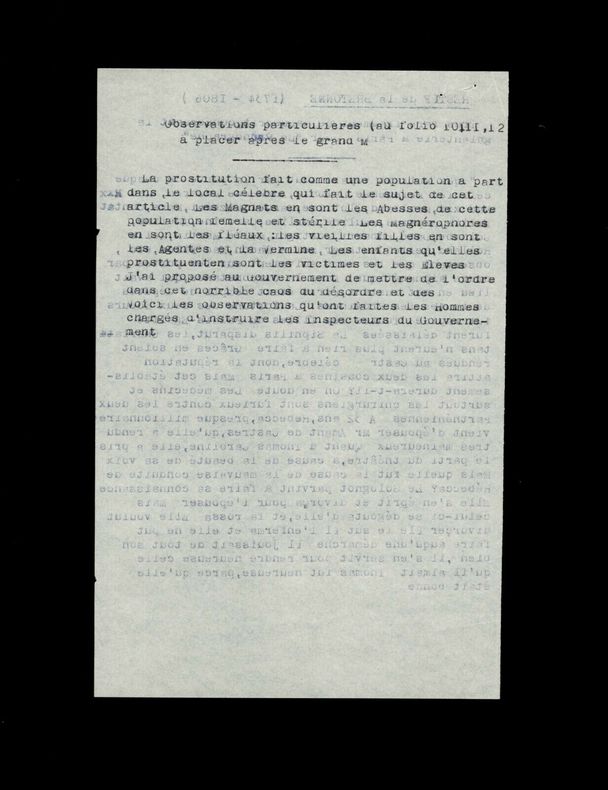
1802AMO-3378Nicolas-Edme Rétif de la Bretonne [Restif de la Bretone] FRAGMENT DE MANUSCRIT AUTOGRAPHE INÉDIT. Vers 1802 / 1804 1 page in-4 Cachet de collection ancienne. Papier vergé. ON JOINT : Transcription dactylographiée par un précédent propriétaire-collectionneur (2 pages in-8).