19 839 résultats
Very Good Turkish, Ottoman (1500-1928) Original color manuscript calendar prepared on a fine special paper with 'ahar'. 36x22,5 cm. In Ottoman script (Turkish with Arabic letters). 2 p. Several ink stains on paper, chipped on extremities. A very good manuscript. It shows astronomic situations, locations of planets and stars, and climates in 1324 [AD 1908]. It starts with high praise to Sultan Abdülhamid II with an old style of color moon & crescent icon. Sealed by Mehmed Pasazâde A. Ihsan. On the verso of paper, can be seen detailed calendar and details of 'ruzname'. Written on 'printed' down of the paper, probably it's prepared for the printing, therefore it's understood that Ihsan and Refet were thinking to print this 'taqwim'. Prepared in the year of the Second Constitutional Regime (II. Mesrutiyet) which was Abdul Hamid II's fall came as a result of the 1908 Young Turk Revolution, and the Young Turks put the 1876 Constitution back into effect. It seems, it's prepared before fall of the Sultan, and for the present to the Sultan. The Second Constitutional Period spanned from 1908 until after World War I when the Ottoman Empire was dissolved. "The starting year of the Hijrî calendar (al-taqwim al-hijri), the fundamental Islamic lunar calendar still in use among Muslims until today, is 622 CE. Its beginning corresponds to the Hijra or emigration of Prophet Muhammed and his followers from Mecca to Medina. It is based on the revolution of the moon around the Earth and consists of twelve months of 29 or 30 days: Muharram (30), Safar (29), Rabî' al-awwal (30), Rabi' al-thani (29), Jumâda al-awwal (30), Jumâda al-thani (29), Rajab (30), Sha'ban (29), Ramadhan (30), Shawwal (29), Dhul-'l-qi'da (30) and Dhul-hijja (29 or 30). The lunar year consists of 354 days, which is 11 days less than the solar year, and every 33 years it falls one year behind the Gregorian calendar. The discrepancy with the solar year, which follows the seasons, meant that Muslim countries also used the solar calendar, and some calendars drawn up by astronomers include the dates according to the European Gregorian calendar named after Pope Gregory XIII in 1582. Ottoman Turkey used both the Islamic lunar calendar and a solar calendar known as the Rumî or Roman calendar, which was based on the Julian calendar introduced since the times of Julius Caesar in 46 BC. The Roman calendar was inherited from the Byzantines and was used by the Ottomans for the taxation of agricultural revenues. The year according to the Rumî or Julian calendar began on 1 March, and the Ottomans took the starting year to be that of the Hijra. To make up for the gain of 11 days made by the solar Rumî calendar over the Islamic calendar, a leap year was deducted from the Rumî calendar every 33 years. A rûzname is a set of tables giving the first days of the months in both the Islamic and Rumî calendars, the date on which the sun enters each sign of the zodiac, and eclipses of the sun and moon. Also known as takvîm-i dâimî (perpetual calendar) or takvîm-i devr-i dâim (calendar of perpetual motion), the ruzname were permanently valid whatever the year. There is no evidence that such calendars were produced in pre-Ottoman times, and they may, therefore, be regarded as a type unique to Ottoman Turkey.". (Source: Glances on Calendars and Almanacs in the Islamic Civilisation by Salim Ayduz).
English translation of map title: [The Complete Map of the Seven Islands of Izu with a Map of the Eighty Uninhabited Islands.] Large woodcut watercoloured map titled to illustrate the remote and mostly uninhabited Nanpo and Ogasawara archipelagos, lying some 1000 kilometers south of Tokyo, of the important and banned map produce jointly by scholar and official Tojo Kindai and Abe Rekisai, from a limited run of 500 maps printed in 1848, for private distribution, not for sale to the public owing to the Tempo reform which oppressed any interest in subject matters concerning Western interests (Hawaiians and westerners were inhabiting the island). Kindai was imprisoned and subsequently exiled from Edo for the publication of the map; Rekisai was a promoter of Japanese settlement of the Bonin islands and it appears that he may have been spared from persecution. Folded and mounted to two striped cardstock boards at two ends for neat storage, also giving it the appearance of a typical Japanese book for concealing the content. Title, legend, placenames, and detailed descriptions, are all in Japanese. Map measures approximately 105 x 76 cm, folding into sleeve for safe storage at approximately 25 x 18 cm. Some age-toning, title label to boards worn, reinforced to one fold, otherwise in very good condition, beautifully preserved, with lovely colour accents, extensive detail, and retianing a strong impression. A rare surviving woodcut map that was banned by the shogunate. Tojo Kindai (1795-1878) was a Confucian scholar, calligrapher and cartographer active in Edo, where he was born, during the mid-nineteenth century. He studied under Ota Kinjo and Kameda Pengsai, and later served the Fukushima Daimyo. His aim with the production of this map was to illustrate the strategic importance of the Bonin islands, but by doing so, revealed secret information, essentially information about Western civilians and their successful agragarian activites on the islands. Knowledge of western ways was strictly prohibited. He was gaoled for seven months, then exiled from Edo for eight years after producing the map, which centered on the coveted southern islands that would become Japan's first overseas colony only fourteen years later (still during his lifetime). Ironically, criminals in Edo were often confined on Hachijojima island (in which he clearly took interest) or Miyakejima of the nearby Izu island group, especially political prisoners such as Kindai would have been labeled. Abe Rekisai (1805-1870), also known as Abe Yoshito, Abe Tomonoshin, and Hashukuen, born in the Toshima District of Edo, was a Japanese botanist, herbalist and author who published many works, with subjects on horticulture, botany, and even social conflict resolution. In 1856 he published geographic descriptions of Hokkaido where Abe Sho¯nin, his ancestor, twice visited to collect medicinal plants, commissioned by the Shogunate government (Bakufu). A most fascinating map produced twenty years before Japan's Tokugawa (Edo) shogunate had claimed the Nanpo and Ogasawara archipelagos lying some 1000 kilometers south of Tokyo in 1862, the islands are named, and communication routes between them are clearly indicated. Mountain ranges are also shown, both on and around the islands. It was the height of the Tempo reform of 1841-1843 when Kindai first published the map, a highly risky endeavour with the economic and political reform that dealt a sweeping blow to the publishing industry. Resolute and unflappable, Kindai continued to seek out more information on the subject, and again printed a small number of his map, slightly revised, in 1848. It too, was banned by the shogunate, who undoubtedly gathered and destroyed all copies they could find, a common practice of the day, which yet again inspired and necessitated scholars to become clandestine transcribers of important works. For his map, now produced twice and deemed "an act of political agitation," Kindai found himself in violation of strict prohibitions against the publication of coastal maps, a rule motivated by security concerns of the isolationists. As such, after printing 500 woodcut copies of the slightly revised version in 1848, again for private distribution, he was discovered, tried in court, sent to a gaol for seven months, and began a criminal sentence that banished him from Edo for eighteen years (Kokushi daijiten.) The present map is an exceedingly scarce limited woodcut print which survived the shogunate's "ban and destroy" campaign while Kindai sat in the gaol.
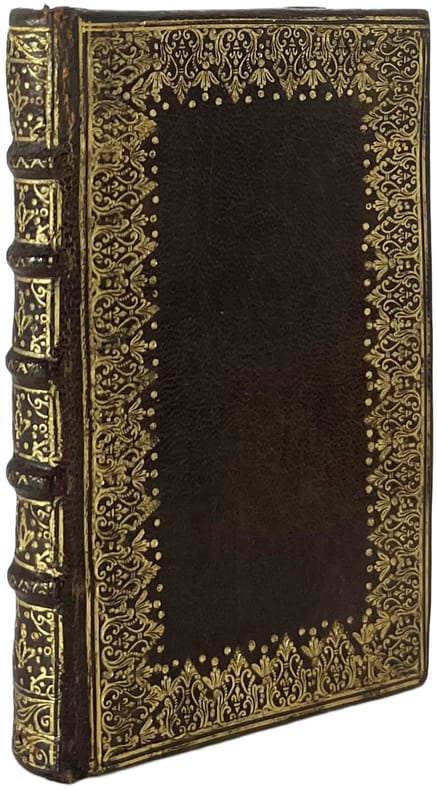
WB18618Paris ca 1795. Hardcover. Near Fine. An exceptional French Mathematics Manuscript in 3 volumes. Contemporary French mottled calf gilt floral panels separate black morocco labeling covers with border line tooling marbling on text block edging. Collation: Géometrie &2- 193 pp. 60 blank leaves; Algèbra & 2 -166 pp. 46 blank leaves; Planches & 2pp. 182 figures on 76 plates 48 blank leaves. All plates are on stiff blue laid paper. This course was taken by noted French economist Arthémond de Régny 1777-1841 probably during his university training in the latter part of the 18 century. Each volume has been prepared well with very legible and precise script and geometric figures. The organization of the Geometry volume starts with Euclid with numerical reference to geometric drawings in the Plate volume. A number of Problems Solutions and Corollaries are next. The remainder of this volume deals with 50 theorems for plane and sold geometry. Each theorem is stated first followed by demonstration then corollaries with further demonstration construction remark and ends with one or more problems along with solutions and reference where appropriate to figures in Plate volume. The volume on Algebra starts with basic addition subtraction multiplication and division. Next is a discussion of algebraic fractions their reduction with same denominator multiplication division and equations. Numerous examples of equations and computations occupy the remainder of the manuscript. Included are problems for solving equations with one two or three unknowns occasionally presenting a solution with a second method. The end of the manuscript has problems for 2 unknowns of znd degree division of irrationals and extracting the square root of a binomial. <br/><br/>Provenance: Arthémond de Régny bookplate on front pastedown of each volume. Régny was a noted French economist who was invited around 1830 by Greek leader Capodistrias to assist Greece with their economic problems. Although Capodistrias was assassinated before he arrived Régny stayed in Greece during the period of Regency 1833-1835. He went on to found and assist in organizing the State Audit Council according to French ideals and became its first chairman. He also assisted in the Foundation of the National Bank of Greece in 1841. Arthémond de Régny got married in 1798 to the Genoese woman Catherine Castellini who was the daughter of Balthasar and granddaughter of Domenico Castellini who conquered the Algerians in 1763. Balthasar Castellini was consul to Naples and subsequently in Cartagena Spain Marseille and Genoa. He was in charge of important missions by the royal court of Naples and also held an outstanding position in the trade. The family Régny was originally from the province of Dombes. At the beginning of the eighteenth century Francois Régny established his family in Genoa where he was in charge of the "Direction of the Diplomats for the King. hardcover
22 X 34 cm, [6]-372-[34] pages. Coutumier manuscrit Vidimé par le Sieur Emanuel Pretellins Secrétaire lt. du Grand Conseil d'Etat de la Ville et Canton de Berne. Cet exemplaire a été établi sur l'exemplaire signé par Emmanuel Rod, chancelier du canton de Berne, daté de 1703. Avec un "répertoire qui indique les pages en fin de volume". Une édition imprimée de ce coutumier avec divers ajouts et corrections paraitra en 1780 à Yverdon chez J. J. Hellen imprimeur. Exemplaire en parfaite condition.
170044630, , (1700 circa). Manuscrit in-16 sur peau de vélin (65 x 109 mm) de (20) ff. dont dix blancs dans un encadrement ornemental peint sur peau de vélin, maroquin brun, dos orné à nerfs, double filet et large dentelle dorés d'encadrement sur les plats, roulette sur les coupes, gardes et doublures de papier dominoté doré d'un décor floral, tranches dorées (reliure de l'époque).
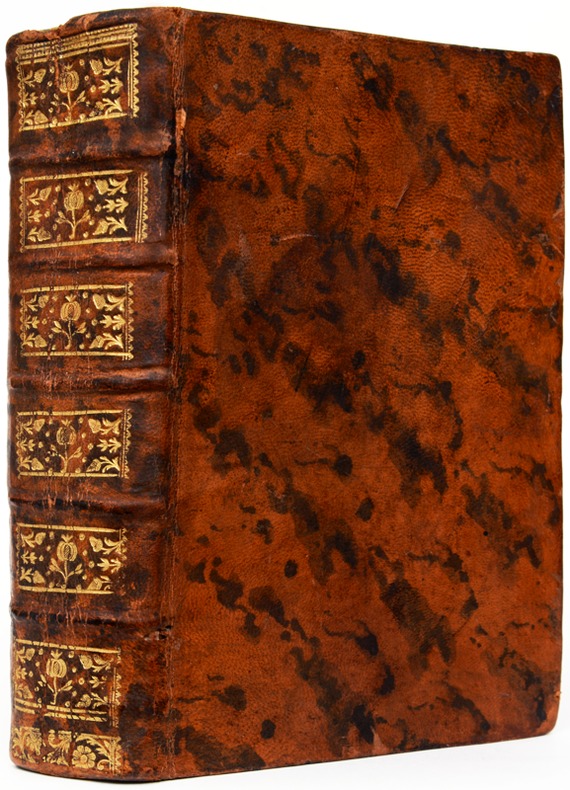
174039847, , 1740. Manuscrit in-12 de (364) ff., basane marbrée, dos orné à nerfs sans pièce de titre, tranches rouges (reliure de l’époque).
168043335, , s.d. (vers 1680). Manuscrit in-8 de 132 pp. veau fauve, dos orné à nerfs, gardes dorées de papier dominoté, tranches rouges (reliure de l'époque).
176343436Sans lieu ni date, , 1763 vers . In-12 de (7)-80 pp., maroquin rouge, triple filet doré et large dentelle à petits fers sur les plats, dos orné à nerfs, pièce de titre en maroquin vert, roulette intérieure, tranches dorées (reliure de l'époque).
17504300, , [1750 ca]]. Ensemble 21 pièces manuscrites in-4 en feuilles (98 ff.).
168543401S.l.n.d., , 1685 vers . Manuscrit in-12 de (5) pp. 1 f.bl. 170 pp. 1 f.bl. 244 pp. maroquin noir, dos orné à nerfs, plats ornés d'un décor à la Duseuil, fleuron d'angle de petits fers, roulette sur les coupes, tranches dorées sur marbrure (reliure de l'époque).
200762966ABLuzern Faksimile Verlag, 2007. 12,4 x 9,2 cm. Mit 47 farbigen Miniaturen und 360 Zierleisten. Samteinband mit vier vergoldeten Eckbeschlägen und zwei vergoldeten Medaillons mit zwei Schließen u. Kommentarband. In Orig.-Plexiglas-Kassette. sehr guter Zustand.- mint condition.
1938Miniature italienne sur vélin, XIVe siècleBelle et fraîche miniature (à vue : 7 x 7 cm) extraite d’un antiphonaire italien. Italie du Nord, dernier tiers du XIVe siècle. Le personnage se situe dans une grande initiale très abondamment rehaussée d’or à la feuille. Belle composition, dans un parfait état de conservation.
1860GITj813Sans lieu ni date ni nom d'artiste vers 1860. In-8 papier fort monté sur onglet 5 feuillets blancs 38 feuillets non chiffrés (soit 76pp, la dernière ornée sans texte) 29 feuillets blancs. Plein maroquin grenat, dos lisse muet, encadrement courant sur le dos et les plats composé de filets guillochés, perlés et continus servant de base à une très large dentelle finement dorée, coupes filetées, grande dentelle dorée sur bordure intérieure, contreplats doublés de moire violet profond, tranches dorées frappées de fleurons, ainsi que des nom et prénoms "Thérèse, Madeleine, Gautier", reliure de l'époque. Le texte, en français, est entièrement calligraphié en beaux caractères gothiques, occupant environ 6cm en largeur et 9cm en hauteur, inscrits dans un encadrement richement orné d'environ 9cm (largeur) sur 12cm (hauteur). Quelques lettrines dorées (volutes, animaux, végétaux), majuscules dorées, certaines sur fond rouge, bleu ciel, vert. Les mots "Dieu", "Jésus", "Seigneur" sont en rouge. Les frises d'encadrement sur fond blanc, bleu nuit, vert, vieux rose, gris-bleu, bleu ciel, grenat, argent et or présentent un décor différent pour chaque page, très joliment et finement composé dans le goût des manuscrits enluminés médiévaux où, parmi des entrelacs de volutes et de végétaux, foisonnent petit peuple d'anges, dragons, bestiaire fantastique, ainsi que Dames parées, Chevalier à bannière, fleurs, animaux, papillons, insectes. Quelques autres décors sont à remarquer: chapelet, barque longeant une côte, paysage nocturne au bord d'un lac et la très romantique évocation d'une tombe sous le Lune, abritée par un saule. On admirera enfin de magnifiques guirlandes de fleurs (certaines sur fond doré) telles que roses, lilas, arum, fuchsia. Sans oublier une grande vignette au centre d'un fin décor de colonnettes dorées, représentant un ange à bannière grenat s'apprêtant à faire tinter une cloche céleste (lettres dorées du texte de la bannière un peu ternies). Nous joignons un signet de soie rouge vif à franges (18cm X 4cm) très gracieusement brodé de fleurettes et de 3 papillons multicolores. MAGNIFIQUE MISSEL MANUSCRIT AUX RICHES ENLUMINURES D'UNE GRANDE FINESSE AYANT CONSERVE TOUTES LEURS FRAICHES COULEURS DANS UNE RELIURE LUXUEUSE, DECORATIVE ET EN BEL ETAT.
1953GF236251953 Manuscrit autographe par Francis de Miomandre de la traduction (parue chez Gallimard en 1953) du premier ouvrage de Miguel Angel Asturias - Le manuscrit est monté sur onglets et reliè en demi-chagrin rouge à coins - dos à deux fois trois nerfs joints - étui - (relié avec une lettre autographe de l'éditeur Georges Crès à Jacques Péricard) - On joint un exemplaire de l'ouvrage dédicacé par Miomandre et Asturias en 1963 -
Notenmanuskript. Quer Folio (240 x 330 mm). 30 Bll. letzte Seite leer. 8 Doppelblätter in 2 Lagen, Fadenbindung, starke Bütte, handrastriert, 10-zeilig, die beiden letzten Seiten 8-zeilig. Zeitgenössische Abschrift des Op. 28, deren Vorlage Rätsel aufgibt: Ein Vergleich mit dem Autograph und dem Erstdruck (Bureau des Arts et d'Industrie, PN 28, Wien 1802) sowie mit Titelauflagen und frühen Nachdrucken (Autograph, Abschrift und Originalausgabe im Querformat, Simrock 240 [1802] und Zulehner 130 [ca. 1807] im Hochformat, Hummel 1321 [1805/1806] im Querformat) führt zu folgenden Resultaten: Das Manuskript hat einige Gemeinsamkeiten mit dem Erstdruck und dem Autograph, die es von späteren Drucken unterscheidet, die daher nicht als Vorlage in Frage kommen. Es gibt aber auch Gemeinsamkeiten mit dem Autograph, in denen sich dieses vom Erstdruck unterscheidet (!), sodass auch eine zwischenzeitliche Abschrift der Sonate aus dem Manuskript vor dem Erstdruck als Kopiervorlage in Frage kommen kann. - Eine mögliche Erklärung dafür wäre der verhältnismäßig lange Zeitraum zwischen Entstehung im Herbst 1801 und Veröffentlichung der Sonate im August 1802 aufgrund der personellen Veränderungen in der Gründungsphase des Verlages: 1. Gesellschaftsvertrag vom 1. 5. 1801 "Kunst- und Industrie-Comptoir" Kappeller und Holer. 2. Dem Gesuch zur Firmenprotokollierung vom 23. 10. 1801 legten die Verleger eine "Kontraktliste" bei, nach der sie bereits über eine Reihe von Kompositionen für die Veröffentlichung verfügten, darunter auch Beethovens Sonate Op. 28. 3. Die neue Firma wurde am 1. 5. 1802 protokolliert, 4. aber erst ab August 1802 die Musikalien des Verlages in der Wiener Zeitung (WZ) annonciert, wobei mit Beethovens Op. 28 (und der dazu passenden Verlags-/Plattennummer 28) ein öffentlichkeitswirksamer Paukenschlag gesetzt werden sollte: Beethovens Sonate wurde am 14.8.1802 (WZ 65) alleine vorgestellt, 4 Tage später folgte dann die Ankündigung der Werke von Krommer, Call, Albrechtsberger, Förster, Eberl, etc. mit den Verlagsnummern 1-30 (ohne die bereits vorgestellte VN 28, 18.8.1802, WZ 66, Weinmann, S. 220 f). - Gertsch/Prahia erwähnen im Vorwort zur Henle Urtext-Ausgabe (2008) zur Erklärung der ungewöhnlichen Zeitspanne zwischen Entstehung und Druck auch die - nicht belegbare - Hypothese, dass Beethoven "dem Widmungsträger Joseph Freiherr von Sonnenfels (1732-1817) auf die Sonate ein Exklusivrecht von einigen Monaten oder gar einem Jahr eingeräumt" hätte. - Das Papier ist nach Auskunft des Archivs der Gesellschaft der Musikfreunde für Wien um 1800 untypisch, und zeitlich nur grob auf die ersten beiden Jahrzehnte des 19. Jahrhunderts bestimmbar. - Etwas fingerfleckig, ansonsten sauber.
Folio (220 x 355 mm). German manuscript on paper. A sheaf of court documents containing records and correspondence (some as drafts or copies). 30 pp., folio und 4to, thread-stitched in grey wrappers with handwritten cover title as quoted above. Uncommon example of early modern court records relating to a case of sexual assault in the principality of Schwarzburg-Rudolstadt (now Thuringia). During the night of Sunday, 14 January 1821, the 19-year-old maidservant Johanna Christiane Pröschold from Piesau was brutally raped at Pfeiffer's inn in Ascherbach (now part of Lichte near Neuhaus am Rennweg) by Friedrich Scherf, Adolph Brödel, Markus Glaser, Christoph and Wilhelm Wächter, as well as Carl Kampf from Lichte. The documents include the records of the statements made by the maid as well as by the perpetrators, signed by the local sheriff Johann Christoph Horn; a certificate of good character for Pröschold's employer, the innkeeper, given by the priest Johann Jakob Korn; the copy of a letter to the Administrative Office in Schwarzburg; and the draft of a report to the general counsel, König, in which it is said that the maid "suffered through this most villainous, shameful behaviour the most horrible maltreatment, indeed insulting to humanity, which in fact endangers her very life". The culprits were sentenced to corporal punishments and prison terms of various severity, spent at the Schwarzburg gaol. - A few leaves loose; a few insignificant edge flaws, but on the whole in excellent state of preservation.
Folio. 33 ff. German ms. on paper. Green cloth (c. 1950) with giltstamped cover title. Narrative of an Austrian captain stationed in Arad (now Romania) about the operation of the local brothel and their life there. Much of the lewd account is dedicated to a so-called "Olympic Festival", a staged public defloration termed "baptism", after the passing of which obscene rite the deflowered girls became full members of the house: "Nun rief die Oberpriesterin: Das Opfer sei vollbracht! - In diesem Momente rauschte die Musik starker um das Ächzen des Mädchens unhörbar zu machen, das elektrische Licht warf seinen vollen Glanz mit möglichster Intensität auf den Opferaltar. Der Jüngling begann mit voller Kraft gegen die Pforte des Heiligthumes der Liebe vorzudringen. Man sah deutlich die konvulsivischen Zuckungen aller Muskel der Jungfrau und nach wenigen, aber markigen Stößen übertonte ein, von heftigem Schmerze ausgepreßtes - Ach! - der Jungfrau die melodischen Töne der Musik, denn der Sieg war errungen, die Pforte zum Tempel der Liebe und Wonne war geöffnet. Noch ein kräftiger Stoß und der Szepter der Liebe war bis an sein Ende im Heiligthume der Wollust weich gebettet [...]". - Inserted in the account of the "baptism" of fourteen-year-old Irma is a digression on Hungarian erotic tradition and superstition. - Tear in title page restored. Well-legible manuscript with numerous corrections and revisions by the author. Occasional slight finger and dust staining; traces of horizontal and vertical folds.
1926GF253361926 Paris - Editions du Siècle - 1926 - 1 volume in8 broché de 125 pages - 1 des 50 exmplaires sur japon de l'édition originale -
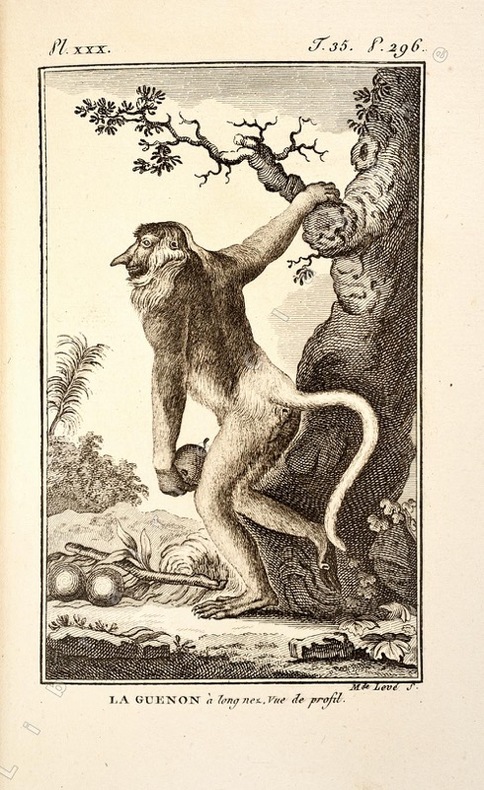
182421251Lyon, 1824 ; in-8, maroquin rouge à long grain, dos lisse à décor de grands losanges de filets pointillés, fleurons, semé de fleurettes, palette en queue, pièces vert-empire, large dentelle d’encadrement des plats, roulettes sur les coupes et d’intérieur, tranches dorées (reliure de l’époque) ; [2] ff. Faux-titre et titre sur papier vert clair, [8] ff. bl, LXXIX planches gravées, protégées par des serpentes, gravées par Voysard, Perée, Berthault, Bigant, Duhamel, Voyez, Jourdan, Miger, Mlle Levé, Cugnet, J. B. Racine, Hubert, Mme Vilain, Delignon, Philipau, d’après Barraband.
222998S.l., s.d. (1796) in-folio, [468] pp. n. ch., couvertes d'une écriture moyenne, régulière, assez lisible (environ 40/45 lignes par page), vélin souple, dos lisse muet, tranches marbrées (reliure moderne). Gardes refaites.
208115S.l., s.d. (1839) in-4 oblong, titre calligraphié dans un encadrement de volutes orientalisant, 16 planches manuscrites (dont 13 aquarelles en couleurs), [5] ff. vierges, demi-chagrin cerise, dos lisse muet (reliure de l'époque). Coiffes, coupes et coins abîmés.
209829S.l., s.d. (1813) in-12, [13] ff. n. ch., couverts d'une écriture moyenne et lisible (environ 20/25 lignes par page), 2 ff. vierges, en feuilles.
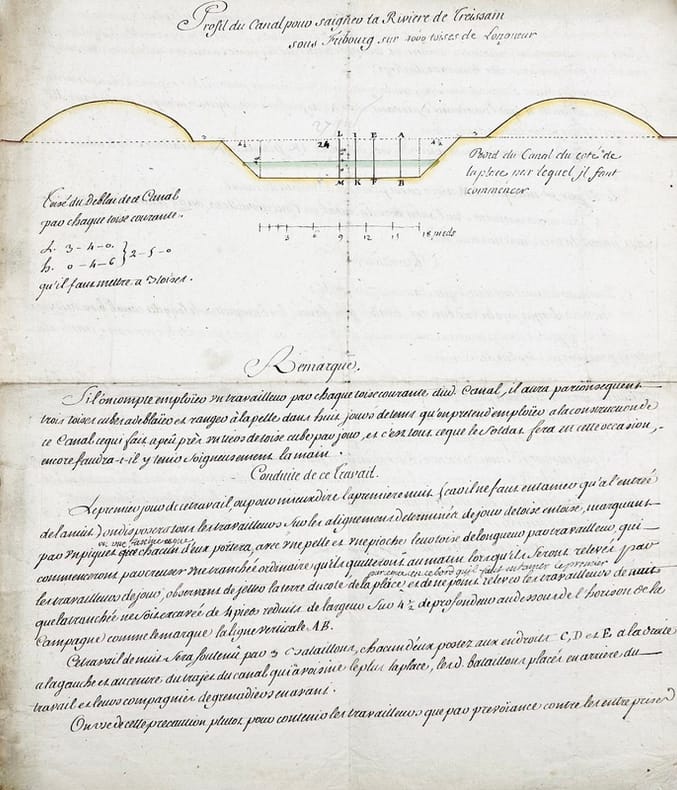
21404In folio (367 mm), demi-vélin de l’époque, 137 pp. d’une belle écriture, bien lisible et 3 plans aquarellés dépliants.
234106Saint-Thomas [Antilles], 18 janvier 1743 in-folio, 12 pp. couvertes d'une écriture lisible (environ 20/25 lignes par page), en feuilles, cousu.
347781 volume in4 de 520 pages + tables - reliure pleine basane d'époque - dos 5 nerfs orné - tranches rouges - mors fendus et frottés - coins émoussés - coupes frottés - Bon état intérieur - Ecriture bien lisible - Un des derniers textes est daté 1749 : "Prophétie au Roi" (p 503) -