1 094 résultats
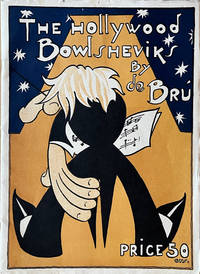
192762150Hollywood CA: Hollywood Bowl Assoc. 7046 Hollywood Blvd. 1927. 4to. 32 pp unpaginated. decorated title w/ tinted background borders 28 Xavier Cugat illustrated plates throughout. Colour-illustrated softcovers Art Deco cover art of caricature conductor by Cugat yapp fore-edges minor wear dustsoiling slight scuffing still VG copy. First edition of this surprisingly scarce and splendidly illustrated caricature rendering of the stars and performers at the Hollywood Bowl for the 1927 Season. Caricatured among the “Hollywood Bowlsheviks†are Alfred Hertz who inaugurated the first Hollywood Bowl season of music in 1922 Bruno Walter Vladimir Shavitch Cecil B. De Mille Louis B. Mayer Pola Negri Hestelle Heartt Dreyfuss Lloyd Wright Pierre Monteux Douglas Fairbank and Mary Pickford. De Bru 1900-1990 was a child prodigy taken to Cuba where he trained as a classical violinist played with the Orchestra of the Teatro Nacional in Havana and after New York was hired as musician and caricaturist in Hollywood at the Bowl. He also put together a tango band in 1927 which performed at the Cocoanut Grove at the Ambassador and later took up a long term residency at the Waldorf Astoria in New York for 15 years and one of the noted performers was Desi Arnaz. His famed caricature “Curtain of Stars†measuring 40 x 60 feet hunt at Grauman’s Chinese Theatre. Cugat’s brother Francis was a noted illustrator best remembered for his cover art of Fitzgerald’s The Great Gatsby. Worldcat locates 1 copy Cal. Hist. Soc. Lib.; Paul Spitzzeri Striking a Chord: A Program for Summer Concerts at the Hollywood Bowl 19-23 July 1927 Homtesead Museum July 20 2020. Hollywood Bowl Assoc., 7046 Hollywood Blvd., paperback
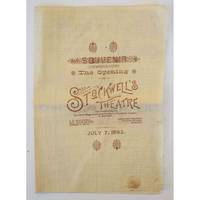
18922621San Francisco 1892. Good. 7-1/2 x 5-1/4 inches. Bifolium 4pp. Cream silk printed in brown with brown and white illustration of Shakespeare to last page. Horizontal fold line; small stain to first leaf; fraying to fore-edges. Silk souvenir program for the opening shows at Stockwell's Theatre which operated from 1892-1894 at 11 Powell St. in downtown San Francisco. Prior to being taken over and renovated at a cost of an estimated $60000 by L. R. Stockwell it had been the Powell Street Theatre. The theatre again changed to new ownership in 1894 after Stockwell went bankrupt and left the city; the Columbia Theatre which replaced it was destroyed in the 1906 earthquake and fire.The program notes the arrival of Augustin Daly's Company of Comedians and lists the members of the troupe who appear next in their roles in As You Like It which opened on July 7 1892. A synopsis of scenery attribution for the original incidental music names of the managers and orchestra notes follows with a list of upcoming plays at the end.OCLC locates one holding at Yale. unknown
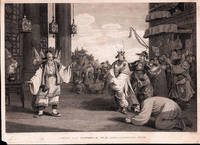
1796198465London.: G. Nicol. April 121796. Copper-plate engraving 24 x 35.3cms image; 26.7x 36.7cms sheet sheet age-toned and margins worn small chip from lower left corner not affecting the image two spots of browning in the sky very faint the image in good condition. An elegant composition after drawings by William Alexander published in Sir George Staunton's two-volume "Account of the Embassy from the King of Great Britain to the Emperor of China" published in London 1796-97. . G. Nicol. unknown
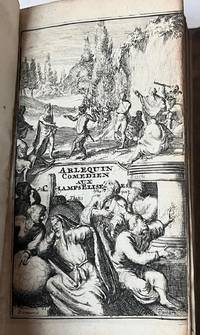
BB110319Full parchment binding in good condition 135 x 75 cm. With decorative frontispiece with in the left botum: Heraclite et Democrite. The figures have names witten under the figure:L Aristote Epicure et al.Theatre play with text in French. Illustrations on p. 21 p. 56 and p. 100. First edition complete copy.Second part Palaprat L'Important de cour comedie La Haye Jacob van Ellinkhuysen 1694 with damaged titlepage 140 pp. Also a theatre play by Jean Palaprat.Third part La femme poussée a bout. Comedie traduite de la piece Angloise intitulée The provokd sic! should be provoked Wife Londres chez Jan Wite 1700 211 pp.Fourth part: La Contr'impromptu de Namur 68 pp. Without titlepage and without illustration. most likely the edition: Le contre impomptu de Namur. Comedie Amsterdam J. Louis de Lorme & Estienne Roger 1696 by anonymous authorFirst part not in STCN.NL Het eerste deel 'Arlequin comedien aux Champs Elisees' gaat over een komische en allegorische geschiedenis rond de figuur Arlequin een bekende persoon uit de Franse komedie. Het bevat elementen van een historische verhaal maar met veel humor en metafysische suggesties. Het bevat een brief van Cardan dat is geschreven vanuit de Champs Elisees aan een heer wiens naam niet wordt genoemd. Het is een mengeling van verschillende stijlen en genres zoals past in de literaire traditie van die tijd. Het tweede deel van Charles Palaprat draait om thema's gerelateerd aan het hofleven en hovelingen. The provoked wife is een theaterstuk van John Vanbrugh over een huwelijksprobleem tussen Sir John Brute en zijn echtgenote Lady Brute. Het derde stuk La femme poussée is vertaald door Charles de Marquetel de Saint-Denis de Saint-Evremond naar het Engels van John Vanbrugh. unknown
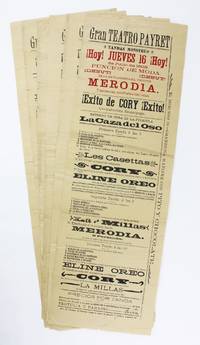
19085578Havana: Moises V. Codina 1908. Good plus. Seven broadsides each approximately 22 x 7.25 inches plus one double bill measuring about 22 x 15 inches. One broadside printed in red and black. Previously folded. Scattered shallow tears from edges not affecting text with some tape repairs on blank versos. A group of eight playbills spanning eight consecutive days in July 1908 that advertise performances and events at the Gran Teatro Payret in Havana. The theater was built by its namesake Jaoquin Payret in 1877 on a corner across from the Villanueva Railway Station now the Capitolio Nacional de la Habana and initially focused on opera and high-class performing arts to compete directly with other established theaters in the Cuban capital. The building had five floors and a capacity of 2300 but the upper balconies collapsed in 1882 after which the theater changed hands and began to showcase more varied popular offerings.<br /> <br /> These playbills publicize an array of performers including the ballet dancer Millas; a cabaret artist Eline Oreo; a magician and telepath Sidney Richards; Troupe Montrose a group of acrobats an Italian dance troupe Les Casettas; two clowns named Pito and Chocolate; and many others. Notably the programming also includes a heavy rotation of short and feature films such as La Electricidad Liquida 1907; El Inagarrables Pick Pocket 1908; Victima de la Ciencia 1907; En Chine: Voyage sur le Canal Impérial 1908; and Venganza del Dervich 1907. The playbill for Thursday July 16 with its headline and date in red proclaims the debut of Trouppe Merodia a seven-person group of acrobats and cyclists as well as the Cuban premiere of a film titled La Caza de Oso The Bear Hunt.<br /> <br /> The theater was closed by hurricane damage in 1926 but reopened as a cinema in 1935 and in the following years became known as the "Cathedral of Spanish Cinema." The building again fell into disuse and disrepair in the decades following the Cuban Revolution but was restored in 2008. A very interesting group that gives a great sense of day-to-day operations at one of Cuba's most important and historic theaters. Moises V. Codina unknown
192750827New York: Frank C. Reilly 1927. 4to. 27 1 pp. Numerous photo illustrations large double-page colour centerfold from painting by M.B. Robinson. Mauve softcovers black lettering on front cover yapp edges minor dustoiling edgewear still VG copy. First edition of this beautifully illustrated Souvenir De Luxe program for the play which opened in 1927. Frank Reilly would also produce A Play Without a Name in 1929. This production featured John Cumberland as Pickwick Charles McNaughton as Sam Weller Hugh Miller as Alfred Jingle and others. Frank C. Reilly, paperback
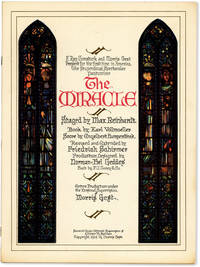
61859New York: Morris Guest 1924. First edition. Quarto 31cm. Pictorial thick paper wrappers; 40pp; illus. Some trivial dusting to wrappers still a Fine copy free of markings or notable wear. <br /> <br /> Lavish souvenir program for the New York premier of Reinhardt's renowned adaptation of Vollmöller's wordless play illustrated throughout with color reproductions of Bel Geddes' costume and set designs. "The Miracle" was originally produced in 1911 at London's Olympia Theatre; the show traveled throughout the Continent until 1914 when it was closed due to the onset of the Great War. The 1924 American revival began as a traveling show playing in Detroit and Milwaukee before its spectacular grand opening on at the Century Theatre on January 16th. An uncommon program beautifully produced. unknown
1926160406Seattle WA: Blue Mouse Theatre 1926. Vintage newsletter for Seattle's Blue Mouse Theatre Vol. 1 No. 4 for the week beginning Saturday March 17 1923. Newsletter features a two-color promotion for "The Beautiful and Damned" attached to the top left corner of the cover.<br /> <br /> The Blue Mouse Theater still in operation today as the Tacoma Blue Mouse Jr. is Seattle's oldest movie theater. During the 1920s the theater published a weekly newsletter every Saturday promoting current and upcoming films as well as Hollywood news and local interest. <br /> <br /> Promoted in the issue on offer here are the films "A Woman's Woman" 1922 "Suzanna" 1923 and "The Beautiful and Damned" 1922.<br /> <br /> 7.75 x 10.75 inches one-color bifold with a two-color attachment. Very Good plus with a faint horizontal crease and a tiny closed tear and chip to the top left. Blue Mouse Theatre unknown
196056965Pasadena CA: n.p. ca. 1960. Folio. 14.5 x 20 in. Twelve original gouache paintings on thick artist’s board 10 of them either w/ typed or manuscript labels 1 entitled “Garden Party†written in manuscript at upper fore-edge 8 preserving their cloth fabric swatch samples some w/ designer’s notes trimmings etc. All are preserved in a gray linen clamshell case minor edgewear rubbing wear to corners still a well-preserved fine set of paintings. This nicely executed set of fashion designs were apparently created for a Civil War theatre production in Southern California around 1960 with characters named Florence Bagshot Mrs. Ludley Bagshot Agatha Mrs. W.D.P.S. and Mrs. Forbes. The designs primarily focused on the women characters including one of a nurse standing in costume in gray striped dress apron and cap with Confederate cavalry trooper in kepi astride his horse and hatless officer with sash standing in the background. Many of the designs reflect the colour palate of the early 1960’s with avocado green vivid blues solid brown earth tones and bright nearly neon orange gauze fabrics in the renderings and samples which would not have been common in those combinations during the Civil War era. Still most of the dress designs incorporate the hoop skirts of the period often with crinoline and/or crinoline cage hoop skirts and high collars with ties and ribbons at the neck and trim patterns typical of the period. The design for Florence Bagshot’s bedroom wear incorporates elements of Mid 20th-Century design and sensibilities rather than the more common chemise and sturdy cotton for the 1860’s. The Confederate Nurse design was painted on “Brownie Board Cold Pressed Duncan Vail Co. Los Angeles†which appears in California art supply advertising from about 1960-1963. We were unable to identify the production after an extensive search through contemporary theatre production trade magazines newspapers and other industry publications. n.p., hardcover
193062548Hollywood CA & New York NY; Oshkosh WI & Parkersburg WV: The Strand Theatre Smoot Theatre Lincoln Theatre & Warner Bros. 1930-1934. Oblong folio. 14.5 x 11.5 in. 100 pp unpaginated. two different papers many preserved in archival mylar sleeves. With 90 original silver gelatin photographs either mounted or loose and inserted into sleeves sized from 2 x 2 in. up to 8 x 10 in. most sized approx. 5 x 7 in. many w/ photographer’s imprints 71 pieces of mounted ephemera including promotional cards souvenir promotional items such as napkins studio advertising mimeograph typescript marketing scripts lobby cards newspaper clippings and more. All leaves bound w/ brass screw posts at gutter margin many preserved in archival mylar sleeves some leaves w/ chipping & tears at fore=-edges offset tears and or reside on versos of a few photos some scuffing old glue markings cropping to some leaves still a VG artifact preserved as album. This exceptional original Warner Bros. Studio marketing photo album/scrapbook chronicles the movie industry’s system of engaging the movie-going public during the Great Depression in a form of interactive promotional live theatre to immerse them in the cinematic experience. Featuring physical props displays special lighting costumed extras studio scripts featuring a myriad of promotions the Warner Bros. Studios theatre group was able to enhance and pull in far more movie-goers and set the foundation for their marketing system in the coming decades. By using their opulent and fabulous 1920’s era created movie palaces these images capture the pre-Code sexualized Mae West in slinky costumes emblazoned on radio station cars physical stand-up showroom displays restaurant menus post-Prohibition tavern beer coasters and even pulled in local officials such as Mayor George Oaks of Oshkosh WI. Also featured here are photos and flyers for the giveaway cars tie-ins with the Oshkosh State Teachers College football team and nearby department store window displays which significantly expanded the visual and immersive experience.Of particular interest is the included and very detailed 117 step campaign script for Mae West’s iconic “I’m No Angel†featuring the titillating star as Tira the circus beauty who manages to always be mistress of the situation whether in the cage with wild beasts her boudoir filled with admirers to be bedded or even charming and seducing the judge at the end of the film with only a wiggle. The pre-Code campaign encourages the Warner Bros. Studio theatre’s to include a “Try your figure†display panel where young women would measure themselves against the busty silhouette and those that matched closest to the scantily gowned West would receive free tickets. Another stunt was setting up a “Mae West Voice Test†using a dictaphone in the lobby with a “pretty girl attendant†set up in charge to ask potential women movie-goer attendees to utter “Come up and see me sometime†and free tickets were awarded for the best Mae West imitations. Other movies featured at the Strand in Oshkosh or the Smoot & Lincoln Theatre’s in Parkersburg WV depicted here with promotions souvenirs and photographs include: “The Sea Wolf†based on Jack London’s book and which starred Milton Sills Jane Keithley and Raymond Hacket released just 1 week after Sills’ death and features stunts with potential young movie-goers to bring their Rin Tin Tin like dogs as well as airplane stunts and lobby card; or elaborate window displays and automobile floats mocked up as dirigibles and costumed extras for Frank Capra’s “Dirigible†released in 1931 and starred Fay Wray Jack Holt Ralph Graves and Hobart Bosworth set against the drama of a competition by fixed-wing aircraft and dirigible airships to reach the South Pole. Other movies briefly archived in the group here feature “When Ladies Meet†released in 1933 starring Ann Harding Myrna Loy and Robert Montgomery or a couple mentions of the 1931 Bela Lugosi Dracula. The 1933 Gold Diggers is featured in several photos which starred Joan Blondell Aline MacMahaon Monica Bannister Joan Barclay and Connie Blackwood as out-of-work Broadway chorus girls. Also appearing here in approximately one fourth of the photo album/scrapbook is a similar campaign as that for Mae West for the 1932 “Fireman Save my Child!†with the wildly popular comedian Joe E. Brown starring as Joe Grant inventor fireman and baseball player offered to play in the big leagues in the film but earning more money from his inventions Again the script advises engaging the local fire department to put on stunts include the supplied advertising on their fire engines and even encourages the use of a large animatronic mechanical head of Brown in a fireman’s hat in the lobby. The movie was actually a natural fit for Joe Brown who had launched his physical comedy during the 1893 Depression by making faces at the firemen on passing coal-burning trains so they would throw coal at him to collect and sell and later worked as circus acrobat and newsboy and was a lifelong baseball fan. From 1930-July 1934 the Hollywood studios were largely self-regulating their content with continued threats by outside groups to “clean†up their movies and somehow balance the puritanical group sensibilities against the ever growing demands by audiences for movies that were daring edgy naughty and even sexualized often depicting spousal abuse sexual bondage marital infidelity free love with stars such as Mae West Norma Shearer Kay Francis Dorothy Mackaill Nancy Carroll and Constance Bennett typically depicted half-clad or in bed. At the time the movie studios and theatre’s were attempting to recoup the massive investments in transitioning to sound films and market the new technology by cultivating a sophisticated campaign system often hiring Broadway writers directors and actors to travel around and oversee their promotions productions. See: John Farr How Movies Got Us Through the Great Depression Best Movies 2024; David P. Hayes Production Code of the Motion Picture Industry 2009; Mae West Reveals Herself as a Circus Queen in “I’m No Angel†at the Paramount New York Times Oct. 14 1933. The Strand Theatre, Smoot Theatre, Lincoln Theatre, & Warner Bros., unknown
196760725New York & London: Printed for the members of The Limited Editions Club at The Curwen Press 1967. 4to. 8.75 x 12.5 in. xx 184 2 pp. Colour-tinted frontisp. title in red & black numerous plates with all printed in a different monochrome wash colour. Quarter-cloth over terra-cotta Roma paper boards brown & gilt lettering on spine w/ open-backed slipcase NF/NF copy signed & numbered by artist on colophon. First Limited Editions Club edition No. 1455 of 1500 copies printed illustrating and presenting these three famed Greek tragedies. Ayrton 1921-1975 was a noted British sculptor printmaker painter and novelist who centered several works around the myths of the Minotaur and Daedalus. Printed for the members of The Limited Editions Club, at The Curwen Press, hardcover
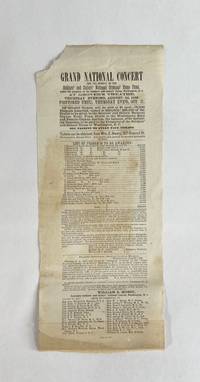
186610020Washington: Press Job Print 1866. Broadside. Broadside. 12" x 5." Printed in black on recto only. Loss to the top corner affecting only the margin; light foxing and toning; but for the corner loss quite an exceptional copy. <br /> <br /> This broadside outlines the lottery scheme to benefit for the Soldiers' and Sailors' Orphan Home Fund. As well as a benefit concert after which the prized were to be announced. This benefit was scheduled to be held at the Grover's Theater in Washington D. C. on August 2 1866 here postponed to October 11. The advertisement states that 300000 tickets were for sale at $1.00 each and 75000 presents awarded. Presents range from cutlery to "1 Three-story Brick Residence H street between 6th and 7th" valued at $18000. The nature of the benefit speaks to a significant problem facing the country in the aftermath of the Civil War the abundance of orphaned children. Rare in commerce. The American Antiquarian Society is the only institution reporting ownership according to OCLC. Press Job, Print unknown
24557Gordon’s letter to Macqueen-Pope is dated 28 December 1950; on letterhead of ‘Everybody’s’ 114 Fleet Street London EC4. Macqueen-Pope’s article without date or place but contemporaneous. From the Macqueen-Pope papers. See his entry in the Oxford DNB. The subject of MP’s article is the press agent and publicist Guido Orlando who came to the United States from Italy with his family in 1917. MP may have come into contact with Orlando in his own position as press agent for Drury Lane and other theatres. He was most active in Hollywood from the 1930s to 1960s. His papers are in the Academy of Motion Picture Arts and Sciences Margaret Herrick Library. He also has an uncredited part in Godard’s 1960 ‘Nouvelle Vague’ classic ‘À bout de souffle’ ‘Breathless’. ONE: Sidney Gordon to MP. TLS 28 December 1950. 1p 8vo. In good condition lightly aged and creased with slight rust spotting from paperclip. As the editor Greville Poke is away from the office he has ‘read the article carefully and I really do not think that he would consider it is suitable for Everybody’s. As you may have noticed it alludes to various scandals incidentally the latest and obvious “tie-up†for the article is now dead as far as public interest is concerned and generally is not quite in line with what we want for this paper. My opinion is strengthened by the fact that we were submitted an article on Orlando some months ago and it was turned down because of a certain flashiness.’ He ends by conveying a message from Poke on another matter. TWO: Typed article titled ‘“Enfant Terrible†of Public Relations’. 17pp 4to each page on a separate page of cartridge paper. Double spaced with title on an eighteenth leaf. In good condition lightly aged apart from a hole in the final leaf resulting in loss of five or six words from the final paragraph. MP is not named as the author but since he is submitting the piece it is presumed that he is. Begins: ‘The grim summer of 1950 would have been even more of a nightmare for millions of newspaper readers if front pages burdened with battles and casualty reports had not been brightened by a royal romance between a king and a sixteen-year-old American schoolgirl. / The king Egypt’s fabulous Farouk apparently was spending a good deal of his time chasing Little Mimi Medart from St. Louis Missouri through Europe’s most plush-lined playgrounds. From Deauville and Biarritz the swankiest of France’s watering spots on the Atlantic Coast to San Sebastian in Spain the king trundled along in Mimi’s wake dragging the royal entourage behind him. / On both sides of the Atlantic the king and the commoner became front-page news. Only Farouk’s announcement of his engagement to Narriman Sadek ended the suspense. When it came Mimi’s mother breathed a sigh loud enough to be heard round the world and exclaimed to newsmen: / “Thank God! Now my daughter can go back and finish her studies in peace.†/ All of this it should be explained is one man’s idea of how to sell hamburgers in St. Louis. It sounded like a fairly far-fetched method until you realize that the man is Guido Orlando the gift of the American public relations profession to Europe.’ The article finishes with the Farouk business after the first five pages. There follows a description of Orlando’s appearance and background before an account of his other activities with reference to ‘Don Jaime the Duke of Segovia’ ‘Mayor Jimmy Walker of New York’ and ‘the Maharajah of Kapurthala’. Gordon’s letter to Macqueen-Pope is dated 28 December 1950; on letterhead of ‘Everybody’s’, 114 Fleet Street, London, EC unknown
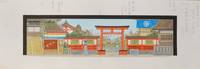
87892JAPANESE THEATRE. ODA OTOYA: A COLLECTION OF STAGE DESIGNS. Oda Otoya 1920-2006 began his career in the arts as an illustrator of fiction moving to stage design in the post-war period. He created designs for many plays at the National Theatre in Tokyo as well as the famous Little Theatre there. He published an important book on his own work in 1977: BUTAI BIJUTSU WO KANGEARU THOUGHTS ON STAGE DESIGN. Receiving a special Kikuta Kazuo Theatre Prize in 1977 and then the coveted Shijushô Purple Ribbon Decoration in 1983 for his advancement of the Japanese theatre arts he was regarded as one of the grand old men of the Japanese theatre. Besides his extensive work in Kabuki he also designed the sets of many modern theatre productions including plays by Mishima Tanizaki etc. This collection consists of literally thousands of his original designs and design ideas for the stage.<br /> <br /> There are:<br /> <br /> 2311 oblong sheets most are around 7 x 21 inches showing proscenium views stage backgrounds pieces of scenery scrims etc. Some are preliminary sketches with touches of color but the majority. over 2000 are highly finished watercolor designs that show either an entire scenic design on one sheet or component pieces of a single scenic design on two or more sheets that form the whole or even a large prop such as a boat. A handful of designs have small photos attached to them that either indicate the inspiration for the design suggest a view to be seen outside a stage window and in one instance show the set as realized with actors.<br /> <br /> 46 smaller various sizes preliminary and final sketches either colored or with touches of color that show scenic designs details of specific elements of designs props decorative motifs etc.<br /> <br /> 456 drawings some sketches while others are quite detailed and include measurements along with photocopies of drawings and painted designs many of which are marked with notations or with areas of color.<br /> <br /> 363 stage plans various sizes that show the placement of the component elements of the rendered designs.<br /> <br /> 29 watercolors of kimono designs 15 x 10 inches and 3 sheets of costume designs.<br /> <br /> An important archive documenting Japanese theatre design in creative context. unknown
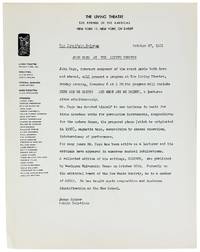
196147315New York: The Living Theatre 1961. Very Good. New York: The Living Theatre 1961. Press release printed mimeograph on single leaf of Living Theatre letterhead 28x21.5cm. Light toning to margins else Very Good.<br /> <br /> Press release dated October 27 1961 announcing a program at the Living Theatre on November 6th which would feature a performance by avant-garde composer John Cage with four lectures "given simultaneously." The release is signed in text by James Spicer. The Living Theatre unknown
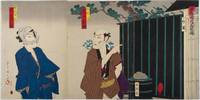
1892218409東京. Tokyo.: 福田熊治良. Fukuda Kumajiro. Meiji 25 1892. Three colour woodblock prints a triptych panels loose each 24 x 35.4cm Japanese text in red identifying the actors and in yellow identifying the roles in the upper left of two panels and program title in the top right of the third panel further text within in a red fish-shape in the lower right of the third panel some offsetting of red ink on the first panel but not affecting the main image slivers of affixing tape to the verso of each print some surface wear and abrasion mainly to the verso but the three images in very good bright condition. Dramatic depiction of the famous Kabuki actors Onoe Kikugorō V 1844-1903 as Yosaburô and Onoe Matsusuke IV 1843-1928 playing the role of Kômori Yasu in the 1892 staging of "Yowa Nasake Ukina no Yokogushi" commonly called "Kirare Yosa". <br> <br>Images such as these were collected by Kabuki fans of the day who bought woodblocks of their favourite actors and then had the prints made up into albums so that they could be enjoyed much in the way poster books and other fan memorabilia of famous movie stars is enjoyed today. <br> <br>The artist Toyohara Kunichika 1835-1900 was acclaimed as one of "The Three Greats of Meiji Ukiyo-e". Many stories surround him including his boast that he had moved 100 times which appears unlikely but this claim combined with his hard drinking womanising lifestyle and overall "live for the day" attitude all contributed to his colourful reputation. His work was very popular during his lifetime with his use of bright imported chemical dyes and his technique of focussing the image on the actors face combining to make up his individual style. see 'Time Present and Time Past: Images of a Forgotten Master' by Amy Reigle Newland. <br> <br>From the collection of the late John Caiger lecturer in Asian studies ANU. . 福田熊治良. [Fukuda Kumajiro]. unknown
117188Moscow Izd. Vseros teatral nogo obschchestva 1934. 4to. XLVIII 211 1 pp. with over 190 plates partly in pagination and partly on separate plates. The colour plates with printed tissue paper guards. Publ. brown blindstamped cloth spine sligthly faded and some wear at corners. Owner’s signature of Lauritz Falk and with ex-library stamp of Kungl. Dramatiska teatern. Rare first edition. Text in Russian. An English translation was published in 1935. Preface by Abraham Efros. An hommage to Alexander Tairov’s modernist Kamerny Theatre in Moscow with fine drawings of set- and costume design and scenes after photographs from its first 20 years. Alexander Tairov 1885-1950 produced many modern non-russian plays by Berthold Brecht Eugene O’Neill Oscar Wilde and G. B. Shaw and he collaborated with many of the foremost avant-garde artists in cubism constructivism etc. The gouverment closed down the theatre in 1949. Abraham Efros 1888-1954 from Moscow was a translator poet art historian and critic. After 1917 he served on the commission for the protection of artistic and antique treasures in the Russian Soviet Republic and on the boards of among other the Tretyakov Gallery and the GOSET Moscow State Jewish Theater. In the Stalinist purges of the late 1930s Efros was arrested and exiled and in the late 1940s he was ousted from his academic posts. The former owner is probably the Swedish-Norwegian actor and painter Lauritz Falk 1909-90. hardcover
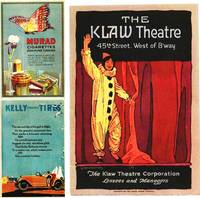
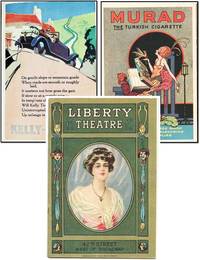
21815Near Fine. A striking 1924 Broadway program where theatre and advertising collide featuring bold Pierrot cover art and vividly illustrated Murad cigarette advertisements capturing the intersection of stage culture and early commercial art.<br /> <br /> Issued for a Christmas-week performance of 'Simon Called Peter' this program represents the mature phase of early 20th-century theatre ephemera-where performance promotion and graphic design converge. The cover illustration with its theatrical Pierrot figure emerging before a stylized curtain reflects lingering Art Nouveau influence transitioning toward the emerging Art Deco sensibility of the 1920s.<br /> <br /> Inside the program blends cast listings and theatre information with a notable range of contemporary advertisements. Particularly strong are the full-page illustrated ads including Murad cigarettes and Kelly-Springfield tires which elevate the piece beyond a simple program into a compact gallery of period commercial design.<br /> <br /> DETAILS:<br /> Title: The Klaw Theatre The Magazine Theatre Program<br /> Author: Klaw Theatre Corporation<br /> Date: Week beginning December 22 1924<br /> Format: Staple-bound booklet<br /> Size: 5.25 by 7.75 inches<br /> Pagination: 16 pages<br /> <br /> CONTENT HIGHLIGHTS:<br /> Program for 'Simon Called Peter' a dramatization of Robert Keable's novel<br /> Cast listings and production details for a Broadway presentation by William A. Brady<br /> Distinctive Pierrot cover illustration with strong theatrical composition<br /> Full-page illustrated advertisements including Murad cigarettes and Kelly-Springfield tires<br /> Period typography and layout reflecting 1920s transition from Art Nouveau to Art Deco<br /> Theatre seating diagrams and venue information<br /> <br /> CONDITION: Very Good. The bindings are tight and secure. Text is clean; light even age-toning. Moderate shelf handling wear with minor edge wear; remains visually strong and complete. HISTORICAL CONTEXT -<br /> By the 1920s Broadway theatre programs had evolved into hybrid cultural objects-part performance guide part advertising vehicle and part design showcase. Publications such as this reflect the commercial ecosystem surrounding live theatre where advertisers targeted an urban leisure-oriented audience.<br /> <br /> The presence of nationally recognized brands alongside local theatre content illustrates how programs functioned as early lifestyle media. At the same time the graphic quality of these advertisements-often employing leading illustrators and refined color printing-places such programs within the broader history of American commercial art.<br /> <br /> Today surviving examples are valued not only for their theatrical associations but also for their visual appeal and documentation of early 20th-century advertising and design.<br /> <br /> Subjects: Broadway theatre programs Klaw Theatre New York 1920s theatre Art Deco illustration Murad cigarette advertising American stage history vintage advertising art New York theatre culture Ephemera Theatre Americana unknown
24525Beauchamp’s commissioning TLS: 15 September 1953; on letterhead of publishers Newnes & Pearson’s London. Carbon of MP’s covering TL: 24 September 1953. MP’s article undated but contemporaneous. From the Macqueen-Pope papers. The occasion of the article was the forthcoming premiere of Rattigan’s play ‘The Sleeping Prince’ Olivier’s production of which at the Phoenix Theatre in London opened on 5 November 1953. The movie rights were bought by Marilyn Monroe and the Hollywood film appeared in 1957 as ‘The Prince and the Showgirl’ with Olivier reprising his stage role and Rattigan also writing the filmscript. See the entries on the Oliviers and Macqueen-Pope in the Oxford DNB. Interest in Beauchamp’s novels has grown in recent years. All three of the present items are lightly-aged and in fair condition; the first two somewhat creased at extremities the third less so. Item One with rust spots to one corner from paperclip. ONE: ALS from ‘Barbara Beauchamp / Fiction Editor’ Newnes & Pearson’s London 15 September 1953. 1p 12mo. Sheila Gould has informed her that MP ‘will be able to write us a 1500 word feature article on the new Terence Rattigan play which the Oliviers are appearing in’. The publishers are planning the feature ‘as a double spread in our issue of the 5th November which is incidentally both the opening night and I believe Vivien Leigh’s birthday’. She asks for the article before the end of the month and suggests ‘a payment of forty guineas for British Empire serial rights’. The following two items are typed on 4to leaves of cartridge paper. TWO: Carbon of MP’s covering TL to Beauchamp 24 September 1953. 1p 4to. With short autograph pencil filing note by MP. Begins: ‘Here you are - the Olivier and Leigh First Night story - not critical naturally as being written before the event - but an attempt to show the whys and wherefores of the importance of this occasion and a little of the Theatre atmosphere.’ He asks her to excuse his typing: ‘being in the middle of hectic rehearsals at Drury Lane and without a secretary throws it all on me’. In a postscript he suggests a future article on ‘the inside story of a first night’. THREE: Duplicated Typescript of MP’s article ‘This is Real Theatre / The Oliviers Return to Town / by / W. Macqueen-Pope’. It does not seem to have been published in book form nor does it appear to have left a digital footprint. 6pp 4to with each page on its own leaf. Double-spaced. MP begins in anticipation of a first night ‘providing a thrill which no other type of entertainment can give a thrill beyond anything which the Films the Circus Radio or Television can compass and which even Grand Opera never reaches in general appeal’ when ‘the Leader of his Profession and his Leading Lady take the stage again’. He places the occasion within a wide context with historical references beginning with ‘the first true Theatre in Europe - that playhouse so rightly called The Theatre in Shoreditch where it arose in 1576’. After mentioning a number of notables in the history of the London stage he praises Rattigan’s play of which he gives a synopsis. He continues in fulsome terms: ‘Everybody who is Anybody - and a sprinkling of those who are not - will be there. . It will be like one of the great days of old. . an Occasion of Occasions’. Beauchamp’s commissioning TLS: 15 September 1953; on letterhead of publishers Newnes & Pearson’s, London. Carbon of MP’s c unknown
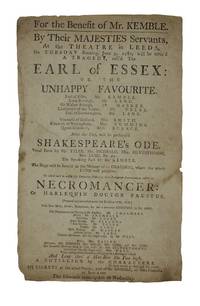
1781AQ31604Leeds: s.n. 1781. Single leaf broadside. Browned and creased some marginal chipping/tearing. An apparently unrecorded playbill advertising a benefit night of John Philip Kemble 1757-1823 at the provincial Theatre in Leeds in 1781. This appearance pre-dates Kemble's London debut by two years. At this time he was touring as a member of Tate Wilkinson's Company on the Yorkshire circuit; indeed it was Wilkinson who had constructed the Leeds theatre in 1771. Kemble son of actor-manager of a strolling theatrical troupe Roger Kemble and younger brother of actress Sarah Siddons took to acting in 1776 joining Wilkinson in 1778. Later in 1781 he moved to the Smock Alley theatre in Dublin before joining his sister at Drury Lane in September 1783. At Leeds he played the titular role in the tragedy of The Earl of Essex after which 'Shakespeare's Ode' was performed in which the majority of the players took vocal parts but with Kemble himself taking the speaking role. The evening concluded with the 'New Pantomime Entertainment' of Necromancer: of Harlequin Doctor Faustus an imaginative retelling of Christopher Marlowe's Doctor Faustus by pantomimist and theatre manager John Rich 1692-1761 first performed in 1723. . Dimensions 190 x 300 mm. [s.n.] unknown
1846AQ21379Leeds: Mann Printer and Stationer 1846. Single leaf broadside. Lightly damp-stained to head a trifle creased slight chipping to margins. An apparently unrecorded playbill announcing the final performances at the Leeds Theatre of actors Miss Fitzpatrick and Miss Acosta who often appeared in tandem in venues across the country in two comedies; The Love Chase 1837 by Irish dramatist James Sheridan Knowles 1784-1862 and The Honey Moon 1805 by ill-omened playwright John Tobin 1770-1804. . Dimensions 190 x 320 mm. Mann, Printer and Stationer unknown
1846AQ21376Leeds: Mann Printer and Stationer 1846. Single leaf broadside. Damp-stained to head lightly creased. An apparently unrecorded broadside advertisement for a staging at the Leeds Theatre of John Tobin's 1770-1804 The Honey Moon a romantic comedy written in blank verse and interspersed with prose. Throughout his life success eluded Tobin his work being summarily rejected by a slew of theatre managers. The Honey Moon was the first of his plays to be accepted in 1804. Tobin died of tuberculosis before the play was premiered at Drury Lane on 31st January 1805. . Dimensions 190 x 320 mm. Mann, Printer and Stationer unknown
1846AQ21378Leeds: Mann Printer and Stationer 1846. Single leaf broadside. Lightly damp-stained to head a trifle creased. An apparently unrecorded playbill advertising productions at the Leeds Theatre of Edward Stirling's 1807-1894 two-act domestic drama The Last Kiss or The Soldier's Grave here with the title curiously inverted and George Lillo's 1693- 1739 immensely popular tragedy The London Merchant or the History of George Barnwell 1731 a sordid tale of an apprentice who murders his guardian. . Dimensions 190 x 320 mm. Mann, Printer and Stationer unknown
21816Near Fine. Where Broadway performance meets the polished glamour of the Jazz Age.<br /> <br /> A visually elegant 1925 Broadway program for 'Lady Be Good!' blending Art Deco design Gershwin's rising musical influence and richly illustrated advertising into a snapshot of Jazz Age theatre culture.<br /> <br /> DETAILS:<br /> Title: Liberty Theatre The Magazine Theatre Program<br /> Author: Liberty Theatre Inc.<br /> Date: Week beginning April 20 1925<br /> Format: Staple-bound booklet<br /> Size: 5.25 by 7.75 inches<br /> Pagination: 40 pages<br /> <br /> CONTENT HIGHLIGHTS:<br /> Program for 'Lady Be Good!' with music by George Gershwin and lyrics by Ira Gershwin<br /> Cast includes Fred Astaire and Adele Astaire<br /> Distinctive Art Deco portrait cover with refined decorative framing<br /> Extensive illustrated advertising section including Murad cigarettes and fashion goods<br /> Period typography and layout reflecting mid-1920s commercial design<br /> Theatre diagrams cast listings and production details<br /> <br /> CONDITION: Very Good. The bindings are tight and secure. Text is clean; light even age-toning. Moderate shelf handling wear with minor edge wear; complete and well-preserved. HISTORICAL CONTECT -<br /> By the mid-1920s Broadway had become both a cultural and commercial centerpiece of American urban life. Productions such as 'Lady Be Good!' helped define the Jazz Age introducing new musical styles and launching performers like Fred Astaire into wider recognition.<br /> <br /> 'The unsigned cover illustration reflects the transition from late Art Nouveau into early Art Deco with a refined portrait style reminiscent of contemporary fashion illustration and commercial design of mid-1920s New York.'<br /> <br /> Theatre programs from this period reflect that evolution. Expanding in size and sophistication they served not only as guides to performance but also as curated advertising platforms aimed at affluent audiences. The presence of national brands fashion advertising and lifestyle imagery underscores the close relationship between entertainment and consumer culture in the 1920s.<br /> <br /> Today such programs are valued for their dual role as theatrical documents and as visually rich artifacts of early 20th-century design and advertising.<br /> <br /> Subjects: Liberty Theatre New York Broadway theatre programs Lady Be Good musical Gershwin Broadway Fred Astaire early career Art Deco illustration Murad cigarette advertising 1920s American culture Ephemera Theatre Americana. unknown
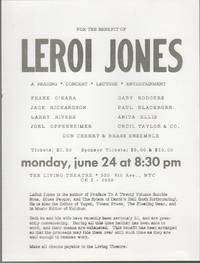
196341956New York: The Living Theatre 1963. First Edition. Near fine. Flyer for a benefit event for Amiri Baraka then Leroi Jones hosted by the experimental theater company The Living Theatre. Consisting of readings concert lectures and other entertainments performers included Frank O'Hara Larry Rivers and Joel Oppenhieimer. Proceeds for the event went to Baraka and his then-wife Hettie Jones who were both ill and unable to work. Hardcover. 8.5" x 11" approx. printed recto only in black. Ink mildly faded with slight toning. Very near fine. The Living Theatre hardcover