Lory, GabrielAntiquariat.de

54 417 résultats
18227686CBMilano, Presso F. Artaria, 1822. Kl.-4°. XI, 175, (5) S. Mit gest. Titel, 30 kol. Aquatinta-Tafeln (meist nach Lory, gest. von Landini und Fumagalli) und 1 gef. Karte. Lederband der Zeit mit reicher Rücken-, Deckel- und Innenkantenvergoldung sowie dreis. Goldschnitt. + Wichtig: Für unsere Kunden in der EU erfolgt der Versand alle 14 Tage verzollt ab Deutschland / Postbank-Konto in Deutschland vorhanden +, 7686CB|7686CB_2|7686CB_3|7686CB_4 [4 Warenabbildungen]
165253606Amsterdam, Visscher 1652. Abb. : 47 x 55 cm. + Rand unter Passepartout. = Sehr schönes altes Kolorit. Gut erhalten.
013-Io.J. Aquarell, über Bleistift, auf Velin, links unten signiert und bezeichnet ?Blaschnik fe Roma.?. 29,5:22 cm. Vermutlich Vorzeichnung für eine Lithogaphie. Bei unserer Darstellung der Innenseite des berühmten Vesta-Tempels von Tivoli handelt es sich sicher um eine sehr seltene Wiedergabe des Motivs ? für gewöhnlich wurde die Außenseite des Tempels, entweder von der gegenüberliegenden Bergseite oder von unten vom Tal her, zusammen mit der Schlucht und den Wasserfällen, von den Malern der Zeit wiedergegeben. Blaschnik jedoch zeigt den Tempel vom Garten des Gasthauses aus, das sich auch heute noch dort befindet.
1830151-W1830. Bleistift, auf chamoisfarbenem Velin, rechts unten bezeichnet und datiert ?Sorrento am 25. Juli 1830? und von einer anderen Hand ?im Hause der Gr(äfin) v(on) E(gloffstein). 18,3:24,1 cm. - Verso: Porträt der Karoline Lauska. Bleistift, rechts unten bezeichnet ?Frau Lauska?. Minimal fleckig. Im Juli 1830 reiste Julie von Egloffstein in Begleitung des Malers Fr. Preller d.Ä. (1804-1878) von Rom über Neapel nach Sorrent, wo sie einige Gemälde und Zeichnungen schuf. Unsere Ansicht ist von dem Haus aus gemalt, in dem die Künstlerin sich während ihres Sorrenter Aufenhaltes aufhielt. Das rückwärtige Bild zeigt ein Porträt der 1794 in Berlin geborenen Malerin Karoline Ermeler, die den Musiker F.I. Lauska (/1764-1825) geheiratet hatte. Sie war eine Schülerin von J.C.H. Kretschmar (1769-1847) und von W. von Schadow (1788-1862). Lauska bereiste Italien drei Mal, sicher 1829-1830. Möglich ist, daß sich Lauska ebenfalls 1830 in Sorrent aufhielt, wo dann Egloffstein das Porträt gemalt haben könnte. Ungewöhnlich ist bei diesem Porträt nicht nur die Wahl der Porträtansicht, sondern auch, daß es sich um eines jener seltenen Porträts einer Künstlerin handelt, das von einer Künstlerin gemalt wurde.
1658ALDR0675London, Abel Roper and Henry Herringman 1658. Gr.-4°. Tit. (rot u. schwarz gedr.), 1 Bl. (Vorw. des Übersetzers), 650 S. [recte 648, Paginierung wiederholt fehlerhaft], 204 v. 205(1) S. (Part II, es fehlen Ss.153/154), 6 [v. 9] Bll. (Register, ohne die letzten 3 Bll.). Marmorierter Halblederband des frühen 19. Jhdt.) m. goldgepr. Rückenschild, Streicheisenverz. auf Rücken, marmor. Deckelbezug sowie umseit. Sprengschnitt. Am ob. Kapital eingerissen, Kanten berieben, Anmerk. v. alter Hand auf Titelblatt, durchgeh. gebräunt, einige Bl. wasserrandig, vereinzelte Wurmgänge. - Gest. Wappen-Exlibris des John Congreve auf vord. Spiegel, jüngerer Exlibristemp. auf flieg. Vorsatz. Erste engl. Ausgabe. Fortführung der von Pietro Bembo begonnenen Geschichte der Republik Venedig. Umfasst die Jahre von 1513 bis 1551. Neben den venezianischen Schilderungen bildet der zweite Teil eine der wichtigsten Quellen zu den Türkenkriegen im Mittelmeerraum. Die Originalausgabe der 'Historia Veneziana' erschien erstmals 1605 in Venedig. Hier vorliegend eine Übertragung ins Englische. Paolo Paruta (1540-1598) wurde als Sohn einer angesehenen Familie, die 1381 in den Adel der Stadt aufgenommen worden war, in Venedig geboren. Den größten Teil seines Lebens stand er als Diplomat im Dienst der Republik Venedig. - Es fehlen 2 Seiten aus dem zweiten Teil und 3 Bll. aus dem Register.- Blackmer 1260.
1618STLE0110Padua, Pietro Paolo Tozzi 1618. Kl.-4°. 24 ungez. Bll., 648 S. Mit 1 gest. Porträt des Verfassers, 308 Textholzschnitten u. einigem Holzschnitt-Zierrat. Lederband der Zeit mit goldgepr. Titel und Rückenverzierungen, Buchdeckel m. schlichtem, blindgepr. Streicheisen-Rahme u. Stehkantenverz., umseit. Rotschnitt sowie marmor. Vorsätzen. Kanten berieben, Goldauflage vereinz. abgelöst, Rücken an der Vorderkante u. am unt. Kapital fachgerecht restauriert, Titel fingerfl. u. m. Signatur v. alter Hand, einige Wurmgänge im Falz u. unt. Seitensteg fachgerecht unterlegt, ersten u. letzten Bll. etwas braunfleckig, im Text sauberes u. gutes Ex., die Holzschnitte in kräftigen Abzügen. Landwehr VI, 625; vgl. BM STC (Italien 17th cent.) 750 (Ausg. 1610); Jöcher III, 2108. ? Fünfte, italienische Ausgabe. - "Ripa schuf mit seiner Iconologia eine völlig neue Form; sein Werk blieb auch in der Folgezeit bis ins 19. Jhdt. richtungsweisend" (Reallex. z. dt. Kunstgesch.). Das erstmals 1593 (1603 erstmals illustriert) erschienene Werk des Cesare Ripa (1555-1622) gilt als eines der bedeutensten Emblembücher des 17. Jahrhunderts. Aufbauend auf Studien antiker Bild- und Schriftquellen, auch der Bibel, gab Ripa abstrakten Begriffen, Künsten und Wissenschaften, Tugenden und Lastern, Affekten und Leidenschaften ein Bild. Aus heutiger Sicht ist das Werk Ripas bedeutsam für die Entschlüsselung barocker allegorischer Darstellungen. Das Buch war, gemäß einem in der Renaissance üblichen Verfahren, nicht systematisch, sondern alphabetisch angeordnet. Jedem Begriff entspricht in dem Buch ein Bild mit einer Beschreibung der allegorischen Figur oder Personifikation. Die Holzschnitte hier mit verschiedenen Renaissance-Zierleisten geschmückt. - DIFFERENZBESTEUERT.
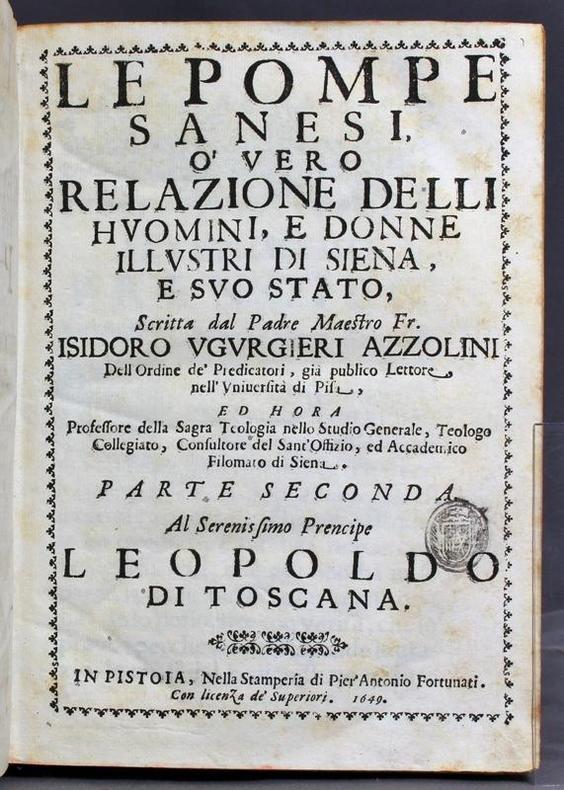
164912412In Pistoia, nella stamperia di Pier' Antonio Fortunati, 1649. 2 volumes in-8 de 685 et 461-[2] pages, demi-vélin blanc à coins, dos lisses avec titre manuscrit, tranches rouges. Tampon ancien aux pages de titre, quelques feuillets un peu brunis.
0816-Bo.J. 3 zeitgenössisch gouachierte Lithographien, nach Raffael, auf festem Bütten, auf Untersätze montiert, 2 Blätter rechts unten signiert und ?1851? datiert. Je ca. 53:75 cm. Von leuchtender Farbigkeit und sehr schöner Erhaltung.
1863ABC_47223Pont-à-Mousson France 1863. Size of the whole when folded and closed: 22.5 x 18 cm. Élie Haguenthal colophon: Paul Toussaint Half red cloth and hand coloured lithographed paper sides. Lithographed folding panorama showing 8 different lithographed scenes captioned in and beneath the illustrations of the Italian War of 1859 from the French-Italian perspective.The 8 scenes 5 3-leaf scenes and 3 single leaf scenes are assembled to make a single long foldout as assembled with the text: 21.5 x 395 cm; image size 19 x ca. 310 cm coloured by a contemporary hand. 5 ll. of letterpress text and the lithographed folding panorama. Second known copy of a lithographic panorama of the Italian War of 1859 also known as the Second Italian War of Independence. This war was fought in the northwest Piedmont region of Italy pitting the Second French Empire and Savoy-Piedmont-Sardinia against the Austrian Empire and it proved crucial in the process of Italian unification. The text and following hand-coloured lithographs describe and depict eight stages of the war from the departure of French troops for Italy to their return some months later and highlighting several important battles including those at Magenta and Solferino. As a result the influence of the Austrian Empire in Italy was greatly reduced.The present work is extremely rare: we have located only one other copy at the Bibliothèque Nationale de France and it moreover differs slightly from the present one.The title-page functions as the front paste-down the text and illustration of the panorama fold out from there. The text and illustration have been printed on one side of the paper. With a French inscription in pencil at the head of the first page. The binding is somewhat foxed and browned the front board is slightly cracked the red cloth around the spine is slightly faded the back hinge is weakened some occasional staining and very slight foxing throughout. Otherwise in good condition.l Cf. WorldCat 461406796 1 copy of a later ed.: Bibliothèque Nationale de France; for the publisher Haguenthal: Dictionnaire des imprimeurs-lithographes du XIXe siècle http://elec.enc.sorbonne.fr/imprimeurs/node/25785. ABE CAT Art History hardcover
185217181München, Hanfstengel, (1852). Ca. 54 cm x 82 cm (Bild), ca. 66 cm x 86 cm (ganze Blatt). [6 Warenabbildungen]
023-Io.J. Aquarell über Bleistift, auf Velin, rechts unten bezeichnet und signiert ?Porta Maggiore in Roma. Blaschnik pixit?; verso bezeichnet ?Porta maggiore in Rom?. 25,3:34,9 cm. Insgesamt leicht fleckig; verso Reste von alten Klebeetiketten.
096-Io.J. Bleistift, leicht gelblich laviert, auf Velin. 17,5:23,9 cm. Provenienz: Aus dem künstlerischen Nachlaß; Schweizer Privatbesitz. Zeichnungen von Frey gehören heute zu den Seltenheiten auf dem Kunstmarkt.
59-BFo.J. Bleistift, auf chamoisfarbenem Velin. 25,4:44 cm. - Verso: Baumlandschaft. Bleistiftskizze. - Ränder geringfügig vergilbt und kleinem Einriß am Unterrand. [2 Warenabbildungen]
145-Io.J. Bleistift, auf Velin, rechts unten bezeichnet und datiert ?Villa Borghese 24. Januar à Roma 1838?. 33,3:47,7 cm. Provenienz: Sammlung Franz Meyer. Die ganz im Geiste der Romantik stehende Zeichnung besticht durch eine zarte und sichere Zeichenführung. Die Datierung lässt zudem den Schluss zu, dass Wagner eine weitere Reise nach Italien im Jahr 1938 unternahm.
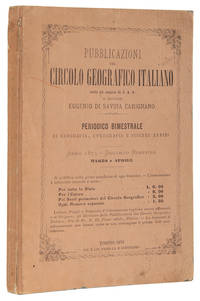
105018Torino Camilla e Bertolero 1873-74. . One volume number '2' from the Circolo Geographico Italiano biannual periodical for the years 1873 and 1874 complete in itself; 8vo 228 x 150; including a 4pp. index list of Arabic names printed in two columns in Italian and Arabic the latter is lithographed from crudely inscribed manuscript annotations and three plates one of these large folding with closed tears to edges relating to Mecca very clean and crisp condition; original printed covers slightly rubbed at extremities else a very good copy.<br /> A rare copy of an article on the architecture and history of the main Ka'aba and holy mosque in Mecca included in an Italian geographical periodical printed in 1874. The article includes a detailed history of the area and provides details from known historical accounts of the region. The article also includes three plates of Mecca including: one large folding reproduction of a tile design depicting the topographical layout and design of Mecca a detailed plan of the site of Mecca including a table of contents and a plate containing depictions of the Black Stone and ZamZam Well.<br /> Torino, Camilla e Bertolero, 1873-74. unknown
177116613In Parigi, Apresso Agostino Delalain, Pietro Durand, Gio. Claudio Molini, 1771. 2 volumes grands in-4 de 331; 340 pages, plein maroquin rouge, dos à nerfs ornés de fleurons et petits fers dorés, triple filet doré en encadrement des plats, double filet aux coupes et roulette dorée aux chasses, tranches dorées.
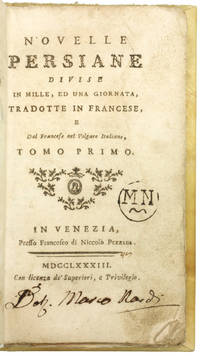
1783ABC_49353Venice: Niccolò Pezzana 1783. Later vellum with the manuscript titles and volume numbers in red on the spines. 12mo. With small vignettes built up from typographical ornaments on the title pages and some headpieces built up from typographical ornaments. 5 volumes. Extremely rare charming five-volume Italian edition of the Heyaryek-Rouz or Thousand and One Days so called to give the work an air of originality Chauvin IV 124. A Persian manuscript of this work was given to Francois Petit de la Croix in Isfahan in 1675 but enjoyed far fewer editions and translations than the Alf layla wa-layla. As Chauvin notes it cannot be determined whether the Thousand and One Days or the Thousand and One Nights was composed first nevertheless to this day the Heyarek-Rouz is much less well-known to the Western world IV 123f. Chauvin quotes one commentator who declares the Heyarek-Rouz much more ingenious and more realistic as it sometimes includes marvels following the taste of the Oriental.The present edition is printed by Niccolò Pezzana who only the following year would produce the Thousand and One Nights part of an ambitious publishing project catering to the Venetian public which at the time was rediscovering a taste for exotic fairy tales.With an owner's stamp MN on each title page and a manuscript inscription "Dot. Marco Nardi on the title page of vols. I and II. Both the inscription and the stamp belong to Dr. Marco Nardi. Further with some manuscript annotations in brown ink on the blank flyleaves. The endpapers are slightly worn some marginal worming to vol. V not affecting text some leaves are very slightly dust soiled. Otherwise in good condition.l OPAC SBN ITICCULO1E019364 3 copies incl. 2 incomplete; cf. this edition not in Chauvin; WorldCat. Niccolò Pezzana, hardcover
184736278Venedig, Giuseppe Kier, 1847. Aus zwei Teilen zusammengesetztes Panorama von Giovanni Pividor (Ansicht 18,8 x 173 cm; Blattgröße 30 x 188,5 cm) in getönter Lithographie, gerollt in bedruckter lithogr. OPp.-Rolle.
167310136Roma: Gio. Giacomo de Rossi 1673. First Edition Primera edición. Hardcover Tapa dura. 345x480mm. 13½x19". Roma Gio. Giacomo de Rossi 1673. En folio mayor apaisado 345 x 480mm. 2 h. con portada y dedicatoria a Luis XIV de Francia grabadas 7 láminas grabadas sin numerar y 119 láminas grabadas y numeradas. Encuadernación en holandesa del siglo XIX. Primera edición de esta obra monumental dedicada a ilustrar el friso escultórico de la Columna Trajana erigida en Roma por orden del emperador Trajano en el año 113. Está ilustrada en bajo relieve en espiral y alcanza los 30 metros de altura compuesta por 18 enormes bloques de mármol de Carrara. El friso escultórico completo mide unos 200 m y da 23 veces la vuelta a la columna. El relieve narra dos victoriosas campañas de Trajano contra los dacios: en la mitad inferior de la columna se ilustra la primera 101-102 y en la superior la segunda 105-106. El relieve estuvo completamente policromado. Pietro Bartoli interesado en la reproducción de obras de arte antiguo reprodujo el friso completo de la columna y comisionó a Bellori y a Chacón para la escribir la historia que aparece al pie de los grabados. Algunos ejemplares llevan 14 páginas de texto que no están en nuestro ejemplar. Gio. Giacomo de Rossi hardcover
167864619Amsterdam, Jacob van Meurs u. Joannes, van Someren, 1678. Fol. Mit illustr. Kupfertitel, Drucktitel in Rot u. Schwarz m. Druckermarke, einer doppelblattgr. Kupferkarte u. 19 doppelblattgr. Kupfertafeln. Mod. Ldr. m. Rückenverg. u. goldgepr. Rückenschild.
15886821CBFlorenz, Filippo Giunti, 1588. Kl.-4°. (4) Bl., 186 S., (9) Bl. Mit Holzschnitt-Portrait, 2 versch. Holzschnittdruckermarken und zahlr. Holzschnitt-Initialen. Flexibler Pergamentband der Zeit mit 2 Schliessbändern (2 Seiten ausgerissen), handschr. Rückentitel und Papierrückenschild. + Wichtig: Für unsere Kunden in der EU erfolgt der Versand alle 14 Tage verzollt ab Deutschland / Postbank-Konto in Deutschland vorhanden +, A|B|C|D [4 Warenabbildungen]
1850171731800 - 1850. Ca. 47 cm x 32 cm. [2 Warenabbildungen]
160520690Augsburg, Custos, 1605. 38 (statt 40) nn. Bll. mit 1 Kupfertitel, 6 ganzseit. Stammbäumen und 25 (statt) 26 ganzseit. Porträts von Raphael Custos (alles in Kupferstichn und in der Kollation). 4°. Mod. Pgmt. [6 Warenabbildungen]
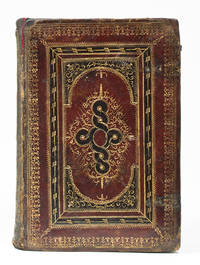
1618254275Venetiis Venice: Juntas 1618. Title with engraved border 11 full-page engravings black chant notation on red four-line staves lxiii i 557 3; 24; 14 pp. text in double columns printed in red and black. 8vo. Bound in contemporary maroon morocco richly gilt black morocco inlaid panel border surrounding central inlaid entrelac design rebacked preserving original spine lacking clasps and catches a.e.g. joints rubbed front joint starting some light foxing throughout contemporary and early ownership notes to endpapers. Title with engraved border 11 full-page engravings black chant notation on red four-line staves lxiii i 557 3; 24; 14 pp. text in double columns printed in red and black. 8vo. Juntas unknown