MARCOLINI (Francesco).Livre Rare Book
54 417 résultats
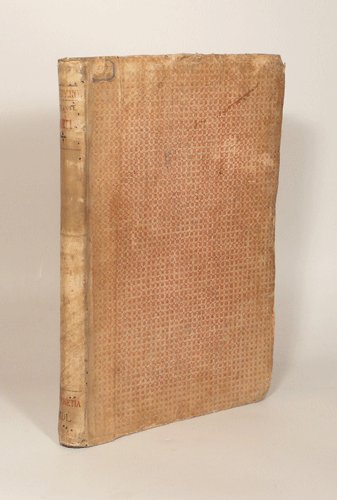
15500033071550 Venise, Francesco Marcolini, juillet 1550. Petit in-folio (225 X 322) demi-vélin ivoire, plats de papier dominoté, auteur, titre, lieu d'édition et date calligraphiés au dos en rouge et noir (reliure XVIIIe) ; A-Z4, Aa-Cc4 : 104 feuillets. A partir des figures des philosophes (page 64) il est donné un même numéro pour deux pages. Nombreuses restaurations aux premiers feuillets, l'encadrement architectural du portrait de l'auteur est masqué par un feuillet de doublure, marges du feuillet 43/44 rognées.
cm. 21 x 30. La collezione completa dei voll. I-XLIII pi? due voll. di indici, rilegata. Fondato nel 1894, cessato con l'anno 1940 (vol. XLIII). Diretto da Giuseppe Lando Passerini e successivamente da Luigi Pietrobono e Guido Vitaletti.
179010313Wien, Artaria, 1762 (recte um 1790). Grenzkolorierte Kupferstichkarte von Anton Weinkopf in 4 Blättern (jeweils ca. 49 cm x 54 cm). Gesamtgröße: Ca. 90,5 cm x 103 cm).
205-Do.J. Pinsel in Braun, braun laviert, über Bleistift, auf Bütten. 28,3:40 cm. - Mit einem Braunfleck im Bereich des oberen Brunnenrandes. Provenienz: Sammlung SRH im Dreieck mit einer Schale (Wiener Sammlung), nicht bei Lugt; Sammlung Anton Schmid, Wien, nicht bei Lugt; Sammlung Helmut Märkt, Reutlingen; Galerie Sabrina Förster, Düsseldorf, Herbstkatalog 2006/2007, Nr. 33 mit Abb. Gutachten: Dr. George Knox, Vancouver (29.06.2006).
37-EFo.J. Feder in Braun, auf Bütten mit Wasserzeichen: bekrönter Wappenschild mit Adler und den Initialen ?GM?, unten von fremder Hand falsch bezeichnet ?Perugia Assisi?. 21,1:30,1 cm. - Geringfügig stockfleckig.
40-EFo.J. Bleistift, auf dünnem Bütten. 30,3:30,7 cm. - Insgesamt etwas stockfleckig, zwei dünne Stellen im Randbereich.
004-Io.J. Aquarell und Pinsel in Grau, über leichter Bleistiftskizze, auf Bütten, auf grauen Büttenkarton aufgezogen, dort verso signiert und nummeriert ?Frommel 3? sowie mit Bezeichnungen von Vorbesitzern. 31,7:24,5 cm. Provenienz: 1. Sammlung E. Fuhrer, Essen, nicht bei Lugt; 2. Galerie Joseph Fach, Frankfurt a.M., Kat. 57, Nr. 70; 3. Sammlung Helmut Märkt, Reutlingen, nicht bei Lugt.
206-Do.J. Feder in Braun, braun laviert, über Bleistift, mit brauner Feder umrandet, links signiert und datiert ?CLabruzzi 1796?. 22,8:18,7 cm. Auf alten Sammlungsuntersatz mit grün laviertem Rand aufgezogen. Vergleichsliteratur: Ausst. Katalog: Carlo Labruzzi. The Grand Tour. Cur. by Sir Timothy Clifford. Simon C. Dickinson Ltd., London, 12 Juni - 13 July, 2012, Nr. 38, Venustempel in Bajae (Vergleich zur Signatur); Auktion Pandolfini Casa d?Aste, Florenz, 15.12.2014, Stampe e Disegni dal XVI al XX secolo,? Nr. 56 Figure di Carlo Labruzzi. Aquatinta, 1788; Auktion Koller, Zürich, 18.09.2015, Zeichnungen des 15.-20. Jahrhunderts, Nr. 3418 Zwei Mönche im Gespräch. Zeichnung.
18401801161840er Jahre. Signiert "C. Muller" und auf dem Unterlageblatt mit "C Muller" bezeichnet. 19,3 x 25,4 cm (Darstellung), 22 x 28 cm (Blattgröße).
281-Eo.J. Bleistift, weiß gehöht, auf graugrünem Papier, rechts unten signiert, bezeichnet und datiert ?Preller fe. Roma, d. 2. Januar 1860?, links unten bezeichnet ?Domenico Antonio Murgiotti di Picinescu.?, unten mittig alter handschriftlicher Besitzvermerk mit zartem Bleistift ?Elise Sigismund. Weimar d. 6. Sept. 1881?. 44,5:35 cm. Entlang des linken Randes leichte Papierverfärbung, wahrscheinlich ein Wasserrand.
158414130In Venetia, Presso Cornelio Arrivabene, 1584. Petit in-4 de [8]-214 (pour 218)-[2] pages (signature: *4; A-Z4; Aa-Dd4), demi-veau fauve, dos à nerfs, pièce de titre noire.
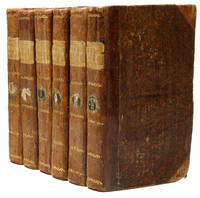
1791ABC_49348Venice: Giuseppe Orlandelli per la dita del fu Francesco di Nicolò Pezzana 1791. Contemporary half calf marbled paper sides with vellum corners a title label lettered in gold on the spine. 12mo. With a small vignette built up from typographical ornaments on the title page of each volume and with some headpieces built up from typographical ornaments. 6 volumes. Second Pezzana edition following that of 1784. That Niccolò Pezzanas company which in the meantime had been succeeded by Giuseppe Orlandelli returned to print the Arabian Nights testifies to the great favour the stories had found among readers in Venice. Also in 1791 the "Continuation of the Thousand and one nights" left its presses in a major publishing project to rediscover oriental fables.With the black ownership stamp of Ettiénne della Valle on the title page of each volume. Overall in good condition.l OPAC SBN ITICCUPUVE023925 4 copies incl. 3 incomplete; WorldCat 960425061 and other numbers for vols. 2-6 1203593861 3 copies; cf. Callegari Le edizioni veneziane delle Novelle arabe divise in mille ed una notte nel XVII secolo in Antoine Galland 1646-1715 et son journal: Actes du colloque international organise a lUniversite de Liege 16-18 fevrier 2015 a loccasion du tricentenaire de sa mort 2020 pp. 105-116 here at 108. This edition not in Chauvin. Giuseppe Orlandelli, per la dita del fu Francesco di Nicolò Pezzana, hardcover
In -8°, pp, 88, cartonato, tagli rossi. Sul verso del frontespizio altro titolo: “Lettera del padre Diego di Pantogia della Compagnia di Giesù al Padre Luigi di Guzman Provinciale nella Provincia di Toledo. Scritta in Pachino corte del Rè della Chiana a di 9 di Marzo, dell’anno 1602. Pubblicata originariamente in spagnolo nel 1605 questa lunga lettera, qui nella sua prima versione italiana, si distingue per la chiarezza argomentativa del testo, quasi giornalistica nel riportare dettagli della vita politica, economica, sociale e religiosa cinese. Il libro è valutato nodale anche come testimonianza circa i rapporti fra religione cattolica e Islam: “This is a very early source written by Christian on Muslims in China proper. The almost non-judgmental treatment of Islam is particularly interesting, although it must be noted that the text was written befor the Jesuit-Muslim conflicts fo the later part of the 16th century, so it must be possible to assume that relations at this time were fairly amicable. [...] The descriptions of Muslim life in China are fairly extensive in comparison with other texts of the early 17th century although, like its counterparts, the text focuses more on other religions such as Buddhism, Taoism, Confucianism and Judaism”. (Thomas Davies, John Chesworth, “Christian-Muslim Relations. A Bibliographical History”, 2012, vol. 11, p. 294. Diego de Pantoja o Diego Pantoja (Valdemoro 1571 – Macao 1618) era un gesuita e missionario portoghese in Cina, noto per aver accompagnato Matteo Ricci a Pechino, dove Diego avrebbe lavorato come astronomo, geografo e musicista. Nel 1617 fu processato come nemico degli astronomi cinesi (aveva apportato alcune correzioni al calendario) ed espulso dalla Cina. Published before in Spanish, this long letter, here in its first Italian edition, is valued as remarkable not only about early contacts between Christian Europe and China, but also about the relationship between Catholic religion and Muslim one: “This is a very early source written by Christian on Muslims in China proper. The almost non-judgmental treatment of Islam is particularly interesting, although it must be noted that the text was written befor the Jesuit-Muslim conflicts fo the later part of the 16th century, so it must be possible to assume that relations at this time were fairly amicable. [...] The descriptions of Muslim life in China are fairly extensive in comparison with other texts of the early 17th century although, like its counterparts, the text focuses more on other religions such as Buddhism, Taoism, Confucianism and Judaism”. (Thomas Davies, John Chesworth, “Christian-Muslim Relations. A Bibliographical History”, 2012, vol. 11, p. 294. Diego De Pantoja (1571-1618) was a portuguese jesuit and missionary in China, known for getting along Matteo Ricci to Beijing, where Diego was an astronomer, a geographer and a musician. He purpoused some changes to Chinese calendar, and in 1617 was prosecuted and banished from China.
011-Io.J. Aquarell, über Bleistift, mit schwarzer Tuschlinie umrandet, auf cremefarbenem Velin, rechts unten signiert und datiert ?F. Knebel fec 1836?. 14,1:20,7 cm. - Farben leicht verblichen und mit kleinen sorgfältigen Restaurierungen.
160015864ABVenice, Io. Baptista Ciotti, 1600. 38,5 : 25 cm. Engraved title, 6 leaves, 136; 15 pages, 32 double-page engraved plates. Calf in contemporary style.
191086274Mailand [Poststempel], 29. X. 1910. Quer-kl.-8vo. 1 p. Postgelaufen.
044-Io.J. Bleistift, 1824, auf Bütten mit Wasserzeichen: Vogel auf Dreiberg im Kreis, auf Untersatz montiert, dort von Richter bezeichnet ?aus Palestrina?. 19,7:27,5 cm. Verso: Bleistiftskizze mit den Konturen des Volskergebirges. Verso an den Ecken alte Leimspuren, an der linken unteren Ecke kleines Stück abgerissen, leichte Quetschfalte im Papier unten (außerhalb der Zeichnung). Provenienz: Nachlaß Frau Helene Kretzschmar, geb. Richter; Sammlung SK im Kreis, nicht bei Lugt sowie weitere unbekannte Sammlung. Die Zeichnung entstand am 20. September 1824, als Richter und Carl Wagner (1796-1867) gemeinsam eine Wanderung nach Olevano unternahmen.
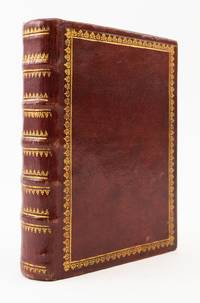
1740ST19100aVenetiis Venice: Giambattista Pasquali 1740. FIRST EDITION. 132 x 90 mm. 5 1/4 x 3 1/2". 20 p.l. 427 5 pp. <br/> FINE CONTEMPORARY VENETIAN RED MOROCCO GILT covers with border of repeating botanical tools raised bands flanked by decorative gilt rolls green silk pastedowns all edges gilt and gauffered. HOUSED IN THE ORIGINAL PULL-OFF MARBLED CALF CASE the book and its case within a brown cloth chemise and matching slipcase. ENGRAVED THROUGHOUT with numerous floral initials 20 charming tailpieces frontispiece and 15 full-page illustrations by M. Pitteri all designed by Giambattista Piazzetta. Front flyleaves with book labels of John Saks Arthur and Charlotte Vershbow and David R. Godine. See: Boorsch "Venetian Prints and Books in the Age of Tiepolo" p. 20 and no. 98; Selby Carol E. "A Small Masterpiece from the Eighteenth Century Publishing World." Bulletin of the Detroit Institute of Arts vol. 43 no. 3/4 1964 pp. 60-63. ◆A hint of rubbing to extremities one tiny abrasion to front cover flyleaves with offsetting from binder's glue one page with tiny ink spot in margin but AN EXTREMELY FINE COPY ENTIRELY CLEAN FRESH AND BRIGHT internally in a beautifully preserved binding and case.<br/> <br/> Preserved in its original pull-off case and in superb unsophisticated condition this is a very charming prayer book engraved by a trio of talented artists that is called "a small masterpiece" in the "Bulletin of the Detroit Institute of Arts" in 1964 and described in the June 2013 Christie's catalogue of the Vershbow sale as "one of the most desirable Venetian illustrated books of the 18th century." The plates here were designed by Giovanni Battista Piazzetta 1682-1754 a painter and illustrator whom Britannica calls "one of the outstanding Venetian artists of the 18th century." Piazzetta was known for his masterful use of chiaroscuro and dynamic compositions--both of which can be seen to great effect in the present work. The engravings were executed by a close collaborator of Piazzetta Marco Alvise Pitteri 1703-86 whom Selby calls "one of the most able and popular engravers in Venice being in demand for the reproduction of works of his most distinguished contemporaries." Using his own unique blend of engraving techniques described by Boorsh as "unprecedented and unimitated" Pitteri is able to translate Piazzetta's animated compositions into a small-scale format with figures that are beautifully highlighted and seem to glow on the page. But perhaps the most impressive part of this work is the text itself. What at first glance appears to be more than 400 pages of letterpress is in fact entirely engraved--an extraordinary feat of precision and patient craftsmanship by Angela Baroni daughter of engraver Giuseppe Baroni. It seems likely that Angela learned the craft from her father but little else is known about her life. Regardless Angela's talents speak for themselves through this work. As Carol Selby tells us "Engraving a book like this one is an undertaking indeed. . . . The more than 400 pages must each have been engraved in reverse on copper plates which being almost impossible to correct allowed little margin for error. The effect is charming lively controlled but free." Thanks to the original and very pretty pull-off case this little gem has remained in outstanding condition inside and out. The volume has a distinguished provenance having belonged to collectors known for their taste and discrimination in the acquisition of a range of especially desirable books: John A. Saks who bought it from Bernard Quaritch in 1981 then Arthur and Charlotte Vershbow then David Godine who bought it at the Vershbow sale for $3000. Giambattista Pasquali unknown
95636aaf31x25 cm, 1) kl. ovales Reliquienmedaillon aus Silber mit Glasfenster und Beschriftung „Ex Oss: S. Franc: Bor:“, mit Zeugnis auf Papier, vorgedrucktes Formular mit gestochenem Bischofswappen, handschriftlich ausgefüllt u. unterschrieben, Medaillon und Zeugnis unter Glas mit ornamentaler Textilrahmung mit Stütze zum Aufstellen auf Rückseite, dazu zwei Klosterarbeiten in ähnlicher Textilrahmung: 2) Gouache-Miniatur von Johannes d. Täufer mit Stickerei, Goldborten sowie polychromen Glasperlen, Stoffblumen, Draht und Pailletten. 3) ovales Stoffmedaillon mit Glasperlen u. goldfarbenem Draht u. Pailletten auf Purpurgrund mit Goldbrokatverzierungen, guter Zustand, an den Ecken Textilrahmen teilw. etwas ausgefranst, es liegt auch ein Dossier mit einer kurzen Dokumentation zum Heiligen u. den Jesuiten bei (Ausdrucke u. Fotokopien),
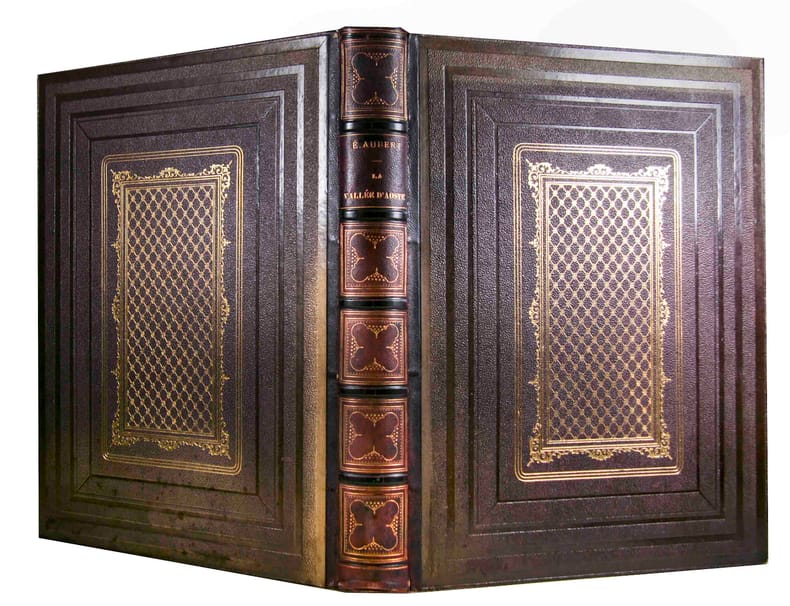
116991aafParis, Amyot, Libraire-éditeur, 1860, in-4to, 4 ff. (faux-titre, titre avec vignette gravée, dédicace ‘A Son Altesse Royale le Prince Amédée de Savoie’, sommaire + 279 p. (+ 1: table des planches et chromotypographies), avec 97 gravures sur bois dans le texte + 33 gravures sur acier h.-t. + 6 chromotypogr. + 1 carte, bonnes marges, rousseurs éparses, surtout dans les pages de texte, reliure en d.-percaline originale, dos à cinq nerfs, plats ornés or, tranches dorées. Bel exemplaire dans la reliure de l’éditeur.
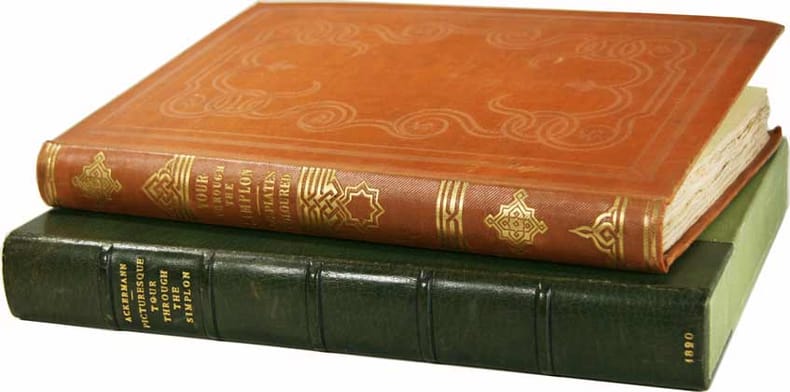
86747aafLondon, R. Ackermann (printed by J. Diggens, St. Ann’s Lane, London), 1820, in-4to, frontispice (map) ‘Plan of the road’ + title + 4 leaves: ‘Preface, List of plates’ + 136 p. + 36 handcoloured aquatinta-plates. Untrimmed copy in an original publisher’s light-brown clothbound, spine richly gilt, covers blindstamped. Housed in a clothbox with green morocco-leather spine with gilt title and year 1820.
96252aafParis, de L’Imprimerie de Firmin Didot, 1822 / 1823, in-folio (atlas) / in-4° ( volume de texte), (Texte:) XLIV + 454 p. / (Atlas:) Titre + VIII + 20 planches gravées sur 76 feuilles. (N° 1.1: grande carte double dépl. + N° 1.2: carte dépl. + 37 planches sur double feuilles numérotées de 2 à 20), exlibris ms. ‘Gabriel Naville’, reliure en demi-cuir, plats couverts de papier marbré, dos sur 5 nerfs, titre or, 1 coin cassé (manque).
181012318Wien, Artaria, o. J. (1810). Ca. 47 cm x 71,5 cm.
184518374Venedig, Kier, o. J. (1845). IV, 298 S., 1 Bl. 1 tonlithograph. Titel und 82 tonlithograph. Tafeln nach Marco Moro. Quer-Gr.-Fol. Mod. HLdr. mit Rückenschild. [5 Warenabbildungen]
164717565Innsbruck, Wagner, 1647. 4 Bll., 215 (recte 115) S. mit Wappen-Titelholzschnitt und Holzschnitt-Titelbordüre. 8°. Ldr. der Zeit mit Wappensupralibros und blindgeprägten Bordüren (bestoßen und beschabt, Kapitelle mit Einrissen, Schießbänder fehlen). [6 Warenabbildungen]