Claudio Tolomeo, Giovanni Antonio MaginiMareMagnum

54 417 résultats
In-folio; 2 tomi in 1 volume; [2], 62, 21, [14]; 212, [30] carte. Marca tipografica ai 2 frontespizi, 64 carte geografiche incise in rame da Girolamo Porro e impresse su mezza pagina, delle quali 33 carte geografiche dedicate all’Europa, 20 all’Asia, 6 all’Africa e una all’America, oltre a 4 mappamondi (primo frontespizio e ultima carta restaurati, sporadiche bruniture.) Legatura coeva in pergamena con titolo dorato al dorso, tagli verdi.
In 4° (234 x 163 mm), 3 parti in 1 volume.; [8], 358, [2] pagine; [28] carte; 47, [49] pagine, 64 carte geografiche a doppia pagina delle quali 27 raffiguranti il mondo antico e 37 raffiguranti il mondo moderno con la descrizione al retro, 12 xilografie e diagrammi nel testo, marche tipografiche (alcuni difetti.). Solida legatura coeva in pergamena con unghie (sguardie nuove).
EN-143o.J. Aquarell und Feder in Schwarz, auf Bütten, mit Feder betitelt, datiert und signiert ?Olevano 1931 / C. Grossberg?. Blattgröße 49,7:40 cm. - Provenienz: Privatsammlung, Hessen. - Während seines Romaufenthaltes besuchte Großberg im Jahr 1931 auch das Bergstädtchen Olevano, das schon im 19. Jahrhundert das Ziel zahlreicher Maler aus Nordeuropa war.
25-Go.J. Öl, auf Leinwand, links unten auf einem Stein signiert und datiert ?C. Küchler / pinx. / Roma 1836?. 29:22,5 cm. - Mit vereinzelten winzigen Retuschen. Auf einem verso aufgeklebten Etikett einer alten Sammlung in brauner Feder bezeichnet ?N. 5. / L.W.S. / Küchler Dresden.? Provenienz: Familie Küchler, Dresden.
18258414Bologna, Giovanni Zecchi, o. J. [um 1825]. 1 typographischerTitel und 40 Kupfertafeln. Quer-Gr.-4°. Kart des 19. Jahrhunderts mit aufgekl.vorderen OU (Rücken erneuert, etw. fleckig, kl. Randläsuren).
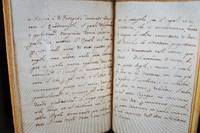
1441Italy 17th Century. <p>127 x 98 mm. 5 x 3 ¾ inches.  16 p. including final blank. Italy 17th century.                                      <br /> A handwritten guide to the drawing of the human head the most important element of any figure drawing and frequently the starting point for early modern drawing manuals. The manuscript appears to be unpublished and we have been unable to trace the text anywhere in the vast digitized corpus.</p> <br /> <p>The content is divided into five brief sections the first explaining how to draw a head in profile. Our scribe focuses on the triangle method in which the profile is anchored by three primary points: the top of the forehead cima della fronte beneath the nostrils sotto le narici and the well of the chin and the beard pozzetta del mento ò barbuccio. The author then explains how to connect these points how to form the nose place the mouth and lips draw the eye etc. Our scribe closes this section with the kind of aspirational promise endemic to manuals of this time namely that if you simple follow my instructions you’ll be able to do this easily. “without much confusion and effort†senza tante confusion et fatiche.</p> <br /> <p>The second section explains how to draw the head “in majesty†Della testa in scurcio by which the author appears to mean ‘head-on’ in such a way to convey power and authority he elsewhere refer to this position as prospetto e.g. on p. 9. Here the author likewise focuses on a simple method of drawing lines between different features of the face. The third section covers drawing the head in shadow Della testa in scurcio which the author admits is alquanto più difficle than the first two exercise and so he won’t be sticking to such geometrical rules. But then he goes on to provide a single very simple rule una regola facile assai namely to start with drawing rounded oval l’ovato cirolare and continues with guidelines that sound awfully geometric to us. The fourth section is on drawing a child’s head in profile la testa del fanciullo in profilo where he again starts with the triangle method adding other geometric principles and referencing the point of a compass. The fifth and final section is on drawing a child’s head in maestà wherein the author cites earlier discussion and further expounds on geometric advice. The author then closes with a general comment on the excellence and nobility of the art of drawing.</p> <br /> <p>The focus throughout is on lines and contours and proportions always guided by geometric rules for producing an accurate but relatively basic sketch. There is only brief passing reference to elements like “hair or other ornament according to the need and what is most pleasing†pelli or altro ornamento secondo che porfarà il bisogno e che più in piacerà . Despite the brief section on drawing the head in shadow there is nothing on rendering value or otherwise on capturing the subtleties that give a drawing depth and feeling.</p> <br /> <p>Like its spine title the Fairfax Murry catalogue calls this 17th-century and we tend to agree based on the script. While we haven’t traced our particular “bird†watermark Heathwood records a few similar marks used in the 17th century and Briquet finds many in the 16th especially in Italy.</p> <br /> <p>No less absorbing than the manuscript is a pair of 16th century Italian binding covers here preserved as doublures both heavily decorate in blind. The front doublure carries an arabesque motif and center Alexander the Great in profile. The rear appears to have been impressed with a single panel stamp also arabesque both doublures betraying the Islamic influence that characterized many Italian bindings of the period. </p> <br /> <p>Provenance: Lot 237 in the second Fairfax Murray sale his label on the inside rear board and perhaps then to Robert Tunstill his bookplate on the front fly-leaf. To us from a fellow ABAA bookseller who purchased it from a UK dealer in the 1990’s.</p> <br /> <p>Condition: Written in a cursive hand in dark brown ink on laid paper watermarked with a bird within a circle. Rebound in the late 19th century or early 20th century in cream pigskin tooled in black preserving as doublures the decorated covers of a 16h-century Italian binding described above title in gilt on spine Del disegno. Ms. Saec XVII. Following the manuscript are four additional blank leaves saved for scanning old pen trials early but the paper is different than the manuscript proper. Additionally six more modern fly leaves have been added at both front and back presumably at the time of rebind. A little loss since filled to the upper outer corner of the manuscript leaves and the four earlier blank leaves affecting just a word or two on each page; a few old pen trials over the text though it remains legible. Binding extremities lightly worn.</p> <br /> References: Catalogue of the Second Portion of the Library of C. Fairfax Murray 1918 p. 42 no. 237 “Manuscript on paper Italian hand 16 pp. repaired white morocco extra the cover of an old stamped vellum binding used as a double. 12mo. Saec. xviiâ€. Alexandra Arvilla Greist Learning to Draw Drawing to Learn: Theory and Practice in Italian Printed Drawing Books 1600-1700 PhD Dissertation UPenn 2011 p. vii “Italian printed drawing books libri da disegnare comprise an important body of evidence for our knowledge of artistic training in Italy during the early modern period. . . Intended for both professional and amateur audiences these printed sources were soon copied throughout Europe where they influenced drawing education for the next 400 yearsâ€. C. M. Briquet. Les Filigranes v. 3 # 12202- 12232 similar watermarks mostly 16th century. Edward Heawood Watermarks Mainly of the 17th and 18th Centuries 1950 # 179 183 similar watermarks 17th century. Anthony Hobson Humanists and Bookbinders 1989 p. 220-21 recording a few 16th century Italian bindings with Alexander the Great plaquettes. Thanks to Patrick Olson for help with this description. unknown
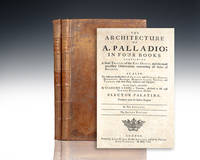
1721146284London: Printed by John Darby for the Author 1721. Rare second English edition of Leoni's English translation of Palladio's monumental work containing new typesetting but reusing the same plates from the first edition. Folio two volumes bound in full contemporary polished calf with gilt titles and ruling to the spine in six compartments within raised bands double gilt ruling and decorative stamping to the front and rear panels engraved frontispiece portrait of Palladio illustrated with 104 numbered engraved plates on 203 leaves including 15 double-page plates as well as 12 engraved in-text plates. Armorial bookplate to the pastedown of each volume. In very good condition. One of the giants of Venetian Renaissance architecture of the 16th century Andrea Palladio based his designs on the values of Greek architecture and the traditions of Roman architecture as outlined by Vitruvius. He is regarded as one of the greatest architects in the history of Western art best known for his villas in the Veneto as well as his palaces Vicenza and churches Venice all located within the Venetian Republic. His architectural theories were laid out in his treatise Quattro Libri dell Architettura The Four Books of Architecture which had a profound impact on building design throughout Europe and America. His style of architecture - a blend of Greek Roman and Renaissance art later known as Palladianism - accorded the greatest priority to maintaining symmetry perspective and overall harmony in the manner of Greco-Roman temple architecture and was widely imitated during the 17th and 18th centuries. Printed by John Darby for the Author hardcover
89492aaf1874 - 1921, in-folio, reliure en d.- cuir bibliothèque / d.-toile.
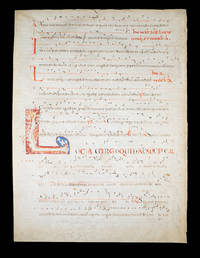
0724<p>This illuminated antiphonal leaf from 12th-century Italy likely Tuscany c. 1125–1150 preserves chants for the Feast of Saint Lucy Santa Lucia. Written in Latin in a rounded Carolingian hand the page features neumatic notation on a single red stave a transitional form of medieval musical notation. Rubrics in red uncials guide the singer while blind ruling for sixty lines ensures precise alignment of text and chant.</p><p>The centerpiece is a historiated initial "L" inhabited by a whimsical bird with red wings and yellow tail set against a red-and-blue paneled background. This inventive zoomorphic design is characteristic of Romanesque Italian illumination combining playfulness with liturgical solemnity.</p><p>The text and chant correspond to Lucia virgo quid a me petis a responsory sung at Matins for the Feast of Saint Lucy December 13th. The responsory set in Mode 7 reflects the veneration of Lucy across Italy especially in Tuscany where she was revered as a protector of sight and celebrated as one of the earliest Christian martyrs.</p><p>This fragment not only embodies the artistry of Romanesque illumination but also provides valuable evidence for the transmission of medieval chant and the devotional culture of 12th-century Italy. Its blend of bold script whimsical decoration and precise liturgical function make it a rare survival.</p><p>Provenance:<br />Italy likely Tuscany 12th century<br />Sotheby's London 25 April 1983 lot 11 two other leaves from this dispersed manuscript sold Sotheby's London 19 June 1979 lot 1<br />Private Collection USA</p><p>Literature:<br />Cantus: Database for Latin Ecclesiastical Chant cantusdatabase</p> Illuminated Antiphonal leaf on parchment
194468726Leipzig, Verlag Karl Baedeker 1944. Mit 1 Karte und 5 Stadtplänen., 168 Seiten., Kl.-8°. rote OHalbleinwand.,
1851STLB0026[Beide Werke:] Trieste, Stabilimento letterario-artistico o.J. (um 1845 und 1851). Quer-4°. Panorama in Tonlithographie auf 5 Doppelbll. (einschl. lithogr. Titel mit Vignette) und Panorama in Tonlith. (einschl. illustr., lith. Titel) auf 15 Doppelbll. (beide lithogr. v. B. Linassi). Prachtvoller Leder-Handeinband der Zeit, durchgeh. m. blindgepr., feinmaschigen Rauten-Flächenmuster, goldgepr. Deckeltitel in schwarzgepr. Deckelrahmen sowie m. reichen gold- und schwarzgepr. Rollenstempelverz. Einbd. an den Kanten etw. abgerieben, Hinterdeckel vereinz. fleckig, Tit. u. ersten 3 Doppelbll. mit Bugfalten, 4 Bll. im Falz m. Einrissen, 2 Bll. m. Wasserfleck, tlw. stockfl., einzelene Bll. stärker, aber zumeist außerhalb der Ansicht. Nebehay-Wagner III, 563 u. 564 (hier andere Ausg. unter Angabe der Ersch.jahre). Zwei prachtvolle, von dem Österreichischen Lloyd in Auftrag gegebene und herausgegebene Panoramen der dalmatinischen Küste (von Triest nach Pula und von Pula nach der Bucht von Kotor). Die größte Schifffahrtsgesellschaft Österreich-Ungarns mit Sitz in Triest eröffnete 1838 einen Liniendienst von Triest bis in die Bucht von Kotor. Das Unternehmen beauftragte den als Joseph Rieger geborenen Maler und Zeichner Giuseppe Rieger (1802-1883), der an der Akademie der bildenden Künste in Wien ausgebildet wurde und später in Triest lebte und wirkte, mit der Wiedergabe der Landschaften und Häfen auf dieser Strecke. Das Ergebnis waren Ansichten mit sehr viel Liebe zum Detail und mit topographischen Erläuterungen zu den Küstenorten und Bergen am oberen und unteren Rand sowie unter Angabe der Entfernungen zu Triest. Die Panoramen von denen sich unterschiedliche Ausgaben mit variierenden Jahreszahlen finden waren ausschließlich für die Passagiere der Gesellschaft erwerblich und nicht im regulären Handel erhältlich und sind daher überaus selten. Der Bildausschnitt des ersten Panoramas das von Triest über Capo d?Istria, Pirano, Omago, Cittanova, Parenzo, Rovigno, Brioni bis Pula reicht ist ca. 10,5 x 290 cm groß und das bedeutend längere, zweite Panorama das von Kap Promotore über Lussin Piccolo, Zara, Sebenico, Spalato, Lesina, Curzola, Ragusa, Castelnuovo, Cattaro bis Perzagno reicht misst 12 x 862 cm und ist um 3 kleinere Ansichten erweitert (mit 35,50, 54 u. 28 cm Länge), die es mit gewissen Unterbrechungen fortsetzen (1. Monte S. Elia und Perasto, 2. Castelnuovo und 3. Budva). Bei unseren Exemplaren dürfte es sich wegen der hohen Qualität und der kräftigen Flächentönung um frühe Abzüge handeln. - Riegers Panoramen Dalmatiens gelten als einzigartiges Werk in der Geschichte der adriatischen Seekartographie.
006-Io.J. Aquarell und Deckweiß, der Vordergrund und die Bäume rechts mit Gummi arabicum lasiert, auf festem Velin, rechts unten signiert ?Müller f?. 37,8:31,1 cm. Literatur: J. Fichter, Weisslingen/Schweiz, wird das Aquarell in das in Vorbereitung befindliche Werkverzeichnis aufnehmen. Provenienz: Laut Auskunft des Vorbesitzers aus der Sammlung R. Rubinstein, London.
12 Litografie originali a colori di Arnaldo Badodi (Oggi è una giornata grigia), Renato Birolli (Figura), Bruno Cassinari (Figure), Sandro Cherchi (Figure), Lucio Fontana (Concetto spaziale), Renato Guttuso (Pensando al futuro), Giuseppe Migneco (La sposa), Ennio Morlotti (Corrente controcorrente), Aligi Sassu (La terre est bleu comme une orange), Ernesto Treccani (Autoritratto), Italo Valenti (Oleggio), Emilio Vedova (Scontro di situazioni) ciascuna contenuta in quartino riproducente in litografia testi autografi e disegni degli Artisti (cm 48x35; 48x70). Testo autografo di Raffaele De Grada riprodotto in litografia (Milano, novembre 1967). Alle sguardie della custodia sono applicate due riproduzioni anastatiche di un fascicolo di ''Corrente'' del 31 Maggio 1940 Opera interamente tirata in litografia sui torchi della Grafica ST dal maestro Giuseppe De Bellis. Carta a mano Ventura intonsa con filigrana. Copia 126/150. Folio (cm 50x38). . . Ottimo (Fine). . Edizione originale di 150 es. numerati. . L'opera intendeva celebrare i maggiori artefici di Corrente a distanza di 30 anni. Per Badodi, non essendosi rinvenute matrici originali, si è litografato a mano un disegno di proprietà di De Grada. Lo scritto è tratto da una lettera alla madre dal fronte russo dove Badodi morì l'11 dicembre del 1942. La lito è firmata dalla signora Gardenia Badodi. Per Renato Birolli è stata doperata una delle matrici originali su carta lucida da riporto messa a disposizione dalla famiglia. La lito è stata firmata da Zeno Birolli. Lo scritto è tratto dal taccuino autografo del 16 aprile 1945.
41-EFo.J. Bleistift, auf cremefarbenem Transparentpapier, mit Bleistiftlinie rechts und unten umrandet, links unten bezeichnet und datiert ?Nach Reinhold Rom 16ten Febr. 1827.? 24,5:33,2 cm. - Verso Reste alter Montierung an den Ecken, rechte untere Ecke wieder angesetzt.
35-EFo.J. Bleistift, weiß gehöht, auf Transparentpapier, aufgezogen, verso von späterer Hand bezeichnet ?Fries?. 15,3:24,4 cm. - Mit Braunfleck rechts oben.
009-Io.J. Aquarell über Bleistift, auf Velin. 47:59,8 cm. Verso Reste einer alten Montierung. Literatur: Vgl. Ausst. Katalog: Kennst Du das Land... Zürcher Künstler in Italien. Zürich, Schweizerisches Institut für Kunstwissenschaften. Zürich 1977, Nr. 56, Abb. p. 31. Ausst. Katalog: Carl Morgenstern und die Landschaftsmalerei seiner Zeit. Frankfurt am Main, Museum Giersch, 2011, Nr. 37 mit Farbabb.
008-Io.J. Aquarell und Deckweiß, über Bleistiftskizze, auf bräunlichem festem Zeichenpapier, rechts unten monogrammiert, bezeichnet und datiert ?HTh (ligiert) Pompei 80?. 35:46,8 cm. Verso an den Ecken Reste alter Verklebung. Literatur: H. Thode: Thoma. Des Meisters Gemälde, Stuttgart/Leipzig, DVA, 1909, Abb. S. 152 unten.
022-Io.J. Sepia-Pinsel über schwarzer Kreide, auf Bütten mit Fragment des Wasserzeichens: bekrönter Wappenschild mit Lilie, links unten bezeichnet ?Viterbo près Corchiano?. 22,3:29,8 cm. Auf altem Etikett bezeichnet ?Philipp Hackert 1737-1807?. Verso dünne Stelle im Papier. Literatur: Vgl. Ausst. Katalog: D. Coutagne, Francois-Marius Granet 1775-1849. Une vie pour la peinture. Aix-en-Provence 2008, Abb. Nr. 46, S. 89, ?Vue du Tibre près du Ponte Molle à Rome, (1803?)?.
003-Io.J. Bleistift, in lichten Farben aquarelliert (grau, gelb und wenig rosa), mit Deckweißhöhungen, auf festem Zeichenpapier. 22:29,8 cm. Mit leichtem Lichtrand rundum, sonst tadellos. Vorzeichnung zur Lithographie (mit Tonplatte) von 1851 aus der Folge ?Skizzen und Bilder aus Rom und der Umgegend.? Literatur: P.K.W. Freude: Karl Lindemann-Frommel. Ein Malerleben in Rom. Murnau 1997, D/XXI/5, Abb. 68.
144-Io.J. Pinsel in Grau über Bleistiftskizze, auf Bütten, links unten zweifach bezeichnet ?alla villa d?Este / a Tivoli / 1807?. 35,3:47,6 cm. Verso: Landschaftsskizze. Pinsel in Grau.
1760260692Brünn: Johann Paul Krauss 1760. Engraved title in each volume vols. II-IV reading "Unser Lieben Frauen .". 189; 2 193-390; 2 393-590; 190 pp. 8vo. Contemporary Italian binding of full brown morocco covers gilt with two outer border rolls corner-pieces and arms of Prince-Bishopric of Trent spine gilt in six compartments a.e.g. Dutch gilt endpapers. Light wear to corners else fine. In original morocco pull-off case tooled in gilt to match lined with Dutch gilt paper. Some wear and splitting to edges of box. Engraved title in each volume vols. II-IV reading "Unser Lieben Frauen .". 189; 2 193-390; 2 393-590; 190 pp. 8vo. A beautiful Italian armorial binding of the mid 18th-century similar in style to those promoted by the Salvioni firm in the original pull-off case. OCLC locates only one copy of this scarce German breviary in the Bayerische Staatsbibliothek. Johann Paul Krauss unknown
1760260692Brünn: Johann Paul Krauss 1760. Engraved title in each volume vols. II-IV reading "Unser Lieben Frauen .". 189; 2 193-390; 2 393-590; 190 pp. 8vo. Contemporary Italian binding of full brown morocco covers gilt with two outer border rolls corner-pieces and arms of Prince-Bishopric of Trent spine gilt in six compartments a.e.g. Dutch gilt endpapers. Light wear to corners else fine. In original morocco pull-off case tooled in gilt to match lined with Dutch gilt paper. Some wear and splitting to edges of box. Engraved title in each volume vols. II-IV reading "Unser Lieben Frauen .". 189; 2 193-390; 2 393-590; 190 pp. 8vo. Italian Armorial Binding in Original Box. A beautiful Italian armorial binding of the mid 18th-century similar in style to those promoted by the Salvioni firm in the original pull-off case. OCLC locates only one copy of this scarce German breviary in the Bayerische Staatsbibliothek. Johann Paul Krauss unknown books
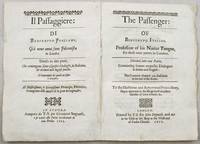
1612ST13801London: printed by Thomas. Snodham. for Iohn Stepneth and are to be sold at his shop at the west-end of Paules Church 1612. FIRST EDITION. 205 x 155 mm. 8 x 6". 18 p.l. 611 1 pp. 601-08 misnumbered 561-68 8 leaves. <br/> New unlettered limp vellum by Courtland Benson in imitation of the original binding. STC 1896; ESTC S124314. ◆Half a dozen gatherings a little browned occasional mild foxing or small rust spots additional trivial imperfections otherwise an excellent copy clean and very fresh in a pleasing new binding.<br/> <br/> This conversation manual by an Italian teacher based in London offers an intriguing glimpse into the lives and concerns of the wealthier classes in 17th century Europe. An early effort to teach language through dialogue the book is part cultural history part guide to better health and it is clear evidence of the importance of the study of Italian in Elizabethan and Jacobean England. The seven dialogues cover subjects from health to travel to servants with Italian and English text on facing pages. Many of the dialogues begin with phrases that will be familiar to all beginning language students: greeting others selecting items of clothing asking prices or directions ordering food. As the conversations progress they explore various topics that one might expect to encounter in polite society. An early morning exchange between master and servant evolves into a discussion of the importance of sleep the optimal amount of sleep for good health and the significance of dreams. A dialogue that begins with ordering meals leads to an involved colloquy about the benefits and disadvantages of fasting and abstinence; the virtues and defects of bread butter meat dairy and eggs; diet recommendations for the healthy and the sick; the best diet for each season; and the importance of a walk after dinner. Other dialogues include advice for travellers observations on the political situation and life at court and finally a discussion of that most eternally fascinating topic: love. This work is of continuing interest and value to linguists as it documents the Benevento Italian dialect which is in need of preservation. It's an extraordinarily rare book probably because it was the sort of volume subjected to hard use: in addition to ours we could trace only two copies in ABPC and RBH since 1948. printed by T[homas]. S[nodham]. for Iohn Stepneth, and are to be sold at his shop at the west-end of Paules Church unknown
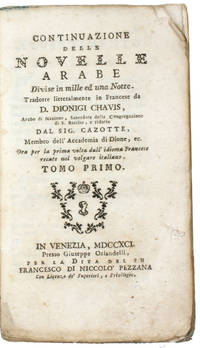
1791ABC_49342Venice: Giuseppe Orlandelli per la dita del fu Francesco di Nicolò Pezzana 1791. Near contemporary wrappers with the manuscript title on the spine. 12mo. With a small vignette built up from typographical ornaments on each title page. 4 volumes. First Italian edition of the Continuation des mille et une nuits an ambitious project to extend the Arabian Nights as translated by Antoine Galland. The Galland Manuscript the Arabic source ended at Night 282 and Galland had to supplement his work with original inventions or by translating French novels that were only orally transmitted.In the 1780s the Syrian monk Diyunisus Shawish renamed Dom Denis Chavis arrived in Paris. Short of money he decided to take advantage of the literary vogue of the moment and announced that he could prepare a more complete manuscript of the Thousand and one nights than Gallands. He proceeded to transcribe the existing corpus introducing numerous changes and expanding it with other stories from a manuscript he had brought with him from Syria. The operation proved successful: the Genevan publisher Paul Barde who was producing an impressive anthology of fairy tales entitled Cabinet des Fées commissioned Chavis to translate much of the material into French and then entrusted the text to the writer Jacques Cazotte who carefully revised it and even added stories of his own invention. The result of this singular collaboration was this beautiful Continuation first published at Geneva in 1788.Wrappers worn and chipped the edges are somewhat frayed. Otherwise in good condition.l OPAC SBN ITICCULO1E019383 7 copies; WorldCat 4 copies incl. 1 possibly only vol. 1; cf. not in Chauvin. Giuseppe Orlandelli per la dita del fu Francesco di Nicolò Pezzana, unknown
30-EFo.J. Bleistift, auf chamoisfarbenem Velin mit Wasserzeichen: J Whatman, rechts unten bezeichnet ?Val-ombrosa? sowie vom Bruder des Künstlers beschriftet ?gesehen mit ausgezeichneter Zufriedenheit, Wilhelm Fries?. 29,6:37,5 cm. - Mit wenigen Flecken.