54 418 résultats
120083aafca. 1650, in-4to, 2 ff. + 1 f. blanche + 214 feuilles num. + 2 ff. blanches /(2 nn. Bl. (Titel u. Inhaltsverzeichnis), 1 w. Bl., 214 num. Bl., 2 w. Bl.), Restaur. Prgt. d. Zt. mit hs. Rtit. / Reliure en parchemin d’époque restaurée, bel exemplaire.
17459402In Parigi, Appresso Prault, 1745. In-16 de XIX-103 pages, plein maroquin citron, dos lisse orné de filets et fleurons dorés, large guirlande florale, roulette et filet dorés encadrant les plats, filet doré sur les coupes, doublé de maroquin vert décoré de même, garde de tabis rose, tranches dorées. Aux armes d'Ange-Laurent de La Live de Jully, grand collectionneur de tableaux et de livres.
2 Vols., in 3, folio, 56pp., frontispieces, numerous tipped-in plates throughout, some light foxing, orig. cloth, slightly worn. A monumental work on Italian Lace.
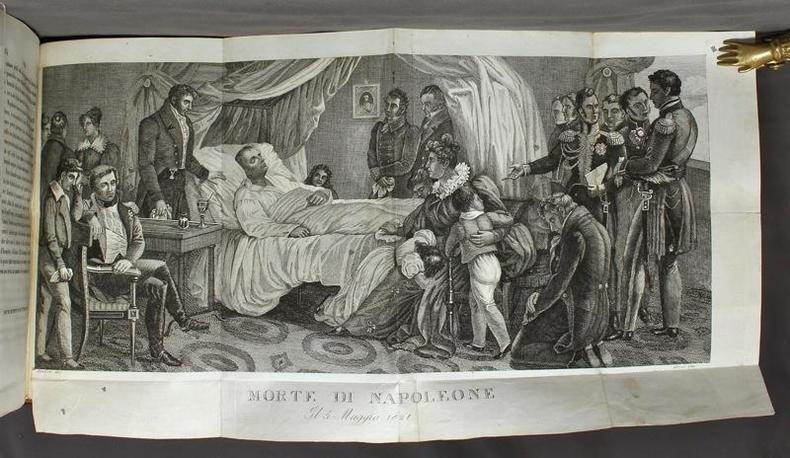
183312585Bastia, Fratelli Fabiani, 1833. 4 volumes in-8 de [2]-XXVII-478; [4]-465; [4]-447 et [4]-487-[5] pages, demi-basane brune, dos lisses ornés de filets, roulettes, titre, tomaison et silhouettes de Napoléon dorés. Reliures un peu frottées, rousseurs, 5 planches avec déchirures sans perte.
63125Ohne Ort (wohl Norditalien), o. J. (erste Hälfte d. 18. Jahrhunderts u. spätes 19. Jahrhundert). 4°. Mit 37 meist ganzs. farb. Gouachen. 64 Bll. (davon einige weiße), Späterer lädierter Ppbd.
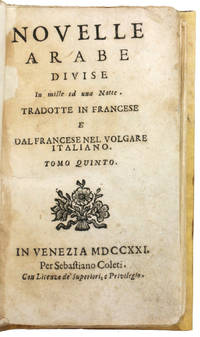
1721ABC_49346Venice: Sebastiano Coleti 1721. Near-contemporary vellum. 12mo. With a small woodcut vignette on the title page and a woodcut ornamental tailpiece. 2 volumes bound as 1. Two volumes from the very rare first Italian edition of the Arabian Nights based on Gallands liberal but highly influential French translation. Adapted to Parisian tastes it had been first published in 12 volumes between 1704 and 1717. The present translation was the main vehicle for the circulation of the Nights in Italian culture through the 18th- and 19th centuries and via Venice also influenced Modern Greek literature which had access to the work only in the Italian translation. The history of the Italian reception of the Arabian Nights is characterised by the hegemony of Gallands work in Italian translation which circulated first via Coletis edition and its various new editions and later in the translation by Armando Dominicis in 1893 Christian-Muslim relations p. 859.Volumes V and VI contain respectively Nights CLXVI-CCIII and CCV-CCCXXXIV. The work is of great rarity: only two complete sets of the present work are traceable in libraries worldwide Arezzo City Library and National Central Library Florence and only two other libraries have an incomplete set volumes 11 and 12; Biblioteca Saveriana Conforti Parma and Biblioteca comunale Alessandro Cialdi Civitavecchia. Thus only two other copies of the present fifth and sixth volumes are known!The binding is slightly soiled internally slightly soiled with small repairs to the title page. Otherwise in good condition.l Burton VIII 104; Chauvin IV p. 46 no. 104A; OPAC SBN ITICCURMSE061932 4 copies incl. 2 incomplete; cf. Christian-Muslim relations A bibliographical history 37; this ed. not in WorldCat. Sebastiano Coleti, hardcover
17733859Mit gest. Titelvign u. 6 gefalt. gest. Tafeln (1 signiert M. Sebastian Giampiccoli). Venedig, Presso G. Pasquali, 1773. 4to. (26,6 x 19,0 cm). VIII, 100 S. Geheftet mit altem Umschlag aus kräftigem weißem Papier.
18475056Dessinée, mesurée, publiée et accompagnée d'un texte historique et explicatif. Mit gest. Titel mit großer Vignette von J. Bein u. 18 gest. Tafeln nach Baltard von Aubert, Leisner, Hibon u.a. Paris, ohne Drucker u. Verlag, 1847. Gr.-Folio (61,3 x 44,2 cm). 4 Bl. (inkl. gest. Titel), 62 S. Halbleinwandband d. Zt. [2 Warenabbildungen]
Acquaforte e punta secca, 1924. Misure della lastra 85x130 mm. Prova d’autore, firmata a matita in basso “L. Bartolini”. Esemplare rifilato al rame ed applicato su cartoncino coevo. Perfetto stato di conservazione. All’incisione, databile al 1924-25 come altre opere analoghe dell’artista, Bartolini assegnerà poi il titolo definitivo di Tre donne alla fontana. Un’esemplare dell’opera definitiva è passato in asta a Berna nel novembre del 2007: https://www.mutualart.com/Artwork/Tre-donne-alla-fontana/591860B3A0845475 Luigi Bartolini è considerato uno dei maggiori incisori italiani del Novecento, insieme a Giorgio Morandi e Giuseppe Viviani. Oltre ad essere un prolifico incisore (al suo attivo oltre mille acqueforti), fu anche pittore e scrittore. Partecipò sia come pittore che come incisore a diverse edizioni della Biennale di Venezia dal 1928 al 1962. Presente a varie manifestazioni artistiche, sviluppò diverse maniere definite: ‘maniera bionda’, ‘lineare’ e ‘nera’. Ricordiamo soprattutto le acqueforti della serie Marche e della serie Sicilia. Iniziò la sua produzione grafica nel 1914 e il suo stile si rifà alla tradizione naturalistica dell’Ottocento. Molte sue incisioni si possono ricollegare ad alcune opere del Goya, di Telemaco Signorini e di Giovanni Fattori. Eccellente nella rappresentazione della natura morta e del paesaggio, spesso il Bartolini rappresentò dolcemente le cose e gli oggetti più umili, i soggetti di natura più dimessi. In essi ritroviamo il sentimento che diviene immagine e la forma che si sviluppa in espressione. Con Bartolini l’incisione torna ad essere un mezzo di espressione poetica libera dal simbolismo e dal vedutismo allora in voga presso le accademie. Nelle sue acqueforti prevale ora un tratteggio leggero (genere biondo), ora una ricerca del chiaroscuro alla Rembrandt (genere nero). Rara. Etching and drypoint, 1924. Plate size 85x130 mm. Artist's proof, signed in pencil at the bottom "L. Bartolini". Example trimmed to copper and applied on contempoary paperboard. Excellent state of preservation. Rare. Born in Cupramontana near Ancona, Luigi Bartolini was the twentieth century Italian etcher, who came closest to the stature of his great rival, Morandi. As a teenager, he saw the collection of etchings, including work by Callot, owned by the Corradi family in Iesi. From 1907 to 1910 Bartolini studied at the Istituto di Belle Arti in Siena, and started to etch c. 1909. He moved to Rome in 1910, where until 1912 he frequented the Accademia di Belle Arti, while also attending lectures on literature and the history of art, and courses on anatomy at the University in Rome. Bartolini studied the etchings of Goya and took lessons on drawing at the Accademia di Spagna. From there, he went to Florence in 1913, where he attended the Scuola del nudo. Bartolini continued his anatomical research, as well as studying architecture, making himself the most assiduous student of all Italian twentieth century printmakers. He also visited the Uffizi and Florentine print dealers to look at the etchings of Rembrandt and Fattori. Bartolini painted his first oils just before the outbreak of the First World War. Although he painted pictures throughout the rest of his career, and was awarded the Premio Marzotto for them in 1956, they have been far eclipsed in fame by his etchings and writings. During the First World War, Bartolini published his first collection of poetry. A very prolific and accomplished writer, in this field he is best known today as the author of the novel, 'Ladri di biciclette' (Bicycle thieves), of 1946, which was quickly turned into a celebrated film by Vittorio de Sica and Cesar Zavattini. After the First World War, Bartolini held a series of minor teaching posts in Macerata, Sassari, Avezzano, Pola, and Caltagirone, while he continued to etch, and started a long career as a polemical journalist and critic of art and architecture. From 1923 to 1929, he wrote for the Naples periodical, 'Cimento', but he also contributed to 'Il Selvaggio', 'Quadrivio', 'Italia letteraria', and 'L'Ambrosiana'. Bartolini's 1924 exhibition of etchings at the Casa d'Arte Bragaglia in Rome was a great success, and later that year he showed 70 etched landscapes of the Marches at the Casa Palazzo di Roma. The following year he visited Paris, where he paid particular attention to the paintings of Van Gogh. Bartolini's political convictions led him to being assaulted by Fascists and hospitalised in 1928. Two years later, he won a prize at the Venice Biennale, where he had exhibited a portfolio of etchings. In 1930, the Turin publisher, Buratti, began to issue a series of portfolios of etchings by contemporary Italian artists under the editorship of Cipriano Oppi, selecting Bartolini for the first album. The following year, Buratti published 'Le carte parlanti', a portfolio of 10 of Bartolini's etchings, which was published in an edition of 20. In 1932, Bartolini shared the first prize at the Prima mostra dell'incisione moderna at the Uffizi with Morandi and Boccioni. His close friend, the leading anti-Fascist art historian, Lionello Venturi, acted as his agent selling his etchings in Paris. Bartolini's correspondence with his compatriots in exile led to his imprisonment, from which he was released on Mussolini's personal intervention. He was then placed under political surveillance. From 1933 to 1938, Bartolini taught in Merano, where he painted and etched in the open air, finding subjects on the banks of the fast flowing Adige. Despite being under political suspicion, he was given a one - man show of 50 etchings at the second Rome Quadriennale in 1935, when he was awarded the first prize for printmaking. Bartolini still encountered political difficulties, and his 'Modi', published by Edizioni del Cavallino in 1938, was censured by Al...
170085147ABAugspurg (sic), Johann Ulrich Kraus, um 1700 (der 2. Teil ist auf 1703 datiert). Quer-4°. Flexibles HPerg. m. handschriftl. R.-Titel v. alter Hand in neuem Schuber (berieben u. bestoßen, Deckel angebrochen u. Fehlstellen im Bezugspapier, hinteres Außengelenk leicht angeplatzt).
Pages 185-220 plus 4 pages of ads. Features: Sensational page of six photos, with text, illustrating Dubai, the primary port and one of the most progressive towns in Trucial Oman - includes the Customs Building, the new bridge, Shaikh Rashid Bin Said, a general view of the town, the Al-Gaz Hotel, the old palace, and more; Cover photo of the Queen Mother upon her 63rd birthday; Article on the Moscow Test-Ban Treaty with photo of DeGaulle; Photo of the Vickers Hovertruck in action; Photo of the Corporal missile on parade at Larkhill; Photo of Mr. David Tapp driving his tractor, The Seahorse, across the English Channel; Photo of champion racing driver Graham Hill aboard replica of a Ford Quadricycle, marking the centenary of Henry Ford who is shown separately driving a Quadricycle in 1904; Photo of spectators swarming onto the pitch at Headingley after West Indies triumph in fourth test match; Illustration of the eminent conductor, Mr. Basil Cameron; Page of fascinating text and photos explain war in Yemen between the Royalist and Republican forces; Photo of engine of wrecked WWII British bomber found in Dutch field; Photo of examination of first wreckage recovered from the U.A.R. Comet which crashed in the Indian Ocean on July 28, killing 62 persons including 26 Boy Scouts from the Philippines; Photos of Japanese Emperor Hirohito examining marine life on Hayama Beach, Japan; Dramatic photos of rescue efforts at Skopje, Yugoslavia after earthquake; Photo of Peru's president-elect, Signor Fernando Belaunde Terry; Amazing photo of huge Australian wedge-tailed Eagle named 'Widgie' landing on the arm of young John Ryder who rescued the bird when it fell from its nest in its youth; Photo of the Bishop of Caltagirone blessing and Italian cradle bound for the unborn child of President Kennedy; Photo of disarmament conference at Geneva; Photo of Orville Freeman presenting Indian peace pipe to Khrushchev on July 30; Book review of "Dieppe - The Shame And The Glory", by Terrence Robertson; Page of news and illustrations from 100 years ago includes New York riots, reoccupation of Jackson, Mississippi, by the Confederates, and balloon reconnaissance at Aldershott; One page photo of London Heliolaters (swimmers) at the Oasis Pool, Holborn, during the fifth day of the current heatwave; Delacroix Centennial exhibition in the Louvre; Illustrated article on the highways and houses of Salsisbury before redevelopment; Major coverage of biblical Shechem in Jordan - its history and current excavations; Photo of Chesterfield Cup horserace at Goodwood on July 31; Aerial photo of Eastbourne showing the Devonshire Park lawn tennis courts; Photos of personalities of the week include Dr. Carl Borgward, Lady Hudson, Sir Horace Clark, Sir Robert Chapman, Miss Claudia Mcpherson of Canada (the youngest Channel swimmer), Miss Jane Allday, six railwaymen who have become mayors in South Wales, Harold Philby (granted asylum in Russia), Jazzman Don Aloysius Gordon (freed on appeal of assault charge), John Grigg, Lord Stansgate with his wife (now Mr. Wedgwood Benn and a commoner), and Mr. St. Clair; Four photos and text of 100 foot first century Roman ship discovered in the Blackfriars mud; Two pages of amazing photos and text describe dystopian life inside a communist Chinese agricultural commune - an exclusive glimpse of life behind the bamboo curtain; and more. Unmarked with average wear. A sound copy of this wonderful issue. Magazine
Futurismo Politico - Dinamismo Plastico - 12 disegni Guerreschi - Parole in Libertà. In antiporta un ritratto fotografico dell'Autore di M. Nunes-Vai. 12 tavole in bianco e nero. Componimenti paroliberi. In chiusura di volume due dei più particolari manifesti futuristi: il "Programma politico futurista" stampato in verticale su doppia pagina e la "Sintesi futurista della guerra", stampata su tavola ripiegata. Catalogo delle edizioni futuriste di Poesia Stampa dello Stab. tip. Taveggia. Brossura stampata ai piatti con bellissima composizione tipografica dell'Autore. 8vo (cm 26 x 19). pp. [2] - 104 + 12 tavole in carta patinata. . Molto buono (Very Good). Copertine leggermente fiorite e brunite con alcune macchie. Angoli superiori delle prime pagine con una piega (Light yellowing and sunning of cover, some stain). Edizione originale. .
161589903Padova [Padua], Pietro Paolo Tozzi, 1615. [16 Bll.], 576 S; [4], lxiii, [1] S. Mit 2 gefalt. u. 227 ganzseit. Holzschnitten. 8vo. Ganzpergament der Zeit mit hs. Rückentitel.
182441Florence, Mariano Cellini, 1865 un vol. in-4 de texte ; un vol. in-folio oblong d'atlas, 206 pp. [volume de texte] ; [2] ff. n. ch. (titre et table des planches), avec 18 planches gravées par B. Bartoccini et montées sur onglets [volume d'atlas], demi-veau blond, dos à nerfs orné de filets et lions dorés, pièces de titre bouteille, tranches mouchetées (J. Weber). Accroc aux coiffes de l'atlas. Bon exemplaire.
58-BFo.J. Bleistift, auf hellgrauem Bütten, mit mehreren eigenhändigen Farbangaben. 23,8:35,9 cm. - Verso: Baumgruppe, bestehend aus Linde, Eiche, Buche und Ahorn. Bleistift, innerhalb der Darstellung mit eigenhändiger Bezeichnung ?Linde?, ?Eiche?, ?Buche? und ?Ahorn?. - Ränder etwas wellig. [2 Warenabbildungen]
53-BFo.J. Bleistift, auf chamoisfarbenem Velin, rechts unten bezeichnet ?doppelt? und ?Spezia?. 22:30 cm. - Verso: Küstenstreifen bei La Spezia. Bleistift, rechts unten bezeichnet ?doppelt? und ?Spezia?. Bleistift. - Im Ganzen leicht knitterfaltig. [2 Warenabbildungen]
74-BFo.J. Bleistift, auf Bütten, unten bezeichnet ?Palermo?. 21,4:31,5 cm. - Verso: Ponte dell?Ammiraglio in Palermo. Bleistift, rechts unten bezeichnet ?Palermo?. - Mit einigen Braunflecken und Knickfalten links unten. [2 Warenabbildungen]
71-BFo.J. Bleistift, auf chamoisfarbenem Velin, rechts bezeichnet ?Bagaria?. 26,3:35,8 cm. - Verso: An der Ostküste der Bagheria mit der Turmruine Sólanto bei Santa Flavia. Bleistift, unten bezeichnet ?Cap Zaferano?. - Geringfügig angestaubt. [2 Warenabbildungen]
10 acqueforti originali, firmate, titolate e numerate al verso di Giovanni Korompay degli anni 1969-1970 (cm 45x54,7). Testo di Carlo Belloli Carta Goya e delle cartiere Filicarta. Esemplare 20/50. Custodia (cm 54,5x45). pp. 4+incisioni. . Ottimo (Fine). . Edizione originale di 50 + X es. numerati. .
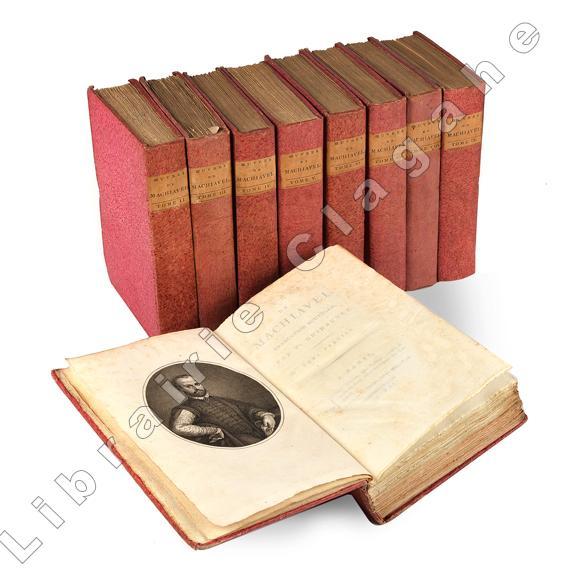
179920337Paris, Potey, Pochard, (imprimerie de Laran), an VII (1799) ; 9 tomes in-8 (210 mm), cartonnage rigide de papier rose à l’éponge, pièce de titre imprimée au dos, non rogné (reliure strictement d’époque) ; CXVII, [1 bl.], [2], 408 ; 384 ; 403 ; 416 ; 448 ; 455 ; 394 pp., [1] ff. bl. ; 370 pp, [1] ff. bl. ; 524 pp., portrait ovale en frontispice ; 7 planches dans “l’Art de la Guerre”, dont deux dépliantes et 2 doubles.
11115120. Jahrhundert. Unten links signiert. 54 x 70 cm.
1957STLS0073Milano, Edizione del Milione 1957. 4°. 71, [118] S., 14 mont. Tafeln, davon 5 in Farbe. Bildteil mit 118 ganzseitigen Abb. u. einem Porträt des Künstlers. OLn. mit OU., Schuber. Sehr gut erhalten. Beigegeben ist eine Federzeichnung des Künstlers auf einer Papierserviette, sign. "a Anita, Manzu", gefaltet. Größe der Darst. 22 x 22 cm.
Secondo manifesto del Movimento Arte Nucleare che, dopo l'affermazione della volontà di combattere ogni accademismo, risalente al primo manifesto, afferma ora l'irripetibilità dell'opera d'arte. Testo in italiano, francese e inglese, stampato fronte retro su foglio di cartoncino ripiegato in tre parti, da un lato con scritte gialle su fondo nero e dall'altro lato con scritte nere su fondo grigio. Copertine di velina azzurra. Il manifesto è firmato da Armand, Enrico Baj, Bemporad, Gianni Bertini, Jaques Calonne, Stanley Chapmans, Mario Colucci, Danerlo, Enrico De Miceli, Reinhout D'Haese, Wout Hoeboer, Hundertwasser, Yves Klein, Théodore Koenig, Piero Manzoni, Nando, Joseph Noiret, Arnaldo Pomodoro, Giò Pomodoro, Pierre Restany, Saura, Ettore Sordini, Serge Vandercam, Angelo Verga / The second manifesto of the Arte Nucleare Group. Folded card sheet, printed in black and yellow on heavy black card within printed turquoise tissue wrapper . 4to (cm 30,5x17). . . Ottimo (Fine). . . .
195825172Rom, (Arte della Stampa), 1958. [Monographie]. Mit 167 oft ganzseitigen Abbildungen auf Tafeln. 4°. 163,5 + Tafeln, 4 S. OLeinen mit goldgeprägtem Lederrückenschild mit etwas beschädigtem Schutzumschlag. Papier vom Text gering vergilbt, gelegentlich leicht stockfleckig. Hinteres fl. Vorsatz mit montierten Fotoecken und 4 lose beiliegenden großformatigen Fotografien.