[ENGLISH SCHOOL -Biblio.com
42 315 résultats
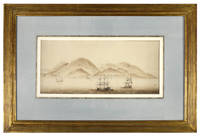
87196ca. 1830 . Sepia ink and pencil early view of Hong Kong showing sailing boats in the foreground probably executed by an English military or naval officer. Laid on card size: 320mm x 143mm.<br /> <br /> ca. 1830] unknown
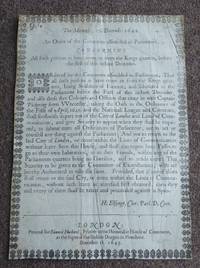
52524<p>London printed for Edward Husband printer to the Honorable House of Commons at the signe of the Golden Dragon in Fleetstreet December 18 1645. BROADSIDE WITH ORNAMENTAL BORDER. Text to recto only 1645 approximately 290 x 205 mm 11½ x 8½ inches 3 small amateur repairs to blank side some folds visible on blank side see attached image old ink hand-numbered "94" to upper lefthand corner zoomable images attached giving the text. Under the text is the printed signature of Henry Elsynge who had spent seven years in foreign travel after which Archbishop William Laud procured him the appointment of Clerk of the House of Commons. His work was significant during the Long Parliament. In December 1648 Elsynge resigned his appointment on a pretext to avoid taking part in the proceedings against Charles I. See: George Thomason Catalogue of the Pamphlets of the Civil War Volume 1 page 410 669.f.9. 48; ESTC R212263 traces 4 copies only world-wide; Wing Short-Title Catalogue 1641-1700 Volume 1 page 555 No. 2643. MORE IMAGES ATTACHED TO THIS LISTING ALL ZOOMABLE FURTHER IMAGES ON REQUEST. POSTAGE AT COST.</p> London, printed for Edward Husband, printer to the Honorable House of Commons, at the signe of the Golden Dragon in Fleetstreet,
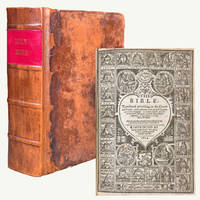
1614T47<p><strong>Description: </strong>Quarto Approx. 8.5" x 6.5". Begins with the Genealogies by John Speed with printed title page n.d. The illustrated Genealogies depicts the lineage from Adam to Christ ending with a double page map of Canaan often lacking. The Bible bound with an engraved title page 1614 with a woodcut border comprising twenty-four small compartments showing the tents of the twelve tribes as well as the figures of the twelve apostles. Title is enclosed within a heart-shaped frame. Text in two column black letter. With Apocrypha as issued. New Testament title page 1613 with similar woodcut border. With <em>Two Right Profitable and Fruitful Concordances </em>by Robert F. Herrey with printed title page and colophon 1613. First chapter woodcut initials head- and tailpieces throughout. </p><p><strong>Collation:</strong> par2 A-Z8 Aa-Zz8 Aaa-Hhh8 Iii4 Old Testament 4 Kkk-Yyy8 Zzz10 New Testament. Complete with both title pages.</p><p><strong>Binding:</strong> Contemporary rebacked brown calf. Spine with four raised bands and a red morocco label with the words "Holy Bible" lettered in gilt. Endpapers renewed. All edges red. Rubbed with corners bumped and scuffed. </p><p><strong>Condition:</strong> Occasional soiling and staining; title page of Genealogies frayed to edges; text trimmed with headlines cropped to parts of the book of Psalms only; Cc6 Kk6 with tear into text without loss; Zzz6 small burn hole to gutter impacting sidenotes. Overall a well-preserved and complete copy with both title pages.</p><p><strong>Provenance: </strong>"James Honey his book 1760" and "Ann Honey her book 1760" with family history records of the Honey family through 1830 on front free endpaper on verso of final leaf of Apocrypha and on verso of title page of Tables.</p><p><strong>References:</strong> Herbert 330; ESTC 2232. </p> Robert Barker hardcover
18770009039NAPLES ALEXANDRIA CAIRO SUEZ JAFFA JERUSALEM. Good. 1877. On offer is a fascinating journal written by an English woman of a trying and difficult voyage from Naples Italy to the Holy Land of Jerusalem in 1877. The journal is 35 pages long and is of a trip of a small group who travel first to Alexandria via Sicily then by rail to Cairo and Ismailia through the newly constructed Suez Canal and finally an extraordinary months journey on horseback with tented camping in the desert at night. The trip is a very difficult journey and at one point the woman writes this was our first experience of travelling in Palestine and I can assure you it was a most trying one. The authors handwriting is beautiful and is an easy pleasure to read. These pages seem to be notes for a talk the woman is going to give. There are also corrections of the writing in pencil by the woman herself and the book ends as if the words were meant to be spoken to an audience. The journal begins: Naples to Jerusalem Notes by the way Naples which is to be my starting point tonight is beautifully situated on one of the finest bays in the world. The city extends for three miles along the short of the bay but rows of houses villages and small towns extend almost entirely around it. Nearly opposite Naples is Mount Vesuvius from whose summit have poured in times past the streams of lava and showers of ashes which have again and again buried whole towns and villages situated on its sides and even at some distance from its foot; and from which a light cloud of smoke is always rising.; We went on board a steamer bound for Alexandria at two p.m. on Sunday February the 18th 1877 but did not sail until five oclock during which time we had a fine view of the city and its surroundings.On the following morning we entered the straits of Messina and about 11 oclock landed at Messina capital of Sicily where we stayed a short time and walked through the town. We sailed about 12 and it was quite smooth through the straits our companions came on deck.Soon after we got through the straits a storm burst upon us. The guards were fixed on to the table today to keep the things in their places but did not remedy all the evil for as you know anything liquid will find its own level so that when we had soup before us and the boat rolled to an angle of 45 de. It was either running over the opposite edge of the plat or pouring over us which was far from pleasant we had no more soup during the three days that the storm commenced. They reach Alexandria a few rough days later: Pompeys pillar and Cleopatras needles are the most striking monumental relics of Alexandria and we drove to Pompeys pillar first. It stands on rising ground the highest in the neighborhood and close to it is a Mohammedan cemetery. The writer is a smart woman adept at conveying events with skillful detail grativats and occasionally humor. She is also quite a worldly woman often bringing in recent world events to give context: Recent events have brought Egypt to the notice of all newspaper readers and the bombardments of the forts of Alexandria by the British Fleet and the subsequent setting on fire of the principal parks of the city and especially of the European part has been brought very vividly before the public by the Illustrated Papers. The Great Square is where the principal buildings of the city were situated. The buildings surrounding it were of imposing appearance here were the Consulates the principal Banks the finest shops and the largest hotel.All this is now a heap of ruins. She goes on to describe the contrast in dress between native women and European women: you often see for instance an Egyptian woman covered from head to foot with a long thick veil which hides all but her eyes and walking close behind her an European lady dressed in the height of Paris fashion. The European gentlemen are of course dressed as we are accustomed to see them except that all wear the Turkish fez and the higher class Egyptians mostly wear the same dress but the lower classes all wear loose petticoat trousers reaching to the ankles and a loose jacket and round the waist they often have a gaily coloured sash or shawl. After Alexandria the writer takes a train to Cairo. She describes the train ordinary first class ones made in England and sent out and the landscape she sees the land is well cultivated and is watered by the annual overflowing of the Nile and is also artificially irrigated by means of numerous canals cut for the purpose from the Nile.. Cairo is a more purely Oriental city than Alexandria and we stay here five days. The writer describes the contrast between old Cairo and new Cairo as well stating that the new Cairo is built after the style of the boulevards of Paris with wide streets and trees planted on the side paths shops and houses in the European style while the old Cairo is truly Eastern narrow irregular streets merely of earth trampled smooth though far from being level. In Cairo the writer describes many different places she sees travelling around the city by donkey indeed there are regular stands for them and anyone who wishes to go out calls for one as we call for a cab and especially the shops in the bazaars. While in Cairo she takes a donkey trip to the Island of Rhoda to see the famous Nilometer that measures flood height. She also goes to see the Boulak Museum the finest collection of Egyptian Antiquities in the world the University of the East and observes the Muslim call to prayer at the University: At 12 o.c. the call to prayer was heard from the minarets of the mosk mosque and instantly all spread their prayer carpets on which they knelt down with their faces turned towards Mecca and utterly regardless of our presence they went through their devotions. From Cairo there are day trips to Sakkara and Memphis where the writer sees and writes of many statues sculptures and sacred bulls all very well preserved and recently discovered and excavated. After the five days in Cairo the author sets off for Ismailia a place on the Suez canal about half way between Suez and Port Said. She comments on the refilling of the dry Lake Imshah after Suez Canal construction just 8 years or so earlier. She writes Ismailia has entirely grown up since the canal was made it was before nothing but desert but a freshwater canal supplies it and other stations on the Suez Canal. It seems as if wherever water can be got on to the land the desert may be turned into a garden for already they have a few good gardens there and many avenues of trees. The author than travels to Port Said across the Suez Canal by steamer. From Port Said she goes onto Jaffa. During the time we had our only experience of the Kamseen which is a hot dry wind full of fine sand blowing off the desert and looks like a thick yellow fog. The sand was so fine that it penetrated all our clothes and we had to go into the cabin for protection. In Jaffa she comments on the numerous orange and lemon groves the poor sanitary situation in the city and the many muddy dirty and crooked streets of the city our first impressions were not pleasant. In Jaffa she goes to Simon the Tanners house and also to where Peter had his vision of a sheet let down from Heaven knit at the four corners and filled with all manner of beasts etc. She also visits a Mission school run by an English lady attended by Jews Mohammedans and Syrians alike. The school is Methodist. From Jaffa the author and her companions set out for the month long horseback trip to Jerusalem sleeping in tents at night. We rode between orange and lemon groves for some distance the road was fenced off with prickly pear a close growing thorny cactus which reaches about 6ft high a fence which will defy man or beast. From the onset of the journey there are persistent problems with the horses: my horse had a bad trick of pulling up suddenly if I tried to pass the foremost of the party they cing very tenaciously to each other and there was no attempt to run away with any of us.We were in the saddle for over five hours with the sun fiercely shining on us from a cloudless sky and if there had not been a nice breeze we should have found it much worse than we did. Despite the problems the write is astounded with the beauty of the Middle Easter landscape. The Plain of Sharon was gay with flowers particularly with a small anemone of a very bright scarlet and as we got into the hill country the ledges of the rocks were filled with beautiful varieties of cyclamen. At night she describes the tents they have brought along and the new experience of sleeping in tents which seemed almost like sleeping out of doors. They have brought along five sleeping tents a saloon tent and a kitchen tent with a Union Jack flag flying from one and Stars and Stripes from the other. It is obvious the people on the trip come from wealth as she describes the extraordinary five course dinner they are served in their camp site: first course soup 2nd stewed tongue with fried potatoes 3rd cauliflower browned with egg & breadcrumbs 4th chicken and asparagus 5th apricot tarts and dessert nuts raisins & Jaffa oranges after which we had a large cup of tea to finish off with. The first nights are cold and noisy nights with dogs barking and frogs croaking. They wake up each morning with a servant blowing a rams horn trumpet. The writer is taken by the Biblical ground through which she travels: Our route to day is over ground of great interest and where great events in the early history of the subjugation of Palestine by Joshua took place. It was here that Joshua uttered the memorable words at the battle of Beth Horon Sun stand thou still upon Gibeon and thou Moon in the valley of Aijalon.I have no doubt they would take the same road we were going for we reached Kirjath Jearim where the Ark was kept so long early in the day. Finally the author and her companions reach Jerusalem. Here she writes clearly and beautifully of Jerusalem of its hills and deep valleys and twisting roads. We descend the Mount of Olives past the garden of Gethsemane then across the brook Hedron and up the other side of the valley passing the traditional site of Stephen's martyrdom. Enter Jerusalem by St. Stephen's gate and along the Via Dolorosa return to our hotel. The journal ends like so We spent several days in visiting the places of interest in the city and its neighbourhood but it would take too long for me to attempt a description of them. I can only hope in conclusion that some here present may have the pleasure of seeing for themselves that wonderful city and land. The journal consists of four gatherings of roughly 10 pages each though these gatherings are not bound and many pages are loose or very close to being unattached. The paper shows some wear and coloration from age but it does not hinder the experience of reading this amazing travelogue at all.; Manuscript; Folio - over 12" - 15" tall; KEYWORDS: HISTORY OF PILGRIMAGE TO THE HOLY LAND JERUSALEM PRE-STATE ISRAEL NAPLES MESSINA ITALY SICILY ALEXANDRIA CAIRO EGYPT ISMAILIA SUEZ CANAL ARABIAN DESERT TRAVEL BY HORSEBACK 19TH CENTURY FEMALE TRAVEL IN THE 1800s BAZAARS OF EGYPT NOTES FOR A LECTURE TRIP THROUGH THE ARAB WORLD NORTH AFRICA MIDDLE-EASTERN TRAVEL RAIL TRAVEL IN THE LEVANT KHAMSIN WIND JAFFA SHARON PLAIN LUXURY TRAVEL BIBLE TRAIL DESCRIPTIONS OF MIDDLE EASTERN LANDSCAPE BRITANNICA HANDWRITTEN MANUSCRIPT DOCUMENT LETTER AUTOGRAPH WRITER HAND WRITTEN DOCUMENTS SIGNED LETTERS MANUSCRIPTS HISTORICAL HOLOGRAPH WRITERS AUTOGRAPHS PERSONAL MEMOIR MEMORIAL ANTIQUITÉ CONTRAT VÉLIN DOCUMENT MANUSCRIT PAPIER ANTIKE BRIEF PERGAMENT DOKUMENT MANUSKRIPT PAPIER OGGETTO DANTIQUARIATO ATTO VELINA DOCUMENTO MANOSCRITTO CARTA ANTIGÜEDAD HECHO VITELA DOCUMENTO MANUSCRITO PAPEL . hardcover
179141520United States of America i.e. Worcester Mass.: Pr. at the press in Worcester Massachusetts by Isaiah Thomas 1791. Folio extra 400 mm; 16". New Testament ONLY. 1 f. pp. 7891012; 19 plts. <br><br>Present here is the extracted New Testament from => the first folio Bible printed in America from the press of the printer whom Ben Franklin called the "Baskerville of America." Being also only the fourth complete Protestant Bible in English printed in the former British colonies its text is the standard King James version printed in double-column format in roman type; and Thomas's production is famous for its typography its achievement in size the pages are 15.5" tall and especially its illustrations. The plates 19 of them were engraved by four of America's greatest artisans: J. Norman Alexander Doolittle Joseph H. Seymour and Samuel Hill.<br>Â Â Â Â "An alphabetical table of proper names" was planned but not printed as indicated by the catchword on the final page; the table does appear in the quarto edition Thomas printed the same year. This volume does contain at its end the whole Bible's "Index to the Holy Bible" and its several "tables" of Weights Measures and Coins; Time; Offices and Conditions of Men; and Kindred and Affinity. <br>Â Â Â Â <br>Â Â Â Â Hills 29; O'Callaghan 38; Herbert 1353; Rumball-Petre Rare Bibles 171; Evans 23186 Wright Early Bibles of America pp. 7488. 18th-century mottled calf nicely rebacked with edges of boards renewed and text block resewn. Old waterstaining from light to severe throughout extending across text and image areas of plates with very variable impact; age-toning occasional staining and off-setting from plates in only the usual degrees. Lower margins display some notable chips and purposeful paper tear-aways and a good many closed tears; only the latter reach sometimes into text without loss. Several plates have had closed tears neatly repaired from the rear; the plate of Mary Magdalen and the final leaf of the last Table show OLD replacement of paper where original paper was torn away from blank areas; the copy retains the old dog-earings and page-creasings of long use and bears pencillings on its final leaf. => A copy that has seen much happen to it over its more than 200 years of existence; still a sturdy interesting and imposing copy of this impressive early American New Testament. Pr. at the press in Worcester, Massachusetts, by Isaiah Thomas hardcover books
160033612Antwerp: By Daniel Vervliet 1600. Small 4to 21 cm; 8.25". 18 ff. 745 1 pp. 13 ff. <br><br>The second edition of the Roman Catholic new Testament in English. The translation is the work of a number of English Catholic priests but principally of Gregory Martin who fled to France in 1568 because of persecution in their native land and under the direction of Dr. later Cardinal William Allen founded the English College at Douai. The college moved for a short time to Rheims but subsequently returned as the title-page here attests.<br>Â Â Â Â The first edition of this translation was issued at Rheims in 1582 in over-sanguine hopes that its sale would be successful enough to underwrite the cost of a prompt production of the Old Testament. The two-volume O.T. did not appear however until 1609/1610.<br>Â Â Â Â The second edition of the Rheims N.T. is a revision of the first not merely a reprinting of it and contains a "Table of Heretical Corruptions" not found in the 1582 printing and a new preface. In an era of noticeable decline in the art of printing this Testament enjoys far better than average typography. <br>Â Â Â Â <br>Â Â Â Â Darlow & Moule 198; Herbert 258; STC 2989; ESTC S102510. Late 17th- early 18th-century English calf with concentric blind panels on covers in contrasting tones of brown and tan all edges deep red; covers with scrapes and bumps rebacked with hinges inside strengthened new endpapers with 1906 owner's inscription on front free one. Title-page dust-soiled and torn in upper margin with some loss of decorative border page skillfully remargined with blank paper. Some foxing and age-soiling in early leaves; this similarly at rear starting around p. 640 and most notable in Tables with also some dust-soiling and with light waterstaining across a good number of upper outer corners. Overall a good to very good copy sturdy and appealing. By Daniel Vervliet unknown books
16811278921681. ENGLISH LAW. Proceedings Upon Impeachments from the year 1666 to the year 1681. Manuscript. No place circa 1681. Quarto modern full brown calf raised bands red morocco spine label. $3200.Original manuscript from the late 17th century with the parliamentary impeachment proceedings against 14 individuals during the reign of Charles II.The accountswritten in legible script with an index at frontbegin with the proceedings against Viscount Mordaunt charged with raping the daughter of the surveyor of Windsor Castle when Mordaunt was the castle's constable. Although they include a number of cases including that of William Penn in 1668 the clear focus is on the Popish plot a supposed conspiracy promulgated in 1678 that led to the arrest and trial of five Catholic lordsBaron Arundell the Marquess of Powis Baron Belasyse Baron Petre and Viscount Staffordall of which are recounted in this manuscript. As anticatholic hysteria waned and it became increasingly clear that the ""plot"" was a fiction the fallout entrapped more of the players: the impeachment of William Scroggs who served as the Chief Justice during the trials is detailed as is that of the Lord High Treasurer the Earl of Danby who was charged with concealing the plot and Edward Fitzharris who had attempted to implicate Danby in Sir Edmondbury Godfrey's murder in 1678 an event which fanned the flames of anticatholic hysteria. Armorial bookplates; inkstamp of the Grotius Society.Spine toned; text clean. hardcover
1634022062London: Robert Barker and Assigns John Bill 1634. Quarto in 8s. 2 34pp. genealogies 3pp. dedication 9 to the reader 1pp. order of books pp. 1-582 Old Testament Apocrypha ends on p. 718; New Testament ends on p. 904; colophon on p. 904. Black letter in double columns. General and New Testament titles within woodcut historiated border. Both title pages state translated out of "Original Greek" with "darknesse" instead of "darkenesse" in Genesis 1:4 undated genealogies bound in at front prior to title page with the Apocrypha without map. Uniquely bound in earlier 19th century polished calf over beveled wooden boards ornately tooled in blind and gilt inner gilt dentelles marbled endpapers all edges red margins trimmed close just entering some headlines or side notes some light marginal soiling very minor worming in blank lower margins of a few leaves in front and middle of book. A very attractive copy from the library of William Otter Gibbs with his bookplate: Gibbs was a 2nd Lieut. 7th Hussars February and Lieut. November 1900. In the South African Boer War served 1901-2 with 7th Hussars in operations in Cape Colony Orange River Colony and Transvaal; awarded Queen's Medal with five clasps. Captain Ap. 1907. Seconded to be Brigade Major of Eastern Mounted Brigade Territorial March 1913-March 1916. In the Great War served in Gallipoli Anzac October-December 1915: in Egypt December 1915-October 1916 Staff Officer Western Defense Force; Brigade Major Coastal Area: in France October-December 1917 as Major 12th Battalion Yorkshire Regt.; in Mesopotamia Ap. 1918-Ap. 1919 with 7th Hussars and in command of them from September 1918. Wounded at Shergat nr. Mosul 28 October 1918. Awarded 1914-15 Star British War Medal Allies' Victory War Medal: Croix de Guerre avec palme: mentioned twice in dispatches 1916 and 1919. Lieut.-Colonel 1919 and in the Regular Army Reserve of Officers from 1920. One of the Exons of the King's Bodyguard of Yeomen of the Guard from 1926. From his family genealogy Herbert 487-b. Robert Barker and Assigns John Bill unknown books
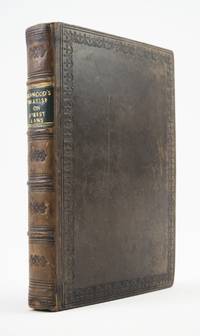
1598ST20689London: Printed by Thomas Wight and Bonham Norton 1598. FIRST PUBLISHED EDITION and First Edition under this Title. 192 x 139 mm. 7 5/8 x 5 1/2". 8 p.l. 154 162-65 159-67 1 blank 6 leaves. Errors in pagination but text complete. <br/> Late 19th century dark brown calf covers tooled in blind with plain rules and fleur-de-lys roll raised bands spine panels with small blind-stamped ornament black morocco label marbled endpapers neat repairs to ends of both joints. Front pastedown with engraved armorial bookplate of Godfrey Wentworth Woolley Park. Beale T-413; Mellon/Podeschi 15; Schwerdt II 7; STC 17291; ESTC S111993.<br /> Extremities slightly rubbed boards a little chafed in spots text lightly pressed but not washed a bit of browning to edges and occasional minor marginal foxing or traces of corner creases but quite an excellent copy the text clean and still fresh throughout and the perfectly suitable binding with no significant wear.<br/> <br/> This is a pleasing country gentleman's copy of the first published treatise on the laws governing English forests. Our author the fittingly named woodsman John Manwood d. 1610 served as gamekeeper of Waltham Forest as well as a justice of the New Forest. DNB tells us that he was possibly a barrister at Lincoln's Inn which would explain his interest in and knowledge of the law. Manwood tells us in the dedicatory epistle that he composed the present work in response to the precarious state of forest preservation stating that "so many do daily so contemptuously commit such heynous spoiles and trespasses" against the country's woodlands but "verie little or nothing as yet is extant concerning the Lawes of the Forrest" to help manage such behaviors. Our copy comes from the first published edition following only the 1592 pamphlet entitled "A Brefe Collection of the Lawes of the Forest" issued for private circulation and now extraordinarily rare. According to DNB the present treatise is "the only substantial work on the subject ever to reach the press" making it an enduringly useful source for those interested in the topics contained which include laws about hunting and perambulation in forests. It remained the standard work on the subject until the 19th century and Schwerdt writes that it has been "invaluable to students and lovers of ancient sport." Our copy is from the library of Yorkshire landowner Godfrey Wentworth 1773-1834 who served as High Sheriff of Yorkshire from 1796-97 and in the House of Commons from 1806-08. He probably had no need for a later printing of the work. Printed by Thomas Wight and Bonham Norton unknown
257693London. 35 albumen carte-de-visite photographs set in an album. 4to. Bound in green pebbled morocco covers with black- and silver-ruled borders set into an Indian carved and inlaid boxwood binding metal clasps and catches by Aspreys of London some loss to spine ends and a few spots of loss to inlay. 35 albumen carte-de-visite photographs set in an album. 4to. unknown
22140See Lowe Arnott and Robinson English Theatrical Literature 1163-1172; ESTC T20784; T20781; T20780; T20726 and T45401; NCBEL II 812. Some minor foxing browning and stains; overall the pamphlets are in very good condition with wide margins; enclosed in quarter morocco clamshell box. 5 vols 4to uniformly bound with attractive tan paper spines period-style and sprinkled paper boards with manuscript titles on the spines. A gathering of five important pamphlets dealing with the acrimonious dispute between two groups of partners of the Covent Garden Theatre - usually referred to as the "Proprietors' Dispute" - a quarrel that began in 1767 when two of the partners Thomas Harris and John Rutherford attempted to insert mistresses - particularly one Mrs. Lessingham - into the theatre company and have them cast in unsuitable roles. Harris and Rutherford squared off with George Colman and William Powell the opposing partners for over a year of accusations and counter accusations that resulted in a legal squabble and a classic pamphlet war. The contents of the pamphlets are informative not only with regard to the dispute itself but they also document everyday operations of the Covent Garden Theatre and theatrical management of the period in general. In all Lowe describes ten pamphlets dealing with the Proprietors' Dispute; rarely are five found together. Full description of five volumes upon request. unknown
185067639A Family Bible with Six of the John Martin Bible Illustrations BIBLE IN ENGLISH. The Holy Bible Containing the Old and New Testaments: Translated out of the original tongues: and with the former translations diligently compared and revised by His Majesty's special command. Appointed to be read in churches. London Edinburgh and Glasgow: William Mackenzie n.d. ca. 1850. Folio. Measures 9 3/4 x 13 x 5/12 x 3 3/4 in. thick; 250 x 335 x 93 mm. thick. Illustrated with thirty full-page engravings by various artists including a frontispiece and a vignette title-page titled The Family Bible With Copious Notes and References two engravings by J. Stephens from photographs of the Holy Land by Frith and six engravings after John MartinÃs Old Testament illustrations ìThe Fall of Manî ìThe Destruction of Pharaoh's Hostî ìJoshua commanding the sun to stand stillî ìBy Babel's Streams We Sat and Weptî ìBelshazzar's Feastî and ìThe Fall of Ninevehî. Contemporary black polished calf over bevelled boards covers tooled in gilt and blind spine lettered and decoratively tooled in gilt in compartments. Gilt turn-ins marbled endpapers. All edges gilt. Minimal wear to extremities. Hinges neatly reinforced. A bright fresh copy throughout. Near fine. MartinÃs Biblical paintings are among the finest ever produced: ìThe spirit in which Martin worked is suggested by a passage in his catalogue for the large oil painting ëThe Fall of Ninevehà which he exhibited in lonely magnificence in 1827: ëThe mighty cities of Nineveh and Babylon have long since passed away. The accounts of their greatness and splendor may have been exaggerated. But where strict truth is not essential the mind is content to find delight in the contemplation of the grand and the marvelous. Into the solemn visions of antiquity we look without demanding the clear daylight of truth. Seen through the mist of ages the great becomes gigantic the wonderful swells into the sublimeÃî Ray The Illustrator and the Book in England from 1790 to 1914 p. 44. At the front of the Bible are three leaves of a family history partially inscribed with the births deaths and marriages of three generations of the Hubbard family of Derby England during the years 1889-1943. A lovely example of a nineteenth-century Bible. HBS 67639. $3000 William Mackenzie hardcover books
179611489Philadelphia: Thomas Dobson 1796. 4to 27.7 cm 10.9". vii xvi 488 196 pp. 8 ff. <br><br>Three American "firsts" here counting that of our caption! For while being additionally the uncommon first printing in America of the Gospels in English in any translation other than the King James or the Douai-Rheims version this is also the first privately accomplished translation of the Gospels printed in America.<br>Â Â Â Â George Campbell 171996 was a minister of the Church of Scotland theologian and principal of Marischal College. He wrote a number of theological works including a defense of miracles in response to David Hume and was noted for originality of argument as well as charity towards his opponents. This translation of the Gospels was first published in England in 1789; the work consists of a preface and preliminary dissertations the actual translation and the notes with the whole being very scholarly resorting frequently to the Greek in the dissertations and notes.<br>Â Â Â Â Provenance: Title-page and contents leaf with early inked inscriptions reading "Jas. Booth. <br>Â Â Â Â <br>Â Â Â Â ESTC W4383; Evans 30086; Hills English Bible in America 56. On Campbell see: The Dictionary of National Biography. Contemporary treed sheep rubbed and abraded with leather lost at corners; nicely rebacked with original label laid on. Title-page and contents inscribed as described above; endpapers waterstained and pages with light spots of foxing. Paper in many sections faintly blue. Thomas Dobson hardcover books
257693London. 35 albumen carte-de-visite photographs set in an album. 4to. Bound in green pebbled morocco covers with black- and silver-ruled borders set into an Indian carved and inlaid boxwood binding metal clasps and catches by Aspreys of London some loss to spine ends and a few spots of loss to inlay. 35 albumen carte-de-visite photographs set in an album. 4to. unknown books
First edition,12mo (170 x 100 mm), [4], 214, 18pp., frontispiece portrait of the author engraved by Robert White, title printed in red and black within ruled lines, following Sig. L4 is a large folding sheet of accounts, the present copy has the usual manuscript corrections to pages 11, 33, 39, 40, 42, 57, 70, 90, 92, 103, 120, 138 & 142 which if not by Pepys himself were likely carried out under his direction, cont. speckled calf, boards rubbed with decorative blind border-rule, calf reback with original label laid-down, re-cornered, some slight edge-browning and light age soiling but still a good copy. First edition of the variant issue with Griffin-Keble imprint. This was the only book written by Pepys to be published in his lifetime, and forms a defence of his administration of the Navy from 1679 until his dismissal from office following the Revolution in 1688. "Upon this he lavished a great deal of thought and care. It represents a side of Pepy's life which is apt to be ignored."?Pforzheimer. Provenance: Interestingly the bookseller whose label is inserted, died in 1833, The Annual Register states; "In Piccadilly, aged 37 paralysis brought on by drinking immoderate quantities of brandy Mr Richard Beckley, Bookseller". Pforzheimer, 793; Wing, P1450; Grolier, Wither to Prior, 662.
158068068London: Christopher Barker Printer to the Queenes Maiestie 1580. BIBLE IN ENGLISH; BARKER ChristopherHERREY Robert F. A Rare First Edition of Herrey's "Concordances"<br> <br> BIBLE IN ENGLISH. BARKER Christopher. HERREY Robert F. compiler. Tvvo right profitable and fruitfull concordances or large and ample tables alphabeticall. The first contayning the interpretation of the Hebrue Caldean Greeke and Latine wordes and names scateringly dispersed throughout the whole Bible with their common places following euery of them: and the second comprehending all such other principall words and matters as concerne the sense and meaning of the Scriptures or direct vnto any necessarie and good instruction. The further contents and vse of both the which tables for breuitie sake is expressed more a large in the preface to the reader. Collected by R.F.H. London: Christopher Barker Printer to the Queenes Maiestie. 1580.<br> <br> First Edition. One of two issues of the same year priority unknown. Our year based upon the issue points as shown by the British Library: "with The "A" of signature mark "A4" under the "t" of "the" ESTC S125409. Quarto 9 1/4 x 7 1/4 inches; 236 x 185 mm. 92 leaves. A8-L8 M4. With preface signed "Thine in the Lord Robart F. Herrey" and dated "xxii of December. An. Domini. 1578." We could find no other complete copies of this first edition of "Concordance" at auction in the past 50 years.<br> <br> Although this comes separately The Herrey "Concordance" is generally found issued with a Barker Geneva Bible starting with the date 1580. There were several printings of this "Concordance" starting in 1580 and going into the next decade however only the present copy and one other printing were issued with the two versions of the Barker Bibles of 1580. Present copy with Signatures: A-L M and with The "A" of signature mark "A4" under the "t" of "the". This version was issued with the 1580 Bible Darlow & Moule 123. Another version of the same year with Signatures: A-C D-V was issued with the 1580 Bible Darlow & Moule 124.<br> <br> Bound separately in modern full brown morocco. Covers ruled in triple blind and with a central "Cross" devise in blind on both covers. Newer endpapers. Some occasional ink small hand marginalia. Edges of leaves a bit frayed. A stain to bottom margin of leaves H2-H3. A paper repair to bottom margin of final leaf M4 not affecting text. Overall very good.<br> <br> According to Herbert and Darlow & Moule " The Concordances which form an essential part of the volume of the Bible were compiled by Robart F. Herrey who is identified with Robert Harrison the Norfolk Brownist 9d. 1585"<br> <br> Darlow & Moule 123. ESTC S125409 . Herbert 165. STC 13228b.1 .<br> <br> HBS 68068.<br> <br> $2850. Christopher Barker, Printer to the Queenes Maiestie unknown
158068068A Rare First Edition of Herrey's "Concordances" BIBLE IN ENGLISH. BARKER Christopher. HERREY Robert F. compiler. Tvvo right profitable and fruitfull concordances or large and ample tables alphabeticall. The first contayning the interpretation of the Hebrue Caldean Greeke and Latine wordes and names scateringly dispersed throughout the whole Bible with their common places following euery of them: and the second comprehending all such other principall words and matters as concerne the sense and meaning of the Scriptures or direct vnto any necessarie and good instruction. The further contents and vse of both the which tables for breuitie sake is expressed more a large in the preface to the reader. Collected by R.F.H. London: Christopher Barker Printer to the Queenes Maiestie. 1580. First Edition. One of two issues of the same year priority unknown. Our year based upon the issue points as shown by the British Library: "with The "A" of signature mark "A4" under the "t" of "the"" ESTC S125409. Quarto 9 1/4 x 7 1/4 inches; 236 x 185 mm. 92 leaves. A8-L8 M4. With preface signed "Thine in the Lord Robart F. Herrey" and dated "xxii of December. An. Domini. 1578." We could find no other complete copies of this first edition of "Concordance" at auction in the past 50 years. Although this comes separately The Herrey "Concordance" is generally found issued with a Barker Geneva Bible starting with the date 1580. There were several printings of this "Concordance" starting in 1580 and going into the next decade however only the present copy and one other printing were issued with the two versions of the Barker Bibles of 1580. Present copy with Signatures: A-L M and with The "A" of signature mark "A4" under the "t" of "the". This version was issued with the 1580 Bible Darlow & Moule 123. Another version of the same year with Signatures: A-C D-V was issued with the 1580 Bible Darlow & Moule 124. Bound separately in modern full brown morocco. Covers ruled in triple blind and with a central "Cross" devise in blind on both covers. Newer endpapers. Some occasional ink small hand marginalia. Edges of leaves a bit frayed. A stain to bottom margin of leaves H2-H3. A paper repair to bottom margin of final leaf M4 not affecting text. Overall very good. According to Herbert and Darlow & Moule " The Concordances which form an essential part of the volume of the Bible were compiled by Robart F. Herrey who is identified with Robert Harrison the Norfolk Brownist 9d. 1585" Darlow & Moule 123. ESTC S125409 . Herbert 165. STC 13228b.1 . HBS 68068. $2850 Christopher Barker, Printer to the Queenes Maiestie. unknown books
163324066London: Pr. by Augustine Mathewes one of the assignes of Hester Ogden 1633. Folio 33.3 cm 13.25". Frontis. engr. t.-p. 58 912 18 25 1 206 2 17 1 blank pp. <br><br>When the Jesuit scholars at Rheims succeeded in printing their Catholic translation of the New Testament into English first edition 1582 the event affected various English Protestant scholars in different ways: Some were offended or outraged others intrigued and yet others spurred to action. William Fulke of Pembroke College Cambridge was among those offended outraged and spurred: In 1589 he produced the first edition of his work attempting to refute the Rheims New Testament. His approach however which was to print the Rheims NT in parallel columns with the Bishops' NT the then accepted version of the Church of England supplying accompanying notes and explanations had unforeseen consequences.<br>Â Â Â Â As Darlow and Moule comment "by printing the Rheims Testament in full side by side with the Bishops' version Fulke secured for the former a publicity which it would not otherwise have obtained and was indirectly responsible for the marked influence which Rheims exerted on the Bible of 1611." Alan Thomas elaborates by observing that "many a dignified or felicitous phrase was silently lifted by the editors of King James's Version and thus passed into the language" Great Books and Book Collectors p. 108.<br>Â Â Â Â This is the fourth edition "wherein are many grosse absurdities corrected." A portrait of William Fulke precedes the engraved title-page both done by William Marshall. The Biblical text is followed as issued by Fulke's Defense of the Sincere and True Translation of the Holy Scriptures into the English Tongue against the Manifold Cavils Frivolous Quarrels and Impudent Slanders of Gregorie Martin. <br>Â Â Â Â <br>Â Â Â Â STC 2nd ed. 2947; Darlow & Moule 371; ESTC S121246; Herbert 480. Contemporary mottled calf covers framed and panelled in gilt double fillets with gilt-stamped corner fleurons spine with gilt-stamped leather title-label all edges gilt; binding rubbed leather moderately acid-pitted joints cracked rectangle of leather lost at upper inner corner of front cover. Lower edges of closed book rubber-stamped; free endpapers excised; lower outer corners lightly waterstained at rear; pages otherwise slightly age-toned but notably clean. A sound good copy. Pr. by Augustine Mathewes on[e] of the assignes of Hester Ogden hardcover books
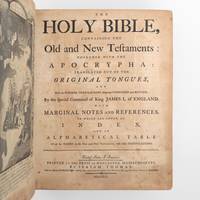
1791373974Worcester: Isaiah Thomas 1791. First Edition. 2 engraved plates complete. 1310pp. Separate OT and NT titles. The family register between the Apocrypha and NT accomplished by Thomas and Lydia Newton Bond. Royal quarto. Contemporary calf spine with raised bands ruled in gilt on either side of each band. Foxing and toning front endpaper detached. First Edition. 2 engraved plates complete. 1310pp. Separate OT and NT titles. The family register between the Apocrypha and NT accomplished by Thomas and Lydia Newton Bond. Royal quarto. "The two Thomas Bibles of 1791 were without doubt far in advance of any other publications of the same kind that had appeared in America in point of typography excellence of paper binding and general execution" Wright Early American Bibles pages 74-88. <br /> <br /> Thomas' quarto bible was published in three distinct issues: with 2 copperplates only i.e. frontispieces to the Old and New Testaments as here; with two copperplates and John Brown's 89-page concordance in the rear; and the rarest and most deluxe form with 48 copperplates and the concordance.<br /> <br /> A very difficult edition to find in a contemporary unsophisticated binding. Evans 23185; Hills 30; ESTC W4496 Isaiah Thomas unknown
172755069London: printed by John Baskett. and by the Assigns of Henry Hills decease'd 1727. Later edition. Hardcover. Very good. Three parts folio in fours 38 by 24 cm. 380 23 3 table pp; text in two columns. Additional engraved title page; main title in red and black; woodcut initials and ornaments. Contemporary two-tone paneled calf triple-ruled in gilt; spine with raised bands elaborately tooled in gilt morocco lettering piece; gilt inner dentelles; marbled endleaves; all edges gilt. Covers very lightly scuffed with mild traces of wear at extremities; upper joint just starting at top; occasional touches of mild mostly marginal foxing. A very good or better copy complete and handsomely bound.<br /> <br /> An uncommon and beautifully printed edition of the Book of Common Prayer "the first single manual of worship in a vernacular language directed to be used universally by and common to both priest and people" Carter and Muir. Despite early revisions and some major alterations following the Restoration the original simplicity of the language has been presevered the text remaining substantially unaltered since 1662. References: ESTC N67554 locates only 4 copies. Cf. Carter & Muir Printing and the Mind of Man 75 ed. 1549. Collation: pi1 a-c4 A-Aaa4 Bbb2 = 203 leaves. printed by John Baskett... and by the Assigns of Henry Hills, decease'd hardcover
1962306831<p>First edition so stated; "First Published 1962". Octavo. Original black cloth stamped in gilt. Dust jacket designed by Barry Trengrove unclipped; four short closed tears; a few nicks. Very good an attractive copy. 196 pages. First edition first issue in black cloth with "16s" price on the front flap and large margins on the jacket flaps.</p> Heinemann hardcover books
197884950Sao Paulo Brazil: Capa 1978. First Edition one of only 6000 copies. Hardcover. Very good/Good. Format is approximately 9 inches by 11.25 inches. 176 pages. Text is primarily in Portuguese with text in English starts at page 155. Illustrations many in color. DJ has wear soiling and some small tears and chips. Inscribed on the fep by the artist the subject of this work. Inscription reads Para Mrs. Anne Richardson com o abroco amigo do Ianelli S. P. dez 78. Stamp of Arcangelo Ianelli with address at bottom of fep. Arcangelo Ianelli July 18 1922 in São Paulo - May 26 2009 was a painter sculptor and illustrator from Brazil who was involved with an artistic group called Grupo Guanabara along with Manabu Mabe 1924-1997 Yoshiya Takaoka 1909-1978 and Tikashi Fukushima 1920-2001. Introduction by Aracy Amaral. Includes Form and Space in the colors by Juan Acha; On Paining and the Painter by Jacob Klintowitz; and An Imaginary Dialogue by Marc Berkowitz. Reviews Biographic Data Bibliography Chronology of the works. Biography of the author. Paulo de Tarso Mendes de Almeida São Paulo May 28 1905 - São Paulo 1986 was a Brazilian lawyer jurist poet writer and art critic. He graduated in Law class of 1931 from Faculdade do Largo de São Francisco he was state attorney until his retirement. However he stood out more in areas other than legal. He began his life as a writer with the publication of a book of poetry entitled Cartazes 1928. From the 1930s onwards he followed all the avant-garde movements that took place in São Paulo being one of the founders of the Sociedade Pró-Arte Moderna and the São Paulo Artistic Family. The arts always excited him and that's why he wrote chronicles about cinema in the Diário Nacional and later about plastic arts in several newspapers and literary magazines in São Paulo Rio de Janeiro Minas Gerais Pernambuco and even Argentina and Uruguay. His main work was the book which he entitled De Anita ao Museu. It is an indispensable work for anyone who wants to know the history of the modernist movement in São Paulo as the author attended and participated in most of the events he describes and does so with complete fidelity. From the beginning of the movement that is from the exhibition by Anita Malfatti in 1917 the narrated facts go through the years until arriving at the creation of the São Paulo Museum of Modern Art and the São Paulo Biennial recounting in fluent prose the events that occurred and its interesting characters. He held the positions of artistic director of the Museum of Modern Art of São Paulo in 1959 and 1960 secretary general of the Bienal de São Paulo and Brazilian commissioner of the XXX Bienal de Veneza in 1960. Capa hardcover
00003Edinburgh: William Blackwood and Sons 1858. Domestic Realism Pathos and Humor<br/>George Eliot's First Works of Fiction<br/><br/>ELIOT George. Scenes of Clerical Life. In Two Volumes. Edinburgh: William Blackwood and Sons 1858.<br/><br/>First edition in book form of George Eliot's first works of fiction. <br/><br/>Two octavo volumes 7 3/8 x 4 5/8 inches; 187 x 117 mm. 4 366; 2 381 1 blank pp. Bound without the half-title in Volume I and without the half-title and fly-title in Volume II.<br/><br/>Nineteenth-century half dark green hard-grain morocco ruled in blind over marbled boards. Spines ruled and lettered in gilt in compartments. Marbled edges and endpapers. Scattered light foxing and soiling. Marginal paper-flaw to leaf H6 pp. 123/124 of volume 1 not affecting text. An excellent set of this rather scarce title.<br/><br/>Scenes of Clerical Life is the title under which George Eliot's first published fictional work a collection of three short stories "The Sad Fortunes of the Reverend Amos Barton" "Mr Gilfil's Love-Story" and "Janet's Repentance" was released in book form; it was the first of her works to be released under her famous pseudonym. <br/><br/>The stories were first published in Blackwood's Magazine over the course of the year 1857 initially anonymously before being released as a two-volume set by Blackwood and Sons in January 1858. The three stories are set during the last twenty years of the eighteenth century and the first half of the nineteenth century over a fifty year period and take place in and around the fictional town of Milby in the English Midlands. Each of the Scenes concerns a different Anglican clergyman but is not necessarily centered upon him. Eliot examines among other things the effects of religious reform and the tension between the Established and the Dissenting Churches on the clergymen and their congregations and draws attention to various social issues such as poverty alcoholism and domestic violence.<br/><br/>"These at once attracted praise for their domestic realism pathos and humour and speculation about the identity of ‘George Eliot' who was widely supposed to be a clergyman or possibly a clergyman's wife" The Oxford Companion to English Literature.<br/><br/><br/>Baker & Ross A3.2. Parrish p. 7. Sadleir 818. Wolff 2062. Edinburgh: William Blackwood and Sons, 1858 unknown books
18306526London 1830. Aquatints coloured by hand. A fine complete series of four anonymous prints of hunting scenes possibly after the Alkens.<br/> <br/> The style and naming of these prints suggests an Alken origin for the series. Siltzer records a number of series by the Alken family in which the first plate is titled "Unkennelling." This title appears to be unique to them and supports the supposition that the present series are after the Alkens. Henry Thomas Alken was born into what became an artistic dynasty. He studied under the miniature painter J. T. Barber and exhibited his first picture a miniature portrait at the Royal Academy when he was sixteen. From about 1816 onwards he "produced an unending stream of paintings drawings and engravings of every type of field and other sporting activity. He is best remembered for his hunting prints many of which he engraved himself until the late 1830s.To many sporting art is "Alken" and to describe his work or ability is quite unnecessary." Charles Lane British Racing Prints pp. 75-76<br/> <br/> Cf. Siltzer pp.57-76. unknown
18306526London 1830. Aquatints coloured by hand. A fine complete series of four anonymous prints of hunting scenes possibly after the Alkens.<br/> <br/>The style and naming of these prints suggests an Alken origin for the series. Siltzer records a number of series by the Alken family in which the first plate is titled "Unkennelling." This title appears to be unique to them and supports the supposition that the present series are after the Alkens. Henry Thomas Alken was born into what became an artistic dynasty. He studied under the miniature painter J. T. Barber and exhibited his first picture a miniature portrait at the Royal Academy when he was sixteen. From about 1816 onwards he "produced an unending stream of paintings drawings and engravings of every type of field and other sporting activity. He is best remembered for his hunting prints many of which he engraved himself until the late 1830s.To many sporting art is "Alken" and to describe his work or ability is quite unnecessary." Charles Lane British Racing Prints pp. 75-76<br/> <br/>Cf. Siltzer pp.57-76. unknown books