42 325 résultats
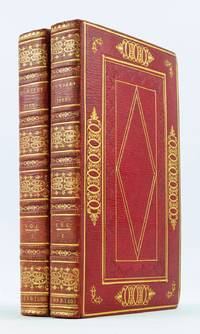
10 volumes, 8vo, half titles, vignette titles and one engraved vignette to the first page of each volume (the vignettes in the Pearch publication by Isaac Taylor), very handsomely leather bound in uniform full period eighteenth century calf with red and black leather lettering labels. A clean and complete set of this renown and much published anthologies. Provenance: Contemporary armorial bookplate of Thomas Parker.
Very Good Turkish, Ottoman (1500-1928) Contemporary burgundy cloth. Cr. 8vo. (20 x 14 cm). In Ottoman script (Turkish with Arabic letters). 223 p., 224 p. (Two books bound together with 'Düsünce fikrinin gayr-i matbua' es'arindan'). Extremely rare first Turkish edition of Shakespeare's 'Antony and Cleopatra', translated by Abdullah Cevdet, (1869-1932). This is the last translation of Shakespeare into Turkish language made by Abdullah Cevdet. Cevdet translated and published five of Shakespeare's plays in his own printing house first in Cairo and then in Istanbul, beginning with Hamlet in 1908 and ending the series with Antony and Cleopatra in 1921. OCLC 66685311, 907298598. Library of Congress. Karl Süssheim Collection, no. 605.
Very Good Turkish, Ottoman (1500-1928) In a contemporary creme cloth. Cr. 8vo. (19 x 14 cm). In Ottoman script (Old Turkish with Arabic letters). 165 p. Kütüphane-i Ictihad, Aded, 20. First Turkish edition of Julius Caesar by Shakespeare. Between 1908 and 1910, Abdullah Cevdet produced a large oeuvre of translations, including four translations of Shakespeare's tragedies: The translations of Hamlet and Julius Caesar (translated by Cevdet as Jül Sezar) were published in 1908, the same year as the declaration of the Second Constitution. [.] Nonetheless, Abdülhamid II seemed to be even less tolerant of the dissemination of Hamlet, Macbeth, and Julius Caesar, since they were about unjust rulers who were executed in the end. It is not surprising that the performances of these plays were subject to strict censorship in the Ottoman lands and banned (Paker 1986: 91). This could be shown as a reason why Abdullah Cevdet was able to publish the translations of these plays only after 1908, though he had finished translating Hamlet in 1902, Julius Caesar and Macbeth in 1904, and Romeo and Juliet in 1905 (Süssheim 1987). Due to the fact that Abdullah Cevdet was a culture-planner, his literary translations cannot only be judged on their "aesthetic" level. It will be discussed in this chapter that Abdullah Cevdet's translations of Hamlet, Julius Caesar, and Macbeth could be read as critical texts directed against Abdülhamid II's absolutist regime. Due to the fact that the selection of source language and culture is an important factor in accounting for any kind of "translation policy", Abdullah Cevdet's selection of source language and culture needs to be questioned (Toury 2000: 202). Even though Abdullah Cevdet does not include Julius Caesar (translated by Abdullah Cevdet with the title Jül Sezar) among what he calls "the four inauspicious tragedies", it was the only play for which Abdullah Cevdet wrote an impressive preface, and it was the second play he translated and published after Hamlet. In a sense, special importance was attributed to Julius Caesar by Abdullah Cevdet for ideological reasons and it was also highly esteemed by other revolutionaries in the Union and Progress Party (Enginün 1979: 119). Abdullah Cevdet was an Ottoman-born Turkish intellectual and physician of ethnic Kurdish descent. He was one of the founders of the Committee of Union and Progress (CUP). In 1908, he joined the Democratic Party, which later on merged with the Freedom and Accord Party in 1911. He was also a translator, radical free-thinker, and an ideologist of the Young Turks until 1908. The son of a physician, and himself a graduate from the Military College in Constantinople as an ophthalmologist, Cevdet, initially a pious Muslim, was influenced by Western materialistic philosophies and came to oppose institutionalized religion, but thought that "although the Muslim God was of no use in the modern era, the Islamic society must preserve Islamic principles". He published the periodical Içtihat from 1904-1932, in which articles he used to promote his modernist thoughts. He was arrested and expelled from his country several times due to his political activities and lived in Europe, in cities including Vienna, Geneva and Paris. His poetry was linked with the Symbolist movement in France, and he received accolades from leading French authors like Gustave Kahn. Özege 9788. Four institutional copies in OCLC: 4026865.
Very Good Turkish, Ottoman (1500-1928) In modern, handsome full brown morocco. Foolscap 8vo. (18 x 12.5 cm). In Ottoman script (Old Turkish with Arabic letters). 159 p. Extremely rare first Turkish translation of Macbeth, printed in Ottoman Cairo. Macbeth reflected Abdullah Cevdet's reaction against Hamidian despotism and his love and advocacy of liberty. One must also remember him as one of the founding members of the Party of Union and Progress - a secret organization that conspired to overthrow Abdülhamid's absolutist regime. The argument that Abdullah Cevdet's translation of Hamlet, Julius Caesar and Macbeth reflected his opposition to Abdülhamid II's absolute monarchy could be justified with the fact that the themes of the translated plays were perceived by the political authorities as threatening since they were about the murder of kings and heads of state. In Abdullah Cevdet's view, Macbeth is famous as a drama of "ambition for status" (hirs-i cah). Abdullah Cevdet was an Ottoman-born Turkish intellectual and physician of Kurdish ethnic descent, and one of the founders of the Committee of Union and Progress (CUP). In 1908, he joined the Democratic Party that later on merged with the Freedom and Accord Party in 1911. He was also a translator, radical free-thinker, and ideologist of the Young Turks until 1908. The son of a physician, and himself a graduate from the Military College in Constantinople as an ophthalmologist, Cevdet, initially a pious Muslim, was influenced by Western materialistic philosophies and came to oppose institutionalized religion but thought that "although the Muslim God was of no use in the modern era, the Islamic society must preserve Islamic principles." He published the periodical Içtihat from 1904 to 1932, of which articles he used to promote his modernist thoughts. He was arrested and expelled from his country several times due to his political activities and lived in European cities including Vienna, Geneva and Paris. His poetry was linked with the Symbolist movement in France and he received accolades from leading French authors like Gustave Kahn. (Source: DR. ABDULLAH CEVDET'S TRANSLATIONS (1908-1910): THE MAKING OF A WESTERNIST AND MATERIALIST "CULTURE REPERTOIRE" IN A "RESISTANT" OTTOMAN CONTEXT; Ayluçtarhan, Sevda). "Between 1908 and 1910, Abdullah Cevdet produced a large oeuvre of translations, including four translations of Shakespeare's tragedies: The translations of Hamlet and Julius Caesar (translated by Cevdet as Jül Sezar) were published in 1908, the same year as the declaration of the Second Constitution. Macbeth, translated by Cevdet as Makbes, was published in the following year. [.] Nonetheless, Abdülhamid II seemed to be even less tolerant of the dissemination of Hamlet, Macbeth, and Julius Caesar, since they were all about unjust rulers who were executed in the end. It is not surprising that the performances of these plays became subject to strict censorship in the Ottoman lands and banned (Paker 1986: 91). This could be shown as a reason why Abdullah Cevdet was able to publish the translations of these plays only after 1908, though he had finished translating Hamlet in 1902, Julius Caesar and Macbeth in 1904, and Romeo and Juliet in 1905 (Süssheim 1987). As Abdullah Cevdet was a planner of culture, his literary translations cannot merely be judged on an "aesthetic" level. It will be discussed in this chapter that Abdullah Cevdet's translations of Hamlet, Julius Caesar and Macbeth could be read as critical texts directed against Abdülhamid II's absolutist regime. [.] Due to the fact that the selection of source language and culture is an important factor in accounting for any kind of "translation policy", Abdullah Cevdet's selection of both these instruments needs to be taken into account (Toury 2000: 202). Özege 12009. Only one copy in OCLC: 949612474 (Bogaziçi University Library of Turkey).
Very Good Turkish, Ottoman (1500-1928) Full morocco in Ottoman style. Foolscap 8vo. (18,5 x 12 cm). In Ottoman script (Old Turkish with Arabic letters). 176 p. Extremely rare first Turkish translation of the Merchant of Venice by Shakespeare in book form. The Merchant of Venice (1885) and The Comedy of Errors (1886-87) were the earliest translations into Turkish by Hasan Sirri, which had the chance to be published in book form. Translators in the Ottoman era had to cope with three obstacles: cultural differences, difficulty in language, and censorship. Shakespeare's works were no exception, as Gönül Bakay argues "the early, Ottoman-period translators and producers expunged the negative imagery" (2004: np) of the Turks in his plays. Even The Merchant of Venice was banned because "it was believed that the theme would offend the Empire's (after 1923, the Republic's) Jewish population". The first play fully translated for print was actually the Merchant of Venice, published in 1885 in Turkish (Arabic letters - Ottoman script). There is a good deal of conjecture about the name of the translator: Only two initials appear on the book, H. and I. now claimed to be the first letter of the first name and the last letter of the last name of a Hasan Sirri. The translator of this book Örikagasizâde Hasan Sirri, (1861-1939), was an administrator and educator who grew up during the reign of Abdulhamid II and was in state service for almost forty years. He was the son of Turkish diwan poet Ahmet Nafiz Pasha and the father of author Nahid Sirri Örik. Özege 22638.; Only three copies in OCLC: 929866546 (NY Uni Lib.; Bogaziçi Uni Lib.; and Library of Congress. Karl Su?ssheim Collection, no. 1527).
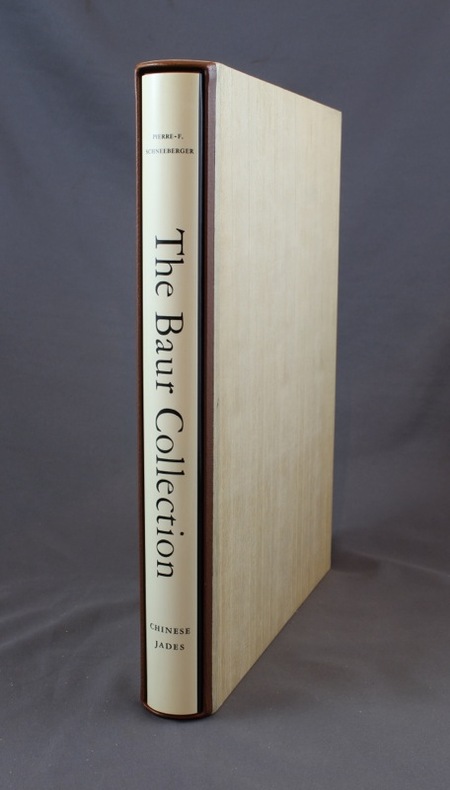
19767407Genève, Collections Baur, 1976. In-4 de [2]-52-[168]p, plein veau brun, couverture illustrée, emboîtage bordé de veau brun. A L'ETAT DE NEUF!!
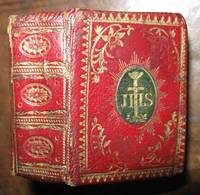
elala3193London: Printed for Elizabeth Newbery 1780. Bondy p. 34. 4.3 x 3.2 cm. 2 engraved titles & 14 engraved plates. A fine copy in original gilt-tooled red morocco gilt back all edges gilt central green morocco onlay on both covers with gilt holy cypher ‘JHS’ London: Printed for E[lizabeth] Newbery, 1780 unknown
19272221659<p>First edition. Octavo. Illustrated by E. H. Shepard. Original gilt stamped red pictorial cloth t.e.g. Pink illustrated endpapers. Dust jacket unclipped; couple tiny tears. Very good. 103 pages. No signatures or bookplates.</p><p>Laid in loose is a flyer advertising an exhibition of the original drawings December 1927 at The Sporting Gallery 32 King Street Covent Garden London.</p> Methuen & Co., Ltd. hardcover books
19272221659<p>First edition. Octavo. Illustrated by E. H. Shepard. Original gilt stamped red pictorial cloth t.e.g. Pink illustrated endpapers. Dust jacket unclipped; couple tiny tears. Very good. 103 pages. No signatures or bookplates.</p><p>Laid in loose is a flyer advertising an exhibition of the original drawings December 1927 at The Sporting Gallery 32 King Street Covent Garden London.</p> Methuen & Co., Ltd. hardcover
27482LONDON W. FADEN 1768. A FINE COPY RECENTLY REBOUND IN HALF LEATHER USING ORIGINAL MARBLED BOARDS NEW ENDPAPERS. REVISED BY HIS SON D. BELLAMY M.A. CHAPLAIN OF PETERSHAM AND KEW IN SURREY. SOME FOXING BUT INTERNALLY VERY GOOD. ETHIC AMUSEMENTS COMPRISES: THE COMFORTS OF PHILOSOPHY IN 5 BOOKS; FAMILY PARTY; COURT OF BEAUTY; THE YOUNG EAGLE; THE PROJECTOR; GRATITUDE; DAMON AND DELIA. THE 'LABYRINTH' IS BOUND BETWEEN GRATITUDE AND THE YOUNG EAGLE WITH ALL PAGES NUMBERED CONSECUTIVELY. THE LABYRINTH HAS 42 PLATES TITLE PAGE THE MAZE THE ENTRANCE AND 39 OF THE FOUNTAINS. IN ADDITION ETHIC AMUSEMENTS HAS A TILE PAGE 2 FULL PLATES AND 4 IN THE TEXT. TITLE PAGE IS FOXED THEREAFTER VERY CLEAN AND CRISP IN A HANDSOME BINDING. A SCARCE ITEM. LONDON, W. FADEN, 1768 hardcover
1885189162Oxford University Press 1885. Signed by Benjamin Jowett a controversial voice in Victorian biblical debate Presentation copy for Robert Scott Dean of Rochester and signed by Benjamin Jowett Vice-Chancellor of the University of Oxford and Norman Macleod Ferrers Vice-Chancellor of the University of Cambridge. The recipient was a classical scholar and co-author of the Liddell-Scott Greek-English Lexicon. The presentation links two leading figures at the intersection of biblical scholarship and classical learning. Jowett the master of Balliol was an influential yet controversial Anglican theologian who advocated for applying modern historical and philological methods to the study of Scripture. His involvement in the Essays and Reviews controversy placed him at the centre of debates over biblical authority and interpretation. 4 vols octavo. Original dark brown hard-grain morocco spines lettered in gilt raised bands Oxford University and Cambridge University coat of arms in gilt to front covers "Presentation Copy" lettered in gilt to vol. 1 front cover gilt fillet turn ins marbled endpapers gilt and red edges blue silk bookmarkers. Spines slightly sunned extremities moderately worn gilt bright foxing to a few leaves. A very good copy. Darlow Moule & Herbert 2037. hardcover
40181OXFORD THE CLARENDON PRESS 1939. WITH A TRANSLATION CRITICAL AND EXEGETICAL NOTES PROLEGOMENA AND COPIOUS INDEXES. THE SECOND REVISED EDITION OF 1895 REPRINTED IN CHINA IN 1939. VOLUMES 1 TO 5 BOUND IN FOUR BOOKS. QUARTO NICELY BOUND IN HALF RED LEATHER OVER RED CLOTH RAISED BANDS GILT MARBLED ENDPAPERS. V1 505pp V2 587pp V3 735 pp V4 785 pp V5 933pp. TEXT IN ENGLISH AND SOME CHINESE. WITH 3 FOLDING MAPS. A VERY NICE SET SLIGHT WEAKENING OF THE FRONT HINGE IN TWO VOLUMES CLEAN AND TIGHTLY BOUND. A HANDSOME SET. VERY SCARCE. OXFORD, THE CLARENDON PRESS, (1939) hardcover
30744LONDON H PLAYFORD 1694. THE SECOND EDITION 58 PAGES. .AS IS ACTED AT THE THEATRE ROYAL BY HIS MAJESTY'S SERVANTS. VERY NICELY BOUND IN MODERN 1934 FULL BROWN LEATHER. NEW ENDPAPERS BOOKPLATE TO FRONT PASTEDOWN. BROWNING OF PAGES COMENSURATE WITH THE AGE. FINE BINDING WITH A FEW MARKS TO THE LEATHER. VERY SCARCE. LONDON, H PLAYFORD, 1694 hardcover
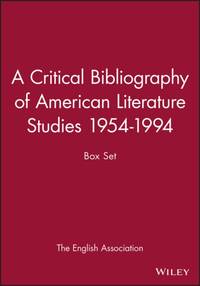
ria9780631209386_inpHardback. New. New Book; Fast Shipping from UK; Not signed; Not First Edition; Based on "The Year's Work in English Studies" this special edition boxed set concentrates on American literature studies from 1954 to 1994. It begins with a review of the analytical index to the journal "American Literature" and closes hardcover
TWELVE VOLUMES. LARGE PAPER EDITION. PLATES IN PROOF STATE. Twelve volumes, illustrated with 240 engraved plates, in their proof state, printed on light paper and mounted to heavier sheets. Each with a protective sheet. Some slight foxing and browning. 313 x 250 mm. All edges gold gilt. Contemporary full dark red morocco bindings. Covers decorated with an interesting wide gold architectural frame. Spines decoratively tooled in a similar manner and lettered in gold. Bindings slightly rubbed. Sir Walter Scott praised this great work of Lodge as "a collection which at once satisfies the imagination and the understanding, showing us. how the most distinguished of our ancestors looked, moved and dressed, and. how they thought, acted, lived, and died" - Allibone 1120. The portraits and biographical sketches include the most important figures in English history, literature, and cultural development. The original paintings were usually from life and executed by some of the greatest artists of the times: Holbein; Titian; Van Dyke; Reynolds; Gainsborough; Kneller; etc. Some of the famous engravers who contributed to the work include: James Thomson (1788-1850); Samuel Freeman (1773-1857); John Cochran; William Thomas Fry; William Holl (1807-1871); W.H. Mote; and many others. This format in large paper with mounted proof plates is most uncommon. Hardbound. Very good. Lowndes V:1381-2. *PRICE JUST REDUCED! W139
Very Good Turkish, Ottoman (1500-1928) Paperback. Foolscap 8vo. (18 x 12 cm). In Ottoman script. 38 p., 1 b/w portrait of Byron. A heavy tear on the back cover. The Prisoner of Chillon is a 392-line narrative poem by Lord Byron. Written in 1816, it chronicles the imprisonment of a Genevois monk, François Bonivard, from 1532 to 1536. After almost 100 years later, this poem was translated into the Ottoman Turkish by Abdullah Cevdet firstly printed in Geneva. Abdullah Cevdet, (1869-1932), was a leading Ottoman/Turkish free-thinker, materialist, and Westernizer. He was born in the town of Arapgir in Ma?muret?ül-Azîz Province of the Ottoman Empire and grew up in a pious, lower-middle-class Muslim household, where he received a strict religious education. His father's stubborn refusal of smallpox vaccination left him pockmarked for life and contributed to his eventual gravitation towards scientism. Abdullah Cevdet graduated from the Military Middle School in Ma'muret'ül-Azîz in 1885, and then entered the Kuleli Military Medical Preparatory School in Istanbul. Three years later, he enrolled in the Royal Military Medical Academy. At this time, he was still very religious; one of his early poetry books from this period includes a glowing "Na't-i Serif," a eulogy for the Prophet Mu?ammad. However, like many other cadets, Abdullah Cevdet's views underwent a drastic transformation in the academy, where he became an ardent scientistic thinker and materialist. Here he produced his first translations from major works of German Vulgärmaterialismus, such as Ludwig Büchner's Kraft und Stoff and Aus Natur und Wissenschaft. He continued to translate from European writers up until his death, including Vittorio Alfieri, Émile Boutmy, Lord (or George Gordon) Byron, Jean-Marie Guyau, Baron (or Paul-Henri Dietrich) d'Holbach, Friedrich von Schiller, William Shakespeare, and François-Marie Arouet (Voltaire). One of his most important contributions to Ottoman and Turkish intellectual debate was the translation of Gustave Le Bon's writings into Turkish and the introduction of his elitist ideas to the Ottoman elite. Abdullah Cevdet also continued to write poetry throughout his life. Although the poems he wrote in the academy bore strong Parnassian influences, his later work was increasingly Symbolist in nature. He also translated the Persian poetry of Khayyâm into Turkish. (Source: Oxford Islamic Studies Online; Cevdet, Abdullah). Özege 18963.; TBTK 7035. OCLC 754957413 (Not found an institutional copy in OCLC). First Edition. Extremely rare.
19381210306London, Constable, (1930 - 1938). Gr.-8vo. Grüne OLwdbde m. goldgeprägten Rückentiteln u. Kopfgoldschnitt (Bibliotheksexemplar m. Rsign., Ex Libris u. Bibliotheksschildchen auf den Vorsätzen, Stempel a. d. Titelrückseiten, hinterer Innendeckel m. Klebespuren; etwas berieben, wenige Innengelenke gelockert).
1819ST15731bLondon: Printed for F. C. and J. Rivington and others 1819. 216 x 136 mm. 8 1/2 x 5 3/8". viii 9-223 1 pp.Translated from the Greek by William Smith. <br/> Attractive contemporary oxblood calf decorated in gilt and blind covers with a wide gilt palmette frame enclosing an intricately blind-stamped panel with additional gilt decoration raised bands spine heavily gilt in compartments black morocco label gilt turn-ins marbled endpapers and edges. Front free endpaper inscribed in ink: "Miss Filliter obtained this Book as a Prize by her uniform attention to the Study of Latin during the Half-year. / June 1828." Lower corners lightly bumped a little rubbing at extremities flyleaves faintly browned occasional trivial internal imperfections but still quite a fine copy the contents extremely clean and unusually bright and in a well-preserved binding with a great deal of aesthetic appeal.<br/> <br/> In a handsomely decorated binding this is an excellent translation of one of the most important treatises of literary criticism to come out of the ancient world. First published in 1737 our translation established the reputation of William Smith 1711-87 as a "talented classical scholar." DNB A later William Smith the lexicographer said of "On the Sublime" "there is scarcely any work in the range of ancient literature which independent of its excellence of style contains so many exquisite remarks upon oratory poetry and good taste in general." Although generally attributed to the third century Greek philosopher and critic Longinus the work probably preceded him. After unsuccessful attempts to determine if Dionysius of Halicarnassus Cassius Longinus Plutarch or another was the author scholars arrived at the solution of calling the creator "Pseudo-Longinus." Our pretty though unsigned binding combines gilt and blind decoration in a particularly pleasant way. Volumes of classics in ornamental bindings were popular school prizes in the 19th century but ours is distinguished by being presented to a young lady who excelled in Latin at a time when most women received little formal education and 40 percent of the women in England were illiterate. The condition here suggests Miss Filliter and her successors treasured and cared for the present volume. Printed for F. C. and J. Rivington (and others) unknown
1808ST15731cLondon: J. Johnson 1808. New Edition. 220 x 135 mm. 8 5/8 x 5 3/8". Two volumes. <br/> VERY PRETTY CONTEMPORARY SCARLET STRAIGHT-GRAIN MOROCCO covers with gilt-ruled frame decorated with multiple overlapping gilt door handle tools and floral cornerpieces central panel with gilt-ruled lozenge enclosed by gilt rules and blind floral rolls raised bands compartments gilt wide turn-ins ruled in gilt and with repeating flower motif in blind and small gilt circles in the centers green inlaid cornerpieces with gilt tooling blue watered silk endpapers all edges gilt. With eight plates after Henry Fuseli including frontispiece to each volume. Verso of front free endpaper with armorial bookplate of Lewis Way. ◆Spines a little sunned corners a bit worn and tending to turn inward light scuffing to extremities plates lightly foxed but the text extremely clean and the pleasing bindings with minor issues only.<br/> <br/> This is an attractively illustrated and handsomely bound edition of the finely crafted poetry of William Cowper 1731-1800 the most notable English poet before the Romantics in terms of a tendency to be confessional in one's verse. Given the fact that he was institutionalized and that he several times attempted suicide these self-revelatory poems can easily be seen as a kind of therapeutic experience and it is testimony to the complexity of his personality that so much of Cowper's verse is light conversational and epigrammatic. His poems range widely from religious reflections to translations of Homer to poetry inspired by a lady's suggestion that he could write on any topic including a sofa see vol. II p. 1. The plates here were designed by Henry Fuseli 1741-1825 a Swiss-born painter who lived mainly in England. He was best known for his paintings exploring the supernatural as well as his influence on the young William Blake. DNB calls him "A superb and intensely dramatic draughtsman . . . notorious for his sensational demonic irrational and bizarre subjects" leading "the surrealists to claim him as a forerunner." Though unsigned the bindings here are extremely attractive with tasteful gilding and luxurious touches such as wide decorative turn-ins and watered silk endleaves. This copy was previously owned by Lewis Way an Evangelical reverend who made it his mission to promote Christianity among the Jews. It was his particular belief that returning Jews to the Holy Land would fulfill a biblical prophecy and to this end he secured several audiences with Tsar Alexander I in the attempt to persuade him to the cause. His home at Stansted Park reportedly contained a library that included rare Judaica and Hebraica. J. Johnson unknown
1823AQ19315Oxford: Printed at the Clarendon Press by Samuel Collingwood and Co. 1823. Unpaginated. With additional engraved title pages for both the O.T. and N.T. and a further 27 engraved plates. Handsomely bound in contemporary blind-stamped black straight-grain morocco lettered in gilt A.E.G. Slightest of rubbing to extremities. Manuscript records of births deaths marriages etc. of the Trueman family to front blank fly-leaves very occasional light spotting. . Quarto. Printed at the Clarendon Press by Samuel Collingwood and Co. unknown
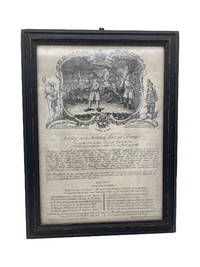
1756004150<p>Worcester: S. Gamidge and W. Pendrill 1756. Single sided engraved broadside approximately 265mm x 380mm engraving 335 x 450 Frame. Lightly soiled surface abrasion towards head on the left hand side but not affecting image several small worm holes but again not affecting image or text. Vignette to head showing Penderel holding a billhook in the foreground with the king on a horse in disguise to the background. Penderel's epitaph is recorded towards the bottom of the engraving with an added note that George II had ordered that his monument be 'cleaned up & beautified in the year 1739'. Engraved broadside celebrating the life of Richard Penderel Richard Pendrill of Hobball Grange Shropshire who with his four brothers saved the life of Charles II after the battle of Worcester hiding him from Cromwell's soldiers. After the Restoration both he and his brothers were rewarded with a pension and he was known as 'Trusty Dick' at Court. He died in 1671 while visiting London and his surviving brothers were later granted exemption from prosecutions for recusancy after the 'Popish Plot'. The publishers were S.amuel Gamidge fl. 1756-1777 see BBTI and W. Pendrill presumably a descendant unlocated in BBTI. Not in ESTC. First Edition. Framed and Glazed. Good. Elephant Folio. Broadside.</p> S. Gamidge and W. Pendrill hardcover
38808LONDON HURST ROBINSON AND CO. 1824. NEW EDITION 20 VOLUMES. SMALL OCTAVO HALF LEATHER OVER MARBLED BOARDS RAISED BANDS. WITH A FINE ENGRAVING AT THE FRONT OF EACH PLAY FOXED TEXT VERY CLEAN. IN VERY GOOD CONDITION. WITH BIOGRAPHICAL AND CRITICAL REMARKS. A HANDSOME SET. LONDON, HURST, ROBINSON AND CO., 1824 hardcover
28024LONDON HARRAP 1912. LIMITED EDITION OF 525 COPIES THIS BEING NUMBER 254 SUPER HALF MOROCCO BY HATCHARDS OF PICCADILLY WITH 16 TIPPED-IN COLOURED PLATES AND MANY DECORATIONS IN THE TEXT BY WILLY POGANY SIGNED BY THE ARTIST DECORATIVE END-PAPERS. A NEAR FINE COPY. LONDON, HARRAP, 1912 unknown
38900LONDON THOMAS TEGG 1812. 12 VOLUMES COMPLETE. BOUND IN FULL LEATHER RAISED BANDS A.E.G. WITH 12 FINELY ENGRAVED TITLE PAGES AND 38 OTHER PLATES. ARMORIAL BOOKPLATE REMOVED FROM EACH FRONT PASTEDOWN. SOME FOXING TO THE PRELIMS. ONLY THEN CLEAN AND TIGHTLY BOUND. CRACKED JOINT TO VOLUME 12. A VERY GOOD SET OF A SCARCE WORK. LONDON, THOMAS TEGG, 1812 hardcover
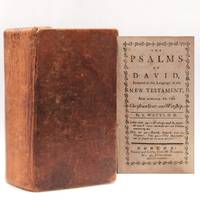
1789373872Boston: John W. Folsom 1789. 31711; 265 1 xii pp. 12mo. Contemporary calf minor wear. Provenance: Anna Duryee inscription on front endpaper dated 1791. 31711; 265 1 xii pp. 12mo. The Psalms unrecorded by Evans are an edition of Mycall's revision with all references to Great Britain and the King removed to make it more palatable to the nascent United States first printed in 1781. A scarce edition with only a handful of institutional holdings of either the Psalms or Hymns printed by Folsom here bound together. Evans 21687 Hymns; ESTC W4418 Psalms and W25174 Hymns John W. Folsom unknown