253 535 résultats
2024Gyan-9788121256711Gyan Publishing House 2024. In 245 Bindings. Hardcover. New. 22.59 x 28.94 x 828.17. English Gyan Publishing House hardcover
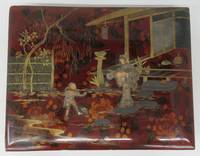
1880127847ca. 1880s-90s. Good. Forty 20.5 x 27 cm albumen hand-coloured photographs pasted into 28 x 35 cm laquer album. Each photo has number and short descriptive caption. Front board of album damaged where ivory was pried off. Board coming loose. Front free endpaper detached and chipped. Tissue guards between plates some detached and folded or chipped. Last three photos detached. Accompanied by one 11.5 cm photograph of woman Bernard & Co. mounted on 19 cm card as well as twenty-one 9 x 13.5 cm photos six with inscriptions on rear. Photos in very fine condition. <br/><br/>These tremendous photographs illustrate Japan during the Meiji Period 1868-1912. During this time period Japan abandoned its centuries-old isolationism and began a period of industrial growth and Westernization. Prince Meiji Mutsuhito encouraged his people to work or study abroad and also invited Westerners to tour his country. During this era Japanese photography began to blossom. A Greek photographer named Felice Beato went to Japan and started documenting the country's landscapes villages and people. When he started to delicately hand colour his black and white albumen prints the Japanese themselves began to take an interest in his work. Soon there were numerous practitioners of the art of handcolouring albumen prints for tourists. These prints are now eminently collectable. The scenes in this album show tea houses restaurants temples fishermen rice growers stores a lantern maker toy shop basket seller farm workers and domestic scenes. The richly decorated album once including ivory in its design was meant for tourists to fill with various personally chosen commercial photos available for purchase. unknown
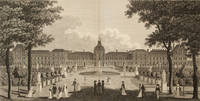
18161435761816. PARIS. Graphic Illustrations of the Most Prominent Features of the French Capital; with Characteristic Figures in the Foregrounds comprised in Twelve Stroke Engravings From Accurate Designs Taken in Paris during the Imperial Reign of Buonaparte. With Descriptive Notices and Interesting Anecdotes. 26 pp. illustrated with 12 double-page engravings. Folio 430 x 380 mm. bound in contemporary French three-quarter black morocco over marbled boards gilt title and floral vignettes on spine paper label with ms. number "20" on front cover and spine. London: Harper and Co. 1816. A fine copy of this extremely rare collection of views of Paris consisting of twelve artistically conceived views of Paris engraved by English artists. The large double-page engravings incorporate local Parisians participating in daily routines within the setting of each view. Panoramic views include: the Military School and the Church of the Invalides; View of Paris from the South Boulevard; View of Paris from Montmartre; South View of the Old and New Louvre; The Mint and The Façade of the Louvre; View of La Place de la Concorde; The Garden of the West Front of the Tuileries; Palace of the Tuileries Facing La Place du Carrousel; Garden of the Tuileries; The Luxembourg or Palais du Senat with the Gardens; The Elysian Fields Distant Gardens of the Tuileries; Entrance to Les Champs Élysées and La Place de la Concorde. Each plate is followed by two pages of text giving historical details and anecdotes about the site illustrated. Minor wear to outer edges of binding plates and text clean. Rare: OCLC lists 6 copies worldwide of which only one is held in America Bowdoin College. hardcover
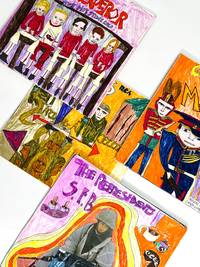
40620n.p.: n.p. 1990. Very good plus. Stunning and extensive collection of original artwork album covers and two lengthy reference books - all describing a vast imaginary world of 20th century rock-and-roll that never existed. Introducing the auto-fanfictive outsider art of The Indoor Kid - a Henry Darger of Greil Marcuses Syd Barrett of Daisy Ashfords Robert Christgau of Richard Dadds - who fell through the pages of ten thousand music magazines into a wonderland of his own making. The anonymous creator hereafter The Artist fashioned an entirely fictitious musical universe. From dozens of albums drawn and collaged over actual LPs as well as what might perhaps best be described as concept art for those albums to extensive accompanying commentaries whose tone owes a great deal both to zines of old and the once-popular Encyclopedias of Rock the impression is one of carpeted suburban bedrooms and children longing to escape both backwards into lost decades and forwards into the autonomy and sexuality of imagined adulthood. The Artist's mock-authoritative assertions of judgment and offhand omniscience speak of a child raised by a stacks of ROLLING STONE and CREAM in lieu of the foundling's traditional pack of wolves. His major fascinations - psychedelia the particular flavor of British whimsy that preceded it and hippie-tinged heavy metal of the Zeppelin-Black Sabbath era- are all in line with this lineage and with the character of the solitary late-'80s adolescent.<br /> <br /> THE DREAM OF FAME BEATS FAME ITSELF:<br /> <br /> The Artist's record collection most immediately calls to mind the work of Mingering Mike the D.C.-based self-made recording artist who constructed scores of fake albums by "unheard artists such as Joseph War the Big 'D' and Rambling Ralph on labels such as Fake Records Inc. Decision Sex and Mother Goose" Hadar. Discovered at a flea market in the early 2000s Mike's work found instant cult and early online fame. The present collection however can be dated with a great deal of confidence to the mid-late 1980s through perhaps the very early 1990s from the issue dates of the original repurposed albums as well as triangulating particular contemporary references coupled with certain early laser-print fonts. Thus while it is almost certainly impossible that the one could have influenced the other the similarities of technique imagination and single-minded dedication in their respective oeuvres are striking. <br /> <br /> Their art styles however are highly individuated. Though both may be placed under the broad umbrella of outsider art our Artist abhors a vacuum; he does not have Mike's appreciation of negative space. Lacking any formal skills or apparent training and with a representational style much younger than his assumed years he works in blasts of color in layers of collage and pen and children's marker in puns and allusions and call-backs both verbal and visual. And whereas Mingering Mike's invented record labels and bands lent verisimilitude to his own fantasied career in which he was the star The Artist is self-effacing to a fault. His dream is pure and strange. Not so much the protagonist of this created world but its chronicler publicist. In short that most reviled and necessary of creatures: the rock journalist. <br /> <br /> "OPIUM: ONE OF THE MOST POTENT DRUGS. NOW THE NAME OF A NEW ROCK AND ROLL BAND."<br /> <br /> Clearly a deep reader if only of music journalism the artist scatters little gems in the corners. Little clusters of mini-trends pop up in band names: the exquisitely named Sand Witch Witch-ita Falls Witching Hour and Witches Comettee sic; Mezzanine Anecdote and The Syntax Man; Tar-O and the O-CULT Band. Elsewhere there's a knowing nod to the Bonzo Dog Doo Dah Band clearly a source of inspiration; a song called "Austin Osmanspare" described as a "creepy tale of a black magic practitioner"; a reference to vocals vocals! like H.P. Lovecraft. Well-versed in the style of Bangsian word-omelettes "a sound full of ponderous organ pounding plodding rhythms screaming operatic vocals fast blitzkrieg-Bach-inspired guitar runs" some of the song titles are undoubtedly jokes on purpose: "Who When And Where Is Our Love Machine" "Soldier Sentry Squabbie Cockleshell Army" "666 All in the Name of Satan" Death Banquet's "Let Me Bludgeon You" followed by "No No No Don't Break The China" and the magisterial "Surrender Your Arms Sexual Metaphor." <br /> <br /> Meanwhile the real world does exist but is kept resolutely peripheral: nods to Timothy Leary praise from George Harrison glowing comparisons to Ozzy Osbourne and sneering ones to Michael Bolton creep in. Occasionally a deep-cut cover appears like "Magic Handkerchief" Bown/Bannister always scrupulously attributed. In a stroke of crossover genius one of the two encyclopedic notebooks explains that the imaginary band Iron Maiden had to change its name when the other real Iron Maiden got too famous. Poets too feature not only in certain liner notes "The group are heavily into Shelly sic Byron Keats William Blake and Sigfried Sasoon sic" but also most intriguingly in one unique piece of album art: "Strange Games" by "WILLIAM BLAKE." Unlike all the others however this album incorporates actual photographs of a teenage boy sulking theatrically for the camera in a red-collared black cape heavy bangs and incipient wispy mustache. We suspect the subject of being the artist and if we are correct his choice of pseudonym is impeccable.<br /> <br /> ENTRANCE TO THE SOLAR MINE<br /> <br /> What became of the creator is unknown and likely unknowable. Perhaps like Mingering Mike he decided that "the dream of fame beats fame itself" Washington City Paper. Perhaps he put away childish things and went on to be a sober and square maker of spreadsheets and never reminisced about a single song no one else had ever heard. Or perhaps he struggled when abruptly deposited in an adult world more real but less beloved than his own - a sadly more likely scenario as this collection was rescued from a storage locker auction.<br /> <br /> What is known for certain however is that the most compelling of pasts is the dream-past just before one's own birth well-remembered by parents and better-known to cool older siblings but eternally opaque to oneself. It is tragically the strangest history of all farthest away yet tantalizingly close. One cannot remember it so one invents. Wasn't Satanic Brittanica's "Moanin' Alone If You Leave Me Girl" a banger And that the song "Bastard" by Dallas sure rocks. Tune the FM dial of the aimless drives of youth. You remember. Collection includes the following 101 items: 52 original hand-colored and collaged record album sleeves. Two handwritten clamp-bound journals. Six color xerox reproductions and 41 original color marker-and-collage artworks for a subtotal of 47 different images; the color xeroxes do not reproduce any of the original works present and though some band names and iconographic motifs recur no images repeat from the album covers. Collaged materials include one piece with several original photographs of a young man tentatively identified as the anonymous artist. All materials show minor wear with occasional glue separation of artwork from original album cover; on the whole spectacularly well preserved. A complete inventory is available as well as a document with further sample quotes. n.p. unknown
2024BIBHB0334000832024. Hardcover. New. Due to the very old age and scarcity of this book some pages are missing and may be hard to read due to the blurring of the original text. The Title 'District Gazetteers of India In 245 Bindings written/authored/edited by Anonymous' published in the year 2024. The ISBN 9788121256711 is assigned to the Hardcover version of this title. This book has total of pp. 82817 Pages. The publisher of this title is Gyan Publishing House. This Book is in English. The subject of this book is History. Size of the book is 22.59 x 28.94 cms Vol: Volume In 245 Bindings hardcover
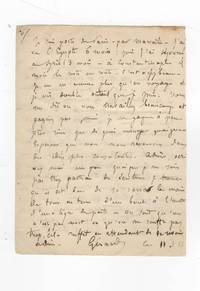
184475148Paris 1844. Fine. Paris 11 février 1844 10.40 x 13.60 cm quatre pages sur deux feuillets Three autograph letters signed by Gérard de Nerval 2 pages signed «Gérard» Théophile Gautier 1 page and a third unsigned letter 1 page penned by a certain «Robert» cf. Nerval's letter Louis Desessart Théophile Gautier's appointed publisher co-published Nervals play Léo Burckart with Barba in 1839. Following financial difficulties he was forced to take refuge «in that sad and charming city of Brussels». The three friends wrote this letter from Paris where they had reunited following Nervals long journey to the East: «I spent six months in Egypt; then three months in Syria four months in Constantinople and the rest en route. Its quite beautiful. I only enjoy myself while traveling and try to live twice as much as I can.» This journey deeply impressed Théophile Gautier who would only travel to Turkey and Egypt years later: «I am in Paris and wish I were in Cairo from where Gérard is returning.» The exoticism of distant lands starkly contrasts with the melancholy and severity of Europe: «How sad Paris is when one returns from sunlit countries.» Nerval And in Paris far from dreams of escape life means toil and melancholy: «We are like sick people who are never comfortable anywhere. I think the good times are gone and the golden hours of the past when we spoke such wise follies will never return. Whats the point of living if we must work and cannot see our friends or write to them or do anything we would like» Gautier The two writers express great compassion for their friends Belgian exile with Brussels appearing as the capital of spleen: «What! Youre still in that sad and charming city of Brussels! . Brussels is even darker poor fellow!» Nerval This joint letter was in fact initiated by «Robert»: «Isnt it true my dear friend that Im quite skilled at making you forget my faults . as a way of making it up to you Im sending you the autographs of two of your . comrades your fondest memories two men of fame who despite all their affection and friendship for you would never have written a word had I not trimmed their quills and handed them paper like sulky children and told them: write at once at once to the exile you love most.» unknown
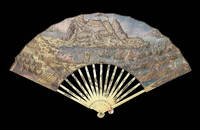
17802221Spain c1780. Folding paper fan with a fine large hand-coloured engraved view of the Siege of Gibraltar with Spanish ships and troops in the foreground the verso with engraved key in Spanish decorated with weapons of war on either side mounted on ivory sticks the ivory sticks decorated in silver and gilt with a fort ship and flag the gaurdsticks carved and pierced and with silver and gilt depicting a ship and drums. The unsuccessful siege of Gibraltar began in 1779 and lasted until February 1783 when the siege was lifted. This fan which it has been suggested belonged to the Earl of Minto is not in the Schreiber Collection. unknown
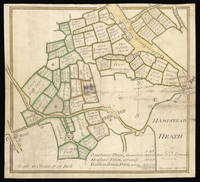
14549mid-18th century. 285 by 315mm 11.25 by 12.5 inches. Pen and ink and wash colour on vellum. A manuscript map of Golders Green extending from Cricklewood to Hampstead Heath now Golders Hill Park. This remarkable map shows the division Golders Green and the surrounding area during the mid to late eighteenth century. The area was divided into three farms: Cowhouse Farm green; Hodford Farm orange; and Golders Green Farm yellow. Each of the farms fields are meticulously laid out with their name and area in acres roods and perches marked. The largest landowners at the time were the Dean of Westminster and the Trustees of Eton College. To the lower right is a table of the total holdings of each farm Golders Green being by far the largest; with the total land of all three farms amounting to just over 470 acres. Common land is marked with a 'X' and amounts to just over six acres. Several buildings are marked on the plan including the Cowhouse Farm and The Cock and Hoop Ale House. In 1896 the authorities closed the Cock and Hoop when it was discovered that the named licensee Mr Robinson had been dead for four years! Eighteenth century manuscript plans of London boroughs are very rare especially on such a large scale. Scale: 10 chains to one inch or 1/8th a mile to one inch. Colloms W & M Kilburn and West Hampstead Past; Howkins F. The Story of Golders Green and its remarkable development London 1923. hardcover
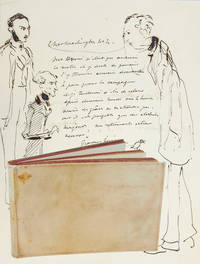
187089636No Location: Sans nom d'éditeur 1870. Fine. Sans nom d'éditeur No Location s. d. 1870 40.5 x 27.9 cm Relié Exceptional album comprising 54 original caricatures some captioned executed in India ink pencil and watercolour including three small pencil sketches on loose leaves together with several blank leaves.This entertaining and highly personal album evidently compiled by an amateur artist appears to chronicle the various adventures and misadventures of a small cast of recurring characters all seemingly connected in one way or another with the French Embassy to the Ottoman Porte as suggested by a piece of official letterhead inserted between two leaves.Contemporary full ivory vellum with yapped edges smooth spine ruled in red a restored split at the head of the spine red fillets framing the boards some marking to the covers comb-marbled endpapers red edges.The album also includes one autograph letter signed in black ink embellished with marginal caricatures addressed to Mr H. Fournier and opening with ""Cher Washington n°2"".The recipient of this satirical illustrated letter appears to be the diplomat Hugues Marie Henri Fournier 18211898 appointed ambassador to Constantinople in 1877.The adventures of the small group identified by captions in black pencil seem to begin in Florence in September 1872 and continue on to Rome.The album includes among other scenes a watercolour depicting the Temple of Vesta.In December 1872 according to an ink caption the groupcomprising the Vicomtes Bresson de Mareuil d'Hauterive and d'Hérissonis caricatured in Rome: at the theatre on the Capitoline Hill on horseback and so forth.A panoramic watercolour likewise satirises the Franco-Prussian War of 1870 and its protagonists.Also portrayed in pencil alongside Fournier are General de Castelbajac and the Baron de Talleyrand.The album further contains a fine pencil portrait of Khalil Bey.The renowned Ottoman diplomat and collector born in Cairo in 1831 and deceased in Istanbul in 1879 had indeed returned to Constantinople in 1872 after his ambassadorship in Vienna 1868 to marry the Egyptian princess Nazli Fazl. In addition to his role in the Crimean War he is remembered for his celebrated art collection which sold at auction in 1868 included works by Courbet among them L'Origine du monde Ingres Delacroix and others.The Comte d'Osmond and Alfred de Courtois are likewise caricatured.The album also features a view titled Pointe imaginaire du sérail and a watercolour depicting a game of lawn tennis.A unique ensemble. Sans nom d'éditeur hardcover
18161435761816. PARIS. Graphic Illustrations of the Most Prominent Features of the French Capital; with Characteristic Figures in the Foregrounds comprised in Twelve Stroke Engravings From Accurate Designs Taken in Paris during the Imperial Reign of Buonaparte. With Descriptive Notices and Interesting Anecdotes. 26 pp. Illustrated with 12 double-page engravings. Folio 430 x 380 mm bound in contemporary French three-quarter black morocco over marbled boards gilt title and floral vignettes on spine paper label with ms. number "20" on front cover and spine. London: Harper and Co. 1816. A fine copy of this extremely rare collection of views of Paris consisting of twelve artistically-conceived views of Paris engraved by English artists. The large double-page engravings incorporate local Parisians participating in daily routines within the setting of each view. Panoramic views include: the Military School and the Church of the Invalides; View of Paris from the South Boulevard; View of Paris from Montmartre; South View of the Old and New Louvre; The Mint and The Façade of the Louvre; View of La Place de la Concorde; The Garden of the West Front of the Tuileries; Palace of the Tuileries Facing La Place du Carrousel; Garden of the Tuileries; The Luxembourg or Palais du Senat with the Gardens; The Elysian Fields Distant Gardens of the Tuileries; Entrance to Les Champs Élysées and La Place de la Concorde. Each plate is followed by two pages of text giving historical details and anecdotes about the site illustrated. Minor wear to outer edges of binding plates and text clean. Rare: OCLC lists 6 copies worldwide of which only one is held in America Bowdoin College. hardcover books
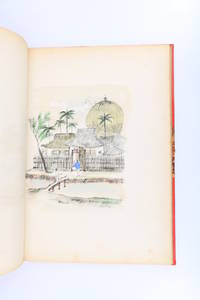
188589859No Location: s. n. 1885. Fine. Superb collection of 49 original watercolours offering a rare and valuable glimpse into Tonkin at the dawn of the French protectorate s. n. No Location s. d. 1885 23 x 32.5 cm Relié Exceptional collection of 49 original watercolours depicting daily life in Tonkin most illustrating rural scenes. These unsigned watercolours each measuring approximately 20 x 15 cm excluding margins are finely executed in Indian ink and watercolour with touches of gouache on paper sheetssome bearing the watermark ""Latune et Cie Blacons."" Contemporary half red cloth binding smooth spine covered in red shagreen some rubbing to the spine boards of marbled paper blue endpapers and pastedowns. Minor foxing to the margins of some watercolours. The scenes depict a variety of subjects: a military post guarded by four soldiers one standing sentry at the entrance; a guard in white uniform holding a rifle with a long bayonet his head covered by a salacco the traditional headgear of Indochinese riflemen; an elderly man seated at a table smoking a pipe while being fanned by a servant; a peasant ploughing with two oxen; a woman praying at a grave; another peasant tilling the soil; two villagers meeting near a small bridge; four people working in a paddy field; a man in formal dress before a temple; three peasants harvesting rice; a cockfight and more. Also depicted are villagers carrying goods or fishing wrestlers performing before a dignitary a child guiding a blind man two labourers transporting stones in a wheelbarrow a procession led by a mounted dignitary carrying a wild boar in a cage a prisoner being flogged another about to be beheaded a hunting scene musicians a woman at a loom villagers at play and so on. Western presence is alluded to only once: an Indochinese sailing vessel flies three tri-colour flags while a steamship probably French makes its way in the background Accompanied by a piece of light brown calfskin 4 x 32 cm blind-stamped with the inscription ""Souvenir du Tonkin 1885-90"". A rare and precious visual record of Tonkin at the beginning of the French protectorate. s. n. hardcover
2024Gyan-9788121256728Gyan Publishing House 2024. In 245 Bindings. Paperback. New. 21.59 x 27.94 x 579.719. English Gyan Publishing House paperback
1840038511United States: M.M. Noah & A.S. Gould 1840. First Edition Thus . Leather Bound. Good/NO Dustwrapper. 8vo - over 7¾" - 9¾" tall. Referred to in Joshua and Second Samuel & APOCRYPHA. Preface by M. M. Noah.THE BOOK OF JASHER or Sefer Hayashar: Faithfully Translated from the Original Hebrew into English. One of the Sacred Books of the Bible with Certificates of authenticity and several Prefaces. APOCRYPHA No title page Second text and also one of the many Sacred Books of the Bible lost hidden or suppressed and omitted from the Bible. Handwritten notes at the beginning of the Apocrypha "FW Briggs Eton College 1831; M.A. Hayes Windsor Cloisters 1834" seem to indicate that this is 2 books bound into one. First Edition Thus. M.M. Noah & A.S. Gould New York USA 1840. ii xxiv 268 232pp hb No Dust-wrapper ornate gilt full calf-leather with raised seams aeg front cover semi-detached covers rubbed & scraped pages browned part of title label missing contents sound scarce book. overall good <br/> <br/> M.M. Noah & A.S. Gould hardcover
3240France c. 1700. Two volumes complete. AN ENTIRELY UNKNOWN UNPUBLISHED AND COMPLETE EXEGETICAL MANUSCRIPT BY A CONTEMPORARY OF BOSSUET CALMET LE CLERC AUSTRUC RICHARD SIMON CAPELLUS GROTIUS AND GUYON. Volume I: 1 leaf; 592 pp. Volume II: 1 leaf; 360 pp; 2 blank leaves; 324 pp. Written in ink in a very fine accomplished almost calligraphic hand on extremely fine thick laid paper. Volume I and the first half of volume II is a verse-by verse commentary on Ezekiel; the second half of volume II is a commentary on selected chapters of Daniel. While this manuscript was created during an important period perhaps the most important period in the history of biblical exegesis it is entirely original and very different from all published exegeses. 4to. BEAUTIFULLY BOUND IN CONTEMPORARY FRENCH CALF SPINES RICHLY GILT IN SIX COMPARTMENTS morocco spine-labels. Marbled endleaves. Minimal wear to extremities of bindings else FINE AND BRIGHT. Unique and important. <br/><br/> France, c. 1700 unknown
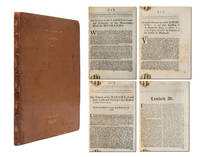
16934178London: Various 1693. First editions. Late 18th - early 19th century full polished calf with gilt to spine and front board. Marbled endpapers. A pleasing square copy with just a bit of rubbing to extremities. Gilt and embossed bookplate of bibliophile Edward Hailstone 1767-1851 to front pastedown. Containing four complete exceedingly scarce pamphlets from the 17th century querelle des femmes debates about women's humanity and place in society interleaved with blanks likely for manuscript glossing although all remain unmarked. Comprised of:<br/><br/>1. Petition of the Ladies of London and Westminster to the Honourable House for Husbands. London: Printed for Mary Want-man the fore-maid of the petitioners and sold by A. Roper in Fleetstreet 1693. First edition. Complete including all four pages called for by ESTC and listing its imprint in the colophon. ESTC records only 8 copies with only 3 listed in the modern auction record since 1940.<br/><br/>2. An Humble Remonstrance of the Batchelors in and about London.in Answer to the Late Paper Intituled A Petition of the Ladies for Husbands. London: Printed for and Sold by the Bookselling Batchelors in St. Paul's Churchyard 1693. First edition. Complete including all four pages called for by ESTC and listing its imprint in the colophon. In all a clean and neat copy of this scarce and important part of the debate on women. ESTC lists only 8 extant copies with only 2 listed in the modern auction record. ESTC R4393.<br/><br/>3. The Petition of the Widows in and about London and Westminster for a Redress of their Grievances. By the Same Solicitor that Drew up The Petition for Ladies. London: Printed for the Use of the Wide--ows 1693. First edition. Complete including all four pages called for by ESTC with the imprint appearing at the rear colphon. A scarce piece recorded at only 7 institutions by ESTC and recorded only twice at auction since 1927. ESTC R25582.<br/><br/>4. Lambeth Ale. London: Printed for Abel Roper 1693. First edition. Complete in four pages with the imprint recorded on the rear colophon. With no listing on ESTC and no appearances at auction a truly scarce piece.<br/><br/>A unique opportunity to trace a string of direct argument-and-response publications rapidly produced within one year of the 17th century querelle des femme pamphlet wars. Brought together in one binding by solicitor and bibliophile Edward Hailstone whose remarkable library at Walton Hall included rare books and antiquities. <br/><br/>The Querelle des Femmes the Woman Question was a debate on women's status that raged across Europe and England through the 16th to 18th century depicted at times in drama and literature but most often enacted through broadsides and pamphlets. While early iterations of the debate focused on whether women were humans or indeed possessed souls emphasis began shifting as an increasing number of women began printing responses of their own. In this collection's first pamphlet "Mary Want-man the fore-maid of the petitioners" the anonymous female author draws attention to the negative impacts that misogynist bolster lectures have had on the general state of matrimony. By labeling women as natural harlots predestined to cuckold their husbands the Petition alleges polemicists endangered women and men alike: the former would lack economic and legal security without a spouse and the former would turn to drink and debauchery. "Mary Want-man" in this sense turns the tables on the terms of the debate. Men are morally weak without a helpmeet and need wives -- and women are placed at social disadvantage by the rules that define them as men's companions. To this end the Petition sets out the demand that men be required to marry much as women have been and that they meet five terms: "First that all men of Quality and Degree soever shall be obliged to marry as soon as they are one and twenty and that those persons who decline so doing shall for their Liberty as they call it pay yearly to the State.Secondly that no Excuse shall be admitted but that of natural Frigidity or Impotence.Thirdly since it is found by experience that the generality of young men are such Idolators of the Bottle.that no person whatsoever shall be privileged to enter a Tavern who is not married.That every Poet or pretender to be a poet or anyone who is hired to write .to the derogation of the Matrimonial State shall be obliged to marry before Lady day ensuing.Lastly.every person of Quality pretending to keep a Miss.must dispose of her in Marriage to his Footman or Groom." Biting and witty this feminist satire suggests that men must be corralled and that marriage is the means by which to do it thus also ensuring stability for women. <br/><br/>Soon after the "Bookselling Batchelors" engaged "Mary" with their own publication -- and in attempting to break down the Petition's satirical arguments An Humble Remonstrance relies on many of the misogynistic commonplaces that the Ladies decried. And in its conclusion Remonstrance teases the possibility that women were right about men's current debauched tendencies shifting The Petition's desire for social instability to one of bawdy fulfillment for men's benefit. "The Ladies are weary of lying alone and so are we: They would fain be advantageously married and so would your humble Servants. The Quarrel on their side is therefore unjustly begun.but because Jacob could serve two Apprenticeships for his Rachel they imagine that we must do the same; not considering that the Race of Methuselahs and Patriarchs is quite extinct."<br/><br/>Unwilling to be outdone the women clap back; and a pamphleteer claiming to represent the interests of the region's Widows joins the printed fray. "Last week a petition subscribed by the unmarried Ladies came before you.Tis true we wondered to find an Army of Maids from whom the world usually expects modesty and silence.Widowes indeed who lye under no such restrictions are allowed to speak for themselves." Thus the Widows point out a crucial and problematic differentiation among women based on marital status: the division of the femme covert unmarried or married women with legal identities subsumed by fathers or husbands under coverture versus femme sole orphaned or widowed women with more independent legal and social status. To this end the widows recognize the need of the Maids to raise concerns about the issues most affecting them; while the more empowered widows can build on this foundation and push for a further expansion of rights.<br/><br/>While the final pamphlet of the group is not a direct engagement with the others it does suggest the collector's own interest in the role alcohol plays in much of the behavior decried by women in these works. <br/><br/>An opportunity unlikely to arise again for acquiring three incredibly scarce directly related arguments released only weeks apart. Various unknown books
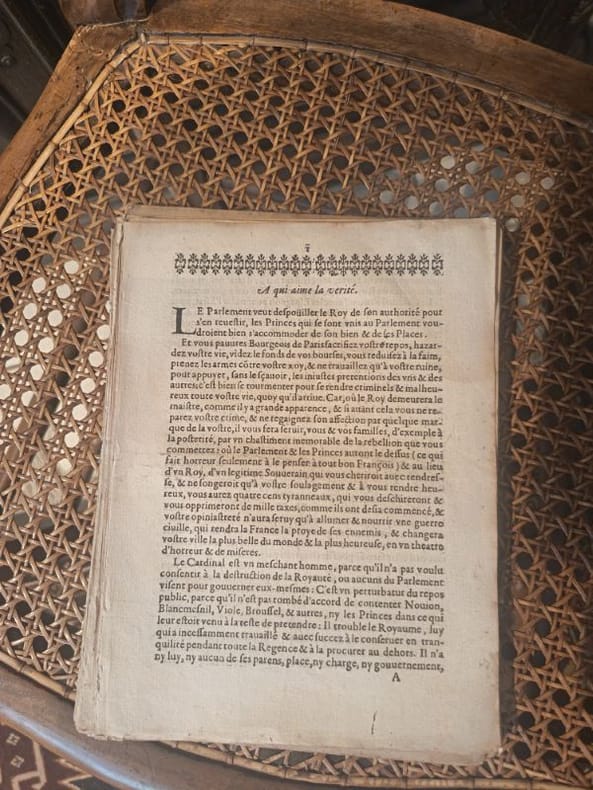
1649LCI-60291649-1651 Voici une opportunité rare de posséder non pas des livres, mais des pièces d'archives intactes. Ces dix Mazarinades d'exception sont les munitions médiatiques de la Fronde, l'écho papier de la seule guerre civile française du XVIIe siècle qui vit la presse pamphlétaire triompher du pouvoir absolu. Elles offrent une immersion physique dans l'effervescence de Paris assiégé (1649–1651).Le véritable trésor ici réside dans la qualité muséale de ces feuillets : Ces imprimés, fragiles par nature, sont parvenus jusqu'à nous dans un état "excellent". Le papier, souvent de mauvaise qualité à l'époque car imprimé à la hâte, est ici étonnamment frais et propre. C'est une rareté qui témoigne d'une conservation sans altération durant près de 375 ans.Feuillets Libres Authentiques : La présentation en pages volantes réunit dans une pochette simple n'est pas un défaut, mais une preuve d'authenticité. Elle rappelle la manière dont ces pamphlets étaient distribués à la criée dans les rues de Paris, échappant à la reliure pour une diffusion maximale.La sélection inclut des pièces maîtresses : le Testament solemnel (la satire la plus célèbre) et la Déclaration du Roy (l'acte officiel d'interdiction de Mazarin), assurant à ce lot une valeur documentaire et collectionneur de premier planCes imprimés sont l'ADN d'une révolution médiatique. Pour l'amateur d'histoire, d'imprimés anciens ou de journalisme politique, ce lot représente un investissement dans un pan unique de notre patrimoine écrit.
171086508Edinburgh: Various. Very Good; Compilation Bound Together of 12 Books/Pamphlets Etc From . Early 1700's About Religious Persecution in Eng. & Scotland. 1710-1717. Leather. PROFESSIONALLY REBOUND IN FINE LEATHER WITH RAISED BANDS GILT LETTERING AND NEW MARBLED BOARDS AND ENDPAPERS. GORGEOUS!! VERY VERY SCARCE!! The title continues: "More particularly her approving of and going into the legal establishment of the Prelatic constitutions of England. The generality of ministers swearing in the Oath of Abjuration to maintain Erastianism Prelacy and English Popish Ceremonies. Non-Jurants joining with Jurants judicially approving that practice to be free of scandal. The Church's establishing tyranny in government against all who will not join in communion with her and approve her practices without redress of grievances. Wherein these and several other causes of withdrawing are proven to be justly chargeable on the Church demonstrated to be contrary to the Word of God and Reformed principles of this Church and just grounds of withdrawing and setting up judicatures distinct from her; and the objections of Jurants and others fully answered."This is a classic detailed statement of the old covenanted principles and the biblical attainments of the second Reformation like the Solemn League and Covenantthe Westminster standards etc. It is also an excellent defense against the modern malignants who counsel Christ's children to remain in the backsliding and covenant breaking denominations that abound in our day. This constitutes 264 pages. The next largest ones bound in this book is: SHIELDS ALEXANDER. A true and faithful relation of the sufferings of the Reverend and learned Mr. Alexander Shields minister of the Gospel.; 772 pages . Various hardcover
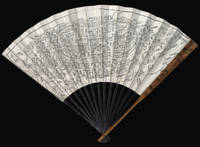
182214997Guangzhou c1822. 302 by 500mm. 12 by 19.75 inches. Woodcut on paper mounted on wooden sticks. A rare Chinese fan depicting the provincial city of Guangdong province which is now part of Guangzhou city. Guangzhoufu Guangzhou prefecture is depicted at the centre encircled by city wall. The names of streets bridges temples forts rivers and mountains are marked in Chinese and represented by two-dimensional diagrams. Several famous sites can be identified on the map for example immediately below the middle of the top rim is depicted a pagoda and marked in Chinese: Wucenglou Five-Storied Pagoda which now is known as Zhenhailou Sea-Guardian Building. It is located in Yuexiu Park in central Guangzhou and now houses the Guangzhou Museum. It was first built in 1380 at the beginning of the Ming dynasty by the Yongjia Marquis Zhu Liangzu . The tower is 92 feet 25 meters in height 102 feet 31 meters in width and 52 feet 16 meters in depth. Above the lower rim to the left is a house with two floors symbolising a temple marked as " ". Haitongsi is a Buddhist temple and monastery on Henan Island in Guangzhou. The official English form of the name is 'Hoi Tong Monastery' a transcription of the Cantonese pronunciation of the Chinese translation of the Indian Buddhist monk S garadhvaja. The monastery was first established as the Qianqiu Temple under the Southern Han a tenth century Tang successor state whose capital was at Xingwang now Guangzhou. The walled city lay north of the Pearl River while Henan Island and the monastery lay to its south. By the end of the Ming the temple operated within the private garden of Guo Longyue who was responsible for renaming it after the Buddhist monk S garadhvaja. The temple complex was particularly important to foreign visitors as it was one of the few locations in Guangzhou Canton open to them before the First Opium War. unknown
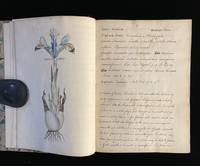
1822013470anonymously hand-printed and illustrated 1822. Hardcover. Near Fine. Replicas of the first 58 volumes of Curtis Botanical Magazine rendered in hand-colored floral illustrations and holographic text edited from and amended to the original text by an anonymous English artistic hobbyist and rebound likely early 20thC in 24 volumes. William Curtis' first volume was published in 1787; Curtis's volume 59 the last in this hobbyist's project is dated 1832 which coincides when the hobbyist concluded his or her work. The magazine continues still under the auspices of Kew Gardens. The hobbyist here started this ambitious undertaking in 1822 which is known from the notation "Commenced 1822" he or she leaves on the title page of the first volume. The ten-year project concluded sometime in 1832 which the last entry is dated. The monumental work results in replications of illustrations and text for 3024 species. The drawing and hand-coloring aspires to the original works of James Sowerby the first of Curtis's artists. The hobbyist here sometimes copies sometimes adapts Sowerby's style; the result though technically primitive in execution is consistently charming. The amateur's colors are not as vibrant as Sowerby's; supplies of high-quality natural pigments would have been limited to the amateurist. Bound-in after Curtis' Volume 42 is the actual published Part 1 of "General Indexes to the Plants contained in the First Forty-Two Volumed of the Botanical Magazine" printed by Stephen Couchman and published by Sherwood Neely & Jones 1816 40 pp and Part II 1817 pp 41 - 111. Most impressive is the hobbyist's holographed index to all Curtis's 53 volumes which runs approximately 200 double-sided pages. These 58 volumes were collected into 24 bound volumes presumably organized by the hobbyist thusly and were professionally rebound in polished black half leather - with five raised bandstitles and devices in gilt to the spine over green/salmon/ black marbleized boards with marbleized edges - by appearances sometime in the first quarter of the 20thC by an anonymous binder. The bindings are of highest quality. Laid-in to Volume 1 is the original bill of sale for the work from Henry A. Martin print dealer and publisher of Washington DC dated 11/24/1916. The original bindings were likely calf which with age would have called for some kind of rebinding here handsomely executed. anonymously hand-printed and illustrated hardcover
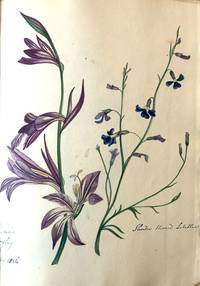
1812G7542<p><b>Original Watercolours of Plants Including American</b></p><p>Small folio; contemp. half calf with title on spine "drawings of plants". Small folio.On front pastedown: "M.H. Speirs 1820.</p><p>Beautiful album with 53 high-quality original watercolour drawings mostly with flower names in English or Latin and mainly dated from 1812 to April 1817. - 2 plates folded in the margins. Slightly foxed. Contemporary half leather spine rubbed.</p><p>Predominantly with flower names in English and Latin and Format ca. 14-24: 10-17 cm; on firm paper chamois format ca. 28 : 18 cm. Illustrations of lilies and aloe as well as <u>numerous American flowers </u>"Virginian Dragonhead" "American Atragen" "Virginian Platonica" and many more "Chinese Epidendrum". <b><br /></b></p>
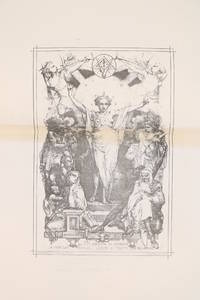
187090176Paris: Teissier et Cie 1870. Fine. ""Extremely rare and probably unique collection of 38 lithographed Masonic plates"" Teissier et Cie Paris s. d. 1870 32.5 x 49.5 cm Relié A probably unique copy comprising pulls of proofs of Masonic illustrations containing 38 plates the majority double-page numbered in red pencil from 1 to 40 discontinuous numbering with bis plates. Not recorded in Caillet or Dorbon. Bound in full black cloth smooth spine no lettering title label pasted onto the upper cover modern binding. A restored tear in the left margin of plate 10 two angular tears in the left margin of plate 12 without affecting the image. Published by the Masonic booksellers Teissier et Cie lithographed by J. Rigal et Cie and in some cases by A. Appert. A highly interesting document on nineteenth-century Freemasonry At the beginning of the volume several plates depicting allegories of Freemasonry are signed Rambert some dated 1862. Issued in folio format the usual issue being small quarto they were intended to illustrate Le Rameau d'or d'Eleusis a work by the Grand Master of the Rite of Memphis one of the Egyptian Masonic rites Jacques-Etienne Marconis de Nègre 1795-1868. The illustrator Charles-Désiré Rambert 1824-1877 is described by Alfred Fournier cited by Beraldi Les graveurs du XIXème siècle vol. XI pp. 167-169 as an ""Hercule à la physionomie singulièrement expressive et étrange : tête de mulâtre rappelant Alexandre Dumas . et des yeux absolument particuliers des yeux d'inspiré"" Other unsigned illustrations relate to models of Masonic diplomas: several plates concern the Grand Orient of Haiti others Rome or Venezuela. The mention ""à effacer"" has been added in pencil on certain lithographs. Bookseller publisher and dealer in Masonic regalia Charles-Adolphe Teissier 1801-1863 was an officer of the Grand Orient de France. After his death his widow and two sons continued the business under the name ""Teissier et Compagnie"" at 37 rue de Grenelle-Saint-Honoré which became 37 rue Jean-Jacques Rousseau in 1868. Both addresses are mentioned in the present collection which may be dated between 1860 and 1870. Teissier et Cie hardcover
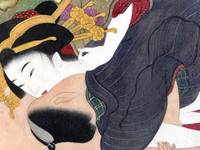
1920845121920. Fine. 1920 15 x 869 cm autre 12 paintings on silk on a transparent silk band of 840cm mounted on paper and bordered in gold. Each painting 70x14cm. It seems plausible to attribute the work to Miyagawa Shunteï. Wooden scroll on which is wound a long ribbon of 869 cm of paper. The paintings are held essentially by the margins and constitute a long silk band of 840cm. The scroll is nestled in a large green silk fabric. Some worming and stains but superb overall condition. Late production of shunga and ultimate flowering of this creative genre these paintings reveal a new pictorial manner never dared before. Of greater purity and greater preciosity these paintings also reflect in these years another way of apprehending sexuality in which woman is more equal lover. The narrow height and very extended width of the paintings allows extremely tight shots of the couples thus conferring greater immersion for the voyeur and more subtle representation of intimacy. The palette of colors used is very rich ranging from pink to black passing through different shades of green. The scroll participates in the mystery of the progressive unveiling of the paintings. Early 20th-century Shunga are rather rare because the censorship exercised by the authorities was very repressive at this time shunga being considered a stain on Japanese civilization. unknown
1880859371880. Fine. 1880 33.50 x 45.50 cm relié 12 large paintings on silk: 24 x 34.5 cm depicting couples embracing. These works seem very close to the style of Yamamoto Schoun. A folding collection covered with a patterned green silk fabric. The silk paintings are loosely inserted into movable paper frames. Label on the upper cover missing. Cloth is faded with a few perforations dampstains in the lower part of the upper cover and missing edges. First board is split at the head and foot of the joint. Although the colors are quite varied they all rest on and derive from a dominant pale green the color found on the boards. The palette mixes different shades of green with complementary colors in the clothing red blue-gray. Couples are always clothed with clothing playing a revealing role an integral part of Japanese eroticism. The decor shows a variety of everyday objects such as teapots and boxes. In each of the paintings elements frame and circumscribe the scene: screens sliding walls windows but beyond a perfectly balanced composition: the interiors participate in the unveiling in a staging intended for the gaze. hardcover
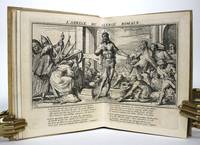
1695017087s.l.: s.n. 1695. 1st Edition. Hardcover. Near Fine/No Jacket. de Hooghe Romeyn; Dusart Cornelius. Small 4to 5.5" x 8". N.d. ca. 1695. S.l. likely printed in Amsterdam Dutch imprint reads "You will find them nowhere but they are sold everywhere in Holland by book and print sellers." Complete in two parts bound in one volume. Tweede Deel title page present lacking in many volumes. Parallel Dutch and French in Part 1 French quatrains and Dutch index in Part 2. Contemporary vellum over boards hand-lettered title to upper spine with spelling error. 4 19 1 104 pp. 25 numbered plates; 7 1 pp. 25 numbered plates. Features Romeyn de Hooghe's two-page frontispiece "L'Abrege du Clerge Romain" depicting Roman clergy torturing Jesus and collecting his blood which has turned to coins while his poor and infirm subjects look on. Contains a total of 50 mezzotint medallion caricature portraits attributed to Cornelius Dusart 1660-1704 by Landwehr. Binding tight but slightly tilted. A few stains to vellum. Light foxing else very clean and well-preserved. Comital bookplate with shelf number to front pastedown likely Belgian or German. Owner inscription of Hecht with their Latin inscription further pencil notations. Inscription of Cottet Oct 66. A rare desirable complete first edition of one of the most famous and remarkable examples of Dutch graphic caricature. The content is a scathing anti-Catholic and anti-monastic satire portraying monks and nuns as brutalized cruel malicious drunken lecherous avaricious and murderous. It was compiled and published by Huguenots during the diaspora and in reaction to the revocation of the Edict of Nantes by Louis XIV in 1685. With the mocking false privilege of Pope Innocent XI d. 1689. Brunet IV 1235; Cohen-de-Ricci 866; Landwehr Romeyn de Hooghe 70; Hollstein. Scarce. s.n. hardcover