ANONYMOUSBiblio.com
253 535 résultats
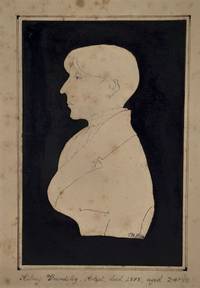
18983867<p>n.p. 1898 1898. Pen and ink portrait of Aubrey Beardsley signed "T.B.B. '98". Image measures 117x77mm on card 187x142mm inside a border beneath which is inscribed "Aubrey Beardsley. Artist died 1898 aged 24". The image is based on a self-portrait done by Beardsley in 1896 and shows him in profile in the form of a bust in white against a black background. Some foxing to the margins and lightly in a few places on the portrait but overall a very good portrait which in a few simple lines captures the ethereal delicacy of one of the strangest and most influential talents of fin de siècle Britain.</p> n.p. 1898
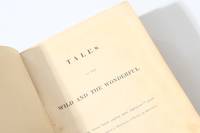
182511991London: Hurst Robinson & Co. London Hurst Robinson & Co. 1825. First edition first impression. Hardback. A good copy. A collection of five tales in the folklore / fairy tales vein. Comprising: "The Prediction""The Yellow Dwarf""Der Freischutz""The Fortunes of De La Pole""Lord of the Maelstrom". Quite uncommon. I hesitate to describe this as being in the original boards because in this case that's not really a bonus. A good chunk of the paper covering is either missing or scuffed there's a later leather spine too. Internally though it's excellent. Collector's plate to the front pastedown C.J. Peacock. Some dustiness to the block edges. Tanning to the title page and a little fingering. No half0title. 11991 Hyraxia Books. . Good. Hardback. 1st Edition. 1825. Hurst, Robinson, & Co. hardcover
200991254BiblioLife. New. 2009. Hardcover. 1117092003 . FREE UPGRADE to Courier/Priority Shipping Upon Request - IN STOCK AND IMMEDIATELY AVAILABLE FOR SHIPMENT - Flawless copy brand new pristine never opened -- 324 pages. Description: "This is a pre-1923 historical reproduction that was curated for quality. Quality assurance was conducted on each of these books in an attempt to remove books with imperfections introduced by the digitization process. Though we have made best efforts - the books may have occasional errors that do not impede the reading experience. We believe this work is culturally important and have elected to bring the book back into print as part of our continuing commitment to the preservation of printed works worldwide." Antiquitiés Découvertes Catalogue Raisonne Catalog Raisonné Complete Works La Vie Et L'uvre Oeuvre Raisonnee BiblioLife hardcover
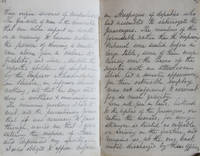
30637<p>12mo 68 manuscript pages plus blanks and 8 pages of notes bound in contemporary embossed leather backed flexible stiff wraps entries written in English in pencil in a clear and legible hand.</p><p> The journal is an excellent highly literate well written account of the author's impressions of Russian society and his keen observations on all aspects of life in Russia which the author refers to as "<i>the Empire of Fear</i>." The diarist who describes himself as a Russian prince is anonymous although he identifies his companions. He takes a business trip to the part of Russia which is now in present day Poland. The purpose of his trip was to draw up a statement of account for the manufactory of Messrs Palin & Dunlop in Nowogrodek. Afterwards he visits the different silk and cotton manufactories in the town and also the place where Russe serge cloth is manufactured. The book only mentions business in passing. Mostly the author is concerned with describing the people and the regime of the country. </p><p> <b>Sample Quotations:</b></p><p> "Wednesday April 24 1872 </p><p> Left Windermere at 8.15 a.m. for Preston meeting at the latter place Thomas Hatch Margaret Hatch; James Ainscough; and Robert Sale proceeded from thence to Hull via Leeds arriving at 4.40 p.m. Went to Foreign Consulate for colltn of Passports; thence Granville Temperance Hotel. Left the Humber Dock Wall by steamship <u>Cyclone</u> at 10.50 same evening for Hamburg…"</p><p> After a rough passage our author and his party arrived in Hamburg after passing through customs they left Hamburg by rail at 11:30 a.m. for Perleburg making several stops along the way they arrived in Berlin shortly before 9 p.m. and stayed overnight at the Café Imperial. They departed Berlin by rail the next morning and arrived at the border of Poland that afternoon:</p><p> "… on the boundary line of Poland where we first encountered the numerous annoyances travelers of all descriptions are subjected to and to which even Russian Princes like myself were obliged to submit during our transit through the Custom House but on arriving at <u>Warsaw</u> I had the mortification of seeing them released in three minutes whilst I had to struggle with every species of trickery for the space of three hours. At four o'clock we succeeded in penetrating that land which is blessed with all the amenities attached to Russian Government which was announced by the Russian Eagle floating over the miserable apology for a building yclept the <u>Groche</u> Custom House Groche being <u>a</u> town of some dozen or so of dilapidated wooden erections which serve not only as shelters but also as dwellings and of which the Customs House is chief Winding by the banks of the river Vistula … the line threaded by the river bank to Nieszawa which seemed to be a busy place for the shipment of sundry descriptions of goods and merchandize; some loading for others unloading from the Baltic; we next came to Bobrownik another port of the same river & from whence two canals diverge; after this we reached Biskepia; where we stayed upwards of 20 minutes and then proceeded to Wyrzogrod at which place we left the Vistula on the right & proceeded by way of Biaski & Takrodzin and reaching Warsaw at 9.20 p.m. at which place a multitude of little superfluous precautions engender a population of deputies and sub-officials each of whom acquits himself with an air of importance and a rigorous precision which seems to say though everything is done with much silence "Make way I am one of the members of the grand machine of state."</p><p> Such members acting under an influence which is not in themselves in a manner resembling the wheel-work of a clock are called men in Russia! I say Russia though I am in reality speaking of Poland which is virtually and tyrannically a part and portion of the Great Empire. The sight of these voluntary automata inspires me with a kind of fear: there is something supernatural in an individual reduced to the state of a mere machine. If in lands where the mechanical arts flourish wood and metal seem endowed with human powers under despotisms human beings seem to become as instruments of wood. We ask ourselves what can become of their superfluity of thought And we feel ill at ease at the idea of the influence that must have been exerted on intelligent creatures before they could have been reduced to mere <u>things</u>. In Russia I pity the human beings as in England I feared the machines: in our own country England the creations of man lack nothing but the gift of speech; in Russian Poland the gift of speech is a thing superfluous to the creatures of the state.</p><p> These machines clogged with the inconvenience of a soul are however marvelously polite it is easy to see they have been trained to civility as to the management of arms from their cradle. But of what value are the forms of urbanity when their origin savours of compulsion The free will of man is the consecration that can alone impart a worth or a meaning to human actions; the power of choosing a master can alone give a value to fidelity; and since despite the reported abolition of serfdom by the Emperor Alexander in Russia an inferior chooses nothing all that he says and does is worthless & unmeaning – The numerous questions I had to meet and the precautionary forms that it was necessary to pass through warned me that I was entering the empire of Fear and depressed my spirits. – I was obliged to appear before an Areopagus of deputies who had assembled to interrogate the passengers. The members of this formidable rather than the imposing tribunal were seated before a large table; some of them were turning over the leaves of the register with an attention which had a sinister appearance for their ostensible employ was not sufficient to account for so much gravity. </p><p> Some with pen in hand listened to the replies of the passengers or rather the accused for every stranger is treated as culpable on arriving on the frontier and remains so at the very least until discharged by these officious notables; during the scrutiny six or a dozen ragged men half covered with sheepskins the wool turned within and the filthy skin appearing without will appear from time to time at the entrance to satisfy their curiosity by a prolonged and vulgar stare at the luckless beings undergoing the ordeal of officious examination. These arrivals and departures though they did not accelerate our matters at least gave me leisure to reflect on the species of filthiness peculiar to the people of the north who for the most part are shut up within doors and have a greasy dirtiness which appears to me far more offensive than the neglect of a people destined to live beneath the open heaven & born to bask in the sun.</p><p> The tedium to which these Russian formalities condemned us gave me also an opportunity of remarking that the great lords of the country were little inclined to bear patiently the inconveniences of public regulations when those regulations proved inconvenient to themselves.</p><p> "Russia is the land of useless formalities" they murmured to each other – but in French that they might not be overheard by the subaltern <u>employ</u><u>ès</u>. I have retained the remark with the justice of which my own experience has only too deeply impressed me. As far as I have been hitherto able to observe a work that should be entitled <u>The Russians judged by Themselves</u> would be severe. The love of their country is with them only a mode of flattering its master; as soon as they think that master can no longer hear they speak of everything with a frankness which is the more startling because those who listen to it become responsible.</p><p> It was a perfect relief to the tortured mind to find the sic such things as gags were not in use as it allowed me to expound a number of invectives which might have brought me into no end of trouble had my hearers been even possessed of an inadequate knowledge of the English language. </p><p> The cause of all our delay was at length revealed. The chief of chiefs the director of the directors of the custom-house again presented himself: it was this visit we had been waiting so long without knowing it. At first it appeared as if the only business of the great functionary was to play the part of the man of fashion among the few ladies who had been subjected to the same indignities as those of the sterner sex. He reminded one of their rencontre in a house where the lady had never been; he spoke to her of balls she had never seen: but while continuing to dispense these courtly airs our drawing room officer of the customs would now and then gracefully confiscate a parasol stop a portmanteau or recommence with an impartable <u>sang froid</u> the researches already conscientiously made by his subordinates. </p><p> In Russian administration minuteness does not exclude disorder. Much trouble is taken to obtain unimportant ends and those employed believe they can never do enough to show their zeal. The result of this emulation among clerks and commissioners is that the having passed through one formality does not secure the stranger from another. It is like a pillage in which the unfortunate might after escaping from the first troop may yet fall into the hands of a second & a third.</p><p> The chief turnkey of the empire having at length concluded his scrutiny graciously permitted us to depart at about half past twelve and time being an object I thought it desireable not to chance the accommodation offered for the night in a city where I had already been subjected to a sufficiency of inconveniences & in opposition to the desires of those under my charge I determined to proceed at the earliest chance which occurred and accordingly on the morning of the 28th Sunday we moved from the neighbourhood of the city of Warsaw at a little past four o'clock and at half past seven reached a large and apparently prosperous town called Praga…"</p><p> Our writer and his party stopped in Praga for about 40 minutes where excellent coffee but detestable food were procured. They resumed their journey and passed Misorent and Kamienezyk a small town on the river Narew. They then reached "a long straggling town" with the"somewhat short name of Nur" on the River Bang. Then the large village of Wysokie and afterwards the town of Surasz an extensive manufacturing place twelves miles further they reached Boralystok and at length arrived at Gradnau where the party stopped for the night at the Hotel de Coulon:</p><p> "… and found it to be under the management of a degenerate French innkeeper. The house was nearly full at that time owing to the marriage of a Duchess which was about to take place; indeed the landlord appeared almost annoyed at being obliged to receive other guests … gave himself little trouble to accommodate us… Having seen their immediate wants attended to I joined the company at the <u>Table d'hote</u> which consisted of a mixture of Russians Poles French Spaniards and a couple of Englishmen and curiously enough not a single lady was present – Amongst those natives of High blood were a Prince & two young Counts. The first named is of an illustrious family and may be taken as a fair specimen of the general swelldom of the country. He is as I was informed the only son of a very rich individual and a character worthy of observation. The tavern is his empire: it is there that he reigns eighteen hours out of the twenty-four; on that ignoble theatre he displays naturally & involuntarily noble & elegant manners; his countenance is intellectual and extremely fascinating; his disposition is at once amiable and mischievous; many traits of rare liberality & even touching sensibility are recounted of him. He is remarkably well informed; his mind is quick and endowed with great capacity; his wit is unequalled but his language and conduct are such as would not be tolerated elsewhere except in the most depraved society. Profligacy has impressed upon his contours the traces of a premature decay; still these ravages of folly not of time have been unable to change the almost infantile expression of his noble and regular features … In no other land could a man be found like the young Prince Leuchtenberg but there are more than one such here.</p><p> He is surrounded by a group of young men his disciples and competitors who without equaling him in disposition or in mind all share with him a kind of family resemblance it may be seen at the first glance that they are and only can be Russians. It is for this reason that I am about to give some details connected with their manner of life … But I know not or rather fear how to begin; for it will be necessary to reveal the connection of these libertines not with women of the town but with the youthful sisters of religious orders – with nuns whose cloisters as it will be seen are not very securely guarded. It may be asked why lift a corner of the veil that shrouds scenes of disorder which ought to remain carefully covered Perhaps my passion for the truth obscures my judgment but it seems to me that evil triumphs so long as it remains secret whilst to publish it is to aid in destroying it and since these incidents may at some future time be submitted to the scrutiny of the public this one particularly is noted here as a memorandum; besides I have resolved to draw a picture of this country as I see it – not a composition but an exact and complete copy from nature. … As for the man whom I select for a specimen of the most unbridled among libertines he carries his contempt of opinion to the extent of desiring me to describe him as I see him. A story of the death of a young man killed in the convent of - by the nuns themselves he told at the full table d'hôte before several grave and elderly personages employès and placemen who listened with an extraordinary patience to this and several other tales of a similar kind all very contrary to good manners. The story in question … relates to a young man who after having passed an entire month concealed within the convent of - began at last to weary of his course of happiness to a degree that wearied the holy sisters also… whereupon the nuns wishing to be rid of him but fearing the scandal that might ensue should the sic send him to die in the world concluded that it would be better to make an end of him themselves. No sooner said than done – The mangled remains of the wretched being were found a few days after at the bottom of a well. The affair was hushed up. …As I have imposed upon myself the duty of communicating the ideas that I have hurriedly formed of this land I feel called upon to add to the picture already sketched a few minor specimens of the conversation of the parties already referred to.</p><p> One boasted of himself & his brothers being the sons of the footmen and the coachmen of their reputed father; & he drank and made the rest drink to the health of all his unknown parents. Another claimed the honour of being brother on the father's side of all the waiting maids of his mother.</p><p> Many of these evil boasts are no doubt made for the sake of talking: but to invent such infamies in order to glory in them shows a corruption of mind that proves wickedness to the very core – wickedness worse even than that exhibited in the mad actions of these libertines. According to them the wives of the middle classes are no better than the women of rank.</p><p> During the months that their husbands go to the fair of Nijni the officers of the neighboring garrisons take care not to leave the vicinity of the deserted wives. This is the season of easy assignations. The ladies are generally accompanied to the place of rendezvous by some <u>respectable</u> relation to whose care their absent husbands have confided them. The goodwill and silence of these family duennas have also to be paid for. Gallantry of this kind cannot be excused as a love affair there is no love without bashful modesty – such is the sentence pronounced from all eternity against women – who cheat themselves of happiness and who degrade instead of purifying themselves by tenderness. The defenders of the Russians pretend that the women have no lovers; I agree with them other term must be employed to designate the <u>friends</u> whose intimacy they seek in the absence of their husbands. … </p><p> Scarcely was I installed in my abode for the night than overcome by fatigue I lay down wrapped in a rug on an immense leather sofa & slept profoundly during – 3 minutes. At the end of that time I awoke in a fever and in casting my eyes upon the rug what a sight assailed them! – a brown but living mass: things must be called by their proper names – I was covered I was devoured with bugs in a place too where I was obliged to remain imprisoned with the enemy and the war was consequently more sanguine. … A Russian waiter appeared. I made him understand that I wished to see his master. The master kept me waiting a long time and when he at length did come & was informed of the nature of my trouble he began to laugh & soon left the room telling me that I should soon become accustomed to it for that it was the same everywhere in Russia. … The town generally is not of a prepossessing appearance; a few yards only to the rear of the inn I came to a guard house full of Cossacks whose stiff bearing and severe gloomy air would impart to foreigners the idea of a country where no one dares to laugh even innocently. In the neighbourhood of the canal wharves all was busy with life whilst a few drowskas were already slowly traversing the streets the drivers dressed in the costume of the country The singular appearance of these men their horses and carriages struck me more than anything else on this my first view of a Russian town or city. The ordinary costume and general appearance of the lower classes by which I mean the workmen coachmen small trades people is as follows – On the head is worn either a cap formed somewhat in the shape of a melon or a narrow brimmed hat low crowned & wider at the top than the bottom. This headdress slightly resembled a woman's turban. It becomes the younger men. Both young & old wear beards. Those of the beaux are silken and carefully combed; those of the old and careless appear dirty and matted. Their eyes have a peculiar expression strongly resembling the deceitful glance of the Asiatic. … The movements of the men whom I met were stiff and constrained; every gesture seemed to express a will which was not their own. The morning is the time for commissions and errands and not one individual appeared to be walking on his own account. I observed very few good-looking women and heard no girlish voices; everything was dull and regular as a barrack. There are scarcely any buildings worthy of note in this busy mart except the Kremlin a building which is indigenous to every Russian town of importance. … Shortly after 9 0'clock we took our departure from <u>Gradnow</u> through a dead flat & muddy district stopping only at 3 insignificant towns or large villages viz: <u>Goja</u> <u>Perschevelka</u> & <u>Onlekha</u>; and about a couple of miles from the last named we reached <u>Novogrodek</u> a large manufacturing town and here terminated our journeying by rail though we were still 21 miles distant from our destination <u>Novogrodka</u> and in order to accomplish this distance I succeeded after some difficulty in securing a team of horses & a rude description of dray minus springs with driver for the sum of half Impl or about 16/1 English in this rude machine we were conveyed at the risk of our necks owing to the badness & unevenness of the road in a trifle under two hours; and shortly after 4 o'clock I presented myself Mssrs Palin and Dunlop's manufactory along with T. Hatch…Mr. Hebden the manager was greatly surprised to see us as he had not been apprised of our coming: though a letter had been forwarded from Manchester a fortnight previously to inform him of our coming but owing to the irregularity of the Russian postal arrangements it had not been delivered although it arrived safely on the following morning."</p><p> "Tuesday April 30th 17th Russian I arose early finding Novorogodka in every way an exact repetition of my first nights experiences in the great Muscovite nation. I have often in my travels had reason to remember the sagacious observations of Pestalozzi the great practical philosopher the preceptor of the classes before Fourier & the St. Simonians. According to his observations on the life of the lower orders of two men who have the same habits of life one will be dirty the other clean. … Among the Russians there reigns a high degree of sordid negligence it seems to me they must have trained their vermin to survive the bath. Notwithstanding my ill humour I went carefully over the interior of the patriotic convent of the Trinity… This is one of the principal convents in the empire and at this season of the year is much sought by pilgrims even from the most remote parts of the country. All the names of note in Russian history have taken pleasure in enriching the convent which overflows with gold pearls and diamonds. … Czars Empresses nobles libertines and true saints have vied with one another in enriching the treasury of Novogrodka. Amid so many riches the simple dress and the wooden cup of St. Sergius shine by their very rusticity. … The convent would have furnished a rich booty to an enemy; it has not been taken since the fourteenth century. It contains nine churches. The shrine is of silver gilt; it is protected by silver pillars and canopy the gift of the Empress Anne. The image of St. Sergius is esteemed miraculous. Peter the Great carried it with him in his wars against Charles XII. </p><p> Not far from the shrine under shelter of the virtues of the hermit lies the body of the usurping assassin Boris Godounoff surrounded by many of his family. The convent contains various other famous but shapeless tombs… The number of monks is now only one hundred… Notwithstanding my persevering request they would not show me the library. "It is forbidden" was always the answer. This modesty of the monks who conceal the treasures of science while they parade those of vanity strikes me as singular. I argue from it that there is more dust on their books than on their jewels. …"</p><p> "… The town of Novogrodka is an important entrepot for the interior commerce of Russia. By it Petersburg communicates with Persia the Caspian & all Asia. The Volga that great national & moving road flows by the town which is the central point of the interior navigation of the country – a navigation wisely directed much boasted of by the subjects of the Czar and one of the principal sources of their prosperity. It is with the Volga that the immense ramifications of canals are connected that create the wealth of Russia.</p><p> The town of Novogrodka is like all other provincial towns in the empire vast in extent and appears empty. The streets are immensely broad the squares very spacious and the houses in general stand far apart. The same style of architecture reigns throughout. The painted and gilded towers which are numerous shine at a distance and gives the idea of a place resplendent with wealth and the town altogether presents a picturesque appearance…. Notwithstanding it's commercial importance the town is empty dull and silent. From the height of the terrace is to be seen the yet more empty dull & silent surrounding country with the immense river its hue a somber iron-grey its banks falling straight upon the water and forming at their top a level with the leaden-tinted plain here and there dotted with forests of birch & pine. The soil is however as well cultivated as it is capable of becoming; it is boasted of by the Russians as being with the exception of the Crimea the richest & most smiling tract in this empire. The primitive droshky is to be seen in this town. It consists of a little board on four wheels entirely concealed under the occupant and looks as though the horse were fastened to his person… The females generally go barefoot. The men most frequently wear a species of sandal made of rushes rudely platted which resembles those of antiquity. The leg is clothed in a wide pantaloons the folds of which drawn together at the ankle by a little fillet are covered with the shoe. This attire is precisely similar to the Scythian statues of the Roman sculptors. </p><p> Upon a long float of timber I observed several men descending the course of their native Volga they managed to guide the raft skillfully the while singing a Russian melody in the vague plaintive strain peculiar to the country. On reaching near to where I stood they wished to land which they eventually did and passed close before me without taking any notice of my foreign appearance; without even speaking to each other. The Russian peasants are taciturn and devoid of curiosity; I can understand why: what they know disgusts them with all of which they are ignorant.</p><p> To a certain point the want of a charitable disposition in the Russians towards strangers appears to me excusable. Before knowing us they lavish their attentions upon us with apparent eagerness because they are hospitable but they are also easily wearied. In welcoming us with a forwardness which has more ostentation than cordiality they scrutinize our slightest words they submit our most insignificant actions to a critical examination; and as such work necessarily furnishes them with much subject for blame they triumph internally saying "These then are the people who think themselves superior to us!" …"</p><p> "… One of the peculiar laws relating to strangers in this country is that on entering the empire in addition to answering the multitudinous and frivolous questions put as to your object &c it is also necessary to mention if the visit or stay on Russian soil is to extend over five days for if so it will be found necessary for the foreigner to advertise not less than twice at intervals of three days his intention of departure in the local newspapers stating the precise time of leaving &c. Also to make an affidavit to the Governor of the province that all debts are duly discharged a note to that effect is given by the Governor for the moderate sum of half a rouble 1/6 ¾ in exchange for his autograph this is then countersigned by the sub-governor who also expects a <u>tip</u>for his condescension. No one can leave Russia under any pretence until he has forwarded all his creditors of his intention in the manner above quoted. This is strictly enforced unless at least you pay the police to shorten the prescribed time and even then the insertion <u>must</u> be made once if not twice. No one can obtain post horses or a railway ticket without a document from the authorities certifying he owes nothing. … The Russian police so alert to torment people is slow to help or enlighten them when they have recourse to its aid in doubtful situations…" </p><p> "… It will by this be seen how the subaltern agents of the Russian police perform their duties. These faithless servants gained a double advantage by selling the body of the murdered woman; they obtained a few rubles & they also concealed the murder which would have brought upon them sever blame if the noise of the event had got abroad. …"</p><p> "… I safely reached <u>Warsaw</u> shortly before 9 at night and entered a Russian or I might perhaps more properly call it a Polish coffee house adjacent to the Railway. … Here I determined to take up my quarters for the night. The waiters were dressed in white shirts girded round the middle and falling like a tunic over loose white pantaloons. The teas served was excellent so is the coffee & liqueurs at this establishment but it is served with a silent solemnity very different from the gaiety which suffuses houses of entertainment in our own country. … About ten o'clock I sallied forth into the city without guide or companion strolling at hazard from street to street. I first traversed several long and wide streets laid out with great regularity. It was only at this time that the sun sank and the moon rose. The turrets of the convents the spires of the chapels the towers the battlements and all the irregular and frowning masses of buildings were swathed with wreaths of light … my eyes were filled with the dust of the streets kept in continual motion by the number of vehicles moving about at a gallop in all directions. It was not until 12 o'clock that I repaired to my lodgings where I slept soundly happily without the aid of the multitudinous bugs which I had experienced previously in Russia." </p>
30637<p>12mo 68 manuscript pages plus blanks and 8 pages of notes bound in contemporary embossed leather backed flexible stiff wraps entries written in English in pencil in a clear and legible hand.</p><p> The journal is an excellent highly literate well written account of the author's impressions of Russian society and his keen observations on all aspects of life in Russia which the author refers to as "<i>the Empire of Fear</i>." The diarist who describes himself as a Russian prince is anonymous although he identifies his companions. He takes a business trip to the part of Russia which is now in present day Poland. The purpose of his trip was to draw up a statement of account for the manufactory of Messrs Palin & Dunlop in Nowogrodek. Afterwards he visits the different silk and cotton manufactories in the town and also the place where Russe serge cloth is manufactured. The book only mentions business in passing. Mostly the author is concerned with describing the people and the regime of the country. </p><p> <b>Sample Quotations:</b></p><p> "Wednesday April 24 1872 </p><p> Left Windermere at 8.15 a.m. for Preston meeting at the latter place Thomas Hatch Margaret Hatch; James Ainscough; and Robert Sale proceeded from thence to Hull via Leeds arriving at 4.40 p.m. Went to Foreign Consulate for colltn of Passports; thence Granville Temperance Hotel. Left the Humber Dock Wall by steamship <u>Cyclone</u> at 10.50 same evening for Hamburg…"</p><p> After a rough passage our author and his party arrived in Hamburg after passing through customs they left Hamburg by rail at 11:30 a.m. for Perleburg making several stops along the way they arrived in Berlin shortly before 9 p.m. and stayed overnight at the Café Imperial. They departed Berlin by rail the next morning and arrived at the border of Poland that afternoon:</p><p> "… on the boundary line of Poland where we first encountered the numerous annoyances travelers of all descriptions are subjected to and to which even Russian Princes like myself were obliged to submit during our transit through the Custom House but on arriving at <u>Warsaw</u> I had the mortification of seeing them released in three minutes whilst I had to struggle with every species of trickery for the space of three hours. At four o'clock we succeeded in penetrating that land which is blessed with all the amenities attached to Russian Government which was announced by the Russian Eagle floating over the miserable apology for a building yclept the <u>Groche</u> Custom House Groche being <u>a</u> town of some dozen or so of dilapidated wooden erections which serve not only as shelters but also as dwellings and of which the Customs House is chief Winding by the banks of the river Vistula … the line threaded by the river bank to Nieszawa which seemed to be a busy place for the shipment of sundry descriptions of goods and merchandize; some loading for others unloading from the Baltic; we next came to Bobrownik another port of the same river & from whence two canals diverge; after this we reached Biskepia; where we stayed upwards of 20 minutes and then proceeded to Wyrzogrod at which place we left the Vistula on the right & proceeded by way of Biaski & Takrodzin and reaching Warsaw at 9.20 p.m. at which place a multitude of little superfluous precautions engender a population of deputies and sub-officials each of whom acquits himself with an air of importance and a rigorous precision which seems to say though everything is done with much silence "Make way I am one of the members of the grand machine of state."</p><p> Such members acting under an influence which is not in themselves in a manner resembling the wheel-work of a clock are called men in Russia! I say Russia though I am in reality speaking of Poland which is virtually and tyrannically a part and portion of the Great Empire. The sight of these voluntary automata inspires me with a kind of fear: there is something supernatural in an individual reduced to the state of a mere machine. If in lands where the mechanical arts flourish wood and metal seem endowed with human powers under despotisms human beings seem to become as instruments of wood. We ask ourselves what can become of their superfluity of thought And we feel ill at ease at the idea of the influence that must have been exerted on intelligent creatures before they could have been reduced to mere <u>things</u>. In Russia I pity the human beings as in England I feared the machines: in our own country England the creations of man lack nothing but the gift of speech; in Russian Poland the gift of speech is a thing superfluous to the creatures of the state.</p><p> These machines clogged with the inconvenience of a soul are however marvelously polite it is easy to see they have been trained to civility as to the management of arms from their cradle. But of what value are the forms of urbanity when their origin savours of compulsion The free will of man is the consecration that can alone impart a worth or a meaning to human actions; the power of choosing a master can alone give a value to fidelity; and since despite the reported abolition of serfdom by the Emperor Alexander in Russia an inferior chooses nothing all that he says and does is worthless & unmeaning – The numerous questions I had to meet and the precautionary forms that it was necessary to pass through warned me that I was entering the empire of Fear and depressed my spirits. – I was obliged to appear before an Areopagus of deputies who had assembled to interrogate the passengers. The members of this formidable rather than the imposing tribunal were seated before a large table; some of them were turning over the leaves of the register with an attention which had a sinister appearance for their ostensible employ was not sufficient to account for so much gravity. </p><p> Some with pen in hand listened to the replies of the passengers or rather the accused for every stranger is treated as culpable on arriving on the frontier and remains so at the very least until discharged by these officious notables; during the scrutiny six or a dozen ragged men half covered with sheepskins the wool turned within and the filthy skin appearing without will appear from time to time at the entrance to satisfy their curiosity by a prolonged and vulgar stare at the luckless beings undergoing the ordeal of officious examination. These arrivals and departures though they did not accelerate our matters at least gave me leisure to reflect on the species of filthiness peculiar to the people of the north who for the most part are shut up within doors and have a greasy dirtiness which appears to me far more offensive than the neglect of a people destined to live beneath the open heaven & born to bask in the sun.</p><p> The tedium to which these Russian formalities condemned us gave me also an opportunity of remarking that the great lords of the country were little inclined to bear patiently the inconveniences of public regulations when those regulations proved inconvenient to themselves.</p><p> "Russia is the land of useless formalities" they murmured to each other – but in French that they might not be overheard by the subaltern <u>employ</u><u>ès</u>. I have retained the remark with the justice of which my own experience has only too deeply impressed me. As far as I have been hitherto able to observe a work that should be entitled <u>The Russians judged by Themselves</u> would be severe. The love of their country is with them only a mode of flattering its master; as soon as they think that master can no longer hear they speak of everything with a frankness which is the more startling because those who listen to it become responsible.</p><p> It was a perfect relief to the tortured mind to find the sic such things as gags were not in use as it allowed me to expound a number of invectives which might have brought me into no end of trouble had my hearers been even possessed of an inadequate knowledge of the English language. </p><p> The cause of all our delay was at length revealed. The chief of chiefs the director of the directors of the custom-house again presented himself: it was this visit we had been waiting so long without knowing it. At first it appeared as if the only business of the great functionary was to play the part of the man of fashion among the few ladies who had been subjected to the same indignities as those of the sterner sex. He reminded one of their rencontre in a house where the lady had never been; he spoke to her of balls she had never seen: but while continuing to dispense these courtly airs our drawing room officer of the customs would now and then gracefully confiscate a parasol stop a portmanteau or recommence with an impartable <u>sang froid</u> the researches already conscientiously made by his subordinates. </p><p> In Russian administration minuteness does not exclude disorder. Much trouble is taken to obtain unimportant ends and those employed believe they can never do enough to show their zeal. The result of this emulation among clerks and commissioners is that the having passed through one formality does not secure the stranger from another. It is like a pillage in which the unfortunate might after escaping from the first troop may yet fall into the hands of a second & a third.</p><p> The chief turnkey of the empire having at length concluded his scrutiny graciously permitted us to depart at about half past twelve and time being an object I thought it desireable not to chance the accommodation offered for the night in a city where I had already been subjected to a sufficiency of inconveniences & in opposition to the desires of those under my charge I determined to proceed at the earliest chance which occurred and accordingly on the morning of the 28th Sunday we moved from the neighbourhood of the city of Warsaw at a little past four o'clock and at half past seven reached a large and apparently prosperous town called Praga…"</p><p> Our writer and his party stopped in Praga for about 40 minutes where excellent coffee but detestable food were procured. They resumed their journey and passed Misorent and Kamienezyk a small town on the river Narew. They then reached "a long straggling town" with the"somewhat short name of Nur" on the River Bang. Then the large village of Wysokie and afterwards the town of Surasz an extensive manufacturing place twelves miles further they reached Boralystok and at length arrived at Gradnau where the party stopped for the night at the Hotel de Coulon:</p><p> "… and found it to be under the management of a degenerate French innkeeper. The house was nearly full at that time owing to the marriage of a Duchess which was about to take place; indeed the landlord appeared almost annoyed at being obliged to receive other guests … gave himself little trouble to accommodate us… Having seen their immediate wants attended to I joined the company at the <u>Table d'hote</u> which consisted of a mixture of Russians Poles French Spaniards and a couple of Englishmen and curiously enough not a single lady was present – Amongst those natives of High blood were a Prince & two young Counts. The first named is of an illustrious family and may be taken as a fair specimen of the general swelldom of the country. He is as I was informed the only son of a very rich individual and a character worthy of observation. The tavern is his empire: it is there that he reigns eighteen hours out of the twenty-four; on that ignoble theatre he displays naturally & involuntarily noble & elegant manners; his countenance is intellectual and extremely fascinating; his disposition is at once amiable and mischievous; many traits of rare liberality & even touching sensibility are recounted of him. He is remarkably well informed; his mind is quick and endowed with great capacity; his wit is unequalled but his language and conduct are such as would not be tolerated elsewhere except in the most depraved society. Profligacy has impressed upon his contours the traces of a premature decay; still these ravages of folly not of time have been unable to change the almost infantile expression of his noble and regular features … In no other land could a man be found like the young Prince Leuchtenberg but there are more than one such here.</p><p> He is surrounded by a group of young men his disciples and competitors who without equaling him in disposition or in mind all share with him a kind of family resemblance it may be seen at the first glance that they are and only can be Russians. It is for this reason that I am about to give some details connected with their manner of life … But I know not or rather fear how to begin; for it will be necessary to reveal the connection of these libertines not with women of the town but with the youthful sisters of religious orders – with nuns whose cloisters as it will be seen are not very securely guarded. It may be asked why lift a corner of the veil that shrouds scenes of disorder which ought to remain carefully covered Perhaps my passion for the truth obscures my judgment but it seems to me that evil triumphs so long as it remains secret whilst to publish it is to aid in destroying it and since these incidents may at some future time be submitted to the scrutiny of the public this one particularly is noted here as a memorandum; besides I have resolved to draw a picture of this country as I see it – not a composition but an exact and complete copy from nature. … As for the man whom I select for a specimen of the most unbridled among libertines he carries his contempt of opinion to the extent of desiring me to describe him as I see him. A story of the death of a young man killed in the convent of - by the nuns themselves he told at the full table d'hôte before several grave and elderly personages employès and placemen who listened with an extraordinary patience to this and several other tales of a similar kind all very contrary to good manners. The story in question … relates to a young man who after having passed an entire month concealed within the convent of - began at last to weary of his course of happiness to a degree that wearied the holy sisters also… whereupon the nuns wishing to be rid of him but fearing the scandal that might ensue should the sic send him to die in the world concluded that it would be better to make an end of him themselves. No sooner said than done – The mangled remains of the wretched being were found a few days after at the bottom of a well. The affair was hushed up. …As I have imposed upon myself the duty of communicating the ideas that I have hurriedly formed of this land I feel called upon to add to the picture already sketched a few minor specimens of the conversation of the parties already referred to.</p><p> One boasted of himself & his brothers being the sons of the footmen and the coachmen of their reputed father; & he drank and made the rest drink to the health of all his unknown parents. Another claimed the honour of being brother on the father's side of all the waiting maids of his mother.</p><p> Many of these evil boasts are no doubt made for the sake of talking: but to invent such infamies in order to glory in them shows a corruption of mind that proves wickedness to the very core – wickedness worse even than that exhibited in the mad actions of these libertines. According to them the wives of the middle classes are no better than the women of rank.</p><p> During the months that their husbands go to the fair of Nijni the officers of the neighboring garrisons take care not to leave the vicinity of the deserted wives. This is the season of easy assignations. The ladies are generally accompanied to the place of rendezvous by some <u>respectable</u> relation to whose care their absent husbands have confided them. The goodwill and silence of these family duennas have also to be paid for. Gallantry of this kind cannot be excused as a love affair there is no love without bashful modesty – such is the sentence pronounced from all eternity against women – who cheat themselves of happiness and who degrade instead of purifying themselves by tenderness. The defenders of the Russians pretend that the women have no lovers; I agree with them other term must be employed to designate the <u>friends</u> whose intimacy they seek in the absence of their husbands. … </p><p> Scarcely was I installed in my abode for the night than overcome by fatigue I lay down wrapped in a rug on an immense leather sofa & slept profoundly during – 3 minutes. At the end of that time I awoke in a fever and in casting my eyes upon the rug what a sight assailed them! – a brown but living mass: things must be called by their proper names – I was covered I was devoured with bugs in a place too where I was obliged to remain imprisoned with the enemy and the war was consequently more sanguine. … A Russian waiter appeared. I made him understand that I wished to see his master. The master kept me waiting a long time and when he at length did come & was informed of the nature of my trouble he began to laugh & soon left the room telling me that I should soon become accustomed to it for that it was the same everywhere in Russia. … The town generally is not of a prepossessing appearance; a few yards only to the rear of the inn I came to a guard house full of Cossacks whose stiff bearing and severe gloomy air would impart to foreigners the idea of a country where no one dares to laugh even innocently. In the neighbourhood of the canal wharves all was busy with life whilst a few drowskas were already slowly traversing the streets the drivers dressed in the costume of the country The singular appearance of these men their horses and carriages struck me more than anything else on this my first view of a Russian town or city. The ordinary costume and general appearance of the lower classes by which I mean the workmen coachmen small trades people is as follows – On the head is worn either a cap formed somewhat in the shape of a melon or a narrow brimmed hat low crowned & wider at the top than the bottom. This headdress slightly resembled a woman's turban. It becomes the younger men. Both young & old wear beards. Those of the beaux are silken and carefully combed; those of the old and careless appear dirty and matted. Their eyes have a peculiar expression strongly resembling the deceitful glance of the Asiatic. … The movements of the men whom I met were stiff and constrained; every gesture seemed to express a will which was not their own. The morning is the time for commissions and errands and not one individual appeared to be walking on his own account. I observed very few good-looking women and heard no girlish voices; everything was dull and regular as a barrack. There are scarcely any buildings worthy of note in this busy mart except the Kremlin a building which is indigenous to every Russian town of importance. … Shortly after 9 0'clock we took our departure from <u>Gradnow</u> through a dead flat & muddy district stopping only at 3 insignificant towns or large villages viz: <u>Goja</u> <u>Perschevelka</u> & <u>Onlekha</u>; and about a couple of miles from the last named we reached <u>Novogrodek</u> a large manufacturing town and here terminated our journeying by rail though we were still 21 miles distant from our destination <u>Novogrodka</u> and in order to accomplish this distance I succeeded after some difficulty in securing a team of horses & a rude description of dray minus springs with driver for the sum of half Impl or about 16/1 English in this rude machine we were conveyed at the risk of our necks owing to the badness & unevenness of the road in a trifle under two hours; and shortly after 4 o'clock I presented myself Mssrs Palin and Dunlop's manufactory along with T. Hatch…Mr. Hebden the manager was greatly surprised to see us as he had not been apprised of our coming: though a letter had been forwarded from Manchester a fortnight previously to inform him of our coming but owing to the irregularity of the Russian postal arrangements it had not been delivered although it arrived safely on the following morning."</p><p> "Tuesday April 30th 17th Russian I arose early finding Novorogodka in every way an exact repetition of my first nights experiences in the great Muscovite nation. I have often in my travels had reason to remember the sagacious observations of Pestalozzi the great practical philosopher the preceptor of the classes before Fourier & the St. Simonians. According to his observations on the life of the lower orders of two men who have the same habits of life one will be dirty the other clean. … Among the Russians there reigns a high degree of sordid negligence it seems to me they must have trained their vermin to survive the bath. Notwithstanding my ill humour I went carefully over the interior of the patriotic convent of the Trinity… This is one of the principal convents in the empire and at this season of the year is much sought by pilgrims even from the most remote parts of the country. All the names of note in Russian history have taken pleasure in enriching the convent which overflows with gold pearls and diamonds. … Czars Empresses nobles libertines and true saints have vied with one another in enriching the treasury of Novogrodka. Amid so many riches the simple dress and the wooden cup of St. Sergius shine by their very rusticity. … The convent would have furnished a rich booty to an enemy; it has not been taken since the fourteenth century. It contains nine churches. The shrine is of silver gilt; it is protected by silver pillars and canopy the gift of the Empress Anne. The image of St. Sergius is esteemed miraculous. Peter the Great carried it with him in his wars against Charles XII. </p><p> Not far from the shrine under shelter of the virtues of the hermit lies the body of the usurping assassin Boris Godounoff surrounded by many of his family. The convent contains various other famous but shapeless tombs… The number of monks is now only one hundred… Notwithstanding my persevering request they would not show me the library. "It is forbidden" was always the answer. This modesty of the monks who conceal the treasures of science while they parade those of vanity strikes me as singular. I argue from it that there is more dust on their books than on their jewels. …"</p><p> "… The town of Novogrodka is an important entrepot for the interior commerce of Russia. By it Petersburg communicates with Persia the Caspian & all Asia. The Volga that great national & moving road flows by the town which is the central point of the interior navigation of the country – a navigation wisely directed much boasted of by the subjects of the Czar and one of the principal sources of their prosperity. It is with the Volga that the immense ramifications of canals are connected that create the wealth of Russia.</p><p> The town of Novogrodka is like all other provincial towns in the empire vast in extent and appears empty. The streets are immensely broad the squares very spacious and the houses in general stand far apart. The same style of architecture reigns throughout. The painted and gilded towers which are numerous shine at a distance and gives the idea of a place resplendent with wealth and the town altogether presents a picturesque appearance…. Notwithstanding it's commercial importance the town is empty dull and silent. From the height of the terrace is to be seen the yet more empty dull & silent surrounding country with the immense river its hue a somber iron-grey its banks falling straight upon the water and forming at their top a level with the leaden-tinted plain here and there dotted with forests of birch & pine. The soil is however as well cultivated as it is capable of becoming; it is boasted of by the Russians as being with the exception of the Crimea the richest & most smiling tract in this empire. The primitive droshky is to be seen in this town. It consists of a little board on four wheels entirely concealed under the occupant and looks as though the horse were fastened to his person… The females generally go barefoot. The men most frequently wear a species of sandal made of rushes rudely platted which resembles those of antiquity. The leg is clothed in a wide pantaloons the folds of which drawn together at the ankle by a little fillet are covered with the shoe. This attire is precisely similar to the Scythian statues of the Roman sculptors. </p><p> Upon a long float of timber I observed several men descending the course of their native Volga they managed to guide the raft skillfully the while singing a Russian melody in the vague plaintive strain peculiar to the country. On reaching near to where I stood they wished to land which they eventually did and passed close before me without taking any notice of my foreign appearance; without even speaking to each other. The Russian peasants are taciturn and devoid of curiosity; I can understand why: what they know disgusts them with all of which they are ignorant.</p><p> To a certain point the want of a charitable disposition in the Russians towards strangers appears to me excusable. Before knowing us they lavish their attentions upon us with apparent eagerness because they are hospitable but they are also easily wearied. In welcoming us with a forwardness which has more ostentation than cordiality they scrutinize our slightest words they submit our most insignificant actions to a critical examination; and as such work necessarily furnishes them with much subject for blame they triumph internally saying "These then are the people who think themselves superior to us!" …"</p><p> "… One of the peculiar laws relating to strangers in this country is that on entering the empire in addition to answering the multitudinous and frivolous questions put as to your object &c it is also necessary to mention if the visit or stay on Russian soil is to extend over five days for if so it will be found necessary for the foreigner to advertise not less than twice at intervals of three days his intention of departure in the local newspapers stating the precise time of leaving &c. Also to make an affidavit to the Governor of the province that all debts are duly discharged a note to that effect is given by the Governor for the moderate sum of half a rouble 1/6 ¾ in exchange for his autograph this is then countersigned by the sub-governor who also expects a <u>tip</u>for his condescension. No one can leave Russia under any pretence until he has forwarded all his creditors of his intention in the manner above quoted. This is strictly enforced unless at least you pay the police to shorten the prescribed time and even then the insertion <u>must</u> be made once if not twice. No one can obtain post horses or a railway ticket without a document from the authorities certifying he owes nothing. … The Russian police so alert to torment people is slow to help or enlighten them when they have recourse to its aid in doubtful situations…" </p><p> "… It will by this be seen how the subaltern agents of the Russian police perform their duties. These faithless servants gained a double advantage by selling the body of the murdered woman; they obtained a few rubles & they also concealed the murder which would have brought upon them sever blame if the noise of the event had got abroad. …"</p><p> "… I safely reached <u>Warsaw</u> shortly before 9 at night and entered a Russian or I might perhaps more properly call it a Polish coffee house adjacent to the Railway. … Here I determined to take up my quarters for the night. The waiters were dressed in white shirts girded round the middle and falling like a tunic over loose white pantaloons. The teas served was excellent so is the coffee & liqueurs at this establishment but it is served with a silent solemnity very different from the gaiety which suffuses houses of entertainment in our own country. … About ten o'clock I sallied forth into the city without guide or companion strolling at hazard from street to street. I first traversed several long and wide streets laid out with great regularity. It was only at this time that the sun sank and the moon rose. The turrets of the convents the spires of the chapels the towers the battlements and all the irregular and frowning masses of buildings were swathed with wreaths of light … my eyes were filled with the dust of the streets kept in continual motion by the number of vehicles moving about at a gallop in all directions. It was not until 12 o'clock that I repaired to my lodgings where I slept soundly happily without the aid of the multitudinous bugs which I had experienced previously in Russia." </p> books
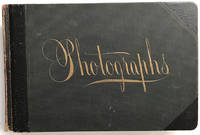
189045598N.P.: 1890s. 1890s. 7 1/2" x 11 1/4" in half morocco and cloth with title Photographs in gilt. Album contains 122 original photographs each 4" x 4" glued directly onto stiff cardboard leaves. A fascinating photograph album depicting life in and around Laramie Wyoming at the end of the 19th century. Approximately fifty photographs represent outdoor life in the area with an emphasis on hunting fishing and camping. These include pictures of an armed wrangler on horseback men and women fishing in a local stream men engaged in horse-breaking hunters posed with dogs and ducks and several armed female hunters in the field. The remaining photos depict daily life in the Laramie area to include architecture and building interiors local businesses candid portraits of locals social gatherings such as dances and stage plays children playing Indians at a town parade house and farm animals as well as other aspects of frontier living in Wyoming. An excellent photographic document of Wyoming life in the 1890s. Light wear to boards front hinge cracked. Some images faded or over-exposed. 1890s. hardcover
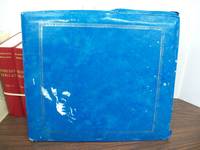
1262864Unique ca 1956-1970<br /> Collection of over 70 objects mostly postcards in a 1960s era photo album related to famous ocean liners and other ships many of which met their end in tragedy. Postcards of ships ranging from the USS Maine to RMS Titanic and Lusitania as well as coastal riverine and lake steamers and shipboard-cancelled envelopes. Included is a full-page magazine ad for the Andrea Doria and a copy of Life Magazine from 1956b featuring the tragedy of the Andrea Doria.<br /> 12.5" x 12.75" 10 album pages plus magazine. Condition is Good most of the postcards being in plastic sleeves rather than glued in to the album.<br /> Room 429. 1262864. Rockville Non-Retail Listings. unknown books
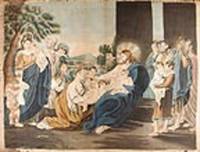
1820147671820. Watercolour heightened with india ink on wove paper some discoloration noticable on the front in the margins. On the verso framing directions in pencil with a title "Christ Blessing Little Children" and a name perhaps the owner Mrs. Pollard. Christ sits with five apostles standing behind Him and blesses seven children attended by five women; a bearded man stands behind them. unknown
1820147671820. Watercolour heightened with india ink on wove paper some discoloration noticable on the front in the margins. On the verso framing directions in pencil with a title "Christ Blessing Little Children" and a name perhaps the owner Mrs. Pollard. Christ sits with five apostles standing behind Him and blesses seven children attended by five women; a bearded man stands behind them. unknown books
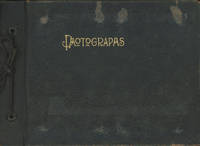
193649330N. P.: Prepared by an unknown couple 1936. 1936. Annotated photograph album documenting a couple’s travels through California Oregon Washington and British Columbia in their 1935 Dodge 4-door sedan including trips to Pine Flats Death Valley Yosemite the Redwoods the Oregon Coast along the Columbia River Gorge the Olympic Peninsula the Washington Coast and into Victoria and British Columbia. A black leather appears to be ostrich string-tied album with the word "Photographs" stamped in gilt 98 pp. 167 silver gelatin photographs sized 2 3/4" x 4 1/2" to 4 1/2" x 6 1/2" all with identifying text below in white ink written neatly at the very lower fore-edge of the blank margin in pen or within the negative. This well-documented photograph album records the automobile travels of a couple as the West Coast began to slowly recover from the Great Depression. Traveling in their sporty 1935 Dodge 4-door sedan featuring suicide doors the couple begins the album with a trek along the newly finished Palms-Pines Highway California 74 with photographs of the Frazier Mountain the 16th highest peak in Southern California along with additional photographs of the scenery in the Transverse Range. Additional photographs show their La Crescenta California home in the snow their Weaver Street house a visit to Yosemite with the requisite bears picture as well as a drive down to the Salton Sea. In August 1935 they drive to Lake Tahoe and then onto the California Redwoods Gold Beach Oregon up the Oregon Coast along the historic Columbia River Highway into the Columbia River Gorge. After a stop at their Grants Pass Oregon farm the couple visits Lake Sutherland and Lake Crescent on the Olympic Peninsula with an extended trip to the Mt. Rainier National Park and hiking Paradise trail around the mountain. Many of the photographs show the trip over to Victoria and Vancouver British Columbia a picturesque sojourn to Butchart Gardens which ended 1935. The 1936 trips included visits to Bishop California the Sierra Nevada mountains Mammoth Lake Grant Lake views of Death Valley and the Painted Desert along with many additional photographs of their Grants Pass home along the Rogue River with images of Mt. Shasta and Mt. Baldy. Covers lightly rubbed else in very good condition. Prepared by an unknown couple, 1936. hardcover
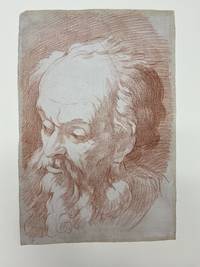
16002751<p>Venetian School. Sanguine drawing. 17th century. Size. With a watermark in the middle of the right eye. Margins: 10 x 7.</p>
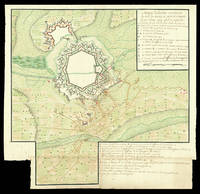
1720113801720. 480 by 485mm. 19 by 19 inches. Manuscript map in pen and ink with wash colouring. Highly finished and skilled engineering plan of the siege of the fortress town of Landau in the German Palatinate. Landau passed into French control under the terms of the Treaty of Westphalia 1648 which ended the Thirty Years' War. In 1688 Louis XIV ordered Sébastien Le Prestre marquis de Vauban one of the most brilliant military engineers in history to construct new defences for the town constructed between 1688 and 1691. During the War of the Spanish Succession Landau was besieged and captured four times; changing hands in 1702 1703 and 1704 as the fortunes of war ebbed and flowed. Finally in 1713 the pace was besieged by the French and recaptured remaining in their hands until the end of the war their possession subsequently confirmed in the Treaty of Utrecht. This decorative manuscript plan which highlights the defences of the places as well as the siege works constructed by the besiegers is typical of the high standard of plans created by French military engineers in the eighteenth century. unknown
175712286A Londres, Aux dépens d’une Société de Libraires 1757. 2 tomes reliés en un seul volume broché de VI puis 158 et 138 pages au format 17 x 11 cm. Couvertures bleues muettes. Dos carré avec 2 annotations d'époque à l'encre noire. Intérieur très frais, avec de très rares rousseurs éparses. Cette importante utopie, intitulé " Histoire d’un peuple nouveau, ou découverte d’une isle à 43 degrés 14 minutes de latitude méridionale, par David Tompson, Capitaine du vaisseau le Boston, à son retour de la Chine en 1756. Ouvrage traduit de l’anglais ", n’est nullement traduite de l’anglais, elle décrit un pays imaginaire, une société où les hommes sont tous devenus frères et où règne un esprit d’égalité contraire à tout ce qu’on voit en Europe. Il s'agit sans doute de la seule utopie de cette époque qui soit fondée sur un sentiment religieux et l’enseignement des évangiles. Rarissime édition originale, surtout broché et dans un tel état de fraicheur et qui manque à un très grand nombre de grandes bibliothèques, dont la Bibliothèque Nationale. Ce texte a été réédité, dans un tirage à 200 exemplaires, par les Editions d’Histoire Sociale en 1976.
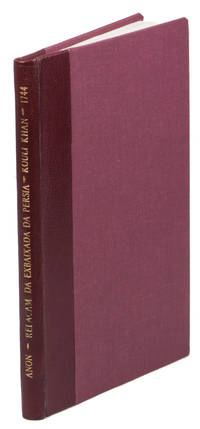
1744ABC_46570Lisbon: Pedro Ferreira 1744. Modern half red morocco red cloth sides gold lettering on spine. 4to 19.5 x 13.5 cm. With a printer's device on the title-page a headpiece with the IHS monogram and a decorated initial on p. 2 and a large tailpiece of an angel playing a horn holding a shield with the coat of arms of Portugal on p. 8. First and only Portuguese edition of an account of the embassy sent by the Prince of Bezancudos a tribe located between Persia and Tartary to the Shah of Persia. The Prince or Chief was afraid of Persia's emperor and the speed and brutality with which he conquered large parts of the Middle East the Caucasus and South Asia. Thus he sent specially selected ambassadors with gifts and other tokens of good-will accompanied by a large group of servants infantry and cavalry to help protect the ambassadors and try to appease the Shah. Nader Shah Afshar 1688-1747 also known as Thamas Kouli-Khan was one of the most powerful Iranian rulers in the country's history and ruled between 1736 and 1747 as Shah of Persia present-day Iran.According to the title page of the present copy the account has been translated from the French. It is probably based partly on a history of the reign of Nader Shah Histoire de Thamas Kouli-Kan Roi de Perse nouvelle edition Paris 1743 by André de Claustre. Whoever prepared the Portuguese text would of course have had to add the description of the 1744 proceedings.With a purple ownership stamp of the library of the Dukes of Palmela their monogram beneath the ducal coronet on the title-page. The upper outer corner of the title-page has been restored slightly affecting the text slight foxing mainly to the margins. Overall in good condition.l Ameal 1018; Porbase 3 copies; WorldCat 3 copies; not in Fonseca; Innocêncio; JFB. Pedro Ferreira, hardcover
183789264s. n. | Sans lieu d'édition 1837 | 20.8 x 27 cm | Relié
173789687Nella Stamperia del Chracas | Roma [Rome] 1737 | 16.3 x 22.5 cm | Broché
185689632Sans nom d'éditeur | Villelouet (Chailles, Loir-er-Cher) 1856 | 19 x 24.5 cm | Relié
1920844991920 | 24.50 x 380 cm | autre
016389Anonyme, L'illustre Rosimante , dédié aux Dames. Paris, Toussaint Quinet, 1642. In-8, front.-[12]-[2bl.]-54-[53-67]-[80-491]p (nombreuses erreurs de pagination). Edition originale et unique de ce roman (l'édition de 1643 est une remise en vente). L'ouvrage, commençant par un sonnet de « Rosimante au sage Anthénor pour la malheureuse Bérénice en prison », est un roman épistolaire, avec quelques poèmes et quelques petits textes mettant en situation les personnages. Le frontispice est décrit par Georges Duplessis sous le n°1108 dans son Catalogue de l'oeuvre de Abraham Bosse (Paris, Revue universelle des Arts, 1859) après avoir été publié en livraisons dans cette revue (livraison en 1857 pour cette gravure). Il est fort probable qu'il l'ait décrit à partir de notre exemplaire : « Dans un cartouche au centre, l'Amour, assis sur son carquois, vogue sur un lac au bord duquel on voit deux amants ». Il précise que ce frontispice est un second état dont le premier - qu'il n'a pas vu - a été utilisé pour un roman, Clytophon et Leucipe, publié en 1635. Il s'agit de Les Amours de Clytophon et de Leucippe (Paris, Toussaint Quinet & Simon Feburier, 1635). Cet ouvrage est d'une grande rareté et, mis à part l'exemplaire des catalogues de la comtesse de Verrue (n°274) et de la marquise de Pompadour (n°1692), nous n'avons identifié aucun autre exemplaire à la date de 1642 dans les catalogues anciens. Aucun exemplaire à cette date n'est conservé en France (seul un exemplaire à Oxford sur le WorldCat). En France, l'édition de 1643 est conservé à la BnF et à la BM de Dijon. Le seul autre exemplaire que nous avons identifié a été proposé par la librairie anglaise Amanda Hall (avril 2022, catalogue n°45, n°54, exemplaire en parchemin sans le frontispice). Provenances : -Louis-Urbain Lefebvre de Caumartin (1653-1720), marquis de Saint-Ange, dit Caumartin-Saint-Ange, avec ses armes (armes ajoutées a postériori). -Charles Giraud (1802-1881), homme politique, juriste. Vente en 1855, n°1961. Il dut vendre sa collection pour payer ses dettes. -Adolphe Pécard (1814-1871), conservateur du Musée archéologique de Tours. Vente en 1888, n°638. Sa collection concernait le règne de Louis XIII. Plein veau marbré aux armes (armes légèrement postérieures), dos à nerfs orné, tranches marbrées et dorées, un coin usé, un petit accroc à la coiffe supérieure, rousseurs éparses, petite mouillure marginale sur une trentaine de feuillets au début (touchant le frontispice). La cahier S (p.273 à p.288) relié dans le désordre. Très rare ouvrage.
49724In-4,cartonnage d'attente.Exemplaire de l'imprimeur Bergeret avec notes et corrections.Signature à l'encre sur la page de garde : " Bergeret,sous-chef de la Typographie,Avril 1825 ".476 p.Tableaux.TBE.intérieur.
188873849Paris 1888 | 18 x 23 cm | relié
51577Ensemble de 25 miniatures datant des XVIIIème et XIXème siècles. Provenant de livres, souvent avec un texte, ensemble de 25 miniatures de groupe de personnages dans leur quotidien. Quelques portraits .Très colorés.
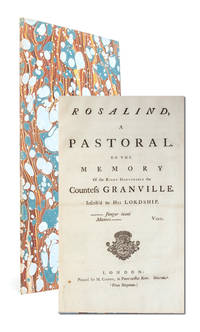
17454023London: Printed for M. Cooper in Pater-Noster Row 1745. First edition. Fine. Recent marbled card wrappers. Bookplate of J.O. Edwards to front pastedown. Folio measuring 195 x 310mm and collating 7 1: complete. Pro-Patria watermark as called for. Internally a wide margined and fresh copy with a slight central fold across the title page and small paper repair to the inner margin of same page not affecting text. An exceedingly scarce work in praise of a woman who generated feminist shockwaves in her all too brief life ESTC lists only five known copies. It has never before appeared at auction and the present is the only one on the market.<br /> <br /> An anonymous poetical tribute to the Lady Sophia Fermor whose writing had already placed her among England's intellectual elite and whose two years' marriage to John Certeret second Earl Granville additionally placed her within London's political power center before her early death at age 24. Hailed by Lady Mary Wortley Montagu as having "few equals in beauty or graces" ODNB she was also the thinly veiled author of the revolutionary feminist tract Woman Not Inferior to Man or A Short and Modest Vindication of the Natural Right of the Fair Sext to a Perfect Equality of Power 1739. Released before her marriage with the by-line of "Sophia a Person of Quality" and predating Wollstonecraft's Vindication of the Rights of Woman by nearly half a century the book was a sensation. Pointing to unequal access to education and unfair treatment under the law as the only reasons for women's cultural inferiority Lady Sophia "exhorted all my sex.to betake themselves to the improvement of their minds and.shew our selves worthy.Let us shew them by what little we do without aid of education the much we might do if they did us justice" Woman Not Inferior. Her marriage was a companionate and loving one both gossiped about and admired. And her loss to puerperal fever in 1745 was felt widely. <br /> <br /> The present work was a tribute to Lady Sophia's irreplaceability. Though on the surface fixated on her external beauty the verses constantly recall women of Ovid and Shakespeare whose uniqueness stemmed from their interior strength and their ability to move others to action. The pastoral emphasis and the name Rosalind immediately evoke Shakespeare's headstrong and outspoken heroine from As You Like It who escaped the injustices of men by dressing and acting as one to protect herself and her best friend. In the poem Rosalind's disappearance to the land of the shades away from her husband Albino's gaze references Eurydice whose life and death inspired Orpheus' powerful songs. And the narrator's pleas for owls and nightingales to quiet themselves harken to stories of female anger and revenge notably Philomela who surived brutality to take her vengeance. The result is something more learned and serious a celebration of a complex woman who could have given more if only she had more time.<br /> <br /> ESTC T45227. Fine. Printed for M. Cooper in Pater-Noster Row unknown
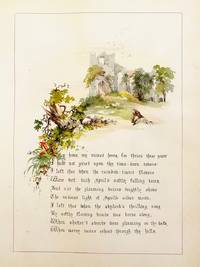
18561088<p><b> A STUNNING VICTORIAN ILLUMINATED MANUSCRIPT POEM ON 26 LEAVES<br /></b></p><p><b>VICTORIAN ILLUMINATED MANUSCRIPT. A. E. J. Illuminator. </b><i>The Exile's Home. 1859. </i>4to original full green morocco by J. Thomas Proudfoot 73 George Street Euston Sq. panels alike ruled in gilt with fleurons at corners spine richly gilt with repeated scroll pattern tooled edges inner gilt dentelles coated yellow end papers 26 leaves of heavy stock one side only. Ornamented title-leaf prefatory leaf with 2 lines from Byron poem written in calligraphic Gothic text ornamented with 30 historiated initials 24 large & 6 small the text incorporating 21 mostly large watercolor border vignettes inside red ruled border a.e.g. Great Britain 1859. </p><p>A choice illuminated poem a work of art confidently executed with watercolors of very high quality. The long poem is a medieval romance of lost love and a warrior's return illustrated with figured historical scenes and landscape views of woodland seaside and ruins. The coloring is rich and subtle the brushwork sure and delicate and the miniature draughtsmanship first rate. The second leaf contains two lines only lines 881-882 from Lord Byron's <i>The Giaour A Fragment of a Turkish Tale </i>1813 without attribution: "Each ivied arch and pillar lone/ Pleads haughtily for glories gone." The artist/calligrapher signed the manuscript at the end with his/her initials "E. J. A." alas unidentified by us. Leaves very mildly tanned mostly at blank edges and papers moderately foxed. 84163</p> hardcover
189647105Estes Park & Vicinity: Frank E. Baker & other anonymous photographers n. d. ca 1895-1896. 1896. COLORADO. Photograph album. 4to. 11 1/4" x 8 1/2" Quarter red leather and black cloth binder with 255 mounted photographs albumen prints silver prints platinum prints bromide prints and cyanotypes; one mounted folding brochure with a map of Estes Park; various newspaper and photographic clippings. A delightful photograph album documenting visits to Estes Park Colorado in the region that became Rocky Mountain National Park twenty years later. Estes Park serves as a base for the Rocky Mountain National Park est. 1915 situated between the towns of Estes Park to the east and Grand Lake to the west whose creation was spearheaded by the American naturalist author and homesteader Enos Mills 1870–1922. The present album documents outings in these parts undertaken by an unidentified couple and their friends primarily in 1895 and 1896 and shows a portion of the National Park before it became officially designated as such. A number of the earliest images in the album show Long’s Peak House a cabin erected in 1880 with the Peak visible in the background. Many of the images immediately following record men hunting and fishing presumably in the Long’s Peak area. In two images hunters are shown descending from elevations with beheaded animal carcasses possibly pronghorns hanging across their chests. In several photographs we encounter members of the party chowing down around a campfire trudging through snow casting for trout etc. Various candid portraits are included many of which center on what appears to be a newlywed couple whose son later provided inscriptions such as "Mother Father 1895." Judging by one photograph and the son’s inscription it seems his mother’s maiden name was Crocker which may tie her to the Crocker Ranch in Estes Park which is still standing. His father’s initials appear to be A.E.P. which he shares with his son. One picture is included of a baby beneath which the son has written "AEP his majesty himself 1896." A lively cavalcade which likely took place in the town of Estes Park is documented including one photograph of Native Americans on horseback with a chief in headdress. Several photographs capture Elkhorn lodge and various other lodges and a handful of views document the town of Estes Park proper. Other photographs show gold mining operations and bear inscriptions reading "Portland G.M. Co. Gold Mining Teller County CO" and "Moon Anchor GM CO Cripple Creek Gold Fields." One Mr. Sherwood is pictured in several of the photographs who likely had ties with the Sherwood Hotel in the park. A number of photographs at the end of the album were taken at Glenwood Springs one showing a group of men swimming in the resort pond. Included are several newspaper clippings and a brochure of Estes Park Colorado complete with a map of the park and information on hotels and boarding houses how to reach the park and other related matters. To this day the park is one of the most visited in the National Park System ranking as the third most visited U.S. national park in 2015. Most of the photographs in the album are snapshots but also included are three large commercial images by F. E. Baker of Greeley as well as two similar unsigned photographs that appear to be his work. An appealing photographic record of the region that would later become the Rocky Mountain National Park. Red leather chipped and worn corners worn spine is perished but holding covers and contents loosely held together photographs are generally in good condition with most being with moderate to strong tonality. Frank E. Baker & other anonymous photographers, n. d. (ca 1895-1896). hardcover