Ostrovsky, Victor (Signed)Biblio.com

109 124 résultats
1994337j0530USA: HarperCollins. Very Good in Good dust jacket. 1994. First Edition. Hardcover. 0060176350 . Signed without inscription by author upon half-title page. "The truth about the death of Robert Maxwell and the story behind the near assassination of George Bush Sr. are just two of the revelations contained in this headline-making account of one man's journey into the dark heart of the Mossad. Never has there been so detailed a look at the hidden agenda of extremists within a major intelligence agency - nor one so worrisome in its implications. Ostrovsky a former Mossad agent gained international celebrity in 1990 when the state of Israel attempted to ban his first account of Mossad misdeeds By Way of Deception. Few who watched that book soar to the top of the New York Times bestseller list anticipated that an even more shocking story remained to be written." - dust jacket. pp. xiv 315. Footnotes. Index. Black and white photographic plates. Clean and unmarked with light wear. Dust jacket now preserved in glossy new archival-grade Brodart. A special copy.; Sm 4to; Signed by Author . HarperCollins hardcover
19090001445CEYLON SRI LANKA MALAYA MALAYSIA SUMATRA JAVA. Good. 1909. On offer is an original sensational October 14th 1909 through April 2nd 1910 manuscript diary detailing a six month visit to Ceylon Sri Lanka Malaya Malaysia Sumatra Java Singapore and Calcutta India. Of great significance are detailed reports on twenty-nine tea rubber and sugar plantations handwritten by the author Alfred William Lafone b. 1853 wherein he writes on 68 pp of the 85 pp folio notebook. The first sixteen pages consist of a businesslike diary of the trip starting at Charing Cross Station London on 14 October 1909 and ending with Lafone's return 'home' on 2 April 1910 to be 'met by Father' i.e. the one-time Conservative MP for Bermondsey Alfred Lafone 1821-1911 of Hanworth Park Hounslow. It would appear that the younger Lafone has been sent out to report on plantations with a view to the purchase of one by his father. He writes on May 25th 1910: 'Handed cable from home by Huttenbacks "If Title Good labour sufficient 500 yearly 1000 if required on good properties."' Lafone records his travels from place to place by boat train motor car and on horseback. He notes down the names of fellow travellers for example on 14 November 1909: 'Mr & Mrs Tate of Tate and Lyle also on board. Also Douglas Osborne tin miner who put me down for the Club. Davie Bishop of Singapore Davison who stopped at E & Ott with me. Josselyn.' He swims plays tennis and golf at the course of the Grand Hotel Newra Elya Nuwara Eliya and at Penang. At a tobacco factory at Paya Djamboe he sees 'the Chinese stapling & sorting the leaf'. The references to India and Singapore are brief and the main body of the item is devoted to the plantations. Each of the thirty estates has its own entry the whole covering forty-nine pages. Those visited are as follows. In Ceylon: Troy Estate Ceylon Proprietary Co.; Sunnycroft Sunnygama Tea & Rubber Cos.; Kiribatgalla; Ambadeniya; Edinborough sic Tea Estate; Culloden Rubber Estate; R. P. K. Kalubara district. In Malaya: Caledonia Penang Sugar Co.; Prye rubber sugar coconut; Batukawan; Straits Bertams; Jebong Perak; Linggi Plantations Bukit Nanas Estate; Sungei Buloh; Ledbury Co. Estate Sione; Batu Caves; Consolidated Malay; Lallang Estate; Mallacca Estates. In Sumatra: Simpang Sumatra Rubber Estate; Mr. Pinckneys Estate private rubber only; Lang Kat Sumatra Rubber Co.; Deli Sumatra Laut Tador; Tandjong Kassau. In Malaya again: United Serdang; United Langkat Tobacco Co.; Late British Deli & Langkat; Sealing Rubber Estates Tebbi Tingi. In Java: Tjiseroe Estate. In India: Bokel Estate tea. With each entry Lafone notes the proprietor of the estate its manager and location as well as salient facts such as altitude acreage drainage nature and price of labour rainfall altitude tapping. Each entry has a final paragraph summing up his view. Of the Late British Deli & Langkat: 'Placing an Englishman in charge when all the assistants were Dutch was a mistake'. Of the Batu Kawan: 'The policy to follow on this Estate is to either plant cocoa nuts only This is a safe or sound investment. The alternative is to reconstruct the factory & utilise say 2000 acres for cane & the rest for cocoanuts but no rubber the following added in pencil To put it briefly this is a wretched estate - signed A. W. Lafone 23/11/09'. Following an account with brief chronology and statistics of the way in which on the Bokel Tea Estate India the 'old tea is being abandoned & new tea being put out at rate of about 25 acres per acre': 'The mistake in the past has been to take everything out of the garden & put nothing into it. There should be at least 10% renewals or additional clearances every year'. The entry for the Linggi Plantations contains a diagram headed '1/4 of tree' showing the process of tapping. The last three pages carry names and addresses. A few entries in another hand; perhaps Lafone's son 32 x 20 cm. 36 lines to the page. Text clear and complete. Internally tight and sound on lightly spotted and aged paper. Worn marbled boards and enpapers with loss and splitting to red leather spine. Overall ; Folio - over 12" - 15" tall; KEYWORDS: RUBBER PLANTATIONS EARLY HISTORY OF RUBBER TEA PLANTATIONS FARMING ASIA SUB CONTINENT ALFRED LAFONE TRAVEL HANDWRITTEN MANUSCRIPT DOCUMENT LETTER AUTOGRAPH DIARY JOURNAL LOG KEEPSAKE WRITER HAND WRITTEN DOCUMENTS SIGNED LETTERS MANUSCRIPTS HISTORICAL HOLOGRAPH WRITERS DIARIES JOURNALS LOGS AUTOGRAPHS PERSONAL MEMOIR MEMORIAL PERSONAL HISTORY TRAVEL 20TH CENTURY antiquité contrat vélin document manuscrit papier Antike Brief Pergament Dokument Manuskript Papier oggetto d'antiquariato atto velina documento manoscritto carta antigüedad hecho vitela documento manuscrito Papel Ceylon Sri Lanka Malaya Malaysia Sumatra Java Singapore Calcutta India . hardcover
18740007019WEST AMESBURY MASSACHUSETTS NORTH VALLEY CALIFORNI. Fair. 1874. On offer is an outstanding journal of an adventurous voyage in the 1870s. Measuring 8.25 inches by 6.25 inches it contains 46 pages. It is about 76% complete. The handwriting is clear and legible. The spine of the hardbound book has broken and the covers are loosely attached but all pages are intact and in good condition. Albion Sanborn was a 35 year old married man living in West Amesbury MA in the later 1860s/early 1870s. He decides to leave his wife Maria and their child to go to California to seek his fortune and then return home at some unspecified time in the future. Casual research has not produced any further biographical information. He makes his way to New York City where on March 14th 1874 he boards the Pacific Mail Steamship Company's SS Henry Chauncey. The Chauncey had an interesting history. She was launched October 1864 for the Pacific Mail Steamship Company and entered the New York to Aspinwall service on November 1 1865 and remained on this route until 1869. She burned at sea on August 16 1871 off the Carolina Coast while on passage from New York to Kingston Jamaica and Aspinwall with no loss of life. The hull was rebuilt and she continued on this route until she was eventually scrapped in 1877. He writes in detail about the ships journey through the Panama Canal mentioning conditions in the various ports of call en route. Such as what it's like in such places as Kingston Jamaica Tobago Islands Panama Aspinwall Colon Panama and Punta Arenes Costa Rica among other destinations. "The island of Jamaica seems to be all mountains and pretty high ones at that. It seems quite nice. . After the vessel had been made fast a young man by the name of Robinson and myself went on shore and hired a carriage of the one-horse persuasion to give us a ride around town and and show us the sights. . By the way we feel the heat here to our hearts content. It seems like five or six fourths of July boiled down into one. . Mar 21 . I should say that the principal business of the place Aspinwall was selling rum whisky and other spirituous liquors. And gambling. In the evening there are tables along the sidewalks for the purpose of gambling. What the game is called I don't know. But one thing I noticed was that most of all who were foolish enough to risk their money in it lost it. . Mar 24 He writes about people both on board and in villages along their route. He speaks often about the Sabbath Day and he is a church-goer. There are many ladies on board and many men that look pale and sick going to seek a more healthy climate . Mar 15 The consumption of dress goods among the native women cannot be very alarming and it is a very common thing to see children without any covering at all which must save an immense amount of wear and tear. . Mar 25 When he arrives in California he describes landmarks towns and people that he encounters. He writes briefly about the mines and prospectors. The boom years of the California Gold Rush had passed but growth in the state continued to be strong. Sanborn disembarked in San Francisco on April 25th. After several days he leaves for North Valley CA. Without any reference to how he found work his entry for May 4th states: Went to shop and worked some in the forenoon. . May 4 The remaining entries mostly concern his working in 'the shop' and include references to people he meets and gets to know as well as social activities. He refers several times to letters he receives from his wife Maria. His journal ends simply on June 14 with an entry about attending church. Following the journal section there is a 6 page section entitled Quotations. In it he has copied a number of passages from various sources that obviously had meaning for him. This is an excellent first-hand account of a journey that had been taken by tens of thousands of Americans who went west to seek their fortune. In its own way it too is a goldmine - of direct observations impressions and reflections of someone who was there to record his part of the experience. Historians would find this a solid piece of primary-source information as would geographers. For social historians this is an excellent window into one of the most dynamic population movements in 19th century America.; Manuscript; 8vo - over 7¾" - 9¾" tall; KEYWORDS: HISTORY OF ALBION SANBORN; PACIFIC MAIL STEAMSHIP COMPANY; SS HENRY CHAUNCEY; CALIFORNIA GOLD RUSH; SAN FRANCISCO; ASPINWALL; PANAMA CANAL NORTH FIELD CA WESTBURY MASSACHUSETTS MARIA SANBORN GOLD MINING PANNING FOR GOLD AMERICANA HANDWRITTEN MANUSCRIPT DOCUMENT LETTER AUTOGRAPH WRITER HAND WRITTEN DOCUMENTS SIGNED LETTERS MANUSCRIPTS DIARY DIARIES JOURNALS PERSONAL HISTORY SOCIAL HISTORY HISTORICAL HOLOGRAPH WRITERS AUTOGRAPHS PERSONAL MEMOIR MEMORIAL ANTIQUITÉ CONTRAT VÉLIN DOCUMENT MANUSCRIT PAPIER ANTIKE BRIEF PERGAMENT DOKUMENT MANUSKRIPT PAPIER OGGETTO D'ANTIQUARIATO ATTO VELINA DOCUMENTO MANOSCRITTO CARTA ANTIGÜEDAD HECHO VITELA DOCUMENTO MANUSCRITO PAPEL . hardcover
19280009075AROUND THE WORLD ASIA EUROPE SOUTH AMERICA. Good. 1928. On offer is an exceptional thoroughly fascinating and definitely unique scrapbook by a long time seaman navy officer and author by the name of Arthur Gordon. It cannot be understated how interesting this document of travel in the late 1920s is. It is in such excellent condition and absolutely filled with interesting photographs postcards from numerous contents and ephemera that lend a tremendous amount of meaning and significance to the documents around it. The scrapbook dates from 1928-1929 right after he graduated from college at NYU. There are probably close to 200 photographs and postcards in this book. Gordon and a friend traveled around the globe for six months via steamship seeking out adventure and this book is the grand culmination of their globe trotting. Many of the photographs post cards and ephemera have captions that explain them and often describe the spots visited along with short paragraphs about the journey. The ephemera in the book are also rare and very interesting. Alongside the photos and post cards Gordon added numerous hotel stickers luggage tags from ports visited identification cards from the ship and even a Certificate of Vaccination that certifies that Mr. Arthur Gordon was vaccinated against Smallpox on Nov. 25 1928 and signed by the Doctor. However the two most interesting items of ephemera are probably 1 an original handout from Dollar Steamship line mentioning 100 tins of Opium still hidden on board this ship and offering a reward of 5 dollars a tin to those with information and 2 a very well preserved broadside that warns the passengers to be on the lookout As there is an organization at this port for the purpose of placing Russian Stowaways on board.The cover page of the book reads: Round the World. November December January February March and April 1928-1929. Hawaii. Japan. China. Singapore. Ceylon. Egypt. Genoa. Capri. Naples. Venice. Rio de Janeiro. Santos. Montevideo. Buenos Aires. On the next page there is a paragraph that sets up the book: After our return from the Amazon Howie went to Harvard Business School Dick began asking himself what was best to do with a year off I returned to my writing. On the night of November 12th 1928 Dick called from Boston to ask if I could leave for Singapore at four oclock the next afternoon. At four oclock the next afternoon we left for Singapore the first stage of the journey being by way of the Overland Express to Frisco. We already had passports and could get what visas we needed in San Francisco. Also I could buy what clothes I needed and suitcases to carry them in. A little later he writes My status was purely social: I was to help Duke enjoy himself until the ways split then was to continue on my own which would be nothing new. All photos and post cards are in fantastic condition and can be removed with no damage. In addition there are five loose photos in the album of Arthur Gordon who apparently posed as a nude model at some point in his life. These photos are quite intriguing because along with the photos is a photo of a sculpture created by Armenian-American artist Haig Patigian a very well known personality in the art world at the time. He was an active member of Bohemian Club serving two terms as club president. He designed the Owl Shrine a 40-foot high hollow concrete and steel structure which was built in the 1920s to have the appearance of a natural rock outcropping which happened to resemble an owl. Patigian has signed this photo to Arthur and it seems like the two might have been friends. I also discovered two of the nude photos of Arthur posing for a fairly well know German photographers studio by the name of Bruno Wiehr of Dresden. I was quite surprised to find this information but I suppose it makes sense considering Arthur Gordon was also an aspiring author. He most likely spent considerable time in artist circles throughout his life and this is how he ended up modeling. Needless to say the photos have some value on their own. This is a truly exceptional travel scrapbook in excellent condition and immensely interesting. The wow factor is exceptional. Background: Arthur Gordon had a long career at sea. He joined the Navy in WW I and was a recruiter during the war. He would later serve aboard the USS Oceanographer for four years on the US Coast Survey. During WW II he would write the book "The Years of Peril". Besides serving in WWI and WWII he traveled extensively as a Merchant Marine Officer and was employed in the tourist industry. After WWI Gordon made two trips around the world and into the Amazon. Gordon also attended Bard College and NYU finally earning a Master's degree. In 1949 he was teaching classes in writing fiction. He was listed as a Navy Commander in the reserves in 1949 as well. At that time his full time employment was as a Freelance Writer. He published short stories in Argosy and Maclean's Magazine sometimes using the pen name "Arthur Shirt".NOTE: WE LIST HIS EARLIER 1919 JOURNAL SEPERATELY. SELLER ID OOO2557.; Manuscript; Folio - over 12" - 15" tall; KEYWORDS: HISTORY OF ARTHUR GORDON HAIG PATIGAN ROUND THE WORLD TRAVEL ROARING TWENTIES INTERWAR PERIOD TRAVEL HOTEL STICKERS GLOBETROTTING SCRAPBOOK DOLLAR STEAMSHIP LINE S.S. PRESIDENT MONROE MARINE NAUTICAL MARITIME NUDE PHOTOGRAPHY ASPIRING WRITER PHOTOGRAPHS OF NATURE HAWAII JAPAN ASIA ITALY SOUTH AMERICA ART AND TRAVEL PRE-GREAT DEPRESSION TRAVEL REMEMBRANCES OF TRAVEL CULTURAL EXPLORATION HISTORY OF TRAVEL AMERICANA HANDWRITTEN MANUSCRIPT DOCUMENT LETTER AUTOGRAPH WRITER HAND WRITTEN DOCUMENTS SIGNED LETTERS MANUSCRIPTS HISTORICAL HOLOGRAPH WRITERS AUTOGRAPHS PERSONAL MEMOIR MEMORIAL ANTIQUITÉ CONTRAT VÉLIN DOCUMENT MANUSCRIT PAPIER ANTIKE BRIEF PERGAMENT DOKUMENT MANUSKRIPT PAPIER OGGETTO DANTIQUARIATO ATTO VELINA DOCUMENTO MANUSCRITTO CARTA ANTIGÜEDAD HECHO VITELA DOCUMENTO MANUSCRITO PAPEL . hardcover
18990009160LONDON ENGLAND to KUCHING SARAWAK BORNEO. Good. 1899. On offer is a fascinating diary of an English gentleman by the name of Ben D. Beeley from England who at the very end of the 19th Century travels from London to Borneo to function as a missionary to the local population there. The 1899 New Year begins with a short entry by Beeley: I commenced the New Year in all Saints Church. O Lord help me to serve Thee with true devotion in my life as a missionary in Borneo. In February He sails aboard steamship from London heading to Singapore. The day before he says his goodbyes: The saddest day in my life he remarks. I left home this morning at 9 a.m. How awful to say good-bye to the dear ones at home Dear Father and Darling mother and dear old Gal. M God help them and bless and comfort them.I took my dear little Lottie for a long walk. How happy I was in her company. How sad to leave her but I am happy since I know she loves me truly and faithfully. I have asked her not to wait for me and she promises she will not. Never can I forget the farewell at All Saints Church. All the girls cried. Jeff embraced me. And those dear men how they did cheer!! My god take away pride from me. He leaves on the steamer Kawachi Maru. The beginning of his journey is less than pleasant filled with headaches terrible sea sickness and rough seas. The days get better as they go on and Beeley notes his activities everyday on the boat. For example: Awoke feeling much better. Had a better breakfast. Spent the morning on Deck. Talk to one of the Miss Vincents. Bible Reading on Luke xvii 1 -10 . Very rough in evening and much spray. He writes everyday of the journey to Singapore. From England the steamer travels across the Mediterranean through the Suez Canal. Beeley doesnt like Port Said much: I was 4 or 5 times in the day grossly insulted in the street. The whole tone of the place is awful. There is work there for 100 missionaries and there is only one! The ship reaches Singapore and is therefore only a day before it goes on to Borneo. Beeley is stationed in Kuching Sarawak as a missionary. His first impressions in early April are very positive and shortly after arriving he get to work: I took Perrys boys for scripture from 10 to 10:45. It was a great treat to hear how well they answered. They were all Dyaks and Chinese. My first bit of mission work. He comes off as an intensely curious person and writes often about the customs and religion of the people around him: Chinese ancestor worship is very extraordinary.a procession headed by 2 men carrying 2.coloured baskets next to a scarlet banner followed by a dead goat on a stretcher and a young dead pig both these have fruit in their mouths.; The Malays have curious customs of piling up pillows one on the top of the others; The Chinese and Malay made an awful row. They believe a dragon was swelling the moon. and they tried to scare him. He also starts to notice some of the ethnic strife: This morning 5 Dyaks were executed for the murder of some Chinese. The murder took place about five years ago but the murders have only just been found out. We had some Cricket at the fort. It was good fun. The Dyaks thoroughly enjoyed it. There was a boy in an inch of water on the pitch. I never expected to play cricket in the east in such a quagmire. While in Kuching Beeley spends considerable time with one of the White Rajahs of Sarawak Charles of Sarawak Charles Johnson/Brooke. The Rajahs were a dynastic monarchy of the English Brooke family who founded and ruled the Kingdom of Sarawak from 1841 - 1947. He receives an invitation for dinner from the Rajah at Astana his palace in Kuching. When Beeley sets off to the field to preach he encounters many obstacles including awful weather tribes of headhunters and dangerous animals. At one village he notices human heads hanging from posts outside of their homes. Saribas people are very nice & all want me to stay with them. There were 2 human heads hanging up the house opposite our beds.He has near disastrous river trip & almost drowns on several occasions. He also hunts & in one case shoots a 7 foot crocodile outside of his hut. His journey to the more rural and isolated parts of the country is exceptionally fascinating to read. Despite becoming a Deacon in September Beeley is assigned to a seemingly abandoned missionary station where everything is rundown and has to live in the ruins of a house. He suffers bouts of dysentery and mentions many of his fellow missionaries are depressed and want to leave Sarawak. He writes 'This Diocese is in a bad state. Men are all dissatisfied. Gomes Perry in fact nearly all want to leave. What will be the end I do not know! Shortly afterward he becomes horribly ill and spends almost two months in a delirious state. He writes often of struggles with his faith I hope I shall not be alone in any mission station I am so weak & I am afraid of myself.; O God help me in the great responsibility of guiding this mission station. Give me strength and help. I do feel the responsibility of this mission I hope all will go well. and his own personal salvation. As well as his struggles to actually comprehend the Dyak language and culture and to speak back to them. At the end of the year Beeley writes a fantastic retrospective passage: The end of 1899. A wonderful year to me. The beginning of a new life how many things have happened !! Some for good some almost bringing about my downfall. God thou knowest- all my love thee feeble and weak though it be. Am I better or worse for the past year The past is gone from us forever. It is gathered and it belongs to us no more. No single work can ever be unspoken no single step retraced. In February I had heart rendering farewells to leave home & my dear family & her whom I love. In April i landed in Sarawak & commenced my work. In July I had fierce trials by temptation. In August I was prostrate on a bed with sickness. In September I was ordained Deacon. In December left alone in the heart of Sarawak. Yet O God I was in thy hands & I know thou will keep me safe. The book is in good condition. The cover and spine have some aesthetic wear and discoloration but are still structurally good. The binding is still tight. The pages inside show little foxing or rips and tears. The handwriting is clear and legible throughout in black and blue ink and occasionally pencil. Some of the ink has faded a bit and there are a couple dozen pages where the ink has bled through to the other side. This does slightly affect the ease at which the content can be read for these pages but the bleeding through is minimal and the words can still be made out with slightly more effort. OVERALL: G; Manuscript; 8vo - over 7¾" - 9¾" tall; KEYWORDS: HISTORY OF BEN D. BEELEY LONDON ENGLAND UNITED KINGDOM PORT SAID SUEZ CANAL SINGAPORE KUCHING SARAWAK BORNEO CHRISTIAN OUTREACH PROSELYTIZING MALAYSIA SOUTHEAST ASIA ANGLICAN MISSIONARY MISSIONARY WORK IN ASIA TURN OF THE 20TH CENTURY CHRISTIANITY IN ASIA MALAY PEOPLE DYAK PEOPLE CHARLES BROOKE RAJAH OF SARAWAK WHITE RAJAHS KAWACHI MARU AMERICANA HANDWRITTEN MANUSCRIPT DOCUMENT LETTER AUTOGRAPH DIARY DIARIES PERSONAL HISTORY FIRST PERSON ACCOUNT WRITER HAND WRITTEN DOCUMENTS SIGNED LETTERS MANUSCRIPTS HISTORICAL HOLOGRAPH KEEPSAKE WRITERS AUTOGRAPHS PERSONAL MEMOIR MEMORIAL ARCHIVE DIARY DIARIES JOURNAL LOG ANTIQUITÉ CONTRAT VÉLIN DOCUMENT MANUSCRIT PAPIER ANTIKE BRIEF PERGAMENT DOKUMENT MANUSKRIPT PAPIER OGGETTO D'ANTIQUARIATO ATTO VELINA DOCUMENTO MANUSCRITTO CARTA ANTIGÜEDAD HECHO VITELA DOCUMENTO MANUSCRITO PAPEL . unknown
18470008168NORWICH CONNECTICUT INTRA CONTINENTAL USA. Good. 1847. On offer is a rare handmade travel journal dating from early 19th century America. The paper volume is composed of 16 pages hand stitched inside a heavier paper cover. The small volume is in good condition and all pages are intact. There is some discolouration due to age but it does not affect the handwriting. The volume measures 6.5 inches by 4.25 inches and is approximately 50% complete. The journal is written in 1847 by a woman named Betsy Allen. Her home is recorded as Norwich which could refer to Norwich CT as her journey begins by travelling to New York City. Allen travelled in a great loop from New York City up the Hudson River and into the Erie Canal. She passed through Buffalo and sailed on to Cleveland OH. From Cleveland she travelled south by canal boat to Ellsworth OH arriving on July 22th. She stayed in Ellsworth until Oct 19th. Daily entries often take the form of a single line or comment: "Left Norwich landing for New York sailed all day slow and sure come to New York" July 7; "7 o'clock came to Rochester" July 16; ". went into Capt Allen's boat Buffalo early in morning" July 19; "50¢ sail out for Cleveland" July 20; On Oct 19th she left Ellsworth in the company of her father and 5 other women and began a remarkable trip back to the east coast via the Ohio and Pennsylvania canal systems. This canal route was a complex transportation system that included canals dams locks tow paths aqueducts and viaducts. Construction of this network began in the early 1820's and continued for the next several decades. She travelled through places like Petersburgh Bridgewater and Lowry. Eventually she reached Pittsburgh. From Pittsburgh she followed the canal through places like Johnstown and Holidaysburgh crossing over the Juniata River by means of a rope ferry. She crossed the Susquehanna River by an aqueduct eventually arriving at Philadelphia after passing through Harrisburg. At Philadelphia she boarded a steam ship for New York City and then Norwich on Oct 27th. She offers more details in her comments during this portion of her trip: "Left Ellsworth for home. Got a cup of coffee and dinner at Mr. Speers in Petersburgh . put up early at Mr.Wells four miles from Bridgewater fare not very good" Oct 19; ". passed through 16 locks in the forenoon. Nothing particular this afternoon only the passage through the tunnel this is a piece of art." Oct 21; ". crossed the Juniata while eating by means of a rope ferry" Oct 23. This is an absolutely fascinating journey and her description spare at times provides an excellent catalogue of the canals and locks that she traversed. It is all the more remarkable because this is a woman making the trip and she obviously came from a family with the means to afford such a trip. By 1900 the canals essentially ceased to operate as railroads took over as the preferred way to move people and goods. However the canals played a vital role in opening up the interior to move settlers west and bring raw materials and crops east to the growing cities of New York and Philadelphia. For a historian this is an excellent first-hand account of travel around the entire system.; Manuscript; 16mo - over 5¾" - 6¾" tall; KEYWORDS: HISTORY OF; UNITED STATES; MID-19TH CENTURY; 1840s; BETSY ALLEN; ERIE CANAL PENNSYLVANIA CANAL; OHIO AND ERIE CANAL; DELAWARE CANAL NORWICH TRAVEL IN THE MID-19TH CENTURY AMERICA; HUDSON RIVER; AMERICAN CANAL BOATS; NORTH AMERICAN CANAL AGE; AMERICAN WATERWAYS IN THE EARLY 19TH CENTURY; NEW YORK STATE CANAL SYSTEM; TRAVELING WOMEN IN THE 19TH CENTURY AMERICA; WOMEN'S STUDIES; TRAVEL DIARIES; AMERICANA HANDWRITTEN MANUSCRIPT DOCUMENT LETTER AUTOGRAPH WRITER HAND WRITTEN DOCUMENTS SIGNED LETTERS MANUSCRIPTS DIARY DIARIES JOURNALS PERSONAL HISTORY SOCIAL HISTORY HISTORICAL HOLOGRAPH WRITERS AUTOGRAPHS PERSONAL MEMOIR MEMORIAL ANTIQUITÉ CONTRAT VÉLIN DOCUMENT MANUSCRIT PAPIER ANTIKE BRIEF PERGAMENT DOKUMENT MANUSKRIPT PAPIER OGGETTO D'ANTIQUARIATO ATTO VELINA DOCUMENTO MANOSCRITTO CARTA ANTIGÜEDAD HECHO VITELA DOCUMENTO MANUSCRITO PAPEL . unknown
18620002220ASEA ABOARD THE ELLEN STUART. Good. 1862. On offer is a super very intriguing original 1862 - 1863 journal handwritten on board the noted clipper ship 'Ellen Stuart' part of the fleet owned and operated by storied merchant Peter Stuart. The ship was a formidable presence on the oceans between England Africa and Southeast Asia during the 1850s. The log written by a mariner likely a first or second officer perhaps James Dalton precisely describing the set of sails and changes to the set weather position working or setting 'the people' to task or 'the people employed holystoning the deck flying fish coming aboard to 'the monkey jumping for pumpkin' making for a technical mariner's dream of a log with a real HM Navy feel in a real life merchant clipper that would please any Forester or Patrick O'Brien fan. While the year is not clearly identified we believe this Liverpool to Calcutta India voyage is dated from Tuesday August 5th 1862 to Saturday May 17th 1863 and while the author is unidentified we believe that an 18 year old fragile letter tucked into the log holds the key. The letter is dated Stanford Terrace Academy December 11th 1845 Ashton Ashton-under-Lyne near Manchester and is a very first 'Dear Parents' letter on the boy's started at the Academy. The letter is signed 'James Dalton'. We believe the letter was kept by the man who was the boy that wrote that letter for sentimental reasons. Or could it be the father of James Dalton who held the letter whilst he travelled the globe again for sentimental reasons We can only speculate. The captain throws a champagne dinner for one of the officers birthday and then a tale of his personal goods being stolen a near unusual crime aboard ship the searching of another seaman's chest and finding more of the writer's possessions an admission of guilt but even more unusual no record of the fate or punishment of the sailor the cat hove overboard by a sailor who saw its mouth foaming a sailor found dead in his Guernsey frock and much much more in this 39 page 10 x 11.5 inch well written account of a super voyage to the Asian subcontinent. Overall G.; Manuscript; 4to - over 9¾" - 12" tall; KEYWORDS: HISTORY OF JAMES DALTON CLIPPER SHIP ELLEN STUART PETER STUART CLIPPERS SAILING VESSELS MARINE MARINERS SAILING OCEAN GOING COMMERCE LIVERPOOL ENGLAND TO CALCUTTA INDIA NAVAL NAUTICAL MARINE STANFORD TERRACE ACADEMY AGE OF SAIL O'BRIEN FORESTER AUBREY HORNBLOWERHANDWRITTEN MANUSCRIPT AUTOGRAPHED AUTHORS DOCUMENT LETTER AUTOGRAPH KEEPSAKE WRITER HAND WRITTEN DOCUMENTS SIGNED LETTERS MANUSCRIPTS HISTORICAL HOLOGRAPH WRITERS AUTOGRAPHS PERSONAL MEMOIR MEMORIAL PERSONAL HISTORY ARCHIVE DIARY DIARIES JOURNAL LOG PRIMARY SOURCE FIRST HAND ACCOUNT SOCIAL HISTORY PERSONAL STORIES LIVING HISTORY ANTIQUITÉ CONTRAT VÉLIN DOCUMENT MANUSCRIT PAPIER ANTIKE BRIEF PERGAMENT DOKUMENT MANUSKRIPT PAPIER OGGETTO D'ANTIQUARIATO ATTO VELINA DOCUMENTO MANOSCRITTO CARTA ANTIGÜEDAD HECHO VITELA DOCUMENTO MANUSCRITO PAPELBIOGRAPHY BIOGRAPHICAL AUTOBIOGRAPHICAL AUTOBIOGRAPHY PERSONAL NARRATIVES . unknown
19440002375MIOS WOENDI AMSTERDAM ISLAND SOUTH PACIFIC. Very Good. 1944. On offer is an original very unusual very different kind of manuscript relic of World War II and America's war in the South Pacific being a log book for "Malaria Control Team 28" handwritten by we believe Lieutenant JG G.H. Penn detailing his mission primarily at M.T.B. Base 21 on Mios Woendi Island from 3 July 1944 to 10 August 1944 and at Advance Base 3 on Amsterdam Island from August 1944 to 21st February 1945. Lt. Penn we can safely assume was a scientist within the field of Malaria control and mosquito life given that we found some post War references to his published contributions on the subjects. The log is a fascinating blend of scientific data detailing efforts by US armed forces to systematically test for identify treat and eliminate tropical diseases including malaria primarily on the Pacific Islands of Mios Woendi and Amsterdam Island and diary narrative bordering on forensics and detective work such as hunting through garbage dumps and disposals 'heads' etc. for maggots and larval specimens lab work and much more with the back drop of the War at a very intense time; constant raids and attacks by Japanese aircraft and kamikaze pilots dealing with casualties from the USS Orestes after it was hit by a kamikaze and much more in the 64 full hand-written pages. Historians and researchers of the American war effort in the South Pacific will all too well recognize the utter importance of malarial control at the time given the debilitating effects that the disease could wreak on unprotected soldiers and marines. This unique journal makes for an irreplaceable record of that effort from the hands of a man that studiously and determinedly worked to eradicate the threat as his part of the war effort. Overall VG.; Manuscript; 12mo - over 6¾" - 7¾" tall; KEYWORDS: HISTORY OF LIEUTENANT JG G.H. PENN MALARIA CONTROL TEAM 28 M.T.B. BASE 21 MIOS WOENDI ISLAND SOUTH PACIFIC PACIFIC THEATER WWII WW2 WORLD WAR 2 WORLD WAR II THE WAR AGAINST JAPAN AMSTERDAM ISLAND GUAM PHILIPPINES TROPICAL DISEASES TROPICAL TREATMENTS TROPICAL MEDICINES DOCTORS BIOLOGY INSECT BORNE DISEASES MOSQUITO MOSQUITOES AMERICANA HANDWRITTEN HANDWRITTEN MANUSCRIPT AUTOGRAPHED AUTHORS DOCUMENT LETTER AUTOGRAPH KEEPSAKE WRITER HAND WRITTEN DOCUMENTS SIGNED LETTERS MANUSCRIPTS HISTORICAL HOLOGRAPH WRITERS AUTOGRAPHS PERSONAL MEMOIR MEMORIAL PERSONAL HISTORY ARCHIVE DIARY DIARIES JOURNAL LOG PRIMARY SOURCE FIRST HAND ACCOUNT SOCIAL HISTORY PERSONAL STORIES LIVING HISTORY ANTIQUITÉ CONTRAT VÉLIN DOCUMENT MANUSCRIT PAPIER ANTIKE BRIEF PERGAMENT DOKUMENT MANUSKRIPT PAPIER OGGETTO D'ANTIQUARIATO ATTO VELINA DOCUMENTO MANOSCRITTO CARTA ANTIGÜEDAD HECHO VITELA DOCUMENTO MANUSCRITO PAPELBIOGRAPHY BIOGRAPHICAL AUTOBIOGRAPHICAL AUTOBIOGRAPHY PERSONAL NARRATIVES . unknown
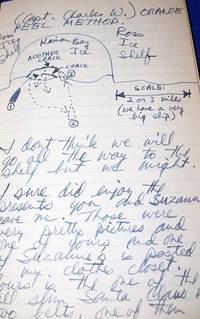
19550002329ASEA ABOARD THE USS GLACIER. Good. 1955. On offer is a super pair of significant original manuscript journals handwritten by Lieutenant P.Y. Matthews Jr. a United States Navy Chief Engineer of the noted USS Glacier detailing the Chief's voyage and participation in Operation Deep Freeze I making for a very detailed account in two volumes beginning in the Antarctic upon arrival December 15 1955 until departure April 1 1956. Written as a group of letters titled 'Dear Jan' it appears from entries in the journal that Jan was perhaps a niece the narrative makes for an intimate sharing of observations and impressions of all the Chief sees. The Chief is as each and every entry attests a personable enthusiastic participant in the voyage who well realizes the significance of the trip. I his own words: 'DEAR JAN The stirring saga of the USS GLACIER the world's most powerful ice breaker and its first polar voyage through six of the seven seas including ice breaking in Antarctica for Operation Deep Freeze I.' We note he writes of sitting down with Admiral Byrd too! Adding great depth are a small number of hand drawn maps diagrams and pictures. Volume 1 is rather half full with 80 or so pages of writings as he only uses the facing pages but Volume 2 contains only a few pages of text the rest is blank as the expedition had ended. Also includes a newspaper clipping about Matthews stating that he had taken much color film footage of Antarctica and Little America. Tucked in is a copy of a document stating that Matthews was in the first landing party on Princess Astrid Coast the original was placed in a cairn there. Overall G.; Manuscript; 8vo - over 7¾" - 9¾" tall; KEYWORDS: HISTORY OF LIEUTENANT P.Y. MATTHEWS JR. US NAVY CHIEF ENGINEER USN UNITED STATES NAVY USS GLACIER OPERATION DEEP FREEZE ANTARCTICA EXPLORATION PRINCESS ASTRID COAST LITTLE AMERICA NAVAL HISTORY NAUTICAL MARINE MARINERS EXPLORERS EXOTIC TRAVEL EXTREME TRAVEL ICEBERGS ADMIRAL BYRD AMERICANA HANDWRITTEN MANUSCRIPT AUTOGRAPHED AUTHORS DOCUMENT LETTER AUTOGRAPH KEEPSAKE WRITER HAND WRITTEN DOCUMENTS SIGNED LETTERS MANUSCRIPTS HISTORICAL HOLOGRAPH WRITERS AUTOGRAPHS PERSONAL MEMOIR MEMORIAL PERSONAL HISTORY ARCHIVE DIARY DIARIES JOURNAL LOG PRIMARY SOURCE FIRST HAND ACCOUNT SOCIAL HISTORY PERSONAL STORIES LIVING HISTORY ANTIQUITÉ CONTRAT VÉLIN DOCUMENT MANUSCRIT PAPIER ANTIKE BRIEF PERGAMENT DOKUMENT MANUSKRIPT PAPIER OGGETTO D'ANTIQUARIATO ATTO VELINA DOCUMENTO MANOSCRITTO CARTA ANTIGÜEDAD HECHO VITELA DOCUMENTO MANUSCRITO PAPELBIOGRAPHY BIOGRAPHICAL AUTOBIOGRAPHICAL AUTOBIOGRAPHY PERSONAL NARRATIVES . unknown
19450007033SOUTH PACIFIC PHILIPPINES JAPAN. Good. 1945. On offer is a rare first-hand record of a naval officer's presence at two significant WWII battles. Labelled "War Diary I and II these volumes are official United States Navy War Diaries from WWII. They are in excellent condition. They each measure 8 inches by 5 inches and contain 196 pages. The covers bindings and pages are all in good condition. The first diary is 100% complete and the second diary is about 11% complete. They also contain wartime Japanese currency and other ephemera. A war diary is a regularly updated official record kept by military units of their activities during wartime. The purpose of these diaries is to both record information which can later be used by the military to improve its training and tactics as well as to generate a detailed record of units' activities for future use by historians. The author of the diaries is Byron F Doenges. Doenges was born in 1922 in Fort Wayne IN. In WWII he enlisted in the U.S. Navy and was commissioned as a Lieutenant in the US Navy Reserve. He was assigned to USS LST 1033. Landing Ship Tank LST or tank landing ship were ocean-going ships built during World War II to support amphibious operations by carrying tanks vehicles cargo and landing troops directly onto shore. LST-1033 was assigned to the Asiatic-Pacific theatre and participated in the assault and occupation of Iwo Jima in February 1945 and the assault and occupation of Okinawa from April through June 1945. Following the war she performed occupation duty in the Far East and saw service in China until mid-July. She was re-designated LSTH-1033 on 15 September 1945. The ship was decommissioned on 1 August 1946 and struck from the Navy list on 28 August that same year. LST- 1033 earned two battle stars for World War II service. After his war service Doenges remained in the USNR rising to the rank of Lt Commander before retiring in 1946. Following his war service he earned an MBA and a PhD. He taught and worked in several universities before entering public service in 1965. He served as economic adviser to the Governor of Oregon before moving to Washington to join the U.S. Arms Control and Disarmament Agency. He served in the agency as Deputy Assistant Director chief of economics and special studies division and finally as senior economic adviser. Doenges passed away in 2006 at the age of 83. His War Diaries documents the ship's journey and participation in the assault on Iwo Jima and Okinawa. And damage assessment of Nagasaki after the atomic bomb had been dropped the repatriation of Japanese soldiers and the transport of Chinese Nationalist troops. The diaries end with his orders to return to the United States. At 0837 underway from Pearl Harbor Hawaii to Eniwetok Marshall Islands operating in Task Unit S1.42.2 via Route Mary. 1300 formed sixty ship convoy with Commander Phil Neikum riding DD LITTLE in command. This ship is in third column from right second ship in column. This convoy is one of 3 similar convoys which is to merge with similar convoys which are to merge at Saipan Marianas to form Task Force 51 for the eventual capture of Iwo Jima . Jan 23 1945 At 0300 sighted salvo flashes and star shells originated by navy fleet units which were bombarding and shelling Iwo Jima volcanoes. 0500 formed cruising disposition # 5 made of 28 LST'S of tractor groups Able and Baker; this ship 14th ship in left hand column. All ships steaming in preparation to line up in single column 5500 yards to seaward of southern beaches of Iwo Jima. 0620 Suribaichi Yama came into view ; the weather was perfect with clear atmosphere At 0741 formed Task Unit 53.3.3 as we came into position before Green Beach #1 .All marines and amphitracks left ship by 0754. . At 0825 aft port pontoon launched to be used as casualty evacuation barge At 0930 this vessel reached its station as casualty ship 4300 yards to seaward Green Beach # 1 Iwo Jima. All while heavy shelling and bombardments by flash units continued while dive-bombers continued strafing and bombing attacks on enemy positions. At 0937 first casualties transported to ship via LCVP's and LCM's from beaches. . Feb 19 1945 Manoeuvring in casualty wound station position 4300 yards to seaward of Green Beach Iwo Jima volcanoes. Casualties close to come aboard after sundown; during daylight hours however when boats can get into beach many casualties were transported to ship. During the night of the 20th approximately ninety Marines remained on tank deck because no boats available or because the APA's would not take them. This is a sad condition because this ship does not have the real hospital facilities an APA has and hence many wounds may have been infected due to delay. The terrific fighting and heavy casualties were in evidence continually. Fleet units and carrier-based aircraft continued to bombard island. 1555 and 1907 enemy aircraft reported in vicinity however none were visible. Feb 20 1945 Anchored as before in Kerawa- Kaikyo Kerawa Retto Okinawa Gunto. 0310 Flash Red alert yellow; heavy enemy air attacks reported at Okinawa Shiwa. 0312 to 0635 exercised at general quarters. No enemy planes or anti aircraft fire sighted in this area. Smoke coverage of this ship was very poor. 0836 to 0851 exercise at general quarters 1047 first casualties arrived wounded from USS Nevada. 1221 underway to shift berths. 1248 anchored in berth K-90 Kerawa- Kaikyo- Kreama Retto Okinawa Gunto. . 1520 & at 1522 the Control became Yellow. Many enemy aircraft reported in vicinity.1630 USS LST 447 preceding from Okinawa to Kerawa Retto and just ready to enter channel was suicided upon by a low flying enemy fighter The ship was hit amidships and a terrific explosion was observed for we were just a little more than a mile north of the beleaguered ship. All ships in vicinity opened fire. At 1640 all hands were seen abandoning the 447. Also at 1640 tea more enemy fighters approached port beam from west side of Fukashi Shima. Again all batteries opened up on attackers one suiciding into SS Logon Victory an ammunition ship and the other demolished by five inch shell hit before it accomplished its mission of diving into another ship. Two friendly F4F's took off the Tulagi CVE 72 at 1645 one was shot down apparently dumping on the other side of the island.1715 first survivors and casualties arrived from LST 447 and the SS Logan Victory; this ships small boat aiding in the rescue work. April 6 1945 Anchored as before. During the mourning ship's officers and army officers aboard went ashore to inspect the Atomic bomb damage at Nagasaki. American troops in force have not yet landed in their area. Got underway for Sasebo Kyushu Japan at 1308 in accordance with CTG 55.7 dispatch dated 200150. . Sept 20 1945 The first of March found LST 1033 skirting the coast of China enroute from Hong Kong to Chaingtao with a load of 832 Chinese troops of the new 1st Nationalist army ship arrived in Chanigtao on March 6 and unloaded immediately. Trip was uneventful. Communist and Nationalist troops were fighting a pitched battle a few miles away while unloading was taking place. Learned that the Chinese first army was completely American equipped however the troops on the whole were very unsanitary. .March 1 1946 . The ship sailed to Shanghai in company with LST's 1046 935 and 96. On 7 March and arrived at the Chinese metropolis on 10 March. However ship did not get into Whangpoo anchorage until 13 March on 15 March ship was notified that she was to load up with 2000 tons of UNRRA food supplies and sail for Hawkow. 1000 miles into the interior to deliver food to starving Chinese.The 1033 was the first LST ever ordered to make a run up the Yangtze River. March 1 to Mar 31 1946 The ephemera includes a 50 Japanese Sen banknote 0.50 Yen. They are part of the withdrawn Japanese Yen banknotes series. The Bank of Japan started issuing these 0.5 Japanese Yen banknotes in 1938. They were withdrawn from circulation in 1945. Also included is a copy of the discharge request on an officer aboard LST 1033 and a draft of Doenges own request for release. This is a thoroughly outstanding documentary record of an American ship and officer in the chaotic last months of WWII and the early days of the Chinese revolution. For a historian is serves multiple purposes. It documents the activities of this ship; it cross-references the names and locations of other ships and officers assisting in filling in the historical record and it speaks to the reach and range of the U.S. Navy and the foreign policy behind its actions. It is truly an eyewitness to history. ; Manuscript; 8vo - over 7¾" - 9¾" tall; KEYWORDS: HISTORY OF BYRON F. DOENGES; LANDING SHIP TANK; LST 1033; IWO JIMA; OKINAWA; NAGASAKI; SHANGHAI; YANGTZE RIVER; U.S. ARMS CONTROL AND DISARMAMENT AGENCY; JAPANESE SEN WAR IN THE PACIFIC SOUTH PACIFIC FORT WAYNE INDIANA USN UNITED STATES NAVY WWII WW2 WORLD WAR TWO AMERICANA HANDWRITTEN MANUSCRIPT DOCUMENT LETTER AUTOGRAPH WRITER HAND WRITTEN DOCUMENTS SIGNED LETTERS MANUSCRIPTS DIARY DIARIES JOURNALS PERSONAL HISTORY SOCIAL HISTORY HISTORICAL HOLOGRAPH WRITERS AUTOGRAPHS PERSONAL MEMOIR MEMORIAL ANTIQUITÉ CONTRAT VÉLIN DOCUMENT MANUSCRIT PAPIER ANTIKE BRIEF PERGAMENT DOKUMENT MANUSKRIPT PAPIER OGGETTO D'ANTIQUARIATO ATTO VELINA DOCUMENTO MANOSCRITTO CARTA ANTIGÜEDAD HECHO VITELA DOCUMENTO MANUSCRITO PAPEL . unknown
19420002558Good. 1942. On offer is a fascinating original 1942 Newfoundland WWII 280 page manuscript diary handwritten from the unique perspective of an Army lawyer Robert Sheldrick who was stationed in Newfoundland where he was responsible for lands and buildings leased or occupied by the Canadian army. An excellent diarist and keen observer detailing his duties and much of what happens around him his service work afforded him many uncommon insights which he shares with his journal. Readers will also be surprised by the complexity of the issues he faces and the work involved. Here are some snippets: 'proposed site for joint services cemeteries for protestant and R.C. personnel near the T.C.A. Building at Torbay had not been approved because coming down to the runway over a cemetery was considered to be well calculated to promote depression among pilots.' October 19 1942 'Advised P.E.I.H. by telephone to strike off strength six men lost in the S.S. Caribou as 'missing believed drowned' on the date of the disaster' referencing the heinous Nazi attack by submarine of a civilian Newfoundland Railway passenger ferry killing 137 many women and children. The significant event and the large scale loss of life is considered one of the most brutal events to occur in Canada and Newfoundland. The largish book a Students MSS Book proper is 269 pages 20 pages tucked in so some soiling. Overall G.; Manuscript; 8vo - over 7¾" - 9¾" tall; KEYWORDS: HISTORY OF NEWFOUNDLAND ROBERT SHELDRICK WWII T.C.A. BUILDING TORBAY S.S. CARIBOU NEWFOUNDLAND RAILWAY PASSENGER FERRY KILLING WW2 WORLD WAR II WORLD WAR 2 CANADIANA LABRADOR PRE CONFEDERATION NEWFOUNDLAND SERVING IN NEWFOUNDLAND CANADIAN ARMY CANADIAN ARMED FORCES HANDWRITTEN MANUSCRIPT DOCUMENT LETTER AUTOGRAPH WRITER HAND WRITTEN DOCUMENTS SIGNED LETTERS MANUSCRIPTS HISTORICAL HOLOGRAPH WRITERS AUTOGRAPHS PERSONAL MEMOIR MEMORIAL AMERICANA ANTIQUITÉ CONTRAT VÉLIN DOCUMENT MANUSCRIT PAPIER ANTIKE BRIEF PERGAMENT DOKUMENT MANUSKRIPT PAPIER OGGETTO D'ANTIQUARIATO ATTO VELINA DOCUMENTO MANOSCRITTO CARTA ANTIGÜEDAD HECHO VITELA DOCUMENTO MANUSCRITO PAPEL . unknown
19350007028NORWAY SWEDEN FINLAND RUSSIA SOVIET UNION. Good. 1935. On offer is a super original and unique 1935 travel diary handwritten by an unidentified Brooklyn woman who left New York July 3rd onboard the steamship "Stavaugerfjiord" to Norway Sweden and Russia. The 7 x 5 inch journal has about 100 double sided handwritten pages with entries through Aug 30 1935. She does a wonderful job describing interactions with passengers and crew mentions her state room receiving a welcome and national anthems played landing in Norway than crossing the border from Finland to Russia. She writes about visiting a Lapp Community in Sweden. Some of the most interesting entries are descriptions of Leningrad & Moscow. She visits the hermitage listens to a factory choir of boys and girls takes a sleeper train to Moscow visits a Russian mining town and much more. Here are some snippets: July 4 1935 At sea board the S.S."Stavaugerfjiord" A beautiful bright day the room was trimmed with American flags and bunting we had a fourth of July celebration on deck the tourist and third class people coming for it. We were awakened at eight by the ships orchestra playing patriotic airs. At 10:45 there was a parade on deck led by the band and participated in by all the passengers each of whom had been given an American flag. Them there was the hymn God of our fathers and address by Rev. S.G. Hauge the hymn God bless our native land remarks by the Captain the hauling down of the Norwegian flag and hoisting of the American flag which flew all day a fourth of July speech by Dr. J.N. Brown and the music patriotic airs. Later on there were Olympic games while we were at the dinner table Mr. lars Esmark. Introduced himself to us. July 15 1935 - Norway Left Oslo at 9:10 this morning and went by train to Lillehammer reaching there about one. the ride was through beautiful fertile country hay was drying on the fences women were turning it in the fields flowers were blooming. July 191935 Beautiful day to day clear & sunny we went out on deck all day and were perfectly comfortable with a coat. We sailed by many snow capped mountains first bare 7 barren rocks & everyone in a while we would come to a little settlement the houses nearly always red & the church white. July 27 1935 Costal waters- Norway Today we stopped at Barentsburg on Green or Greenfijord It is a Russian mining town we called at 7:30 had an early breakfast and went ashore. The Dane the Pole the German Mr Falch the Norwegian lady and I. It was raining and everything was very muddy and desolate looking at he wharf. A building with pictures of Lenin and Stalin with red decorations below them greeting us. The houses were well built - better looking than those at Long Year City. Some of the men spoke to us but none of the women did. They were as well dressed as men and emcee in any mining town on a rainy day would be but no one looks happy and smiling. The only women who was dressed in a coat pants going to the mine who stopped for the German to take her picture. Every building that we went in had pictures of Lenin and Stalin. We went to the children's home or day nursery. We saw two women feeding babies at the breast in that little bit of an alcove. In the larger room were little beds children lay in bed or playing on the floor and several attendants. A statue of Lenin stood on the table. These women smiled and spoke to us. We went to the dining hall where men with their hats on and women were eating than into the recreation hall were men were playing billiards with wooden balls about the size of a croquet ball and one man was playing the piano. Then we went o the fire engine house and to see the cows & pigs. A Mr. Felch said the stables and pens were clean nearly white washed the cleanest things we saw. Everywhere we saw pictures of Stalin and Lenin the red flag and pictures of Russian activities. July 20 1935 Finland Beautiful snow capped mountains with green patches and little villages in open spaces the inevitable red houses & white churches. The air was almost balmy to hot in the sun. Five of us two men and three women went ashore we started to see the Meridian Stone The Polish Naval officer had taken the town's taxi to go. We were walking he overtook us all and took us all in. We were a truly International party. Two Americans a Swedish woman three men a Norwegian and German and Pole. Aug 8 1935 Finish/ Russian boarder - Leningrad. Left Helsinki at 11:20 pm in a comfortable sleeper for Leningrad. At 10:30 we reached the last Finish station where we had breakfast. Then we went a short distance till we came to the small station separating Russia & Finland. On the Finish side is a white building on the Russian side a red one. Half of the bridge over the stream is painted white and half red. At the Russian size Russian officials came on & examined our money counted our express checks and gave us a signed paper with our declaration of money. The baggage examination was very simple the train is made up almost entirely of medical people going to Leningrad to the convention. An intertourist girl guide met us and took us to the Moscow Hotel. It apparently had been a fine hotel in former times and is still very elegant in a shabby way. We have very large rooms electric light telephone private bathing furniture which had once been fine although now rather threadbare. The dining room is a magnificent large room with four large glass chandeliers a high vaulted window and alcove with stained glass window and a platform orchestra which played in the evening. The waiters are dressed in white there is a pathetic air of trying to do things in the right way by the people who do not know how. At noon another shabby & wilted bouquet was at the table but in the evening fresh white flowers where there. At 4:30 we took a sight seeing drive we two a chaffer a girl guide in a broken down car. Leningrad must have been a magnificent city with wide streets fine large buildings parks monuments. We saw the fine square on which the Winter Palace now a museum is located. One the opposite side is the large building built by Catherine the Great. We saw Alexander the III monument with the insulting inscription written there by the communist- the statue of Peter the Great placed by Catherine the Great.We visited a beautiful park near the palace where victims of the revolution were buried. Aug 10 1935- Moscow We left Leningrad last night by sleeper for Moscow very comfortable compartment only the two of us. Reached Moscow in the morning and went to Savoy Hotel where we had single rooms took a sight seeing trip around the city a most magnificent city in the afternoon we drove pas the Kremlin but it was closed and we could see it only distance. We saw the coronation church with its golden domes - the church where the Czar worshiped and the church where many czars are buried but we could nor go in. Lenin's tomb was also closed but we saw the great magnificent square where a red funeral was to be held but we could not go we went into a cemetery and saw Stalin's wife's grave. In the evening we went to a great cinema of the great parade held in the square on June 30 celebrating fourteen or seventeen years of physical advancement before going upstairs to cinema we heard a concert given by boys and girl factory workers.; Manuscript; 12mo - over 6¾" - 7¾" tall; KEYWORDS: HISTORY OF; TRAVEL RUSSIA FINLAND NORWAY AMERICAN FEMALE REMOTE RUSSIAN MINNIG CAMP SWEDISH LAPP VILLAGE MOSCOW STAVAUGERFJIORD LAPLAND SCANDINAVIA LENINGRAD GULF OF BOTHNIA BALTIC SEA BARENTSBURG ON GREEN GREENFIJORD INTERTOURIST HANDWRITTEN MANUSCRIPT DOCUMENT LETTER AUTOGRAPH WRITER HAND WRITTEN DOCUMENTS SIGNED LETTERS MANUSCRIPTS DIARY DIARIES JOURNALS PERSONAL HISTORY SOCIAL HISTORY HISTORICAL HOLOGRAPH WRITERS AUTOGRAPHS PERSONAL MEMOIR MEMORIAL ANTIQUITÉ CONTRAT VÉLIN DOCUMENT MANUSCRIT PAPIER ANTIKE BRIEF PERGAMENT DOKUMENT MANUSKRIPT PAPIER OGGETTO D'ANTIQUARIATO ATTO VELINA DOCUMENTO MANOSCRITTO CARTA ANTIGÜEDAD HECHO VITELA DOCUMENTO MANUSCRITO PAPEL . unknown
18530002566NEWPORT RHODE ISLAND TO CINCINNATI OHIO OH. Fair. 1853. On offer is a super original manuscript travel diary handwritten by one of Mr. and Mrs. Coe as stated in the title/inscription though we bvelieve Mr. Coe did the writing. The Coe's in 1853 of a trip and visit to Cincinnati Ohio. Mr. Coe did an excellent job detailing the trip and the extended stay in the Ohio city on 11 and a half well filled folio pages. Here are some snippets: 'Left Newport October 13th at 8 o'clock in the Steamer Perry for Providence thence to Pawtucket in the cars dined and left for New York by the Stonington Route arrived at 5 on the morning of the 14th walked out to Clinton Avenue stopped with our friends for about ten days passed over the ferry at New York and entered the cars at New Jersey raining very hard for two hours then followed a heavy snow storm which lasted until we reached Elmira a distance of 273 miles which we reached at elven o'clock started again at 4 in the morning for Niagara after dinner visited the falls crossed the bridge to goat Island took a view from the different points there and returned to the house started for Buffalo arrived at 10 waited about 2 hours for the cars and left for Cleveland where we arrived at about 8 in the evening Noticed many interesting objects on the road among which was the various log houses that were scattered along the way some quite neat and comfortable others less so but we observed a great many neat and handsome houses even in the thinly settled parts of the country Arrived at Cincinnati Thursday evening 27th and reached home at about 8 o'clock raining hard but thankful that we have been preserved from every danger and through the goodness of God arrived in safety and good health Went by invitation to hear the Rev Mr Butler in the morning Received a number of friendly calls were all invited and went to take tea and pass the evening with Mr and Mrs Hazard In the afternoon attended the funeral of a Mr Smith a stranger who died suddenly and was buried from the house of Mr Goodman Went in the morning to hear Mr Hansell preached on the subject of the duties of American Citizens to the foreign population took up a collection at the close for the benefit of the colored orphan asylum Was introduced to many ladies among them Mrs Temple widow of one of our former missionary's in the evening quite a large number of gentlemen came in all together forming an large and social party Sunday attended the Vine Street Church which was opened after being repaired heard Rev Boynton read Solomon's Prayer at the dedication of the Temple Overlooking a vast extent of country with a prospect of the Ohio River before us returning passed a building where was a large quantity of bricks being baked here they are made and used in great abundance Went to Mr Boal's church heard from him a very solemn address on the commencement of the New Year he endeavored to show by the prophecies and the signs of the times that the Millennial day was beginning to dawn upon the world and that what was most needed in helping it forward was a higher standard of Christian conduct Went to attend prayer meeting of females conducted by Mrs Finney which was very interesting and in the evening went to the Tabernacle to hear Mr Finney subject the sinner selling his birthright Tuesday made a journey to Dayton a distance of 60 miles left Cincinnati at 8 in the morning in the cars rode through a very pleasant section of country stopped at 15 different places and arrived at the Philips House at 11 it has the Miami river on one side and the canal on the other the streets are very wide and clean crossing each other at right angles we noticed some handsome buildings particularly the courthouse which constructed of stone with the front resting on 6 large pillars Spent part to the day writing and in the evening went to hear Mr Finney preach in the same church where he is laboring for two weeks subject test of character founded on the vision of Ezekiel Sunday went in the morning to hear Mr Finney preached from the passage the sermon was very impressive there were 11 received into the church 5 by letter and 6 by profession of faith 7 miles and 4 females ' There is age toning and some chipping the covers are near useless but Overall G-.; Manuscript; Folio - over 12" - 15" tall; KEYWORDS: HISTORY OF CINCINNATI OHIO CHARLES FINNEY COLORED ORPHAN ASYLUM PREACHER TRAVEL RHODE ISLAND STEAMSHIP TRAVEL AMERICANA HANDWRITTEN HANDWRITTEN MANUSCRIPT AUTOGRAPHED AUTHORS DOCUMENT LETTER AUTOGRAPH KEEPSAKE WRITER HAND WRITTEN DOCUMENTS SIGNED LETTERS MANUSCRIPTS HISTORICAL HOLOGRAPH WRITERS AUTOGRAPHS PERSONAL MEMOIR MEMORIAL PERSONAL HISTORY ARCHIVE DIARY DIARIES JOURNAL LOG PRIMARY SOURCE FIRST HAND ACCOUNT SOCIAL HISTORY PERSONAL STORIES LIVING HISTORY ANTIQUITÉ CONTRAT VÉLIN DOCUMENT MANUSCRIT PAPIER ANTIKE BRIEF PERGAMENT DOKUMENT MANUSKRIPT PAPIER OGGETTO D'ANTIQUARIATO ATTO VELINA DOCUMENTO MANOSCRITTO CARTA ANTIGÜEDAD HECHO VITELA DOCUMENTO MANUSCRITO PAPELBIOGRAPHY BIOGRAPHICAL AUTOBIOGRAPHICAL AUTOBIOGRAPHY PERSONAL NARRATIVES . unknown
18380002214HONDURAS 1838. On offer is a fascinating original significant 1838 - 1840 manuscript diary of an unidentified Englishman in the Central American country of Honduras. While the author is unidentified we believe that there is a familial connection to Lt.-Col. Hugh Guin Macdonnel also spelled Macdonald along other connected family lines whose later 1870s diary while he was a diplomat in Argentina we list separately. Both diaries came from the same estate. The family connection would appear to fit well with his time spent in Honduras with the MacDonalds. Using a 7½ x 9 inch coverless sewn ream of paper he begins writing 21 pages from November 28th 1838 through to January 19th 1840 the author details his times living and traveling in Honduras. Historians and researchers of the Central American country recognize by the dates that the writer has arrived in Honduras at a key moment in the country's history as mere days earlier Honduras had left the Central American Federation after 17 years and becoming an independent and sovereign state in October. While the country's evolving independence is the backdrop the diary reveals a man in turmoil struggling to reconcile his deep feelings and sometimes innermost thoughts with his religious beliefs making for an unusual sharing of those emotions with pen to paper: writing about his frequent companions the Colonel and Mrs. Macdonald: "I rode with Mrs Macd' in the morning.some impure thoughts. I confessed the sin on uncleanliness and prayed for forgiveness.Vanity - I felt sorry that no one witnessed me giving an old man a flannel frock". Casual research reveals this to be Colonel Alexander Macdonald of the Royal Artillery her majesty's Superintendent in Honduras. He writes of his day to day life "Went to the hospital in the morning to visit a sick man. I am afraid he will die. What an awful consideration as I fear he was an habitual drunkard. I prayed for him with Mr Newport who seems to have been the settlements chaplain in his boat.I dined at the barracks.sent a letter about coming home by Patsy Blount.a great deal of work in the office.on Christmas day I rowed poor Ed Strangeways on board the schooner in a little boat to make the men on board a present of two bibles. I observed something very odd in his manner and on landing begged Mr Newport to observe him.We both agreed he was not right in the mind.the most alarming symptoms; on Monday he was bled in both arms.Determined on going home on the Guatemala packet.today the packet has bought me accounts from home and of my brother Neil." He then travels on the Nina and stops briefly in New Orleans. He writes of going to the Theatre there and being "much disquieted with the constant use off the name of God" before returning to England where he states that he has been found a place a Magdalen College Cambridge by his uncle Edward. Overall G. Very Good. 8vo - over 7¾" - 9¾" tall. Manuscript. unknown
1852951865London: Edward Moxon, Dover Street. 1852. Octavo, ca. 197 x 124 mm. (Einband minimalst berieben, erste und letzte Blätter braunfleckig, sehr schönes Exemplar) [10 Warenabbildungen] vi, [1], [1 blank], 165, [2], [1 blank] pp. - 8 pp. (List of Books). Ganzleder Handeinband mit reicher Vergoldung,
19180009036NORD FRANCE FLANDERS YPRES LYS BELIGUM. Good. 1918. On offer is the exemplary and fascinating wartime diary of Lieutenant Charles Sanderson of the Machine Gun Corps of the British Army. The diary covers the entire year of 1918 the last of World War 1. Kept against orders it is very rare to find such a detailed diary outside the archives of the Imperial War Museum or regimental collections. Sanderson notes all the place names and identifies brigades so that it is possible to follow in detail the final stages of the war. In the beginning of the diary Sanderson is in Amiens France. "Wednesday January 1918. Went into Amiens by Lorry from D.H.Q. Arrived at 9.00am. Bought Christmas Dinner for Company. Stayed all night at the Hotel de L'Univers. Coy. relieved in line by 7th Coy." The diary entries are most often short and concise matter-of-fact jottings on what was done by his company that day and the movements of other companies and officers: "Received orders for Coy. to go into line tomorrow. Won 35 fr. at Bridge."; "Rode toward Bgde. 195 Coy. in morning to 200 Coy. A.S.C. in afternoon. Went to Benatre at night to fetch in broken down G.S. wagon belonging to Bgde. H.Q."; "Rest of Br. Transport turned up in late morning. Nothing doing all day."; "Marches from Bois de Courton at 4.00 am and arrive at Germaine about 9.0 am. Entrains at 5.30 pm and detrains at Fere en Champenois at 9.30 pm. Went in lorries to Bn. at Corroy." There are also numerous entries of the fighting around him and his company. "Heavy bombing again at night. Bombs all round us but nothing hit at all in our Brigade."; "Aeroplanes about again but no bombs dropped near us."; "Badly bombed at night. 199 Coy. A.S.C. lost all their horses." In March Sanderson has leave for two weeks. He travels back to London to be with his family. "March 1. Arrived Boulogne about 6.15am. Had breakfast at E.F.C. embarked 8.30 am. Rough passage. Arrived London 2.30 pm. Went to palladium at night with Uncle Laura."; "March 9. Played golf with Dad Upjohn and T. Roman. Went to Upjohn's afterwards to play cards"; "March 15. Crossed to france in afternoon and stayed the night at the Cafe de la Pork." He is back with his company by the 17th. His company then moves onto Bucquoy France then Bonneville then Armentieres in Flanders. Here they see combat. "April 8. Attack south of Armentieres began. Part of 74th Coy. went up at night. Rode over to Free's Cashier at Ravesburg in morning." This is the beginning of the "Battle of the Lys" also known as the Lys Offensive the Fourth Battle of Ypres the Fourth Battle of Flanders and Operation Georgette which would last from April 7 to the 29th. The month of April is filled with entries about this battle. "April 10. Still at Ravelsburg but expect to move at any time. Took ammunation up to Petite Monque Farm at night."; April 14. Moved from field near Berthen to Boechepe - Abelle Road. Mess in at Boechepe. Took rations up to Dranoutre but could ot find men."; "April 22. Walked over to R. E. Park and to 199 Coy. A.S.C. in afternoon. Played bridge in evening with Dr. and Aycock and won 5 fr."; April 26. Attacked in morning & retook Kemmel Hill. Had to come back on French did not move." April 30. Heavy bombardment during day but no infantry attacked." After the Battle Sanderson takes leave in Paris: "May 17. Still in Paris having a hell of a time. Bolam & Markielle returned in evening. Went to Casino de Paris but had to leave early as there was air raid warning." After Paris he returns to his company and the trials and tribulations of war return: "May 27. Bosche attack started at 10 am. Drove us back. Moved transport back to Bourancourt and then to Lonchery Roady & then to Grevy. Out all night. Looking for Br. H.Q. and rations." Boche is a French slang word for 'rascal' first applied to German soldiers during World War One "June 16. Italians came to reconnaitre line to relieve us tomorrow night night. Major Courtaullo came up to take Command of Coy." Much of the diary follows this pattern. There are long days of his company's movement going to where they are needed and there are days where attacks and battles are witnessed and fought. In between all the moving and fighting Sanderson has his leaves from the military. These passages are much more detailed and jubilant than all the others for obvious reason. Whether in line or on leave Sanderson is quite the gambler and many passages end with him playing poker and winning or losing money. As the war nears its end there are still occasional entries of battle. In the end of October and the early part of November the last weeks of the War Sanderson sees heavy fighting in Northern France and Beligum. "October 16. Did attack with 55th Div. not a big success and had lot of casualties. Stayed with S.A. Bgde. in tavern W. on Montay."; "October 17. Still in same place with guns gradually pushing forward."; October 23. Operated with 7th 75th Bgds. in attack east of Le Calean. Took L'Eveque Wood. Moved from Quenette Farm to Pommereuil in morning living with combined Bgde. H.Q."; "November 4. Started fresh attack from neighbourhood of Fontaine au Bois. All going well. Went up to take over 'C' Coy. after Lime was wounded. Move in evening from Le Fause.; "November 6. Advanced again with guns moving behind advanced guard. Moved up with 7th Bgde. in evening to Faisniere. Put 8 guns in outpost line in evening Rept. 8 in reserve in Dompiere." The war ends on November 11: "November 11. 'Cease Fire' went at 11.00 am. So nothing more done except 'Celebration.'' The rest of the diary is comprised of pretty short entries: of parades church salvage duty and other post-war activities. On December 31st he writes: "Very wet all day & nothing doing. Months leave approved by XIII Corps. Made money in the evening at bridge." After the diary entries there are a number of detailed pages of 'Cash Accounts" that show all the money Recieved from and Paid to throughout the year. The book is roughly 100 pages long with almost every single entry on every page written in. There is a green cloth cover and structurally the book is in very good shape. Sanderson writes in pen with no smudge marks and his handwriting is very easy to read. Included as well is thin blue "Army Book 439" which was issued to every combatant officer below the rank of Lieutannt-Colonel. It has much personal and military information of Sanderson including army courses taken service record promotions received 1st Lieutenant - June 1st 1917; Captain - May 29 1918 and an employment form for when discharged from the Machine Gun Corps. The book is also in very good condition and is 12 pages long.; Manuscript; 8vo - over 7¾" - 9¾" tall; KEYWORDS: HISTORY OF CAPTAIN CHARLES SANDERSON ACTING CAPTAIN LAST YEAR OF WW1 WORLD WAR ONE MACHINE GUN CORPS BRITISH M.G.C. BELGIUM NORD FRANCE BATTLE OF LYS FERE EN CHAMPENOIS ARMY BOOK 439 KEPT AGAINST ORDERS LYS OFFENSIVE FOURTH BATTLE OF YPRES FOURTH BATTLE OF FLANDERS OPERATION GEORGETTE END OF THE GREAT WAR NON COMMISSIONED OFFICER ARMISTICE DAY WRITTEN DEPICTIONS OF BATTLE BRITANNICA HANDWRITTEN MANUSCRIPT DOCUMENT LETTER AUTOGRAPH WRITER HAND WRITTEN DOCUMENTS SIGNED LETTERS MANUSCRIPTS HISTORICAL HOLOGRAPH WRITERS AUTOGRAPHS PERSONAL MEMOIR MEMORIAL ANTIQUITÉ CONTRAT VÉLIN DOCUMENT MANUSCRIT PAPIER ANTIKE BRIEF PERGAMENT DOKUMENT MANUSKRIPT PAPIER OGGETTO DANTIQUARIATO ATTO VELINA DOCUMENTO MANOSCRITTO CARTA ANTIGÜEDAD HECHO VITELA DOCUMENTO MANUSCRITO PAPEL . hardcover
18900002315SOUTHERN ENGLAND GREAT BRITAIN. Good. 1890. On offer is a super original manuscript relic of travel through England on its inland waterways and canals as handwritten by the intrepid author "Rutland Bleign" but really unidentified as it seems a pseudonym who is travelling with his friend and illustrator the brace working to publish the as titled book: "In Tow: The Chronicle of a Cruise in a Monkey Boat." Written from August 6th through the 28th in 1890 he leaves off the year but some sleuthing concluded definitely the year as stated the manuscript which appears unpublished details the three week cruise on the historic canals of Southern England at the perfect time for historians and researchers of canal travel as in 1890 while some were in peak years of usage while others beginning to see the inevitable decline due to increased railway service. Rutland is an erudite witty raconteur in this travel account. Here are some snippets: ". after a ramble round the town I took our permit to the Canal Office to be initialled in due form and had a chat with the agent Mr. White. returning to our boat. I found a very serious gentleman with a pencil and notebook in hand. announced himself as the Canal-Boat-Inspector-for-the-Newbury-District-under-the- Local-Government-Board. he wanted to know how much women children and other livestock were onboard. if any of us were subject to hydrophobia Asiatic cholera smallpox or other little ailments of that sort. the blue books had already told me; but then as its owners the G.W.R. Great Western Railway get the traffic which it would otherwise take it seems to be merely a transference from one pocket to the other. No doubt the Railway people would close the Cut tomorrow if their powers allowed them which fortunately for us easy-going folk who infinitely prefer their water- to their iron-way is not the case." "The canal closing Sunday rule is absolutely stringent it appears and even a party of G.W.R. officials Great Western Railway who came down the canal for a weekend 'trip' were not allowed to infringe it. As the pleasure traffic begins to feel its way along these hitherto almost unknown waters this regulation will naturally become more & more irksome and will probably be relaxed eventually." ".Melksham. the sunny old Quaker town. the grand old Quaker enterprise and grit which made the place had largely disappeared but Sir Robert Fowler still is there and the methodist connextion is evidently strong." ". beyond a square orchard with some lumps in the turf. Stanley Abbey. our host insisted on our partaking in some home brewed wine vintage '86 Chateau Rhubarb Beds of subtle flavour and half inclined to be sparkling." "We begin to expect great things of 'New Swindon' and may after all have to spend more than the inevitable 'ten minutes for refreshment' which begins and ends most peoples acquaintance with the place; and which must have brought a fortune to the far seeing contractor who stipulated for that stopping clause in his lease with the Railway Company." Overall G.; Manuscript; 8vo - over 7¾" - 9¾" tall; KEYWORDS: HISTORY OF RUTLAND BLEIGN 19TH CENTURY ENGLAND CANALS CANAL CRUISES ENGLISH WATERWAYS TRAVEL BY CANALS MONKEY BOATS THE DECLINE OF TRAVEL BY INLAND WATERWAYS DAWN OF RAILWAY ERA BRITTANICA RAILROADIANA RAILWAYS TUGS RAILROADINGHANDWRITTEN MANUSCRIPT AUTOGRAPHED AUTHORS DOCUMENT LETTER AUTOGRAPH KEEPSAKE WRITER HAND WRITTEN DOCUMENTS SIGNED LETTERS MANUSCRIPTS HISTORICAL HOLOGRAPH WRITERS AUTOGRAPHS PERSONAL MEMOIR MEMORIAL PERSONAL HISTORY ARCHIVE DIARY DIARIES JOURNAL LOG PRIMARY SOURCE FIRST HAND ACCOUNT SOCIAL HISTORY PERSONAL STORIES LIVING HISTORY ANTIQUITÉ CONTRAT VÉLIN DOCUMENT MANUSCRIT PAPIER ANTIKE BRIEF PERGAMENT DOKUMENT MANUSKRIPT PAPIER OGGETTO D'ANTIQUARIATO ATTO VELINA DOCUMENTO MANOSCRITTO CARTA ANTIGÜEDAD HECHO VITELA DOCUMENTO MANUSCRITO PAPELBIOGRAPHY BIOGRAPHICAL AUTOBIOGRAPHICAL AUTOBIOGRAPHY PERSONAL NARRATIVES . unknown
1861000671ALBANY New York. Good. 1861. On offer is a significant 1861 Albany New York REPUBLICAN ARTILLERY COMPANY 25th REGIMENT Company A New York State Militia NYSM handwritten Civil War diary and journal completed by Private J. McClelland. On April 15th 1861 President Lincoln called on the States to provide 75000 militia men to meet the call of insurrection for a total of 3 months of duty. The 25th Regiment Company A NEW YORK STATE MILITIA was called up to answer President Lincoln request. This sensational artifact begins April 22 1861 to May 25th 1861 nineteen pages text. For the most part it is written in one hand in ink starting with a list of all the officers and enlisted men including musicians. A total of 82 privates 4 Sgt. 10 musicians 4 corporals 1 Capt. J. Fredendall and 3 Lieut.s Myers Pechim and Stackhouse. Handwriting is very legible. It also lists 3 of the soldiers who died including a Sgt. who started a diary of this company and died before completing it. Research suggests this is not that diary but most likely a source that may have been used by McClelland. The diary is not in chronological order since there are early written references to June 1861 and then later May 1861. The author was most likely was using recollections and written notes of the Sgt. who passed away as mentioned in this written account. This very scarce early Civil War diary highlights a meeting with President Lincoln some fighting early in the war as the 25th took part in the advance into Virginia and occupation of Arlington Heights May 24 1861 and capturing rebel pickets etc. Here are some snippets: "They left Albany on 4/22/1861 for Washington D.C. for 3 months. Did trench work at Arlington Heigths Virg. starting June 20." "On April 28th marched to Casperi's House. Tuesday the 30th the troops were visited by "Abe the President" and Seward. On May 4th sworn to service to the U.S. service to May 23rd. On the 23rd moved into Virginia with 14000 other troops and arrived at Roach's house.who at 4 a.m. took out a pistol and was subdued by the troops. At 8 a.m. saw 2 cavalry pickets who attempted to flee were captured and brought under guard and marched to Washington." "The Rifle Co. being in the rear of the regiment kept on the raid to Harper's Ferry instead of turning to Alexandria as the regiment did." "On May 25th a report went to Washington that they were being cut to pieces and Sherman's battery came over a long bridge flying to our assistance." This leather bound ledger style book was used as the diary/journal along with some Masonic information since McClellan was the treasurer of a Masonic Temple in Wadsworth N.Y. A scarce first hand account of the early Militia and its duties and battle in the Civil War. There are also some bit of ephemera including a few newspaper clippings found in the diary relating to McClellan as a Mason.; Manuscript; 16mo - over 5¾" - 6¾" tall; HANDWRITTEN MANUSCRIPT DOCUMENT LETTER AUTOGRAPH WRITER HAND WRITTEN DOCUMENTS SIGNED LETTERS MANUSCRIPTS HISTORICAL HOLOGRAPH WRITERS AUTOGRAPHS PERSONAL PERSONAL HISTORY MEMOIR MEMORIAL DIARY JOURNAL DIARIES JOURNALS LOG LOGS KEEPSAKE AMERICANA Civil War War Between the States LINCOLN NEW YORK ALBANY MILITIA SLAVERY ABOLITION SEWARD VIRGINIA ARLINGTON HEIGHTSN.Y.S.M. NYSM NEW YORK STATE MILITIA ATILLERY . hardcover
87313San Francisco: Arion Press 1986. First Edition. First Edition. One of 425 copies this being No. 50. <br /> <br /> A portfolio of 156 bird portraits with a companion biography of the naturalist and Grayson's notes on the plates. Grayson has been hitherto largely unknown. This lavish reproduction of his paintings and the accompanying biography bring to a wider audience a recognition of his place in American ornithological history. Prospectus laid in. <br /> <br /> Fine in a Near Fine tan dutch linen tray case with just a bit of spotting to the bottom of the case not affecting any of the interior or plates and some bowing to the case lid. Companion volume is Fine in the same cloth and gold-stamped leather labels in a Fine matching slipcase. <br /> <br /> Portfolio: 160 leaves 25 x 19 inches; companion volume: 436 pages 12 x 9 inches printed in Monotype and handset Van Djick and handset Castellar capitals on Coventry Rag paper in two weights heavy weight for the plates light weight for the text from the Parson Paper Mill. Arion Press unknown
1995006454New York: Times Books 1995. Hardcover in non price-clipped dust-jacket. 403pp. True Times Books First edition first printing using the Randon House number string 9-2 Random House did not use "1" but rather removed words "first edition" when going to 2nd printings. Correct price on dust-jacket flap: $23.00. Black cloth spine with gold lettering over white boards. No previous ownership marks. No remainder marks. A very clean square tightly bound copy of Obama's first book now very scarce as most of the initial 7500 print run went to libraries. Book has no faults and appears new dust-jacket has no tears or chips and only a hint of shelf-wear. A very nice copy of a very difficult to locate book. Fine in a near fine dust-jacket. First Edition. Cloth Spine Over Boards. Fine/Near Fine. 8vo - over 7¾" - 9¾" tall. Times Books Hardcover
1939863H4593New York: Longmans Green and Company Co. 1939. Book. Good. Hardcover. Signed by Authors. First Edition. 8vo - over 7¾" - 9¾" tall. Signed and affectionately inscribed by Carter Glass upon front free endpaper. "Here is a character composed of truth sincerity and courage. He hates deceit and detests a lie. But this Jeffersonian Democrat possesses a rarer integrity which we call intellectual integrity. Appointed to the Banking and Currency Committee in 1904 the supreme opportunity soon came to him to be the chief architect of the Federal Reserve System. He became the great post-WWI Secretary of the treasury and won Woodrow Wilson's intimacy trust and praise. He came to the Senate and is the most outstanding Senator Virginia has ever contributed to the nation's chief deliberative council." - Introduction. xv 1 519 pages. Index. Four black and white plates. Unmarked with average wear to publisher's navy blue cloth. Binding sound. Above-average wear to dust jacket now preserved in mylar. Photocopy of New York Times book review dated May 28 1939 laid-in. A sound signed copy of the life story of this highly-influential Virginian. Longmans, Green and Company Co. Hardcover
1946516H2195New York: The Philosophical Library. Good in Fair dust jacket. 1946. First Edition. Hardcover. xvi 498 pages. Index. Forty-nine black and white photos and illustrations. Map of India. Frontis portrait of author. "The subtle but definite laws by which yogis perform miracles and attain complete self-mastery are explained with a scientific clarity." - Dust jacket. "His unusual life document is certainly one of the most revealing of the depths of the Hindu mind and heart and of the spiritual wealth of India ever to be published in the West." - Preface. Selected as one of the "100 Most Important Spiritual Books of the Twentieth Century" by a committee led by Philip Zaleski on behalf of HarperSanFrancisco. Included in the book "50 Spiritual Classics" by Tom Butler-Bowdon. Unmarked with moderate wear to beige publisher's cloth. Binding sound. Above-average wear to dust jacket now preserved in archival-grade Brodart. Steve Jobs thought so highly of this work that departing attendees of his memorial service were each given a copy.; 8vo - over 7¾" - 9¾" tall; Yogananda Paramhansa Yogi Biography Autobiography Luther Burbank . The Philosophical Library hardcover
19660001918VIETNAM. Very Good. 1966. On offer is a very interesting original manuscript relic dated September 6 1966 through October 1 1967 of the Vietnam War and American involvement handwritten and typed by US Special Forces Chaplain David G. Boyce b.1928 - d. March 4th 2013. One part "Duty Log" and moreso a diary of all his movements and his personal thoughts regarding his service this is a very intimate personal history. There are even some movie plots he has imagined and poetry and songs - Boyce was quite a Renaissance man it appears! Using yellow legal pad paper originally handwritten the author changes over to a typed manuscript of 350 pages doing a superb job of recording names ranks operational duties and much much more. He does at times use blank spaces to be discreet and sometimes he admits he has forgotten the name. Here is a sample passage - spelling and typing mistakes intact: I remember the invitation of the Mike Force CO who is up here with a company guarding the camp while it is under construction. He and Sgt. Matthews the first sergeant had said to come on over and visit. I decided that if I dedn't get out that I would do just exactly that. I would go visit the Mike Force since I had now payed my visit to the Strike Force. I sat outside the team tent TOC for a while. Then I went inside and talked with Capt Horn CO. I told him my plan and gave him sixteen 16 of the Lubbock Texas "To a Soldier in Vietnam" letters- He said that he did not want to be abrupt but he had to leave for a meeting. We parted on this note. He went to his meeting and I went to gather my gear to go to Mike. Went outside and found that Sgt. Pederson was leaving. He said that he would give me a ride. He is E-7 acting team Sargeant. He took me down about 1700 to the Mike force location near the river- I dismounted and walked out into the woods. I saw the China Boy troops. They were obvisiuly Chineese. They kept pointing me farther back into the woods. Away from the road. Finally I came across two 2 Americans- It was Sgt. Leon and Sgt. Hoskins and Sgt. Leon came over and picked up my pack and took it for me over to the next object a half building 35 meters farther back. It looked like a half built house with posts and part of a back wall and about half of a grass roof with bamboo beams. This was the CP. Here I found the C.O. Capt. ----- Sgt. Matthews and Sgt. Lopey. I was given a very warm reception. It was the warmest that shave received since being in Vietnam. Even better than the one I received at Don Phuc mike force which was the best one that I had received up to that time. The warmth of their reception more than made up for the cold night that I was to spend there. I sat down and was introduced all around and told them that I remember Lopey from Bragg. He has a wife that is from Munich Germany and he now has orders to the 10th Group. Sgt. Leon is a dew and wanted to know why some of the ranking Chaplains are not ______. Sgt. Hoskins is called snake because he is very fearful of snakes. He is intrepid in battle is not afraid of death but he does not like snakes. The CO has orders to Fort Benning. He says that he is going "home". He knows Col. Stanly. He went through VW school with him and on one of their field problems he was point man one night and fell unto a 30 foot well. Sgt. Natthews is an old soldier with another couple to go which he will do in ROTC at _________ and hopes to continue there in ROTC after he retives. As a civilian the state pays half and federal pays half. Sgt. Hoskins has 23 years in Air _______ Since 1943. He was in the 519th Abn Bn that Gen. Yarbrough was in- Black Potch with the Red out line of a C-42 door and a resene parachute in the foor- He says that he will shortly retive and go to work in D.C. investigating welfare cases- His goal is to stamp out welfare- I sat down and they asked if I had eaten. I said no and told then that I wanted some of that pork and rice they had promised me. The served me with a big bowl of rice and pork with cooked cucumbers tasted like cooked turnips and a glass and a half of chocolate milk. It was a good meal because the fellowship was so good. I used several helpings of soy sauce to make it down and finished the entire bowl. Then we sat around batting the breeze which I usually don't enjoy but I did enjoy with them. Some one asked for the time and then some one said 1745. Shortly afterwards I need a watch to be more accurate there was a couple of explosions like a grenade heard off toward the river. Some one said that they are playing with grenades down there. Then there were more explosions and the sound an automatic weapon and some one called out four the Nungs Vee Cee! With that everyone started to scurry around. I was frightened so I took my cigar and put it is my mouth so that I would appear more calm than I was. I had a cigar because I had previously passed out cigars to Sgt. Matthews Sgt. Lopeg and Sgt. Leon- the CO and Sgt. Hoskins don't smoke- I put the cigar in my mouth and went over to my ruck sake and put on my tiger suit shirt I don't know whyand put on my webb gear. Next I dug out my 45 pistol and then had to hunt for the chips. I put a chip in but did not put a round in the chamber. Next I stood around trying to look calm with my cigar in my mouth. I went to the Nortor pit and watched then five the 60 MM nortors. They fived 5 had a misfire cleaved the barrel. I was very apprehensive as they cleaved the chamber and I tried to edge away without being too conspicuous. He finally cleaved it and began to fire some more. When he completed the fire mission the sound of firing died away and I thought that it was all over. I wandered back toward the CP trying to be as nonchalant as possible just as I reached the edge of the CP roof everything opened up all at once. I was frightened and the man standing next to me who was acting as my body guard told me to get in the hole that had been dug at the edge of the CP. I gladly got in. I thought that we were being over run because of the valume of fire power that was being put out. I pulled out my 45 and tryed to put a round in the chamber. It would not go. I pulled out the clip and all the bulled fell out. My Chineese body guard very calmly said "#10" and proceeded to take my clip and put the rounds in it while I helf his carbine. I than realized that I showed carry my carbine with me when I go out on field trips. It would be best to have a folding stock. He fixed the clip and I stock it in my weapon and put a round in the chamber and held the 45 on ready. I was expecting to see the VC any minute. My body guard then commented. "No VO". I couldn't see how this was possible but he said it several times with calmness and I began to be less frightened. I then got up out of my crotching position and sat on the edge of the foxhole. Again he saig "No V.C." and by now I began to believe him. With his words of assurane ringing in my lars I found the comrage to get up out of the fox hale and wander around. The firing was still going on but not with the first initial intersily. Behind the CP I found Sgt. Matthews firing the rocket launcher. He fired at least 4 or 5 rounds with the new self contained unit. The firing of the rocket launcher just about finished up the firing. A FAC came over. Sgt. Matthews wanted Francois to go down the road and locate China Boy 3 the CO & Sgt. Leon & Sgt. Hoskins & Sgt. Lepey. They would not come up on the radio. Francois did not seem inclined to go look. Soon they came in the CO and the ones who had gone out to investigate. The CO gave me a suvineer the tailfin off of a rifle grenade home made type that the local VC us. There had been 4 VC local type they had been firing at a jeep or trying to get in close enough to the New Camp for night _______ or trying for revenge on the Mike Force. As an informal critize it was pointed out that there were 4 VC. We did not get a one of them and in the process $5000.00 worth of ammo was expended. The heavy valume of fire at the end which had frightened me was the firing of their weapons out of frustration and out of just wanting to fire the weapons. Sgt. Matthews said that the time to be scarred is when you hear the "crack" of the bullets. Then you know that is incoming. Then is the time to be frightened- I realized that I had just about chewed the cigar into and also I realized that I was sweating out of fright. I threw away the cigar slobb and wiped my sweaty brow. Adding additional breadth to this personal account are more than a dozen photos many original of the writer who was the senior officer and the head of the Chaplain's Unit his colleagues and other Officers. Boyce we learn from a news clipping was a member of the Mecklenburg Presbytery Church of Charlotte North Carolina and distinguished as the first Presbyterian to be selected as a Special Forces Chaplain. He was also a jump master and fully qualified for the elite 3rd Special Forces Airborne Group. Further research regarding his military record list his military specialties which include an unusual and very intriguing record as Special Forces Officer Training Officer Chaplain and Parachutist. Research also notes many awards and decorations. Overall VG.; Manuscript; 4to - over 9¾" - 12" tall; KEYWORDS: HISTORY OF VIETNAM WAR SPECIAL FORCES US ARMY VIET CONG SOUTHEAST ASIA NAM DAVID G. BOYCE 3RD SPECIAL FORCES AIRBORNE GROUP SPECIAL FORCES CHAPLAIN CHAPLAINS' CORPS AMERICANA HANDWRITTEN MANUSCRIPT AUTOGRAPHED AUTHORS MANUSCRIPT DOCUMENT LETTER AUTOGRAPH KEEPSAKE WRITER HAND WRITTEN DOCUMENTS SIGNED LETTERS MANUSCRIPTS HISTORICAL HOLOGRAPH WRITERS AUTOGRAPHS PERSONAL MEMOIR MEMORIAL PERSONAL HISTORY ARCHIVE DIARY DIARIES antiquité contrat vélin document manuscrit papier Antike Brief Pergament Dokument Manuskript Papier oggetto d'antiquariato atto velina documento manoscritto carta antigüedad hecho vitela documento manuscrito Papel . unknown
19030001815PEGGY'S COVE NOVA SCOTIA NS CANADA. Good. 1903. On offer is a superb Peggy's Cove Lighthouse manuscript ledger book issued to and kept by Lighthouse Keeper Sidney H. Garrison from January to December 1903. The pre-printed journal was published by the Canadian Dept. of Marine and Fisheries specifically for use by the Lighthouse Service. A page for each month consists of a form where the lighthouse keeper noted the date weather time of lighting extinguishing total burning time and the amount of oil chimneys and wicks used along with general remarks. This diary pertains to the original lighthouse which eventually succumbed to the elements in 1914 causing it to be rebuilt. The lighthouse at Peggy's Cove remains one of the most iconic coastal landmarks in North America since 1766. The folio sized book is filled with one year's worth of lighthouse data and/or observations for all twelve months of 1903 have been completed in this diary revealing lighthouse keeper Garrison's various observations and insights over the course of a full year. Entries range from day-today remarks to critiques of his predecessor and concerns regarding the condition of the lighthouse. Day-to-day entries include: "Heavy Sea" "Very Heavy Sea" "Birds Flying" "Very Smooth" "Stormy Night" "Ship Passed Out" "Steamer Passed Out" "Winds Blowing Heavy" "First Birds" "Mackerel Schooling" "Heavy Storm" "Heavy Gale" "Bad Weather" "Coldest Night" etc. Lighthouse keeper Garrison's more elaborate "Report" notes include: "On the 17th inst. I put the spare lamp which was standing idle in the light room in the lantern and timed it Leeward and I presume it will improve the light." Jan. 31st 1903. "I am receiving many congratulations for keeping a good light since I have taken charge of the station. The Light keepers on Green island Lunenburg Co. which is nine miles distant says my light has double the power it had under the late keeper" March 30th 1903. "I am in need of a new Book of rules and regulations for the guidance of Light House Keepers; the one left by the late Keeper is torn and dirty" April 30th 1903. "I have repaired up the old fence as well as possible until I get a new one which is badly needed. I have also cut and scraped lots of the old putty from around the Lantern glass which was cracked and shrunken thus causing it to leak and replaced it with new putty and paint and it is now thoroughly tight" June 30th 1903. HISTORICAL NOTES: One online source provides: "Peggy's Cove is one of the best known most popular lighthouses of Canada. The original Peggy's Cove Lighthouse was built in 1868. The present concrete tower built in 1914 is located just a few feet above the site of the old wooden structure which deteriorated and was destroyed." See: Julie S. Taff's "Lighthouses: A Photographic Tour" p. 29. Peggy's Cove is a small rural community located on the eastern shore of St. Margaret's Bay about 43 kilometres 26 miles southwest of downtown Halifax Nova Scotia Canada. It comprises one of the numerous small fishing communities located around the perimeter of the Chebucto Peninsula. The community is named after the cove of the same name a name also shared with Peggy's Point immediately to the east of the cove. The village marks the eastern point of St. Margaret's Bay. The first recorded name of the cove was Eastern Point Harbour or Peggs Harbour in 1766. The village is likely named after Saint Margaret's Bay Peggy being the nickname for Margaret which Samuel de Champlain named after his mother Margarite. There has been much folklore created to explain the name. One story suggests the village may have been named after the wife of an early settler. The popular legend claims that the name came from the sole survivor of a shipwreck at Halibut Rock near the cove. Artist and resident William deGarthe said she was a young woman while others claim she was a little girl too young to remember her name and the family who adopted her called her Peggy. The young shipwreck survivor married a resident of the cove and became known as "Peggy of the Cove" attracting visitors from around the bay who eventually named the village Peggy's Cove after her nickname. The village was formally founded in 1811 when the Province of Nova Scotia issued a land grant of more than 800 acres 3.2 km² to six families of German descent. The settlers relied on fishing as the mainstay of their economy but also farmed where the soil was fertile. They used surrounding lands to pasture cattle. In the early 1900s the population peaked at about 300. The community supported a schoolhouse church general store lobster cannery and boats of all sizes that were nestled in the Cove. Many artists and photographers flocked to Peggy's Cove. As roads improved the number of tourists increased. Today the population is smaller but Peggy's Cove remains an active fishing village and a favourite tourist destination. Peggy's Cove is one of the busiest tourist attractions in Nova Scotia and is a prime attraction on the Lighthouse Trail scenic drive. The community's famous lighthouse marks the eastern entrance of St. Margaret's Bay and is officially known as the Peggy's Point Lighthouse. Peggy's Cove has a classic red-and-white lighthouse still operated by the Canadian Coast Guard. The light station is situated on an extensive granite outcrop at Peggy's Point immediately south of the village and its cove. This lighthouse is one of the most-photographed structures in Atlantic Canada and one of the most recognizable lighthouses in the world. Visitors may explore the granite outcrop on Peggy's Point around the lighthouse; despite numerous signs warning of unpredictable surf including one on a bronze plaque on the lighthouse itself several incautious visitors each year are swept off the rocks by waves sometimes drowning. The first lighthouse at Peggy's Cove was built in 1868 and was a wooden house with a beacon on the roof. At sundown the keeper lit a kerosene oil lamp magnified by a catoptric reflector a silver-plated mirror creating the red beacon light marking the eastern entrance to St. Margaret's Bay. That lighthouse was replaced by the current structure an octagonal lighthouse which was built in 1914. It is made of reinforced concrete but retains the eight-sided shape of earlier generations of wooden light towers and stands almost 15 metres 50 ft high. The old wooden lighthouse became the keeper's dwelling and remained near to the current lighthouse until it was damaged by Hurricane Edna in 1954 and was removed. The lighthouse was automated in 1958. Since then the red light was changed to white light then to a green light in the late 1970s. Finally to conform to world standards the light was changed to red in 2007. The lighthouse used to contain a small Canada Post office in the lower level during the summer months serving as the village post office where visitors could send postcards and letters. Each piece of mail received a special cancellation mark in the shape of the lighthouse. However Canada Post closed the lighthouse post office in November 2009 citing mould growth as a safety hazard. The book is in original stiff marbled wraps with label pasted to front cover; moderate cover wear with tear to lower corner of back cover end pages toned generally clean internally with ink bold and legible throughout. Volume is complete save for some loss at the rear lower corner containing 26 pages of manuscript entries comprising all 12 months of 1903. Folio measures approx 13" tall x 8.25" wide. Overall G.; Manuscript; Folio - over 12" - 15" tall; KEYWORDS: HISTORY OF LIGHTHOUSE KEEPER SIDNEY H. GARRISON PEGGY'S POINT PEGGY'S COVE MARITIME NOVA SCOTIA CANADA CANADIANA SIDNEY H. GARRISON CANADIAN DEPT. OF MARINE AND FISHERIES LIGHTHOUSE SERVICE ST. MARGARET'S BAY EASTERN POINT HARBOUR PEGGS HARBOUR GREEN ISLAND LUNENBURG CO CHEBUCTO PENINSULAPEGGS HABOR HANDWRITTEN MANUSCRIPT DOCUMENT LETTER AUTOGRAPH DIARY JOURNAL LOG KEEPSAKE WRITER HAND WRITTEN DOCUMENTS SIGNED LETTERS MANUSCRIPTS HISTORICAL HOLOGRAPH WRITERS DIARIES JOURNALS LOGS AUTOGRAPHS PERSONAL MEMOIR MEMORIAL PERSONAL HISTORY AMERICANA ANTIQUITÉ CONTRAT VÉLIN DOCUMENT MANUSCRIT PAPIER ANTIKE BRIEF PERGAMENT DOKUMENT MANUSKRIPT PAPIER OGGETTO D'ANTIQUARIATO ATTO VELINA DOCUMENTO MANOSCRITTO CARTA ANTIGÜEDAD HECHO VITELA DOCUMENTO MANUSCRITO PAPEL . paperback
19310001735JOHANNESBURG SOUTH AFRICA SA TEL AVIV ISRAEL. Good. 1931. On offer is a fascinating significant original archive of three 3 manuscript books; being two 2 diaries covering 1930s through 1990s and one 1 book of personal thoughts writings and copies of his favourite essays poems and observations handwritten by Yehuda Lieb Frank a fascinating individual originally from South Africa then Israel and back to South Africa and Israel again biographical notes follow the listing. Lieb Frank does not write a traditional diary but moreso a log book of happenings to remember and a ledger of events. Some months he will write 5 or 6 entries as simple as a grandchild's visit or their first step. A doctor's appointment the results of blood tests or in the 1930s how well he danced ballet or if he bought new dance shoes. Some days he writes 3 4 or 5 lines noting a small number of the day's details but overall it is between the 2 diary books and the anthology book a remarkably clear picture of this man who would bloom as an activist Zionist and heroic leader of South African Jews. Book 1: 1931 - 1953 Headings include: books read; theatres cinemas concerts; visitors visits meetings; miscellaneous and then diary entries. Book 2: 1954 - April 21st 1998. Book 3: My Random Anthology "There is a melody and an indescribable exquisiteness about beautiful ideas expressed in beautiful words. Beautiful language like sweet music is the language of the angels - a delight for the heart and head " Headings include: War Hate Woman and Love the East My People - Ami and more. The books are approximately 15cm x 10cm with about 120 pages the first two books in Good shape with some age spotting and general ageing but the shape of the third book is worse as the text block loose some loose pages but all present. BIO NOTES: Jerusalem Post: May 22 2012 Tuesday 1 Sivan 5772 12:50 IST SOUTH AFRICAN and Zimbabwean Rhodesian expatriates who missed out on paying their last respects to Leib Frank who passed away a month ago at 91 will have the opportunity to do so at the consecration of his tombstone on Friday at the Kfar Shmaryahu cemetery. Frank served from 1962-1979 as the director of the South African Zionist Federation now known as Telfed. One of his four children the late David Frank was for several years a member of the editorial staff of The Jerusalem Post. While still in South Africa Leib Frank was one of the founding members of Hashomer Hadati which was the forerunner of Bnei Akiva. In 1940 together with many other Jewish youths he volunteered for the South African army to fight the Nazis. He was severely wounded and lost a leg. After returning to Johannesburg he married Rachel Luffy Josephson. In 1949 Frank was appointed director of the Rhodesian Zionist Federation in which capacity he hosted Moshe Dayan and Moshe Sharett. In 1961 he finally realized a long-cherished dream and settled here. A year later he became the director of what was to become Telfed and was instrumental in making the absorption process of many immigrants from South Africa and Rhodesia much easier. His interest in South African immigrants remained steadfast even after his retirement and he found ways of helping them through the various boards on which he served. Frank's two surviving children are Lironne Bar-Sadeh a diplomat currently serving in Italy and Gillam Keinan director of Foreign Investments at the Ministry of Industry Trade and Labor. He is also survived by eight grandchildren. One online source provides: Obit: It is with great sadness that we report the passing of Leib Frank at the age of 91. Leib served for many years 1962-1979 as the Director of the South African Zionist Federation now known as TelFed. Born in Bloemfontein and raised in Johannesburg he became a dedicated Zionist in his teens. He was among the founding members of the Hashomer Hadati the forerunner of Bnei Akiva in South Africa. The funeral will take place at the Kfar Shmaryahu Cemetery on Sunday 10th January at 15.00. Shiva will be held at Beth Protea today Sunday and Monday. Tuesday and thereafter at Gillam's house at 42/9 Hermon St. Mivaserret Tzion - Keinan Family. In 1940 he volunteered for the South African army together with many other Jewish youth "in order to go and fight the Nazis" as he put it. Leib fought with the 1st. Rand Light Infantry regiment in North Africa. He was severely wounded in action and consequently lost his right leg. He never complained about his disability and it certainly didn't affect his future dreams. Indeed only his closest family was aware of it. He walked with his prosthesis -his artificial leg undetected by most. On his return to Johannesburg he met Rachel Luffy Josephson. They married and had four children. In 1949 Leib was appointed Director of the Rhodesian Zionist Federation. In 1961 he realized his boyhood dream and made Aliyah. In 1962 he replaced Sam Levin as Director of TelFed in Tel-Aviv. After his retirement he continued to serve the South African community in Israel sitting on numerous boards. Thousands of South Africans who made Aliyah in the 1960's and 70's benefited from his professionalism and caring manner. ; 32mo - over 4" - 5" tall; KEYWORDS: HISTORY OF JOHANNESBURG JEWISH JUDAICA ISRAEL SOUTH AFRICA ZIONISM ZIONIST ACTIVIST YEHUDA LIEB FRANK SOUTH AFRICAN ZIONIST FEDERATION HASHOMER HADATI RHODESIAN ZIONIST FEDERATION 1ST. RAND LIGHT INFANTRY SOUTH AFRICAN SOUTHERN AFRICA AFRIKAANS AFRIKANER HANDWRITTEN MANUSCRIPT DOCUMENT LETTER AUTOGRAPH DIARY JOURNAL LOG KEEPSAKE WRITER HAND WRITTEN DOCUMENTS SIGNED LETTERS MANUSCRIPTS PHOTO ALBUM PHOTOGRAPHIC ALBUM HISTORICAL HOLOGRAPH WRITERS HANDSCHRIFT HANDGESCHRIEBEN MANUSKRIPT DIARIES JOURNALS LOGS AUTOGRAPHS PERSONAL MEMOIR MEMORIAL PERSONAL HISTORY antiquité contrat vélin document manuscrit papier Antike Brief Pergament Dokument Manuskript Papier oggetto d'antiquariato atto velina documento manoscritto carta antigüedad hecho vitela documento manuscrito Papel . hardcover