Suard, Jean Baptiste Antoine (Besançon 1734 - 1817) :Livre Rare Book

7 962 résultats
4341Paris, Dentu, 1803 - 1804 ; cinq tomes (3 + 2), in-8 ; plein veau marbré, dos lisses à décor doré, pièces de titre de maroquin bordeaux, filet doré sur les coupes, tranches rouges (reliure de l'époque) ; XII, 383 ; 407 ; 412 ; III, 386 ; 385 pp.
2020241852020 Acrylique et poussière d'or sur fond laqué calligraphiée encre blanche signée en marge et titrée au dos, 2020, 29 x 38,5 cm.
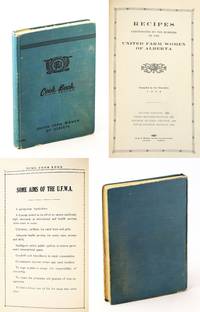
1946615j1947Calgary: United Farm Women of Alberta U.F.W.A. Fair with No dust jacket as issued. 1946. Fifth Revised Edition. Hardcover. Offers a wide assortment of down to earth Alberta recipes for: Bread; Cookies; Cakes; Icings and Fillings; Puddings & Desserts; Pies; Frozen Desserts; Beverages; Salads & Dressings; Pickles; Canning and Preserves; Cheese & Luncheon Dishes; Soups & Broths; Fish; Meats; Vegetables; Candy; and Sandwiches. 240 pages. Index. Includes several ads in text plus additional illustrated ads at back including a fascinating one-page declaration by the Province of Alberta entitled 'Progress in Welfare Legislation' which lists seven free health services provided to residents "without increased taxation and without the regimentation that usually accompanies state social security schemes." Unmarked with above-average external wear. Binding intact with moderate lean to spine. A worthy example of this beloved vintage compilation of Alberta recipes. Driver A59.5 Peel 3 5291.; 8vo; Alberta - Cookbooks United Farm Women of Alberta - Cookbooks Alberta - Cookery U.F.W.A. . United Farm Women of Alberta [U.F.W.A.] hardcover
8140EBo.J. 4°. 30,5 x 21,5 cm. 10 Original-Farbfotografien mit Beiblatt in Original-Pappkassette mit Blindprägung. [5 Warenabbildungen] (York der Knoefel, geboren 13.12.1962 in Potsdam, gestorben 16.12.2011 in Berlin).
17014Women Education Handwritten Album Memory album from student at Female Academy in Springfield MA. A memorabilia recording many aspects of the first major movement of women's education in the United States brings depth to a movement that was groundbreaking in its time but today is largely at risk of disappearing from the historical record. Filled with 44 handwritten inscriptions dated 1876-1882 from classmates teachers and friends. 4.25 x 7 in. Original leather boards. 114 pages. Gilt "Autographs" and decorative detail to front cover. Two original illustrations of a bird one in color. Most entries are signed from schoolmates in Springfield MA. Memory albums held autographs sentiments and reminiscences of friends and schoolmates similar to yearbooks today. Young women particularly those finishing their time at a female academy and preparing to leave their school friends tended to be the ones to create friendship albums. Included is an entry from teacher Myra F. Hoffman who writes: "That your work in life may be always as cheerfully and faithfully performed as now is the wish of your friend and teacher."Â Many inscriptions directly reference school life. A entry from 1877 is titled "Schoolmate": "In your list of real friends My name I wish to see. And if a lasting friend you wish That friend you will find in me." Others sign off "Your Seat-mate" and one of 1882 is from "Your Sincere Friend and Classmate" and another "Friend and Schoolmate." One quotes Ralph Waldo Emerson: "Do that which is assigned thee" says Emerson "and though canst not hope too much or dare too much." Interestingly one entry from 1877 entries is signed "Shang Hai China."Â Loss to leather spine though hinges are sound. Front and back cover are attached. Good to very good condition. unknown books
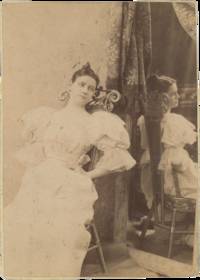
List29100Unknown location late 19th century. Photograph measuring 4 x 5 ½ inches mounted on heavy cardstock. Brown Brothers stamps verso and marked verso “Nelly Blyâ€. Excellent contrast; overall excellent. Elizabeth Cochrane Seaman 1864–1922 pen name Nellie Bly was a pioneering female journalist best known for circumnavigating the globe and for her undercover exposé of the conditions at New York City’s Women’s Lunatic Asylum. Offered here is a portrait of Bly reclining in a high-backed chair. The date and location are unknown but her dress and hair are styled identically to a photograph that purports to be from her time in Mexico a trip she made in 1885. She published a book Six Months in Mexico documenting her time there in which she describes the lives and especially the poverty of the Mexican people. unknown
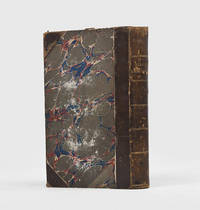
1830181412London: W. J. Sears 1830. First edition. The Female's Encyclopaedia was published anonymously by a woman and the sketches provided by Matthew Urlwin Sears 1800-1870. The work has sections on everything from emotion and morality to the properties of various meat and fish and from the duties of servants and wives to a recipe on how to "destroy bugs" which includes red lead as its main ingredient. Octavo 220 x 137 mm. With engravings to text. Contemporary quarter brown calf spine lettered and ruled in gilt marbled boards edges speckled red. Rubbing to calf spine tips worn and bumped top edge toned contents with occasional finger soiling and toning. A very good copy. hardcover
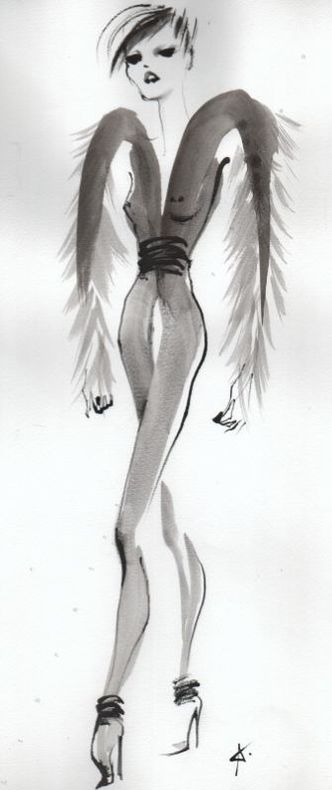
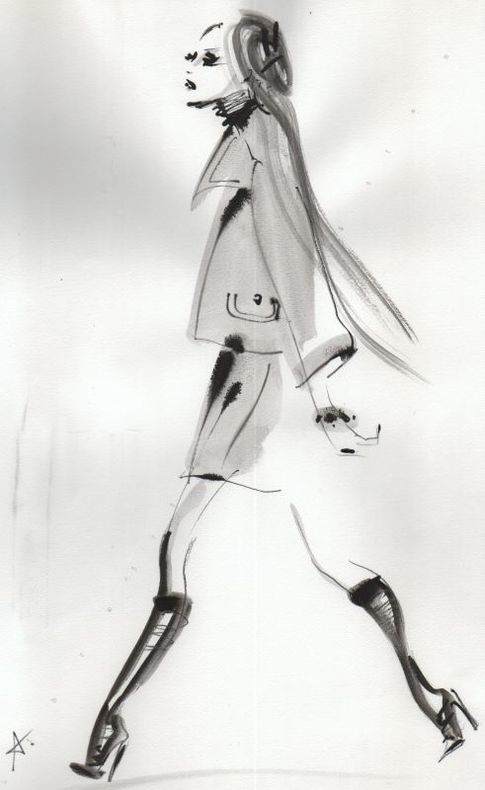
2013235232013 Encre et lavis sur papier, signé en bas à gauche, titré et daté au verso, 2013, 41 x 14 cm.
2013235222013 Encre et lavis sur papier, signé en bas à gauche, titré et daté au verso, 2013, 39 x 20 cm.
Original Wraps. 8vo. 12; 32, [4]; 24, [2]; 32, [4]; 16; 13, [4]; 25; 35; 13; 16; 20; 19; 19; 11; 27; 19 pages. 20 cm. Pastedown label on cloth slipcase: Plays For New Year Sukkoth Hanukkah Purim Passover Lag B'Omer Shabuoth And For Other Occasions. Every play of Elma Ehrlich Levinger dated 1923; her plays include: The unlighted Menorah: a Chanukah fantasy of the time of Felix Mendelssohn, in one act; The light of Israel: a Chanukah play in four acts; A sick Purim; a modern Purim play in one act; "Let there be light, a pageant in seven episodes; How Succoth came to Chayim; a modern play in one act; Ruth of Moab; a springtime play in one act; The golden staff; a Succoth operetta with music by Samuel Goldfarb. By Samuel Schulman and Sara Miller: The spirit of Judaism: a pageant. By Ruth Atlas Binstock: Harvest festival; a pageant in four scenes. By Miss Eva Herbst: Ruth; a harvest pageant. Plays by Fannie Barnett Linsky: America and the Jew; a pageant for Thanksgiving day; A Purim fantasy, a play in one act; The Sabbath angel. A play in two acts; Old pictures in new frames. A group tableaux for any holiday; The counting of the days; a Lag b'Omer cycle; Happy New Year; a play in one act, a prologue and an epilogue. All plays published by the Union of American Hebrew Congregations Department of Synagogue and School Extension, which was initially established as the Department of Synagogue Extension in 1903, to provide for and advance Sabbath schools for the instruction of the young and to aid and encourage the development of new and young congregations. Elma Ehrlich Levinger (1887 1958) Active in an array of Jewish womens and youth organizations, Elma Ehrlich Levinger was also the author of over thirty books for children and several for adultsall of which emphasize the importance of maintaining Jewish identity in America. Levinger used both drama and the short story as a means of educating young people and women about Jewish history and traditions, hoping to encourage them to participate in Jewish social life. (Jewish Womens Archive Encyclopedia) . Subjects: Mendelssohn-Bartholdy, Felix, 1809-1847. Drama. Hanukkah - Drama. Sukkot - Drama. Ruth (Biblical figure) - Drama. Sukkot - Drama. Purim Drama. Jewish drama. Tableaux, Religious. Rosh ha-Shanah - Drama. All plays are listed on OCLC; however, none exceed 15 listings. No listings on OCLC for a boxed set such as ours (extra space in the box suggests that it may have been designed to hold other titles as well) . Light rubbing to cloth of slipcase, with rip to corner of lid; wraps of two plays lightly soiled, otherwise all plays near fine. Very Good+ Condition. (MX-36-22)
16740Women Education Girl student's laboratory notebook of 38 experiments and 30 scientific drawings at Wadleigh High School in 1903 only 16 years of existence New York City's first public high school for girls. 8 x 7 in. Original maroon boards. 142 pages first 97 pages filled with handwriting in pencil. All experiments dated 1903. "to be pasted on outside cover of note book. Borough of Manhattan New York City Wadleigh High School January 12 1904. This notebook contains the original notes of Sylvia DeGiorgio on laboratory work done under my immediate supervision. All numerical data and all notes descriptive of apparatus process and resulting phenomena were written in the laboratory at the time when the experiment was performed. Florence Hermann Teacher." Records 38 experiments that explore different topics in physical science such as: Verify the Law of Flotation Prove that a lever acts as if its mass were collected at one point Determine the mechanical advantages and law of inclined plane and Determine chemical action in a simple voltaic cell. Experiments contain tables to record data and observations with 30 scientific hand drawings in pencil to accompany lab notes. "I placed a 100g weight in such a position as that it would not roll and on it placed a meter stick and balanced it. I placed a 50g weight on the 17 cm mark and determined where a 20g weight should be applied to balance it. I then calculated the distance of 50 g or Force A from the fulcrum and also of 20g on Force B by subtracting the distance fo the position of A from the fulcrum and of B from the fulcrum. Then I multiplied the weight or magnitude of A by the calculated distance of A from the fulcrum and of B likewise the product was the moment of the force and the products of A and B should equal. I performed the same operation tree other times each time placing the weight-at different points on the stick. The movements of the forces acting on one part of the lever should equal the movement of the forces acting on another part of the lever."<br/><br/>Wadleigh High School was first founded in 1897 when secondary education for girls especially immigrants was considered highly novel; this important school led the way for other educational reforms in the country and also led to more job opportunities for women to work as higher level teachers. This student Sylvia DeGiorgio was from an immigrant family with several members born abroad in Italy Malta and Egypt and the school took pride in both the academic as well as social education it provided to its girls students taking pride in the "gentlewomen" who graduated from the school. 2 loose pages recount the births and deaths of family members. First 2 pages detached. Loose hinges. Boards worn at extremities. Clean crisp interior. Very good condition. unknown books
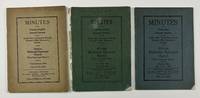
19274616Cleveland 1927. Good. Three serial works: 432; 511; 471pp. All bound in original printed wrappers stapled. Mostly minor wear and dust-soiling to wrappers some chipping. Middle work worn and chipped with text block and both covers detached but present and no loss of text. A trio of works recording the minutes of three separate annual sessions of the North Ohio Conference Branch Women's Mite Missionary Society of the A.M.E. Church between 1924 and 1927. The meetings were held in Youngstown Cleveland and Alliance Ohio respectively. Each work prints the officers and members of the N.O.C.B.W.M.M. Society as well as each conference's daily activities the minutes of the Executive Board meeting various officer and committee reports and more. One of the more interesting features of the works is the two-page table which concludes each work listing the various societies throughout Ohio their president and corresponding secretary and detailed financial data. All three pamphlets also contain the text of the President's Report or Annual Address providing details on the leadership activities of the group. The first two pamphlets have an ownership signature on the front wrapper belonging to Miss Veetta Jackson of Alliance who almost certainly attended all three annual sessions and is listed in the Conference Branch Roll of the third year when the event took place in her hometown. OCLC records microfilm or digital records for a couple of years apparently 1922 and 1926 at a handful of institutions but does not report any copies for any of the annual reports present here in any format. unknown
193064082Chefoo Yantai China: Self-Help Dept. Women’s Bible School Presbyterian Mission ca. 1930. Oblong 4to. 9.25 x 7 in. 18 leaves unnumbered. w/ title leaf promotional explanatory leaf laid-in printed text on tissue papers w/ borders each facing the delicately cut-out silhouette Jianzhi paper designs on the facing leaves of thick paper stock. Pictorial silk flexible covers punch-sewn at gutter margin as issued w/ black silk braid NF copy. First edition thus of this beautiful album of mounted paper Jianzhi silhouette cut-outs prepared and cut from stencil drawings from a pattern. The introductory laid-in leaf details the steps of preparing the pattern sewing down the stencil to ten thicknesses and thereupon using tiny scissors and knives of various shapes to create the subsequent designs. Typically these are good for making ten at a time and then pasted on cards. These were fundraisers for the China Inland Mission Women’s Bible College in Chefoo Yantai and copies would have different stories and designs. This particular copy includes Wen Yen Beh and the Lost Ball; Djang Liang and Whang Hsi Gung; Han Hsien and Hsiao Nine; Outwitting of Wang Shen; The friend who failed; How the frogs got their croak; and finally Story of Si Mah Gwang. These original occupational works enhanced vocational training for Chinese women in developing a skill aided funding for the Women’s Bible College but also contributed to funding the Temple Hill Hospital at the CIM also known as the Yuhuangding Hospital. It later served during World War II during the 1942-43 Japanese Occupation as an internment camp. Worldcat locates 4 similar copies w/ varying supposed dates and frequently different stories or legends Texas A&M Peabody Essex Royal Danish Library & UBC. Self-Help Dept., Women’s Bible School, Presbyterian Mission, unknown
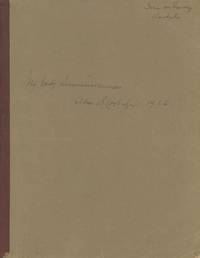
1926List3141Quincy Massachusetts: unpublished 1926. 201 pp cardstock wraps. Normal wear to wraps; overall Near Fine. Alice Brackett White Coolidge 1864–1927 was a Boston socialite of the prominent Richardson family; her grandfather was merchant and Massachusetts State Legislator Jeffrey Richardson. Coolidge was also the author of three children’s books: The Bunnies of Evergreen Village 1917 The Refugees in Evergreen Village 1918 and Evergreen Village to the Rescue 1922. Offered here is Coolidge’s unpublished memoir of her early life written in 1926 titled My Early Reminiscences.<br /> <br /> The memoir recalls Coolidge’s childhood and teen years spent mainly in Massachusetts New Hampshire and Maine. Her recollections typically involve extensive descriptions of the houses at which her family stayed the scenery around them and the various families they met and visited with. Given her position in society her acquaintances are sometimes quite influential people: Princeton president John Grier Hibben enjoys Coolidge’s fishcakes; Trinity Church rector Phillips Brooks gives her grandfather an “excellent pew†in the newly-finished church; pioneering doctor Alfred Worcester mistakes red pepper for mercury in a scientific demonstration at her school; and she recalls brief correspondences with John Greenleaf Whittier and William James.<br /> <br /> Coolidge also took dance lessons from Augustus Papanti whom she describes as “one of the thinnest men I ever saw†who was “very melancholy. I hardly remember his ever smilingâ€; and remembers Judge Charles Devens for “his great stature his charming face his courtliness of manner and his really boyish simplicity in entering into our evening games†including a game of “mind reading†which Devens played “with zest.â€<br /> <br /> One of her longtime friends was Rear Admiral John E. Pillsbury. She recalls:<br /> <br /> “Mr. Pillsbury as a young naval man a brother-in-law of my uncle Dr. Richardson used to take me out in the swan-boats on the Public Garden Pond. Later he went through all the ranks up to being retired as a Rear Admiral but time and circumstances never changed him. We always met at Thanksgiving and Christmas dinners and always talked at great length. . He was a wonderfully interesting lovable man and very modest and unassuming and shy. I always considered him one of my best friends though older by many years than I.â€<br /> <br /> Another interesting New England figure Coolidge encountered was Joseph Lee. She describes Lee’s hotel in Newton:<br /> <br /> “The house where we stayed was kept by a remarkable man named Joseph Lee. He was a mulatto much above many of his kind and his wife was a handsome woman partly Indian. They did the cooking and he waited on table with a colored maid to help him. In fact there were no white women in the house. The cooking was delicious.â€<br /> <br /> Lee was born enslaved in South Carolina freed in 1865 and went on to invent the automatic bread kneading and bread crumbing machines.<br /> <br /> Though nearly all of her childhood was spent in New England she also remembers being invited to visit Charles Joseph Bonaparte in Baltimore:<br /> <br /> “We had never been so far south except to Washington and I felt a curious feeling of being in a different atmosphere from any I had known. . We were met at the station by Mrs. Bonaparte in a large roomy covered vehicle with two horses. The coachman and footman were in the Bonaparte colors -- a deep wine color. The footman I well remember. He was a light-colored young negro very handsome and smiling and excited over having young ladies from the North. . All the servants were colored and lived in cabins near the house. . I never knew Mr. Bonaparte in public life so my memories of him are quite intimate and I fancy I saw much of his real self. . His mind was very active. He used to talk or listen as he walked and he moved his head in a curious way from one side to the other with a slightly rolling motion which was distinctly individual. . I never saw him irritated or excited and he was always very simple. In the group picture we had taken at the Maplewood he sat down cross-legged on the piazza floor like a boy. That was in about 1887. I suppose in public life or in law he was different but he was very equable and charming as we met him in his home and at the mountains. Most of all I admired his sweet tender ways with his flower-like wife.â€<br /> <br /> This was not too long after the end of Reconstruction and Coolidge remarks on the tense atmosphere:<br /> <br /> “Mrs. Bonaparte had warned me to be careful about questions regarding the North and South as the ‘feeling’ had not yet died away. I was so glad she had warned me. A gentleman slipped in and sat down beside me to watch a parade and whispered in my ear as the bands had been playing ‘Dixie’ how glad he was to meet a Northerner. I was glad to meet him too although I remember neither his name nor face but I felt I breathed freer in his sympathetic locality. . I had no idea that this feeling still remained as far North as Baltimore and of course I remembered how our Massachusetts troops had been fired upon in Baltimore at the outset of the war but I was admonished and very wise and only returned my unremembered neighbor’s greeting with a sympathetic word and look.â€<br /> <br /> Besides individuals Coolidge does cover a few historical events including the Great Boston Fire of 1872:<br /> <br /> “Oh! a horrible sight met our eyes. Back of the opposite houses in Park Square was a background of sheets of red flames and heavy black smoke rising high into the air. . On the Parade Ground all was in confusion and the sight was very sad and never-to-be-forgotten. It was literally covered with boxes and bales of furniture and sad forlorn desperate looking people crouching or sitting or standing amidst what they had saved from their homes . At night . the whole city was in darkness as there was no gas.â€<br /> <br /> The family also frequently stayed at hotels in the White Mountains of New Hampshire and Coolidge recalls the “overwhelmingly tragic†effects of the 1867 sale of this land to logging companies; she writes that looking out from the Flume House in Franconia “all about were brown scarred places marking the woodchoppers’ work which was cutting away our beautiful trees for lumberâ€.<br /> <br /> In this memoir Coolidge supplies detailed remembrances of the private personalities of influential figures of Gilded Age New England. We find two copies of My Early Reminiscences on OCLC. Of interest to historians of the era especially as told through the perspective of a young woman. unpublished unknown
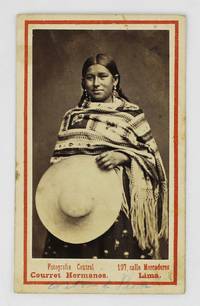
18805806Lima: Fotografia Central Courret Hermanos 1880. Very good. Carte-de-visite photo 4.25 x 2.75 inches. Minor soiling pencil notation at foot of card. Handsome image of a young Peruvian woman in traditional dress. Pictured in three-quarter length she holds a wide straw hat a printed skirt peeking out of the bottom of the photos beneath a traditional shawl wrapped around her shoulders. Her hair is in two braids and she wears elaborate earrings. The pencil notation at the bottom reads "Native of Peru." The photographer Eugene Courret was a French native who moved to Lima in 1860 to work in a photography studio; he opened his own studio with his brother in 1863 and returned to France in the 1890s. Fotografia Central Courret Hermanos unknown
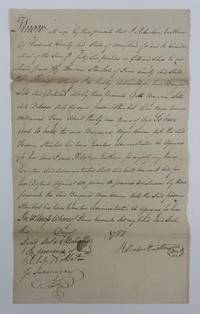
17884111Frederick County Md: March 7 1788. About very good. 1p. folio docketed on verso. Old folds short splits along a couple of fold lines minor toning. An impactful manuscript document from the early national period in Maryland formalizing the sale of a slave woman in Frederick County. The sale was made by Robertson Eastburn whose family emigrated from England to Maryland in the early 18th century. The document reads in part: "In consideration of the sum of forty six pounds in Gold and Silver to me in hand and paid by Frederic Strombol.I do hereby Acknowledge have Bargain'd Sold and Delivered and by these presents doth Bargain Sell and Deliver Unto the said Frederic Strombol One Negro Woman named Torry about thirty years of age To Have and to hold the said Bargained Negro woman unto the said Frederic Strombol."<br /> <br /> Slavery in Maryland lasted over 200 years from its beginnings in 1642 when the first Africans were brought as slaves to St. Mary's City to its end following the Civil War. In 1664 under the governorship of Charles Calvert 3rd Baron Baltimore the Assembly ruled that all enslaved people should be held in slavery for life and that children of enslaved mothers should also be held to the same standard of law. 19th-century American slave sale documents are growing increasingly scarce in the market. March 7 unknown
199688390San Francisco: Margo St. James for Supervisor 1996. Original poster with text and image offset printed in red black and grey on white poster stock measuring 48.25cm x 63.5cm 19" x 25". Some handling and wear a few discreet staple holes tape remnants and adhesive-pull to extremities with a shallow loss to upper edge at center and and some brief writing in pen along the lower margin; Very Good. <br /> <br /> Humorous original 1996 campaign poster for Margo St. James's bid for a seat on the San Francisco Board of Supervisors. "Although her 1980 campaign for the Republican presidential nomination had been an activist stunt her 1996 run for a seat on the San Francisco Board of Supervisors was for real and she came in seventh out of 28 candidates in the race for six at-large seats. When one seat was later vacated then-Mayor Willie Brown refused to appoint her instead choosing now-governor Gavin Newsome" The Bay Area Reporter January 16 2021. 88390. Margo St. James for Supervisor unknown
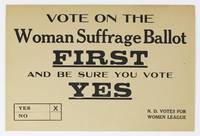
19146466North Dakota 1914. Near fine. Broadside 6 x 9 inches. Minor wear. Handbill published by the North Dakota Votes for Women League ahead of the suffrage referendum in that state in 1914. North Dakota had several 19th-century attempts at women's suffrage which all failed to pass. The League was established in 1912 and pushed another referendum in 1914. It too failed to pass. North Dakota was the twentieth state to ratify the 19th Amendment in 1919 finally granting the vote to women. unknown
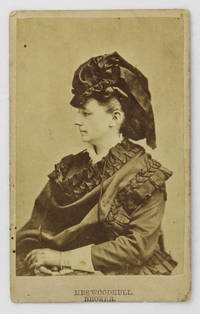
18705090Portland Me: Geo. Stinson & Co 1870. Very good. Carte-de-visite 3.5 x 2.25 inches on a slightly larger mount with printed caption in bottom margin photographer's credit printed on verso. Light surface wear and dust-soiling minor edge wear to mount. Ownership signature in blue pencil on verso reading "Miss Gordon Fredericton." A delightful profile portrait of the great Victoria Claflin Woodhull 1838-1927. Woodhull was a force of nature in 19th-century American politics journalism finance and society. Woodhull was the first woman to testify in front of a Congressional committee arguing that the 14th and 15th Amendments already entitled women to vote the first woman to be nominated for President of the Equal Rights Party with her proposed running mate Frederick Douglass the first woman to head a Wall Street brokerage firm after befriending and then learning investing from Cornelius Vanderbilt and much more. In fact the present photograph references Woodhull's Wall Street experience in its printed caption which reads "Mrs. Woodhull. Broker." Along with her sister Tennessee "Tennie" Claflin Woodhull also owned and edited a weekly newspaper Woodhull and Claflin's Weekly beginning in 1870. The newspaper printed articles in favor of women's suffrage spiritualism communism the weekly published the first English-language edition of Karl Marx's The Communist Manifesto free love equal rights and other important progressive issues. Though Woodhull's popularity would decline in the late-1870s due to the radical nature of her views and an obscenity charge stemming from publication of a story about an affair between Henry Ward Beecher and one of his congregants she continued to work in support of women's suffrage and publish periodicals even after relocating to England. She lived out her elderly years in the English countryside where she died in 1927. Geo. Stinson & Co unknown
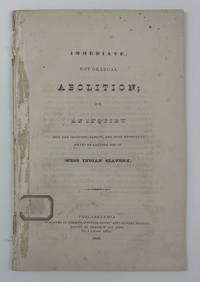
18364768Philadelphia: Published by the Philadelphia Ladies' Anti-Slavery Society. Printed by Merrihew and Gunn 1836. Good. 24pp. Disbound. Ex-Vermont State Library with embossed blindstamp and remnants of shelf label on title page and small numbered ink stamp on first page of text. Remnants of original wrappers along outer gutters mostly minor foxing throughout. A rare Philadelphia edition of an early abolitionist tract by Elizabeth Heyrick an English Quaker. The work was first published in Great Britain in 1824 and reprinted several times in both England and the United States. The present work is just the second edition published in Philadelphia and the only edition sponsored by the Philadelphia Ladies' Anti-Slavery Society which formed in 1833. The Philadelphia Ladies' Anti-Slavery Society was created in the same year as the American Anti-Slavery Society by a group of Pennsylvania women both White and Black including Lucretia Mott. The organization is credited with being among the first and only racially integrated abolitionist societies in antebellum America. Heyrick's work was essentially focused on immediate and total abolition at a time when most abolitionists hoped the end of the slave trade would result in a gradual end to the peculiar institution. Heyrick's central argument calls for a boycott of West Indian sugar as a way to force a faster end to "the hydra-headed monster of slavery."<br /> <br /> Interestingly the present work includes a one-page introduction not present in other editions written expressly by someone in the PLASS. The introduction emphasized the impact of the work upon initial publication noting that "it proved greatly advantageous to the cause of Emancipation in the British West Indies." It also claims the work was so influential to the general cause of abolition that it convinced no less than William Wilberforce "and other leading abolitionists" to transition as "gradualists" to those calling for an end to slavery "immediately." The conclusion of the introduction continues to praise the work's impact: "It is commended to the attentive serious perusal of the reader as the same principles and duties that apply to slavery in the West Indies are equally applicable to that which exists in the United States. Published by the Philadelphia Ladies' Anti-Slavery Society. Printed by Merrihew and Gunn unknown
1927440Little Rock 1927. Overall very good. Eleven items. Light wear and tanning. A representative group of materials published in the 1920s for use by the Women of the Ku Klux Klan. After the Klan was officially reformed in 1915 a women's branch of the organization was founded in Little Rock in 1923. The principal material present here comprises five pamphlets with rules oaths ceremonies and music for group meetings. They are as follows: 1 The Code of the Flag As Adopted by the National Flag Conference. cover title. Little Rock: Parke-Harper Publishing Co. 1923. 16pp. Stapled self wrappers. Small chip at top edge of final leaf. 2 Constitution and Laws of the Women of the Ku Klux Klan Adopted by the First Imperial Klonvocation at St. Louis Missouri on the Sixth Day of January 1927. Little Rock: H.G. Pugh & Company 1927. 71121pp. Original printed wrappers stapled. 3 Installation Ceremonies Women of the Ku Klux Klan. Little Rock: J.F.H. Co. 1923. 16pp. Original printed wrappers stapled. 4 Musiklan. Little Rock: Parke-Harper Publishing Co. 1925. 12pp. Original printed wrappers stapled. 5 Second Degree Obligation First Section. Property of Women of the Klu Klux Klan cover title. Little Rock. 1923. 4pp. Original printed wrappers stapled. Accompanying these are six ephemeral pieces that include a triplicate application form for the "Second Degree" level of the Women's Klan a notice of admission to the Klan examples of payable and receivable receipts a piece of "Tri-K-Klub" letterhead and an "Imperial Passport" allowing the bearer to attend the meetings of other Klaverns. Quite uncommon as a group. unknown books
195415968Orrville OH; 1954-1990. 4to. Hardcover binder with 99 clear plastic leaves holding hundreds of clipppings ephemera and 203 photographs 53 black and white snapshot; 122 color snapshot; 26 Polaroid instant color prints; 2 black and white enlargements. Contents laid into pages loose. Majority of photographs captioned to versos. Overall well preserved; about near fine. <br/><br/>A large scrapbook compiled by Dorothy Agnes Welsh b.1921-d.2001 documenting her 40-year career with the Schantz Organ Company of Orrville Ohio. Founded in 1870 Schantz was primarily a local operation until a national expansion in the years immediately following WWII. A turn-key firm responsible for all aspects of the design building installation service and renovation of many of the country's finest pipe organs its growth and many of its most ambitious projects are documented here including the firm's magnum opus: a massive 1950's installation in the Cathedral of the Sacred Heart in Newark NJ conatining nearly 9000 individual pipes. <br /> <br />Through article clippings images detailed captions and notes Dorothy documents the day-to-day at Schantz through her clear well composed views and uncomplicated text. Approximately 1/4 of the images are of employee gatherings primarily retirement parties though the majority of prints are occupational and provide clear views of the company's process and employees: woodworking intricate electronic designs antique organ restorations installations etc. from the early 1950's to 1990 and from the perspective of a female employee. <br /> <br />Welsh began work in the console department in January of 1951. During her four-decade long career she served in nearly all of the company's departments thus these images seem to document every aspect of the firm's work. Many employees were women. A telling bit of ephemere suggests what the workplace may have been like for Dorothy: an illustrated napkin disparaging women drivers along with a brief note on and 1965 photograph of the co-worker who left it for her Ray Eyster is among the ephemera. The incident seems to have stuck with Dorothy given its presence among the contents. "Eyster Put this on my work bench. I had been driving a car a short time when this show up. He work at Schantz a few yr. He was not happy .". <br /> <br />Clippings are often notated by Welsh and focus on local and national coverage of Schanz's projects and notable life events of her co-workers primarily obituaries. Additional are several photographic company brochures with detailed specs on organ installations at Lawrence University in Appleton WI: Trinity United Church of Christ in Canton OH; First Methodist Church in Glendale CA; Sharp Chapel at Tulsa University; and more. <br /> <br />A considerable primary record of women in an artisan workplace richly documenting in visual and written detail the myriad elements involved in the work of the Schantz Organ Company. hardcover books
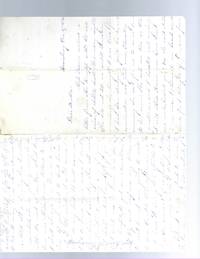
1708719th c. Women Education Archive of 6 handwritten letters from a student at Lewisburg Seminary an all Women academy in Pennsylvania. 1868-1869. She writes on her education to become a teacher tuition and family matters. 5 letters come with original mailing envelopes. 8.25 x 5.5 in. Each letter is 3 or 4 pages long; final letter is only 1 page. The letters are dated: December 27 1868; January 9 1869; February 3 1869; February 13 1869; February 27 1869; February 1869 original mailing envelope is postmarked March 1. Lewisburg Seminary was the female branch of the University at Lewisburg now known as Bucknell University. In all of her letters student Libbie Grant talks on the importance of her education. In the first letter she offers to help her recently widowed brother but that school was also a priority for her: "If you want to keep house the rest of the winter I will come tome and do my best. It will seem so hard to board right away. I don't know how I can stay here all next term without seeing any of you but shall content myself if you don't wish me to come. It is for my own benefit to get an education." In the January letter she lists subjects she is taking in school: "I study Grammar Physiology Geography and Astronomy." She gives a lengthier update in the February 3 letter: "I get along very well in my studies much better than I did last term. Miss Brown said there was a mistake made in my report and Scripture is excellent also Spelling. I do not get as homesick as I did last term." In one letter Libbie writes on how nervous she is regarding her future: "When I think of the future I feel sad to think I must wander from place to place." She is likely referring to various places where she would work as a teacher. In the February 13 letter her teacher Miss Brown adds a line about Libbie's next steps likely where she will work as a new teacher: "I trust she will succeed in getting a pleasant school for the summer."<br/><br/>Libbie also writes on financial matters requesting money from her brother for tuition and clothing. She stresses the necessity of new clothes which seem "unnecessary" to her brother Robert Grant residing in rural upstate New York; this highlights some one of the different social challenges that young women from rural backgrounds faced while living in and attending schools in cities. In the February 13 letter she writes about how she needs money for clothes to wear and new shoes; she is clearly distressed as her brother residing in Neversink NY seems unconvinced that new shoes and Church appropriate clothing is necessary. "I write this with my eyes full of tears for I know your thoughts. I know you think these re all unnecessary. They would be if I were home and I could get along with less." Miss Brown's addendum on the following page affirms Libbie's need of money and assures her brother that these items are necessary and his sister is "exceedingly economical." Lewisburg Seminary was originally the female branch of the University at Lewisburg which later became Bucknell University. In 1852 the Female Institute was established to exclusively educate women at the University. All letters in very good condition. A lovely collection of letters from a young woman studying to be a teacher in the 19th c. unknown books
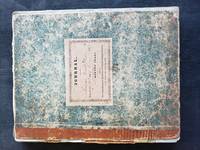
17025Women Education Handwritten notebook from girl student learning about Botany and Zoology in 1857. Filled with 68 pages of notes and essays on plant and animal biology. 68 pages handwritten. Original green marble boards with brown leather spine. 9 x 7.25 in. Title plate on cover lists original owner "Louisa Woodson". List sales address in London. "Sold at the Depository of the Home and Colonial School Society 16 St. Chad's Row Gray's Inn Road."Â "Instructions to Student" printed on inside front cover with notes on how composition book should be used. "These Journals are intended to contain a record of the daily course of instruction and occupation through which Students pass whilst at the Institution. It is expected that particular attention should be paid to the plainness and legibility of the writing; to the grammar spelling and punctuation; and also to the general arrangement and neatness of execution." All entries dated to 1857. Weekly written class schedules included throughout notebook listing coursework in Reading Scripture Language Numbers Writing Natural History Domestic Economy Dictation and Geography. Student includes notes and short essays on topics including animal and plant life. "Lesson on the Whale: The most remarkable peculiarities of the whale tail are as follows - though they inhabit water and never leave it they are not fish but mammals breathing air by lungs and therefore coming to the surface to breath." "Botany Leaves. Leaves are flat extended objects growing on the stems and consisting of two parts namely the stalk and blade known by botanists as the petiole and lamina." Also includes entries on the Gospels and notes on her own general academic performance from the past week: "6 errors in Gram. & Comp.; 4 omissions. This journal bears evidence of great carelessness." Other entries are on topics such as: The Elephant The Whale Tribe What Buds Are The Gourd Tribe Botany Roots and On Shells. "Tribe" is used here synonymously with genus or scientific family. Comes with 3 loose handwritten documents 2 concerning plant life. Boards are worn spine is detached though signatures hold. 1 page fully detached. Good condition. unknown books
19211885Chamberlain & Various Places in South Dakota 1921. About very good. 69 original photographs each measuring 2.5 x 3.5 inches plus six leaves of text twelve postcards other ephemera. Oblong album embossed calf boards string-tied. Moderate wear at edges some rubbing and scuffing to boards. Light dust soiling internally. Photos generally clear captioned in manuscript on album leaves. A engaging photo album compiled by a young South Dakota woman that documents her activities as a part of the Chamberlain Chapter of the Camp Fire Girls during the early 1920s. Vera Gilman and her friends were members of the "Naswawkee Camp Fire" founded in 1918 in Chamberlain South Dakota. As four leaves of introductory text explain Gilman joined the group whose Native American name was intended to translate to "Feathered Arrow" in 1920 when the chapter made a camping trip to American Island a large Missouri River island opposite Chamberlain that was submerged by the construction of the Fort Randall Dam in 1953. The first half of the album documents this excursion of the eleven members all of whom have "Indian names" and occasional appear in faux-Native American dress. The second part of the album documents a 1921 trip to the Black Hills and "Dakota Wonderland" which included the Badlands Deadwood Lead Canyon and other sights which the chapter funded from their performances of a theatrical production "A Perplexing Situation" in Chamberlain and nearby Ola. A lively record of this Plains small-town iteration of Camp Fire an outdoor youth organization founded in 1910 as the girls' alternative to the Boy Scouts. unknown books