692 527 résultats
Small folio (230 x 295 mm). Arabic manuscript on cream-coloured paper. 58 ff. (plus 2 flyleaves), 5 lines per extensum, written in crisp Sini script in black ink. Text within red double rules, verses separated by gilt roundels, surah heading in gold outlined in red. Opening bifolio with brightly coloured and gilt quasi-geometric illumination, final bifolio with gold and polychrome Central Asian floral and tendril motifs in the borders. Contemporary blind-tooled brown leather binding with fore-edge flap. Indigo blue cotton endpapers. Prettily illuminated Qur'an Juz' (one of thirty parts of varying lengths into which the Qur'an is divided) written in late 18th or early 19th century China. Arab presence in China dates back as far as the first Caliphate: the Prophet's companion Sa'd ibn Abi Waqqas is traditionally credited with introducing Islam to China as ambassador in 650. Indeed, many major cities in China, such as Xi'an (or Chang'an, as it was known during the height of the Silk Road) and Beijing boast a long and rich Muslim history. Qur'an sections written by Chinese Muslims show Chinese influence clearly in both the decoration and the script, which is derived from naskh. The section of the Qu'ran copied here is the twelfth Juz', which comprises surah 11 (Hud), aya 6, to surah 12 (Yusuf), aya 52, named after the prophets Hud and Joseph. - Fingerstaining to lower corner and margin; a few leaves loose. An attractively illuminated example of the Chinese Muslim manuscript tradition.
Small folio (ca. 210 x 300 mm). 74 pp. Arabic manuscript in black Naskh, headings and key words in red, ruled in red (often to form tables and geometric patterns). Several diagrams, 2 ff. with circular diagrams, some ruled leaves blank. Contemporary limp leather. A theological manuscript entitled "The book of description (or attributes) of the Prophet and the Leader". - Binding a little rubbed, spine chipped. A few leaves loosened. Some light staining and finger-soiling throughout; a few ink smudges; a number of edge tears (some professionally repaired).
Large 4to (176 x 262 mm). Arabic ms. on oriental paper. 325 ff., expertly written naskh script, possibly in more than one hand, black ink with rubrics, usually 6-8 lines to the page, considerable interlinear and marginal glossing. Full-leather Islamic binding with fore-edge flap; original blind tooled ornamentation (medallion). Manual on Islamic Law by Abu al-Barakat `Abdallah b. Ahmad b. Mahmud al-Nasafi (d. 710/1310), an important Hanafi legist and theologian. Born in Nasaf in Sogdian, he taught in the Madrasa al-Kutbiya al-Sultaniya in Kirman, came to Baghdad in 710 and died in Rabi` I 710 (August 1310), apparently on his return journey to Idjadj (in Khuzistan), where he was buried. The Kanz al-Daqa'iq is an important text on Hanafite law and formed the basis for a great number of commentaries, especially in the 9th/14th and 10th/15th centuries (EI² VII, p. 96; GAL II, pp. 250-53). Contains both the `Ibadat and the Mu`amalat. - Final 12 leaves (f. 313ff.) show edge damage with some loss of text. Copied by Khidr b. Shaykh `Ali (colophon in a chancery hand on f. 325v). Cf. GAL S II, 265.
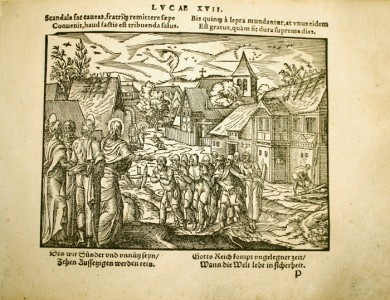
LCS-5719AMMAN, Jost. Icones novi testamenti. Arte et industria singulari experimentes, tum evangeliorum dominicalium argumenta. Francfort, Martin Lechler pour Jérôme Feyerabend. 1571. Petit in-4, oblong, de 10 feuillets préliminaires, 93 planches et 1 f. de marque Vélin. Reliure de l’époque. 208 x 158 mm.
In folio (mm 320x220). Tre carte non numerate con frontespizio calcografico entro riquadro a piena pagina, dedica al principe, allegoria incisa con il Leone di San Marco che campeggia sopra l'isola di Candia con libro aperto "Pax Tibi Marce Evangelista Meus" e spada sguainata; 61 magnifiche acquaforti a piena pagina, molte delle quali ripiegate (tav. n° 1 Il regno di Candia, carta geografica dell'isola con toponomastica ricchissima che descrive le infinite insenature ed isolette; tav. n° 2 Scoglio et For di Garabuse, tav. n° 6 Pianta della Canea, tav. n° 9 Fortezza della Suda, n° 14 Fortezza di Rettimo, tav. n° 23 Città di Candia, n° 25 Candia Assediata (grande tavola fuori formato ripiegata più volte su ambo i lati), n° 33 Fortezza di Spina Longa, tav. n° 39 Città di Settia. <BR>Piena pergamena rigida coeva con titolo impresso in oro su tassello al dorso, traccia di etichetta decorata di scaffale, tagli a spruzzo. <BR>Prima edizione della più celebre e rara opera veneziana su Candia. Completo della straordinaria grande tavola dell'assedio di Candia, (di solito mancante), incisa sempre finemente in rame, testimonia il teatro di battaglia, nei dettagli, mostra gli accampamenti, le trincee, le batterie le galere barbaresche che attaccano i vascelli veneziani, soldati a cavallo etc.; ai lati due riquadri con legende.<BR>L'autore, Nadal Melchiori Marco Boschini nacque a Venezia nel 1613, dopo aver studiato belle lettere, probabilmente a Padova, fu discepolo dell'incisore bolognese, ma attivo a Venezia, Odoardo Fialetti, nonche? di Jacopo Palma il giovane, "nei studi che io faceva in mia gioventu?" (secondo quanto egli stesso afferma in una lettera al bolognese Malvasia). Fu dunque scrittore d'arte, incisore e pittore (ma della sua attività pittorica nulla rimane). E' conosciuto per la sua celebre opera la Carta del Navegar Pitoresco (1660), in dialetto veneziano, dedicata all'arciduca Leopoldo Guglielmo e scritta in quartine rimate. Boschini inizia nel 1645 una importante attivita? di cartografo, anno dell'inizio dell'assedio di Candia; quando l'opera fu pubblicata la città di Candia (Heraklion) era nel quarto anno di un assedio che durò fino al 1669 (6 settembre, quando Francesco Morosini negoziò la resa dopo eroica resistenza) ponendo fine a un dominio veneziano che durava dal 1204.<BR><BR>La carta di Creta è una riduzione basata sulla grande carta di Francesco Basilicata di cui sopravvive un solo esemplare alla Biblioteca Nazionale di Francia. Riporta una fittissima toponomastica delle località costiere e delinea con eleganza l'orografia dell'èp'isola. In alto due medaglioni, uno dei quali col leone marciano, e due semplici cartigli, in basso una rosa dei venti. Boschini, nella introduzione alla sua opera, riporta notizie di una sua carta in scala maggiore, pubblicata nel 1645, anno dell'assedio di candia da parte dei Turchi. Questa carta sarebbe insieme a quella di Basilicata il prototipo di questa, inserita nel "Regno tutto di Candia".Pieghe editoriali, alcune minime tracce di tarlo restaurate in basso vicino alla rosa dei venti. Zacherakis, 592/394; Blackmer/Sotheby's, 37.<BR>Ottimo esemplare su carta vergellata e con marca d'acqua, ottima inchiostratura. Alcune marginali macchioline sporadiche a qualche tavv.<BR><BR>Brunet I, 1123; Piantanida 1331; Atabey 136; Blackmer 171 (incorrect plate count); Graesse "Tresor de Livres Rares et Precieux" voll. 1 - 2 p.500. <BR><BR><BR>
Small 4to. 2/3 page. To Lieutenant General Friedrich Wilhelm von Baur about the visit of the Countess Palatine Caroline of Deuxponts, whom she had invited together with three of her daughters to find a fiancée for her son, the future Emperor Paul I of Russia, letting him know that the Countess would spend a night in Yamburg and would have lunch with her in Gatchina on Saturday: "Herr General Lieutenant die Landgräfin wird diese nacht in Yambourg schlafen [...] den Sonabend aber zu Gatschina mit mir den mittag speisen [...]". - The visit had been a success: Paul was to marry Caroline's daughter Wilhelmina Louisa the very same year.
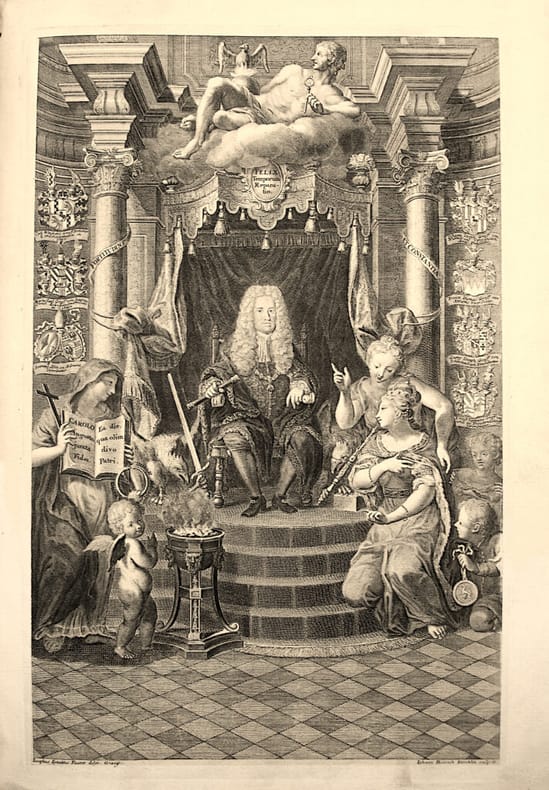
LCS-184567Imprimé sur très grand papier de Hollande. Prestation de serment à l'empereur d'Allemagne Charles VI... comme duc de Styrie, par les États provinciaux de Styrie, le 6 juillet 1728, par G.-J. von Deyerlsperg. Grätz, s.d. [1740]. Grand in-folio de 1 portrait frontispice, (2) ff., 91 pp., 12 planches dont 9 sur double-page et 3 dépliantes, 1 carte dépliante, 1 petite déchirure restaurée sans manque p. 49. Basane brune frottée, tranches rouges. Reliure de l’époque. 466 x 332 mm.
Folio. 2 vols. in one. (12) pp. With 325 engraved plates, numbered 1-147, (1), 148-324. 4 plates misbound: 6/7 and 273/274. Contemporary boards. Second expanded edition of "one of the most important of pre-Linnaean works" (Hunt): Dillen's description of plants in the great botanical garden in Eltham (London) of James Sherard, "one of the most richly stocked gardens in the world". - To this second edition the Linnaean binomal names are added on the preliminary leaves and in the present copy a contemporary hand has written these names in ink under each of the plates. The first edition, printed in London 1732 is extremely rare, only 145 copies of the plates and 500 of the original text were printed. The present second Leiden edition is praised for its very fine plates of succulents. - Johann Jakob Dillen (Dillenius) (1684-1749), was one of the important botanists of his time. He was born in Darmstadt and settled in England in 1721. James Sherard (1666-1738) was a weatlhy botanist and apothecary, whose gardens at Eltham, south of London, were famous for their exotic and rare plants from the Cape, Virginia, Mexico, the West Indies and Argentina. Sherard had visited other continental gardens and wanted to have his catalogued according to the highest scientific standard. He was able to persuade Dillen to take up this task. Many of the plants in Sherard's garden were new to science and were never illustrated before. Dillen immortalized the gardens with 325 excellent plates that illustrate 417 plants, drawn and engraved by himself. He complains in one of his letters about the high costs for meeting the demands of James Sherard without receiving any financial support from his side. However, when William Sherard died in 1728 he left a fund to the Oxford University for a professorship of botany, of which Dillen was the first holder. - "Dillen's work was highly respected by Linnaeus ... His Hortus Elthamensis (first edition 1732) may have served as a prototype for the Hortus Cliffortianus(1737)" (Stafleu, Linnaeus). The plates by Dillen were sufficiently accurate to be of considerable service to Linnaeus. In a gesture of appreciation Linnaeus named a genus of trees Dillenia. Dillen offered Linneaus his position as professor of botany at the University of Oxford, but he declined. - Wholly untrimmed with very large margins. Very many handwritten notes at the bottom of the pages, a small brown stain at the bottom of the page. Slightly rubbed and soiled but completely intact and firm. Overall in good condition. Dunthorne 94. Hunt 637. Nissen, BBI 492. Pritzel 2285. Stafleu, Linnaeus, p. 199. Stafleu-Cowan 1471.
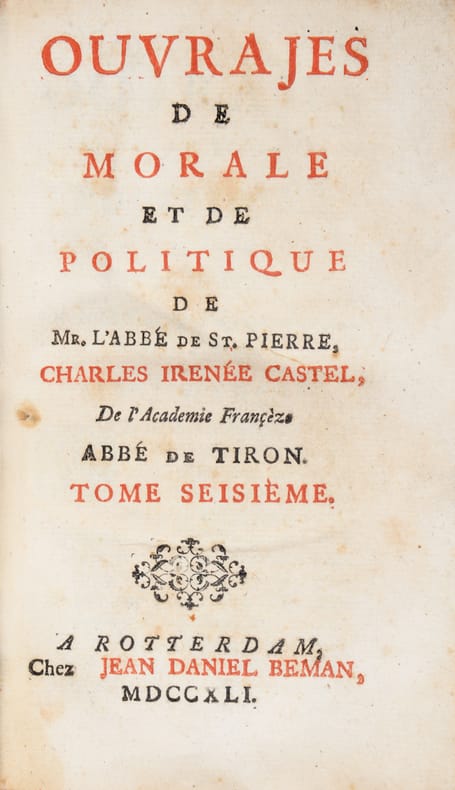
173311268A Rotterdam, chez Jean-Daniel Beman, 1733-1741. 16 vol. in-12, demi-basane brune à petits coins, dos lisse orné de roulettes dorées (reliure italienne de la fin du XVIIIe siècle).
8vo. 8 pp. on 4 ff. (conjoined leaves). With a contemporary photograph of her in costume. A wartime letter in which Mata Hari tells "Monsieur Petitpied" about her stay at the Paris Grand Hotel, her friends fighting since day one, and about her role as a "godmother" when they are at the front: "Me voilà déjà presque deux mois en voyage et il est vrai je ne vous ai pas encore donné de mes nouvelles. C'était un peu de votre faute parceque un jour que j'étais venue du consulat pour ces papiers inévitables, vous m'aviez reçu un peu brusquement. Peut-être étiez vous énervé ; ou ennuyé, soit - j'ai cru qu'il serait plus sage de ma part de ne pas venir inutilement vous déranger et voilà la raison pour laquelle je suis partie sans vous dire adieu. Tant mieux si je me suis trompée et si vous le désirez je serai toujours heureuse de vous écrire de temps en temps. Me voilà à Paris et comme vous voyez descendue au Gd. Hôtel. Ce n'est pas ce qu'il y a de mieux mais c'est central et j'ai trop d'essayages à faire pour ce que je habiterais plus loin. J'ai le grand bonheur jusque ici d'avoir mes amis en vie malgré qu'ils sont au front depuis le premier jour de la guerre et en première ligne. Quand ils sont en congé je leur suis tout ce que je puisse être, comme femme, et quand ils n'y sont pas, je suis la 'marraine'. D'abord je me suis amusée des marraines parceque il y a des ridicules, mais au fond il y a quelquechose de bien gentil, de bien Français, et voilà, que moi aussi je le suis devenue […] L'atmosphère de Paris est toujours Parisienne, il y a l'imprévu et on a le sourire, sans savoir pourquoi. On a envie d'être gracieuse, aimable, parceque on l'est envers vous. Je pense sérieusement à revenir vivre ici, mais je n'ose en parler encore au Baron v d C. [Cappelen, one of her lovers] Je sais que je lui ferai beaucoup de chagrin et alors j'attends [...]". - Mata Hari's border-crossing and powerful connections would see her executed as a spy the following year. - On Grand Hotel stationery; light toning. Together with a period photograph of her in costume.
Imperial folio (520 x 415 mm). 17, (1) pp. With additional coloured title in Persian and 44 coloured plates. Original blue cloth portfolio with gilt-embossed floral and oriental decoration. Marbled endpapers. Very rare monograph about Henri Moser's collection of oriental arms and armour. The present copy in German is no. 103 of a small press run of 125 German copies (total number of copies: 300). The outstanding plates, printed in colour by the Vienna Court Printing Office, show extraordinary pieces of Moser's precious collection containing over 1,300 weapons. The Swiss merchant and art patron Henri Moser (1844-1923) left Schaffhausen at the age of 23 and began travelling through Asia. During his expeditions he collected many pieces of art, weapons, armour, and hunting trophies. His remarkable collection was displayed at various museums throughout Europe. - Cloth portfolio splitting at hinges. A few insignificant edge flaws; some staining, mainly confined to the text fascicule, otherwise in excellent condition.
LCS-18564Précieux exemplaire de cette très rare relation de l’expédition Hollandaise aux Indes orientales dans les dernières années du XVIe siècle. Amsterdam, Corneille Nicolas, 1601. In-folio de(1) f., 21, (8) ff. pour l’Appendice, 27 figures gravées dans le texte dont 22 à mi-page. Petite restauration dans le coin supérieur du f. 7 et dans la marge blanche inférieure f. 16 sans atteinte au texte, qq. mouillures marginales sans gravité. Demi-veau fauve à coins, titre en long doré. Reliure vers 1900. 320 x 230 mm.
6 Imperial documents for members of the Nádasdy and Sermage families (issued by Franz Josef I, Franz I, Maria Theresia, Ferdinand I, and Ferdinand II), 4 portrait miniatures, several photographs and miniature coats-of-arms. Ferenc Nádasdy, a descendant of King Edward I Plantagenet and grandson of Ferenc Nádasdy, the "Black Prince" (1555-1604), who had led many successful campaigns against the Turks but is mainly remembered as husband of the "Blood Countess" Elizabeth Báthory (cf. T. Thorne, Countess Dracula. London 1998), served as Hungarian High Judge of the Crown Court. He was beheaded in Vienna on 30 April 1671 as one of the four principal leaders of the so-called Wesselényi conspiracy. The conspirators had conducted secret talks with France and Turkey for support against Emperor Leopold I; the conflict escalated when they arrested the Hungarian governor Count Rüdiger von Starhemberg. It was Nádasdy's failed attempt to throw off Habsburg rule that brought about Austria's absolutist and repressive regime in Hungary (cf. Encyclopaedia Britannica, s. v. "Wesselény Conspiracy"). Nádasdy's fortune and property were seized by the Crown, but the Emperor is said to have returned most of it to several of his children. Similarly, the change of name originally demanded of the sons was not enacted, as they served in high positions of church and state under their true name (cf. Wurzbach XX, 16). A fine ivory miniature portrait of Ferenc Nádasdy that was passed on within the family until the 19th century bears witness to the uninterrupted veneration of the executed national hero. The portrait is accompanied by an explanatory document by Nádasdy's great-granddaughter to her son, the poet and statesman Karl Johann Peter Graf Sermage von Szomszedvár (1792-1851). The 19-page document in booklet form prepared for Joseph Graf Nádasdy contains the text of several last wills and entailments concerning the family and bears Mariua Theresia's autogr. authentication and seal; it is countersigned by Nikolaus Palffy. The miniature portraits of Nádasdy's descendants by some of the most highly regarded portrait painters of their times, such as Wenzel Schránil (1821-84) and Georg Koberwein (1820-76), bear witness to the eminent position that the family had regained by the 19th century. - Detailed list upon request. Cf. Claudia Ham, Graf Franz III. Nádasdy. Held oder Rebell (Vienna 1991).
8vo. (12), 200 ff. Title with architectural woodcut border. 17th century vellum with ms. title to spine. An early merchants' guide to the measurements of the Mediterranean and Near East, this pocketbook for sixteenth-century Italian traders is one of the foremost sources for the study of the metrologies of Venice and her trading partners in the early sixteenth century. It enabled conversion between Venetian currency, weights and measures and units of other Italian city-states, European neighbours and more exotic locations in the Levant, North Africa, the Near and Middle East, including Constantinople, Aleppo, Tripoli, Damascus, Cyprus, Corfu, Rhodes, and Crete. Pasi's manual is invaluable as a record of the panoply of commodities traded in the Mediterranean at the beginning of the sixteenth century, including pearls, silks, wool, saffron, chestnuts, figs, galangal, vegetable oils, gold and silver. On fols. 3, 11, and 12, Pasi recorded the tariffs on pearls in Damascus, Aleppo, Cairo, Alexandria, Constantinople and Venice. It is very likely that the famous merchant Balbi carried a copy of this classic with him on his travels. First printed in Venice in 1503, and again in 1521, this 1540 edition appears to be the third and was followed by another in 1557. -- Some brownstaining to preliminary matter; a few contemporary ink marginalia slightly trimmed in the course of the 17th-century rebinding. On the whole an excellent clean copy. Very rare: the only copy of any edition to surface at auction within the last thirty years appears to be the Honeyman copy of the 1503 edition. Kress 51. Adams P 374. Smith, Rara Arithmetica, 79. Cf. Goldsmiths' 7 (1503 edition). R. A. Donkin, Beyond price. Pearls and pearl fishing: origins to the age of discoveries (Philadelphia, 1998), p. 138.
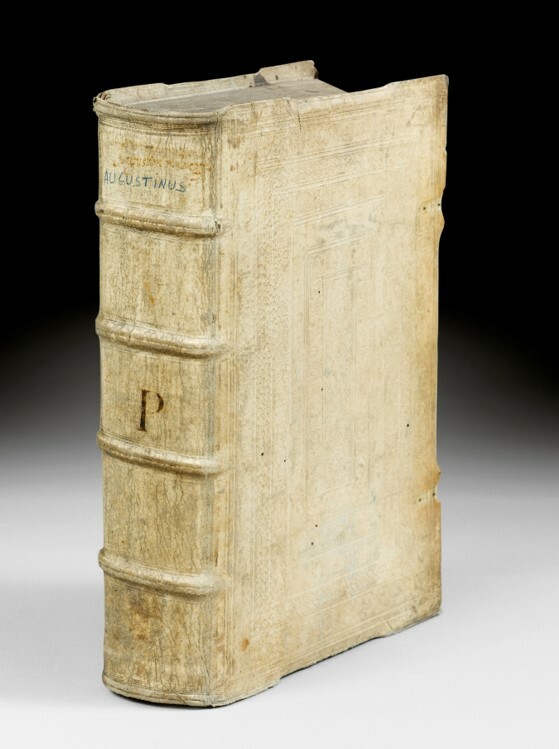
YTB-96Lyon (Matthias Bonhomme), 1565. In-folio de (6) ff., 615 ff., (1) f. bl. Peau de truie estampée sur ais de bois de l’époque. 350 x 243 mm. TRES RARE EDITION ORIGINALE DE CETTE ŒUVRE CONTENANT DES FRAGMENTS D’UNE LETTRE NON REPERTORIEE DE SAINT AUGUSTIN. Adams, A 2183 ; Baudrier, VII, 423. « Des fragments d’une lettre non répertoriée d’augustin... Ces fragments se lisent dans le Milleloquium veritatis sancti Augustini, le plus grand des florilèges augustiniens du Moyen Age. Celui-ci fut complié durant le second quart du XIVe siècle par Bartolomeo Carusi, un ami de Petrarque qui appartenait à l’ordre des Ermites de Saint-Augustin. L’ouvrage fut dédié au pape Clément VI élu en 1342 et valut à son auteur l’évêché d’Urbino en 1347. Selon la dédicace, il avait été préparé à l’université de Bologne sous la direction de Denis de Modène et fut publié alors que ce dernier était devenu prieur général de l’ordre des Ermites, c’est-à-dire en 1343-1344. Le Milleloquium, dont plusieurs éditions furent imprimées entre 1555 et1734, renferme environ quinze mille extraits rangés sous un millier d’entrées d’Abel à Zizania. L’ampleur et la date du Milleloquium expliquent sans doute pourquoi les fragments présentés ici n’ont pas retenu l’attention. En 1994, j’ai identifié, précisément dans le Milleloquium, l’incipit et trois extraits d’un autre sermon inédit d’Augustin. Il est donc avéré que des florilèges postérieurs au IXe siècle et notamment celui de Barthélemy d’Urbino, peuvent avoir transmis des extraits originaux, non reconnus comme tels » (François Dolbeau, Fragments méconnus d’une lettre d’Augustin « A Adéoat et autres serviteurs de dieu »). The Augustinian friar Bartholomew of Urbino, as he is usually called after the town of his birth where he served as bishop during the last three years of his life (1347–1350), is best known for his still valuable Milleloquium veritatis S. Augustini. This monumental concordance contains some fifteen thousand excerpts from the writings of St. Augustine, grouped under about one thousand alphabetically arranged key words illustrating Augustine's doctrines on these topics. The work, for which Bartholomew's friend Petrarch furnished two poetical embellishments in the form of as many alternate sets of verses, was a success. Bearing witness to its wide diffusion and appreciation are over thirty MSS still extant in northern and central Europe (Austria, Belgium, Czechoslovakia, Germany, The Netherlands, and Poland), and about the same number in French, English, Italian, and Spanish libraries. It also went through five printings: Lyons 1555; Paris 1645, 1649, and 1672; Brescia 1734. BEL EXEMPLAIRE CONSERVE DANS SA RELIURE EN PEAU DE TRUIE ESTAMPEE SUR AIS DE BOIS DE L’EPOQUE. Provenance : ex-libris manuscrit.
Album in Folio oblungo (340x490); 57 tavole litografiche magnificamente colorate d'epoca a tempera (su 60) ognuna con relative pagine di testo per un totale di 85 fogli di testo, compreso il frontespizio e l'elenco delle tavole. <BR>Le belle tavole litografiche sono stampate da Brizeghel, su disegno di Marco Moro le 35 (su 36) vedute e le 4 raffigurazioni di feste (Festa del Giovedì Grasso, la Regata, lo Sposalizio del mare e le Forze d'Ercole), mentre i 20 costumi, (Doge, Dogaressa, Senatore, Ammiraglio, Nobildonna, Gondoliere ecc) sono disegnati da Rebellato. Le vedute raffigurano oltre a vari scorci celebri, anche sei interni con sale del palazzo ed alcune chiese dei dintorni (Murano e Torcello). A causa degli errori di un legatore poco scrupoloso il testo descrittivo dell' "Ammiraglio" è stato sostituito da quello del "Senatore" (che è doppio); mancano la veduta del Tempio di Santa Maria della Salute, mentre il testo è presente, e i due costumi del Procuratore e del Cavaliere della Stola d'Oro, di cui mancano anche i testi descrittivi, oltre ovviamente alla veduta panoramica della città, quasi mai inserita nell'album per motivi di formato.<BR><BR>
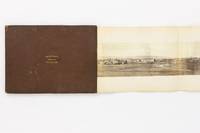
1866141595Adelaide: Townsend Duryea 1866. First Edition. Hardcover. Adelaide Townsend Duryea circa 1866. A photograph album 254 × 340 mm containing a magnificent panorama of Adelaide comprising five roughly uniform albumen paper photographs mounted as issued slightly overlapping to form a continuous image 124 × 880 mm on a linen-backed card mount 244 × 951 mm folded into three plus 12 albumen paper photographs nine of them around 130 × 200 mm or the reverse one 130 × 172 mm and the last two approximately 220 × 285 mm mounted on the rectos of stiff card leaves. Original russet pebble-grain cloth lettered in gilt on the front cover; cloth slightly flecked with minor wear to the extremities; endpapers foxed with slight loss to silverfish and the rear free endpaper is missing; leading edge ribbon ties appear never to have been inserted; mounts lightly cockled and occasionally lightly spotted and foxed; bottom margin of the final mount lightly stained with trifling loss to silverfish; minimal signs of age and use; overall a very pleasing copy with the photographs - and in particular the stunning panorama - in uniformly fine condition. The twelve individual photographs are captioned in pencil on the mounts: 'View in botanical gardens - showing Asylum' 'View in Botanical Gardens' 'View in Gardens' five captioned simply 'Botanical Gardens' 'Bridge between N & S Adelaide' 'near Willunga' and two captioned 'Willunga' both superb large-format prints. <p>New York-born Townsend Duryea 1823-1888 emigrated to Australia Melbourne in 1852 and commenced work as a photographer the following year. In 1855 he relocated his studio to Adelaide. By the early 1870s Duryea's panoramas royal portraits and prizes won in Society of Arts photographic competitions had made him famous 'Australian Dictionary of Biography'. Much more detail on Duryea may be had from the lengthy article in Joan Kerr's 'Dictionary of Australian Artists . to 1870'. However the panorama in this album is not the one described in Kerr 'a fold-out 360-degree panorama of Adelaide taken from the tower of Adelaide Town Hall in 1865 was the album's major feature' nor is it the larger panorama 'taken from the top of the GPO tower soon after it was completed in 1870'. The present panorama is taken from a local rise in North Adelaide and sweeps left to right from the hills towards the sea. All of these panoramas are very rare indeed not least because 'Duryea's studio and enormous collection of glass-plate negatives stated to number 50 000 were destroyed by fire in 1875'. This catastrophe effectively ended Duryea's career as a photographer. It must assuredly account for the genuine scarcity of material by Duryea on the open market other than bread-and-butter carte de visite portraits. <p>This album is very rare in our experience and if the available records are any guide for long before we came on the scene in the mid-1970s. Although this is the fourth example we have handled it is also only the fourth one we have seen on the open market in that time. We have inspected three other examples in institutions; all seven copies are bound similarly and contain the same panorama. However the balance of the contents varies in quantity and image selection in each instance. <p>Duryea began to advertise these albums in Adelaide newspapers in August 1866. One such from the 'South Australian Register' for 28 August 1866 reads: 'DURYEA'S VIEW ALBUMS. These Albums are neatly bound in cloth and form a beautiful acquisition either for the drawing-room table or transmission home. A PANORAMIC VIEW of the CITY of ADELAIDE and the SUBURBS three feet in length has been introduced as a Frontispiece; and as a further advantage purchasers have the privilege of choosing Photographs from a large Album containing 90 of the most interesting and picturesque Views of Adelaide and the Country. The above are open to the inspection of the public at Mr. Duryea's Studio 66 and 68 King William-street. Any of the Views mentioned above can be had separately. Photographs of Gentlemen's Country Seats Business Offices Shops &c. taken at the shortest notice by Ross's Improved Wide Angle Lens'. <p>Provenance: Edwin Ashby 1861-1941 South Australian property developer and naturalist; by descent. While Ashby was obviously not the first owner of this album its numerous images of the Botanical Gardens must have appealed to him. The fine gardens he established at his property 'Wittunga' at Blackwood in the Adelaide hills after the turn of the century were later donated to the State by his heirs and are now the Wittunga Botanic Garden. Townsend Duryea hardcover
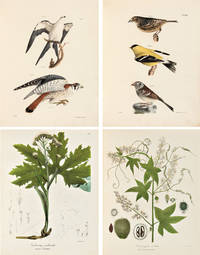
1894WRCAM28514Albany 1894. Thirty volumes described below. Original cloth gilt-stamped in the earlier volumes in the series several volumes rebacked with original backstrips laid down. Several volumes with minor nicks or tears in cloth but overall a very good set of a work seldom found in decent condition. A complete set of one of the great monuments of American science and natural history illustration of the 19th century. It is virtually impossible to assemble all of the volumes in this set as they were issued across more than half a century and are generally found in poor condition because the bindings were not adequate for the weight of the heavy text blocks. Many of the volumes were issued in two states with the plates either colored or uncolored. In this set all possible plates some 539 are colored. <br> <br> The New York Natural History and Geological Survey was established by the state legislature in 1836 under the direction of James Ellsworth DeKay. By far the most ambitious scientific project undertaken in the United States up to that time it was designed to be issued in six sections: Zoology Botany Mineralogy Geology Agriculture and Paleontology. After six years of preparation volumes began to appear in 1842. The first four parts a total of twelve volumes were issued in 1842-44 and the five volumes of the Agriculture section between 1846 and 1854. The final section Paleontology began publication in 1846 but under its editor James Hall it took on a life of its own. Hall managed to turn it into a long career in his position as state paleontologist ultimately issuing thirteen volumes where only one had been planned originally. Without Hall's genius as a lobbyist for additional state funds the entire project would have been wrapped up in the 1850s. Instead he was still in office at age eighty-three when the final volumes were published. <br> <br> NATURAL HISTORY OF NEW YORK is notable for its vast array of color plates and in later volumes its use of other innovative forms of natural history illustration. In all it contains several thousand plates colored and uncolored making it a project on the same scale as the Pacific Railroad Survey. The present set contains 539 handcolored lithographs. The set is much less well known because far fewer volumes were produced than the U.S. government publications but it clearly was the model on which the great U.S. surveys of the 1850s were based. Some sections of the set are particularly desirable and more difficult to obtain while others were produced in very small editions. An essential work for any collection of early American science or American illustration especially color plates. A synopsis of the set with notes on illustration and rarity is given below. A detailed collation of the set is given in Meisel. <br> <br> Part I. ZOOLOGY OF NEW YORK: OR THE NEW YORK FAUNA; COMPRISING DETAILED NOTICES OF ALL THE ANIMALS HITHERTO OBSERVED WITHIN THE STATE OF NEW YORK. This series was edited by James Ellsworth DeKay. <br> <br> Vol. I. Mammalia. Albany. 1842. Thirty-three plates. These plates are usually found uncolored as here. A colored issue does exist but is extremely rare. <br> <br> Vol. II. Birds. Albany. 1842. 141 handcolored plates. <br> <br> Vol. III. Reptiles and Amphibians. Albany. 1842. 102 plates. These plates are usually found uncolored as here. The extremely rare colored issue of this volume is probably the hardest segment or issue to find of the NATURAL HISTORY. <br> <br> Vol. IV. Reptiles and Amphibians. Albany. 1842. The text volume for the preceding. <br> <br> Vol. V. Mollusca and Crustacea. Albany. 1844. Fifty-three handcolored plates. <br> <br> Part II. A FLORA OF THE STATE OF NEW YORK COMPRISING FULL DESCRIPTIONS OF ALL THE INDIGENOUS AND NATURALIZED PLANTS HITHERTO DISCOVERED IN THE STATE. Albany. 1843. Two volumes. 161 handcolored plates. This section was edited by the noted botanist John Torrey. Not surprisingly the beautiful colored lithographs of flowers have made this one of the most sought after sections of the NATURAL HISTORY. <br> <br> Part III. MINERALOGY OF NEW YORK; COMPRISING DETAILED DESCRIPTIONS OF THE MINERALS HITHERTO FOUND IN THE STATE OF NEW YORK AND NOTICES OF THEIR USES IN THE ARTS AND AGRICULTURE. Albany. 1842. Eight uncolored plates. This section was edited by Lewis C. Beck. <br> <br> Part IV. GEOLOGY OF NEW YORK. Prepared by various authors. <br> <br> Vol. I. Mather William W.: Part I.first geological district. Albany. 1842. Forty-two handcolored plates. <br> <br> Vol. II. Emmons Ebenezer: Part II.second geological district. Albany. 1842. Fifteen uncolored plates. <br> <br> Vol. III. Vanuxem Lardner: Part III.third geological district. Albany. 1842. No plates only illustrations in text. <br> <br> Vol. IV. Hall James: Part IV.fourth geological district. Albany. 1843. Nineteen uncolored plates. <br> <br> Part V. AGRICULTURE OF THE STATE OF NEW YORK; COMPRISING AN ACCOUNT OF THE CLASSIFICATION COMPOSITION AND DISTRIBUTION OF THE SOILS AND ROCKS AND THE NATURAL WATERS OF THE DIFFERENT GEOLOGICAL FORMATIONS. This section was edited by Ebenezer Emmons. <br> <br> Vol. I. Part I. Albany. 1846. Twenty-one uncolored plates. <br> <br> Vol. II. Analysis of Soils Plants and Cereals. Albany. 1849. Forty-two uncolored plates. <br> <br> Vol. III. Fruits. Albany. 1851. Text only. <br> <br> Vol. IV called "Atlas" to Volume III. Fruits. Albany. 1851. Ninety-five handcolored plates. This volume is also highly sought after for its plates of fruits from upper New York State prefiguring the many fruit illustrations which began to be produced in Rochester in the mid1850s. <br> <br> Vol. V. Injurious Species of Insects. Albany. 1854. Forty-seven handcolored plates. <br> <br> Part VI. PALAEONTOLOGY OF NEW YORK. This section was edited throughout by James Hall. <br> <br> Vol. I. Organic Remains lower division. Albany. 1846. 100 uncolored plates. <br> <br> Vol. II. Organic Remains middle division. Albany. 1852. 104 uncolored plates. <br> <br> Vol. III. Part I. Organic Remains.lower Helderberg group. Albany. 1859. No plates. <br> <br> Vol. III. Part II. Atlas for above. Albany. 1861. 143 uncolored plates. <br> <br> Vol. IV. Fossil Brachiopoda. Albany. 1867. Sixty-three uncolored plates. <br> <br> Vol. V Part 1 Vol. 1. Lamellibranchiata. Albany. 1884. No plates. <br> <br> Vol. V Part 1 Vol. 2. Lamellibranchiata. Albany. 1885. Ninety-six plates. <br> <br> Vol. V Part 2 Vol. 1. Gasteropoda. Albany. 1879. No plates. <br> <br> Vol. V Part 2 Vol. 2. Gasteropoda. Albany. 1879. 120 uncolored plates. <br> <br> Vol. VI. Corals and Bryoza. Albany. 1887. Sixty-seven uncolored plates. <br> <br> Vol. VII. Trilobites. Albany. 1888. Sixty- four uncolored plates. <br> <br> Vol. VIII Part 1. Paleozoic Branchiopoda. Albany. 1892. Forty-four uncolored plates. <br> <br> Vol. VIII Part 2. Paleozoic Branchiopoda. Albany. 1894. Eighty-four plates. The final eight volumes of this series are much harder to find than the first four having been issued much later and in smaller editions. The final two volumes comprising Volume VIII are extremely rare. MEISEL II pp.613-18. ANB 6:356 De Kay 9:861 Hall. REESE STAMPED WITH A NATIONAL CHARACTER 73. BLUM PICTURING NATURE 199-209. hardcover books
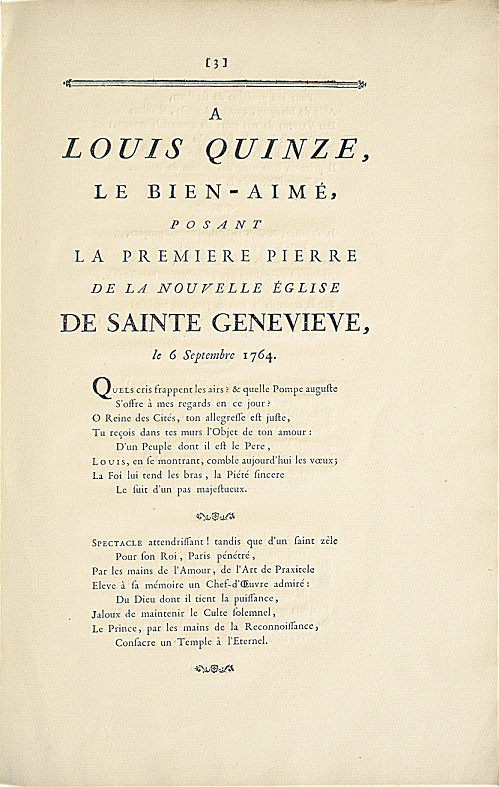
LCS-17353« L’Ode à la reconstruction du Panthéon », opérée sur ordre de Louis XV, par l’architecte Soufflot, reliée pour Madame Elisabeth, sœur de Louis XVI, guillotinée le 10 mai 1794. Paris, Veuve Thiboust, 1764. In-folio de 8 pp., 7 pp. Plein maroquin rouge, triple filet doré encadrant les plats, fleurs-de-lys couronnées aux angles et armoiries frappées or au centre des plats, dos lisse richement orné, pièce de titre de maroquin olive, roulette dorée sur les coupes, roulette intérieure dorée, tranches dorées. Reliure de l’époque. 400 x 258 mm.
- Léon Curmer, Paris 1840-1842, 18x26,5cm, 11 volumes reliés. - Les Français peints par eux-mêmes. Encyclopédie morale du dix-neuvième siècle - Le Prisme [with] Les Anglais peints par eux-mêmes [The French painted by themselves - The English painted by themselves] Léon Curmer | Paris 1840-1842 | 18 x 26,5 cm 11 volumes in half morocco First edition, one of the grand papier (deluxe) copies with two states of the illustrations for the 8 volumes of Les Français peints par eux-mêmes: one in black on tinted paper, and one enhanced by hand using the so-called "coloris gommé" technique with watercolour and varnish on white paper. Les Anglais peints par eux-mêmes includes the engravings in black. No deluxe copies in colour have been made for this rare set of Les Français. Bound in half brown morocco, spine in five compartments enhanced with stipple engraving and double gilt panels richly decorated with gilt floral motifs framing a mosaic medallion of green morocco with a gilt rose stamped in the center, cartouches at the top decorated with a gilt garland framing the place and publication date, some light minor rubbing on some compartments, gilt fillets on the marbled paper boards, comb-patterned endpapers, top edges gilt. Elegant late nineteenth century bindings signed Durvand-Thiret. Complete with all engravings along with added engravings, i.e. 930 engravings including 415 in colour. Title pages dated 1841 for all volumes of Les Français except for volume 5 of Les Parisiens and volume 3 of La Province dated 1842. Les Français peints par eux-mêmes has 415 engravings in black (including that of Napoleon on horseback) instead of the 405 announced and 415 in colour including a double page map of France in volume III of the Province. The English volume illustrated by Kenny Meadous is complete with 100 plates in black. This unique set contains in total almost a thousand black and coloured engravings and more than 1500 in-text illustrations. Famous gallery of woodcut portraits depicting the social classes of the 19th century by the greatest artists of the time: Gavarni, Daumier, Delacroix, Grandville, Johannot, Bellangé, Charlet, Daubigny, etc... The portraits are all accompanied by original texts from the most famous Romantic authors, including: Balzac, Nodier, Gautier, Nerval, Gozlan, Janin, Karr, etc... Scarce foxing affecting mainly the Prism and the Anglais. The texts and illustrations of the book paint a lively picture of inhabitants and their trade in metropolitan France and its colonies. It sets the tone for panoramic literature - a new genre coined by Walter Benjamin in Charles Baudelaire. A lyric poet at the height of capitalism. In addition to these portraits of the Français, "the contribution of a whole areopagus of great and small authors and illustrators" (S. Le Men, "La 'littérature panoramique' dans la genèse de la Comédie Humaine: Balzac et Les Français peints par eux-mêmes", L'Année balzacienne 2002/1 (No. 3) CAIRN) includes some of the most renowned authors and cartoonists of the time, each of whom made an original creation for the project. This protean fresco was directed by editor Léon Curmer, already known for the publishing success of Paul et Virginie between 1836 and 1838. Curmer is represented here by an article, "L'éditeur" in volume IV written by Elias Regnault. The latter takes example in Louis-Sebastien Mercier's Tableau de Paris, published in 1781, whose vision is even further extended by the representation of French provinces in Les Français. Thanks to Curmer the work finds an even deeper meaning: "the editor has widened his frame, and instead of letting a few fleeting portraits get lost in the immense daily whirlwind that engulfs all things, he has sought to bring together the most salient physiognomies of that time." (S. Le Men, Ibid.) Curmer selected the authors and illustrators closest to the ones they depict: "It is therefore a question of calling upon authors and illustrators who are well
LCS-18584Exemplaire à belles marges relié en maroquin doublé de maroquin de Chambolle-Duru. Paris, chez la Veuve de Sebastien Mabre-Cramoisy, 1689. In-12 de (2) ff., 562 pp., (1) f. de privilège. Plein maroquin brun doublé de maroquin rouge, plats et dos richement ornés aux petits fers, double filet or sur les coupes, riche dentelle dorée sur la doublure, tranches dorées sur marbrures. Chambolle-Duru. 163 x 90 mm.
4to. (8), 181, (1) pp. With folding woodcut map. Modern half calf. First German edition. - "This is an important source work for the battle of Lepanto. Contarini has written a detailed account of the battle, including the events leading up to it. He includes many interesting statistics - the source of the various ships, numbers of men taking part, etc." (Navari). "One of the most extensive accounts of the Battle of Lepanto, with details as to the Venetian, Spanish, and Papal ships" (cf. Göllner). - Title page numbered; a few old underlinings. Closely trimmed at upper edge (occasionally touching headlines); insignificant brownstaining. Very rare: not a single copy in postwar German auction records. Formerly in the Ottoman collection of the Swiss industrialist Herry W. Schaefer. VD 16, C 4965. IA 143.974. BM-STC 221. Blackmer 396 (note). Schottenloher 43475 c. Apponyi 1837. Kertbeny 860. Göllner 1617.
LCS-17675Aucun autre exemplaire de cette rare originale n’est apparu sur le marché public international depuis 1940. Paris, Louis Sevestre, 1700. In-12 de (11) ff., 69 pp., (3) pp. Relié en veau brun moucheté de l’époque, dos à nerfs orné de fleurons dorés, coupes décorées, tranches mouchetées. Coiffes légèrement émoussées. Étui en maroquin brun. Reliure de l’époque. 157 x 90 mm.
- La Maison-Forestière (Argonne) 28 mai 1915, 13,4x21,3cm, 4 pp. sur un feuillet double. - One of the most magnificent letters by Fernand Léger La Maison-Forestière (Argonne) 28 mai 1915, 13,4 x 21,3 cm, loose leaves A fabulous handwritten letter by the painter Fernand Léger, written on the front line during the Battle of Argonne, addressed to the Parisian art trader Adolphe Basler. 92 lines in black ink, four pages on a double leaf, dated 28 May 1915 by Léger. The handwritten letter is presented with a half forest green morocco chemise, green paper boards with a stylised motif, endpapers lined with green lamb, slip case lined with the same morocco, the piece is signed by Goy & Vilaine. The letter was chosen for Cécile Guilbert's anthology, Les Plus Belles Lettres manuscrites de Voltaire à Édith Piaf, Robert Laffont, 2014. A true masterpiece of correspondence, this exceptional missive by Fernand Léger shows that the experience of the trenches is of fundamental importance to his future work. Sent to the Engineering troops in 1914, Léger spent two years on the front at Argonne, in the Maison-Forestière section, from where he writes this letter on 28 May 1915, "pendant que les obus [lui] passent au-dessus de la tête," "while shells were passing over his head." In complete freedom of tone and form, the Célinian charm of this style is a surprise and is a sign of the "mécanique," "mechanical" period of his post-war painting. Through his letter we witness his political conscience awakening to contact with the men he has met on the front line, whose merit and bravery made their mark on the painter. His particularly clear analysis of the inhumanity of the war gives this missive a place amongst the most beautiful combat letters of the first World War. Fernand Léger is replying to Adolphe Basler, a Polish art critic, who was Guillaume Apollinaire's secretary and a trader of paintings. Basler probably met Léger around 1910, since he was a member of the "bande à Picasso," "Picasso's gang" and was strongly influenced by Cubism alongside Derain, Maurice de Vlaminck and Max Jacob. Trying his hand at monochrome and then at abstraction, Léger applies the principles of form decomposition and perspective distortion. His work with Cubists becomes premonitory of the pending apocalypse. Some years later, this Cubist vocabulary in fact becomes, for Léger, the perfect illustration of the war, which he describes to Basler: "It is linear and abrupt like a geometry problem. So many shells, for such a long time, on such a surface, so many men every metre, ready to go at any given time." More than ever the Cubist innovation allowed the contemporary world to be translated, swaying between rationalism and chaos. Contact with the trenches causes a real upheaval, both intellectual and artistic, for the painter. As Blaise Cendrars comments, "It was at war that Fernand Léger had a sudden revelation of the depth of today...". Léger tell Basler of his vision of an industrial, inhumane and depersonalised war: "The wavering is over. It is a war without 'waste.' Everything goes. Everything is organised for maximum return. This war is the perfect orchestration of the all methods of killing, old and new. It is intelligent through and through. It is even annoying, there is nothing left that is unexpected." Léger's pertinent analysis was reflected in his post-war canvases by very calculated and balanced aesthetics, a "rendement pictural," "painting output," of the image of the modern war in which he took part. For Léger, the Cubist lesson is accompanied by a deep reflection of modernity and "the modern men," that he wishes to represent in his painting. The letter shows the gestation of his post-war painting style, keeping the Cubist elements while making his canvases more vibrant with color and patterns taken from his time in the trenches. In fact, Léger gives Adolphe Basler a glimpse of his famous "période mécanique," "mechanical period," in the 1920s, of which the p
2 volumi in-folio, ff. (16, primo, e l'ultimo bianchi), 144, (2, di errata); ff. (18), 157, (1, bianco); 2 ff. inseriti dopo il f.n. 6, che contengono 2 lettere di Luigi XII. Legatura in mezza perg. secentesca per il primo vol., in piena pelle 800esca decorata a secco per il secondo. Seconda edizione degli Statuti di Milano, e prima degli Statuti riformati da Lodovico il Moro. Impressi con lo stesso elegante carattere (R.109) seppur a 4 anni di distanza: anche il primo volume, seppur senza indicazioni tipografiche, fu impresso da Ambrosius de Caponago per il Minuziano, letterato ed editore, il quale si servì di vari stampatori milanesi. Lodovico il Moro intraprese l'ultima riforma generale degli Statuti Civili, già riformati da Gian Galeazzo Visconti nel 1396. Gli aggiornamenti furono promulgati il 20 Ottobre 1498, ma l'occupazione francese, nonché la morte del Moro, interruppero il lavoro di revisione, che fu ultimato dal re di Francia Luigi XII d'Orléans; i senatori ed i giureconsulti incaricati terminarono l'opera il 23 aprile 1502. Opera di straordinaria importanza storica, giuridica e politica per la città di Milano e di insigne rarità a reperirsi completa delle due parti. Bell'esempl., fresco e con grandi margini; seppur in legatura non uniforme. Di notevole importanza, in quanto il primo vol. appartenne al giureconsulto Gregorio Panigarola, vicario generale del ducato, con note di appartenenza e chiose marginali di mano sua e del figlio Antonio; mentre il secondo volume reca sul primo f. num. un'iniziale dipinta con stemma dei Visconti, ed in basso un medaglione con ritratto di profilo di Ludovico il Moro, con estensioni nei margini (miniatura non coeva ma di notevole pregio decorativo).. IGI 6325. Goff S-718. (parte I). Cat.Hoepli su Milano, 934 (Solo il II vol.). Predari 97 (solo la 2a parte). Manzoni II,27-86. Cat.Senato IV,295-96. Fontana II,185-86..