692 467 résultats
Folio (34 x 24 cm). 1 p. on bifolium. Brown ink on paper, written in a clear gothic hand. Folded for sending and addressed on the outside, with a slot for a ribbon and traces of a red wax seal. Watermark: B [crowned heart] P, (with the feet of the letters toward the centre of the sheet). An informative letter written by the French regent Catherina de' Medici concerning the exchange of gifts between France and the Ottoman Sultan. Written in French, from Catharine's favourite palace, Château de Chenonceau in the Loire valley near Tours, to Jacques de Germigny (d. 1587 or 1596), French ambassador to the Ottoman Empire. Catherine, mother of King Henry III, last of the Valois kings of France, was a powerful and colourful figure (familiar in literature from the historical novels of Alexandre Dumas), often running the government for her son. In the present letter she arranges an exchange of gifts with the Ottoman Sultan Murad III (1546-95). Germigny had written to her on 17 July concerning various items he had selected, and she asks him to send the gifts from the Sultan to André Hurault de Maisse (1539-1607) at Venice, who was France's ambassador there. She also suggests a change in one item they are giving the Sultan: "J[']ay receu v[ost]re l[ett]re du xvij de juillet avec la liste des presens que ma faict la sultane mere du grand seigneur lesquelz vous me mandez avoir retenuz par devers vous pour me les faire apporter quant vous partirez de par dela pour venir trouver le Roy monsieur mon filz. Et pour ce quil pourra passer plus de temps jusques la que je ne le vouldrois et que je seray bien ayse d[']avoir plustost lesd[its] presens je vous prie de les envoier au Sr de Maisse ambassadeur du Roy monsieur mon filz a Venize lequel me les fera tenir par apres. Au surplus j[']ay a vous dire touchant Le Rouge que desire recouvrer de moy lad[ite] Sultane semblable a celluy que je luy ay cy devant envoie quelle trouve meilleur, et mieulx faict que celluy d[']Espaigne, que je n[']en ay plus maintenant, et ne seay en sorte du monde la recepte et facon de le faire qui est cau[s]e que je ne puis contenter a p[rese]nt lad[ite] Sultane de ce qu[']elle desire de moy en cest endrent, dont du suis bien marrye mais j[']adviseray si j[']en pourray avoir le moien par cy apres dont je vous advertiray [...]". Counter-signed by her Secretary of State, Pierre Brulart, and addressed to "Mons[ieur] de Germigny, ch[eva]l[ie]r de l[']ordre du Roy monsieur mon filz, son con[seill]er et amba[ssa]deur en Levant". The two-leaf folio was folded twice on horizontal folds, then briefly once more on a vertical fold without a sharp crease for sending. A cut through the sixteen layers would have had a ribbon through it and one can see traces of red sealing wax around the slot on the back. The letter was stored folded horizontally, and eight small worm holes run through the eight layers, but they barely touch an occasional letter of the text. There are also a few small marginal tears. In very good condition and with the whole sheet of paper untrimmed.
¾ S. auf Doppelblatt. Folio. Mit Adresse verso. Wasserzeichen: Anker in Kreis mit Stern. Etwa zwei Monate nach Abschluss des Passauer Vertrags mit König Ferdinand I. verfasster Brief an seinen Bruder August von Sachsen (1526-86) mit der Bitte, entweder zwei seiner Kämmerer für zwei Edelleute zu schicken oder jenen ansonsten vertraulich zu schreiben, um zu erfahren, wie ihre Angelegenheiten gegenüber Herzog Johann Friedrich I. von Sachsen (1503-54) stünden: "Wir bitten E. L. vieler Ursachn halber freuntlich und bruderlich Sie wolle etwa Iren Cammerern [...] oder sonst Irer vortrauten diener [...] schicken, Oder Inen sonst vortraulich schreiben, und von Ihnen erfaren lassen, wie doch Ire Sachen gegenn unserm Vettern Hertzog Hansfridrichen stehen [...]". - Dank des Passauer Vertrags im September des Jahres aus seiner fünfjährigen Gefangenschaft befreit, nutzte Herzog Johann Friedrich während seiner letzten Lebensjahre weiterhin den kurfürstlichen Titel und das entsprechende Wappen, was abermals zu Auseinandersetzungen mit Moritz führte. - Etwas stock- und braunfleckig. Mit zwei kleinen Randeinrissen und Siegelspur. Etwas gebräunt und mit kleinen Papierdurchbrüchen; geringer Textverlust durch Abdeckung im Adressfeld.
8vo. (10), 56, (4), 370, (28) pp. Near contemporary vellum with giltstamped spine label. All edges sprinkled in red. First edition. The editor, Joseph Labrosse, "was born in Toulouse in 1636 and entered a Carmelite order, taking the name of Fr. Angelus of St Joseph. In 1662 he went to Rome and studied Arabic for two years before travelling to Isfahan to study Persian. While in Iran, he used medicine as a means of propagating Christianity and in the process read many Arabic and Persian books on medicine and 'visited the houses of the learned people of Isfahan and paid hundreds of visits to the shops of the druggists, the pharmacists, and the chemists.' After returning to France in 1678 he published his 'Pharmacopoea persica', which consisted of a Latin translation of a Persian book on compound remedies written in the previous century by Muzaffar ibn Muhammad al-Husayni (d. 1556), with additional comments by Labrosse" (in: I. Loudon [ed.], Western Medicine [1997], p. 52f.). Hyde (Biographia Britannica, cited by Langlès, Biographie universelle) asserts that the credit for this work really belongs to Père Matthieu. - Insignificant chipping to spine label. Some minor browning and brownstaining. 18th century annotations on first endpaper and engraved bookplate to pastedown. From the library of Swedish antiquarian bookdealer Björn Löwendahl (1941-2013). Wilson 7. OCLC 13058281.
Folio (ca. 210 x 330 mm). (8), 245 ff. (1), 246-481 ff. With numerous genealogical plates printed in red and green (of which 2 folding) in the 2nd volume. Original printed flexible boards with cloth-reinforced spine (vol. 2); vol. 1 bound in modern half calf with cloth covers, preserving original printed upper wrapper within. Rare history of the Emirate of Transjordan (today the Hashemite Kingdom of Jordan), then a British protectorate. Presentation copy from the author to Ahmed Salem el Sakrun of the Arab Legion and inscribed by him to "my friend Ahmed Effendi Hsein El Amawi as a remembrance, Amman 23.12.35" on inside of upper wrapper. - The second volume contains not only the first volume's index, but also an annotated directory of the tribes of the various districts of Transjordan, comprising extensive tables, genealogies, and introductory essays on each tribe. With a separate index to the tribes and a bibliography at the end of the volume. Major-General F. G. Peake (1886-1970), known to the Jordanians as "Peake Pasha", served under Lawrence of Arabia and formed the "Arab Legion", the territory's regular army, in the early 1920s. He was later appointed Major-General in the army of the Emirate of Transjordan. Upon his retirement in 1939 he was succeeded in his command by John Bagot Glubb. - Title of vol. 1 trimmed and mounted on blank leaf; some light spotting or soiling; final leaf a little stained, slight fraying to edges at beginning and end, original printed upper wrapper rubbed and stained, lacking lower outer corner. Spine of vol. 2 a little chipped, else fine. - Mimeographed typescript, printed on one side throughout. No copy in British Library. OCLC 29109691.
4to. 1½ pp. In French. Highly interesting letter that is part of an affair surrounding the admission of a member of the House of Hénin and courtier of the Marquise de Pompadour to the Order of Malta. Apparently, the bailiff of Saint-Simon, a cousin of the Duc de Saint-Simon and unquestionably a political enemy of the Marquise, tried to prevent the desired admission of Hénin. The Marquise immediately put pen to paper and intervened on behalf of her courtier, casting doubt on the credibility of the detractor. The letter contains "two reflections" on the matter; it accompanied a further letter to a high-ranking Knight Hospitaller, most likely Louis Gabriel de Froulay, ambassador of the Order of Malta to Louis XV: "The 1st, his having been my gentleman, cannot disadvantage Mr. d'Hennin to enter the Order of Malta, since there is more than one example of dear ones who are admitted, whose fathers had belonged to ladies of the court, and even to titled names. The 2nd, that to serve the King at the table is a very great honour, and that it is usually the governors of the royal houses who are in possession of it, Monsieur the Bailiff of St Simon cannot say what he saw at my table, since he has never been there" (transl.). In closing, she asks the recipient to inform the Grand Master before he makes any decision and announces that M. Rouillé, probably the Secretary of State Antoine Louis Rouillé, will give him "an exact account of the affair". - The intervention appears to have been successful: the Marquise's protégé was probably François-Joseph de Hénin-Liétard (b. 1729), who was received into the Order of Malta on 16 March 1755. - Well preserved.
Folio (218 x 340 mm). Two parts: 1) Confidential. Survey by Major E.T. Rich, R.E., of routes between Bandar-Abbas and Kerman. General Staff, India. Simla: Government Branch Press, 1917. 9, 13, (1), 7, 16 = 46 pp. With six maps and plans (two folding), a proof plate with 2 photo views, and 13 leaves of original manuscript, typewritten and printed telegrams related to the report. Both original publisher’s wrappers bound in. - 2) Confidential. Report by Major E. T. Rich, R.E., on the Construction of Motor Roads in South Persia between Bandar Abbas and Kerman. 1917. General Staff, India. 2 vols. Delhi: Superintendent Government Printing, India, 1918. Vol. 1: (2), IV, 38 pp. With 12 leaves of plates (including one proof plate) and 8 maps and plans (3 folding). Vol. 2: 39-54 pp. With 3 folding maps. Occasional red ink notes by Rich in text and on the maps/plans; original publisher’s wrappers bound in. Occasional red ink notes by Rich in text and on the maps/plans; both original publisher’s wrappers bound in. Custom-made hardcover binding with the first publisher’s wrapper of the original report pasted to the front board. With a large folding linen backed map of Persia in the pocket at rear. Addenda (see below). Special custom-bound, historically important archive, compiled by E. T. Rich and containing confidential printed reports, 18 maps and plans, as well as original documents related to the survey of potential routes for a motor road between Bandar Abbas and Kerman in southern Persia. The survey was carried out by Rich as a part of the Persian campaign during the First World War on the special orders of the Chief of General Staff in India. As a part of WWI military operations, Bandar Abbas was occupied by British forces under command of Sir Percy Sykes in March 1916, and the survey was apparently undertaken in order to establish additional supply routes to the war’s Persian front. Rich was ordered "to report as soon as possible on the best route for a road to take motor lorry traffic from Bandar Abbas to Kerman and to frame estimates from the same and proposals as to the best way of carrying out the work." The survey was done between December 1916 and June 1917; a year later Rich was promoted a Companion of the Order of the Indian Empire (C.I.E.) for his work. Nevertheless, the road never was constructed, probably because of the cardinal changes on the Persian front after the collapse of the Russian front line as a result of the revolution in February 1917. - The volume contains: confidential reports by Rich; printed "Working notes" on the survey; maps and plans of Bandar Abbas, Kerman, and the area in between; telegrams sent to him from the Chief of General Staff (Delhi & Simla), Surveyor General’s Office in Calcutta, British Consul in Bandar Abbas; tables with distances and estimates of construction, printed views of the area et al. Several leaves slightly age-toned, but overall a very good custom-made copy. - Supplemented with Rich’s copy of a typewritten dispatch from the British Vice-Consul in Bandar Abbas to the Chief of Roodbar (South Persia) Zarghan-us-Saltaneh, dated Bandar Abbas, 2 Dec. 1916. In the dispatch the consul asks for the assistance to Rich who is going to visit the area under the chief’s control during the course of his road survey. The copy is signed by the consul and has his manuscript note "Original sent by special messenger direct to Zarghan-us-Saltaneh." - There are also two autograph signed letters by Rich, addressed to his aunt in London and written while on field service in Southern Persia. The letters are dated 10 & 25 Dec. 1916, housed in the original envelope with a postal stamp of Bandar Abbas, and contain interesting notes about Rich’s work and his observations on the native life. [Near Kerman:] "It is Xmas evening & as I have no one to talk to, the nearest white man being over 100 miles away, I am writing instead. Being high up over 5000 feet in the mountains, it is bitterly cold & proper Xmas weather, but personally I’d prefer it a bit warmer as I can’t keep warm no how at night which means continuously waking up [...] The food of the villagers about here is most strange, being dates & bread about 2 lbs of each per diem & nothing else. They feed the horses & cows on dates & even the dogs. I eat them once a day for lunch which consists of porridge, bread & cheese & dates. I often envy the meals my servants get at home when I am out on these expeditions." - E. T. Rich (1874-1937) was a British military engineer and surveyor, Fellow of the Royal Geographical Society. He graduated from Sandhurst with the Pollock Medal and was gazetted as 2nd Lieutenant in the Royal Engineers. In 1895 he went out to India and was posted to railway survey work in Burma. In 1905-1909 Rich worked as survey officer on the Indian North-West Frontier, and took part in the Bazar Valley and Mohmand Campaigns of 1908 (as a divisional and a chief survey officer respectively). During the latter he was slightly wounded and for his services was promoted brevet-major. In 1911 Rich was appointed the head of the survey office on the Burma frontier post at Myitkyina, where he carried out the survey of the border with Tibet and Yunnan. In 1916/17 he was in charge of the survey party looking for the alternative routes between Bandar Abbas and Kerman in South Persia; in 1918 he was in charge of the North West Persia Survey Detachment which accompanied British intervention in the Caspian under command of General Dunsterville. Rich carried out important surveys in Baku, Batum and Tiflis. After WWI Rich returned to Burma where he became the head of the Burma Circle of the Survey of India. In 1920-22 while surveying the unadministered territory between Burma and Assam he encountered slavery and human sacrifices still practiced there; in 1925 he took part in the Sir Harcourt Butler’s Mission to the Hukawng Valley to suppress slavery. Rich retired with the rank of Colonel and C.I.E. in 1929. "Colonel Rich was a great linguist, and besides his knowledge of Urdu, Pushtu, and Persian, he was able to converse in Yunnanese and several dialects of Burma - Kachin, Maru, and Lisaw [...] He was a keen explorer throughout his career and did much to encourage a spirit of adventure in younger officers who served under him” (Obituary, The Geographical Journal 91.1 [1938], p. 96).
Folio (275 x 407 mm). 2 vols. (4), XLVIII, (16) pp. 2144 (but: 2136: skipping 441-448) cols. (4) pp., XX cols., (6) pp., 2286 cols. 19th century English calf. First edition of the first Persian-Arabic-English dictionary, edited by the orientalist Sir John Richardson (1740/41-1795). The first volume includes a dissertation on the languages, literature and manners of Eastern nations. ''An excellent work. As the first vol. or Persian, Arabic and English part was published separately, many more copies were sold than of the second or English, Persian, and Arabic. A few broken sets of the first volume being left, the booksellers were led to reprint several deficient sheets, and so with the copies left on hand of the second vol. they made up some perfect sets. But these are easily known from the original'' (Clarke), as they are printed in London in 1800. - "On 12 November 1767 [Richardson] was proposed for the Society of Antiquaries of London as of Furnival's Inn. In London he pursued both the law and the study of Arabic and Persian. In his oriental interests Richardson was much influenced by another young man, William Jones, who was already coming to be regarded as a prodigy of learning in Asian languages. With the growth of British territorial power in India the potential market for a Persian dictionary had aroused the interest of London publishers and by 1770 Jones and Richardson were working on a new version of Franciscus Meninski's 'Thesaurus linguarum orientalium', first published in 1680-87. Progress was very slow, and Jones withdrew to concentrate on his legal career, leaving the field to Richardson. Thanks to his 'ingenuity and perseverance' (memorial of A. Hamilton and G. Nicol to East India Company, 6 Feb 1776, BL OIOC, E/1/60, no. 26), an abridged version of the original project eventually appeared in two volumes in 1777 and 1780 as A Dictionary, Persian, Arabic and English. Fundamentally revised by others, notably by Charles Wilkins in 1806 and 1810, the dictionary was to have a long life, but although the company took 150 sets, there were few other subscribers and Richardson got little reward for the huge effort he had expended on it" (Marshall). - Bindings rubbed and worn, inner hinges partly split, endpapers renewed. Some staining and marginal repairs to interior; larger tears to 5 leaves, staining to both titles, ownership inscriptions partly inked out; both titles showing central repaired clipping as well as marginal strenghtening and collector's stamp. A large part of both volumes shows worming to gutter; a few leaves with repairs. Zaunmüller 189. Vater/Jülg 25. Graesse VI, 113. Cf. Brunet IV, 1285 (later ed. only, 1806-1810). Clarke, John. (1806). The Bibliographical Miscellany - Supplement, vol. 1 (London, 1806) pp. 273-274; for Richardson: Marshall, "Richardson, John [styled Sir John Richardson, ninth baronet] (1740/41-1795), orientalist", in: ODNB (online ed.).
Pastel on paper, laid onto canvas stretched over (original?) wooden board (305 x 410 mm). This pastel was drawn by the prolific itinerant portraitist John Saunders (1682-c. 1758) at Peterborough in September 1739. Saunders is recorded as active in East Anglia, the Midlands and elsewhere in the mid-18th century (cf. Neil Jeffares, "John Saunders", Dictionary of Pastellists Before 1800 [London, 2006]). The sitter, John Sturges in Turkish costume, wearing a white turban with blue feather and golden embroidered coat, was probably drawn from a mezzotint after John Vanderbank (1694-1739) by Francis Kyte (d. 1744), published in 1733. The pastel is of interest as an example of mid-18th century depiction of Turkish costume. Saunders, perhaps in an attempt to add extra exoticism to Mr. Sturges, has included a curling moustache that is not present in the mezzotint. Sturges, an architect based in the East Midlands, is known to have collaborated with William Talman (1650-1719) at Chatsworth and Milton House in Northamptonshire. The fact that this pastel was produced in Peterborough may indicate some connection with descendants of Sturges, assuming that he himself was dead by 1739. The Fitzwilliam Museum holds a drawing of John Sturges by John Vanderbank (wash on paper, PD.1-1992). - Verso with label bearing 19th century manuscript note concerning the autograph pencil inscription by Saunders top right: “Saunders pinxit after Mr. J[oh]n Vanderbank Peterborough Sept. anno d. 1739”. Two negligible scratches to surface, otherwise good, offered without frame.
4to. (12), 506, (30). With woodcut title-vignette and headpiece. Near-contemporary giltstamped full calf with giltstamped spine-title. Leading edges gilt, sumptuously gilt inner dentelle bordering silk pastedowns. Later marbled flyleaves. All edges gilt. First edition of the travelogue of the Spanish diplomat Silva y Figueroa (1550-1624), who embarked on an embassy to Persia in 1614, hoping to secure from Shah Abbas exclusive trading rights in Persia and its dependencies. As the Latin manuscript was not published and a Spanish translation did not appear until the 20th century, this French translation published by de Puis (as well as the one issued by Louis Billaine the same year) long remained the only available version of the itinerary. - In 1619, Figueroa was granted an audience in Isfahan with the Shah, who sought to conclude a trading agreement with the Spanish but would not subscribe to the ambassador's demands for the restoration of Gombroon and other Portuguese enclaves, nor to the exclusion of the English and other nationalities. Negotiations were suspended and Figueroa ended up returning to Spain, where he arrived in 1624 after an absence of ten years. His account describes Lar, Shiraz, Kašan, Qazvin, and Qom as well as other places including the caravansaries where he stayed, and gives interesting ethnographic data on the non-Muslim communities, such as the Armenians in Jolfa or the Zoroastrians, as well as a precise description of Persepolis and its cuneiform inscriptions. Although Antonio de Goueva (1602) and Giambattista and Girolamo Vecchietti (1606) had already recognized cuneiform as a type of writing, Figueroa was the first person to describe the cuneiform characters as shaped like "pyramids" and "obelisks", thus anticipating Pietro della Valle. Of the Persian dependencies, Ormuz and Bahrain were considered of particular importance, the former for its trade in silks, the latter for pearls: "Mais ce Golfe [...] qui est beaucoup plus long que large, ayant au milieu cette fertile Isle de Baharen [...] si celebre par tout l'Orient, à cause de sa riche & precieuse pesche de perles" (p. 59). Furthermore, Figueroa mentions falcons "larger and stronger than in Europe" (p. 105) as well as "excellent horses" (p. 426), and "the best dates of all of Persia" (p. 94). - Covers slightly scuffed. Interior occasionally browned and waterstained; a few small marginal tears, not touching text. Several handwritten marginal annotations, particularly in the index. Bookplate of the bibliophile and horse enthusiast Joseph Guilhem de Lagondie (1809-79) to flyleaf, who sold the book in March 1878 (handwritten note of acquisition by the new owner to flyleaf). Shelfmark label and catalogue description mounted to flyleaf. Palau 313613. Wilson 70. Diba 3. Howgego I, S105. Encyclopaedia Iranica IX, 612f. OCLC 166132497. Not in Blackmer, Atabey or Weber.
2 parts in 1 volume. Folio. With XII finely hand-coloured numbered engraved plates. Near contemporary half cloth, marbled sides. Very rare first and only edition of an illustrated description of 13 Jamaican plants (13 illustrated with 1 plate each, but only the first 9 described) by the Swedish botanist Olof Peter Swartz (1760-1818), who had drawn some 200 plants during his travels through the West Indies. 71 of these drawings were destroyed in WWII. J.F. Volkart made 13 engravings after some of these drawings for the present publication (all showing Jamaican plants): in the present copy they are delicately hand-coloured with a subtle gradiation of tones. It was intended as part of the first fascicule of a much larger publication that would have contained engravings after all of Swartz's drawings, but the rest still remains unpublished today. - Swartz first published findings from his voyage to the West Indies in his Nova genera & species plantarum seu prodromus descriptionum (1788), which is not illustrated. He enrolled as a medical student at the University of Uppsala in 1778 (the year the elder Linnaeus died), studied under Carl Linnaeus the younger and graduated with a doctoral thesis in 1781. From 1784 to 1786 he traveled via North America to Jamaica, Puerto Rico, Haiti and Cuba and made a special study of the flora of parts of Jamaica that western botanists had not yet visited. On his return voyage, he stopped in London to study the collections of Banks and Linnaeus, comparing them with his own assembled material. After his return to Sweden he became a leading figure in Swedish botanical studies, in charge of the Hortus Botanicus Bergianus and professor of botany. - The title-page, dated 1794, says fascicule 1, and the table of contents, also explicitly described as fascicule 1, lists 25 numbered species, but the present copy contains all that was published: the descriptions for species 1-9 and one plate each for species 1-13. Fascicule 1 was intended for publication in two or more instalments. The first instalment, issued in 1794, includes the title-page (A1) and contents (A2) for the entire fascicule. One might think the first instalment covered species 1-9, and that plates 10-13 (intended for the second instalment) were added when further work was abandoned, even though no descriptions had been printed for them. Stafleu & Cowan, however, cites correspondence indicating that plates 1-6 were issued in 1794 and plates 7-13 in 1801, so it describes the work as two published instalments containing plates 1-6 and 7-13, and an intended third instalment, never published, that would have contained plates 14-25. But the nine descriptions appear on sheet B (pp. 5-8, though B2 is mis-signed "A2"), with the description of species 5 beginning on B1v and concluding on B2r, so the nine descriptions could not have been issued in two separate instalments. In any case, the descriptions of species 10-25 and the 12 plates for species 14-25 never appeared. - Spine slightly discoloured, corners a bit bumped. Minor foxing on the text leaves. Otherwise in very good condition. Hunt 735. Linnaeus and the Linnaeans, p. 155. Nissen (BBI) 1917. Stafleu/Cowan 13529.
Large folio (545 x 375 mm). (16) pp. With 6 hand-coloured lithographed plates and a lithographed title. Contemporary half calf with cloth sides, gold tooled title on front cover. First and only edition of an ethnographic study of native Indian people by William Tayler (1808-92), who was at the time Acting Salt Agent of the Central Division of Cuttack for the East India Company. He dedicated his work to "Lady William Bentinck" (born Lady Mary Acheson, 1809-50), who was the wife of the Governor-General of India. The illustrations were drawn by Tayler himself, who was an amateur artist and drew much of the Indian daily life that he encountered. He selected the present 6 drawings to be published and had them lithographed by J. Bouvier. The first 3 plates not only show the ways of Indian people, but even more so the luxurious life of the English in India. The first plate, "The Young Civilian's Toilet" shows a young man relaxing while being treated by several servants, who are named "Anglo-Indians". The room is strewn with objects of leisure. The next 2 plates, "The Young Ladies Toilet" & "The Breakfast" show equal scenes. The other 3 plates are more ethnographic in nature, showing native Indians in their everyday life: "Women grinding at the mill"; "the Sunyasees" (Sannyasis) & "The village barber". Tayler later became a controversial figure for his excessively harsh oppression of Indian people when he was the commissioner of Patna. - Spine and covers slightly worn, pages a little frayed, some foxing on the text pages. Dedication page browned. Plate 2 detached and inserted loosely. Plates in good condition. Abbey, Travel 465. Bobins I 272. H. K. Kaul, Early Writings on India 454. Prasannajit De Silva, Colonial Self-Fashioning in British India, c. 1785-1845 (2018), pp. 116-119.
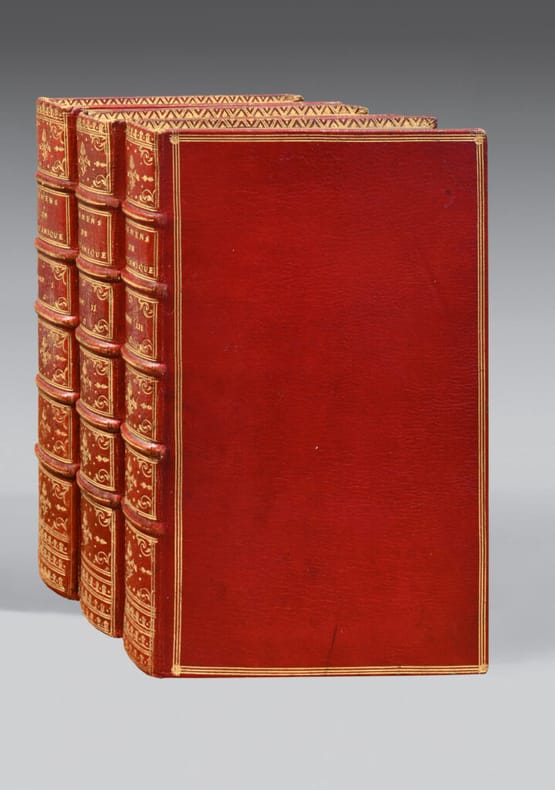
LCS-18488Fort rare exemplaire, très grand de marges (hauteur: 217 mm), conservé dans sa belle reliure en maroquin rouge de l’époque. À Paris, de l'Imprimerie royale, 1694. 3 volumes in-8 de: I/ 1 frontispice gravé, (10) ff., 562 pp., (10) ff.; II/ 1 frontispice gravé, 234 planches; III/ 1 frontispice gravé, pl. 235 à 451. Maroquin rouge, triple filet doré encadrant les plats, dos à nerfs ornés, coupes filetées, roulette intérieure dorée, tranches dorées. Reliure de l’époque. 217 x 135 mm.
"This book is different from other books. First of all, it is only in form a book at all. In reality it is a part of the life of action. It is a turning-point in European history, a late turning-point, but a real one. This book is itself the first blow in the gigantic war for the liberation of Europe. The prime enemy is the traitor within Europe, who alone makes possible the starving and looting of Europe by the outer forces. He is the symbol of Chaos and Death. Between him and the spirit of the twentieth century is unremitting war." - Foreword. "The spectacle of [Yockey, 1917-1960] being persecuted, framed and driven to his death simply because he wrote [this] book is not one we would expect to see in the Twentieth Century in the land of the free and the home of the brave." - Willis Carto. [10], iv, [4]-405, [3] pp. Average wear and soiling to publisher's khaki cloth. Title embossed atop front board. Black lettering upon backstrip which has been professionally restored. Modicum of moisture-induced rippling near fore-edge of back board. Binding sound. Contents tanned at periphery. Foxing to free endpapers. Publisher's address lightly penciled upon copyright page, otherwise unmarked. No dust jacket. A sound copy of this nationalist classic. 7.25" x 5". Singerman 757 Book
LCS-A47Des bibliothèques Genard et Léon Rattier, avec ex-libris. Berlin, C.F. Henning, 1751. 2 tomes en 2 volumes in-12 de: I/ (7) ff., 488 pp., (1) f. d’errata,pte. déch. restaurée ss. manque p. 191; II/ (2) ff., 466 pp., (1) f. d’errata. Maroquin rouge, triple filet doré encadrant les plats, dos à nerfs ornés de filets et fleurons dorés, double filet or sur les coupes, roulette intérieure dorée, tranches dorées sur marbrures. Reliure signée de Chambolle-Duru. 143 x 85 mm.
1) 260:340 mm. 2) 260:350 mm. 3) 260:360 mm. James Weir (d. 1820) was Captain of Marines on HMS Audacious from 1795 to 1800, and was also an accomplished watercolourist. His drawings show 1) "The Seraglio from the Marmora March 1806", 2) "The Seraglio at Constantinople from the harbour", and "7 towers Constantinople 19 March 1806".
Folio (243 x 372 mm). (12), 389, (3) pp. With double-page-sized engraved frontispiece (G. Wingendorp sc., bound after p. 8), 12 engravings in the text, and 139 woodcuts in the text (wants the engraved portrait). 18th century full calf with giltstamped red label to gilt spine in seven compartments. All edges red. First edition of this description of the important natural-historical and ethnological collection assembled by the famous Danish physician and naturalist Worm (1588-1654), forming the nucleus of the museum he founded, one of the first natural history museums ever established. The double-page frontispiece (sometimes counted as an additional engraved title page) shows his natural history collection inboxes, on shelves and hanging from walls and ceiling. This plentiful text illustrations show exotic as well as Scandinavian animals, plants, fossils, ethnological trophies, archeological discoveries, etc. For many items in the mineralogical and chemical section, the Arabic names are given (such as Borax or "Baurach", Alkali, Tinkur, etc.). Among the exotic flora are many plants endemic to the Middle East and Arabia, including the "Nabuch Arabum", the "Nux indica" (with reference to Avicenna), the date palm, pistachio ("ex Persia, Arabia & Syria"), gum arabic etc. - Binding slightly scuffed in places, but well preserved. Slight browning and brownstaining to interior, mainly confined to blank margins. A few early marginalia and underlinings in ink (trimmed by binder's knife when rebound in the later 18th century). As virtually all copies available for comparison, ours lacks the portrait (to be bound after the preliminaries). Nissen, ZBI 4473. Willems 772 ("Description raisonnée du cabinet d'histoire naturelle formé par le savant danois Olaus Worm").
69536, Guangxi Normal University Press, 2012 Cloth binding with blue silkscreen printed lettering, 572 pages, 30 x 24 cm, English and Chinese. *Good condition, lightly bleached from sunlight, no dustjacket. With origami fold-out. ISBN 9787549572083.
4to. 6 vols. 12, 942, (2) pp. (4), 968, (2) pp. (2), 936 pp. (2), 1048 pp. (2), 66, 512 pp. VII, one blank, 262, one blank leaf, VIII, 265-781, one blank page, (2) pp. With 6 letterpress plates in vol. I. Near-contemporary half cloth over marbled boards with giltstamped volume numbers to spine. 2 volumes bound with the original printed wrappers. First edition, rare. The 19th century classic edition of Yaqut's famous geography, prepared by the German orientalist Ferdinand Wüstenfeld (1808-99). The four volumes of Arabic text are completed by annotations and indexes in volumes V and VI, including "some 12,000 persons, many with additional bibliographical references" (cf. Fück). Composed between 1224 and 1228 and considered a literary geography, Yaqut's work is essentially an alphabetical index of place names from the literary corpus of the Arabs. The geographical descriptions are enriched with historical, ethnographic, and associated narrative material, historical sketches and accounts of Muslim conquests, names of governors, monuments, and local celebrities. - The four volumes of text are removed from the library of the Munich Franciscan monastery, with their stamp of ownership to versos of title-page or flyleaf. Later in the collection of the German historian Else Reitemeyer (b. 1873) with her handwritten ownership to flyleaves (vols. I-IV). German title-page and foreword of first volume (12 pp.) bound between pp. 480 and 481. Extremities occasionally very slightly rubbed. Last 20 pages of volume V pierced near right margin (not touching text). In all a very well preserved copy of this monumental series. Fück 193f. OCLC 3423433. Not in Zenker.
8vo (150 x 206 mm). (564) pp. Ottoman Turkish and Arabic manuscript written in Naskh script on polished oriental paper. 2 columns, 17 lines. Black ink; chapter headings in red. Text ruled in gilt, red and black; first two pages have attractive 'unwan decorations in gilt, red, lapislazuli, pink, and orange; final page has gilt floral scrollwork decoration. Gilded line decorations on some pages, a red and gillt inscribed figure known as the "Flag of the Prophet on the Day of Judgment" (Liwa al-Hamd) on one page. 19th century oriental brown leather binding with fore-edge flap, decorated with gilt borders and lozenge-shaped ornamentation to both covers. Marbled endpapers. Early Turkish manuscript of the "Magharib al-Zaman" ("Sunsets of Time"), a widely popular devotional work on the Prophet Muhammad, first written in Arabic in 1449 by the Ottoman Sufi poet Yazicioglu Mehmet (d. 1491) and translated into Ottoman Turkish by his younger brother Ahmed Bican. Mehmet, a native of the Gallipoli peninsula, was a follower of Haci Bayram-i Veli (1352-1430) and was influenced by the writings of Andalusian mystic Ibn 'Arabi. The earliest printed edition appeared in 1842 at Istanbul's Military Press. - Comprising some 9,000 couplets, the "Muhammadiyah" is one of the longest works in Turkish literature, but its style is easily accessible, and it contributed much to the formation of Ottoman Sufi culture. Written to disseminate the basic tenets of Islam among the common people, it covers Muhammad's biography, various aspects of Muslim devotion, and eschatological matters, including Gog and Magog, the Sun rising in the west, and the Day of Resurrection. Mehmet is notably preoccupied with the eschatological role of Jesus and of the Ottoman conquest of Constantinople, which he anticipated by several years. - Anonymously copied (as common for religious texts), this manuscript includes occasional explanations and Qur'an verses that are extraneous to Yazicioglu's text and were introduced by the scribe (or by the copyist of the MS he followed). Among the appealing decorations the first two leaves stand out, as does the gilt depiction of the Prophet's standard, "Liwa al-Hamd" (Banner of Praise), which is to be unfurled on the Day of Judgment. Three phrases written in red ink appear on this banner: "Al-Hamdu Lillahi Rabbil-'Alamin" (Praise be to God, Lord of the Universes), "Bi-smi llahi r-rahmani r-rahim" (In the name of Allah, the Most Gracious, the Most Merciful), and "La ilaha illallah, Muhammadun rasulullah" (There is no god but Allah and Muhammad is messenger of Allah). - Occasional light brownstaining, mainly confined to margins; generally very finely preserved. The first leaf of the book bears a faint Ottoman note of acquisition from the 19th century: "Isbu bin iki yüz doksan bes senesi Zilkade'nin yigirmi üçüncü sali günü yüz elli gurus fiyat" ("This book was bought for 150 Kurush on 23 Dhu al-Qadah, 1295 H" [18 November 1878 CE]. A complete list of the individual chapter titles is available on request. Cf. J. Spencer Trimingham, The Sufi orders in Islam (Oxford, 1971); Arin Shawkat Salamah-Qudsi, Sufism and Early Islamic Piety: Personal and Communal Dynamics (Cambridge, 2018).
Various formats. Altogether 16 ff. Including 7 autograph documents on large Folio sheets signed, partly with initials, and partly in the third person within the text, varying between "Mlle la ch're D'Eon," "La ch're D'Eon," and "D.". Ledger pages or receipts, listing prices paid or owed for firewood, lumber, food, clothing and other items, documenting the daily life of an 18th century crossdresser. - Éon de Beaumont was a French transsexual political adventurer, secret agent of Louis XV in Russia (1755), then minister to England. The term "eonism" denoting the tendency to adopt the costume and manners of the opposite sex, is derived from his name. Despite d'Éon's wearing a dragoon's uniform all the time, there were rumors that he was actually a woman, and a betting pool was started on the London Stock Exchange about his true sex. D'Éon finally claimed to be physically not a man, but a woman, and demanded recognition by the government as such. King Louis XVI and his court complied, but demanded that d'Éon dress appropriately and wear women's clothing. D'Éon agreed, especially when the king granted him funds for a new wardrobe. Overall, Charles d’Éon spent his first 49 years as a man, and his last 33 years as a woman. Upon death, a council of physicians discovered that d'Éon's body was anatomically male.
1735ST18632Amsterdam: Petrus Shenk 1735-38. First Edition in Dutch. 415 x 264 mm. 16 3/8 x 10 3/8". Entirely complete with continuous pagination but with a jump in page numbering from the end of book XIII to the beginning of XIV as usual. 15 parts in eight volumes. Translated by Florentius H. J. van Halen. <br/> HANDSOME CONTEMPORARY VELLUM covers with large gilt entrelac centerpiece framed with gilt floral rule with bouquet-like cornerpieces gilt floral border raised bands compartments richly gilt titles and volume numbers handwritten in ink on spines all edges gilt. With head- and tailpieces 15 engraved titles printed in red and black with engraved vignettes and complete with frontispiece two engraved portraits of the author and the engraver the latter with shorter margins probably tipped-in and 760 OFTEN STRIKING COPPER ENGRAVINGS on 758 plates one with partial hand coloring a few double-page. Front pastedown of first volume with handwritten note in French on lined paper; with additional black & white title to first work erroneously dated 1728. Nissen ZBI 3661; see also: Faber du Faur "German Baroque Literature" p. 472. Trivial soiling to the vellum the seventh volume with a faint marginal dampstain affecting a few quires but not touching engravings the odd negligible blemish but AN OUTSTANDING SET the very attractive original bindings showing only insignificant wear and THE CONTENTS ESPECIALLY FRESH AND CLEAN THROUGHOUT WITH VERY FINE IMPRESSIONS OF THE PLATES.<br/> <br/> This is the first Dutch translation of Scheuchzer's "Sacred Nature" one of the most splendid German illustrated books of the 18th century presenting what surely is the most impressive combination of biblical exegesis and scientific illustration to be found in any printed book. First published in 1731-35 as the "Physica Sacra" in Latin and as the "Kupfer-Bibel" in German so-named for the amazing array of copperplate engravings this work is arranged according to the progression of books in the Bible citing passages from those chapters where phenomena from the natural world are mentioned. The typical pattern here includes a textual citation followed by the author's often lengthy remarks on the passage and in many cases a dramatic engraving to illustrate what is said. The plates are identical to the earlier editions retaining the inscriptions in Latin and German and are the work of Johann-Melchior Fuseli of the well-known Zurich family of 18th and 19th century artists. The engraved scenes are always executed with great skill are generally very animated and are often fascinating. Of the 760 images meant to illustrate the text many are strictly or primarily depictions of biblical scenes; several are simply illustrations of specimens of nature; and a large number perhaps half offer a kind of combination. An example of this last type includes a wonderful scene showing the birth of Man as related in Genesis 1:26-27 depicting not only a startled Adam in his fecund paradise but also 10 images of fetuses placentas and the skeletons of children attached like mounted specimens to the architectural frame of the illustration. According to Faber du Faur it is in this work that "the Baroque attains philosophically as well as artistically its high point and its conclusion. It is the last of those elegant works which do not really contain illustrations to a text but which are in effect composed of splendid plates with a text to accompany them." Scheuchzer 1672-1733 was a prolific naturalist who promoted at every opportunity the most modern scientific ideas though without wanting to risk the accusation of being irreverent. He says that the present work represents an attempt at finding a harmony between reason and revelation though it can also be seen as an effort to promulgate progressive theories under the venerable cloak of biblical commentary. The bibliographies disagree about the number of plates that ought to be present in this work and in other editions but ours corresponds to copies previously sold at auction as complete. Copies of the "Physica Sacra" and its translations show up regularly for sale but almost never does one see the work both complete and as here with a clean and fresh text in remarkably well-preserved and attractive contemporary bindings. Petrus Shenk unknown
195663207Warsaw, March (27th) 1956. 8vo. Original printed wrappers. With ""Wylacznie do uzytku organizacji partyjnych"" (""Exclusively for inner-party use"") printed to top of front wrapper. Stamped serial number to front wrapper: 3083. Light sunning to outer margins of wrappers and a few small tears (no loss) to spine. Capitals with tiny loss. A very nice copy indeed. 72 pp.
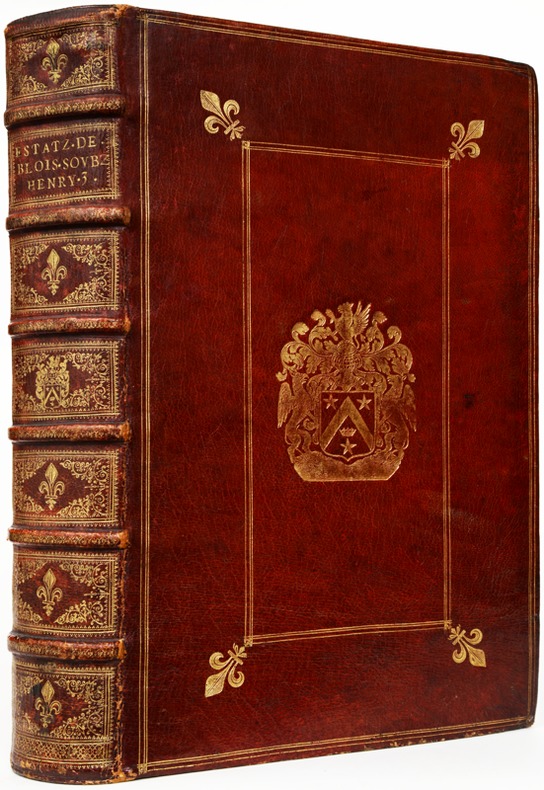
160639823, , 1606. Fort volume in-folio d'environ 600 ff., maroquin rouge, dos orné à nerfs, arrmoiries et fleurs de lys frappées entre les nerfs, encadrement de triples filets dorés sur les plats, armoiries au centre, fleurs de lys aux coins, tranches dorées (reliure de l'époque).
162183(Hanau), (1813-1814) 40 x 55,5 cm, Gouache sur papier contrecollée, cadre de bois.
Stencil-coloured lithograph. 33.7 x 42.8 cm. One of the very rare Weißenburg illustrated broadsheets showing oriental motifs. These were published under the fictitious address of Hassan Uwais (Auvès) in Cairo. The actual publisher, Camille Burckardt, was head of the Weißenburg company from 1880 until 1888. - Slight crease with minor edge damage; occasional browning. All of these prints are very rare; a different print commanded £21,250 at Sotheby's in 2012.