692 467 résultats
179288280Metz le 4 [janvier-février 1792] | 11.50 x 17.10 cm | une feuille
4to. ½ p. Rare draft for a letter to his Minister of Finances, Charles Gaudin (1756-1841), asking for more information about aid to the veterans of Piedmont as they would soon be his subjects in the newly created Kingdom of Italy: "Monsieur Gaudin, je vous renvoie vos états sur les biens des camps de vétérans en Piémont. Je désire que vous me fassiez un rapport d'une page, qui me fasse connaitre 'la loi a affecté' la quotité des biens que la loi a affectés aux camps de vétérans dans la 27è division militaire, combien il y en a déjà de désignées pour ce service et ce qu'il y manque" [Mister Gaudin, I return your budget of the assets of the veterans' camps in Piedmont to you. I want you to compile a one page report for me that informs me 'the law has affected' the share of the assets that the law has affected in the veterans' camps of the 27th military division, how many have already been appointed for this service and what it lacks"]. - Because of the many corrections the letter was never signed or sent. Every line has been partly crossed out or modified by the Emperor. - Napoleon's coronation as Emperor of the French had only taken place three months prior at which occasion the deputies of the Italian Republic officially offered the crown of Italy to him. On March 17, 1805 the political transformation of the Italian Republic to the Kingdom of Italy (1805-1814) was put into effect. The letter to Charles Gaudin relates to this process as Napoleon wanted to be fully informed about the financial obligations to the veterans of Piedmont, his new subjects.
1608V96189Romae [Rome], Ex typographia Reu. Camerae Apostolicae 1608 [20] + 154 + [6] pp., engraved vignette on title page, with a full page engraving with Porta's portrait signed I. [Iacobus] Laurus and with over 40 woodcut illustrations in text representing a.o. distilling apparatus, original first 1608-edition, nice recent binding in half leather and marbled boards in fine condition, gilt lettering on spine, engraved capitals in text, text clean and bright with only some occasional foxing, 22cm., most text is in Latin, very good condition, [This is a rare first edition of Porta's work on distillation, in which he offers a compilation of any knowledge available at that time regarding experiments and observations of distillation, its methods, apparatus and applications such as the preparation of perfumes and essential oils. It includes beautiful and quite bizarre woodcut illustrations of apparatus and stills resembling animals. Cfr. Duveen (481) who describes this work "as rare as it is beautiful". Porta (1535-1618) was an Italian philosopher, scientist and alchemist, and was/is often referred to as "professor of secrets". The engraved portrait of Porta included in this work is surrounded by various figures and gives a good impression of his scientific interests: distillation, astrology, chemistry, alchemy, optics, magnetism, etc. Content of this book: Liber I: Primordia pandit distillationis eiusq[ue], causas & instrumenta (pp.1-45), II: De odoratis Aquis eliciendis (pp.46-67), III: In quo de Oleorum tractatur (pp.68-87), IV: De distillatione oleorum exocitarum plantarum (pp.88-94), V: De refinis distillandis (pp.95-106), VI: De Oleo ex Lignis extrahendo (pp.107-112), VII: De Aquis validis extrahendis (pp.113-125), VIII: Quo de extrahendis rerum virtutibus varia experimenta traduntur (pp.126-144), IX: Oleorum extractio cum praelo (pp.145-154), + 6pp. of index and colophon], V96189
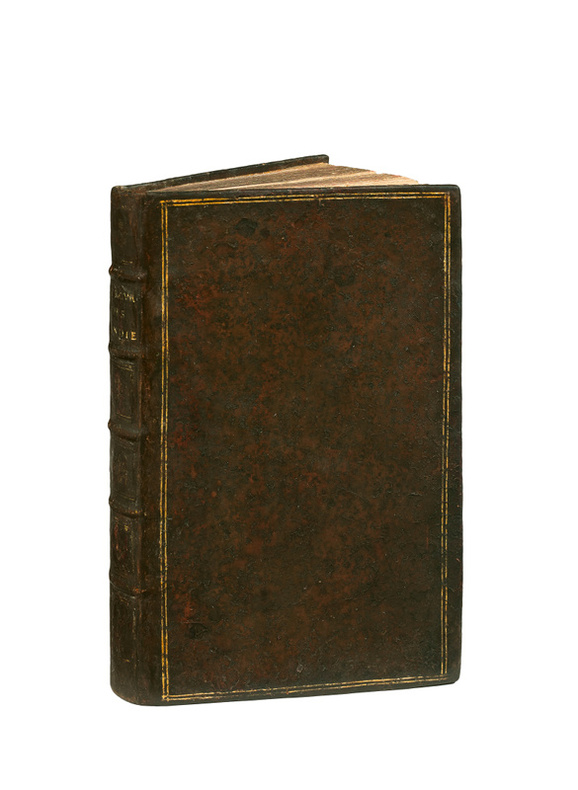
LCS-17921Rare première édition, premier tirage, de ce traité estimé et recherché sur l’activité minière et la métallurgie par l’orfèvre parisien P. de Rosnel. Paris, 1667. Soit 2 parties en 1 volume in-8 de : (8) ff., 64 pp. ; (8) ff., 176 pp., qq. taches. Veau brun de l’époque, double filet or encadrant les plats, dos à nerfs orné de fleurons, coupes décorées, tranches mouchetées rouges. Reliure de l’époque présentant quelques restaurations. 178 x 111 mm.
In-8 gr. Di questa fondamentale rivista di storia locale lombarda offriamo una "raccolta completa" di 139 annate - dal 1874 (Anno I) al 2014. La collezione è per lo più rilegata in elegante mz. pelle rossa, mentre alcune annate sono in brossura editoriale e 12 annate in cartonato moderno. Dal 1874 al 1947 l'"Archivio Storico Lombardo" si pubblicò annualmente in 4 fascicoli. Dal 1948/49 - Serie Ottava - solo in un volume all’anno. Tracce d’uso alle prime 4 annate in brossura e ai volumi in cartonato, ben conservati i volumi in mz. pelle: di certo complessivamente un buon esemplare.
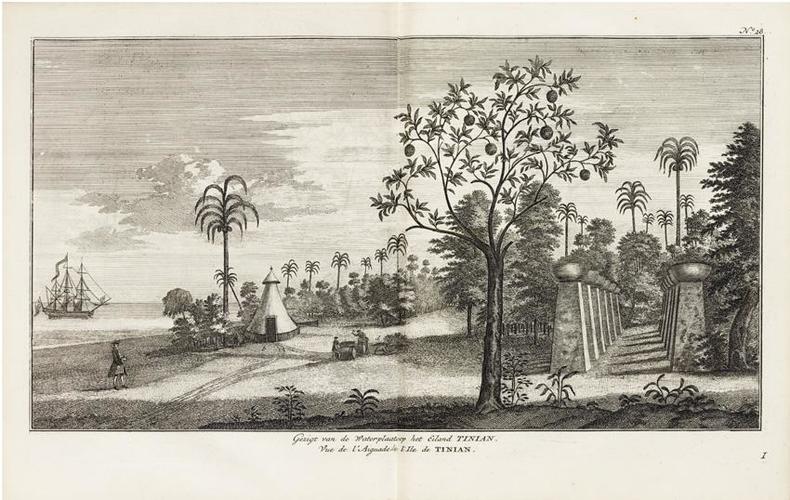
1749YTB-19Amsterdam, Arkstee et Merkus, 1749. Edition originale. Amsterdam, Arkstee et Merkus,1749. In-4 de (4) ff., XVI et 333 pp., (1) p. d’errata et 34 planches gravées. Maroquin rouge, triple filet doré encadrant les plats, dos à nerfs orné à la grotesque, double filet or sur les coupes, roulette intérieure dorée, tranches dorées. Reliure par Jacques Antoine Derome, avec étiquette. 255 X 210 mm. EDITION ORIGINALE FRANÇAISE DU CELEBRE VOYAGE AUTOUR DU MONDE D’ANSON. Elle est illustrée de 34 belles planches dépliantes représentant des navires, des cartes et des vues d’Argentine, du Brésil, du Pérou, du Mexique et de la Chine. Elle est demeurée inconnue de Chadenat. Sabin, 1637 ; Cordier Sinica, III, 2096 ; Allibone, III, 2563 ; Borba Moraes, I, 38-39 ; Palau, 12 865.
LCS-18306Merveilleux exemplaire conservé dans sa remarquable reliure décorée de l’époque. Poitiers, 3 mars 1525. In-folio de (12) ff. titre compris (rouge et noir), gothique, LXXII et LXXXI ff chiffrés, grande figure sur bois au verso 2ème feuillet. Plein veau brun, décor de trois encadrements de triple filet à froid sur les plats avec fleurons or aux extrémités, double fleuron central doré, dos à nerfs orné, filet à froid sur les coupes. Authentique et pure reliure décorée de l’époque. 291 x 190 mm.
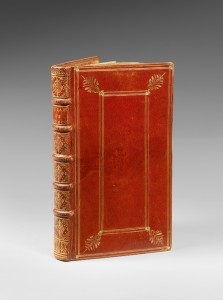
LCS-574Le voyage diplomatique de Foy de La Neuville en Russie en 1689. Superbe exemplaire relié à l’époque en maroquin rouge décoré à la Du Seuil. Paris, Pierre Aubouyn & Charles Clouzier, 1698. In-12 de (8) ff., 225 pp. mal chiffrées 231, (3) pp. Relié en plein maroquin rouge de l’époque à la Du Seuil, dos à nerfs richement orné, roulette dorée sur les coupes, roulette intérieure dorée, tranches dorées sur marbrure. 162 x 86 mm.
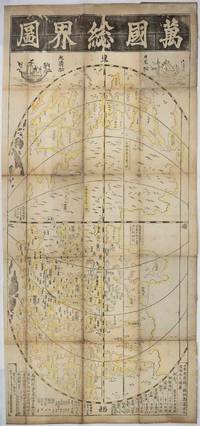
1708219243東京. Tokyo.: 須原屋茂兵衛. Suwaraya Mohei. Hoei 5 1708. Black and white woodblock map with yellow outlining in original hand colour 55.8 x 127cm map; 59.5 x 131cm sheet folding into the original Japanese wrappers chipped and rather worn 26.4 x 17.4cm the map with old repairs laid down on washi rather browned and wormed at the folds but with no serious loss the sheet age-toned and a little dusty but overall in remarkably good condition. Preserved in a modern blue linen Japanese case with toggle-closures. A famous woodblock-printed Japanese map of the world by renowned Edo Period map-maker Ishikawa Tomonobu who is also known as Ishikawa Ryūsen. This is a revised version of an earlier map produced by Ishikawa in 1688. <br> <br>The map appears to draw on Chinese and Portuguese geographical knowledge. The Chinese production of world maps had been transformed by the influence of the Italian Jesuit Matteo Ricci who collaborated with Chinese cartographers to produce a 1584 map of the world. In Japan the production of maps of "the myriad countries" or "the international countries" bankoku had been inspired by contact with Portuguese missionaries and with the Dutch in the 16th century. <br> <br>Ishikawa's map broadly resembles the Ricci map in being placed in an oval frame with the Pacific and thus also China and Japan at the centre. The content though is different. While Ricci's map is oriented to the north Ishikawa's is oriented to the east with America at the top of the page and the sketchy outlines of Europe including 'Ikiresu' England and a large and clearly marked Holland and Africa 'Kafuri' at the bottom. This orientation apparently influenced by the first world map in Japan "Bankoku Sōzu" 万国総図 which was published in 1645. Interestingly although Ishikawa had earlier produced a quite detailed and fairly accurate map of Japan the Japan shown on this world map is a rather loosely outlined collection of islands in which for example Ryūkyū the Ryukyu Kingdom now Okinawa and Hachijōjima appear much larger than they are in reality. Japan is also unusually oriented making it appear as though Ezo now Hokkaido is in the middle of the Pacific. It seems that the cartographer's interest here was less in outlining Japan in detail than in broadly setting out the country's place in relation to the land masses to the east and west. <br> <br>Like other Japanese world maps of the Edo period and like Ricci's map Ishikawa's image of the world includes imagined countries such as 'The Land of Giants". The continuing centrality of China in Japanese thought is indicated by the fact that Ishikawa's map contains a very clearly marked depiction of the Great Wall and that the map is decorated at the top with depictions of a Japanese and a Chinese sailing ship. The text at the bottom gives estimated distances between Hizen Province where the port of Nagasaki provided Japan's main official outlet to the world in this age of seclusion and various places in China and between Hizen and the Ryūkyū Kingdom. It also gives the estimated distance from Korea to Tsushima Island which served as Japan's gateway for diplomatic and trade relations with Korea. <br> <br>Engelbert Kaempfer a German physician and explorer brought back the 1688 edition of this map printing to Europe after his stay in Japan between 1690 and 1692. The map was introduced to European audiences in the 17th century and impacted on later European cartographic endeavours. <br> <br>Copies of this rare and historically significant map are held only in a handful of major collections: the British Library National Diet Library NDL of Japan the Staatsbibliothek of Berlin University of California Berkeley's Japanese Historic Maps Collection and the University of British Columbia. . 須原屋茂兵衛. [Suwaraya Mohei]. unknown
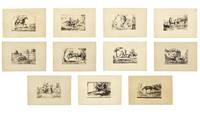
1864142931Adelaide: The Author 1864. Fine. Adelaide The Author 1864. Eleven albumen paper photographs approximately 88 × 134 mm mounted on the recto of individual cards approximately 165 × 240 mm neatly captioned below the plate with the title at the head of the first one with all captions by George Hamilton himself. A few light spots and marks to some of the cards; essentially in fine condition with the photographs uniformly rich in colour. The Art Gallery of South Australia has all 11 original artwork - pen and ink with wash - in its collection. The 'Adelaide Observer' on Saturday 27 August 1864 contains a review of Hamilton's recently self-published book 'a well-conceived well-written neatly-printed and elegantly-illustrated brochure under the above title'. It describes at length the illustrations '11 in number photographed from the author's drawings by Colonel Biggs Mr. Baines and Professor Hall and they bear ample evidence of the artistic taste as well as the correct judgment displayed in the spirited originals'. <p>Robert Holden 'Photography in Colonial Australia. The Mechanical Eye and the Illustrated Book' 1988 describes this book and one other Molesworth Jeffrey's 'Various Exercises and Fragments in Metre by Divers Authors' Hobart 1864 as being the 'first recorded use of original photographs as illustrations in commercially produced and dated books' in Australia. His descriptive bibliography records that the published work indeed contains 'Photographs of eleven drawings . by Colonel Briggs sic from rough sketches by the author. It would appear that these images were printed eleven to a sheet and then arranged in random order throughout the text'. His collation of the three copies in the State Library of South Australia indicates the individual print sizes range from 20 × 35 mm to a maximum of 40 × 60 mm. <p>The present offering clearly predates the published use of these images and its presentation is much to be preferred. The first and most obvious difference is the superior size and quality of the prints. However the captions greatly enhance the images; when they are read and viewed in the intended order numbers 1-11 are lightly pencilled in the top right-hand corner of the cards this becomes a proto-photobook of the highest order . and far from being a prosaic account of how to look after a horse as the title might suggest it is a searing indictment of the widespread ill-treatment of horses. 'Mr. Hamilton proceeds with pen and pencil to describe and portray some of the trials a horse has to undergo from the time his liberty is first invaded in the bush until in the last scene of all that ends this painful history he is reduced to the drudgery of a hackney car'. <p>See Ferguson 10180b and 10181a; Holden 50 and 51 plus pages 13-21. Both bibliographies contain errors. 11 items. The Author] unknown
2598P., Courcier, 1809, un volume in 8 relié en demi-maroquin rouge à grains longs, dos orné de filets dorés, (reliure postérieure), (2), 56pp., 312pp., 4 planches dépliantes
in-folio (mm. 394x265), ff. (6 prelim.), (+7 con il "Repertorium Chronicae" ristampato nel XVIII secolo), (422); solida leg. 700esca. p. pelle marrone chiaro, dorso a nervi con tassello e tit. oro, tagli rossi. Impresso con nitido car. romano. L'opera è così illustrata: una silografia a piena pag. (al v. del secondo f. prelim.) con la Virtù che sostiene 2 stemmi, l'uno dei Corio, l'altro degli Ascanio; due altre a piena pagina (al v. del quinto f. prelim. e ripetuta al f. aa1) raffig. l'autore seduto allo scrittoio con nella mano destra una penna, ai suoi piedi un cagnolino, in basso i due versi del Dolcino «Bernardine tibi Insubres debere fatentur/ non minus ac magno Roma superba Tito» ed in alto i motti «E' bello dopo il morire vivere anchora», «Amica veritas» e «Sustine et abstine» ; ed una silogr. a mezza pag. (recto di ff3) con la Virtù che sostiene lo stemma dei Corio. Queste silografie sono considerate ("Illustrazione del libro in Lombardia nel '400 e '500" a cura di SAMEK LUDOVICI, 1960) opera di un artista di cerchia leonardesca, pur presentando influssi ferraresi-mantegneschi; alcuni le dissero opera di Bernardino de' Conti, pittore di Pavia, autore anche di un ritratto (Parigi, Jacquemart-André) che si è presupposto essere quello del Corio; KRISTELLER, invece, le attribuisce al Maestro del Melchiorre da Parma (cfr. Lombardische Graphic, pp. 54-6 e 100-101). Edizione originale ed unica veramente completa, poiché molti passi furono soppressi nelle edizioni successive a causa di alcuni giudizi negativi sui Duchi milanesi, i quali ordinarono la distruzione degli esemplari impressi, e ciò ne spiega la grande rarità. L'opera, in sette parti, è la più importante storia di Milano, dalle origini alla fuga del Moro in Germania e la principale del Corio, che la iniziò nel 1485 pubblicandola a proprie spese coi tipi del Minuziano. La notevole rarità di quest'opera già nei secoli scorsi fece sì che la gran parte degli esemplari venisse completata con fogli di testo impressi con caratteri lievemente diversi e con le figure copiate su rame, insostituzione dei legni originali. Questa particolarità è difficilmente riscontrabile senza poter confrontare più esemplari tra loro, ed è quindi possibile che non sia stata evidenziata nelle descrizioni di bibliografie e cataloghi di vendita. Il Sander, ad esempio, cita equivocamente un esemplare di un cat. Rosenthal del 1927 "dans lequel le portrait n'est pas gravé sur bois, mais à l'eau-forte". In alcuni rarissimi esemplari, vennero aggiunte all'inizio sei carte con un utile indice, impresse dai fratelli da Legnano pochi anni più tardi; questo esempl. assai bello, a grandi margini, fu corredato al momento della rilegatura di un "Repertorio" ristampato nel XVIII secolo senza la bordura silografica (margine basso o esterno dei primi 16 ff. e dell'ultimo restaurato o rinforzato; lieve censura a penna sul f. a5; rare chiose di mano coeva nei margini). figure in legno (Virtù, al v. del secondo f. prelim, 2 ritratti di Corio, al v. del quinto f. prelim. e ripetuta al f. aa, e figura allegorica con stemma, al recto del f. ff3), la prima tiratura della dedica ; il Repertorio, senza la bordura, in tiratura del ‘600, doppia versione del f. a4.. Kristeller 116. Sander I, 2170: «Les 6 ff. premiers contenant le premier titre, l'avis au lecteur et le répertoire n'ont été publiés que plusieurs années après l'ouvrage et manquent souvent». Mortimer I, 137. Trivulziana 154. Predari 136. Cat. Hoepli 647..
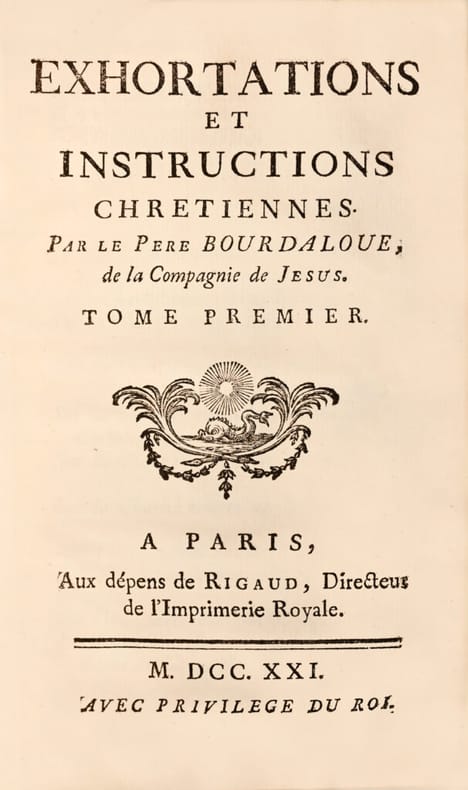
LCS-18416La plus belle édition ancienne des Exhortations et instructions chrétiennes de Bourdaloue. A Paris, Aux dépens de Rigaud, Directeur de l’Imprimerie Royale, 1721-1723. 2 volumes in-12 de : I/ (2) ff., 520 pp., (14) ff.; II/ (6) ff., 474 pp., (13) ff. Maroquin olive, dentelle en encadrement sur les plats avec fleurons d’angle, armes frappées or au centre, dos lisses ornés de fines roulettes et de fleurs dorées, filet or sur les coupes, roulette intérieure dorée, doublures et gardes de soie rose, tranches dorées. Riches reliures à dentelle du règne de Louis XV attribuables à Derome. 166 x 125 mm.
117 Blatt, davon etliche leer, etwa 12 Blatt alt entfernt. Brauner Original-Lederband (beschabt, Rücken mit kleinen Fehlstellen, Innengelenke gebrochen) mit überaus reicher Rücken- und Deckelvergoldung sowie Buntpapiervorsätzen und Goldschnitt, Innendeckel mit gekröntem Monogramm "J. G. S." und der Jahreszahl 1751. Qu.-8vo (185:125 mm). Stammbuch von Johann Georg Schlupper aus Münchberg, in verschiedenen Diensten des Markgrafen von Bayreuth. Als bemerkenswerteste Beiträger dieses rund 100 Einträge umfassenden Albums sind die drei Kleinknecht-Brüder zu erwähnen, die sich allesamt in Bayreuth und darüber hinaus als Musiker einen Namen gemacht haben. Allen voran Jacob Friedrich Kleinknecht (1722-94), der sich hier mit einer kleinen Notenhandschrift verewigt hat (dat. Bayreuth, 3. IV. 1757). Kleinknecht wurde 1743 Flötist, später Violinist der Bayreuther Hofkapelle. 1748 erschienen erste Kompositionen von ihm im Druck, später wurde er Hofkomponist und 1764 Musikdirektor der Bayreuther Hofkapelle. Auch seine beiden Brüder Johann Wolfgang Kleinknecht (1715-86) und Johann Stephan Kleinknecht (1731-1806), ebenfalls Musiker an den Höfen von Bayreuth und Ansbach, lieferten jeweils einen Eintrag (ebenfalls 1757). Des weiteren sind zu nennen: Johann Adam Ludwig Wezel (1736-1808), Hofmeister zu Bayreuth, Bibliothekar zu Ansbach; Gottlieb Friedrich Wilhelm Wezel (1738 - nach 1800), kgl. Preußischer Kriegsrat, Kammersekretär zu Bayreuth; Johann Daniel Wezel, Justiz- und Polizeidirektor zu Aisch; Johann Andreas Lübeck (1723-82), Verlagsbuchhändler in Bayreuth; Ferdinand Heinrich Frenzel (1723-64), Pfarrer zu Weißdorf und Schriftsteller; Andreas Nicolaus Funk (1699-1758), Pfarrer in Ahrenberg; Georg Wolfgang Fischer, Postbeamter in Bayreuth; Johann Benedict Scholler, Militär, Stadt- und Landphysikus in Bayreuth; Johann Wilhelm Hofmann, Kammerkanzlist und Kopist zu Bayreuth. - Mitunter leicht gebräunt und fleckig, teils leicht gelockert. Höchst interessantes Forschungsobjekt zur Geschichte des Bayreuther Hofes mit Notenautograph von Jacob Friedrich Kleinknecht.
Oblong 8vo (197 x 114 mm). French and German manuscript on paper. 41 ff. with 12 entries. Includes 13 watercolour drawings, 6 ink and ink wash drawings, 5 pencil drawings, 1 gouache and 1 embroidery. Contemporary giltstamped full brown calf with ornamented brass clasp and bosses to the corners and centres of both covers, the centre bosses inscribed with "Souvenir" (front) and the monogram "CL" (back). With light blue leather end papers. All edges gilt. Remarkable friendship album kept by Clara Lafontaine, daughter of Pierre François Lafontaine, a French emigrant in St Petersburg and officer in the service of the Tsars. Clara’s brother Jean Baptiste Joseph Lafontaine (1796-1859) returned to France in 1802/03 and became successful as a playwright under the pen-name W. Lafontaine. - The family was associated with bourgeois expatriates in Russia as well as with the local bourgeoisie and aristocracy. Three entries stem from members of the princely Trubetskoy family. With some degree of certainty they can be identified with Sofia Andreevna Trubetskaya (1796-1848) and her children Sergey Vasilyevich Trubetskoy (1814-59) and Maria Trubetskoy (1819-95). Additionally, a beautiful loosely inserted gouache showing a tulip and other flowers is inscribed: "Given by the princess Marie Trubetskoy". Sergey Vasilyevich, who became a cavalry lieutenant and was the legal father of the famous princess Sofia Sergeyevna Trubetskaya, purportedly an illegitimate child of Tsar Nicholas I, enriched his sentimental entry with a swan feather. - The first entry in the book can be attributed to Franz Ludwig von Wissell (1797-1853), who served in the Hanoverian army and rose to the rank of an Lieutenant Colonel. Wissell’s entry is followed by five pages of watercolours, one on blue paper, all by the same hand. The drawings of a man in Persian costume, of an English bulldog, a ruin at night, a remarkable and charming Cupid with bow and arrow in Russian costume, and an infantryman in a blue and white uniform are all inscribed “Meurville” or “Meurville ainé"; while they are of high quality, the artist remains unidentified. - The following entry, a long, humorous narrative describing a friendship book containing rather abortive entries, can with some likelihood be ascribed to the French educator Jean François Antoine Cournand (1797-1842), who lived in St Petersburg with his family and is the father of the pianist and last Chopin student Marie Roubaud de Cournand. An entry by one "Catinka" or Catherine Ratouin from 25 August 1825, apparently the day she left St Petersburg for France, seems to be connected to the previous entry, as it is followed by a watercolour drawing and a washed pencil caricature which are both signed by Courand. A particularly charming, anonymous watercolour drawing on one of the following pages shows a horse-drawn sleigh with two people. The page is marked by a pressed shamrock. - Both Gotthard J. Fehst (29 March 1829) and Adolph Vincent Martinsen (10 June 1830) are members of prestigious bourgeois families from Reval (now Tallinn) who left their entries in Clara Lafontaine’s book. Fehst or another family member also contributed a small pencil drawing of Roman ruins on blue paper. The page containing Fehst's entry is loose, with another ink drawing of a bird-hunting scene signed by "Meurville ainé" on the verso. The only German entry "Je schmerzlicher die Trennung / Je freudiger das Wiedersehen", dated 22 July 1830, remains unidentified. - Carla Lafontaine’s young nieces Sophie and Camille wrote charming entries on 26 April 1832 in St Petersburg. While the six-year-old Sophie left mostly scribbles, Camille expresses her sadness about the geographical distance between her and her beloved aunt: "Ma bonne tante je te regrette de tout mon cœur et t’aime de même, pense souvent à ta petite nièce". The final entry can be attributed to the German-British merchant Franz Heinrich Hermann Overbeck (1804-88), father of the theologian Franz Overbeck (1837-1905) who would become known as a close friend of Friedrich Nietzsche. The final two drawings in the album are probably the most striking ones: a pencil sketch of a hound and a washed ink drawing of another hound, both by the same hand. Intriguingly, the pencil sketch is signed "Lagrénée": both Louis Jean François Lagrenée and his younger brother Jean-Jacques were French painters briefly active in St Petersburg, but they died well before the album was started. However, Louis-Jean's son Anthelme-François Lagrénée (1774-1832) followed in his father’s footsteps and spent time in St Petersburg during the 1820s in the service of Tsar Alexander I. As the two drawings are pasted into the album and are of a quality suggesting a trained artist, they may well be the work of Anthelme-François Lagrenée. - Leather somewhat chafed, interior showing some brownstains and browning to the margins, but well preserved.
Deutsche, lateinische und französische Handschrift auf Papier. 90 Bll. mit ca. 90 Einträgen, 3 Aquarellen und einer Silhouette. Lose in grüner Pappmappe der Zeit mit Rückenvergoldung, aufgeklebtem Rückentitel "Pro Memoria", goldener Deckelbordüre, goldgeprägtem Monogramm "G TH B 1790" und Goldschnitt. Außergewöhnlich hübsches Album amicorum, das durch oft sehr persönliche Einträge enger Freundinnen und Freunde des Besitzers sowie durch schöne Kalligraphie besticht. Der 1771 geborene Georg Thomas Bach besuchte die Realschule seiner Heimatstadt Nürtingen, wo er später selbst lehren sollte, und setzte seine Ausbildung wohl in Stuttgart oder Nürnberg fort. Das Stammbuch lässt nicht auf ein studentisches Milieu schließen; die Einträge stammen zumeist von evangelischen Pfarrern, Vikaren und Pädagogen. Neben zahlreichen württembergischen Kleinstädten besuchte Bach auch Altona, Frankfurt am Main und Göttingen. - In Nürtingen trug sich der Begründer der dortigen Realschule Jakob Friederich Klemm (1733-93) ein, dem auch die Einführung des von John Spilsbury um 1760 erfundenen Puzzles in Deutschland zugeschrieben wird, ferner der erste Realschullehrer (und damit ein Amtsvorgänger Bachs) Georg Friedrich Ettensberger (1756-1824), der Verwaltungsbeamte Karl Christoph Friedrich Gock (1776-1849), Friedrich Hölderlins Halbbruder, sowie Nathaniel Köstlin (1744-1826), Diakon und Privatlehrer Hölderlins. Bachs Mutter Veronika Dorothea verabschiedet ihren Sohn mit einem Psalmenzitat und den Worten: "Diese Lehre gibt dir mit auf den Weg deine dich liebende Mutter". - In Stuttgart verewigte sich Konrad Friedrich Schüle (1771-1833), Gesellschafter des Textilunternehmens Kolb & Schüle, im nahegelegenen Grafenberg Christian Gottlob Pregizer, der spätere Stadtpfarrer von Haiterbach und Namensgeber der radikalpietistischen "Pregizer-Gemeinschaft". Mit Christoph Friedrich Cuhorst (1727-93), Johann Immanuel Friedrich Schmid (1756-1821) und Johann Christian Zügel (1723-95) sind auch die Pfarrer von Unternsingen, Bickelsberg und Ditzingen im Stammbuch vertreten. Christoph Ludwig Flattich (1756-1822) stand seinem Vater, dem bedeutenden evangelischen Pädagogen Johann Friedrich Flattich, als Vikar in Münchingen zur Seite, als er seinen Eintrag verfasste; später wirkte Flattich als Pastor in Suppingen. Am 14. Juni 1790 trug sich Johann Ludwig Mannhardt (1749-1816) ein, Klosterhofmeister in Maulbronn und Bruder des bedeutenden Theologen Johann Wilhelm Mannhardt. - In Altona traf Bach 1791 auf Hinrich van der Smissen (1742-1814), Enkel des gleichnamigen berühmten mennonitischen Unternehmers und Reeders, sowie auf zwei weitere Mitglieder der Familie und den niederländischen Botaniker George Voorhelm Schneevoogt (1775-1850) in jüngsten Jahren. Interessant sind auch zwei 1794 entstandene Einträge aus Nürnberg: zum einen der des Spezereienhändlers Johann Christoph Karg (1733-1806), ein enger Freund und Briefpartner Lavaters, zum anderen der von Georg Michael Eisenbach (1728-1804), der 1783, zwei Jahre nach Erlass des Toleranzpatents Josephs II., erster Pastor von Eferding in Oberösterreich wurde. Wie bereits in früheren Positionen geriet Eisenach mit den Kirchenobrigkeiten in Konflikt und wurde 1788 aus Österreich ausgewiesen, woraufhin er sich als Privatlehrer in Nürnberg niederließ. - Ein Mitglied der Familie van der Smissen ergänzte seinen auch kalligraphisch herausragenden Eintrag um ein kleines Aquarell der Zwei-Wege-Metapher. Der Eintrag eines Christian Gottfried Hellfeld in Schleusingen ist verso um ein hübsches kleines Emblem mit französischem Motto ("Vivre pour mourir et mourir pour vivre") bereichert. Louise Huzelin, Tochter des Schnaitheimer Pastors Ludwig Christoph Huzelin (1725-83), begegnet uns auch als Silhouette. Ein besonders schönes Aquarell, das eine Ideallandschaft mit phantastischen Blumenornamenten zeigt, lässt sich keinem Beitrag zuordnen. Zuletzt können auch die besonders intimen Zeilen einer Maria Bach hervorgehoben werden. Der ursprüngliche Eintrag vom 22. April 1830 wurde verso zweifach ergänzt: "Wer wünscht so viel zu ihrem Glück / Als die welche dieses schreibt / O denken sie recht oft zurück" sowie "Fält [!] Ihnen dieses Blätchen in die Hände so erinnern Sie sich an den froh verlebten Abend im Juli 1843 und denken sie auch zuweilen in müssigen Stunden an [...]". - Einband minimal bestoßen. Die Seiten von Sammlerhand in Blei numeriert, teilweise minimal fleckig und angestaubt, mit vereinzelten kleinen Einrissen und Knicken.
Deutsche, lateinische, griechische, niederländische, französische, italienische, arabische, hebräische und englische Handschrift auf Papier. Titel, 1 w. Bl., 538 (statt 548) teils w. SS., 3 Bll. reg., SS. 549-557, mit 163 Einträgen. Lederband der Zeit mit reicher Rückenvergoldung, goldgepr. Deckelbordüre, Goldschnitt und patroniertem Brokatpapiervorsatz. Qu.-4to (214 x 175 mm). Die meist sorgfältig und gut leserlich geschriebenen Einträge im Stammbuch des jung verstorbenen Erlanger Theologen Scheler (1733-60) stammen überwiegend von Coburger, Erlanger und Leipziger Kommilitonen und Professoren (meist Theologen, aber auch Archäologen, Historiker, Mediziner und Naturwissenschaftler) wie Johann Sebastian Albrecht (1695-1774), Johann Christian Arnold (1724-65), Johann Christoph Georg Bodenschatz (1717-97), Christian Friedrich Börner (1683-1753), Johann Andreas Buttstedt (1701-65), Johann Friedrich Christ (1701-56), Christian August Crusius (1715-75), Heinrich Wolfgang Fratzscher (1694-1757), Johann Christian Hebenstreit (1686-1756), Kaspar Jakob Huth (1711-60), Abraham Gotthelf Kästner (1719-1800), Johann Erhard Kapp (1696-1756), Erdmann Rudolph Fischer (1687-1776), Jean-Jacques Meynier (1710-83), Philipp Ludwig Statius Müller (1725-76), Matthias Georg Pfann (1719-62), Joachim Ehrenfried Pfeiffer (1709-87), Adam Rudolph Solger (1693-1770), Johann Christian Stemler (1701-73), Johann Ernst Basilius Wiedeburg (1733-89), Johann Samuel Wiesner (1723-80), Christian Ernst v. Windheim (1722-66) und Karl Christian Woog (1714-71); ferner von verschiedenen Familienmitgliedern sowie: Bartenstein, Beulwitz, Brenner, Briegleb, Ehrenberger, Ernesti, Eyring, Frobenius, Frommann, Goebel, Happach, Kessel, Linck, Marschall, Pfeiffer, Pfündel, Reutlinger, Rossmann, Sauerteig, Sayn-Wittgenstein-Hohenstein, Seckendorff, Slevogt, Speßhardt, Stein, Tabor, Uz, Winkler v. Mohrenfels, Zerbst u. v. m. Auf S. 449 ein Eintrag des Fabeldichters und Moralphilosophen Christian Fürchtegott Gellert (1715-69), datiert Leipzig, Oktober 1752, auf S. 521 ein undatierter Eintrag des Künstlers Johann Heinrich Meil (1730-1820), der auch Gellerts Fabeln illustrierte. Am Schluss ein Register. Die 1769-72 datierten Einträge auf SS. 303-311 gelten einem nicht genannten Nachfahren des 1760 verstorbenen ersten Eigners. 123 der paginierten Bll. sind unbeschrieben. Es fehlen die SS. 61f., 279f., 483f., 515f. und 519f. Gering gebräunt, kaum stockfleckig. Anfangs mit kl. Randmängeln. Der dekorative Einband leicht berieben, vorderes Gelenk unten mit kleinen Wurmspuren, vorderes Vorsatzblatt mit Knickspur. Farblithogr. Exlibris "Scheler" von Lorenz M. Rheude (Schutt-Kehm 38.202).
Qu.-4to (206 x 142 mm). Meist deutsche und französische sowie lateinische und selten griechische Handschrift auf Papier. Ca. 300 Einträge auf zus. 428 SS.: 1-18, 21-52, 55-84, 87-88, 93-222, 225-252, 255-306, 309-318, 321-358, 361-368, 371-402, 405-431, (15, mit Namensregister) SS. (davon 67 SS. weiß und 43 SS. mit dem Wörtchen "belegt"). Mit 3 montierten Gouachen auf festerem Papier und hs. Paginierung. Marmorierter Lederband der Zeit mit floraler und ornamentaler goldgepr. Rückenverzierung, die Deckel mit goldgepr. breiten Bordüren, vorn mit Monogramm "P.E.C.", rückseitig mit Jahreszahl "1773. Kleisterpapiervorsätze nach Herrnhuter Art und dreiseitigem Goldschnitt. In Pappschuber der Zeit. Sehr umfangreiches, wichtiges Jenaer Studentenstammbuch, illustriert mit drei sorgfältig ausgeführten Gouachen. Das von "Freund und Bruder" G. Fr. Hoechstetter "A. S. C. Windshemio" dem Eigner zugedachte Album enthält eine große Zahl aus ganz Deutschland, von Waldeck bis Lübeck, stammenden Einträgen, meist zum Thema Freundschaft und Liebe, wie jener eines gewissen A. J. P. Weis: "Seit die Götter mir ein Mädchen gaben / Muß ich ganz und gar vergehn, / Seh ich es, vor Zärtlichkeit, / Seh ichs nicht, vor Herzeleid. / Ewig wünscht ich es zu sehen, / Oder nie gesehn zu haben [...]" (S. 35). In weitere Beiträgen vertreten sind: der Silhouetteur Johann Friedrich Anthing, Johann Christoph Bezold, Biedenweg, K. L. Birkel von Buchwaldt aus Hollstein, Fr. Buddeus, J. L. Cramer, D. Cruse, Karl Baron Eckbrecht von Dürckheim (pfälzisch-elsässischer Uradel), Karl Friedrich Eichhorn, der Theologe Johann Philipp Gabler (1753-1826), Johann Paul Ludwig Gehring, der protestantische Theologe Martin Hamaliar, G. G. Harder, Johann Christoph Hartung aus der Grafschaft Limburg, L. W. J. Hülshoff, Bernhard Gottlieb Huldreich von Hellfeld (1759-1788), der Moralphilosoph und Aufklärer Justus Christian Hennings (1731-1815), J. P. von Hinckeley, G. F. B. Höchstetter, C. L. Jacobi, der spätere Sachsen-Coburgische Landschaftsdirektor Christian Ferdinand Frh. von Könitz, der Mediziner Christian Loeber, Georg Marienburg, J. F. Meermann, A. Ch. Niehaus, G. Ohmstede, C. C. von der Osten ("Hannoveranus"), Wilhelm Pollich, F. W. von Prangen, Christian. Jakob Rambusch, Leberecht von Rath, der Jurist und Syndikus der Universität sowie Hofgerichtsrat und Professor der Rechte Johann August Reichardt (1741-1808), L. L. Ribbentrop aus der Grafschaft Lippe, J. Fr. Rosenbusch, "V. H. Salfeldt de Quedlinbourg", der Rechtswissenschaftler Heinrich Gottfried Scheidemantel, H. C. A. von Schoenfels, F. C. Severin aus Waldeck, Johann Ernst Simler, Michael Stephan aus Siebenbürgen, Julius Dietrich Tannen (studierte 1770-74 in Jena), der Rhetoriker und Philologe sowie Geologe Johann Ernst Immanuel Walch (1725-78), der Rektor der Universität Karl Friedrich Walch, der Quedlinburger Theologe und später in Halle (Saale) tätige Georg Christian Westphal (1752-1808), F. v. Witzleben, J. W. Wunderlich, Karl Anton Friedrich von Wurmb, "C. G. Baron de Zschock" u. v. m. - Die Gouachen zeigen eine allegorische Titelillustration in reichem Rocaille-Rahmen, dann eine Darstellung mit einer schönen allegorischen Frauenfigur (Venus) in weiter Landschaft und zum Schluss eine anzügliche Illustration mit einem Mönch und einer Nonne beim innigen Beichten mit dem Spruch "Solus cum Sola non praesumitur orare Pater noster" ("Wenn 'Er' und 'Sie' allein sitzen, beten sie kein Vaterunser") und der Übertitelung "Vollkommner Ablaß". - Teilweise leicht tintenfleckig, frisch und gut erhalten. Am Gegenblatt zum Titel der hs. Eintrag "Secretär Clausing lebte und starb in Großvater [...]'s Hause. Bemerkung von August Krohn". Ein Eintrag kopfüberstehend. Der Einband etwas beschabt und berieben, der Schuber stärker berieben.
12mo. XXX, 161, 113 pp. Modern brown calf preserving original marbled covers. First edition of "Sind-Bâd" and the first independent printing of any part of the Arabian Nights in Arabic. Although traditionally included in the corpus of the Thousand and One Nights (Alf layla wa-layla) as told by Scheherazade, it is thought that the series of stories that make up the voyages of Sindbad have older and separate origins, incorporating elements of Homer, Panchatantra, other Persian, Arab and Indian literary material as well as historical material relating to trade and navigation. Set traditionally during the reign of Haroun al-Rashid, Sindbad undertakes seven voyages from Basra, each leading one to the other, encounters fabulous creatures, faces exhaustive ordeals and amasses fabulous wealth. The publisher of the present edition, Louis-Mathieu Langlès (1763-1824), an important figure in the study of Middle-Eastern and Oriental languages and literature, was a correspondent of William Jones in Calcutta, co-founder of the École des Langues Orientales Vivantes in Paris, and the keeper of the Indian manuscript department in the Bibliothèque Nationale in Paris. "Un ouvrage classique, et d'une certaine importance sous le point de vue scientifique, historique ou littéraire" (preface). - Some browning and waterstaining throughout; occasional paper defects to edges (no loss to text); an Arabic stamp to p. 90 of the French text. Chauvin VII, p. 2. Brunet III, 820. OCLC 4433261.
11 vintage photo prints (ca. 90 x 120 mm, but one 105 x 170 mm) on backing cardboard (20 x 25 cm). Highly uncommon photographs of Arabian horses (all individually captioned) at the famous Bábolna stud in Hungary, the principal stud for producing the best horses for the Austro-Hungarian military in the 19th century. The "Bábolna Nemzeti Ménesbirtok" (Bábolna National Stud) was founded by Emperor Joseph II in 1789. In 1816 it was decreed that henceforth only Arabian stallions should be used for stud service - a policy that raised the quality of the Austrian cavalry's horses to a famous level and necessitated the frequent introduction of new pure-bred Arabian stallions from the Middle East. One of the greatest commanders and stud-masters of Bábolna, Mihály Fadlallah el Hedad, hailed from Syria. - The photos show portraits of the horses Sechun, Nadir, Tahita, Nasira, Celeby, Dzerid, El Hafi, El Denedzi, Hiläl, Riat, as well as a larger group portrait showing several of the horses with their Arabian and Austro-Hungarian trainers. Some slight staining to backboards, but altogether well-preserved. Extremely rare.
A total of 267 photographs of construction work on the Aswan Dam. Comprises 190 large photographs (ca 25 x 30 cm), frequently with captions in the negative, mainly by D. S. George but also including A. Gianny and G. Kemble Bolam of Cairo (56 tipped in to an album and captioned, 21 loosely inserted within another album, 108 stored loosely within a portfolio, and 5 separately matted). Also, 77 smaller photographs (gelatin prints) of the dam and its environs, ca 15 x 18 cm (including a few duplicates), in an envelope. An impressive collection of photographs detailing the construction and opening of the Aswan Low Dam between 1899 and 1902 and of the work to raise it in 1907-1912. The images (frequently captioned in English on reverse) include views of the navigation channel in various stages of completion, the countless hundreds of local workers toiling in the unfinished West Channel and on the masonry of Bab el Maroum, the locks, trenches, Asyut Barrage, the accumulator house, the inauguration ceremony, but also a friendly football match between the "10th Soudanese Regiment (Blacks)" and the "Whites" (final score: Blacks 0, Whites 5). A stark panoramic shot shows the solar eclipse of 28 May 1900 above the Mohammed Ali Channel, seen from Awad. - Owing to its rainless climate Egypt has always depended on the annual flooding of the Nile for irrigation. The Aswan dam was designed by eminent British engineers to provide storage of annual floodwater and to augment dry season flows; construction about 1000 kilometres up the river from Cairo was begun in February 1899 by the London-based contractor John Aird & Co. Nothing of its scale had ever been attempted; on completion, it was the largest masonry dam in the world. It created an artificial lake extending 200 miles up the valley, partly submerging Ptolemy's temple on the island of Philae. The 1.25 mile-long dam with 180 sluice gates cost 3 million pounds sterling. It was opened by the Khedive on 10 December 1902. Originally limited in height by conservation concerns, the dam worked as designed but provided inadequate storage capacity for planned development and was raised between 1907 and 1912. The heightening still did not meet irrigation demands, and in the 1960s the Aswan High Dam was built 6 kilometres upstream. - A few nicks along the edges, some gelatin prints somewhat faded and with occasional creases. Mats generally foxed, with some foxing to the matted images, but on the whole an outstandingly preserved ensemble printed in rich, crisp detail.
Using the binding and block of: Sebastião Barradas, SJ, Opera omnia, vol. III (Mainz, Mylius, 1640). 674 pages, all edges red, pasted together, hollowed out (interior space: 158 x 280 mm) and lined with red marbled paper, filled with 10 small drawers and a mirror-lined compartment holding four identical glass bottles. Early 18th century full leather gilt, spine richly gilt in seven compartments, spine labels reading "R. P. Barradii Opera", "Tomus III". Folio (230 x 348 mm). A curious late 19th century concoction, using an inconspicuous mid-17th-century volume of theology in a slightly later binding to conceal a miniature chest of drawers with space for four bottles measuring up to ca. 10 cms. The German-language drawer labels bear the names of poisonous plants: banewort, Devil's snare, hemlock, wormwood, henbane and foxglove, among others. The pastedown bears a large memento-mori illustration with a Latin quote from the Epistle to the Hebrews (9:27): "Statutum est hominibus semel mori" ("All men are destined to die once"). - Front cover slightly warped, but well preserved in all. An appealing ensemble, probably an elaborate private prank.
8vo. (10), 736 pp. Printed in red and black throughout. Contemporary blindstamped black calf binding. The Arabic Horologion (following the Byzantine rite), containing the breviary, canonical prayers and hymns for the feast days of the Saints throughout the year. From the printing office of the Melkite monastery of St. John the Baptist at al-Shuwayr in the Lebanese Kisrawan mountains, operative between 1734 and 1899, during which time it produced in all 69 Arabic books, including re-editions (cf. Silvestre de Sacy I, pp. 412-414; Middle Eastern Languages and the Print Revolution. A Cross-Cultural Encounter, Westhofen 2002, pp. 179-181). Occasional insignificant brownstaining; slight chipping to extremeties of the appealing original binding. Rare: OCLC lists two copies only (at the University of Leiden and the Veech Library, Catholic Institute of Sydney, Australia). OCLC 68525490, 224329156.
4to (180 x 256 mm). 5 issues, 222 pp. altogether. Extracts bound together in a single volume without original wrappers. Modern red cloth with giltstamped cover title. All the five issues of "Nature" in which, between February and October 1953, the crucial papers were published that revealed to the world the double-helix structure of DNA. Some of the various authors were collaborators, others competitors, and while the credit for the discovery is today almost entirely attached to the names of Crick and Watson, their breakthrough depended on experimental work done by all the other scientists whose relevant papers were published in the same journal and are also here included. - The papers comprise, individually: - a) Pauling, L. and Corey, R. B. Structure of the Nucleic Acids (Nature 171, No. 4347, 21 Feb. 1953, p. 346). - b) Watson, J. D. and Crick, F. H. C. Molecular Structure of Nucleic Acids: A Structure for Deoxyribose Nucleic Acid (No. 4356, 25 April 1953; p. 737f.). - c) Wilkins, M. H. F., Stokes, A. R. and Wilson, H. R. Molecular Structure of Deoxypentose Nucleic Acids (p. 738-740). - d) Franklin, R. E. and Gosling, R. E. Molecular Configuration in Sodium Thymonucleate (p. 740f.). - e) Watson, J. D. and Crick, F. H. C. Genetical Implications of the Structure of Deoxyribonucleic Acid (No. 4361, 30 May 1953, p. 964-967). - f) Franklin, R. E. and Gosling, R. G. Evidence for 2-Chain Helix in Crystalline Structure of Sodium Deoxyribonucleate (Vol. 172, No. 4369, 25 July 1953, p. 156f.). - g) Wilkins, M. H. F., Seeds, W. E., Stokes, A. R. and Wilson, H. R. Helical Structure of Crystalline Deoxypentose Nucleic Acid (No. 4382, 24 Oct. 1953, p. 759-762). - Together these papers provide the single most important advance in biology since Darwin's theory. The first, by America's leading chemist of his age, Linus Pauling, ultimately contributed least because Pauling's theory erroneously suggested a triple-helix structure. "Instead, victory fell to an unlikely quartet of scientists in England who didn't work as a team, often weren't on speaking terms, and were for the most part novices in the field" (Bryson, A Short History of Nearly Everything, p. 487f.). These were the American wunderkind James Watson and his older colleage Francis Crick at Cambridge; the brilliant but often overlooked Rosalind Franklin (with her student Raymond Gosling), working at King's College London; and the New Zealand-born Maurice Wilkins, also at King's but who communicated to the competition at Cambridge Franklin's key findings - particularly, an X-ray photograph showing the DNA molecule's basic shape and dimensions, which provided Watson and Crick with the crucial clue. It was by then known that "DNA had four chemical components - called adenine, guanine, cytosine and thiamine - and that these paired up in particular ways. By playing with pieces of cardboard cut into the shapes of molecules, Watson and Crick were able to work out how the pieces fit together. From this they made a Meccano-like model - perhaps the most famous in modern science - consisting of metal plates bolted together in a spiral, and invited Wilkins, Franklin and the rest of the world to have a look. Any informed person could see at once that they had solved the problem. It was without question a brilliant piece of detective work" (Bryson, p. 491f.). Less than two months later, their paper, "Molecular Structure of Nucleic Acids: A Structure for Deoxyribose Nucleic Acid", appeared in "Nature". Franklin's own paper, in the same issue, shows the now-famous X-ray diffraction image of DNA fiber and pointedly concedes that "our general ideas are not inconsistent with the model proposed by Watson and Crick in the preceding communication" (vol. 171, p. 741). - For the discovery of the DNA double helix, Crick, Watson, and Wilkins shared the 1962 Nobel Prize in Physiology. Franklin had passed away four year earlier at the age of 37, a victim of the X-rays to which she had over-exposed herself in her work. - Tightly bound and in excellent condition throughout.
Folio (354 x 526 mm). (2) pp., 5 engraved folding maps and plans. In the publisher's original blue marbled wrappers. (Includes:) Le Père, [Jacques-Marie]. Mémoire sur la communication de la Mer des Indes à la Méditerranée, par la Mer Rouge et l'Isthme de Soueys. [Paris, l'Imprimerie Imperiale, 1809]. 21-186 pp. (With:) Bois-Aymé, [Aimé] du. Mémoire sur les anciennes limites de la Mer Rouge. 187-192 pp. Modern white boards with giltstamped black spine label. Folio (290 x 442 mm). The five-plate atlas to accompany the mémoire regarding the possibility of constructing a modern canal from the Mediterranean to the Red Sea via the Isthmus of Suez, which J.-M. Le Père, chief engineer of the Ponts et Chaussées, would submit to Napoleon in 1803. The plates include a hydrographical map of Lower Egypt and the Isthmus, a plan of the port of Suez, a plan and view of the "Fontaine de Moïse", a synoptic chart of the (supposed) various water levels along the Isthmus, and a plan of the city and ports of Alexandria. Even here, in their earliest publication, dated 1802 on the title page, the plates already bear the numbers under which they would be published in 1809 and 1817 within the monumental "Description de l'Égypte", bearing witness to the accuracy with which the editors had planned their famous work. Indeed, the commission to distil into a publication the enormous amount of data accumulated in Egypt by Napoleon's savants had only been established in February 1802, and the table of contents (on the reverse of the title page) specifies that "ces planches font partie du grand Atlas de l'ouvrage de la Commission d'Égypte, état moderne". - Le Père's mémoire itself was not published at all before it formed part of the "Description": a copy of this first publication, removed from part II: État Moderne, volume 1, is included with this set (it would be published independently, with the atlas, in 1815). - During the 1798 campaign in Egypt, Napoleon's officers had discovered remnants of the ancient "Canal of the Pharaohs", a west-east waterway built under Darius I of Persia that linked the Nile and the Red Sea. Napoleon contemplated the construction of a north-south canal to connect the Mediterranean with the Red Sea, and Le Père was commissioned to investigate the possibility of building such a canal. While the plan was abandoned because it wrongly concluded that the sea levels were different and the waterway would require locks, the report was important as a basis for Ferdinand de Lesseps' successful plans for the Suez Canal many decades later. - Occasional foxing to margins of plates, binding somewhat loosened in places, but in excellent condition altogether. Very rare. Ibrahim-Hilmy I, 374. OCLC 492528366. Gay 1999.