ALDROVANDI, Ulisse.MareMagnum

692 508 résultats
in-folio, pp. (6, compr. tit. inc., ma privo di un f. bianco), pp. 732 (dopo p. 480 sono inseriti 2 ff. di cui sotto), (28); legatura coeva p. perg. rigida, dorso a nervi con tit. ms., altro tit. calligr. sul taglio infer. Frontespizio inciso entro splendida bordua allegorica con figure e stemma di Francesco Vitelli, arcivescovo di Tessalonica, cui l'opera è dedicata da da parte di Marco Ant. Bernia. Pur essendo una fedele ristampa della precedente edizione del Tebaldini, in questa del 1661 l'editore ha aggiunto 2 ff. tra le pp. 480 e 481 (particolarità non riscontrata nelle bibliografie): il primo (pp. cccclxxxj-cccclxxxij) col testo del ''Libri tertij de Piscibus Auctariolum de inviso antea Pisce Monstroso'' ed il secondo con la raffigurazione silografica del medesimo pesce serpentiforme pescato nelle vicinanze di Napoli. Edizione di notevole pregio (la prima era stata impressa da Giov. Batt. Bellagamba nel 1612-13), curata da Ioannes Cornelius Uterverius, corredata di 400 splendide figure in silografia di pesci e cetacei, anche a piena pagina. Opera di grande interesse pure per gli ampi capitoli sulla natura e sulla pesca della balena. "Ce qui est précieux, ce sont ses figures; elles se composent de toutes celles de Gesner, de Rondelet et de Belon et d'un très grand nombre de dessins nouveaux. Placé plus favorablement que Rondelet et Gesner pour recevoir les productions du midi de l'Europe, (Aldrovandi) en recueillit plusieurs qui avaient échappé à ces deux grands naturalistes. Il en reçut aussi des Indes. L'Amérique d'ailleurs et l'intérieur de l'Afrique lui fournirent différentes éspèces qui n'étaient pas encore arrivées en Europe" (Hoefer I, 745). E' uno tra i più preziosi dei 13 volumi di storia naturale redatta dall'Aldrovandi, che costituisce la più significativa raccolta del sapere naturalistico del Rinascimento, ed il più notevole tentativo di descrizione e classificazione zoologica, botanica e mineralogica che sia mai stato fatto dopo Aristotele e prima dei tempi moderni. Figura straordinariamente eclettica, l'Aldrovandi (Bologna 1522-1605) fu appassionato collezionista di materiale naturalistico raro e prezioso: si vantava "di non avere mai descritto cosa alcuna senza averla toccata colle proprie mani e senza averne fatto l'anatomia". Bell'esempl. genuino e marginoso.. Ediz. non in BMC, XVII sec. né Cat. Vinciana. Nissen n. 70. Ceresoli p. 41..
8vo (145 x 215 mm). 70 pp. In Ottoman script within rules, lithographed throughout. The heading (serlevha) and borders of the first double page are printed in gilt. Bound in contemporary wrappers, taken from a volume, and stored loosely within protective giltstamped cloth boards (modern spine). First and only printed edition of one of the earliest Islamic travel accounts of China and the first description of the Silk Road in the Islamic world, pre-dating even Ibn Battuta's Rihla. - The present work, one of the most complete descriptions of Ming Dynasty China in the 16th century, was originally written in Persian in 1516. Completed and issued soon after Khitai reached Istanbul in 1520, it was later translated into Turkish by Hezârfen Huseyin (d. 1691) and became influential also in the Turkish-speaking Muslim world. According to the colophon, the book was finished on the last day or days of Rabî I 922 (3 May 1516), while the preface contains a panegyric on Suleiman the Magnificent (ruled 1520-66). - Based on the author's personal observations, the book's 20 chapters discuss roads, cities and castles, stores, brothels and prostitutes, eunuchs, legislation, administration, jails, law and law-abidance, the military, agriculture, magazines, the imperial throne, the various religions, celebrations, entertainments, wonderful arts and strange cures, schools, persons from the West, Qalmaqs, gold, silver and currency, as well as Chinese temples and other matters. Thus Ali Akbar's book conveyed to a reader of the 16th century a fair impression of China: as a guidebook it could serve as a companion especially for Muslim merchants travelling along the Silk Road. - The Chinese scholar Lin Yih-Min describes Ali Akbar as a "Turkish businessman" (58) who probably journeyed only to Central Asia, where he gathered the information for his book before returning then to Turkey. The book was dedicated to Sultan Suleiman, and as the author's name suggests a Shi'ite background, it is possible that Ali Akbar may have wished to impress on the Ottoman court the difficult conditions of the Shi'ite community living in Istanbul, among a dominant Sunnite community. - Also known as the "Khataynameh" ("Book on China"), the work aroused considerable interest not only in the Ottoman Empire but also in Europe in the 19th century. The book's immediate impact is difficult to estimate, but astonishingly the Ottoman Empire, here referred to as "Lumi", would figure quite prominently in Chinese sources after a first embassy arrived in Beijing in 1524, four years after the book was first issued; other embassies followed until 1618. Thus, it is entirely possible that Ali Akbar's book had a direct influence on Ottoman diplomacy and commerce in China and Central Asia. - A few holes in the last leaf (minor loss of a few letters); some browning. A few contemporary pencil marginalia and calligraphic examples on the last blank page. Overall a good copy. Özege 20686. Cf. Ralph Kauz, "One of the Last Documents of the Silk Road: The Khataynameh of Ali Akbar", The Silk Road 1 (2005), p. 59f. Lin Yih-Min, "A comparative and critical study of Ali Akbar’s Khitây-nâma with reference to Chinese sources", Central Asiatic Journal 27 (1983), pp. 58-78.
3 vol. (2 di testo ed 1 di atlante) in-4, pp. VIII, 440; VIII, 416, 167, (privo delle 9 pp. n.n. finali contenenti un ''Indice delle Materie''); leg. coeva in pergamena titoli in oro ai dorsi, tagli marmorizz. Il terzo vol. è costituito da 65 bellissime tavole num. su doppio foglio, finem. inc. in rame dall'autore stesso; esse illustrano una grande varietà di fiori nell'insieme e nei particolari (le prime tre raffig. rispettivamente un magnifico frontesp. allegorico, semi ed attrezzi da giardinaggio, esempi di aiuole). Prima assai rara edizione di quest'opera, trionfo del Barocco nel libro botanico e di grande interesse per la storia della biologia vegetale, nella quale talvolta sono anticipate concezioni che saranno meglio chiarite da Darwin e Mendel nel secolo successivo. Il primo vol. tratta soprattutto della riproduzione delle piante e dell'impollinazione tramite gli insetti (scoperta che i testi botanici attribuiscono generalmente a Kölreuter, essendo stata per lungo tempo trascurata l'opera di Arena); il secondo vol. si occupa più specificamente dei fiori, del giardinaggio, del terreno e della coltivazione, del ''secreto per far venire dalle semenze i fiori doppi, semidoppi, di bei colori, e nuove forme...e nuovi mostri di fiori o frutti'', della semina, della piantagione; particolarmente interessanti sono i capitoli concernenti la varietà degli agrumi ed infine, nella parte quarta, viene esposto il ''Catalogo primo e secondo di tutti i generi di fiori nobili''. Esempl. assai bello. Nissen 48. Pritzel 223. De Backer-Sommervogel I, 527.4. D.B.It., IV pp. 79-81. Vendita De Belder 1987 n. 9. Mira I, 52..
8vo. (37)-84 pp. Contemporary half calf with giltstamped title to upper cover and spine. Endpapers marbled. All edges gilt. Only edition. - Rare account, by the French physician Paul Aubry, of Turkish military and civil hospitals, describing in detail their design and medical capacities, including accurate numbers of beds. An exceptional documentation of health care infrastructure in the Ottoman Empire, mentioning the Yildiz Ambulance, the Haider Pacha military hospital and the Haseki Hospital in Istanbul. The present offprint also contains a medical bibliography of works in German, Danish and Swedish published in 1886-87 as well as several abstracts, including an article on gonorrhoea by the Ottowa physician Coyteux Prévost, published in the "Union Médicale du Canada" in the same year. - Inscribed and signed by Aubry to Sultan Abdul Hamid II (1842-1918) on the front flyleaf. Binding slightly rubbed. Small marginal tears to pp. 39-42; last few pages somewhat creased. Library stamps erased from flyleaf and first page. From the library of Sultan Abdul Hamid II, the last Sultan of the Ottoman Empire to exert effective contol over the fracturing state and also remembered as a poet, translator and one of the dynasty's greatest bibliophiles. While his passion for books is memorialized by the many precious donations he gave to libraries all over the world and which mostly have remained intact to this day (including the 400-volume "Abdul-Hamid II Collection of Books and Serials" gifted to the Library of Congress), his own library was dispersed in the years following his deposition in 1909: books were removed to other palaces and even sold to Western collectors, the greatest part of his collection is today preserved in the Chester Beatty Library in Dublin. U.S. Army, Index-catalogue of the library of the surgeon-general's office VII, 393. Wohnlich-Despaigne, Les Historiens Français de la Médecine au XIXe Siècle 59.
Oblong folio (510 x 385 mm). 25 albumen prints (ca. 260 x 370 mm), loosely mounted on grey leaves, each captioned in French. Green half morocco. Early, uncommonly well-preserved album of photographs showing the monuments of Egypt. Having arrived in Egypt as early as 1859, Antonio Beato (1835-1906) was among the first commercial photographers to make their way to the Middle East in order to capitalise on the increasing demand for souvenir photographs. Beato's images of Egypt were distinctly different from those of other photographers working in the region (cf. Hannavy). - Binding a little rubbed. Most of the photos signed in the negative, showing fresh and crisp contrast. Hannavy, J. (ed), Encyclopedia of Nineteenth-Century Photography (Routledge, 2013), pp. 127f.
Folio. Four pts. in 1 vol. (30), 278 pp. (2), 64 pp. 26, (88, index) pp. Title-page printed in red and black, Arabic and Latin text in two columns. Original calf. First edition (reprinted in 1755). The eminent Arabian writer and statesman Bohaddin, better known in the East as Ibn-Sjeddad, "wrote several works on Jurisprudence and Moslem Divinity; but the only one that can be interesting to us is his 'Life and Actions of Saladin', which, with other pieces connected with the same subject, was published by Albert Schultens, at Leyden, in 1732, accompanied by a somewhat inelegant Latin translation, also by notes, and a Geographical Index. This work affords a favourable specimen of the historical compositions of the Arabs [...] The enthusiasm with which every thing about [Saladin] is narrated, and the anecdotes which the author, from his own personal knowledge, is able to communicate respecting that extraordinary character, give his work a great degree of interest" (Enc. Britannica, Suppl. II [1824], p. 352f). Schnurrer 148, no. 175. Gay 2238. Cf. Fück 107. Not in Smitskamp.
Folio. Four pts. in 1 vol. (30), 278 pp. (2), 64 pp. 26, (88, index) pp. T. p. printed in red and black, Arabic and Latin text in two columns. Contemp. blindstamped vellum on seven raised bands with faded ms. title to spine. First edition (reprinted in 1755). The eminent Arabian writer and statesman Bohaddin, better known in the East as Ibn-Sjeddad, "wrote several works on Jurisprudence and Moslem Divinity; but the only one that can be interesting to us is his 'Life and Actions of Saladin', which, with other pieces connected with the same subject, was published by Albert Schultens, at Leyden, in 1732, accompanied by a somewhat inelegant Latin translation, also by notes, and a Geographical Index. This work affords a favourable specimen of the historical compositions of the Arabs [...] The enthusiasm with which every thing about [Saladin] is narrated, and the anecdotes which the author, from his own personal knowledge, is able to communicate respecting that extraordinary character, give his work a great degree of interest" (Enc. Britannica, Suppl. II [1824], p. 352f). - An appealing copy in Dutch blindstamped vellum from the Berne Abbey, home of the Premonstratensians of Heeswijk, North Brabant, and the oldest extant religious community in the Netherlands (their stamp on t. p.). Modern protective flyleaves (but original pastedowns). Slight wrinkling to final pages; otherwise clean and unbrowned. Schnurrer 148, no. 175. Gay 2238. OCLC 21516733. Cf. Fück 107. Not in Smitskamp.
Oblong folio (425 x 330 mm). 102 albumen photographs (220 x 275 mm) mounted on card. Contemporary green pebbled cloth ruled in blind. A large collection of portraits and views of Jerusalem and surroundings, most signed or captioned in-plate by Felix Bonfils (46), the American Colony studio (16), Zangaki (7), Dumas, and P. Sebah. Striking scenes include sea-bathers in the Dead Sea, the market at Jaffa overflowing with melons, the Greek Orthodox ceremony of the washing of the feet in the courtyard of the Church of the Holy Sepulchre, several scenes of the interior of the same church, the Tombs of the Kings, the convent of Mar Sabba clinging to a cliffside, the Christmas Day pilgrimage in Bethlehem, the Valley of Jehoshaphat, street scenes of Jerusalem populated by passersby in Ottoman and European dress, men and camels resting along the banks of the Jordan or aiming their rifles across the river for the camera, the "Mosque of Omar" (Dome of the Rock, Qubbat as-Sakhra) and the interior of the Al-Aqsa Mosque (also known as the Qibli Mosque). The collection also includes portraits, largely of locals: two portraits of women from Nazareth, all in European style dresses under long headscarves, two wearing tall pattens to keep their feet from the street mud; father and son street vendors in Ottoman dress, a young woman from Bethlehem in an elaborately embroidered jacket, and a bearded man captioned "Cheik de Village". - Some fading and occasional wear to photographs, binding skilfully rebacked and repaired. An interesting and wide-ranging collection documenting Jerusalem from the individual to the historical scale just prior to the turn of the century.
Oblong folio (385 x 275 mm). 49 albumen photographs (approximately 236 x 293 mm) mounted on card. Near-contemporary half brown morocco and pebbled cloth, marbled endpapers. Scenes of Palestine by the famous 19th century photographer Félix Bonfils (1831-85) or his studio and others, most titled and attributed in-plate. The photographs include genre scenes, natural and urban scapes, ancient monuments, architectural points of interest, and religious scenes. Many also show the human element of ancient places: Jewish women in embroidered headscarves lined up at the Western Wall for prayer, Orthodox priests eyeing the camera outside the entrance to the Church of the Holy Sepulchre, two men relaxing in the shade at the Tombs of the Kings, children keeping watch over cows just outside Jericho. One photograph shows Cairo rather than Palestine, and captures a winding and crowded street at the famous Khan el-Khalili bazaar. Other scenes show the interiors of Jerusalem mosques and churches, the port at Jaffa, and the site labeled "The well of Jacob", potentially taken just prior to the construction of a new church on the site in the 1890s. - Leaves faintly rippled, light wear to photographs. The album has a bookseller ticket from the Maison Martinet, Albert Hautecoeur, Paris. An interesting record of Jerusalem and its surroundings at the end of the 19th century.
12mo. 6 vols. With 84 engraved plates, mostly aquatints, in contemporary hand colour, several folding. Contemp. red grained morocco, blindstamped and giltstamped, spine gilt, leading edges and inner dentelle gilt. All edges gilt. First edition, the rare coloured issue in contemporary French master bindings. - Contains a large number of very pretty views and charming genre scenes, also showing costumes, arms, tools, etc. Accompanied by notes by Jean Joseph Marcel (1776-1854), director of the French imperial printshop at Cairo. Immaculate, sumptuously bound copy from the library of Mary Lecomte du Noüy with her gilt morocco bookplate on all pastedowns. Uncommonly well preserved; most copies in the great travel collections were incomparably the worse for wear: the Atabey copy was described as "rubbed, upper joint of vol. VI wormed" and was uncoloured, as were most of the press run and all recent copies showing up in trade or at auction. Atabey 148. Blackmer 200. Ibrahim-Hilmy I, 87. Röhricht 1631. Lipperheide Ma 10. Colas 438. Hiler 113.
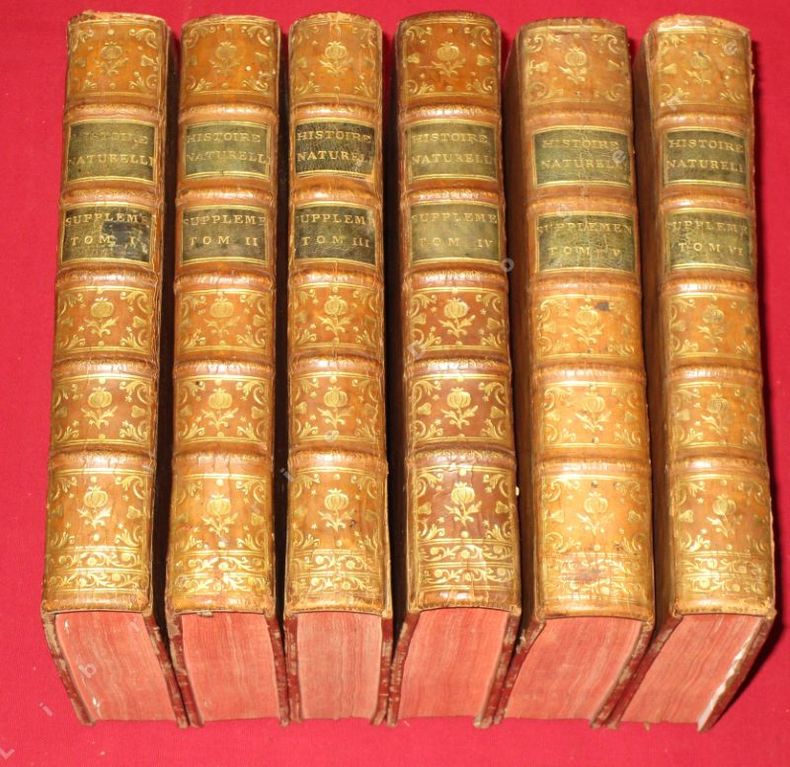
96654A Paris, de l'Imprimerie Royale, 1770-1782, 29 volumes in-4 sur 31 : Histoire naturelle (15 volumes, ensemble recomposé) illustrée de 578 planches + 1 portrait en frontispice+ 2 cartes+1 tableau dépliant (Chiens) (total 582 planches) - Supplément à l'Histoire naturelle (6 volumes sur 7 de 1774 à 1782, illustré de 144 planches + 1 carte Chaîne de Montagnes +1 carte Régions polaires ( total 146 planches) - Histoire des Oiseaux (tome 1 à 8 sur , de 1770 à 1781), illustrée de 227/231 planches, soit un total 29/31 volumes illustrés de 955 planches, série recomposée avec 2 tomes à la reliure légèrement différente, plein veau fauve (2 tomes en veau marbré dont une reliure aux armes), dos à nerfs portant titres et tomaisons dorés, ornés de caissons à fleurons et motifs dorés, coupes et chasses dorées, gardes marbrées, tranches rouges (1 tome avec tranche marbrée). Des rousseurs et pages brunies, petites galeries et mouillures dans les marges, des frottements épidermures et petits accrocs sur le cuir, des coiffes ébréchées, des coins émoussés, petits défauts de marge, quelques pages tachées, bordures de certaines gravures fendillées et brunies, sinon belle série en bon état.
8vo. With 8 woodcut tailpieces. Later mottled calf, red spine labels, red edges. Rare edition of the collected works of Luis de Camões, including Os Lusiadas and three Rimas. In the same year, Antonio Craesbeeck published another edition with the same title but with less content and with a different frontispiece. This collection of works is made up of separate publications. - Os Lusiadas is the great epic poem of Portuguese exploration, in the original Portuguese, a monument of Portuguese literature that gave a Homeric aura to Renaissance voyages of discovery and colonial conquests, here together with the other works of Camões. Camões's work was first published in Portuguese at Lisbon in 1572. - In the early 1530s the great Portuguese historian, João de Barros, most famous for his Decadas de Asia, had called for an epic poem of Portuguese exploration and discovery. Luis de Camões (1524-80) answered that call four decades later. Camões was educated in a monastic school in Coimbra, and produced poetry and plays at an early age. In his early twenties he was banished from Lisbon after producing a play considered disparaging to the royal family. He served as a soldier in the Portuguese forces besieging Ceuta in North Africa, where he lost an eye. Camões returned to Lisbon in 1550, but found himself in more trouble, and was pardoned by the King on condition that he serve the Crown in India for five years. He arrived at Goa in late 1553 and stayed there briefly before joining an expedition to the Malabar Coast. Later he participated in a campaign against pirates on the shores of Arabia. In 1556 he left Goa again for the East Indies, taking part in the military occupation of Macao, where he remained for many months. On his return trip to India, he was shipwrecked off the Mekong and wandered in Cambodia before reaching Malacca and eventually returning to Goa. He did not return to Lisbon until 1570. The Lusiads gives a fine description not only of Portuguese exploits in the East, but also of the flora and fauna of Asia and India, the ethnographic details of the peoples there, and the geography of the region, informed by Camões's own experiences as well as his familiarity with Ptolemy and Barros. - With the bookplate of "Aulo-Gélio", 1961, with a view of Lisbon. The first few pages slightly worn with some repairs. Stained throughout. Some contemporary annotations in ink in the margins. Bibliotheca Lusitana p. 62. Inocêncio XIV, 78. José de Canto, 37.
LCS-A60Superbe exemplaire relié en maroquin citron aux armes de Madame Sophie (1734-1782), fille de Louis XV. A Amsterdam, chez Michel-Charles Le Cene, 1731. 2 volumes in-12: I/ (6) ff., 388 pp.; II/ (2) ff., 438 pp. Maroquin citron, triple filet doré encadrant les plats, armoiries au centre, dos à nerfs ornés, tranches dorées. Reliure de l’époque. 160 x 90 mm.
Folio (215 x 328 mm). (4), 104 pp. With engraved frontispiece and 51 leaves of plates (8 double-page-sized or folded). Near-contemporary red half morocco with gilt rules and marbled covers, spine richly gilt (loss of label). Marbled endpapers. All edges gilt. Rare description of the Holy City of Jerusalem and of the whole of Palestine; a reissue (with changed title) of the edition published by Josef Baumeister in Vienna in 1787. Previous editions had appeared in Venice in 1728, then in 1749 and 1781, while the 1787 edition boasted "a new text and different iconography" (Staikos). This latter edition is here reproduced largely unchanged save for bringing the name of the Patriarch of Jerusalem up to date (from Abraham to Anthimus), as well as that of the editor, Apostolas Boras, on the title page. "The engraving of the Patriarch on his throne is unchanged except for the name; it is signed (in Greek): 'engraved by Schindelmayer in Vienna' [...] A large-sized, impressive book" (Staikos). "A portrait of the Patriarch [Anthimus] forms the frontispiece; also, there is an illustration of the Palace of David, and a plan of the Church of the Holy Sepulchre, though the view of its cross-section is quite haphazard [...] The author expands on Jerusalem, Bethlehem, Hebron, and the sacred sites of Galilee. The text is apparently more or less that of the Venice 1728 edition; apart from that, it is generously interspersed with highly appealing illustrations in the true taste of modern Greece" (cf. Tobler 135). The Viennese publisher and printer Franz Anton Schrämbl, whose company was continued by his widow Johanna after his death in 1804, specialised in reprints (often of large sets), maps, and books in Greek. Their production was one of the strongest in Vienna (cf. Frank/Frimmel, Buchwesen in Wien, p. 175f.). - Extremeties bumped; spine-ends chipped. Still a beautiful volume from the library of King George III of the United Kingdom (1738-1820) with his royal cypher on the spine. Staikos no. 28 (note p. 94). OCLC 41651327. Cf. Röhricht 1362, 1515. Tobler 124f., 135. Legrand (XVIII) 1208.
8vo (128 x 198 mm). (4), 44, (4) pp. Bound with six other poetical pamphlets: - 1) Sewell, [George]. Poems on Several Occasions. London, E. Curll & J. Pemberton, 1719. VII, (1), 76, (4) pp. ESTC T72201 OCLC 745130780. - 2) [Poems on several occasions: viz. Waller's Anniversary on the Government of the Lord Protector, Anno 1655. A Pastoral Courtship, &c. London, J. Roberts, 1717.] (2 [instead of 4]), 64 pp. Case 302. ESTC T65281. - 3) [Wesley, Samuel]. The Battle of the Sexes: a poem. The second edition. London, J. Brotherton, 1724. XIII, (1), 32 pp. OCLC 557368259. - 4) [Amhurst, Nicholas]. Strephon's revenge: A satire on the Oxford toasts. The 4th edition. London, R. Francklin, 1724. VIII, 54, (2) pp. Foxon A211. ESTC T129063. - 5) [Ralph, James]. Clarinda: or The fair libertine. A Poem. In four cantos. London, John Gray, 1729. (6 [instead of 8]), 64 pp. Foxon R14. ESTC N27118. - 6) (A. B.). The Happy Bride: a Poem. In three canto's. London, D. Browne, 1730. (2), V-VIII, 55, (1) pp. Foxon H39. ESTC T496. Contemporary half calf with worn gilstamped spine title. First London edition of a very early account of "foot-ball", a precursor to modern day Association Football, Rugby, and Gaelic Football, which were not separately codified until the mid-19th century. "Concanen's opening lines 'I sing the pleasures of the rural throng / and mimick wars as yet unknown to song" indicate that in writing a long poem about a football match, he was breaking new ground [...] The ball, we are told, was constructed of 'three folds of bullock's hide with leathern thongs bound fast on either side' and stuffed with hay. There were goals at either end of the pitch constructed by sticking two willow rods in the ground some feet apart, bending them towards each other and tying the ends together so that a semicircle was formed". The first edition appeared at Dublin in 1720. An early work by the Irish poet and lawyer Concanen (1701-49), who was appointed attorney-general of Jamaica in 1732, a post he held for over sixteen years. - Some light staining and browning. Light wear and soiling to binding. Provenance: John Mills (erased inscription on title of "A Match at Foot-ball"); Lloyd Kenyon (1696 - ca. 1773; inscription on first title); Roger Kenyon (1735-1796; various inscriptions throughout). ESTC T39033. Foxon C328. OCLC 39646791.
Oblong 8vo (168 x 228 mm). Hand-coloured lithographed upper cover and 7 hand-coloured lithographed scenes bound concertina-style and extending to approximately 850 mm. A fine example of a peepshow, consisting of six cut away scenes and one back scene on the inside of the lower cover. When viewed through the holes in the upper cover a lively, three-dimensional scene is revealed, a festival crowd in a long street of Constantinople, terminating at the port. An intact example of a fragile piece. No copies recorded in OCLC. - Some soiling and wear to cover, bellows intact, minor damage to a few figures, minor spots of toning.
4to (268 x 205 mm). 675 pp. With 2 maps, one folding, 14 aquatint plates, all but one coloured by hand. Contemporary straight-grained brown morocco gilt by Lubbock of Newcastle (rebacked). Marbled endpapers. Rare first edition of this detailed account of Kabulistan. The pretty engravings mainly depict costumes. "According to A. Janta, Elphinstone's encompassing scope and psychological insight have never been surpassed: for the historically leaning ethnologist, Elphinstone's work remains a source of the very highest caliber" (cf. Henze). - Armorial bookplate of John Waldie. Small tears to folding map professionally repaired. Howgego II, E10. Abbey, Travel 504. Tooley (1954) 209. Wilson 66. Henze II, 165. Lipperheide Ld 16. Colas 960. Hiler 269. Brunet II, 966. Graesse II, 469.
4 SS. 8vo. Die Zeichnungen zeigen zwei Soldaten, einen Hund und eine Landschaft. Der Brief des etwa 12-jährigen Erzherzog Carl Ludwig mit Zeichnungen seines etwa 15-jährigen Bruders Erzherzog Franz Joseph geht an die von den Kindern hochgeschätzte Erzieherin Baronin Luise Sturmfeder: "Liebe gute Amie. Ich schreibe dir heute wieder ein Mahl um dir Freude zu machen. Und sogar auf so einem Papier welches der Franzi gezeichnet hat, und ein ebenso schönes wie er dir gemacht hat damit du darauf der Lotte schreiben kannst. Ich hoffe daß du wieder bald zu uns essen kommen kannst. Ich freue mich heute schon ausserordentlich auf daß gute Mittagsmahl wovon du gestern den Speisezettel geschrieben hast [...]".
8vo. (1), 81, (1) pp. Ottoman Turkish in Arabic type. Modern blindstamped full calf with the Turkish crescent and star to upper cover, and giltstamped spine. Marbled endpapers. First and only early edition. - An exceedingly rare travelogue of the first ever voyage of the Ottoman navy to the American continent, albeit accidental. Thrown off their course to Basra by a storm on the Atlantic near Cape Verde, the two Ottoman warships Bursa and Izmir were dragged in the opposite direction, to Rio de Janeiro. This lively account by the Turkish engineer and naval officer Faik Bey describes all the stages of the corvettes' 13-month journey, their voyage from Istanbul across the Mediterranean Sea to Cadiz, on to the Canary Islands and the Cape Verde Islands, and the fierce storm that brought them to the shores of Brazil, where they laid anchor at the port of Rio de Janeiro before setting sail again two months later. They visited many ports and countries including the Cape of Good Hope, Mauritius, Muscat, Bombay, and Iran, before finally reaching Basra in November 1866. Faik Bey gives a personal account of what must have been an exciting but strenuous journey, while also reflecting on the economic conditions in the Ottoman state and the Islamic world at the time. - Extremely rare; we were not able to trace a single library copy. A second edition was not published until 138 years after the first, in 2006 (Istanbul, Kitabevi). - A second account of this voyage, written by Imam Abdurrahman Efendi, who remained in Brazil for a while before returning to Istanbul, was published in 1871. It only briefly mentions the voyage to South America, instead focussing on the author's time in Brazil and his return journey. - Flaws to upper margins of several pages, rarely touching the text. - An intriguing documentation of an unplanned visit to the New World. TBTK 10454. Özege 17908. Cf. Snowden, Accidental Turks in Brazil and Beyond. Kabacali, Gezi edebiyati seçkisi (2004). Not in OCLC, Weber, or Cox.
4to. (16), 196 pp. (With:) Bobowski, Wojciech / Hyde, Thomas. Tractatus Alberti Bobovii Turcarum Imp. Mohammedis IVti olim interpretis primarii, de Turcarum liturgia, peregrinatio Meccana, circumcisione, aegrotorum visitatione etc. Ibid., 1690. (2), 31, (1) pp. Marbled half calf with giltstamped title to spine. Top edge gilt. First Latin edition of the cosmographical and geographical work of Abraham Farissol, first published in Hebrew in 1586. Includes the Hebrew text together with the Latin translation by Thomas Hyde and copious notes, including sections in Arabic. Farissol incorporated accounts of Portuguese and Spanish exploration including the New World and Vasco da Gama's voyage to India. Also includes a contemporary work on Turkish liturgy and the pilgrimage to Mecca by Wojciech Bobowski, a renegade Pole employed as a teacher, interpreter and musician at the Ottoman court of Mahomet IV. Composed at the behest of Thomas Smith (1683-1719) during his tenure as chaplain to the English ambassador at Constantinople, the manuscript was bought back to England and translated into Latin by Hyde. - Binding rubbed and chafed, otherwise in good condition. Auboyneau 265 (p. 34). Wing F438. Sabin 60934. Steinschneider 4222 no. 2. Fürst I, 276. Not in Blackmer or Atabey.
4to (245 x 190 mm). 32, CXXVI, (2), 219, (1) pp. Complete but irregular pagination. With full-page engraved map of part of Yemen, drawn by Niebuhr and engraved by Peter Haas. 19th century half calf over green marbled boards. All edges marbled, title in gilt on spine. First edition of a "pioneer work by the great botanist Forskål which substantially increased the knowledge about the vegetation in the areas he visited. The author proposed 50 new genera, half of which are still valid" (Hünersdorf). The Swedish botanist Peter Forsskål (1732-1763), a brilliant pupil of Linnaeus, was part of the famously doomed Royal Danish expedition to Arabia 1761-1767. Despite his success in studying Arabic and collecting and recording numerous botanical and zoological specimens, all but one of Forsskål's party perished; Forsskål himself contracted malaria and died in Yemen at only thirty-one. The sole survivor was the group's cartographer, Carsten Niebuhr (1733-1815), who returned to Sweden and published Forsskål's meticulous notes, preserved in this volume, which describe a staggering number of Arabian plants for the first time in modern scientific terms. Forsskål was also known for using local Arabic terms for plants and animals in assigning them Latin names. Many Arabic terms are listed alongside botanical descriptions in this volume as well, appearing in both Latin and Arabic scripts. Among these are coffee and the drug plant qat (Catha edulis). Indeed, Forsskål and Niebuhr were the first Europeans to taste the qat. In a note added to his description, Forsskål describes the cultivation and uses of the drug, observing how the Arabs chewed the green leaves to stay awake all night (p. 64). The volume closes with one of Niebuhr's maps, showing the Western side of the Arabian Peninsula, today Saudi Arabia, as it was in the 1760s. - Light external wear, otherwise well-preserved. Pritzel 2969. Hünersdorf, Coffee, pp. 517-518. Stafleu & Cowan 1819. Cf. I. Friis, "Coffee and qat on the Royal Danish expedition to Arabia", in: Archives of Natural History, vol. 42, No. 1 (April 2015), pp. 101-112..
4to (192 x 251 mm). 7, (1); 6 pp., blank leaf. Contemporary red morocco with gilt spine and cover borders; upper cover giltstamped "Bibliotheque Imperiale" and lower cover with gilt ornament. Marbled endpapers. Only edition. - A capsule condensement, for the use of students, of the author's 208-page history of the Ottoman Empire (1869), here written in rhyming verse, published in French and Ottoman Turkish (the latter part lithographed). - Binding a little rubbed, mainly at extremeties. Removed from the library of Sultan Abdul Hamid II, with traces of requisite marks and the author's handwritten inscription to front flyleaf: "Á Sa Majesté Abdul Hamid II / Hommage très respectueux de l'auteur C. Furet". - Abdul Hamid II (1842-1918) was the last Sultan of the Ottoman Empire to exert effective contol over the fracturing state and also remembered as a poet, translator and one of the dynasty's greatest bibliophiles. While his passion for books is memorialized by the many precious donations he gave to libraries all over the world and which mostly have remained intact to this day (including the 400-volume "Abdul-Hamid II Collection of Books and Serials" gifted to the Library of Congress), his own library was dispersed in the years following his deposition in 1909: books were removed to other palaces and even sold to Western collectors, the greatest part of his collection is today preserved in the Chester Beatty Library in Dublin. OCLC 613456710.
Folio (202 x 294 mm). (16), 100 pp. Title printed in red and black. With woodcut title vignette and full-page woodcut of the author at the end of the preliminaries. 19th century half cloth. Second edition of Galvao's great history of exploration and voyages, including the Portuguese conquests on the Arabian coast, in the Gulf, and in the Kingdom of Ormus. The first edition, published in 1563, is considered virtually unobtainable, as only some five or six copies are known to exist. "This second edition, says Innocencio, 'has been equally rare for many years, since almost all copies were lost, in the house of a bookdealer, during the Lisbon earthquake'" (Borba de Moraes). Galvao's text was translated in 1601 by Hakluyt, who complained about the rarity of the first edition even then, and had to rely on a copy sent from Lisbon. - Born in 1503, Galvao was sent to India in 1527, and after distinguishing himself there, he was appointed governor of the Moluccas. He maintained a keen interest in military and religious affairs throughout his career, and spent the latter part of his life assembling accounts of the voyages that comprise this collection. He provides a relatively succinct chronological list of ancient and modern discoveries to the year 1550, including those by Columbus, Cabral, Cortés, and Pizarro. "Ce livre est divisé en deux parties: la première traite des premières navigations, y compris celles faites par les Espagnols et les Portugais dans l'océan Atlantique et aux côtes d'Afrique. La seconde partie contient toutes les découvertes faites par les Espagnols et les Portugais en Amérique et aux Indes jusqu'en l'année 1550" (Leclerc). "The author has been styled 'the founder of historical geography'. The book gives a good summary of the geographical explorations of the Portuguese and other important voyagers, including the English" (Hill). - Spine worn. Slight spotting and thumbing throughout, slight worming to lower blank margin of first 6 leaves, minor hole to blank margin of fol. M3. Sabin 26468. Borba de Moraes 289. Bosch 180. Rodrigues 1059. Palau 182.290. Leclerc 225. Innocencio I, 147, 720. Hill 670. Bibliotheca Americana 642. European Americana 731/89.
12mo. 136, (8) pp. With woodcut title vignette and 10 woodcuts in the text. - (Bound with) II: Carcano, Francesco. Dell'arte del strucciero con il modo di conoscere, e medicare falconi, astori, et sparavieri, e tutti gli uccelli di rapina. Ibid., 1645. 82, (2) pp. With woodcut title vignette and 7 woodcuts in the text (2 full-page). - (Bound with) III: Manzini, Romano. Ammaestramenti per allevare, pascere, & curare gli uccelli. Ibid., 1645. 58, (2) pp. With woodcut title vignette and 8 woodcuts in the text. Contemporary vellum with ms. title to spine. Fine sammelband containing three classic Italian works on hawking, falconry, and the care of birds in their final edition. I: "Well-known book" (Schwerdt), first published in 1547. The English author Turberville drew heavily on this work for his famous "Booke of Faulconrie or Hauking". - II: "A small book on hawking, by a practical falconer" (Schwerdt). - III: The third edition of a book "on bird catching and the care of birds. The first edition was published at Milan by Pacifico Pontio in 1575 and must be rare" (Schwerdt). "This little book relates solely to cage-birds [...] It is usually bound up with the books on Falconry by Francesco Carcano and Federico Giorgi, and might be supposed to relate to that subject" (Harting). - Bookplate of Hans Dedi von front pastedown. A good copy of this collection of rare works in a contemporary binding, in excellent state of preservation. I: Souhart 217. Harting 144. Cf. Schwerdt I, 207. - II: Schwerdt I, 94. Harting 142f. Souhart 86. - III: Schwerdt II, 7. Souhart 315. Harting 147.
Folio. 4 pp. on 4 ff. An important letter on the construction of an overland telegraph line through Africa, to the telegraphic engineer Samuel Canning (1823-1908), a pioneer in submarine telegraphy. Writing while serving as governor-general of the Sudan and engaged in the suppressing of the slave trade and the improvement of communications in the region, Gordon acknowledges the receipt of a letter from Canning on the construction of an overland telegraph line through Africa, and a Royal Geographical Society pamphlet on the same subject: "You ask me if I would recommend to the Egyptian Government, a convention, with a Company, on the basis of the terms alluded to by Mr. Geigler (and Geigler Pasha). I presume you want my outspoken opinion [...] A Company for any such work requires some certain advantages. They do not enter into a scheme like this for love of the Negro or for exploration purposes. Therefore, let me ask you, do you think, even if Egypt made the line up to Uganda, from the north, could the Company make the line up to Uganda, from the south. Even if you did make the line, are you sure of keeping it safe, except with an armed force [...] I doubt entirely, in spite of all the explorers have written, that you could do either one or the other without an armed force. The explorers say this king will do this or that, but they have only the words to go on [...] I am to recommend to the Egyptian Govt. with respect to the extension of the Egyptian line, to Uganda. I would support this extension on the terms which Geigler Pasha has mentioned [...] I should wish to see a lot of penal clauses put in which might bring in the Egyptian Govt. the reproaches of the Counsel General [...] I would prefer the following scheme, which would not compromise Egypt: 1. that the Company should take all receipts for a term of - years, from Khartoum southward, and vice-versa, allowing the Egyptian officials [...] to telegraph free, from stations in Egyptian territory. 2. that the Egyptian Govt. should supply half the cost of labour [...] By this means, Egypt would avoid any chance of interference, by the Company, of by the Counsel General [...] There is no doubt that if the line from the South up to Uganda is not made, then the line from Khartoum to Uganda could be of no use [...]". - Some spotting.