692 507 résultats
622:473 mm. 1 page. Large-format letter of recommendation to the Chinese Emperor Guangxù for Ernest Constans, former Minister of the Interior, who was to serve as ambassador to China in 1886-87 with a view to strengthening trade between the two countries.
Folio (210 x 290 mm). 2 volumes bound in one. Arabic manuscript on polished oriental paper. 166 ff; 273 ff. (foliated in a later hand), 40 lines, per extensum. Black ink with red emphases. Contemporary blindstamped full calf, restored and spine rebacked. Fiqh commentary on the famous and much-glossed Hanafi manual "Mukhtasar al-Qudurii" (known among Hanafi scholars simply as "al-Kitab") of Abu al-Husayn Ahmed ibn Muhammad al-Quduri al-Baghdadi (362-428 H). The author of this commentary, Abu Bakr bin Ali bin Muhammad al-Haddad al-Zubaidi al-Yamani (d. 800 H / 1397 CE), was a Hanafi jurist and exegete. He hailed from the people of Abadieh, from the villages (Wadi Zabid) in Tihama, historically in Yemen but today mostly in Saudi Arabia. - The first volume, copied in 1046 H (1636 CE), has an ownership inscription of Abdullah bin Hassan Al-Afif Al-Kazaruni, a Hanafi jurist from Mecca, dated 1063 H (1653 CE). The second volume has an inscription stating this was commissioned by him in 1071 H (1661 CE). - Handwritten table of contents on the preserved original flyleaves. Some light browning and brownstaining throughout; a few repairs; old waqf stamps and inscription to first page of both parts; marginal annotations throughout. The restored binding uses the prettily stamped original cover material. Removed from the Kutub Khana-i-Sultani (Sultani Library), one of the libraries the Nawabs of Bahawalpur, established in 1926 at Dera Nawab Sahib in south Punjab. GAL I, 175; II, 189; II S, 250.
8vo. 2 vols. XXXII, 400 pp. VII, (1), 320 pp. With a total of 8 folding maps and 11 plates as called for. Contemporary full calf with giltstamped red labels to gilt spine. Second London edition of this important work, first published in Edinburgh in 1727, "which remains to this day one of the most valuable first-hand histories of English merchant shipping in the Indian Ocean and East Indies" (Howgego). It covers "the whole of the Orient" (Hill) from Ethiopia to Japan and is very strong on India (some 20 chapters, not counting Bengal, which is described separately), but also includes an extensive section on the Arabian Peninsula: chapter IV "gives a little description of the coast of Arabia the Happy, from Mount Sinai to Mocha, with some observations on the religion, customs and laws"; chapter V "gives a description of the Immaum of Mocha's country, particularly its situation, laws, customs and commerce"; chapter VI "contains a description of Aden [...], also an account of the sea-coast of Arabia petraea, as far as Muskat and Bassora", chapter VII "treats of the kingdom and city of Muskat, and of their religious and civil customs [...] and a little account of the sea-coast of Arabia deserta, as far as Bassora", while chapter VIII "gives an account of Bassora City, and that part of Arabia deserta". Includes a rough, but apparently original map of the Gulf, showing "Barreen Island", "Cape Mussendon", and little detail along the Peninsula's northeastern coast in between save for a place labelled "Zoar", here not indicating Sohar in Oman but clearly referencing the area of the present-day Emirate of Sharjah (even Niebuhr's 1765 map still shows a town named "Seer" - Sir, Julfar - opposite the island of "Scharedsje"). The text mentions the region's trade in horses and pearls, stating, "There are no towns of note between Muskat and Bassora, but Zoar, and but very few inconsiderable villages; but there are two or three pretty convenient harbours for shipping. The southernmost is about 6 leagues to the southward of Cape Mosenden, called Courfacaun. It is almost like Muskat Harbour, but somewhat bigger, and has excellent fresh water from deep wells, about a quarter of a mile from the landing place. The village contains about twenty little houses; yet there are pretty good refreshments to be had there [...]". - In India, Gujarat and Bombay are covered particularly extensively, and the illustrations include not only a detailed coastline map of the subcontinent, but also several plates showing Ganesha, the elephant-headed god; a religious procession involving an elaborate wheeled scaffold from which men are hung; the temple of Jagannath; and the notorious "Juggernaut" car. - The Scottish captain Hamilton went to sea, in his own words "very young", in 1688, and travelled as far as the Barbary coast before basing himself in Surat and trading and travelling all over the Indian Ocean, "visiting, it is said, every port between the Cape and Canton" (Howgego). He made a reputation for himself as a foul-mouthed, resourceful and bold operator fending off Baluchi robbers, treacherous governors and Indian pirates. - Bindings professionally repaired. Light browning and occasional waterstaining; a few pencil annotations. Provenance: from the collection of the American diplomat Alexander Weddell (1876-1948) and his wife Virginia Chase Steedman Weddell (1874-1948); deaccessioned from the Virginia House Museum, Richmond (handwritten ownership "A. & V. Weddell, 1924, Calcutta" to flyleaves; bookplate to pastedowns). Alt-Japan 630. Howgego I, p. 477, H13. Cf. Macro 1115. Goldsmiths' 6522. Hanson 3724. Cordier, Indosinica 890. The Hill Collection of Pacific Voyages (2004) 765.
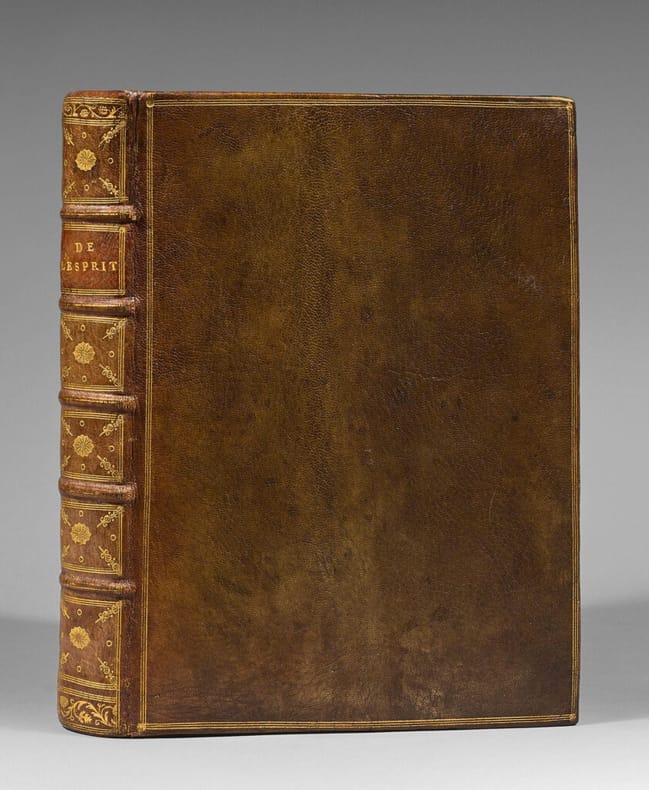
LCS-17835Bel exemplaire relié en maroquin vert de l’époque provenant de la célèbre bibliothèque de Madame de La Borde avec ex-libris. A Paris, chez Durand, Libraire, Rue Du Foin, 1758. Avec Approbation et Privilège du Roi. Grand in-4 de (2) ff., xxii pp., 643 pp., (1) p. Plein maroquin vert bronze, triple filet doré autour des plats, dos à nerfs orné, filets or sur les coupes, roulette intérieure, tranches dorées. Reliure en maroquin de l’époque. 253 x 193 mm.
Folio (240 x 350 mm). Vol. 1 (of 3). (52), 590, 583-982 pp. Title-page and half-title printed in red and black; half-title with an engraved border showing great medical practitioners. Further with woodcut device on title, a nearly full-page woodcut diagram of the ocular anatomy, and 2 full-page woodcuts with a total of 6 illustrations showing the practice of osteopathy. Near-contemporary full calf with giltstamped label to gilt spine. Marbled endpapers. All edges sprinkled red. Rare, early illustrated edition of "the most famous medical text ever written" (Garrison/M. 43). Giunta's was the first edition ever to contain illustrations (six meticulous woodcuts of a physician performing chiropractic treatments, as well as a diagram of the human eye anatomy). The present volume, the first and by far most copious of a set of three commonly bound in two volumes, comprises books 1 through 3 (out of 5). - Ibn Sina's "Keta-b al-qanun fi'l-tebb" ("Canon of Medicine"), written in Arabic but widely translated throughout the Middle Ages and the basis of medical training in the West as late as the mid-17th century. Finished in 1025, the Qanun is divided into 5 books, devoted to the basic principles of medicine, the Materia Medica (listing about 800 drugs), pathology, diseases affecting the body as a whole and finally the formulary. - Ibn Sina (c. 980-1037), in the West known by his Latinized name Avicenna, was physician to the ruling caliphs. The influence of his Qanun can hardly be overestimated. Translated into Latin in the 12th century, it became a standard textbook of Galenic medicine, influencing many generations of physicians. "From the early fourteenth to the mid-sixteenth century Avicenna held a high place in Western European medical studies, ranking together with Hippocrates and Galen as an acknowledged authority" (Weisser). "[T]he final codification of all Greco-Arabic medicine. It dominated the medical schools of Europe and Asia for five centuries" (Garrison/M. 43). - Some light brownstaining, mainly confined to upper margin. Early 20th century bookplate to front pastedown. Binding uncommonly well preserved; a very appealing copy. Krivatsy 496. OCLC 4457623. Cf. M. H. Fikri, Heritage Library, Scientific Treasures, p. 57, no. 23. Norman 1590. N. G. Siraisi, Avicenna in Renaissance Italy (2014), pp. 140, 165. Garrison/M. 43f. Hayes, Genius of Arab Civilisation, Source of Renaissance, pp. 168-169. PMM 11.
Small 4to. XXXIII, (1), 560 pp. With an engraved folding map of Asia Minor, 3 engraved plans (2 of which folding), and 6 lithographed plates. Contemporary full calf with giltstamped borders, spine and spine-labels. First edition. Presentation copy inscribed by one of the authors to pastedown: "Captain Shiffner R.N. frm. Capt. Mangles". - Early privately published travelogue of the Middle East. It consists of 6 letters, the first and last of which are dated Cairo 1817 and Cyprus 1818 respectively. Irby and Mangles, both naval officers, assisted Giovanni Battista Belzoni in his excavation at the site of Abu Simbel, an independent account of which is given in the present work. From there, they travelled through the desert to Gaza, Jaffa, Beirut and Tripoli; thence to Baalbek and Antioch; and reached Aleppo, where they were among the earliest modern explorers of Syria. They continued to Palmyra, Damascus, down the Jordan valley, and through the Holy Land. - The engraved plans include a ground plan of the great temple of Ebsambal, a ground plan of Petra, and a portion of the Dead Sea. The lithograph plates, prepared by William Westall, James Duffield Harding, and others, include scenic views of the Nile and Aswan, as well as a botanical study of the Heshbon wheat. - Covers somewhat rubbed and spotted; rebacked preserving most of the original spine and green morocco labels. Corners bumped. Paper occasionally slightly foxed; the map with a small tear. From the library of Captain Henry Shiffner (b. 1789). Atabey 606. Blackmer 860. Ibrahim Hilmy I, 325. Weber I, 123. OCLC 257597235.
in-folio (332x220 mm), pp. (12), 967, (1), bella legatura secentesca in pergamena, titolo su tassello al dorso, in astuccio in tela. Frontesp. a stampa rossa e nera, impresa tipogr. di Froben in rosso, testatine e grandi iniziali. silogr. Prefazione in latino di Arnoldus Peraxylus Arlenius, editore dell'opera (''in Fl. Iosephi opera, e historiae utilitatem''), al nobile spagnolo Diego Hurtado Mendoza, ambasciatore di Carlo V a Venezia, antico possessore del manoscritto, sul quale è basata la presente edizione. Editio princeps dell'opera omnia dello scrittore ebraico del I secolo d.C., comprendente le "Antiquitates iudaicae", la storia degli Ebrei in 20 libri, il "De bello judaico", 7 libri sulla conquista della Galilea da parte di Vespasiano ed il "De antiquitate Judaeorum contra Appionem", apologia degli Ebrei contro un libello antigiudaico scritto dal maestro Alessandrino Apione. Affascinante volume, interamente impresso in greco con somma eleganza e chiarezza. "The editio principes of Josephus... was in fact an edition of his works in Latin, still the intellectual language of Europe in 1470; the first edition of the Greek text did not appear in print until nearly 75 years later, after the Renaissance revival of Greek learning". Bell'esempl. su carta forte, a grandi margini. Al contropiatto nota di inizio XIX secolo del libraio G.B. Petrucci Piancastelli a Palazzo Ruspoli, nota di possesso dell'epoca in greco, qualche fioritura più fitta in pochi fogli, forellino all'ultimo f.. Dibdin II, 130:"This volume is beautiful and rare". BMC, German, 463. Adams J-351. Hoffman II, 443..
4to. 1 p. White House stationery. As President, to Harry I. Johnson of the Clearwater Sun, thanking him for his coverage of the Inaugural address, with a holograph postscript: "Many, many thanks": "I certainly appreciate the manner in which you covered the Inaugural address. It was very thoughtful of you to send me your Inaugural Day edition". - Stains at all edges from prior mounting, horizontal fold.
2 volumi in folio, pp. (20), 690; (2), 462, (38). Frontespizio inciso, ritratto dell'arciduca Leopoldo, entrambi su disegno di J.P. Schor, e 21 tavole numerate a 23, di cui 4 ripiegate. Numerose illustrazioni xilografiche, di cui tre a piena pagine. Foglio di Errata alla fine del vol. II. Legatura coeva in piena pergamena rigida con titolo su tassello al dorso. Piccolo strappo alla cuffia superiore
LCS-A14Exemplaire sur grand papier somptueusement colorié à l’époque. Leeuwarden, 1758. 3 ouvrages en 1 volume in-folio de: I/(2) ff., 86 pp. (1) f., 20 estampes hors-textecoloriées à la main, armoiries sur le feuillet de dédicace; II/(2) ff., 132 pp., 19 gravures hors-texte coloriées à la main; III/ (2) ff., 168 pp., saut dans la numérotation p. 146 et 162, (2) ff. Demi-basane usagée, dos à nerfs orné, non rogné. Reliure de l’époque. 368 x 263 mm.
8vo. 2 pages on bifolium. Letter to the delegates of the Austrian Workers' Party in which Lafargue praises the Austrian Socialist Movement: due to the workers' mentality, he writes, the movement managed to withstand the police actions against them that would otherwise have led to anarchy. Lafargue compares the Austrian situation to the German one. There, Bismarck's strategy of fighting the workers' movement through his Anti-Socialist Laws even advanced it and ultimately led to socialism being imported to the USA through his expulsions: "L'énergie, l'intelligence et l'esprit de discipline des ouvriers de votre pays vous ont permis de triompher des manoeuvres policières pour égarer le mouvement socialiste autrichien dans l'anarchie [...] il brûle d'imiter Bismarck, qui par ses lois d'exception, a contribué à constituer le plus puissant parti socialiste qui existe, et par ses expulsions a réussi à importer le socialisme aux Etats-Unis d'Amérique". Lafargue mentions the French situation and the measures taken by the government, namely imprisonment and gunfire. He especially notes, with a hint of irony, the First of May protests in Fourmies, where nine persons were killed and many more prosecuted: "Nous sommes aussi en France l'objet de la sollicitude du gouvernement; il essaie d'entraver notre mouvement par des manoeuvres policières, des emprisonnements et des fusillades. Le gouvernement après avoir massacré les socialistes à Fourmies, et les avoir chargé et sabré dans toutes les villes le 1er mai dernier, continue son oeuvre par des poursuites judiciaires [...]". - On squared, headed paper of the French Workers' Party. Some stains. Traces of old folds.
Copper engraving (from J. Huygen van Linschoten, Itinerario, 1596). Printed on 2 joined sheets. 385 x 535 mm. Matted. Famous map of the Arabian Sea between Cyprus and northern Sumatra from one of the ed. 1596-1644. "Probably the first detailed navigation chart printed for the Indian Ocean and the Arabian sea" (Al Ankary 148). Tibbetts 46. Al Ankary 148f. Gole, Early Maps 8. Schilder, MCN V, p. 140 & VII, p. 220/1. Clancy 70. Clancy/R. 67 (all illustrated).
4to. 2/3 pp. Bifolium with integral address panel and censor's comment. Written during the divorce proceedings of Countess Sophie von Hatzfeldt (whose lawyer Lassalle was), during imprisonment, to judge "Oppenhoven" (i. e. Oppenhoof) at Cologne, asking for an arraignment and for the examination of several witnesses named Uderbach, Carl Gianella, and Gladbach regarding Arnold Goedecke and his concern with Mr. v. Stockum "in whose service he is". - During the trial, Lassalle had been arrested and was accused of having stolen a casket of important documents. - Traces of moisture on top of fol. 1 (opening lines faded) and some damage to edges.
4to 1 p. To Mr. Richard: "Your request rather worries me. My writing has no literary pretension, but has attracted notice since people have told stories about my oddness, making me out a romantic person - and it is considered curious that such a one should wish to write. Your paper is meant, you say, to be rather good. If so, why strain after a contribution from the merely notorious? I think I must wait till I have bought your first number + judged it for myself [...]".
62 vols. bound in 42, including: 7-16, 19, 21-25 (paper), 28-33, 37-41, 50-57, 63, 69-73, 75-77, 80, 88-92, 94-99, 102, 115, 139, 154-155, 168 (paper). Indices of 1-3, 8-11, 12-15, 28-31, 131-152, 1-39. Vol. 154 with a folded map. Mostly blue cloth with giltstamped crest and spine title, original wrappers included in the binding. 6 vols. in original wrappers. Lithogr. coloured plate of a chart at the end of vol. 56/57 added. First and only edition: a substantial torso of the League of Nations Treaty Series (LNTS), the League's officially published collection of treaties and other international engagements. Begun in 1920, it was discontinued in 1946 (following the dissolution of the League) after 205 volumes. The present set includes numerous important agreements reached during the interwar period between the western powers and those of the Middle East, such as Saudi Arabia, the Trucial States, Yemen, and Oman. - To cite but a few examples, vol. 71 includes the full Arabic and English text of the "Treaty of Friendship and good understanding between his Britannic Majesty and his Majesty the King of Hejaz and of Nejd and its dependencies. Signed at Jeddah, May 20, 1927", authorized by Faisal Abdul-Aziz al Saud, Abdul-Aziz ibn Abdul-Rahman al Saud and Gilbert Clayton, pp. 133-164, also noting: "Article 6. His Majesty the King of the Hejaz and of Nejd and its Dependencies undertakes to maintain friendly and peaceful relations with the territories of Kuwait and Bahrain, and with the Sheikhs of Qatar and the Oman Coast, who are in special treaty relations with His Britannic Majesty's Government", p. 154. - Vol. 115 includes the German and Arabic text as well as a French and English translation of the "Treaty of Friendship" between Germany and Hejaz, Neijd and dependencies of 1929 in Cairo which was authorized by Stohrer, Sheikh Hafez Wahba, and Sheikh Fausan El Sabek, pp. 266-270. - Vol. 8 includes the English text of the "Anglo-Muskat commercial treaty": "[...] the Treaty of Friendship, Commerce and Navigation between Great Britain and Oman, signed on the eighth day of Shaban 1308 H., corresponding to the 19th March, 1891, will be prolonged by this writing notwithstanding all or any correspondence between His Late Highness Syud Faisal bin Turki and the Glorious British Government [...]" authorized by Taimur bin Faisal, Sultan of Muscat and Oman and R. Wingate, I.C.S. - Vol. 25 includes the English text of the "Anglo-Muscat Treaty prolonging for one year from February 11, 1924", authorized by R. G. Hinde and Nadir, Muhammad bin Ahmad, Rashid, and Zubair in Muscat, pp. 388-391. - Vol. 168 includes the "Agreement between Great Britain and Muscat renewing for a further period of one year from February 11th, 1927, the Treaty of Friendship, Commerce and Navigation of March 19th, 1891 [...]" in Arabic, French and English authorized by Said bin Tamur, Sultan of Muscat and Oman, and Major R. P. Watts, I.A., pp. 230-233. - Vol. 96 includes the "Agreement between Great Britain and Mascat renewing for a further period of one year, from February 11, 1929, the above Treaty of March 19, 1891" in Arabic, English and French, authorized by B. S. Thomas, G. P. Murphy, and Hadji Zuber bin Ali "on behalf of his Highness Sayid Sir Taimur bin Faisal, K.C.I.E., C.S.I., Sultan of Maskat and Oman", pp. 194-197. Numerous further relevant treaties are referenced in the copious indices included with the series. - Three sets of indices bound in separate volumes, the others bound with the treaties. Some of the original wrappers somewhat damaged when not included in the binding, but well preserved. Removed from the Champlain Library of the Université de Moncton, Canada (their shelfmarks to spines and stamps to edges); previously in the library of the University of Washington, Seattle, International Fisheries Commission (their stamps to some wrappers).
Pergamentlibell. 15 SS. Folio. Roter Samteinband mit tw. erhaltenen Schließbändern anhängendes Siegel in Holzkapsel, ornamentierte Metallkassette mit Ausnehmung für das Siegel. Gegengezeichnet von Graf Julius Friedrich Bucellini.
LCS-16221L’acte initial de la Révolution Française. Paris, de l’Imprimerie Royale, le 24 Janvier 1789.Placard in-folio. La lettre est imprimée sur quatre colonnes séparées par un filet noir. Pts. manques de papier dus aux plis, qq. rousseurs. Encadré. 825 x 545 mm.
4to. 3 vols. XXXVIII, 319 (but: 337), (1) pp. VIII, 379, (1) pp. XII, 556 pp. With 50 (instead of 51) engraved plates and maps (9 [instead of 10] of which folding), 2 in original hand colour. Contemporary giltstamped full calf with giltstamped spine-labels. First edition: a scarce series of research papers of one of the leading learned societies of the 19th century, focusing on India and Persia. Among the most prominent authors are James Mackintosh, George Staunton, Henry Salt and Vans Kennedy. The "Transactions" include an English translation of the fifth sermon of Saadi, a discussion of the Akhlaq-i Nasiri, the account of a journey from al-Qatif to Yanbu, a description of the character of Muhammad, and an account on the deciphering of cuneiform, as well as papers on antiquities and archaeology, literature, religion, linguistics, geology, history, current affairs, and anthropology. The illustrations depict mainly archaeological finds and excavation sites, including the caves in Salsette and the excavations at Elephantana, as well as architectural ornamentation, showing the Temple of Boro-Budor, cuneiform writing, and "a curious case in Arabian surgery" involving a wounded arm. - Provenance: "Ochterlony" bookplate to front pastedown of volume II, most likely that of David Ochterlony (1758-1825), commander of the British East India Company and British Resident at the Mughal Court in Delhi. Later obtained by the Schlagintweit brothers, eminent German 19th century scientists and explorers (their library blindstamps "Ex Bibliotheca Schlagintweit" to title-pages). Last in the collection of Prince Konrad of Bavaria (1883-1963), a member of the Bavarian Royal House of Wittelsbach (his bookplate to pastedowns of two volumes and front free endpaper of the other, his library stamp to half-titles). - Bindings professionally restored; vols. I and II lacking title-labels. Tears in gutter of one folding plate repaired with old adhesive tape (not touching image). Some minor spotting, offsetting of plates and text; light marginal dampstaining to a portion of volume two. A scarce work with fine provenance. OCLC 977182244.
8vo. 3 pp. on on bifolium. With one addendum (s. b.). The letter is addressed to Peter Le Neve Foster, Secretary to the Society of Arts, with whom Livingstone corresponded a good deal during this period, asking him to supply samples which give an idea of the papers for the Indian civil service examinations: "[...] Neither of my boys are fit as yet for it but I would like to shew them what is expected one of them got prizes for Geography German French & Latin yesterday and seems likely to go on in these studies - Another got a prize for drawing - I wish to set them to aim high [...]". - Livingstone worries about the future of his surviving son, while preparing for his final departure for Africa that August. He had been invited to return to Africa by the Royal Geographic Society that January, in order finally to sort out the problem of the Nile. He wrote this letter when staying with his long ailing and bedridden mother. Soon afterwards, thinking that she was rallying, he dashed down to Oxford in order to deliver a lecture, where he received a telegram announcing her death on the eighteenth. He and his wife Mary, who had died in Africa in 1862, had three sons, Robert Moffat Livingstone (1846-64), Thomas Steele Livingstone (1849-76) and William Oswell Livingstone (1851-92). Robert, the eldest, had died of his wounds the previous December, while fighting on the Union side in the American Civil War under the name Rupert Vincent so as not to bring discredit to his father, who was wont to accuse him of trading off his name. In Tim Jeal's opinion, 'Robert's life is really the story of Livingstone's failure as a parent' (Livingstone, Pimlico edition, p. 281). Oswell, the youngest, fell out of favour when in 1872, as a member of the RGS relief expedition that had been upstaged by Stanley, he failed to join his father but instead recommended him to return home, causing his father to dub him 'as poor a specimen of a son as Africa ever produced'. Tom, the middle and eldest surviving son, stayed the course and was to act as his father's chief executor; although it was to be his sister Agnes, Livingstone's doted-upon daughter, who became chief guardian of his reputation. - An album with letters to Foster by Henry Cole and others is included in the lot.
Title page and 38 unnumbered pages of text. Half cloth binding from around 1870 with gilt spine-lettering and marbled boards. This is a preliminary outline of the material to be covered extensively in Ludolf's "Istoria Aethiopica", which was published in three volumes from 1681 to 1693. Job Ludolf, a German German scholar, and the "founder of Ethiopian studies" (Katalog der Eutiner Landesbibliothek) gathered the most important information available about Ethiopia in his time, working for a time in collaboration with one of the Ethiopian monks who stayed in Rome. In addition to his monumental history of the country, he wrote dictionaries and grammars of Ge'ez and Amharic. His intensive studies of Ethiopian culture and life made his work the best 17thcentury source on the region described. "A most important work on Abyssinia" (cf. Paulitschke), "of an importance transcending his own time". Very good condition outside, text shows browning and foxing. Stamp on reverse of title page. A particularly scarce and hardly known work, preceding Ludolf's famous publication on Ethiopia by a full 5 years and at the same time Ludolf's very first publication!
6 Lederalben (qu.-folio) und lose Photographien (verschiedene Formate). Private Photosammlung des Schiffsstewards Hermann Muller, der zwischen den 1930er und 1960er Jahren - der Hochzeit der Luxusschiffahrt - auf den Passagierdampfern der Reederei United States Lines im Bordservice gearbeitet hatte und bis zum Chefsteward aufgestiegen war. - Die aus einer Postschiffahrtsgesellschaft hervorgegangene amerikanische Reederei United States Lines betrieb von 1929 bis 1969 eine Transatlantiklinie (New York-Bremerhaven und New York-London) für Luxus-Passagierdampfer, die tlw. mit ehemals deutschen, als Reparationszahlungen übernommenen Passagierschiffen (America, George Washington), später mit eigens für die Reederei gebauten Dampfern befahren wurde. Der berühmteste Dampfer des Unternehmens war die United States, das Flaggschiff der Reederei, die auf ihrer Jungfernfahrt 1952 (unter Kapitan H. Manning) das "Blaue Band" errungen hatte. Sie hält bis heute den Rekord für die schnellste Atlantikquerung eines Passagierschiffes in östlicher Richtung. - Hermann Muller fuhr unter anderem auf den Schiffen America, President Roosevelt, Leviathan, Manhattan, Washington und eben auch der United States. Als Chefsteward hatte er die Verantwortung für Küche, Vorratshaltung und Reinigung des Schiffs. Mullers große Umsicht und Einsatzbereitschaft für das persönliche Wohl der teils prominenten Passagiere sowie ein offensichtlich sympathisches Wesen machten ihn zum ersten Ansprechpartner und beliebten Mitglied der Bordcrew, wie zahlreiche herzliche und persönliche Widmungen auf den Photographien wie "Wishing you as always a Happy sailing thru life" bezeugen. Die Photographien (Formate zwischen 7 und 12 und 20 und 26 cm) stammen überwiegend von den Bordphotographen der Linie oder von privat und zeigen neben den Passagieren auch die Crew und das Küchenpersonal, Banketts, Silvester- und Geburtstagsfeiern, Bordhochzeiten, Seebestattung, seltene Details oder auch Gesamtaufnahmen der Passagierdampfer; daneben finden sich auch Familienphotos aus dem Privatleben von H. Muller. - Unter den Passagieren, die sich mit Photo und einigen Grußworten in der Sammlung verewigten, befinden sich viele berühmte Namen der funkelnden Welt des Films und des Jet Sets, des Sports und der Politik, darunter John Wayne, Burt Lancaster, Charlton Heston, Cary Grant, Bob Hope, Horst Buchholz, Edward Duke of Windsor mit seiner Frau Wallis Simpson, Harold Lloyd, Walt Disney, Charles Boyer, Donald Campbell, die Boxer Walter Neusel, Bob Olin und Erich Seelig, Dean Jagger, Joan Crawford, Cornel Wilde, Jean Wallace, James Cagney, den Bürgermeister von London Cuthbert Ackroyd, Corinne Calvet, Herbert Marshall, Salvador Dali, Harry Truman, Dwight D. Eisenhower, Haile Selassie, Ludwig Erhard, Felix Graf von Luckner, Saud ibn Abd al-Aziz Al Saud u. v. m. - Photographien teilweise gelöst, einzelne mit Randeinrissen, die Alben gering berieben. Insgesamt eine interessante und umfangreiche Sammlung von sehr guter Erhaltung.
LCS-1864036De la bibliothèque Ambroise Firmin-Didot. Paris, Pierre Rocolet, 1629. In-folio, 1 f. frontispice, (4) ff. préliminaires, 180 pp. chiffrées (saut dans la numérotation de la p. 18 à la p. 21 sans manque), 11 pp. pour La Rochelle aux pieds du Roy, (1) f., 15 planches gravées à pleine page dont 14 hors texte. Vélin, double encadrement de filets dorés sur les plats, armoiries de la ville de Paris frappées or au centre, dos lisse orné en long d'un encadrement de double filet doré, tranches dorées. Reliure de l'époque. 358 x 248 mm.
2 volumes. (30,5x22cm). IV, 741; IV, 54, 16, 48, 36, 36, 12, 6, 30, 12 pp. With numerous illustrations in text, one small map after the preface, and 15 folding maps in the second volume. Half sheepskin, cloth sides. First edition of a travelogue through Asia, written by Carl Gustav Mannerheim (1867-1951), future president of Finland, 1944-1946. In 1906, Mannerheim, then a colonel, was sent on an expedition to Asia. "The object of this expedition was to study conditions in the interior of Northern China, collect statistical materials and perform various tasks of a military nature", says Mannerheim in the preface. Russia wanted to know the state of affairs in China due to the reforms and modernization undertaken by the Qing Dynasty. Besides that, Mannerheim wanted to collect items of scientific interest for the National Museum in Helsinki and to study the little-known peoples living in Northern China. This makes the work, with its numerous illustrations by photographs, an interesting anthropological account as well. The first volume contains Mannerheim's journal with many photographs. The second describes the scientific results the artefacts Mannerheim took with him to Helsinki and, including sculptures, costumes and utensils. - Number 33 out of limited edition of 100 and signed by the author. With owner's inscription of Ewald Henttu on flyleaf, dated 1940. Very good copy; binding slightly rubbed along the extremities.
12mo. 3 vols. X, 238 pp. With 8 steel engraved plates. (4), 166 pp. With 6 steel engraved plates. (4), 279 pp. With 10 steel engraved plates. Contemporary long-grained red morocco, decorated raised bands, gilt fillet and decorative frames on covers, gilt edges. First edition of this early study of the Bedouins of Egypt and Syria, covering their manners, laws, civil and religious customs. Illustrated with 24 steel engraved plates by Charlin after F. Massart and finely watercoloured at the time. The notes by Dom Raphaël were most probably taken during the French occupation of Egypt. Raphaël Monachis (Rufa'il Zakhûr) was born in Egypt of Syriac ancestry and was a monk in the Greek community in Cairo. He was an Arab member of the French Institute of Egypte and the first interpreter of the Diwan from Cairo. - Rare complete copy, some corners slightly scuffed, spine faded, otherwise in good condition. Macro 1555. Gay 3587. OCLC 25988256.
4to. 3 lines on vellum. Beautiful autograph on the last page of a copy of a contract with the tax stamp of the generality of Bordeaux (fol. 1r). Montesquieu probably annotated and signed this document, originally drawn up on 5 May 1712 in Castiers, in his role as président à mortier of Bordeaux, confirming that he had "received the sous and taxes of the present contract" and "canceled the third": "J'ai reçu les sols et rentes du present contrat et ai quitté le tiers". - Montesquieu had inherited his title, a large fortune and his office in Bordeaux from his uncle Jean-Baptiste de Secondat in 1716. He would remain président à mortier for 10 years until 1726, when he was forced to sell his venal office in order to settle debts. - Minimally smudged.