119 774 résultats
In-4°, (2cc), Clemens papae V. Monitorium, & declaratio excommunicationis, interdicti, & aliarum poenarum ecclesiasticarum contra Venetos ... 12cc; Sixti papae IV. Declaratio & promulgatio excommunicationis, interdicti, & aliarum censurarum contra Venetos ...(10cc); Iulii papae II. Monitorium, & declaratio excommunicationis, interdicti, & aliarum censurarum ecclesiasticarum contra Venetos ...(10cc) + Mandata Reipub. Venetae ad concordandum cum Iulio II (8cc)+ Absolutio Venetorum ab excommunicatione & anathemate per Iulium II (2cc) La ripresa dell'economia veneziana fu accompagnata, negli anni a cavallo tra Cinquecento e Seicento, dalla ricerca di un'autonomia dalla Spagna e dal papato. La ricerca dell'autonomia – che spinse Venezia a stabilire accordi diplomatici con i principi protestanti, con l'Inghilterra e la Francia di Enrico IV – condusse la Repubblica a crescenti tensioni e poi allo scontro con la chiesa romana, guidata all'epoca da papa Paolo V. La fase più acuta della contrapposizione si verificò con la vicenda dell'"interdetto" (1606-1607). In questa occasione, Venezia non si piegò alle richieste del papa di abrogare alcune leggi che regolavano la proprietà ecclesiastica nel territorio della Repubblica, rifiutandosi anche di consegnare due sacerdoti veneziani, accusati di delitti comuni, che l'autorità religiosa pretendeva di giudicare secondo i propri codici e di sottrarre così alla giurisdizione civile. Di fronte all'"interdetto", cioè alla scomunica comminatale da Roma, la Serenissima reagì con vigore: furono tra l'altro espulsi da Venezia i gesuiti, il potente ordine religioso identificato come strumento delle interferenze papali nella vita della Repubblica. Dopo una fase di tensioni crescenti, in cui Venezia ottenne l'appoggio degli stati protestanti, la vicenda si avviò alla sua conclusione grazie a un compromesso, favorito dal re di Francia. The recovery of the Venetian economy was accompanied, in the years between the sixteenth and seventeenth centuries, by the search for autonomy from Spain and the papacy. The search for autonomy - which led Venice to establish diplomatic agreements with the Protestant princes, with England and the France of Henry IV - led the Republic to growing tensions and then to the clash with the Roman church, led at the time by Pope Paul V. The most acute phase of the opposition occurred with the "interdetto" (1606-1607). On this occasion, Venice did not bow to the pope's requests to repeal some laws that regulated ecclesiastical property in the territory of the Republic, also refusing to hand over two Venetian priests, accused of common crimes, which the religious authority claimed to judge according to their own codes and thus remove from civil jurisdiction. Faced with the "interdict", that is the excommunication imposed by Rome, the Serenissima reacted vigorously: among other things, the Jesuits, the powerful religious order identified as an instrument of papal interference in the life of the Republic, were expelled from Venice. After a phase of growing tensions, in which Venice obtained the support of the Protestant states, the affair was drawn to its conclusion thanks to a compromise, favored by the King of France.
mn1282Presses de la Cité Cartonné avec jaquette "Lot de cent trente-neuf volumes in-12, cartonnés dont la plupart sous jaquette illustrée, 136 titres de la collection ""Captain Johns"" (+ 3 doubles), ce lot comprend les titres suivants : CAPTAIN W.E. JOHNS aux PRESSES DE LA CITE : Aventures dans la mer de corail // (Worrals) Au-dessus de la foret vierge // no.1 - (Biggles et les) Corsaires du Pacifique // no.2 - Jeunes filles de l'Intelligence Service // no.3 - (Biggles dans) Le bal des Spitfires // no.4 - Rendez-vous en Extrême-Orient // no.5 - King et ses hommes // no.6 - Commandos en France // no.7 - Le cygne jaune // no.8 - Le trésor des flibustiers // Les Pirates du Pôle Sud // no.10 - Le mystère des avions disparus // no.11 - Jusqu'au bout // no.12 - Mission en Catalogne // no.13 - Biggles dans les Mers de Sud // no.14 - Biggles à Bornéo // no.15 - King dans la jungle // no.16 - Le lac maudit // no.17 - Biggles joue le grand jeu // no.18 - La vallée des serpents à sonnettes // no.19 - Biggles et Cie // no.20 - Biggles au Tibet // no.21 - Biggles au grand nord // no.22 - Aventuriers de l'air // no.23 - Biggles en Afrique // no.24 - Biggles s'en va-t-en guerre // no.25 - Biggles combattant du ciel // no.26 - Biggles en permission // no.27 - King à la rescousse // no.28 - La bataille dans le désert // no.30 - Le démon des sables // no.31 - Biggles cherche de l'or en barre // no.32 - Service secret // no.33 - Biggles en danger // no.35 - Biggles en Arabie // no.36 - King et ses brigands // no.37 - l'île interdite // no.43 - Biggles détective de l'air // no.45 - La momie égyptienne // no.46 - King et les loups-garous // no.47 - Retour de King // no.48 - Rendez-vous avec Biggles // no.49 - Worrals courrier secret // no.50 - Biggles dans le désert // no.51 - Aux mains des pirates // no.52 - Biggles porté manquant // no.53 - Les exploits de Biggles // no.54 - Worrals et l'opale noire // no.55 - King chez les Indiens // no.56 - C'est X... qui frappe // no.57 - Biggles reprend le manche // no.58 - Espions de l'air // no.59 - Biggles en croisière // no.60 - Biggles entre en scène // no.62 - Château fort et faux billets // no.63 - La piste du chien blanc // no.64 - L'avion noir // no.65 - Biggles à la dérive // no.66 - Biggles chez l'ennemi // no.67 - Biggles en France // no.72 - Biggles court le risque // no.74 - Biggles, pilote de chasse // no.75 - Biggles en Corée // no.77 - Tout va bien // no.79 - Biggles et l'eléphant noir // no.83 - King répond à tout // no.89 - Biggles à la Jamaique // no.93 - Biggles en Mongolie // no.100 - Huit affaires pour Biggles // no.105 - Rois de l'espace // no.107 - King et les Zombies // no.108 - Biggles autour du monde // no.109 - Biggles dans la Légion // no.110 - Biggles et le puzzle Chinois // no.111 - Biggles en Australie // no.112 - Biggles l'échappe belle // no.113 - Retour sur Mars // no.116 - L'aventure sans frontière (en double) // no.117 - Biggles, jeune pilote // no.119 - Biggles fait ses premières armes // no.121 - (La) Croisière aux étoiles // no.122 - Biggles en Sologne // no.127 - Biggles à Soho // no.128 - Captifs de l'espace // no.132 - Vers les mondes lointains // no.137 - L'île mystérieuse de Biggles // no.139 - Biggles enterre la hache de guerre // no.142 - Biggles au Mexique // no.148 - Où plane l'aigle // no.150 - Biggles aux Indes // no.153 - Biggles cherche fortune // no. 159 - Biggles s'en mêle // COLLECTION ILLUSTREE : no.1 - Biggles au Cap Horn // COLLECTION LES AMIS DES JEUNES (ARTHAUD) : no.4 - Worrals en missions // Biggles en Norvège // Biggles en Egypte // HACHETTE : Un exploit de Worrals (sans jaquette) // AUTRES AUTEURS, PRESSES DE LA CITE : Wolf le rajah (Bertrand Shurtleef) // Compagnons du Grand Nord (Bertrand Shurtleef) // On embarque pour le Gulf Stream (Zachary Ball) // Wolf s'évade (Bertrand Shurtleef) // Le Trésor disparu (E. Ellsberg) // Le Page de Dame Agnès (Yvonne Morance) // Wolf en campagne (Bertrand Shurtleef) // La Tour Sarrasine (Ralph Hammond) // Flamme au Sahara (Eric Leyland) // La Forêt secrète (Zachary Ball) // Frères de la côte (Ernst Löhndorff) // Le Trésor de Lima (Ralph Hammond, deux éditions différentes) // Patrouille en Nouvelle Guinée (Bertrand Shurtleff) // Rescapés de la banquise (Bertrand Shurtleff) // Le Drame du Virgo Fidelis (Joseph Perrin) // Terre de personne (André Demaison) // Flamme en Afrique (Eric Leyland) // Flamme commence (Eric Leyland) // Flamme relève le défi (Eric Leyland) // Flamme mène l'enquête (Eric Leyland) // La Bataille des astres (Paul French) // Rois de l'espace (Brane et Clinton) // Opération ""Soucoupe"" (Ivan Southall) // L'or perdu (Wilfrid Robertson) // Le Mystère du Delta (Zachary Ball) // Astropolis (Alfred Fritz) // Venus contre la Terre (Paul French) // Clément Ader ou l'enfant qui voulait se faire oiseau (Louis Castex) // Histoire d'un hors-la-loi (Henry G. Lamond) // Garçons sur un voilier (Peter Dawlish) // Graine de cowboy (Ralph Moody) // Saint-Exupéry, pilote légendaire (Jean Bruce) // Le Ranch du Grand Losange (Ralph Hammond) // Allô contrôle ici radar (Ivan Southall) // Le lac aux sept secrets (Sam Campbell) // Missions en Birmanie (Kenneth Ross) // Flamme le libérateur (Eric Leyland) // Pavillon noir (Ernst Londorff) // Flamme chez les coupeurs de têtes (Eric Leyland) ; coupes et coiffes frottés, état variable selon le volume notamment aux jaquettes, dont certaines peuvent présenter des manques et frottements assez importants, assez bon état général. Livraison a domicile (La Poste) ou en Mondial Relay sur simple demande."
Deuxieme edition de l'Etude sur la Strategie navale. Text in French. Maroon leather, blue cloth-covered boards with gilt trim. Top edges gilt. Marbled endpapers. Volume I - La Strategie is 384 pages. Volume II - La Tactique is 142 pages. Volume III - L'Organisation Des Forces is 315 pages. (please note that Volume III was printed in 1910) Former copy of the Royal Canadian Naval College Library with usual markings. Only external markings are writing at base of backstrips. Bindings all intact. Moderate to average wear externally. A sturdy copy of this influential work. Book
1944117199Montrouge Atelier Robert Doisneau 1944 1 vol. en feuilles Tirage argentique d’époque, 21 x 18 cm, tampon rouge du photographe au verso. Célèbre photo reproduite p. 64 de l'album "Paris libéré" préfacé par Mauriac (Flammarion, 1944). Titulaire d'une accréditation pour suivre l’insurrection parisienne et l’avancée des troupes alliées, le photographe est au plus près des événements pour en saisir toute la gravité. Epreuve originale, en parfaite condition.
1944117200Montrouge Atelier Robert Doisneau 1944 1 vol. en feuilles Tirage argentique d’époque, 20,7 x 18 cm, tampon rouge du photographe au verso. (Musée Carnavalet - Histoire de Paris, réf. PH11038). Epreuve originale, en parfaite condition.
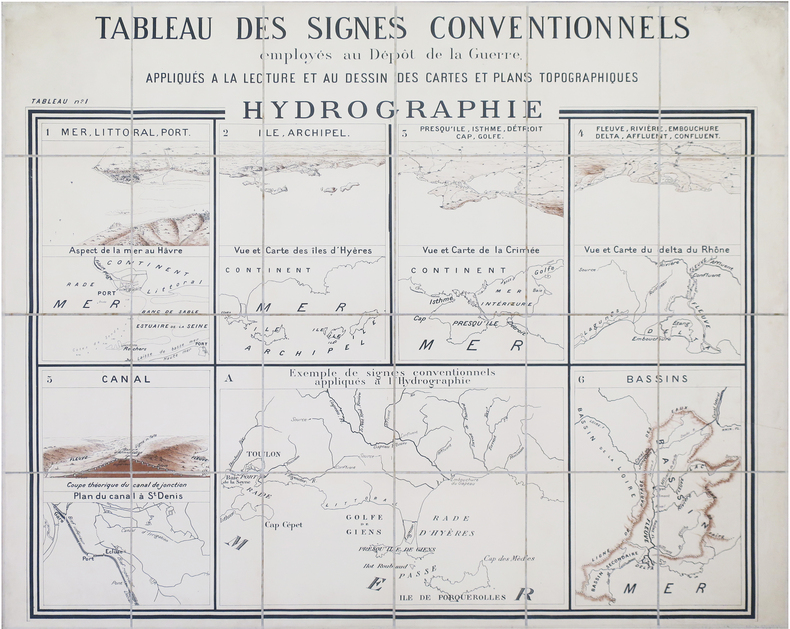
1880LBW-8467Dépôt de la Guerre, [circa 1880]. En 24 sections montées sur toile et repliées, formant une carte de 0,94 x 1,13 m.
1914123637Mézières 1914 1 vol. en feuilles 5 p. manuscrites en langue allemande (+ 3 p. blanches), format 33 x 21 cm, pliées en 4, sur papier à en-tête de l'Etat-major général. Rapport secret du plus grand intérêt, signé et daté du 18 novembre 1914, rédigé au Quartier général allemand de Mézières.Erich von Falkenhayn (1861-1922), ministre de la guerre et fraîchement nommé chef de l'Etat-Major général, dresse ce 18 novembre 1914 un rapport sur la situation de l'armée allemande partagée entre les fronts de l'Est et de l'Ouest. Commandant le front de l'Ouest, il fait un point sur la situation à son homologue du front de l'Est Hindenburg : l'envoi de troupes de choc du front de l'Ouest vers le front russe ont permis de remporter plusieurs victoires mais Falkenhayn s'inquiète d'une possible attaque de l'ennemi sur le front Ouest qui risquerait de les obliger à évacuer les côtes de la Baltique. Or, tant qu'ils sont maîtres des débouchés sur la mer, les Allemands restent supérieurs à leurs plus dangereux ennemis : les Anglais."Les Français sont inoffensifs tant qu'ils ne sont pas surexcités par un espoir très passionné. Il ne faut absolument pas donner l'éveil à leurs aspirations patriotiques, comme en septembre par exemple ou après une diminution des effectifs de l'armée de l'Ouest au profit du front de l'Est, ils nous firent reculer..."Falkenhayn reste pourtant résolu à envoyer de nouveaux bataillons à l'Est ne serait-ce que pour montrer à leurs alliés autrichiens qu'il est bien décidé à les aider dans leur lutte en Galicie.Excellent document.
In-4°, 48pp, frontespizio con marca editoriale e motto In te Domino speravi non confundar in aeternum, capolettera xilografico. Lo scritto di Bernardo Giusti si inserisce nella polemica seguita alla cosiddetta ‘guerra dell’interdetto’, in cui Venezia non si piegò alle richieste del papa di abrogare alcune leggi che regolavano la proprietà ecclesiastica nel territorio della Repubblica, rifiutandosi anche di consegnare due sacerdoti veneziani, accusati di delitti comuni, che l'autorità religiosa pretendeva di giudicare secondo i propri codici e di sottrarre così alla giurisdizione civile. Bernardo Giusti condanna i sostenitori dell’indipendenza veneziana equiparandoli a Wycliff e Marsilio da Padova. In-4 °, 48pp, title page with printers mark and motto In te Domino speravi non confundar in aeternum, wood engraved initial. Bernardo Giusti's writing is part of the controversy following the so-called 'guerra dell’interdetto', in which Venice did not bow to the pope's requests to repeal some laws that regulated ecclesiastical property in the territory of the Republic, also refusing to hand over two Venetian priests , accused of common crimes, which the religious authority claimed to judge according to their own codes and thus to remove from civil jurisdiction. Bernardo Giusti condemns the supporters of Venetian independence comparing them with Wycliff and Marsilio of Padua.
Lausanne, Sumptibus M.M. Bousquet, & Sociorum, 1758 - 1759, volumi 4, in-4, mezza pergamena moderna e angoli, tasselli in pelle con scritte oro sui dorsi. Frontespizio stampato in rosso e nero, finaletti e testate incisi. Bei ritratti del Grozio e del Cocceo, incisi a piena pagina in antiporta al primo e secondo volume. Bell'esemplare.
Signed, without inscription, by author upon title page. Also signed and inscribed by author upon front free endpaper. xvi, 662 pages. Black and white reproductions of archival photos. "Except for the last few chapters, this entire work was written from day to day during the three years of the author's internment in Santo Tomas and is therefore to be considered as a prison document. The writing of any such record as this was forbidden by the Japanese under strong menace. In the end they destroyed their own records and those of the successive internee executive committees, but the author's voluminous typescript, carefully hidden away, was never found by them. Every story is based on interviews with numerous persons who participated in the events they talked about." - Foreword. No dust jacket. Unmarked with somewhat above-average wear to grey boards. Binding intact. Please note that we are offering volume one only of this important two volume chronicle. Book
1943117212Paris Pierre Jahan 1943 1 vol. en feuilles Tirage argentique d’époque, 22,6 x 19,5 cm, tampon et signature autographe du photographe au verso, avec la mention manuscrite "cliché 42, tirage de l'auteur en 1943". L'une des photographies de Pierre Jahan (1909-2003) faites en secret, sous l'Occupation, dans "l'entrepôt où l'Allemagne cassait et fondait nos statues". Ces clichés firent l'objet d'une édition en 1946 : "La mort et les statues", avec 20 photos reproduites en héliogravure et un texte de Jean Cocteau. Le titre du cliché correspond à celui mentionné dans l'ouvrage (pl. n° 2). Il est repris en jaquette de la réédition parue chez Seghers en 1977. Epreuve originale, en parfaite condition.
1st edition. Original illustrated wrappers, 4to (large) , 34 pages. Loaded with illustrations. Event program. Striking cover illustration and one text illustration by Mitchell Loeb. Includes illustrations in text (halftones) and a section of ads. The World Labor Athletic Carnival was organized to directly oppose U. S. Athletes' participation in the 1936 Berlin Olympic Games, which were viewd as providing both legitimacy and a prime propaganda opportunity to Hitler's Nazi government. Put together in 1936 by a coalition of New York left-wing political organizations and labor unions including the heavily Jewish International Ladies' Garment Workers Union (ILGWU) , the Socialist and Communist Parties, the Jewish Labor Committee, and others, the Carnival took place over two days, coinciding with the two final days of the Berlin Games, and involved an array of high-profile American, Canadian, and a few international competitors including high-jumper Walter Marty, sprinters Eulace Peacock and Perrin Walker, and pole vaulter George Varoff. In the end, the Carnival proved something of a disappointment from both an attendance and an athletic perspective. Aside from Varoff's world-record setting performance in the pole vault, "... The New York Herald Tribune described the athletic performances as 'mediocre' and noted that the spectators were unenthusiastic'" (for a detailed account of the event, see Edward S. Shapiro, "The World Labor Athletic Carnival of 1936: an American Anti-Nazi Protest, " in American Jewish History v.74, no.3 (Mar 1985) , pp.255-273) . No copies anywhere in OCLC. Exceedlingly rare, we have never seen a copy offered for sale. Slightly stained and creased, but Very Good. A few event results have been supplied by the original owner in pencil. (holo2-149-1)
284 pages. Index. Photo illustrated endpapers. Black and white photographic plates. "This startling story, never revealed in its entiretly before, is told with full documentation by Major Jordan, who served as liaison officer with the Russians at Great Falls, Montana - the staging base for Russian Lend-Lease supplies... Documents the two known shipments of uranium; explains how engraving plates from the U.S. Treasury were made available to Russia with the help of Harry Dexter White... This book could well be titled 'How We Helped Russia and How the Russians Helped Themselves'." - from dust jacket. Unmarked book bears moderate wear and sound binding. Average wear to dust jacket which is now preserved in a glossy new archival-grade Brodart cover. Quality copy of this important record. Book
214785Paris, Louis Tirpenne, s.d. (1855) in-folio, un feuillet de notice historique, avec plan ; et 5 planches lithographiées sur fond teinté, en feuilles sous couverture crème imprimée, ébarbée. Couverture un peu défraichie.
109312Venetiis apud Aldum Mense Aprili M.DII, (Venise, publiée par Alde l'Ancien) Edition de 1502, in-12 de 165x100x20 mm environ, 140 ff. n. ch. (signatures a-r8, s4 y compris le colophon), caractères italiques, reliure postérieure, pleine basane acajou, titres dorés sur dos lisse, orné de petites frises dorés avec date et nom de l'imprimeur en queue, encadrement des plats d'une frise dorée. Une ancienne étiquette de librairie des signatures et des notes manuscrites sur les pages de gardes, traces d'encre sur la tranche supérieure, des feuillets un peu salis, reliure restaurée sur le dernier plat, début de fente sur les mors, quelques trous de ver sur le cuir et dans l'ouvrage (sans atteinte au texte).
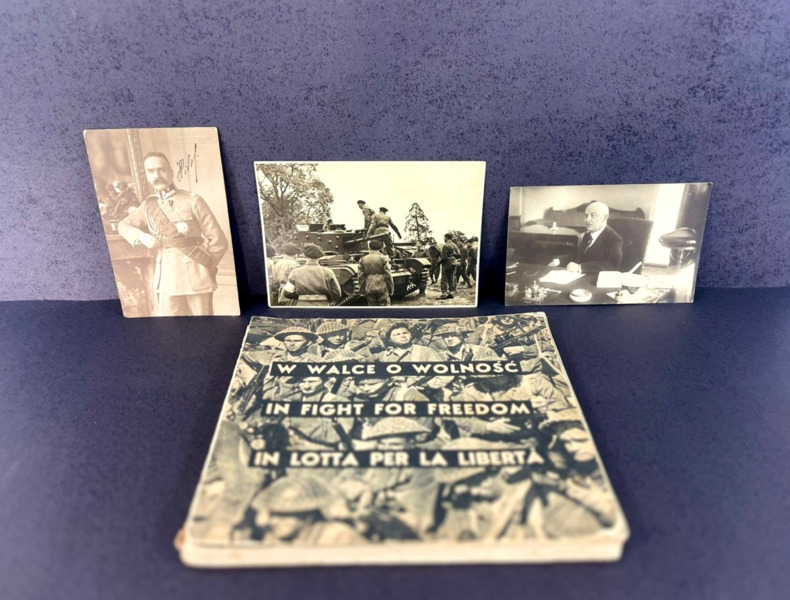
1945517This is a set which belonged to Janusz Gluchowski, a high-ranking Polish military officer at the time of the WW2. The set contains three original B&W pictures. First one: undated postcard showing Marshal Jozef Pilsudski, signed by himself in black ink, 8.5 x 13.5 cm, with two embossed mentions above and below. Second picture: undated postcard showing Poland President Gabriel Narutowicz, with a written mention on the back. Third picture: 11 x 15.5 cm photograph. General Tadeusz Bór-Komorowski inspecting a British Cromwell tank, accompanied by Polish officers of the 3rd Armored Regiment (3 puk pancerny). The image was captured during an official ceremony in the city of Kelso, Scotland, in the immediate post-war period, on June 15, 1945. The scene shows the General in an observation position, climbing onto the tank while surrounded by Polish soldiers. The tank corresponds to a British model widely used by Polish forces in exile during the Western European campaign. On the reverse, the following handwritten inscriptions appear: VI 1945, Kelso. N. Wódz gen. Bór-Komorowski dokonuje inspekcji 3 p. panc. N. Wódz w towarzystwie bryg. puku na czogu." / June 15, 1945, Kelso The book is an illustrated three-languages (Polish, English and Italian) set commemorating the struggles of the Polish II Corps. Edited by Wyda Rererat [Referat] Kultury i Prasy Kresowej Dywizji Piechoty in Rome, 1945. Oblong book of 21 x 19 cm, unpaginated (144 pp.). Cover detached. Endpapers and first page show Janusz Gluchowski's stamp. In publisher's photographically illustrated wrappers. Each page contains a photographic image or a photomontage accompanied with a short text in three languages. Front cover shows some wear and tear, the binding is a bit loose - we would advise having this book bound. The Polish II Corps was a major tactical and operational unit recruited from Polish deportees in the Soviet Gulags in 1943. First they fought in the Middle East, and in 1944 February they were transferred to Italy and as independent part of the British Army to fight in the Italian campaign, in the battles of Monte Cassino and Ancona and also the Battle of Bologna during the final offensive in Italy in 1945. The book goes through the story of Poland and the later established Polish II Corps, starting with the German and Soviet occupation in 1939. It shows the deportation of Poles to forced labour to the Gulag and, after the Polish-Russian Military Agreement in 1941, the establishment of the Polish Army on Soviet soil, also their military training and their fights in various battles. Janusz Julian Gluchowski was a Major General in the Polish Army during the Second Polish Republic. He was born on August 6, 1888, in Bukowa. He fought in the Polish Legions in World War I, the Polish-Ukrainian War, the Polish-Soviet War, and the invasion of Poland by Nazi Germany, Slovakia, and the Soviet Union in 1939, which culminated in the start of World War II. In his adolescence, he attended high school in Czstochowa. In 1905, he became a member of the Combat Organization of the Polish Socialist Party and was wounded in the hand during an attack near Czstochowa. To avoid arrest by the Russian authorities, he left for Belgium, where he studied at the University of Liège. He returned to divided Poland around 1910 and settled in Austrian Galicia. In 1912 he graduated from the Officers' School of the Riflemen's Association in Stroza, near Krakow. In the early hours of August 1914, he commanded a platoon in Oleandria and was Wadysaw Belina-Pramowski's representative during the legendary attack of the so-called Seven Lancers of Belina (Uaska siódemka). On August 6th, together with the First Cadre Company, he left Krakow and marched to Miechów. In October 1914 he was promoted to Lieutenant (Poruchik) and, in November 1916, to Rittmeister (Cavalry Master). Until 1917 he served in the First Uhlan Regiment of the Polish Legions. After the Oath Crisis (Kryzys przysigowy) he was interned first in Fort Beniaminów and later in Werl. Released in October 1918, he went to Lublin, where, in early November, he formed the Third Ulan Regiment (later renamed the Seventh Ulan Regiment of Lublin). Along with his unit, he fought in the Polish-Soviet War. On May 29, 1920, he was promoted to Polkovnik. He was transferred in July 1920 to Eastern Galicia, taking command of the First Cavalry Brigade, fighting against the Soviets in Galicia and Volhynia. After the war, he remained in this position until 1925, when he was transferred to the Fourth Cavalry Brigade. Promoted to Brigadier General on March 16, 1927. Appointed commander of the Center for Higher Military Studies on June 4, 1930, and three years later, after the death of General Stanislaw Tessaro, he was appointed commander of Military District X in Przemyl. In October 1935, he became Deputy Minister of Military Affairs. In the early days of the 1939 invasion of Poland, Gluchowski ordered General Walerian Czuma to prepare the defense of Warsaw. In mid-September 1939, he fled to Romania. After his escape, he managed to travel to the Middle East and, in January 1941, received orders to go to London. In October 1941, he was appointed Commander of the Training Brigade stationed in Scotland. On September 23, 1943, he was appointed commander of all Polish Army units stationed in Great Britain, except the First Independent Parachute Brigade, which remained under the authority of the Commander-in-Chief. He was promoted to Major General on June 1, 1945. He decided not to return to Soviet-occupied Poland and remained in Great Britain. He frequently criticized the Soviet regime and the Soviet occupation authorities in postwar Poland. Furthermore, he was one of the founders and president of the Jozef Pilsudski Institute in London. He was, therefore, an active member of the Polish community in Great Britain. He was president and honorary member of several Polish veterans' organizations. He died on June 11, 1964, in London, England.
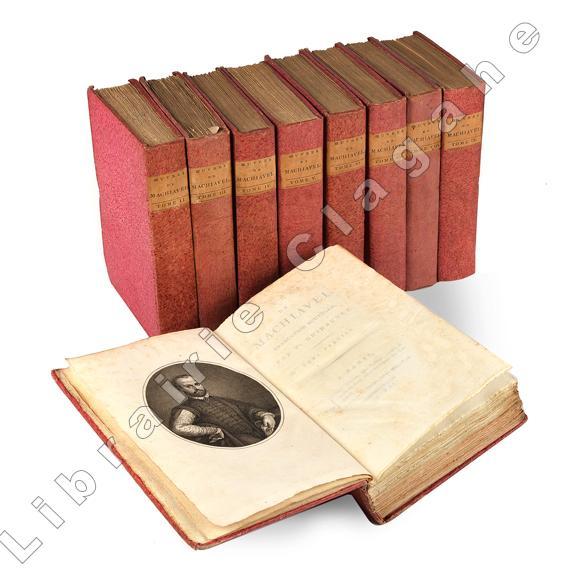
179920337Paris, Potey, Pochard, (imprimerie de Laran), an VII (1799) ; 9 tomes in-8 (210 mm), cartonnage rigide de papier rose à l’éponge, pièce de titre imprimée au dos, non rogné (reliure strictement d’époque) ; CXVII, [1 bl.], [2], 408 ; 384 ; 403 ; 416 ; 448 ; 455 ; 394 pp., [1] ff. bl. ; 370 pp, [1] ff. bl. ; 524 pp., portrait ovale en frontispice ; 7 planches dans “l’Art de la Guerre”, dont deux dépliantes et 2 doubles.
80 pages. Features: Magnificent cover illustration by William Winter depicts a quintessentially Canadian backyard skating rink; Household Finance (HFC) ad on page one features photo of Mr. J.B. Vaillancourt, manager of the Shawinigan Falls, Quebec office; Our Sham Defense Battle - Editorial; Krupp, Schacht and Rommel - Beverley Baxter reflects on what happened at the Castle Harben on October 1, 1946 in the wake of the Nuremberg Trials verdicts; William Stephenson - The Biggest Private Eye of All - he directed the most secret of all cloak-and-dagger operations of the Second World War - here, for the first time, is the story of the man who pulled the strings which spiked Hitler's guns in the western hemisphere - article with photo; Dr. Gordon M. Bell's School for Sobriety - The Shadow Brook Health Foundation for men and the Willowdale Hospital for Women, both located on the outskirts of Toronto; Karsh's Charlottetown (PEI) - The City That's One Big Farm - article with great Karsh photos, especially a large shot of Premier Walter Jones meeting voters to resolve their issue, and another of Dr. Roderick Macdonald at age 94; Maude Burbank and her Musical Moppets - she takes care of two musical bands of Moncton youngsters; Manitoulin Island - The Eden Isle of Evil Spirits - article with nice colour photos; What the Boyd Gang Fiasco Can Teach Us - the Mayor or Toronto, Allan Lamport assails conditions which helped the Boyd Gang terrorize his city; The Slide That Shook The West - A Maclean's Flashback article to the April 29, 1903 Frank Slide, in which part of Turtle Mountain crashed into Crowsnest Pass, destroying the town of Frank; The World's Most Ardent Birdwatcher - Peter Scott, the gifted son of Scott of the Antarctic will fly anywhere to gaze lovingly at rare wildfowl - article with photos; You Can't Stop a Woman Crying; Nice one-page colour ad for Stanfield's "Look-Alike" Balbriggan Pajamas with happy family scene; Gaines Meal dog food ad features illustration of Saint Bernard; Vintage Frigidaire ad includes lengthy Christmas message and suburban evening scene of appliances being delivered to happy homes; Cream of Wheat ad features Li'l Abner; Vintage colour ad for Christie's Premium Crackers; Colour centrefold ad for Ekco and their many kitchen products; Champion Spark Plug ad includes photos of 12 new members of the 100-mile-an-hour club at Indianapolis; Two-page colour ad for Revere Cookware - 'the world's finest'; Lightning Zipper ad shows irate wife fixing husband's trousers while he stands, semi-dressed, taking her abuse; and more. Unmarked with moderate wear. Two-inch opening to fore-edge of front cover and first two pages mended with archival tape. A sound copy of this very special issue. Book
Washington, Epic Ink Books, 2011, in folio (cm. 46 x 39) versione deluxe in tutta tela con cofanetto/custodia rigita telata con titoli impressi in oro, pp. 33 pagine completamente illustrate da fotografie in nero e a colori Edizione speciale di 5000 copie numerate In stato di nuovo, perfetto con ancora la scatola di cartone dell’imballaggio originale. Completo di garanzia applicata all’interno della custodia.
A UNIQUE SKETCHBOOK WITH ORIGINAL DRAWINGS (including several spectacular ones on color) BY SEVERAL OF THE MOST NOTED CARICATURISTS OF THE BELLE EPOQUE AND THE FIRST WORLD WAR, including SEM, CARAN D'ACHE, and HENRI FOURNIER. 40 leaves, almost all of which with drawings on both sides. Many of the drawings are unsigned (some are by Lafosse himself), but among the signed ones are several by Sem, Caran d'Ache, and Rola, and one by Fournier. First leaf: "Au grand artiste Robert Lafosse. Ses admirateurs." On very good wove paper. Oblong 8vo (13 x 21 cm). Original plain cloth cover. A couple of leaves detached (but present), else very good. Unique and important.
260 pages. Index. List of main sources. Black and white photographic plates. Organizational chart of the German Broadcasting Company (RRG) in 1942 and its links to the Ministry of Propaganda. Organizational chart of the Ministry of Public Enlightenment and Propaganda in 1942. "The first complete account of the gigantic propaganda organization of the Third Reich. Reveals and describes: The inner workings of the Nazi propaganda organization; The network of Party speakers; The German radio's war effort; The Nazi press system; The German stage and screen in 1942; Propaganda for the armed forces; The men in control. Access to unique German documentary material and an intimate knowledge of German wartime broadcasting and of the Nazi press have enabled the authors to paint a full-length picture of Hitler's political warfare machine." - dust jacket. Printed to wartime standard, apparently without a front free endpaper. Unmarked with average wear and soiling to publisher's canary yellow cloth. Average wear and half-inch of loss to decorated orange dust jacket at top of spine. Binding sound. A quality vintage copy of this vital and incisive wartime study. KEHR & LANGMAID 2950. Book