CHURCHILL PeterBiblio.com
119 781 résultats
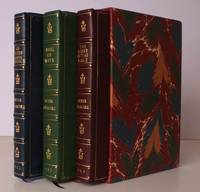
195221886Hodder & Stoughton 1952-3-4. 3 vols. 8vo. First Edition with plate and map; handsomely bound in respectively burgundy/navy/dark green full crushed morocco sides with gilt frame border backs with raised bands ruled in gilt second and fourth compartments lettered and ruled in gilt all other compartments tooled in gilt gilt tops most attractive set ideal as a gift or for presentation. FIRST VOLUME SIGNED BY THE AUTHOR ON TITLE. Captain Peter Churchill's famous trilogy recounts his training his first mission to France his three later missions his friendship and service with Odette their capture his solitary confinement in Fresnes and deportation to Sachsenhausen and Flossenburg before his final liberation as a 'prominenten' in Italy in 1945. ARGUABLY THE FINEST CONTINUOUS MEMOIR OF SERVICE WITH SOE IN WWII. Enser pp.396 396 351 respectively; Foot p.456. Hodder & Stoughton, hardcover
2 vols., 8vo., First Edition, on hand-made paper; original brown buckram, gilt tops, uncut, marbled endpapers, a very good, bright, clean copy in archival film wrappers [wrappers not shown in image]. EDITION LIMITED TO 520 COPIES. Bright, crisp copy of Frederic Manning's masterpiece, published anonymously (as was the expurgated version 'Her Privates We' a year later). The frankness and detail of the story was praised by many of those who shared Manning's front line experiences (including Lawrence and Sassoon) and the work as a whole found favour with men of letters, among them Hemingway and Bennett. Today the work is recognised as the finest novel to emerge from the Great War, and one of the very finest in the literature of warfare. 'No praise could be too sheer for this book' (T.E. Lawrence).
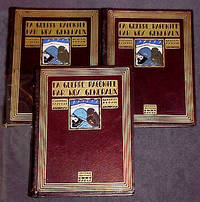
19215823Paris. Librarie Schwartz 1921. Sumptuously bound in the High Art Deco style in full burgundy period morocco. Elaborate gilt-ruling to spine and covers with gilt titles. Silk moire endsheets. Each volume presents a gorgeous and unusual multi-chromatic raised enamel onlay of a beleagured French soldier to front covers. Folios. Profusely illustrated in Art Deco style with plates panoramas fold-out colour maps photographs sepias etc. by Charles Foqueray Lucien Jonas et al. A huge and graphically stunning history of the Great War encased in a fabulous Deco binding without peer. A magnificent and rare item. Some minor wear to extremities a bit of chipping to spine gutters minor water staining to lower edges not affecting internal text or illustrations. A Very Good eye-boggling set. Librarie Schwartz unknown
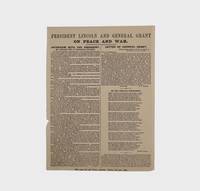
1864377691Np: Printed for Sale by all News Agents 1864. Handbill 11-1/8x8-3/8 inches. Unbound minor toning repaired tear. Handbill 11-1/8x8-3/8 inches. A scarce anti-Demoocrat Election of 1864 camaign handbill which reprints an interview with Lincoln by Joseoph Trotter Mills published in the Grand County Wisconsin Herald in which Lincoln addresses whether he would agree to a peace on Confederate terms which were return African American soldiers to slavery. The interview "shows that Lincoln saw Emancipation as political currency: a vote for him was a vote for the Black fighters helping to save the country" Abraham Lincoln: His Life in Print.<br /> <br /> Also included on the handbill is a August 16 1864 letter by Ulysses S. Grant to E. B Washbourne on what would happen if the North agreed to a peaceand a poem by Bayard Taylor titled On the Chicago Surrender a reference to the peace platform of the Democratic party adopted at their convention. Scarce. Abraham Lincoln: His Life in Print p. 195; BAL 19689. Not in Monaghan Printed for Sale by all News Agents unknown
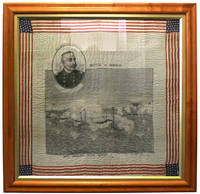
18983295791898. Lithographed view on silk of the Battle of Manila Bay with a large oval portrait of Commodore George Dewey at the upper left within a hand-drawn American flag border stitched to the view. 21-1/2 x 21-1/2 inches. Framed and glazed. Lithographed view on silk of the Battle of Manila Bay with a large oval portrait of Commodore George Dewey at the upper left within a hand-drawn American flag border stitched to the view. 21-1/2 x 21-1/2 inches. The first major engagement of the Spanish-American War the battle was one of the most decisive naval battles in history and marked the end of the Spanish colonial period in Philippine history. On April 27 1898 Dewey sailed from China aboard USS Olympia with orders to attack the Spanish at Manila Bay. He stopped at the mouth of the bay late the night of April 30 and the following morning he gave the order to attack at first light saying the now famous words "You may fire when you are ready Gridley." Dewey defeated the Spanish in a battle lasting just six hours. The Asiatic Squadron sank or captured the entire Spanish Pacific Squadron under Admiral Patricio Montojo y Pasarón and silenced the shore batteries at Manila with the loss of only one life on the American side.<br /> <br /> This broadside view on silk with American flag border was evidently issued as a commemorative scarf or hankerchief. unknown
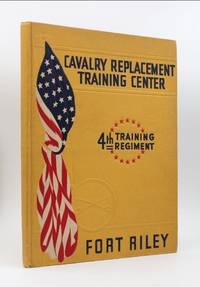
1941352792Fort Riley 1941. Illustrations throughout. 4to. Publisher's embossed yellow cloth decorated with the American flag. Provenance: Thomas M. Evans signature on front endpaper. WITH: Watercolor on paper of a church next to a stream signed TME captioned "Somewhere in Germany" and dated 5 May 1945 laid in. Illustrations throughout. 4to. An unusual yearbook published by the Cavalry Replacement Training Center at Fort Riley just prior to America's entry into World War II. As the army was not desegregated until after the war the yearbook shows entirely white and black squadrons the latter including Troops A and B of the Eighth Squadron.<br /> <br /> At the beginning of the Second World War the 4th Cavalry made the transition from horses to vehicles along with most of the Cavalry Branch. The unit was re-designated as the 4th Cavalry Group Mechanized with M5 light tanks M8 armored cars and M3 half-tracks. The regiment was the armored reconnaissance force for the VII Corps and the regiment was the first unit ashore on Utah Beach on June 6th 1944. The 4th Cavalry was awarded the Croix de Guerre for its actions during the Battle of Cherbourg in July 1944. The regiment was in the van for the great Allied drive across France and into Belgium. They played a critical role during the Battle of the Bulge attacking at Bogheim into some of the best units in the German army and capturing critical ground at great cost. The regiment received a Presidential Unit Citation for this action.<br /> <br /> OCLC locates only 2 copies held at the US Army War College and Western Reserve Historical Society. unknown
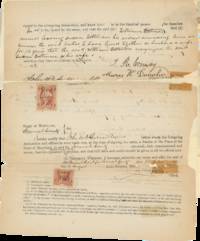
1865List3406Annapolis Baltimore and Somerset County Maryland 1865. Three documents. Two folded with normal wear else Near Fine; one very delicate torn into two pieces formerly mended with archival tape with some damage intersecting with text good. Overall very good. Three documents certifying the death of William Cottman a private with the 9th Regiment of the US Colored Troops USCT during the Civil War. The 9th was organized at Camp Stanton in Benedict Maryland in November of 1863 shortly following the establishment of USCT divisions; Cottman’s documents state that he enlisted on November 22. Coming from Maryland William Cottman was likely formerly enslaved; the Cottmans were a prominent Maryland family holding many enslaved people.<br /> <br /> According to the National Parks Service record during the 9th’s service forty-seven men one an officer were killed in combat and 266 enlisted men died from disease; the latter includes Cottman whose paperwork states that he “Died at Base Hospital Jones Landing of feverâ€. In fact not only did the USCT mortality rate exceed other that of other troops by thirty-five per cent the majority of the deaths were from disease.1 Living and sanitary conditions for these troops were subpar and there was significant difficulty in convincing qualified surgeons to work in African American regiments. <br /> <br /> These forms are possibly related to a pension claim by Cottman’s widow Susan Cottman; one of the documents certifies with two witnesses that the couple were married for fourteen years. Pension applications for Black Civil War veterans and their dependents were complicated—many were formerly enslaved and thus might be illiterate without documents such as a birth certificate or with marriages that were not legally recognized.<br /> <br /> Of interest to researchers of the USCT and the postbellum lives of their families.<br /> <br /> 1 Herbert Aptheker “Negro Casualties in the Civil War†The Journal of Negro History 32 no. 1 Jan. 1947: 10–80. unknown
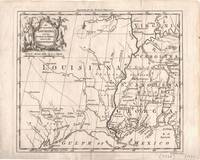
17603697A great small map of a good portion of the now southeastern United States reaching to the Gulf coast at the south and Texas to the west. The area to the east of the Mississippi is marked "Territory in Dispute." The colonies of Virginia North and South Carolina and Georgia all extend to the Mississippi. <br /><br />English claims to the disputed area are bolstered by a notation along the border between the Carolinas noting: "A large country subject to the English since 1729." Numerous Indian tribes are noted as well as "Wandering Indians" at the western portion of the Gulf coast. <br /><br />Maps from <i>The British Magazine</i> are cited by Jolly as "practically unobtainable." A fascinating portrayal of the area that was the subject of the French and Indian War in a very uncommon source. <br /><br />Reference: Jolly Maps of America in Periodicals before 1800: 157. Not in Cumming; <i>The Southeast in Early Maps</i>. ICN 7568. From The British Magazine, February, 1760 issue.
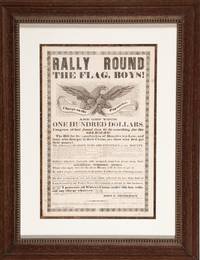
186638501Winchester Illinois: Democratic Print. 1866. Attractive folio broadside measuring 11-1/2" x 17-1/2" by sight. Housed in a wood frame 20-3/4" x 26-3/4." Light scattered foxing and old folds a couple of short fold separations in blank margin. A variety of bold type sizes and styles within a decorative border. Very Good.<br /> <br /> This eye-catching evidently unrecorded broadside features the iconic Screaming Eagle wings spread and holding a banner which reads "Charge on the Paymaster." Henderson's name and address are printed at the bottom: "John G. Henderson Atty at law and WAR CLAIM AGENT Naples Ill." <br /> The Equalization Act whose terms the broadside recites became law in July 1866. It provided additional bounties to men or their families and heirs who had been honorably discharged after three years' service; and smaller bounties to those honorably discharged after two years' service.<br /> Born in Greene County Illinois in 1837 Henderson became a teacher and then a "prominent" lawyer. He practiced law in Naples Scott County Illinois until 1866; and then in Winchester until 1877 when he became a judge. He then resumed the practice of law. History of Greene and Jersey Counties Illinois. Springfield: 1885. Page 714. Henderson also became something of an authority on Naples' archeological Mounds dating to the year 100 A.D. His work on the Mound Group was noted in the case of Juliet Wade v. Drew Lewis 561 F. Supp. 913 N.D. Ill. 1983. <br /> Not located in Graff Sabin or on OCLC or the online sites of AAS Boston Athenaeum LCP University of Illinois Newberry as of June 2025. Democratic Print. unknown
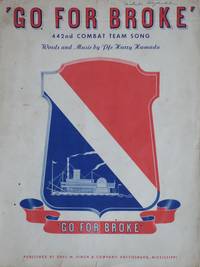
1944List2436Hattiesburg: Earl M. Finch 1944. Sheet music measuring 12 x 9 inches 4 pp. Signature of a Nabuko Hayashida on front cover. Slight tears at fold some toning two small pinholes very good overall quite attractive. Very Good. In Hawaii in May 1942 a battalion of Nisei volunteers was assembled for service in World War Two despite earlier failures of efforts to recruit Japanese-Americans due to the Army’s labeling of Nisei recruits as 4-C enemy aliens. Designated as the 100th Infantry Battalion they were deployed to North Africa in June 1943 integrating with the 34th Division in active combat. Their subsequent deployment to Italy in September 1943 exposed them to intense warfare earning them the moniker of the "Purple Heart Battalion" due to their notably high casualty rate.<br /> <br /> In January 1943 the U.S. War Department officially declared the establishment of the segregated 442nd Regimental Combat Team RCT which was comprised of Nisei volunteers originating from Hawaii and the mainland. The culmination of this initiative transpired in June 1944 when the 442nd RCT merged forces with the 100th Infantry Battalion in Europe subsequently absorbing the latter into its structure. The notable achievements of Nisei soldiers in combat operations prompted the reinstatement of the draft in January 1944 specifically targeting Nisei detainees to augment the ranks of the 442nd. Over time the 442nd RCT expanded to encompass the 2nd 3rd and 100th Battalions; the 522nd Field Artillery Battalion; the 232nd Engineering Company; the 206th Army Band; Anti-Tank Company; Cannon Company; and Service Company. <br /> <br /> Offered here is a very scarce piece of sheet music entitled “Go For Broke†which was written by the Hawaiian musician Harry Hamada reflecting the slogan of the 442nd and performed by Shelby and others during the war as part of efforts to boost morale. Hamada would feature in the 1951 movie “Go For Broke†as Masami alongside several other veterans of the 442nd. This publication of “Go For Broke†is from 1944 seven years before the movie’s release. The piece is dedicated to Colonel C.W. Pence. Hamada was a Hawaiian musician who performed with a band called the Shelby Hawaiians or the Shelby Serenaders. They performed as early as 1943. The Hattiesburg Mississippi merchant Earl M. Finch who ran an Army and Navy store close to Camp Shelby befriended Hamada and other members of the 442nd and acted as a sponsor for the group and eventually published this version despite his business being a dry goods merchant house and not a publishing house. The group with the support of Finch performed throughout the country to lift morale. At some point Hamada penned this composition likely in 1944 as we find no reference to it in 1943 articles and Finch published it - Hamada’s composition would become the theme song of the 442nd and Hamada would perform at the Halloran General Hospital in New York and the Walter Reed Hospital in Washington D.C. in 1944 likely performing this composition. Another composition called “Go For Broke†exists as well and it is unclear to what degree Hamada’s work caught on among the regiment. <br /> <br /> We find two records of Finch’s published version of the composition one listed as part of an online remembrance of the 442nd by the Smithsonian Institution https://americanhistory.si.edu/explore/stories/day-remembrance-70-years-after-executive-order-9066 which appears to have been on loan from the National Japanese American Historical Society and another copy held at Stanford though not listed in OCLC. Finch’s story is also interesting and is the subject of a remembrance on a 100th Battalion History page online https://www.100thbattalion.org/history/stories/earl-finch/. We find no copies listed in OCLC. Overall a very scarce piece of Japanese-American wartime history. Earl M. Finch unknown
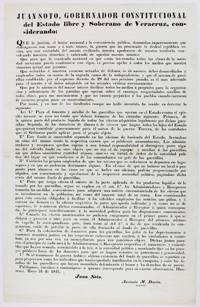
18472634Huatusco: May 31 1847. Very good. Broadside decree 17.5 x 11 inches. Printed on lined paper. Previously folded with a couple of very small losses at central fold. Minor wear at edges. Light dust soiling and toning. A rare broadside decree that establishes guidelines for the collection of funds and donations for guerillas and their families continuing the fight against the American invasion around Veracruz in 1847. The important port city had fallen two months prior and Santa Anna was routed at Cerro Gerro by Winfield Scott a month earlier. All that was left for Mexican forces in the region was sustained guerilla harassment of the American army. In this decree a separate account from regular government monies is established for funds raised and various government departments of the state of Veracruz are ordered to encourage donations and to publicize contributions and children are even encouraged to contribute food to the soldiers. A desperate plea for a desperate situation; dated May 31 1847 and signed in type by Veracruz state president Juan Soto in Huatusco the temporary location of the displaced government. OCLC locates no other copies. May 31 unknown
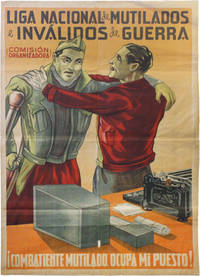
193852890Madrid: Gráficas Reunidas U.H.P. 1938. Original illustrated poser offset printed in colors on beige stock measuring 68.5cm x 100cm 27" x 39.25". Light wear and toning to extremities a few old folds smoothed-out with several tiny nicks and small edge tears a few tiny splits at intersection of folds and a small loss toward lower margin just above the lettering; an unrestored Very Good example unbacked. <br /> <br /> The first in a series of four propaganda posters produced by Gráficas Reunidas for the Liga Nacional de Mutilados e Inválidos de Guerra LNMIG the National League of War Wounded and Invalids founded in Madrid in 1937. "The creation of this association was the first tangible outcome of the organizational efforts made by wounded Republican veterans. According to their provisional programme their key concern was to remain 'useful' útiles to the war effort and provide 'unconditional help to the government'. It was stated that the association should 'educate and re-educate the disabled veterans in physical and cultural terms. As a consequence of the efforts made by the LNMIG on behalf of disabled veterans the government gave preference to the war wounded to fill vacant menial jobs such as janitors messengers and the like" cf.Matthews James. Spain at War: Society Culture and Mobilization 1936-44. The poster created by an anonymous artist depicts a wounded soldier supporting himself with a crutch being embraced by a typist above text reading "Wounded soldier take my place!" translation mine. OCLC notes a single holding at the Biblioteca Universitat de Barcelona. CARULLA 1.268. Gráficas Reunidas U.H.P. unknown
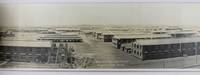
19171992San Antonio 1917. Very good. Large panoramic photograph 8 x 92 inches. Rolled. Minor wear at edges with one very short closed tear at top edge. Light blemish in negative at center of image. Light dust soiling and toning. An outstanding and extremely long panoramic photograph measuring well over 7.5 feet in length that depicts Camp Travis in San Antonio following its recent opening. Although the camp was open and housing an entire division-in-training at the time of this image the camp was still under construction as evidenced by the organized piles of lumber at the far right of the image and the incomplete barracks building in the center foreground. The panorama nevertheless gives a sense of the scope and size of the training camp with barracks and outbuildings stretching almost as far as the eye can see in the center and left sections of the photograph. Structures are sparser in the right-hand side of the image both because they as yet unbuilt and because some of the training fields were located in this part of the camp. The photographers Mayhart Studio of Chicago were responsible for a number of military and patriotic views during the United States' involvement in the Great War including the well-known "Living Flag" image of thousands of servicemen composing an American flag. <br /> <br /> "On July 15 1917 after its selection as the training site for the Ninetieth Texas-Oklahoma Division of the army Camp Wilson was renamed Camp Travis in honor of Alamo hero William B. Travis. The camp was ready for occupancy on August 25 1917. Additional land was subsequently acquired for vital training facilities and numerous structures were erected by the soldier welfare agencies. Camp Travis comprised 18290 acres of which 5730 were on the main campsite adjoining Fort Sam Houston. The Ninetieth Division was organized at Camp Travis in September and October of 1917. During the summer of 1918 Camp Travis served as an induction and replacement center with an average strength in July of about 34000 White and Black troops. On December 3 Camp Travis was named as a demobilization center. The facility was also designated a local recruiting station and a regional recruit depot in March 1919. Some 62500 troops were discharged at Camp Travis in about eight months. The camp then became the home station of the Second Division. Its service as a separate entity was terminated however upon its absorption by Fort Sam Houston in 1922" -- Handbook of Texas Online.<br /> <br /> A quite fascinating view of this enormous World War I-era training camp in San Antonio now a part of the even larger Fort Sam Houston military base on the east side of the city. We locate no other copies of this large and remarkable panorama. unknown
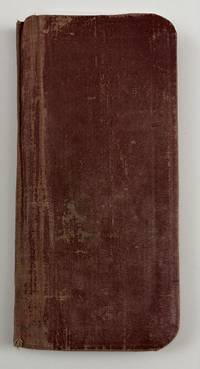
19184995Various locations in the United States and France 1918. Good. 60pp. of manuscript entries. Contemporary pocket notebook 5.25 x 2.5 inches with a small collection of news clippings and a few ephemeral items laid in. Moderate wear and soiling as expected hinges cracked but holding. A manuscript journal and daybook maintained by Corporal Fred Henry Scheu 1895-1974 during his training time in Oklahoma and his wartime service in France during the latter period of the First World War. Fred Scheu was born in Fayetteville Texas to German immigrants Fritz and Alwine Scheu later of Malone Texas. At the time of his enlistment and for a long period after the war Scheu was a clerk and station agent for various iterations of the Santa Fe Railway in Texas and Oklahoma. Scheu hailed from a large family himself but after marrying Ida Christine Ender Scheu the couple had just two children Idaleene and Fred Scheu Jr. Scheu passed away in Temple in 1974 and is buried in Waco Memorial Park in Robinson Texas.<br /> <br /> Fred Scheu enlisted in the Army on February 26 1918 and was discharged just a little over a year later on April 16 1919. Between those two dates Scheu served in training at Camp Travis Texas and Camp Mills Long Island as a private in Company B of the 343rd Machine Gun Battalion. Scheu and his unit disembarked from Brooklyn New York on June 20 1918 headed for Liverpool. They served in various camps in England before crossing the English Channel and serving in numerous locations in France from early July until the end of the war and well after departing Brest France in March 1919. Scheu's journal opens with a detailed six-page timeline of his service from his enlistment until the end of his service in France which provided the preceding information.<br /> <br /> Scheu's journal is not written in the traditional mode of a diary but rather in a few distinct sections which together paint a picture of his service in the war. The main record of his service is memorialized in an eight-page section titled "As Days Rocked By." This section is similar to the timeline described above also titled by Scheu "As Days Rocked By" but includes more detailed information on his time in France including some mentions of engagement with the Germans. Dated entries are brief but closely written without line breaks; a typical example of a few consecutive daily entries which take up just seven lines reads: "9-24-18. Arrived front lines near Pagney and Preney west side of Moselle River 4:15 AM. 9-25-18. German counter attack at 5AM. 9/26. Caught in German box barrage from 11AM until 5:20PM." Another sequence reads: "10/30/18. Arrived in woods large hill about 2 miles N-W of Romange. Fired barrage after barrage at 4:30AM. 10/1/18. Over with 360 Inf Co K Advanced 6 kilo to near little village St. Gerey. Heavy MG fire. 11/2/18. Advanced from St. Gerey 4 kilo to large hill. Little piece of shrapnel from shell that hurt Cpl. C.C.J. hit my foot." Scheu's timeline continues in much the same manner through the end of the war "Armistice signed 11/10/18" and beyond when he remained in France on guard duty and hiked and trained across the country. In addition to Scheu's detailed timeline he writes a similarly-detailed page on his experiences during the "Second Battle Argonne" in October 1918.<br /> <br /> Scheu also includes a detailed seven-page account of a portion of his service entitled "Dedicated to the service Griesencourt France 9/20/18." He initials the ending of the account "F.H.S." The account reads like it was written to be read aloud. It begins "We came here today to be deloused 'Bath' after being relieved on St. Michel front. Most of our dead were buried -- some in valley 1 kilo south of Fey-en-Haye." Scheu then provides a much more detailed account of his battle experiences in September expounding on just a short portion of his timeline over the course of the remaining six pages. He recounts "enemy shells falling at intervals" "an enemy plane flying real low" details the death of Captain Dryson of Co. A "He set down beside a tree himself where he was killed when a shrapnel bursted in the tree and a piece came down hitting him in the head" and other stark details which took place amid the intense battle. In the course of his narrative Scheu reveals that he was "in charge of Intelligence Section 'Runners.'" After a slightly more detailed account of finding out that Captain Dryson had been killed Scheu ends his account on a rather forlorn note: "Where do we go from here -- Boys where do we go from here."<br /> <br /> Peppered throughout the journal Scheu also includes other information about his service including a detailed listing of other members of Company B of the 343rd "Members My Organization Co B 343 MGBN"; several pages listing which American military units were present in Europe with another list totaling up the troop count of twelve company and division units of infantry artillery medical units and more; a few basic morning reports surrounding the Battle of St. Michel; a page listing "Headquarters Troops Landed by Division;" three pages of notes on the history leading up to the war; and more. In addition to the wartime content a few pages at the front of the journal were utilized as an address book before the war; among the entries is "Miss Ida Ender" whom Scheu would marry in June 1919 shortly after his return from France. A brief but nonetheless detailed account of one young Texas man's service during the final months of World War I with much to mine for historians and scholars alike. unknown
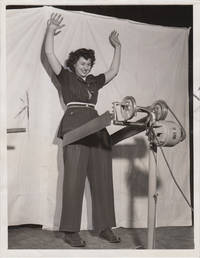
1942CAT0191Cleveland 1942. Silver prints most 6 ½ by 9 with various editorial marks and identifiers to versos. A collection of women’s fitness press photographs taken around Cleveland in 1942 from the archives of the Cleveland News. Excellent. A collection of twenty-two photographs documenting women’s fitness programs in Cleveland in 1942. The programs and corresponding articles in the Cleveland News appear to be the work of Eleanor Dearnley physical education teacher at Flora Stone Mather College. Other photographs show women’s fitness activities at the Lakewood Community Center also in Cleveland. There are several examples of similar local efforts in support of the national “Keep Fit for Victory†Campaign. <br /> <br /> The photographs show women in a range of activities - basketball stretching calisthenics volleyball etc. Some of the photographs are graphically hand-painted by the editorial staff. Most pictures have corresponding articles pasted onto versos. The images are generally quite playful in nature - perhaps because it was early in the war or because the pictures were intended as morale boosters. A generally quite well-preserved group in excellent condition except for the above-mentioned editorial marks. unknown
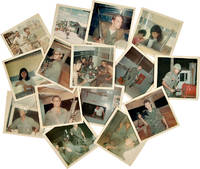
1972WRCAM55575Various places in Vietnam 1972. 145 photographs all but thirteen in color most approximately 3 1/2 x 3 1/2 inches. Majority of photographs mounted on black paper stock with non-archival adhesive tape some photos retain remnants of tape at corners. Some images a bit faded but generally in very good condition. A tremendous collection of photographs depicting the personal life and military service of an unidentified African-American soldier with the last name "Williams" serving in Vietnam during the war and with numerous family photographs at home. The majority of the photographs are undated but those that are dated place the collection roughly between 1968 and 1972. Other identifying characteristics in the photographs indicate that the soldier was likely part of the United States Air Force 93rd Security Police Squadron which provided security and air base defense during the Vietnam War. There is a photograph of Williams leaning against the sign for the 93rd SPS dormitory. <br> <br> Notable in the sixty or more photographs from the soldier's time in Vietnam are images from an unidentified American Air Force base depicting soldiers in the barracks a mess hall and fraternization among soldiers; additional photographs show a heavily-armed Williams manning a bunker holding an EBONY magazine posing with a South Vietnamese soldier in an urban setting and staring strikingly at the camera wearing machine gun ammunition and a hand grenade. A series of thirteen images were taken at "Le Van Loc" a popular Vietnamese night club located on the Tan Son Nhut Air Base near Saigon indicating Williams may have been stationed at or near that base. Personal photographs show individuals of varying ages presumably family members who appear alone or in groups and at times are photographed with Williams. Several of these photographs feature children presumably Williams' at home and at an Elmhurst School function. Williams seems to have been especially proud of his motorcycle as it features in a few shots. <br> <br> A collection of both service and family photographs capturing a young African- American serviceman during the Vietnam War. unknown books
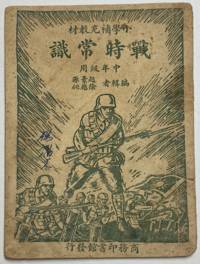
1938AG20016<p><b>WARTIME GENERAL KNOWLEDGE-Elementary School Supplementary Textbook Middle Level Military manual China 1938 《战时常识》—å°å¦è¡¥å……ææ–™</b><br /></p><p>Shanghai: The Commercial Press distributed by branches in Guangzhou Wuzhou Kunming Guiyang Hong Kong Shantou and Fuzhou 1938. 8vo 30 pages in total pictorial wrappers good condition.</p><p>A general knowledge book on war by Zhao Jing Xu Ying basic knowledge about army navy and air force air defense use of gas mask wartime hygiene as well as patriotism. Two maps and nineteen illustrations included.</p><p>《战时常识》为å°å¦ç”Ÿè¡¥å……ä¸å¹´çº§æ•™æ,由商务å°ä¹¦é¦†1937年第一版,1938å¹´å†ç‰ˆå°åˆ·ï¼Œç”±å¤šä¸ªåˆ†é¦†åŒæ—¶å‘行。共30页。书以19å¼ å›¾ç‰‡å’Œ2个地图图文的形å¼æ写了陆军,海军,空军,防空,毒气å£ç½©ä½¿ç”¨ç‰å¤šæ–¹é¢çš„知识。</p> The Commercial Press paperback
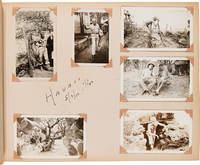
1945WRCAM55773Philippines New Caledonia Guadalcanal New Zealand Hawaii 1945. 213 photographs from 2 3/4 x 2 1/4 to 6 1/2 x 8 1/2 inches corner-mounted; plus twenty-two pieces of ephemera mounted or laid in including two mimeographed pamphlets. Oblong quarto album. Red silk boards blue silk ties with stylized Japanese figure on center of front board. Some fraying to edges and corners some loss to silk on rear board minor soiling. Photographs in excellent condition overall. Very good. A dramatic photograph album from Harvey D. Burgstresser's 1912-83 service in the U.S. Army artillery during World War II. Although most photos are not labeled individually they are labeled by group and track Burgstresser's travels through various combat stations during the war in the Pacific. The first photo labeled "Fayetteville NC" shows Burgstresser on left in uniform with another solider walking along a city street. The first section follows and is labeled "Hawaii 5/7/42-11/1/42" and consists mostly of photographs of soldiers at-ease playing with radio equipment and goofing around likely as they wait for deployment to the front. The next section "Guadalcanal 11/15/42-12/1/43" is short but more somber including photo prints of indigenous people of the island the corpse of a soldier and a photo of a sign posted on a roadside reading: "Kill the Bastards! Down this road marched one of the regiments of the United States Army Knights Serving the Queen of Battles Twenty of their wounded in litters were bayoneted shot and clubbed by the yellow bellies. Kill the Bastards!" <br> <br> Next is a section entitled "Auckland New Zealand 12/1/43-3/1/44" a small and peaceful section featuring photos of couples a few female friends and shots of Burgstresser's battery and company in formation 90th Field Artillery Battalion 25th Infantry Division. From there he was off to "New Caledonia 3/1/44-12/15/44" with a joint force of ANZAC soldiers. Most of these shots are also at- ease and around camp several featuring a truck marked "NZ Mail." From here he moves to "Luzon P.I. 1/9/45 to 10/2/45" the final section and the place where things get a bit more serious; this is also the largest section in the album. Several images show soldiers setting up artillery stations laying wire and organizing ammunition. One image in this section is labeled "V-J Day" and this is the only mention Burgstresser makes about the progress of the war. There are scenes of buildings damaged from war along with a few scenes of combat and more of the aftermath of combat including downed planes and destroyed tanks and several quite explicit images of corpses. In the midst of this are images of Filipino women and men in traditional attire and likely some from New Caledonia and Guadalcanal as well including several shots of topless Filipino women likely not taken by Burgstresser. <br> <br> Various pieces of ephemera are in the album including a twenty-eight-page mimeographed pamphlet entitled WELCOME 25th. INF. DIV. with sections corresponding closely to Burgstresser's arrangement of this album; and a six-page mimeographed pamphlet entitled THE SEA BREEZE "Souvenir Edition" October 23 1945 issued to those aboard the troop ship USAT "Cape Meares." Also included is Burgstresser's military "Motor Vehicle Operator's Permit" authorizing him to drive automobiles large trucks and a "Vehicle wheeled combat;" an invitation to ceremonies honoring General Douglas MacArthur's return to the U.S.; Burgstresser's "Good Conduct Pass" for Auckland; a few newspaper clippings; and pieces of Japanese currency including two pieces of Japanese government- issued "fiat pesos" which the Japanese issued during their occupation of the Philippines. <br> <br> According to his obituary PHILADELPHIA DAILY NEWS April 25 1983 Burgstresser had graduated from Bucknell University; after the war he went into the insulation business and was eventually president of the Philadelphia Asbestos Corporation. His album ably captures both the camaraderie and the horror of the war in the Pacific. hardcover books
1518100733<p> Small broadside about 6 x 8 1/2 printed on one side about ten partial lines of text including title Proclamation!. Minor toning slight creasing a little uneven small margin on the left side a couple of minor nicks; overall very good. While Kentucky may have been neutral at the start of the war after the Confederates invaded the state they turned toward the Union. This small broadside reminds people they needed to register with the "home guard." It also reminds people that failure to register will result in being disarmed. This order was passed under the threat of an impending invasion of Kentucky by General Braxton Bragg's Army of Tennessee. The broadside is signed in print by Major P. G. Bracht. </p> Observer and Reporter Power Press Print
1518100733<p> Small broadside about 6 x 8 1/2 printed on one side about ten partial lines of text including title Proclamation!. Minor toning slight creasing a little uneven small margin on the left side a couple of minor nicks; overall very good. While Kentucky may have been neutral at the start of the war after the Confederates invaded the state they turned toward the Union. This small broadside reminds people they needed to register with the "home guard." It also reminds people that failure to register will result in being disarmed. This order was passed under the threat of an impending invasion of Kentucky by General Braxton Bragg's Army of Tennessee. The broadside is signed in print by Major P. G. Bracht. </p> Observer and Reporter Power Press Print books
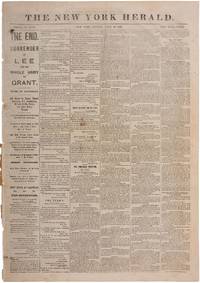
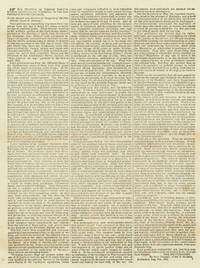
186537333New York 1865. Elephant folio 15-1/2" x 22." 8pp each page in six columns. Several pages of advertisements. The rest devoted to the details of the surrender. A large map on page 8 displays the final troop movements and Appomattox Court House. Disbound some spine separations Very Good.<br/> <br/> The surrender having occurred on April 9 the previous day this is one of the earliest accounts of the capitulation at Appomattox Court House. The first page prints the dramatic headlines in the left column; the balance of the front page pages four five and page 8 print related reports. Most of page 8 prints a large detailed map headed "THE SURRENDER OF LEE. Scenes of Grant's Operations Against Lee in Virginia; of Sherman's Operations Against Johnston in North Carolina." Interesting advertisements for a variety of goods and services are also printed as well as information about President Lincoln's discussions on the restoration of Virginia to the Union. unknown books
1862217811862. No binding. Fine. Broadside. ""The Petition of Certain Non-Conscripts Respectfully Presented to the Confederate States Congress."" Richmond August 8 1862. Signed in print ""The Petitioners By their Counsel John H. Gilmer."" 1 p. 7 7/8 x 10 3/8 in. Petitioning against General Order No. 46 of the Confederate War Department which rescinded the part of the Confederate Conscription Act of April 16 1862 that mandated the discharge of all voluntary enlistees under age 18 or over age 35 in July 1862. ""These were the terms of the law. They were plain unequivocal and mandatory. Common sense - universal public opinion . understood accepted and adopted the law . Shall an army order revoke a solemn act of Congress . Have we a constitutional Government with specific powers granted . or have we an unlimited Government dependent only on Executive will or ministerial caprice Are the People free or is the Executive supreme"" Historical BackgroundPresident Davis Secretary of War George Randolph and the Confederate Congress instituted the first conscription act in American history in April 1862 after early defeats in Tennessee and North Carolina in anticipation of the expiration of one-year enlistments signed at the war's outset. The Conscription Act would cause all males ages 18 to 35 to be drafted into service unless exempted. Those already enlisted would be held to a three year commitment from their date of entry into the service. Conscription raised difficulties for Southern politicians who had argued for most of their careers against the broad construction of federal powers in the United States Constitution. Some believed it violated the cardinal principle of states' rights others such as Georgia Governor Joseph Brown protested its tendency toward centralization and despotism. Common folks complained about the fact that planters who owned 20 or more slaves were exempt as were many overseers and tradesmen and those who could afford to buy ""substitutes.""According to historian James McPherson conscription was ""the most unpopular act of the Confederate government. Yeoman farmers who could not buy their way out of the army voted with their feet and escaped to the woods or swamps. . Armed bands of draft-dodgers and deserters ruled whole counties.""ReferencesParrish & Willingham 5422 locating 5 copies.McPherson James. Battle Cry of Freedom New York 1988 p. 432. unknown
1862217811862. No binding. Fine. Broadside. ""The Petition of Certain Non-Conscripts Respectfully Presented to the Confederate States Congress."" Richmond August 8 1862. Signed in print ""The Petitioners By their Counsel John H. Gilmer."" 1 p. 7 7/8 x 10 3/8 in. Petitioning against General Order No. 46 of the Confederate War Department which rescinded the part of the Confederate Conscription Act of April 16 1862 that mandated the discharge of all voluntary enlistees under age 18 or over age 35 in July 1862. ""These were the terms of the law. They were plain unequivocal and mandatory. Common sense - universal public opinion . understood accepted and adopted the law . Shall an army order revoke a solemn act of Congress . Have we a constitutional Government with specific powers granted . or have we an unlimited Government dependent only on Executive will or ministerial caprice Are the People free or is the Executive supreme"" Historical BackgroundPresident Davis Secretary of War George Randolph and the Confederate Congress instituted the first conscription act in American history in April 1862 after early defeats in Tennessee and North Carolina in anticipation of the expiration of one-year enlistments signed at the war's outset. The Conscription Act would cause all males ages 18 to 35 to be drafted into service unless exempted. Those already enlisted would be held to a three year commitment from their date of entry into the service. Conscription raised difficulties for Southern politicians who had argued for most of their careers against the broad construction of federal powers in the United States Constitution. Some believed it violated the cardinal principle of states' rights others such as Georgia Governor Joseph Brown protested its tendency toward centralization and despotism. Common folks complained about the fact that planters who owned 20 or more slaves were exempt as were many overseers and tradesmen and those who could afford to buy ""substitutes.""According to historian James McPherson conscription was ""the most unpopular act of the Confederate government. Yeoman farmers who could not buy their way out of the army voted with their feet and escaped to the woods or swamps. . Armed bands of draft-dodgers and deserters ruled whole counties.""ReferencesParrish & Willingham 5422 locating 5 copies.McPherson James. Battle Cry of Freedom New York 1988 p. 432. unknown books
186324584<p>"<i>We the members of the Loyal League do hereby pledge ourselves by words and acts whenever practicable to use our influence in support of the Government in all its measures for the suppression of the present unholy rebellion; and we will use our influence to discountenance and oppose all efforts in opposition to the Government and the Union.</i>"</p> <b>CIVIL WAR--RHODE ISLAND.</b>Pledge and original membership roll of the Loyal League of Providence Manuscript Document Signed with 161 signatures ca. January 1863 Providence RI. 2 pp. 7¾ x 22¼ in.<p><b><br /></b></p><p><b>Historical Background</b></p><p>Loyal Leagues also often known as Union Leagues were men's clubs established during the Civil War. They usually consisted of the professional merchant and artisan classes in northern cities. The first such club formed in Philadelphia in 1862.</p><p>Many of the signers of this membership roll were born between 1844 and 1850 and many were probably students at Providence High School. In 1861 students from the high school organized into a militia company called the "Ellsworth Phalanx" in honor of the New York Zouave commander Elmer Ellsworth killed in May 1861 in Alexandria Virginia. They drilled and paraded in Providence throughout the winter and into the spring of 1862.</p><p>After Confederate General Stonewall Jackson routed Union General Nathaniel Banks' forces at Winchester Virginia and pushed them back across the Potomac River in May 1862 urgent calls went out for troops to defend Washington D.C. In response Governor William Sprague of Rhode Island ordered the organization of the 10th Rhode Island for three months' service. Company B was recruited almost entirely from the ranks of the High School and University companies and commanded by Captain Elisha Dyer former governor of the state. At least one of the signers here William H. Hawkes served in Company B in 1862 and another Harry A. Richardson had served in Company K of the 9th Rhode Island in the summer of 1862.</p><p>The likely author of the pledge and first signer on the right column was Granville Budlong 1844-1909. The first signer in the left column was Lewis G. Janes 1844-1901 son of prominent abolitionist Alphonso Janes. Other signers included Arthur Lincoln son of a professor at Brown University; and William E. Cushing 1844-1880 who became an architect and designed the city's baseball stadium in 1878. At least two signers Frederick Metcalf and Eugene F. Granger were killed later in the war while serving in the military. Metcalf was only seventeen when he died of disease in South Carolina in 1864 after a year in the service. Granger the son of a Baptist minister joined a New Hampshire regiment and died in a Confederate prison in North Carolina. His younger brother Edward V. Granger also signed this roll. Other signers were the sons of merchants railroad agents carpenters tin platers and masons in Providence. Several went on to graduate from Brown University in the late 1860s and early 1870s.</p><p>On March 19 1863 the <i>New York Times</i> reported that in Providence Rhode Island</p><p>"Only two weeks remain before the election. The Republicans and those loyal men of other parties who have united with them are diligently at work in canvassing the State. They are marking those "peace" men who … are expressing sympathy with the rebellion. The Democrats are really very unfortunate. They can't find one of their own party who wants office. They have been trying a month to get a Governor but no Democrat will accept their nomination…. When bad men combine good men must unite. So the loyal men of all parties are coming together in solemn league to support the Government and to give all their energies to the vigorous prosecution of the war. The "League" in this city is composed of some two thousand loyal names. It is fast increasing in numbers and is extending its spirit and influence throughout the loyal portions of the State."</p><p><b>Condition</b></p><p>Originally two joined leaves. The topmost portion of the sheet lost allowing the title "Pledge" to just be made out. Conservation repairs of fold separations. Strong signatures in various color inks continuing and with docketing on verso.</p> books
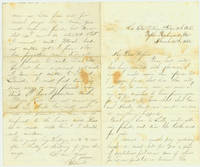
1865223991865. No binding. Fine. Six letters to his wife Libby approx. 15 pp. in all. ""There will be an awful hot time if our Brigade is engaged. I dont think anything can restrain the men if they once get started. I am in hopes to come out alive but no one can tell but the Almighty"" The white officer of the USCT Captain Richard Andrews wrote to his wife about the sieges of Petersburg and Richmond and the impending Appomattox campaign. Union forces including African American soldiers captured Richmond on April 3rd and Lee would be forced to surrender at Appomattox just over two weeks after Andrews wrote. In other letters he details his health concerns his transfers after the war's end and possibilities of land ownership. His final letter details an anticipated transfer to the Freedmen's Bureau in Galveston Texas.RICHARD ANDREWS. Autograph Letter Signed ""Richard"" to his wife Libby before Richmond Va. March 25th 1865 4 7/8 x 8 1/8 in. 4 pp. #22399.01"".I received a month's pay yesterday bought a sword belt for 7.00 a pair of pantaloons for $12.00 pair of gloves for $2.00 paid $25.00 towards the present to Genl. Draper.As soon as I sell my horse I will send you more if I had sold her three days ago I could have got over $100.00 for her but now she is very lame so much so that no one can use her. I fear I shall have to dispose of her at a loss. We shall move in a very short time.Things are coming to a crisis. Lee will have to skedaddle or there will be a terific fight. Our brigade is practicing charging every day. There will be an awful hot time if our Brigade is engaged. I dont think anything can restrain the men if they once get started. I am in hopes to come out alive but no one can tell but the Almighty. My health is pretty fair now and I trust I may not even get wounded for I am anxious to gain strength this summer.""Historical BackgroundFrom Salem Massachusetts Lieutenant Richard F. Andrews fought in the Battle of Chaffin's Farm September 29-30 1864. Just two months earlier he was so sick that he was excused from duty but he volunteered for service and helped lead the 36th Regiment of U.S. Colored Troops to victory. The performance of the USCT at Chaffin's Farm New Market Heights put an end to any doubts of their bravery or fitness for service. There Andrews was shot in the leg and for his bravery he was promoted to Captain.The 36th Regiment of USCT was organized in February 1864 out of the 2nd North Carolina Colored Infantry. In addition to Chaffin's Farm it saw service toward the end of the Siege of Petersburg the single greatest concentration of African American troops during the war at Richmond and its occupation and in the Appomattox Campaign.The United States Colored Troops USCT were regiments of the United States Army during the American Civil War composed of African American soldiers. First recruited in 1863 by the end of the Civil War the men of the 175 regiments of the USCT constituted approximately 10% of the Union Army. The United States War Department issued General Order Number 143 on May 22 1863 establishing a ""Bureau of Colored Troops"" to facilitate the recruitment of African-American soldiers to fight for the Union Army. Regiments including infantry cavalry engineers light artillery and heavy artillery units were recruited from all states of the Union and became known as the United States Colored Troops USCT. USCT regiments were led by white officers and rank advancement was limited for black soldiers. Approximately 175 regiments composed of more than 178000 free blacks and freedmen served during the last two years of the war. Their service bolstered the Union war effort at a critical time. RICHARD ANDREWS. Autograph Letter Signed ""Richard"" to his wife Libby near City Point Va. May 9th 1865 7 ¾ x 9 ¾ in. 4 pp. #22399.02"".I had quite a nap-fell asleep just after dinner and snoozed away for over two hours something unusual for. See website for full description unknown books