119 781 résultats
1st edition. Period boards. 8vo. 16 volumes, 31 cm. Early volumes are generally around 200 pages each; later volumes end up more like 125 pages. Ca. 2800 pages total this run. Published quarterly, or ever 3 months; the run here includes the first 6 years of the Nazi period. After 1946, this publication was known as the JWB Circle. The National Jewish Welfare Board (JWB) was formed on April 9, 1917, three days after the United States declared war on Germany, in order to support Jewish soldiers in the U.S. military during World War I .In 1921, several organizations merged with the JWB to become a national association of Jewish community centers around the country in order to integrate social activities, education, and active recreation. These merged organizations included the YWHA, YMHA, and the National Council of Young Men's Hebrew and Kindred Association (Wikipedia). These quarterly journals report on those efforts and make suggestions for how to improve outreach, activities, and leadership; they also make other proposals and raise questions for the Jewish Community Center movement to grapple with. SUBJECTS: Jews - United States - Periodicals. OCLC: 2262910. Most OCLC holdings appear to be fragmentary. Excellent condition. (YID-33-10-el)
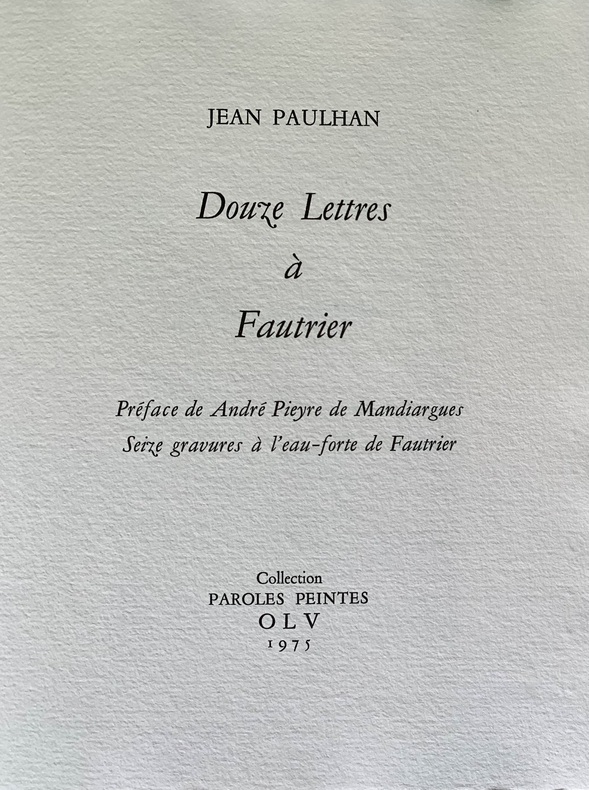
awd-1188Paris, Paroles peintes (Odette Lazar-Vernet), 1975. In-4 en feuilles, couverture muette à rabats, emboitage de l’éditeur (56 pp.).
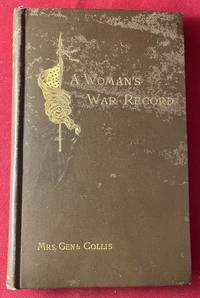
18896267New York: G.P. Putnam's Sons 1889. First Edition First Printing. Hardcover. Very Good. 4 1/2 X 7 Inches. 78 PP. First printing in the original brown cloth binding. Signed and inscribed by Collis directly on the FFEP. Septima was the wife of Union General and Medal of Honor winner Charles H.T. Collis. Her memoir recounts her life on the frontline alongside her husband as well as social life during the war and meeting President Lincoln. While not uncommon Septima remained torn by her Southern sympathies having been born in Charleston SC and her life with the Union army. Her brother David a Confederate soldier was killed at the Battle of Murfreesboro in July of 1862. Her concise memoir remains a terrific read and one of the few accounts we have of life for the female on the frontlines of the American Civil War. Signed copies extremely scarce. <br /> <br /> Light mottling and wear to covers. Binding remains clean and tight. A very attractive copy overall. G.P. Putnam's Sons hardcover
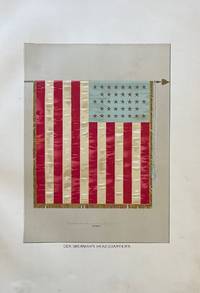
188759523Philadelphia: Burk & McFetridge Lithographers U.S. Army 1887. Folio. 11.5 x 15.5 in. 87 leaves unnumbered. 87 chromolithograph plates for title and flags throughout all mounted on linen hinges as issued. Brown pebbled publisher’s cloth gilt lettering front cover decorated endpapers front inner hinge starting very faint tidemark & bubbling to cloth of fore-edges of front cover minor wear & bumping to corners still a VG bright copy w/ plates quite sharp. First edition of this lavish work reproducing the flags carried by U.S. Army infantry cavalry and artillery units during the Civil War featuring headquarters flags battle flags corps flags pennants and guidons. Following the Civil War both Sherman and Sheridan attempted to regularize unit flags and recommended that battle names be omitted from the flag and unit registers. This work compiled by US Army Brig. Gen. Holabird 1826-1907 was carried out towards the end of his service as Quartermaster which ended June 16 1890. William Burk ca. 1857-1905 and John McFetridge 1844-1903 launched their company in 1877 by purchasing William Harding’s printing house and specialized in chromolithographic trade cards advertising book illustrations calendars and other material until about 1900. Burk & McFetridge, Lithographers, U.S. Army, hardcover
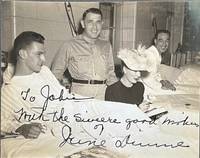
194356274Bethesda MD: National Naval Medical Center 1943-1946. Thick 4to. 8.75 x 11.5 x 4.75 in. Approx. 456 pp issues all separately paginated. w/ 100s of photo and text illustrations self-printed illustrated softcovers all complete; 4; 4 pp unpaginated colour lithograph covers; 164 pp unpaginated. on thick black paper stock w/ 188 silver gelatin photographs sized from 1.5 in. by 3.25 in. up to 8 x 10 in. w/ the majority 3.5 x 4.5 in. and all mounted neatly on pages w/ 92 filled. Original black cloth Multiple Binder w/ all pieces carefully inserted and held by metal rods attached at head & foot of spine rounded corners gilt lettering stamped on front cover minor wear soiling front cover still excellent copy from the libraries of Rear Admiral Commanding William Chambers US Navy commanding officer of Naval Medical Center beginning 1945 after commanding medical facilities in the Pacific theatre during World War II and personally organizing evacuations of wounded from Bougainville & Charles Waite Orville Bunker 1882-1958 commanding officer of the Naval Medical School 1941-1942 and then National Naval Medical Center at Bethesda Feb. 1942-Oct. 1944 signatures of Rear Admiral Chambers Captain Bozarth and photographer John Byers as well as signed photo of Irene Dunn visiting the troops. This extraordinary souvenir album incorporates not only the entire first 15 months of the weekly paper issued by the Naval hospital chronicling 1945 and 1946 events overseen by Rear Admiral Chambers but also incorporates 188 photographs providing essential visual documentation. The National Naval Medical Center at the urging of President Franklin D. Roosevelt former Secretary of the Navy pressed for the construction of the facility which was dedicated and operating by the time the U.S. entered World War II with Rear Admiral Bunker in command. Originally desinged to hold 1200 Beds the Naval Medical School the Naval Dental School and the Naval Medical Research Institute the facility quickly outgrew its’ space and additional temporary buildings were added to accommodate over 2400 American sailors and Marines by the end of World War II. The photos document the celebrity visits by Alan Ladd Veronica Lake Irene Dunne who had appeared in My Favorite Wife the Awful Truth and Anna and the King of Siam Bing Crosby Danny Kaye and others. In addition there are photos of Harold Russell double-amputee that won the best supporting actor Academy Award for “The Best Years of Our Loves.†Also included are photos of the WAVES Hospital Corps School participants nurses surgical facilities hospital wards patients and much more. The facility pioneered comprehensive occupational therapy techniques to rehabilitate injured Naval personnel and US Marines. Byers b. 1901 was a lifelong Carroll County Maryland resident who served in the U.S. Navy from 1942-1946 and afterwards was elected to the Westminster City Council in 1951 and also owned and operated the F.A. Sharrer Funeral Home. Although never operating a professional studio 1000s of his images preserved in the Historical Society of Carroll County chronicle Maryland life. No similar runs of the National Naval Medical Center News in Worldcat Locates 3 libraries holding Medical News Letter issued from 1947-1969; See: Information Bulletin Bureau of Naval Personnel NAVPERS-0 No. 334 January 1945; John Byers Collection Historical Society of Carroll County 2020. National Naval Medical Center, paperback
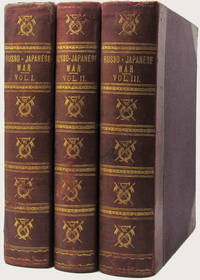
190434391Tokyo: Kinkodo-Shoseki-Kabushiki-Kaisha Kinkodo Publishing Co. and Maruzen-Kabushiki-Kaisha Z.P. Maruya & Co. 1904. Ten parts in 3 volumes. First edition the text in English for global distribution. Illustrated throughout with a vast number indeed many hundreds of chromo-lithographs coloured maps charts finely coloured plates full-page photographs colotypes and textual illustrations mostly full-page and some double-page with extraordinarily fine colour printing throughout including highlighting in silver and gold. Thick Royal 8vo publisher's bindings of three quarter morocco over cloth covered boards the spine fully decorated with gilt roll tooling dividing the compartments lettering in gilt central ornamental devices gilt. vi 424; ii 425-848; ii 849-1418 pp. A very good set indeed the bindings strong the text in pleasing condition with only occasional notes of wear the many coloured plates very well preserved some tissue guards with old evidence of damp not affecting the plates or text and probably from damp prior to binding a pleasing set in well preserved condition. FIRST EDITION BOUND FROM THE ORIGINAL PARTS REPLETE WITH ILLUSTRATIONS AND MANY VERY FINELY COLOURED AND HIGHLIGHTED IN SILVER AND GOLD. The Russo-Japanese War of 1904-05 which began with the Japanese naval attack on Port Arthur had repercussions throughout the world. Germany had helped to nudge both powers towards the war and had also managed to alienate both belligerents. She had used tremendous diplomatic pressure against the Japanese to force them to relinquish Port Arthur to the Chinese who then leased it to the Russians. Simultaneously the newly emerged nation of Japan was training its army officers in Germany. German involvement in the conflict led to war scares with both France and Great Britain causing Germany to quickly arrange an unwanted international conference at which they found themselves distrusted and isolated.<br> The war ended with the Treaty of Portsmouth arranged by U.S. President Teddy Roosevelt. The Russo-Japanese War won for the U.S. a place at the table of superpowers and a new respect in world diplomacy but for Germany it earned nothing but suspicion. In August 1905 the future chief of the general staff Helmuth von Moltke noted in his diary that "all the other nations are pretty well united in reviling Germany. They all assert that we are disturbing the peace."' Even Baron Friedrich von Holstein the chief architect of foreign policy from 1890 to 1906 admitted the bankruptcy of German diplomacy. "In short" he wrote to a friend "in the present atmosphere it seems to me that the correct and dignified thing to do would be to act like Russia after the Crimean War and calmly to withdraw into ourselves." Kinkodo-Shoseki-Kabushiki-Kaisha (Kinkodo Publishing Co.) and Maruzen-Kabushiki-Kaisha (Z.P. Maruya & Co.) hardcover
Paris, Chez Magimel, 1814, 26 x 20’5 cm., hol. piel, IV – 67 págs. – 2 grandes planos plegado de Zaragoza y Tortosa, de 89 x 60 cm., por Ambrosio Tardieu grabados en cobre. (“El autor fue testigo de los hechos” Palau.).
pp. (8), 540, (2), 22, 56, 57, 65 , 32, 33 + A handsome bust portrait engraved by Basire, after Cipriani. Portrait offset on to the unusual title page. Some old foxing. Large 4to. 295 mm. x 240 mm. Modern plain full leather binding. Hardbound. Very good. ** WITH AMERICAN CIVIL WAR ERA (1863) MANUSCRIPT NOTES AND ANNOTATIONS. Edited by the great 'Republican' Thomas Hollis, with additions and corrections by Joseph Robertson, this edition includes: Memoirs of the Life of Algernon Sydney; Discourses Concerning Government; Letters of Algernon Sydney, taken from Thurloe's State Papers; The Protector's Advice to Algernon Sydney; Letters of Algernon Sydney, taken from the Sydney papers; Letters of A. Sydney to Henry Savile, Ambassador in France; The Trial of A. Sydney; The Apology of A. Sydney in the Day of his Death; and A General view of Government in Europe. This is an important book in the history of the ideas that founded the American republic, but what is perhaps most interesting about this copy are the manuscript notes and annotations written, in a careful small hand, in America, during the Civil War (1863). A few of these struck our eye, and we're glad to reproduce a few selections here: "I have lately undertaking to read Algernon Sydney on government. There is great difference in reading a book at four and twenty and at eighty eight. As often as I have read it and fumbled it over, it now excites fresh admiration that this work has excited so little interest in the literary world. As splendid an edition of it as the art of printing can produce, as well as for the intrinsic merits of the work, as for the proof it brings of the bitter sufferings of the advocates of liberty from that time to this, and to show the slow progress of moral, philosophical, political illumination in the world, ought to now be published in America" - John Adams to Thomas Jefferson 17 September, 1823. ".the danger in America. arises from (1) the indifference of the people to the character of their deputies; (2) the disinclination of good men to go as deputies; (3) and the inclination of bad men to go as such. The rottenness of our law making bodies has reached such a point that if it shall not soon be cured it can not longer endure." - 1863. "Among the causes, which have brought the USA to their present unhappy condition, may be reckoned, as a leading one, the predominance in their councils of mere municipal lawyers. The low morals and the crass ignorance (of these) are not equal to the work of government, filched by them from a blindly confiding people. A profession proverbially selfish and dishonest can not produce statesmen, however fecund it may be of politicians. The conduct of government is the work of statesmen - of unselfish, honest, high-hearted, great-minded men = that class has disappeared and has given way to small country lawyers whose minds exercise only upon petty squabbles of the neighborhood, incapable of grasping the vast concerns of a nation. Bad as this is, there is something worse. and that is that the profession of the law is every year sinking lower in ignorance and in contempt, while at the same time it is rising in power." - 1863. These manuscript annotations make this copy UNIQUE, and very worthy of further study. W150. **PRICE JUST REDUCED!
25091The first three-quarters from Paris 18 June to 16 November 1859. The last quarter from Dresden and Copenhagen 1860 to 1863. The papers of Sir Charles Stewart Scott an Ulsterman: see his entry in the Ulster Dictionary of Biography are held by the British Library. The present journal described by its writer as ‘Private & most Confidential’ covers the very start of his career from Paris in 1859 to Copenhagen in 1863. The basic details of his career to this point together with information regarding his colleagues are to be found in the Foreign Office List for January 1865: Scott was nominated attaché in 1858 and transferred to Paris on 31 March 1859 and to Dresden on 5 October of the same year to Copenhagen three years later and was promoted to position of a third secretary in April of 1863. This journal is 186pp 8vo; all edges gilt in embossed brown cloth binding with the label of Paris stationers Delarue & Hivert. The paper is lightly aged with a little discoloration and a few loosening leaves and the binding is worn but the general overall condition is good. On reverse of front free endpaper: ‘33 Rue de la Madelaine / Charles: S: Scott. / Attached to H.B.M Embassy Paris’. The diary is as Scott admits kept in a ‘negligent way’. The first page is headed ‘Private / Paris’ and the first three-quarters of the journal consist of 140pp covering the period between 18 June to 16 November 1859 followed by three and a half pages headed ‘Nearly A year afterwards in Octr 1860’ but with only one entry: 4 October 1860. After a blank page the final quarter of the journal consists of 45pp carrying desultory entries between March 1861 and January 1863 as follows: 4pp Dresden 26 March 1861; 6pp ‘January 1862’; 7pp 6 to 14 January 1862’; 16pp 16 October to 12 November 1862; 2pp Copenhagen 21 December 1862; 2pp ‘January 1863’; 3pp ‘Princess Alexandra’. The diary contains a good mixture of the personal and professional. Of particular interest is Scott’s description of Embassy news and gossip: reports and telegrams received communications composed the views of superiors articles in the newspapers. The pre-eminent topic is the Parisian response to the conclusion of the 1859 Franco-Austrian War Second Italian War of Independence including a description of Napoleon III’s victory parade and a couple of references to Garibaldi. Other topics include the American Civil War and the marriage of Princess Alexandra of Denmark to the future King Edward VII. There is also a description of initial reports of the Second Battle of the Taku Forts June 1859 in the Second Opium War. On the personal side there what Scott himself sees as his ‘illspent youth’ with frequent references to money worries 4 August: ‘we all dined at Voisin’s capital dinner but enormously dear 18 frs a head. Afterwards we played Loo and I lost £16 - my state of mind is something awful. I could scarcely sleep a wink all night & vowed I never should play a gambling game again’. The following day he ‘must borrow £25 from somebody’. He searches for new lodgings in Paris describes his dinner engagements and socializing ‘I saw some very pretty faces in the Champs Elysees’ his private reading ‘I finished Tennyson’s New poem. I like it as a whole very much Enid is very pretty & so is the last Guinevre sic I think my favorite is Alaine evidently the Lad of Shalott’ the weather and much Embassy news and gossip. With reference to the Franco-Austrian War Second Italian War of Independence on 25 June Scott describes an early report of the victory of Napoleon III and the Sardinians at the Battle of Solferino: ‘On my way down to the Chancery at 12.30 I saw an “Affiche†giving the news of a great battle dated Caravina June 24 9.15 in the morning to the effect that the Allies had engaged the whole Austrian. Army in a line of 15 miles taken all the positions & captured several guns flags & prisoners. The details have not yet been given. It appears to have been a very bloody affair & I should not wonder at hearing a very different version soon.’ The following day is the Fête de Dieu: ‘The Chancery was very intolerable & as there was no news of any importance we had not much to do. Laurence & I spent the afternoon on chairs in the Champs: Elysee. The rest of the Chancery seem to have done ditto - We then drove to the Tavern & dined. We found Atlee there too. A very fine woman was dining near me I liked her face very much. Atlee seemed to know her. After dinner we did the coffee & liqueur dodge at the Cardinal & while we were there the newest telegram was posted up stating that the Austrians had lost 1500 prisoners in the hands of the French 30 guns & 3 flags. On one side of us as the news arrived were some Italians on the other Germans. The effect on the respective parties was worth seeing.’ The long entry for 12 July is headed ‘Conclusion of Peace of Villafranca’ discusses aspects of the conclusion of the war. The entry for 21 July begins: ‘I was in the Embassy at 11.30 Cowley sent down an angry minute with a request that some of us shd. be in the Chancery every day from 11. till 7. & that we shd be on duty by turns. He & Norton went in full tog to St Cloud where the Emperor received the Corps Deputations. made a short speech expressing the pleasure of the Corps at his safe return & the speedy reestablishment of peace. The Emperor replied with some little asperity in his tone that Europe had been unjust to him at the commencement of the war that he was glad now to have an opportunity of proving that once the honor & interests of France satisfied he did not desire to provoke further confusion of a more general war. A very important Tel: from Rome passed thro’ Paris this morning a measure of reforms has been recd by the French Ambassador at Rome to be submitted to HH. The Pope is in secret negotiation with Spanish. Minister. to reconquer Legations. In case of distress he will probably retire to Spain.’ Scott speculates regarding ‘what sort of a Foreign. Minister. Ld John will make’ Lord John Russell had been appointed to the post in the new Liberal government. On 4 July he reports: ‘There was rather an important Desp: from Ld. John relative to the Perugia atrocities he desires C. to read the Desp: to Wal: & in it he expresses his conviction that the Papal Govt is a crying evil in Italy & that at any future negotiations it would be desirable to take steps to deprive H.M. of all temporal powers - C. wrote an important Conf: Desp home upon the rumoured agreement between France & Sardinia. respecting cession to former of Savoy he expressed a wish that the gentlemen of the Chancery shd not speak about it to anyone. It appears that steps have been already taken towards negotiation by Prussia she has made proposals at London & St. Petersburg to England & France to join her in settling Bases Austria wished Prussia to act alone Prussia will not assent to do so. Claremont writes from Valeggio the Sardinian Army are besieging Peschiera the Emperor seems to have turned his attention to Venice.’ The entry for 22 July contains a long account of a despatch from Cowley: ‘a 5 sheeter an important one which he has taken two days to concoct. it is in answer to the question “should England take part or not in a Congress on Italyâ€â€™ ‘C. answers emphatically no’. He describes the French victory parade on 14 August: ‘Up at 7. dressed in white tie & tails & down & sic the Chancery at 9. there I found Lord C. and Atlee in morning coats so went back to the Rue de la Madelaine changed & got to the Place Vendome at 9.30. The Place had a most gorgeous appearance one enormous amphitheatre packed tight with well dressed ladies & gay uniforms among them an Irish milita uniform. Proh sic Patria! above us in front of the Ministere de la Justice & facing the column the Imperial balcony. Covered with crimson flock & shaded by a crimson velvet awning & this was crowded with the members of the court among them the Prince Jerome Princesse Mathilde Walewski Hamelin Gould & c. After a short time the Empress’s carriage drove into the Place amid the most enthusiastic cheering. She made her appearance some minutes afterwards in the balcon with the Prince Imperial. The latter in the uniform of the chasseurs de la garde. He is a pleasing looking little child yellow like most French babies with pudding cheeks. His mother looked very nice it was the first time I had any chance of seeing her to advantage she has such a charming expression. & was looking her very best. After this there came a long pause which I employed in looking round at my neighbours I was in the diplomatic gallery. Ld Cowley & Kisseleff Nikolai Kiselyov the Russian ambassador below me the Swedish Minr. behind some Persian attaches beside me in full uniform & the American mission a little in front. On the neat tribune the Duchess of Montrose & Lady H Graham & lots of charming English faces everybody nicely dressed & as happy as possible under the hotters sun I have felt for some time. - Soon a rustling of dresses & a number of impatient & excited explosions of “les voila†made us all strain our eyes towards the entnree by the Re de la Paix & in a few seconds the Emperor at the head of the Cent Gardes & surrounded by his staff cantered into the Place on a beautiful charger. I shall never forget the magnificence of this sight.’ The following two pages contain a description of the review of the troops ‘the Cent Gardes with the captured Austrian colours & the assorted colors of some of the regts.’. news articles in French papers ‘The Patrie has this evening rather a bitter article against the English dread of invasion - alluding to article in Moniteur.’. English fears of invasion are apparently genuine. On 28 July he writes: ‘There was an article in the Moniteur to-day giving notice of the Emperor’s intention to place the army & navy on a peace footing if this be really carried out it will be a stopper on the fears of invasion on the other side of the Channel. This Announcement is said to be the result of a Privy Council meeting who upon the suggestion of to do something to appease the fears in England met yesterday to consider what course they should take.’ News from Italy on 1 August: ‘I decyphered a long Tel. from Elliot this morning to the effect that the Neapolitan. Govt had been informed that Garibaldi with 12000 men meditated a descent on some part of the Neapoln. States & had engaged steamers at Genoa & Cagliari for that purpose. the Govt of H.S.N. wished to know whether Her .Majesty’s. Government. would protest agst Sardinia permitting this expedition & if H.Ms. fleet wd allow it to be carried out.’ Cowley asked Wal: whether he had received any intimation to the same effect he said he had been applied to by the Neapn. Govt & had accordingly written to Sardinian Govt but he did not believe there was any foundation for these apprehensions.’ On 7 September 1859 he is ‘again reduced to the same miserable pauper state’ and ‘thinking of changing to Lisbon. I have been spending too much money here - and as Sir A. Magennis is appted: Minister at that place & Grey his greatest friend has offered to recommend me strongly to him. I have thought to accept Grey’s offer & have written to Papa about it’. The same entry contains a discussion of ‘political news’ including ‘the great question’: ‘What is to become of the Duchies’ A week later 15 September he is ‘of course getting poorer & poorer. to-day Friday I had to borrow 60 frs. from Adams 20 of which went to little A - who is also hard up.’ In the same entry he gives an account of the Second Battle of the Taku Forts June 1859: ‘Matters are coming to an interesting crisis and a new European mess is brewing & this time on a very respectable scale. 1st. in China. The Frh: & English Minrs: proceeding up the Reiko in order to ratify Treaty were fired upon on the 20th of June & 3 guns boat were lost 460 men killed & wounded & the Minrs. forced to retire to Shangai. This was the first telegram which came to our hands. & a startler it certainly was. The details soon followed telegraphed by Rumboldt sic who was on his way home with Desps:’. Further details are given including ‘the P.P. ordered Adml. Hope to force the passage which he succeeded in doing when all of a sudden the batteries on either bank were unmasked & a slashing fire poured upon them. The batteries were manned by Mongols an enemy which we met for the first time in the field. An attempt to land some of our marines in gun-boats was signally unsuccessful the banks being formed of a soft mud in which our men sank up to their middle exposed all the time to a desperate fire. Adml. Hope is wounded & the affair is altogether a most signal disaster’. He continues to discuss this and ‘The 2nd mess’ - ‘a more serious one . the result of the Death of the Emperor of Morocco’. ‘Papa & the girls’ pay a visit in mid-September and he reports ‘My people are gone’ at the beginning of the following month. On 16 September 1859 he writes from ‘Dresden’ stating that he came to the place ten days before and that his ‘first fealing on hearing of my appointment was sheer disgust’ but that he is ‘beginning to know the place’ and ‘far happier than at Paris. Strange enough Dresden is to me twice as gay as Paris.’ In the pages that follow he describes the opera at Dresden and a visit to ‘Saxon Switzerland’ before giving a review headed ‘January 1862’ of his ‘illspent youth that has planted its vices in my blood and weighs me down into the mire’ and his desire to ‘emerge mothlike from the chrysalis of the past & with blood keeping an even tenour follow the “Beautiful†that now only comes to visit me in visions. - How hard now to acquire the strenghth of will that has failed me hitherto! and yet I feel that unless the change be effected now my future happiness will be ruined.’ Regarding the brewing American Civil War he writes: ‘Each day may bring us important answers from America: I fervently hope such an unnatural war may be averted.’ On 5 January 1862 he writes that ‘The news from America continues to be pacific’ but on the following day: ‘A Telegraph has come in to the effect that the Privateer Sumpter has made some prizes has sunk them & run into Cadiz. - pretty warfare this for the 19th: Century’. On 16 October: ‘Little prospect of a peaceable settlement of affairs on the other side of the Atlantic. Lincoln’s proclamation emancipating the slaves not only an uncivilized but a useless & an impolitic move. / Prussian affairs looking bad. The lower House has unanimously refused to vote the military Budget “in toto†without details. The Herrenhaus sides with the Govt: & the Chambers closed. - I do not see how the question can be settled. - We have also had a meeting of Deputies at Weimar & the National Verein at Coburg. both seem bent upon restoring the Reich Verfassung of 49. - the 1st: in favor of exclusion of Austria.’ 24 October: ‘2 new battles in America account as yet confused. - Confederates. said to have retreated. - Garibaldi a little better.’ He gives a full-page description of a ‘Jewish wedding’ on 25 October: ‘The Congregation a most curious assemblage of Jewish faces in wh: the hooked nose was the most characteristic feature.’ On 30 October he responds to a speech by Cobden proposing ‘to exempt private property from capture at sea’ and the blockade of continental ports: ‘the raw material of our food & industry come fm. America the only three powers w. whh. we cd. go to naval war are France Russia U. States. F. cd. always make use of Haburgh & the free ports & from Russia & the U:S: we draw our principal imports. In the Crimean War we purposely abstained from enforcing a blockade until we had imported sufficient grain fm. the Rn: ports. - Disputation in N of England showed what a state we shd. be reduced to if we strictly enforced the blockade of the Baltic Ports.’ On 12 November 1862 he comments sarcastically on the ‘pleasant announcement’ that he has received his orders to proceed to Copenhagen. On 21 December he records his arrival there ‘This place is certainly no pleasant residence in winter.’. January 1863 sees ‘the Federals in a worse state than ever the accounts of the late battle at Fredericksburg are terrible & the loss almost unparalleled’. Another question he discusses at this time is the ‘Affairs of Greece’. On 12 January 1863 he describes his socializing: ‘I dined twice with the Chief and went to the Lutzerodes where I met everybody & did my duty to all acquaintances. I was presented to Countess: Hohenan Prince: Albert of Prussia’s wife. She seems agreeable. - A party at the Sawyers where I was introduced to Mme: de Benst Freyburg & her daughter who has the reputation of being a beauty. I was disappointed.’ He is presented to ‘Princess. Alexandra our future Pss: of Wales she is lovely & graceful natural & charming in her manners & will certainly have great success in England.’ Over a page he describes the ‘“tableau†at the Landgraf’s’ at which he first saw Alexandra. ‘It was the Landgts. birthday & the Pce: & Psses: had arranged a series of tableaux vivants each subject to begin with one of the Initial Letters of H. Hs. name.’ The last three pages give an ecstatic account headed ‘Princess Alexandra’: ‘without being a great beauty has one of the loveliest faces & expressions I have ever seen . She leaves Denmark in tears & will find England awaiting her with smiles & English welcomes!’ In conclusion we give in its entirety the very first entry in the journal 17 June 1859. It is lengthy and gives a good indication of the general tone and level of detail and the good mix of personal and professional: ‘I found some difficulty in opening my eyes at 10 A.M. & when I succeeded in doing so found them fixed on Darand’s garçon arranging my breakfast. My conscience painfully reminding me that I owed him 60 francs for breakfast & that each day I had promised to pay his little “note†“demainâ€. Future entrie contain complaints against his debtor ‘Conyngham the wretch’ and a row with ‘Duraud’s garçon’ takes place ‘consisting of mild expostulation on his part confusion and indignation on mine’. I closed them again & answered his ‘Monsieur est serve†said in a hesitating tone only by a low grunt & he departed. After taking my usual time for consideration before committing the rash act of getting up and after taking my bath I found my breakfast as cold as my breakfasts generally are when I take half an hour to consider about getting up. / I did not go to fence but booted slowly down to the Embassy we only moved to our new pig stye of a Chancery yesterday. I found Laurence in the Chancery he had deserted Ruas too. There was no work a Tel: had been sent off about Despatches. to be forwarded to Turin. Bayly soon made his appearance I answered a Mons d’Hartville about some book which he had sent Cowley a copy of. Little news in any of the Papers. Later in the day there came in news of a conspiracy in Athens to dethrone King Otto & the intelligence was sent in cypher to the F.O. details to be sent by messenger. It appears that the Conspirators have called themselves the Italian French Society & tried to implicate the French. Minister. / Very important news arrived of the state of the Prussian policy drawn from a Convention. of French. Ministers. with Schlemetz. General. opinion in Chancery that Germany wd. join Austria before the end of the month. / I wrote to Conyngham about the £4. 10 travelling expenses asking him to send it to me. I am in a fearful state in the way of finances and I am afraid to tell the Govenor but what am I to do this is the 17th. Quarter does not commence before 23rd day of July & I have only the £4. 10 with lots of debts. - I read a book called Lama the style & character ridiculously extravagant & unnatural. Something in it excites me so I could not put it down I think it must be the present unhealthy state of my mind. / We dined at the Tavern why I say we I mean Atlee Sandford Laurence & myself. My dinner cheapest 3.75 with waiter. Then to the Cardinal coffee & petits verres. Atlee & Sandford went to their - & Laurence & I to the Embassy & his diggings where we played double dummy & talked on various subjects. I borrowed Shelley from him - walked home by the Avenue Gabriel beautiful moonlight tho’ nothing to what I saw on Wednesday night in the Place de la Concord - / Letters - from Tom. is going to be priested - Parish matters. good advice &c / Lizzie - State of religious excitement in North - to my weak mind this looks like a damned humbug. & that it is the effect of living in the same uncivilized spot without new ideas that has made everybody so superstitious. However Liz: seems rather to believe in it. / I feel rather maudlin & sentimental in fact in low-spirits tonight - the state of my funds. Darand’s bill & other details weigh upon me like a nightmare or an over feed - I have been a great fool I am doing nothing to get myself on in my profession & instead of improving my mind I think I am stupifying myself more & more every day. I wonder if the Diary will do me any good. It will never do to go on at this rate writing 5 pages a day so good-night I am off to Shelley & Bed. -’ The first three-quarters from Paris, 18 June to 16 November 1859. The last quarter from Dresden and Copenhagen, 1860 to 1863. hardcover
25428Vols 1-3 cover the period 27 August 1915 to 12 July 1916; Vols 4-8 the period between 31 January 1918 and 7 June 1919. On the Western Front in France with leave in Britain. It is hard to do justice to this vivid informative and well-written 250000-word account of the author's First World War service as Medical Officer In Charge attached to three regiments on the Western Front present during the Battle of the Somme Kaiserslacht and Hundred Days Offensive. It is hard to conceive of a better account of the day-to-day activities of a member of the Royal Army Medical Corps on active service during the Great War. The author is observant intelligent and diligent in his duties which involve attending to the wounded being called to certify deaths at all hours of the day or night doing the rounds of the wounded holding sick parade the supervision of field ambulances and the maintenance - and on one occasion the construction under fire - of aidposts. He discusses the conduct of the war describing in detail how he and his colleagues are informed about the forthcoming Battle of the Somme; and discusses the armaments and vehicles involved there are a number of references to the war in the air and describes as a medical man of the effects of poison gas reveals the comments made by a German officer while under interrogation following the capture of a German patrol a 'stunt' which wins the DSO for his colleague Lieut. J. J. Tynan see his 1948 obituary in the Irish Times. He pokes repeated fun at his corps commander ‘Hunter-Bunter’ i.e. Sir Aylmer Gould Hunter-Weston see Oxford DNB and describes 'our review' by Kitchener and the Prince of Connaught. The environment and everyday privations of active duty are described with occasional use of army slang and there are frequent reference to the tangled maze of trenches whose features are named to evoke life back home Edgware Road Kings Road Winchester Street Tube Station Chocolate Corner the Covered Way. Instances of German subterfuge are also described the writer not being well-disposed towards ‘the hun’ ‘bosche’ and ‘Fritz’. There is much gossip and small talk and description of pastimes sightseeing and entertainment while waiting for demobilization he purchases a piano and forms a ‘jazz band’. with mention of his activities while on leave in England. The weather is assiduously described sometimes in eloquent terms 15 March 1916: ‘A damp drizzly morning blossomed into a grand day’ and 30 March 1916: ‘The huns abused this beautiful warm morning by commencing early to shell the Rue de Bois just behind our H.Q.’. There are notes on terrain and other matters and a number of transcriptions of official documents and some statistical tables including two pages of ‘Operation Orders for Gas Beam Attack’ in June 1918. He writer’s attitude to the ‘jolly old war’ is surprisingly positive on demobilization. The eighth and last volume ends with an ‘Envoi’ summing up his feelings regarding his experiences in which he expresses regret that ‘the war is won and done’ stating that it was something he ‘would not have missed for anything’ and noting that the ‘periods of intense activity more than compensated for the monotony and boredom. It caused me to meet and to live with all sorts and conditions of men under all sorts and conditions of environment from the magnificence of the Chateau de Selincourt to the misery of the front line trenches in mud and shellfire where one had to trample over the bodies of dead comrades sometimes inevitably over even the faces of men dead but a few moments men one had seen and talked to day by day to reach a spot ahead where lay ones work the patching up of torn bodies of those still alive. At times it has been ghastly but the ugliness the sordidness the discomfort hunger gas death all these miseries fade from the memory in time from the conscious memory at any rate’. He feels that when most of the survivors have scattered those who are left in the army will soon be ‘seniors looked to for advice and direction by a younger generation who have not had the - to them - enviable experience of serving during the war just over’. His experiences have made little difference to him from a medical point of view: ‘If they are sufficiently sick or wounded to be interesting professionally they are bad enough to require immediate evacuation for hospital treatment. But by being thrown into the company of and being brought in contact professionally and otherwise with all manner of people my knowledge of human nature at least has been extended to a degree that would be impossible in even a lifetime of civilian practice’. The diary is certainly unpublished and no reference to it has been discovered let alone to the original from which it was transcribed. From the condition and appearance of the typescript and the design of the manuscript map by which it is accompanied one would guess that it is a near-contemporaneous transcript in all probability by the diarist himself who may well have destroyed the original as was the practice at the time. The author does not identify himself but internal evidence indicates that he is William John Henry M.B Ch.B graduate of Glasgow University who enlisted in December 1914. The diary begins on 27 August 2015 with Henry having completed his basic training leaving Taunton for Southampton where he embarks on the troop ship the SS Karnak bound for the western front where as a Temporary Lieutenant he serves as Medical Officer attached to the 28th Siege Brigade Royal Garrison Artillery until the beginning of 1916 when promoted to Temporary Captain he exchanges with the 6th Battalion the Wiltshire Regiment he gives his ‘Reasons’ in the entry for 28 January 1916. There is a hiatus in the diary between mid-July 1916 and the beginning of 1918 presumably covering his recuperation from an injury reported in the press see below. By the time of his journey back to France on board the SS Onward in February 1918 Henry has exchanged once again this time with the 11th Battalion Rifle Brigade with which he serves until his demobilization in June 1917. On 15 January 1916 the British Medical Journal reports Henry’s promotion from Temporary Lieutenant to Temporary Captain; and on 4 January 1919 ‘Temp. Capt. W. J. Henry’ features in the same journal among the 8 November 1918 list of those mentioned in despatches. There is a report of Henry’s injury in the Roman Catholic newspaper the Tablet on 5 August 1916: ‘The following names are of wounded officers :— . ‘Captain William J. HENRY M.B. R.A.M.C. attached 6th Wilts R.’ Another report in the RAMC Journal December 1916 gives a few biographical details: ‘Captain William John Henry R.A.M.C. wounded graduated as M. B. and Ch. B. at Glasgow in 1913. He joined the R. A. M. C. as a temporary Lieutenant on 16th December 1914 and became Captain after a year’s service. He was attached to the Wiltshire Regiment.’ There is a similar report in the Glasgow Medical Journal. In 1919 the RAMC Journal contains a reference to ‘W. J. Henry MB attached 11th Battalion Rifle Brigade’. Henry’s identity as author of the diary is confirmed by the entry of 21 January 1916: ‘We had another very enjoyable musical evening with the two Mademoiselles Henry - of all names - of Jacks billet and we parted finally with the best of good wishes. He hopes to have leave soon and I do not expect I shall see him for a long time. As it turned out I ever saw him again. He was killed on the Somme in August 1916. R.I.P.’ Henry does not give much away about himself in the diary: he is a Scot on 24 October 1918 he refers to ‘we Scotsmen’ from the neighbourhood of Glasgow on 28 April 1919 he declares ‘Gartloch is near home’ and a Roman Catholic whose birthday is on 2 October. Each page of the typescript is printed on a separate leaf with a manuscript map in red and black ink on the reverse of one leaf. The numbering of the eight volumes is a typed part of the original text with vols 1-3 covering the period 27 August 1915 to 12 July 1916; and vols 4-8 between 31 January 1918 and 7 June 1919 see above. A total of 345pp 4to closely-typed and single-spaced with around 56 lines to a page. Complete but for six pages missing in vol.3. Paginated in manuscript 1-348 as follows: Vol. 1 pp.1-50: 27 August to 7 December 1915. Vol. 2 pp.51-120: 24 December 1915 to 21 April 1916. Vol. 3 pp.121-177 lacking pp.166-171: 22 April to 12 July 1916. Vol.4 pp.178-221 with unpaginated conclusion on slip cut from top of p.222: 31 January to 13 May 1918. Vol.5 pp.222-250 with two pp.233 and map in red and black on reverse of final leaf: 14 May to 15 July 1918. Vol. 6 pp.251-277: 16 July to 5 September 1918. Vol.7 pp.278-333 with two pp.333 and mispagination making leap from 322 to 324 but with no text lacking here: 22 September 1918 to 28 March 1919. Vol.8 pp.334-348: 15 April to 7 June 1919. Each page is typed on separate leaf with a blank reverse except for p.250 which has the manuscript map in red and black on the reverse of its leaf. Each of the eight sections has its leaves attached with a brass stud. As stated above six pages are lacking and damage to the first leaf has resulted in loss of a few words of text at the beginning of the first entry; a handful of leaves are detached with some creasing and in one case loss to two or three words in a corner; otherwise the paper is aged discoloured and a little worn at the edges but in fair condition with the text entirely legible. The following extracts are an arbitrary selection of the mass of interesting and informative material contained in the eight volumes. Beginning with Henry’s first arrival in France we find him thrown into the thick of it. He writes on 18 February 1916: ‘I slept none too well on this my first night in the trenches. This quietness was all the more remarkable because we had a man killed of D coy by a shot through the head. His condition was so apparent that they did not need to waken me to verify the fact but sent him straight to the shed used as a mortuary near to the cemetery about a quarter of a mile away.’ And the following day: ‘I resumed my tour of inspection and presently a whiz-bang arrived about ten yards away and in bursting it splattered me all over with mud. I wandered on to D coys mess dugout and had tea with Tanner Williams Garthwaite Whitlock and Shapland. There was a lot of quite ineffective bosche sniping going on all the time and Tanner showed me the country around through some periscopes of different sorts and I had a good look at the front of our own line as the hun sees it from a projecting bit of the front line called the “Bird-cage walk†and a massive structure of sandbags it looked.’ Nine days later 27 February he gives a long account of a visit to the soon-to-be-destroyed church at La Gorgue. Earlier in the month 11 February 1916 he gives a description of ‘our review by Lord Kitchener’: ‘K. came along accompanied by Prince Arthur of Connaught with his club foot limp General Monro of the 1st Army and General Bridges commanding the 19th Division. They walked down the line followed by a huge staff and at a greater distance still by a great fleet of motor cars. K. looked enormously Big and burly and seemed in excellent condition. Prince Arthur with his pronounced limp seemed rather hard pressed to keep up the pace for K. with his great long legs made the pace down the line an uncommonly smart one. Unfortunately one cannot see all that one might when the order is “Eyes Front†and as we were trying to look like soldiers we had to stand still much as we would have liked to turn round. We came off parade almost as soon as they had entered their cars and I changed out of the wettest of my things and spent the rest of the evening working out mess bills.’ On 2 March 1916 complains about the mess: ‘The mess here is not particularly satisfactory.’ On 16 March 1916 he evaluates his new mess-mates after stating ‘That single whiz-bang proved more important than I imagined at the time. It satisfied the hun that he had my aidpost “taped†as we call it and he could strafe it at any time he wished without further registration and this he did later in his own good time. . Turner and Gibbs are very childish and grouse about everything or about nothing at all all day long. Lefroy is variable and uncertain while Pritchard is an ex-Guards ranker and is very N.C.O. -like in every way yet he is infinitely to be preferred to the other two. Capt. Smith however is a really splendid man and he almost redeems the mess by his personality.’ On 17 March 1916 he goes off ‘with Bambridge to explore the front line. We tried one trench but it bore away to the right across the La Bassee Road and finally became full of water so we turned about and tried another bearing to the left and it took us to Port Arthur Keep a trench with sides about three feet high and mud about two feet deep. I did a sanitary inspection of Port Arthur which is a reinforced farm house in the midst of a system of trenches and parapets. We left by another and a better trench which took us into Hun Street by which we reached the front line. . Tydmarsh or Tiddles as we called him was in good humour and showed me all sorts of things through periscopes and I had a shot at a hun with a telescopic rifle being probably quite unsuccessful. Then I had a look though a telescope from a snipers post a loophole in the parapet.’ On 21 March 1916 he experiences a heavy enemy bombardment: ‘What an ass I was to write that sentence about the quietness prevailing ! ! ! I had scarcely finished it when the hun started a furious bombardment of the Cheshires to our left and of Neuf Chapelle. From 12 till 1 the air was alive with shells of every kind. Shrapnel bust in mid air with a white puff of smoke and a smokey parabolic trail followed by a most vicious bang. Heavy crumps sang their way along landing with a great cr-r-r-ump throwing up clouds of earth and smoke two to three storeys high. Universal shells containing high explosive and shrapnel mixed were bursting low in the ai with a horrible huge red flare volumes of black smoke and a deafening roar. Nothing of all this fell on our battalion front though hundreds of shells went over and the Cheshires who got it all had only 20 hit and of them only 1 killed. At one point I saw a huge felled tree trunk lifted a good six feet off the ground and fall again. Our brigadier and brigade major were going round our front line at the time and teh show began just before they left our line for the Cheshires. The retaliation of our guns to all this was feeble to a degree.’ During the same month he supervises the building of an aidpost. On 28 March: ‘About 11-15 the hun sent over about twenty whiz-bangs at H.Q. but failed to hit any of our men and of course they were about 250 yards from where the aidpost work was going on. The afternoon was bright but cold with a high wind which quickly dried up the place. No retaliation was asked for the morning shooting as they were only whiz-bangs - 77mm high velocity shrapnel and H.E. field gun shells - and anyhow we probably would not have got any as the gunners are restricted to four rounds per gun per day and they have to account strictly for these four. During the afternoon the aidpost work went well but had to be interrupted for half an hour while the hun shelled us. They gave our working party 12 whiz-bangs all to themselves and scored one direct hit on the derelict house within which the aidpost is built. One huge chunk of shell came plunging through a sheet of corrugated iron with which we had filled a great hole in the wall to protect from the weather the sandbags we were putting up inside but no one was hit. I decided that the huns could see us at work filling sandbags so I found another place where the men were better concealed.’ On 5 April 1916 after a report of an attack on Chocolate Corner: ‘I knocked my people off work and strolled along to H.Q. Here I was telephoned for by the padre to go to Tube Station to see a man who was wounded so I got my corporal Braithwaite and off we went to see the unfortunate. He had a large hole in his head caused by a snipers bullet and a large piece of brain was protruding and he showed signs of a fractured base as well. I tinkered him up and stimulated him with everything I had and got him away as quickly as possible. Then I sent my corporal home and stayed to lunch with Eldred the Padre Matthews and Hunter and Tynan came along later. We had a merry meal’. Also in April a colleague Lieutenant J. J. Tynan pulls two ‘stunts’ for the latter of which he recieves the DSO. The account of the first is given on 8 April 1916 after a description of cases he has had to deal with: ‘After lunch the C.O. told me that he wanted me and my two orderlies to wait behind after the relief tonight as Tynan was going to do a bombing stunt the same one that he was prevented doing by the presence of the large hun working party last night. Tonight he is going to kill the huns in the listening post or to capture them if possible. The listening post is an old bosche communication trench extending between their line and ours the post being about 30 yards in front of their parapet. If the working party is out again he means to bomb down the trench and kill as many as he can.’ The mission is described with Tynan throwing a ‘Mills grenade which burst and killed one hun outright.’ He carries the ‘heavy hun for more than a hundred yards then three of the scouts took him over. A great strapping hun he scaled over 14 stones and much useful information was obtained from him dead though he was. As it turned out the other hun lost himself in the fog and taking the wrong direction he came up to our parapet and was made a prisoner later in the night. . The dead hun proved to belong to the 46th Reserve Jaeger Regiment’. The second of Tynan’s ‘stunts’ for which he will win the DSO takes place on 12 April 1916 and Henry’s account is headed ‘Capture of a German Patrol’ and involves Tynan and twelve scouts. Henry reports the result of the interrogation of the German officer: ‘He expects Verdun to fall in a month and that then the French will break up and the war will finish with a huge German victory. He considered that the English were not soldiers at all but that all Germans were and Tynans suggestion that one Englishman was as good as three huns was answered by a shrug of the shoulders. Regarding the treatment of British prisoners in Germany as described in the Daily Mail he declared it to be a one-sided account and maintained that they had lots of food and football. The officer had been fighting since 1914 and wore the Iron Cross; a question as to how he had obtained it was answered by the one word “braveryâ€. What impressed Tynan most was the obvious patriotism that the man showed and his keenness as a soldier. On the whole he was very favourably impressed by his captive.’ The ‘exploit’ reaches ‘one step higher than his listening post adventure had done’ with the Divisional General sending the message ‘Well done the Wilts! Bridges Major General’. The entry for 1 June 1916 gives a good example of his duties. After holding a sick parade of only fourteen men and returning to his billet to enter up his ‘sick chart’ he ‘wandered to D coy but found no one up yet. At 9 oclock King Parsons and I held a board of inspection on the S.B.Rs. small box respirators of the battalion which took us till 9.4. We found there was not enough rubber sponge material round the goggles to make them gas-tight and not enough padding under the chin for the same purpose. Then I wandered down to H.Q. Quarter-master-sergeants C.Q.M.Ss. about the parafin soap. . After initiating the C.Q.M.Ss. into the mysteries of making the parafin soap I went off on a water hunt. I rode out past B company and about 1 1/4 miles away I found a stream that the C.O. had mentioned yesterday. I came back by Dracourt where brigade H.Q. are and got home about 12.30 after a lovely ride through a beautiful avenue of trees. . The padre Davis and I had tea by ourselves in the garden’. On 23 June 1916 without any previous hint he receives a briefing regarding the forthcoming ‘push’ which is to start the Battle of the Somme. The entry begins: ‘About 10 oclock this morning after sick parade Colonel Johnson D.A.Q.M.G. deputy assistant quarter-master general of the 19th Division came along with two huge plans in relief of the ground over which we are to fight and he gave a most interesting general outline of the whole scheme especially as it affected our division.’ The entry gives a ‘summary’ of Johnson’s ‘discourse’ in ten numbered parts including ‘5th. The artillery preparation will be phenominal sic most careful and thorough’ ‘6th. The advance is to be most carefully regulated and there is to be no going “as far as possible†- as at Loos - but only to definite objectives’ and ‘10th. That aeroplanes are to control the advance by light signals of various kinds’. He continues: ‘A good part of the rest of the day was spent in marking our lines of advance on our trench maps and in completing as far as possible my preparations. There are rumours that the bombardment is to start tomorrow. In the early afternoon there was a violent thunder-storm in the course of which we were interested to see one of our sausages behind our camp calmly break its moorings and whisk away into the clouds making as it appeared straight for the bosche lines. He later reports that it is unmanned and ‘came to earth at Senlis’ Many of our mens bivouacs were washed away by the torrents of water pouring down the hillside. The mess tent was ankle deep’. The following day he goes with Padre Davis ‘up the hill behind the camp whence we had a splendid view of the bosche lines and of a lot of our shells bursting upon them but they were only small stuff. After dinner there was a glorious sunset and as it got darker we admired the spectacle of the flashes of our guns and of the bursting shrapnel over the bosche lines. One curious feature of the configuration of the country here is that scarcely a murmur is to be heard at the camp of the noise of the guns . quite diferent from Flanders and probably due to the hills around. The bombardment proper is expected to start tomorrow. . The guns on our front are now so numerous that they say that each battery will have to deal with only about 30 yards of front - some concentration surely - and with unlimited ammunition at that!!!’ The following day 25 June 1916 ‘some of our heaviest guns started shooting 9-2 12 and 15 inch. . A terrific strafe arose which lasted for an hour. We shelled Contalmaison to pieces and then the guns turned to other targets. The hun retaliated with a lot of heavy stuff on Albert and shrapnel too. We had a splendid view of all this from the camp and the reverberating crashes of the bursting 5-9s in the town and the clouds of smoke and brick dust were colossal while any empty spaces in the air seemed to be filled with bursts of shrapnel and of high-explosive-shrapnel universal shell. It was a very noticeable fact at this time that a German aeroplane was never to be seen. Our lines were so thoroughly patrolled by our flying men that the hun did not have a chance.’ Preparations include ‘thousands of motor lorries that passed in an unending stream up and down the Albert Road’. He reports the ‘persistent rumour that the hun has evacuated his front line and is taking up his position in his second line leaving only some trench mortars and machine guns in front. If this be true then our artillery preparation will be wasted’. The five corps making up the 4th Army from north to south are these; the 10th 3rd 15th 13th and 8th. The 34th Division whih is holding our front line here has on its right the 21st Division then the 32nd then the 36th both of the 10th Corps. . An interesting point Col. Johnson mentioned on Friday was that it is known that the hun has only five spare divisions with which to reinforce his front against our pushing army. To lunch we had two friends of Major Thynnes from the 15th corps on our right but they had little to tell us that we did not already know.’ The following day he acquires ‘a Tommys tunic from Harris’ and has his ‘start sewn on the shoulder straps and also two big new pockets inside. So I now have a complete Tommys outfit boots tunic belt steel helmet and hose tops as per regulations for all officers going into action must have and wear Tommys uniform as they would stand out too prominently and offer too good a target in their own distinctive gear. The colonel had ordered me to wear my red cross armlet or brassard. . As it turned out it was a bad thing for it offered an excellent target to the hun and was the chief cause of my being knocked out later.’ He describes a ‘conference for company commanders’ called by the commanding officer who has ‘just got back from a pow-wow at Brigade himself’ outlining ‘two possible lines of attack that had been mentioned at the C.O.s conference’ ‘As usual he found the Army staff people exceedingly sanguine. They always are before a show. They were so before Loos.’ ‘If what the Army Staff looks for comes about the 34th Division will reach not only their own objectives but ours as well so slight will be the opposition after the bombardment. Then our division will act as advance-guard of General Goughs 5th Army a mixed force of cavalry and light infantry and we shall march up the Bapaume Road in columns of four and billet for the night in Pozieres. On the eve of the battle he writes: ‘We all regard the Bapaume business as a myth.’ But the colonel scoffs at all this and declares that we shall much more probably be employed in helping the 34th Division to take their objectives which are only half way to our own objective - Besantin le Petit.’ On 29 June: ‘A German artillery deserter reports that on the first day of the bombardment we put 600 gas shells into Pozieres which was full of troops and that some hundreds of these were killed. On the other hand prisoners taken in raids vary in their accounts of the effect of the bombardment. Apparently in some cases the dugouts are so deep that the occupants are quite safe. We have some grand big guns close to us here. A 12 inch gun on a railway mounting calmly lobs a 1000 lb. shell into Bapaume ten miles away and there are lots of “Grannies†- 15 inch howitzers and “Mothers†- 9-2 inch howitzers.’ On the eve of the battle he sends one of his corporals ‘to the 57th Field Ambulance to see if any instructions had arrived for I had received no orders from the A.D.M.S. about medical arrangements for the show . He came back with the information that there were to be no R.A.M.C. personnel attached to battalions this time and that the field ambulances were to clear the battle-field. What is to be done now Are the poor devils that are wounded to lie there till the field ambulance is graciously pleased to consider it safe to come and collect them No bearers!! Who is to collect the wounded Am I and my two corporals supposed to collect them without any assistance The regimental stretcher-bearers will be quite busy enough if they do first aid without carrying cases about and I am not going to let them carry stretchers into action as they would be of little use and very much in the way. I thin it is positively criminal of the A.D.M.S. Hinge.’ The night before the advance is bitterly cold: ‘We had no cover. The men lay in the trench and the officers on the grass of the steep embankment. We were all in our fighting kit with no greatcoats and in our short trousers we were bitterly cold. The dew was heavy and there was a 12 inch gun on a railway mounting beside us which fired at Bapaume every fifteen minutes with a blinding flash and a terrific roar. Apart from this gun there was a very heavy strafe on both sides all night and the huns kept asking their people for more retaliation by means of red flares all night but with little apparent result.’ Vol.3 breaks off with p.165 in the middle of the entry for 1 July 1916 and when it resumes on p.172 during the entry for the following day 2 July 1916 it is clear that the missing six pages pp.166-171 have described Henry himself getting wounded ‘All appreciation of touch and sense of position had gone from the leg and foot’. The entry for the following day 3 July 1916 begins: ‘About 1 a.m. I was put on an ambulance for the casuality sic clearing station and to my surprise I found I had a fellow passenger Springett of B coy whom I had not seen at the ambulance at Albert. He had been wounded through the leg and foot and was promised a limp for life.’ After the hiatus the last five volumes continue in similar style as the tide turns in the Allies’ favour. On 21 February 1918 Henry describes ‘the devastated area a desolate plain of shellholes old barbed wire curmbling trenches and war debris of all kinds’ in an area ‘about ten miles west of Chaulnes’: ‘All the way along there were evidences of the bosche retirement all that I had read of in the papers in England. There were trees cut in two in many cases actually felled in others cut through just enough to ensure the death of the tree. Houses had been destroyed by blowing them up or by blowing in the bases of the walls so that the house collapsed and so on.’ On 21 March 1918 at the start of the Ludendorff Offensive he reports a rumour that ‘the bosche . had broken through but that our flanks had closed in on him and we had taken 12000 prisoners’. Three days later 24 March he complains that ‘artillery support was totally absent throughout. We were crumped and crumped and crumed till we were almost deaf and nearly crazy and as jumpy as if we were on springs and all we could give in return in addition to our rifles and a very few Lewis guns were a few a very very few 18 pounder shells - with 18 pounders when he had 8 inch and 5-9s galore.’ On 28 March 1918 he reports another case of German perfidy: ‘One feature of the night was that one of our men caught by the bosche during the counter-attack on Buchoir was made by them to shout out “Stretcher-bearers†at intervals throughout the night. A patrol of the Scotties was captured while trying to reach him and one of ours out on the same errand escaped narrowly from the same fate.’On 17 May 1918 he describes the effects of poison gas: ‘I went for lunch to B coy and there saw some gassed cases and took seven of them to the A.D.S. just beyond Na Poo Corner. Their eyes were still fearfully sore inflamed and practically blind and they were a pitiful little band headed by the worst case of all people the gas sergeant of the company. Of all the diabolical inventions of this war I think mustard gas is the very worst. It can be used only in shells in which it is packed in liquid form. When the shell bursts this venomous liquid is scattered all round and if any of it falls on your person or clothing it burns its way through and if it falls on your eyes it blinds you for life. But its virulence does not end there. What of the liquid falls on to the ground sinks in a little way and then lies dormant but as soon as the warm sun comes out it evaporates slowly and the vapour that rises is only a little less damaging than the liquid itself and causes acute inflammation of the eyes and of the respiratory passages.’ On 13 June 1918: ‘more bosch planes came over and bombed Cite St. Pierre on our left and both lots of gunners were busy all night’. On 30 July 1918 there is a football match betwen officers and sergeants with the officers losing 6-1 ‘even though we had Eassom and Bennett a professional both playing but we had some extraordinarily bad players among the officers to balance that.’ And the following day ‘I went over to Chateau de la Haie about two miles away to see the Volatiles the Canadian Concert Party. They were uncommonly good and had a perfectly wonderful “girl†who not only acted the girl splendidly but did the Vesta Tilly stunt of male impersonations with surprising skill.’ As the war draws to its conclusion the tone lightens with several amusing anecdotes told of ‘Hunter-Bunter’: ‘Our corps commander Hunter Weston is probably the subject of more tales and stories than any other man in the army’. On 6 June 1919 he is present at the departure of his ‘old battalion the 11th R.B.’ saying goodbye to ‘those of my friends who were with what was left of the battalion at the end. These were the Colonel Cotton Bosvile adjutant Jelly Q.M. and the babe Cunningham otherwise Ganymede. I purchased their piano for 200 francs and it became the nucleus of a jazz band which I organised at Fonquevillers and which soon easily outshone any similar organisation in my experience.’ In the final entry he regrets having to exchange ‘that most serviceable colour called Khaki’ for civilian clothes: ‘but I am a soldier no longer my army pay has stopped and so I must conform to convention’. Interspersed between entries are a several ‘NOTES’ with three pages on the terrain in Flanders and two pages giving a detailed description of ‘the guns chiefly in use by our army in the field under nineteen headings from ‘Maxim’ to ‘15 inch Howitzer’. The notes to Vol.2 include a page about the stories told about the early part of the war by ‘Our colonel’ including one on an incident of friendly fire. ‘Colonel Barron’ also describes ‘One piece of unrecorded history’: ‘that on the Marne 15000 Ulhans got in between the left flank of our army and our general headquarters staff - General French and his brass hats and the French troops who were further to the left on the Paris side’. ‘The panic . was indescribable and that day has always been regarded by the staff as the blackest day of the war.’ After this set of notes is a page-long ‘PERSONNEL OF UNITS’ listing ‘Artillery’ and ‘Infantry’ with comments on the former i.e. ‘Lieut. Col. Pollock. sent to England as inefficient 1915’ and ‘Lieut. Hood’: ‘Wounded January by F.A. premature. Two fingers of left hand broken.’’ On 28 January 1916 Henry gives almost a whole page of ‘Reasons for my exchanging from the 28th Siege Brigade R.G.A. to the 6th Battalion the Wiltshire Regiment’ beginning with ‘Colonel Barron was a super-excellent gunner but a most difficult man to live with.’ Transcribed items include an alleged ‘COPY OF A GERMAN DOCUMENT CAPTURED RECENTLY. Notice No 13875’ allegedly written by ‘W. L. O. Twiss Major / General Staff 22 March 1916 beginning: On account of all the able-bodied men having been called to the colours it remains the duty of all those left behind for the sake of the Fatherland to interest themselves in the happiness of the married women and maidens by doubling or even trebling the number of births.’ The entry for 1 April 1918 is followed by nearly two pages of ‘NOTES’ beginning with a list headed ‘On coming out of the line at Domart the battalion mustered 113 other ranks and 5 officers not counting myself. The officer casualties were as follows’. The entry for 15 July 1918 is followed by a two-page ‘COPY OF OPERATION ORDERS FOR GAS BEAM ATTACK’ ‘Secret’ from ‘J. T. Bosvile Capt. and Adjutant 11thS Bn. R. B.’ the first of the two orders beginning: ‘1. A Gas Beam Attack will be carried out tonight or the first night after on which the wind is favourable. Gas will be discharged from trucks Decauville rail head N-36-d-92 62 to N-32-d-69 60.’ and with sections on: Precautions Code Words Zero Hour Lewis Gun Fire etc. Signal Officer Rations. The two orders followed by a full-page copy of a secret document by ‘Wingate Col. A.D.M.S.’ giving a ‘Summary of Sick and Wounded Admitted to 20th Division Medical Units and Evacuated to C.C.S. during the Month of May 1918’. On the back of this page 250 are two original manuscript maps of ‘BOSCHE LINE’ in red and black the first featuring the ‘LENS-LIEVIN ROAD’ and the second the ‘Souchez River’. Vols 1-3 cover the period 27 August 1915 to 12 July 1916; Vols 4-8 the period between 31 January 1918 and 7 June 1919. On the We hardcover
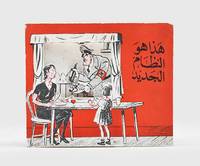
1942176681Probably Britain: c.1942-43. Pop-up anti-Nazi propaganda in Arabic A rare example of anti-Hitler propaganda in Arabic produced likely in Britain during the North Africa campaign. We have traced no other copies or any other examples of Arabic pop-up satire from the Second World War. As the Arabic text displays grammatical features typical of the Tunisian colloquial this pop-up was likely produced for the Tunisian campaign of 1942-43. The opening scene shows Hitler stealing food and wine from a family's dinner table while in the pop-up scene he handles the loot to a German soldier who is walking out of a house. The text at rear denounces how the German "locusts" and their leader "the pig Hitler" - a phrase used in contemporary anti-Nazi European satire here acquiring additional overtones within a Muslim context - stole food from all the countries they crossed to feed themselves while letting the local people starve. It concludes stating that this is how the new system works: everything is carried out for the sole benefit of the Germans. Oblong octavo folds into 100 x 150 mm. Paper engineered "pop-up" propaganda card Arabic title on the front and Arabic text on the back. Extremities a little rubbed and dust-soiled very slight foxing: a very good example. unknown
8vo., First US Edition; cloth, covers very slightly faded else a very good, bright, clean copy in unclipped dustwrapper, the whole housed in a calf solander case with gilt back and marbled edges. A SIGNED PRESENTATION COPY TO DAVID LOW, WITH THE AUTHOR'S HOLOGRAPH INSCRIPTION DATED 1947 ON FRONT FREE ENDPAPER. This scarce collection (the author's first book and sole collection of verse) contains the structured poem 'Lessons of War', Part I of which, 'Naming of Parts', is arguably the most famous poem to emerge from WWII. It also contains the famous T S Eliot parody 'Chard Whitlow'. PRESENTATION COPIES ARE EXCEEDINGLY SCARCE. THIS ONE IS TO DAVID LOW, LEADING BRITISH POLITICAL CARTOONIST AND CREATOR OF 'COLONEL BLIMP'. A New Zealander by birth, Sir David Low (1919-1963) arrived in Britain in 1919 to progress his fledgling career as a political illustrator. In his early years in Britain he worked with a variety of publications including the 'Star', 'New Statesmen', 'Punch' and 'The Graphic'. In 1927 he was invited by Lord Beaverbrook to join London's 'Evening Standard' and the rest is history. A staunch anti-fascist, Low used the scaithing and incisive poweer of his cartoons to attack the complacency of the British establishment in the 30s; in 1934 he created in Colonel Blimp' one of the most famous figures in newspaper cartoon history. His work was swiftly banned in both Germany and Italy and after the outbreak of war several of his cartoons were used to inspire the British people during the darker days at the beginning of the conlfict. Low was appointed an official War Artist and as such attended the Nuremberg War Trials. He was knighted in 1962. Many of Low's cartoons were published in book form, the most famous collections being 'Low's Political Parade with Colonel Blimp (1936) and 'Europe at War' (1941). His most famous character was the basis of 'The Life and Death of Colonel Blimp' (Powell & Pressburger, 1936), one of the most important feature films in the history of British cinema. A UNIQUE AND PARTICULARLY APPROPRIATE ASSOCIATION COPY IN THE CONTEXT OF WWII.
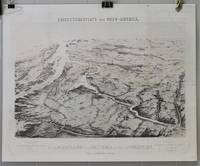
1862W2430Bremen Germany: A. D. Geisler 1862. Original lithographed folding map. The image is 13 1/4 inches by 19 1/2 inches on a sheet that measures 18 inches by 22 1/4 inches. This map is similar to perhaps inspired by Panorama of the seat of war : bird's eye view of Virginia Maryland Delaware and the District of Columbia published by John Bachmann in Baltimore in 1861. Both are semi-topographical birds-eye views of the region but there are differences not the least of which is that only this Geisler map is oriented with North being at the bottom of the map. My best guess is that Geisler produced the map for sale to people in Germany who had a keen interest in the American Civil War. The map does not show troop movements or anything else military; it appears to be intended to give the Germans a picture of the territory where the war was taking place. This map is quite scarce with copies located only in the Library of Congress and the Maryland State Archives. Only one other dealer has a copy for sale at this time. The map is in about very good condition. There are a few closed tears along some fold lines that have been stabilized professionally with a barely discernible ricing on the verso. Some faint staining is noticeable primarily in the upper corner margins. First Edition. Single Sheet. Very Good. Illus. by A. D. Geisler. 13 1/4 inches by 19 1/2 Inches. Map. A. D. Geisler
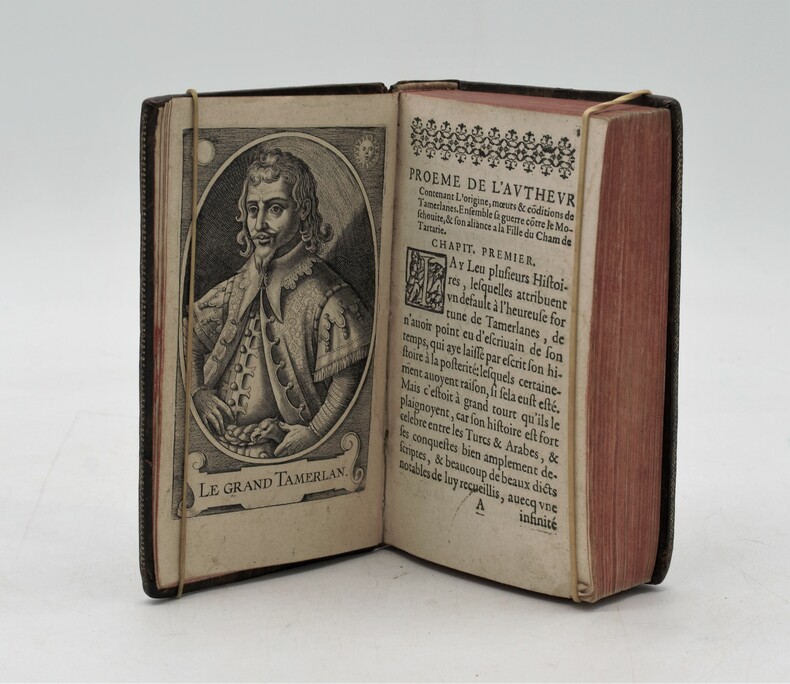
1602PHO-1223Bruxelles , Rutger Velpius, 1602 in-8, [3] ff. n. ch. (titre, au lecteur, dédicace), 504 pp., avec un portrait-frontispice, veau brun marbré, dos à nerfs cloisonné et fleuronné, tranches rouges , titre remonté, bon exemplaire. (reliure de l'époque).
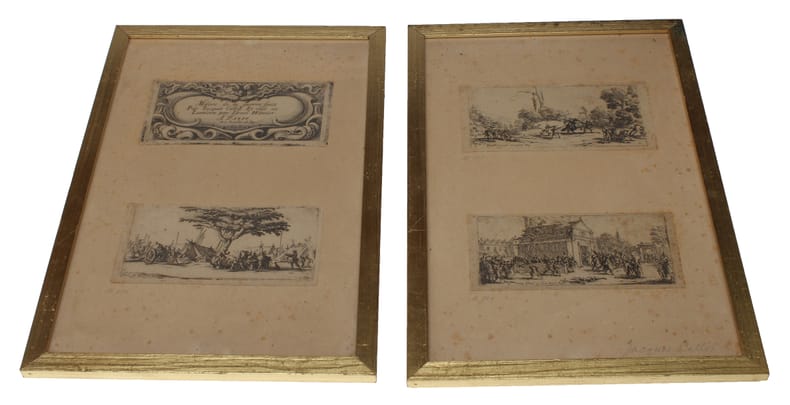
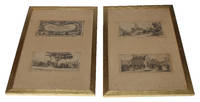
163651722A Paris, Avec Priuilege de Roy, 1636. Four original etchings by Callot, published by Henriet who added a frontispiece (title) etched by Abrahem Bosse. Comprising frontispiece and 3 etchings (ca. 59 x 120 mm.), numbered 1,2 a. 3 in the plate. All 4 mounted and framed in two (29 x 20 cm.). Mildly brownspotted.
163651722A Paris Avec Priuilege de Roy 1636. Four original etchings by Callot published by Henriet who added a frontispiece title etched by Abrahem Bosse. Comprising frontispiece and 3 etchings ca. 59 x 120 mm. numbered 12 a. 3 in the plate. All 4 mounted and framed in two 29 x 20 cm. Mildly brownspotted. <br/><br/><em>The "Small miseries of the War" was unfinished - there was only published 7 etchings the 4 first offered here.Callot was one of the first great artists to practise the graphic art exclusively. His innovative series of prints documenting the horrors of War of which his series "Les Miseres et les Mal-Heurs De la Guerre" Great Miseries of War is the most famous greatly influenced the socially conscious artists of the 19th and 20th centuries. For instance its themes and imagery were used as a source by Goya and he is acknowledged as equal to the three great: Dürer Rembrandt Goya. It is said that no one ever to such an extent possessed the talent of grouping a large number of figures in a small space and of representing with two or three bold strokes the expression action and peculiar features of each individual. Brunet I 1488 17. </em> unknown
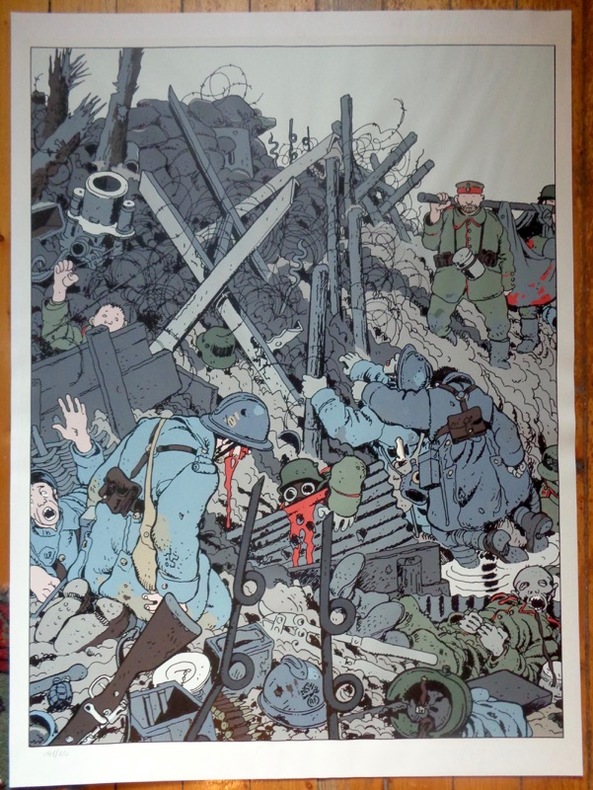
19852260Paris, Escale, 1985. Diptyique, complet en 2 très grandes sérigarphies originales au format (chacune !) de 84 x 114 cm. Quelques marques, hélas, d'humidité (voir photos).
1914213901914. World War I battlefield scenes documented in photographic postcards produced during the conflict between 1914 and 1918. The images record key elements of industrial warfare on the Western Front including trench systems artillery deployments armored vehicles aerial combat and the destruction of urban centers in France. Together the photographs present a visual survey of military technology battlefield conditions and command leadership during the war. Scenes of soldiers in trenches artillery firing positions advancing tanks and devastated cities illustrate the scale of mechanized warfare that defined the conflict and reshaped military operations in the twentieth century.<br /> <br /> Archive composed of 32 vintage real photo postcards mounted on two cardboard display sheets. Each photograph measures approximately 3 x 4.5 inches and is captioned in the negative. The images depict multiple aspects of the Western Front including French soldiers occupying front line trenches and artillery units operating large caliber guns such as a Canon de 220mm Schneider mortar. Several photographs show armored vehicles including Renault FT tanks advancing near Andicourt in the Aisne region. Additional images document captured German heavy artillery including large siege mortars identified as 21 cm Mörser guns seized by British forces. Aerial warfare appears in photographs of fighter aircraft in flight including an image attributed to the aircraft of French ace Captain Georges Guynemer. Urban destruction is represented through photographs of damaged French cities including scenes of devastation in Reims with the cathedral visible above surrounding ruins. Infrastructure damage is also recorded in photographs of a destroyed bridge at Château Thierry. Leadership and command figures appear in several images including a photograph of Georges Clemenceau visiting a French aviation camp near the front and another showing Marshal Ferdinand Foch with General John J. Pershing at American General Headquarters.<br /> <br /> The photographs collectively illustrate the transformation of warfare during World War I through the introduction of mechanized weapons systems coordinated artillery operations and the integration of air power into military strategy. The presence of tanks aircraft and rail mounted artillery demonstrates the technological changes that characterized the conflict and influenced subsequent military development. Mounted photographic postcards also functioned as documentary and commemorative imagery circulated during and after the war to illustrate the scale of military operations and battlefield destruction. Thirty two photographs mounted on two cardboard sheets measuring approximately 12 x 19 inches. Light wear and minor creasing visible on several images with overall strong photographic clarity. Overall very good condition. The mounted set preserves a broad visual record of Western Front combat and military technology during the First World War. unknown
8vo., Third Impression, with frontispiece, plate and full-page map; sand cloth, backstrip blocked and lettered in gilt and sand, pale blue top, a very good, bright, clean, crisp copy in unclipped dustwrapper, the latter lightly chafed (not affecting lettering) at head and tail of backtrip, and a little browned on (predominantly white) rear panel. With a few relevant cuttings loosely inserted. Published a year after the first edition. One of the finest (and scarcest) literary works to emerge from the Great War, Hailed as 'a work of genius' by Eliot (then at Faber) it was awarded the Hawthorden Prize for 1938. RARE IN THIS CONDITION.
7 vols., 8vo., Mixed Editions, with folding engraved maps and plans (a number coloured in outline), some light and inoffensive spotting; uniform original red cloth, boards framed in blind, gilt backs, uncut, primrose endpapers, tops lightly dust-soiled, several hinges tender (but all bindings entirely sound), a very good, bright, crisp set. THIS SET WAS FORMERLY IN THE LIBRARY OF MAJOR-GENERAL FREDERICK EDWARD SOTHEBY OF ECTON HALL AND BEARS HIS ENGRAVED ARMORIAL BOOKPLATE ON FRONT PASTE-DOWNS OF ALL VOLUMES. The set comprises Kaye: Vol. I (ninth edition, 1880); Vol. II: (fifth edition, 1888); Vol. III (fourth edition, 1880); Malleson: Vol. I (second edition, 1878); Vol. II (second edition, 1879); Vol. III (first edition, 1888); Pincott (first edition, 1880). Major-General Frederick Edward Sotheby (1837-1909), born in Sewardstone, Essex and only son of Rear Admiral Charles Sotheby, led a distinguished military career. Commissioned in the Rifle Brigade in 1855, he served in the Crimea at the siege and fall of Sebastopol and the storming of the Redan. HE WENT ON TO SERVE THROUGHOUT THE INDIAN MUTINY AND WAS WITH HIS REGIMENT DURING THE CAPTURE OF LUCKNOW AND THE OUDE CAMPAIGN. Later service included the Chinese War (1860) where he was present at the surrender of Pekin, and the Ashanti War (1874) where he fought at Amoaful and Coomassie. Sotheby retirned in 1888 with the rank of Major-General. His family seat at Ecton Hall, Northamptonshire, was renowned for its library, of which the present set doubtless formed a part. 'Malleson's history begins at the close of the second volume of Sir John Kay's history. Malleson defends this action in his preface. Here he states that the third volume of Kaye did not do justice to the actors in the drama of the Mutiny' (Sorsky). Chuadhuri calls Malleson's work 'the most exciting in Mutiny literature'. SCARCE IN ANY EVENT, THIS IS A SPLENDID ASSOCIATION SET WITH DISTINGUISHED AND RELEVANT PROVENANCE. Sorsky, 594.
1900144708New York: Underwood & Underwood; Chicago H.C. White Co.; London Erdmann & Schanz; Meadville Keystone View Company; and London Fine Art Photographers' Publishing Co 1900. First Edition. Hardcover. Near fine. New York Underwood & Underwood; Chicago H.C. White Co.; London Erdmann & Schanz; Meadville Keystone View Company; and London Fine Art Photographers' Publishing Co. 1900 to 1902. The pairs of images are approximately 80 × 77 mm each top corners rounded laid down on printed cards approximately 88 × 177 mm. All have captions or titles on the rectos and many have descriptive text on the versos. A few minor signs of age and handling; one card with an unobtrusive ink stamp; overall in near-fine condition. Each card comes in a glassine sleeve some slightly torn and the collection is now housed in two custom-made cloth-covered boxes. The stereo views depict scenes from some of the most important campaigns of the war including Ladysmith Colenso Modder River Kimberley Spion Kop and Pretoria troop movements and positions commanders from both sides including Roberts Kitchener Baden-Powell French Botha de Wet and de la Rey and the daily life of soldiers. Of specific interest are cards showing colonial units three Australian four Canadian one New Zealand prisoners of war battle scenes some appear to be staged surveillance from hot air balloons signals units railway engineering hospitals and wounded soldiers and dead soldiers and war graves. <p>The views were published by: Underwood & Underwood New York 89 cards; H.C. White Co. Chicago 30 cards; Erdmann & Schanz London 9 cards; Keystone View Company Meadville 3 cards; and the Fine Art Photographers' Publishing Co. London 1 card. 132 items. Underwood & Underwood; Chicago, H.C. White Co.; London, Erdmann & Schanz; Meadville, Keystone View Company; and London, Fine Art hardcover
12742Shanghai, North-China Daily News & Herald Limited, 1938. 1 volume, oblong in-quarto (23*29 cm), 163 pp., fully illustrated with photographs and cartoons by Sapajou, hard illustrated covers, a very good and clean copy.
In 8° (mm 290x205); frontespizio, pagg. VIII, 72 con 40 tavole fuori testo in litografia a colori (la 39 dell'assedio di Peschiera in antiporta) e 2 carte delle battaglie di Magenta e Solferino nel testo iniziale.<BR>Legatura editoriale in percallina rossa con impressioni in oro raffiguranti scene di battaglia ed a secco a piatti e dorso, titolo in oro al piatto ed al dorso, tagli in oro. Le belle tavole sono delineate da Bossoli ed eseguite in litografia da vari autori <BR>Il ticinese Carlo Bossoli (Davesco Lugano 1815- Torino 1884) pittore, disegnatore e litografo, seguì l'esercito sardo nella guerra del 1859 e documentò con grande bravura gli episodi bellici salienti rendendo le scene con realismo e paesaggismo di buona fattura. Il testo è opera del colonnello magiaro Nandor Eber, corrispondente dalla Crimea per il Times di Londra. <BR>Discrete condizoni generali con qualche abrasione, macchia ed escoriazione alla legatura. Una piega al frontespizio, qualche ossidazione e fioritura all'interno. <BR>
In 8° (mm 200x130); pagg. 146, (2 bianche), le ottave sono separate da fregi floreali e finalini in silografia, note a stampa a piede di pag. Splendida legatura coeva artistica siciliana rococò, in pelle di vitello dai toni nocciola, all'uso francese a "dentelles". Ai piatti una tripla cornice con intrecci, filetti e foglie in oro, ai quattro angoli vi sono degli intarsi a griglia in marocchino verde pisello con punteggiature floreali in oro; al centro due medaglioni ovali campeggiano adornati da ricchi decori a piccoli ferri con leggere volute, eleganti losanghe e fiori. Dentelle e tagli dorati. Dorso a cinque nervi e scomparti ornati da fiori, volute e punteggiature in oro. Titolo impresso in oro. Prima edizione italiana, in elegante e rimarchevole legatura, di questo poema in ottava rima tradotto dal francese, in cui sono cantate le gesta di grandi condottieri. Splendido esemplare. Mira II, 427. Melzi I 90.
1611P1-2E-4Lyon, Antoine de Harsy, 1611. In-8 (172x103mm), reliure d’époque, plein velin, titre manuscrit au dos, texte en latin et Grec sur 2 colonnes, 7ff.n.c.-470pp.-36ff. index. Bon état.