119 781 résultats
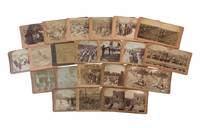
1898231301898. Spanish-American War stereoview archive circa 1898-1899 documenting how the war was pictured through mass-produced photographic views that followed U.S. mobilization battlefield action occupation and military life across both Cuba and the Philippines. These stereoviews preserves the visual system by which the war was circulated to American audiences showcasing camp organization troop movement burial hospital care naval power and overseas deployment. Particularly notable is the archive's coverage of the Rough Riders the Santiago campaign in Cuba and U.S. presence in Manila and Malate showing how stereoview photography helped normalize the war's expansion from anti-Spanish conflict into a broader American imperial presence.<br /> <br /> Archive of 21 stereoviews Various publishers. Spanish-American War stereoview archive. Cuba the Philippines and the United States circa 1898-1899. each measuring 3" x 7". The views are drawn from multiple phases and theaters of the war including camp and drill scenes in the United States embarkation and troop arrivals at Tampa battlefield and occupation imagery from Cuba and extensive and some grisly scenes from Manila and surrounding areas in the Philippines. Captions and images show soldiers in formation cavalry drill military reviews naval artillery hospital interiors encampments burial grounds and troops in active position. Cuban views include Morro Castle after bombardment dead and wounded on the battlefield of Santiago U.S. soldiers preparing to invade Cuba and troops dining near Cabañas Fortress. Philippine views include a departure for Manila American pickets routing a Filipino reconnoitering party the 18th Infantry engaged by Filipino outposts volunteers awaiting orders under the tropical sun Army Hospital Manila and "Our Boys in Camp at Malate P.I." One stereoview identifies Roosevelt's Rough Riders in the mobilization phase linking the archive to one of the war's most publicly mythologized units.<br /> <br /> As a group the stereoviews demonstrate the process by which the Spanish-American War was framed not simply as a short military victory over Spain but as a sustained structure of U.S. troop deployment and occupation extending from Cuba into the Philippines. The Manila and Malate scenes are especially important in this regard since they place American soldiers within the opening phase of the Philippine conflict where U.S. military presence quickly moved beyond liberation rhetoric into imperial control. The archive's mixture of battlefield casualties camp routine naval spectacle and celebratory review scenes shows how stereoscopic publishing converted war into a domestic viewing experience while reinforcing the legitimacy of American expansion abroad. Wear to mounts some toning; overall very good condition. A strong cross-theater visual archive of the Spanish-American War and the emergence of U.S. imperial power in Cuba and the Philippines. unknown
194489941Washington DC: United States War Department Army Services Forces Headquarters 1944. Many apparent first printings. Olive Green Two-hole Remington Rand large binder Style BA Binding Kansas Capacity 3 inch Open Back 6 inch Thong Centers U.S. Patent No. 5. Good. The name of previous owner R.H. Wurtz on front cover. Size of binder is 6.5 inches by 9.5 inches. Illustrations photos and diagrams. Tabular data. RARE ordnance parts and equipment compilation. Contains ORD 9 SNL A-4 Rifle Automatic Cal.30 Browning M1918A2 Illustrations 34 pages; followed by ORD 8 SNL A-4 Addendum for Rifle; Automatic Cal.30 Browning M1918 M1918A1 and M1918A2 12 p ORD 8 SNL A-4 2p; ORD 7 SNL A-4 Spare Parts 12p; ORD 7 SNL A-4 3p; SNL A-5 71p;SNL A-5 Change 2 2p; ORD 8 SNL A-5 21p; ORD 8 SNL A-5 2p; ORD 7 SNL A-5 20p; ORD 9 SNL A-6 66p; ORD 9 SNL A-6 23p; ORD 8 SNL A-6 3p; ORD 7 SNL A-6 24p' S. N. L No. A-7 63p; S. N. L No. A-7 Addendum 5p; Change 2 3p; ORD 9 SNL A-32 28p Changes No.1 2p; Addendum SNL A-32 12p; Changes No.5 2p; ORD & SNL A-32 11p; SNL A-37 127 p; ORD 8 SNL A-37 35p; ORD 7 SNL A-37 27p; Changes No. 1 2p 2 copies; ORD 9 SNL A-39 82p; Changes No. 1 2p; Addendum 22p; Changes No. 2 2p; ORD 7 SNL A-39 21p; ORD 9 SNL B3 34p; ORD 8 SNL B3 14p; ORD 8 SNL B3 Changes No. 2 3p; ORD 7 SNL B3 19p; Changes No.1 2p; SNL B-6 12p; ORD 8 SNL B-6 12p; ORD 7 SNL B-6 12p; ORD 9 SNL B-7 23p; ORD 9 SNL B-8 16p; ORD 9 SNL B-16 12p; SNL B-21; ORD 9 SNL B-21 17p; ORD 7 SNL B-21 Changes No.1 2p; ORD 9 SNL B-28 22p; Changes No. 1 2p; ORD 8 SNL B-28 11p; Changes No. 1 2p; ORD 7 SNL B-28 15p; SNL J-2 135-183p; SNL F-210 42p: ORD 7 SNL F-210 14p; ORD 8 SNL Changes No.2 2p; ORD 11 SNL T-2 18p and ORD 11 SNL T-6 2. The Army Service Forces was one of the three autonomous components of the United States Army during World War II the others being the Army Air Forces and Army Ground Forces created on 9 March 1942. By dividing the Army into three large commands the Chief of Staff General George C. Marshall drastically reduced the number of officers and agencies reporting directly to him. The Army Service Forces brought together elements of five different components of the Army: elements of the War Department General Staff WDGS especially its G-4 division responsible for logistics; the Office of the Under Secretary of War; the eight administrative bureaus; the nine corps areas which became service commands; and the six supply arms and services which became known as the technical services. The Army Service Forces was initially known as the United States Army Services of Supply but the name was changed on 12 March 1943 as it was felt that the term "supply" did not accurately describe the broad range of its activities. The Army Service Forces was abolished on 11 June 1946 and most of its functions were taken over by the War Department General Staff. For most of its existence the Army Service Forces was commanded by General Brehon B. Somervell with Lieutenant General Wilhelm D. Styer as his chief of staff. After Styer left for the Pacific he was succeeded by Major General LeRoy Lutes on 18 April 1945. Brigadier General Lucius D. Clay was the Deputy Chief of Staff for Requirements and Resources and as such he was responsible for the development of the Army Supply Program the operation of the Lend-Lease program and liaison with the War Production Board concerning the allocation of raw materials. Although he had his own logistics staff in the G-4 division of the War Department General Staff it was to Somervell and Styer that Marshall turned to for advice on logistical matters and it was Somervell who attended the important wartime conferences. Six supply arms and services became part of the new organization: the Corps of Engineers Signal Corps Ordnance Department Quartermaster Corps Chemical Warfare Service and the Medical Department. They were designated "supply services" in April 1942 and "technical services" in April 1943. A seventh technical service the Transportation Corps was created in July 1942. The technical services developed military equipment manufactured or purchased it stored it in depots maintained and repaired it and issued it to the troops. Each had its own budget and together they accounted for half of the Army's appropriations. The service commands were the field agencies of the ASF. There were initially nine of these each responsible for a different geographical region. In August 1942 the Military District of Washington also assumed the status of a service command. The Northwest Service Command was created in September 1942. It was responsible for the construction and maintenance of the Alaska Highway the operation of the railway between Skagway Alaska and Whitehorse and the Canol Project. Army installations in the continental United States that were placed directly under the service commands included recruiting stations induction and reception centers repair shops enemy alien and prisoner of war camps medical and dental laboratories Reserve Officers' Training Corps units dispensaries finance offices disciplinary barracks and named general hospitals except for the Walter Reed General Hospital. United States War Department, Army Services Forces, Headquarters unknown
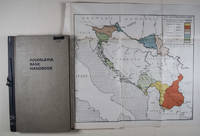
194444093London: Military Intelligence War Office 1944. First edition. Hardcover. g to vg. Folio 13 1/4 x 8 1/2". 2 111 1pp 70pp 11 folded maps 71 1pp 1 large folded map at rear. Original string bound cloth with black lettering to front cover. <br /> <br /> Published by the War Office between 1943 and 1944 this handbook is one of a series of 'Basic Handbooks' dealing with enemy countries Germany Italy Japan and countries occupied by the enemy.<br /> <br /> Dealing with Yugoslavia a country divided and occupied by Germany and Italy in April 1941 this work is divided into four parts: Pre-Invasion; Post Invasion; Map Section; and Supplement. It is complete with its 11 large folded colored maps General Map; Communications and Gridded map; Administrative Divisions in 'Independent Croatia;' Formation of Yugoslavia; The Banovina System; The Partition of Yugoslavia; Racial Groups; Density of the Population Map; Agricultural Regions Map; Main Types of Agriculture Map disbound but present; and Chief Mineral and Industrial Resources Map. The pocket at rear contains an addition large folded map indicating the Administrative Sub-Divisions.<br /> <br /> The emphasis is directed to the administrative system political organizations economic features and national characteristics together with so much of the history of the country as is required for an understanding of the subjects.<br /> The detailed social and economic information in both parts pre & post include information on the nature of the religious communities and how they fared during the war. Includes various references to the Jewish population of 71000 in Jugislavia including the savage campaign against them by the occupying German forces. At some point in 1941 four Orthodox Bishops met with Serbian Jews suggesting to them to wear the Star of David in protest Chapter 4 and in chapter 5 treating the social conditions including religion in Serbia and Croatia. <br /> <br /> Some rubbing and minor chipping to spines. Corners slightly bumped not affecting pages throughout. Binding in overall good interior in very good condition. Military Intelligence, War Office hardcover
16409World War II Original war time U.S. War and Navy Departments first editionsPocket Guide books for 18 countries. These guidebooks were prepared by the U.S. War and Navy Departments to educate American soldiers stationed overseas during the conflict. It includes points on culture language including slang local history and the military justification for American presence in the area; in this sense these pocket books are a unique distillation of American wartime policy composed by the highest decision-makers in government for the soldiers actually setting foot on foreign soil. These guides provide a concise yet rich example of wartime indoctrination and the resulting cultural associations and relationships formed within the average American by the war.<br/><br/> All 18 guide books are war dated and they include: Alaska 1943; Australia 1944; Egypt 1943; France 1944; Paris and Cities of Northern France 1944; Cities of Southern France 1944; Great Britain 1944; India 1944; Iran 1943; Iraq 1943; Italian Cities 1944; New Caledonia 1944; New Guinea and the Solomons 1944; New Zealand 1943; Northern Ireland 1942; Panama 1943; Syria 1942; West Africa 1943. Washington DC: War and Navy Departments 1942-1944. Stapled bindings. 5.25" x 4.25" inches. All first editions. Written often in a casual approachable way From the Pocket Guide to Iraq: "Herr Hitler knows he's licked if the peoples united against him stand their ground" these guides repeatedly drill in the strategic necessity for Americans to create diplomatic relations wherever they are stationed. For example from the Pocket Guide to New Zealand: "Always remember that it is to our enemies' advantage to sow seeds of discord between us and our allies and it is to our advantage to understand them and to make them our friends." They also illustrate explicit policy motivations as with the Pocket Guide to Iran: "As an American soldier assigned to duty in Iran once called Persia you are undertaking the most important job of your life. There is no other war theater where military success by the United States and her fighting allies will contribute more to final victory over the axis. You've heard a lot of talk in this war about life lines - the sea lanes and land routes by which military supplies flow into the combat zones to be turned against the enemy. Iran is much more that a life line. It is a major source of the power that keeps the United Nations' military machine turning over -- oil. Because of its prime strategic value Iran in the only country in the world where the armies of three of the United Nations -- Great Britain Russia and the United States -- are operating in daily touch with each other . You as an American have a responsibility that goes beyond the ordinary military duties required of you. Your country has a reputation throughout the world for decency and unselfishness in its dealings with other nations. That reputation is a major asset for us in this global war. By your actions you can uphold it or destroy it." Includes period maps of the respective regions as well as cartoon illustrations to accompany the instructional text. Scattered soiling and wear. Altogether very good. unknown books
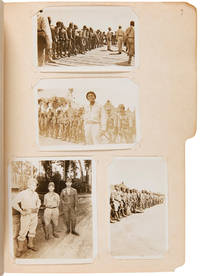
1945WRCAM55788Morotai Bougainville Green Island and other locations in the South Pacific 1945. Three clasp-bound collections of manila folders containing 113 mostly vernacular photographs occasionally captioned in pencil two divisional newsletters copies of Japanese surrender documents and numerous news clippings and assorted ephemera related to the soldier's war experiences. Minor dust-soiling to folders some toning to contents. Overall very good. An informative collection of photographs documents and clippings related to the World War II experiences of the African-American 93rd Infantry Division in the South Pacific. The 93rd Infantry Division was a segregated "colored" unit formed first during World War I and reactivated for service in 1944. The unit was shipped to the Pacific Theater where they served primarily in construction and defensive infrastructure operations. The 93rd occupied Morotai in the Dutch East Indies from April to October 1945 where they witnessed the surrender of the Second Japanese Army. <br> <br> The material in the present collection is organized in three compilations of clasp- bound manila folders with the contents of each compilation annotated in pencil on the front cover. The chief feature of the collection are the 113 photographs arranged thematically throughout the first two folders. <br> <br> Folder One contains photographs and documents pertaining to the Japanese surrender to the division's commander Major General Johnson. There are also photographs showing various Japanese troops surrendering to Australian officers including one of a Japanese officer surrendering to Gen. Thomas Blamey at Australian field headquarters in Morotai. A few photographs emanate from a Japanese hospital ship "taken over by our Div." showing "a few in the hospital." One photograph features an African-American soldier perhaps the compiler of this collection smiling in front of a line of surrendering Japanese soldiers. In the first folder there are also two copies of divisional newsletters: one from the 13th Jungle Air Force; and another titled IGUANA which was the daily newsletter for the 93rd Infantry we could locate no copies of IGUANA in OCLC. Rounding out the first folder are copies of an address on Japanese surrender delivered by Gen. Sir Thomas Blamey to Lieutenant-General Teshima Commander of the Second Japanese Army "On the occasion of the signing of their Surrender Morotai 9th September 1945" and a lithographic copy of the "Instrument of Surrender" between the two combatants. <br> <br> The front cover of Folder Two is titled in pencil "Places and People in the Netherland East Indies and Green Is. in the Northern Solomons and Bougainville." This folder contains images of Australian soldiers in Morotai; numerous pictures of indigenous Morotain people including men women and children; the entrance to the Morotai War Cemetery; photos of the 13th Australian Air Force; overhead images of an active volcano in Bougainville; pictures of Bob Hope Carol Landis a popular Hollywood actress who performed extensively for troops during the war and others on a U.S.O. mission at Bougainville; images of various aircraft including B-29 nose art and Japanese planes; a few pictures of dead Japanese soldiers in Morotai captioned "Good Japs"; photographs featuring the invasion of Morotai; and other images of the South Pacific islands where the compiler was stationed. <br> <br> Folder Three is labeled "Places I've Seen" and is composed of beer labels the compiler collected during his service along with numerous newspaper and magazine clippings memorializing his unit's service. The clippings indicate the compiler also served at Leyte in addition to Morotai Bougainville and Green Island in the Dutch East Indies. <br> <br> An interesting collection of firsthand photographs of an African-American unit's service in the South Pacific during the Second World War. unknown books
194520240The Hague ca. 1945. Hardcover. Near fine. Two oblong 8vo. albums. First album: 11.5" by 9" approx. String-tied faux-alligator boards. 43 gelatin-silver prints majority 3.75" by 2.5" but many 5.5" by 3.25" mounted to stiff gray leaves with cobweb-patterned tissue guards on each and handwritten captions in Dutch. Apparently complete. Near fine with several photos mildly yellowed but majority bright and sharp. <br /> <br />Second album: 13'' by 9'' approx. String-tied grey textured paper boards. 91 gelatin-silver prints of various sizes from 3.75'' by 2.5'' to 5.5'' by 3.25'' most of the latter size on stiff blue paper with tissue guards and handwritten captions in Dutch. Also contains an anti-Hitler card affixed to the front paste-down several cards with art and verse and two sepia-toned photographs on the final page. Two 5'' scuff marks to front board album corners and edges worn and bumped otherwise near fine with bright and sharp photographs. <br/><br/>A pair of carefully assembled albums possibly compiled for official use. The majority of the photos in both albums record the aftermath of a botched Allied bombardment in the Hague on March 3 1945; the attack claimed the lives of 511 civilians and left over 20000 people homeless. Targeted at a German missile base in the occupied Netherlands bombs deployed by the Royal Air Force landed instead in the adjacent Bezuidenhout neighborhood in the Hague destroying thousands of homes business and public buildings. The photos show several bombed-out churches and many apartment buildings with street names captioned underneath. Near the end of the first album three images show the burning of the Schevenigen Pier near the Hague which the compiler blames on the Germans but whose exact cause has never been established. The album forms a direct account of wartime destruction in the Netherlands. <br /> <br />The second album much more extensive includes some of the same material along with many other photographs. Affixed to the front paste-down is a black-bordered satirical memorial card for Hitler reading in Dutch "He came.but not to England / He saw.Moscow / He lost.the war." Beginning with two views of The Hague one in 1930 and one apparently mid-bombardment labeled March 3 1945 it also includes numerous scenes of destroyed buildings and monuments identified by street name. Some of these overlap with images from the first album; many do not. In addition to those showing the aftermath of the bombing several photos show intact monuments and buildings from neighboring cities like Middelburg possibly as a point of comparison with the ones destroyed. A few pages show photographs of various Bailey bridges at unspecified locations and other wartime construction. The final page of uncaptioned photos includes a shot of a pro-Hitler slogan painted in Dutch on a bridge underpass and a photo of several posters including a Dutch advertisement for "De Eeuwige Jood" The Eternal Jew a German propaganda film. A final leaf follows with two pro-R.A.F. cards with verses and drawings and three souvenir cards of Queen Wilhelmina Princess Juliana and her children Beatrix and Irene. The final page has two sepia-toned photos of a parade presumably celebrating the war's end. An important act of witnessing from an unfortunate event. hardcover books
27890PARIS, C. L. F. Panckoucke, 1817/1821 - EDITION ORIGINALE - In-8 (13,5 x 20,5 cm - Reliure uniforme 1/2 basane - dos lisse - Pièces de titre & de tomaison en maroquin rouge - Tranches jaunes - 23 tomes reliés sur 26 volumes (Manque 6, 8 & 10) + Couronne Poétique (1 volume) - légères rousseurs - Bon exemplaire Portraits de Généraux Français : PARIS, C. L. F. Panckoucke, 1818 - EDITION ORIGINALE - reliure plein veau de l'époque - dos lise très orné -Pièces de titre en maroquin rouge - 31 pages + 151 Portraits + 1 page de texte - rousseurs éparses - - Bon exemplaire - Envoi rapide et soigné - SOIT au Total 25 VOLUMES - Envoi rapide et soigné - Photographies sur demande
PARIS, C. L. F. Panckoucke, 1817/1821 - EDITION ORIGINALE - In-8 (13,5 x 20,5 cm - Reliure uniforme 1/2 basane - dos lisse - Pièces de titre & de tomaison en maroquin rouge - Tranches jaunes - 23 tomes reliés sur 26 volumes (Manque 6, 8 & 10) + Couronne Poétique (1 volume) - légères rousseurs - Bon exemplaire Portraits de Généraux Français : PARIS, C. L. F. Panckoucke, 1818 - EDITION ORIGINALE - reliure plein veau de l'époque - dos lise très orné -Pièces de titre en maroquin rouge - 31 pages + 151 Portraits + 1 page de texte - rousseurs éparses - - Bon exemplaire - Envoi rapide et soigné - SOIT au Total 25 VOLUMES - Envoi rapide et soigné - Photographies sur demande Edition originale parue en livraisons entre 1817 et 1821. L'ouvrage est illustré de 171 plans, cartes (par Tardieu) et gravures hors-texte très souvent dépliants et de 16 planches de fac-similé d'écritures ; le dernier volume contient 151 portraits de militaires et généraux. Monument militaire élevé à la gloire de la France par souscriptions. Bauvais, responsable de l'édition, demanda des mémoires à de nombreux militaires pour retracer l'histoire exacte, par des témoins, de l'histoire des batailles depuis l'an I de la République (1792) jusqu'en 1815. Une large introduction compare les français aux romains et dresse le tableau de son histoire militaire et de ses généraux, chaque livre détaillera ensuite pour chaque année l'histoire militaire et politique de la France et de l'Europe. Bien que cette préface donne le but de l'ouvrage, jamais on n'avait réuni autant de matériaux sérieux pour tracer l'histoire exacte de l'épopée militaire française sous la Révolution et l'Empire, vus comme une continuité. Les tomes 1 à 24 retracent l'histoire des différents faits militaires français ; les tomes 25 & 26 contiennent une table d'errata et une biographie militaire française dites "Tables du temple de la Gloire"l. L'ouvrage "Couronne Poétique" contient les chants & poésies consacrés à la Patrie & au courage, Enfin, le dernier ouvrage est une une galerie de portraits des maréchaux et généraux. Ces 2 derniers ouvrages sont très souvent absents.
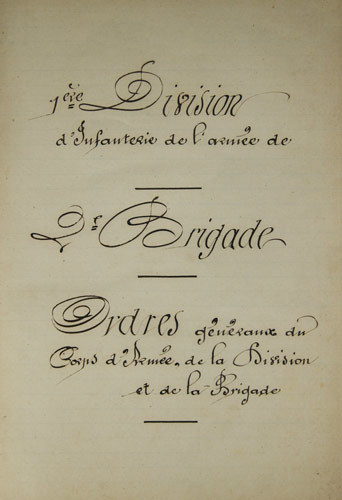
76339aafin-4to, 2 ff. (table d. mat.) + titre + 35 p. + 132 p. vierges, avec 17 lettres et notes d'ordres entre les feuilles, dont une partie portant le sceau du Général Commandant, rel. orig. en demi-toile avec titre manuscrit sur le plat sup., plats usées et lég. abîmés, mais en bon état.
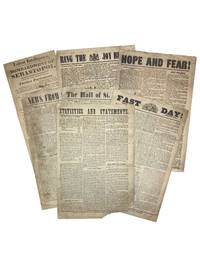
1854003685Nottingham: T. & W. Plant; Thomas Stevenson 1854. Collection of seven provincially printed broadsides relating to the Crimean war all printed in 1854 or 1855 the smallest measuring approximately 170mm x 370mm in size and the rest approximately 245mm x 370mm. All lightly browned some light foxing and light creasing a few small nicks and tears one 'News From Sebastopol!' with small chip to left hand margin and small hole to centre catching a few letters but with no loss of sense 'Statistics and Statements' with loss to bottom right hand corner but no loss of text 'Bombardment of Sebastopol' is laid on to linen. 'Bombardment of Sebastopol' was printed by T. & W. Plant in Clare Street Nottingham possibly descendants of James Plant see BBTI; the remainder were printed by Thomas Stevenson in Wheeler-Gate probably the same printer as the Thomas Stevenson & Co. located in Middle Pavement Nottingham in 1847 see BBTI. A mixture of news from the Crimean war which was one of the first conflicts to be extensively documented in reports and photographs. The topics here include death numbers notable events and diplomatic developments and are taken from a number of sources including European and Russian papers. Lord Raglan is noted in one as "a good rider and does not appear to feel the want of the arm which he left at Waterloo". All are unrecorded in Library Hub. First Edition. Unbound. Good. Folio. Broadside. T. & W. Plant; Thomas Stevenson Paperback
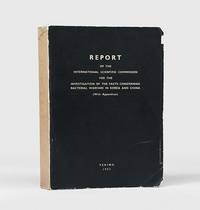
1952161381Beijing: Foreign Languages Press 1952. Perhaps the most controversial scientific report of the 1950s First edition in English first printing scarce in commerce of the so-called "Needham Report" an explosive exposé of American biological warfare in Korea compiled by the International Scientific Commission a team of scientists including the British biochemist and Cambridge don Joseph Needham. In March 1952 Needham and his colleagues were invited by the Soviet-backed World Peace Council to undertake an impartial investigation into Washington's conduct in the Korean theatre. The final publication released on 31 August 1952 was immediately divisive - lauded by the Communist bloc and dismissed by the United States for its "pseudo-scientific paraphernalia. skilfully designed to impress" Defence Research Board quoted in Avery unpaginated. Needham was blacklisted in Western academia although the report's findings came to seem increasingly credible. Bertrand Russell originally a sceptic later wrote in his 1969 autobiography that given developments in Vietnam "I owe Professor Needham and others my sincere apologies for thinking these charges too extreme". In addition to the report Needham 1900-1995 is most well known for his monumental Science and Civilisation in China a defining contribution to the study of the history of science. Quarto. With 103 half-tone plates 1 with glassine guard 2 large folding tables folding colour map tables and graphs in text. Original black and off-white limp card wrappers front cover lettered in off-white. Covers creased with a few small losses tidemarks on rear cover and at head of spine contents evenly toned with light cockling to final quarter a few neatly repaired closed tears illustrations generally well-preserved with browning to map: a very good copy. Donald H. Avery Pathogens for War: Biological Weapons Canadian Life Scientists and North American Biodefence 2013. unknown
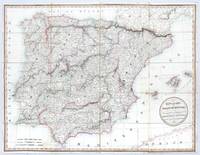
1811151721London: Robert Laurie & James Whittle October 9th. 1811. Charting the seat of war A scarce Peninsular War-era map nicely engraved by John Stephenson fl. 1790-1836 a veteran of the nautical chart trade and cannily utilising the name of the leading Spanish cartographer of the day Vicente Tofiño. An online institutional search shows five copies only: British Library Oxford Cornell Stanford and Chicago. Tofiño produced two excellent atlases covering the Iberian littoral the Derrotero de las costas de España and Atlas Maritimo both published in 1789. A reduced quarto edition of the former was published in 1812 by William Faden the king's geographer as Espana Maritima or Spanish Coasting Pilot and served as the standard onboard rutter for Royal Navy officers. Hand-coloured engraved map 630 x 810 mm linen backed dissected into 20 sections folding down into the original case 210 x 135 mm Spatter pattern marbled paper circular printed label to front priced in a contemporary hand at 12 shillings. Some old stains to verso just showing through in places on the map; a little wear to case yet overall a very good bright example. unknown
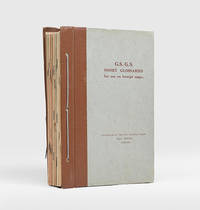
1947183934London: Geographical Section General Staff May 1943 - May 1947. A seemingly complete run as per the list on the rear pastedown of these official short-lists of foreign language topographical and descriptive terms to assist in the interpretation of Geographical Section General Staff maps together constituting an excellent period cartographic resource. The majority of these copies are first editions some provisional issues where stated the print-runs are 10000 but nonetheless they remain decidedly uncommon. "This collection of short loose-leaf glossaries has been compiled from official maps of the countries concerned. It does not attempt to be a complete list of all terms found on maps. neither the time nor the labour has been available. The Glossaries do however claim to cover the more usual and essential foreign terms which are likely to be found on maps and for which the map reader does require to know the English equivalent" intro. The glossaries collected here are first editions and 1943 unless otherwise stated - Albania Second Edition 1946; Arabic 1947; Burmese 1945; Bulgarian 1944; Chinese; Czech and Slovak; Danish 1944; Dutch; Estonian Provisional; Finnish; French; Indo-Chinese Languages A. Romanized Annamese 1945; B Romanized Thai Laos & Tonkin Provisional 1945; C. Romanized Khmer Provisional 1945; German; Greek; Hungarian; Icelandic 1944; Italian; Japanese Provisional; Latvian Provisional; Lithuanian Provisional; Malay A in English Orthography; Malay B in Dutch Orthography; Norwegian Provisional; Persian Provisional; Polish; Portuguese Provisional; Romanian; Russian; Serb and Croat; Swedish Provisional; Spanish; Thai; Turkish. Folio 270 X 165 mm. 35 issues average c. pp. 20. 4 issues with outline maps to the text. Triple hole-punched and laced into the original moderate reddish brown cloth-backed printed pale green paper-covered boards; each part wire-stiched into the original printed light card wrappers in various colours strong reddish orange designating provisional issues. Boards lightly rubbed and soiled through on the corners; lightly soiling or sunning on the wraps variable toning of the texts; very good. paperback
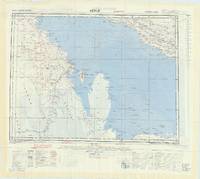
60029London: War Office 1957. 2 maps 62 x 72.5 cm printed recto verso in colour on one single sheet of rayon artificial silk marked "Restricted " in red. Published by the War Office in 1957 the present map shows large swathes of what are now the United Arab Emirates on a scale of 1:1000000. To the recto is a map entitled 'Hofuf' which shows the Persian Gulf Qatar Peninsula Bahrain Island part of the north-eastern coast of Saudi Arabia and a small part of Oman. To the verso is a map entitled 'Bandar Abbas' showing the Persian Gulf the Straights of Hormuz the Gulf of Oman and bordering countries. Both maps had first been produced by the War Office in 1945 and were revised only slightly for use here. Some light trivial fraying and small fold mark to upper margin not affecting map generally an excellent copy. During the Second World War the British War Office began to produce Escape and Evasion maps for its soldiers and personnel printed on Rayon acetate. Because of the silky nature of this material however which was chosen for its durability and portability they came to be known as silk maps. The War Office and later the Department of Defence continued to produce these throughout the twentieth century covering many regions across the world. The maps take the standard form of British Escape and Evasion maps with relief represented by hachures altitude tints and spot heights which height given in metres. Among the significant features shown are borders highways important roads railway tracks airports rivers bodies of water and telegraph lines. These are identified in keys alongside both maps where relevant information such as "fresh water" is emphasised. Alongside these keys there are other helpful resources for military personnel in the area whether by design or due to an emergency landing. These include a glossary of Romanised Arabic terms and diagrams placing the region shown in its wider geographical context. In 1932 Said bin Taimur became the Sultan of Muscat of Oman his Sultanate stretching down the entirety of Oman's eastern coast. His reign was supported by the British Government which maintained significant control over his land installing its ministers in his government. British interest the area was mainly motivated by the promise of oil with the Iraq Petroleum Company IPC being 23% British-owned and over the following decades the Sultan and the Company searched the deserts in the hope of striking a new and lucrative deposit. After failing to discover any significant resources within his direct domain however Said bin Taimur with the backing of the IPC raised an army to occupy the Imamate of Oman where he hoped to find oil at last. Thus in 1954 the Jebel Adkhdar War or Oman War broke out as the local Omanis and their leader Imam Ghalib ALhinai fought against the combined forces of the Sultanate and the British Army to protect their land from the would-be occupiers. Eventually Arab states including Egypt Saudi Arabia and Iraq came to the support of the Imamate but the war nevertheless stretched on until 1959 when a final effort by. The British SAS brought the conflict to a decisive end. The treatise and agreements signed in the aftermath of the war were heavily weighted towards British interests giving them trading rights the islands of Kuria Muria and extensive power over the Sultanate's ministries. The Sultanate was thus transformed into a de facto British colony. The present map produced in the very middle of the conflict shows much of the theatre of the Jebel Adkhdar War. It is not entirely clear however why the cities of Hofuf and Bandar Abbas both of which are indeed shown on their respective maps are selected as the titles for each. Neither seems to have played a role in the war and in fact the latter was a small fishing port of about 17000 people during the late 1950s. They are by no means the only cities to be shown with a wealth of toponyms covering the maps and so it remains a mystery why they have been singled out as titles. [London]: War Office, 1957. unknown
1917192609London: 25 July 1917. The devastating impact of submarines A typescript copy marked "secret" of a report from the director of statistics Lieutenant Colonel J. G. Beharrell to the first lord of the admiralty Eric Geddes. It was drafted during a period of increased fear of submarines and gives detailed statistics on annual losses of merchant ships fishing vessels and foreign ships. Much of this information is difficult to find compiled elsewhere. After the international outrage at the sinking of the Lusitania and the Arabic in 1915 the German Admiralty chose to suspend submarine attacks on passenger and neutral vessels. However in 1917 Admiral Henning von Holtzendorff successfully petitioned for a resumption of unrestricted submarine warfare in a last-ditch attempt to starve Britain. This led to a heightened sense of fear on the seas and eventually to the entry of America into the war. The report is split into two sections: Beharrell's letter to Geddes and the accompanying tables of data. Beharrell writes in his opening paragraphs that 1501 merchant vessels had been lost to date with a gross tonnage of 4698324 representing 26.1 per cent of the British pre-war sea-going capability. He then explains each table. First are four tables of annual losses for different types of vessels with estimated rates of annual loss. It is clear to see the growing impact of submarine warfare as the fighting progressed for example where 135 merchant ships were sunk by submarines in 1915 that number climbed to 950 in 1917. The following tables give data on mercantile shipping numbers accounting for losses and new constructions the overall effect on British tonnage the effects on overseas trade the number of ships escaping submarine attacks comparative losses on a monthly basis and the number of submarines reported as sunk. Folio 340 x 220 mm typescript in red and black on recto only of 20 leaves threaded with treasury tags into 2 groupings 5 and 15 leaves all in paper wrappers and tied with string through hole black typescript on front wrapper purple "SECRET" stamps throughout. Leaves a little soiled as expected rust stains around treasury tags fore edges of some leaves worn touching edge of text: a very good example. unknown
1516140915Paris: Maison du Livre 1915-16. Rare complete and in such good condition First edition first printing one of 100 on Japon paper this copy unnumbered. This illustrated collection of poems from the First World War was sold for the benefit of artists and craftsmen of the book industry who were wounded in that war. The contributing authors include Émile Verhaeren for Crime allemand Léon Bloy for Nous ne sommes pas en état de guerre Robert de Montesquiou for Nouvelles offrandes blessées and Marcel Boulenger for La belle santé. Folio in 12 parts. 12 engraved frontispieces after various artists including Théophile-Alexandre Steinlen Louis Legrand and Henri Gervex and a loosely inserted engraving after Carlos Schwabe titled "In Memoriam" and left blank to "receive the name of a beloved departed" title pages printed in red and black. Each part in its original colour card wrappers titles in black on colour backgrounds within decorative frames of claws and German spiked helmet untrimmed; with gilt-printed pictorial bifolio collective title page. Housed in custom cloth-backed blue card chemise. Ink stamp from a Rheims printer to front of chemise. light toning to collective title the wrappers otherwise remarkably bright unfaded and fresh internally clean; a near-fine set. hardcover
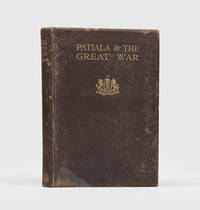
1923170533London: Printed by the Medici Society Ltd for private circulation 1923. A record of war service surpassed by no other State in India First and only edition rare in commerce. This illustrated history details the contributions of Patiala's Rajindar Sikhs and lancers to the defence of Suez and the Mesopotamian Campaign as well as the many tributes paid to them after the end of hostilities. The several dozen photographs chronicle the maharaja's wartime visits to the Middle East theatre and the Western Front. During the First World War the Maharaja of Patiala 1891-1938 recruited over 10000 subjects into the Indian Army and raised an additional 4300 men for infantry squadrons and his 72nd Hired Camel Corps. In 1921 he visited Brighton to unveil a new southern gateway for the Royal Pavilion constructed in thanks for the welcome afforded Indian soldiers convalescing in the city during the war. Octavo. Photogravure frontispiece after portrait of Bhupinder Singh Maharaja of Patiala with captioned tissue guard; 49 tipped-in platinum prints. Title page partly printed in blue. Original brown cloth over bevelled boards spine and front cover lettered in gilt and with gilt coat of arms of Patiala edges gilt black silk bookmarker. Cloth rather worn especially at foot of boards leaves brittle and a few beginning to split at gutter pp. 1-2 repaired and lined with tissue on verso couple of other repairs bookmarker split: a very good copy. hardcover
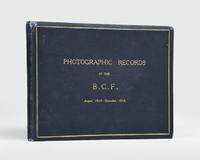
1916162509No stated place or publisher: after 1916. Gallantly led by Vice Admiral Sir David Beatty First edition profusely illustrated with shots taken at sea. It shows the battles of Dogger Bank and Jutland the damage done to ships such as HMS Lion and "the final moments of HMS Invincible" McCartney p. 116 before her destruction. We have traced only four institutional copies: the National Library of Scotland the universities of Leeds and Cambridge and the National Maritime Museum. The Battle Cruiser Fleet was formed in February 1915 after the Battle of Dogger Bank proved the effectiveness of this type of ship. It was commanded by Vice Admiral Beatty here photographed with his commodores and captains on page 16 and saw service most famously at the Battle of Jutland. Some of the illustrations in this volume show battles fought before the BCF was inaugurated such as Dogger Bank the Falklands and Heligoland Blight. The main focus is HMS Lion but HMS Southampton Invincible Indefatigable and Princess Royal also make regular appearances. Oblong folio. Half-tone photographic illustrations throughout. Original blue cloth over bevelled boards front board lettered and bordered in gilt yellow patterned endpapers. Binding rubbed especially at spine ends a couple of superficial scratches and scattered marks small split at spine head a few closed tears at edges sometime repaired with tape occasional minor foxing or finger-soiling: a very good copy. Innes McCartney Jutland 1916: The Archaeology of a Naval Battlefield 2018. hardcover
1930WORLDWAR014160The Soncino Press London. 1930. First edition. Foreword by William Rothenstein. Introduction by H.M. Tomlinson. Quarto. pp 16 sixteen plates with captioned tissue guards. Green buckram covers with gilt decorative design to front. The images are of an unremitting bleakness and come from sketches made by Percy Smith while he served as an artilleryman on the Somme. They could have led to a court martial as such things were expressly forbidden. The etchings are reproduced in collotype and printed at the Curwen Press.Out of a total edition of 167 numbered copies this is one of 145 on a Dutch mould-made paper.Some slight spotting to prelims. Covers a bit rubbed at the edges. Bottom corners of covers bumped. Very good. The plates are all fine. Scarce. The Soncino Press, London. hardcover
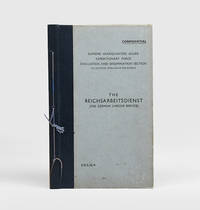
1944184351London: 1944. A counter-intelligence problem of considerable importance A confidential Anglo-American intelligence report on the Reich Labour Service produced ahead of the Allied advance into Germany warning of the threat it poses as an ideologically committed force but also of the opportunity it presents if it could be commandeered for post-war reconstruction. The Military Intelligence Research Section MIRS was a joint Anglo-American intelligence agency established in 1943 to analyse and exploit captured Axis documents. MIRS produced a series of handbooks on Nazi military and paramilitary organizations for Allied intelligence officers and military officials. This report estimates the RAD's total strength at 300000 men and notes its close ties to the Wehrmacht with members increasingly committed to military action. It describes the organization's structure and insignia and traces its evolution from a voluntary labour service in 1931 to a compulsory state body in 1935 culminating in its full integration into the war effort. It highlights its threat: "For the occupying forces the entire German Labour Service may well pose a counter-intelligence problem of considerable importance since Nazi indoctrination has been carried out within its framework to a far-reaching degree most of its members having been schooled in the Nazi creed ever since they were in the Hitler Jugend". However it is "a ready instrument for reconstruction work in occupied countries once these have been freed and it could be used in Germany itself for the maintenance or reconstruction of vital utilities or the demolition of military installations. The RAD when transformed into an instrument of peace could easily become a valuable educational factor in post-war Germany". Provenance: Evgenii Semenovich Mollo 1904-1985 a military historian specializing in uniforms and insignia with his "Mollo Collection" bookplate to the front pastedown. Folio. With 3 full-page illustrations. Original dark blue quarter cloth grey boards printed in black string tied. Minor pencilled annotations. Trivial wear at extremities a few marks to covers contents a little toned with some foxing. A very good copy. hardcover
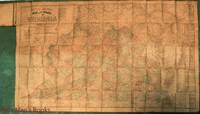
186239443US War Department. Very Good with no dust jacket. 1862. Hardcover. Color Illustrated; J. T. Lloyd. Lloyd's Official Map of the State of Virginia. New York: J. T. Lloyd 1862. 31 x 51.5". A large linen-backed folding map first issued in 1861 then 1862 and last issued in 1863 taken from Boye's map of 1828 and extensively revised. Each county is in color. This version was intended for use by Union military officer's and bears the printed notation "This is the only map used to plan campaigns in Virginia by Gen. McClellan". The map is mounted in embossed brown cloth covers measuring 4.5" x 7.25" and the front board is titled in faded gold Lloyd's $100000 Topographical Map of Virginia. By War Department. Largest and finest map of the state produced in the nineteenth century" according to Wooldridge. Linen backed aprox 32" x 51.5". Contents are in excellent condition. There are a couple small holes where the folds intercept. Colors are a bit muted as it was printed. Aging has darkened the background of map. On both the right and the left sides there are somewhat lengthy commentaries. The map is at least in Very Good condition as due to it's format it has had minimal light exposure. The entire contents consists of this map. Boards with cloth spine. Boards are VG though faded the color is even the spine matches the board color but is wrinkled. Complete as issued an unusually nice copy. . US War Department hardcover
1903000058WAYNE COUNTY NEW YORK NY. Good. 1903. Leatherette. Group of three handwritten diaries 1903 1907 1912 kept by this Civil War veteran who lived and farmed in Wayne County New York. Bindings and contents in very good condition. approx 6" x 3" 3 volumes 103pp in all written legibly in pencil. At the end of each volume is a detailed ledger of expenses yielding more details of farming. The author's style is eccentric semi-literate and very flavorful. For example: "Went over to the Collins Berring burying ground Mr. Wells was agointo put up some Hed Stones for Roswell and Matilda"; &c. &c. Together the three diaries give a comprehensive picture of life running a small-but-prosperous farm and orchard in upstate New York near Lake Ontario at the turn of the 20th century as reported by a simple unemotional but thorough man who does not identify himself. The author is fairly well off hiring a man or two to help with the field work almost every day although he works alongside the hired men. He also holds several mortgages on other people's properties. The diaries contain many details about working in the orchard and fields selling farm produce and livestock as well as doing maintenance to keep the farm and farmhouse operative. We also observe the changes in his farm chores and home activities as this Civil War veteran gets up in years. Visits to nearby towns are recorded: Rose; North Rose; Clyde; Lyons; Wolcott; Palmyra; State Fair at Syracuse; etc. Binding is cloth/leather.; Manuscript; 16mo - over 5¾" - 6¾" tall; WAYNE COUNTY NEW YORK HANDWRITTEN MANUSCRIPT DOCUMENT LETTER AUTOGRAPH WRITER HAND WRITTEN DOCUMENTS SIGNED LETTERS MANUSCRIPTS HISTORICAL HOLOGRAPH WRITERS AUTOGRAPHS PERSONAL PERSONAL HISTORY MEMOIR MEMORIAL DIARY JOURNAL DIARIES JOURNALS LOG LOGS KEEPSAKE AMERICANA . hardcover
13240Paris MARCILLY XVIIIème Ensemble de trois Canons, estampes en gravure en taille douce colorée à la main polychrome portant un texte en latin imprimé à l'encre noire avec illustrations se rapportant à l'iconographie et aux instructions liturgiques(collées sur carton enveloppé de papier vieux rose). Le canon central est Pliant et de forme rectangulaire horizontale (format déplié : 38 cm de haut x 61 cm de large - Format plié : 21,6 cm de large x 38 de haut), les deux autres de forme rectangulaire verticale (format : 24,8 cm de large x 33,4 cm de haut), Le canon central est composé de trois espaces scandé par un décor (décoré à la main) aux guirlandes de fleurs et Anges avec aux pieds des personnages bibliques avec leurs attibuts : MOÏSE et sa Table de la Loi, Saint-MARC assis sur un Lion avec un livre ouvert, Un Aigle avec Saint-JEAN l'évangéliste, Saint-LUC assis sur un Boeuf, Saint-PIERRE tenant ses Clefs à la Main, Saint MATTHIEU et son Ange, Saint-PAUL et son Epée, Saint-LAURENT en habit de Thuriféraire avec son brule-encens etc... avec des Anges dans la partie supérieure. Le canon dit du Dernier Evangile : le texte en latin est encadré à gauche et à droite de 2 Colonnes sculptées avec motif floral en couleurs surmontés chacune d'un Ange tenant une guirlande de feuilles verte au dessus du texte avec une Urne dorée au centre. Le canon dit du Lavabo présente le même type de mise en scène, avec au pied du texte en latin un Livre, une Croix d'or et un Brule-Encens représenté au lieu d'un Agneau Pascal blanc; l'ensemble est trés beau et les couleurs trés fraîches peintes à la main sont resplendissantes, le coin droit du canon central est fortement écorné sans que cela ne touche à aucun moment à la gravure, petites traces de coulures de cire, montrant bien que cet Autel Portatif à servi, sans date (XVIIIème) sans lieu ni nom d'Editeur ( peut être Paris Marcilly, rue saint Jacques n° 21, Imprimeur Editeur),
In folio oblungo (320x480); leg.in mezza pelle verde con percallina ai piatti, armi impresse in oro della biblioteca Cortiniana. Titolo inciso, dedica figurata. a Luigi XIV re di Francia e di Navarra, 3 tavv. iniziali raffiguranti la colonna e tre (su quattro) tavole raffiguranti in pianta e prospetto il basamento della stessa; 119 tavole in rame di Pietro Santi batoli, che rappresentano nel dettaglio i bassorilievi . Mancano, apparentemente mai rilegate, le 14 pagg. di testo del Ciaccone l'indice.<BR>Monumentale opera raffigurante le sculture che ornano la colonna traiana.<BR>Bell'esemplare con ampi margini, La legatura presenta abrasioni agli spigoli e alle cuffie, una traccia di umido al piatto inferiore. <BR>Olschki, Choix, n.16420. Berlin Kat. n.3622. <BR>
4 fogli senza titoli ma alcuni con una num. ms. nei margini. 1) mm 315x425 e margini, n. 65; 2) n.n., mm 300x400 e margini; 3) n. 66, mm 290x395 e margini; 4) n. 64, mm 305x410 e margini. Silografie con forte coloritura a maschere. Il foglio n. 66 reca la filigrana "GR", ed è databile 1820-1825 mentre gli altri sono in tirature su carta del secondo quarto del XIX secolo. I soldati, singoli o a gruppi, a piedi o a cavallo, sono suddivisi su due o tre strisce ed erano destinati ad essere ritagliati dopo essere stati incollati su fogli di carta o cartoncino di rinforzo. I Remondini produssero altri fogli di soldatini alla fine del XVIII secolo ma da matrici in rame e di formato più piccolo. "Degli esemplari settecenteschi non sembra purtroppo sia rimasta traccia. L'assortimento più ampio di soldatini i Remondini lo offrirono durante le guerre napoleoniche, con serie di fogli degli eserciti: austriaco, inglese, russo e francese, ricavati da matrici in rame. Anche di questi fogli però non risulta si siano conservati esemplari".. Cfr. Infelise-Marini, 1990 nn.13, 14, 15 pp.212/213; Zotti Minici 1996 nn.1576, 1577, 1578..