119 781 résultats
18620000618<p>Charlestown Virginia: Head Quarters Banks' Division Charlestown March 5 1862. First edition. Folio 13.5" x 10" letterpress broadside printed on thin paper in black ink. Accompanied by a manuscript version of the text single sheet 2 pages which includes corrections as reflected in the published version almost certainly contemporary. Corona & Shetler/ West Virginia Imprints 805 citing this copy. </p><p>Broadside with old folds edge wear tears & a couple of old tissue repairs on the verso. Manuscript folded & foxed.<br /></p><p>General Nathaniel P. Banks via Assistant Adjutant General & Major of Volunteers R. Morris Copeland condemns the actions of troops for "<b><i>depredations on property disturbance of peaceful families and the most reprehensible infringement upon the rights of citizens"</i></b> and warns of the consequences:<br /></p><p><b><i>"To countenance excuse or tolerate such crimes is to impair and destroy the discipline of the army and injure the holy cause that we have left our homes to sustain. The citizens who are wronged suffer least from the injuries inflicted upon them. The curse returns upon the army which thus abuses its power and for that reason as well as others they must be suppressed. Men who commit such flagrant acts will meet the punishment such acts deserve and for the worst the punishment is DEATH." </i></b><br /></p><p>Major Robert Morris Copeland was dishonorably discharged from the army later in 1862.<br /></p><br /> Head Quarters, Banks’ Division, Charlestown books
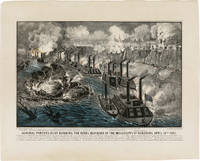
1863WRCAM56146New York: Currier & Ives 1863. Handcolored lithograph 12 x 15 inches. Tiny chip in upper left corner well away from the image. A clean near fine copy. A colorful and dramatic depiction of Admiral David Dixon Porter's Mississippi River Squadron running the Confederate blockade at Vicksburg during the siege of the city by Union forces in 1863 an important strategic victory in taking control of the river. Captions identify Porter's flagship the U.S.S. Benton in the right foreground leading the Lafayette and General Price which are followed by the Louisville Mound City Pittsburg Carondelet Silver Wave Forest Queen Henry Clay and Tuscumbia. A barrage of cannons fire from both the squadron and the Confederate batteries on the embankments overlooking the river. Union cannonballs are hitting both the batteries and the buildings on the bluffs of Vicksburg further in the background. Clouds of smoke billow from the ships the burning buildings and one of the floats of flammable material set out by the Confederates. <br> <br> Initially Grant had asked only for a few gunboats to shield his troops but Porter persuaded him to use more than half of the Squadron. Six nights later April 22 they made a similar run past the batteries to give Grant the transports he needed for crossing the river. Grant first tried to attack the Rebels through Grand Gulf south of Vicksburg and had Porter's gunboats eliminate the two forts there so his troops could cross. Despite intense shelling the upper fort held; Grant called off the assault and moved downstream to Bruinsburg where he crossed unopposed. Afterwards Porter's ships remained in place securing the Mississippi and Yazoo Rivers and guaranteeing the success of the siege. Grant was effusive in his praise Porter's actions and for his contribution to the victory Porter's appointment as acting rear admiral was made permanent. <br> <br> The additional printed caption describes the event thusly: "At half past ten P.M. the boats left their moorings & steamed down the river the Benton Admiral Porter taking the lead - as they approached the point opposite the town a terrible concentrated fire of the centre upper and lower batteries both water and bluff was directed upon the channel which here ran within one hundred yards of the shore. At the same moment innumerable floats of turpentine and other combustible materials were set ablaze. In the face of all this fire the boats made their way with but little loss except the transport Henry Clay which was set on fire & sunk." <br> <br> The Union victory at Vicksburg was the second major blow to the Confederacy in the spring and summer of 1863. On July 3 Lee's invasion of the North foundered at Gettysburg and on July 4 the U.S. flag rose over Vicksburg. This print is surprisingly uncommon in the market. CURRIER & IVES: CATALOGUE RAISONNÉ 0058. PETERS CURRIER & IVES 1180. Currier & Ives unknown books
40474This Union officer served on the staff of Brigadier General James Shields whose troops faced Stonewall Jackson's Confederate troops in the Shenandoah Valley in June 1862 and later commanded the Second Louisiana Regiment Cavalry; he was a good friend of famed Irish soldier Miles W. Keogh 1840-76 killed in the Battle of the Little Bighorn who served under him in the Papal Army during the Italian rebellion in 1860 and who fought with him in the Battle of Port Republic; he's reported to have become enamored with famed Southern spy "Belle" Boyd" at one point and to have unwittingly revealed military secrets to her. Outstanding pencilled ANS 2pp recto and verso heavy stock 4" X 2½" card "Conrad's Bridge" Virginia n.d. ca. early June 1862. Addressed to "General" probably James Shields. Very good. Lightly age toned. In this remarkable small report Keily reports in a small tight but fairly legible hand to his commander that "Col. Carroll moves his comm'd. at p.m. and will push on as rapidly as possible some cannonading heard this morning in the direction of Harrisonburg I would respectfully submit that if the Infantry did not move rapidly enough to carry out your views at Wainesborough before Jacksons arrival there a reconnaisance composed of cavalry conducted cautiously might attain the object with a good Guide which we have procured I would be glad to undertake it -- respectfully" and signs off adding his rank "Capt. A.D.C" beneath. A rather light challenging to transcribe postscript reads "P.S. Just received information from a reliable source that Jackson has --- --- --- Train on the --- Pt. Republic Road." It's difficult to precisely date Keily's note but General Shields did write General McDowell on June 4 1862 that "Colonel Carroll. after a forced night's march reached Conrad's Bridge this morning at 5 o'clock which bridge he found burned" -- which likely dates Keily's letter from this date or shortly after. Whether Shields took Keily up on his offer to lead a cavalry reconnaissance is unclear. Shields 1810-79 is perhaps best remembered as the Illinois politician who almost fought a duel with Abraham Lincoln in 1842; he's also the only person in American history to serve as U.S. senator from three different states Illinois Minnesota and Missouri; as a brigadier general of volunteers in the Civil War his lackluster performance as commander of the 2nd Division of the V Corps in the Army of the Potomac during the crucial Valley Campaign caused him to resign his commission. On June 9th the Battle of Port Republic took place a costly Confederate victory in which Jackson's 6000 troops faced off 3500 Union troops losing just over 800 men to the Union's loss of just over 1000 men -- a battle at which Keily himself was severely wounded in the face while leading a charge of Ohio cavalry up a hill into a barrage of Confederate artillery fire. The following year after painful recuperation Keily ended up on the staff of General Charles P. Stone in New Orleans recruiting cavalry troops in that occupied state. Late in the war he was court-martialed for "conduct unbecoming an officer" but the charges were shown false and by the end of the war he was brevetted a brigadier general. Keily died from yellow fever in Louisiana at age 38 shortly after the war's end making his autograph material quite scarce -- and a choice war-date item such as this most desirable. This remarkable war-date communication sheds interesting light on Shields as commander during the disastrous Valley Campaign. unknown books
40474This Union officer served on the staff of Brigadier General James Shields whose troops faced Stonewall Jackson's Confederate troops in the Shenandoah Valley in June 1862 and later commanded the Second Louisiana Regiment Cavalry; he was a good friend of famed Irish soldier Miles W. Keogh 1840-76 killed in the Battle of the Little Bighorn who served under him in the Papal Army during the Italian rebellion in 1860 and who fought with him in the Battle of Port Republic; he's reported to have become enamored with famed Southern spy "Belle" Boyd" at one point and to have unwittingly revealed military secrets to her. Outstanding pencilled ANS 2pp recto and verso heavy stock 4" X 2½" card "Conrad's Bridge" Virginia n.d. ca. early June 1862. Addressed to "General" probably James Shields. Very good. Lightly age toned.In this remarkable small report Keily reports in a small tight but fairly legible hand to his commander that "Col. Carroll moves his comm'd. at p.m. and will push on as rapidly as possible some cannonading heard this morning in the direction of Harrisonburg I would respectfully submit that if the Infantry did not move rapidly enough to carry out your views at Wainesborough before Jacksons arrival there a reconnaisance composed of cavalry conducted cautiously might attain the object with a good Guide which we have procured I would be glad to undertake it -- respectfully" and signs off adding his rank "Capt. A.D.C" beneath. A rather light challenging to transcribe postscript reads "P.S. Just received information from a reliable source that Jackson has --- --- --- Train on the --- Pt. Republic Road." It's difficult to precisely date Keily's note but General Shields did write General McDowell on June 4 1862 that "Colonel Carroll. after a forced night's march reached Conrad's Bridge this morning at 5 o'clock which bridge he found burned" -- which likely dates Keily's letter from this date or shortly after. Whether Shields took Keily up on his offer to lead a cavalry reconnaissance is unclear. Shields 1810-79 is perhaps best remembered as the Illinois politician who almost fought a duel with Abraham Lincoln in 1842; he's also the only person in American history to serve as U.S. senator from three different states Illinois Minnesota and Missouri; as a brigadier general of volunteers in the Civil War his lackluster performance as commander of the 2nd Division of the V Corps in the Army of the Potomac during the crucial Valley Campaign caused him to resign his commission. On June 9th the Battle of Port Republic took place a costly Confederate victory in which Jackson's 6000 troops faced off 3500 Union troops losing just over 800 men to the Union's loss of just over 1000 men -- a battle at which Keily himself was severely wounded in the face while leading a charge of Ohio cavalry up a hill into a barrage of Confederate artillery fire. The following year after painful recuperation Keily ended up on the staff of General Charles P. Stone in New Orleans recruiting cavalry troops in that occupied state. Late in the war he was court-martialed for "conduct unbecoming an officer" but the charges were shown false and by the end of the war he was brevetted a brigadier general. Keily died from yellow fever in Louisiana at age 38 shortly after the war's end making his autograph material quite scarce -- and a choice war-date item such as this most desirable. This remarkable war-date communication sheds interesting light on Shields as commander during the disastrous Valley Campaign. unknown
1925536421925. Folio. Eight pages approximately 2750 words; accompanied by another autograph letter from Russell to Trowbridge 14 March 1925; 4to four pages approximately 750 words with more information on the political situation in Missouri on the eve of war and an autograph transcription by Russell of the long poem "The Battle of Wilson's Creek August 10 1861" folio two pages with his own commentary on the poem. Folded. Insect damage to the poem and first leaf of the longer letter resulting in the loss of a number of letters but quite legible throughout. 813. Russell a native of St. Louis enlisted under Lincoln's first call for troops and served in a Missouri regiment through the summer of 1864. Following an outline of sectional struggle from 1820 and early events of the war given in the first half of the longer letter Russell describes the events of the Wilson's Creek Campaign and then his own eyewitness to history: "The Kansas boys like ourselves were resting when all at once the rebels crept up the hill to the top of the crest opened a tremendous fire right into the Iowa boys and our regiment but we went at them anyway and a hand to hand struggle began . My Captain Cary Gratz was killed . I was wounded four times and the Kansas boys were holding their own. Capt. Lyon had been hit twice once a scratch along the forehead and a light superficial wound in the knee. I was carried down the hill and placed on the hill side opposite the line of battle the valley being merely a hollow. I had a good view of the fight as it went on. My first attention was attracted to my right as I lay there and watched Capt. Lyon trying to rally the Iowa boys who were in a panic their Colonel had been killed and although the Kansas boys had saved them Capt. Lyon was rallying them into formation to use as they were then near the front. All at once I saw him rear off that dople sic gray horse and fall to the ground. Maj. Schofield also ran to his side a messenger sent for our surgeon Dr. Comyns . Capt. Lyon was carried down the hill he was shot nearly half way up from the hollow to the battle lines. The bullet had struck him squarely in the breast and had gone through his hear and he had lost the pleasure of seeing the victory his indomitable courage had won."_The Confederates commanded by Gen. Sterling Price made another assault following the death of Lyon but Samuel Sturgis rallied the Union troops and the Federal lines held. Sturgis then left the field toward Springfield and the Confederates did not pursue him. "The campaign marked the beginning of the war in Missouri and the trans-Mississippi. Afterward the Federal army withdrew to rolla Missouri leaving the Southerners in possession of most of the southwestern region of the state" "Encyclopedia of the Confederacy"._Lyon 1818-1861 a Connecticut native graduated from West Point in 1841 served in the Mexican War and on the western frontier most of the time to the eve of Civil War in "Bleeding Kansas" becoming involved in the political issue of slavery in the territories. Appointed brigadier general in May 1861 to command the Union forces in St. Louis he also led discussions with Confederate sympathizers on Missouri's position in the union; when compromise failed he launched his first military campaign which culminated in his death at Wilson's Creek. "The entire north mourned his death and he immediately became a national hero and martyr . his brilliant work had done much to hold Missouri for the Union" DAB. <br/><br/> unknown books
193362637Baltimore: Maryland War Records Commission 1933. Presumed first edition/first printing. Hardcover. Good. No dust jacket. Cover has some wear and soiling. Map box has tear at bottom. Small tears to the top of some pages. 3 volume set. Volume 1 A-J xiv 1056 p.; Volume II J-Z vi 1057-2355 p. Volume III 5 maps. The publication of these volumes 2 volumes of text one volume with 5 large folding maps concluded the wrok of the War Records Commission. The Introduction proves a General Review of the War statements on Maryland's Contribution to the Military and Naval Forces the National Guard and includes tables of statistics decorations and citations an Honor Roll and then the service records. Maryland War Records Commission hardcover
1846WRCAM46339Monterey 1846. Broadside 12 1/4 x 8 1/2 inches. Old fold lines. Minor wear. Near fine. In a cloth clamshell case. American forces under the overall command of Gen. Zachary Taylor fought for control of the important city of Monterrey Mexico during September 22-28 1846 in one of the most important battles of the Mexican- American War. The Mexican forces under Gen. Ampudia trapped in the city plaza and bombarded with artillery decided to negotiate and Taylor agreed to a controversial armistice lasting eight weeks. The occupation of the city was disrupted by the behavior of the American troops especially the Texans who were as a result sent back north. On October 5 a Mexican lancer was shot by an American soldier - without provocation - while riding through the streets. Taylor was forced to ask for instructions on how to try the man only to find that no American laws applied and that he could only discharge the man and send him home. With the present decree the U.S. Army tried to establish some legal principles for ruling the city in this period. All rights enjoyed by citizens under Mexican law are to be retained including commercial laws for dealing with foreign merchants excepting supplies purchased for the use of the army; additionally no payments can benefit the government of Mexico and every supplier of the army must be registered. hardcover books
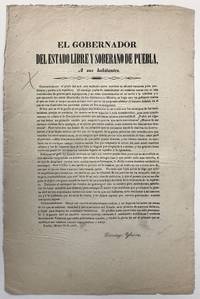
18471730Puebla 1847. Very good. Broadside 12.75 x 8.5 inches. Minor soiling and wear. A rare broadside that prints the thanks and admonitions of the Governor of Puebla Domingo Ibarra following an attempted insurrection there in late February and March 1847 during the Mexican-American War. The uprising was a part of the so-called Polkos Rebellion that followed popular outrage at a January law that allowed the federal government to seize church property in order to pay for the war effort. In Puebla the revolt involved elements of the city's military garrison but was successfully put down by the rest of the guard. In this address Ibarra seeks to inspire unity amongst the citizenry and to warn them of the imminent danger of the American army having just landed at Veracruz. The broadside begins:<br/><br/>"Conciudadanos: el génio del mal está soplando nosotros su aliento venenoso para perdernos y perder á la república. El enemigo acaba de desembarcar en nuestras costas con un tren considerable de guerra para sojuzgarnos y en estas circunstancias se os invita á la rebelion y á que apoyando las miras liberticidad de los disidentes de México se haga caer un gobierno contra el que se tiene el mayor encono porque es el que se ha propuesto afirmar el sistema federal en el que se ven frustrados los perversos planes de los monarquistas. Si hoy que se vé la patria en un peligro tan imminente no se contienen los enemigos de las instituciones porque su ambicion de mando se hace superior à toda consideracion ¿qué será cuando estemos en calma si la Providencia permite que salvemos nuestra nacionalidad"<br/><br/>The landing of Scott at Veracruz was probably the primary encouragement for negotiations between rebel factions and the federal government. Ibarra concludes:<br/><br/>"Obrad con vuesta acostumbrada cordura y asà dejareis burladas las miras de los que os seducen. Atendad à que la salvacion del Estado es el primero de nuestros deberes y dejad para despues las cuestiones domésticas. El pérfido norte-americano nos está provocando á las guerra casi en nuestras mismas puertas: corramos á combartirlo: auxiliémos à nuestros hermanos de Veracruz que están pidiéndonos socorro y tendrà la gloria de ser el primero que sacrifique con vosotros vuetro conciudidano y amigo."<br/><br/>A stirring address and rare. We locate only one copy at Yale. unknown books
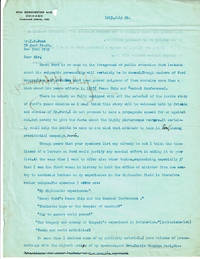
192395410Chicago: July 20 1923. 1923. Good. - A one-and-a-quarter page letter with over 325 words typed on 2 sides of her 11 inch high by 8-3/8 inch wide light blue "4740 Dorchester Ave. Chicago" stationery. In her letter to the American lecture agent James B. Pond the noted feminist & pacifist Rosika Schwimmer outlines her intention to offer a lecture on Henry Ford's role in the Peace Ship expedition she led in the early years of the First World War a timely subject as Henry Ford was then campaigning for the Presidency. "Though numbers of Ford biographies and articles have been poured out none of them contains more than a hint about his peace efforts in 1915 Peace Ship and Neutral Conference." She goes on to explain that she is not proposing to "make a propaganda speech for or against him but merely to give the facts about a highly picturesque venture. It certainly would help the public to make up its mind what attitude to take in Ford's coming presidential campaign." Schwimmer also tells Pond about the subjects of other lectures she can offer listing 6 of them. Boldly signed in full on the verso with a couple of corrections in her hand. Folded for mailing with a few short tears to the bottom and to the edges of the folds reinforced with clear archival document tape from the verso. There is a horizontal crease along the top with a perforation to the top left. <p>The Hungarian-born leader in the international pacifist and feminist movements Rosika Schwimmer 1877-1948 was a leading advocate of women's rights in Hungary. Schwimmer campaigned against child labor and for marriage reform and birth control. Her Hungarian Feminist Association succeeded in passing woman suffrage laws in 1920 Hungary. Living in London when the First World War was declared she traveled to the United States to convince President Woodrow Wilson and William Jennings Bryan to sponsor a neutral mediation conference. Unsuccessful she traveled the US speaking to a wide range of constituencies including feminist and Jewish groups. Creating the Women's Peace Party she convinced Henry Ford to sponsor a Neutral Mediation Conference in Stockholm. Setting off on the Oscar II which became known as the Peace Ship the American delegation was ridiculed by the press and suffered several setbacks. Several delegates resented Schwimmer's overbearing authoritative approach and supposed financial mismanagement and Henry Ford withdrew his support. She served as Hungary's minister to Switzerland during its brief existence as a democracy but fled after Bela Kun's communist party took over. Returning to the United States in 1921 she was shunned by those who had once supported her and had difficulty obtaining speaking engagements. A Chicago federal district court denied her application for American citizenship as she would not "bear arms in defense of the country" due to her pacifist convictions and because she was an advocate for a form of World government. The district court decision was upheld by the U.S. Supreme Court but with a dissent from Oliver Wendell Holmes Jr. The first reason for denying her citizenship is laughable considering her advancing age and that women were not then expected to serve in combat. She remained in the US as a resident alien until her death and was awarded a privately sponsored World Peace Prize and subsequently nominated for the Nobel Peace Prize in 1948. Chicago: July 20, 1923. unknown
1898WRCAM54953Puerto Principe Cuba 1898. Broadside 16 1/4 x 12 1/4 inches. Toned old folds and creases minor edge chipping short closed tear slight fold separations. Very good. A very rare possibly unique surviving example of a Cuban broadside dating from the month after the conclusion of the Spanish- American War. The war ceased with a truce between the United States and Spain on August 12 1898; the official end of the war came a few months later on December 10 when the two parties signed the historic Treaty of Paris. Here on September 10 in the interim between truce and treaty the outgoing Spanish colonial governor of the south- central Cuban city of Puerto Principe present-day Camagüey Emilio March y Garcia calls for reinforcement of the truce agreement that would ensure free and open commercial trade in the region in the face of continuing interference by Cuban insurgents. March y Garcia claims that the Cuban revolutionaries are illegally detaining people interrupting the cattle trade trampling property rights carrying arms in flagrant disregard for the law and more. The ARIZONA REPUBLICAN published an English translation of this proclamation in its September 26 1898 issue. The translation reads: <br> <br> "I hereby inform the commanders of insurgent bands who are pillaging in the neighborhood of this city; who not observing the agreement between the Spanish and American governments with regard to the freedom of commercial relations are illegally detaining the country people; who are obliging the land owners to procure special passes and permits in order to put in order their plantations and will not allow them either to sell their cattle under the absurd pretext that the estates are the property of the nominal Cuban state and that its government alone can distribute and sell them and turn their products to what uses it sees fit thus trampling under foot the rights of property whereas on the part of this government the most absolute liberty in making contracts has been allowed and will be allowed in the future thus demonstrating the respect it has for the rights of all persons within its jurisdiction. I must call to notice with real sorrow that if these towns are suffering almost the horrors of starvation it is the result of the measures adopted by the chiefs of the insurgent bands who are impeding free traffic by forbidding the entry of all kinds of provisions especially cattle into the towns. In view of what I have already explained I consider it necessary to publish the following warnings: Article 1. I repeat my order of August 23 last permitting free entry and exit to all towns of this province subject to my authority and the most absolute freedom of trade between all the inhabitants of the province. Article 2. The prohibition to enter towns with arms remains in force and whoever is found with arms in his possession will be punished in accordance with the laws." <br> <br> Don Emilio Augusto March y Garcia Mesa was a career Spanish military commander who spent at least three stretches of time in Cuba the last as military governor of Puerto Principe during the Spanish defeat in the Spanish- American War. He also served as the colonial governor of Puerto Rico and general captain of Arago the Balearic Islands and the Canary Islands. <br> <br> The present broadside is exceedingly rare and quite possibly unique with no copies listed in OCLC and no records at auction. unknown books
1772178R58Printed by W. Strahan Jun. for T. Becket and Co. and T. Cadell in the Strand T. Davies in Russel Street and T. Evans in King Street London: . 1772 pp. 8 540 2 22 56 57 65 32 33 A handsome bust portrait engraved by Basire after Cipriani. Portrait offset on to the unusual title page. Some old foxing. Large 4to. 295 mm. x 240 mm. Modern plain full leather binding. Hardbound. Very good. WITH AMERICAN CIVIL WAR ERA 1863 MANUSCRIPT NOTES AND ANNOTATIONS. Edited by the great 'Republican' Thomas Hollis with additions and corrections by Joseph Robertson this edition includes: Memoirs of the Life of Algernon Sydney; Discourses Concerning Government; Letters of Algernon Sydney taken from Thurloe's State Papers; The Protector's Advice to Algernon Sydney; Letters of Algernon Sydney taken from the Sydney papers; Letters of A. Sydney to Henry Savile Ambassador in France; The Trial of A. Sydney; The Apology of A. Sydney in the Day of his Death; and A General view of Government in Europe. This is an important book in the history of the ideas that founded the American republic but what is perhaps most interesting about this copy are the manuscript notes and annotations written in a careful small hand in America during the Civil War 1863. A few of these struck our eye and we're glad to reproduce a few selections here: "I have lately undertaking to read Algernon Sydney on government. There is great difference in reading a book at four and twenty and at eighty eight. As often as I have read it and fumbled it over it now excites fresh admiration that this work has excited so little interest in the literary world. As splendid an edition of it as the art of printing can produce as well as for the intrinsic merits of the work as for the proof it brings of the bitter sufferings of the advocates of liberty from that time to this and to show the slow progress of moral philosophical political illumination in the world ought to now be published in America" - John Adams to Thomas Jefferson 17 September 1823. ".the danger in America. arises from 1 the indifference of the people to the character of their deputies; 2 the disinclination of good men to go as deputies; 3 and the inclination of bad men to go as such. The rottenness of our law making bodies has reached such a point that if it shall not soon be cured it can not longer endure." - 1863. "Among the causes which have brought the USA to their present unhappy condition may be reckoned as a leading one the predominance in their councils of mere municipal lawyers. The low morals and the crass ignorance of these are not equal to the work of government filched by them from a blindly confiding people. A profession proverbially selfish and dishonest can not produce statesmen however fecund it may be of politicians. The conduct of government is the work of statesmen - of unselfish honest high-hearted great-minded men = that class has disappeared and has given way to small country lawyers whose minds exercise only upon petty squabbles of the neighborhood incapable of grasping the vast concerns of a nation. Bad as this is there is something worse. and that is that the profession of the law is every year sinking lower in ignorance and in contempt while at the same time it is rising in power." - 1863. These manuscript annotations make this copy UNIQUE and very worthy of further study. W150. PRICE JUST REDUCED! Language: eng. Hardcover. Very Good. Printed by W. Strahan Jun. for T. Becket and Co. and T. Cadell in the Strand, T. Davies in Russel Street, and T. Evans in King S hardcover
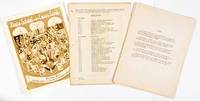
51-4278Lowry Field in Denver Colorado.:States War Department - Department of the Armyand Polaroid 1940-44. Most material in the Archive is printed in mimeograph form and measures 11x8½" unless otherwise noted. Some material marked "Restricted" below "Confidential" which is a classification no longer used. . A large Archive of WWII photo technical school course materials used by the Department of the Army for the training of personnel in photography at Lowry Field in Colorado.The Basic photography classes at Lowry Field normally lasted six months consisting of courses in elementary ground and aerial photography; mosaics and mapping; camera repair; cinematography; and photographic field equipment. During World War II Lowry’s tasking to provide increased trained personnel to the U. S. military resulted in the base population reaching 20000 operating three shifts seven days a week twenty-four hours a day.Archive includes: Photograph: Photo School at Lowry Field Graduating Class of November 14 1942. 154 pp Manuscript course notes.IF abbreviation stands for Information Form List of Instruction Forms of the Photo Technical School. 8/1943. 7 pp. List of Instruction Forms of the Photo Technical School. 11/1943. 7 pp. IF#1-1 Organization of Army. 1942. 51 pp. IF #0 Photographic Department. 1942. 2 pp. IF #0 Index of Instruction Forms. 1942. 5 pp. IF #4 Lettering Of Student Instruction Negatives. 1942. 1 pg. IF #4 Mix Photographic Processing Solutions. 1943. 7 pp. IF #9 Photographic Assignments. 1942. 2 pp. IF #10 Skin Inflammation Caused By Photographic Developers. 1941. 2 pp. IF #10-1 Optical Formulas. 1942. 16 pp. IF #10-2 Care and Cleaning Lenses and Bellows. 1942. 8 pp. IF #10-3 Photographing With the Tripod Mounted Camera. 1942. 16 pp. IF #10-4 Exposure and Exposure Meters. 1942. 18 pp. IF #10-5 The Elements of Photography. 1942. 14 pp. IF #10-6 Projection Printing. 1942. 18 pp. IF #10-7 The Elementary Principles of Fixing Baths. 1942. 18 pp. IF #10-12 Photographic Finishing. 1942. 18 pp. IF #10-13 Artificial Lighting For Photography. 1942. 22 pp. IF #10-15 The Elementary Principles of Developers. 1942. 24 pp. 2 copies IF #10-19 Photographic Processing Solutions. 1942. 20 pp. 2 copies IF #10-20 Contact Printing. 1942. 14 pp. IF #10-22 Copying. 1942. 16 pp. IF #10-23 Fundamentals of Photographic Filters. 1942. 16 pp. IF#10-25 Mechanics Of Sheet Film Processing. 1942. 10 pp. IF#10-26 Elementary Principles Of Light and Lenses. 1942. 20 pp. IF#10-27 Mixing Photographic Solutions. 1942. 14 pp. IF#11 Photographic Chemistry. 1942. 6 pp. 2 copies IF#12 Photographic Optics. 1941. 8 pp. IF#12 Photographic Optics. 1942. 8 pp. IF#15 InterValometer. 1942. 3 pp. IF#17 Check Sheet Operating of the Type A-2 Ground Camera. 1940. 2 pp. IF#18 Check Sheet Setting the A-2 Ground Camera For Register Without Filters. 1940. 2 pp. IF#19 Photographic Review. 1941. 7 pp. IF#27 Check Sheet Operation of the Type C-3 Ground Camera. 1942. 10 pp. 2 copies IF#29 Printing Aerial Negatives For Mosaic Assembly. 1942. 1 pg. IF#34 Retouching Varnish For Use Either With Negative Or In Spotting Glossy and Semi-Mate Prints. 1942. 1 pg. IF#48 Mixing Solutions By Hydrometer. 1941. 1 pg. IF#50 Intensification Of Aerial Roll Film. 1942. 2 pp. IF#50-1 The Contrast of the Negative. 1942. 6 pp. IF#50-2 Principles of the Fixing Bath. 1942. 10 pp. IF#50-3 Photographic Lenses. 1942. 10 pp. IF#50-3 Photographic Lenses. 1942. 9 pp. IF#50-4 Mixing Photographic Solutions. 1942. 12 pp. IF#50-5 Speed of the Film. 1942. 7 pp. IF#50-6 Standard Developing and Fixing Solutions and Their Use. 1942. 13 pp. IF#50-7 Copying-General. 1942. 5 pp. IF#50-8 Copying With Process Color-Blind Emulsions. 1942. 4 pp. IF#50-9 Copying With Orthochromatic Emulsions. 1942. 3 pp. IF#50-10 Copying With Panchromatic Materials and Filters. 1942. 4 pp. IF#50-12 Exposure and Photoelectric Exposure Meters. 1942. 5 pp. IF#50-13 Use of Kodachrome Film Type V Class M. 1942. 8 pp. 3 copies IF#50-16 Calculating Exposure With Extended Bellows. 1943. 6 pp. IF#50-22 Reduction and Intensification of Negatives. 1943. 9 pp. IF#50-22a Reduction and Intensification of Negatives. 1943. 9 pp. IF#50-26 Key Stop Method of Exposure Calculation. 1943. 8 pp. 2 copies IF#52-1 Photographic Chemistry - Principles and Tables. 1943. 9 pp. IF#52-2 Theory of Fixation - Fixing Baths. 1942. 7 pp. 2 copies IF#52-3 Substitution In Chemical Formulas. 1943. 1 pg. IF #52-4 Mathematics In Aerial Mission Planning. 1943. 6 pp. 2 copies IF#52-5 Depth of Field Chart. 1 pg. 2 copies IF#52-7 Sensitized Materials - Sea Water Processing. 1943. 3 pp. 2 copies IF#52-11 Sensitized Materials. 1943. 2 pp. IF#52-12 General Electric Exposure Meters and How To Use Them. 1942. 6 pp. IF#52-13 Photographing Small Objects With Artificial Light. 1943. 2 pp. IF#52-14 Flash Exposure Table. 1943. 1 pg. IF#52-14a Flashlight Photography. 1942. 4 pp. IF#52-15 Elementary Photography. 1943. 9 pp. IF#52-16 Sensitized Materials - Use Of Packaged Chemicals For Normal and Tropical Photographic Processing. 1943. 14 pp. IF#52-17 Sensitized Materials - Use of "Aerosol OT" As Wetting Agent In Photographic Processing. 1943. 2 pp. IF#52-18 Chemicals Used In Developing Solutions. 1943. 2 pp. IF#52-22 The Reduction and Intensification Of Negatives. 1943. 6 pp. IF#52-32 Filters General. 1943. 6 pp. IF#54-4Mixing Photographic Solutions. 1943. 1 pg. IF#54-21 The C=1 Camera Eastman. 1943. 7 pp. IF#54-23 Open Tank Development. 1943. 2 pp. IF#56-3 Lens Demonstration #1. 1943. 2 pp. IF#56-15 Developing Sheet Film In Tank. 1943. 1 pg. IF#56-16 Developing Sheet Film In Tray. 1943. 1 pg. IF#56-22 Contact Printing Elementary. 1943. 1 pg. IF#56-23 Contact Printing. 1943. 2 pp. IF#52-24 Chemical Poisoning Metol. 1943. 3 pp. IF#52-28 Film Speed Ratings. 1944. 4 pp. IF#52-41 Paper Emulsions. 1944. 1 pg. IF#52-42 Sensitized Materials Description of AAF Photographic Film. 1944. 3 pp. 2 copies IF#54-20B Problems - Photographic Optics. 1943. 7 pp. IF#56-5 "Key Stop" Method of Calculating Exposure. 1943. 1 pg. IF#56-7 Reduction and Intensification. 1943. 2 pp. IF#56-9 Calculate Exposure With "Extended" Bellows. 1943. 1 pg. IF#56-14 Load and Unload Cut Film Holders. 1943. 2 pp. IF#56-21 Engineering Photographs. 1943. 1 pg. IF#57 Check List - Sensitized Materials. 1941. 2 pp. IF#60 Reduction and Intensification of Negatives. 1941. 2 pp. IF#61 Type C-1 Altitude Correction Computer. 1942. 2 pp. IF#64 Mosaics Descriptions and Problems. 1941. 6 pp. IF#66 Operation Of the Type A-1 Dry Mounting Press. 1941. 3 pp. 2 copies IF#70 Lens Demonstration #1. 1941. 2 pp. IF#73 Lens Demonstration #2.1941. 2 pp. IF#75 Film Speed Ratings 1942. 2 pp. IF#77 The Theory of Fixation - Fixing Baths. 1942. 7 pp. IF#80-1 Quick Printing and Finishing. 1943. 12 pp. 2 copies IF#80-2 Printing Under Adverse Conditions. 1943. 9 pp. IF#80-3 Tray Cleaning. 1943. 3 pp. IF#80-4 Care and Cleaning of Negatives. 1943. 3 pp. IF#80-5 Print Dodging Blurred Image Method. 1943. 3 pp. IF#82-1 Finishing Room Procedures. 1943. 19 pp. IF#82-1A Finishing Room Procedure. 1943. 2 pp. IF#82-2 Retouching Varnish For Use Either With Negatives Or In Spotting Glossy and Semi-Matte Prints. 1942. 1 pg. IF#82-3 Printing Contrasty Negatives. 1943. 7 pp. IF#82-4 Negative and Print Filing. 1943. 9 pp. IF#82-5 Tri-Metrogon Printing. 1943. 4 pp. IF#82-6 Printing Dense Negatives. 1943. 6 pp. IF#82-8 Printing Thin Negatives. 1943. 7 pp. IF#84 Specification Developer. 1942. 1 pg. 2 copies IF#84-4 Tropical Development Of Cut Film and Film Pack. 1943. 2 pp. IF#84-7 Intensification Of Aerial Roll Film. 1943. 2 pp. IF#84-8 The Vectograph Process. 1943. 3 pp. IF#84-9 Introduction To Vectography. 1943. 3 pp. IF#84-10 Vectograph Course Process Demonstration. 1943. 11 pp. IF#84-11 Aerial Oblique Vectographs. 1943. 3 pp. IF#84-12 Vectograph Mosaic Prints. 1943. 3 pp. IF#84-12A Vectograph Mosaic Prints. 1943. 7 pp. IF#84-13 Vectograph Mosaic Prints - Projection Printing. 1943 1 pg. IF#84-14 Aerial Reconnaissance Vectograph. 1943. 3 pp. IF#84-15 Vectograph Ground Prints. 1943. 1 pg. IF#87 Tropical Development of Aerial Roll Film. 1942. 2 pp. IF#88 Tropical Development Of Cut Film and Film Pack. 1942. 2 pp. IF#92-8 K-1A Processing Machine. 1943. 24 pp. IF#92-8A Negative Processing - K-1A. 1943. 2 pp. IF#92-8B K-1A Film Developer. 1943. 5 pp. IF#92-10 Operation Of Type G-3 Developer Unit. 1943. 12 pp. IF#97 Finishing Room Procedure. 1941. 7 pp. IF#98 Properties of Photographic Films. 1941. 7 pp. IF#115 Elementary Photography. 1941. 10 pp. IF #134 Filters General. 1942. 7 pp.The majority of the military photographers covered combat were in the Signal Corps. Signal Corps companies consisted of seventy-five men: twenty were still photographers thirty were motion picture cameramen twenty were darkroom technicians two were film recorders and three were maintenance men. Signal Corps units accompanied U.S. troops from the beginning of U.S. operations abroad but they did not have a major presence until later in the war. Some of the Signal Corps photography units were assigned to combat areas others to communications zones. Those photographers stationed in forward areas received two sorts of orders: a general assignment to cover an operation such as an assault on an island or a town and a specific assignment such as to record the effect of enemy tank-destroyer fire on friendly tanks. The photographs these units produced were put to many uses: tactical for immediate use in the theaters; strategic for use in planning; training or the instruction of troops; intelligence for reconnaissance; technical for the improvement of equipment; and historical for future study. Lowry Field in Denver, Colorado.:States War Department - Department of the Army,and Polaroid, 1940-44 unknown
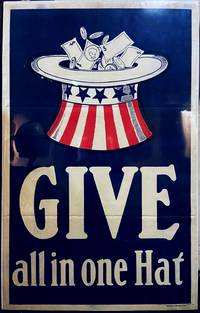
295876New York: Sweeney Litho Co. Lithographed canvas banner. 46" x 29"<br/> <br/> This large World War I-era poster was sponsored by the United War Work Campaign. Established in 1918 by Woodrow Wilson the campaign brought together seven organizations--the YMCA the YWCA the American Library Association the War Camp Community Service the Knights of Columbus the Jewish Welfare Board and the Salvation Army--to form a group fundraising effort with the hope of raising over $170 million for the war. The canvas banner depicts a red and white striped top hat on a blue background. The hat is full of dollar bills and coins symbolizing the collective fund that had been created and encouraging citizens to donate. The poster is in very good condition. Folds as issued. The vintage colors are rich and emblematic of the era.<br/> <br/> Sweeney Litho Co unknown
295876New York: Sweeney Litho Co. Lithographed canvas banner. 46" x 29"<br/><br/> This large World War I-era poster was sponsored by the United War Work Campaign. Established in 1918 by Woodrow Wilson the campaign brought together seven organizations--the YMCA the YWCA the American Library Association the War Camp Community Service the Knights of Columbus the Jewish Welfare Board and the Salvation Army--to form a group fundraising effort with the hope of raising over $170 million for the war. The canvas banner depicts a red and white striped top hat on a blue background. The hat is full of dollar bills and coins symbolizing the collective fund that had been created and encouraging citizens to donate. The poster is in very good condition. Folds as issued. The vintage colors are rich and emblematic of the era.<br/><br/> Sweeney Litho Co unknown books
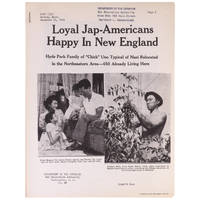
1944319493Boston: War Relocation Authority 1944. Pamphlet. Near fine. A very scarce example of the War Relocation Authority's efforts to find opportunities for interned Japanese Americans in New England. The pejorative headline suggests that the Boston field office of the WRA may not have fully supported the effort.<br /> <br /> This pamphlet is dated December 31 1944. The Western Defense Command the Army unit that issued the order to remove people of Japanese descent from the Pacific Coast rescinded the order in December 1944 with effect on January 2 1945. This publication is likely connected to the official end of the Japanese internment. As a practical matter before the surrender of Japan it was difficult for internees to obtain permission to return to California Oregon and Washington. With relatively few people being cleared to return home the WRA made an effort to find jobs for interned Japanese in other parts of the United States. <br /> <br /> The WRA operated small offices around the country. The Boston office perhaps ordered to expand its outreach to potential employers and non-profit groups willing to help resettle Japanese and Japanese Americans did the bare minimum with this publication. The content consists entirely of reprinted newspaper articles about Japanese Americans mostly collected from midwestern cities. <br /> <br /> The stories selected include articles about Nisei soldiers and WACs babies and Nisei men and women doing all-American things like decorating Christmas trees and ice skating. Notably absent is any text about what someone amenable to assisting the interned Japanese might do to help.<br /> <br /> 24 leaves printed rectos front side only. Publication no. 48 / C-2015. Not located in OCLC; in fact no WRA publications from Boston are recorded. The date and location are printed in the upper left corner of the front cover.<br /> <br /> SOURCE: The same bookseller from whom I acquired the other Japanese American pamphlets in my list 114. A near fine copy stapled in the upper left corner as issued. Complete with page 24 labeled "final" in the lower margin. With an ink stamp from the Hartford CT WRA office on the front cover and a chop mark 土井 the surname Doi on the verso of the last page. War Relocation Authority unknown
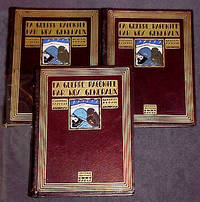
19215823Paris. Librarie Schwartz 1921. Sumptuously bound in the High Art Deco style in full burgundy period morocco. Elaborate gilt-ruling to spine and covers with gilt titles. Silk moire endsheets. Each volume presents a gorgeous and unusual multi-chromatic raised enamel onlay of a beleagured French soldier to front covers. Folios. Profusely illustrated in Art Deco style with plates panoramas fold-out colour maps photographs sepias etc. by Charles Foqueray Lucien Jonas et al. A huge and graphically stunning history of the Great War encased in a fabulous Deco binding without peer. A magnificent and rare item. Some minor wear to extremities a bit of chipping to spine gutters minor water staining to lower edges not affecting internal text or illustrations. A Very Good eye-boggling set. Librarie Schwartz unknown books
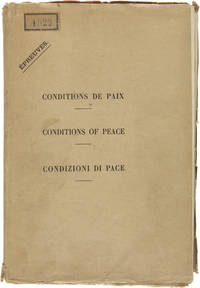
1919WRCAM35473N.p. but likely Paris 1919. Four versions of the text separately paginated and grouped together printed in English French and Italian two versions. Folio. Gathered signatures loosely inserted into printed wrappers as issued the four sections laid into a general printed wrapper. Moderate edge wear. Near fine. Germany's great ally in World War I was the Austro-Hungarian empire which in 1919 was broken apart and made into the separate states of Austria and Hungary birthing as well several other nations in Eastern Europe. The new state of Austria signed the Treaty of Saint Germain making peace with the victorious Allies on September 10 1919. Present here are preliminary printings in English French and Italian actually two Italian versions of that treaty indicated as such by the printed words "proof" "epreuves" and "bozza" on the respective treaties. The articles three versions of the treaty are not numbered sequentially but rather are numbered discreetly within parts and the pagination is not continuous between the parts. The second Italian version present here however does number the articles a total of 371 and the pages a total of 177 continuously though there is no printed date for the signing of the treaty indicating that it is also a preliminary proof printing though made later than the other three. Several of the most important parts of the treaty - those dealing with financial reparations for example - are blank here indicating that these proof versions were printed before those matters were completely settled. <br> <br> The conclusion of the Great War split apart the Austro-Hungarian Empire. In the Treaty of Saint-Germain the newly-created state of Austria recognized the independence of Hungary Czechoslovakia Poland and Yugoslavia and also had to cede much land to Italy and Bukovina to Romania. Austria also had to agree never to compromise its independence and was therefore forbidden from entering into any alliance with Germany. Austria was also forced to admit its complicity with Germany in waging the war and was saddled with reparations payments. Austria's army was limited to 30000 and other articles of the treaty addressed political and economic issues. The text of the treaty also contained the League of Nations Covenant and therefore was never ratified by the United States Senate. <br> <br> A very rare and interesting version of an important treaty ending the First World War here in a very small printing likely made only for participants in the peace conference. unknown books
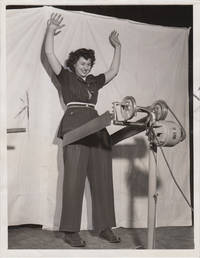
1942CAT0191Cleveland 1942. Silver prints most 6 ½ by 9 with various editorial marks and identifiers to versos. A collection of women's fitness press photographs taken around Cleveland in 1942 from the archives of the Cleveland News. Excellent. A collection of twenty-two photographs documenting women's fitness programs in Cleveland in 1942. The programs and corresponding articles in the Cleveland News appear to be the work of Eleanor Dearnley physical education teacher at Flora Stone Mather College. Other photographs show women's fitness activities at the Lakewood Community Center also in Cleveland. There are several examples of similar local efforts in support of the national "Keep Fit for Victory" Campaign. <br /> <br /> The photographs show women in a range of activities - basketball stretching calisthenics volleyball etc. Some of the photographs are graphically hand-painted by the editorial staff. Most pictures have corresponding articles pasted onto versos. The images are generally quite playful in nature - perhaps because it was early in the war or because the pictures were intended as morale boosters. A generally quite well-preserved group in excellent condition except for the above-mentioned editorial marks. unknown books
[Figurato Militaria] (cm.26,3) mezza pergamena antica restaurata, piatti con foglio di antifonario.-- cc. 8 nn., pp. 267, (1), cc. 4 nn. con 33 grandi incisioni in rame 18 delle quali a piena pagina. Illustrato macchine da guerra, fortificazioni, carri, arieti, strutture difensive e strumenti vari. Edizione originale. E' un dettagliato trattato sull' arte della guerra e sulle milizie romane. Le belle incisioni sono attribuite al maestro di pie Paolo Rubens, Otto Vaenius (1588-1629) attivo anche ad Anversa. il Lipsius (1547-1606) filologo e umanista belga, si convertì poi al cattolicesimo. Bell' esemplare fresco e marginoso. * Adams L 797; * Choix 3964; * Bm. Stc. Dutch 119; * Cockle " Military Books " 672.[f55] Libro
194386252London: Western Central District Office. Very Good. 1943. First Edition. Hardcover. Original hardcover tan cloth boards blue cloth spine string binding through three punch holes with general age toning soiling sharp cornered. First edition from 1944 marked "Secret" at top right corner from time of publication. Light soiling to boards but otherwise crisp and clean. One of a series of handbooks dealing with enemy countries and countries in enemy occupation. Book covers the administrative system political organizations economic features and national characteristics. Many folding maps of France bound in. Part I deals with Pre-Armistice Background. There is no Part II. Part III revised deals with France Since June 1940 Part IV deals with Radio Films Press and the last section is a discrete Map Section. Sections not marked consecutively. Free of any markings not ex-library. ; 4to 11" - 13" tall . Western Central District Office hardcover
191960735Great Lakes Chicago & Waukegan IL: Naval Aviation Training School L. Blakemore Isaack Wallenstein & Western Photo Studio Photographers ca. 1919-1921. Oblong atlas folio. 21.5 x 9 in. 43 leaves unnumbered. on thick black paper stock. With 52 original silver gelatin photos tipped-in sized from 5 x 7 in. up to 19 x 8 in. 36 panoramas sized from 18 x 3 in. up to 19 x 18 in. some w/ photographer’s imprint w/in negative at lower fore-edge some captioned all tipped-in. Contemporary Spruce plywood post-binder covers same as wood used for spars and biplane bodies in World War I rounded corners piano hinge front joint gilt decorative lettering & logo on front cover minor scuffing shelfwear still VG exemplar. This outstanding souvenir album depicts the height of the vital Naval Aviation Training School which provided essential technical expertise and training to entire generations of Naval Aviators and Naval aviation mechanics and carpenters through World War I and beyond. Founded originally in 1904 when a board appointed by President Theodore Roosevelt selected two farms of north of Lake Bluff IL as a training station which originally covered 172 acres. By Armistice Day at the end of World War I the facility had expanded to 1200 acres and over 45000 men underwent training. Of particular interest in this album are the 36 panoramic photographs documenting Naval Aviator and Naval Aviation mechanic classes for the 15th Regiment and 1st Battalion 15th Regiment from 1919-1920 as well as class rooms machine shops for aviation mechanics and Naval instructors. Others encompass the cutaway model Aviation engines with instructional charts on the surrounding wals the carpenter’s shop with aviation machinery jigs on work benches and airline bodies under construction. One photo depicts the Motor Laboratory Steam Laboratory and Equipment from the USS Eagle 25 at the Aviation Mechanics’ School a US Navy patrol boat which had sunk in a storm in June 1920 and then been raised and sold off as a hulk by Dec. 1921. Other panoramic photos capture the Riggers’ School classroom at Great lakes with full scale biplanes and seaplanes scale model dirigible the Coppersmith School classroom the Fittings classroom with airplane propellers hanging from the walls dip baths for machined parts and nickel plate coating and several of the Naval Aviation School football baseball and other sporting teams including the largest panorama of the Inter-Training Station Baseball championship team from Great Lakes. Wallenstein 1861-1958 was a longtime Chicago photographer through the first four decades of the 20th Century who operated his studio out of his 3928 N. Kenneth home and specialized in panoramic photographs. Western Photo Studio in Waukegan IL appears to have been short-lived as the Waukegan IL directories from 1918-1921 do not list the business but possibly connected with the Western Union Telegraph offices as the address was interchangeable. Volpe 1885-1950 began working in New York originally as a bookbinder before enlisting as an aviation mechanic with the US Navy in 1910 assigned originally to the newly formed ground school in Pensacola and later became Chief Warrant Officer Pilot Airman and Instructor who oversaw the Naval Aviation Training School from 1918-1921. He was also the assistant Athletic officer for baseball and tennis at the base. Naval Aviation Training School, L. Blakemore, Isaack Wallenstein, & Western Photo Studio (Photographers), unknown
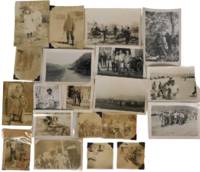
1949192101949. African American U.S. Army soldiers photographed in Korea during the early 1950s document Black military service during the first major war fought after the desegregation of the United States armed forces. Twenty photographs dating to the Korean War era depict African American soldiers operating in field environments during active deployment. One photograph includes a detailed inscription written by a soldier identified as PFC Glenn Miller describing harsh winter conditions during a convoy movement in December 1951. The images record daily wartime experience during a transitional period in American military history when Black soldiers were serving in increasing numbers within newly integrated units following President Harry S. Truman's 1948 order mandating racial equality in the armed forces.<br /> <br /> Twenty black and white photographs depicting African American soldiers in U.S. Army uniforms during Korean War service. Photographs measure approximately 2 x 2 inches to 3 x 5 inches and show soldiers operating outdoors in Korean terrain including roads forested areas and mountainous landscapes. Several images show troops wearing helmets and carrying rifles while others depict soldiers traveling with jeeps or trucks in convoy movements along rural roads. Numerous group photographs show African American soldiers posed together in field conditions. One photograph bears a lengthy inscription on the verso written by PFC Glenn Miller and dated December 1951 describing a winter convoy: "It was plenty cold that night and a lot of snow we had to sleep outside after riding 25 miles on uncovered trucks for 3 hrs. boots were so cold I could hardly get them on.".<br /> <br /> The Korean War fought between 1950 and 1953 became the first large scale test of the U.S. military following the formal desegregation of the armed forces ordered in 1948. African American soldiers had served in segregated units during World War II and their wartime contributions strengthened political pressure from civil rights advocates to end racial separation in the military. By the time U.S. forces entered the Korean conflict integration policies were being implemented across many units though resistance from some senior commanders and uneven enforcement slowed the process in the early years of the war. Approximately 600000 African Americans served in the armed forces during the Korean War and Black servicemen accounted for roughly 9 percent of American fatalities in the conflict. The photographs provide firsthand visual documentation of Black soldiers serving in combat zones while enduring the severe winter conditions and rugged terrain that characterized the Korean battlefield. Twenty photographs ranging from approximately 2 x 2 inches to 3 x 5 inches. A small number of images show minor discoloration from age; most remain well preserved with clear contrast. Overall condition very good. unknown
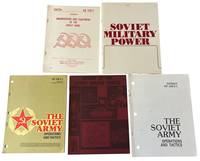
235101978. U.S. Army and Defense Department Soviet-threat instruction archive documenting late Cold War American intelligence on Soviet ground forces into battle-simulation tables field doctrine weapons comparisons and nuclear battlefield procedures. "Soviet Military Power" carrying Secretary of Defense Caspar W. Weinberger's printed preface shows Soviet tanks artillery helicopters SS-20 and ICBM and SLBM launchers bombers naval construction Afghanistan and technology acquisition. The technology-transfer passage offers one of the clearest Cold War intelligence arguments stating that "The communist countries are some of the National Technical Information Services' best customers" and that before the Soviet subscription was terminated in February 1980 the Soviets bought an estimated 80000 NTIS documents each year. Set beside Army manuals on Soviet organization antitank weapons SCUD-B missiles PT-76 tanks electronic warfare and nuclear battlefield doctrine the passage records an information war fought through public documents as much as espionage the same government warning of Soviet acquisition of American technical literature was producing its own unclassified guides to Soviet equipment and tactics for battle simulation officer training and operational planning.<br /> <br /> Archive of five U.S. government publications and extracts on Soviet military organization operations tactics weapons electronic warfare technology transfer and nuclear battlefield doctrine. The group consists of staple-bound punched and wrappered government manuals and reports with organizational charts contents pages doctrinal summaries weapons tables captions printed prefaces equipment photographs and restricted-distribution or field-manual markings.<br /> <br /> 1 United States Army Combined Arms Combat Developments Activity. HB 550-2 Organization and Equipment of the Soviet Army. Fort Leavenworth Kansas: Threats Division Concepts Doctrine and Literature Directorate Combined Arms Combat Developments Activity 31 July 1978. Approximately 70 pages.<br /> <br /> 2 Defense Intelligence Agency. Review of the Soviet Ground Forces. RSGF 1-80. Washington D.C.: Defense Intelligence Agency January 1980. 39 pages.<br /> <br /> 3 United States Department of Defense. Soviet Military Power. Washington D.C.: U.S. Government Printing Office 1981. 99 Pages. Approximately 55 pages.<br /> <br /> 4 United States Department of the Army. FM 100-2-1 The Soviet Army: Operations and Tactics. Washington D.C.: Headquarters Department of the Army 16 July 1984. Approximately 110 Pages.<br /> <br /> 5 United States Department of the Army. Extract FM 100-2-1 The Soviet Army: Operations and Tactics. Washington D.C.: Headquarters Department of the Army after 16 July 1984. Approximately 40 Pages.<br /> <br /> These materials come out of the most dangerous turn of the late Cold War the years when détente collapsed and the United States rearmed against an adversary it believed it was losing ground to. Afghanistan the failure of SALT II and the Reagan buildup hardened the conviction that American intelligence had undercounted Soviet strength and out of that conviction came an industry of threat assessment whose working products these are. This archive shows the American manufacturing knowledge of its enemy: Soviet organization armor and doctrine reduced to simulation tables at Fort Leavenworth codified into field manuals and repackaged as public argument under the Secretary of Defense's name. Containing many references to nuclear biological and chemical operations as routine doctrine while Soviet Military Power tallies the SS-20 ICBM and SLBM launchers aimed at the West. Working copies containing scattered annotations and highlighted portions in some. Overall in good condition. unknown
19062111902158501110Hakubunkan 1906. Soft Cover. Fine. Number of pages: 16 books Size: 27 cm Number of books: 16 books Hakubunkan paperback
187241653Berlin, Mittler et Fils, Paris, Dumaine, 1872-1881. 36 vol. in-8 en 2 parties à pagination continue de 1421 et 1111 pp. avec leur supplément de 357 et 502 pp., 110 cartes et plans hors texte, demi-percaline bleu ardoise à coins, pièces de titre grenat, non rogné (reliure de l’époque).