VERNET CARLE (1758-1836).Livre Rare Book
30 331 résultats
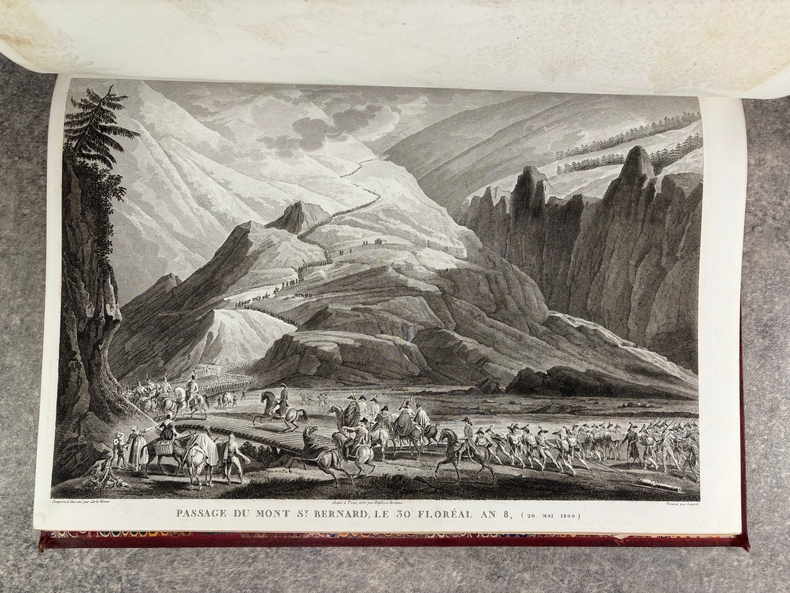
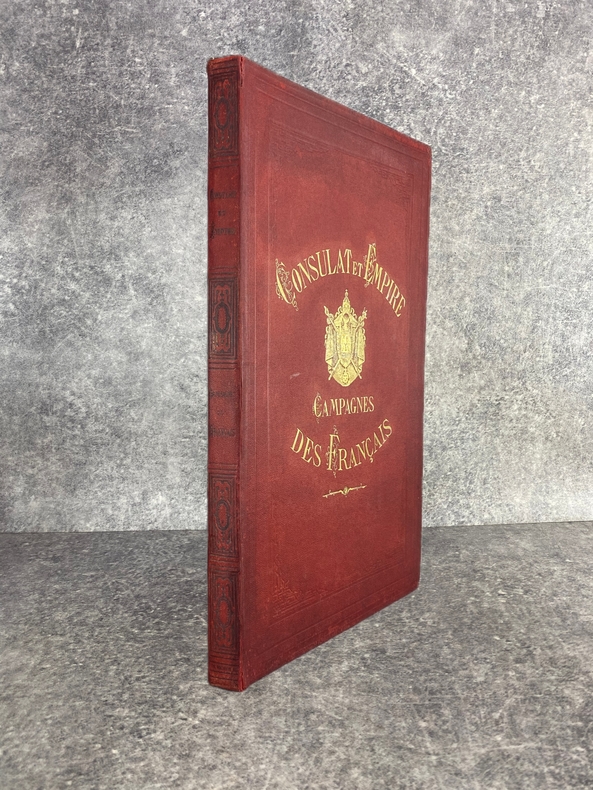
18251327PARIS. VISCONTI. SANS DATE (VERS 1825). IN-FOLIO (32,5 X 48 X 3 CENTIMETRES ENVIRON) DE 60 PAGES, RELIURE DE L'EDITEUR A LA BRADEL PLEINE PERCALINE ROUGE, PLATS SUPERIEUR AUX GRANDES ARMES IMPERIALES DOREES, TITRE DORE SUR DOS LISSE, TRANCHES DOREES (CH. MAGNIER REL). CONTIENT : FRONTISPICE AVEC LE PORTRAIT DE L'EMPEREUR ET UN FAC-SIMILE AUTOGRAPHE, TITRE ILLUSTRE D'UNE VIGNETTE, FEUILLET DE TABLE, 5 PLANCHES DE 20 MEDAILLONS CHACUNE DONNANT 100 PORTRAITS DES DIGNITAIRES DE L'EMPIRE ET 52 GRAVURES REPRESENTANT LES PLUS ILLUSTRES BATAILLES NAPOLEONIENNES, SOUS SERPENTES. PETITS DEFAUTS EXTERIEURS, SANS GRAVITE, SINON BON EXEMPLAIRE.
18251969PARIS. VISCONTI. SANS DATE (VERS 1825). IN-FOLIO (32,5 X 48 X 3 CENTIMETRES ENVIRON) DE 60 PAGES, RELIURE DE L'EDITEUR A LA BRADEL PLEINE PERCALINE ROUGE, PLATS SUPERIEUR AUX GRANDES ARMES IMPERIALES DOREES, TITRE DORE SUR DOS LISSE, TRANCHES DOREES (CH. MAGNIER REL). CONTIENT : FRONTISPICE AVEC LE PORTRAIT DE L'EMPEREUR ET UN FAC-SIMILE AUTOGRAPHE, TITRE ILLUSTRE D'UNE VIGNETTE, FEUILLET DE TABLE, 5 PLANCHES DE 20 MEDAILLONS CHACUNE DONNANT 100 PORTRAITS DES DIGNITAIRES DE L'EMPIRE ET 52 GRAVURES REPRESENTANT LES PLUS ILLUSTRES BATAILLES NAPOLEONIENNES, SOUS SERPENTES. PETITE DECHIRURE SANS MANQUE SUR UN FEUILLET GRIS DE GARDE, PETITS DEFAUTS EXTERIEURS, SANS AUCUNE GRAVITE, SINON BON EXEMPLAIRE.
18252496PARIS. VISCONTI. SANS DATE (VERS 1825). IN-FOLIO (32,5 X 47,5 X 2,5 CENTIMETRES ENVIRON) DE 60 PAGES, RELIURE DE L'EDITEUR A LA BRADEL 1/2 CHAGRIN ROUGE, DOS A CINQ NERFS ORNE DE CAISSONS A FLEURONS DORES, PLATS EN PLEINE PERCALINE ROUGE, PLATS SUPERIEUR AUX GRANDES ARMES IMPERIALES DOREES, PLAT INFERIEUR A L’AIGLE DORE, TITRE ET TRANCHES DORES. CONTIENT : FRONTISPICE AVEC LE PORTRAIT DE L'EMPEREUR ET UN FAC-SIMILE AUTOGRAPHE, TITRE ILLUSTRE D'UNE VIGNETTE, FEUILLET DE TABLE, 5 PLANCHES DE 20 MEDAILLONS CHACUNE DONNANT 100 PORTRAITS DES DIGNITAIRES DE L'EMPIRE ET 52 GRAVURES REPRESENTANT LES PLUS ILLUSTRES BATAILLES NAPOLEONIENNES, SOUS SERPENTES. QUELQUES DEFAUTS EXTERIEURS, SINON BEL ETAT INTERIEUR.
18522554PARIS. LIBRAIRIE VISCONTI. SANS DATE (VERS 1852). IN-FOLIO (33 X 48,5 X 3 CENTIMETRES ENVIRON) DE 60 PAGES, RELIURE DE L'EDITEUR A LA BRADEL PLEINE PERCALINE ROUGE, DOS LISSE ORNE DE CAISSONS A FLEURONS DORES, PLAT SUPERIEUR AUX GRANDES ARMES IMPERIALES DOREES, TITRE ET TRANCHES DORES (CH. MAGNIER REL). CONTIENT : FRONTISPICE AVEC LE PORTRAIT DE L'EMPEREUR ET UN FAC-SIMILE AUTOGRAPHE, TITRE ILLUSTRE D'UNE VIGNETTE, FEUILLET DE TABLE, 5 PLANCHES DE 20 MEDAILLONS CHACUNE DONNANT 100 PORTRAITS DES DIGNITAIRES DE L'EMPIRE ET 52 GRAVURES REPRESENTANT LES PLUS ILLUSTRES BATAILLES NAPOLEONIENNES, SOUS SERPENTES. AVEC L’EX-LIBRIS ARMORIE GRAVE A LA DEVISE « A TOUTE HEURE », DE VICTOR-AUGUSTE DU HAMEL, ECRIVAIN ET HOMME POLITIQUE FRANCAIS (1810-1870) ET CELUI EN COULEURS DE LA « COLLECTION MILITAIRE BERNARD FRANCK ». OUVRAGE REEMBOITE AVEC QUELQUES DEFAUTS EXTERIEURS, SINON BON EXEMPLAIRE D’UNE TRES BELLE PROVENANCE.
106376A Amterdam, et se trouve à Paris, chez la Veuve Duchesne, 1768 / A Padoue, 1752 / A Vienne, chez Jean-Thom. de Trattnern, Imprimeur & Libraire à la Cour, 1769, 3 textes reliés en 1 volume in-12 de 172x100x35 mm environ, 1f.blanc, 179-xij-153-xliv-224pages, 1f.blanc, plein marbré cognac, titres dorés sur dos lisse orné de caissons à fleurons et motifs dorés, coupes dorées, gardes marbrées, tranches rouges. Une coiffe ébréchée, épidermures et frottements sur le cuir, quelques rousseurs, petites restaurations sur les 2 derniers feuillets de l'ouvrage, sinon bon état. Mehmet Effendi fut ambassadeur ottoman à Paris entre 1720 et 1721. Grâce à son influence et à ses connaissances, la première imprimerie en caractères arabes en milieu musulman est ouverte par brahim Müteferrika en 1727.
1970158580北京.Beijing.: No publication details. circa1970. Coloured Chinese Air Defence poster incomplete set consisting of 9 posters each poster is numbered. The set includes poster numbers 4 8 10 11 12 13 14 15 and 16. These posters are in secondhand condition. The posters show some creasing with a number of small tears particularly at margins some mending on reverse with tape. Two posters are considerably torn at margin affecting the image slightly in one case. There is some browning and staining and there is considerable annotation on the reverse of poster number 8. Text in Chinese. Sheets measure appoximately 53.9 x 77.9cm. Poster no. 4 depicts 9 images of different types of simple air defence shelters trenches caves etc. Brief descriptions of each type of shelter are provided below the images. Three images in the lower section suggest that when selecting the site for air defence shelters one should not build too close to buildings flammables and electric wire. <br> <br>Poster no. 8 includes 9 images showing the alternative shelters when air raids happen and no nearby air defence shelter available. Alteratives suggested include basements beneath a bridge the corner of a wall and under solid staircases as good alternative shelters. <br> <br>Poster no. 10 shows 3 methods to use to fire at enemy aeroplanes each with detailed instructions. The speed and size of the aeroplane and shooting angles and distance are all taken into consideration. A chart in the centre gives the calculations required to be prepared in advance to successfully shoot down an aeroplane. The calculations require taking into account the plane's size and distance. <br> <br>Poster no. 11 includes 3 images to demonstrate methods to fire at enemy paratroopers with detailed instructions. A chart in the centre gives the calculations for advance preparation taking into account the person's height and distance from the invading paratroopers. <br> <br>Poster no. 12 depicts 5 images showing various anti-aircraft firing positions. They are: a position where a single person lifts and stabilises the rifle while the other person aims; position aided by fortification; position aided by tree branches; position aided by walls; and kneeling position. <br> <br>Poster no. 13 is illustrated with 5 images showing two squads rifle shooting squad and machine gun shooting squad who are in charge of the anti-aircraft placement and three main targeted aircrafts bomber military cargo aircraft and helicopter to shoot. <br> <br>Poster no. 14 shows 10 images of self-rescue and first aid for other people after air raids with detailed instructions. Self-rescue actions featured are emergency bleeding control and fire evacuation; first aid treatment introduced are treatment for bone rapture CPR and transport the wounded. <br> <br>Poster no. 15 depicts 5 images demonstrating methods to extinguish fire bombs. Methods include: burying or covering the burning objects with sand and soil; covering the burning objects with soaking wet quilts or sack bag; throwing the burning objects into water containers with iron shovel; and using a fire extinguisher extinguishing powder or carbon nitride. <br> <br>Poster no. 16 includes 6 images showing plans and actions of rescue urgent repair and maintance of law and order with detailed instructions. It suggests: to report to the relevant government agency and evacuate nearby civilians when unexploded bombs are discovered; during air strikes lay down perimeters around shops to prevent from looting; to restore transportation by clearing roads immediately after air raids; to urgently repair damaged electric wires and water pipes; it gives the major patrol sites as the factory shops warehouses dams bridges and power station and urges the viewer to arrest suspects if necessary; to put out fire immediately and to make sure the safety of the civilians is paramount. <br> <br>中國人民解放軍總參謀部動員部Mobilization Division of People's Liberation Army General Staff Department was first formed in 1954 and later joined with 中国人民解放军总参谋部军务部 Military Division of People's Liberation Army General Staff Department to form a joint division in 1969. The Division returned to its original name in 1975. . No publication details. unknown
Very Good Turkish, Ottoman (1500-1928) Original illustrated wrappers. Chipping on top edge and front cover. Occasional foxing on pages. Overall a good copy. Roy. 8vo. (23 x 15 cm). In Ottoman script (Old Turkish with Arabic letters). 103 p., b/w plates (19 unnumbered b/w plates and 1 map). First edition of this extremely rare first-hand and historically significant eyewitness account of the Syrian and the Suez Canal Operations during the Great War by an Ottoman soldier and statesman. Erden describes in this book his return to Istanbul after his military attaché duty in Paris and his departure to Damascus to join the 4th Army in Syria under the command of Cemal Pasha (1872-1922). He then discusses the Arab Revolt in Hejaz and its possible effects on the Ottoman Empire (The Arab Uprising was initiated by Sharif Hussein bin Ali in June 1916 during the Great War with the aim of creating an independent and united Arab state comprising of Aden in Yemen and Aleppo in Syria against the Imperial Ottoman). After disclosing his views and the actions of the army in the region, he goes on to describe Jerusalem, the Suez Canal, and the wars that took place there. Erden gave new information on the reasons and results of the Canal operation, the condition of the Turkish army along Palestine and Syria fronts, the relations among the Turkish staff, and the nature of the Arab revolt through his views and observations in Egypt, Palestine, and Syria fronts accumulated as he was Cemal Pasha's chief of staff. Erden was a Turkish soldier and war historian. After graduating from the Military Academy in 1903, he worked in the units and headquarters in Yemen, as the staff of the 3rd Corps in the Balkan War and as the Paris Military Attaché. During the Great War, he served as the Chief of Staff of the 4th Army within the entourage of Admiralty Minister Cemal Pasha in Syria. Özege 16174. Kursun p. 51.
20032080502106402119Fuyoshobo 2003. Soft Cover. Fine. The book is in fine condition. Fuyoshobo paperback
8vo., First Edition, with fine portrait frontispiece and 65 plates and maps (a number full-page) on 39; original red cloth, gilt back, red top (lightly faded as often), a near fine copy in unclipped dustwrapper. SIGNED BY THE AUTHOR ON FRONT FREE ENDPAPER. One of the key military memoirs of the twentieth century, this is as much an autobiography as a soldier's account of war. Written entirely by 'Monty' himself (in pencil, as so many of his official communications were composed), this characteristically straightforward (and often politically outspoken) account covers boyhood, early service with the Warwickshires, WWII and beyond (notably, about a third of the work covers his post-war career as CIGS and after). For technical military detail we look to the author's other works; here we find the simple account of a 'soldier who kept the faith'. A great read from one of the unforgettable leaders of his times. SIGNED COPIES ARE VERY SCARCE IN THIS CONDITION. Baxter 268; Enser, p.277.
1685AQ22730London: Printed by the Assigns of John Bill deceas'd: And by Henry Hills and Thomas Newcomb 1685. 271pp 1. ESTC R7189 Wing A105. Bound with: Rules and articles For the better Government of His Majesties Land-Forces In Pay during this present rebellion. London. Printed by Printed by the Assigns of John Bill deceas'd: And by Henry Hills and Thomas Newcomb. 1685 36pp. ESTC R28828 Wing R2239. 8vo. Contemporary gilt-tooled speckled calf later rebacked preserving contemporary backstrip. Rubbed head-cap perished. Early manuscript shelf-marks to FEP early inscription of Hugh Scott to title page of first mentioned work dampstaining primarily confined to margins of first work more extensive in second. A scarce late seventeenth-century martial manual on the English army line infantry formations. First printed in 1676 the work is primarily devoted to the correct battlefield positioning of pikes and muskets; detailed instruction is provided for the efficient command of personnel in order to maximise damage inflicted and minimise friendly losses. The information is presented in an efficient and remarkably accessible manner the directions for the 'exercise of the musquet' for example are arranged as a list of succinct stages easily comprehended: 'Handle you Charger / Open it with your Teeth / Charge with Powder.' Successive editions each a revision on the last accommodated advances in military technology such as the introduction of flintlock firing mechanisms and the wide-spread employment of the bayonet. This copy is paired with a reissue of the regulations for the conduct of the infantry occasioned by the onset of the Monmouth Rebellion during which the ranks of the English Army swelled in response to the threat of the deposition of James II. . Printed by the Assigns of John Bill deceas'd: And by Henry Hills, and Thomas Newcomb unknown
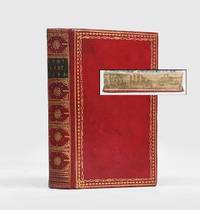
1799183026London: War-Office 1st March 1799. Late 18th-century edition in an attractive binding. Army lists were published annually by the War Office between 1754 and 1879 giving the names of officers and their dates of commission. The fore-edge painting executed at a later date shows Broadway and New York City Hall based on an etching by Carl Fredrik Akrell after a drawing by Baron Axel Leonard Klinckowström. Provenance: Alexander Adair d.1834 with his armorial bookplate. Adair was the great grandson of Sir Robert Adair of Ballymena and inherited the family estate at Flixton Hall in 1783. In 1805 he raised and commanded the 9th Troop of Suffolk Yeomanry. One "Mr Adair" army agent at Pall Mall is listed on Page 73. The same page features numerous ink corrections to the list. Octavo 226 x 140 mm pp. ii 655 5. Tables in text. Contemporary red straight-grain morocco green spine label smooth spine compartments decorated with gilt sunburst device boards tooled with gilt borders board edges milled in gilt turn-ins tooled in gilt marbled endpapers edges gilt near-contemporary fore-edge painting of Broadway in 1824. Spine rumpled boards slightly marked contents clean: a very good copy. ESTC T170321. hardcover
18600021783Washington D.C. USA: George W. Bowman. Bound in sumptuous full leather binding with five raised bands to spine and gilt decorations and titles this dated 1860 hardcover First Edition is VG. Late of Royal United Services Library but having several tiny impressed stamps to indicate the association. 287pp186 full-page many folding including maps and battle plans. 20th century binding with unmarked cream endpapers. One corner of frontis plate is neatly snipped 1cm x 0.5cm. Several folding plates are slightly misfolded but without loss. Weight of book is 3.5Kg. Condition generally VG . Very Good. Full Leather Hardcover. First Edition. 1860. George W. Bowman hardcover
1839770481839 Paris, Imprimerie Royale, 1839, petit in 4° relié demi-veau cerise, dos à faux nerfs orné, VIII-310 pages ; quelques rousseurs ; frottis à la reliure, coiffes usées.
180721313Pont-A-Mousson; Nancy; Paris Delahaye-Haener; Magimel 1807 -in-4 demi-basane 1 tome de texte et 1 tome d'Atlas reliés en 1 volume, reliure demi-basane (half binding sheepskin in-4) vert foncé grand in-quarto (30 x 23 cm), dos long (spine without raised band), décoré or (gilt decoration), à filets et roulette or (gilt line and fillets), titre et tomaison frappés or (gilt title), triple filets "or" en place des nerfs avec deux filets fins "or" intercalés, papier marbré vert et noir aux plats (cover with marbled paper), petit manque à la coiffe de tête, dos au cuir fatigué frotté mais intérieur parfait, toutes tranches lisses (all smooth edges), 298 pp + Atlas de 32 planches hors-texte gravées en noir (certaines dépliantes), 1807 Pont-à-Mousson : [Fleuret] ; Nancy : Delahaye-Haener ; Paris : Magimel Editeurs,
1913381597Washington: Government Printing Office 1913. Hardcover. Very Good. First edition. Three volumes. House Documents No. 1346 and No. 1346 part 2 62d Congress 3d Session 1912-1913 and House Reports No. 92 and No. 92 part 2 63d Congress 1st Session 1913. Complete as issued in one cloth bound volume and one cloth box; and one cloth bound volume. Octavos. Bound volume: 172pp. folding maps; box: 16 folding maps and 3 folding diagrams; bound volume: 19 6pp. 1 folding map and 1 folding chart. Moderate soiling to the cloth boards a very good set. An extensive topographical survey of the Alaska Territory conduced by Major Jay J. Morrow of the US Army Corps of Engineers. A scarce complete set of the two-volume House Document with the folding maps in fine condition and the additional one-volume House Report bound with 48 other reports. Government Printing Office hardcover
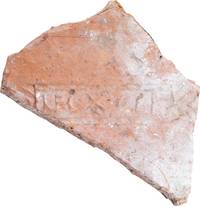
1106Carnuntum c62AD-200AD. Fragment of a reddish clay brick with the stamp of Legio X Gemina Pia Fidelis “"LEG X C PF" the 10th Roman legion of 5280 men split into 10 cohorts. Mortar layer on the back otherwise a very good and well preserved stamp. Ex collection Piscator 1959. Cf. on this piece Brandl op. cit. no. 187-190. 6 1/2" x 4" x 1 1/4" Legio X Gemina was formed from the disbanded Legio X the first Roman legion levied personally by Julius Caesar in 58 BCE. It distinguished itself as one of the four legions used by Caesar in his invasion of Gaul fought for Octavian and Antony against Brutus and Cassius in the Battle of Philippi in 42 BCE and followed Antony in his campaigns against Parthia and Armenia 36-34 BCE. The legion surrendered to Octavian after the Battle of Actium in 31 BCE losing its prestigious name Equestris as punishment and receiving veterans from other legions which earned it the cognomen "Gemina" twin. After service in the Cantabrian Wars and brief deployments to various frontier posts the legion was sent to Carnuntum a fortress on the Danube between current day Vienna and Bratislava in about 61 CE where it remained vigilant against Germanic threats. Following participation in Trajan's Second Dacian War the legion moved twice more first to Aquincum Budapest in 103 CE then finally to Vindobona Vienna in 114 CE where they remained stationed defending the Danube frontier until the 5th century though vexillationes were periodically sent for campaigns in Judaea Mauritania and Parthia.<br /> <br /> Red clay bricks like these were a common building material in Roman architecture from about the time of Augustus and making bricks was among the chores for Roman soldiers during their down time. unknown
191912692Washington DC: Presumed United States Government Printing Office 1919. Presumed First Edition First printing. Hardcover. Good. C.C.P. 400. Volume I: viii 713 3 pages. Figures 1 fold-out. Tables. Appendices. Index. Boards quite weak and partially restrengthened with glue. Pencil name inside front board Cover/spine is scuffed and has worn edges. Grayish binding. Volume II: viii 342 2 pages. Figures including several fold-outs. Tabular information. Index. No board weakness noted. Red binding. This is a mixed set due to different color of binding. In a 1918 journal article the functions of the Committee on Classification of Personnel in the Army were enumerated as: 1 classifying personnel according to their military qualifications 2 establishing the Trade-Tests division 3 enlisting the occupational needs of units in a division 4 extending the personnel work to staff corps troops 5 establishing the Central Personnel Bureau 6 appointing a committee on education and special training 7 organizing the War Service Exchange 8 rating the officers and candidates for commissions in the Officers Training Camps 10 cooperating with the Provost Marshall General 11 reducing the army paper work 12 enlisting the intelligence ratings of army men and 13 selecting aviators and navy men. The Committee on Classification of Personnel in the Army subsequently became The Classification Division Adjutant-Generals Department. The personnel system of the United States Army developed during 1917 and 1918 was an answer to the demand for a method of increasing the speed and efficiency of mobilization by utilizing to the best advantage the training experience and other qualifications which recruits brought with them from civil life. The system was planned and introduced largely through the efforts of the Committee on Classification of Personnel in the Army a civilian body working under the jurisdiction of the Adjutant General of the Army. The history of this movement is dole in Volume I. Volume II contains "The Personnel Manual". It gives detailed instructions for the actual operation of the personnel system as finally evolved and used during the latter part of 1918. This manual is the product of the experience of a year and is issued in complete form as a series of helpful suggestions so that the Army may profit by them in peace as well as in any future emergency. Presumed United States Government Printing Office hardcover
1796173179London: War Office 1796. Hardcover. Good cover edges bumped cover soiled interior tight. Red leather boards with gilt lettering on spine 98 pp 29 leaves of plates 27 folded. Printed for the War Office. The 18th century was a wealth of knowledge exploration and rapidly growing technology and expanding record-keeping made possible by advances in the printing press. War Office hardcover
1796173179London: War Office 1796. Hardcover. Good cover edges bumped cover soiled interior tight. Red leather boards with gilt lettering on spine 98 pp 29 leaves of plates 27 folded. Printed for the War Office. The 18th century was a wealth of knowledge exploration and rapidly growing technology and expanding record-keeping made possible by advances in the printing press. War Office hardcover books
196483699Washington DC: Department of the Army Headquarters 1964. Presumed First Edition First printing. Three hole punched with metal fasteners. Fair. Format is approximately 9 inches by 11 inches. 6 pages plus many tabs with one or more pages per tabbed section. Rare surviving original copy. Ink notation on front cover. Pages 1/2 is ahead of page 'i' The contents include: Introduction including Instructions for the use of the nuclear play calculator Strike Assessment Procedures including sections for cannons free rockets missiles air delivered weapons atomic demolition munitions and new weapons; Damage Determination ReferencesSample Problem Strike Assessment and Nuclear Play Calculator Aids in envelope. The Aids are present. This manual includes tabbed sections on Cannons Rockets Missiles Air-delivered weapons Atomic Demolition Munitions and then by yield from 0.5 KT through 5 MT. The Tab for I KT is mislabeled 1 MT. This manual provides guidance on procedures and techniques for nuclear play during tactical exercises. This manual provides the necessary aids for the Aggressor to determine the damage to United States and Allied forces from nuclear strikes. The weapons systems in this manual are based on material contained in the Handbook on Aggressor Military Forces FM 30-102. Aids envelop includes 8 plastic sheets of horizontal dispersion templates for cannons free rockets and Guided missiles and air delivered weapons and Damage circle templates for 1:50000 and 1:25000. The nuclear play calculator is a device for applying performance probabilities to nuclear delivery systems. The horizontal dispersion template is an aid used to determine the actual ground zero of a nuclear weapon. The damage circle template is an aid used in conjunction with the damage letters to evaluate the damage to personnel and equipment. The target element table describes target categories and the damage to be expected within each letter damage circle. The Damage circle radii tables are a series of tables showing the damage radii based on the height of burst and the weapon yield. This manual reflects the state-of-the-art the state of knowledge the state of training and the state-of-tactical nuclear weapons employment during the height of the cold war after the Cuban Missile Crisis and before the focus of the Army shifted to ground combat in Vietnam. Department of the Army, Headquarters unknown
1882WRCAM23378Philadelphia: Thomas Hunter Lith. 1882. Title-leaf 4pp. plus ten chromolithographed plates and nine other plates. Oblong folio. Original blindstamped cloth gilt title on front cover expertly rebacked with tasteful spine to match. Old stamp on verso of title-leaf and on last plate. Else just about very good. This work issued under the auspices of the Quartermaster General contains ten fine chromolithographed plates showing the different uniforms of the Army as dictated by regulations in 1882. It would seem to be the first official such work and may have been prepared by H.A. Ogden whose named appeared on a similar publication noted by Bennett which was published in 1888 with twelve plates. Ogden later produced a much larger work UNIFORM OF THE ARMY OF THE U.S. ILLUSTRATED FROM 1774 TO 1889 which was issued from 1900 to 1907. HOWES R155 "aa." BENNETT p.85 ref. Thomas Hunter Lith. hardcover books
19414205CMinsk:, Minsker Verlags- und Druckerei-G.m.b.H., [ca. 1941-1942]. (ca. 22 x 14,5 cm). 12 S. Original-Broschur, geheftet, mit Deckeltitel / Original boards (softcover) with title to front cover. [2 Warenabbildungen] Einband leicht gebräunt und fleckig. Papier innen gering gebräunt, sonst wohlerhalten. Altersentsprechend guter Zustand / Boards with low browning and minimal stained. Paper inside with some browning, otherwise well preserved. Appropriate to its age and u
185063341ABParis, Aubert, 1850. 27 cm. 30 farb.Tafeln, handcolorierte ! Lithografien mit Textbegleitung.(satirische Szenen aus dem Militärleben) Textanhang 14 S., Blauer Original-Leineneinband , vergoldeter Deckeltitel, Ecken etwas bestoss., unbeschnittene Tafeln sehr schön und frisch erhalten,schönes,kräftiges ,klares Colorit. sehr guter Zustand.
19962081502111905359Danketsu 1996. Soft Cover. Fine. The book is in fine condition. Danketsu paperback
179828423London: printed for the War Office by T. Egerton 1798. First edition 8vo pp. 6 iii-iv 5-54 without the final advertisement leaf; 31 hand-colored folding plates of lines of battle troop movements attacks etc.; contemporary marbled boards neatly rebacked in beige cloth green cloth label lettered in gilt on spine; first gathering loosening else generally a very good sound copy. Ex-Royal United Service Institution with their engraved bookplate and with a small release stamp; no other markings. The text is in 2 parts the second part with continuous pagination and register with the title On Movements and Attacks; with Reference to the Appendix in His Majesty's Regulations for Cavalry" and the plates are divided 12 and 19 respectively. The text is signed at the end: J. G. L. M. A second edition with only 19 plates appeared the following year. OCLC and ESTC locate a total of 9 copies only Yale Society of the Cincinnati and the U.S. Military Academy in the U.S. <br/><br/> printed for the War Office by T. Egerton hardcover books