[US Army]. [American Southeast] U SBiblio.com
30 331 résultats
19374173N.p. 1937. Very good. 353pp. rectos only including fifty-nine vernacular sepia-toned photographs measuring 2.5 x 3.5 inches and a few maps and manuscript diagrams. Typed self wrappers brad-bound. Minor creasing and dust-soiling to wrappers. Clean internally. A profusely illustrated report with a few hand-drawn diagrams and numerous manuscript emendations focused on various U.S. Army installations in the American Southeast. The author Major George H. Schumacher of the U.S. Army's Quartermaster Corps visited several Army bases and other posts in Florida South Carolina North Carolina Alabama and Georgia in the Spring of 1937. His report includes inspection details notes on personnel recommended repairs and other information for each site he visited on his 3065-mile tour beginning with Fort Barrancas and Key West in Florida to Fort Moultrie in South Carolina to Fort Bragg and Raleigh Cemetery in North Carolina Fort McClellan in Alabama and ending with a couple of bases in Georgia. The text of the report is supplemented with almost sixty annotated photographs which are interspersed throughout. A sampling of the photographs includes the Bachelor Quarters in Key West the CCC Camp at Fort Taylor the St. Augustine Cemetery a WPA road under construction at Fort Moultrie various buildings at Fort Bragg and the Raleigh Cemetery a road and bridge at Fort McClellan and various features at Georgia forts Screven and Oglethorpe. A unique production and an informative assessment of 1930s Army installation in the American South and Southeast. unknown
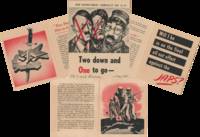
1945List2747Paris France; and Washington D.C. 1945. Six 8 x 10 inch and smaller typed pages; one 4 x 5 inch card with two tickets; one twenty-six page 4 x 5.5 inch pamphlet; one six page 6 x 8.5 inch pamphlet; six 2.5 x 3.5 photographs and two 3 x 4.5 inch photographs. Of the printed matter most is affixed to paper some small tears and folds; overall excellent; photographs near fine. Mary J. Bremer 1917–2019 was a Technician fourth grade from Grant Township Nebraska. Her correspondents here include June Miller 1920–deceased an aviation cadet from Michigan and John Melotte 1919–deceased an artilleryman from Philadelphia. Bremer and Miller were members of the Women’s Army Corps WAC. Established in May of 1942 as the Women’s Army Auxiliary Corps the WAC converted to active duty in July of 1943. The women of WAC known as Wacs served in noncombatant roles across the various theaters of World War II.<br /> <br /> Offered here is a small archive of Bremer’s documents and photographs relating to WAC: a few letters including a description of Paris the day after the Nazi surrender; two pamphlets including the War Department pamphlet Two down and One to go –; and a collection of photographs of Eisenhower’s victory parade and Roosevelt’s funeral procession.<br /> <br /> On April 12 1945 President Roosevelt died of a stroke in Warm Springs Georgia. His body was returned to Washington two days later and a military procession escorted it from the train station to the White House. Two photographs of the funeral procession are included in the archive. One showing a woman at the start of a section of the parade is identified verso as “WACs led by Capt. Machenâ€.<br /> <br /> The following month the Nazis surrendered. Bremer’s friend June Miller was stationed in Paris at the time. She wrote to Bremer the next day describing the celebration:<br /> “It began the night before when we stood on the roof and watched the flares go off all over the city--just like the 4th of July; the Sacred Couer was blazing with lights and it looked like a miniature fairy-land. Last night all the famous old buildings including the Arc d’Triumph was all lit up the fountains in the parks at Concord in front of the Trocadero--they were all going and the kids were wading and splashing around having the time of their life. It was really something to see--something the French had been waiting a long time for. “Fini le guerre†they kept saying--the end of the war!â€<br /> <br /> Miller also claims to have witnessed a bomber flying a celebratory loop through the Eiffel Tower:<br /> <br /> “When we came out of the Trocadéro the fountains were on and what a sight that is. Looking down over the water that looks like a miniature waterfall to the Eiffel Tower at the bottom of a small hill. And if I hadn’t seen it with my own eyes I would never have believed that I saw a small bomber come through the bottom but that’s just what it did--and just did clear it too. The planes seemed to be going as wild as the people on the ground--they were so thick up there that pretty soon we thought surely something would happen.â€<br /> In June Dwight Eisenhower returned from Europe and a homecoming parade was held for him in Washington D.C. Six photographs of this parade are included in the archive including a shot of his plane arriving at the airport and one where he is visible standing in the back of a Jeep.<br /> <br /> Miller notes in her letter from Paris that “you wondered what was coming next; where we would go from here ‘cause in a sense there is still a war very definitely going onâ€. In fact John Melotte who seems to be Miller’s partner writes to Bremer that he “May be slated for that place they call the CBI but don’t tell June please. She does not want me to even mention the place in my letters so I let well enough alone†July 15 1945. Hostilities would continue in the CBI—the China-Burma-India theater—until September of that year.<br /> The process by which soldiers were selected to be sent to the Asia-Pacific theater is laid out in the War Department pamphlet Two down and One to go –. The pamphlet reminds them that there are still “a couple of big jobs ahead†the primary one being to “crush†or “smash†the “Japs†and the second one being to occupy and police “conquered lands . until the peril of future aggression is gone.†It is a visually striking piece with illustrations in a bold black and red color palette; its cover is a reproduction of a caricature of Hitler Mussolini and Hirohito by Polish-Jewish artist Arthur Szyk.<br /> <br /> Also included in the archive are a card from a friend with tickets to an American League baseball game; a humorous poem congratulating Wacs Ruth O.B. and Lenore I. Nier on new work assignments; and a Christmas 1945 WAC pamphlet with a dinner menu and list of WAC officers. The pamphlet assures the Wacs with a note from Colonel Kenton Cooley “Before another Christmas you all will have returned to civilian life and each of you will take with you my appreciation and my sincere admiration for a great job well done.â€<br /> Of interest to scholars of women’s history especially in the military; and of the events leading up to the end of the Second World War. unknown
194543502Recruiting Publicity Bureau United States Army 1945. 1st Edition. Cream paper printed in blue grey and white. Backed in linen with white paper coating to poster side. Fine condition. Broadside. Linen-backed. Large illustration of a woman in a blue WAC uniform carrying a surgical tray. Poster: 37-3/4" x 25-1/4". Backing: 39-1/2" x 27-1/4" <br/><br/>Although the U.S. Army Medical Department was one of the slowest to integrate women when over 5000 of its combat-ready men -- including many trained technicians and orderlies -- were forced to transfer to the Infantry in early 1944 the department began a major push to recruit women to fill the positions. The Female Medical Technician campaign as pictured here was hugely successful despite the high qualifications demanded of applicants many of whom were required to have advanced degrees and at least two years of experience in their fields. WACs also served as laboratory technicians psychiatric social workers medical stenographers and in a variety of other technical and/or skilled medical positions; by the end of the war the Medical Department employed approximately 20000 WACs nearly a fifth of the Corps. Treadwell United States Armies in WWII. Special Studies: The Women's Army Corps The poster reads in full: "Women . . . our wounded need your care! You can help to give it . . . The U.S. Army Medical Department is calling for help -- the help of WOMEN -- needed in Army hospitals to serve as medical technicians surgical technicians and in other important assignments. Assignments also available at Army Air Forces Ground Forces and Service Force Installations. Join a hospital company. For information apply at any U.S. Army Recruiting Station or ask your local Postmaster." Uncommon particularly in this fine of condition. Recruiting Publicity Bureau United States Army unknown books
6827Londres, Chez les libraires associés, 1773. 2 tomes in-4 reliés en un volume, (2)-LII-154-(2) p., (12 pl.) et (2)-128 p., (15 pl.), reliure plein veau, dos lisse orné, tranches marbrées (coiffe inférieure arasée, mouillures).
201509895A Paris, Chez Magimel, Anselin et Pochard, libraires pour l'art militaire, rue de Thionvi, 1812 ; in-8, 242/12-563-/9, cartonnage de l'éditeur. Les 2 volumes. Plein veau marbré dos en bel état orné, (presque en très bon état)1 coins usagé, bon état complet de ses gravures- A l'usage de MM. Les élèves de l'école spéciale Militaire, rédigé par ordre de M/ Le Général de division Bellavène, commandant, directeur des études da ladite école(non d'un ancien élève sur le 1er plat de reliure ? Auguste De Goyon n°144) -En trois parties : 1. Des opérations militaires dont la connaissance sert d'introduction à l'étude des fortifications. 2. De la fortification passagère. 3. De la fortification permanente. "Dès que cet ouvrage parut, il réunit tous les suffrages et devint le manuel indispensable de tout officier d'artillerie." Quérard, VIII-490. Complet des planches, les 12 premières sur les fortifications passagères, les 9 autres sur les fortifications permanentes, ici relié en deux volumes.
244717S.l., s.d. (1796), in-folio, [10] ff. n. ch., couverts d'une écriture fine, régulière et très lisaible (environ 30 lignes par page), en feuilles. Fortes rousseurs.
173343S.l., s.d. (vers 1800) in-4, [6] ff. n. ch., couverts d'une écriture moyenne, soignée et très lisible (environ 30 lignes par page), en feuilles, cousu.
176153S.l., s.d. (1777) in-folio, [5] ff. n. ch., un feuillet vierge, demi-basane aubergine, dos lisse orné de filets dorés (reliure du XIXe s.). Dos insolé, accrocs aux deux coiffes.
183262Berlin, Gustav Fincke, 1836 in-4, [2]-42-[2] pp. de texte sur deux colonnes, et 150 planches gravées au trait, demi-chagrin brun à coins, dos lisse cloisonné et orné en long, double filet doré sur les plats (reliure de l'époque). Quelques épidermures, rousseurs, mais bon exemplaire.
182863001München, Gedruckt mit Rösl?schen Schriften, 1828. 8°. Mit 2 gefalt. lithogr. Titeln, 93 gefalt. lithogr. Tafeln u. 7 gefalt. lithogr. Musikseiten. XV, 501 S., 1 Bl.; XIX, 360 S., 1 Bl., Ldr.-Bde. d. Zt. a. 4 Bünden m. Rückenverg. u. goldgepr. Rückentiteln (die Textbände auch mit dreiseitigem Goldschnitt).
223115Paris, Paul Roulleau, 1953 in-4, [2] ff. n. ch. (titres), et 14 planches en couleurs, numérotées, en feuilles, sous chemise factice demi-toile cerise à rubans, dos lisse muet.
4B472Rösl München 1828. XV 501 / XIX 360 S. Textband 1 mit 40 mehrfach gefalteten gestochenen Tafeln sowie vorgeschriebene Märsche u. Trompeten-Signale zu den Unterrichten in den Waffenübungen 7 gefaltete Notentafeln / 2.Tafelband: Tafel 41-90. Fünfzig mehrfach gefaltete gestochene Tafeln orig. Halbleder etwas stockfleckig. -Enthalten: Band 1: Erster und zweyter Theil / Band 2: Dritter vierter und fünfter Theil / komplettes Quellenwerk- unknown
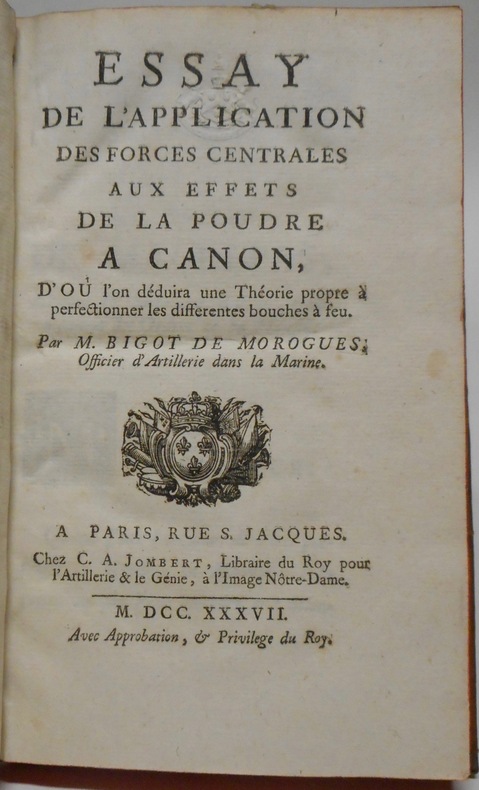
156072Paris, C.-A. Jombert, 1737 in-8, [4]-163-[13] pp., avec une pl. dépl., veau fauve marbré, dos lisse orné, simple filet doré sur les coupes, tranches rouges (reliure de l'époque).
1749wa613A Paris, chez Charles-Antoine Jombert, libraire du Roy pour l'artillerie & le génie, à l'Image Notre-Dame Relié 1749 "Deux volumes in-4 (20,7 x 26,2 cm), reliure plein veau, dos à 5 nerfs ornés d'une pièce de titre et de tomaison, ""Cercle militaire de Rennes"" doré aux premiers plats, 411 et 547 pages, ouvrage de M. le Maréchal de Puységur, mis au jour par M. le Marquis de Puységur son fils, maréchal des camps et armées du Roy, bien complet des 51 planches (37 au tome 1 et 14 au tome 2) ; tampons de bibliothèque au début des deux volumes, quelques rousseurs éparses, petite mouillure au début du tome 1 en queue, bon état général. Livraison a domicile (La Poste) ou en Mondial Relay sur simple demande."
1913585PARIS. J. LEROY ET CIE, EDITEURS. 1913. GRAND ET FORT IN-4 (30 X 39,5 X 6,5 CENTIMETRES ENVIRON) DE (8) + III + (1) + 314 ET (2) PAGES, RELIURE D’EPOQUE 1/2 CHAGRIN ROUGE, DOS A QUATRE NERFS, TITRE DORE, DOUBLE COUVERTURE ILLUSTREE D’UNE VIGNETTE AVEC TITRE IMPRIME EN NOIR, ET DOS CONSERVES. SPLENDIDE OUVRAGE ILLUSTRE DE 48 PLANCHES HORS TEXTE D'UNIFORMES EN COULEURS, DE 10 PLANCHES HORS TEXTE, DONT 6 DE PORTRAITS MULTIPLES ET 4 D’ETENDARDS ET FANIONS (2 EN COULEURS) ET DE 24 VIGNETTES DANS LE TEXTE. EDITION ORIGINALE ET PREMIER TIRAGE, LIMITE A 1000 EXEMPLAIRES NUMEROTES, 300 SUR ARCHES ET 700 SUR ALFA. UN DES 700 SUR ALFA, CELUI-CI PORTANT LE NUMERO 432. QUELQUES ROUSSEURS EPARSES SANS GRAVITE, SINON TRES BEL EXEMPLAIRE.
19133004PARIS. J. LEROY ET CIE, EDITEURS. 1913. GRAND ET FORT IN-4 BROCHE (28,5 X 38,5 X 5,5 CENTIMETRES ENVIRON) DE (8) + III + (1) + 314 ET (2) PAGES, COUVERTURE GRISE REMPLIEE ILLUSTREE D’UNE VIGNETTE EN NOIR, TITRE IMPRIME EN NOIR. SPLENDIDE OUVRAGE ILLUSTRE DE 48 PLANCHES HORS TEXTE D'UNIFORMES EN COULEURS, DE 10 PLANCHES HORS TEXTE, DONT 6 DE PORTRAITS MULTIPLES ET 4 D’ETENDARDS ET FANIONS (2 EN COULEURS) ET DE 24 VIGNETTES DANS LE TEXTE. EDITION ORIGINALE ET PREMIER TIRAGE, LIMITE A 1000 EXEMPLAIRES NUMEROTES, 300 SUR ARCHES ET 700 SUR ALFA, CELUI-CI SUR ALFA, PORTANT LE NUMERO 319. ERREUR DE FACONNAGE DE L’OUVRAGE AU MOMENT DE SA PARUTION, NEAMMOINS BIEN COMPLET ET COLLATIONNE, AVEC DES PAGES SUPPLEMENTAIRES (46-49, 47-52, 45-50 ET 51-48), UN CAHIER VOLANT A REFIXER (PAGES 45-52). QUELQUES TRACES D’HUMIDITE ANCIENNE, PETITS DEFAUTS EXTERIEURS SANS GRAVITE, COMME SOUVENT COMPTE-TENU DU POIDS DU VOLUME, SINON BON EXEMPLAIRE. ON JOINT UN BULLETIN DE COMMANDE ET UN BULLETIN DE SOUSCRIPTION AVEC UNE PLANCHE SPECIMEN SUPPLEMENTAIRE.
19133371PARIS. J. LEROY ET CIE, EDITEURS. 1913. GRAND ET FORT IN-4 BROCHE (28,5 X 38,5 X 5,5 CENTIMETRES ENVIRON) DE (8) + III + (1) + 314 ET (2) PAGES, COUVERTURE GRISE REMPLIEE ILLUSTREE D’UNE VIGNETTE EN NOIR, TITRE IMPRIME EN NOIR. SPLENDIDE OUVRAGE ILLUSTRE DE 48 PLANCHES HORS TEXTE D'UNIFORMES EN COULEURS, DE 10 PLANCHES HORS TEXTE, DONT 6 DE PORTRAITS MULTIPLES ET 4 D’ETENDARDS ET FANIONS (2 EN COULEURS) ET DE 24 VIGNETTES DANS LE TEXTE. EDITION ORIGINALE ET PREMIER TIRAGE, LIMITE A 1000 EXEMPLAIRES NUMEROTES, 300 SUR ARCHES ET 700 SUR ALFA, CELUI-CI SUR ARCHES, NON JUSTIFIE. QUELQUES ROUSSEURS, SINON BON EXEMPLAIRE. .
18062628PARIS. A PARIS. BASSET, MD D’ESTAMPES. 1806. GRANDE CARTE ENTOILEE, GRAVEE EN NOIR, LIMITES REHAUSSEES EN COULEURS, REPLIEE DE 120 X 100 CENTIMETRES ENVIRON, COMPOSEE DE 28 PLANCHES DE 25 X 17 CENTIMETRES. PREMIER TIRAGE RARE. DANS SON ETUI CARTONNE D’ORIGINE, COULEUR SAUMON, POURTOURS ENCADRES D’UNE DENTELLE DOREE, TITRE DORE SUR ETIQUETTE BLEUE AU CENTRE DU PLAT SUPERIEUR. PETITS DEFAUTS EXTERIEURS SUR L’ETUI, SINON CARTE EN TRES BEL ETAT.
242915Paris, Magimel, an IX - 1800 2 parties en un fort vol. in-4, [4] ff. n. ch., XXXII pp., 103 pp. (avec interversion typographique des f. 59-60 et du f. 61-62), 502 pp., avec 6 grands tableaux dépliants hors texte, une carte, broché sous couverture d'attente de papier bleuté, non coupé. Dos un peu défraîchi, petit travail de ver en marge intérieur n'altérant pas la lecture, carte détachée.
215715Nancy, Paris, Berger-Levrault, 1914-1932 3 vol. grand in-8, LXI-487 pp., VIII-358 pp. et VII-288 pp., 6 planches (dont 4 portraits), croquis in-t., 7 tableaux, 9 croquis et 2 cartes dépliants, demi-chagrin mandarine, dos lisse, filets à froid, couv. cons. (Montécot). Dos un peu passé. Bon exemplaire.
210033Paris, H. Fournier, 1836 2 vol. in-8, XVI-440 pp. et 449 pp., avec un portrait-frontispice lithographié d'après un dessin de l'auteur, demi-veau gris, dos à nerfs orné de filets dorés (reliure de l'époque). Qqs rousseurs. Ex-libris Bibliothèque de Mr Laplagne Barris. Bon exemplaire.
1835111617P., Anselin, 1835-1846, 7 vol. pt in-4°, 904, 1053, 987, 1030, 954 et 1058 pp, texte sur 2 colonnes, 6 volumes de texte et un atlas de 113 planches, reliures demi-chagrin vert bouteille, dos lisses à faux nerfs à froid, titres et caissons ornés dorés, double filet doré sur les plats, tranches mouchetées (rel. de l'époque), un coin lég. abîmé au tome III, qqs rousseurs, bel exemplaire. Rare complet des planches annoncées
141169Paris, Administration, 1851-1853 7 vol. petit in-4, nbses planches et cartes h.-t., demi-basane verte, dos lisses, filets dorés et à froid (reliure de l'époque). Rousseurs.