30 332 résultats
11841Bourg-en-Bresse, Francisque Martin-Bottier, puis A. Gonin, successeur, puis Imprimerie Villefranche, 1886-1891 ; 3 tomes in-8, brochés ; XII, XV, (1 bl.), 417 pp., (1) f. d’errata ; (4), 663 pp. ; VIII, VI, 309 pp., couvertures vertes imprimées en rouge et noir.
1852rbr1wam396From the Title Page: "Illustrated by numerous beautiful plates from drawings taken on the spot also A Reconnoissance of a New Route Through The Rocky Mountains and Two Large and Accurate Maps of That Region.<br /><br />Separate folder containing 2 large folding maps is present. The two maps are hand colored Salt Lake less so. Many tears along folds on both maps.<br /><br />The hardbound volume has 487 pages - 589 lithography plates. Howes S-884<br /><br />Please see photos for condition. Stanbury's Expedition with the Folder with the 2 Maps. Lippincott, Grambo & Co. hardcover
194560292USA, 1945. Some minor wear to edges and covers-overall very good. Illustrated by black and white photos. 68 pp. + Attached letter to Whom It May Concern from Waldemar Westergaard Chief United States Office of War Information, Copenhagen and a letter from Berlingske Tidende from 01.05.80 to Fonsmark. Composition - Major Alfred L. Howes. Art Work - T/Sgt. John S. Denney. Copy Preparation - T/3 Chas W. Denney. Photographs - 163d Signal Photo Company. Printing - 649th Topo Battalion.
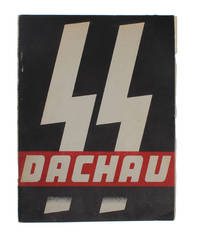
194560292USA 1945. Some minor wear to edges and covers-overall very good. Illustrated by black and white photos. 68 pp. Attached letter to Whom It May Concern from Waldemar Westergaard Chief United States Office of War Information Copenhagen and a letter from Berlingske Tidende from 01.05.80 to Fonsmark. Composition - Major Alfred L. Howes. Art Work - T/Sgt. John S. Denney. Copy Preparation - T/3 Chas W. Denney. Photographs - 163d Signal Photo Company. Printing - 649th Topo Battalion. <br/><br/><em>First edition of the "Dachau US Army Report" is a compilation of reports photographs and documents related to the liberation of the Dachau concentration camp by American troops during World War II. Dachau the first concentration camp built by Nazi Germany was operational from 1933 to 1945. The book includes eyewitness accounts of the atrocities committed by the Nazis at the camp as well as information on the history and organization of the camp. This report is based on two days and primarily focuses on one aspect of life in Dachau - the internal organization of the camp the evidence of self-administration among the prisoners the emergence of special control and pressure groups and the position of various social political and national groups within this organizational framework. It was intended to serve as a historical record of the events at Dachau and as a warning against the dangers of fascism and genocide. </em> unknown
91923aafImagerie d’Epinal - Pellerin & Cie, imps.-édits (Déposé), s.d. vers 1870, 197x60 cm, planche en très grand format (assemblage de 3 feuilles), gravée sur bois imprimée en noir sur papier et coloriée au pochoir, une feuille, roulée, déchirures au pied de l’image sans perte sinon bon état.
91917aafImagerie d’Epinal - Pellerin & Cie, imp.-édit (Déposé), s.d. vers 1870, 197x60 cm, planche en très grand format (assemblage de 3 feuilles), gravée sur bois imprimée en noir sur papier et coloriée au pochoir, une feuille, roulée, bon état.
91922aafImagerie d’Epinal - Pellerin & Cie, imps.-édits (Déposé), s.d. vers 1870, 235x60 cm, planche en très grand format (assemblage de 3 feuilles), gravée sur bois imprimée en noir sur papier et coloriée au pochoir, une feuille, roulée, qqs pt. manques et déchirures aux bords sinon bon état.
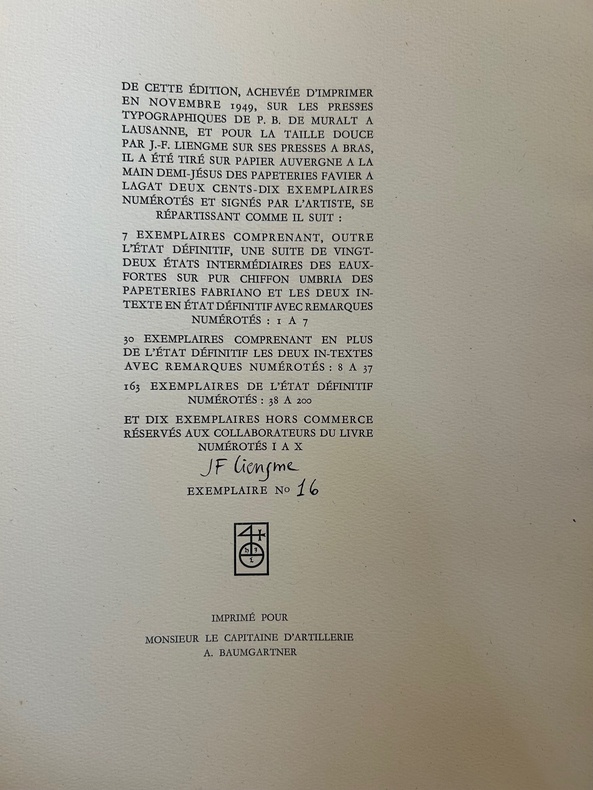
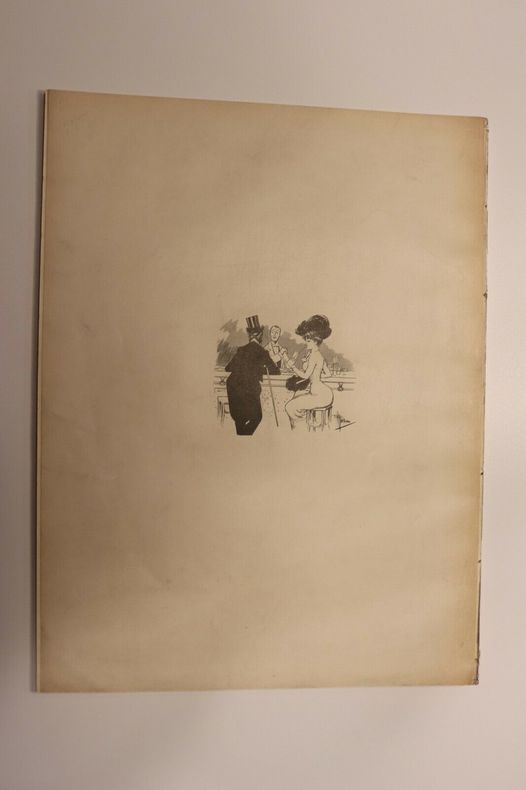
CSP-1750Chez le graveur Carra, Genève, 1949. Portfolio (42x30 cm).16 pages de texte avec 2 gravures originales + 17 gravures originales. En feuilles sous couverture cartonnée en excellent état protégé par un étui cartonné. L'étui est légèrement usé. Il a été tiré sur papier auvergne à la main demi-Jésus des Papeteries Favier à Lagat 210 exemplaires, dont 30 exemplaires numéroté 8 à 37 et signé par l'artiste, celui-ci porte le numéro 16, exemplaire nominatif au Capitaine d'artillerie A. Baumgartner.
MA09A-06211United States Government Printing Office. Collectible - Good. Washington: United States Government Printing Office 1927. 8vo. ix845pp. Illus. Good book. Spine ends worn. Top half of spine cover and top corners of both boards are slightly dampstained. Back board scuffed. Board corners bent and slightly frayed. Signed by Brigadier General George H. McManus on front free endpage; he is mentioned on p. 738 as a recipient of the Distinguished Service Medal. Lower corner of textblock slightly bumped in first portion of book. Top page edges a bit warped. Inquire if you need further information. United States Government Printing Office hardcover
MRMktGER84np: Printed by Witek & Suchy 18-. 8vo. pp. 2 p.l. 205. 5 folding plates & 150 text diagrams many full-page. manuscript text: lithographed throughout. contemporary bds. with centre portion of original illus. wrs. mounted on covers rubbed some staining & soiling to mounted wrs. np: Printed by Witek & Suchy, [18-]. unknown
1900AMO-4198Pour vos beaux yeux. Album en couleurs (colorié au pochoir - ateliers Greningaire). Par Albert Guillaume. Préface de Coquelin Cadet. H. Simonis Empis, éditeur, s. d. (1900). Format 35,5 x 28 cm. Couverture illustrée en couleurs (premier plat) et 20 planches imprimées en couleurs (coloriage au pochoir par Greningaire) (avec 1 feuillet de faux-titre, 1 feuillet de titre et 2 feuillets de préface). Superbe et très rare tirage de luxe sur papier du Japon à 13 exemplaires seulement signé par l'artiste Exemplaire dérelié. Tête dorée. Superbe état de fraicheur des couvertures (les deux plats sont conservés en très bon état). A relier (un cartonnage papier serait le bienvenu). Voir photos de l'annonce. Très rare dans ce tirage.
1742143P., Barois, 1742; un volume relié en plein veau marbré, dos orné de fers dorés, tranches rouges (reliure de l'époque), mouillures très pâles dans la marge des derniers feuillets), 24pp., 320pp., (2)
1792PHO-1270Paris, Chez Plassant, 1792. ATLAS seul in-4, en feuilles , titre , liste des planches , 4 cartes dépliantes et 88 planches dont 19 à double page , non rogné , pages de titre et liste des planches légèrement effrangés et salies
64 pages. Features: Nice colour ad for Dominion Oilcloth & Linoleum inside front cover includes illustration of amourous military couple; Nice colour-illustrated Pepsi ad features pretty blonde and illustration of boys fishing; News digest includes The Marsh Report, 'Cradle to Grave' security, and more; Nice one-page illustrated Canadian Pacific Air Lines ad explains their substantial contributions to the war effort, amid dramatic air and land battle scene; Colour Ritz cracker ad includes service man and woman; Editorial discusses how the war has tarnished certain words and lifted others; Ford Motor Company one-page ad with illustration of Canadian troops in firefight; One-page Northern Electric ad includes illustration of deHavilland Mosquito; Friendly Invasion - great photo-illustrated article on construction of the Alaska Highway, with photo of Felix Murawski, 74th Engineers of Oklahoma City; Pigs' Feet (short story); The Penalty is Death (short story); Canada's Future Housing - photo-illustrated article explains ideas to be borrowed from Great Britain and the U.S.; Chowder Boy (short story); Sea Water Gurney's Boy (short story); Hollywood News and photos; One-page Parker Pen ad shows mailman handing mother a letter beneath caption "Your boy writes often now!"; Beer is Booze; One-page ad for the T. Sisman Shoe Co. includes great illustration of soldier on motorcycle; Canadian General Electric half-page ad boldly proclaims "Vitamins For Victory"; Woodbury Powder ad includes nice photo of Lana Turner; Magnificent centrefold two-colour (red and black) Victory Bonds ad entitled "Shoulder Your Own Share" includes text on left and, on right, a large illustration of Madame Chiang Kai-Shek super-imposed over scene of fighting in her war-torn China; Army Meals Go Modern - nice photo-illustrated article explains and illustrates meal preparation for the gigantic 7,000 man "army restaurant" at Webb Hall in Toronto; Nice colour one-page ad for Heinz Tomato soup includes illustration of tomato-headed aristocrat in top hat and monocle; Fashion illustrations; Is Your Daughter Happy in the Service? - article with photos of Daisy Horner of Dorset, Ontario, Dolly Mawson and Gay Sutton of Toronto, Elizabeth Cook from Creemore, Wren Barbara McClelland of Toronto, and twins AW2 Beryl and AW2 Daphne MacPhee of Charlottetown; Fashion article; Quotes from around the world; Elaborately colour-illustrated Canadian Pacific - Canadian National Victory Bond ad inside back cover entitled 'A Profession of Faith' includes calligraphy explaining their faith in Canada's future; Nice colour Wabasso Cottons ad on back cover shows mother, daughter and sewing machine; and more. Unmarked with moderate wear. Covers detached as one. A quality copy of this excellent wartime issue. Book
33437Paris, chez Lattré et Bordeaux en 1761....." où sont marqués les Marches et Campemens des Armées, depuis l'entrée des Trouppes Prussiennes en Saxe en Aoust 1756, jusqu'au commencement de 1762. " 17 cartes gravées ,coloris d'époque, sur onglets reliées avec le Journal de la Guerre, présente en Allemagne. 64 pages + catalogue. In-32 en maroquin d'époque, triple filet sur les plats avec motif fleuri aux angles, dos orné avec pièce de titre, tranches dorées, nom effacé sur le 1er plat avec seulement initiale du prénom conservée. Ex-libris. TBE.
1964ZB626365London: Royal Air Force Museum 1964-2008. volumes 42-46 48 50-53 55-78 80-86 all complete volumes in original paper wrappers very good. - If you are reading this this item is actually physically in our stock and ready for shipment once ordered. We are not bookjackers. Buyer is responsible for any additional duties taxes or fees required by recipient's country. Photos available upon request. London: Royal Air Force Museum unknown
Volumes 1 has light bumping. DJ has some tears to spine ends and some spotting to DJ spine. Vol. 1: small tear to front panel of DJ (1 cm). Vol 2: minor chipping and browning to DJ. Vol 3: DJ has some spotting to DJ spine. A few small tears. Vol 5: old price to inner cover in pen. DJ spine a bit sunned. Very slight edgewear. Books range from VG to NF. Djs from VG- to VG+; V. 1: (1966) 480 pgs. ISBN: 0198141262; V. 2: 1962 edition 436 pgs ISBN: 0198140037; V. 3: 1966 edition pages 437-748. V. 4: 1970 edition 502 pgs ISBN: 0198141785; V. 5: 1981 edition 502 pgs. ISBN: 019814198X. ; 5 Volume Set COMPLETE; Vol. 1/5/2022
Volumes 1 has former owner's name to ffep in pen. Vol. 1: tears to ends of DJ and lower front corner. DJ has a bit of spotting. Vol 2: a few tiny tears to DJ. DJ is price-clipped. Vol 3: minor creasing to foreedge of ffep. DJ has a couple of tears to head of spine. DJ is price-clipped. DJ has chipping to lower corners. Vol 4: a bit of bumping along upper edge of front board and corner. Foxing/dustsoiling to top of textblock. Pages tanned. DJ is price-clipped. Vol 5: bumping to corners. Spotting to textblock. Foxing/dustsoiling to top of textblock. DJ spine is a bit sunned. Very slight edgewear. Books range from VG to NF. Djs from VG- to VG+; V. 1: (1971) 480 pgs. ISBN: 0198141262; V. 2: 1969 edition 436 pgs ISBN: 0198140037; V. 3: 1969 edition pages 437-748. V. 4: 1978 edition 502 pgs ISBN: 0198141785; V. 5: 1981 edition 502 pgs. ISBN: 019814198X. ; 5 Volume Set COMPLETE; Vol. 1/5/2022
M., Antonio Marín, 1757, 21 x 15’5 cm., perg., escudo grabado – 13 h. – 406 págs.
1911381165Washington: Government Printing Office 1911. Hardcover. Very Good. First edition. Two volumes. 62d Congress 1st Session 1911. 1. Portfolio House Document No. 76: 19pp. stapled and 31 large folding maps numbered 0-30. Complete as issued in cloth portfolio with cloth tie. Light soiling to the portfolio box and topedge of the folded maps very good. 2. Octavo House Document No. 81: 55pp. and 10 large folding maps and charts numbered 1-10. Complete as issued in cloth also very good. Each volume with a shelf numbered spine. A topographical and engineering survey and report prepared under the direction of the Secretary of War by the U.S. Army Corps of Engineers. A handsome set scarce in the trade. Government Printing Office hardcover
1921381472Washington: Government Printing Office 1921. Softcover. Very Good. First edition. Two volumes: the 1913 topographical and engineering survey and the 1921 Federal Power Commission report undertaken to determine the feasibility of constructing a hydroelectric power plant at Great Falls on the Potomac River now a protected National Park. The 1913 survey was issued as House Document No. 1400 62d Congress 3d Session. Portfolio. 143pp. 1 folding chart bound in linen cloth wrappers and 64 loose folding maps and plans complete as issued in the original publisher's cloth portfolio box with cloth tie. Moderate soiling to the portfolio very good. Prepared under the direction of the Secretary of War by the US Army Corps of Engineers. The 1921 report was issued as Senate Document No. 403 66th Congress 3rd Session. Quarto. 179pp. 28 numbered folding maps folding color chart and plates. Also complete as issued in the original publisher's cloth. A very good or better set scarce in the trade with the many folding maps in the portfolio and bound volume in fine condition. Government Printing Office unknown
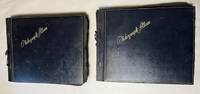
195635221Europe: n/a 1956. Photograph Album. Fair. Two oblong thick string tied photograph albums. Dark covers. Approx. 14" x 11". Both volumes have 50 black sheets of paper completely filled on both sides with numerous personal photographs souvenir photographs post cards ephemera and hand written narratives and notes in white pen. Both bindings are fragile with several loose pages in both volumes. Some of the pictures and cards are loose and laid inside the volumes. The black sheets are chipped on the edges with small pieces flaking off. Albums in fair condition only. <br /> <br /> Each volume has a one page hand written explanation note by Carl Wahle on service issued paper with color "Vienna" seal illustration and color flag illustrations of America United Kingdom. Russia and France top of the page. "7690 HQ. & SVC. CO. APO 777 US Army NY. NY." is printed in black at the center top edge of the paper. The title is taken from one of the first written title headings in volume 1. A very unique and detailed collection of photographs and ephemera detailing the personal life and service of Carl Wahle in Europe during the mid 1950's when the United States was at "Cold War" with Russia. Private First Class Wahle served with the Allied forces that controlled Vienna after World War II. There are many pictures of Carl inside the albums. He witnessed the historic departure of Allied forces from Vienna in July 1955 after the Austrian State Treaty was signed May 15 1955. Several up close pictures taken of the Russian French and British Armies during the this peace keeping mission are included. <br /> <br /> The first album contents include:<br /> <br /> Introductory note page to Volume 1 written by Carl<br /> colored embroidered shoulder patches pasted down on the inside of the front cover<br /> 186 personal and bought photographs of European places Military marches service people etc. <br /> 18 color photographs of Russian & American Changeover Ceremony Sept 1953 <br /> 23 photographs from November and December 1954 of service activities places misc.<br /> a note card by Carl to his folks dated December 19 1953<br /> a drawn white outlined map titled "My Trip to Berchtesgaden Germany Dec. '53 <br /> 4 souvenir cards <br /> 5 souvenir and 2 personal pictures of "Berchtes Jaden Salt Mines"<br /> 61 mostly souvenir photos of the Bavarian Alps Hitler's Eagle Nest and Berchtas Gaden Germany in Winter 1953; <br /> 9 mostly personal photographs taken in Paris with two photographs presumably of Carl<br /> a drawn map outlined in white titled "Trip to Paris Frankfurt Bad Ischle. - Dec. '53<br /> 2 pages of hand written narrative of Paris France Christmas 1953 including 2 maps and a small picture of the Eiffel tower pasted down<br /> color program from the Paris nightclub "Bal Du Moulin Rouge<br /> 18 pictures of Paris<br /> 1 page narrative of Bad Ischl Austria December 1953 with 6 pictures<br /> 21 more pictures Paris and Austria with a picture portrait of Carl subtitled "Student 137 March 1953; <br /> pasted down Certificate - "Tactical Command USFA NCO ACADEMY Honor Graduate signed by L. J. Chase Major Infantry and C. E. Hoy Brigadier General with Carl's note - "Graduated fourth in my class of 135 students"<br /> 25 pictures of NCO Academy<br /> 6 photographs of the 4th Recon Review April 1954; <br /> 24 training and bivouac area photographs <br /> 13 photographs of "Stiftskaserne May 1954 Honor Guard farewell ceremony for Commanding General of Vienna Command Brigadier General Fits" <br /> white drawn outlined map titled "Trip to Bavaria Ger. Switzerland Italy Monaco France & Austria. - June 54"<br /> approximately 193 photographs post cards views and ephemera of an extended trip in Europe. Carl writes several notes about this trip including "the marvelous journey I undertook accompanied by Miss Irene Nikenoay Mr. and Mrs. Kellman aunt & uncle through Austria Germany Switzerland Italy Monaco and France June 1954. There is a pasted down paper of travel orders and with 14 customs stamps. <br /> <br /> The second album includes<br /> <br /> Introductory note by Carl stating "This is Volumn Volume II of my overseas photographs and should not be examined until first reading Volume I. Please turn pages very very slowly and with extreme caution. I request this due to the fact I have written with white ink on every page and also because of the large amount of photographs therein. Thank you Carl."<br /> 6 photographs "Command Inspection by Brigadier Gen. Nutter<br /> 20 scenes within the Stiftskaserne<br /> 51 pictures of service in Europe including views of the former Nazi World War II headquarters Russian military zones and photographs of politicians Senator Estes and Congressman Daniel Reed<br /> 44 pictures of "Soviet - American change over ceremony Vienna dated 1 Sept 1951 should be later than 1951<br /> 26 photographs of Carl's parents arrival and travel in Vienna<br /> one page with one nice color illustrated note card pasted down<br /> 8 pictures "British - American change over Ceremony Heroes Square 1 Nov 1954" <br /> 19 service photographs taken October 1954 <br /> large photograph of the "Flak tower Stiftskaserne" made by the Nazis<br /> 86 views and cards from a trip made in October 1954 to Frankfurt London Rotterdam Brussels Luxembourg and Stuttgart<br /> 3 pictures of a newly wedded couple unnamed<br /> 61 more pictures of the October 1954 trip<br /> a small color embroidered note card dated May 15th with a note written inside "Belvedere Palace. this baroque structure which was constructed in the 18th century for Prince Eugene was the scene for the signing of the Austrian State Treaty. On this day a new era began for Austria."<br /> large photograph of the "Austrian Landscape" <br /> 56 pictures and views of places in Vienna a British Inspection at Schonbrunn Barracks Vienna Radio Station "International weapons match" a picnic an Austrian dance boxing match change over ceremonies involving American-British French-British American-Russian<br /> a nice holiday greeting card printed in German from Irene Nikenday<br /> 16 pictures cards ephemera from Austria<br /> 4 pictures Russian-American Changeover<br /> 4 pictures General Nutter farewell ceremony<br /> 5 misc pictures armed forces day inspection in 2 American Generals a miniature photograph of Carl "X-9" a wedding picture<br /> 41 pictures of French American Russian military units drill teams marches etc. dated 28 July 1955 "was the date the Austrian State Treaty came indo foree. and another note "Austria is Free! 28 July 1955 The Austrian State Treaty is now in force."<br /> a large mounted picture with the sun shining through a tree forest titled "Morning"<br /> a very large color picture of 3 cows<br /> 44 more pictures and cards of various unnamed places to complete the end of Volume 2. From the United States Department of State:<br /> <br /> Austrian State Treaty 1955<br /> On May 15 1955 representatives of the governments of the Soviet Union Great Britain the United States and France signed a treaty that granted Austria independence and arranged for the withdrawal of all occupation forces. These governments signed the agreement with the understanding that the newly independent state of Austria would declare its neutrality creating a buffer zone between the East and the West. The Austrian State Treaty was the only treaty signed by both the Soviet Union and United States in the decade after the 1947 Paris Peace Treaties and it marked the only Cold War era withdrawal by the Soviet Union from a territory it occupied.<br /> The Austrian situation was unique in postwar Europe. In 1938 it had been the only nation to be annexed in its entirety by Nazi Germany a fact that raised consistent questions during the war about the extent to which the country was a victim of Nazi aggression or whether it had been a collaborator. At the Potsdam Conference in 1945 the Allies agreed that they would jointly occupy Austria in the postwar period dividing the country and its capital Vienna into four zones as they planned to do with Germany and Berlin. The Soviets also demanded reparations from Austria a request that was dropped due to the country's non belligerent status but the United States did agree that the Soviet Union would be entitled to any German assets in the Soviet occupation zone. In contrast to Germany the Austrian government continued to exist in the postwar period and govern although the Four Powers could veto any new legislation if they unanimously agreed to do so. This arrangement was maintained until the withdrawal of the occupying powers upon the completion of the Austrian State Treaty.<br /> The breakdown of the wartime "Grand Alliance" and the emergence of the Cold War led to the Austrian occupation lasting far longer than anyone anticipated. Negotiations over the final status of Austria began in 1947 when half of fifty-nine proposed articles for a treaty were agreed upon. At the first meeting the foreign ministers agreed to name the agreement under negotiation the Austrian State Treaty not the Austrian Peace Treaty to acknowledge that Austria's involvement in the war had not been voluntary and that the treaty was therefore not to end a war but to reestablish an independent state. The principle sticking point during the 1947 negotiations was the issue of German assets: how they were defined and just how much compensation the Soviet Union was entitled to take. The Soviet occupation forces had seized control of factories railroads as well as oil and shipping concerns all of which had been under Nazi control at one point or another and only offered to sell them back to the struggling Austrian provisional government at exorbitant prices. As a solution to this situation France suggested a revenue-sharing plan in which some profits from the formerly German-held industries would be sold back to Austrians and some would operate independently with the Austrian State and occupying powers sharing their revenue but then the Soviet Union refused the treaty claiming some Austrian territories on behalf of the government of Yugoslavia. The parties finally reached an agreement in 1949 in which the West would offer economic concessions to the Soviet Union in exchange for the Soviet relinquishment of Yugoslav claims. Just when a deal appeared imminent the Soviet Union again opted not to sign; in fact at several points throughout the process the Soviet Union delayed completion of the treaty while it reconsidered what benefits it hoped to gain from the agreement.<br /> Between 1950 and 1953 tense Cold War relations and the existence of a hot war in Korea also contributed to stalling the talks on the Austrian situation. Then after the death of former premier Joseph Stalin in 1953 his successors in the Soviet Union launched a "peace offensive" to try to decrease international tensions. Although there were some concrete indications of the new policy such as relaxed controls in East Berlin and the newfound willingness of the Chinese to discuss Korean War POW exchanges after Chinese leaders visited Moscow U.S. President Dwight D. Eisenhower stated that he would only agree to holding a summit meeting with the Soviet Union if there were several clear indications that Soviet actions would match its rhetoric of peace. One of the examples he named was the completion of the Austrian State Treaty. Even before negotiations on the treaty restarted there were indications that Soviet policy toward Austria was liberalizing as it loosened restrictions on the press and travel in and out of its sector and also worked to establish formal diplomatic relations with the Austrian Government.<br /> With the German assets question all but settled in the last set of draft treaties the question holding up the negotiations at this stage was the issue of Austrian neutrality. The Austrian Foreign Minister went through the neutral government of India to inform the Soviet Union that if a treaty was signed independent Austria would also remain neutral staying out of NATO or other defensive arrangements. Eisenhower was against neutrality on principle and he was both angered by this maneuver and hopeful that Austrian neutrality could still be prevented. One particular danger was that West Germans anxious for their nation's own reunification would follow the Austrian example and offer their neutrality in an effort to expedite unification. German neutrality would have greater implications for American security plans in Europe than Austrian neutrality would. In late 1954 the West German Government and the Western powers at last reached an agreement under which Germans would rearm under the NATO command reassuring the United States.<br /> Finally in April of 1955 and after substantial debate on both sides representatives of the Austrian Government traveled to Moscow and returned just four days later with a complete treaty that outlined compensation to the Soviet Union for German assets and the nature of Austrian neutrality. U.S. officials demanded two changes in the treaty regarding the upper limit placed on Austrian armed forces and the removal of a clause on voluntary repatriation of displaced persons that they feared could be used by the Soviet Union to force anticommunist refugees to return to East Bloc countries. The Soviets conceded on both points. The overall terms of the treaty were less favorable to the Soviet Union than previous proposals but the timing was right for the USSR to initiate its withdrawal from Austria. On May 15 representatives from Britain France the United States and the Soviet Union signed the Austrian State Treaty ending seventeen years of occupation by foreign troops. As promised the newly-independent nation declared and maintained its neutrality for the remainder of the Cold War. n/a unknown
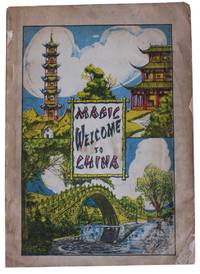
19476092Nanking China: Engineer Section Army Advisory Group 1947. Good. 9½" x 6¾". Illustrated thin card wrappers. Pp. 5 88 1. Good: lacking the map; wrappers heavily soiled and worn with some loss to edges and spine; internally very good with light toning at extremities.<br /> <br /> This is a heavily illustrated guidebook to China produced for the wives and families of American soldiers. The first section provided a "Greeting" and backdrop of information:<br /> <br /> "This small booklet is intended to give you an insight into China from the point of view of an American Army or Navy family. Your husband may be stationed in Shanghai Nanking Hankow Hangchow Tsingtao or Peiping. We have tried to tell you a little about each of these places: where you will live what kind of a home you may expect to find awaiting you and what there is to do and see."<br /> <br /> At the time of publication the United States Army Advisory Group was stationed in Nanking the Nationalist capital. Americans stayed on in China post-World War II through 1949 after Congress passed the Economic Cooperation Act of 1948 to administer the European Recovery Program. We know this program better as the Marshall Plan; the same legislation included $460 million in military and economic aid to China.<br /> <br /> The bulk of the book was dedicated to Shanghai as the authors expected that "you will all want to go there from your home station to shop in its fabulous stores and to enjoy a little of its cosmopolitan atmosphere." Readers were assured that once they "forget the filth in the streets the crowds and all of the peculiarities which will at first probably surprise and shock you Shanghai will grow on you - that is its biggest asset."<br /> <br /> Several pages provided information on Shanghai including tips on shopping hotels theaters and restaurants and "a doctor's advice for your health." A section on places of worship interestingly included Jewish temples and there's also a brief history of the city. The book also devoted five- to ten-page sections respectively on the cities of Nanking Peiping Hankow Hangchow Chengtu and Tsingtao.<br /> <br /> The book boasts a beautifully colored front wrapper along with 58 illustrations and 38 photographic images. The illustrations were by Gyula Singer a Jewish artist who according to an oral history escaped the Nazi occupation of Austria by moving to Shanghai. He later relocated to New York where he ran a commercial design business with a specialty in theater backdrops.<br /> <br /> OCLC shows five copies over two entries. Engineer Section, Army Advisory Group unknown
1862160225-MG61Philadelphia: George W. Childs 1862. very good hardcover. 1862 hinges tight no marks some foxing endpapers very nice copy. Hard Cover. Very Good/No Dust Cover. George W. Childs Hardcover
1867005330Salem OH: Hudson & Son Printers 1867. Book. Very good condition. Paperback. First Edition. Octavo 8vo. ii printed wrapper with verso blank 12 pages of text followed by ii blank rear wrapper. Moderate soiling and age-toning to wraps with a few small tears to edges and a few tiny stains on front wrapper. Includes a Preamble 23 Articles and Resolutions. At this the First National Encampment of the Grand Army of the Republic; it is likely that General John M. Palmer Major B. F. Stephenson surgeon of the Fourteenth Illinois regiment and General S. A. Hurlbut were present and involved in the formation of the national rules. First edition. Hudson & Son, Printers Paperback books