86 422 résultats
Large rolled poster, 1400 x 485 mm. Clean screenprint in yellow ink on red coated paper, thin wooden stretchers to top and bottom. Rare poster in Italian and Chinese calling for the defeat of imperialism and American social-imperialism, featuring images of Mao and Zhou Enlai. A brash and brilliant piece of graphic design; a typical example of Carboni's visual style and her support for the Palestinian liberation movement. Besides the crowded pastiche of Chinese Republic iconography, exemplified by the two dragons entwined around upward-pointing rifles and the children happily wading upstream at centre, two symbols appear slightly out of place: namely the small maps of Africa and Palestine. The poster's iconography and Maoist phrases convey a distinctly anti-Zionist message, with Carboni drawing comparison between Mao's demands for the liberation of black peoples and the Palestinian struggle; both nations are subjugated by the yoke of American imperialism. Carboni produced a number of other pro-Palestine posters in the early 1970s, including two equally aggressive posters for the Comune. Carboni was evidently familiar with Mao's writings and the oft-repeated slogans of the CPC: the three big characters at the top declare this a "dazibao" poster, with the word "manifesto" superimposed on an AK-47. The other three dazibao-style slogans roughly translate as "long live Chairman Mao", "long live the people's/peasant's republic of China", and "the dictatorship of the proletariat". The Italian text consists of direct quotations from Mao: the intellectual youth must go from the city into the countryside; the young, the graduates of middle schools, high schools and universities must mobilize themselves, and the peasants will welcome them; all reactionaries are paper tigers, and appear more terrible than they really are; the black peoples must be liberated; strategically we must despise the enemy, but tactically we must take him seriously; fight egotism and criticise revisionism, etc. We have been able to locate only one other copy, in the Zurich Museum of Design. - A few minor creases to margins, some repairs to corners and margins of verso with white tape, some very minor chipping at centre, else very good.
32 SS. Ziegelrote Originalbroschur. Kl.-8vo. Sehr selten, wohl zeitgleich mit der amerikanischen Fassung in Chicago gedruckt. - Auf dem 1. Weltkongreß der kommunistischen Parteien vereinigten sich diese zu einem international agierenden Zusammenschluß, der bis zur Auflösung durch Stalin 1943 unter zunehmendem Einfluß der sowjetischen KP stand. Unter der Führung Lenins schlossen sich im März 1919 in Moskau (unter Enthaltung des Abgeordneten der deutschen KPD) Parteien aus mehr als 25 Ländern zusammen. - Mit einem Vorwort zur Bedeutung des Manifests ("Es stellt nach dem kommunistischen Manifest von Marx und Engels das wichtigste Schriftstück der internationalen sozialistischen Bewegung dar [...]"), unterzeichnet von M. F. L., und dem Text "An das Proletariat der ganzen Welt!" - Über WorldCat kein Exemplar in einer Bibliothek nachweisen. - Minimal fleckig, das innerste Doppelblatt aus der Klammerheftung gelöst. Wenige Bleistiftanstreichungen.
Folio. 165 (but: 65) ff. With large woodcut title vignette and 18 woodcut text illustrations. 19th century half calf over marbled boards with giltstamped spine label. A very well preserved copy of the popular "Chronicle of the Hungarians", the most prominent work of late medieval Hungarian historiography and an important example of medieval chronicle writing. Janos Thuroczy (ca. 1435-88) was the first layman to compose a chronicle on Hungarian history. Originally published in Latin in 1488, this first German edition was translated by Hans Haug zum Freystein and contains all five books of the chronicle in a single volume. Provides detailed descriptions of the events in the territories of modern Hungary, starting with the uprising of the Huns in 373 A.D. and ending with the death of King Louis II of Hungary in the battle of Mohács against the Ottomans in 1526, including accounts of Saint Stephen, the first king of Hungary, and of the turbulent infant coronation of Ladislaus Postumus in 1440, with more general notes on the Hungarian coronation ceremony. - Handwritten ownership "Alfred Graf Hirmayer" on title-page. Some margins repaired, slightly waterstained and fingerstained, otherwise well preserved. From the library of the Viennese collector Werner Habel, with his ownership stamp to flyleaf (his note of acquisition from 1977 is loosely inserted). VD 16, T 1212. Kertbeny 485. BM STC-German 423. Cf. Apponyi I, 14 (Latin ed. 1488).
8vo. 39, (1) pp. With 2 photographs in the text. Original printed self-wrappers with tan paper spine strip. First of only four published issues of this journal of the Russian socialist revolutionary movement "Narodnaia Volia" (People's Will), perhaps best known for its affirmation of political terrorism and the successful assassination of Tsar Alexander II in 1881. The journal was published by Vladimir Burtsev (1862-1942), a Russian revolutionary activist and publisher. Quite scandalously, the first issue openly reprimands the organization for failing to resist the Russian government and calls for assassinating Nicholas II. In 1898, Burtsev was arrested by British authorities based on this publication and sentenced to 18 months of hard labour. Numbers 1-3 were published in London in 1897; no. 4 followed in Geneva in 1903, for which Burtsev was deported and forever banned from the country. This issue also reproduces the photographs of two terrorists who unsuccessfully conspired to assassinate Alexander III in 1889 and had since died (Isaak Dembo and Sofia Ginsburg). Burtsev would later oppose the Bolsheviks after returning to Russia, and eventually he was arrested. Gorky secured his release and Burtsev once again fled Russia. He became an outspoken activist against both Soviet antisemitism as well as the fascist movements of the 1930s. - Traces of stamp and slight loss to upper right corner of front wrapper. Spine strip somewhat fragile; internally very good. From the famous collection of Socialistica of Marxist bibliophile and scholar Chimen Abramsky (1916-2010), who fled to London from the Soviet Union in the early 1930s and became a leading specialist in both Judaica and socialist thought. His enormous collection, parts of which were auctioned after his death, has recently been commemorated in his son's biography, The House of Twenty Thousand Books (2014).
Small folio. 3 vols. 4to. (20), 938, (2) pp. (8), VIII, (2), 1022, (2) pp. (12), 660, (2) pp. All title-pages printed in red and black. Contemporary full calf with labels to richly gilt spines. Marbled endpapers. All edges red. First and only edition. A principal source for the financial history of France; the chief work of the author. The third volume constitutes a history of the Compagnie des Indes, including a great number of facts and figures difficult to find elsewhere. The present three volumes are all that was published of a projected 40-volume complete history of French finances, compiled so as to resolve practical difficulties with the tariff. The first two volumes give a detailed account of the tariff of 1664 for exports (vol. 1) and imports (vol. 2). The author treats, alphabetically, hundreds of taxed goods, including books, clothing, drugs, gold, ivory, jewels, lace, matches, paintings, printing types, silver, wine, and weaponry. The first volume includes an introductory history of duties imposed by earlier regulations since 1304. The highly interesting third volume, with the half title "Histoire de la Compagnie des Indes avec les titres de ses concessions & privileges", deals exclusively with the French East India Company. The greater part of the volume (pp. 159-602) is taken up by sources: official documents, extracts from private memoirs, etc. The volume ends with a chronological index of facts and titles and alphabetical indexes of subjects, of geographical names (with numerous references to Asia and America), and an index of persons. - The archaeologist, poet and historian Du Fresne (1704-81) spent some time at the Prussian court of Frederick II and was a member of the Berlin Academy. He befriended Voltaire, who published the first edition of his "Siècle de Louis XIV" under Du Fresne's name. - Bookplates of the Belgian Château de Seneffe, owned by Julien Depestre (1725-74), a Walloon merchant who made his fortune by trade with the Imperial Austrian troops stationed in the Austrian Netherlands. Light wear to extremities but a fine set. Einaudi 1639. Kress 4380 (vol. 3 only). INED 1533. Stourm p. 38. Bourgeois/Andre 5918 (vols. 1 & 2) ("a work of the highest order") & 6031 ("of capital importance"). Sabin 21147 (vol. 3). Larousse du XIXe VIII, 755.
8vo. (4), 83, (1) pp. Contemporary stiff wrappers. Rare first separate edition of this early work on infrastructure financing and ways to advance road building without the use of bonded labour. Text slightly modified from the first publication in the Éphémérides V (1767). "Moyen de financer la construction des chemins et leur entretien, et moyen de supprimer les corvées en nature" (INED). - Dupont de Nemours (1739-1817), a student of Quesnay's, is the principal exponent of the physiocratic school, which saw the source of a nation's wealth not in its foreign trade (as did mercantilism), but in its land and agriculture. The economic theory is named after Dupont's magnum opus, "Physiocratie, ou constitution naturelle du gouvernement", also published in 1767, and likewise with the place of publication cited as "Pekin" - a reference to the physiocrats' admiration for the meritocratic Chinese administration. - Contemporary handwritten ownership of the French civil servant Auger Lamaignère (secretary of the tiers état in 1789) on the title page. Slight paper flaw to final leaf of text, professionally repaired. Slightly browned throughout. A wide-margined copy. OCLC cites only four copies in libraries worldwide. Higgs 4176. INED 1596. OCLC 490473422. Not in Humpert, Weller, Goldsmiths, or Kress.
VI, (7)-146, (2) SS. - (Beigebunden) II: Lassalle, Ferdinand. Die indirekte Steuer und die Lage der arbeitenden Klassen. Eine Vertheidigungsrede vor dem Königl. Kammergericht zu Berlin gegen die Anklage, die besitzlosen Klassen zum Haß und zur Verachtung gegen die Besitzenden öffentlich angereizt zu haben. Leipzig, Julius Röthing / Braunschweig, W. Bracke jr., 1873. 117, (1) SS. (Beigebunden) III: Die Verhandlungen über das Tabakmonopol im Deutschen Reichstage. Vollständige Wiedergabe der Reichstags-Verhandlungen am 10., 12. und 13. Mai 1882. Nach dem amtlichen Bericht. Stuttgart, Dietz, 1882. 197, (3) SS. Marmorierter Halbleinenband der Zeit. 8vo. I: Seltene Erstausgabe während des Sozialistengesetzes in Zürich erschienen und teils illegal in Deutschland verbreitet. Die äußere Anregung gab Morgan mit seiner "Ancient Society" 1877 über die Entwicklung der Familie. Marx hatte sich mit dem Thema beschäftigt und Material hinterlassen, das Engels durch umfangreiche eigene Forschungen ergänzte und mit den Leitideen des historischen Materialismus verband. "Dadurch wird das Buch ein Grundlagenwerk zur Entwicklung der Gesellschaft aus der Sicht des historischen Materialismus" (Laffont). Engels untersucht hier erstmals in der Entstehungsgeschichte des Marxismus ausführlich die Entwicklung der Familie, der Ehe und die unterschiedliche Stellung der Frau. "Es ist die instruktivste Anwendung der materialistischen Geschichtsauffassung auf die Frühformen der menschlichen Gesellschaft" (NDB IV, 525). - II: Zweite Auflage; die erste in Deutschland erschienene Ausgabe: erstmals 1863 in Zürich erschienen. - III: Erste und wohl einzige Ausgabe; eine der frühesten Publikationen des Dietz-Verlags. - Durchgehend etwas gebräunt; zu Beginn geringfügige Randläsuren; ein hinterlegter Ausriss im Inhaltsverzeichnis am Schluss. Besitzvermerk "Gust. Erdmann" am vorderen Innendeckel. I: Stammhammer I, 73, 20. Marx-Engels Erstdrucke 45f. (mit Abb.). Rubel 93. - II: Stammhammer I, 127, 27. - III: Emig A 6.
128 pp. Staple-stitched blank wrappers (as issued?). 8vo. First Russian translation of Engels's important history of the German Peasants' War of 1525, begun shortly after the German revolutionary events of 1848 and published in a series of articles in Neue Rheinische Zeitung. This was the first work to argue that the reasons for the uprising had been socio-economic, rather than cultural or religious. It also deduced from its failure the need for collaboration between the peasants and the urban proletariat. The present edition contains a translation of Engels's new preface written in 1874, for the third 1875 edition, as well as a preface by the editor, which cites a letter written by Engels shortly before his death. Aleksandr Finn-Enotaevskii (1872-1943) was a noted Russian Marxist who fled abroad after being arrested and collaborated with the Bolsheviks and Lenin himself; after 1917 he was closer to the Menshevik faction. He was prosecuted during the Stalinist repressions of the 1930s. - Not in the Bernstein-Souvarine catalog. This copy has a curious provenance: an undocumented Russian student organization in a small Saxon town, possibly allied with revolutionary tendencies. Rare; KVK and OCLC only locate the copies at Bibliothèque de Genève and IISG. Not at the Russian State or National Libraries.
X, 250, (2) SS. Pappband der Zeit mit Rückenschildchen. 8vo. Erste und einzige Ausgabe der äußerst seltenen Schrift des bedeutenden Ökonomen. Besondere Bekanntheit erlangte er durch seinen Einfluss auf den jungen Marx. Die Exzerpte aus Gülichs Werken gehören zu den umfangreichsten, die Marx von Ökonomen angefertigt hatte. - Einband berieben und beschabt, Rücken mit Bibliotheks-Nummernschild. Ausgeschiedene Bibliotheks-Doublette mit Stempeln am Titel. Durchgängig etwas stockfleckig. Nicht bei Goldsmiths', Kress und Humpert.
8vo. VIII, 256 pp. Contemporary half cloth. Only edition of this book which Karl Marx studied thoroughly during his work on the second volume of "Das Kapital". "Marx's interest in Dühring's writings may have been influenced by his reading of F. A. Lange's brochure 'J. St. Mill's Ansichten über die soziale Frage [...]' Duisburg 1866. He prepared excerpts of this book in his notebook kept between 20 August 1867 and September 1868 (IISG, estate of Marx and Engels, B 107, pp. 31-37), immediately before he excerpted Dühring, and reflected on his criticism of Carey's German admirers" (cf. Marx, Manuskript zum zweiten Buch des 'Kapitals', Entstehung und Überlieferung, MEGA II.11, pp. 911f.). - Slight browning and brownstaining throughout. Stamps of the "Schweizer Arbeitersekretariat" and the "Schweizer Gewerkschaftsbund". A good copy. Stammhammer I, 125, 1 ("1865"). Die Bibliotheken von Marx und Engels (MEGA IV.32), no. 722.
8vo. 19, (1) pp. Original printed wrappers bound within modern full red cloth with giltstamped title-label to spine. First edition of this extremely rare political pamphlet against the Socialist Revolutionaries. Attacking their programmatic views and tactics as well as advocating the social democratic cause and the peasant movement, Lenin accuses the Socialist Revolutionaries of "tearing Marxism to shreds". His essay is essentially a polemic against the SR's use of terrorism as a substitute for Iskra-style political agitation. - Stamp of the "Russischer Leseverein Zürich" to title-page with handwritten shelfmark number to title-page. A small tear to title-page; occasional light foxing. Lenin, Collected Works VI, pp. 186-207. OCLC 914883431.
8vo. LXVIII, (2 pp. table of contents, verso also numbered LXVIII), 589, (1) pp., including 2 title pages. Contemporary half cloth over marbled boards with giltstamped spine title. First edition. - Friedrich List's seminal advocacy of economic nationalism, derived from the nationalist and romantic ideas of Alexander Hamilton and Adam Müller, from whom List also adopted his opposition against the ideas of Adam Smith. List considered the principle of free trade detrimental to the national interest, to which the immediate interests of groups and individuals should be submitted. For List, the nation was an entity whose aim is not the creation of wealth by international exchange, but the development of its own economic and productive sources. "These views coincided so exactly with the reawakening of German nationalism that List's book caused a great sensation when it was published, and it remained for seventy years the theoretic gospel of the advocates of protectionist tariffs in Germany, Britain and the United States" (PMM). - Binding a little rubbed. Tiny defect to gutter of title leaves, usual mild browning throughout, a few leaves with a heavier, but mostly small brownstain to margins. A good copy. Kress C.5545. PMM 311. Books That Made Europe, p. 210 ("The undisputed manifesto of nationalist economics").
Large 8vo. 2 volumes in one. (4), (16), 502 pp. (4), 504, (2) pp.; followed by 40 pp. of sheet music. With two allegorical engraved title vignettes on both title-pages (printed in red and black), an engraved frontispiece by Jeremias Jakob Sedelmayr after Francesco Solimena, an engraved author's portrait by Antonio Baldi, and 11 engraved plates by both Sedelmayr and Baldi after Solimena, accompanying the 10 tragedies and the dedication. Also with some engraved initials and some woodcut tailpieces and 40 pages of engraved sheet music to the choruses. Contemporary brown morocco, gold tooled spine, gold-tooled frames on both boards with gold-tooled cornerpieces, black morocco spine label with title in gold, decorative gilt roll to edges and inner dentelles, marbled endpapers and gilt and goffered edges with an intricate fore-edge painting, incorporating both a closed and fanned design for the outer edge. The edges at the head and foot of the text block are painted with floral and botanical designs. The fore-edge is painted with a central cartouche with scrolling leafs in a rococco-style, which reveals, when fanned, a painting a of tree with a scroll with "Prospiciente Deo" painted above. The cartouche is surrounded by flowers and a crown is painted above. The fanned designs also reveals another cartouche in the same style, reading "Si faveat coelum, bene surculus, arbore crescet: Si mihi TU, faveas, sic EGO MAGNUS ero" and the monogram signature of an unknown artist below. The painting of the tree and the scroll and the subscription below are taken from Camerarius, being his third emblem in the first part of his "Symbolorum et Emblematum" (first edition Nuremberg, 1593). First and only edition of this collection of ten Italian Christian tragedies, written by the Neapolitan poet Annibale Marchese (1687-1753). It is illustrated with beautiful engravings after the important Italian baroque painter Francesco Solimena (1657-1747) and complemented with the sheet music for the choruses of the five tragedies in the second volume, composed by some of the foremost Italian and German 17th and 18th century composers, including Tommaso Carapella (1655-1736), Domenico Sarro (1679-1744), Leonardo Vinci (1690-1730), Francesco Durante (1684-1755), Johann Adolf Hasse (1699-1783), and Nicola Fago (1677-1745). - Binding only slightly worn around the edges and corners; a few wormholes to spine. Some browning and foxing, some marginal waterstaining in the lower margin of the first few leaves (preliminaries only, not affecting the plates). Provenance: armorial bookplate of James Whittle and another bookplate of the California collector and philanthropist Dorothy Jayne Pedrini Shea, both on the front pastedown. Also with the loosely inserted bookplate of Randall J. Moskovitz, M.D., whose collection comprised many books with fore-edge paintings. - Overall a good copy in intriguing binding with a bright and detailed fore-edge painting, both closed and fanned. For the emblem of the tree of the fore-edge painting see Emblemata: Handbuch zur Sinnbildkunst des XVI. und XVII. Jahrhunderts, col. 165.
Folio (220 x 357 mm). 2 parts in 1 vol. (10), 431, (13), (12), 362, (20) pp., final blank. Both title pages printed in red and black. With separate engr. title page, large folding map, 49 (instead of 40!) portrait plates (of which 13 contain 9 portraits each), 54 engr. views or battle scenes (1 folding), and 2 small folding maps. Contemp. vellum with ms. title to spine. Third (and final), most extensive edition of this principal work on the history of the Turkish wars. This encompassing contemporary chronicle had first been published in 1602. Contains views of the sieges and battles of all principal cities and the portraits of all warlords involved on both sides. Includes nine portrait plates more than required by Nebehay/Wagner. Occasional insignificant browning and fingerstaining, but in uncommonly good condition throughout. VD 17, 23:323431G. Nebehay/W. 464. Németh H 1540. Sturminger 300. Hampe, Fürst, p. 123.
210 x 135 mm. Etwas spätere rote Halblederbände der Zeit mit Rückenvergoldung und ein sehr ähnlich gebundener moderner Halblederband, dort die Original-Umschläge meist mit eingebunden. Mit Beigaben zusammen 10 Bde. Umfangreiche Sammlung. Enthält in Bindefolge: - Band 1: 1. H. Saint-Simon. Oeuvres. Paris, Capelle, 1841. 2 Bll., XXXVIII, 364, 201 (recte: 199) SS. Kress C. 5642. - Band 2: 2. (H. Saint-Simon u. a.). Opinions littéraires, philosophiques et industrielles. Paris, Bossange, 1825. Kress C.1515; Fournel 32. - Band 3: 3. H. Saint-Simon. Du système industriel. Paris, Renouard, 1821. 2 Bll., XX, 311 SS. Kress C.772; Fournel 26f. Vortitel verso mit gedrucktem Schildchen von Capelle. - Bd. 4: 4. (H. Saint-Simon). Nouveau christianisme. Lettres d'Eugène Rodrigues sur la réligion et la politique. L'education du Genre humain, de Lessing, traduit par E. Rodrigues. Paris, Bureau du Globe, 1832. VII, 346 SS., 1 Bl. Kress C.3321; Fournel 94. - Bd. 5: 5. Doctrine de Saint-Simon. Exposition. Premiére année. 1828-1829. 3me èd. Paris, Bureau de l'Organisateur, 1831. 432 SS. Beigedruckt: (P. Enfantin u. A. Bazard). Religion saint-simonienne. Lettre à M. le Président de la Chambre des députés. 8 SS. (wie die Doctrine bei Everat gedruckt). Fornel 73. - 6. (H. Carnot). Doctrine saint-simonienne. Résumé général de l'exposition faite en 1829 et 1830. 3e éd. Paris, Bureau du Globe, 1831. 1 Bl., 45 SS. - Fournel 73. - Bd. 6: 7. Religion saint-simonienne. Projet de discours de la couronne pour l'année 1831 (par M. Chevalier). Moyens de supprimer immédiatement tous les impôts (etc.) (par É. Pereire). La Vendée (par M. Chevalier). Paris, Bureau du Globe, 1831. 1 Bl., 36 SS. Kress C.2932. - 8. J. Pereire. Religion saint-simonienne. Leçons sur l'industrie et les finances ... suivies d'un projet de banque. 2 Bll., 105 SS. Kress C.3262; Fournel 83ff. - 9. (P. Enfantin). Religion saint-simonienne. Économie politique et politique. 2me éd. Paris, Bureau du Globe, mars 1852. 181 SS., 1 Bl. Kress C.3131; Fournel 94. - 10. Religion saint-simonienne. Politique industrielle et système de la Méditerranée (par M. Chevalier). Paris 1832. SS. (3)-150 (inkl. Vortitel), 1 Bl. Inh. Kress C.3095; Fournel 80. - 11. (M. Chevalier). Religion saint-simonienne. Politique européenne. Articles extraits du Globe. Paris, Bureau du Globe, 1831. 2 Bll., 127 S. Kress C.2756; Fournel 80. - Bd. 7: 12. Religion saint-simonienne. Morale. (P. Enfantin u. É. Barrault). Réunion générale de la famille (etc.). Paris, Libraire saint-simonienne, avril 1832. Mit gest. Porträt (Enfantin). 2 Bll., 207 SS., 2 Bll. Kress C.3132; Fournel 93. - 13. Religion saint-simonienne. Enseignement des ouvriers. Paris, Bureau du Globe, 1831. 23 S. Fournel 84. - 14. P. Enfantin. Père Enfantin à Charles Duveyrier ... à François et Pfeiffer. (Paris), Everat, (1831). 22 SS., 1 w. Bl. Kress C.2795; Fournel 68. - 15. (P. Enfantin u.a.). Religion saint-simonienne. À tous. Paris, Librairie saint-simonienne, avril 1832. 1 Bl., 33 SS. Kress C.3130; Fournel 85. - 16. Religion saint-simonienne. Correspondance. Articles extraits du Globe. Paris, Bureau du Globe, 1831. 56 S. Kress C.2929; Fournel 83. - Bd. 8: 17. (H. Saint-Simon). Du systême industriel. (Deuxième partie.) [No. 1:] Au Roi. Premiere adresse. Paris, chez l'auteur, 1821. 128 SS. Fournel 27. - 18. (É. Barrault). Aux artistes. Du passé et de l'avenir des beaux-artes. (Doctrine de Saint-Simon.) Paris, Mesnier, 1830. 84 SS. OU. Fournel 65f. - 19. (Doctrine de Saint-Simon). (E. Rodrigues). Lettres sur la religion et politique, 1829 (etc.). Paris, Bureau de l'organisateur, 1831. XVI, 180 SS., 1 Bl. OU. Vgl. Fournel 66-68. - 20. Religion saint-simonienne. Prédication sur la constitution de la propriéte (par J. Reynaud). (Umschlagtitel). 23 SS. OU. Vgl. Fournel 79. - 21. Religion saint-simonienne. Rapports adressés aux pères suprêmes sur la situation et les travaux de la famille. Paris, Bureau du Globe et de l'Organisateur, 1831. 1 Bl., 33 SS. OU. Vgl. Fournel 82. - 22. Religion saint-simonienne. (Michel Chevalier). La presse. Articles extraits du Globe. (Umschlagtitel). Paris ebda. 1831. 28 SS. OU. Fournel 82. - 23. Religion saint-simonienne. (J. Lechevalier). Enseignement central. Paris, Everat, 1831. 64 SS. OU. (= Bureau de l'organisateur). Vgl. Fournel 78. - 24. Religion saint-simonienne. Politique industrielle. Systême de la Méditerranée; par M. Chevalier. Paris, Bureau du Globe, mars 1832. 56 SS., 1 Bl. Fournel 85. - Insgesamt stellenweise stockfleckig oder gebräunt; Bd. 5 stellenw. wasserrandig. . Dazu: H. Saint-Simon. Son premier écrit; lettres d'un habitant de Genève ... sa Parabole politique ... Le Nouveau christianisme ... Publiés par Olinde Rodrigues. Paris, Librairie saint-simonienne, 1832. 2 Bll., XXXVIII, 201 SS. Etwas späterer Halblederband. Fournel 100. Stellenweise stockfleckig. - G. Hubbard. Saint-Simon. Sa vie et ses travaux. Paris, Guillaumin, 1857. 12mo. 2 Bll., 316 SS. Hldr. d. Zt.
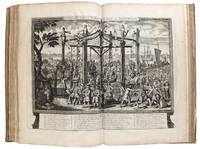
172542567Amsterdam 1725. Folio. 15 3/8 x 10 inches. Title printed in red and black. Folding engraved frontispiece engraved list of plates within a decorative surround 1 title page and 87 engraved plates maps and broadsides 40 double-page 22 folding single-page 6 folding double-page and 17 single-page. Includes some plates with multiple variants. Vellum tooled gilt with 8 raised bands forming 9 compartments spine gilt morocco lettering piece in second compartment<br/> <br/> A rare work exhibiting a collection of contemporary satirical prints relating to the financial exploits of John Law and his infamous Mississippi Bubble.<br/> <br/> John Law 21 April 1671 - 21 March 1729 was a Scottish economist who believed that money was only a means of exchange that did not constitute wealth in itself and that national wealth depended on trade. He is said to be the father of finance responsible for the adoption or use of paper money or bills in the world today. Law was a gambler and a brilliant mental calculator and was known to win card games by mentally calculating the odds. An expert in statistics he was the originator of economic theories including two major ideas: The Scarcity Theory of Value and the Real bills doctrine. The present work records the economic crisis precipitated by Law. The crisis had its origins in the decision of the French regent Philippe d'Orléans to appoint John Law the Controller General of Finances for France. In May 1716 the Banque Générale Privée which developed the use of paper money was set up by Law. It was a private bank but three quarters of the capital consisted of government bills and government accepted notes. In August 1717 he bought the Mississippi Company to help the French colony in Louisiana. In 1717 he also brokered the sale of Thomas Pitt's diamond to the regent Philippe d'Orléans. In the same year Law floated the Mississippi Company as a joint stock trading company called the Compagnie d'Occident which was granted a trade monopoly of the West Indies and North America. The bank became the Banque Royale in 1718 meaning the notes were guaranteed by the king. The Company absorbed the Compagnie des Indes Orientales Compagnie de Chine and other rival trading companies and became the Compagnie Perpetuelle des Indes on 23 May 1719 with a monopoly of commerce on all the seas. The system however encouraged speculation in shares in The Company of the Indies the shares becoming a sort of paper currency. In 1720 the bank and company were united and Law was appointed Controller General of Finances to attract capital. Law's pioneering note-issuing bank was extremely successful until it collapsed and caused an economic crisis in France and across Europe. Law exaggerated the wealth of Louisiana with an effective marketing scheme which led to wild speculation on the shares of the company in 1719. In February 1720 it was valued for a very high future cash flow at 10000 livres. Shares rose from 500 livres in 1719 to as much as 15000 livres in the first half of 1720 but by the summer of 1720 there was a sudden decline in confidence leading to a 97 percent decline in market capitalization by 1721. Predictably the bubble burst at the end of 1720 when opponents of the financier attempted en masse to convert their notes into specie. By the end of 1720 Philippe II dismissed Law who then fled from France. Originally published by a group of Amsterdam booksellers the work has a convoluted bibliographic history owing to the ongoing enlargement of the number of prints published between late 1720 and the ensuing years coupled with the issuance of the plates as separate unbound sheets as well as later editions with yet more plates which maintained the title page dated 1720. In short nearly every extant example is unique in composition. "This remarkable complexity helps to explain why the book continues to fascinate scholars and readers to the present day: Het groote tafereel der dwaasheid in its many diverse copies represents an important witness to the events of 1720 and their aftermath which makes it valuable to cultural and economic historians . The book presents the rise progress and downfall of the deceptive trade of 1720 what that a group of booksellers who published it in 1720 when in Amsterdam where in order to restore social and ethical norms in Dutch society why by making fools of the greedy in a theatrical setting how. In short the Tafereel is an Amsterdam-born satirical comedy in disguise" Kuniko Forrer "Het groot tafereel der dwaasheid: A Bibliographical Interpretation" in The Great Mirror of Folly: Finance Culture and the Crash of 1720 Edited by William N. Goetzmann et. al. pp. 35-36. The present example corresponds to Forrer's third edition issued shortly after 1723 with the "Register" listing 73 plates and bound in a contemporary binding attributed to the Double Drawer Handle Bindery. This edition noted as the final edition published in the 1720s and the most complete including portraits of Madame Law and the King of the Mississippi "Der Koning van Missisipi" not found in earlier issues among other additions.<br/> <br/> Goldsmiths 5829; Kress 3217; Muller 3535; Sabin 28932; A.H. Cole The Great Mirror of Folly . an economic-bibliographical study Harvard: 1949; The Great Mirror of Folly: Finance Culture and the Crash of 1720 Edited by William N. Goetzmann et. al. Yale University Press: 2013. unknown
1720B5707c. 1720 . Altogether a very good and attractive copy of this important caricature platebook.<br>. Edition: First Edition Binding: Contemporary full calf with raised bands in 7 compartments. Text on 2 gilt centerpieces and decorative borders in compartments. Notes: Text is in Dutch. “This great Theatre of Folly representing the origin progress and downfall of the South Sea Bubble in France England and Holland is an exceedingly curious collection of emblematical plates and caricatures on the scheme of J. Law and the Mississippi Company and the imitations of it in Holland with their fatal results. Not a few of the scenes here depicted have been reproduced in the New York Exchange. The engravings which illustrate the rise and fall of the great speculation are full of humor; many of them are exceedingly ludicrous and some very obscene. They are finely engraved on copper and are accompanied with full descriptions in prose and poetry. So much offence was given to the English and French by this book that medals were struck by them in ridicule of the Dutch which was perhaps the beginning of the hostility which long existed in the minds of the English against the latter. The number of the plates in copies varies from sixty to seventy-four.†<br><br>This first edition of the most elaborate publication was inspired by the economic events of 1720 primarily satirizing Dutch manifestations of the speculative mania that led to the Mississippi Bubble in France a financial scheme that shook the French economy to its core and instigated the use of paper money in the country; engineered by Scottish economic theorist John Law and the South Sea Bubble in England.†Sabin<br> Size: Folio 394x235mm. Illustration: Illustrated with red and black title 74 engraved plates including many double-page or folding; 70 of 74 plates as listed in Koninck's rarely preserved index of plates of early editions; plates 26 29 39 and 71 of this list are not included but instead four other plates one of these a map entitled “Louisiana by the River Mississippiâ€. References: Alden European Americana 720/114; Cole The Great Mirror of Folly pages 23-35; Sabin Bibliotheca Americana 28932; Goldsmith 5879; Howes G 442; Muller America 1503 Pages: Title bl. 25 list of towns; 1-52; 1-14; detached insert of four letters 195x156mm: 1st: title bl. 1-10; 2nd: title bl. 1-10; 3rd: title bl. 1-10; 4th: title bl. 1-9; 15-26 29-31 bl. 1-8. Category: Book Caricatures; Book Europe Benelux; Book Europe France; Book Plate Books General; hardcover
172520771Amsterdam 1725. Folio. 15 3/8 x 9 3/4 inches. Title printed in red and black. Folding engraved frontispiece engraved list of plates within a decorative surround 72 engraved plates maps and broadsides on 73 leaves 5 of the single-page plates cut to the edge of the image and mounted as issued 45 double-page 19 folding and including 10 which combine both engraving and letterpress text one plate loosely inserted 2 with sections of blank margins torn away some other clean tears occasionally affecting the image area. Contemporary Dutch speckled calf spine in eight compartments with raised bands red morocco lettering-piece in the second compartment repeat decoration in gilt in the others.<br/> <br/> A rare work exhibiting a collection of contemporary satirical prints relating to the financial exploits of John Law and his infamous Mississippi Bubble.<br/> <br/> John Law 21 April 1671 - 21 March 1729 was a Scottish economist who believed that money was only a means of exchange that did not constitute wealth in itself and that national wealth depended on trade. He is said to be the father of finance responsible for the adoption or use of paper money or bills in the world today. Law was a gambler and a brilliant mental calculator and was known to win card games by mentally calculating the odds. An expert in statistics he was the originator of economic theories including two major ideas: The Scarcity Theory of Value and the Real bills doctrine. The present work records the economic crisis precipitated by Law. The crisis had its origins in the decision of the French regent Philippe d'Orléans to appoint John Law the Controller General of Finances for France. In May 1716 the Banque Générale Privée which developed the use of paper money was set up by Law. It was a private bank but three quarters of the capital consisted of government bills and government accepted notes. In August 1717 he bought the Mississippi Company to help the French colony in Louisiana. In 1717 he also brokered the sale of Thomas Pitt's diamond to the regent Philippe d'Orléans. In the same year Law floated the Mississippi Company as a joint stock trading company called the Compagnie d'Occident which was granted a trade monopoly of the West Indies and North America. The bank became the Banque Royale in 1718 meaning the notes were guaranteed by the king. The Company absorbed the Compagnie des Indes Orientales Compagnie de Chine and other rival trading companies and became the Compagnie Perpetuelle des Indes on 23 May 1719 with a monopoly of commerce on all the seas. The system however encouraged speculation in shares in The Company of the Indies the shares becoming a sort of paper currency. In 1720 the bank and company were united and Law was appointed Controller General of Finances to attract capital. Law's pioneering note-issuing bank was extremely successful until it collapsed and caused an economic crisis in France and across Europe. Law exaggerated the wealth of Louisiana with an effective marketing scheme which led to wild speculation on the shares of the company in 1719. In February 1720 it was valued for a very high future cash flow at 10000 livres. Shares rose from 500 livres in 1719 to as much as 15000 livres in the first half of 1720 but by the summer of 1720 there was a sudden decline in confidence leading to a 97 percent decline in market capitalization by 1721. Predictably the bubble burst at the end of 1720 when opponents of the financier attempted en masse to convert their notes into specie. By the end of 1720 Philippe II dismissed Law who then fled from France. Originally published by a group of Amsterdam booksellers the work has a convoluted bibliographic history owing to the ongoing enlargement of the number of prints published between late 1720 and the ensuing years coupled with the issuance of the plates as separate unbound sheets as well as later editions with yet more plates which maintained the title page dated 1720. In short nearly every extant example is unique in composition. "This remarkable complexity helps to explain why the book continues to fascinate scholars and readers to the present day: Het groote tafereel der dwaasheid in its many diverse copies represents an important witness to the events of 1720 and their aftermath which makes it valuable to cultural and economic historians . The book presents the rise progress and downfall of the deceptive trade of 1720 what that a group of booksellers who published it in 1720 when in Amsterdam where in order to restore social and ethical norms in Dutch society why by making fools of the greedy in a theatrical setting how. In short the Tafereel is an Amsterdam-born satirical comedy in disguise" Kuniko Forrer "Het groot tafereel der dwaasheid: A Bibliographical Interpretation" in The Great Mirror of Folly: Finance Culture and the Crash of 1720 Edited by William N. Goetzmann et. al. pp. 35-36. The present example corresponds to Forrer's third edition issued shortly after 1723 with the "Register" listing 73 plates and bound in a contemporary binding attributed to the Double Drawer Handle Bindery. This edition noted as the final edition published in the 1720s and the most complete including portraits of Madame Law and the King of the Mississippi "Der Koning van Missisipi" not found in earlier issues among other additions. This copy is accompanied by: GOETZMANN William N. et al. The Great Mirror of Folly: Finance Culture and the Crash of 1720. New Haven: Yale University Press 2013. The definitive modern study of the present work edited by William N. Goetzmann Catherine Labio K. Geert Rouwenhorst and Timothy Young. The volume reproduces and interprets the full range of plates satires and texts situating it within the broader visual and cultural history of the early modern financial revolution. Richly illustrated and deeply researched it brings together essays by leading scholars on economic thought print culture theatre and art illuminating how Law's System and the speculative mania of 1720 transformed Europe's understanding of credit risk and value.<br/> <br/> Goldsmiths 5829; Kress 3217; Muller 3535; Sabin 28932; A.H. Cole The Great Mirror of Folly . an economic-bibliographical study Harvard: 1949; The Great Mirror of Folly: Finance Culture and the Crash of 1720 Edited by William N. Goetzmann et. al. Yale University Press: 2013. unknown
1553030664Florentiae , Florence 1553 In officina Laurentii Torrentini Ducalis Typografi , L. Torrentinus Full-Leather 1st Edition
150464018CBLugduno [Lyon], 1504. 2°. 44 x 30 cm. [26] Blatt. 2 Holzschnittinitialen. Restaurierter Holzeinband im Stile der Zeit, als Halbband auf 5 Bünden mit blindgeprägtem Pergamentbezug in Platten- und Rollendruck sowie Lederriemenschließen mit verzierten Hakenverschlüssen aus Messing und privat appliziertem Daumenregister in Leder. [10 Warenabbildungen]
400 x 290 mm. Important and previously unseen large-format photograph of the one and only meeting between Castro and Hemingway. The historic moment took place at an unlikely venue: the Torneo Anual de Pesca fishing competition, run each year by Hemingway himself. Castro was initially supposed to referee, but at the last minute decided to take part as a contestant - and won the day. - Captured here in a candid snapshot by Castro's photographer, Alberto Korda, Hemingway presents the trophy to Castro, and the two are able to speak briefly. Hemingway's fishing competition has outlasted both men, and continues to draw international anglers to Cuba every summer. - The Studios Korda stamp appears on the verso, unlike in later reproductions. Lightly toned, otherwise in good condition. An iconic and rare original.
4to. (4), 143, (1) SS. With engraved frontispiece and engraved portrait of Nautius Rutilius, both in splendid hand-colour, as well as an additional hand-painted portrait of Johann Joachim von Aichen on vellum. 18th century green satin binding over wooden boards with marbled endpapers (some damage to pastedowns); traces of clasps. All edges gilt. The rarest work of the Swiss scholar Bucelin: a genealogical study of the gens Rutilia, a Roman plebeian family to which the Italian Roverella family and the German von Aichen family trace themselves. Bucelin dedicated the work to the Austrian civil servant Peter von Aichen, who was ennobled in Lower Austria in 1666. It must have had a very limited press-run, and only six copies are known in libraries worldwide: in the Austrian National Library (the copy of the Imperial civil servant Joachim Windhaag) and in the University of Vienna (the Vienna Jesuits' copy), in the Lower Austrian Library in St. Pölten and in the State Library of Württemberg in Stuttgart (the latter institutions holding two copies each). The present seventh known copy is that of the Aichen family itself and contains a splendid portrait of the Lieutenant Governor or Lower Austria, Johann Joachim von Aichen (1664-1729), painted on vellum and decorated with drapery, architectural elements, allegorical figures, the family arms, and an inscription (overpainted in red and poorly legible), monogrammed and dated at lower right "JMP 1707". - The Benedictine monk Gabriel Bucelinus (1599-1681) from Diessenhofen in Thurgau, one of the most prolific scholars of the 17th century, taught as professor at the Weingarten monastery and served as provost of Feldkirch in Vorarlberg, where the book was printed. - Satin binding a little stained. A few areas of Aichen's portrait are rubbed or chipped in the paint; the marbled endpaper has been crudely peeled from the pastedowns. In all a very finely preserved specimen, a unique survival from the family of the dedicatee. No copy recorded in the trade. OCLC 311312169. Not in VD 17.
453Francofurti ; id. ; Romae : Matthiae Beckeri ; Ioannem Wolffium ; Ex Officina Accoltiana, 1610 ; 1611 ; 1580. UN PRÉCIEUX RECUEIL DE TRAITÉS POLITIQUES À L'USAGE DU DERNIER DES VALOIS
12mo (90 x 144 mm). (2), 260 pp. With engraved title-page, 2 engraved plates, 14 hand-coloured plates, 1 hand-coloured folding plate, 16 head-pieces (2 hand-coloured), numerous tailpieces and 1 folding table. - (With) II: Drosakk' amenayn terut'eanc [Flags of All Nations]. Ibid., 1813. Engraved title and 15 engraved plates, coloured throughout. Contemporary calf gilt with morocco spine label in Armenian and florally gilt spine. Patterned paper endleaves. All edges gilt. Only edition of this rare Armenian almanac, edited by Lukas Inchichean (Ghukas Injijian), who is hailed as the father of modern Armenian geography. Illustrated with hand-coloured plates of various costumes, including a large folding plate illustrating a ceremony wherein a woman in scarlet dress is jumping into a raging bonfire; in her hands she holds a golden arrow and a golden box. The almanc appears always to be bound with "The flags of the nations", containing 15 plates of hand-coloured national flags, dated 1813 on the title-page. Both works were printed and issued by the Mekhitarist Congregation on the Island of San Lazzaro in Venice. This island was a favourite of Lord Byron: while living in Venice, Byron rowed out alone in his gondola every day to the monastery of San Lazzaro to spend hours learning Armenian, poring over rare books in the library and conversing with the friendly Armenian fathers. - Some light browning and, near the end, occasional waterstaining; a few annotations and inscriptions to flyleaves, dated 1944. A few weakend folds to the large plate professionally restored. Nersessian 309. OCLC 1055969209.
1914164313Erlangen, Enke, 1850-1914. Einheitl. Hldrbde. m. goldgepr. Rtit. Bibliotheksex. m. St. a. Vorsatz u. Tit. Rücken teilw. m. Fehlst. u. berieben. Seiten einiger Bde. gebräunt od. braunfl. Es fehlen Rücken d. Jgge. 8, 30, 31, 36, 42 u. 52/53. Jg. 28 Tit. lose. Registerbd. S. teilw. lose.