86 422 résultats
136958aafAugsburg, Weyssenborn / Strassburg Johannum Albrecht / Albrecht, 1536 / 1536 /1536: in-4to, 1) Fuchsperger: Titelblatt mit gest. Wappenholzschnitt (Ai) + 4 Bl. (AII-AV) + 1 Bl. weiss + 4 Bl. (B1-B4) + 91 Blatt (numm. I bis XCI ) + 1 Bl. (das Buch Beschleüsst) + 1 Faltbl. (Just. Inst. summ. verklär.) + 8 Blatt Register. Zwischen Blatt 52/53: 1 Faltblatt / Blatt LIIII verso gest. Geneal. Tabelle: Erbfolge. // 2) Brandt: Titelblatt mit Holzschnitt (AaI) + 6 Bl. (AaII-VII) + 1 Holzschnitttafel (AaVIII) + 135 Blatt (numm. I -CXXXV). (Blatt CII-(102) verso Holzschnittabb.) // 3) TENGLER, Ulrich - BRANT: Titelblatt mit Holzschnitt (CI) + 5 Bl. (CII-CVI) + 128 Blatt (numm. I-CXXVIII) + 3 Bl. Register, Illustriert mit 20 Text-Holzschnitten + 5 blattgrossen Holzschnitten (manchmal wiederholt). Blindgeprägter Schweinsleder Einband d. Zeit mit 1 (von 2) Schliessen.
Small oblong folio (327 x 190 mm). 2 parts in one volume. With 2 engraved titles and a total of 50 engraved views, maps and plans (several folded, 5 maps in original hand colour). Modern half vellum with giltstamped spine title. A fine collection of maps and views of Hungary which Bodenehr issued after the 1718 Treaty of Passarowitz, in which the Ottomans had to surrender large areas to Habsburg Empire, which now reached its greatest territorial expanse in history. Among the engravings are many fortresses and cities, such as Vienna, Pressburg, Sziget, Munkacs, Tokay, Nagy-Várad, Gyula, Temeswar, Kaschau, Buda, Belgrade, Székesfehérvár, Orsva, and Constantinople. The present issue must have appeared in or after 1737, as the view of the fortress of Užice mentions the handover that took place on 2 October of that year. - Light foxing, browning and waterstaining. Binding slightly scuffed and rubbed; front flyleaf creased. Contemporary ownership of Joseph Wanizek to title-page. Latterly in the library of the Viennese collector Werner Habel (1939-2015) with his handwritten and stamped ownership, dated 1978, to the pastedown. Nebehay/Wagner 104, pt. 7.
Very Good Arabic Original autograph document/letter sealed by Ahmad I of Tunisia. 54x42 cm. 1 p. 6 long lines. The letter includes full of poetic praise. It must be sent after successful diplomatic intercourse with Naples. Ferdinand II (Ferdinando Carlo) was King of the Two Sicilies from 1830 until his early death in 1859. It starts with 'Thank God alone', and goes on 'From poor Ahmad Pasha to Lord Almighty Field Marshal Amîr [ruler]. Sealed by the seal of Ahmad Basha Beg including an impressive qasidah in Arabic. Ahmed I (ibn Mustafa), born 2 December 1805 in Tunis died May 1855 at La Goulette, was the tenth Husainid Bey of Tunis, ruling from 1837 until his death. He was responsible for the abolition of slavery in Tunisia in 1846. He succeeded his father Mustafa Bey on 10 October 1837. He had grand ambitions - to expand his army and create a modern navy; to build a new royal residence, a mint and modern institutions of education but neither he nor his brother-in-law the young Mustapha Khaznadar who served as his finance minister, had a clear idea of what such initiatives would cost. As a result, many of his projects became expensive failures which damaged the financial health of the country. Soon after his accession, Ahmad Bey received the traditional Firman from the Sublime Porte which formally invested him with authority to rule from the Ottoman Empire and furnished him with the insignia of office. The Ottoman envoy, Osman Bey, arrived in la Goulette on 15 May 1838 onboard a frigate. The following day, Osman Bey made his official entry into Tunis on horseback, preceded by all the ministers of the beylical cabinet who went before him until he was two leagues from the city. Before he were carried the sword of honor and the caftan to be presented to the Bey. He was escorted by spahis and followed by a large contingent of regular troops an Arab cavalry. Three days after his official entry into the city, the envoy presented himself at the Bardo Palace to formally invest Ahmad Bey with his insignia of office and present gifts. Named as a Divisional General in the Ottoman army in May 1838, he was later promoted by the Sultan to the rank of Marshal on 14 August 1840. This was the first time that a Bey of Tunis had held a rank higher than Divisional General. The purpose of these honors was to emphasize the supremacy of the Ottoman Empire over the Regency of Tunis. Under a treaty with France signed in 1830 by Hussein Bey, a piece of land in Carthage had been ceded to allow the erection of a monument to Louis IX of France who had died there during the Eighth Crusade. On 25 August 1840, the first stone was laid in the cathedral of Carthage. Ahmad Bey also permitted the Christian community of Tunis, consisting mainly of European merchants, to enlarge their small church near the Bab el Bhar. In June and July 1846 the Duke of Montpensier, son of King Louis Philippe of France visited Tunis and Carthage. He was received with great solemnity by Ahmad Bey. According to the Tunisian historian Mohamed Bayram V, Bey's reforms were focused on state structures, the army, and education. He established a modern structure of government and gave his high officials the title of 'minister'. His senior ministers were his Grand Vizier Mustafa Sahib at-Taba'a, Mustapha Khaznadar, Minister of Finance and of the Interior, Mustafa Agha as Minister of War, Mahmoud Khodja as Minister of the Navy and Giuseppe Raffo as Foreign Minister. At certain times Mahmoud Ben Ayed also served as Trade Minister, Kuchuk Muhammad in the honorific post of Minister in charge of the security home of Ahmad Bey's reforms wasted money, such as the large frigate built at La Goulette that could not make it through the channel to the sea. of Tunis and Mohamed Lasram IV as Minister of the Pen. The historian Ibn Abi Dhiaf was the Bey's private secretary. Among Ahmad Bey's successes may be counted as the abolition of slavery in January 1846. To this may be added the formation of the military academy at...
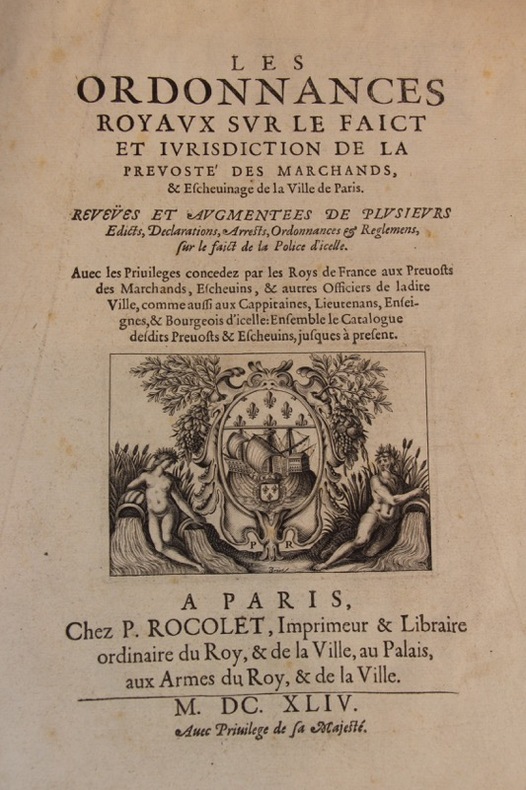
164461556Paris, P. Rocolet 1644 In-folio, plein maroquin pourpre, sur les plats double encadrements de filets classiques dorés bordés de roulettes ornées, fleurs de lys dorées aux angles de l’encadrement intérieur, lequel est empli d’un semé de fleurs de lys avec armes dorées au centre, dos à nerfs orné de caissons de semé de fleurs de lys dorées, tranches dorées rel. de l'époque, [4] ff.- 533 pp. -[4] ff. Dos restauré habillement. Vignette de Pierre Rocolet gravée sur cuivre par Briot, au f. de titre. Le frontispice gravé par Claude Mellan manque, petites galeries de vers marginales, quelques mouillures marginales.
Folio (230 x 360 mm). 3 parts in one vol. (100), 306, 80, (2), 38, (4), 96, (10), 28 pp. (20), 128, 52, (2), 26, (2), 34, (2), 30 pp. (4), 20, 8, (2), 10, (2), 26, (48) pp. All 3 titel pages printed in red and black. With an engraved frontispiece, 19 engr. portraits, 18 engraved plates (some folding), 2 engr. plans and 17 headpieces (8 woodcuts, 9 engraved). Contemporary vellum with giltstamped spine title. Wants ties. A complete copy of the most sumptuous of all imperial coronation diaries ever produced: the splendidly illustrated account of the coronation of Elector Charles Albert of Bavaria as Roman Emperor Charles VII on 12 February 1742, and of his wife Maria Amalia of Austria as Empress. Notably, Charles was the only person not born of the House of Habsburg to become emperor in over three centuries; it was only his early death in 1745 that once more cleared the way for Franz Stephan of Lorraine and the Habsburg succession through his wife Maria Theresa. - The large folding plates (after Lentzner, Funck, Lippold, Diehl and others) depict the coronation ceremony, entrances, the banquet, other celebrations on the square before the Römer, soldiers, wagons, structures erected for the pageant, the illumination etc., as well as the portraits of the Imperial couple and of the prince-electors. The notice to the bookbinder with the list of plates at the end of vol. 3 comprises only the plates in parts 2 and 3. - An extensive and important source, not least by virtue of its numerous supplements such as the long lists of guests to be entertained, providing hundreds of names, offices of the various retainers and large entourage, even giving the names of the cooks, bakers, and cellarers. "In questo assai grosso volume di circa mille pagine sono compresi tutti gli atti pubblici precedenti e susseguenti l'Incoronazione e l'Elezione. Cominciano le tavole col frontespizio, seguono 15 ritratti, e 18 grandi tavole intagliate [...] con molta e dispendiosa cura" (Cicognara). - From the collection of Karl Bacher with his fine, coloured bookplate on the pastedown. 1832 ownership of "Johannes Lang" on the verso of the frontispiece. Binding rubbed; some warping to vellum edges. Some light fingerstaining but largely unbrowned; upper corner of the flyleaf clipped. - Very rarely encountered complete as thus. Provenance: from the estate of the Frankfurt lawyer Wilhelm A. Schaaf (1929-2015), a specialist in economic, commercial and insolvency law. Lipperheide Sba 28. Kat. der Ornamentstichslg. Berlin 2898. Cicognara 1510. Kat. Sauer 259. Not in Ruggieri.
20 x 9½ inches. Bound in star-patterned paper-covered stiff-boards. 5 double-pages, with hand-held woodblock printing (often over 60 per page), hand-coloured highlights. The album depicts military formations and drills. Cavalry, and infantry divisions are seen in various offensive and defensive positions. The illustrations include soldiers carrying rifles, spears and banners. The album contains formations 6 to 9, according to the hand-written labels affixed to the bottom of each illustration. It is complete thus: presumably, formations 1 to 5 would have been contained in another album. "Piling-up Array" is a form of assembling troops where lines upon lines of troops are "piled up". This formation is clearly depicted in the many illustrations. The hand-written text (on red paper labels on each page) reads as follows: The Sixth is Piling-up Array. The sentinels of the two posts on the back left follow the end of the lines. The mounted soldiers charge. The Seventh is Piling-up Array. The sentinels of the two posts on the back left follow the end of the mounted lines. The middle sentinel withdraws and then charges at the enemy. The mounted soldiers retreat. The Eighth is Piling-up Array (made of 2 drawings). The formation turns into 2 dragon lines. The Ninth Gather to the 5 posts. Kneel down for the order to fire. - Minor restorations. Overall in very good condition
LCS-18518Précieuse réunion ces deux textes juridiques et historiques de la plus grande importance et de la plus grande rareté. Paris, Imprimerie de la République, Frimaire an IX (janvier 1801). - [Suivi de]: Projet de Code de procédure civile, présenté par la Commission nommée par le gouvernement. Paris, Imprimerie de la République, An XII (1804). Soit deux ouvrages reliés en 1 volume in-4 de lxvi pp., (1) f. de table, 355 pp., (1) f., xii pp., 143 pp., pt. manque à l’angle inf. des pp. 117 à 120 sans atteinte au texte. Demi-basane, dos lisse orné de fleurons dorés, pièce de titre de maroquin rouge, tranches jaunes. Reliure de l’époque. 249 x 190 mm.
8vo (155 x 230 mm). 2 vols. (8), 286 (instead of 288) pp. (4), 428 pp. Contemporary maroon cloth with gilt titles to spine. Three of only four issues (in two volumes) of the "Dawn", an extremely uncommon journal of revolutionary Marxism edited by the Iskra group in Stuttgart. Here Vladimir Ulyanov famously first used the pseudonym "Lenin" to sign a published article (he had begun to use the pseudonym in letters in 1901). - Issue no. 1 contains an article "Sluchainyi zametki" (Random observations) signed by the earlier pseudonym "T. Kh", which he also used for two articles in issue no. 2-3. The third long article, "The Agrarian Question and the 'Critics of Marx'" ("Gg. 'kritiki' v agrarnom voprose") is signed "Lenin". The journal propagated the ideas of revolutionary Marxism and criticized the Narodniks and other more moderate movements. Among the leading contributors were G. Plekhanov, Z. Zasulich, P. Aksel'rod, Iu. Martov, A. Potresov and others. - Issue no. 1 also contains a translation of the memoirs of Karl Kautsky. Also included is a four-page pamphlet (single folded leaf) about a dispute within the editorial team, entitled "Kto vydumal plokhuiu vydumku' ("Who thought up the bad idea?"), written by the economist and philosopher Boris N. Krichevskii (1866-1919). Both volumes are from the famous collection of the Marxist bibliophile and scholar Chimen Abramsky (1916-2010), who fled to London from the Soviet Union in the early 1930s and became a leading specialist in both Judaica and socialist thinking. His collection, parts of which were auctioned after his death, has recently been commemorated in his son's biography, "The House of Twenty Thousand Books" (2014). - Bookplate of the London School of Economics, with withdrawal stamp and Chimen Abramsky's hand-written note inside front wrapper, noting that he exchanged these volumes in 1970. No. 1 one lacks the final leaf. Very scarce in the trade. Emig p. 197. Schwarz p. 166.
Folio (273 x 360 mm). Lithographed frontispiece in colour, 4 portraits of the Nobel family, and 39 plates in colour and black and white (all with printed tissue guards). Publisher's original galf cloth over grey boards with title printed to gilt upper cover. Rare Russian commemorative publication memorializing the 50th birthday of Emanuel Nobel (1859-1932), nephew of Alfred Nobel. He was head of the family's oil business, Branobel, an oil empire that was based in Baku (Azerbaijan, Imperial Russia) and was the largest oil company in Europe. Emanuel Nobel accepted Russian citizenship at the Tsar's personal request; from 1891 until 1918 he also sat on the board of the Russian State Bank's Discount Committee until he was forced to flee Russia after the Revolution. Emanuel Nobel was also instrumental in the execution of his uncle's will and thus in the formation of the Nobel Prize. The album was prepared and published by the Nobel Brothers "Petroleum Partnership Employees Committee" (their publication label is pasted to the inside front covery), and every participant in the festivities was presented with a copy. - Extremeties slightly bumped, a few very minor nicks to edges of plates, but altogether uncommonly well preserved. OCLC 185188381.
Large 4to. XXXIX, (1) pp. With woodcut printer's device to title page. Contemporary Italian boards. First edition of Venice's anti-Jewish statutes of 1777, the last "Ricondotta" published by the republic. With the political deterioration of Venice, ever new repressive measures were enacted against the Jewish community, based increasingly on anti-semitic sentiment rather than economic motives. On 27 September 1777 the Senate passed a far-reaching decree banishing all Venetian Jews from the city that could not prove a right of residence or lived in the ghetto. Also, Jews were forbidden to maintain a manufacturing business or sell meat, grain, or any food at all. - Slight duststaining to binding; interior shows faint waterstain; title page numbered in red crayon. Extremely rare; last sold at auction at Sotheby's, New York, in 1985. ICCU VEAE\005013. OCLC 14559111.
Folio. Typoskript (Durchschlag). 42 SS. 34 Photographien, 2 Falttafeln und 3 gefaltete Karten. Broschur mit Klammerheftung. Äußerst seltene und interessante österreichische Fotodokumentation kurz vor Ende des Ersten Weltkriegs. Die Luftaufnahmen stammen aus der Zeit zwischen der zweiten (15. bis 22. Juni 1918) und dritten Piaveschlacht (24. Oktober bis 3./4. November 1918). Letztere führte zum Waffenstillstand von Villa Giusti bei Padua und zur Niederlage Österreich-Ungarns im Krieg gegen Italien und bedeutete das Ende der "Isonzo-Armee". Abgebildet sind Infanterie- und Artilleriestellungen, italienische Maskierungsarbeiten, Brückenbau und Radiobeschießung, Kanalverkehr im Raum Boaria Bressanin, Fliegersignale durch sog. Plachenzeichen und Bodenaufnahmen des in Casarsa notgelandeten englischen Kampfflugzeug "Bristol Fighter". Anschließend folgt eine Konstruktionsskizze des Korns des Bristol Fighters und eine Auflistung der Verteiler des Halbmonatsberichts (17 Stellen, darunter A.O.K., H.G.K., Kisa Evidenztruppe "Feind", Seeflugstation Triest). - Teils etwas fleckig und knittrig, Gebrauchspuren. Ein Doppelblatt lose.
8vo. (14), 1272, (22) pp., final blank. Wants frontispiece (which announced the work as "Dr. Bechers Commercien-Tractat"). Contemporary vellum with handwritten spine title. Second, much expanded edition: the first available one. The major book of "the greatest representative of cameralism" (Roll). This is the best edition: the work was first published in 1668 as a diminutive volume of a mere 234 pages which, according to Humpert, was seized. Further editions appeared in 1688, 1721, and in an edition published and annotated by Georg Heinrich Zincke in 1754 and 1759. - Binding somewhat dust-soiled. Handwritten ownership "D. Karschulin", dated 14 May 1890, on pastedown. Faint stamps of the Vienna Academy of Trade on title and verso. VD 17, 1:068320R. Kress 1327. Humpert 73. Schumpeter 283f. Palgrave I, 128. Roll, A History of Economic Thought (1956), p. 66. Not in Goldsmiths' or Einaudi.
8vo (17.8 × 12 cm). Original staple-stitched self-wrappers; 32 pp. Six vignettes throughout the text. Scarce pamphlet representing an account of the first May-Day activities held in the newly "liberated" Russia, after the February Revolution of 1917. In a highly graphic and solemn text, the author, who was likely using a pseudonym, announces the grandeur with which Russian workers would celebrate the first international workers' day in the Soviet Union: "You will see the unfurled red banners, which will cover the entire Russian land, the land which was thus far reddened only with the people's blood, spilled by the former, now overthrown regime." The book further contains a fictionalized, imaginary account of what the first May 1st celebrations will look like, as well as a narrative of a suppressed factory demonstration held before the Revolution. The author also provides a historical sketch of the history of the International Workers' Day. Finally, the book concludes with the Russian text of an early revolutionary First-of-May song, "Vremia ne terpit." - Rust to staple; else very good. An important, striking document on the history of the official May Day celebrations which took place throughout the Soviet Union. KVK, OCLC show only the copies at Staatsbibliothek zu Berlin and the Swedish National Library.
8vo. VIII, 199, (1) pp. Modern full mottled calf, tooled outer border on covers. Only edition. The book entitled in Chinese "Hsien-wen-shu", or "Book of Good Lore", containing 200 moral proverbs, was meant to serve as an exercise book for the beginner of Chinese studies. "The learned translator, Mr. Davis, appears, from the preface, to have drawn up his work at Macao, and to have sent home to the library at the India House his manuscript-version for impression: but as the requisite types were not to be found in that institution, it was, at the recommendation of Dr. Wilkins, sent back to Asia" (The Monthly Review 107 [1825], p. 197). Ultimately, the book was printed in Macao, as stated on the bottom of the final leaf (and distributed in England by John Murray). - A few corner defects, otherwise a good copy in a modern period-style binding. Cordier 1429. OCLC 4802428.
8vo. (6), 202 pp. (Includes): A short method for the easie resolving of any military question propounded. Ibid., 1639. (4), 8, (4) pp. With woodcut frontispiece entitled "The Military Encycle", one woodcut plate inserted after L1, and numerous woodcut illustrations, plans and diagrams throughout the text; dedication with woodcut initials. Splendid modern French red morocco gilt by Lortic fils (signed). Spine gilt in compartments. Extremely rare second English edition of the author's "Les discours militaires" (the second part, with its own title-page but beginning on leaf O1, still in the first edition). "A book frequently quoted from, and, in its time, highly esteemed. It has now become very scarce, and is almost unknown to bibliographers; neither Hazlitt nor Lowndes, Brunet nor Graesse, mentions it. The Second Part, which was intended by Du Praissac to be used as a 'corollary', or epitome of his other tracts, is to be found separately" (Cockle). The first part deals with all subjects, such as levying, marching, building forts, ordnance, fireworks, duties, etc. The second belongs to one of three first edition issues printed by Daniel in Cambridge in 1639, each with varying imprints. - John Cruso (1595-1655) wrote, edited and translated military works before the English Civil War. Born in Norwich, his parents had fled Hondschote in Flanders. He was the captain of the Dutch/Walloon company of the Norwich trained bands. "Cruso's military works were significant in that they were the first to make the new continental, primarily Dutch, military literature available to an English-speaking audience" (ODNB). - Sumptuously bound by Marcellin Lortic (1852-1928) of Paris. Frontispiece very slightly shaved. - Provenance: from the collection of Thomas Fremantle, 3rd Baron Cottesloe (1862-1956), commander of the Territorial Army and president of the Society for Army History Research, with his armorial bookplate to pastedown (purchased from Pickering & Chatto, 30 Dec. 1898, for £3-18s). ESTC R204361. Wing D2667B. Cf. Cockle 146. Jordan 0992. Spaulding/Karpinski 127.
Folio (240 x 304 mm). Near-contemporary half cloth with gilt title to spine. The complete first year of this rare radical weekly that ceased publication in 1920. In the course of the October Revolution, Däumig (1866-1922) became the speaker of the left wing of the Independent Social Democratic Party of Germany (USPD), which favoured a system of councils (Räte, Soviets) over parliamentary democracy. The same vision informs the present short-lived journal. The first issue begins with the invocation: "Proletarians! The socialist century has begun." - Browned throughout due to paper. Binding a little rubbed and bumped in places, otherwise fine. OCLC 183382517. ZDB-ID 549100-9.
35, (1) SS. Leinenband der Zeit (die bedr. grüne Originalbroschur mitgebunden). Gr.-8vo. Erste französische Buchausgabe (als "Bibliothèque de la Revue Socialiste I"), war zuerst in den Nummern 3-5 der "Revue Socialiste" von 1880 erschienen. "Die Schrift entstand aus drei Kapiteln aus dem 'Anti-Dühring', die Engels für seinen Freund Paul Lafargue mit einigen Zusätzen zur Übersetzung ins Französische zusammenstellte" (Marx/Engels Erstdrucke). - Unbedeutend gebräunt. Am Innendeckel rot reliefiertes Exlibris einer Adelsbibliothek (Monogramm "B"). Am Broschurdeckel Stempel der römischen Buchhandlung "Ermanno Loescher & Co.". ME-Erstdrucke 41. Rubel, Engels 79. Stammhammer I, 73, 16.
15135661513 Lyon, Jacob Maréchal, 1513.
4to. 31, (1) pp. With printer's woodcut anchor-and-dolphin device to title-page and 26 woodcut illustrations (one full-page). Prefixed by 3 manuscript pp. of index and followed by 19 pp. of manuscript additions (paginated 32-52) as well as 7 pp. of manuscript folding tables. 19th century green wrappers with handwritten spine-title. An engraving loosely inserted. First edition. Rare treatise on the history of the orders of knighthood, by the Reverend Andrea Guarini, discussing the origin and foundation of all religious and military orders established since the early Middle Ages. The work includes descriptions of the Constantinian Order ("the noblest and oldest", p. 5), the Knights Templar, the Knights of Malta, the Military Order of Christ, and the Order of the Golden Fleece, with the woodcut illustrations showing the various orders' insignia. Dedicated to Giovanni Andrea Angelo Flavio Comneno, Prince of Macedonia, Count of Drivasto, and Grand Master of the Constantinian Knights of St. George. - The treatise is preceded by a handwritten index and followed by a handwritten supplement from the first half of the 18th century describing several additional orders, including the Order of the Starry Cross, the Livonian Order, and the Cavalieri del Giglio. This section is followed by a 19th century seven-page folding list of the main orders of the world, arranged alphabetically by country (from Asia to Württemberg). It is titled "Elenco de' principali Ordini Cavallereschi" and is arranged as a table, giving the respective country and name of the order, the year of its foundation, the name of the founder, as well as brief comments (until 1834). - The loosely enclosed engraving is taken from Johann Hübner's encyclopedia "Neu-vermehrtes und verbessertes Reales Staats-, Zeitungs-, und Conversations-Lexicon" from the mid-18th century: plate III, captioned "Delineation derer in Europa berühmbtesten Ritter-Orden" and showing 70 numbered insignia of the most prominent European knightly orders. - Binding rubbed, spine and lower cover a little chipped. Occasional brownstains to paper; an old shelfmark to pastedown. With a 19th century note in Italian on the flyleaf, stressing the exceptional combination of texts from several centuries in the present volume: "Esemplare distinte per aggiunti mss. di più epoche". Katalog der Stadtbibliothek in Zürich (1864) I, 496. G. S. Sainty, The Constantinian Order of Saint George, note 63. OCLC 457352824.
Folio (206 x 310 mm). 3 parts in one volume. (10), 98 pp., blank leaf. 62 pp., blank leaf. 26, (2) pp. With additional engraved title by Melchior Küsell and 27 double-page engraved plates. Contemporary full vellum (lacking ties). Coloured edges. First edition of this classic 17th century treatise on fortification architecture. - Author's presentation copy for his immediate superior, the Bavarian Lord Chamberlain, Count Maximilian Portia (d. 1679) from the Bavarian line of the counts Porcia and Brugnera, who hailed from Pordenone in Friuli, with Heidemann's full-page, elegant German inscription to the pastedown. Count Maximilian was descended from the military writer Jacopo di Porcia. - The engineer Heidemann served under the Elector of Bavaria and is regarded as a "firm adherent of Speckle's. Heidemann's construction was plainly reproduced in Sturm's 'Architectura militaris'" (Jähns). - Occasional browning and minor dampstaining. Vellum binding somewhat soiled and slightly worn at extremities. Provenance: Maximilian, Graf von und zu Porcia und Brugnara; latterly in the collection of Thomas Fremantle, 3rd Baron Cottesloe (1862-1956), commander of the Territorial Army and president of the Society for Army History Research (purchased from Charles Sawyer, London, 21 February 1955, at £20). VD 17, 23:294435N. Jähns 1343. Cf. Ornamentstichkat. Berlin 3531.
12mo. 4 vols. (4), 331 pp. III, (1), 259, (1) pp. (4), 257, (3) pp. (4), 304 pp. Contemporary full calf, spines richly gilt with red and green label. Marbled endpapers. All edges red. First edition of the only collected edition issued by Hume himself. It is made up of re-set volumes previously issued, with cancel titles and, where the cancels were not prepared in sufficient numbers, with the original titles. Todd (p. 195) has determined the order of issue of the volumes, in part by the record of William Strahan, printer of most of Hume's works, and in part by "the sequence displayed in the sets examined". Individually, the volumes are entitled: vol. I) Essays, moral and political. The fourth edition corrected, with additions; vol. II) Philosophical essays concerning human understanding. The second edition, with additions and corrections; vol. III) An enquiry concerning the principles of morals; vol. IV) Political discourses. The second edition. - Small circular stamp ("Biblioteca A. Chambion 1848") to titles, handwritten ownership to title of volume 1. Usual mild browning and minor imperfections at bindings, but a very appealing set. Todd a (vols. 1, 2 & 4) and d (vol. 3).
4to. XII, (3)-469, (3) pp. Original printed wrappers bound within somewhat later half calf over marbled boards with giltstamped spine-title. First edition of this early, albeit illegal collection of Lenin's works, containing some of the principal writings of Bolshevism. Includes the important preface by Lenin, advocating an organization of professional revolutionaries. - In 1907, the Zerno Book Publishers, directed by M. S. Kedrov, decided to bring out a three-volume collection of Lenin’s works under the general title "Twelve Years". The first volume, which is present here, contains seven important political publications: "The Economic Content of Narodism and the Criticism of it in Mr. Struve's Book", "The Tasks of the Russian Social-Democrats", "The Persecutors of the Zemstvo and the Hannibals of Liberalism", "What is To Be Done?", "One Step Forward, Two Steps Back", "The Zemstvo Campaign and Iskra's Plan", and "Two Tactics of Social-Democracy in the Democratic Revolution". The volume, which came off the press in November 1907 (the cover gives the date 1908), was confiscated soon after its appearance. The second volume was to appear in two parts: "The Agrarian Question: Part One" was published in January 1908 under the pseudonym "VI. Il’in". For the second part, Lenin wrote "The Agrarian Programme of Social-Democracy in the First Russian Revolution, 1905-1907". The galleys and manuscript of this work were confiscated by the tsarist security police, and were destroyed. However, a part of the edition was saved, and the book continued to circulate illegally. - Binding slightly rubbed; interior in excellent condition. OCLC 56677898.
12mo (105 x 144 mm). (8), 2, 2, 250 pp. With half-tone portrait frontispiece and uncorrected facsimile plate of calligraphy by Lin Biao. Original red vinyl over paper boards, titled and stamped with a star in blind on the upper cover. First edition in the original Chinese, second issue with the printing error on pages 82/83 corrected. Schiller 2.
12mo (102 x 137 mm). (8), 2, 2, 250 pp. With half-tone portrait frontispiece and uncorrected facsimile plate of calligraphy by Lin Biao. Original printed paper wrappers. First edition in the original Chinese, second issue with the printing error on pages 82/83 corrected. Old Chinese ownership inscription ("Yul Feng") and additions to table of contents. A few edge flaws. Schiller 3.
8vo. 4 parts in 1 volume. XV, (1), 391, (1) pp. VI, (2), 285, (1) pp. XIV, (2), 444 pp. VII, (1), 144 pp. With 3 folding tables and 4 hand-coloured diagrams on 2 folding plates at the end of the first volume. Contemporary half calf over green marbled boards with giltstamped title to spine. Moirée endpapers. First complete edition, with the second revised edition of the first part and first editions of the following parts. Comprises: Erster Theil. Untersuchungen über den Einfluß, den die Getreidepreise, der Reichthum des Bodens und die Abgaben auf den Ackerbau ausüben. Zweite vermehrte und verbesserte Auflage. - Zweiter Theil, erste (-zweite) Abtheilung. Der naturgemäße Arbeitslohn und dessen Verhältniß zum Zinsfuß und zur Landrente. Ibid., 1850-63. - Dritter Theil. Grundsätze zur Bestimmung der Bodenrente [...]. Ibid., 1863. - Thünen's "Isolated State" is recognized as one of the greatest achievements of scientific economics in the 19th century, praised for its exposition of the basic principles of spatial economics as well as for its application of rigorous mathematical methods to the theory of marginal productivity. The first part originally appeared in 1826 and the present second edition is the only edition revised by the author. - Boards a bit rubbed, extremeties somewhat worn. Small name stamp of Hinrich Döscher, Hainmühlen, to title and half-title of first part. Some mild foxing and browning as common, but generally very good. "A landmark contribution to the economics of agriculature" (Books That Made Europe, p. 200). Kress C.5974. Einaudi has the 3rd edition of 1875 only. Theocharis p. 113-119.