86 357 résultats
8vo. 4 vols. in one. 120, 142, 175, (1), (6), 176 pp. Contemporary full vellum. Early editions of a widely used manual for commercial arithmetic, rarely found complete in all four volumes. The various parts were published separately and reprinted many times from the end of the 17th until the middle of the 19th century, revised and brought up to date by various other writers. Though separate parts are well represented in libraries, complete sets are rare in the trade. - Binding somewhat dustsoiled with two small flaws to spine. 19th c. bookplates to pastedowns (library of John Jackson, Warrington, gifted to the Warrington Museum in 1875). Bierens de Haan 2767-2774. EHB 544.
4to. 5 parts in one volume. 8, 320, (4), 106 pp., (1 blank f.), (16), 280, 152, 158 pp. With 5 repeated title vignettes (woodcut portraits) and double-page-sized woodcut in the text. Contemporary vellum with ms. spine title. Edges sprinkled. Early collected edition of Machiavelli's works, including his famous "Principe", the work with which he "founded the science of modern politics" by analysing Cesare Borgia's much-admired "mixture of audacity and prudence, cruelty and fraud, self-reliance and distrust of others" (PMM). This is the so-called "testina" edition, named after the author's woodcut portrait on all the half-titles. It is this very reliable redaction which is used by all quotations of the "Crusca". Five variant editions are known, all bearing the fictitious year of printing "1550" on the title page, through which the (most likely) Swiss publishers intended to circumvent the Papal prohibition. The present variant is usually regarded as the fourth (Bertelli/I.: "Databile al 1635-46"). Contains: 1) "Delle historie fiorentine"; 2) "Il Principe"; 3) "Discorsi"; 4) "Dell'Arte della Guerra"; 5) "L'Asino d'Oro" and other works. - Variously browned throughout due to paper (as common). From the library of Georg Philipp Helberg, secretary to the Electoral church council in Heidelberg and a member of the enlightened secret society "Deutsche Union" (his autograph ink ownership, dated 1787, on the title page). Bertelli/Innocenti 206a. Gamba p. 195, no. 623.3. Bonnant, p. 86f., D. Gerber II, 102f. Lenger, Machiavel, 19. Adams M 10. BM-STC Italian 400. Edit 16, CNCE 66076. GLN 6759. Malicki, BJ 16, M-4. Cf. PMM 63.
12mo (103 x 143 mm). (8), 2, 2, 250 pp. With half-tone portrait frontispiece and uncorrected facsimile plate of calligraphy by Lin Biao. Original red vinyl over paper boards, titled and stamped with a star in blind on the upper cover. First edition in the original Chinese, first issue with the printing error on pages 82/83 (without erratum slip). The plate of Lin Biao's calligraphy has been torn (likely in 1972, after he fell from grace) and mended; similarly a large tear in the final page has been repaired, with slight loss to the text supplied from another edition. A few edge flaws; old ownership inscription in Chinese. Schiller 1 (without erratum slip).
B113987s.l., s.d. [19th cy.] [6bl] + [740] + [14bl] pp., containing 242 biographies of the Great Councils members (each starting on top of the page with their coat of arms (pre-printed, 220 of them handcoloured), followed by 1 to 3 pages of text in French) and followed by a chronological and alphabetical list of the members, included is also a text of 9 pages: Translation du Grand Conseil à Namur à cause des troubles des Pays-Bas le 7 juin 1580, 40x27 cm., 19th cy. hardcover binding (spine in vellum, marbled boards, edges bit rubbed, small defect at lower end of spine), very neat and uniform handwriting, text and interior is clean and bright, no date mentioned but most probably dating from the first half of or mid 19th cy., well preserved and in good condition, [The Great Council of the Netherlands at Malines was the highest court in the Burgundian Netherlands. It was founded by Charles the Bold in 1473 and disbound after his death. It was re-erected in 1503 by Philip the Handsome in 1503 and its influence and importance grew till the Eighty Years War, after which its power declined and it was finally abolished during the French Revolution. The composition of the Great Council was quite stable throughout the period of its existence, and consisted of a chairman, 15 to 16 councillors, one procureur-general, one fiscal advocate, some secretaries and clercs, advocates and a Huissier de justice], weight: 4.3kg., B113987
31 pp. Original printed wrappers. 8vo. First edition of the text of a speech held by the father of Russian Marxism, Georgi Plekhanov, in Geneva, on the 25th anniversary of the poet Nikolai Nekrasov's death. Plekhanov here repeats a point made during Nekrasov's funeral in 1878, namely that Nekrasov's literary role dwarfs the achievements of Alexander Pushkin, because it instilled in Russian readers a sense of socio-political responsibility. Initially intended to be published in the journal "Iskra", Plekhanov's text was printed in a separate edition. - Lacking rear wrapper; lower right corner scuffed; else internally very good.
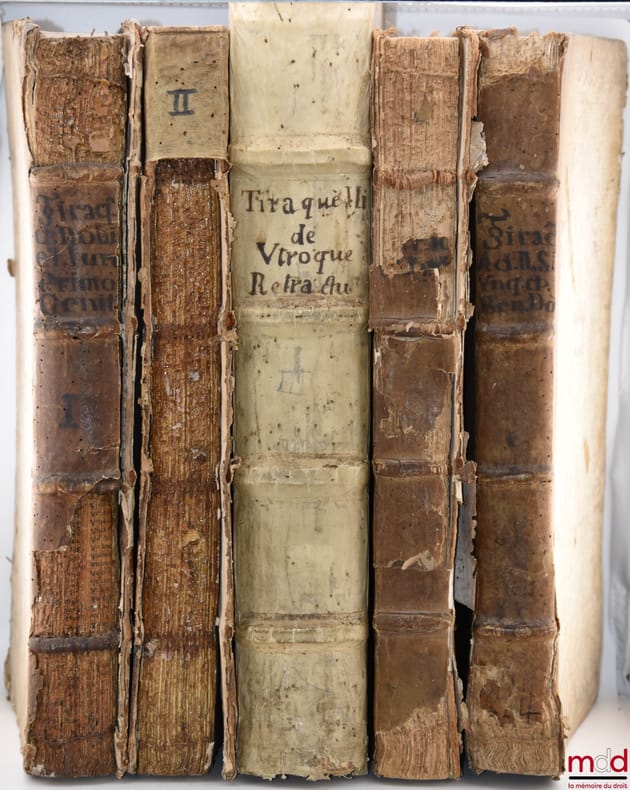
52351, Venetiis [Venise]- Lugduni [Lyon], Apud Ioannem Baptistam Somaschum- Gulielmum Rouillium 1589- 1588- 1574- 1589- 1588- 1588- 1588, 7 t. en 5 vol. in-folio, t.I, II, IV, V, VI et VII: demi-vélin beige, tit. manuscrit au dos, inscriptions sur les tr. sup., Ex-Libris manuscrit, lettrines ornées, vignettes, imp. en double colonne, (t.I: rel. très fragile, 1erplat détaché et charnière inf. très fragile, importants mq. de cuir au dos, des trous de vers non traversants, papier parfois acidifié et fragile, mouillures à l’int.; t.II: rel. détachée, dos manquant, nb. trous de vers dont certains traversants mais sans incidence sur la lecture, papier parfois acidifié avec de rares rousseurs et mouillures sur certaines pages; t.IV et V: rel. détachée, importants mq. de cuir au dos, trous de vers traversants mais sans incidence sur la lecture, 1ff. détaché; t.VI et VII: rel. fragile, mq. de cuir au dos, trous de vers traversants mais sans incidence sur la lecture, coupes frottées), int. frais et bien conservé; t.III: pl. vélin beige, tit. manuscrit sur dos à quatre nerfs, inscription à froid sur la tr. inf., gravure à l’effigie de l’auteur, tit. gravé pl. p. en frontispice, lettrines et bandeaux, annotations en marge, (trous de vers au dos, coins inf. légt marqués, qq. légères tâches sur les plats, qq. rousseurs et rares tâches à l’int., qq. mouillures et trous de vers sans incidence sur la lecture), ouvrage bien conservé, int. assez frais.
181053914Translated from the original Latin of Cornelius Van Bynkershoek, 1 vol. 8vo, original full leather binding, Published by Farrand & Nicholas, Philadelphia, also by Farrand, Mallory & co, Boston, P. H. Nicklin & Co, Baltimore, D. Farrand & Green, Albany; Lyman, Mallory & Co, Portland, and Swift & Chipman, Middlebury, Fry and Kammerer, Printers, 1810, 1 f. blanc, 1 f. n. ch., xxxiv-218 pp. , pp. 249-251 (Index from another book) et 1 f. blanc
18252575Mexico City 1825. Still very good. Two volumes in one. 2xxvi221xi2; 2xviii190xviiiiii pp. Contemporary quarter calf and paper boards spine gilt. Light rubbing and a pair of small perforations to spine leather. Edges worn; corners bumped. Light tanning scattered foxing. A handsome copy of an early Mexican imprint that Lathrop Harper described succinctly as the "First edition of the first decrees of the first independent Mexican Congress." This collection of decrees issued for the first and second sessions of the Mexican Congress established after the promulgation of independence in 1821 contains a wealth of information relevant to the founding of the country. These include the act relating to the "coronation of D. AgustÃn de Iturbide the hereditary successor to the throne†formalizing that “the acts of his government are declared invalid." <br /> <br /> Of particular interest are two decrees directly relating to Anglo-American settlement in Texas. The first of these dated April 11 1823 begins “Que el gobierno si no encuentra inconveniente acceda a la solicitud de Estevan Austin sobre que se confirme la concesión de establecer 300 familias en Tejas.†Roughly translated this decree states that "the government if it finds no objection agrees to Estevan Austin's request for confirmation of the concession to establish 300 families in Texas.†Stephen F. Austin's "Old Three Hundred" families were the foundation of Anglo-American settlement in Texas and here the nation of Mexico authorizes their emigration.<br /> <br /> The second decree dated September 29 1823 is titled “Esención de derechos por siete años a los efectos que se introduzcan en Tejas.†The text of the decree reads in full: “El Soberano Congreso mexicano tomando en consideracion el deplorable estado a que las hostilidades de los barbaros han reducido a la provincia de Tejas y para ocurrir en parte a la miseria de sus habitantes civilizados ha venido en decretar y decreta. Que todos los efectos de cualquiera clase nacionales o estrangeros que se introduzcan en la provincial de Tejas para el consume de sus habitants sean libres de derechos; durando esta esencion siete anos contados desde su publicacion en aquella capital.†This second decree effectively extended the term for duty-free trade allowed to the Texas settlers as recompense for the troubles they experienced at the hands of the local "barbarians" i.e. the indigenous native peoples who had lived on the land for centuries.<br /> <br /> Of course the works also stand alone as a significant document of the first independent Mexican government and contains many important details on the early organization of the new country the Constitution of 1824 and the first presidential elections amongst much else. The two works present here were printed simultaneously but were issued separately and are not always found together as here. The first compilation of laws governing the fledgling nation of Mexico with early Texas colonization content. <br /> Palau 56388. Lathrop Harper 220:116. unknown
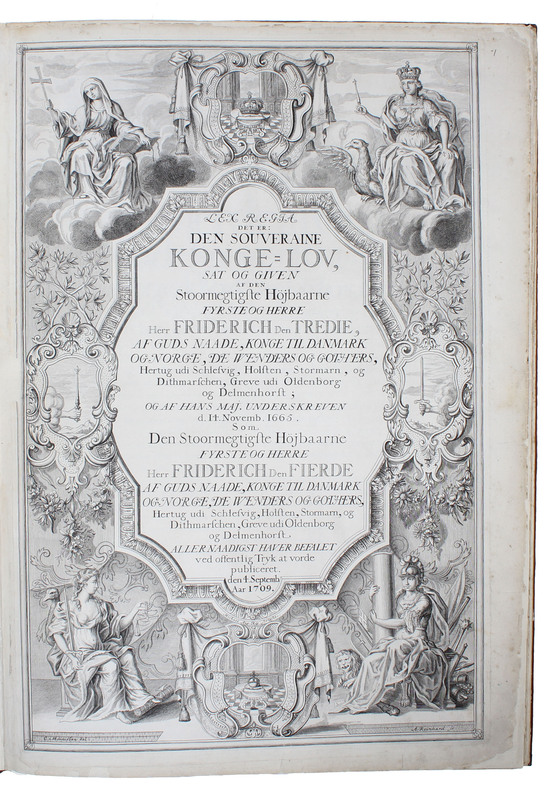
170959593(København), 1709. Folio. 53x35 cm. Contemporary full mottled calf. Boards with a bit of wear and a few scratches. Corners and capitals repaired. 19 leaves, all with engraved text and ornamental frames. The broad frames that all differ from each other ornamentally depict animals and plants as well as the different trades of the country. A few leaves with minor weak dampstaining to upper margin. Upper margin slightly soiled. Otherwise a nice and clean copy on thick heavy paper.
(København), 1709. Folio. 53x35 cm. Contemporary full mottled calf. Boards with a bit of wear and a few scratches. Corners and capitals repaired. 19 leaves, all with engraved text and ornamental frames. The broad frames that all differ from each other ornamentally depict animals and plants as well as the different trades of the country. A few leaves with minor weak dampstaining to upper margin. Upper margin slightly soiled. Otherwise a nice and clean copy on thick heavy paper.
Small 4to. 42 pp., final blank leaf. With an engraving in the text on p. 13 and a woodcut vignette on title-page. Contemporary boards (Italian carta rustica). First edition of this exceedingly rare manual about bread, unrecorded in the standard bibliographies and in splendid condition, written to help bakers make an affordable and good quality bread for the poor. The anonymous author explains how to make different types of loaves by using various flours and how the stone-crushed wheat should be sifted rather than milled and then separated into different grades of flour with the help of a machine called "Il Buratto" (shown in the engraving). - A single copy in Italy (Biblioteca nazionale centrale, Firenze); WorldCat lists one further copy in the USA (University of Iowa). Another edition, similarly rare, appeared at Viterbo in the same year. - A clean and untrimmed, wide-margined copy preserving the deckle edges. Near-contemporary inscription "Pane" on upper cover, with early 20th century armorial bookplate of the marchese Piero Gerini (1874-1938) of Florence. ICCU CFIE\038014. OCLC 953414960. Not in Kress or Goldsmiths', Westbury, Vicaire or Bitting.
8vo. 483, (1), VIII pp., final blank leaf. 1920s temporary wrappers (Portuguese mackle paper) with handwritten cover title. Only edition: one of the great mysteries of Qur'anic literature, and apparently the first translation of the Qur'an into French by a woman - or, as it is glossed in the British Museum catalogue, "a compilation of passages of the Koran, of Traditions, and of ideas peculiar to Fatma Zaida" (Ellis). Following those of Du Ryer (1647), Savary (1783), and Kazimirski-Biberstein (1840), this fourth French version of the holy text is original in many respects: notably, it is the first to retain the untranslatable name "Allah" instead of substituting "Dieu". Also, it does not follow the traditional order of surahs, but tries to arrange them chronologically, by Meccan and Medinan surahs (as, curiously, did Rodwell in his English translation, which appeared in London that same year). Indeed, as Ellis noted, this is not at all a literal translation: instead, it is interpretative, interventionist and even feminist, liberally transposing verses from surah to surah and often offering less of a translation than a new creation, more true perhaps to the spirit of Islam than to the sacred text. As early as 1961, the scholar Abul Muzaffar drew attention to the fact that Fatma-Zaida's name is probably spurious (though conceivably borrowed from a servant at the Turkish Embassy at Lisbon) and that the author was very probably a European convert to Islam, not proficient in Ottoman Turkish and not fully in French, either, who felt spiritually at home in the Muslim Orient and, wishing to defend Islam from its detractors, produced an apologetic version of the Qur'an. If this is so, the translator was still almost certainly a woman: as Rim Hassen has variously pointed out, Fatma-Zaida's text quite clearly endeavors to "project a positive image of Muslim women and their position in society" (p. 226), and even goes so far as to interpolate entirely new material such as verse "209" in the Third Sura, which impresses on the reader to "require the castration of merchants of female slaves"! - Some browning and foxing throughout; untrimmed as issued. Lower original orange wrapper cover preserved but partly pasted to the temporary wrappers, upper cover inscribed "O Alkorao (o Livro Sagrado dos Mahometanos)". An exceptional work, very rare in libraries and never reprinted. Chauvin X, 180. Ellis, Catalogue of Arabic Books in the British Museum I, 891. OCLC 7039046. Abul Muzaffar, Le Coran de "Fatma Zaida". Le Centenaire d'un Mystérieux Ouvrage. In: Pensée Chiite 8 (1961), pp. 19-22. Rim Hassen, "From a Slave to a Translator: Conflicts and Mediation in Fatma-Zaïda’s Translation of the Quran: Customs Officers or Smugglers?", in: Diana Roig-Sanz, Reine Meylaerts (eds.), Literary Translation and Cultural Mediators in 'Peripheral' Cultures (Cham, 2018) pp. 211-234. Quaritch, Oriental Languages Cat. (1887), no. 33054 ("Rare and curious").
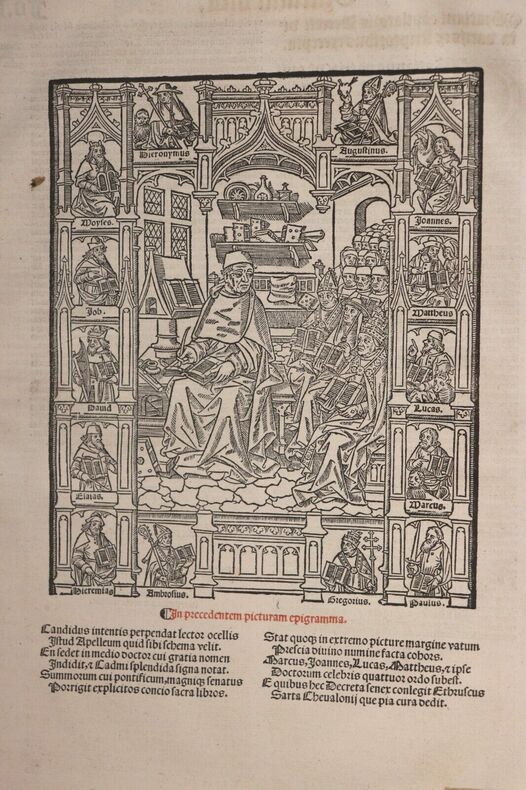
1528AMO-4518Parisiis, ex officina Claudii Chevallonii sub sole aureo in dia ad divum Jacobum. 1528 mense Aprili. [Paris, Claude Chevallon, avril 1528] 1 fort volume in-folio (39 x 28 cm) de 28 feuillets non chiffrés, CCCCLIX fol. chiffrés (le folio CCLXXIX manque), XLVI fol. chiffrés et 1 fol. non chiffré. Titre imprimé en rouge et noir dans un encadrement gravé sur bois, marque de B. Rembolt sur le titre. Grande gravure sur bois au verso du folio I (L'auteur présentant son ouvrage). Grande gravure sur bois au verso du folio CCCCXVIII (Arbor consanguinitatis) et autre grande gravure au recto du feuillet suivant (qui n'est pas chiffré). Le dernier feuillet contient le registre. Texte imprimé en rouge et noir pour la plupart des feuillets, le plus souvent sur 4 colonnes avec différentes tailles de caractères, le tout en caractères gothiques. Reliure ancienne (probablement du début du XVIIe siècle) en veau brun. Reliure usagée encore solide. Manque de cuir au dos, mors fendus. A restaurer. Intérieur assez frais. Quelques mouillures sans gravité à quelques feuillets. Mouillure avec petit manque de papier dans la marge inférieure des derniers feuillets, sans atteinte au texte. Comme indiqué plus haut le folio 279 manque (trace d'arrachage dans la marge intérieure), sinon tous les autres feuillets sont présents. Superbe mise en page avec de très nombreuses grandes lettrines historiées.
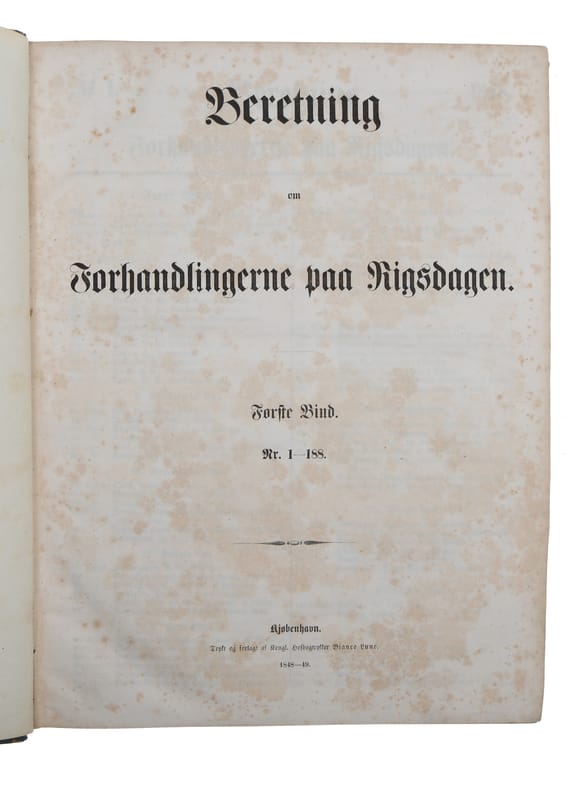
59589Kjøbenhavn, Bianco Luno, 1848-49 + 1849. Stor 4to. Indbundet i ét samtidigt brunt halvlæderbind med nydelig ny ryg, under anvendelse af den samtidige nydeligt forgyldte ryg. Permerne er nydeligt forstærket med brun shirt under anvendelse af de samtidige marmorerede permed. Første titlblad brunplettet, men ellers et nydeligt, rent og silidt eksemplar. 3906, LXVI spalter (= 1986 pp.).
184961592Kjøbenhavn, Bianco Luno, 1848-49 + 1849. 4to. Two volumes, both in the original blue boards with paper title-label to spine. Wear to extremities, hinges and edges of boards with loss of the blue paper, primarily affecting vol. 2. Inner hinge on vol. 2 split. Occassional brownspotting throughout. 3906, LXVI columns. (= 1986 pp.).
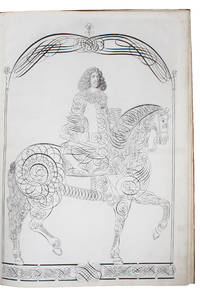
170954195København 1709. Folio. In contemporary full calf Cambridge-style mirror binding with blindstamped borders. Light wear to extremities. Seven leaves with minor repairs to margins one leaf with a 15 cm long closed tear and one leaf with an 30 cm long closed tear all professionally executed and with no loss of imprint. Margins slightly soiled. 19 leaves -text and frames engraved. The broad frames that all differ from each other ornamentally depict animals and plants as well as the different trades of the country. A nice copy printed on thick heavy paper. Housed in a cardboard box.Provenance: From the collection of Danish book collector Viggo Lohse. The present copy was exhibited at 'Dansk Bibliofil-Klubs 50 års Jubilæumsudstilling' in 1992 The 50 year anniversary exhibition for the Danish Society of Bibliophiles no. 94. <br/><br/><em>First edition of this landmark work of Danish book production and the constitution of the Danish absolute monarchy. The Royal Law established the absolute right of the Monarch to rule and it defined the line of royal succession. It was more rigorous than the other monarchal laws of Europe at the time.The text which is written by Peder Griffenfeld is engraved in copper throughout in order to prevent the possibility of re-printing pirated editions and text-counterfeiting. Frederik Rostgaard the King's state archivist who was famous for his excellent taste in books was in charge of the editing and issuing of the work. In front of the actual law text a leaf is inserted with the portrait of King Frederik III on his horse and everything except for the head of the king which was engraved after his death-mask is executed in the beloved flourishing- or scroll- manner of the time. The titles and the text are engraved throughout by Michael Røg. </em> unknown
170954195(København), 1709. Folio. In contemporary full calf Cambridge-style mirror binding with blindstamped borders. Light wear to extremities. Seven leaves with minor repairs to margins, one leaf with a 15 cm long closed tear, and one leaf with an 30 cm long closed tear, all professionally executed and with no loss of imprint. Margins slightly soiled. 19 leaves, -text and frames engraved. The broad frames that all differ from each other ornamentally depict animals and plants as well as the different trades of the country. A nice copy printed on thick, heavy paper. Housed in a cardboard box.Provenance: From the collection of Danish book collector Viggo Lohse. The present copy was exhibited at 'Dansk Bibliofil-Klubs 50 års Jubilæumsudstilling' in 1992 (The 50 year anniversary exhibition for the Danish Society of Bibliophiles), no. 94.
(København), 1709. Folio. In contemporary full calf Cambridge-style mirror binding with blindstamped borders. Light wear to extremities. Seven leaves with minor repairs to margins, one leaf with a 15 cm long closed tear, and one leaf with an 30 cm long closed tear, all professionally executed and with no loss of imprint. Margins slightly soiled. 19 leaves, -text and frames engraved. The broad frames that all differ from each other ornamentally depict animals and plants as well as the different trades of the country. A nice copy printed on thick, heavy paper. Housed in a cardboard box.Provenance: From the collection of Danish book collector Viggo Lohse. The present copy was exhibited at 'Dansk Bibliofil-Klubs 50 års Jubilæumsudstilling' in 1992 (The 50 year anniversary exhibition for the Danish Society of Bibliophiles), no. 94.
1720B7274Nakomelingen c.1720. Edition: First Edition. Binding: No binding. Notes: Text in Dutch.Folio. Approx. 410 x 260 mm. <br>A very good example of this “extraordinary visual record of the first banking crash showing the shocking effects of the South Sea Bubble in France England and Holland and placing John Law 1671-1729 with his Mississippi company scheme squarely at the centre of the disastrous chain of events. ‘A unique historical document … of real significance’†Cole p.1; “the engravings which illustrate the rise and fall of the great speculation are full of humor; many of them are exceedingly ludicrous and some very obscene†Sabin. “Published in Amsterdam the giant tome includes pamphlets legal documents economic analyses maps satirical plays poems playing cards and more than seventy prints. The volume attracted wide audiences feeling the sting of the financial crises taking place in England France and the Dutch Republic that together resulted in the first international stock market crash.â€<br>“Het Groote Tafereel der Dwaasheid references Tulipmania in the Dutch Republic where the prices of tulip bulbs spiked and abruptly plummeted in 1637; the South Sea Bubble in England and Mississippi Bubble in France that burst in 1720; and other British French and Dutch enterprises that failed in 1720. Investing frenzy is characterized as a form of contagion moving from one country to the next: a consequence of the craze for international emulation as was evident in the English for example adopting the measures of John Law’s Mississippi Company that ultimately resulted in the South Sea Bubble. Prints in the volume commonly depict the dreams disordered states of mind and moral failures of investors caught up in the speculative zeal—alluding to herd behavior gambling corruption insanity immorality and demonic possession.â€<br>The text first appeared in 1720/21 and continued to be reprinted throughout the 18th century. Very few copies of this book survive as most were broken apart so that engravings could be sold individually. Professor Arthur Cole writes: “Rarely does a single volume combine in itself so much economic interest and so many bibliographical puzzles as Het Groote Tafereel Der Dwaasheid. There is scarcely another item just like it. Not merely are the identity of the compiler and the place of publication unknown and not merely is the date of original issuance uncertain but the volume went through an evolutionary process over time quite unnoticeable by ordinary superficial inspection. Moreover so strange was the mode of issuance that no two specimens even of approximately the same actual issue date are exactly the same. Neither the textual material nor the engraved prints are always identical nor do they appear in the same sequence within the volume.â€<br><br>This copy with 68 plates many folding out and/or double-page. Includes frontispiece original engraving of John Law and a deck of “bubble cards.†Title in red and black. Papegaay of Actie-Kaart-Klap… pages unnumbered but all text present. Pg. 29 mislabeled as 92. Page numbers jump from 26 to 29 where noted in pagination above but text continuous. Unbound all leaves loose.<br><br><br>TEXT<br>-Pg. 29 mislabeled as 92 signature H<br>-Goes from pg. 26 – 29 but matches complete bound book same online<br>-Last text pgs. 1-8 are unnumbered but all present<br>-Online copy has Copye Van Een Brief as very last text before plates so did that<br><br>PLATES<br>Missing<br>-Y Pg. 139 on Gale resource/163 on NYPL: “De Kermis-Kraam Van De Actie-Knaapenâ€<br>-Pg. 281 on NYPL/185 Gale: man’s portrait ‘QUINQU/ENPOIX’<br>-Pg. 299 on NYPL: Louisiana <br>-Pg. 327 on NYPL: woman’s portrait<br>-Pg. 329 on NYPL: man’s portrait #2 profile<br><br>-Not seeing plate #29 Tonneel<br>-#65 Kaart-spel van Momus<br>-#68 B have card decks in place<br>-#70 Ronde Godt Have Biespieling… in place<br>-#73 Tooverkaart magic card; have De Wintgot there instead<br>-#74 Tooverkaart twede Stuk magic cad; have other cards there<br><br>Y = confirmed missing plate with contents plate<br><br> Size: Folio Provenance: Ex-Library Chicago Historical Society; embossed and perforated stamps on title elsewhere. References: Cole Great Mirror of Folly 1949; Goldsmiths' 5879; Kress 3217; Sabin 28932. Pages: P Frontispiece. Blank. Title. Blank. Pp. 1 – 25. Aanwyzinge Der Projecten. Pp. 1 – 52. Versameling van Gedigten… 1 – 26 pagination jumps 29 – 31. Blank. Papegaay of Actie-Kaart-Klap… 8. Copye Van Een Brief… 1 – 10. 67 plates. Category: Book Caricatures; Book Europe Benelux; Book Plate Books General; Nakomelingen, unknown
Complete set bar one, (Vol.3,1981). 186 volumes in very good condition. Published in three parts annually to 1990, four parts thereafter. The earliest publications (pre 1995) show more distinct age-related wear; some discolouration of boards and spines, bumped corners and similar. There is a varied selection of attractive library plates to pastedowns and FEP's throughout the collection, and many previous owners, including QC's, have penned prior ownership. Discreet library stamps and bar codes are also present on a number of volumes. Internally, pages are well bound; several of the later volumes in 'as unread' condition. Older volumes have the occasional loose leaf, and there is marginalia within some volumes. Additional photographs on request. CN Used
Folio (235 x 320 mm). (4), 169, (17) pp. With 15 plates. Contemporary cloth with title lable removed from original cloth binding to the uper cover. All edges red. Rare, luxurious 25th anniversary publication for Branobel, one of the largest oil companies of the late 19th century, founded by the brothers Ludvig (1831-88) and Robert Nobel (1829-96) in Baku in 1876. The plates include large portraits of the brothers Ludvig and Robert, their father Immanuel Nobel (1801-72), the co-founder Baron Peter von Bilderling (1844-1900), and Ludvig's son Emanuel Nobel (1859-1932) who led the company at the time of the publication. Emanuel's famous uncle Alfred Nobel was the largest individual investor in the company. About 12% of the money he left for the establishment of the Nobel Prize came from his Branobel shares. - Together with the engineer Vladimir Shukov, Branobel in 1878 pioneered the construction of the first oil pipeline in the Russian Empire, near Baku, one of the first in the world. The final unnumbered 17 pp. of the publication contain tables, charts, as well as a map of the west coast of the Caspian Sea, indicating oil wells. - Slightly duststained. Lower right corner of the final leaf clipped.
2 vols. (Large) 8vo. Altogether 36 pamphlets, bound in contemporary half calf over marbled boards or full cloth respectively, the former with giltstamped spine and spine title "Pamphlets". Two edges red. Two miscellanies of extraordinarily rare political pamphlets advocating the British labour movement. Uncommon in its extent, the collection encompasses several brochures prepared by the Communist Party of Great Britain, including articles on the general strike of May 1926 as well as a report on the party's Tenth Congress from 19-22 January 1929. Among other notable publications are the "Select Speeches of Kossuth" in their first edition (London, Trübner, 1853), an anthology of the most important addresses given by the leader of the Hungarian independence movement, Lajos Kossuth, during his visit to the United States between December 1851 and June 1852, edited by Francis William Newman. This takes up nearly the entire second half of volume 2 (376 pp.). The archive is completed by eight issues of the "Political Fly-Sheets" published by E. Tucker, whose contributors included the Scottish politician David Urquhart: vol. I, no. III ("England’s Part in Turkey’s Fall"), no. IV ("The War for Russia, not against Russia"), no. V ("Position of Louis Napoleon in respect to Russia"), no. VII ("The Invasion of the Crimea"), no. VIII ("The Words of Palmerston"), no. IX ("The Spider and the Fly"), vol. II., no. 1 ("The New Hope for Poland"), and no. II ("Letters on the Evidence of the Duke of Newcastle"). The remaining pamphlets address Jewish emancipation as well as British foreign politics, topics including colonialism and the "War on China". - Volume one has a contemporary ownership of "M. Mindel" to first leaf and flyleaf, probably the Socialist bookbinder Morris Mindel, with small binder's label of Mindel & Sirotkin to pastedown. Pamphlets in volume 1 numbered up to no. 11 in pencil. Binding of the half calf volume significantly rubbed. Full cloth volume has modern spine. Provenance: from the collection of Chimen Abramsky (1916-2010), London.
4to. XXXII, 174, (2) pp. Contemporary half calf over marbled boards with giltstamped spine and spine-title. Marbled endpapers. First and only edition. Signed presentation copy, inscribed by the author to the Russian writer, poet, singer, composer, and salonnière Zinaida Volkonskaya (1792-1862): "Pour Madame la Princesse Zeneide Volkonsky de la part de l'auteur en signe d'amitié / CDB" (signing as Conte de Boutourlin). This political treatise by the Russian general, military historian and bibliophile D. P. Buturlin (1790-1849) was composed in July 1821, during the beginning of the Greek War of Indendence. The book describes acts of Ottoman aggression as well as the indifference with which they appeared to be met throughout Europe: "Les infidèles massacrent en ce moment les chrétiens sur un sol européen, et l'Europe chrétienne et civilisée se tait" (p. 1). It is a personal commentary on the situation in the summer of 1821, reflecting a sense of frustration with European politics as well as an apprehension of Islam encroaching on Europe: "Dans la nécessité inévitable de prononcer et de soutenir la conservation de l'une des deux nations, nous osons croire que toutes les considérations possibles [...] doivent en dernier résultat porter à bannir l'islamisme de l'Europe" (p. 11). - A good copy on large paper. Interior occasionally browned and brownstained; short tear to lower edge of title-page. Never seen at auction, rare. OCLC 457125752.
Folio (302 x 195mm). (10), 51, (1) pp. With additional engraved title-page, 6 folding engraved plates, and 5 engraved illustrations (2 double-page). 19th-century half calf over marbled boards, flat spine with red morocco lettering-piece. Second edition of this early English work on cavalry. The engravings show formations, military armament and diagrams. - A few annotations in ink, some light browning, slight water damage to a few plates, rubbed. Ownership inscription of Thomas Hetherston on flyleaf, dated December 1666 with a price of 7s. Later in the collection of Thomas Fremantle, 3rd Baron Cottesloe (1862-1956), commander of the Territorial Army and president of the Society for Army History Research. ESTC R23795. Wing C7433. Cf. Cockle 124 (first edition).
Engraved broadsheet, ca. 610 x 930 mm. Heightened with red wash and gold, neatly presented in tables with red and yellow wash with gold ruled borders. On laid paper with large armorial watermark and countermark of D. & C. Blauw. An engraved table with detailed statistics on international trade, probably prepared for official use. Such large-scale synoptic tables, representing on a single sheet of paper a substantial amount of economic and fiscal information about the state of the kingdom of France in a given year, were produced at least from 1785 onwards. The last known example dates from 1792, after which - France being drawn into war with most other European nations, the Terror looming large, and French economy in shambles - the production of these useful aids would appear to have been discontinued. - The table provides data about the following 24 countries: France, England, Turkey, Austria, Russia, Spain, Prussia, Portugal, Holland, the Kingdom of the Two Sicilies, Denmark, Sweden, Sardinia, Saxe, Venice, Bavaria, the Papal States, Tuscany, Hanover, Genoa, Poland, Wurttemberg, Hesse-Kassel and Switzerland. The information concerns the surface, population, density, annual revenue, military expenditure, general expenditure, infantry and cavalry, and the naval strengths of each of these polities. Among other information, the "Apperçu" also includes data about the number of ships sent to and returned from India and China by European nations, with details about the value of expected and imported goods, and the balance. A summary calculates the real value of the importations in Europe. Remarkably, the French budget for 1789 is stated to have generated a surplus of 60 millon livres tournois - in spite of the fact that in truth there was a deficit of 126 million livres, crucially precipitating the downfall of the Ancien Regime: it was precisely the chaos of the royal finances that finally resulted in the Estates General being called into session in early 1789, soon leading to the outbreak of the French Revolution with the fall of the Bastille in Paris in July. - While similar examples of such "Apperçus" for the years 1785-88 and 1790-92 are kept at the Bibliothèque nationale de France and the Bibliothèque de l'Arsenal in Paris, no copy of this present issue for 1789 has been found in France. - Central vertical fold. Some slight edge flaws restored. Provenance: Her Majesty's State Paper Office (their ink stamp at centre left); latterly in a London private collection. Goldsmiths'-Kress no. 13840.2. OCLC 1006406762.