86 357 résultats
4to. 23-28 pp. (October) and 69-76 pp. (November issue). Bound with 7 issues of "Held's Volksvertreter". Modern red leatherette binding with giltstamped spine-title. Second printing of the first German translation of any work by Fourier, published in one of the earliest periodicals to advocate the Berlin workers' movement. Slightly abridged from the first publication (under the title "Ein Fragment Fouriers über den Handel") in the "Deutsches Bürgerbuch für 1846", here presumably published by the editor Friedrich Wilhelm Held without Engels' knowledge. The inclusion of this article in his periodical provided important support to the working class among the heavily censored Berlin press. - The present volume comprises the complete run for June to December 1846 of Held's short-lived journal "Der Volksvertreter", each issue including a woodcut title-page and several headpieces. - Pencil notes to pastedown mentioning Engels' article as well as 4 lithographs by Theodor Hosemann. However, illustrations by Hosemann could only be verified in the issues of January and February 1846. - Inner hinges damaged. Occasional light foxing; a few pages slightly wormed and waterstained. Fourier's essay is in fine condition. Bernstein, Die Geschichte der Berliner Arbeiterbewegung 2-4. Beiträge zur Geschichte der Deutschen Arbeiterbewegung VI, 276. Eberlein 1969.
Small 4to. IV, 282 pp. Bound in 19th century half calf on marbled boards with gilt title to spine. Copy presented to Syud Hossain by the Californian Democratic Congressman Edward McGlynn Gaffney, with a full-page presentation inscription commending India's struggle for independence: "Edward McGlynn Gaffney, March 2, 1923, Presented to Syud Hossain with the fond hope that the sterling Americanism expressed by these men of America's past may someday find expression in deeds of service to India in her struggle for freedom." Dr Syud Hossain (1888-1949) was instrumental in forging links between American-based Indian nationalists and the Indian National Congress. A co-founder of the National Committee for Indian Independence (headquartered in Washington, DC), Hossain spearheaded the Indian lobby for self-rule from abroad. "Immaculately dressed, polished in manners, brilliant in oratory, Hossain captivated his audiences from coast to coast", said A. K. Mozumdar, a colleague and fellow activist of Hossain. The Los Angeles Times described him as "the most distinguished Indian visitor in America since Tagore", while according to the New York-based Foreign Policy Association, "of the hundreds of speakers who have addressed our conferences during the past five years, none were more brilliant or authoritative than Mr Hossain". - In September 1945, Hossain suggested to Jawaharlal Nehru that he return to India to work towards Hindu-Muslim harmony and stand for elections. After consulting Asaf Ali and Gandhi, Nehru cabled back: "Gandhiji thinks you can do more important work in America". Hossain briefly served as India's first ambassador to Egypt, where he died in 1949. - The popular California Senator Edward McGlynn Gaffney (Democrat) enjoyed election continuously from 1940 to 1962. - Extremities rubbed; contents clean and crisp. Cf. Chakrabartii, J. N. (ed). Dr Syud Hossain: A Glimpse of his Life, Speeches & Writings (Calcutta, 1960); Gould, Harold. Sikhs, Swamis, Students and Spies: the India Lobby in the United States, 1900-1946 (New Delhi, 2006).
12mo. (8), 303, (1) pp. Contemporary full calf with prettily giltstamped spine and morocco spine label. Marbled endpapers. All edges red. The rare first edition of one of the major works of mercantilism, with many valuable suggestions for improvements to the Austrian economy. First published anonymously, the work soon achieved great popularity and by 1784 had been reprinted some fifteen times. It was, however, never translated (and Carpenter explains that "one need look no further than the title to ascertain one of the reasons"). - Binding rubbed, extremeties bumped. Some browning throughout as common. The lower third of fol. G12 has been torn away; the text has been supplied in the early 20th century on an inserted folding slip of typescript paper. - Provenance: from the library of the noted economist Oskar Morgenstern (1902-77) with his pencil ownership to flyleaf. In collaboration with the mathematician John von Neumann, the German-born Morgenstern, who taught at Princeton University, founded the mathematical field of game theory and its application to economics. Kress 1599. Goldsmiths'-Kress no. 02552.1. Humpert 82. Carpenter VI, 14. Holzmann/Bohatta III, 7550. OCLC 20890604. Cf. Higgs 674.
129794À Nancy, Chez la Vve Cusson, Lamort, 1733-1786 15 tomes en 17 vol. in-4, veau fauve marbré, dos à nerfs orné de fleurons et de guirlandes dorés, ou basane fauve marbrée, dos à nerfs orné de fleurons et de filets dorés (rel. de l'époque). Manques à certaines coiffes, certains mors fendus, mais exemplaire convenable dans l'ensemble.
Folio (215 x 345 mm). 2 vols. (10), (10) pp. Contemporary papered spines. Rare documents of political persecution in Germany's "Vormärz" period: two addenda to the 1835 escapee list published by the German police, containing signalments of a total of 63 wanted men. For each they state the occupation, charge, date of flight, probable location, personal description, and the date they were first posted as wanted. Charges include participation in "subversive societies", the 1833 "charge of the Frankfurt guard house", membership in fraternities, and "offences against censorship". - The lists of wanted men include several familiar names, such as the naturalist Ernst Dieffenbach, the theologian Karl Hundeshagen, the politicians Friedrich Ernst Schlutter and August Ludwig von Rochau, the historian Wilhelm Obermüller, and the educator Georg Geilfus, as well as a whole series of men from Georg Büchner's circle, including his friends Christian Kriegk, Hermann Wiener, Wilhelm Braubach, Carl and Gustav Soldan, the printer Carl Preller, the physician Carl Theodor Stamm, and the revolutionary Ludwig Rosenstiel. The persecution extends to Büchner's "Society for Human Rights", the literary group "Junges Deutschland", and participants in the 1832 Hambach Festival. - Büchner, who died in exile in Zurich on 19 February 1837, had already been cited in the original list of 1835. Here, the second addendum states that "according to official reports received, the escapees Büchner and Hahmann have died". Similarly, the deaths of Ludwig Börne in Paris and of the revolutionary Eduard Scriba in Liverpool are recorded. - Both the 1835 list and the present addenda from 1836 and 1838 are exceptionally rare: while KVK and OCLC cite four copies of the 1835 list (two each in the Austrian National Library and in the Landesarchiv Baden-Württemberg), a single additional copy is known of the 1836 addendum (in the Staatsarchiv Sigmaringen), and none at all of the 1838 addendum. - Traces of vertical folding; insignificant browning.
1720ABC_49340Amsterdam 1720. Folio. Contemporary gold-tooled half blueish green roan with a red morocco title label lettered in gold on the spine blue paste paper sides. With the title page printed in red and black 78 mostly double-page or folding engraved plates with caricatures on the 1720 Bubble and a double-page hand-coloured plate of the foundations of a house near Leiden loosely inserted in the back. 1 1 blank 25 1 52 "31" = 29 1 blank 8 9 1 blank pp. and engraved ll. A famous collection of texts and plates satirising the Englishman John Law his Mississippi Company and the international land and trading speculation in worthless shares of the South Sea Bubble of 1719-1720 which resulted in an international scandal. The speculation began in Paris London and Hamburg spreading to the Netherlands in the summer of 1720. While plays satirizing the speculation already opened in September 1720 the bubble really burst in October. Pieter Langendijk and Gysbert Tysens have been identified as authors of some of the plays. The book also provides the texts of official documents relating to the Dutch trading companies involved.In The great mirror of Folly Cole presents lists of plates which can be found in various copies the total of which however is never found in a single copy. The present copy contains no. 22 with a German title and no. 65 the famous playing cards in the later "Pasquin" version. Rare prints that are seldom present are no. 73 the magic cards and supplement nos. 2 3 4 and 6. The interest and importance of the collection is hardly to be exaggerated. It presents a unique source on one of the most interesting periods in economic history commenting on the feverish activity of speculation accompanying the introduction of the stock market not only in the Netherlands itself but also in France and England including the activities of John Law the Mississippi Bubble in France and the South Sea Bubble in England. The prints also include a map of the American State of Louisiana near the Mississippi River.With the bookplate of B. Eveleigh Winthrop mounted on the front pastedown. The binding is worn. The text is partly browned the plate with the playing cards has a large horizontal tear and the upper left corner has been torn off but is still present. Otherwise a good copy.l Cole The great mirror of folly nrs. 1-4 6-8 10-71 73; Muller Historieplaten 3535 ff.; Van Rijn Atlas van Stolk 3452 ff.; STCN 254984576; cf. slightly differing collation or fingerprint STCN 254984185 293084076 228136539. unknown
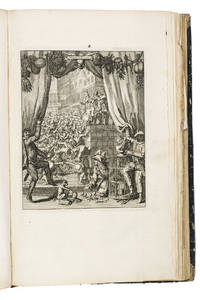
Large 4to. 4 parts in 2 vols., bound in one. 288 pp. 287, (1) pp. Printed in double columns. Contemporary green half calf over marbled boards with giltstamped title to spine. Third collected edition of a principal journal of the Italian enlightenment, "The Coffeehouse", modelled on the English periodical "The Spectator". It was published by the "Società dei pugni" (Society of Fists), members of which included the Milanese brothers Pietro (1728-97) and Alessandro Verri (1741-1816), the philosopher Cesare Beccaria (1738-94) and the mathematician Paolo Frisi (1728-84). Covering a large range of subjects, the journal's emphasis was on economics and public policy. It did not enjoy a long life: the first issue appeared in June 1764 (at Brescia to avoid censorship), the last in May 1766. The first collected edition appeared as early as 1765-66 in Brescia, and a second one in Venice in 1766. In 1764, the year that "Dei delitti e delle pene" was published, Beccaria contributed to one of the first issues an article on the relationship between tariffs and smuggling ("Tentativo analitico su i contrabbandi", vol. 1, pp. 122f.). This essay has been recognized by various authors as an important early contribution to mathematical economics and is been treated at length by Reghinos Theocharis. Beccaria posed the problem of a smuggler desirous to compute the risks of his profession. He attempts to express in algebraic formulae the relations between the value of goods purchased by the smuggler, the value of goods left after part of the goods have been seized by customs, and the value of the confiscated goods. This article "intended to convey a slight idea of how economic science may be considered analytically". Beccaria reasoned that algebra is "a precise and quick method of reasoning about quantities, which can be applied not only to geometry or mathematics but also to economic problems". While the articles are signed with an initial only, the present edition includes a publisher's note which resolves their identities. Both volumes have also an added leaf with a systematic table of contents. - Occasional foxing. Two old stamps to title of first part, and another to title of the third. Kress B.4775. Einaudi 6161 (the original journal). OCLC locates reprint editions only. Schumpeter p.179. Theocharis pp. 21-24. Bousquet p. 43. New Palgrave I, 218f. (Beccaria).
12mo (105 x 172 mm). XI, (1), 201, (1) pp., final blank leaf. Printed on strong wove paper. Contemporary giltstamped red morocco with gilt fleur-de-lys borders, arms of the Order of the Holy Sepulchre to both covers, and spine-title. Leading edges gilt, inner dentelle gilt. Blue silk endpapers. Leading edges gilt. All edges gilt. Only edition of "considerably rare little work" (cf. Saffroy) in connection with the great project of re-establishing the brotherhood of the Knights of the Holy Sepulchre. Includes a history of the order as well as its statutes and a list of the knights active between 1740 and 1815. - The history of the Knights of the Holy Sepulchre is a complex one, involving several attempts at institutionalization as well as competition in the form of confraternities since the Middle Ages. The order founded by St Louis in 1254 lasted until 1792, and included as ex-officio members several Princes of the Blood. From 1814, the Count Allemand, general administrator of the Order of Malta for France, worked to revive the brotherhood: he obtained an informal approval from Louis XVIII, but saw his efforts foiled by the opposition of Chateaubriand. - The title of general administrator, which Allemand bore at the time of the publication of the work, has been stricken from his name in ink (on the title-page as well as on pp. XI, 1 and 199) by a hand indicating his successor, Count Jacques-Louis-François Delaistre de Tilly, an officer of the Ancien Régime who became a general of the Empire. Tilly's name and title are added by hand at the bottom of the list of knights (p. 201). - Slight foxing to velin stock. A fine copy in a charming, richly gilt luxury binding. Rarely seen at auction. Saffroy 6300. OCLC 1067878144.
8vo. 248 pp. With 58 steel-engraved plates. Splendidly decorated beige satin binding (ca 1855), covers with brocade initials and coloured floral ornaments. Moirée silk endpapers; edges goffered and gilt. Extremely attractive, well-preserved satin binding showing the monogram of the Virgin Mary on the upper cover and the Empress's crowned, elaborately ornamented initial "E" on the lower cover. A lace-bordered leaf (H. Bertou) with a meticulous handwritten dedication in red and brown ink is inserted before the half-title: "Ad Elisabetta Amalia Graziosissima Imperatrice d'Austria [...] Per L'Augusto Consorte pei Figli diletti". - Occasional foxing to interior; the splendid binding is perfectly preserved. OCLC 557055399.
8vo. (6), 504 pp. With engraved portrait frontispiece. Contemporary full vellum with ornamental gilt tooling (oxydized) to both covers and spine; traces of cloth ties. All edges gilt and sparsely goffered. Rare account of the life of Tamerlane (Timur), the successful and barbaric 14th-century Turkish conqueror, based strongly on Arabic sources. Jean du Bec (1540-1610) was Bishop of St-Malo. He had visited the Middle East sometime before he became Abbé de Mortemer in 1578 and was so introduced to an Arabic history of Timur by an author referred to as "Alhacen", which was translated for him by an Arab who knew Italian. His book was first published at Rouen in 1595, shortly after Timur was once more made famous in the West through Christopher Marlowe's play "Tamburlaine" (1590). - Old ink ownership and small red Chinese collection stamp to title-page. Front pastedown shows armorial bookplate of the Esterházy de Galántha family's library at Nordkirchen castle near Münster, owned by the Esterházys between 1833 and 1903. A good, clean copy. Brunet II, 846. Graesse I, 319. Cf. Cordier III, 1926 (English translation in Purchas His Pilgrimes).
Folio (245 x 328 mm). (2), XXIV, 25-76, 686, (2), XL pp. With an engr. frontispiece and engraved title vignettes, both in contemporary hand colour and raised in gilt, 4 (instead of 6) engraved plates (portrait of Caesar; fortifications; 2 double-page plates showing Germanic tribes and a triumphal procession), 54 engravings and maps in the text, and 38 engraved vignettes and initials. Printed within engraved borders throughout (the Lion of St Mark and the three pillars of St Mark's Square in Venice). Letterpress printed in two columns, with Latin and Italian in parallel text. Later half vellum over marbled boards with giltstamped spine title. Splendidly illustrated large-paper edition, in Latin and Italian parallel text, of Caesar's war commentaries. The Civil War and the Alexandrine War led him to Egypt and the Near East (parts of Palestine, Arabia Petraea and Arabix Felix are shown in one of the maps). The coloured frontispiece shows the triumphant commander at work writing while surveying the conquered provinces. The beautiful illustrations are taken from those in Samuel Clarke's 1712 edition, "engraved by the greatest English artists at the expense of several wealthy Englishmen" (cf. Schweiger). Translated by Fr. Baldinelli with improvements by Palladio. A second part, announced on the title page, was to contain variant readings from a manuscript of Cardinal Bessarion, but was never published. - This is very likely a test print for the dedication copy on vellum that was produced for the Venetian government library, which differs noticeably from the paper version in being larger and more elaborately decorated. Two such vellum copies are known, one in the Bibliotheca Smithiana (cf. Brunet and Bib. Smithiana II, 83), the other in the Marciana: "Esemplare di dedica, in pergamena densa [...] dell'alt. di mill. 328 su 231 di largh., proporzioni superiori, per ampiezza di margine, a quelle del cartaceo. Ma non è questo il solo termine di differenza, dacché nel membranaceo sono miniate l'incisione dell'antiporta rappresentante Cesare [...]; la medaglia incisa nella vignetta del frontispizio ad onore del conte Enrico Collalto [...]; e sono pure adornati due margini del frontispizio col leone alato, con un ruscello, coi tre pili della piazza su cui vedonsi inalberate le tre bandiere col ritratto del doge Pisani. Manca pure agli esemplari cartacei fra le pagine XVI-XVII l'incisione in rame del busto di Cesare [...]. Il fregio a tempera dei margini del frontispizio [...] si ripete inciso in rame su tutte le pagine dell'esemplare membranaceo" (Libri Membranacei a Stampa Della Biblioteca Marciana, p. 129-131). The present copy very much agrees with the Marciania's description, save for the fact that the pagination is not precisely identical: the present copy on paper has an longer Latin index and an additional Italian index at the end. Lacks two plates; pages 41*-44* are not repeated as they are in some copies (though not in that in the Marciana). Rebacked edge flaws to frontispiece and title page; some rather pronounced waterstaining near the beginning, but overall a beautiful, unusually wide-margined copy with charmingly coloured title and frontispiece. Ebert 3298. Brunet I, 1461. Krieg, MNE I, 123. Schweiger II, 47. OCLC 4537995. ICCU UBOE\002198.
Folio (242 x 350 mm). (3), 58 ff. With woodcut illustrations and initials, small woodcut map of the world above colophon. - (Bound after) II: Teti, Carlo. Discorsi delle fortificationi, espugnationi, & difese delle città, & d'altri luoghi. Vicenza, Giacomo de' Franceschi, 1617. (2), 210 pp. With woodcut printer's device on title-page, woodcut initials and illustrations (some double-page), 3 folding woodcut plates, with blank leaves. Contemporary English calf, blue edges. Capobianco's work on artillery was first published in 1598 and was the first book to recommend the use of cartridges in cannons which would supersede the difficult, tedious and dangerous earlier method of loading with loose powder. Also interesting for the description of a remarkable measuring instrument, consisting of five component parts, invented by the author. Capobianco was captain of artillery for Crema and he demonstrates knowledge of Tartaglia's work on ballistics. The woodcuts show for the most part cannons and their construction, their correct positions for the bombardment of certain targets, and plans of fortifications. - II: Teti's treatise on military engineering was first published in 1569, and again in 1589, with additions. This profusely illustrated issue contains all eight books. Teti served the Emperors Maximilian II and Rudolf II; the Hungarian fortifications at Érsekújvár, Nagykanizsa and Komarom were designed by him. Additionally, he served as a tutor to the Saxon Prince Elector Christian I and was employed by the Medici of Florence and the Dukes of Savoy. - Binding professionally repaired. With contemporary ownership of "Francisco Drake" to flyleaf and title-pages. Latterly in the collection of Thomas Fremantle, 3rd Baron Cottesloe (1862-1956), commander of the Territorial Army and president of the Society for Army History Research (purchased from Pickering & Chatto, 14 November 1901, £1-4s). Cockle 673 & 776. USTC 4031756 & 4029522.
8vo. 8 vols. With engraved frontispiece and a total of 130 folding plates (several in the 6th volume loose). Contemporary marbled boards with giltstamped spine labels. All edges sprinkled in red. Final, most extensive edition of this compendium of 18th century science, compiled by the naturalist Gianmaria della Torre (1710-82), a Somascan Father and professor of physics in Naples. The first two volumes treat general physics, the others are dedicated to special fields, including thermometry, geophysics and minerals, metals, magnetism, earthquakes and volcanism, electricity, hydrophysics with rivers and ice, hydraulics as well as navigation; botany, animal life, the human body, anatomy; atmospheric phenomena and the perception of sound, light, colours, optics, etc. Of particular interest are the numerous engraved illustrations, showing not only instruments and experiments, but also maps of the Old and New World (Europe, Africa, Asia, America), the Torne River on Finland's Arctic Circle, the English Channel, crystals, volcanoes (with several views of Vesuvius and its latest eruptions), pumps and pumping stations, diving bells, etc. "Della Torre was a man of wide culture and of wide scientific curiosity. His studies led him into the history of philosophy, optics, and microscopy [...]; in addition, he observed and recorded eruptions of Vesuvius [... His] most important work, however, was as an encyclopedist. His two-volume work, 'Scienza della natura' (Naples, 1748-1749; [...] a considerably enlarged Neapolitan edition appeared in 1767-1780 as 'Elementa physicae'), anticipated the more famous 'Encyclopédie' the publication of which began in 1751. [... Della Torre's 'Elementa'] presents a complete and ordered picture of the state of scientific knowledge in its time. Although Della Torre's work is almost forgotten today, he was strongly influential in establishing the scientific climate of 18th-century Italy" (DSB). - Bindings rubbed and bumped; variously brownstained and waterstained; a few plates loose; unappealing old collector's stamps to title pages. Almost never encountered complete (as thus): no copy in auction records internationally; even libraries rarely hold more than four or six volumes, while the eighth and last volume is almost never present (nine-volume sets - such as those in the libraries of Benevento and Veroli - collect all the illustrations into a single volume of plates). DSB IV, 26. Poggendorff II, 1118 ("9 vols."). OCLC 883699282. Cf. Engelmann (Bibl. hist.-nat.) 198 (first ed.).
Mit 45 Original-Fotos (90:90 mm). Dunkelblauer Buckramband der Zeit. 8vo (140:175 mm). Die Photographien stammen wohl von Draga selbst oder einem Hobby-Photographen ihrer Entourage, was die klar erkennbar ungeübte Hand vermuten lässt. Die Aufnahmen zeigen Draga, einige ihrer Begleitpersonen, ihre Villa, Promenaden, Kutschen, Strände und Buchten sowie Einheimische. Eine der Aufnahmen, die eine kleine Gruppe beim Verlassen eines Hotels oder dergleichen zeigen dürfte, weist eine interessante Doppelbelichtung auf. - Dem serbischen Königspaar sollte noch mehrere unbeschwerte Jahre vergönnt sein; im Juni 1913 fielen beide einer Verschwörung von Offizieren zum Opfer und wurden bestialisch ermordet. - Beiliegend eine vom Hersteller beigefügte Benützungsanleitung des Albums in französischer Sprache. Die Photographien teilweise ausgeblichen; der Einband gering berieben.
2 Teile in einem Band. (8), 268, (28) SS. (20), 287, (25) SS. Mit 4 (2 versch.) Druckermarken. Blind- und goldgepr. Lederband der Zeit über Holzdeckeln mit Resten von 2 Schließen, datiert "1604". Folio (225:354 mm). Erste Ausgabe dieser bedeutenden Sammlung der böhmischen Geschichtsschreiber, besorgt von dem 1565 in Augsburg geborenen, 1614 in Heidelberg verstorbenen Juristen, Historiker und Diplomaten Marquard Freher. Als zweiter Teil beigegeben sind die Kommentare des Olmützer Bischofs Johannes Dubravius (1486-1553), hier erstmals mit dessen "Oratio ad Turcam debellandum exhortatoria" an den polnischen König Sigismund. - Etwas gebräunt und fleckig, sonst wohlerhaltenes Exemplar aus dem Besitz des böhmischen Gelehrten Johann Chorinus (1561-1606), "Magister der Philosophie, Professor an der Karolinischen Universität, und einer der vorzüglichsten lateinischen Dichter Böhmens" (G. J. Dlabacz, Johann Chorinus [Prag 1821], S. 3). Das zweite Vorsatzblatt trägt verso ein zwölfzeiliges Widmungsgedicht von seiner Hand an seinen Kollegen Johannes Tetaurius (Svinczanus), datiert März 1606, nur kurz vor Chorinus' Tod im Mai. Am Titel finden sich der Kaufvermerk Chorinus' sowie vier wenig spätere Besitzvermerke. Auf den Vorsätzen und in den Texträndern weitere, teils ausführliche Notizen bzw. Marginalien, überwiegend von einer einzigen Hand (möglicherweise die des Tetaurius). Der schöne Widmungseinband trägt vorn das Reichswappen, hinten den böhmischen Löwen, vorn zudem den blindgeprägten Aufdruck "Chorinnus / Vendidit / Iohan. Tetaur / Anno 1606". Stärker berieben und bestoßen, kleine Schabstelle im Lederbezug des Hinterdeckels, sonst schön erhaltenes Widmungsexemplar. Dahlmann/W. 1005. Ebert 7897. Graesse II, 632 & 439. VD 17, 23:318613P.
4to. 154 pp. With folding table after p. 130. 19th century blue boards with cloth spine and handwritten label. First and only edition. A project for a loan-office, based upon the principles of probability developed by Leonhard Euler. Published simultaneously in French as "Eclaircissemens sur les etablissements publics en faveur tant des veuves que des morts", for which - according to his present preface - Fuß had done the calculations. Fuß was a Swiss mathematician who, recommended by Daniel Bernoulli, moved to Russia to become Euler's assistant and in 1800 secretary of the Imperial Academy of Sciences. As from page 83: "Analytischer Anhang die Auflösung der in obigem Entwurf einer allgemeinen Leihe-Bank vorkommenden Aufgaben enthaltend". - Removed from the Tbilisi Magnetic and Meteorological Observatory with their cancelled lithographic bookplate to the inside front cover; Georgian stamp to first free endpaper and to page 17. Humpert 6798. Not in Kress, Goldsmiths' or Einaudi.
15627634BBFrankfurt am Main, Christian Egenolff Erben, 1562. Folio. (6) Bl., 157 Bl. Titel in rot und schwarz, mit reicher figürlicher Holzschnitt-Einfassung. Auf Verso Porträt-Medaillons mit den Bildnissenvon Gobler und Egenolff. Kalbldr. d. 18. Jh., Rücken mit Blindprägung. + Wichtig: Für unsere Kunden in der EU erfolgt der Versand alle 14 Tage verzollt ab Deutschland / Postbank-Konto in Deutschland vorhanden +, A|B|C [3 Warenabbildungen]
8vo. (2), XIX, (1), 404 pp. With 2 folding printed tables (included in pagination). With 2 letterpress folding tables (1 printed in red and black). Contemporary calf, gold-tooled. First and only edition of a history of the relation between Great Britain and their possessions in the East Indies, written by the British lawyer and politician Robert Grant (1779-1838), son of Charles Grant, chairman of the board of directors of the British East India Company. "The projected work was intended to exhibit, first, a historical sketch, derived from authentic sources, of the past proceedings of the East-India Company: in the next place, a correct view of the actual nature and effects of their present system, both political and commercial ... and lastly, an investigation of the objections adduced or adducible against the present system..." (p. II). The main text consists of four extensive chapters, followed by 15 appendices, mostly tables listing officers, troops and commercial details. The work is mostly written in defence on the East India Company's conduct, believing in "the Company's ability to improve conditions in India" (Tuck). - Slightly foxed and binding slightly rubbed, otherwise in very good condition. The Cambridge history of India: British India, 1497-1858, p. 631. Tuck, The East India Company 1600-1858, pp. 45, 183.
Small folio. (4), 276, (2), XXI pp. With 2 engraved portraits and 43 coloured engravings. Contemporary marbled calf with giltstamped arms of Paris on both covers and label to richly gilt spine. All edges red; marbled endpapers. First edition of this work of military theory. Presentation copy on large paper in a binding with the arms of the city of Paris. In contrast to the normal edition published simultaneously, the presentation copies contained colored plates. - The appendix depicts the Paris guard with their new uniforms. "Il existe des exemplaires in-folio sur grand papier et des pl. colories" (Colas). - A very fine copy. Lipperheide Qk 12. Cohen/Ricci 477. Hiler 418.
4to. XXXVI, 455, (1) pp. With 5 engraved folding plates and one folding table which extends to pp. 135-138. Contemporary boards with handwritten spine title. A prominent work on Ottoman military history divided into two parts, the first treating weapons, marches, camps, battles and sieges in general, including the Siege of Vienna in 1683, the second one discussing armed conflicts between the Ottoman and the Holy Roman Empire in Hungary between 1682 and 1739. The engraved plates illustrate the text by exhibiting the line-up of the Ottoman forces as well as their fortifications in various situations, while the table shows the organisation of the army divided into land and naval forces. - With several shelfmark numbers and notes ("Rerum Turcicarum") to front pastedown and flyeaf. Lower inside hinge weakened, binding rubbed, temporary blue boards and first few pages slightly waterstained, otherwise well preserved. Ownership stamps by Hungarian libraries to the title-page and the plates ("M. Kir. Testörség Könyvtára", "M. Némz. Muzeum"). Removed from the library of the Viennese collector Werner Habel, with his ownership stamp, dated 1977, to front pastedown. Seemann 4130. Cf. Apponyi 2489 (1783). Sturminger 158.
31 pp. Original staple-stitched self-wrappers. 12mo (160:110 mm). Scarce publication of the Russian Social-Democrat Labor Party, printed in Geneva for distribution in the Russian Empire. Pamphlets such as these are rarely encountered in such good condition and without any ownership marks. KVK, OCLC show seven copies, of which none in Europe.
8vo. 110, (2) pp. Original printed wrappers. First edition. Lenin's relentless analysis of the Unity Congress, a political event that brought out the fundamental differences between Bolsheviks and Mensheviks. The pamphlet became an object of persecution even prior to its completion: the police searched the Dyelo printing works in St. Petersburg, where the pamphlet was being set, and delivered the latter to the St. Petersburg Press Committee. Although the Committee banned the pamphlet, the Party succeeded in sending the text to Moscow, where its printing was eventually completed. The work includes an appendix comprising the draft resolutions submitted to the Congress by the Bolsheviks and the Mensheviks, resolutions adopted by the Congress, and other matter. - Wrappers slightly spotted; interior with occasional small marginal flaws. Contemporary handwritten ownership, as well as a faded library blindstamp to title-page. OCLC 970953325. Lenin, Collected Works X, pp. 317-382.
8vo. (2), V, (1), 13, (1) pp., final blank leaf. Original printed wrappers bound within modern full red cloth with giltstamped title-label to spine. First edition. Crucial memorandum by the police department superintendent Lopukhin with a foreword by Lenin. Harshly criticizing the security regulations implemented in 1881, which granted the police extensive rights and powers, it is essentially a reckoning by a police official with Russia's fundamental police law. In his preface Lenin asserts the "complete bankruptcy of the police regime", stating that the regulations have proved ineffective "ever since the revolutionary movement really penetrated among the people and became inseparably bound up with the class movement of the working masses". In addition to the Russian title the brochure is titled in German "Memorandum des Herrn Lopuchin". - Title-page somewhat browned and dampstained near upper margin. Insignificant vertical crease to first few pages. Occasional pencil annotations. Lenin, Collected Works VIII, pp. 202-205. OCLC 33430990.
8vo (145 x 210 mm). 104 pp. Original printed wrappers. First separate edition of Lenin's crucial pamphlet on capitalism and agriculture in the United States based on the U.S. Census reports for 1900 and 1910. The wrappers bear the date 1918; dated 1917 on the title-page. In his study "Lenin focused on black sharecropping in the American South to suggest that the American path of capitalist agriculture, which he had advocated less than a decade earlier, also contained authoritarian, even 'feudal' elements. After the American Civil War, Lenin noted, the American bourgeoisie restored 'the most shameless and despicable oppression of the Negroes' within 'free, republican-democratic capitalism'" (Zimmerman). - Written in 1915, Lenin, while in Berne, sent the manuscript to Maxim Gorky for the Parus Publishers in 1916, but it did not appear at that time. It was published in Petrograd in 1917 by Zhisn i Znaniye. Lenin never realized his intention of writing a second part of the book, which was to have dealt with Germany. - Upper wrapper detached; partly disbound. Faded stamp of ownership to front cover. Lenin Collected Works XXII, 13-102. Zimmerman, Alabama in Africa 239.
8vo. 29, (3) pp. Original printed wrappers. Stapled. First edition. Lenin's popular commentary on Russia's political landscape in the form of questions and answers. Drafted within weeks of the February Revolution, it explains the positions of the major political parties regarding the burning issues of the day. It was originally planned as a leaflet, owing to the fact that the Cadets, Socialist Revolutionaries and Mensheviks were making wide use of leaflets in their propaganda and pasted them up all over town. Lenin believed that a Bolshevik leaflet explaining what every party was and what it stood for should be pasted alongside the anti-Bolshevik proclamations. However, the article turned out to be too long to be issued as a leaflet, and was first published in the Helsingfors Bolshevik newspaper "Volna", then issued in pamphlet form by the Zhizn i Znaniye publishers in 50,000 copies. The proprietors of the printing-press, who sympathised with the Cadets, held up publication, but with the help of the workers' committee the pamphlet was issued on 4 July 1917. Owing to the July events, however, it was hidden away in the publishers' warehouse. A few days later it began to circulate in the working-class quarters. The first edition sold out quickly and a reprint was put out. A second edition was published in Moscow in 1918 with a foreword by Lenin. - Upper wrapper detached; small traces of worming. Lenin, Collected Works XXIV, pp. 93-106. OCLC 314383800.