86 357 résultats
Folio (345 x 441 mm). (3), XLIII (but: XLIV) ff. With 4 calligraphed half-titles, 2 engraved illustrations, 2 engraved initials, and 33 engraved full-page genealogical trees included in the foliation. Contemporary full calf with giltstamped borders to covers, giltstamped spine and spine-label. Leading edges gilt. Stored in custom cloth slipcase with marbled insides. Scarce, monumental edition of this genealogy of the Portuguese noble family Mello de Castro, seeking to prove their direct descent from Charlemagne. Appointed with delicately engraved genealogical trees including arms as well as small views of towns and castles in the background. Dedicated to Caspar Constantine Hercules de Mello. The present edition not in common Portuguese bibliographies, including Caetano de Sousa and Bernardes Branco. Only a single copy could be traced in auction records. - Near contemporary ownership of "de Bellisca" to half-title. Modern bibliographical notes in pencil to pastedown. Lower margin of the first 3 leaves extensively restored (without affecting text); trimming with loss of the last letter of the word "Mello" on 3 half-titles; margin of last family tree and last sheet restored, with loss of 7 lines of text; several wormholes repaired. Attractively bound with fine gilt decoration to both covers and spine. Cf. António Caetano de Sousa, História genealógica I, CCXV. Bernardes Branco, Portugal e os estrangeiros IV, 540. Azevedo Soares, Bibliographia nobiliarchica 1075. Palau 43547 (other eds.).
8vo (138 x 200 mm). XXIII, (3), 258 pp., (4) pp. of advertisements. Contemporary full cloth with stamped cover-title. Rare first Dutch edition of any part of "Das Kapital". Contains the first nine chapters of the first volume of Marx's magnum opus, including the prefaces to the first and second edition. Translated by the insurance broker and literary critic Franc van der Goes (1859-1939) after the fourth German edition published by Friedrich Engels in 1890. In a short note the translator expresses his hope that a complete translation will follow shortly. In fact a complete Dutch translation of the first volume would not be published before 1910. - In 1881 the great Dutch socialist leader Ferdinand Domela Nieuwenhuis had published a kind of summary of the book ("Kapitaal en arbeid"). Though Marx showed his appreciation for it, his annotations in a copy presented to him were highly critical. In 1894 there appeared a preprint of the first chapter of the present translation in a brochure edition; the single known copy of this publication is held at the Amsterdam University Library ("Het kapitaal. Kritiek van de staathuishoudkunde [...]"). - Van der Goes joined the Social Democratic Party in 1891. He became an ardent propagandist of social democracy and for a time the major theorist of orthodox Marxism in the Netherlands, closely allied to German Social Democracy. From 1899 to 1912 he also lectured in Marxist economics at the University of Amsterdam. - Contemporary art nouveau bookplate to pastedown ("Ex libris Gulden"). Extremities slightly rubbed. A good copy of this important work rarely found in the original binding. BWSAN V, 82. Harmsen 75. Not in Stammhammer.
Large 8vo. 3 vols. XXII, 740 pp. XXIII, (1), 479, (1) pp. XXV, (1), 836, (2) pp. With a portrait frontispiece in the first volume. Publisher's half cloth. First Swedish edition of "Das Kapital". The Social Democrat Rickard Sandler had been tasked with preparing a translation as early as 1912, and the Bolshevist-leaning Swedish banker Olof Aschberg donated 6000 crowns toward the project. However, Sandler's service in various political offices (including that of Prime Minister) forced him to postpone the publication for nearly two decades. - Slight waterstaining to the outer margins of the first few pages in the final volume, otherwise perfect. Not in Marx-Engels Erstdrucke. Cf. PMM 359.
8vo. XXIII, (1), 619, (5) pp. Untrimmed in publisher's brown printed wrappers. First Czech edition of Marx's "Das Kapital", edited by Lev Winter and translated by Theodor Šmeral and Ludvík Tošner. - Extremities somewhat rubbed, spine panel with vertical creases. Very rare; OCLC locates only three copies outside the Czech Republic (Friedrich-Ebert-Stiftung; Dt. Historisches Museum Berlin; Los Angeles Public Library), to which KVK adds a copy in the Austrian National Library. OCLC 914729107.
2 vols. in 1 (4to) and atlas (folio). VIII, X, (2), 104 pp. (4), XII, 206, (2) pp. Contemporary red morocco with elaborately gilt spine and covers. Gilt title to spine, leading edges and inner dentelle gilt. All edges gilt. Atlas contains 32 lithographed maps and plans (some folding or colored) with lithogr. title. Stored loosely in contemporary red half morocco portfolio with giltstamped covers and title. First edition of Miller's principal work on military tactics. Finely bound copy, inscribed by the author for Count Theodor Baillet de Latour (1780-1848), later the Austrian minister of war. Full-page autograph inscription by Miller, Colonel of the Royal Württembergian general staff, on front flyleaf; recipient's signature on title page. Baillet de Latour himself had been head of the military staff in the army of the Crown Prince of Württemberg in 1814; in 1815, he was made field marshal's lieutenant (major general) in the Austrian army. Created minister of war in 1846, he was lynched by revolutionaries during the riots of 1848. - Portfolio slightly dusty and bumped, otherwise in fine condition. Katalog der k. k. Kriegs-Bibliothek (1853), 161.
Folio (348 x 492). (5), (121 [instead of 125]) ff. (= printed title within woodcut border; engraved portrait of Ferdinand II of Tyrol, Archduke of Austria; 3 ff. of preface; 121 engraved portraits by Domenicus Custos after Giovanni Fontana with letterpress text on versos within woodcut borders). Contemporary blindstamped pigskin. First German edition. - Ostensibly a series of portraits of military nobles from the 15th and 16th centuries from all across Europe, this is in fact a magnificent catalogue of the collection of arms and armour owned by Archduke Ferdinand (1529-95) at Ambras Castle near Innsbruck, which had been collected by previous generations of Habsburg rulers and greatly expanded by Ferdinand with the help of his secretary, Schrenck von Notzing, who edited the work at the commission of his lord. First published in Latin by Agricola in 1601, it is considered the world's first illustrated museum catalogue, most notable for the representation of the military costumes of some of the protagonists. - All portraits are engraved within splendid, richly decorated architectural borders; even the biographical text is enclosed within a four-part woodcut border. Lacks the portraits of the Muslim statesmen Sultan Soliman and Sokollu Mehmed Pasha, as well as those of the military leader Ulrich von Schellenberg and the Polish-Lithuanian Prince Mikolaj Krzysztof Radziwill. Binding slightly rubbed and insignificantly wormed in places. A few short marginal tears to paper, occasional spotting and light staining. - An impressive presentation of the famous Ambras armoury, rarely seen at auction. VD 17 23:266204Y. Lipperheide Ci 1. Colas 2691. Hiler 787 (note). Hollstein (German) VI, 182. Pelc, Illustrium Imagines, 140. Waldner, Tiroler Buchdr. 252, 100. Durstmüller I, 68 ("Paurs sog. Österreichisches Ehrenwerk - eine meisterhafte Leistung in gemischter Technik"). Graesse VI, I, 317.
XLIII, 257, (3) SS. Bedruckte Originalbroschur. 8vo. Erste Ausgabe. - "Sein wichtigstes und wirkungsvollstes Werk sind die Reflexionen über Gewalt […] Sie sind hervorgegangen aus Sorels Artikeln im 'Mouvement socialiste'. Er verteidigt die Gewalt, die er vom Zwang unterscheidet. Gewalt braucht nicht notwendig von Roheit begleitet zu sein. Sorel betrachtet sie als ein Werkzeug des moralischen Fortschritts […]" (Ziegenfuß/J.). - Unaufgeschnitten; Rücken leicht rissig, Umschlag mit kleinen Randdefekten. Stammhammer III, 317, 28. Ziegenfuß/J. II, 566.
4to. (6), 112 pp. (but: 108 pp.; pp. 61-64 skipped in pagination). With 2 folded engraved plans. Contemporary full calf with giltstamped red label to gilt spine. Leading edges gilt. First English translation. - The popular report on the 1683 siege and liberation of Vienna by the Imperial Councillor of War, Vaelckeren, who was sick in Vienna in 1683, when the Turks enclosed the capital. Originally published in Latin, the account saw numerous reissues and translations. The plans show the Ottoman camp around Vienna with the surrounding landscape and towns, as well as the battle formation on 12 September 1683. - Pages 61-64 skipped in pagination, text continuous. With a handwritten insertion in the margin of p. 103 ("of that quality"). Handwritten ownership by "Fran[cis] Parry" to flyleaf. Sold by Gilhofer and Ranschburg in 1913. - Hinges starting. Paper evenly browned throughout, brownstained in places. From the library of the Viennese collector Werner Habel, with his signed and stamped ownership, dated 1976, to the front pastedown. His note of acquisition from the same year is loosely inserted. Sturminger 2953. Gugitz I, 485. Apponyi II, 1132. ESTC R28429. Cf. Kábdebo, p. 43f. Cf. Mayer 576ff. Cf. Jöcher IV, 1381.
(4), 352 (20) pp. - (Bound with) II: [Kunitz, Georg Christoph von]. Diarium welches am Sonntag den 12. Septembris 1683 nach glücklich von der türckischen Belägerung befreyten Statt Wien in dem türckischen Läger gefunden worden. Nebst außführlicher Relation der Wienerischen Belägerung [...]. No place, 1684. (2), 38 pp. With a folding engr. plate bound as a frontispiece. - (Bound with) III: Hammer, Johann Andreas. Disputatio iuridica inauguralis exhibens militem desertorem, eius delictum atque poenam [...]. Strasbourg, Johann Welper, 1677. 38 (but: 40) pp. With woodcut tailpiece. - (Bound with) IV: Seelmann, Sebastian. Ruhm-belorberter Triumphs-Fahn, dem durchleuchtigsten Fürsten und Herrn, Herrn Maximilian Emmanuel [...]. Munich, Johann Jahn, 1685. (6) pp., last blank f. Contemp. vellum with ms. title to spine. Wants ties. 4to. Attractive sammelband with rare pamphlets on the Thirty Years' War and the Turkish Siege of Vienna, a dissertation on military desertion, and a previously unknown encomium on a hero of the Turkish Wars, from the collection of the author of the latter publication, who was a member of the Pegnesian Order of Flowers, a Nuremberg literary society. - I: First German edition; continued by the editor until the year 1643. "The book's uncommon popularity was mainly due to Wassenberg's able and briskly narrated condensation of the War's events in a slender, readable quarto volume" (cf. ADB). - II: Rare pamplet, listed only in the BSB by VD 17: apparently the earlier of two variants, of which the other is not paginated and mentions the author in the slightly differently worded title: George Baron Kunitz, Imperial envoy to the Turkish court and present during the Siege, had left the manuscript behind during his flight. The catalogues of Austrian National Library and Vienna City Library list only this latter variant (also held at Admont, according to Kábdebo), while Sturminger also cites a copy of our present variant in the Austrian National Library. The engraving (mentioned only on the title page of the other variant) depicts the Battle of Vienna. - III: Remarkable Strasbourg legal dissertation about military desertion by J. A. Hammer from Regensburg (one of two variants with different dedications). - IV: Only known copy of this encomium of Elector Max Emanuel of Bavaria, who had fought in the 1683 Battle of Vienna and, together with the commanders of Lorraine and Waldeck, had achieved the victory of Esztergom and had recaptured Nové Zámky in 1685. The Regensburg jurist Sebastian Seelmann, a member of Harsdörffer's "Pegnesian Order of Flowers" since 1668 (under the name of "Silvius"), is mentioned on the title page as Secretary to the Elector. As evidenced by the characteristic hand-written spine title, this volume once formed part of Seelmann's own library, and it is likely that he assembled the volume personally in this order for binding. Front hinge reinforced with old paper; very well preserved. I: VD 17, 23:275673G. ADB XLI, 233. Cf. Apponyi 846 (1648 Latin ed.). - II: VD 17, 12:186448V. Sturminger 1094. Kábdebo 50 (and cf. 42). - III: VD 17, 1:004922B. - IV: Not in VD 17.
1938221315Potsdam, 1811-1938. In 115 Hldr.-, Hlwd.-od. Ppbdn. Meist stark bestoßen, berieben u. beschmutzt. Einbd. teils m. Fehlstellen. Meist Bibliotheksex. m. Rsign., St. u. Sign. a. Tit. Seiten sind häufig braunfl., selten eingerissen od. beschmutzt. Bei einigen Seiten sind die Ränder bestoßen u. leicht brüchig. Wenige Bde. haben farb. Anstreich. Es fehlen: Jg. 1916, 1917, 1919, 1920, 1922-26, 1928-1930, 1933 u. 1937. Bei Jg. 1823 fehlen Hefte 34,47 u. 50; 1824 u. 1832 fehlt Heft 52; 1834 fehlt Heft 8; 1851 fehlen die Hefte 9,11,18,20,23,32,42 u. 47; 1877 fehlt Heft 26 u. 1931 fehlt Heft 23. Einige wenige Bde. sind ohne Chronologische Übersicht od. Sach- u. Namenregister, bei anderen liegt dies lose bei.
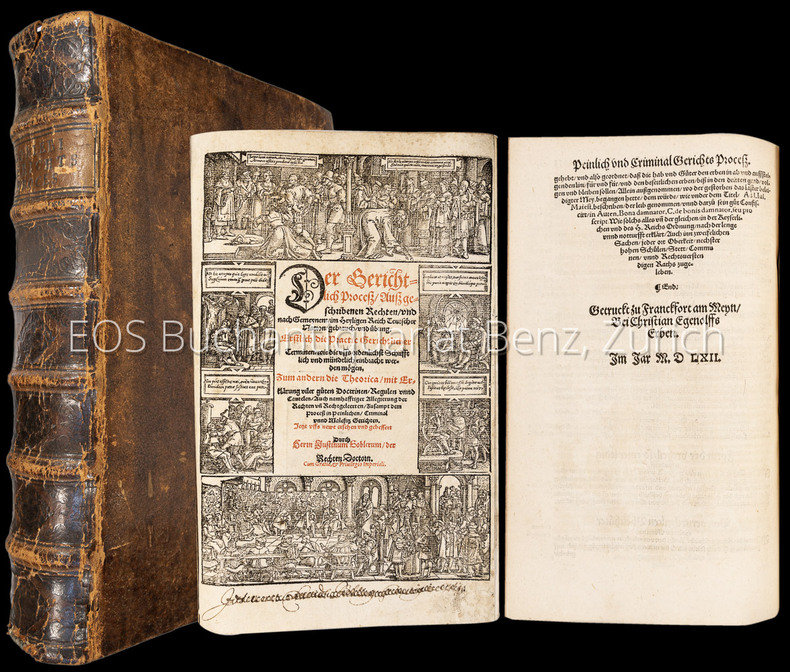
15627634BBFrankfurt am Main, Christian Egenolff Erben, 1562. Folio. (6) Bl., 157 Bl. Titel in rot und schwarz, mit reicher figürlicher Holzschnitt-Einfassung. Auf Verso Porträt-Medaillons mit den Bildnissenvon Gobler und Egenolff. Kalbldr. d. 18. Jh., Rücken mit Blindprägung.
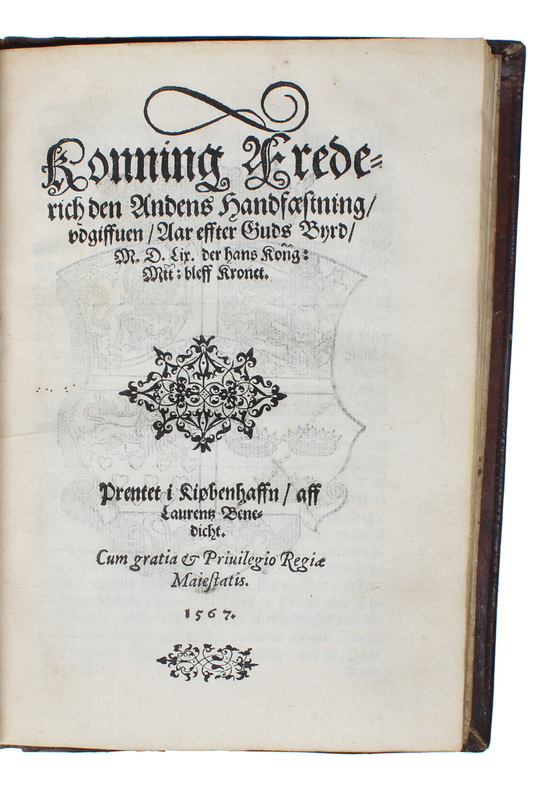
156754328Kiøbenhaffn, Lorentz Benedicht, 1567. 4to. Indbundet i et ganske velbevaret samtidigt hellæderbind af brunt kalveskind med blindtrykte rammer i streg, en bred blindtrykt ramme med symbolske figurer og portrætter. Midterfeltet omgivet af en smallere dekorativ blindtrykt ramme. I midterfeltet med blindtrykt pladestempel ""Prudenc"", alle dyders moder. Den blanke ramme mellem de blindtrykte, er forsynet med spredte håndstempler, stjerner og rosetter, som oprindeligt har været forgyldte. I den brede blindtrykte ramme på bindets bagside findes bogbinderens signatur ""D L"". Ryggen med 3 ægte bind. Lette reparationer på forpermens kanter og hjørner samt reparation på øverste og nederste rygfelt.Ad 1. Titelbladet trykt i rød/sort. 40 blade (sidste tomt). Blad 1b med stort træstukket rigsvåben. De 4 første blade med kantreparationer, her og der med tab af nogle bogstaver. På titelbladet er der tab af ""mectigste"" i Stormectigste. Annoteret i marginer og nogle tekstunderstregninger, alle i gl. hånd. Ellers velbevaret.- Ad 2. 16 blade. Blad 1b træstukket rigsvåben. Enkelte annoteringer. Velbevaret. - Ad 3. 14 blade. Blad 1b træstukket rigsvåben. Velbevaret. - Ad 4. Titelbladet trykt i rød/sort. 30 blade. Blad 1b træstukket rigsvåben. Velbevaret. Alle de 4 forordninger er trykt på godt papir, gennemgående rene og velbevarede.
Kiøbenhaffn, Lorentz Benedicht, 1567. 4to. Indbundet i et ganske velbevaret samtidigt hellæderbind af brunt kalveskind med blindtrykte rammer i streg, en bred blindtrykt ramme med symbolske figurer og portrætter. Midterfeltet omgivet af en smallere dekorativ blindtrykt ramme. I midterfeltet med blindtrykt pladestempel ""Prudenc"", alle dyders moder. Den blanke ramme mellem de blindtrykte, er forsynet med spredte håndstempler, stjerner og rosetter, som oprindeligt har været forgyldte. I den brede blindtrykte ramme på bindets bagside findes bogbinderens signatur ""D L"". Ryggen med 3 ægte bind. Lette reparationer på forpermens kanter og hjørner samt reparation på øverste og nederste rygfelt.Ad 1. Titelbladet trykt i rød/sort. 40 blade (sidste tomt). Blad 1b med stort træstukket rigsvåben. De 4 første blade med kantreparationer, her og der med tab af nogle bogstaver. På titelbladet er der tab af ""mectigste"" i Stormectigste. Annoteret i marginer og nogle tekstunderstregninger, alle i gl. hånd. Ellers velbevaret.- Ad 2. 16 blade. Blad 1b træstukket rigsvåben. Enkelte annoteringer. Velbevaret. - Ad 3. 14 blade. Blad 1b træstukket rigsvåben. Velbevaret. - Ad 4. Titelbladet trykt i rød/sort. 30 blade. Blad 1b træstukket rigsvåben. Velbevaret. Alle de 4 forordninger er trykt på godt papir, gennemgående rene og velbevarede.
1790143822Paris: Buisson 1790. Uncut in original wrappers First collected edition of the works of the French finance minister John Law whose financial schemes led to the Mississippi Bubble and economic collapse during regency France. Apart from Money and Trade Considered all the works in the collection including two Mémoires sur les Banques and a number of letters were previously unpublished. The publication of the collection during the French Revolution reflected a revived interest in solutions to deficit financing and a re-appraisal of the previously discredited Law and his grand schemes of long-term government finance. The editor Gabriel-Étienne de Sénovert "made a point of highlighting its current relevance. 'Credit' he wrote at the beginning of his introduction to the edition citing Sir James Steuart for corroboration 'plays so considerable a role in the political economy of modern nations and is connected so intimately to their prosperity and even to their existence that it could be said that the science of government is nothing but the science of credit itself'. Sénovert's assessment of Law was however judiciously neutral. As he went on to emphasise both in the rest of his introduction and in the notes that he added to Law's own works it was difficult to decide whether Law's system was a real example or a dreadful warning" Sonenscher pp. 314-15. The revolutionary government's solution to the economic situation issuing the assignats backed by land and confiscated property was not dissimilar to Law's solution of notes tied to French land in North America; both rapidly lost value and further destabilized France's economy. Octavo. Uncut in contemporary marbled paper wrappers paper spine label lettered in manuscript printer's waste pastedowns. Occasional light spotting. A remarkably well preserved copy. Goldsmiths' 14361; Kress B.1919. Michael Sonenscher Sans-Culottes: An eighteenth-century emblem in the French Revolution 2008. unknown
1944186789Italy: Printed and Bound by Printing and Stationery Services 21 Army Group 1944. Inscribed by the victor amid the ruins First edition presentation copy inscribed by Montgomery on the front free endpaper "To: Ernest Bevin Foreign Secretary of England. B. L. Montgomery Field-Marshal. Berlin 29-8-45". After the Labour Party's surprise victory in the July 1945 general election Prime Minister Attlee appointed his close ally Ernest Bevin as Foreign Secretary allowing him significant autonomy in foreign policy decisions. Montgomery met the new Foreign Secretary at the Potsdam Conference and wrote "I was much impressed by Bevin; he will be the power behind the throne in the new set-up" Hamilton p. 551. Montgomery signed this volume the day before the conference at which he joined Georgi Zhukov Dwight Eisenhower and Jean de Lattre de Tassigny in forming the Allied Control Council the supreme governing authority in occupied Germany. The book privately produced and surviving in very few copies collects the printed personal messages issued by Montgomery to the Eighth Army as it fought its way from Alamein to Tunisia. These messages were central to the legendary morale of the Eighth Army. As Freddie de Guingand says in his foreword "These messages were always eagerly looked forward to by the troops and fostered the spirit and the will-to-win that made the Eighth Army such a great and happy family". An additional message from Montgomery from 25 August 1945 is loosely inserted. Small folio. Original black sand-grain cloth with Eighth Army insignia to front cover. Light rubbing to cloth ink marks to initial and final leaf. A very good copy. Nigel Hamilton Monty Final Years: 1944-1976 1986. hardcover
2014547732014. ISBN-13: 9781584779773. ISBN-10: 1584779772. "The Megatherium of the Older Abridgments" Viner Charles. A General Abridgment of Law and Equity: Alphabetically Digested Under Proper Titles with Notes and References to the Whole. Originally published: Aldershot: Printed for the Author 1742-1753. 23 volumes. Hardcover folio 9" x 14". Reprinted 2009 2014 by The Lawbook Exchange Ltd. ISBN 9781584779773. Hardcover. New. $4995. Reprint of the First edition. Descended from Rolle's Abridgment Viner's Magnum Opus marks the end of an era in English legal bibliography. Originally intended as a continuation of D'Anver's abridgment which ends at "Factor" Viner's work went on to become the longest and most detailed work of its kind. According to Winfield "it is the megatherium of the older abridgments.For several years we have used Viner for the purpose of getting all available references to all existing cases on three or four branches of the law and we have found his book very useful." Marvin adds that "it is a vast Index of the law" that "often rewards the labour when all other resources have failed." In addition to the Abridgment Viner 1678-1756 contributed much for the study of English law through his posthumous establishment of the Vinerian chair and Vinerian scholarships. The first holder of the Vinerian Chair was Sir William Blackstone. During his tenure he delivered the lectures that formed the basis of his Commentaries on the Laws of England. Winfield The Chief Sources of English Legal History 244-45. unknown
2011687512011. One of the Landmarks in American Legal Publishing. One of the Landmarks in American Legal Publishing. One of the Landmarks in American Legal Publishing United States Congress. United States Statutes at Large. Boston: Charles Little and James Brown 1845- ; Washington: United States Government Printing Office. Vols. 1 1789 to 125 Part 2 112th Congress 1st Session 2011 in 260 books. Vols. 1 and 2 facsimile reprints else original imprints in publisher's tan buckram with red and black spine labels. Ex-library good condition. $4995. The United States Statutes at Large contains the full text of all the federal laws in the order they were passed by the United States Congress. The United States Statutes at Large typically referred to as the Statutes at Large is the permanent collection of all laws and resolutions enacted during each session of Congress. Publication of the United States Statutes at Large began in 1845 by the private firm of Little Brown and Company under authority of a joint resolution of Congress. During Little Brown and Company's time as publisher 1845-1873 Richard Peters Volumes 1-8 George Minot Volumes 9-11 and George P. Sanger Volumes 11-17 served as editors. In 1874 Congress transferred the authority to publish the Statutes at Large to the Government Printing Office under the direction of the Secretary of State. Woxland & Ogden Landmarks in American Legal Publishing 67. The Statutes at Large is presently prepared and published by the Office of the Federal Register OFR National Archives and Records Administration NARA. Under the provisions of 1 U.S.C. 112 the printed edition of the Statutes at Large is legal evidence of the laws concurrent resolutions proclamations by the President and proposed and ratified amendments to the Constitution. Some portions of the United States Code have been enacted as positive law and other portions have not been so enacted. In case of a conflict between the text of the Statutes at Large and the text of a provision of the United States Code that has not been enacted as positive law the text of the Statutes at Large takes precedence. Until 1948 all treaties and international agreements approved by the United States Senate were also published in the set but these now appear in a publication titled United States Treaties and Other International Agreements abbreviated U.S.T. In addition the Statutes at Large includes the text of t. unknown books
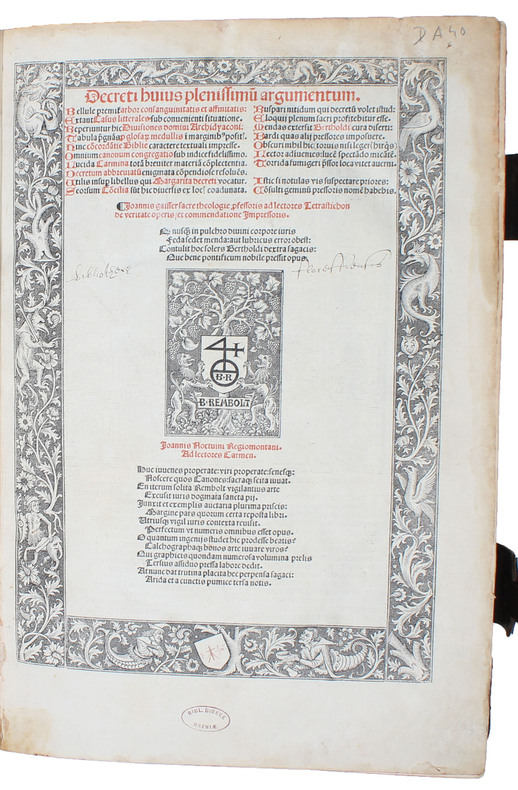
151151294Paris, B. Rembolt, 1511. Large folio. (40x30 cm.). Contemp. full brown calf over wood, richly blindtooled covers. Later rebacking. 5 raised bands. Brass clasps and catches. Leather on clasps renewed. Brass edges on covers. Fol. 459,(27),46,(1). Lacking Folios in Index (Fol. 41-43). Title-page printed in red/black within woodcut border and with printers woodcut device. Text throughout printed in red/black. Large woodcut on Fol. 1 verso (biblical figures, church fathers and Gratian in the middle). Numerous figurative woodcut initials throughout. Internally very fine and clean, a few leaves with a faint dampstain to margins. On fine thick paper. On the renewed spine is with letters in gold printed 1507 (it should be 1511).
Paris, B. Rembolt, 1511. Large folio. (40x30 cm.). Contemp. full brown calf over wood, richly blindtooled covers. Later rebacking. 5 raised bands. Brass clasps and catches. Leather on clasps renewed. Brass edges on covers. Fol. 459,(27),46,(1). Lacking Folios in Index (Fol. 41-43). Title-page printed in red/black within woodcut border and with printers woodcut device. Text throughout printed in red/black. Large woodcut on Fol. 1 verso (biblical figures, church fathers and Gratian in the middle). Numerous figurative woodcut initials throughout. Internally very fine and clean, a few leaves with a faint dampstain to margins. On fine thick paper. On the renewed spine is with letters in gold printed 1507 (it should be 1511).
154143462Paris, Charlotte Guillard, 1541. Petit in-8 réglé de (8)-216 ff. (sign. aa8 a-z8 A-D8), index, vélin doré à recouvrement, dos lisse titré orné de filets et fleurons, double filet en encadrement, armoiries avec légende dans un médaillon au centre des plats, tranches dorées, traces de fermoir (reliure de l'époque).
495 x 605 mm (image: 300 x 450 mm). In one room in Havana, sharing cigars: Che Guevara, Simone de Beauvoir, Jean-Paul Sartre, and Antonio Núñez Jiménez. Guevara had a lifelong interest in French existentialism, and after the success of the Cuban Revolution found himself able to invite Sartre and de Beauvoir to visit Havana in his new role as guerilla fighter turned diplomat. Jiménez, a local, was not a philosopher but a scientist and geologist - another occupation Guevara admired - and the first president of the Cuban Academy of Sciences. The original photo was taken by Alberto Korda, who has signed and dated the print in black felt-tip pen on the lower right. - In flawless condition.
200233Paris, chez Mr. Aubry de Saint-Vibert, 1787 11 parties en un volume in-folio, [2] ff. n. ch. (titre gravé, avertissement), x pp. d'introduction, puis pagination multiple, avec 6 cartes hors-texte, dont 5 à double page, vélin vert, dos lisse, pièce de titre cerise, tranches rouges (reliure de l'époque). Charnière supérieure fendue, coins abîmés.
138486A Dijon, Ressayre, Causse, 1689-(1781) 17 vol. in-4, basane brune mouchetée, dos à nerfs (reliure de l'époque). Épidermures sur les plats. Accrocs sur certains dos. Pièces de titres parfois abîmées. Qqs rousseurs et mouillures. Il manque les pages de titre des tomes I et III. Petites galeries de vers sur quelques plats, au tome V, elles sont aussi dans l'ouvrage avec atteinte au texte. Au tome XII, l'année 1751 manquait, elle a été remplacée par une copie manuscrite.
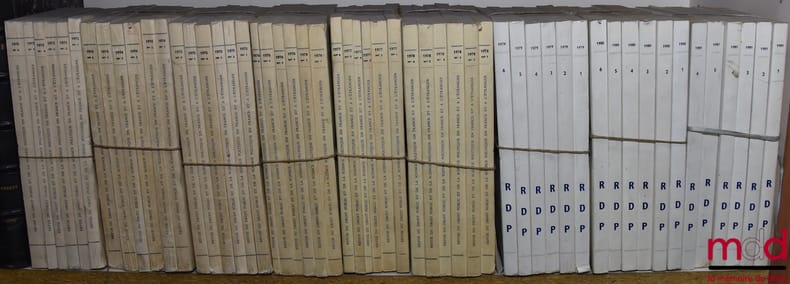
3969, Paris, Chevalier Marescq & Cie [1894-1903]/ V.Giard & E.Brière [1904-1921]/ M.Giard [1922-1934]/ L.G.D.J. [depuis 1935] 1894 et s., 88années en 88 vol. in-8, rel. en demi-chagrin brun/fauve pour la période 1894 à 1972 (tit. & tom. dorés sur dos à nerfs avec filets dorés encadrants et filets à froid soulignant), broché à partir de 1973, bon état général hormis qq. reliures légt frottées et qq. rousseurs, brochages fanés.
4to. Title page, (8) pp., final blank f. With woodcut arms (intended as those of the Holy Roman Emperor Francis II) on first leaf. Printed in gold throughout. Set in roman type with incidental italic. Gold-brocade decorated paper wrappers, showing an embossed floral pattern (also including grapes) with hunters, a wild boar, deer and dogs scattered through it, in gold, orange, yellow, lavendar and blue. The paper used to make the wrapper is decorated on both sides (from the same block and with the same colour pattern, but with the the whole on the inside upside down) and another piece of the same decorated paper has been used to reinforce the inside of the fold. In modern clamshell box with red morocco spine label. Verses celebrating the repulsion of the French from the walls of Acqui Terme in Piedmont (between Torino and Genoa) by Habsburg Imperial forces on 17 May 1799 during the War of the Second Coalition (1798-1801). It collates: [A]6 = 6 ll., with only the woodcut arms on A1 (verso blank), the title-page on A2r, a "Madrigale" on A2v, 4 numbered poems on A3r-A4v (the first titled "Sonetto" and the fourth explicitly referring to the military confrontation at Acqui Terme on 17 May 1799) and a "Canzone" on A5r-A5v. A6 is blank. Although the imprint explicitly indicates that it is from Arcasio's printing office and that he is printer to the city of Acqui Terme ("Acqui[:] nella stamperìa di Gio Francesco Arcasio stampatore dèll' illustrissima città."), ICCU records no other work under his name and no other publications at Acqui Terme between 1622 and 1805. It records only one other copy of the present work (at the Biblioteca Federico Patetta at the law department of the University of Torino) and neither it nor the library's own catalogue indicates whether it is printed in gold (nor does it describe the binding). That copy may also lack the initial leaf with the coat of arms and its blank conjugate. We have located no other copy. The book must have been printed in a very limited press run. It is dedicated to the general of the Imperial troops, "Baron de Sekendorff", perhaps the successor to Generalleutnant Carl Friedrich Freiherr van Seckendorff (1736-1796). The author calls himself "Regio Segretaro della Prefettura, ed Accademico Torinese". The arms on the first leaf are clearly intended as the arms of the last Holy Roman Emperor, Francis II (reigned 1792-1806). They show a crowned double-headed eagle with a coat of arms on its breast, but the arms on the breast are somewhat roughly rendered and appear to be in mirror image. - The printing shows through the paper slightly, but both the book and the wrapper are in fine condition, with only slight soiling to the wrapper and a couple very minor stains at the foot margin of the last printed page. An extraordinary and extremely rare piece of occasional printing from the War of the Second Coalition: only one copy on ICCU; not in WorldCat.