86 357 résultats
8vo. VI, (7)-146, (2) pp. Later half cloth with giltstamped spine label. Rare first edition, published in Zurich while the Anti-Socialist Laws were in force in Germany and illegally distributed there. Engels's motivation for this work was the 1877 book "Ancient Society" by the American anthropologist Lewis H. Morgan, discussing the origins and development of the family. Marx had investigated the same subject and left notes which Engels combined with copious research of his own, blending it with the principal ideas of historical materialism: "thus, the book becomes a fundamental work on the development of society from the viewpoint of historical materialism" (Laffont). For the first time in Marxism, Engels here studies extensively the development of the family and of marriage, as well as the various positions of women in society. "This is the most instructive application of the materialist conception of history to the early forms of human society" (cf. NDB IV, 525). - Browned, with slight staining near beginning and end of the volume. Slight edge defects, mostly repaired, to title page. Rubel (Appendix) 93. Stammhammer I, 73, 20. Marx-Engels Erstdrucke 45f. (pictured).
1723135461Paris: Ches Louis-Denis Delatour & Pierre Simon 1723. John Law accused of illegally building on claimant's land First edition setting out the claim of Jean Pasquier in the legal action brought against the financier John Law and others concerning a building in Chaillot in Paris. The claimant disputes Law's title to the land and calls for the building's demolition and the claimant's renumeration. The land in question is across the river from where the Eiffel Tower now stands. Pasquier claims he inherited the land through his wife but that his neighbour Jean Des Vaux acquired it on false legal pretexts. Des Vaux partnered with John Law who built an iron foundry there in 1719 using English workmen. Pasquier repeatedly appealed to the Paris parlement for his right seeking the return of the land to him and demolition of the foundry as well as damages. This publication presents his claims making extensive observations on private rights and public welfare and the nature of property law in France and its relation to civil society. The Mémoire implies that Law was arguing that as the enterprise was of national importance and built on good faith with Des Vaux it should not be demolished. Law moved his then-skyrocketing wealth into various enterprises and had already invested in a factory in Harfleur in 1718 similarly bringing over English workmen including the engineer Richard Jones. The British parliament was concerned by these enterprises due to the mercantilist perception that France's gain would be England's loss - they drafted a law forbidding any British manufacturer to develop enterprises abroad Buchan p. 187. The Mémoire is dated 5 July 1723. Pasquier had printed another claim the previous year with the same publishers and under the same title which is dated 5 September 1722; the same ground is covered but the text is different and this further elucidates and updates the case into 1723. We could trace only one other copy that in the Bibliothèque nationale de France who also have the only traced copy of the 1722 publication. Folio 394 x 239 mm 14 pp. Recent blue boards red label. Neat early annotation and notation to first page. Slightly spotted faint staining at head of inner margin. A very good copy. James Buchan John Law 2018. hardcover
1773665487 vol. in-4 reliure uniforme début XIXe demi-basane marron, dos lisse orné numéroté de 1 à 6 avec un 3bis. Détail [ Contient Notamment ] : Tome I 1755-1773 : Mémoire pour Maître Bourdon, Greffier en chef de l'Hôtel de Ville de Péronne 1755 - Arrests de la Cour de Parlement portant défenses aux nommés Bazin, De La Sauvagère, Mormont & De Renty de récidiver leurs Libelles & diffammations - Sommaire pour Me Jean-Baptiste Ropiquet, Procureur en la Cour contre Messire De La Folie de Vorme, Seigneur de Reincheval - Sommaire pour Jacques Maillard, Fermier de la Ferme de Renancourt - Précis sur Délibéré pour le Sieur Gallot & les Héritiers du Sr Savoye, Propriétaires des Moulins bannaux du Bourg d'Ault - Mémoire pour Me Etienne Lalau, Prêtre Chapelain de la Cathédrale d'Amiens - Mémoire pour la Dame veuve Masset et les Sieurs Masset... tous Marchands Commissionnaires à Saint-Valéry sur Somme, Intimés Contre la prétendue Communauté des Gribaniers de la même Ville - Mémoire sur Délibéré pour le Sieur Dubus Avocat en Parlement... Elu en l'Election de Senlis - Observations Sommaires pour les Habitans, Corps & Communautés d'Wavant & Beauvoir-Rivière contre le Vicomte de Marle & la Dame son Epouse - Mémoire et Consultation pour M. Luneau de Boisjermain, Soucripteur de l'Encyclopédie contre le Sieur Briasson et le Sieur Lebreton - Mémoire pour Me Boistel, Ecuyer, Seigneur de Belloy-sur-Somme, Avocat en Parlement au Bailliage & Siège Présidial d'Amiens - Mémoire pour les Maïeurs & Echevins de la Ville d'Abbeville, Défendeurs ; contre le receveur Général des Domaines & Bois de la Généralité de Picardie - Mémoire pour les Maire, Echevins et Officiers Municipaux de la Ville d'Amiens, Intervenans, contre le Sieur Le Seneschal, Receveur Général des Domaines & Bois de Picardie, Demandeur - Précis pour Me Jean-Baptiste Hesse, Curé d'Agnière, Doyen de Chrétienté de Grandvilliers - Précis pour les Srs Claude & Balthazar Picquet Seigneurs de Belloy-sur-Somme - Mémoire pour le Marquis de Gouy contre la Marquise de Gouy, par Le Go, Procureur. 1772 - Addition au Mémoire par De Vergès et Linguet - A Messieurs les Grands Bailli, Lieutenant-Particulier & Hommes de Fiefs, Gradués de la Gouvernance & Bailliage Royal d'Arras. 1773 - Mémoire signifié pour les Sieurs Dégardin, Bailli-Général de la Châtellenie & Comté d'Oisy - Mémoire pour le Sieur Ducandas, Chanoine de l'église Cathédrale d'Amiens - etc... ; Tome II 1774-1777 : Consultation pour le Marquis de Soyecourt 1774 - Mémoire pour la Communauté des Procureurs au Parlement contre les Prévot et Echevins de la Ville de Paris, les Conseillers et Quartiniers, les Six Corps des Marchands, De l'Imprimerie de Louis-Charles Caron, Amiens, 1774 - Mémoire pour Anéglique Galletn Veuve Clément, Contre Joseph & Jean-Baptiste Leroi, neveux & héritiers de Me Jean-Baptiste Leroi, en son vivant Curé de Warloy 1774 - Mémoire pour le Sieur Louis-Pierre-François Assegond Marchand Corroyeyr à Dieppe Contre Charles Duval, Marchand Tanneur à Blangy en Normandie - Mémoire sur Délibéré pour le Sieur Jean Marchant du Casseau, Avocat en Parlement, Intimé, Contre Timothée Girault, ci-devant Meunier du moulin de Saint-Eloy de Ferrière, Appelant, et les Abbé Prieur & Religieux de l'Abbaye Royale de Ferriere - Précis pour Gabriel Bos é Consors intimés Contre Me Jean Martin, Prêtre, Curé d'Allenay, appellant et contre Firmin Machet, Ménager à Bourseville - Mémoire pour les Maire, Echevins, Habitans & Corps commun de la Ville d'Albert en Auvergne contre M. le Comte de Merle, Brigadier des Armée du Roi, ci-devant son Ambassadeur en la Cour de Portugal 1775 - Précis pour la Demoiselle Elizabeth Mouret, Demanderesse, Contre Maître Watier & le Sieur Calixte Vilbault, dit Condé - Observations pour le Receveur-Général des Domaines & Bois de la Généralité d'Amiens, Demandeur, Contre le Sieur François-Alexandre de Bucy, Chevalier, Seigneur de Villers-Saint-Christophe, 1755 - Réponses Sommaires du Sieur de Bucy, Chevalier, Seigneur de Villers, aux Observations du Sieur le Sénéchal - Extrait de Titres et Observations Sommaires pour Monsieur le Comte de Crequi Canaples contre les Habitans de Beauquêne 1775 - Mémoire pour la Comtesse de Béthune, De l'Imprimerie de Philippe-Denys Pierres, Paris, Seguier, Avocat, Linguet Avocat 1775 - lettre de M . le Président de Meinières à Madame la Comtesse de Béthune - Mémoire pour la Comtesse de Béthune, Seconde Partie - Observations sur un Imprimé ayant pour titre : Mémoire pour Me Gerbier ancien Avocat, De l'Imprimerie de Philippe-Denys Pierres, Paris, 1775 - Supplêment aux Réflexions pour Me Linguet, Avocat de la Comtesse de Béthune - Mémoire pour la ville d'Amiens 1776 - Mémoire pour le sieur Isidore-Parfait Mimerel Chapelain de la Chapelle de Notre-Dame, dite de l'Aurore, érigée dans l'Eglise Cathédrale d'Amiens, Défendeur, contre le Sieur Asselin, Vicaire de la Paroisse de Notre-Dame, 1776 - Précis pour le Sieur Flesselle, Entrepreneur de l'un des Manufactures de la Ville d'Amiens, & encore les Sieurs Mercier & Doucet tous deux Voituriers au Village de Saint-Maurice-lès-Amiens, Contre les soi-disant Compagnons Fluqueurs & Déchargeurs de la Ville d'Amiens 1776 - Affaire très-intéressante pour le Commerce, en ce que l'Arrêt à intervenir doit faire réglement 1776 - mémoire pour les Syndic, Habitans, Corps & Communauté de la Paroisse de Vaux sous Amiens , Contre les Abbé, Prieurs & Religieux de l'Abbaye de Saint Jean d'Amiens, Ordre de Prémontré 1776 - Mémoire pour Firmin Sannier, Laboureur demeurant au Village de Métigny-Laleu, Défendeur, 1777 - Mémoire Me Cochepin, Seigneu de Métigny 1777 (avec plan dépliant en couleurs) - Mémoire Signié pour Sieur Louis-Robert Cocu, ci-devant négociant à Amiens, Appellant, contre Louis Vautour, Marchand de Modes à la même ville, 1777 - Précis pour Messie Vollant de Bervill, Marquis de Lisbourg, contre Messire Marie de Berne, Ecuyer, Seigneur de Lahaye - Précis pour la Dame Veuve du Comte de Fercourt, Tutrice de ses Enfans Mineurs, Défendresse, contre le Sieur Papin de Caumesnil, Demandeur - Précis dans l'Instance sur sur Référé pour le Sieur de La Morlière, Teinturier à Amiens, Contre le Sieur Cordier Duflos, Négociant à Abbeville 1777 - Précis pour les Frères Coquillard, Négocians à Amiens ; Tome III 1777 - 1783 : Précis pour le Sieur de Crocquoison de la Cour de Fiefs 1778 - Mémoire sur Délibéré pour les Sieurs Auguste & Augustin Coquillart, Frères, Négocians à Amiens, Appelans 1779 - Mémoire pour Jean-Baptiste Morgan, Ecuyer, Seigneur de Frucourt, Dondelainville & Warcheville, demeurant à Amiens, Contre le Sieur Sanson Leprince, Agent de Change, demeurant audit Amiens 1779 avec grand plan dépliant en couleurs - Mémoire signifié pour le Sieur Henry, Bourgois d'Amiens, Défendeur, contre le sieur Dotttin, 1779 - Précis pour les Habitans de Vignacourt, contre Philippe Duboisle, Habitant dudit lieu, et contre le Sieur de Famechon, Chevalier, Seigneur de Canteleu, Etouvi & autres lieux - Mémoire pour Me Pierre Bardoux, Notaire Royal au Bailliage d'Amiens, à la résidence de Fienvillez, et pour Jean-Baptiste Bardoux, Majeur Coutumier vivant de son Bien, contre Augustin Destrée, Tisserand, demeurant au village de Fief 1779 - Mémoire sur Appointement à mettre pour les Sieurs Paillieux négocians contre le Sieur Florimond d'Wailly, Fabricant, demeurant à Saint-Maurice-les Amiens, 1779 - Plaidoyer pour le Sieur Jean Tranel contre le Sieur de Portelance 1773 (nombreux mémoires sur la même affaire) - Mémoire pour les Officiers de la Sénéchaussée de Ponthieu & Siège Présidial d'Abbeville Contre Me Lavernier, Notaire Royal en la même ville 1780 - Mémoire pour Messire Louis-François Pingré, Ecuyer, Seigneur de Fricamps, La Houssoye, Vadancourt, Dutronquoy et autres lieux, 1781 - Mémoire signifié pour les Syndics, Habitans, Corps & Communautés du Bourg d'Auxi-le-Château, Picardie & Artois contre Messire Charles-Antoine, 1782 - Mémoire pour François Demonchy, Laboureu, demeurant à Woignarue, contre Jean-Baptiste Boinat, Tisserand, demeurant à Chepy, contre les Sieurs Navier du Coudray et Jean-Gaspard Testard-Desportes, intéressés dans les affaires du Roi, fermiers de la Mense Abbatiale de Saint-Valéry-sur-Somme, 1782 - Précis pour Adrien d'Arragon, Maître Sellier demeurant à Lignières-Châtelain, Conre Alexis Mouret, ci-devant Domestique à Paris, 1782 - Mémoire pour le Sieur Pierre-François Beauvarlet, Marchand Cirier, demeurant Abbeville, contre ses soeurs - Précis pour le sieur Nicolas Boulnois, Négociant à Sarcus en Picardie, contre le Sieur Robert, Négociant, ci-devant à Amiens, depuis à Philadelphie en Pensylvanie, & actuellement à Amiens, 1782 - Mémoire signifié pour Demoiselle Pélagie Monchaux, veuve du Sieur carretten Laboureur au village de Bussun contre Nicolas-Joseph Carrette, Laboureur, demeurant au village de Noyelles-en-Chaussée - Consulation pour Jean-Baptiste Boint, Tisserand à Chepy, 1783 - etc. ; Tome III bis 1776 - 1783 [ Recueil d'une vingtaine de mémoires, réponses ou consultations sur l'Affaire de la Baronie de Picquigny vendue au Comte d'Artois ] : Consutlations pour le Sr Calmer, Seigneur de la Baronie de Picquigny & du Vidamé d'Amiens, sur la question de savoir s'il est dû un droit de Quint & Requint à M. l'Evêque d'Amiens, pour la vente faite au prix de 1500500 livres de la Baronie de Picquigny, du Vidamé d'Amiens & dépendances, tenus en un seul Fief de son Evêché, 1776 - etc ; Tome IV 1784-1792 : Mémoire pour le Sr Bernard de Nolongue contre Bernard de Cléry, 1784 - Mémoire pour Messire Danzel Vicomte de Boismont, demeurant en son Château au Village d'Aigneville, 1784 - Requête au Roi et Pièce Justificative pour le Marquis de Wargemont ; contre le Comte de Wargemont, en présence de Monsieur le Comte d'Artois, 1785 - Mémoire pour Me De La Haye, Ecuyer, Seigneur de Vaulx-sous-Corbie, Sailly-le-Secq, 1785 - Mémoire et Consultation pour les Engagistes du Greffe des Présentations d'Amiens, 1786 - Mémoire Signifié pour Pierre-Marie Delahaye, Ecuyer, Seigneur de Molliens-le-Vidame, contre Langlois Seigneur de Courcelles - Mémoire Signifié pour les Seigneurs, Syndic, Habitans, Corps et Communauté du Village de l'Hortoy, Contre Me Antoine Marminia, Prêtre, Vicaire perpétuel à portions congrue de la Warde-Mauger, & Curé seul gros Décimateur de la Paroisse de l'Hortoy, 1787 - Mémoire pour Me Léonor Scribe, Notaire au Bailliage d'Amiens, 1787 - Mémoire pour le Sieur Brandicourt, Curé de Saint-Firmin le Confesseur, à Amiens, 1788 - Mémoire à Consulter pour Claude Boullet, Ecuyer, Sieur de Lamothe - Mémoire à Consulter et consultation contre les Srs Administrateurs de l'Hôpital-Général d'Amiens, 1789 - Mémoire pour les sieurs de Vermont contre le Sieur de Morel de Foucaucourt, 1789 - Mémoire pour le Sieur Delamarre, Laboureur à Sarcus, contre le Marquis de Grasse, 1789 - Observations des Sieurs Eloy-Louis et Dominique-César Leleu Frères, négocians, Sur un écrit intitulé "Second Mémoire pour les Maîtres Boulangers", 1789 - Compte-Rendu au Public par les Sieurs Leleu sur l'établissement des Moulins de Corbeil, 1789 - Rapport fait au Roi, par M. Taboureau, Contrôleur Général, le 23 Février 1777 - Réflexions d'un Citoyen sur la conduite du Peuple envers M. Jourdain de Leloge, Négociant à Amiens, 1789 - Mémoire pour le Sieur Jean Baptiste Alexandre Leleu Fils, Négociant & Consul en exercice de la Ville d'Amiens, 1789 - Réplique du Sieur Caron-Berquier, imprimeur, 1790 - Mémoire pour M. Bussilot, négociant à Amiens, 1790 - Observations de Germai-Louis Chambosse, receveur du district d'Amiens ; Tome V An 4 - 1806 : Précis servant de réponse pour le Cotoyen Guidé le jeune, Négociant demeurant à Amiens contre le Citoyen Barbieux, Négociant à Lille, An IV - Mémoire sur délibéré pour les Héritiers d'Honoré Delaporte contre les Enfan Lesouef - Mémoire à consulter et consultation pour les citoyens Durieux le jeune, et Morgan, négocians à Amiens, Contre la citoyenne Dujardin du Royal, an VI - Mémoire à Consulter, pour les intéressés à la Manufacture de draps et ratines d'Andely, stipulés et representés par les citoyens Ribard et Levieux, Négociants à Rouen - Mémoire à Consulter et Consultation pour le Citoyen Mille Marchand à Amiens, contre les Citoyens Mallet-Dessommes et Rousseau, An VII - Mémoire présenté à la Commission consulaire exécutive de la République Française, par les négocians et manufacturiers d'Amiens, An VIII - Mémoire pour le Cotoyen Pierre Louis, Négociant demeurant à Lille, contre le Citoyen Ladame, Négociant demeurant à Amiens An VIII - Mémoire pour Jean-Baptiste Canaples ci-devant Marchand à Oisemont contre Villeret, Cultivateur demeurant à Avelège, An IX - Réhabilitation Coulon Frères, An XI - Mémoire pour François-Joseph Lecus, Agent de Change, à Abbeville, Demandeur en Cassation, etc. - Tome VI 1806-1813 : Mémoire en réponse pour les Frères Enfantin, Demandeurs en homologation, poursuites et diligences de marcel Enfantin, l'un deux, Liquidateur, contre le Sieur Herbel fils - Affaire Veuve Dewarsy contre Poujol D'Avankerque (nombreux mémoires) - Mémoire pour Mme De Bussy de Folleville contre Musnier, Général de Division - Résumé pour Charpentier, Comte de l'Empire, Général de Division, contre Brayer Maison Neuve demeurant à Soissons - Précis pour le Sieur Dumoiron contre le Sieur Stubert - Consultation pour MM les Syndics à la Faillite de la Maison Virnot de Lille - Précis pour le Sieur Jean-Baptiste Laurent, ancien Négociant demeurant à Amiens - Conclusions motivées pour les Habitans de la Commune de Magny-le-Freule, etc...

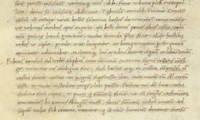
14502454001/01/1450. <blockquote><p>A very uncommon leaf from Livy very few manuscript examples having survived</p></blockquote><p>Rome having survived the invasions of the Celtic Gauls in the early 4th century BC set its sights on further expansion in the middle part of the century. They re-conquered those Latin and Etruscan towns that had left the fold during the Gallic occupation and in absorbing others reconsolidated their position as the dominant force in Latium and Central Italy. With their home turf secured or so it seemed the Romans looked south towards Campania.</p><p>At this time the Samnites had moved into the fertile lands of Campania from the south-central Appenines. They already controlled the towns of Capua and Cumae to the south of Rome and held sway to the east as well. Rome to protect its flanks while still in the midst of re-taking Latium and Etruria wisely entered into an alliance with the Samnites in 354 BC. Conflict with Samnium over Campanian dominance was inevitable however and would soon turn into a series of wars lasting from 343 - 290 BC.</p><p>The years surrounding the Samnite Wars were not only one of military prowess for Rome but of great public works as well. In 329 BC the Circus Maximus got one of many face-lifts throughout its history gaining permanent horse-stalls and starting gates. The first Roman road the Via Appia was constructed from Rome to Capua in 312 BC and the first aqueduct the Aqua Appia was also established at the same time. These magnificent structures not only were of great benefit to Rome and her people but proved the flourishing disposition of the state even during time of war and expansion. At the end of the Samnite Wars Rome held perhaps as many as 150000 people making it one of the largest cities in the Mediterranean region. As many as 1000000 people claimed citizenship to Rome and vastly larger numbers were obligated through Latin rights and allied status.</p><p>With the defeat of Samnium the last major Italian threat Rome was the master of nearly the entire Italian peninsula save for the Gauls occupying the Po valley in the north and the Greek holdout cities like Tarentum in the far south. This growing power soon gained the attention of regional powers in Greece and later the masters of the Mediterranean the Carthaginians.</p><p>Livy or Titus Livius 59 BC - 17AD wrote his history of Rome starting with the foundation myth of Aeneas 510 BC up to the successful German campaigns and death of Emperor Drusus 9 BC. This history comprised 142 books. Of those books 35 survive to present day with the bulk being the first 10 years Books 1-10 fragments of 11 Books 21-45 fragments of 91 and scattered quotations preserved in secondary works.</p><p>Though the accounts differ the destruction of Livy’s work has been attributed to the hand of Pope Gregory the Great 590–604 who was trying to eliminate pagan works from Christian hands. This biblioclasm whether it was through the Pope’s doing or through the natural loss of material to time has severed us from an important access point to Roman history as some of the material used by Livy has not been found in his source texts.</p><p>With the bulk of the texts destroyed Livy’s History of Rome passed into the Middle Ages primarily through summary and with the extreme length of the work the original Classical and Early Medieval manuscripts were not recopied and fell into decay and loss. Thus by the so-called 12th Century Renaissance Livy’s historical writing was quite rare. It was not until the 1300s that Livy regained popularity. Dante was one of those who respected Livy and in his Inferno the poet references Livy ""come Livïo scrive che non erra"" as Livy wrote who does not err.</p><p>The hunt was on for Livy’s lost manuscripts even just a fragmental scrap was a treasure worth finding in the 1300s. Even Pope Nicholas V turned his efforts towards finding these rare manuscripts some of which had been destroyed by his papal predecessor. The Italian Humanist period into the Renaissance increasingly sought any extant versions of this history; as the esteem for and ardent imitation of Greco-Roman culture increased so did the need for access points to this history. Entire country homes in Italy were sold to buy a single manuscript of Livy’s works copied by one of the men primarily responsible for the new handwriting style now known as the Humanist hand. Scholarship and commentary ranging from England by Dominican Friar Nicholas Trevet to Italy by Laurentius Valla paved the way for further analysis of the Roman historian.</p><p>This Italian manuscript leaf likely from the mid-1400s to the very early 1500s comprises part of Book 9 from BC 308. With only minor deviations from the Loeb Classical Library text which is the scholarly standard. These deviations indicate that this manuscript descends from a different stemma than the most common or most “correct†one which was for the Loeb edition further painting the picture of the Humanist effort to grasp this fading history from the jowls of history and the pains to retaining the original text despite the lack of exemplars.</p><p>In addition to representing an important moment in the recuperation of history the script throws us into modernity. Towards the end of the 14th century several Italian humanists including Niccolò Niccoli and Poggion Bracciolini began set about to reform the increasingly dense Gothic handwriting which had dominated book making since the mid-13th century. The Gothic script whose legacy in printing extends to 20th century German fraktur found in pre-war books was full of letters fused together ornate thorns and hairlines and single strokes called minims which became impossible to read. These 14th century Italians set about to recreate a script that utilized space between each letterform and simpler strokes— a new take on the handwriting endorsed by Charlesmagne himself for the education of his Holy Roman Empire. This script known as Humanist caught on and proliferated. By the time texts were bring printed at the end of the 15th century the printers looked to this script to make a font and further our modern Times New Roman font is based on the Humanist script which is in part why this text of Livy is so legible to us as a modern audience.</p><p>Pierre Maréchaux “The Transmission of Livy from the End of the Roman Empire to the Beginning of the Seventeenth Century: Distortion or Discovery a Story of Corruption†A Companion to Livy ed. Bernard Mineo John Wiley & Sons: 2014 pp. 437-452.</p><p><strong>More details</strong></p><p>LEAF FROM LIVY’S AB URBE CONDITAS in Latin text manuscript on parchment Northeastern Italy perhaps Padua 1456 Single column of 34 lines written in brownish ink in Humanist hand with some slant and ligatures. Letters beginning sections set in margins with two hatch marks in pen next to all but one of the initials. Single correction indicated by strike through with amended word written above line 15 recto; Ruled horizontally in red ink. Distinct hair and flesh sides. Modern pencil number 185 at the bottom left hand of the column on verso. Provenance: Sothebys March 1825 Payne and Foss 1825 Sothebys 1902 & 1923 Parke-Bernet 1941 Otto Ege. Gwara Handlist 52.</p><p><strong>Text & Translation:</strong></p><p>…ruperat Fabius consul nec dubia nec difficili victoria dimicat. Ipsum oppidum—nam ad moenia victor accessit—cepisset ni legati dedentes urbem exissent. Praesidio Perusiae imposito legationibus Etruriae amicitiam petentibus prae se Romam ad senatum missis consul praestantiore etiam quam dictator victoria triumphans urbem est invectus; quin etiam devictorum Samnitium decus magna ex parte ad legatos P. Decium et M. Valerium est versum; quos populus proximis comitiis ingenti consensu consulem alterum alterum praetorem declaravit.</p><p>XLI. Fabio ob egregie perdomitam Etruriam continuatur consulatus; Decius collega datur. Valerius praetor quartum creatus. Consules partiti provincias: Etruria Decio Samnium Fabio evenit. Is profectus1 ad Nuceriam Alfaternam cum pacem petentes quod uti ea cum daretur noluissent aspernatus essetoppugnando ad deditionem subegit. Cum Samnitibus acie dimicatum. Haud magno certamine hostes victi; neque eius pugnae memoria tradita foret ni Marsi eo primum proelio cum Romanis bellassent. Secuti Marsorum defectionem Paeligni eandem fortunam habuerunt.</p><p>Decio quoque alteri consuli secunda belli fortuna erat. Tarquiniensem metu subegerat frumentum exercitui praebere atque indutias in quadraginta annos petere. Volsiniensium castella aliquot vi cepit; quaedam ex his diruit ne receptaculo hostibus essent; circumferendoque passim bello tantum terrorem sui fecit ut nomen omne Etruscum foedus ab consule peteret. Ac de eo quidem nihil impetratum; indutiae annuae datae. Stipendium exercitu Romano ab hoste in eum annum pensum et binae tunicae in militem exactae; ea merces indutiarum fuit.</p><p>Tranquillas res iam in Etruscis turbavit repentina defectio Umbrorum gentis integrae a cladibus belli nisi quod transitum exercitus ager senserat. concitata omni iuventute sua et magna parte Etruscorum ad rebellionem compulsa tantum exercitum fecerant ut relicto post se in Etruria Decio ad oppugnandam inde Romam ituros magnifice de se ac contemptim de Romanis loquentes iactarent. Quod inceptum eorum ubi ad Decium consulem perlatum est ad urbem ex Etruria magnis itineribus pergit et in agro Pupiniensi ad famam intentus hostium consedit. Nec Romae spernebatur Umbrorum bellum et ipsae minae metum fecerant expertis Gallica clade quam intutam urbem incolerent Itaque legati ad Fabium consulem missi sunt ut si quid laxamenti a bello Samnitium esset in Umbriam propere exercitum duceret. Dicto paruit consul magnisque itineribus ad Mevaniam ubi tum copiae Umbrorum erant perrexit.</p><p>Repens adventus consulis quem procul Umbria in Samnio bello alio occupatum crediderant ita exter-ruit Umbros ut alii recedendum ad urbes munitas…</p><p>In the same year the consul Fabius fought a battle with the remnants of the Etruscan forces near Perusia—which together with other cities had broken the truce—and gained an easy and decisive victory. He would have taken the town itself—for after the battle he marched up to the walls—had not ambassadors come out and surrendered the place. Having placed a garrison in Perusia and having sent on before him to the senate in Rome the Etruscan deputations which had come to him seeking friendship the consul was borne in triumph into the City after gaining a success more brilliant even than the dictator’s; indeed the glory of conquering the Samnites was largely diverted upon the lieutenants Publius Decius and Marcus Valerius of whom at the next election the people with great enthusiasm made the one consul and the other praetor.</p><p>In recognition of his remarkable conquest of Etruria Fabius was continued in the consulship and was given Decius for his colleague. Valerius was for the fourth time chosen praetor. The consuls cast lots for the commands Etruria falling to Decius and Samnium to Fabius. The latter marched against Nuceria Alfaterna and rejecting that city’s overtures of peace because its people had declined it when it was offered them laid siege to the place and forced it to surrender. A battle was fought with the Samnites in which the enemy were defeated without much difficulty nor would the engagement have been remembered but for the fact that it was the first time that the Marsi had made war against the Romans. The Paeligni imitated the defection of the Marsi and met with the same fate.</p><p>Decius the other consul was also successful in war. When he had frightened the Tarquinienses into furnishing corn for the army and seeking a truce for forty years he captured by storm a number of strongholds belonging to the people of Volsinii. Some of these he dismantled lest they should serve as a refuge for the enemy and by devastating far and wide he made himself so feared that all who bore the Etruscan name begged the consul to grant them a treaty. This privilege they were denied but a truce for a year was granted them. They were required to furnish the Roman army with a year’s pay and two tunics for each soldier; such was the price they paid for a truce.</p><p>The tranquility which now obtained in Etruria was disturbed by a sudden revolt of the Umbrians a people which had escaped all the distress of war except that an army had passed through their territory. Calling up all their fighting men and inducing great part of the Etruscans to rebel they mustered so large an army that they boasted with much glorifying of themselves and fleering at the Romans that they would leave Decius behind them in Etruria and march off to the assault of Rome. When this purpose of theirs was reported to the consul Decius he hastened by forced marches from Etruria towards the City and encamped in the fields belonging to Pupinia eagerly waiting for word of their approach. At Rome no one made light of an Umbrian invasion. Their very threats had excited fear in those who had learnt from the Gallic disaster how unsafe was the City they inhabited. Accordingly envoys were dispatched to carry word to Fabius the consul that if there were any slackening in the Samnite war he should with all speed lead his army into Umbria. The consul obeyed the order and advanced by long marches to Mevania where the forces of the Umbrians at that time lay.</p><p>The sudden arrival of the consul whom they had believed to have his hands full with another war in Samniurn a long way from Umbria so dismayed the Umbrians that some were for falling back on their fortified cities and others for giving up the war…</p><p><img class=""alignnone wp-image-24457 size-post-window"" src=""https://cdn.raabcollection.com/wp-content/uploads/20231204150746/Folder-site-8-1600x1327.jpg"" alt="""" width=""1600"" height=""1327"" /></p> unknown
1966143289Berlin/Hamburg, Decker, 1853-1966. Hldr., Lwd., Hlwd., Pp. u. in Heften. Einbde. teils berieben bzw. angerissen. Einige angeschmutzt. Wenige Bind. gelockert u. 2 Bind. halb lose. Einbd. bzw. S. teils stockfl. Einige Bde. m. Rsign. St. u. Sign. a. Vorsatz u. Tit.
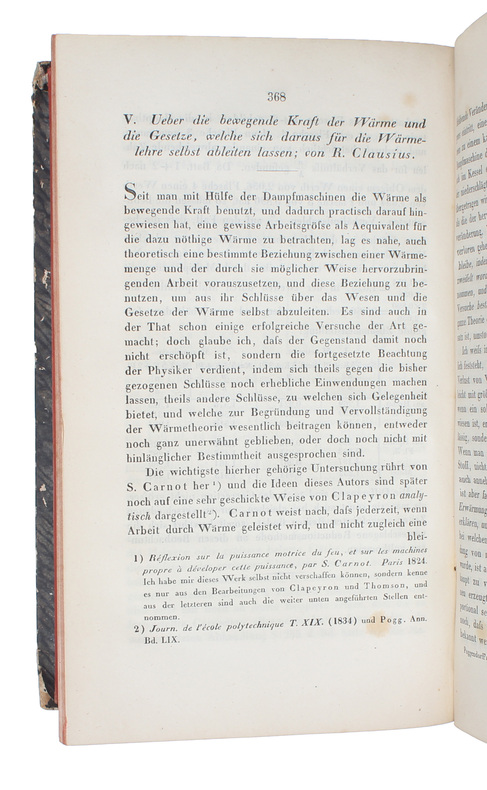
185053436Leipzig, Johann Ambrosius Barth, 1850. Contemp. marbled boards. Gilt spine, titlelabel with gilt lettering. Light wear to spineends, corners and edges. Stamps on title-page (Gusstahlfabrik Fried. Krupp). In ""Annalen der Physik und Chemie"", Dritte Reihe, 19. Band (79. Band der ganzen Reihe). IX,(1),580 pp. and 3 folded engraved plates. (Entire volume offered). Endpapers and the first and last few leaves with brownspots. Clausius's paper: pp. 368-397 a. pp. 500-524. Internally clean.
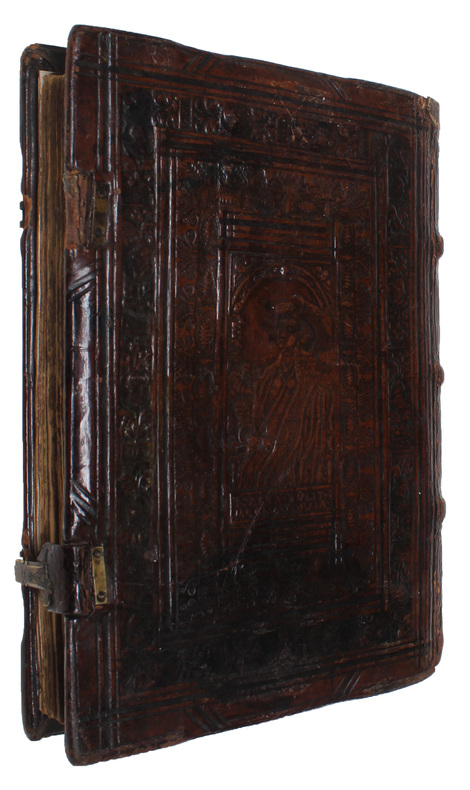
157656695(Colophon:) Kiøbenhaffn (Copenhagen), Matz Wingaardt, 1576. 4to. Pragtfuldt samtidigt hellæderbind af kalveskind over træ med skråtskårne kanter og 2 lukkestroppe med messingbeslag (det ene hængsel løst), antageligt udført af en dansk bogbinder. 3 ophøjede ægte bind på ryggen og med blindtrykte stregbordurer. Permer med dobbelte stregrammer og 2 brede rammer udført med ruller og stempler. Midtfelterne med stort pladetrykt billede af Justitia, på bagpermen et billede af Justinian ?. Kapitæler med mindre reparationer. Titelbladet med en træsnit illustration af den danske konge med rigsvåbnet. Kolofon med Gotfred af Ghemens trykkermærke i træsnit. 111 unummerede blade. Indersiden af forpermen har notater i gl. hænder vedrørende bogens indhold. Fra Oscar Wandels bogsamling med hans exlibris. Da bogen ikke er ombundet foreligger den her i dens opsrindelige størrelse med pænt brede marginer. Få spredte brunpletter. Nogle blade med en svag skjold nederst på siderne. De første 6 blade (incl. titelbladet) er noget restaurerede med senere omkantning. Titelbladet har en smule tab af stregrammen omkring kongen, blad 2 recto har tab af et ord i nederste linie (tagher). Trykt på svært papir.
185053436Leipzig Johann Ambrosius Barth 1850. Contemp. marbled boards. Gilt spine titlelabel with gilt lettering. Light wear to spineends corners and edges. Stamps on title-page Gusstahlfabrik Fried. Krupp. In "Annalen der Physik und Chemie" Dritte Reihe 19. Band 79. Band der ganzen Reihe. IX1580 pp. and 3 folded engraved plates. Entire volume offered. Endpapers and the first and last few leaves with brownspots. Clausius's paper: pp. 368-397 a. pp. 500-524. Internally clean. <br/><br/><em>First edition of this monumental famous paper in thermodynamics in which Clausius for the first time states the Second Law of Thermodynamics one of the most importent laws of Nature having a huge impact on the development of physical theory cosmology communications and information theory. The law states that a the energy of the Universe is constant and b the Entropy of the Universe tends to a maximum."Clausius' contribution to thermostatics is comparable to those of Newton and Maxwell to mechanics and electromagnetism respectively. In the obituary J.W. Gibbs remarked that Clausiu's first memoir "marks an epoch in the history of physics."" Chowdhury and Stauffer in "Principles of Equilibrium Statistical Mechanics".In "The Nature of the Physical World" Eddington writes: "The Law that entropy increases - the Second Law of Thermodynamics - holds I think the supreme position among the laws of Nature. If someone points out to you that your pet theory of the Universe is in disagreement with Maxwell's equations - then so much the worse for Maxwell's equations. If it is found to be contradicted by observation - well these experimentalists do bungle things sometimes. But if your theory is found to be against the Second Law of Thermodynamics I can give You no hope; there is nothing for it but to collapse in deepest humiliation.".Parkinson "Breakthroughs" 1850 P. </em> hardcover
(Colophon:) Kiøbenhaffn (Copenhagen), Matz Wingaardt, 1576. 4to. Pragtfuldt samtidigt hellæderbind af kalveskind over træ med skråtskårne kanter og 2 lukkestroppe med messingbeslag (det ene hængsel løst), antageligt udført af en dansk bogbinder. 3 ophøjede ægte bind på ryggen og med blindtrykte stregbordurer. Permer med dobbelte stregrammer og 2 brede rammer udført med ruller og stempler. Midtfelterne med stort pladetrykt billede af Justitia, på bagpermen et billede af Justinian ?. Kapitæler med mindre reparationer. Titelbladet med en træsnit illustration af den danske konge med rigsvåbnet. Kolofon med Gotfred af Ghemens trykkermærke i træsnit. 111 unummerede blade. Indersiden af forpermen har notater i gl. hænder vedrørende bogens indhold. Fra Oscar Wandels bogsamling med hans exlibris. Da bogen ikke er ombundet foreligger den her i dens opsrindelige størrelse med pænt brede marginer. Få spredte brunpletter. Nogle blade med en svag skjold nederst på siderne. De første 6 blade (incl. titelbladet) er noget restaurerede med senere omkantning. Titelbladet har en smule tab af stregrammen omkring kongen, blad 2 recto har tab af et ord i nederste linie (tagher). Trykt på svært papir.
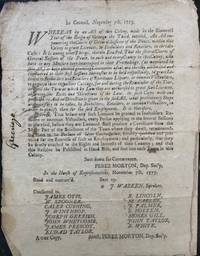
177563921Watertown Mass: Printed by Benjamin Edes 1775. Broadside. 21 1/2 x 16 1/2 cm. A true copy signed in type and sent down for Concurrence by Perez Morton Dep. Sec'y. in the House of Representatives November 7 1775. Read and concurr'd and sent up by J. Warren Speaker who signed in type along with the following: James Otis W. Spooner Caleb Cushing J. Winthrop Joseph Gerrish John Whetcomb James Prescot Eldad Taylor B. Lincoln M. Farley J. Palmer S. Holten Moses Gill John Taylor and B. White. This copy has an ink note at the left margin "Greenage" sp.; and another note on verso correcting "Greenage" to "Greenwich" presumably the destination for this copy of the hand bill. Another note reads: "Nov.r 7: 1775 an order of Court Respecting Licenses or Taverns." Old fold lines a few spots some overall toning to the sheet ink on verso bleeds through but text all legible. <br/>ESTC: AAS MHS. Library of Congress also appears to have a copy. EVANS 14198. FORD Broadsides 1876 which adds Mass. Archives Div. CUSHING Mass. Laws 896. <br/><br/> Printed by Benjamin Edes unknown books
1982566j0533Atlantic Highlands New Jersey: Humanities Press. Good with no dust jacket. 1982. First Edition. Hardcover. 0391023713 . Signed without inscription by Murray Rothbard atop front free endpaper. "Economics can help supply much of the data for a libertarian position but it cannot establish that political philosophy itself. For political judgements are necessarily value-judgements political philosophy is therefore necessarily ethical and hence a positive ethical system must be set forth to establish the case for individual liberty." - Preface. "Rothbard 1926-1995 was a central figure in the 20th-century American libertarian movement and a founder and leading theoretician of anarcho-capitalism" - Wikipedia. Clean and unmarked with moderate peripheral wear to original dark blue cloth brightly lettered in gilt. Binding tight. Light foxing to edges. No dust jacket apparently as issued. A quality signed copy of this fascinating study. ; Sm 4to; Signed by Author . Humanities Press hardcover
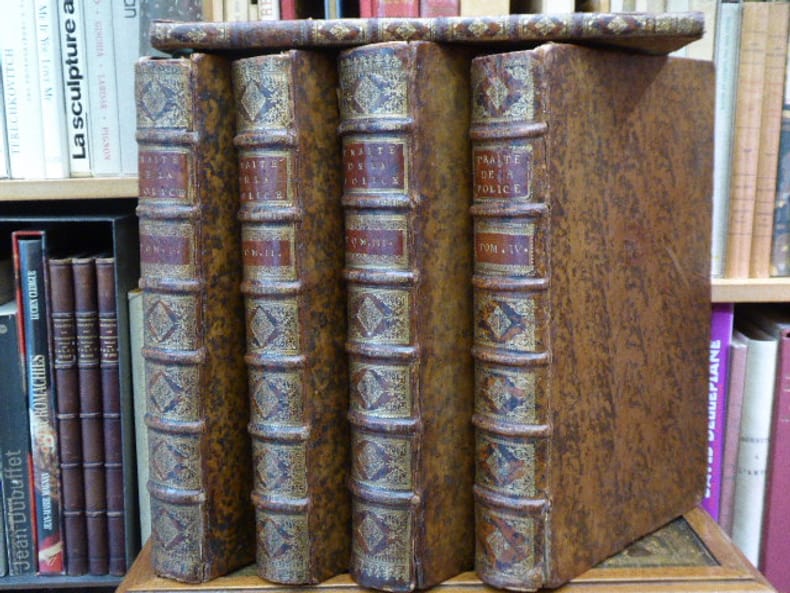
278472Cot - Brunet - Hérissant Paris 1735-1738 4 volumes + 1 volume de supplément in-folio. Reliures de l'époque pleine veau havane, dos à nerfs ornés de caissons de double filet doré richement et finement fleuronnés, pièces de titre et de tomaison en maroquin grenat, roulettes dorées sur coupes, toutes tranches rouges. Le supplément est en demi-reliure de l'époque. Orné de vignette sur titre répétée aux armes et chiffres royales, 10 en-têtes et lettrines historiées, et bien complet de ses 8 plans dépliants dont le plan des fontaines de la ville des faubourgs de Paris. Le supplément concerne les livres 1 et 2. Des cartes avec petites déchirures mais sans manque, divers défauts aux coiffes et mors mais l'ensemble reste solide et fort décoratif. BEL EXEMPLAIRE, peu commun
1758016251Philadelphia: William Bradford 1758. First Edition. Hardcover. Title page with a few repaired tears hinged with following Preface page; two adjoining leaves pages 441-444 of text lacking and supplied with facsimiles. Contents Very Good binding about Fine. Folio 7-1/4" x 11-1/2" bound in contemporary calf leather with a decorative blindstamped border recently rebacked with a new gilt-lettered and decorated spine preserving original paste-downs and free endpapers; 4 763 pages. Title within rule border decorative woodcut head- and tail-pieces. An important compilation of the fundamental New Jersey charters and session laws of the proprietary period 1664 to 1702 up to Lord Cornbury's commission and instructions as Royal Governor when New Jersey became a crown colony under Queen Anne. Publication was ordered by the New Jersey Assembly in 1752 but two years were required to collect the documents to be included while the typesetting and printing took Bradford an additional three. By the date of publication some 170 copies had been subscribed. This title was the largest volume issued from Bradford's press and one of the largest from any eighteenth-century American press. Evans 8205; Sabin 39527. Early owner name on the title page and early twentieth century names on the front pastedown. <br/><br/> W[illiam] Bradford hardcover
1840188261Wien, Moesle, 1792-1840. M. 12 gest. Front. u. zahlr. Tab. In 48 uniformen Lwdbdn. m. goldgepr. Rtit. u. Rsign. Einbde. teilw. etwas gelockert, angeschmutzt u. stockfl. Einige Bde. m. geringer Nässespur. M. zahlr. St. Teils gebräunt u. braunfl. Es fehlen: Bd. 7 Tit. u. Front, 55 S. 527/528, 10 u. 31 jeweils Repertorium. Bde. 36/37 u. 50/51 als Doppelbd.
1906480694Paris, Larose et Forcel, 1886-1906. Et supplements vols. 1-14. Paris, Sirey 1911-1936. Halbleder der Zeit. 4to. Contemp. half leather.
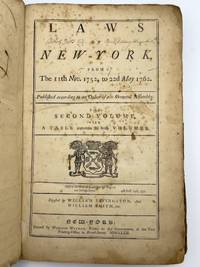
1762408263New York: James Parker I; William Weyman II 1762. Joints cracked but holding cloth tape reinforcements on inner hinges some light browning and occasional spotting dampstaining in volume 2. Together two volumes folio. Vol. 1: Title 3-page list of subscribers Preface i-iii 1-488 Errata leaf. Vol. 2: 1 1 3 268 pages. Contemporary calf leather spine labels on volume 1 one a modern replacement. Provenance: Swann Galleries 21 October 2004 lot 323 $2530. FIRST EDITIONS. Volume one is signed on the title by Petrus Stuyvesant 1727-1805 the great-grandson of the British Colonial Governor by the same name. Volume two is signed on the front free endpaper and title by colonial statesman and Revolutionary patriot Robert Yates. Evans 6897 and 9213; Tower 624 and 625. James Parker [I]; William Weyman [II] unknown
18029239Didot l’aîné 1802 3 volumes in-folio plein veau marbré, dos lisse, tranches dorées, filets, dentelles et fleurons, pièces de titre et de tomaison, triple filet sur les plats, roulettes sur les coupes et contreplats. I : 2 ff.- frontispice - VI- 36 pp.- 9 gravures hors-texte - 272 pp. - 68 gravures hors-texte 1 à 68. II : 2 ff.- frontispice - pp. 273 à 580 - 76 gravures hors-texte de 69 à 144. III : 3 ff. - frontispice - 123 pp. 60 gravures hors-texte. Coiffes absentes, charnières fendillées. Quelques rousseurs marginales sur les planches. Bon exemplaire.
26316All bound in three 4to volumes. Contemporary red morocco, spines gilt with raised bands, labels with gilt lettering, two volumes with a gilt stamped ornamental center piece on both sides, all three with a floral ornament in the corners, gilt borders (two volumes) and gilt double fillet (one volume), two volumes with gilt edges, joints of two volumes rubbed, extremities shaved. Very interesting and important legal document: these pieces deal with the trial of the Duc de Bethune and J.-E. Dat against the Marquis de Becelaer with regard to the heritage of Mademoiselle de Melun. The inheritance in question came from Mademoiselle de Risbourg who had made up a will on October 31, 1746, which she changed on November 4, 1746. The Duc de Bethune, J.-E. Dat and Mademoiselle de Melun oppose this change and claim that the original will as drafted on October 31 is the valid one and that the Marquis de Becelaer has manipulated Mademoiselle de Risbourg into changing her will shortly thereafter. All mentioned parties were heirs in both versions of the will: what changed however was what each of them received. The manuscript "Extrait des registres de la Cour du Parlement" text at the end of volume 3 rules in favour of the defendant, the Marquis de Becelaer.The third volume has a particular feature: the first and third texts are printed on small folio sized paper and have been bound crosswise in the volume and folded to match within the binding. First volume:[1] - A NOSSEIGNEURS de la cour de Parlement de Flandres. (Drop-head title). No place, (1752). 38 pp.[2] - REPONSE au principal, Pour Messire Maximilien Marquis de la Voestine et de Becelaer, Chevalier, Baron du St. Empire, Seigneur de Ghelw, & de la Terre et Seigneurie de Walincourt, Clary & Sevigny, Défendeur; sans préjudice de la fin de non recevoir reprise dans son Ecriture du 13 Mai 1752, & pour satisfaire à l'Arrêt de la Cour, rendu sur le Placet des Demandeurs ci-après nommés, du 15 Juin suivant, par lequel il est ordonné au Sieur Défendeur, de proposer toutes ses exceptions & de contester à toutes fins, par un seul volume, &c. Contre Paul-François Duc de Bethune, Pair de France, Capitaine des Gardes du Corps du Roi, Chevalier de ses Ordres, Lieutenant-Général des ses Armées, Tuteur honoraire de Dell. Marie-Gabriele-Charlotte-Louise de Melun, Fille Mineure d'Alexandre-Theodose, Prince d'Epinoy, & Jean-Etienne Dat, Bourgeois de Paris, son Tuteur onéraire, Demandeurs aux fins de leur Requête du 29 Février 1752. (Drop-head title). No place, no date. 74, 44 pp., with two folding tables. Second volume[1] - MEMOIRE pour Mr. le Duc de Bethune Pair de France, Tuteur honoraire, & le Sr. Dat, Tuteur onéraire de la Damoiselle de Melun. Contre le marquis de Becelaer. (Drop-head title). No place, no date. 64 pp.[2] - SOLUTIONS pour Messire Maximilien Marquis de la Woestine et de Becelaer, Chevalier, Baron du St. Empire, Seigneur de Ghelwe, Walincourt, Clary & Selvigny, Défendeur. Contre Paul-François Duc de Bethune, Pair de France, Capitaine des Gardes du Corps du Roi, Chevalier de ses Ordres, Lieutenant-Géneral de ses Armées, Tuteur honoraire de Demoiselle Marie-Gabriele-Charlotte-Louise de Melun, & Jean-Etienne Dat son Tuteur onéraire, Demandeurs aux fins de leur Requête du 29 Février 1752. (Drop-head title). At end: A Douay, chez Jacques-Fr. Willerval, no date. 68 pp.[3] - CONSULTATION de Quatre célébres avocats du Parlement de Paris. (Drop-head title). No place, (1753). 12 pp.Third volume:[1] - MEMOIRE et Consultation Pour Monsieur le Duc de Bethune, Pair de France, Tuteur honoraire; & Jean-Etienne Dat, Tuteur oneraire de Demoiselle Marie-Gabriele-Charlotte-Louise de Melun. Contre le Marquis de Bescelaer. Où l'on refute sa Réponse imprimée, ses Ecritures du 12 Mars dernier, & la Consultation de quatre Avocats au Parlement de Paris qui y étoit jointe. (Drop-head title.) No place, (1753). 97, (1) pp.[2] - CONTREDITS Pour le Marquis de Becelaer, Défendeur. Au Mémoire et Consultation de Mr. le Duc de Bethune, Tuteur honoraire, & Jean-Estienne Dat, Tuteur onéraire de Demoiselle Marie-Gabriele-Charlotte-Louise de Melun, Demandeurs. (Drop-head title). At end: A Douay, chez J.F. Willerval, no date. With one folding table ("Réfutation de la Comparaison & Balance présentée par Mademoiselle de Melun"). 45, (1) pp.[3] - OBSERVATIONS Pour M. le Duc de Bethune, Pair de France &c. Tuteur honoraire, & le Sr. Dat, Tuteur onéraire de Demoiselle de Melun l'aînée, Demandeurs. Contre le Marquis de Becelaer, Défendeur. (Drop-head title). No place, no date. 8 pp.[4] - EN LA CAUSE Du Marquis de Becelaer, Défendeur. Contre Mr. Le Duc de Bethune, & Jean-Etienne Dat, en la qualité qu'ils agissent, Demandeurs. (Drop-head title). No place, no date. 2 pp.[5] - EXTRAIT des Registres de la Cour de Parlement. Manuscript text, dated Douay, 13eme aout 1753, 2 pp.Nice copy in red morocco.
254 x 175 mm. A scene from the funeral of one of the most influential men of the 20th century. The photograph shows a projection of Alberto Korda's iconic "Guerrillero Heroico" photograph beamed onto the side of the National Theatre of Cuba in Havana's Plaza de la Revolucion; before it waves a section of the Cuban flag. The print is signed and dated on the recto by the photographer Alberto Korda, and on the verso are the autographs of Korda's colleagues Perfecto Romero, Osvaldo Salas and Raúl Corrales. - Small signs of wear, otherwise in good condition.
Large 4to. 7 vols. (6 vols. + supplementary vol.). (8), XIX, (1), 348 pp. (2), VIII, 429, (5) pp. XXXVI, 448 pp. XX, 418, (2) pp. XXVI, (2), 348 pp. XX, 414, (2) pp. XXVIII, 336, (2) pp. With 7 engraved frontispieces, 6 engr. title vignettes, 811 (partly folding) engr. plates, and several engravings in the text. Decorative contemporary calf bindings on 5 raised bands with double giltstamped labels to richly gilt spine. First (only vol. 1: second) edition. An "important and remarkably extensive work [...] The last, supplementary, volume, edited by Bombarde from Caylus' manuscripts, includes a memoir on the author. Caylus had been to the Levant and was well known as an archaeologist, essayist and engraver. The plates were engraved directly from the original works, many of them in the author's own collection" (Blackmer Cat., 465). As usual, the first volume of this set is present in its second edition (the first had been printed in a very small press-run and had to be reprinted in 1761). - Bindings slightly rubbed, occasional insignificant browning. Brunet I, 1705f. Blackmer 303. Gay 1971. Cohen/de Ricci 211. Ebert 3827. Fürstenberg 23 & 138. Sander 302. Cohen 99. Cf. Barbier IV, 51 e.
415 x 295 mm. Limp full calf portfolio, dyed in two shades, with giltstamped floral and ornamental borders and similar border around inset oval centerpiece. Pink moirée silk endpapers. The personal writing case of Archduke Charles, famous for his victory over Napoleon in the Battle of Aspern and as the modernizer of Austrian military organization and administration during his long tenure, from 1801 to 1809, as President of the Council of War. A master binding from the collection of the Austrian art historian and longtime director of Vienna's Albertina collections, Walter Koschatzky (1921-2003), on whose information the attribution is based. - Edges scuffed and split in places; lower spine somewhat rubbed. A charming survival.
178643537Bergerac, J. B. Puynesge, 1786. 2 vol. in-4 de XXV-(1)-553-(1) pp. et XVIII-401-(1)-40 pp., demi-basane brune, dos lisse orné (relié vers 1820).
136185Besançon, Daclin, 1771-1778 6 vol. in-folio, 4 tableaux dépliants au tome V, basane fauve marbrée, dos à nerfs ornés de motifs végétaux dorés, tranches marbrées (reliure de l'époque). Petits accrocs aux coiffes, épidermures sur les plats, coins émoussés. Au tome IV, les pages 67 à 70 manquantes ont été remplacées par des feuillets dactylographiés du texte.
1743ABC_46524The Netherlands 1743. Folio ca. 32 x 21.5 cm. Contemporary blind-tooled vellum sewn on 6 vellum supports laced through the joints with the manuscript title on the spine red sprinkled edges. With some woodcut decorated initials. 24 parts in 1 volume. 4 15 1 31 1 30 2 7 1 9 2 blank 1 4 10 2 2 2 21-27 3 1 6 20 67 1 9 2 blank 1 48 8 1 2 blank 1 8 4 10 1 1 2 2 pp. Rare collection of missives ordinances petitions and extracts from resolutions concerning the conflicts surrounding and law proceedings concerning Jacob Coren van der Mieden 1698-1751. He fled his hometown of Alkmaar in fear he would be captured by the Court of Holland. Initially the Van der Mieden family was a wealthy noble family with a good reputation. Jacob's father Aris was mayor of the city of Alkmaar Jacob was appointed bailiff of Nieuwburgen in 1731. Here one of his judicial officers ran a reign of terror. The people felt that bailiff Jacob was protecting his officer which made him very unpopular. Jacob was also lord of Callantsoog where he imprisoned the former bailiff Jan Harge in 1740 after Harge was being accused of abuse of office. The problem was that he did so under such bad conditions that the wife of Harge complained to the Court of Holland after which Harge was exonorated and the Court of Holland turned to Van der Mierde. Out of fear of being put behind bars he fled to Lent near Nijmegen. His wife Susanna Doubleth appealed the court and advocated that her husband would be tried by the local court in Alkmaar instead of the Court of Holland. These request are added in this collection. The last ordinance in the collection is the conviction of his younger brother Adriaan counselor of the Court of Holland who was accused of co-writing the requests with Susanna which were quite libel and defamatory undermining the Court of Holland as the highest judiciary institution of Holland. Adriaan was suspended from the court in 1747. The fate of Jacob van der Mieden remains unclear.With a manuscript annotation on the title page signed by G.J. van Persijn 1791. Govert Jan van Persijn was a lawyer advocaat at the Court of Holland Antonius Quirinus van Persijn was his son. Govert Jan van Persijn also added letters to the index and occassionaly made some marginal annotations and corrections in the text. The binding is slightly dust soiled otherwise in very good condition.l J.G. Gijsberti Hodenpijl van Hodenpijl Extracten uit de crimineele ordonnantien van Holland gives the pamphlets individually; STCN 240322061 3 copies; WorldCat 1144496082 1258013052 3 copies also in STCN; not in De Buck; Knuttel; Tiele. hardcover
Large 12mo. (4), CVI, "239" (but: 339), (3) pp., wanting half-title. With engraved folding Tableau economique. Slightly later half calf over blue marbled boards, spine gilt. All edges red. First edition. - An abridged version of the author's "Philosophie rurale" of 1763, one of the major publications to expose the doctrines of the Physiocrats, and in fact a comprehensive elucidation of François Quesnay's famous "Tableau economique". - Bookplate of Thor Ekecrantz to front pastedown. Kress 6477. Einaudi 3948. INED 3197.