86 315 résultats
Glasmalerei. Durchmesser ca. 205 mm. Die mit Schwarzlot und Silbergelb gemalte Renaissance-Bleiglasscheibe, wohl eine sogenannte Kabinettscheibe für einen profanen Raum, zeigt das Wappen der Murauer Liechtensteiner (in schwarz zwei silberne Schräglinksbalken). Die Umschrift "Her Ott von Liechtenstain" ist vermutlich auf Otto von Liechtenstein-Murau (1520-64) zu beziehen. Die bedeutende, im 17. Jahrhundert ausgestorbene steirische Adelsfamilie war nicht mit dem fürstlichen Haus Liechtenstein verwandt; Ottos bekanntester Vorfahr ist der Minnesänger Ulrich von Liechtenstein (1200-75). Eine Variante des Wappens der Murauer Liechtensteiner ist im Wappen der Stadt Murau erhalten. - Die zentrale Scheibe mit der Wappendarstellung ist gebrochen und wurde mit einem Sprungblei gesichert und an einer Stelle geklebt. Eine der vier umgebenden Scheiben wurde ebenfalls mit einem Sprungblei repariert. Drei dieser Scheiben sind etwas locker in den Bleiruten.
Folio (206 x 301 mm). (8), 183, (1) pp. Title printed in red and black within engraved borders. With 91 engravings in the text, woodcut initials and head- and tail-pieces. 19th century half calf over marbled boards. Scarce first German edition of this early work on pyrotechnics, printed in German and French parallel text. "The only work on artillery by a Frenchman published in the 16th century" (Jähns). The engravings, by Boillot, show various types of guns and cannons, grenades, mines, etc. One engraving depicts Berthold Schwarz, weighing the ingredients of gunpowder, the devil poised behind him with a gesture of benediction. - Binding slightly rubbed at extremeties. Some browning and light staining, small paper flaw to leaf B1. Handwritten ownership to title: "Justus Laigneau, Doctor Medicus Patavinus". The French physician Laigneau served King Louis XIII as medical inspector of hospitals. Later in the collection of Thomas Fremantle, 3rd Baron Cottesloe (1862-1956), commander of the Territorial Army and president of the Society for Army History Research. VD 17, 3:312613N. Jähns I, 654 ff. Graesse I, 473. Cf. Cockle 933.
Ensemble de 15 volumes in-8 (202 x 123 mm), plein veau acajou moucheté de l'époque, dos lisses ornés d'un riche décor romantique de palettes, chaînettes, filets et fers spéciaux dorés, pièces de titre et de tomaison de veau vert bronze, tranches cailloutées assorties aux gardes. Exceptionnel ensemble des oeuvres collectives non romanesques de Benjamin Constant, en édition originale, réunies et reliées uniformément à l'époque (sauf le dernier volume, relié à l'identique). 1- Première édition collective en partie originale, recueil complet des écrits politiques, écrits de circonstances et articles de presse composés par Benjamin Constant, augmentés de l'histoire des sessions parlementaires de 1816 et 1818. (Courtney, 131a). 2- Edition originale. Recueil de 69 discours prononcés par Benjamin Constant entre 1819 et 1827, précédés d'un avant-propos de l'auteur. (Courtney, 132a). 3- Première édition collective de ces vingt importants essais de philosophie politique de Benjamin Constant, la plupart dans des éditions modifiées, et six inédits, précédés d'une préface de circonstance. Publié quelques mois avant la mort de l'auteur, l'ouvrage constitue l'ultime synthèse de sa doctrine et son testament politique, "véritable credo du libéralisme". (Courtney, 134a). 4- Édition originale des cinq parties, conforme à la description donnée par Courtney, les deux dernières ont paru à titre posthume. (Courtney, 58a). 5- Edition originale posthume. Le testament spirituel de Benjamin Constant, "expression interrompue et dernière d'une pensée qui aurait dû prolonger sa course longtemps encore". (Courtney, 63a). 6- Première édition complète. Etablissement du texte, introduction et notes par Jean Mistler. Ce volume en reliure moderne à l’imitation de l’ensemble. Des rousseurs et piqûres éparses, plus soutenues à certains feuillets. Bel ensemble réuni dans une reliure romantique uniforme décorative de l'époque.
8vo. (16), 196 [misnumbered "66"], (4) pp. With engraved frontispiece and 9 numbered folding engraved plates. Contemporary full vellum with gilt title label to spine. All edges red. First edition under this title. - Very scarce manual for artillery warfare by the military engineer and general Fernández de Medrano (1646-1705): a reissue of his 1681 work "El perfecto bombardero y práctico artillero", also drawing on his 1680 work "El prático artillero". It saw a second and third edition by Amberes in 1708 and 1723, both equally rare. The charming plates, drawn by some of de Medrano's students, were engraved by the Dutch artist Jacobus Harrewijn (1660-1727), who is known to have worked in Brussels from 1695 to 1714. They depict ordnance and munitions, as well as towns under heavy artillery fire. - Binding slightly warped. Minor marginal tears to plates professionally repaired. Pastedowns long separated from interior of boards, with an old pencil sketch of a church to the verso of the lower pastedown leaf. - Provenance: late 18th century handwritten ownership of the artillery officer António Henrique Banazol de Ataíde e Campos to half-title. Later in the famous Ashburnham library assembled by Bertram Ashburnham, 4th Earl of Ashburnham (1797-1878), with his purple ink shelfmark ("26.E") and note "Catal. M 1859" to front inner board. The collection was dispersed by the 5th Earl. Latterly acquired by Thomas Fremantle, 3rd Baron Cottesloe (1862-1956), commander of the Territorial Army and president of the Society for Army History Research (purchased from Pickering & Chatto, 25 August 1899), with his armorial bookplate glued to the recto of the front pastedown leaf. Palau 89222.
4to. 3 vols. XI, (1), 412, (6) pp. XI, (3), 536, (4) pp. XI, (1), 594, (6) pp. Original gilt green cloth, vols. 1 and 3 preserving the originalem dust-jacket (carefully restored in places), all volumes in their original cardboard slipcases as issued. Presentation copy inscribed by the author in pencil on the flyleaf of the first volume: "Der geliebten Gusti / von ihrem aufrichtigen Seelenfreund / Egon Friedell / Berlin, Februar 1930" ("To my beloved Gusti from her sincere soulmate Egon Friedell"). - The printed dedication of Friedell's magnum opus is to the great director Max Reinhardt; the recipient of the present copy's autograph inscription was Reinhardt's personal secretary. Auguste (Gusti) Adler was born in Brixen in 1890, the daughter of the painter Maria Adler and the country squire and later journalist Heinrich Adler, the brother of Victor Adler, founder of the Austrian Social Democratic Workers' Party. Her sister was the artist and conservator Marianne Adler. After training as a sculptor with Richard Kaufungen in Vienna, Gusti focused on painting and arts and crafts, also publishing essays in the "Wiener Fremdenblatt" since 1913. Upon relocating to Berlin, she contributed to Viennese and Berlin newspapers under the pseudonym "Christoph Brandt" and edited works by Jean Paul and Georg Forster. In 1919 her childhood friend Helene Thimig introduced her to Max Reinhardt, and for the next two decades she served as his personal assistant, organising almost every detail both of his private life and his many stage productions, especially those at the Salzburg Festival. In 1939 she followed Reinhardt into exile in the USA and collaborated on his "Workshop for Stage, Screen and Radio". After Reinhardt's death in October 1943 she worked in Hollywood at Warner Bros.' Documentation Department, retiring when she turned 80. Her biography of Max Reinhardt appeared in 1946, followed by a second volume in 1980. She passed away in Hollywood in 1985. - First volume: 4th-6th printing; 2nd volume: 1st-6th printing, third volume: 1st-12th printing. Volume 2 has an inserted card from the publisher: "Im Auftrag des Verfassers".
(30), 548, (12) SS. Mit gest. Titel (Portraits der Äbte), Holzschnittdruckermarke am rot-schwarzen Drucktitel, Holzschnittinitialen sowie -vignetten und einer doppelblattgroßen Ansicht des Montevergine samt seiner Umgebung. Pergamentband der Zeit mit Rahmung aus Goldfileten und Rollenstempel (Dentelles), Eckfleurons und großem Wappen-Supralibros auf beiden Deckeln. Dreiseitiger Goldschnitt. Folio (240 x 322 mm). Der Benediktiner G. Giordano (um 1591-1661) war der 14. Abt des Klosters Montevergine (gegründet 1118 durch den Hl. Wilhelm) bei Avellino in Kampanien. Die gedruckte Widmung richtet sich an Niccolo Ludovisi (1610-64), Neffen des Kardinals Niccolò Albergati-Ludovisio, und seit 1634 Fürst von Piombino. - Etwas berieben, bestoßen und gebräunt. Einband entlang der Kanten mit modernem Pergament restauriert; Goldfileten nachgezogen; Vorsätze erneuert. Alter Stempel am Titelblatt entfernt (fachmännisch restauriert). Erstes Blatt mit schmalem Wasserrand. Ab S. 315 mit Feuchtigkeitsfleck im Rand. Teils etwas stock- und braunfleckig.
Folio (295 x 312 mm). (12), 203, (1), 175, (1) pp. Contemporary half vellum over marbled boards. First and only printing. A treatise on the economy of the grain trade, one of the principal economic works of the 17th century. According to Van Rees, it contains "many pages whose content would have done honour to the writings of Turgot or Adam Smith". The first part collects all regulations concerning the grain trade in the Netherlands from 1501 to 1634. It is printed in double columns, with the text of the regulations and Graswinckel's Latin translation. The second part contains Graswinckel's commentary on the grain trade, with marginal notes in Latin. Graswinckel (1600-66) regarded agriculture as the country's principal source of wealth. He advocated free grain trade and high prices for agricultural products, wishing export restrictions to be kept to a minimum. He also fought other obstacles to free trade, such as prohibitions on buying future harvest (pre-purchase) and on sales without immediate delivery. Also, he proved shrewdly to have understood the causes of the 17th century grain price increase, which he linked to the influx of gold and silver from the West Indies. Schumpeter notes that while Graswinckel's insights were not new in 1651, he had a better understanding of the underlying price mechanisms, and that many would place him (with his contemporary Pieter de la Court) above his English contemporaries on the basis of his liberal views on domestic and foreign trade, finding that both writers should occupy a prominent position in a history of economic thought. This copy has the Dutch title; other copies, otherwise identical, bear the Latin one. Flyleaves, half-title and final leaves slightly frayed without loss of text. Goldsmiths' 1201. Dekkers p. 66, 7. Willems 694 (Dutch) & 695 (Latin). Liesker p. 61 & 262. Schumpeter 197 & 368. Van Rees I, 326. Laspeyres p. 205 & no. 178. Palgrave II, 256. Not in Kress.
Hektographiertes Typoskript. Reihe I (in Deutsch): 7 in 4 Bdn. Bde. 1, 2, 3 (in 1): 64, (1), 58, (1), 138, (3) Bll. Bde. 4, 5 (in 1): 219, (1), 101 Bll. Bd. 6 (in 1): 267 Bll. Bd. 7 (in 1): 315 Bll. Reihe II (in Englisch): 7 in 8 Bdn. Bde. 1, 2 (in 1): (1), XIII, (1), 61, (1), 62 Bll. Bd. 3 (in 1): 199 Bll. Bd. 4 (in 1): 252 Bll. Bd. 5 (in 1): 121 Bll. Bd. 6 (in 1): 288 Bll. Bd. 7 (in 2): 400, etwa 200 nn. Bll. Zus. 12 Bde. Der aus einer Familie mit langer militärischer Tradition stammende Heeresoffizier Franz Halder war am 1. September 1938 zum Nachfolger Ludwig Becks als Generalstabschef des Heeres ernannt worden und war zu Beginn des Zweiten Weltkrieges an allen strategischen Planungen der Wehrmacht beteiligt gewesen, darunter der Polenfeldzug 1939, der Westfeldzug 1940 ("Frankreichfeldzug") und der Überfall auf Rußland 1941 ("Unternehmen Barbarossa"). Nach einer Auseinandersetzung mit Hitler über den mißglückten Ausgang der deutschen Sommeroffensive in der Sowjetunion 1942 (der "Fall Blau" bzw. das "Unternehmen Braunschweig") wurde Halder am 24. September 1942 als Generalstabschef abgesetzt und zog sich als Pensionär nach Berlin und nach Aschau im Chiemgau zurück. Halders in seiner Funktion als Generalstabschef geführtes KTB wurde schon kurz nach Kriegsende, am 5. Juni 1945 auf dem Speicher eines Dachbodens entdeckt, wo es von einer Vertrauten Halders versteckt worden war, und gelangte in die Dokumentenzentrale des Nürnberger Tribunals. Eine Arbeitsgruppe unter dem 1930 aus Österreich in die USA ausgewanderten Übersetzer Arnold Lissance übertrug das im Original in Gabelsberger-Kurzschrift verfaßte Buch in deutsche Kurrentschrift. "Der damalige Chef der Historical Division der US Army in Europa, Oberst H. E. Potter, ließ schließlich in seiner Abteilung das 'Tagebuch' in der Lissanceschen Fassung deutsch und englisch vervielfältigen und an westliche Kommandobehörden verteilen" (Jacobsen, s. u., Bd. III, S. 537). - Die vorliegenden Bände sind ein vollständiges Exemplar dieser deutschen und englischen Fassung, die in insgesamt 14 Bänden (gebunden in 12) den Zeitraum vom 14. VIII. 1939 bis zum 24. IX. 1942 umfaßt. Eine Buchausgabe der deutschen Fassung erschien von 1962 bis 1964 in drei Bänden im Verlag W. Kohlhammer in Stuttgart. Herausgeber war der Arbeitskreis für Wehrforschung, der von Franz Halder seit 1954 betrieben wurde und nebst Halders eigenem KTB auch das "Kriegstagebuch des Oberkommandos der Wehrmacht. 1940-1945" veröffentlichte. Die hier ebenfalls vorliegende englische Fassung weist zudem ein Vorwort Lissances auf, ein Abkürzungsverzeichnis und auch rund 200 Seiten Anmerkungen. - Die Kapitale teils etwas berieben und bestoßen (Bd. 4 der ersten Reihe stärker). Hans-Adolf Jacobsen (Bearb.), Generaloberst Halder. Kriegstagebuch. 3 Bde. Hg. vom Arbeitskreis für Wehrforschung (Stuttgart: Kohlhammer, 1962-1964).
Gest., ill. Titel, 3-4, gest. Portrait, 132, (8) SS. Mit einer Falttafel nach S. 88. Halblederband der Zeit mit goldgepr. Rücken und rotem Rückenschildchen; beriebene blaue Marmordeckel. 8vo. Ausnehmend rarer Wiener griechischer Druck: das berühmte walachische Gesetzbuch des Ioan Gheorghe Caragea (Karatzas, Caradja; 1754-1844), herausgegeben und ins Neugriechische übertragen vom Dichter Athanasios Christopoulos. Die "Legiuirea Caragea" des Wojwoden und Phanariotenfürsten Karatzas, kompiliert nach dem Vorbild des Code Napoléon, überholte die walachische Rechtsprechung grundlegend und gilt als erstes modernes Normenwerk der Donaufürstentümer. - Die vorliegende griechische Ausgabe des Gesetzeswerks war zum Gebrauch für die phanariotischen Funktionseliten der Walachei gedacht, die das Fürstentum für die Hohe Pforte verwalteten und deren Verkehrssprache Griechisch war. Gleichen Jahrs erschien in Bukarest auf Basis der hier vorliegenden griechischen auch eine rumänische Ausgabe. Der Codex war bis 1865 im Gebrauch. - Das Titelblatt ziert ein großformatiges herrschaftliches Wappen der Walachei. Die danach folgende Tafel besticht vor allem durch ein vom Wiener Stecher Blasius Höfel als Punktierstich ausgeführtes Porträt von Karatzas mit dessen darunter postiertem Siegel. Des weiteren ist eine Falttafel eingebunden, die eine genealogische Tafel abbildet. - Den Druck besorgte der damals von Bartholomäus Zweck geleitete Witwenfortbetrieb der Wiener griechischen Offizin des Georgios Bendotes. Die Bücher aus der Druckerei Bendotes kennzeichnete insbesondere ein "sauberer, splendider Satz" (Durstmüller). - Einband stellenweise berieben, an den Ecken und Kanten bestoßen, die beiden fliegenden Vorsätze mit Besitzerstempel ("M. Simos"), die Tafeln und einige Seiten gering stockfleckig. - Von großer Seltenheit; weltweit nur 8 Exemplare in institutionellen Beständen nachweisbar. Durstmüller I, 256 u. 286f. Mayer II, 139 und 180f. (Zweck). Iliou, A Greek Bibliography of the 19th century I, 1818.62. Bianu/Hodos/Simonescu, Bibliografia romaneasca veche (1508-1830) III, 1000 u. Add. 157ff. Râpa-Buicliu, Dan. Bibliografia româneasca veche: Additamenta, Galati, 2000, p. 402. Stefan, Catalogul cartii românesti vechi si rare din colectia Muzeului Municipiului Bucuresti (1648-1829) 108, 41. Georgios Andreiomenos, "Legislating in modern Greek for residents of Wallachia: Athanassios Christopoulos and the language of Karatzas’s Nomothesia (1817/8)", in: EEFSPA 34 (2000-01), 343-354. OCLC 37970655.
8vo. 58, (2) pp. Marbled half cloth. Apart from his journalistic and political work, Kossuth was an early promoter of the Hungarian trade and industry. The first Hungarian industrial exhibition took place from 25 August to 21 September 1842; 213 tradesmen showed 298 pieces to more than 14,400 visitors. At the beginning of his account, Kossuth discusses the production of beet sugar and soda before enumerating the various award winners and other industrialists with their various products. Although a preliminary note states that the present account was to be included as a supplement in all Hungarian and German newspapers, in a total press run of some 20,000 free copies, a single copy could today be traced in libraries (in the Szeged University Library). - The translator Imre Henszlmann (1813-88) was an important Hungarian historian of architecture; with Kossuth he collaborated in the early 1840s on the newspaper "Pesti Hirlap" (also published by Landerer & Heckenast). - Title and final leaf show small edge flaws, repaired by an early owner. Edges slightly rubbed, otherwise well preserved; occasional small pencil notes. Provenance: handwritten note "dem löbl. nied. österr. Gewerbverein" on title page. Carpenter p. 10 (note). Cf. Biogr. Lexikon zur Geschichte Südosteuropas, no. 808 (online version). Krücken/Parlagi II, p. 65 ff.
126, [1] pp. Original printed wrappers on blue stock. 8vo. First separate edition of a series of letters by the Russian anarchist thinker Petr A. Kropotkin (1842-1921), first published in the newspaper "Russkie Vedomosti" beginning in 1914. "In numerous statements and in a series of articles published in a Moscow newspaper between 1914 and 1917, he denounced German militarism and expansionism and warned of the dire consequences for Russia of a German victory" (Marshall Shatz, Introduction to Kropotkin: The Conquest of Bread and Other Writings). After receiving news of the February Revolution, Kropotkin made plans to return to Russia, from which he had been exiled for 41 years. According to the preface, the present edition was prepared after his return in March (October 1917). Date of publication erroneously given as "1918" on wrapper. - Largely uncut and unopened copy (the final two gatherings cut somewhat inaccurately); light discoloration to left margin of front wrapper and spine. A good copy. Scarce in the trade.
8vo (165 x 247 mm). 32 pp. Original printed wrappers. First edition. Two addresses given by Lenin at the 1919 Congress on Adult Education. With a group portrait printed on lower wrapper, showing Lenin among a circle of followers during the congress. - Occasional light spotting; small tears to spine insufficiently repaired with adhesive tape; frayed at edges. OCLC 28834534.
8vo. 104, (2) pp. Original printed wrappers bound within modern full red cloth with giltstamped title-label to spine. Second edition. Crucial brochure on capitalism and agriculture in the United States based on the U.S. Census reports for 1900 and 1910. In this study "Lenin focused on black sharecropping in the American South to suggest that the American path of capitalist agriculture, which he had advocated less than a decade earlier, also contained authoritarian, even 'feudal' elements. After the American Civil War, Lenin noted, the American bourgeoisie restored 'the most shameless and despicable oppression of the Negroes' within 'free, republican-democratic capitalism'" (Zimmerman). - Written in 1915, Lenin, whilst in Berne, sent the manuscript to Maxim Gorky for the Parus Publishers in 1916, but it did not appear at that time: instead, it was published in Petrograd in 1917 by Zhisn i Znaniye. Lenin did not realize his intention of writing a second part of the book, which was to have dealt with Germany. - Tear to front wrapper; flaws to margins of pp. 21-24 (no loss of text); evenly browned throughout. A very good copy of this important work. Lenin, Collected Works XXII, 13-102. Zimmerman, Alabama in Africa 239. OCLC 930878651.
8vo. Proof copy. X, (3), 155, (2 blank) pp. With lithographed colour plate, half-tone photographic portrait frontispiece and 33 lithographed diagrams (14 in colour) within the text. Original half brown cloth over marbled paper-covered boards. Francis Marion Rust was the Director of Near East Relief in Persia, where he and other members of the organisation aided Assyrian and Armenian Christian refugees fleeing Ottoman forces. While working in Tabriz, he oversaw the printing of this book, a bizarre treatise on the development of democracy in the West, its problems, and his vision for a united post-war world inspired by the League of Nations. This copy is a proof, signed by Rust. - Alongside his duties, Rust found time to publish "Evolution of Democracy". As he was a schoolteacher before travelling to Persia, and the book was authorized by the Superintendent for Education in Azerbaijan, it is possible that it served a didactic purpose in the orphanages and temporary schools of Tabriz. - The text is eccentric and uneven. If an argument can be traced, it is Rust calling for larger systems of confederation as a way of moving beyond the horrors of the First World War. He talks of a post-war "European nationality" (p. 105) and the gathering together "into one fold all peoples of the world in government" (p. 108). - Curiously, at no point does Rust apply his ideas to the situation in the Near and Middle East. This is possibly due to the complexity of the post-war political landscape and the difficulty of extending an already jumbled piece of writing. There is, however, a slip of printed additions between page 16 and 17, concerning the problems posed by receding Empires, which states "... the break up of the Old Russian Empire has all but resulted in wiping out two small national groups [the Armenians and Assyrians] in Asia" (p. 16). It was after returning to America that Rust further examined his experiences in the Near East, submitting an MA thesis on the "Post War Problems of Turkey 1918-1925" (University of Louisville, 1932). - There are minor manuscript and printed corrections, additions and deletions to seven pages, possibly in Rust's hand. Whereas they do little to significantly alter the text, the three printed slips offer much more substantial additions to the content. In addition to signing this copy, Rust has updated the title-page with the New York address of Near East Relief, and somewhat eccentrically, his personal addresses in city and country. - Boards professionally repaired, spine a little rubbed and sunned, otherwise good. Professional paper repairs to original endpapers. Stamp of the Woodrow Wilson Memorial Library and deaccession stamp to front pastedown. Later stamp of A. Randle Elliott to front free endpaper. Author's ms. signature to portrait frontispiece. Several manuscript and printed corrections; three bound-in slips with extensive printed additions. - Rare in commerce, with no copies in auction records. Not found in the usual bibliographies of Persia.
8vo. 2 parts in 15 vols. 439, (1) pp. 732, (8), XII pp. With 107 engraved plates (9 of which folding), including 17 plates in original hand colour, 35 portraits, 2 coloured maps, and 2 plans of Warsaw and Cracow. Original printed wrappers. Only edition. - Rare, complete set of this finely illustrated history of Poland by the jurist and historian Bernard Zaydler (1799-1835), a member of the Polish Royal Society of the Friends of Science, in the 15 original livraisons as issued, instead of being bound (as is more common) as a two-volume set. The plates by the Italian engraver Antonio Verico and other artists show costumes and city views, mostly of squares and landmarks in and around the capital Warsaw, as well as historical and battle scenes, including the 1683 Siege of Vienna and the 1813 Battle of Leipzig. The portraits show the principal personages of Polish history, including Kings John III Sobieski and Casimir III the Great as well as the astronomer Nicolaus Copernicus. With two plans of Warsaw and Cracow as well as two folding maps of Eastern Europe in original hand colour, depicting the geographical situation of Poland prior to the first partition in 1772, as well as its 1831 state. - The 12 pages of preliminaries are bound at the end of volume 15. A small tear to p. 369f. of volume 5, not touching the text. Slightly foxed in places. Well preserved with a few minor flaws to the wrappers of a few volumes. Auction records do not list a single copy in the original 15 issues; 2-volume sets are rarely found to contain all 107 plates. Estreicher (19. Jh.) V, 252. OCLC 165493220.
1773YRG-509Il s'agit de la toute première édition au format in-4° des œuvres de Pothier, publiée entre 1773 et 1777 en sept volumes, in-4, plein cuir marbré, dos a cinq nerfs, titre tomaison et caisson doré, toutes tranches rouge. quels rousseurs ainsi que quelques pages jaunies, coiffe haute du tome 4 en partie absente. traces d'usage sur les plats ainsi que quelques épidermures. Bel ensemble. chez Jean Debure père (Paris) et la Veuve Rouzeau-Montaut (Orléans).
1943005853Tunisia: British Eighth Army 28 April 1943. Leaflet. This compelling Second World War artifact is an original message from General Bernard Law Montgomery to his Eighth Army troops on 28 April 1943 during the final Allied effort to expel Axis forces from North Africa. This printed message is not only a remarkable survivor but is signed by Montgomery B. L. Montgomery just below his printed name. While the signature is undated it seems almost certainly to have been signed in situ; Montgomery was created Viscount Montgomery of Alamein in January 1946 and thereafter routinely signed Montgomery of Alamein. <br /> <br />The leaflet measures 8 x 10 inches 20.3 x 25.4 cm printed in black on a single side of thin acidic stock. Condition shows wear expected for an original piece of North African theatre ephemera. A single vertical crease and two horizontal creases testify that the leaflet was folded notionally to fit in a soldiers pocket. The folds and edges show wear and fractional chipping there is overall soiling particularly to the blank verso and a central rectangle of the printed and signed recto is differentially toned indicating that it was once framed and thereby exposed to sun. Nonetheless like the solder to whom it once belonged and the General who authored and signed it this copy survived. <br /> <br />Montgomerys EIGHTH ARMY Personal Message from the Commander specifies that it is To be read out to all troops and consists of eight numbered points. The first three points encapsulate recent Eighth Army objectives and accomplishments. Points 4-7 are a spur to action with a specific repeated exhortation to KEEP UP THE PRESSURE!. The final point 8 is Good luck to each one of you. You can rest assured that I am watching over the battle carefully and together we will finish the job. Montgomerys signature is faded but still clear below his printed name at the lower right and the leaflet is printed 28.4.43 Tunisia. at the lower left. Operation Vulcan which began on 22 April 1943 was among the final Allied initiatives to overcome the last Axis North Africa defenses. By 13 May 1943 British Middle East Commander-in-Chief Harold Alexander sent Churchill the message the Tunisian campaign is over We are masters of the North African shores. Churchill THoF p.780 <br /> <br />Nearly two and a half millennia after Thucydides discussed the unpredictable role of chance in war Bernard Law Montgomery 1886-1976 and the Eighth Army found one another in North Africa. In July 1942 British troops checked Rommels forces in the First Battle of El Alamein but Allied momentum stalled. Churchill flew to Cairo on 1 August to assess command replacing Middle East Commander-in-Chief Claude Auchinleck with General Alexander and appointing General Gott to command the Eighth Army. When Gott was killed on 7 August flying back to Cairo Churchill acceded to General Montgomery in Gotts stead. Montgomery seized command two days earlier than authorized by his C-in-C and began an historic transformation of a beaten body of men into the legendary Eighth Army that fought its way from Alamein to Tunisia between August 1942 and May 1943. North Africa and the Eighth Army proved the perfect milieu for Montgomerys messianic vitality and vanity. Montgomerys political ineptitude and diplomatic limitations earned him significant postwar hostility and criticism but did not prevent his becoming widely regarded as the outstanding British field commander of the twentieth century. As this Personal Message testifies Above all Montgomery understood soldiers hearts and minds thousands of miles from home in a citizen army The men of the Eighth Army wanted to know what they were required to do Montgomery gave them an immediate answer. ODNB Montgomery later said the intent of his Personal Messages was to define the common objective and thereby foster unity of purpose.I like to think that these messages did much to foster the spirit and the will-to-win El Alamein to the River Sangro <br/><br/> British Eighth Army unknown
16811278921681. ENGLISH LAW. Proceedings Upon Impeachments from the year 1666 to the year 1681. Manuscript. No place circa 1681. Quarto modern full brown calf raised bands red morocco spine label. $3200.Original manuscript from the late 17th century with the parliamentary impeachment proceedings against 14 individuals during the reign of Charles II.The accountswritten in legible script with an index at frontbegin with the proceedings against Viscount Mordaunt charged with raping the daughter of the surveyor of Windsor Castle when Mordaunt was the castle's constable. Although they include a number of cases including that of William Penn in 1668 the clear focus is on the Popish plot a supposed conspiracy promulgated in 1678 that led to the arrest and trial of five Catholic lordsBaron Arundell the Marquess of Powis Baron Belasyse Baron Petre and Viscount Staffordall of which are recounted in this manuscript. As anticatholic hysteria waned and it became increasingly clear that the ""plot"" was a fiction the fallout entrapped more of the players: the impeachment of William Scroggs who served as the Chief Justice during the trials is detailed as is that of the Lord High Treasurer the Earl of Danby who was charged with concealing the plot and Edward Fitzharris who had attempted to implicate Danby in Sir Edmondbury Godfrey's murder in 1678 an event which fanned the flames of anticatholic hysteria. Armorial bookplates; inkstamp of the Grotius Society.Spine toned; text clean. hardcover
1944221318Magdeburg, 1816-1944. 8° u. 4°. In 126 Bdn., versch. geb., 4 Jgg. lose Nrn. zusammengeheftet. Meist St., Sign. o. Tekt. a. Tit. Einige Einbde. bzw. Rücken fleckig o. beschäd. 1 Jg. ohne Einbd. 1 Rücken fehlt. 3 Jgg. Wasserschaden. Mehr. S. lose beigelegt bzw. eingeklebt. Fehlen: Jg. 1825 Nr. 49; 1826 Nr. 3-7, 9, 11, 35; 1830 Nr. 1 u. Reg.; 1833 Nr. 5, 10, 51 u. Reg.; 1843 S. 35/36; 1845 Nr. 52; 1847 Nr. 7, 11, 12, 47, 51; 1851 Nr. 38, 39, 48, S. 737-768, 928-948; 1852 S. 641-656, 797-804; 1853 Nr. 13, 29, 38; 1891 u. 1894 jeweils Tit.; 1846, 1848, 1850, 1861, 1900, 1903, 1921, 1922, 1924 jeweils Reg.; 1920, 1941 u. 1944 jeweils Tit. u. Reg.; 1935 Nr. 52; 1944 Nr. 32.
1940153630Wien, 1849-1940. 4°. In 112 versch. geb. Bdn. Bibl.-Ex. Einbde. teils beschabt, angeschmutzt, etwas beschäd. u. m. Rsign. Meist m. St. Es fehlt: Jg. 1874.
19159356Madrid: Revista de Derecho Privado 1915-1974.- Tamaño 4º; Los 15 primeros años que ofrecemos están encuadernados en Media Piel.- Contiene además un índice sistemático de 1934 a 1946. La revista ha sido catalogada por mensualidades en vez de por números considerando el mes que se omita como número falto. DERECHO EN GENERAL Libro en español Revista de Derecho Privado hardcover
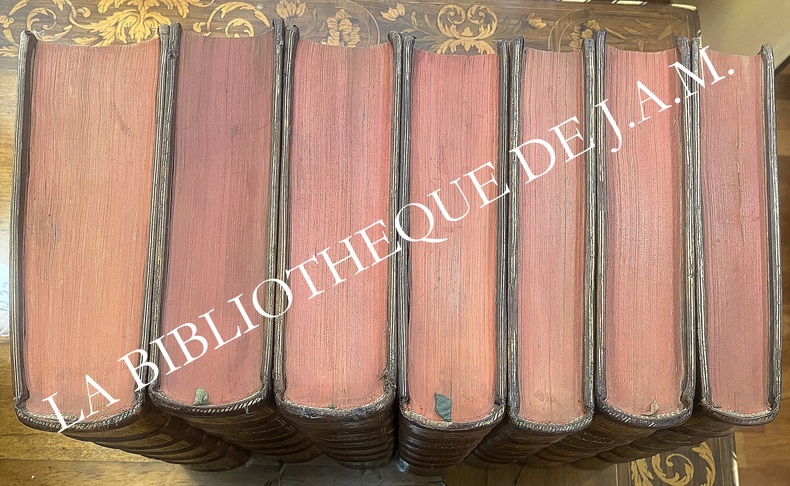
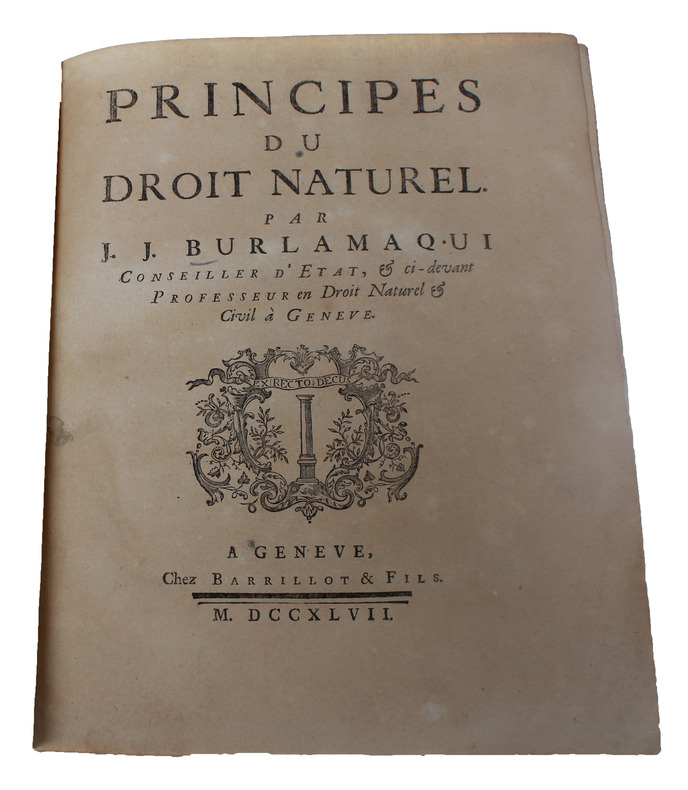
174752100Geneve, Barrillot & Fils, 1747. 4to. Contemporary full vellum with gilt title-label to spine. Binding a bit soiled, but overall nice and tight. Title-page a bit toned, but otherwise very nice and clean. XXIV, 352 pp.
Geneve, Barrillot & Fils, 1747. 4to. Contemporary full vellum with gilt title-label to spine. Binding a bit soiled, but overall nice and tight. Title-page a bit toned, but otherwise very nice and clean. XXIV, 352 pp.
2021718672021. 2021 Supplements Now Available Restatement of the Law 2d 3d and Principles of the Law series. Complete set of the 2021 Pocket Parts & Supplementary Pamphlets. St. Paul Minn.: American Law Institute Publishers 2021. Softbound. New. $3124. Complete set of all 2021 cumulative pocket part and supplementary pamphlets to the 2d 3d and Principles of the Law series. Individual Pocket Parts are $69.00; Supplementary Pamphlets are $106.00. unknown books
1908019606Washington: Government Printing Office 1908. First Edition . Blue Cloth Gilt. Fine. 9 7/8' Tall. 81 Pp. First Printing Of Roosevelt's Speech Regarding The Need For Further Regulation Of The Relations Of Capital And Labor In The Standard Blue Cloth Bindings Used For White House Copies Of Presidential Speeches For Decades. The Document Showing Roosevelt's Unelectability By Any Major Party. The Personal Copy Of Rudolph Forster A Highly Responsible Non-Political Official In The White House For Over Forty Years And Recipient Of Roosevelt's Personal Copies Of His Presidential Publications. "Rudolph Forster Was Executive Clerk And Administrative Officer In Charge Of Executive Papers At The White House Until His Death In 1943. He Had Piled Up Nearly Fifty Years Of Service To Eight Presidents. His Job Was To Remind The President That A Bill For Example Must Be Acted Upon In A Certain Amount Of Time Or That By Law He Must Fill A Vacancy Within A Definite Period. He Was Also Responsible For The 'Orderly Handling Of Documents' And Supervision Of The Large Clerical Staff. He Was The Most Important Permanent Official At The White House. " -Off The Record With F.D.R. Rutgers University Press 1958. "Rudolph Is A Man Without Faults." - Franklin D. Roosevelt As Cited In That Book P. 140. With The Bookplate Of Forster's Son Warren Rudolph Forster No Other Marks No Signatures Or Writing. <br/> <br/> Government Printing Office hardcover