86 315 résultats
Large 4to. 2 vols. 6, (4), 434 pp. (4), 387, (1) pp. Both titles printed in red and black. Contemporary calf, backs elaborately gilt with labels. All edges red. First edition. A comprehensive work on commerce in all its aspects: the commerce of the European nations, public credit, banking, accounting, population, currency, the effects of the abundance of gold and silver, the Indian companies, commercial law and practice, bankruptcy, speculation, bills of exchange, etc. The French lawyer Accaria (1709-92) lived in Holland, where most of his works were published anonymously. He is known as an opponent of the ideas of the French philosophers and the Physiocrats. Though the second edition published the following year in four ducodecimo volumes is quite common, this first edition, in quarto, is scarce. - Label of second volume gone, bindings a bit rubbed and minor imperfection at foot of first volume. A vague waterstain in lower inner corner, a bit worse towards the end of the first volume, still a fine set. Kress 6310. Goldsmiths' 10188. INED 12. Sabin 79234. Spengler p. 316-321.
240 x 180 mm. Castro sits at ease, in uniform, cigar in hand. The original photograph was taken by Luis Korda (1912-1985), famous for his photography of the Cuban Revolution. The print is stamped with the Korda Studios mark on the verso and signed by Luis on the lower right. - Light wear, otherwise in good condition.
(2), IV SS., 1 w. Bl., 96 SS. Neueres marmoriertes Halbleder mit goldgepr. Rückentitel und Kopfgoldschnitt; der bedr. blaue Originalumschlag mitgebunden. 8vo. Einzige Ausgabe der "Enden und Anfänge". Der russische Philosoph, Schriftsteller und Publizist Alexander Iwanowitsch Herzen (1812-70) ist vor allem bekannt für seine russische Exilzeitschrift "Kolokol" ("Die Glocke"), die in den Jahren 1865-68 in Genf erschien und zum zentralen zensurfreien Organ der revolutionären Demokratie wurde. - Von tadelloser Erhaltung. Nicht bei Stammhammer. OCLC 29435641.
(4), 191, (1) SS. Neuerer marmorierter Halblederband mit goldgepr. Rückentitel (die bedr. Originalbroschur mitgebunden). Gr.-8vo. Berühmte Sammlung politischer Essays, wohl zweiter Druck der ersten Ausgabe (mit korrigiertem Paginierungsfehler auf der letzten Seite). "Die brillant geschriebenen Artikel des Sammelbandes, die der Autor dem Literaten Friedrich Kapp in deutscher Sprache diktierte, enthalten Herzens Beurteilung der revolutionären Bewegung von 1848" (in Paris) und stellen "mit ungewöhnlicher Schärfe [...] die Frage nach der Möglichkeit einer Überwindung der bürgerlichen Gesellschaft durch die sozialistische Ordnung" (KLL XXIII, 10050). Nach Herzens Ansicht läuft die Natur des Menschen der Schaffung einer idealen Gesellschaftsordnung zuwider. Der im Anhang gedruckte Brief an Georg Herwegh geht besonders auf die russischen Verhältnisse ein. - Am Vortitel hs. Besitzvermerk "Neukirch" in Bleistift. Sehr breitrandig, durchgehend leicht stockfleckig. Zweiseitig unbeschnittenes, ansprechend gebundenes Exemplar. Stammhammer I, 251 (& 105) (falsch: "Am andern Ufer"). Steinbrink 1850, 11.
208408Genève [Paris], Barillot, & fils, s.d. (1749) 2 vol. in-4, [4] ff. n. ch. (faux-titre & titre, deux premiers ff. de la préface), XXIV-522 pp., un feuillet non chiffré d'errata ; [2] ff. n. ch. (faux-titre & titre), XVI-564 pp., veau fauve marbré, dos à nerfs cloisonné et fleuronné, pièces de titre et de tomaison cerise, encadrement de double filet à froid sur les plats, tranches mouchetées (reliure de l'époque). Restaurations aux coiffes et aux coins. Quelques discrètes mouillures (T.I).
Folio (196 x 294 mm). (8), 90, (8) pp. Title within elaborate engraved border, engraved portrait of the author on verso of title-page. With 2 engraved illustrations and 8 folding engraved plates. With woodcut initials and head- and tailpieces. Modern vellum by Franz Ostermann (d. 1938) of Paris (with his ticket, dating to no later than 1902). First German edition, translated by Johann Theodor de Bry. - Giorgio Basta, Count of Huszt (1550-1607), an Italian general of Arbëreshë origin, was employed by Emperor Rudolf II to command the Habsburg forces in the Long War of 1591-1606. Later he was sent to administer Transylvania as an Imperial liege and to restore Catholicism as the dominant religion in the region. - "Basta's work bridges the gap between the forms of warfare evolved during the Dutch-French religious wars and those imposed on the Western world during the fights against the Ottomans" (Jähns). - Slightly browned throughout, some staining, otherwise in good condition. Provenance: from the collection of Thomas Fremantle, 3rd Baron Cottesloe (1862-1956), commander of the Territorial Army and president of the Society for Army History Research (bought from Davis & Orioli, November 1924). VD 17, 39:125881R (stating 9 folding plates, but there is no mention in the text of a ninth plate; each of the other 8 has a "Declaratio" in the text). Jordan 177, p. 22. Jähns II, 928. Cockle 600 (not listing this German edition).
1855B111216Bruxelles, Gobbaerts (& 3e série: Devroye) 1855-1878 complet en 6 volumes: cxiv,896 + 463 + 462 + 490 + 866 + 1084 pp., 41cm., reliures cart. modernes (dos en toile rouge avec titre doré, plats marbrés) en très bon état, [contient: I: 1ère série (974-1506), 1 tome, 1878 / II-IV: 2ème série (1507-1684), 3 tomes, 1869-1871, V-VI: 3ème série (1684-1794), 2 tomes, 1855-1860], dans la série "Recueil des anciennes ordonnances de la Belgique", texte frais, très bon état, poids: 31kg., B111216
complet en 6 volumes: cxiv,896 + 463 + 462 + 490 + 866 + 1084 pp., 41cm., reliures cart. modernes (dos en toile rouge avec titre doré, plats marbrés) en très bon état, [contient: I: 1ère série (974-1506), 1 tome, 1878 / II-IV: 2ème série (1507-1684), 3 tomes, 1869-1871, V-VI: 3ème série (1684-1794), 2 tomes, 1855-1860], dans la série "Recueil des anciennes ordonnances de la Belgique", texte frais, très bon état, poids: 31kg., B111216
190613750, , 1906 ca. 1 vol. in-12 de (2)-208 pp., demi-chagrin noir, dos à 5 nerfs (reliure de l'époque).
Folio (275 x 373 mm). Vols. 1 & 2 (of 3). LXVIII pp. (2), XLII, 471 pp. With 2 engr. title vignettes, 9 engr. head- and 6 engr. tailpieces, 9 engr. initials, a full-page engraving in the text, and 201 engr. plates (some folding). Contemp. vellum with giltstamped title to spine. "Cet important ouvrage est resté la base et la source principale des recherches sur l'antique Etrurie" (Vinet). "Gori a eu la plus heureuse influence sur le développement de la science archéologique, d'abord en rassemblant des quantités de matériaux disséminés et accessibles au public, et ensuite en les expliquant avec beaucoup de bonheur" (Hoefer). A third volume was issued in 1743. - Slight tear to final leaf of vol. 2; front pastedown flyleaf shows clipped ownership; some waterstaining to last plates. A good, clean copy. Borroni 12213. Cicognara 2584. Brunet II, 1670. Graesse III, 120. Ebert 8701. Pollen 704. Vinet 1672. Hoefer XXI, 295.
185186794s. l. [Paris] 12 juin (1851) | 11.50 x 17.90 cm | 4 pages sur un bifeuillet
8vo. 2 vols. XXXII, 739, (1) pp. XXVII, (1), 526 pp. Contemporary half calf with remains of gilt spine. Fourth edition of vol. 1 (Der Produktionsprocess des Kapitals); first edition of vol. 2 (Der Cirkulationsprocess des Kapitals), edited by Friedrich Engels. - Handwritten ownership of "Dr. Sienz" (ca 1919) on title of vol. 1; includes postcard by Th. Döring to Dr. Hans Sienz in Nuremberg (dated 8 Sept. 1919). Both spines professionally repaired (using original material in the spine of vol. 1), otherwise a well-preserved set of the first two volumes (the third volume would not appear until 1894). Marx/Engels Erstdrucke 32. Rubel 633 (note). Stammhammer I, 145, 7.
141064Paris, De l'Imprimerie de Lachevardière [puis] Imprimerie de Cosse et Dumaine, Paris, Bachelier [puis] Bur. l'Administration du Recueil [puis] Libr. du Recueil Sirey, 1831-1942 153 vol. in-4, demi-basane bleu-vert, dos lisses, filets et palettes dorés (reliure de l'éditeur).
17801278931780. ADULTERY. Collection of Adultery Trials. London: various circa 1780-1808. Octavo contemporary full tan calf gilt raised bands marbled endpaper and edges. $3500.A collection of reports of 11 adultery trials from the late 18th and early 19th centuries combined with 30 engravings of scandalous encounters.Published accounts of adultery trials were very popular in late-18th/early 19th-century England a way to indulge a taste for the erotic and the scandalous under the thin veil of condemnation. Included here are the trials of Robert Gordon for adultery with the wife of Joseph Seymour Biscoe Rev. Mr. Cooper with the wife of Lord Cadogan Sir John Bennett Piers with the wife of Lord Cloncurry ""Thomas Theaker Coachman for Adultery with Mrs. Gregson"" Thomas Sheridan with the wife of Peter Cambell Captain Elwin with the wife of Sir George Brograve J. Hacket with Mrs. Mansergh R. J. Fergusson with the Countess of Elgin Lord Borringdon and Sir A. Paget ""for criminal conversation with the plaintiff's wife"" Colonel T.R. Powlett and Lord Sackville with another plaintiff's wife and Ralph Benson with the wife of Thomas Parr The collection of 30 engravings bound at the back of this book are taken from Trials for Adultery: or a History of Divorces a multivolume work published beginning in 1779. First two trials without title pages; ink marks to a few early pages; expert repair to contemporary binding. hardcover
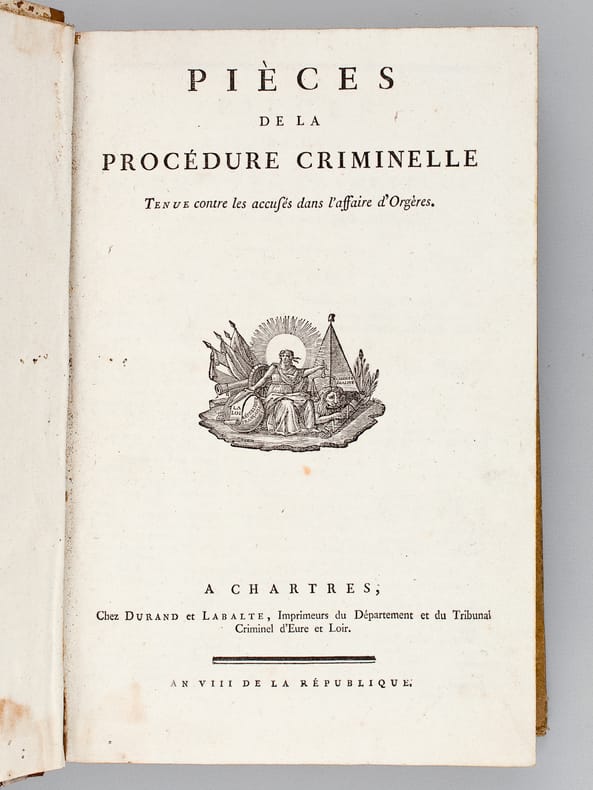
1799660493 vol. in-folio reliure de l'époque demi-basane marron, Chez Durand et Labalte, Imprimeurs du Département et du Tribunal Criminel d'Eure et Loir, A Chartres, An VIII de la République [ 1799 - 1800 ],
99168aafBasel, Helbling u. Lichtenhahn, 1912-1979, in-8vo, Gebunden. Gut erhalten.
1567171<p>Folio 30.5 x 19.5 cm 10 ff. 307 i.e. 308 13 ff. including woodcut title showing Ferrara and Este arms and full-page woodcut portrait of the printer Rossi on EEEviii v. Bound in 18th-century stiff vellum title stenciled on spine. Some minor staining in scattered leaves and some trivial worming in margin but generally a broad-margined and fresh copy excellent. Rare and most likely the earliest acquirable edition of the municipals laws of Ferrara one of the richest and most cultivated of Northern Italian courts published shortly after the concluding session of the Council of Trent 1563. The work contains one of the earliest portrait of a printer in a book he himself produced see below. The work significantly revises the previous publication of local statutory law and is signed by a committee of local jurists 3v-4r. The statutes govern all aspects of civil and criminal law from the buying and selling of goods and property marriage testaments to criminal procedure. The work is of interest for containing a portrait of the printer. Note: Rossi had no editorial or authorial part in the work; he is expressly designated "Typographus" printer in the identifying legend. This is of interest to historians of the book for it showing the developing confidence and prestige enjoyed by 16th-century printers and is analogous though considerably more assertive to putting an element of the printer's process or trade in a publisher's device. "Rossi was near the end of a career as a printer at Ferrara that covered more than 50 years and certainly justified the use of his portrait in this volume" Mortimer I.261. Although it should be regarded as a form of self-indulgence and did not catch on-as say the author portraits on which it is based obviously did-it nonetheless remains an interesting bit of evidence for the elevated status of Italian printers. There is no repertory of examples and we know of no study of the subject but in querying colleagues we have located only two earlier analogous portraits: Rossi pictured himself in smaller format in the colophon to another book he published: Giovanni Maria Verrato's 1561 response to critics of the Council of Trent: Contra responsiones et protestationes. And Francesco Priscianese pictured himself in a Latin grammar published in 1540. Also Prof. Anthony Grafton draws our attention to the portraits of the illustrators in the Historia Stirpium of Leonhart Fuchs 1542. Further searching would doubtless turn up a few other examples but it is clearly an isolated phenomenon The statutes received an incunable edition in 1476 published by Severino da Ferrara BMC VI.609 the only copy we have been able to locate: this edition is not in Goff and we locate no American copy. The next edition was published by Rossi in 1534 with a less elaborate version of the title cut and without the portrait. The present edition is next making it third. According to Mortimer the hypothetical issue points raised by F. Berlan in his Bibliografia degli statuti municipali ed inediti di Ferrara Rome 1878 pp. 21-7 are in need of substantial copy-checking. There are no copies of the editio princeps or the 1534 edition in America; for the present edition OCLC lists Kansas Minnesota and the Waseda Library to which should be added the Harvard copy described by Mortimer. Mortimer Italian 182; Adams F266; Fumagalli Lexicon p. 128 fig 45 portrait; L. Manzoni Bibliografia degli statuti ordini e leggi dei municipali italiani I.2 Bologna 1876 pp. 177-78.</p> Francesco Rossi hardcover
1567171<p>Folio 30.5 x 19.5 cm 10 ff. 307 i.e. 308 13 ff. including woodcut title showing Ferrara and Este arms and full-page woodcut portrait of the printer Rossi on EEEviii v. Bound in 18th-century stiff vellum title stenciled on spine. Some minor staining in scattered leaves and some trivial worming in margin but generally a broad-margined and fresh copy excellent. Rare and most likely the earliest acquirable edition of the municipals laws of Ferrara one of the richest and most cultivated of Northern Italian courts published shortly after the concluding session of the Council of Trent 1563. The work contains one of the earliest portrait of a printer in a book he himself produced see below. The work significantly revises the previous publication of local statutory law and is signed by a committee of local jurists 3v-4r. The statutes govern all aspects of civil and criminal law from the buying and selling of goods and property marriage testaments to criminal procedure. The work is of interest for containing a portrait of the printer. Note: Rossi had no editorial or authorial part in the work; he is expressly designated "Typographus" printer in the identifying legend. This is of interest to historians of the book for it showing the developing confidence and prestige enjoyed by 16th-century printers and is analogous though considerably more assertive to putting an element of the printer's process or trade in a publisher's device. "Rossi was near the end of a career as a printer at Ferrara that covered more than 50 years and certainly justified the use of his portrait in this volume" Mortimer I.261. Although it should be regarded as a form of self-indulgence and did not catch on-as say the author portraits on which it is based obviously did-it nonetheless remains an interesting bit of evidence for the elevated status of Italian printers. There is no repertory of examples and we know of no study of the subject but in querying colleagues we have located only two earlier analogous portraits: Rossi pictured himself in smaller format in the colophon to another book he published: Giovanni Maria Verrato's 1561 response to critics of the Council of Trent: Contra responsiones et protestationes. And Francesco Priscianese pictured himself in a Latin grammar published in 1540. Also Prof. Anthony Grafton draws our attention to the portraits of the illustrators in the Historia Stirpium of Leonhart Fuchs 1542. Further searching would doubtless turn up a few other examples but it is clearly an isolated phenomenon The statutes received an incunable edition in 1476 published by Severino da Ferrara BMC VI.609 the only copy we have been able to locate: this edition is not in Goff and we locate no American copy. The next edition was published by Rossi in 1534 with a less elaborate version of the title cut and without the portrait. The present edition is next making it third. According to Mortimer the hypothetical issue points raised by F. Berlan in his Bibliografia degli statuti municipali ed inediti di Ferrara Rome 1878 pp. 21-7 are in need of substantial copy-checking. There are no copies of the editio princeps or the 1534 edition in America; for the present edition OCLC lists Kansas Minnesota and the Waseda Library to which should be added the Harvard copy described by Mortimer. Mortimer Italian 182; Adams F266; Fumagalli Lexicon p. 128 fig 45 portrait; L. Manzoni Bibliografia degli statuti ordini e leggi dei municipali italiani I.2 Bologna 1876 pp. 177-78.</p> Francesco Rossi hardcover books
4to. 287, (1) pp. With fine vignette on title-page and at the head of p. 3. Contemporary full marbled calf, spine attractively gilt, gilt triple-fillets on both covers. All edges red. First and only edition. A collection of official documents relating to Turgot's dissolution of the craft guilds and their partial revival after Turgot's fall as minister of finance. The famous preamble has been recognized as among the most important statements in political economy: here, Turgot declares man's fundamental right to work: "God, by giving to man wants, and making his recourse to work necessary to supply them, has made the right to work the property of every man; and this property is the first, the most sacred and the most imprescriptible of all". It has been noted that this preamble includes arguments against trade corporations similar to those used in the same year by Adam Smith in the tenth chapter of the first book of his "Wealth of Nations". The function of the guilds or jurandes was to maintain the interests of their members by limiting the admission of new members, regulating the length of apprenticeship and the issue of "lettres de maitrises" to those who qualified for membership. Though the system did offer some guarantees of consistent quality, they also prevented free competition and caused increases in prices. In early 1776 Turgot presented his famous six edicts to the King. The first contained the abolishment of the corvees, the second, third, fifth and sixth the suppression of various taxes and tolls. The important fourth edict contains the suppression of the guilds. Turgot's proposals were accepted by the King, but parliament refused their registration, and a lit de justice was necessary which earned Turgot the animosity of many, leading to his dismissal shortly after. - The present volume begins with the text of the fourth edict, the "Édit du Roi, portant suppression des jurandes & communautés de commerce, arts & métiers" of February 1776 (pp. 3-22), with Turgot's famous ten-page preamble. This edict is followed by several other edicts and numerous Arrets du Conseil d'Etat du Roi restoring the old corporations, though in a more liberal sense: the edict of August ordering the establishment of the Six Corps and 44 other corporations, the Lettres-patentes du Roi inviting tenders for supplying the court, the Declaration du Roi ordering the establishment of a Syndic for the free professions, the Declaration du Roi en faveur des artisans du Fauxbourg Saint-Antoine, the edict reforming the corporations in Lyons, the similar edict for the other towns, the Declaration du Roi concerning the pharmacists and chemists, etc. - A fine copy. Not in Kress, Goldsmiths' or Einaudi. OCLC locates 3 copies in U.S. libraries. Coquelin & Guillaumin II, p. 777ff.
16 unn. Bll. (und zahlreiche weiße) mit insgesamt 18 Einträgen. Mit einer Deckfarbenminiatur und einer aquarellierten Federzeichnung. Goldgepr. Lederband der Zeit mit Supralibros "J. L.S." (Vorderdeckel) und "1798" (Hinterdeckel). Dreiseitiger Goldschnitt. Quer-8vo. Zum Teil in (Rostocker?) studentischen Kreisen entstandenes Freundschaftsalbum mit Einträgen von Juristen und Medizinern, darunter Heinrich Gottfried Heinsius (1751-1808), Gerichtsaktuarius am Stadtgericht und vereidigter Notar in Waren, der spätere Pastor und Dichter Christoph Joachim Friedrich Theodor Hückstädt (1781-1823), sowie der durch Fritz Reuter verewigte August Friedrich Hersé (1773-1829), Apotheker und Notar in Stavenhagen. Erwähnt sei ferner der Pharmazeut O. C. Blandow (gest. 1810) aus Malchin, der als Student eine ganzseitige Deckfarbenminiatur beigetragen hat: Dargestellt sind zwei Botaniker beim Pflanzensammeln im Wald und auf der Wiese, darüber das Motto: "O botanicae reficientis!" - Leicht gebräunt und fleckig.
1586126541586 1 À Paris, pour Thomas Mallard marchand libraire demeurant à Rouën, 1586, in-4° de 10 ff.n.ch. (2 bl., titre "aux léopards", 7 ff. d'Epistre) - 120 ff. chiffrés - un arbre de consanguinité replié (non mentionné par Frère) - 43 ff. de Procès-verbal - 2 ff.n.ch. (table, feuillet de la marque "aux léopards" du libraire Martin Le Mégissier) ; reliure de vélin souple à recouvrement d'époque, dos lisse, lacets postérieurs ; manque angulaire de vélin au second plat, coins inférieurs de la page de titre et des 4 premiers feuillets restaurés, de même les cinq derniers feuillets restaurés, quelques traces de mouillure marginales.
179116684reliées en un volume in-24 (91x56mm), veau marbré, dos lisse à faux nerfs, décors et titre dorés, roulette décorative d'encadrement, roulette sur les coupes, tranches jaunes (reliure du tout début du XIXe) ; 1- La Constitution Française, décrétée par l'Assemblée Nationale Constituante, aux années 1789, 1790 et 1791 ; acceptée par le Roi le 14 septembre 1791. Paris, imprimerie de Didot Jeune, chez Garnery, 1791 ; 160 pp. (Précedée de la Déclaration des Droits de l'Homme et du Citoyen ; en 17 articles). 2- Acte Constitutionnel, décrété par la Convention nationale de France, en 1793, et présenté à l'acceptation du Peuple Français ; précédé du Rapport fait sur ce sujet, par Hérault-Séchelles, membre du corps constituant. Paris, Lepetit, 1793 (imprimerie de Rochette) ; 96 pp. Contient le Rapport sur la Constitution du peuple français, la Déclaration des Droits de l'Homme et du Citoyen (en 35 articles), la Constitution Républicaine. 3- Constitution de la République Française. Paris, chez Et. Gidde, imp. de Crapelet, an IV (1795) ; 159 pp. 4- Constitution de la République Française, avec les lois organiques. Paris, imp. de Munier ; chez Lepetit, jeune, an VIII ; 63 pp.
Broadsheet, 556:476 mm. Traces of folds. A large currency table intended for wall-mounting, as it was variously issued during the last decades of the 18th century for the use of British merchants, giving the exchange rates of the European and even overseas currencies at the rates prevalent near the end of the Ancien Régime. Decorative, and still a useful tool for any historian of the period. - A little closely trimmed at head, just touching the letter "A" at the head. Provenance: Her Majesty's State Paper Office; latterly in a London private collection. OCLC 29059897. NUC NM0666743. BLC 320, 63. Cf. Kress 2164. Goldsmiths'-Kress no. 03626.11. ESTC T68981.
8vo. (16), 214, (2) pp. With woodcut title-vignette. Later half calf over marbled boards with giltstamped spine-label. The first edition to feature the laws of the maritime republic in Italian and Latin parallel text. This pocket-size digest reflects the 1528 constitutional reform as well as the laws implemented after the 1575 civil war, which pitted the wealthy "old" nobility against the rising merchant class, the so-called "new" nobility. In addition to several hundred laws and regulations, the present edition is extraordinarily rich in personal names, listing about 400 delegates of the Consiglio Maggiore, as well as the persons admitted to or excluded from the seminary since 1576. The work was first published in 1576 in Latin and saw an Italian translation by the lawyer Giovanni Paolo Pianta in 1577. This 1584 edition was edited by Gabriello Pelo. - The index, which is usually bound at the end, is placed after the foreword in the present copy. Contemporary ownership with the handwritten initials "B.G." to title-page. A description of the book from a Milanese bookseller's catalogue (dated by hand November 1961) is loosely inserted. Extremities slightly rubbed, paper slightly browned throughout; pp. 3-16 with small traces of worming near upper gutter. Rarely seen at auction. Edit 16, CNCE 20653. Manno, Bibliografia di Genova VI, 25309. BM-STC Italian 295. Manzoni, Bibliografia statutaria e storica italiana I, 211. Fontana II, 20. Bibl. enato III, 289.
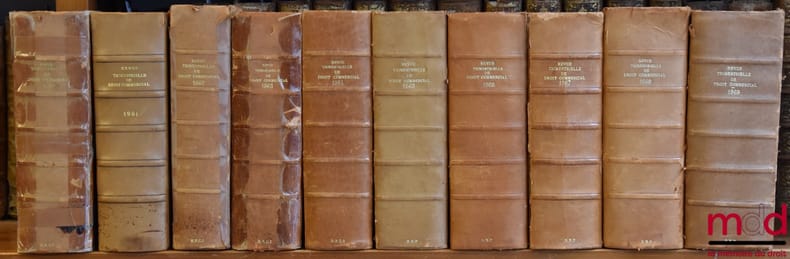
3872, Paris, Dalloz 1949-2004, 54années en 55 vol., demi-basane marron, tit. & années dorés sur dos à 5nerfs soulignés par fers à froid, au chiffres de la «B.N.C.I.»puis «B.N.P.», (qq. mors fendus et recollés au ruban adhésif, qq. autres mors partiellement fendus, plusieurs épidermures, qq. coins émoussés, reliure usagée, des feuilles jaunies, marques d’utilisation).