Justinian.MareMagnum

86 310 résultats
(42) SS., 2222 Spp. Mit Druckermarke am Titel. Lederband der Zeit auf 5 Doppelbünden mit goldgepr. floraler Rückenverzierung sowie rotem Rückenschildchen. Folio. Große und vollständige Ausgabe der Digestum Vetum mit der Glosse des Accursius und Denis Godefroys (1549-1622) Zusätzen. Das Titelblatt ziert jene berühmte Druckermarke, welche einen fliegenumschwirrten Löwen mit dem Spruch "De forti dulcendo" zeigt. Dieser ging als "lion moucheté" in die Geschichte ein. Die Digesten, das juristische Kernstück des Corpus Iuris Civilis, werden seit dem Mittelalter unterteilt in drei Teile: Digestum Vetus, Infortitum und Digestum Novum. Der Inhalt ist ein Flickenteppich, der von einer Gesetzeskommission aus einer grossen Masse von juristischen Schriften des 1. bis 2. Jhs. zusammengestellt worden ist. Die Ende des 11. Jhs. in Bologna zugrundegelegte Handschrift, die Vulgata oder "Littera Bononiensis", bestimmte den Rechtsunterricht und die Rechtspraxis bis Mitte des 16. Jhs. Im Jahre 1553 wurde eine weitere archetypische Handschrift der Pandekten ediert, die unter dem Namen "Littera Florentina" rechtshistorische Bedeutung erlangte. Der Druck des Corpus war ein umkämpfter Markt: Zunächst war Venedig beherrschend, wurde jedoch zu Beginn des 16. Jhs. von Lyon abgelöst. - Am Titel zeitgenöss. hs. Besitzvermerk "Ex Libris Joannis Francisci Xaverii Rascas Patroni" (d. i. Jean Francois Xavier de Rascas, Rechtsgelehrter und Erzdiakon von St. Sauveur d'Aix, der als "avocat au parlament" an der Jurisdiktion im Ancien Regime mitwirkte). Ecken und Kanten berieben, Lederbezug des Einbands größenteils abgelöst. Teils wurmstichig und wasserfleckig. Nicht in STC-BM French oder bei Adams.
4to. 3 pts. in 1 vol. (12), 296 pp. (6), 140 pp. (20), 142, (8) pp. With 2 engr. frontispieces, engr. t. p., 20 engr. plates, and 8 engravings in the text (1 with a moving part). Contemp. calf with double labels to gilt spine. All edges red. First complete edition, previously published only without illustrations and without the "Exercitium zu Pferd und zu Fuß" (issued here with separate half-title). These drill regulations are considered the first encompassing work of their kind in military history (cf. Z&K 18, 2684). "The standard regulations for official use during the age of Maria Theresia and Frederick the Great" (cf. Jähns). - Some uniform plates in attractive comtemporary colour. Binding insignificantly rubbed; slight worming to last third of volume, otherwise clean and well preserved. De Ridder 251. Hiler 494. Jähns 1589f. Cf. Lipperheide Qe 1.
Folio (270 x 420 mm). (2), XL, 152 (but: 160) pp. (with inserted pages 4a/b, 20a-d, 120A/121A). Contemporary orange boards with giltstamped spine. Only edition. - The scholar and mathematician Meyer Moses Kornick (also: Kurnik, d. in Hamburg in 1826) was a native of Glogau in Silesia, where he also served as a rabbi. "Kornick, who had corresponded with Rabbis Akiva Eger and Moses Sofer as well as contemporary Christian savants, published synoptic calendar tables that were highly regarded in scholarly circles, both Jewish and non-Jewish [... This] concordance of Julian, Gregorian, Jewish, and Islamic calendars formed the basis of Jahn's 'Tafeln' (Leipzig, 1856). It was highly praised by Isidore Loeb in his 'Tables du Calendrier Juif' (Paris: Durlacher, 1886). Max Simon [...] explained that although Kornick's esteemed tables were sold out at booksellers they still could be found with scholars who rely upon the tables for their research" (E. Carlebach, When Does the Modern Period of the Jewish Calendar Begin?, in: L. Strauss [ed.], Mediating Modernity [2008], pp. 43-54, at p. 47; 53). - Some brownstaining, mainly confined to margins. Binding rubbed and bumped at extremeties, some chipping. Inscribed "Till Blekingska Nationens Bibliothek" with ownership "C. V. Hammar" (and note "+ 1846 30/4") on endpapers. Rare. Fürst II, 206. Kayser III, 398. Bibliographie von Deutschland I (1826), S. 156, Nr. 1174. OCLC 233683853.
8vo. 3 vols. LXXXVIII, (8), 406 pp. 376 pp. 378, (4) pp. Contemporary green calf with title to richly gilt spine, giltstamped cover fillets, inner dentelle, and white silk endpapers. All edges gilt. Splendid copy of the first edition of this standard reference book with calligraphic letter of dedication (in watercolours and gold) for Archduke Rainer Joseph of Austria, Viceroy of Lombardy and Venetia (1783-1853). Includes an autogr. 3-page letter by the author to Archduke Rainer (dated 25 Nov. 1840): "As now the third and last volume of my manual has left the press, I take the liberty of presenting your Royal Highness with a copy, begging you to receive it with grace. I thus complete the task vested in me [...]”. - Decorative bindings slightly rubbed at edges and corners, otherwise fine. Humpert 10325.
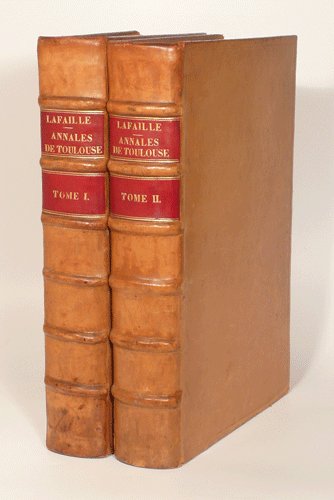
16870031851687 Toulouse, Colomyez & Posuël, 1687-1701. Deux forts volumes in-folio (257 X 357 mm) basane blonde glacée, dos six nerfs, pièces de titre et de tomaison grenat, large encadrement de filet à froid sur les plats, tranches rouges (reliure ancienne). TOME I : (2) ff. blancs, titre, (18) ff., 149 pages, (1) f., 344 pages, (1) f., 128 pages, (18) ff., 20 pages ; [relié à la suite] titre, (3) ff. de dédicace et avertissement, 46 pages, (1) f. de table, (1) f. blanc. TOME II : titre, (4) ff. d'avertissement et errata, 548 pages, (2) ff., 112 pages, CII pages, (1) f., 20 pages, (20) ff. Pointes de rousseurs éparses, quelques feuillets uniformément roussis, erreurs de pagination et quelques feuillets intervertis sans manque.
Large 8vo. 2 vols. XVIII, (4), 379, (1) pp. IV, (2), 479, (1) pp. Contemporary blue half cloth, spines finely gilt. First edition. The first great book of the author, the future leader of the Allgemeiner Deutscher Arbeiterverein, the first German social democratic party founded in 1863: a voluminous study on the pre-Socratic philosopher Heraclitus, on which Lassalle worked for more than fifteen years. It clearly shows the profound influence of his study of Hegelian dialectical methods. - Some foxing throughout. Handwritten ownership of the German philosopher Henning Winzer (dated 1982) to flyleaves; Diels/Kranz numbers pencilled in the margin in his hand. Stammhammer I, 127, 21.
8vo. 2 vols. IV, 112 pp. VIII, (2), 259, (1) pp. With a total of 42 figures in the text. Contemporary purple half cloth over marbled boards with giltstamped spine title. First (vol. 1: second) edition. - Launhardt began his career as a civil engineer, later becoming professor at the Technical University in Hanover and its first rector. A specialist in the technology and economics of road and railway transportation, he gradually applied his insights to the more general problems of transportation networks. His fame as an economist is chiefly based upon his "Mathematische Begründung der Volkswirthschaftslehre" (1885), which gave Launhardt a prominent place in the history of economic analysis. His work is characterized as "Germany's most important and in fact only significant contribution to the 'marginal revolution' in the last three decades of the 19th century. In the economic analysis of transportation and location, this contribution was not surpassed until the 1930s. Available only in German, some of it in publications that are hard to find, it still has not found the recognition it deserves, and Schumpeter's references [...] are inadequate" (New Palgrave). - The present work on the "theory of network planning" consists of two parts: the first, on "commercial network planning", is a much revised and enlarged version of an earlier publication ("Kommercielle Tracirung der Verkehrwege", 1872), containing the derivation of efficiency criteria without regard to topography. The second part, on "technical network planning for railroads", applies economic efficiency criteria to curves and gradients imposed by topography. "The contributions to economics are found in Part I. This begins with a discussion of investment criteria. From a social point of view, networks should be planned in such a way that the sum of operating and capital costs is a minimum. Private capitalists, however, try to maximize the internal rate of return on their capital. Under perfect competition the two criteria would coincide, since the internal rate of return, if duly maximized, would equal the market rate of interest. In reality, however, since the railroad industry is inherently non-competetive, rates of return can be pushed above market rates of interest by keeping railroad investment below the social optimum. This was one of Launhardt's basic arguments for government ownership of railroads" (ibid.). - Binding insignificantly rubbed, spines sunned. Removed from the library of Vienna's Imperial and Royal Technical University, Chair of Railway Construction II ("K. k. Technische Hochschule in Wien, Lehrkanzel für Eisenbahnbau II") with gilt paper library label on spines, small library label on pastedowns, and cancelled library stamp on titles. Small repair to blank corner of title of first volume with some offsetting on opposite page, otherwise a good copy. New Palgrave III, p. 140 ff. Schumpeter p. 948.
8vo (160 x 235 mm). VIII, 146 pp. Original printed wrappers. Second edition. The famous brochure setting forth the conditions for the dictatorship of the proletariat and the suppression of the capitalist state. Considered by Lucio Colletti to constitute Lenin's "greatest contribution to political theory", the book describes the role of the state in society, the necessity of a proletarian revolution, and the theoretic inadequacies of social democracy in achieving revolution to establish the dictatorship of the proletariat. With the foreword of the 1917 first edition. - Frayed at edges. Several pencil annotations. Contemporary ownership to title-page ("T. Rehsner"?). Lenin, Collected Works XXV, 381-492. OCLC 40548203.
8vo (145 x 220 mm). 16 pp., including original printed wrapper cover. Probably the first edition. Title-page headed "Rossijskaja soc.-dem. rabochaja partija". - Frayed at edges. Spine repaired, unsewn. OCLC 749099576.
19 pp. Original printed wrappers. 8vo. Text uncut and unopened; somewhat fragile, with light fraying to gutter of wrappers, into which gatherings are loosely inserted as issued. OCLC 24092349 (copies at Hoover, Melbourne, and the Swedish National Library).
8vo. 3 vols. (4), XLVII, (1), 468 pp. (6), 533, (1) pp. (4), 569, (1) pp. With numerous maps (3 folding in colour at end of volume 1) and tables (3 folding in volume 2, 1 folding in volume 3). Contemporary half calf over green marbled boards with giltstamped spines. Marbled endpapers. First edition. Presentation copy for Lucien March, inscribed by the author on the half-title of vol. 1. - Now-classic historical and statistical studies on French and comparative population: this is among the major achievements of the author hailed as "the father of modern economic history in France"; its publication was "an even more important event in historiography" than the publication of his voluminous history of the working classes. "For Levasseur, the object of statistics as a science was to make numerical data available to historians and economists. Indeed, he believed that statistics had become an indispensable tool for the historian". - A fine set. Einaudi 3379. IESS IX, 261.
4to. 115 numbered issues bound in one volume. 4 pp. each (except no. 59, comprising 8 pp.). With numerous woodcut illustrations. Contemporary half calf over marbled boards with giltstamped spine and spine-title. A remarkable ensemble of 115 complete issues of the popular anti-corn law periodical, edited by the social reformer and politician Livesey (1794-1884), "one of the unsung heroes of the anti-corn law campaign" (Miller). Issued from December 1841 until the repeal of the laws in 1846, the periodical amounted to 235 issues in total, reaching up to 15,000 readers a week - a "unique reach compared to other free trade periodicals" (ibid.). In his journal Livesey "anticipated the working-class liberalism that developed after Chartism. The content of 'The Struggle' bears a close affinity to the key tenets of later Gladstonian liberalism, with its emphasis on Cobdenite free trade, manly independence, self-improvement, and respectability" (ibid.). - Each issue begins with a political caricature attacking trade restrictions, featuring prominent figures like Sir Robert Peel and Queen Victoria, as well as allegorical depictions with characters including "Buckingham Badger, the monopolist" compared to "Cheap John, the free trader". - The present volume comprises issues 1 through 120, omitting only 6 issues (nos. 9, 35, 62, 64, 79 and 109). No. 120 is followed by no. 224; no. 29 bound after no. 30. Binding somewhat rubbed; spine professionally repaired. Paper with some marginal tears, sometimes causing slight loss to text; occasionally brownstained. Provenance: from the collection of Chimen Abramsky (1916-2010), London. Miller, "Free Trade and Print Culture: Political Communication in Early 19th-Century England", Cultural and Social History 14.1 (2017), pp. 6, 21. Brake/Demoor, Dictionary of 19th-Century Journalism in Great Britain and Ireland, 370.
053254Paris Charles-Béchet, Libraire-Commissionnaire 1827 in 8 (21,5x13,5) 1 volume reliure demi veau prune ancienne, dos orné de faux nerfs dorés, tranches peignées, LXXXIII et 424 pages [2], avec 2 tableaux dépliants. Charles Lucas, Saint-Brieuc 1803 - Paris 1889, criminaliste et jurisconsulte français, président du Conseil des inspecteurs généraux des prisons, auteur de plusieurs ouvrages démontrant l'inefficacité dissuasive et préventive de la peine de mort, et la nécessité de son abolition. Rare édition originale de ce célèbre manifeste contre la peine de mort, avec la signature manuscrite de l'auteur au verso de la page de faux-titre. Bel exemplaire, finement relié ( Photographies sur demande / We can send pictures of this book on simple request )
Ca. 68 x 69 cm. Backed on cloth. Original typographic poster, signed in red in the right margin by the Swiss graphic artist and typographer Hans Lutz. Using the beginning of chapter I of the Communist Manifesto, the poster's stark sans-serif typeface alternates bold and light varieties to form a striking portrait of Karl Marx. - Hans-Rudolf Lutz began as typesetter with Orell Füssli in Zürich in 1955 before studying typographic design with Emil Ruder and Robert Büchler at Basel. In 1964 he became the leader of the group "expression typographique" at the Hollenstein studio in Paris; two years later he accepted a position as teacher of typography and interdisciplinary design in Lucerne, but also set up his own studio as well as a publishing house. He participated at the creation of the F&F School for experimental design in Zurich. - In fine condition, showing only light wear.
165789212Hierôme Olivier | Le Mans 1657 | 23.3 x 36.5 cm | Relié
12mo. 1, (1 blank), 1, (1 blank), 3, (1 blank), 333 pp. With a portrait of Mao used as a frontispiece. Red vinyl cover wrapper over cardboard. Arabic translation of the "Quotations from Chairman Mao Tse-tung", popularly known as the "Little Red Book". First compiled and published in 1964, by 1970 several billion copies were printed as every Chinese citizen was more or less obliged to own and carry a copy. After the book was approved for publication outside China in 1966, the Foreign Languages Press oversaw the translation and publication of the book into dozens of languages. The Arabic translation was first published in 1967 and printed not in China but in Egypt to influence the Pan-Arabist movement. According to an article in the Peking Review, China's official foreign newspaper: "The publication [...] was enthusiastically welcomed by the revolutionary Arab masses. Some of them began to read Chairman Mao's works on the street as soon as they bought them. [...] While working hard to print the Quotations, the workers at the printing house squeezed in time to study this treasured book of revolution" (Peking Review). The "Quotations" became the inspiration for the form, if not the contents, of Muammar Gaddafi's "Green Book". - With a stamp of the "Committee on New Alternatives in the Middle East" on the front endpaper and a faded Chinese stamp on the back endpaper; a very good copy. "Mao Tsetung thought inspires Arab people's advance", in: Peking Review 17 (25 April 1969), pp. 13-15.
12mo (92 x 134 mm). (12), 311, (3) pp. With half-tone portrait frontispiece and facsimile plate of calligraphy by Lin Biao. Original red vinyl over paper boards, titled and stamped with a star in blind on the upper cover. First English edition.
8vo. 97, (3) pp. Original printed wrappers. A new issue ("5me mille") of the second French translation, first published in 1901. No. 8 in the "Bibliothèque socialiste". - Prepared by the French Germanist and philosopher Charles Andler after the fourth German edition of 1890. Includes the preface of Marx and Engels to the second edition of 1872, as well as Engels' prefaces to the editions of 1883 and 1890. With an appendix titled "La collaboration de Frédéric Engels à la Réforme de Flocon et de Ledru-Rollin". - A few unobtrusive marginal pencil strokes on p. 39. Andréas 459. Cf. Rubel 70. Stammhammer III, 224, 2.
8vo. 55, (1), 30 pp. Original printed wrappers. Very scarce, uncommon Russian-language edition of the Communist Manifesto. The translation was prepared by Georgi Plekhanov, who greatly enhanced the 1869 first Russian version made by Bakunin, which had omitted several sections of the German original. The present edition contains the prefaces of the 1872, 1883, and 1890 editions along with Plekhanov's footnotes from his 1900 edition. - Marx and Engels' groundbreaking work of communist propaganda is "undoubtedly the most widespread, the most international production of all Socialist literature, the common platform acknowledged by millions of working men from Siberia to California" (preface to the 1888 edition). In the words of the British economist Harold Laski, the Manifesto is "admitted by every serious student of society to be one of the outstanding documents of all time". It also constitutes an early sum of Marx' and Engels' ideas, later to become known under the heading of 'scientific socialism': "[L]e manifeste renferme en puissance la quasi-totalité des idées élaborées par ses deux auteurs dans leurs ouvrages ultérieurs et qui, dans leur ensemble, représentent ce qu'ils appellent le socialisme scientifique; la seul exception importante est la théorie de la plus-value" (Andréas, p. 1). - Unbeknownst to either author, it would be Russia where the Revolution heralded by the Manifesto would finally take place, under the leadership of their disciple Lenin who did not discover Marxism until after Marx's death (but who was later to prepare his own translation of the Communist Manifesto). - Old shelfmark-label to front cover. A few marginal flaws. Uncut copy. OCLC 913119785. Cf. Andréas 135 (1882 ed.). PMM 326.
Large 8vo. 2 vols. 837, (3) pp. 549, (3) pp. With a portrait frontispiece. Publisher's original blue cloth. First Serbo-Croatian edition. - Bindings rubbed, book-blocks loosened, some pencil annotations and markings. Quite rare. OCLC 442764506, 439419769.
Oblong 8vo. 2 vols. XII, XLVIII, 388 pp. (4), 482 pp. With an engraved calligraphic plate in the preliminaries of vol. 1. Contemporary full calf, spines gilt with labels. All edges red. First edition. The complete first volume and the first part of the second are dedictated to simple and double entry bookkeeping. The remainder of the second volume pertains to bills of exchange and to weights and measures, adapted to the new system introduced by the National Convention in the year II (1793/94). The preface provides a short review of earlier literature on the subject. This is followed by a dictionary of terms used in commerce, navigation and banking. - Bindings a little rubbed. Includes the final leaf in vol. 2 with printed labels to be cut out and pasted on the wrapper spines by the bookbinder. HAL p. 161. Not in Kress, Goldsmiths' or Goldsmiths'-Kress.
In -4°, pp. (24), 152, (2); marca editoriale al frontespizio, testo in ebraico e latino; piena pergamena con tasselli e titolo al dorso. Testo a fronte su due colonne, in ebraico e latino. Prima edizione di queste due opere di Maimonide nella traduzione fatta dal vescovo inglese Robert Clavering: le due opere riguardano nello specifico l’educazione dei giovani e la natura e dottrina delle condanne legali. The first edition of these two Maimonides’ works, in the english translation of the Bishop Robert Clavering. M
In folio (cm 22,1 x 33,5), bellissima legatura piena pelle di scrofa coeva, assai ben conservata, vera e propria scultura ornata di minuziosi ceselli: le sedici figurine per piatto dell'Antico e del Nuovo Testamento: Davide con l'arpa, Pietro... ogni personaggio con in calce il proprio motto, gli ornamenti e i fregi di ogni genere -qui il leit-motiv è dato dalle ghiande, presenti in numero di ventiquattro. Cc (13), (1) bianca, 660, (35) di Indici. Al frontespizio, splendida impresa dell'Episcopius: mano vescovile regge pastorale, che reca in cima cicogna con il sassolino nella zampa, simbolo di vigile attesa; circondato da ricca cornice silografica allegorica. L'impresa è ripetuta, con varianti, al verso dell'ultima carta, a piena pagina. Al verso del frontespizio, grande stemma araldico della famiglia Frundeck. Esemplare in buone condizioni, Al verso del piatto, etichetta ex libris "Castello di Duino"; Joachim Mynsinger von Frundeck (* 13. Agosto 1514 in Stuttgart; 3. Maggio 1588 in Helmstedt) fu celebre giurista riformato, la cui opera fu messa all'Indice; i Paesi tedeschi erano i centri dell'"infezione" luterana, e la vigilanza doveva essere applicata soprattutto a quelle opere di cui maggiore era la pericolosità, perchè trattanti di: usura, questione del matrimonio (uno dei cardini della nuova legislazione tridentina), giurisdizione temporale del papa. Il Mynsinger rimase all'Indice fino al 1580, anche perchè nel 1581 venne impressa un'edizione preventivamente espurgata. Nessun esemplare di questa edizione censito nelle biblioteche consultate; SBN censisce sette esemplari dell'edizione veneziana Porta del 1581. Bibliografia: Sabine Schumann, Joachim Mynsinger von Frundeck (1514-1588). Herzoglicher Kanzler in Wolfenbüttel - Rechtsgelehrter - Humanist. Zur Biographie eines Juristen im 16. Jahrhundert. Wiesbaden 1983. Karl Zippelius, Ein Juristenleben im 16. Jahrhundert: Joachim Mynsinger von Frundeck. In: Melanges Fritz Sturm, Liège 1999, S. 959-970.
Large 8vo. 3 vols. VII, (1), CLIX, (1), 352 pp. VII, (1), 536 pp. VIII, 468 pp. With folding table in vol. 1. Contemporary grey wrappers with handwritten titles to spine. First edition, likely first issue. The only authentic account of the finances of France previous to the Revolution. This was undoubtedly Necker's most successful book: it saw some 20 editions (or issues) within a few years, including translations into English, German and other languages. It is said to have sold 80,000 copies, though McCulloch's statement that this occurred "in the course of a few days" would seem exaggerated. Carpenter distinguishes seven issues all dated "1784" and, according to him, all printed from the same type setting, but differing in pagination as well as in location and number of errata. The present issue fully agrees the description of his first item (with respectively 12, 10 and 8 errata on the last preliminary page of each volume), but it does not show the misnumbering of page VIII of the third volume. The second volume includes the Supplement (pp. 533-536) referring to the edict of August 1784 which "appeared since the printing of the previous chapters". - Entirely untrimmed copy measuring ca. 14 x 21,8 cm. In fine general condition. *Einaudi A582. Kress B.752-756. Carpenter XXIX,1. Coquelin & Guillaumin II, 272. McCulloch p. 347.
1867R38350Romae, typis S.Congregationis de propaganda fide 1867-1892 17 parts in 16 volumes (complete set): each volume has 600 to 700pp. (part 17 contains index), all bound in same way (cart.cover with spine in cloth), library stamp on titlepage, few foxing, text in latin, 24x20cm., good condition, R38350