[CANTILLON (Richard)]Livre Rare Book

15 993 résultats
39235In-8 (157 x 95 mm), veau marbré de lépoque, dos à 5 nerfs, orné de compartiments fleuronnés et cloisonnés, palettes, tranches rouges, 427 p., (5) pages de table. Londres, Fletcher Gyles dans Holborn [i.e. Paris?], 1756.
152855S.l. [Douai], s.d. (1791) in-4, [113] pp. (seules les 21 premières sont chiffrées), couvertes d'une écriture fine et lisible (environ 40 lignes réglées par page), avec 11 figures aquarellées dans le texte, et 9 pl. hors-texte (dont deux ff. doubles volants, et une grande carte dépl. aux contours rehaussés de couleurs, représentant le tracé du cours de la Sambre depuis la frontière jusqu'à Namur), en feuilles.
222527Genève, et se trouve à Paris, Damonneville, 1758 2 vol. in-12, viij pp., 228 pp., veau fauve marbré, dos à nerfs cloisonné et fleuronné, pièces de titre et de tomaison, chaînette dorée sur les coupes, tranches marbrées (reliure de l'époque). Un mors inférieur fendu, petite galerie de vers infra-paginale à la fin du volume I.
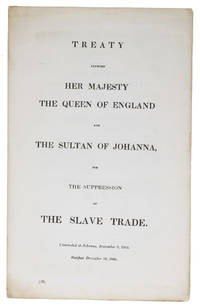
1845ABC_48495Johanna Anjouan 1845. Ca. 32.5 x 20.5 cm. Original paper wrappers. 5 1 blank pp. Historically important treaty between Queen Victoria of the United Kingdom of Great Britain and Ireland 1819-1901 and Sultan Selim dates unknown of Johanna present-day Anjouan for the suppression of the slave trade. The treaty was concluded in November 1844. The present work is the ratified version from 10 December 1845 signed by Sultan Selim and Christopher Wyvill 1792-1863 captain of the HMS Cleopatra and formation commander of the British Royal Navy in Africa between 1849-1853. The publication is exceptionally rare. We have not been able to find any printed copies anywhere else either in sales records or libraries. The archives of the UK parliament make mention of the treaty but it appears to be otherwise unknown.In the present work the Sultan of Anjouan states that: "There shall be no dealing in slaves in our territory and no slaves shall be imported to be sold in our country". He further allows the British to inspect Anjouan ships and take them to an English port if they are found engaging in slave trade. The present treaty which is of significant historical importance is an excellent example of the measures that were undertaken across the world to stop the slave trade.The leaves are slightly creased and browned around the edges. Otherwise in good condition. unknown
17600041101760 Sans lieu d'édition [Paris], ni nom d'éditeur [Chaubert et Hérissant], 1760. In-quarto (206 X 265 mm) demi-basane fauve à coins, dos cinq nerfs, pièce de titre chagrin grenat, tranches rouges (reliure de l'époque) ; (1) f. blanc, VIII (dont titre)-336 pages, (1) f. blanc. Pièce de titre renouvelée. Ex-libris ancien collé sur le premier contreplat.
17599039A Copenhague, chez les Frères Cl. & Ant. Philibert, 1759-1765. 5 tomes en 3 vol. in-folio, veau, dos orné à nerfs, pièces de titre en maroquin rouge et de tomaison en maroquin vert, tranches rouges (reliure de l'époque).
Unread. As new. Number 216 of limited edition of 350 copies. Signed by co-author R.E. Gosnell. "Few publications, if any, of similar size and excellence have been produced in Canada." - From Editor's Foreword. Part I includes 210 pages and eighteen chapters which constitute "a survey of events from the earliest times down to the Union of the Crown Colony of British Columbia with the Dominion of Canada." Part II is "a history, mainly political and economic, of the Province since Confederation up to the present time." Part I is preceded and followed by dozens of tissue-protected black and white portraits of individuals influential in the early history of the province, complete with their brief biographies upon the tissue. Part II comprises eighteen chapters over 226 pages plus 5 pages of addenda followed by dozens of tissue protected portraits of "some of the men conspicuous as present day factors in development." Top edge gilt. Gilt lettering upon backstrip. Marbled endpapers. Exceptionally clean, bright, and unmarked with zero wear. Brown suede exterior appears as fresh as the day it was applied over 100 years ago. This majestic fourteen pound tome measures 13" x 10.5" x 4". A magnificent acquisition for any serious collector of British Columbia history. A better copy will not be found. [Lowther 1607, Hale 2523, Edwards & Lort 3177, Strathern 495] Book
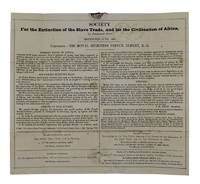
AQ30000Single leaf mulready letter- sheet folded addressed to 'Mrs Clive Sanderstead Croydon Surrey' postmarked Frome with the 306 duplex cancellation to folded front and further post-marks of Croydon and Frome dated September 1844 to folded verso. Some tears to folds margins without loss of text remains of opened wax seal and old paper repairs to recto. The earliest of several known variants of this rare plea for donations for the Society for the Extinction of the Slave Trade and for the Civilization of Africa printed on the reverse of a 'Mulready' penny postal stationary sheet. First issued on 1 May 1840 in parallel with the world's first stamp - the Penny Black - these pre-paid self-folding letter sheets featured an engraved design by John Thompson after William Mulready 1786-1863 and were valid for use from 6th May. Much to postal reformer Rowland Hill's surprise unlike their adhesive philatelic counterpart the Mulready covers quickly proved unpopular both with customers and stationers - who relied upon the sale of writing paper for letters - alike. They were superseded by the introduction of simpler postal stationary with impressions akin to stamps in the top left hand corner in 1841; Mulready sheets were subsequently withdrawn from sale during the early 1840s. Despite their unpopularity soon after issue the promotional opportunities provided by advertising on the verso of the Mulready letter-sheets were seized upon by commercial and voluntary associations alike. Insurance companies banks newspapers publishers and religious institutions are all known to have advertised in such a manner; many made this stationary available in quantity at a discounted rate to ensure wide circulation to the writing desks of the literate across Britain. Advertisements for The Society for the Extinction of the African Slave Trade are known to have featured on nine slightly different advertisements to the verso of the Mulready one- and two-penny letter-sheets; this is the earliest known advertising that 'Shortly will be Published' an Abridgement of Buxton's The African Slave Trade London 1840 implying that these were issued in the very first year of the stationary's use. The fact that no fewer than four works published by John Murray are also advertised could indicate that the cost of producing these pre-paid advertising letter sheets was borne by the publisher. 'A subscription of One Guinea and upwards per annum constitutes an Annual Member. A donation of Ten Guineas and upwards constitutes a Life Member Subscriptions and donations of a smaller amount will be thankfully received.' Founded by English politician Fowell Buxton 1786-1845 in June 1839 with the aim not only of finally extinguishing the Slave Trade in Africa some decades after the original abolition of the Trade in Britain her colonies and the United States but also to 'watch over and befriend the interests of Africa' and form a commercial 'Company which shall cultivate portions of her soil'. As noted in this advertisement which sought 'subscriptions and donations' this included persuading the British Government's sending an expedition see item number 36 led by the Royal Navy to explore the Niger river which despite the death of a full third of the those involved largely to fever did secure the signing of several treaties against the slave trade with tribes in modern day Nigeria. As this advertisement - signed by secretary Irish clergyman and missionary John Trew 1792-1869 notes further expeditions 'into the interior of Africa' were envisaged at 'considerable expense' to the society; however the Society was acrimoniously dissolved in 1843 - the year before this letter-sheet was used - before any such expeditions could be repeated. Stanley Gibbons Queen Victoria Vol. 1 Pt. 1 SG MA480a. Dimensions unfolded: 220 x 200 mm; folded: 133 x 88 mm. unknown
AQ27989vs.: vs. 1820-40s An archive comprised of sixty-eight loose articles of late Georgian and early Victorian manuscript and printed ephemera relating to the purchase of alcohol including a number of bill-heads for merchants in inter alia Glasgow and London. The majority of the manuscript material - predominantly receipts and purchase orders - are addressed to Nottingham-based wine merchant Thomas Bailey 1785-1856 father of poet Philip James Bailey 1816-1902 noted author of Festus 1839. The elder Bailet who established his business in 1817 relinquished control in the 1830s in order to devote himself more fully to his roles as newspaper editor and author. The later material in this archive dating to the 1840s is addressed to Bailey's son-in-law and successor John Brown. A remarkable opportunity to acquire an archive of mid-nineteenth century commercial material directly connected to the provincial wine and spirit trade. . [vs.], [1820-40s] unknown
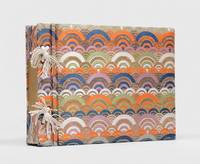
1934180258Japan: 1934. A last-ditch attempt to repair Anglo-Japanese relations A well-preserved photo album presented by the Japanese government to members of the Barnby mission. This delegation was "unofficial and supposed to deal solely with commercial issues but the Japanese government and media treated it as if it had a political purpose much to the embarrassment of the British Embassy" Cortazzi p. 141. WorldCat lists no other examples. After the invasion of Manchuria and Japan's withdrawal from the League of Nations in 1933 a pro-Japanese group in Britain centred on Neville Chamberlain attempted to repair relations between the two countries. The group was led by Colonel Lord Barnby the former president of the Federation of British Industries and staffed by representatives of the Iron and Steel Federation and the banking firm Seligman Brothers. Officially its goal was to investigate business opportunities in the new colony but as the Japanese ambassador Matsudaira Tsuneo wrote "its real aim is to promote friendly relations between Japan and Britain and between Britain and Manchukuo" Nish p. 19. The delegation was greeted by an audience with the emperor much to the horror of the British ambassador Robert Clive who suspected that their friendliness was simply a ruse to persuade the British to "accept a subordinate position in East Asia" Cortazzi p. 142. The mission caused such a stir that it was debated in parliament on 7 November 1934 where Viscount Cecil of Chelwood asked whether the Japanese government had been properly informed of its non-political nature. The first photograph shows the mission meeting with the Japanese delegation and the final photograph shows the interior of a railway car. There are also many photographs of traditional Japanese sports and performing arts as well as the scenery of famous places like Nara Hakone and Kyushu. Oblong folio. With 60 gelatin silver photographs landscape or portrait approximately 105 x 152 mm mounted recto and verso on grey card with captions in English. Original patterned brocade white thread musubi-toji binding spine ends capped with patterned brocade gilt-speckled endpapers gilt edges. Brocade fresh a little frayed at edges a few leaves sometime strengthened with tape at the gutter photographs bright with a little toning and silvering at edges: a very good example. Hugh Cortazzi British Envoys in Japan 1859-1972 2021; Ian Nish Anglo-Japanese Alienation 1919-1952: Papers of the Anglo-Japanese Conference on the History of the Second World War 1982. unknown
184324188St. Louis: John B. Sarpy 1843. Folio. 2 pp. 12 1/2 x 7 1/2 inches. Docketed on verso fold lines with some separation a few repaired. A manuscript affidavit written by fur magnate John Baptiste Sarpy of Pierre Chouteau & Co. that gives one a granular sense of the difficulities of running a frontier business dependent on mountain men like Jim Bridger and Frapp.<br/> <br/> A remarkable window onto the business dealings of famed mountain man Jim Bridger this signed manuscript affidavit of John B. Sarpy testifies to his actions on behalf of the estate of fellow fur trader Henry Fraeb also known as Frapp who was killed by Indians in the Rocky Mountains. Sarpy who was a partner in the major fur firm Pierre Chouteau &. Co. had worked closely with Frapp and knew him well. In his affidavit he writes about the Chouteau Company's concerns about Jim Bridger Frapp's partner at the time of his demise and the difficulty of getting Bridger to pay his debts. Written in St. Louis Sarpy's affidavit states: "On the 8th day of August last he was appointed . . . administrator of the estate of Henry Fraeb then lately deceased. Said Fraeb had been a trader in the mountains & was at the time of his death in partnership with a man of the name of James Bridger & said Bridger & Fraeb were indebted to the firm of Pierre Chouteau Jr. & Co. & it was feared by the members of said firm that unless some one became the administrator of the said Fraeb the said Bridger might interpose difficulties in the settlement of the accounts existing between them & Bridger & Fraeb & for the purpose of doing justice to themselves as well as to the said Fraeb the said Sarpy applied for letters of administration which were granted to him as above mentioned. The said Bridger has however since this time been here & has settled in full the accounts existing between the firm of Pierre Chouteau Jr. & Co. & the said Bridger & Fraeb. And the said Sarpy says that no property has come into his hands as the administrator of the said Fraeb although it may be that the said Fraeb has property in the mountain country or in the hands of James Bridger his former partner." Though he may have been one of the greatest and most beloved mountain men of all time Jim Bridger was not the best debtor in the world nor did Pierre Chouteau & Co. forget business. John B. Sarpy unknown
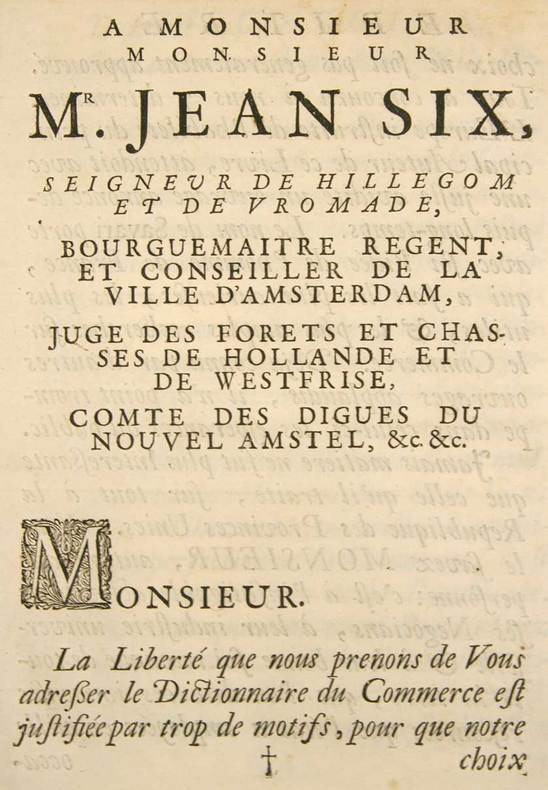
128479aafAmsterdam, chez les Jansons à Waesberge M. DCC XXVI, (Janssonius van Waesbergen), (1726), in-4to, With a folding engraved portrait of the dedicace ‘Jan Six, Heer van Hillegom en van Vromade’ bourgmestre d’Amsterdam, by Houbraken, and 2 large allegorical engraved headpieces (Pool after A. Coypel) + 2 endpieces. Main text printed in two columns. Collation: Vol. 1) XXXVIII + folded engr. front + 2030 col. ; Vol. 2) 2000 col., title-pages printed in red & black, hw ownership on free fly ‘Nunc à J. Louïs Panchaud’ à Wufflens & Appartient à Gabriel Tachenon. 1731 , avec un prix ‘coutte L 296’, reliure plein veau d’époque, qqs restaurations aux coiffes, pages de gardes en papier dominoté d’origine, bel exemplaire.
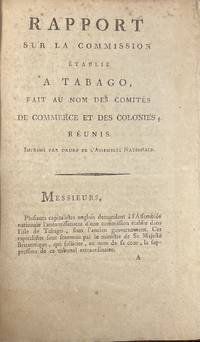
17913649Paris: Imprimerie Nationale 1791. First edition. Bound in later hardpaper boards covered with pastepaper spine with red gilt leather title vignette. Untrimmed. Paper tanned. Otherwise in very good condition. First edition. Bound in later hardpaper boards covered with pastepaper spine with red gilt leather title vignette. 18 2 blank p. <p><br /> Official report on the 1786 “Commission de Tabago†an extraordinary tribunal established to examine debts between British creditors and settlers after the French conquest of the island.<br /> <p><p><br /> First edition of the National Assembly’s official report on the controversial “Commission de Tabago†an extraordinary tribunal established in 1786 under the ancien régime to review debts between British capitalists and settlers after the French conquest of Tobago.<br /> <p><p><br /> The report reconstructs the background of the island’s transfer: originally ceded to Britain in 1763 Tobago had been largely settled and financed by British investors who lent capital for the development of sugar estates secured by mortgages. Following the French conquest 1781 and definitive cession Treaty of Paris 1783 the treaty guaranteed the inhabitants’ property rights under English law. Nevertheless in 1786 the Conseil du Roi created a special commission at Tobago to investigate alleged usury and excessive interest rates in these mortgage contracts. The commission—presided by the governor and ordonnateur—confiscated titles annulled or reduced debts and declared most English claims void provoking losses estimated at over 13 million livres.<br /> <p><p><br /> This Rapport examines the legality of the tribunal under both French and English law concluding that it was arbitrary unconstitutional and in violation of the 1783 peace treaty. The committees show that English statutes were misquoted that the island’s existing courts Common Pleas and Chancery already had proper jurisdiction and that no disputes existed before the commission was imposed. The report also denounces the suppression of trial by jury and the disregard of due process. It recommends—and the Assembly accepted—that the entire commission and its judgments be annulled thereby restoring lawful jurisdiction in the colony. The episode marked one of the last acts of French administration on Tobago which was recaptured by Britain in April 1793 returned to France in 1802 under the Treaty of Amiens and formally surrendered under the Treaty of Paris in 1814.<br /> <p><p><br /> An important Revolutionary document reflecting early attempts to reconcile French constitutional principles with colonial administration and international treaty obligations.<br /> <p><p><br /> Not in Sabin. No records on RBH. WorldCat locates 6 copies.<br /> <p>. [Imprimerie Nationale] unknown
17745521Marseille 1774. No Binding. Very Good. Folio - over 12 - 15" tall. Two folio bifolia 43.1 x 27.7 cm each with letterpress text woodcuts and manuscript text on the first leaf. Retaining deckle edge on all sides folded and annotated as typical of such documents one of the documents a bit weak at the folds otherwise very well preserved. Two rare folio-size maritime insurance policies from 1770s Marseille relating to mercantile voyages to France's American colonies in the Caribbean and valuable witnesses to the more practical bureaucratic aspects of maritime trade in late 18th-century France. Each document is illustrated with the three large woodcut seals of the city and carries in letterpress the standard legal formulas particular to Marseille as well as extensive manuscript notes and signatures completing the policy. The earlier of the two policies signed in May of 1774 relates to the vessel La Gentille likely the frigate later recorded as having taken part in the 1780 Battle of Martinique a stalemate between the French and British navies during the American War of Independence. The second policy signed on 3 November 1777 concerns the Bon Pasteur a ship under the command of captain Pierre Antoine Massier. Historical records show that this policy was nearly redeemed: Returning from Martinique in late December the Bon Pasteur was fired upon by the British frigate Westmoreland off the coast of Cabo de Gata in Spain boarded by six men each armed with a brace of pistols and a saber and Captain Massier roughly handled. The English suspected that the Bon Pasteur was not carrying goods from Martinique but from New England tobacco rice which would have been in violation of the protectionist economic policies common in both the French and British colonies in the Americas. After several sailors aboard the Bon Pasteur were thoroughly questioned the ship was sent on its way and its insurers in Marseille breathed a sigh of relief. OCLC does not locate any institutional copies of Marseille policies of this sort. B.-M. Emerigon and P. S. Boulay-Paty Traité des assurances et de contrats à la grosse vol. 1 pp. 54-5; Bulletin de la Socété archéologique historique et artistique vol. 3 pp. 277-8; Observations sur le Mémoire justificatif de la cour de Londres 1780 pp. 12-3. books
1775AMO-3759A Genève, chez les libraires associés, 1775 3 volume in-4 (26 x 20 cm) de (4)-IV-III-VIII-719, (4)-VIII-662 et (4)-VIII-658 pages. Portrait de l'auteur en frontispice du premier volume (dessiné par Cochin et gravé par L. Le Grand). Au tome I : 1 gravure hors-texte (livre I) + 1 grande carte repliée + 1 bandeau à l'eau-forte par Marillier + 1 gravure hors-texte (livre IV). Au tome II : 1 gravure hors-texte (livre VII) + 2 cartes repliées + 1 bandeau à l'eau-forte par Marillier + 1 gravure hors-texte (livre X). Au tome III : 1 gravure hors-texte (livre XIV) + 1 carte repliée + 1 bandeau à l'eau-forte par Marillier + 1 gravure hors-texte (livre XV) + 1 gravure hors-texte (livre XVIII). Soit 1 portrait, 7 gravures hors-texte (avant la lettre), 3 bandeaux et 4 cartes. Collationné complet. Reliure de l'époque plein veau caramel, dos à nerfs orné aux petits fers, pièce de titre de maroquin rouge, pièce de tomaison de maroquin olive. Reliures très décoratives et solides. Usures de surface sur les plats du premier et deuxième volume (épidermures stoppées), petits manques de cuir et petite galerie sans gravité, petites piqûres de vers en queue du dos du premier volume. Malgré ces quelques défauts l'ensemble reste très décoratif et parfaitement solide. Intérieur très frais. A noter une mouillure en marge intérieure des trois premiers feuillets du premier volume et les derniers feuillets du même volume avec mouillure marginale saine (à quelques feuillets seulement). Exemplaire relié à l'époque aux armes (en queue) d'un membre de la famille de Damas (?) ou d'Aubusson (?). Première édition au format in-quarto. Cette édition est bien complète en 3 volumes in-quarto (il n'y a pas d'atlas pour cette édition). Elle reprend le corpus de l'édition en 7 volumes in-8, avec les passages supprimés réintégrés ici au bas des pages sous forme de variantes. La première édition de ce magistral ouvrage a paru pour la première fois en 1770. "Véritable encyclopédie de l’anticolonialisme au XVIIIe siècle" ce texte entre dans la catégorie des "Voyages philosophiques" et représente un prétexte à des réflexions sur la "loi naturelle" et dénonce tout à la fois despotisme, cléricalisme, esclavage et colonialisme. L'ouvrage est toujours décrit par les commentateurs comme une « machine de guerre » contre le pouvoir en place. Pour la rédaction de cette encyclopédie Raynal eut recours à la collaboration de nombreux informateurs et collaborateurs écrivains tels que le Baron d'Holbach ou Diderot, à qui on attribue une part importante des textes. Interdite en 1772, l’Histoire des deux Indes sera à nouveau publiée par l’abbé Raynal dans une nouvelle édition en 1774 qui est immédiatement mise à l’Index par le clergé. C’est en 1780 qu’il publie sa troisième édition de l'Histoire des deux Indes, encore plus virulente que les deux précédentes et qu’il avoue implicitement comme étant de lui en y faisant graver son portrait en frontispice. Condamné par le Parlement de Paris, l’ouvrage est brûlé par le bourreau en place publique, ce qui lui assure un succès considérable. L’Histoire des deux Indes a également été l’occasion de la Lettre apologétique de l’abbé Raynal à Monsieur Grimm (1781) de Diderot (qui aurait écrit au moins un tiers de l'ouvrage, selon Grimm). Dans cette lettre Diderot écrit : « Raynal est un historien comme il n'y en a point encore eu, et tant mieux pour lui, et tant pis pour l'histoire. Si l'histoire avait, dès les premiers temps, saisi et traîné par les cheveux les tyrans civils et les tyrans religieux, je ne crois pas qu'il en fussent devenus meilleurs; mais ils en auraient été plus détestés, et leurs malheureux sujets en seraient peut-être devenus moins patients... Le livre que j'aime et que les rois et leurs courtisans détestent, c'est le livre qui fait naître des Brutus... » Dans notre exemplaire une note manuscrite de l'époque révolutionnaire indique : "Le Parlement de Paris proscrivit, le 25 mai 1781, l'Histoire philosophique de l'abbé Raynal, et ordonna que cet ouvrage fût brûlé. Il décréta même l'auteur de prise de corps. L'abbé Raynal se vit donc forcé de s'enfuir précipitamment de France. Le 15 août 1790, l'Assemblée nationale, sur la rédaction proposée par les députés Voidel et Maloüet, annula, comme contraire aux droits naturels et imprescriptibles de l'homme, le décret lancé par le Parlement de Paris contre l'abbé Raynal et son Histoire philosophique (v. Oeuvres d'André Chénier, 2e vol., p. 119)." (note manuscrite ancienne sur le faux-titre du premier volume). "It became a key text of the American Revolution, and Raynal became a correspondent of Franklin, Jefferson, and Adams." "Un des ouvrages clefs de la crise de l'Ancien Régime" (Michel Delon, in En Français dans le texte) "Celui qui abdique lâchement sa liberté, se voue au remords et à la plus grande misère qu’un être pensant et sensible puisse éprouver. S’il n’y a, sous le ciel, aucune puissance qui puisse changer mon organisation et m’abrutir, il n’y en a aucune qui puisse disposer de ma liberté. [...] L'esclavage est l'état d'un homme qui, par la force ou des conventions, a perdu la propriété de sa personne, et dont un maître peut disposer comme de la chose. [...] La liberté est la propriété de soi; on distingue trois sortes de libertés: la liberté naturelle, la liberté civile, la liberté politique; c'est-à-dire la liberté de l'homme, celle du citoyen et celle d'un peuple. [...] L'homme est aux prises avec la nature; sans cesse il la modifie, et sans cesse il est modifié. [...]." (extraits). Provenance : A. Leclerc, 1885 (étiquette). Armes dorées en queue des dos (mariage - non identifiées - non reconnu par O.H.R. qui les cite pourtant sous la planche n°888, figure n°3). Armoiries peut-être d'une ancienne famille de Bourgogne ? (provenance bourguignonne pour les volumes concernés). Par ailleurs O.H.R. les mentionne sur une Histoire de Bourgogne), peut-être les armes d'une branche de la famille de Damas (à la croix ancrée) ou d'Aubusson. Les présents volumes de Raynal ont été acquis également en Bourgogne ce qui laisserait supposer l'hypothèse "de Damas" plus pertinente. Références : A. Feugère, Bibliographie critique de l'abbé Raynal, 40 ; En français dans le texte, 166 ; Bel exemplaire relié aux armes à l'époque de cet ouvrage très important du Siècle des Lumières, dans son format le plus majestueux.
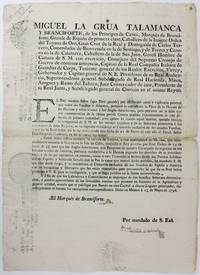
17965074Mexico City: May 13 1796. About very good. Broadside 17 x 12.25 inches. Old fold lines. Slight separation and loss at center fold slightly affecting a few letters. Minor wear else. Proclamation made by the Viceroy of New Spain authorizing trade between Cuba and the United States. The Caribbean was in tumult in the 1790s with Toussaint L'Ouverture overthrowing the French colonial government and outlawing slavery. Likewise in Cuba there was a similar revolt against slavery demanding abolition and equality -- both revolutions were of substantial concern to slaveholders in the American South. Specifically the present decree mentions flour and other vital foodstuffs as a measure against shortages in Cuba intended to prevent further trouble. "Para precaver la escasez de viveres y con especialidad de harinas que verosimilmente causaria la guerra concedio El Rey Permiso por Real Orden de 25 Junio de 93. para que los Anglo-Americanos.pudiesen conducirlos a la Havana pagando los derechos los puertos habilitados de España." The Viceroy at the time was Don Miguel de la Grua Talamanca de Carini y Branciforte First Marques de Branciforte. The Marques was notoriously corrupt even for colonial Spain having gained position through marriage to the Prime Minister's sister. He made sure to make some profit on everything that passed through his hands including taking advantage of the War in Cuba to remove the French from their lands and sell them to his benefit. A rare and interesting decree. We locate a single copy in OCLC at the University of Minnesota. May 13 unknown
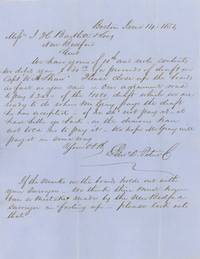
1855List3333Massachusetts New York Maine Pennsylvania and others 1855. Fifty letters with four empty envelopes or covers. Forty-four letters addressed to I.H. Bartlett & Sons: two from the 1830s eight from the 1840s and thirty-four from the 1850s. With five letters addressed to Capt. John C. Blanchard 1838 1839 1844 and 1849 and one to Cumston & Hatch N.d. Overall excellent to Near Fine. Ivory Hovey Bartlett 1794–1871 was a merchant and whale oil seller based in New Bedford Massachusetts. Bartlett moved to New Bedford from Plymouth in 1819 first dealing in grain and later transitioning to general merchandise and whaling.1 Whale oil and spermaceti were widely used in lamps and as lubricant and whalebone baleen was used for structure in items like umbrellas and corsets. In the nineteenth century whaling was the basis of New Bedford’s economy—supporting shipbuilding refineries toolworks and more—making it the wealthiest city in North America at the peak of the industry in the midcentury. Whaling declined in the 1860s with the rise of petroleum which could be both used as a lubricant and distilled into kerosene for lighting.<br /> <br /> Offered here is a collection of letters mainly to Bartlett’s company I.H. Bartlett & Sons with five to Captain John C. Blanchard of Searsport Maine and one to Cumston & Hatch. The latter is unknown; Blanchard was in the cotton and sugar trades sailing between the US Europe and West Indies.<br /> <br /> Letters to Bartlett are mainly from other mercantile firms; they pay bills make purchases discuss oil prices and occasionally complain. For instance Robert Robinson of Portland Maine writes:<br /> <br /> “I have just got 4 Casks of my oil 3 of the last and 1 of the invoice of 30th ult. I cannot understand why my oil should be keep back in this way. Hyde had seven casks by yesterdays Boat the same boat which mine came by it seem’s as if the fates where against this Oil as yesterday boat did not arrive untill late yesterday afternoon and this mornings boat has arrived without the balance there must be something wrong somewhere . I must say I think such neglect should be made known but perhaps it would be better to suffer for fear of the future. I shall not be able to get off any oil untill tomorrow as the oil was not out of the boat untill this morning. it is not thirteen days since that one cask left New Bedford .â€. October 13 1852<br /> <br /> Most of Bartlett’s customers buy whale oil though beef molasses and coal are also discussed but some are interested in whalebone; as are Wright Bros & Co a Philadelphian umbrella manufacturer who write to complain about market speculation:<br /> <br /> “The fact appears to us that speculation and the calculation of holders put the price kept it so high that it considerably lessened consumption – so much so of late that some have been disposed to slide it off below New Bedford rates very quietly.†October 23 1852<br /> <br /> The letters to all parties are generally all business except for two of the five to John Blanchard: one from his wife Caroline Houston and one from fellow Searsport captain David Nickels Jr. 1823–1888 who writes from Bangor:<br /> <br /> “I see by to day’s Mercantile gazette that you are in trouble I can sympathize with you God knows I have had a good share of it since I left the land of Gospel light and liberty as the good people say in their prayers I have been in this place fifteen days you doubtless knew I was chartered by Capt Pendleton to go from Leith to Bangor for a cargo of slates and from here to Boston I sailed from Leith on the 27th of November last for this place I got as far as the Orkney Islands on the 30th of November the wind blowing heavy from the westward and having a pilot belonging to the Orkneys on board I concluded to take the harbour of Longhope and lay till a shift of wind or till it moderated . in spite of all our endeavouring we were driven on shore broke the keel out of her filled as high as the lower deck which was on the 3d of December and on the 22d of March we left the Orkney Islands after having been near four months there When I got here I found the man who was to freight the Barque from here to Boston had neglected to place funds in the hands of the slate agent of this place consequently he refuses to put slates on board of the vessel till he receives funds from Boston .â€. May 13 1849<br /> <br /> Overall a look at the dealings of maritime merchants in the mid-nineteenth century particularly in the critical east coast whaling industry.<br /> <br /> 1 “Death of a Well-Known Merchant†The Standard-Times February 6 1871 2. unknown
18721427091872. TRADE CATALOGUE -- NURSERYMAN'S GUIDE. DEWEY D.M. Nurseryman's Specimen Book of American Horticulture and Floriculture Fruits and Flowers Ornamental Trees Shrubs Roses &c. D.M. Dewey's American fruit & flower plates colored from nature 2300 varieties. With a chromolithographic title page and 56 stencillled plates of fruits flowers and 9 chromolithographic plates plates of fruits flowers and trees. 8vo. 220 x 140 mm bound in contemporary morocco rebacked. Rochester N.Y.: D.M. Dewey n.d. ca. 1872. An early American trade catalogue of Fruit Flowers Trees and Nursery stock issued according to the Smithsonian Library "ca. 1872" by the firm of D.M. Dewey Rochester N.Y. Many of the plates have captions giving name of variety of plant and brief information on main characteristics and growing season. The Smithsonian copy contains only 24 plates compared to the 40 in the above copy. "Nurserymen's plates were an American innovation. They were made by various methods the most distinctive being painted in watercolors. In design and coloring these plates were more akin to folk painting than to the commercial art of their time" Charles von Ravenswaay "Drawn and Colored from Nature" in Antiques Magazine March 1983 pp. 594-599. Some minor wear overall in excellent condition. See Raphael. An Oak Spring Pomona Nos 63 to 66. unknown books
4986Paris, Imp. de Selligue, 1829. In-8 broché, 42 p. Etat moyen : qq. rousseurs, manque plats, page de titre déchirée.
In -4°, pp. VIII, 182, (4). Piena pergamena con titolo al dorso. Prima edizione. Contraddittorio e inquieto studioso, Odazi (Atri, 1741 - Napoli, 1794) è considerato fra gli economisti napoletani di maggior rilievo nella seconda metà del Settecento. Allievo del Genovesi, la cui cattedra gli sarebbe stata affidata nel 1781, massone, partecipò se pure con indolenza al fermento politico che avrebbe portato nel 1799 alla guerra civile e poi alla Repubblica napoletana. Ma, imprigionato nel ’94, si era ucciso in carcere, in circostanze mai chiarite. In questo suo “dotto studio” O. invoca “contro l’opinione del Galiani, la libertà dei prezzi, col notevole intento di giovare agli umili e, di riverbero, alla prosperità nazionale” (R. di Castiglione, “La massoneria nelle due Sicilie”, Gangemi, 2006, p. 115). A restless and complex scholar, Odazi was considered one of the major neapolitan economists of the second half of XVIII century. A mason, pupil of Genovesi, whose chair he obtained in 1781, he took part in politic stirs that brong in 1799 to civil war in Naples and the to the “Repubblica”. But he was imprisoned and died in jail, probably suicide, in ’94. In this learned work O. claims, against Galiani opinion, the freedom of prices, meaning to benefit the humble classes.
1663PHO-2278A Paris, chez Jacques Langlois, 1663-1666 3 parties en 1 volumes in-folio (38x25cm). Veau tacheté époque, dos à nerfs ornés avec pièce de titre en maroquin et tomaison, tranches jaspées rouges. Réparations au dos et coins, mouillure, quelques rousseurs, réparation au titre, renforcement à la carte. Complet de ses relations de voyage selon Brunet & Camus
193042850Leicester UK: Cascelloid 1930. Very good . Beautifully-produced trade catalogue from the Cascelloid "Palitoy" company displaying a wide range of baby dolls and other toys. Several uncomfortable designs of black children with pitch-dark skin date this catalogue at roughly the 1930s when the Cascelloid company was dubbed the "House of Constant Progress" by the industry press for its material innovations with the plastics Bexoid and Plastex. One page features a celluoid model by the noted designer Mary Lucie Attwell a doll named "Diddums." The catalogue also displays the company's offerings of animal dolls die-cast trucks pool toys golf and ping-pong sets rattles pinwheels and more. Needless to say color photography was not the norm at this time and this catalogue comprises a beautiful set of vivid and sharp photographic prints. A truly exceptional example unlike anything we've seen: simultaneously surreal and nostalgic. Oblong 4to. album. Blue leather-covered boards. Contains 29 color photographs all 9" by 6.5" approx. mounted on rectos one each of light-gray cardboard leaves. About very good plus overall. Moderate rubbing and edgewear to boards. Several pages display mild soiling and offsetting from photos. Prints just a bit yellowed but remain sharp vivid and clean. [Cascelloid] hardcover
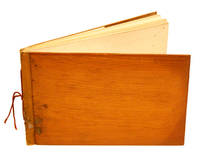
1893607017Lowman & Hanford 1893. First Edition. Wraps. Very Good. A Rare Northwest imprint; this was from the library of noted historian Edmond S. Meaney with his signature to the front pastedown and further inscribed 'From C. T. Conover Seattle Wash.' This copy has been specially bound with a leather spine and two bevelled and varnished wooden boards. 38pp. with 10 b/w plates one panorama shot of the waterfront and one map. Issued as a souvenir for Seattle's guests on the occasion of the celebration commemorating the completion of the Great Northern Railway to its Pacific terminus at Seattle and the inauguration of through traffic June 1893. WorldCat only located 3 copies. [Lowman & Hanford] unknown
19391729691939. INK TRADE CATALOGUE. Kraski. Trest 'Poligraf'. 173 unnumbered leaves of text and illustrations. Vertical 4to 265 x 175 mm publisher's cloth fastened with string. Moscow: Nauchno-issledovatel'skii institut poligraficheskoi i izdatel'skoi tekhniki 1939. The State Trust of the All-Union Economic Council of National Economy "Poligraf" existed since 1924 and produced movable types. They also produced printing inks. In this sample book they are divided by the techniques they were intended for: movable-type printing lithography offset lithography mezzotint. The samples are on different kinds of papers to show the differences for printing. At the end is an overview of complementary mixtures and drying oils including fatty printing pastes to increase the capacity of printed forms. One of 300 copies only. Of the greatest rarity and not listed on OCLC. hardcover
19361714361936. SOVIET TRADE CATALOGUE. Kolbasy i myasokopchenosti. Sausages and smoked meats. Soviet Union. Glavnoe upravlenie miasnoi promyshlennosti. 3 volumes. 1: Livernyye i krovyanyye kolbasy. Liverwurst and Blood Sausages. 32 pp. 1936. 2: Kopchenyye kolbasy. Smoked sausages. 68 pp. 1937. 3. Zil'tsy i studni. Brawns and Aspics. 32 pp. 1937. Illustrated throughout. Oblong 8vo 146 x 214 mm. publisher's blind-stamped wrappers. Moscow; Leningrad: Pishchepromizdat 1936 & 1937. These three surreal homages to the sausage are a modest forerunner to the massive work produced in 1938 by the same publisher. While far smaller the plates each with an individual sausage still have a somewhat surreal quality. While they do not have the avant-garde sensibility of Telingater's ball bearing catalogue or Piet Zwart's wire catalogue these odes to the sausage can certainly lay claim to a place in surrealist literature. These are rare books and are not listed on OCLC. unknown