15 990 résultats
17209An X - 1802. Bound in 8 volumes. 8vo. Seven volumes bound in contemporary half calf, with gilt lettering, contrasting labels with gilt lettering, one volume in modern boards. Under the Bourbon's the controller-general's office had long sought quantative information about the French population and economy. By mid-eighteenth century, it was receiving from the intendant's subdelegates bi-weekly reports of the market prices of grains, bread, vegetables, meat, wool, linen, and iron and from the inspectors of manufactures semiannual reports on the production of woolen, cotton, and linen cloth. From time to time it conducted also special statistical inquiries on mining, metallurgical industries, paper manufactures, tanneries, forests, and hemp and on population (births, marriages and deaths). After many interruptions during the Revolution, the governments of the Directory, the Consulate and Empire intensified this statistical effort. Lucien Bonaparte and Jean Chaptal, Bonaparte's second and third ministers of interior, established the Bureau of Statistics, which lasted until 1812. Under an imaginative minister of interior, Chaptal, and a zealous bureau chief, Alexander de Férrière, it launched a massive statistical description of France in 1801. Prefects of each department were instructed to secure from subprefects, mayors, and local savants and societies of agriculture detailed descriptive (verbal) and quantative data on the topography, population, agriculture, industry, and commerce of their jurisdiction in 1789 and 1801. This was to be a vast cooperative inquiry with a twofold purpose: to discover what change had occured during the Revolution and to establish for 1801 a cross-sectional description of France from which later demographic and economic movement could be measured. However, the reports came in slowly or not at all. Only thirty-five were ultimately submitted, and they were uneven in completeness and accuracy. Contains: Seine-et-Oise, par Garnier. (2), 39, (1) pp. (Perrot 658).Orne, par Lamagdeleine. (2), 56 pp. (Perrot 483).Sarthe par, L.M. Auvray. With 4 folding tables. (2), 254 pp. (Perrot 613).Ille-et-Villaine, par Borie. (2), 56 pp. (Perrot 288).Loire-Inférieure, par J.B. Huet. (2), 70 pp. (Perrot 351).Deux-Sèvres, par Dupin. With 2 folding tables. (2), 177 pp. (Perrot 666).Vendée, par P.L.C. Labretonnière. With 8 folding tables. 130 pp. (Perrot 706).Lot-et-Garonne, par Pieyre fils. (2), 64 pp. (Perrot 365).Gers, par Balguerie (2), 61 pp. (Perrot 256).Tarn, par Lamarque. (2), 101 pp. (Perrot 683).Aude, par Barande. With one folding table. (2), 26 pp. (Perrot 79).Lozère, par Jerphanion. (2), 79 pp. (Perrot 370).Var, par Fauchet. With 3 folding tables. 121 pp. (Perrot 691).Drôme, par Colin. (2), 48 pp. (Perrot 193).Hautes-Alpes, par Bonnaire. (2), 113 pp. (Perrot 32).Mont-Blanc, par Saussay. (2), 126 pp. (Perrot 423).Rhône, par Verninac. With one folding table. (2), 129 pp. (Perrot 566).Allier, par Huguet. (2), 68 pp. (Perrot 20).Cher, par Luçay. (2), 84 pp. (Perrot 149).Aube, par Bruslé. With one folding table. 116 pp. (Perrot 70).Marne, par Bourgeois-Jessant. (2), 129 pp. (Perrot 390).Aisne, par Dauchy. With 13 folding tables. (2), 144 pp. (Perrot 14).Bas-Rhin, par Laumond. 284 pp. (Perrot 536).Vosges, par Desgouttes. With 4 folding tables. 111 pp (lacks the title). (Perrot 723).Vienne, par Cochon. (2), 97 pp. (Perrot 714).
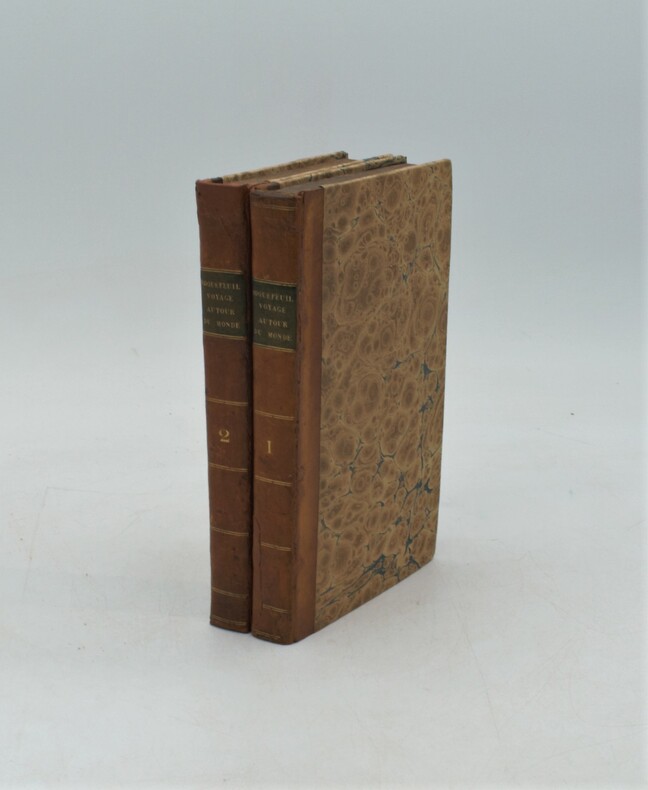
1823PHO-2006Paris, Ponthieu, Lesage, Gide fils, 1823. 2 volumes in-8, xlix, [1]. 344 ; [4], 407 pp., relié demi basane époque, dos lisse orné avec pièce de titre olive et tomaison, ex-libris Jacob Fagel, réparations, quelques rousseurs. Chadenat, n°1196. - Forbes, n°569. - Sabin, n°73149.
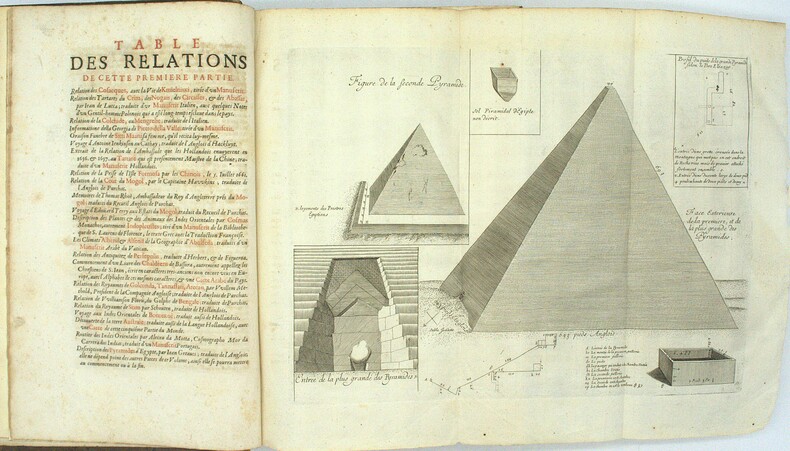
1696PHO-1981Paris, Thomas Moette, 1696 ; 5 parties en 2 vol. in-folio (37x23,5cm), veau marbré, dos à nerfs richement orné de motifs dorés avec tomaison et pièce de titre grenat, quelques frottements, charnières fendillées, manque au dos, coins usés, coiffes absentes, 8 feuillets détachés, rousseurs, qlqs feuillets brunis. L’illustration comporte de nombreuses gravures et illustrations dans et hors texte, 6 cartes dont la carte de l’Indostan, de la Colchide, du Japon (qui regarde l’Amérique), carte de la route du voyage de Canton à Péking, carte de l’Éthiopie, carte de l'Éthiopie ["Entrée de quelques ports…"]. Il manque la Carte de Bassorah, les 2 planches de caractères Chaldéens, la carte de l’Australie, la carte des côtes d’Arabie et d’Asie, la carte des Costes de Sierlionne, la carte des Philippines et Chine, la carte de Chine
46680aafGenève, Jean-Léonard Pellet, 1780 (i.e. April 1781), in-4°, 4 (de 5) front. dont le portrait de l'auteur, avec atlas de 2 ff. + 28 p. + 23 tables dont 12 repl., 50 doubles cartes (num. 1 à 49 plus 17bis), qqs traces d'eau et de lég. taches princip. marginales plus fortes vers la fin du tome 4, belles reliures en veau marbré à nerfs, dos richement ornés en or, pièces de titre et tomaison bordeaux et vertes aux dos, encadrement d'un triple filet doré sur les plats, qqs frottements , tranches marbrées, restaurations professionelles aux reliures.
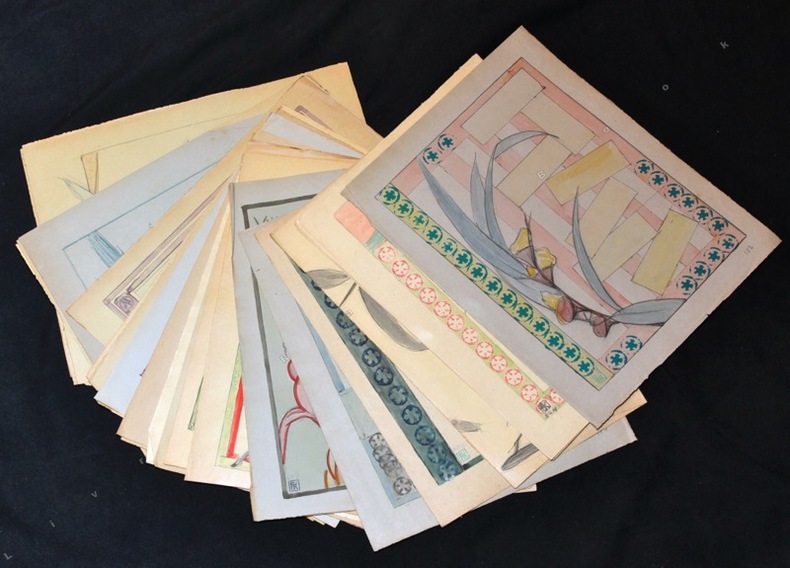
10630[Le Cannet], [1901 - 1927]. Important ensemble de 330 aquarelles, empreintes et dessins originaux d'Auguste Tavel, ayant pour motifs des compositions végétales. La plupart devaient servir pour des menus. Ainsi 74 feuillets sont non seulement décorés, mais ils sont datés, le menu y est inscrit à l'aquarelle, et les noms des invités figurent souvent au verso, avec le plan de table. L'artiste a utilisé des papiers de différentes teintes et textures. Presque chaque feuillet porte le tampon de Tavel. L'ensemble n'est pas relié, mais conservé sous une reliure portant la mention "Roc-Tavel - Menus" au dos et sur le premier plat.
1843WRCAM42012St. Louis 1843. 1p. docketed on verso. Folio. Old fold lines; some separation at folds a few repaired with older archival tape. Quite clean and bright. Good. A remarkable window into the business dealings of famed mountain man Jim Bridger this signed manuscript affidavit of John P. Sarpy testifies to his actions on behalf of the estate of fellow fur trader Henry Fraeb who was killed by Indians in the Rocky Mountains. Sarpy who was a partner in the major firm of Pierre Chouteau & Co. had worked closely with Fraeb and knew him well. In his affidavit he writes about the Chouteau Company's concerns about Jim Bridger Fraeb's partner at the time of his demise and the difficulty of getting Bridger to pay his debts. Dated at St. Louis Sarpy's affidavit states: <br> <br> ".on the 8th day of August last he was appointed.administrator of the estate of Henry Fraeb then lately deceased. Said Fraeb had been a trader in the mountains & was at the time of his death in partnership with a man of the name of James Bridger & said Bridger & Fraeb were indebted to the firm of Pierre Chouteau Jr. & Co. & it was feared by the members of said firm that unless some one became the administrator of the said Fraeb the said Bridger might interpose difficulties in the settlement of the accounts existing between them & Bridger & Fraeb. & for the purpose of doing justice to themselves as well as to the said Fraeb the said Sarpy applied for letters of administration which were granted to him as above mentioned. The said Bridger has however since this time been here & has settled in full the accounts existing between the firm of Pierre Chouteau Jr. & Co. & the said Bridger & Fraeb. And the said Sarpy says that no property has come into his hands as the administrator of the said Fraeb although it may be that the said Fraeb has property in the mountain country or in the hands of James Bridger his former partner." <br> <br> Though he may have been one of the greatest and most beloved mountain men of all time Jim Bridger was not the best debt in the world nor did Pierre Chouteau & Co. forget business. unknown books
184324188St. Louis 1843. 1pp. docketed on verso. Folio. Old fold lines; some separation at folds a few repaired with older archival tape. Quite clean and bright. Good. Jim Bridger's bad debts.<br/> <br/>A remarkable window into the business dealings of famed mountain man Jim Bridger this signed manuscript affidavit of John P. Sarpy testifies to his actions on behalf of the estate of fellow fur trader Henry Fraeb who was killed by Indians in the Rocky Mountains. Sarpy who was a partner in the major firm Pierre Chouteau &. Co. had worked closely with Fraeb and knew him well. In his affidavit he writes about the Chouteau Company's concerns about Jim Bridger Fraeb's partner at the time of his demise and the difficulty of getting Bridger to pay his debts. Dated at St. Louis Sarpy's affidavit says that "on the 8th day of August last he was appointed.administrator of the estate of Henry Fraeb then lately deceased. Said Fraeb had been a trader in the mountains & was at the time of his death in partnership with a man of the name of James Bridger & said Bridger & Fraeb were indebted to the firm of Pierre Chouteau Jr. & Co. & it was feared by the members of said firm that unless some one became the administrator of the said Fraeb the said Bridger might interpose difficulties in the settlement of the accounts existing between them & Bridger & Fraeb. & for the purpose of doing justice to themselves as well as to the said Fraeb the said Sarpy applied for letters of administration which were granted to him as above mentioned. The said Bridger has however since this time been here & has settled in full the accounts existing between the firm of Pierre Chouteau Jr. & Co. & the said Bridger & Fraeb. And the said Sarpy says that no property has come into his hands as the administrator of the said Fraeb although it may be that the said Fraeb has property in the mountain country or in the hands of James Bridger his former partner." Though he may have been one of the greatest and most beloved mountain men of all time Jim Bridger was not the best debt in the world nor did Pierre Chouteau & Co. forget business. unknown books
15440A La Haye, Chez Pierre de Hondt, 1739. Titles printed in red and black, with folding table on two sheets and 1 engraved plate. 6 volumes in 3. (2), 204 pp.; (2), 312 pp.; (2), 208 pp.; (2), 286 pp.; (14), 294 pp.; (18), 246 pp. Small 8vo. Modern overlapping vellum, red morocco labels. Kress 4447; Goldsmiths 7712; Einaudi 3728; INED 1553; Mattioli, 2247; Conlon 39:427; JFBL M162; European Americana, 739/191; not in Sabin. The only edition of this important work. An account of the financial operations of John Law and his 'Compagnie des Indes', including a great number of important memoirs, letters patent, decrees, declarations, etc. Barthélemy Marmont du Hautchamp (1682 - ab. 1760) was an admirer of John Law's system and his book is not written without partiality but has yet been recognized as the best contemporary history of the system and its most precious source. John Law's operations began with the foundation in 1716 of the 'Banque Générale', soon afterwards renamed 'Banque Royale'. This was followed by the scheme of colonization known as 'Mississippi scheme' in the 'Compagnie des Indes' which, by absorbing various other chartered companies, acquired the monopoly on the trade to America, Africa and China. Moreover, the company obtained the monopoly of tobacco, the control of the mint, the payment of the national debt, and the farm of the taxes. Within a few years Law's companies thus got almost complete control over France's overseas trade, its currency and public finances, to the extend that Law's companies at one point owned more than half of the then known United States. In 1719 the 'Compagnie des Indes' and the 'Banque Royale' were united, and the promising outlooks of the new company lead to an unprecedented speculation in its shares. As known the bubble burst in 1720, cash payments were suspended and Law fled from the country, leaving behind ruined many of his former supporters.The last 2 volumes contain the full texts of the 'mémoires', 'letters patentes', 'édits', 'déclarations', 'arrêts', etc., mostly by the Conseil d'État, as well as many other documents of which many are dealing with the 'Compagnie d'Occident', and the 'Compagnie des Indes Orientales et de la Chine', on which documents the author based this thorough and important history.Marmont du Hautchamp was born in Orléans and fermier des domaines in Flanders. He was also the author of the famous and very rare Histoire générale et particulière du visa (also published in The Hague, in 1743) which also dealt with the activities of John Law and the Mississippi bubble.
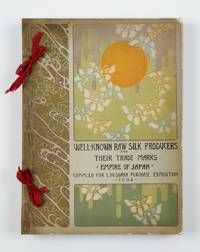
77254Tokio Tokyo The Japan Sericultural Association 1904. Folio 29.6 x 22.0 cm. Preliminary leaf title page xiv advertisements 166 7 ix pp. 144 text illustrations logos of which 142 in colour - mostly in full colour chromolithography a few partly printed in silver. Additional full-colour illustrations in the advertisement sections. Original multi-colour pochoir wrappers with two silk ties. Printed erratum leaf tipped in. = A very rare survey of Japanese silk producers prepared for the 1904 Louisiana Purchase Exposition. In all 144 companies present themselves here each providing a - mostly very colourful - logo often depicting birds as well as various other animals flowers geishas warriors etc. Included is an overview of the silk industry and its history. Between 1850 and 1930 raw silk ranked as the leading export of Japan accounting for 20 per cent to 40 per cent of Japans total exports. Between the 1890s and the 1930s Japanese silk exports quadrupled making Japan the largest silk exporter in the world. "The Louisiana Purchase Exposition informally known as the St. Louis World's Fair was an international exposition held in St. Louis Missouri United States from April 30 to December 1 1904. Local state and federal funds totaling $15 million were used to finance the event. More than 60 countries and 43 of the then 45 American states maintained exhibition spaces at the fair which was attended by nearly 19.7 million people" Wikipedia. It was by far the most important world fair before WWI." The Japanese government spent lavishly: $400000 plus $50000 from the Japanese colonial government of Formosa with an additional $250000 coming from Japanese commercial interests and regional governments". This lavishly illustrated work was not for sale and it seems likely that most copies ended up in governmental libraries. This copy however is not a library copy and apart from some very light wear to the wrappers is in excellent condition. Provenance: inscribed on the front free endpaper William Streuli from Berizzi Bute . One copy in the collection of The Met in New York City and one copy recorded in OCLC in a Danish library. We found only one auction record. unknown
17687223Amsterdam & Paris, Desaint, 1768. Cinq ouvrages en un volume in-8 (195 x 124 mm), IV pp., 162 pp., 3 tables dépl.; 48 pp.(interversion du texte avec le quatrième ouvrage à partir du cahier C); 8 pp.; 8 pp.; un tableau dépl., 147 pp. et 1 p. n. ch.; 2 ff. n. ch., 314 pp., 1 f. n. ch. Veau porphyre, triple filet doré en encadrement sur les plats, dos à nerfs orné de caissons avec pièce d'armes au cerf doré répété, pièces de titre vert foncé et rouge, coupes filetées, tranches marbrées, habiles restaurations (reliure de l’époque).
195421470Paris, Chez Grasset, 1954 ; in-quarto tellière broché, chemise-étui moderne ; 140 pp., [2]ff., couverture granitée jaune rempliée, imprimée en noir et chocolat ; page de titre imprimée en noir et vert printemps.
17640041111764 Avignon, sans nom d’éditeur, 1764. Deux volumes in-quarto (211 X 260 mm) basane fauve marbrée, dos cinq nerfs ornés, caissons ornés aux petits fers, pièces de titre et tomaison maroquin rouge et vert, tranches rouges (reliure de l'époque). Tome I: titre illustré, (4) ff. de titre, avertissement et table des chapitres, 615 pages, (1) page d'errata, 7 cartes et 7 planches hors-texte; Tome II: titre illustré, (4) ff. de titre, avertissement et table des chapitres, 618 pages, (1) page d'errata, 3 cartes et 5 planches hors-texte. Quelques pointes de rousseurs et piqures.
1665PHO-2284Leide, Jacob de Meurs, 1665. In-folio (38x25cm), titre frontispice, portrait, 290pp.-1f-134pp. erreurs de pagination, veau tacheté époque, dos à nerfs orné avec pièce de titre, réparation au dos avec caissons conservés et coins, trou sur la carte, réparations aux feuillets 93 & 188, petit trou de ver en marge, un feuillet (page 59) facsimilé manuscrit ancien, réparation à 1 planches, 2 feuillets renforcés en marge. Illustré d’un titre frontispice, un portrait de Colbert, une carte dépliante, 34 planches doubles et nombreuses vignettes
1818127276London: J. M. Richardson 1818. One of the outstanding exponents of the theory of international trade in the nineteenth century First separate edition of this anonymous tract originally published in The Pamphleteer Volume XII number 23. Arnold Plant declared that "the anonymous author of this tract should take his place with Ricardo J. S. Mill Longfield Mangoldt and Edgeworth as one of the outstanding exponents of the theory of international trade in the nineteenth century. His use of algebraic symbols in setting out the ratios between the quantities of commodities his method of ascertaining from these ratios which of a number of commodities can be most advantageously exported and imported his demonstration that the ratios used may be either those of quantities of different commodities within the same countries or of the same commodities in different countries will bear comparison with for instance Professor Viner's own lucid exposition well over a century later" Plant introduction to 1933 reprinting pp. 40-41. Although the tract was reprinted in the Pamphleteer in the same year it has otherwise left little trace. Octavo 197 x 120 mm. Recent quarter cloth paper label to spine marbled paper sides. Light marking to cloth some very faint scattered foxing else an excellent copy. See Goldsmiths' 22070 for The Pamphleteer. hardcover
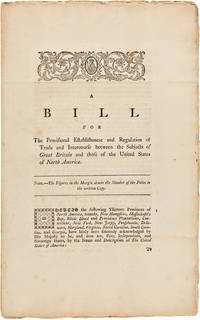
1788WRCAM47396London 1788. Paginations given below. Folio. Four of the titles string-tied as issued. First title lightly foxed and toned. Very good. In a half morocco and marbled boards box spine gilt. An interesting assemblage of British legislation from the period immediately following the Revolutionary War documenting British efforts to allow only very limited trade with the newly independent United States. British trade policy during this period is an excellent example of a foreign power taking advantage of the weak structure of the American Articles of Confederation which made it difficult for the thirteen states to act in concert and out of a any position of strength through unity. <br> <br> By 1783 the United States had formal trade relations with only two nations: France secured through the 1778 Treaty of Amity and Commerce; and the Netherlands via a Commercial Treaty negotiated by John Adams in 1782. Before the Revolution British merchants had relied heavily on exports sent to the British colonies in North America which greatly outweighed goods imported to Britain from the colonies. After the war the British government was reluctant to sign a formal commercial treaty with the United States. The states at the time were operating under the relatively weak structure of the Articles of Confederation and the British felt that they could secure the benefits of trade with the American states without making any treaty concessions. <br> <br> Britain opted instead for a series of acts that established limited trade with the United States and between the United States and Canada and the British colonies in the West Indies. The first of these laws was passed in 1783 and the evolution of that law is reflected in the first three items below. In all these British laws severely circumscribed American trade with England and with English colonies though they did allow some markets for American exports and did facilitate the flow of much needed imports into the United States. In 1784 British exports to the United States were valued at more than £3.5 million while American exports to England were less than one-fifth of that sum. The United States and Great Britain would not sign a formal trade treaty until the Jay Treaty which was approved in 1795 and which gave the United States limited trading rights in the British West Indies. <br> <br> The first second third and fifth titles below were printed in very small numbers for the use of members of Parliament during debate and action on the bills. Known as "slip bills" they are a snapshot of the legislation as it proceeded through the legislative process. The first and fifth titles contain blank spaces in the text where dates and tariff rates would be filled in later and all four of the slip bills have printed docketing on the final page. The first and fifth items also contain a printed note before the text of the bill reading "the figures in the margin denote the Number of the Folios in the written copy" which indicates just how early in the legislative process these bills were printed. <br> <br> The four bills and one act included in this group are: <br> <br> 1 A BILL FOR THE PROVISIONAL ESTABLISHMENT AND REGULATION OF TRADE AND INTERCOURSE BETWEEN THE SUBJECTS OF GREAT BRITAIN AND THOSE OF THE UNITED STATES OF NORTH AMERICA caption title. London. 1783. 31pp. This bill gives the United States the same trading status as other independent sovereign states but restricts American exports to Great Britain only to those goods that are "the growth produce or manufacture of the said United States." It thus forbad the "triangular" trade in which American merchants liked to engage while not imposing the same restriction on British exporters. ESTC locates only five copies. ESTC N32490. BELL G578 ref. <br> <br> 2 A BILL AS AMENDED IN THE COMMITTEE FOR THE PROVISIONAL ESTABLISHMENT AND REGULATION OF TRADE AND INTERCOURSE BETWEEN THE SUBJECTS OF GREAT BRITAIN AND THOSE OF THE UNITED STATES OF NORTH AMERICA caption title. London. 1783. 51pp. This bill expands on and further defines the previous bill clearly spelling out the limitations on American trade with England while imposing no such restrictions on English merchants and in fact making every provision to facilitate British exports to America. ESTC locates six copies. ESTC N32061. <br> <br> 3 A BILL AS AMENDED IN THE COMMITTEE TO WHOM THE SAME WAS RE-COMMITTED FOR THE PROVISIONAL ESTABLISHMENT AND REGULATION OF TRADE AND INTERCOURSE BETWEEN THE SUBJECTS OF GREAT BRITAIN AND THOSE OF THE UNITED STATES OF NORTH AMERICA caption title. London. 1783. 51pp. As with the previous two versions of this bill the language here explains that it would be "highly expedient" to have a trade treaty with the United States but until that point England would make due with legislation regulating Anglo- American commerce. The same restrictive language regarding exports from America is carried over. ESTC locates only five copies. ESTC N32016. <br> <br> 4 AN ACT TO EXTEND THE POWERS OF AN ACT.FOR GIVING HIS MAJESTY CERTAIN POWERS FOR THE BETTER CARRYING ON TRADE AND COMMERCE BETWEEN THE SUBJECTS OF HIS MAJESTY'S DOMINIONS AND THE INHABITANTS OF THE UNITED STATES OF AMERICA TO THE TRADE AND COMMERCE OF THIS KINGDOM WITH THE BRITISH COLONIES AND PLANTATIONS IN AMERICA.caption title. London: Printed by Charles Eyre and William Strahan 1784. 2715-716pp. This law specifically relates to British exports of iron hemp and sail cloth from the Baltic states to the United States. ESTC locates only three copies. ESTC N58431. BELL G585. <br> <br> 5 A BILL FOR REGULATING THE TRADE BETWEEN THE SUBJECTS OF HIS MAJESTY'S COLONIES AND PLANTATIONS IN NORTH AMERICA AND IN THE WEST INDIA ISLANDS AND THE COUNTRIES BELONGING TO THE UNITED STATES OF AMERICA; AND BETWEEN HIS MAJESTY'S SAID SUBJECTS AND THE FOREIGN ISLANDS IN THE WEST INDIES caption title. London. 1788. 91pp. This bill essentially prohibits American trade with Britain's colonies in the West Indies and prohibits American exports to Canada as well. The sole exemption is with regard to salt from the Turks Islands a product the English wanted to encourage. The bill allows American ships to receive salt on the islands. It also limits exports from the West Indies to America on such goods as sugar molasses coffee etc. to British ships only. ESTC locates only four copies. ESTC T201245. RAGATZ p.95. BELL G618 ref. <br> <br> An important group of rare working drafts of British legislation. hardcover books
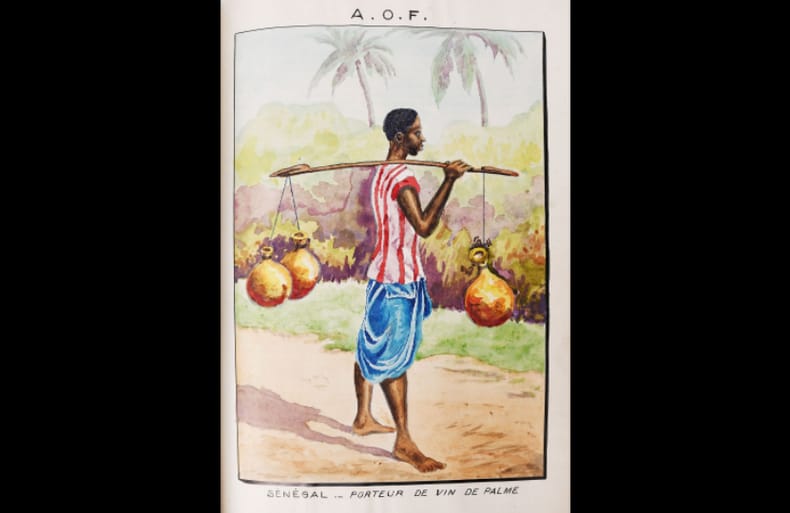
193823642Sans lieu, sans nom, 1938. Fort in-4 (21 x 30 cm) maroquin marron, premier plat orné des lettres dorées A. O. F. dans un contour dessinant l'Afrique de l'Ouest avec petit décor d'instruments de musique, dos à nerfs avec filets dorés, plats et doublures de maroquin marron, chemise de maroquin marron à bandes doublée de suédine de couleur noisette, étui bordé. 662 pages.
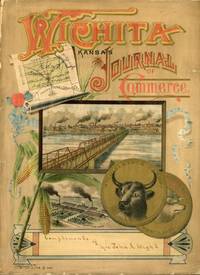
188854232Wichita Kansas: Eagle Printing House 1888. 1888. KANSAS. First edition.4to. Original color pictorial wrappers 92 pp. introduction numerous illustrations numerous advertisements mostly printed in double column. This promotional publication by the Wichita Board of Trade was published to counter the "malignant attacks" conducted by "powerful newspapers all over the country" who have "deliberately leveled their batteries at Wichita." The promotional contains an historical overview of Wichita in the cattle trade information on crops and capabilities of Kansas and calls Wichita "The Southwestern Metropolis." Illustrations include street cars telegrams churches private residences and schools. Containing also a directory of wholesale business information on Wichita's railroads and railway connections lists of industrial enterprises the meat packing centers the livestock market and information on taxes and building enterprises. In addition there are numerous advertisements for various businesses in Wichita. Light cosmetic touch-up to the spine and extremities by a master paper conservator else an attractive informational and scarce promotional for Wichita. Housed in a quarter leather and color decorated boards with raised bands and titles stamped in gilt on the spine. Not in Adams Herd. Not in Graff Eberstadt or Howes. OCLC locating only three copies. Considered to be very scarce with only a few known surviving copies. Eagle Printing House, 1888. hardcover
17699La Haye, Jean Neaulme, 1720. In-12, [8]-187-[19] pp. 1 pl., veau marbré fauve de l'époque, triple filet doré en encadrement sur les plats cantonnés de fleurons dorés, dos lisse orné de caissons et fleurons dorés, pièce de titre rouge, tranches dorées (coiffe arasée, mors fendus, épidermures, quelques rousseurs, dernier cahier relié dans le désordre).
1609PHO-11431 volume in-folio (33 x 23 cm), vélin rigide parchemin (reliure de l'époque), dos lisse titré à l'encre, nombreuses écritures manuscrites sur les plats, 5 à 53-[1] feuillets. Page de titre, 3 premiers feuillets et feuillets 51 et 52 manquants, charnière fendue ,mouillure sur 5 ff et manque de papier en marge , galerie de vers avec manque. Seconde édition française, illustrée de 55 gravures sur bois in-texte.
1798PHO-1092Deuxième reliure de la première édition. Édition originale in-4 sur grand papier, remise en circulation en 1841 avec un nouveau titre avec la mention fictive "nouvelle édition" (quelques exemplaires imprimés en 1798 n'avaient toujours pas trouvé preneur). Une édition octavo en six volumes a également été publiée. in-4 ,y compris l'atlas. Avec 16 (10 dépliantes) dont 15 cartes gravées, 1 planche gravée et table dépliante. - Beau demi-cuir contemp , dos lisse avec titre et tomaison , petits manques au dos , quelques mouillures intermittentes et vieille trace d’humidité (T1), déchirure carte hydrographique sans manque. xii, cxliv, 628, [3] ; xvi, 676, [2] ;[xi], 431, [1];[2],viii, 158pp.
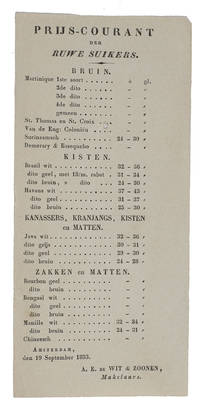
1721LC4D1MQ3QGJ6Amsterdam 1721. 1 leaf 21 x 8 cm; 1 leaf 20.5 x 8 cm; 1 leaf 17.5 x 8 cm. Jacobus van Egmond Ad 1: Text printed on both sides each in a border built up from typographic ornaments. Ad 2: Text printed on one side. Ad 3: Text printed on one side. 3 documents. Ad. 1: Rare VOC ships manifest for cargo shipped from the East Indies - Batavia and Ceylon Sri Lanka - on 22 East-Indiamen sailing on 1 December 1720 from Batavia and on 15 November from Ceylon. The list includes more than 100 different colonial wares and gives the weights in pounds or the lengths in feet: from pepper more than 6.5 million pounds cloves 694000 pounds cinnamon 604000 pounds and coffee more than 1.77 million pounds to 962 pounds of Javanese cardamom some jewels and rariora and many feet of silk and linen cloth. Small wormhole affecting two characters otherwise in good condition.Ad. 2: Rare list of the results of the auctions of colonial wares organized in 1781 by the Chambers of the VOC Amsterdam 30 April 1781; Zeeland 7 May; Delft 15 May; Rotterdam 17 May; Hoorn 22 May; Enkhuizen 23 May including pepper cinnamon nutmeg etc. with the prices fetched. With a small tear not affecting the text. Still in good condition.Ad. 3: Price list of the various varieties of raw sugar: brown sugar from Martinique Surinam etc.; sugar packed in chests from Brazil Havana; in bales from Bengal Manilla etc.Small hole not affecting the text.l Ad. 1: cf. Landwehr VOC 1123-1134 other manifests. hardcover
1870WRCAM55334Osage Mission Ks 1870. Hand-drawn and hand-painted watercolor sign on a 14 x 18 3/4-inch sheet of cardstock. Pencil sketch for the same sign on the verso. Small chips at lower corners some light soiling. Very good. A remarkable and very attractive handmade sign for D.B. Gregory's livery stable in Osage Mission Kansas. Undated the style of the sign suggests a date of the 1870s. The center of the sign shows a lovely illustration in profile of a horse pulling a single-rider four-wheeled carriage along a dirt road. The text above the illustration reads "D.B. Gregory & Co." and below: "Livery & Sale Stables / Best Stock / Horse & Buggies / Main Bet. County & Neosho Strs. / Osage Mission Kan." The lettering is in black with blue and purple shadowing and "Osage Mission Kan." is drawn in a very ornate style. The entire sign is decorated with purple watercolor ornamentation. On the verso is a pencil sketch of the horse and the lower half of the carriage likely a preliminary sketch for the finished illustration. <br> <br> David B. Gregory born in 1846 in Iowa established his livery business with his brother in Osage Mission now St. Paul Neosho County Kansas by the early 1870s. An advertisement in the March 23 1873 issue of the OSAGE MISSION TRANSCRIPT describes Gregory's livery as having a "fine and well selected stock of horses and carriages.the best matched teams for style and speed in the city. Saddle horses for ladies and gents a specialty that defy competition." Settlers came to the region around Osage Mission in the 1840s following the founding of nearby Fort Scott in 1842. Osage Mission itself was founded in 1847 by Father John Schoenmakers as a mission to local Indian tribes and then grew into a town in its own right serving as a trading post and gateway for commerce and westward exploration. By the late 1860s it had grown to nearly 900 people with a hotel boarding house saloon stables general store hardware store and blacksmith. <br> <br> A rare significant and informative survival from the American frontier. unknown books
18052612Leipzig: E. Z. Steinacker 1805. 3 parts small oblong 4to 178 x 219 mm. 20; 18; "19" recte 20 pp. Each part with half-title only titles supplied on the wrappers. 12 plates of oval hand-colored tinted aquatints by Geissler. Occasional light foxing to text. Publisher's original pale green printed wrappers some wear and creasing sewing loose in part 1.Only Edition a high spot of nineteenth-century German book illustration a fine copy in the rare original wrappers. In impressionistic prose an anonymous author delivers a dozen diverting vignettes of salesmen and their customers at the annual Leipzig trade fair weaving stories around Geissler's masterly hand-colored aquatints. This delightful suite was issued in parts published to coincide with the two 1804 Leipzig fairs at Easter and Michaelmas and the 1805 Easter fair. Together Geissler's aquatints and the text portray fortunetellers a peep show and its barker performing jugglers and musicians Russian dancers Transylvanian and Greek merchants in their native dress shoemakers Jewish clothing vendors processions of horses for sale horse traders and peddlers and fraudsters of every ilk. One of the oldest trade fairs in Europe by the eighteenth century the Leipzig fair had become the main venue for trade with Eastern Europe a perfect artistic subject for Geissler who had spent most of his twenties traveling through Russia and the Ukraine.Geissler's first subject part 1 Scene 1 is a second-hand bookseller. Surrounded by trunks of dusty books and pictures this poorly dressed oddball is a master of patter. His efforts to sell two popular 17th-century prayerbooks Arndt's Paradies-Gärtlein and Michael Cubach's Gebetbuch to a couple of wary customers is rendered verbatim. Other than the fact that the books are recommended for their usefulness the tactics of persuasion have not changed in two centuries. Meanwhile in the background two street urchins "two sons of the Vorstadt poorer outlying areas of town from the Order of the Barefoot" steal a defective copy of a red-bound issue of the Taschenbuch "wishing to return it to precisely the place mentioned in the title" i.e. their pockets. A poor book collector arrives; he is granted credit. This inimitable scene is completed by two more characters a French emigré hoping to find a "La Fontainesque novel" for a few pennies and a poet for hire shown from the back in the aquatint whose tragi-comic portraits are gleaned from their clothing hairstyles and gestures as rendered by Geissler.Equally astute and moving are the portraits of Russians and Eastern Europeans who appear in five scenes. In the final chapter in part 2 the anonymous author - an "unnamed Leipzig man of letters a friend of Geissler's who worked for a Modemagazin fashion magazine probably Baumgartner's" Wustmann p. 23 - quotes Geissler's own description of the wild Russian dancing and singing of the last night of the fair in a moving paean to Slavic soulfullness sharply contrasted with Germanic stiffness.The son of a Leipzig goldsmith and mineral dealer Geissler had trained at the Art Academy there but his major influence was the illustrator Johann Salomo Richter from whom he learned the taste for hand-colored aquatint portraits of the common people and genre scenes of everyday life. Geissler spent 1790 to 1798 in Russia serving as the expedition artist with the German scientist Peter Simon Pallas on his travels in the Caucasus and southern Russia. On his return to Leipzig Geissler published the Pallas works as well as his own illustrated accounts of Russian customs and costumes. Creatively gifted Geissler was also skilled at marketing his works. He established close relations with Leipzig publishers for whom he produced numerous children's books. The present "Scenes from the Leipzig Fair" was his most important publication during the period between his return from Russia and the Napoleonic wars. He later produced illustrated reportages of the Battle of the Nations Völkerschlacht in Leipzig and individual war images for newspapers almanacs and even peep shows. In the US OCLC locates copies at Brown Rice University and University of Wisconsin. Lipperheide 828 DfG 5; G. Wustmann C. G. H. Geissler der Zeichner der Völkerschlacht Leipzig 1912 pp. 23-24 and 115 note 24;; Rümann Die illustrierten deutschen Bücher des 19. Jahrhunderts 1926 504; Thieme Becker 13:351-2. E. Z. Steinacker unknown books
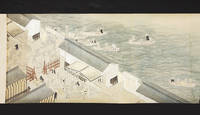
5736Japan: late Edo. Until the late 17th century the Chinese had been permitted to move in Japan quite freely for trading purposes. But in 1689 due to the rise of smuggling activities the Chinese were restricted like the Dutch to a compound on the eastern tip of Nagasaki - called the "Tojin yashiki" "Chinamen's mansions" - surrounded by a moat and walls with gates which could be locked from the outside. Inside were housed on average 2000 Chinese merchants and sailors along with interpreters inspectors and staff. This scroll depicts two large Chinese ships just off Nagasaki surrounded by a number of smaller transport and supply ships. It is clear that these smaller ships are Japanese based on the clothes the crewmen are wearing. The numerous Japanese government officials are dressed in black robes; they are inspecting the arriving goods sugar raw silk and finished fabrics along with antiques. The final section of the scroll depicts a portion of Tojin yashiki. We see the arriving transport ships warehouses government workers inspecting the arriving goods laborers carrying goods etc. This scroll - based on a scroll at the City Museum of Kobe entitled "Nagasaki tokan koeki zukan" - is unfinished in several ways: it has not been fully colored and it is clearly incomplete at the end. Nevertheless this is a marvelous record of the early trading days in Japan with the outside world. Minor worming carefully repaired otherwise in fine condition. hardcover books
193019955Leicester UK: Cascelloid ca. 1930s. Very good . Oblong 4to. album. Blue leather-covered boards. Contains 29 color photographs all 9" by 6.5" approx. mounted on rectos one each of light-gray cardboard leaves. About very good plus overall. Moderate rubbing and edgewear to boards. Several pages display mild soiling and offsetting from photos. Prints just a bit yellowed but remain sharp vivid and clean. <br/><br/>Beautifully-produced trade catalogue from the Cascelloid "Palitoy" company displaying a wide range of baby dolls and other toys. Several uncomfortable designs of black children with pitch-dark skin date this catalogue at roughly the 1930s when the Cascelloid company was dubbed the "House of Constant Progress" by the industry press for its material innovations with the plastics Bexoid and Plastex. One page features a celluoid model by the noted designer Mary Lucie Attwell a doll named "Diddums." The catalogue also displays the company's offerings of animal dolls die-cast trucks pool toys golf and ping-pong sets rattles pinwheels and more. Needless to say color photography was not the norm at this time and this catalogue comprises a beautiful set of vivid and sharp photographic prints. A truly exceptional example unlike anything we've seen: simultaneously surreal and nostalgic. [Cascelloid] hardcover books