Leonardus Lessius .Livre Rare Book
15 993 résultats
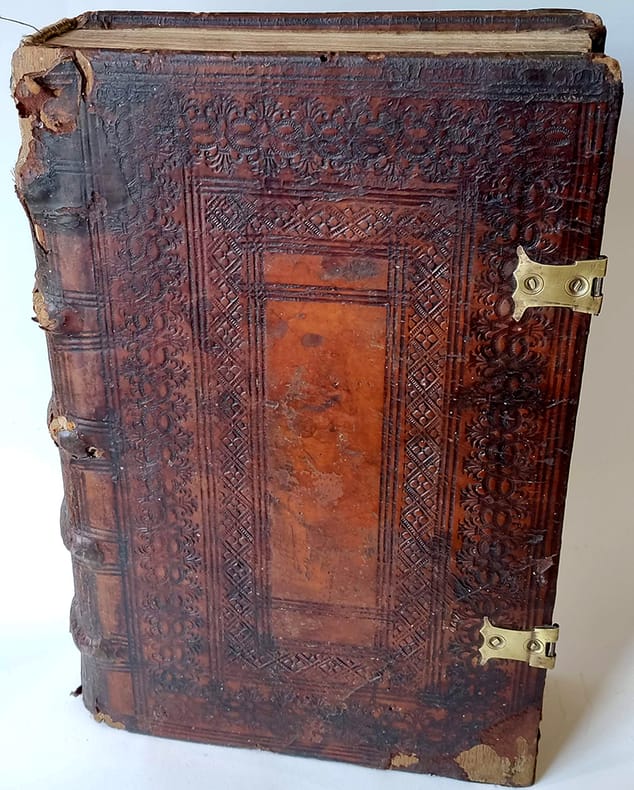
16666Ex officina Plantiniana Balthasaris Moreti "Anvers, 1626, in-folio, plein veau sur ais de bois décoré à froid, dos à cinq nerfs, restes de fermoir en laiton et de coins. Reliure de l’époque. Manque en haut du dos (de la coiffe au premier nerf) ; manque de cuir de recouvrement au coin inférieur droit du premier plat. Quelques petits manques sur les nerfs. Petit trou de vers sur les 15 premiers feuillets avec perte de quelques lettres. Mouillure très claire dans l’angle supérieur de quelques feuillets sinon intérieur propre et sain. 8ff. (dont le titre-frontispice) 825pp.-34ff. d’index-2ff. bl. Texte sur deux colonnes. Frontispice allégorique d’après Pierre Paul Rubens, gravé par Cornelis Galle (331mmx202m). Ce frontispice apparait pour la première fois avec la quatrième édition de cet ouvrage en 1617. Titre écrit dans un ovale de laurier, flanqué de personnifications féminines du sage gouvernement et de l'abondance ; La Justice assise en haut au centre entre un lion et une balance ; au-dessous du titre se trouvent un satyre et un homme aux yeux. La première édition du De Justitia est publiée à Louvain en 1605 et connaitra une vingtaine d’éditions au XVIIe siècle. Lessius est en effet le premier théologien à se pencher sérieusement sur les problèmes moraux liés à l’économie de marché et la finance. « Cette oeuvre a joué un rôle primordial dans l’histoire du droit des obligations. Plus d’une fois le prétendu fondateur du droit naturel moderne, le hollandais Hugo Grotius, se borne à donner une simple synthèse dans son Du droit de la guerre et de la paix (De iure belli ac pacis) de ce qu’il a lu dans le De iustitia et iure de Lessius, au point même d’en copier les fausses références. Pour la rédaction de son traité, Lessius fut lui-même fortement inspiré par un collègue un peu plus âgé originaire de Cuenca, Ludovic Molina (1535-1600). Ludovic Molina fut le premier jésuite à adopter le modèle du De iustitia et iure pour aborder toutes les questions juridiques concernant la propriété, les actes illicites, les contrats, les testaments, les taxes, les bénéfices ecclésiastiques, les règles monastiques etc. » (Le droit au creuset de la théologie morale Wim Decock) Provenance : Fr. Iacobivanden Berghe tertii Ordinis St. Francisci Conventus Antverpiensis filii (ex-libris manuscrit au reco du second plat.) Décédé à Anvers le 19 février 1685. Backer-Sommervogel Bibliothèque de la compagnie de Jésus T.IV-1729, N°5 / Basan, Catalogue des estampes d’après P.P. Rubens, p.178 N°30 / Judson & Van de Velde (Corpus Rubenianum XXI), 38. "
15962Chez Jean-Edme Dufour, imprimeur et libraire "A Maestricht, 1775, 7 vol. in-8 veau tacheté, dos rond sans nerf. Dos encadré d'un double filet doré, roulettes et fleurons ""soleil"" dorés. Reliure de l'époque. T.I 1f.-Frontispice-1f. De titre-3pp. Explication des estampes-Portrait de Raynal-VIIIpp.-carte-439pp (dernière chiffrée 437 par erreur) // T.II Xpp.-frontispice-carte-316pp. // T.III XIIpp.-frontispice-carte-440pp. // T.IV VIII-frontispice-carte-301pp. // T.V VIII-frontispice-carte-296pp. // T.VI VIII-fontispice-carte-287pp. // T.VII VIII-frontispice-carte-326pp. Cohen 854 (qui indique par erreur 8 vol. Tous les volumes sont par ailleurs à la date de 1775 et non 1774-1775). Tous les volumes sont à l'adresse de Maestricht, y compris le vol.V contrairement à ce qu'indique Bancarel. Exemplaire bien complet des 7 figures par Eisen non signées reproduisant celles de l'édition de Gosse fils (La Haye 1774), du portrait et des 7 cartes dépliantes dressées par Bonne. Véritable ""encyclopédie du décolonialisme"", cet ouvrage initialement publié anonymement en 1770 connu près d'une cinquantaine d'édition jusqu'en 1843. Raynal revendique la paternité de l'ouvrage à partir de la troisième édition en 1780, son nom apparaissant sous le portrait. L'ouvrage fut condamné par la censure civile et ecclésiastique et brulé en place publique. Raynal fut également comdamné à l'exil. Il faut néanmoins relativiser la part de Raynal dans la rédaction de l'ouvrage puisque la partie philosophique, quand elle n'est pas de la main de Diderot, est largement empruntée au Baron D'Holbach, à Naigeon et Péchmeja. Pour ce qui concerne le commerce, Raynal a inséré des mémoires du fermier général Paulze, des comtes d'Aranda et de Souza. Cette Histoire des deux Indes constitue l'un des plus virulent réquisitoire contre l'esclavage à l'époque des Lumière. Quelques coins frottés, tout petit manque de cuir à un mors du T.VI sinon très bel exemplaire en fine reliure de l'époque. Cette édition ne comporte pas d'atlas et est complète telle que décrite."
1737EANmoFRA36London: Sold by J. and P.Knapton E.Symon and J.Stagg 1737. 1737. 8vo. pp. 1 p.l. viii ie. xvi 120 ie. 240 1. French & English text on opposite pages with duplicate pagination. woodcut title vignette ornaments & initials. contemporary calf bit rubbed occasional light foxing short tear to outer margin of B7 - no loss. armorial bookplate of Sir Richard Neave. First Edition. The first memorial pp. 1-20 concerns the Guinea Company the commerce of the French colonies in America the state of the French West Indian islands Martinique Sainte Croix Saint Domingue &c. and the means of preserving and extending trade there. Included are remarks on restricting some branches of commerce to certain ports exclusive companies and farms of certain commodities particularly tobacco and sugar. Goldsmiths' 7461. Kress 4346. Sabin 47744 title from a bookseller's catalogue. F. London: Sold by J. and P.Knapton, E.Symon, and J.Stagg, 1737. unknown
2020__1108495427Cambridge University Press 2020. 6 Hardback books. New. 1st edition. 4800 pages. 10.00x10.00x6.25 inches. Cambridge University Press hardcover
Paris, chez Giraud-Badin, 1924-1928. 29 volumes petits in-4, brochés. ENSEMBLE EN PARFAIT ETAT. COMMERCE, revue littéraire fondée en 1924 par Marguerite Caetani, se présente sous la forme de vingt-neuf « cahiers trimestriels publiés par les soins de Paul Valéry, Léon-Paul Fargue et Valéry Larbaud ". Elle s’inscrit magistralement dans le champ concurrentiel des revues des années vingt. Commerce joue un rôle de « découvreur » important, s’ouvre au meilleur des auteurs étrangers de son temps et redécouvre des anciens textes capitaux : par son esprit « classique moderne », Commerce réinvente l’héritage classique. elle publie vingt-neuf numéros entre 1924 et 1932. Jean Paulhan participe aussi à sa rédaction. Elle propose en son premier numéro les premiers extraits traduits en français d'Ulysse de James Joyce. Textes de Louis ARAGON, Antonin ARTAUD, André BRETON, Paul CLAUDEL, Pierre DRIEU LA ROCHELLE, T.S. ELIOT, Léon-Paul FARGUE, André GIDE, Thomas HARDY, Max JACOB, James JOYCE, Valéry LARBAUX, Henri MICHAUX, SAINT-JOHN PERSE, Francis PONGE, RIBEMONT-DESSAIGNE, Rainer Maria RILKE, Jacques RIVIERE André SUAREZ, Jules SUPERVIELLE, Paul VALERY, Roger VITRAC. Un certain nombre de textes, comme « Colline » de GIONO et « Nadja » de BRETON y sont parus en pré-originale. Tirage numéroté sur alfa. Founded in 1924, Commerce is a literary review which discovers new talent, welcomes the best of contemporary foreign writing, and rediscovers seminal texts from earlier eras : with its take on the ‘modern classic’, Commerce seeks to reinvent traditional literary history".
1781704313Göttingen, Victorinus Bossiegel, 1781. Kl.-8°. Gestoch. Frontispitz, gest. Titelvign., 7(2 gef.) Kupfertaf., 9 Bl., 136 Seiten. Schlichter Pappband der Zeit mit kleinem Rückenschild.
1965015774Veilhes G.P. [Gaston Puel] 1965 In-12 En feuilles, couverture à rabats <
47179Richard/Caille/Ravier.An VII de la république.2 vols,petits in-8,formats à l'italienne.388 et 482 p.avec Tables. Intérieurs frais.Reliures d'époque avec pièces de titre et tomaison.Tranches rouges.Coins émoussés dans le Tome 2.Coiffes absentes ou usagées.Tome 1: mors inférieurs ouverts.
Features: X for Escape - Photo-illustrated article (part 1 of 2) by Flt.-Lieut. Tony Pengelly describes the dramatic Great Escape from Luft Stalag III involving 83 prisoners, 50 of whom were later shot - basis for the classic WWII film The Great Escape starring Steve McQueen; Nice cover illustration by R. York Wilson features brass band practicing; W.A. Irwin becomes new Editor of Maclean's - photo and brief article; Relax - It's Good for You; Bee Business - Ervin Hogarth has 150 bees near Tara, Ontario; Mars Gone Barmy - Maj.-Gen. J.F.C. Fuller argues atomic war cannot be won; Where Milk is Medicine - Europe's lack of food in the aftermath of WWII; Britian's Place in the World; Washington Memo - U.S. Strikers want to keep war wages (52 for 40 or Fight!); Backstage Ottawa - NRMA men (Zombies) were sent to the First Canadian Division on or after VE Day; Is the Union Shop Democratic? - arguments for and against; Sculptors Elizabeth Wyn Wood and Mani Hahn - Photo-illustrated article; "When the Ice-Worms Nest Again" - Brief article discussing Robert Service; Stretch the Meat; and more. Short stories include: Molly Was a Doctor; White Horse; Soft Music. Nice ads for: The Wartime Prices and Trade Board (encouraging the mending of clothes); Imperial Oil (featuring oil exploration); Frigidaire, Kraft Philadelphia Cream Cheese; Canadian Pacific (color illustration of driving of the last spike to celebrate 60 years of progress, 1885-1945); Pepsodent Tooth Paste; Eveready Flashlight Batteries - featuring image of Vancouver radio personality Thora Anders; Arrid deodorant - featuring photo of Gertrude Niesen; Nostalgic one-page Maclean's subscription ad; National War Finance Committee; Nice colour-photo Caterpillar Diesel ad inside back cover features two dozers preparing new rail bed through mountains. 68 pages. Unmarked with average wear. A quality copy of this historic vintage issue. Book
417 pages. Index. Appendices. Footnotes. List of sixty black and white illustrations. A rare surviving copy of this important reference, made all the more engaging by today's environment of competing fiat currency devaluations. "Hitherto Numismatists when stydying the Origines of Coinage had confined themselves to the materials presented to them in the earliest money of Lydia, Greece and Italy, and on the other hand the Metrologists had almost completely limited their range of observation to the systems of Babylon, Egypt, Greece and Rome. As the Comparative Method has yielded such excellent results in the study of other human institutions, I have endeavoured by its aid to get some new principles which may throw some fresh light on the first beginnings of monetary and weight systems." - from Preface. Attractive gilt decoration upon green front board. Legible gilt lettering upon backstrip. Average external soiling and wear. Several chips from and lengthy openings along backstrip which has become brittle with age. Narrow opening along most of front hinge. Back hinge open. Bookplate discretely removed inside front board. Unmarked. A tender but worthy copy. Book
1713PHO-1341A Paris, Chez Pierre Ribou et Rouen chez Jean Baptiste Machuel (tome 5), 1713. 6 volumes in-12, relié plein veau époque, dos à nerfs orné avec pièce de titre et tomaison, tranches marbrées, Tome 5, reliure légèrement différent avec tranches rouges, coins et coiffes usés .T1,27p-501p-1f(table); T2, 1f-465-1f (table);T3 ,1f-402-3f(table);T4,1f-367-2f(table);T5 ,3f(titre, épître)-467-2f(table),T6 3f(titre, épitre)244 -2f (table) .Illustré de 63 planches la plupart repliées, dont un portrait et 3 grandes cartes (manque la carte du Japon) ; quelques vignettes dans le texte , quelques planches au tome 5 volantes, 1 planche doublée.
P., Firmin Didot, 1818. Deux volumes in-4 reliés demi basane (reliure d'époque), dos longs ornés, plats de papier vert, coins vélin, gardes blanches, tranches mouchetées, frontispice (armoiries des Etats de Languedoc)-XIX-584 pages-5 cartes et plans dépliants ; frontispice (armoiries de Carcassonne, Narbonne, Castelnaudary et Limoux)-VIII-carte en couleur dépliante du département de l'Aude-679 pages-5 plans et cartes. Carte du Canal des Deux Mers sous les murs de Carcassonne, plan et élévation du pont de Marengo, plan et élévation du pont aqueduc de Fresquel,carte du canal et de la Robine de Narbonne, tableau synoptique du Canal du Midi ; Vue de Carcassonne, plan de l'ancienne cité de Carcassonne, vue de Castelnaudary, vue de Narbonne romaine, vue de Narbonne. Quelques frottements sur les plats, un début de fente à un mors inférieur au tome 1. Bel et agréable exemplaire dans sa reliure d'époque. L'ascension de C-J. Trouvé est tout d'abord liée à l'Empire, dont il sera baron en 1809, puis sa carrière se poursuit sous la Restauration avec Charles X. Il a été préfet de l'Aude de 1803 à 1816. En 1807 il organise un important recensement de la population et de l'agriculture puis des enquêtes sur l'industrie et l'enseignement . Son ouvrage donne un large panorama du département tant du point de vue de la population que des activités, de l'enseignement, des contributions.
15890A Paris, Chez Moutardier, Cerioux, (an) 8 (1799-1800). With 2 engraved plates. 2 volumes. (2), 8, 368 pp.; (2), 356 (last page misnumbered 561) pp. 8vo. Contemporary half calf, corners, green and red labels with gilt lettering. Not in Musset-Pathay; not in Kress; not in Goldsmiths; Einaudi 6099 (for the English edition). First French edition. Mainly devoted to agriculture, but also supplying useful information on population, commerce, industry. The first English edition appeared in 1780. The additional Recherches by the translator cover the pages 83-end of volume 2. For the period before 1790 the travel accounts as given by Young form an important part of the economic literature, owing to the absence of regular reporting by permanent agencies: see at length: Schumpeter, History of economic analysis. - With an engraved bookplate on the front paste-down of each volume. Copy from the library of Edmond Vallée, with his small owner's stamp on flyleaves.
2081002109001333Kyushu Mining Association N.A. Soft Cover. Fine. Number of pages: 372p Size: 27cm Kyushu Mining Association paperback
Cádiz, en la Real de Marina, y Real Audiencia de Contratación de D. Manuel Espinosa de los Monteros, 1762, 20,5 x 14,5 cm., piel de época, lomo cuajado, 158 págs., incluso varias figuras intercaladas y dos grabados xilográficos de una nave al comienzo de cada parte. (Ejemplar con taladro de insecto marginal en 19 hojas, sin afectar al texto. El nombre del autor de esta obra figura al fin de la última hoja).
Very Good Turkish Original working fisches, notes, their envelopes and trimmed advertisements collection (most of ads. are photocopy). Some of them are unpublished, some is used for his articles and his book 'From Pera to Beyoglu' as sources. Apprx. 350 papers in 3 modern files. Selected contents: (All notes contains 1840-1950 years). Restaurants of Istanbul in the 19th and early 20th centuries, food types, their menus, prices, discount days, special programs, their chefs and managers; hotels, accommodation prices; music shops and their owners and founders; buildings, architects; patisseries; cinemas, their history, matinees of the movies, ticket prices; every non-Muslim shops and tradesmen of Pera; their old and new addresses; booksellers, antique shops; and everything on social life of Pera - Galata area which are shedding light on the social history of Istanbul in its period like that first coming of circus, fires... The notes mostly have sources with their abbreviations and sources are some journals, periodicals in its period and selections from literature.
42 volumes, orig. uniform cloth. "The aim of this series is to provide access to contemporary sources for the history of English publishing and bookselling, including controversy over copyright legislation and freedom of the press, from the Restoration through the early nineteenth century. To this end, we have gathered from libraries in Great Britain and the United States a comprehensive working collection of pamphlets, broadsides and memoirs, amounting to 156 individual titles, reprinted in forty-two volumes".?Introduction.
The board (300 x 320 mm) features four examples of spines (230 x 45 mm), the whole backed with marbled paper to represent the endpapers (corners rubbed), at the head of the board is a large black morocco label with a gilt boarder entitled "Specimens of Bookbindings", plus three additional separate models of spines. This has the appearance of being dated to the 1890's with the titles on the dummy samples being of Dickens novels and periodicals (i.e. Strand Magazine, Sunday at Home, etc.). However, the sample "Stand Magazine" is lettered Jan.-June 1921.
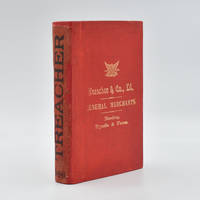
190621209251906. Mumbai: The Times Press. 1906. 8vo. Publisher's red cloth upper board lettered in gilt spine lettered in black; advertisements to pastedowns; pp. x iv xxi 1 blank '800' i.e. 802 xi-xviii continued pagination from advertisements at front free endpapers included in pagination; pp. ii-x and xi-xvii printed on pink paper numerous lithographic in-text illustrations throughout p. iv printed in pink 23 ff. plates of which 6 on pink paper 9 in colour and 2 double-page pp. 352-530 'Jewellery and Hall-Marked Goods' printed on thick paper; rebacked with original spine laid down plate facing p. 732 with two central closed cuts browning to 2 ff. tipped-in advertisements after p. 330; a very good copy; contemporary manuscript corrections to p. i. An extensively illustrated and very rare Mumbai-printed trade catalogue advertising goods for the British market in India encompassing an extraordinary range of products from gunpowder to soap and everything in between with numerous coloured plates.Treacher & Co. were a prominent British-run firm operating as merchants druggists and chemists based in Bombay Mumbai and Poona Pune during the late nineteenth and early twentieth centuries. This extensive catalogue presents a vivid picture of colonial consumption and supply advertising an exhaustive array of merchandise including toiletries; crockery; agricultural machinery and flower and vegetable seeds; pipes; sporting equipment and 'Gymkhana kit' including Brooks' bicycle saddles for both men and women bicycle pumps dumbbells and Sandow's Obesity Reducer and Sandow's Combined Developer; alcoholic drinks as well as 'Sparklet's' carbonation tablets and 'Seltzogenes for the production of sodawater lemonade gingerade &c.'; parlour games including board games billiards roulettes and table bowls; cameras; books and medical remedies; jewellery; and more. The catalogue features numerous plates many chromolithographic or printed on coloured paper advertising china sets gunpowder biscuits tar and vinolia soaps California poppy perfumes Windsor & Newton's paints and hair lotions inter alia. A contemporary owner has corrected in manuscript the names of two of Treacher & Co.'s directors to p. i.No copies traced on OCLC or Library Hub. hardcover
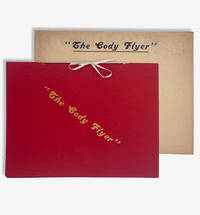
191221208461912. Aldershot: Gale and Polden. 1912. 4to. Original red card wrappers lettered in gilt original printed envelope preserved; pp. 11 1 highly illustrated after photographs and drawings printed on yellow blue and white coated paper; wire-stitching removed and replaced with new ties traces of oxidation along gutters final page with a little offsetting from red wrappers; a rare survival with the original printed envelope this a little spotted.Extremely rare trade catalogue for the Cody mono- and biplanes as well as a manned war kite. 'Samuel Franklin Cowdery was born in 1867 in Davenport Iowa was a Wild West showman and early pioneer of manned flight. He changed his name to Cody at age 21 when he was part of a touring Wild West show not to be confused with that of Buffalo Bill Cody. He is most famous for his work on the large kites known as Cody War-Kites that were used by the British in World War I as a smaller alternative to balloons for artillery spotting. Financed by his Wild West shows Cody's unusual interest in manned kites advanced significantly when he enlarged upon Lawrence Hargrave's double-cell box kite to increase its lifting power especially by adding wings on either side. He patented his design in 1901 and it became known as the Cody kite. Cody eventually managed to interest the British Army in his kites. In 1906 he was appointed Chief Instructor of Kiting for the Balloon School in Aldershot and soon after joined the new Army Balloon Factory down the road at Farnborough. The Factory would eventually become the Royal Aircraft Establishment. In 1908 the War Office officially adopted Cody's kites for the Balloon Companies he had been training. This group would in due course evolve into the Air Battalion of the Royal Engineers No. 1 Company of which later became No. 1 Squadron Royal Flying Corps and eventually No. 1 Squadron Royal Air Force. During 1907 he was given full authority as the designer of the the British governments dirigible understructure and propulsion system. On 5 October 1907 Britain's first powered airship British Army Dirigible No 1 and using Cody's engine the Nulli Secundus flew from Farnburough to London. In 1907 the British Army decided to back the development of Cody's powered aeroplane the British Army Aeroplane No 1. His flight of 16 October 1908 is recognized as the first official flight of a piloted heavier-than-air machine in Great Britain. He went on to win a number of aeronautical awards and started developing his own aircraft company. That company produced the Cody Flyer a monoplane for which this pamphlet was issued. On 7 August 1913 he was test flying his latest design the Cody Floatplane when it broke up at 200 feet and he and his passenger the cricketer William Evans were killed' Nat DesMarais Rare Books. The 1908 British Army Aeroplane No.1 was actually Cody's biplane sometimes called Cody 1 later officialy referred to as The Cody Flyer. 'On 16 October at Farnborough it made what is recognised officially as the first sustained powered flight in Great Britain by a heavier-than-air machine covering 423.7m before crash-landing' Virtual Aircraft Museum online.Library Hub locates a single copy in the National Aerospace Library. unknown
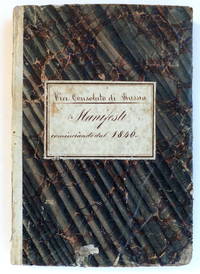
18403417<p><i>Through Russian Waters</i></p><p>RUSSIA - TRADE FORMS. Vice Consolato di Russia. Manifesti cominciando dal 1840. Trapani 1840-49.</p><p>Small folio pp. 196 of pre-printed shipping manifest forms of which 137 completed in ink; contemporary flexible vellum-backed marbled paper boards with ink-lettered label to upper board; corners bumped and spine a little chipped.</p><p>Fine documentation of the maritime trade from the harbour of Trapani in Sicily. The manifest gives bills of lading from January 1840 to March 1849. The pre-printed manifests are completed in ink giving the name of the freight ship and its captain the destination and then details of its freight i.e. type and quantity of merchandise names of senders and recipients.</p><p>Trapani boasts some of Europe's oldest salt marshes and salt extraction has been a major business for centuries which still flourishes to the present day. By the nineteenth century Sicilian sea salt was exported to European countries as far away as Norway and Russia. These shipping manifests document that it was sent to destinations as far afield as Constantinople Abo Stavanger Carlscrona Stockholm Bergen Odessa Reval and Riga.</p><p>Clearly some of the shippers acted on their own account being both captains of the ship and shipper whereas others acted on commission. The shipping routes went through Russian waters which explains the accounts kept by the Russian Vice Consulate.</p>
2005DADAX0387226850Springer 2005-05-26. 2005. hardcover. New. 10.10x7.50x13.20. Buy with confidence. Excellent Customer Service & Return policy. Springer hardcover
94286aaf1756 / 1758 / 1802 / 1834, in-4to, brochures originales en bon état (n. 3 avec tache d’humidité).
17005A Paris, De l'Imprimerie de P.G. Le Mercier, 1766. Two works in one volume. 4, 180, lxxii, 4, 4 pp.; 8, (also numbered 242)-328, (also numbered 56)-164 (also numbered 196)-212 (also numbered 288)-306 (also numbered 168)-190 pp.; 1-56 (also numbered 328)-397, (1) pp. 4to. Contemporary marbled calf, spine gilt with raised bands, some damage to foot of spine, corners worn and bumped, some staining to binding, small damage to upper band. First work: Conlon 59:417. First edition. Contains: Exposition du sujet de la consultation. - Mémoire pour les officiers de la Conservation de Lyon & Avis des députés du commerce sur ce Mémoire. - Projet de la déclaration proposé par les députés. - Observations de MM. de Lyon sur ce projet, & réponse à ces observations. - Projet de déclaration fourni par MM. de Lyon, & réfutation de ce projet. - Consultation. - Pièces justificatives.Second work: Kress 6362; Conlon 66:321; not in Goldsmiths; not in Einaudi; not in INED.First edition.Important collection, containing many memoirs from numerous Chambers of Commerce, not published elsewhere. At the end of the Avertissement is the following announcement: 'Le lecteur est prié de n'avoir aucun égard aux chiffres des pages, quelques circonstances survenues depuis l'impression de l'ouvrage, ont exigé un nouvel ordre dans les pièces, & ont interverti celui des chiffres'.Contains, among others: Représentations des six Corps des Négocians de Paris - Représentations des Jurisdictions Consulaires de Paris - Mémoire des Syndics de la Chambre de Commerce de Normandie - Premier Avis de MM. les Députés du Commerce - Second Avis de MM. les Députés du Commerce - Mémoire des Prieur & Juge-Consuls de Rouen - Mémoire des Prieur & Controlleur des Bourges Communes de Toulouse & de Montpellier - Projet de Déclaration - etc. etc.
18576A Rennes, Chez J. Vatar; A Paris, Chez la Veuve de B. Brunet, 1760-1772. With engraved frontispiece and 4 engraved plates. 2 volumes. xxxviii, 38, 284, (6) pp.; viii, 392, (8) pp. 8vo. Contemporary marbled calf, richly gilt spines with raised bands and gilt lettering, with the gilt stamped armes of the États de Bretagne on the covers, slightly rubbed. INED 1-2 & 3243-3244 lists different issues but no second volume with the date 1772; Higgs 2179 & 5423; Goldsmiths 37378 & 10838.1; Einaudi 48 & 49; not in Kress; not in Mattioli. One of at least two editions for volume one from the year of publication, the other being in 12mo and with a completely different collation. The 12mo edition has no frontispiece and three plates. First edition of volume one, second edition of volume two, all published. The second volume is identical to the volume published in 1762 but for the date on the title-page. Louis-Paul Abeille was an economist of the Physiocratic school, inspector-general of manufactures in France and later secretary to the council of the bureau of commerce. Montaudouin was a lawyer from Nantes. These reports were the only ones published although a third report was planned. The Société d'Agriculture was the first society of this type established in France, founded through Gournay's influence. Its members were to examine the state of agriculture, commerce and manufacturing industry. For the arms see: Olivier, Hermal and Roton, Reliures Armoriées Françaises, plate 1576, nr 3.