Stanislas de GuaitaMareMagnum

8 476 résultats
In 8°. Pagine 552; 808. Rarissimo testo di magia del celebre esoterista francese Stanislas De Guaita, ricco di illustrazioni e splendidamente conservato. Bella e pregiata legatura coeva in mezza pergamena con titoli su tasselli in oro al dorso. All'interno annotazioni di antica mano anche in lingua ebraica. Introvabile.
189010821ABO.O, o.J. (ca. 1890). 46 : 29 cm. 8 Seiten Anleitungen Mit ca. 30 verschiedenen Hilfsmitteln zur Vorführung von Zaubertricks. Original-Pappkasten mit farbiger Deckelillustration.
117953aafs.n. (Würzburg ?, Herbipolis), s.d., (1665?), kl. in-4to, 2 ll. (Drucktitel + Candido lectori, (without engraved front) + 363 p. (+ 1 blanc, page 71 with some staines) + 4 ll. Index + 22 engraved plates, ‘Tréah’ & name ‘Nolent 1902’ on fly, 19th century boards (XIX c.),
1801306156London: Printed for G. Kearsley Fleet Street; Bell and Bradfute Edinburgh; and Brash and Reid Glasgow by W. Glendinning 1801. First English edition. xix i errata 397 3 publisher's ads pp. 8vo. Contemporary half leather over gray paper-covered boards. Covers worn joints cracked but sewing sound lacking spine label text block roughly trimmed occasional light soiling along lower blank margins. Remnant of contemporary bookplate. In a custom redpaper slipcase and matching chemise. First English edition. xix i errata 397 3 publisher's ads pp. 8vo. The first English edition of this quite unusual and very entertaining compendium of conundrums problems parlor tricks and "interesting facts" - it is actually much more fun than the title would seem to suggest. The first French edition was published in London in 1799 under the title Choix d' amusements physiques et mathématiques. The work includes tricks with cards magic squares magic lanterns feats of artificial memory and proto-spiritualist conjuring through "palingenesy" by which a performer can make the images of the dead appear in a glass jar plus other optical illusions. A large collection of mathematical and physical curiosities including chapters on arithmetic "To arrange 30 criminals in such a manner as to save 15 of them &c." "A lady lamenting that her age was triple that of her daughter" and amusing "secrets" "To make people in a room have a hideous appearance". Toole Stott 240 Printed for G. Kearsley, Fleet Street; Bell and Bradfute, Edinburgh; and Brash and Reid, Glasgow, by W. Glendinning unknown
1801306156London: Printed for G. Kearsley Fleet Street; Bell and Bradfute Edinburgh; and Brash and Reid Glasgow by W. Glendinning 1801. First English edition. xix i errata 397 3 publisher's ads pp. 8vo. Contemporary half leather over gray paper-covered boards. Covers worn joints cracked but sewing sound lacking spine label text block roughly trimmed occasional light soiling along lower blank margins. Remnant of contemporary bookplate. In a custom slipcase and chemise. First English edition. xix i errata 397 3 publisher's ads pp. 8vo. The first English edition of this quite unusual and very entertaining compendium of conundrums problems parlor tricks and "interesting facts" - it is actually much more fun than the title would seem to suggest. The first French edition was published in London in 1799 under the title Choix d' amusements physiques et mathématiques. The work includes tricks with cards magic squares magic lanterns feats of artificial memory and proto-spiritualist conjuring through "palingenesy" by which a performer can make the images of the dead appear in a glass jar plus other optical illusions. A large collection of mathematical and physical curiosities including chapters on arithmetic "To arrange 30 criminals in such a manner as to save 15 of them &c." "A lady lamenting that her age was triple that of her daughter" and amusing "secrets" "To make people in a room have a hideous appearance". Toole Stott 240 Printed for G. Kearsley, Fleet Street; Bell and Bradfute, Edinburgh; and Brash and Reid, Glasgow, by W. Glendinning unknown books
180263050Graz, Christian Friedrich Trötscher, 1802. 8°. Mit einigen Holzschn.-Vignetten u. 2 gefalt. Tabellen. Zus. ca. 880 S., Ppbde. d. Zt. goldgepr. Rückenschildern.
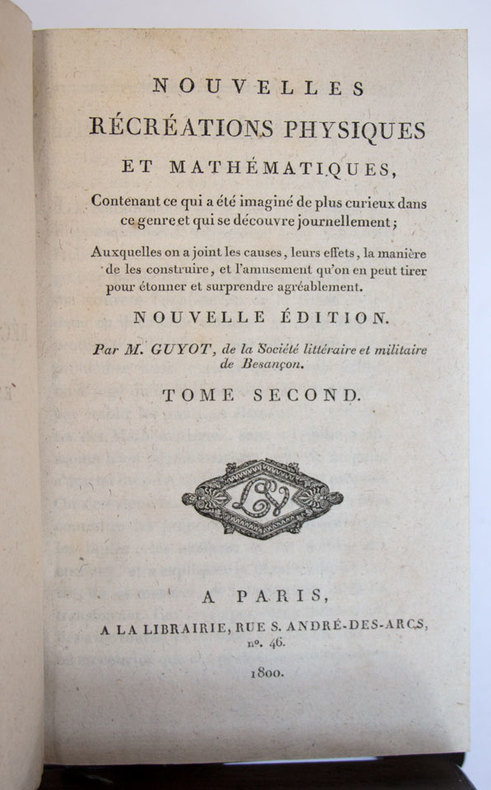
In-8 p. (mm. 216x135), 3 volumi, brossura muta coeva (dorsi restaur.), pp. XV,375; (4),408; (4),408,(4); con complessive 102 tavole inc. in rame f.t., ciasc. con numerose figure che rappresentano gli apparecchi, gli strumenti e le esperienze curiose realizzate e descritte dall’A.: fisica, statica, elettricità, ottica, lanterna magica, ecc. L’opera contiene “ce qui a été imaginé de plus curieux dans ce genre, et ce qui se découvre journellement; auxquelles on a joint les causes, leurs effets, la manière de les construire, et l'amusement qu'on en peut tirer pour étonner et surprendre agréablement”. Alla fine dell’opera si trova la lista “des pièces de récréations contenues dans cet ouvrage qui sont vendues par l’auteur”. “.. monumentale trattato di scienza dilettevole di Edme-Gilles Guyot, che presenta numerosi giochi di prestigio - alcuni basati su trucchi matematici, altri sulla manipolazione e altri su elaborati principi che sfruttano le carte da gioco. Oltre 30 pagine sono dedicate al gioco dei bussolotti e alle sottigliezze necessarie per eseguire ciascuna mossa in modo illusivo”. Cfr. Caillet,II,4900 che cita altre edizioni di: “Edme-Gilles Guyot, géographe, philosophe et physicien, né à Paris en 1706, mort en 1780. Directeur du Bureau Général des Postes de France”. Con lievi fiorit. interc. nel t., ma certamente buon esemplare con barbe.
in-8, pp. (128), 844, (20, le ultime 2 bianche), legatura moderna p. perg. rigida, tass. in pelle con tit. oro al dorso. Titolo a stampa rossa e nera, con impresa tipogr. Testo in car. rom. con frequenti passi in greco. Con alcune figure schematiche (a pag. 150 e segg.) e vignette silogr. assai curiose (a pag. 566 e segg.). Dedica dell'autore a Gaspare Coignet de la Thuilerie, ambasciatore di Francia a L'Aia. Prima edizione di questa dottissima opera sull'influenza, reale o supposta, dell'anno climaterico sulla vita dell'uomo. ''On entendait par climatérique chaque septième (année)..., parce que cette période était jugée nécessaire pour le renouvellement intégral de toutes les parties du corps'' (Willems). L'autore (Claude de Saumaise, erudito francese nato a Semur nel 1588 e morto a Maastricht nel 1653) nega decisamente qualsiasi influsso degli astri sulla vita degli uomini, che invece viene regolata semplicemente da leggi naturali. La salute degli individui, in particolare, dipende dalla costituzione fisica, dall'aria, dal clima, dal modo di vivere, ecc. Buon esempl. (piccoli restauri di parti bianche del foglio di titolo).. Caillet III, 9918. Bibl. Magica Casanatense n. 1087. Dorbon 4375. Willems 644. Cantamessa III, n. 7111: ''L'opera ebbe dunque successo, e non so dunque perché si limitò a questa sola edizione''..
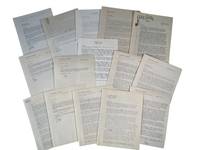
1959214711959. Gloye Eugene E. Archive of Autograph letters on Magic late 1950s to mid 1960s document the working methods technical experimentation and intellectual framework of a mid twentieth century American magician engaged in both performance and psychological analysis of illusion. Written primarily to fellow magician Don Tanner these letters provide direct evidence of how tricks were conceived refined and communicated within professional networks revealing the intersection of apparatus design sleight of hand and audience perception. Gloye's dual role as performer and psychologist situates the correspondence within broader developments in performance theory and applied psychology supporting research into the history of magic entertainment culture and the study of deception. Eugene Gloye authored 23 magic books including "For Magicians Only" "Fantastic Tricks with Plastic Cups" and "Theatrical Magic" <br /> <br /> Archive of sixteen letters spanning approximately the late 1950s through the mid 1960s containing detailed discussions of trick construction performance strategy and experimentation with materials and methods.Throughout the letters Gloye discusses numerous tricks he devised or refined often providing detailed explanations of their mechanics and performance nuances. His correspondence reveals a deep engagement with magical apparatus sleight of hand and psychological deception. One of the more detailed discussions in the letters revolves around Gloye's development of Fan-Ta-Cups which evolved from an earlier trick he had devised Fan-Ta-Bill. On September 5 1961 he describes how the trick was born: "I first got the idea for this cup trick about 14 years ago when I was experimenting with a bill trick which I eventually put on the market. The bill trick also uses a celluloid gimmick and was an adaptation of Liquid Appear. Since I thought of the cup trick at the time of my Fan-Ta-Bill I decided it was fitting to call it 'Fan-Ta-Cups.'" He further explains that while the idea had been percolating in his mind for years he hadn't developed a complete routine for it until recently. Inspired by the classic three-shell game he worked out a performance structure that he believed would make it more engaging.<br /> <br /> In a letter from July 11 1961 Gloye excitedly shares his thoughts on using hollow plastic golf balls for new magic tricks: "I am convinced that this new golf ball will open up many new trick possibilities. The fact that they come in several colors is also interesting." This suggests that Gloye was experimenting with different materials for manipulation tricks possibly related to vanishing or color-changing effects. Gloye also played with magical history concocting a hoax to see how the magic community would react. In the September 5 1961 letter he reveals his plan: "Last December I got an idea for a variation on the Tip-Over Box. It's just a slightly different way of building it. At first I was going to put it in my 'New Look' series but then as we were talking about it I commented that this trick should have been in Hoffmann. This led to the devilish idea of writing it up in Hoffmann style and publishing it in Genii as a lost page from the original book." He notes that Bill Larsen and another friend were in on the plan and they wanted to see if the trick would be accepted as a legitimate discovery.<br /> <br /> Another standout trick mentioned in the letters is Gloye's adaptation of Billy McComb's routine using a flap slate and a force deck. On January 31 1961 he explains: "My version which I tried for the first time several days ago with huge success uses one deck and a flap slate. The deck is made like a peek deck but with two cards only. All faces are the same and all concealed cards are the same. Cards which audience sees are trimmed and glued at one end to a second group of 26 duplicates." This approach ensured that the spectator would believe they had freely chosen a card when in fact the outcome was predetermined.<br /> <br /> Gloye describes modifications he made to a Head Chopper Illusion a prop widely used in stage magic in a February 23 1961 letter: "My version does not retain the Chinese theme. My blade is a simple black affair with a couple of brass stripes across it to make it look more solid. I spent a long time trying to figure out a good lock for the blades Abbott's want you to remove a couple of tacks which hold the blade and this is simply not workable. I ultimately did come up with a practical idea only to abandon it in my current routine." He explains that his routine involved swapping out the real blade for a fake setting up a comedic climax where "carrots fly in all directions" as the blade seemingly falls.<br /> <br /> This archive is a rare window into the intellectual and technical world of a magician who bridged academia and performance. Gloye's detailed notes on illusion mechanics reflections on the state of magic and collaboration with figures like Bill Larsen and Frances Marshall make this a significant collection for magic historians and collectors alike.<br /> <br /> Produced during a period of active exchange among professional magicians through correspondence and publications such as The Linking Ring these letters document how knowledge circulated within specialized communities and how innovation often emerged through incremental modification of established techniques. Gloye's attention to apparatus construction coded deception and audience management reflects broader mid century interest in performance psychology while his references to collaborators and publication strategies illustrate the role of print culture and informal networks in shaping the field. As a cohesive manuscript archive the letters preserve the technical language and creative process underlying stage magic offering a detailed record of mid twentieth century illusion practice. Light wear and handling consistent with age with legible manuscript throughout; overall condition very good. unknown
199838962New York New York U.S.A.: Scholastic Press 1998. 1st US . Hardcover. As New/As New. Grandpre Mary. 1st US Larger book fine green cloth spine dark blue boards with diamond pattern bright silver lettering on spine red inside covers and adjacent end papers 341 pages. DJ heavy paper colorful illustration of Harry with phoenix. DJ beneath mylar and book both As New. <br/> <br/> Scholastic Press hardcover
19050041551905 Paris, Hachette, sans date [1905]. Grand in-quarto (270 X 328 mm) reliure à la Bradel cartonnage papier crème illustré en couleurs, tête dorée (reliure de l'éditeur); (2) ff. blancs, (2) ff. de faux-titre et titre illustré imprimé en rouge et noir, 380 pages, 41 planches sous serpente, (2) ff. blancs.
In 12° (15,4x9,6 cm); (24), 480 pp. e una c. di tav. più volte ripiegata (nella maggior parte degli esemplari, la grande tavola contenete i due “Quarré Naturele” e i due “Quarré Magique”, si trova ritagliata in quattro parti). Bella legatura coeva in piena pergamena con titolo, autore e stemma nobiliare araldico, abilmente chiosati al dorso. Tagli spruzzati in rosso. Esemplare in ottime condizioni di conservazione. Terza rara edizione (più rara sia della prima che della seconda ed altrettanto ricercata) di questo importante studio, del grande matematico, teologo e filosofo giansenista, acerrimo nemico dei gesuiti, Antoine Arnauld, soprannominato dai contemporanei “Le Grand Arnauld”, per distinguerlo da suo padre (Parigi, 5 febbraio 1612 – Bruxelles, 8 agosto 1694). Nel 1656 venne espulso dalla Sorbona per le questioni espresse nei suoi scritti “Lettre à une personne de condition” e nella “Lettre à un duc et pair” editi nel 1655. Questi scritti fornirono a Blasile Pascal, suo grande amico, materiali per le sue “Lettres provinciales”. Arnauld fino al 1668, quando si addivenne alla "pace della Chiesa", diresse la cosiddetta, resistenza di Port-Royal. Fra i primi ad adottare la filosofia di Cartesio, seppur con qualche riserva legata alle sue profonde credenze religiose, fu impegnato in diverse celebri dispute filosofiche. Da ricordare quella con Malebranche sui rapporti fra teologia e metafisica che si protrasse dal 1683 al 1685. Insieme a Pierre Nicole, fu autore di “La Logique ou l'art de penser” uno dei testi basi della Logica fino agli inizi del XX° secolo, conosciuta anche come “Port-Royale Logic”. Considerato uno dei più grandi matematici del suo tempo, la sua fama in questa materia, scemò nei secoli successivi a favore dei suoi scritti di logica e filosofici, per essere poi recuperato come matematico di primissimo piano, nel XX° secolo. “The Elements undertakes a reworking and reordering of the Euclidean theorems in the light of the contemporary literature and Pascal's influence. It bases its claim to originality and influence on the new order in which the theorems, many of them adapted from contemporary sources, are arranged. As mathematics, it is characterized by the mastery of the contemporary literature and by its clear and fresh exposition... It is interesting to compare Arnauld's order of theorems with such recent ones as that of Hilbert and Forder, whose aims are quite different...”. (DSB I p. 292). L’opera qui presentata è conosciuta anche come la “Geometrie de Port-Royale”. Le illustrazioni poste alla fine che vedono presenti 4 tavole con quadrati magici, sono usate per spiegare il trattato di Pascal, pubblicato alla fine dell’opera e spiegre la soluzione di uno dei problemi più famosi e più difficili dell'aritmetica, comunemente chiamato “les quarrez magiques”. Fermat e Pascal furono i primi matematici a interessarsi al problema dei quadrati magici. Pascal descrisse i risultati dei suoi studi all'amico Arnauld che li pubblicò in quest’opera. La geometrie di Arnauld è il frutto del lavoro in comune con l’amico Pascal, tanto che l’opera qui presentata, viene, comunemente, attribuita anche a Pascal. Nella lunga prefazione di Pierre Nicole si parla di Pascal senza nominarlo, come una delle grandi menti di questo secolo e di uno dei più geniali matematici per la sua apertura mentale. Nicole spiega come Arnauld sia partito da un piccolo saggio in cui Pascal, si era accontentato di sostituire le classiche dimostrazioni di alcuni problemi matematici di Euclide, sostituendole con dimostrazioni più acute e naturali. Come ci racconta Nicole, Arnould letto lo scritto dell’amico Pascal decise di presentare seguendo lo stesso spirito dell’amico ma con più metodo, tutto il corpo del pensiero pascaliano. J. Itard, nel suo famoso articolo dedicato alla “La Géométrie de Port-Royal”, nella rivista “L'enseignement mathématique” del marzo 1940, esaminando in dettaglio il contenuto del libro di Arnould, osserva che l'insegnamento della geometria in Francia, fu permanentemente influenzato, almeno fino a Legendre, dalle opinioni e dimostrazioni matematiche espresse da Arnould in questo libro. Rarissima terza edizione in buone-ottime condizioni di conservazione. Rif. Bibl.: Bibliotheae Casanatensis catalogus librorum, Tomus Primus, Romae, Salvioni, 1761, pag. 277; Klaas Hoogendoorn, Bibliography of the Exact Sciences in the Low Countries ca. 1470 to the Golden Age (1700), Brill, London, pag. 50 “First edition: Paris 1667; Second Edition: Paris 1683. So this is the third edition. There is a reissue of 1711”; ICCU IT\ICCU\BVEE\023016.
2 voll. legati in uno in 8°, elegante legatura ottocentesca in mz pelle con nerv. e fregi in oro, timbrino alla sguardia, fioriture alle primme cc pp 2, 298; 2, 340. nella prima parte vi è una storia del magnetismo e si espongono fenomeni come guarigioni di malattie e sonnambulismo, nella seconda parte vi è una bibliografia sul magnetismo dai primi trattati del '500 fino alle opere piu recenti. " Ouvrage indispensable dans une biblioteque magnetique" Caillet, 2933. Buon esemplare.
158720901Lyon Pillehotte 1587 in-12 plein-veau 1 volume, reliure plein veau raciné moucheté et coloré havane petit in-douze (binding full calfskin in-12) (12,5 x 8,6 cm), RELIURE D'EPOQUE, dos à nerfs (spine with raised band) décoré "or" (gilt decoration) à filets et roulettes "or" (gilt line), titre et tomaison frappés "or", pièce de titre et de tomaison (label of title and volume numbering) sur fond bordeaux avec double filet "or" en encadrement, roulette "or" en place des nerfs avec un filet"or" de part et d'autre des nerfs, entre-nerfs à fleuron "or" dans un encadrement à double filets "or" avec fleuron "fleurette" "or" aux angles, roulette "or" en tête et en pied, la coiffe inférieure manque, plats décorés "or" d'une roulette "chaînette" "or" en encadrement, toutes tranches lisses rouges, Texte en Latin, sans illustrations (no illustration) excepté une marque de l'Editeur en bas du titre gravée sur bois en noir avec la devise : "nomen domini laudabile" (le nom du Seigneur soit loué) + orné de bandeaux et lettrines historiées (and illuminated of headpieces and dropped initials) gravés sur bois en noir, [Liber I : 322 + Liber II : 150 + Liber III : 200 (de la page 151 à la page 350) + i ff. blanc + 31 ff. d'Index , privilège et errata] pages, 1587 Lugduni : apud J. Pillehotte Editeur,
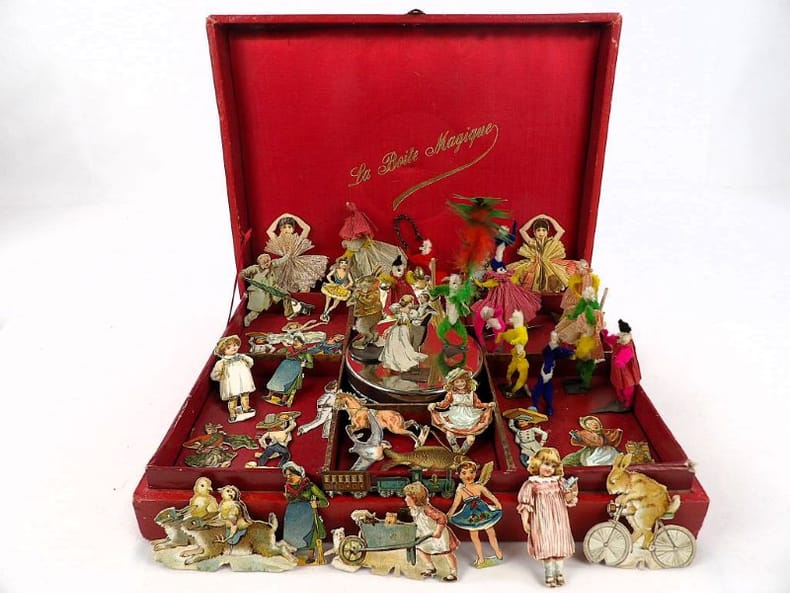
19062854Paris, K-B (Kratz-Boussac), circa 1906. 26,5 x 20 x 5 cm. Boîte recouverte de papier rouge. Titre doré sur le couvercle. La Boîte Magique est un jouet magnétique créé à l'origine par Abraham Martin, ingénieur mécanicien, qui déposa son brevet en France le 21 décembre 1894 avant de céder ses droits à Henri Kratz-Boussac en janvier 1906. Ce dernier, fondateur de la célèbre "Société des inventions brevetées" et de la marque Euréka, commercialisa alors le jouet sous sa propre marque. Malgré son nom évocateur, le principe est purement magnétique : à l'intérieur d'un boîtier en métal chromé, un mécanisme entraîne en rotation un ou plusieurs volants à axe aimanté, lequel — actionné par une crémaillère — communique son mouvement à des figurines [en chromos, en papier crépon et cure pipe, en simple fil de fer torsadé, ou encore en tôle lithographiée (train et poisson)] posées sur des patins métalliques glissant sur la surface lisse de la boîte, s'animant ainsi en va-et-vient ou en rotation. Cette version de la boîte magique de Kratz-Boussac, avec ses sept compartiments, correspond vraisemblablement à la version de luxe, bien plus généreuse en figurines et accessoires que les modèles courants à deux compartiments décrits dans les catalogues de l'époque.
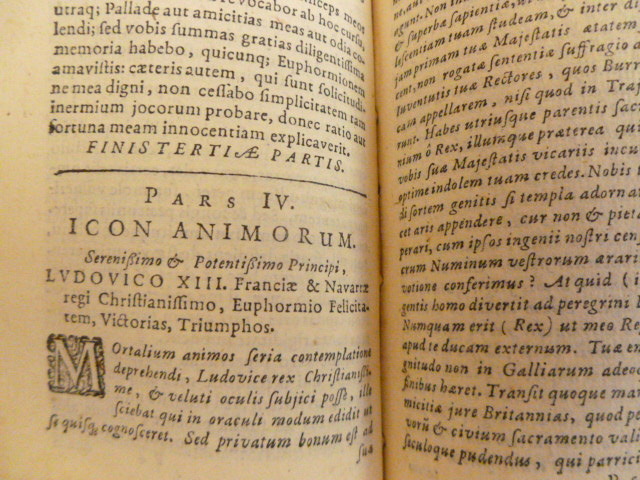
CZC-2193EUPHORMIO SATYRICI AVGVSTISSIMO REGI Jacobo Primo Evphomionis Lvsinini Satyricon Pars I, II : Euphormionis Lusinini Satyricon Pars III; Euphormionis Satyrici Apologia pro se. Pars IV : Euphormionis Satyrici Icon Animorum Pars V: Alithophili veritatis lacrymae sive euphorm lusini continvatio Henrico Borbonio Galliarum Protoprincipi vol, in-16, 12,5 x7,5, relié pleine basane époque, accrocs, toutes tranches dorées, 717pp, très bel état intérieur, rare ! Bien complet de ses 5 parties Volume XVIIe (1616) Bibliothèque du Comte de Boussay
CZC-2193EUPHORMIO SATYRICI AVGVSTISSIMO REGI Jacobo Primo Evphomionis Lvsinini Satyricon Pars I, II : Euphormionis Lusinini Satyricon Pars III; Euphormionis Satyrici Apologia pro se. Pars IV : Euphormionis Satyrici Icon Animorum Pars V: Alithophili veritatis lacrymae sive euphorm lusini continvatio Henrico Borbonio Galliarum Protoprincipi vol, in-16, 12,5 x7,5, relié pleine basane époque, accrocs, toutes tranches dorées, 717pp, très bel état intérieur, rare ! Bien complet de ses 5 parties Volume XVIIe (1616) Bibliothèque du Comte de Boussay
1916YRG-415Deux forts in-8, broché reliure de l’époque, 573 et 847 pages.Complet. Jauni dans l'ensemble, quelques manques de papier au dos et traces d'usage sur la couverture et la 4ème de couverture. Chez Durville, Paris.
In 16° (155x105). Pagg. 16 (compresa l'antiporta allegorica in rame), 156, (32). Testatine in legno e iniziali ornate. Dedica di Johann Scheffer a Benedetto Skytte, nobile svedese. Obsequens, vissuto nel IV sec. d.C., attingendo da varie fonti, in particolare da Tito Livio, creò un "Prodigiorum liber" in cui narra molti fenomeni curiosi, di cui alcuni erano stati interpretati come avvistamenti di UFO.<BR>Piena pelle marmorizzata coeva con dorso a nervi e titolo in oro. Tagli a spruzzo. Ottimo esemplare fresco, legatura un po' sciupata.<BR>Edizione rara. La prima edizione fu stampata a cura di Lycosthenes nel 1552, a cui fece seguito il celebre Prodigiorum ac ostentorum chronicon..nel 1557.<BR>Dorbon, 3299 in nota; Casanatense biblioteca magica, 914.
180095388Paris, P., à la Librairie, rue S. André-des-Arts 1800 3 volumes In-12, plein veau havane marbré de l’époque, dos lisses ornés de roulettes encadrés de fers dorés, pièces de titre maroquin havane et vert, XVI- 375- VII- 410- 408 pp., 102 planches gravées hors texte. Découpe marginale sans atteinte à une planche. Reliures légèrement frottées, intérieur très frais.
Fiel Jareño, Emilio Cabalgando al dragón del vientre. , Mandala Ediciones 2009-12-01, Ottimo (Fine) . <br> <br> Copertina flessibile <br> 250<br> 9788483521960
104504Leipzig, 1588, 1 volume in-12 de 198x155 mm environ, 1 f. blanc, titre en rouge et noir avec vignette gravée,3ff. ( paitre, table), 629 pages, 10 ff., il manque 9 pages de table), (2) ff., reliure parchemin crème avec plats à recouvrements, titre manuscrit sur le dos, tranches mouchetées. Manque de cuir sur le premier plat (avec restauration ancienne), quelques rousseurs et mouillures, quelques petits trous de ver qui ne gênent pas la compréhension du texte, sinon bon état.
162010917A Lyon de l'Imprimerie Simond Rigaud, Marchand. Librairie en ruë Merciere, deuant S.Antoine 1620. In-12 relié de 263 et 232 pages au format 17,5 x 3, 5 x 11 cm. Reliure ancienne et d'époque pleine basane brune. Dos à 5 nerfs orné et doré portant une pièce de titre en maroquin rouge, tranches jaspées de rouge. Dos, bords et coins avec petits frottements. Page de garde en papier marbré. Intérieur frais avec annotation manuscrite au verso de la page de garde, datée de 1765 et 2 inscription en page de garde. La Métaphysique est divisée en quatre parties. Cet ouvrage contient, réunies, les 3 premières parties des principes généraux de cette science : Principes généraux , L'âme séparée du corps, Bons et mauvais anges. Il manque la quatrième consacré à la divinité. Tous les ouvrages de Scipion du Pleix, Seigneur de Clarens, né à Condom en 1569, mort dans cette même ville en mai 1661, qui fut historien, grammairien, philosophe et conseiller de la reine Marguerite de Valois, sont rares. Ils traitent de la sorcellerie, des démons, des incubes et des succubes, de l'univers des anges, de l'état de l'âme après la mort, etc. Rarissime édition originale collective en superbe état général.
In 4° (19,5×15 cm); due tomi in un volume: (24), 325, (43), (4), 44, (4), 109, (3) pp. e 6 c. di tav. fuori testo e 25, (1) pp. e una c. di tav. fuori testo più volte ripiegata. Magnifiche le tavole mediche. Bella legatura coeva in piena pelle scura con dorso a 5 nervi e titolo impresso in oro su fascetta ai tasselli, abile restauro al dorso. Piatti con bella cornice a secco con fregi. Tagli spruzzati in rosso. All’interno esemplare in buone-ottime condizioni di conservazione. Nell’opera con frontespzio proprio: Prosepro Alpini de Balsamo Dialogus In quo verissima Balsami Plantae, Opobalsami, Carpobalsami, & Xylobalsami cognito, plerisque antiquorum atque juniorem Medicorum occulta, nunc elucescit. Prima rarissima edizione, nella versione stampata da Boutesteyn Cornelis weduwe & Boutesteyn Pieter, di questa celeberrima raccolta di scritti del grande medico, botanico e scienziato vicentino originario di Marostica, Prospero Alpini. Botestein pubblicò una prima volta la celeberrima opera di Alpini nel 1718. Nello stesso anno pubblicò anche la “De Rhapontico disputatio” che risulta ancor più rara dell’altra opera, tanto che nessun esemplare è censito in ICCU. L’anno dopo, nel 1719 ripubblicò le opere in un unico volume. Alpini “Nato a Marostica, nella Repubblica di Venezia, in gioventù servì le armi nell’esercito milanese, ma nel 1574 decise di studiare medicina all’Università di Padova, dove si laureò nel 1578. Iniziò la professione di medico a Camposampiero, un piccolo paese del territorio padovano, ma dopo poco tempo, nel 1580, il patrizio veneto Giorgio Emo, nominato console a Il Cairo in Egitto dalla Repubblica Veneta, lo volle con sé come medico personale: in questo modo poté dedicarsi allo studio della botanica, suo interesse scientifico prevalente. Trascorse circa tre anni in questo paese, fino al 1584, e, dalle pratiche di coltivazione della Palma da dattero, Alpini dedusse il concetto di differenza sessuale nelle piante, che in seguito fu adottato come fondamento dal sistema di classificazione scientifica di Linneo. Egli comprese che “le palme da dattero femminili non portavano il frutto a meno che non ci fosse un mescolamento tra i rami maschili e femminili o, come generalmente avviene, a meno che la polverina prodotta dai fiori maschili non fosse cosparsa sui fiori femminili”. Nel 1584 tornò a Venezia e in seguito, risiedette per qualche tempo a Genova come medico di Andrea Doria. Nel 1590 tornò di nuovo a Venezia e nel 1593 ottenne la cattedra di lettura dei semplici all’Università di Padova. Dal 1603 fu nominato prefetto dell’orto botanico e titolare anche della cattedra di ostensione dei semplici (l’odierna farmacologia). … Nel De Medicina Egyptiorum (Venezia, 1591) sono contenute le prime considerazioni sulla pianta del caffè pubblicate in Europa.”. Esemplare in buone-ottime condizioni di conservazione. Rarissima edizione. Rif. Bibl.: Rappaport n. 15-80.
[Enciclopedico-Vino] (cm22,5) buona tutta pergamena originale con unghie e tracce di lacci, titolo al dorso.-- cc. 36 nn., pp. 426, c. 1 nn. Bella marca tipografica al frontis, ripetuta altre due volte. Prima edizione della traduzione del Baldelli, assai pregiata di opera da considerare come una vera e propria enciclopedia del sapere con capitoli sulla medicina, orologi, musica, astrologia, magia, agricoltura, caccia, pesca, armi, giochi olimpici, arte, colori, seta, prostituzione, invenzione della stampa, il Lib. III parla del vino. Gamba: " Le opere del volgarizzate del Baldelli sono raccomandate dal Colombo, siccome tutte fatte da uno dè forbiti scrittori del cinquecento ". Lievissime fioriture a qualche carta, molte interessanti note manoscritte coeve ai margini bianchi, ma esemplare molto bello e geniuno. * Camerini II 142; * Wellcome I 6548; * Razzolini 272; * Gamba 1745; * Bm. Stc. 720; * Ferguson I Pt. V p.4; * Graesse VII 284; * Choix 7942; * Argelati " Addizioni " V 777. Rarissimo, manca all' Adams, Paitoni, e Simon " Bibl. Bacchica " N676 che ha la seconda edizione del 1592. Il " Census " Iccu, registra solo 9 copie presenti nelle biblioteche italiane.[f56] Libro