15 963 résultats
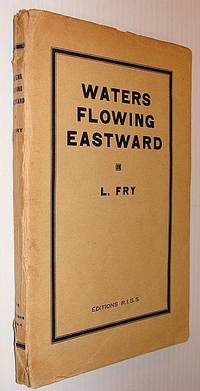
1931328c6774Paris: Editions R.I.S.S. 1931. First Edition. Paperback. Fair. 225 pages. "Beneath the great westward flow of our civilization there are undercurrents moving eastward. These are impelled by a spirit which looks back to the east to the days of tyrant and slave of luxury and misery and incidentally to the suppression of western culture. The following pages are designed to cast light on these eastern undercurrents which have undermined western states." - Preface. Black and white photographic portrait of Sergius A. Nilus who "published the first complete version of the Protocols of the Elders of Zion in Russia in 1905." - Wikipedia. In this work "the genesis of the Protocols is traced to Asher Ginzberg better known by his Hebrew pen name Ahad ha-Am who supposedly wrote the Protocols in Hebrew in 1880 while in Odessa." - Singerman 0221. Erratum list affixed inside front cover. Unmarked. Above-average wear. Age-yellowing to card covers and contents. Covers nearly detached. Binding tender.; 8vo - over 7¾" - 9¾" tall; Protocols of the Learned Elders of Zion Zionism Israel Balfour Declaration Jacob Brafmann Russia Asher Ginzberg Political Zionism Ahad ha-Am . Editions R.I.S.S. paperback
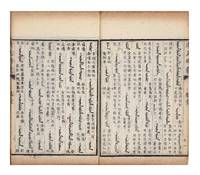
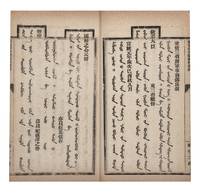
9990Eight vols. Large 8vo orig. wrappers orig. stitching. China: 1802 date of colophon.<br /> <br> <br> <br /> <br /> Second edition of this landmark Manchu-Chinese dictionary the last of the great Manchu dictionaries of the 18th century. Ihing first published his dictionary privately in 1786 the date of the Preface. We know of only one copy of this edition held at a Chinese library. All other copies in circulation are to the best of our knowledge of the second edition.<br /> <br> <br> In 1708 on the Kangxi emperor’s command a Mirror of the Manchu Language had been published at court. In 1724 Li Yanji published Ch.: Qingwen huishu 清文彙書 Ma.: Manju isabuha bithe Manchu Collected which translated the contents of the Mirror into Chinese and rearranged the entries in Manchu alphabetical order. Li’s book became outdated however when the Qianlong emperor reformed the Manchu lexicon and published a number of new lexicographical works the most important of which was the Mirror of the Manchu Language Expanded and Emended from 1772-73. Our book did to the “expanded and emended†Mirror what Li Yanji had done to Kangxi’s original: rearrange its contents in Manchu alphabetical order. Yet Ihing went further than that. He also culled words from other Manchu books published on imperial command in the preceding years including a book with phrases from pre-conquest Manchu sources and translations of the Confucian classics. The result is that Ihing’s dictionary contains words that were not in Qianlong’s expanded Mirror making it in these cases the more complete lexicographical resource. For example a term such as deyengge nimaha “flying fish†is included in our book but not in Qianlong’s Mirror. In such cases Ihing noted that the words had been announced by the Grand Secretariat on such-and-such a date.<br /> <br> <br> Our copy has slips on the outside cover of the volumes with Manchu syllables written in manuscript. The syllables indicate which word initials are covered in the volume in question facilitating searching the dictionary. There is a colophon by Fa-ke-jing-e æ³•å…‹ç²¾é¡ dated 1802. A nephew of Ihing Fa-ke-jing-e revised the book at his uncle’s request.<br /> <br> <br> Ihing Ch.: Yi-xing 1747-1809 belonged to the Bordered Yellow Manchu Banner and as a descendant of Nurhaci was a member of the imperial clan. He rose to the post of vice minister of several of the boards in the Qing secondary capital at Mukden and later served as governor of several southern provinces and as an imperial agent in Outer Mongolia. <br /> <br> <br> Very good set some light dampstaining in the final volume; preserved in a hantao.<br /> <br> <br> ⧠MÃ¥rten Söderblom Saarela The Early Modern Travels of Manchu: A Script and Its Study in East Asia and Europe 109. unknown
10493Woodblock-printed map 830 x 1715 mm. finely hand-colored. Edo: Sagamiya Tahei 相模屋太兵衞 1697.<br /> <br> <br> <br /> <br /> The 1697 printing of Ishikawa’s famous map of Japan; a less complex printing was first issued in 1691 an earlier version with a different title appeared in 1689. The series of maps published by Ishikawa an ukiyo-e artist “established a model for woodblock maps throughout most of the eighteenth century. Works based on Ishikawa's original version and published mainly in the area of Edo are referred to as RyÅ«sen-type maps of Japan. Ishikawa’s<br /> maps were both decorative and practical and they served as a combined Who’s Who and travel map. Useful information to administrators travelers and the general public included the names of feudal lords the standard productivity of the land in koku of rice and important and scenic places along the routes. Each new edition tended to expand both the informative and ornamental aspects of the work.â€â€“Kazutaka Unno “Cartography in Japan†in The History of Cartography Vol. 2 Book 2 Chicago: 1994 pp. 412-13.<br /> <br> <br> Our map is finely hand-colored showing fiefdoms and includes lists of important place names and shrines a chart of tidal variations and a chart of seasonal changes. Another chart gives distances from Nagasaki to far-away destinations such as Holland Indonesia Thailand the Philippines and several port cities of China. The main highways are shown as well as the inland and coastal sea routes. Also indicated are post stations on highways such as the TÅkaidÅ running from Edo present-day Tokyo to Kyoto and the distances between stations. Thanks to the beautiful colors and wealth of information RyÅ«sen’s maps became very popular and this style of map set the pattern for most published maps of Japan for the next century.<br /> <br> <br> In the extremities of the map small portions of China Korea RyÅ«kyÅ« and Hokkaido are shown.<br /> <br> <br> Fine copy. Short clean splits in a couple of folds. Well-backed and minor worming mended.<br /> <br> <br> ⧠Mary Elizabeth Berry Japan in Print. Information and Nation in the Early Modern Period California: 2006 pp. 2-3–The map is “so legible and packed with information that it has been revised and reissued annually since its first publication in 1689. It charts the nation’s provinces and castle towns land and water routes famous sites and scenic places. It labels every ferry crossing and every post station along the major highways listing the distances between stops in an index. Thick with social and political geography it also identifies all regional lords or daimyo with notes on the gross productivity of their domains.â€. unknown
10372Ten vols. 8vo orig. wrappers old stitching. China: 1909-12.<br /> <br> <br> <br /> <br /> An important one-of-a-kind trilingual textbook. In 1905 the Qing government took the radical move to abolish the civil service examinations which had been contested for a long time and reformed in 1901. Rather than a system of examinations supported by schools preparing students for the lowest level of the exams the court instituted a tiered system of schools from elementary to advanced with students across the country using new textbooks. Our book is a product of the extension of this new educational regime to “present-day†Inner Mongolia.<br /> <br> <br> One of the two textbooks chosen for the new Chinese schools — and the most popular — was Zuixin chudeng xiaoxue guowen jiaokeshu 最新åˆç‰å°å¸åœ‹æ–‡æ•™ç§‘書 The Up-to-Date National Language Reader for Lower Primary Schools which Jiang Weiqiao 1873-1958 and Zhuang Yu 1878-1940 published in 1905 with the Commercial Press in Shanghai. Jiang was a low-level examination graduate who had been exposed to Western learning through the publications of the Jiangnan arsenal. After a first career as a teacher in new-style schools he entered the translation department at the Commercial Press in 1903 where he planned and wrote many of the textbooks that the press published. His later career was spent in education administration at the national provincial and university levels. Zhuang was trained in geography and entered the Commercial Press on Jiang’s recommendation. He too later worked in school administration while continuing to write textbooks.<br /> <br> <br> The purpose of Jiang and Zhuang’s book was as they explained in the Preface to “provide everyone basic moral values and knowledge and enable them to learn about important thoughts of ancient sages and academics arts and skills of all countries in the world.†Like others in the genre this book “touched on a wide range of topics such as science history geography and civics†and included “the newest terms concerning every subject at the time and reflected the most recent findings of scholars†He pp. 100-01.<br /> <br> <br> As the Qing government attempted to bring the empire’s Inner Asian possessions closer to China proper in the face of foreign aggression new schools were instituted in parts of Inner Mongolia. What textbooks to use presented a problem. Ungde or Rongde who was appointed as honorary supervisor of the Fengtian Mongolian Language School in what is now the city of Shenyang was aware of this issue. Ungde also taught Mongolian at the school. He noted that the school used Gao E’s 高鶚 Lizhi jiyao åæ²»è¼¯è¦ Essentials of Administrative Discipline which TongÅ¡ui 通瑞 had translated into Manchu and Meng boo å¤¢ä¿ in turn translated into Mongolian. Gao’s text had been written sometime before his death in 1814 and it was not a textbook fit for molding an informed citizenry in the early 20th century. Ungde therefore decided to translate Zuixin chudeng xiaoxue guowen jiaokeshu into Mongolian.<br /> <br> <br> Mongolia had traditionally been administered in the two languages of Mongolian and Manchu the Qing dynastic language and not in Chinese. Accordingly most of the Mongolian pedagogical literature that circulated in China — as opposed to the Tibeto-Mongolian literature that circulated in the Buddhist milieus of Mongolia itself — contained Manchu as a bridge language between Chinese and Mongolian. Ungde felt the need to keep Manchu in the new textbook as well.<br /> <br> <br> Translating a textbook concerned with modern industrial society meant that Ungde had to invent many new terms for which there were no Manchu or classical Mongolian equivalents. Scholars who have studied this issue in reference to Manchu have pointed out new words such as “society†ba-i acan “civilization†šu genggiyen “automobile†sukdun-i sejen “machine†šurdere tetun “telephone†talkiyan-i gisun and “telegraph†talkiyan-i serkin Qu p. 62.<br /> <br> <br> Before the translation received official endorsement Ungde translated four volumes between 1907 and 1909. These four were subsequently published along with two more in 1909 for distribution to the new schools. In 1910 Volumes 5 to 8 were published. Volumes 9 and 10 appeared only at the very end of 1912 when the Manchu dynasty had already fallen and China had been declared a republic. These different printings were presented to the throne and subsequently the president’s office. Reportedly an additional eight volumes were translated but they were never printed and do not appear to have survived Li first article p. 41.<br /> <br> <br> Our copy is a later printing. The Preface contains the list of Ungde’s students who assisted by writing the fair copy of the book which is missing in the early printings Li second article p. 67. The book is rare today; we are able to only locate four copies in North American libraries Walravens no. 248 WorldCat.<br /> <br> <br> Nice set with minor browning. Preserved in two hantao.<br /> <br> <br> ⧠Li Qinpu æŽå‹¤ç’ž Man-Meng-Han sanwen hebi jiaokeshu de fanyi banxing shang 《满蒙汉三文åˆç’§æ•™ç§‘书》的翻译é¢è¡Œï¼ˆä¸Šï¼‰ Manyu yanjiu 2014 No. 1: pp. 34-42; idem “.xia†下 Manyu yanjiu 2014 No. 2: pp. 67-74; Qu Liusheng 屈å…生 “Lun Qingmo Manyu de fazhan: Jianping Man-Meng-Han sanwen jiaokeshu†論清末滿語的發展——兼評《滿蒙漢三åˆæ•™ç§‘書》 Manyu yanjiu 2004 No. 2: pp. 60-65; He Jiani “From Empire to Nation: The Politics of Language in Manchuria 1890-1911†PhD dissertation Cambridge 2018; Hartmut Walravens “Vorläufige Titelliste der Mandjurica in Bibliotheken der USA†Zentralasiatische Studien 10 1976: pp. 551-613. unknown
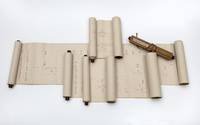
1109716 ink & brush diagrammatic illus. Five scrolls details below all with silk brocade outer front endpapers & gold speckled inner endpapers with manuscript title labels. Japan: mid- to late Edo at the end of each scroll we have the signature of Matsuura & two of his seals.<br /> <BR> <BR> Feng shui arrived in Japan from China in the 6th-7th centuries and soon became formalized by the OnmyÅryÅ Bureau of Yin-Yang which managed divination cosmology and geomancy. Over several centuries the Japanese practice of feng shui known as fÅ«sui 風水 was absorbed into native beliefs like ShintÅism using intuitive practices that stressed simplicity and mindfulness. FÅ«sui employed the geomantic concept of the “Four Divine Guardians†using this to plan buildings and cities. Each cardinal direction is protected by one of four mythological creatures: the Azure Dragon é’é¾ seiryÅ« in the east the White Tiger 白虎 byakko in the west the Vermilion Bird 朱雀 suzaku in the south and the Black Turtle-Snake çŽ„æ¦ genbu in the north. The practice of using fÅ«sui was known as kasŠ“house physiognomy†or “ecomancy†choosing not only the proper house design but also an auspicious site and placement on that location. These considerations are still widely observed today in Japan.<br /> <BR> <BR> The author of our five scrolls Matsuura Tokei 1752-1820 a ShintÅ priest was one of the leading practitioners of fÅ«sui in Osaka during a time when its use dramatically increased. He wrote a number of books on fÅ«sui and kasÅ including KasÅ zukai 家相圖解 House Physiognomy Illustrated and Described 1798 and KasÅ zusetsu taizen 家相圖說大全 Encyclopedia of House Physiognomy Illustrated and Explained 1801.<br /> <BR> <BR> The collection of texts and illustrations presented in our five scrolls:<br /> <BR> <BR> 1. “KasÅ chÅ«Å no maki†家相ä¸å¤®ä¹‹å·» “Scroll on House Physiognomy Essential Information.†Scroll 203 x 4750 mm. A general introduction to fÅ«sui and kasÅ. There are also suggestions on good and bad locations of the kitchen and the Buddhist altar room.<br /> <BR> <BR> 2. “KasÅ seiryÅ« no maki†家相é’é¾ä¹‹å·» “Scroll on House Physiognomy Azure Dragon.†Five illus. Scroll 203 x 5420 mm. This east guardian is represented by water and symbolizes spring and the element wood.<br /> <BR> <BR> 3. “KasÅ byakko no maki†家相白虎之巻. “Scroll on House Physiognomy White Tiger.†Three illus. Scroll 203 x 4460 mm. The west guardian is connected to autumn metal and a major road or path.<br /> <BR> <BR> 4. “KasÅ suzaku no maki†家相朱雀之巻 “Scroll on House Physiognomy Vermilion Bird.†Five illus. Scroll 203 x 5590 mm. The south guardian is associated with fire summer and open plains or sea.<br /> <BR> <BR> 5. “KasÅ genbu no maki†家相玄æ¦ä¹‹å·» “Scroll on House Physiognomy Black Turtle-Snake.†Three illus. Scroll 203 x 4320 mm. The north guardian is linked to winter water and protective mountains to shield from evil forces.<br /> <BR> <BR> All five scrolls are concerned in great detail with the proper placement of the well kitchen and bathing area as they are the primary sources of good or ill health.<br /> <BR> <BR> Fine condition preserved in an oldish wooden box with an inscription on the outside bottom: “owned by Takeda April 1886.â€. unknown
6330Edited by Yusuishi Tanaka. Woodcut frontis. & eight fine double-page woodcut illus. 21; 18 folding leaves. Two vols. Large 8vo orig. blue wrappers wrappers rather worn & rubbed orig. block-printed title labels on upper covers rubbed new stitching. Osaka Edo & Kyoto: 1749. First edition of this beautifully illustrated book; the fine woodcuts are by Sukenobu Nishikawa 1671-1750 or -51 or -54 who "counts among the foremost masters of so-called ukiyo-e primitive prints. His subject matter like that of his contemporaries revolved around images of women walking. These images are stylised lending the rhythmic movement of the sumptuous robes an almost sculptural effect. Nishikawa also did many book illustrations.Nishikawa founded a whole school and according to his family archives Harunobu 1725-1770 was a follower of his."-Oxford Art Online. This work is concerned with the education of women in its widest sense combining knowledge with taste. Four types of girls' "play" are described and illustrated; each providing instruction in behavior and ethics. The fine woodcut frontispiece depicts a young woman reading a book surrounded symbols of knowledge and refinement: bookshelves and brushes for calligraphy. Her clothes and hairstyle are appropriate. The first volume is concerned with dolls hina. In Japan dolls are not for play but have high spiritual value which offer girls preparation for adulthood and marriage. For the Japanese dolls are living creatures possessing heart and soul from which girls can learn discipline obedience and control. Nakanishi 1634-1709 was a scholar and writer on Shintoism and the present text was edited and posthumously published by Yusuishi Tanaka who has contributed a preface. The theme of the text is instructional and written for girls and young women: there are many references to texts essential for proper behavior and ethics. Nakanishi draws on the Nihon Shoki the oldest chronicle of Japan; Man'yoshu the eighth-century anthology of Japanese poetry; the Tale of Genji; and Makura no Soshi the famous Pillow Book. There are four fine double-page woodcut illustrations in the first volume. The first illustration depicts an upper-class woman sending her dolls away in a boat thereby sending her suffering away. The second illustration depicts the hinamatsuri doll festival with dolls arranged on shelves. The following illustration depicts a young woman facing her suitor her dowry behind her all are objects of knowledge and culture: a calligraphy set fine papers in a box picture scrolls books etc. The final illustration in this volume depicts an offering made to the sky referencing tanabata the star festival. According to legend the Milky Way separates two lovers; they are allowed to meet only once a year on the seventh day of the seventh lunar month of the lunisolar calendar. The second volume is concerned with kai-awase the Japanese shell-matching game. Again there are four fine double-page illustrations each filled with deep meaning. Matching the shells symbolizes the unity of partners in a marriage. There are many references to the Tale of Genji and Lady Murasaki; scenes from this novel were often used to illustrate the shells. One of the illustrations depicts the traditional card game called uta-garuta being played by several women. A very good set and rare. Some carefully repaired worming mostly confined to the margins. The lower outer corners of many leaves are "thumbed." ❧ Brown Block Printing & Book Illustrations in Japan p. 131. hardcover books
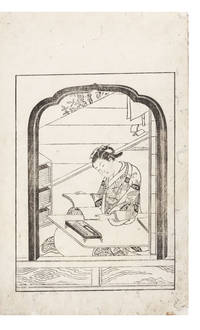
6330Edited by Yusuishi Tanaka. Woodcut frontis. & eight fine double-page woodcut illus. 21; 18 folding leaves. Two vols. Large 8vo orig. blue wrappers wrappers rather worn & rubbed orig. block-printed title labels on upper covers rubbed new stitching. Osaka Edo & Kyoto: 1749.<br/> <br/> First edition of this beautifully illustrated book; the fine woodcuts are by Sukenobu Nishikawa 1671-1750 or -51 or -54 who “counts among the foremost masters of so-called ukiyo-e primitive prints. His subject matter like that of his contemporaries revolved around images of women walking. These images are stylised lending the rhythmic movement of the sumptuous robes an almost sculptural effect. Nishikawa also did many book illustrations…Nishikawa founded a whole school and according to his family archives Harunobu 1725-1770 was a follower of his.â€â€“Oxford Art Online.<br/> <br/> This work is concerned with the education of women in its widest sense combining knowledge with taste. Four types of girls’ “play†are described and illustrated; each providing instruction in behavior and ethics. The fine woodcut frontispiece depicts a young woman reading a book surrounded symbols of knowledge and refinement: bookshelves and brushes for calligraphy. Her clothes and hairstyle are appropriate. <br/> <br/> The first volume is concerned with dolls hina. In Japan dolls are not for play but have high spiritual value which offer girls preparation for adulthood and marriage. For the Japanese dolls are living creatures possessing heart and soul from which girls can learn discipline obedience and control.<br/> <br/> Nakanishi 1634-1709 was a scholar and writer on Shintoism and the present text was edited and posthumously published by Yusuishi Tanaka who has contributed a preface. The theme of the text is instructional and written for girls and young women: there are many references to texts essential for proper behavior and ethics. Nakanishi draws on the Nihon Shoki the oldest chronicle of Japan; Man’yoshu the eighth-century anthology of Japanese poetry; the Tale of Genji; and Makura no Soshi the famous Pillow Book.<br/> <br/> There are four fine double-page woodcut illustrations in the first volume. The first illustration depicts an upper-class woman sending her dolls away in a boat thereby sending her suffering away. The second illustration depicts the hinamatsuri doll festival with dolls arranged on shelves. The following illustration depicts a young woman facing her suitor her dowry behind her all are objects of knowledge and culture: a calligraphy set fine papers in a box picture scrolls books etc. The final illustration in this volume depicts an offering made to the sky referencing tanabata the star festival. According to legend the Milky Way separates two lovers; they are allowed to meet only once a year on the seventh day of the seventh lunar month of the lunisolar calendar.<br/> <br/> The second volume is concerned with kai-awase the Japanese shell-matching game. Again there are four fine double-page illustrations each filled with deep meaning. Matching the shells symbolizes the unity of partners in a marriage. There are many references to the Tale of Genji and Lady Murasaki; scenes from this novel were often used to illustrate the shells. One of the illustrations depicts the traditional card game called uta-garuta being played by several women.<br/> <br/> A very good set and rare. Some carefully repaired worming mostly confined to the margins. The lower outer corners of many leaves are “thumbed.â€<br/> <br/> ⧠Brown Block Printing & Book Illustrations in Japan p. 131. unknown
1703B7089Paris: Chez Simon Langlois c 1703. near fine with text clean and crisp. . Edition: First Edition. Binding: Contemporary full paper boards expertly rebacked; raised spine with five 5 bands black ink title on vellum label on two; central black fleur de lis design on four. Notes: Provenance: Upper pasted endpaper with owner’s armorial bookplate: “Watkin Williams Esq of Penbedw // in the County of Denbighâ€. Concerning this name Archaeologia Cambrensis states: “1789. Watkin Williams Esq. of Penbedw in the county of Denbigh but owner of property in the parishes of Mallwyd and Llan-y-mowddwy in the county of Merioneth M.P. first for Montgomeryshire and afterwards during nearly thirty years for the Flint contributary boroughs was appointed lieutenant and custos rotulorum for Merionethshire.†Final free endpaper watermarked. <br>This edition of this Canadiana publication is unique in that we are not able to locate another copy of the same anywhere. The second last paragraph of the introduction to the priests clergy and missionaries in this edition states that this publication encloses at the end of the first part or 'Rituel' a second part entitled 'les Statuts Ordonnances & Mandemens.' instructions prepared at various times by the Church for the conduct of all including those entrusted to the clergy that these instructions may not be ignored. The recipient are advised that they are restatements of instructions previously given to be read often just as such given in the Ritual itself; they are to be followed with precisions including all the rules contained not to be lost sight of observed faithfully in all works and ones conduct. The inclusion of this paragraph is unlike the introduction of another edition published at the same time and same location but not including this paragraph or the 'Statuts.'. <br>The present work describing festivals sacraments statutes and ordinances for the use by priests in Quebec is extremely rare and was immediately followed by a second edition published the same year: Gagnon reports that in a copy of the second edition of 1703 now at the Laval University library and previously owned by Abbé Plante a note says that the first edition “would have been almost completely destroyed by the sinking of the ship …carrying it to Canada and for this reason a second edition was immediately made.†<br>On the “privilege†included as the final leaf in our first edition example it is stated that the work was registered on March 30 1703 and completed for print for the first time on March 31 1703; <br><br>Saint-Valier was a supporter of the Counter Reformation. His initial intent in the New World was to engage in the conversion of the indigenous residents. He introduced Jesuits and Recollects in an attempt to evangelize New France. Many of these missions Illinois Louisiana and Mississippi resulted in conflicts between Bishop Saint-Vallier the Jesuits and the seminary of Quebec.<br><br>His various construction projects reflect a desire to restore and renew the authority in the Catholic Church as the main institution of administrative organization. In 1697 Saint-Valier built a palace in Quebec for his clergy and as a place of hospitality. During the same year he also established a nuns monastery in Trois-Rivières Saint-Vallier’s zeal for religious activities and establishments stretched from Quebec Montreal Acadia and Louisiana. His way of life embodied that of the ideals of the Council of Trent.<br><br>The Diocese of Quebec was vast and its population diverse and widespread. It included the whole of French North America or what was called New France divided in seven colonies: Newfoundland Acadia ÃŽle Royale Louisiana Illinois Upper Country and Canada inhabited by Indigenous people and the European settlers. During the tenure of Saint-Vallier immigration from France was mostly over; the European colonists were farmers fishermen sailors merchants and ‘coureurs des bois’ overseen by a small elite of aristocratic leaders but a great demographic explosion occurred between 1685 and 1730 the white population in New France jumping from c. 12000 inhabitants to c. 41500.<br><br>During the same time the number of Amerindian fell from c. 163500 to c. 61500. That loss mainly in the tribes of Louisiana was attributed to warfare and diseases brought to the valley of the Mississippi. The number of Aboriginals compared to white settlers is one reason for the presence of so many religious orders in New France. The missions and conversions to Christianity were deemed very important.<br><br>Priests of the Missions Étrangères of Paris the Jesuits the Recollets and the Sulpicians often worked in collaboration with the nuns from different orders like the Congrégation de Notre-Dame or the Canonesses of St. Augustine of the Mercy of Jesus at l’Hôtel-Dieu de Québec. The arrival of Saint-Vallier and his strong views on what should be the duties of the priests created a shock wave in the orders especially for the Seminary of Quebec newly founded by his predecessor Bishop Laval. … Saint-Vallier's tenure as bishop was defined by interminable quarrels with governmental and religious institutions in French North America. … his active leadership style brought him into conflict with various groups who perceived him as at times domineering and micromanaging.<br>While subject to much criticism Saint-Vallier was also admired in his diocese for his dedication and self-sacrifice. Rather than staying in Quebec or Montreal he tirelessly traveled the back-country. The founding of the Hôpital Général and installation of Jesuits and Recollets at Montreal were also to his credit.<br><br>There was a very strong suspicion in the colonies and in France that the Bishop of Quebec was in fact a follower of Jansenism. . In the beginning of the 18th century the Bishop wrote 3 books; the Ritual the Catechism and the ‘Statuts et ordonnances’ – two of which are bound in the present volume. <br>…the Superior of the jesuite order decided to attack Saint-Vallier’s authority by writing a long critic of those three books seeing them as a "lapse into Arianism Pelagianism Jansenism Lutheranism and Calvinism". Father Bouvart based his accusations on different passages of the works of the Bishop … who eventually appealed to the Sorbonne to have his works rehabilitated. The doctors of the Faculty of Theology declared the Ritual and the Catechism perfectly orthodox and censured the critic of Bouvart. Nevertheless Saint-Vallier decided to re-edit in 1713 the Ritual so as to cast away all doubts about his pretended Jansenist ideas. This book remained in use in the parishes until the middle of the 19th century. The present work is the unedited original and first edition of his ritual and statuts. <br><br>The disputes with the religious orders of New France the government and the merchants gave way to a more peaceful period that lasted until his death. Austere throughout his life he became more and more humble in his way of living and turned toward contemplation and simple duties. .He also took very seriously his duties of Bishop and developed parishes in the farthest corners of the diocese.<br><br> Size: Octavo 213 x133mm. Illustration: Text in French; with some text in Latin<br>Achevé d'imprimer pour la premiere fois ce 31 mars 1703. Relié avec le Rituel du même. <br><br>Illustrated with two printer's devices representing the arms of the archdiocese of Quebec; various head and tail pieces incl. vignettes; in-text music notes on Qiiii-Si; Ggii-iiii. References: Philéas Gagnon: Essai de bibliographie canadienne: Inventaire d'une bibliothèque . Volume 1: 3138 & 3139 p.437; Archaeologia Cambrensis Volume 1 p.142. Pages: Ff. 2 bl. ill. title bl. author to priests on the use of the book 4 Fetes Observe’es 4 604 table 2 errata 3 bl.; ill. title bl. letter 3 8-146 table 2 privilege 2 bl.2; In leaf collation: bl. v A-Z8 Aa-Nn8 Oo-Rr4 iiiff. table; a1 a3-a8 e8 i8 o8 u8 aa8 ee8 ii2 oo8 uu8 aaa1 ii bl. Category: Book Canada; Book Religious Christianity; Chez Simon Langlois, hardcover
29286THWAITES Reuben Gold ed. Early Western Travels 1748-1846. A Series of Annotated Reprints of some of the best and rarest contemporary volumes of travel descriptive of the Aborigines and Social and Economic Conditions in the Middle and Far West during the Period of Early American Settlement. Edited with Notes Introductions Index etc. Cleveland: The Arthur H. Clark Company 1904-1907. 31 vols. plus folio Atlas vol. Illus. Maps. Orig. cloth. Fine set. Howes T-255. Limited to 750 copies signed by the publisher. RARELY FOUND COMPLETE. Includes the travel journals of Brackenridge Bradbury Bullock Croghan Cuming De Smet Evans Farnhaum Faux Flagg Flint Flower Franchere Gregg Harris Hulme James Long Maximilian Michaux Morris Nuttall Ogden Pattie Ross Townsend Welby Wood and Wyeth among others. unknown
1783B6593Ingoldstad Germany : Anton Attenkhouer c. 1783. . A very good example occasional minor browning. Edition: Second edition of Henrich Palmaz Leveling's German Binding: Full recent panelled calf triple gilt outer borders on speckled natural calf; central blind-stamped green panel; spine raised with five 5 bands; titles on two and four and compartments with central gilt ornament dated. Notes: Text in German. Gothic Script.<br>Second edition of Henrich Palmaz Leveling's German translation or Ingolstadt edition after the first of 1781.<br>This second Ingolstadt edition of only 1500 exemplars features beyond twohundred 200 in-text engravings printed from Vesalius’s original woodblocks; the woodblocks were destroyed during the WWII bombings of Munich. Leveling not only translated this work but introduced updated information often relying on the French Winslow as information source. Size: Folio 396x274mm. Illustration: Illustrated woodcut title depicting the dissection lecture hall; printed title with engraved vignette of the portrait of Heinrich Palmatius Leveling flanked on either side by the staff of Aesculapius and a skeleton respectively; headpieces at 2 A1 Bb1 Xx1 Nnn Yyy2r Ccc1r; and tailpieces at Q1 Bb1 Uu1v Eee2 Mmm2v Yyy1v Bbbb2v Hhhh2v 1v or final leaf; ornamental Gothic initials on title and dedication; in-text partial page illustrations at A1 A2v B1r 3 B2r B2v C1r 2 C1v 2 C2r D1r D1v D2r 2 D2v2 E1r E2v 2 F2r 2 G1r G2r 3G2v 3 H1v2 H2r 3 H2v2 I1r3 I2r 4 I2v3 K1v K2r5 L1v L2r6 L2v3 N1v2 O1v2 Nn1r Qq2r Ss1v2 Ss2v Tt1r8 Uu1r Zz1v 2 Aaa2v Bbb2v 2 Ccc1v Ccc2r Ggg2v Iii2v Lll2v Ooo1v Ppp2r Ppprv Qqq1v Qqq2v Rrr1v2 Rrr2r 2 Sss1v Xxx1v Xxx2v 2 Yyy1r Yyy2r Zzz2r Zzz2v Aaaa1r 2 Aaaa2r Aaaa2v 2; in-text half page illustrations often consisting of multiple illustrations at: A1v A2v F1v9 H1v H2r I2v K1v 5L1r2 M1v2 M2r4 M2v O2r15 Q1r Rr1r Rr1v Rr2v Ss1r Ss2r2 Tt2v Xx1r Zz2r Fff1r Nnn1r Nnn2r Ooo1r Ppp2r Qqq2r Sss2r Ttt1v Uuu1r Uuu2r Xxx2r Yyy2v Cccc1r Cccc2r Cccc2v Dddd1v Dddd2r Eeee1r Eeee2r Ffff1r Gggg2r Gggg2v Hhhh1v; in-text full page illustrations at: F1r N2r13 P1r P1v P2r Bb2r Cc2r Dd2r Ee2r Ff2r Gg2v Jj17r Jj2v Kk2v Ll2v Mm2v Nn2v Oo2r Pp2r Xx2v Zz2v Ccc2v folding Eee2v Fff1v Iii2v Kkk1r Mmm12 folding Ooo2v; <br>Moreover two double-paged woodcuts insert of Adam and Eve at Iiii2v. <br> Volume: Seven books in one volum Provenance: Signature: “H.Linder // 1875†on the margin of the upper free endpaper; Stamp on verso of final leaf: “Henry Linder //SCULPTOR Studio … // NEW-YORK.†Some of Linder’s work 1854-1910 renowned New York sculptor is exhibited at the Smithsonian America References: Choulant-Frank 185; Cushing VI A.15; Heirs of Hippocrates 1042; Osler 573; Waller 5752 Pages: Ll: Bl. 2 ill title printed title with portrait vignette of Leveling dedication 3 x1-xx2 preface x1-2 index; A1-Z2 Aa1 1st book Bb1-T2 U1 2nd book ; Xx1-Eee2 3rd book Fff1-Mmm2 4th book Nnn1-Yyy1 5th book Yyy2-Zzz2 Aaaa1-Bbbb2 6th book Cccc1-Hhhh2 7th book Iiii1-2 2 folding plates- of Adam and Eve Kkkk1-Oooo2 summarische Abhandlung 1-2 1 Index; bl.2. Category: Book Medical; Anton Attenkhouer, unknown
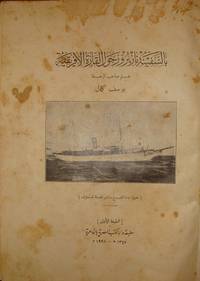
1928000493<p>Bi-l-safÄ«na "NÄz برور" ḥawla al-qÄrra al-ifrÄ«qiyya</p><p>Cairo: DÄr al-Kutub al-Miá¹£riyya 1928.<br />Book. Very Good. Hardcover. First Edition.<br />4to 9¾ × 12 in.<br />Very rare limited edition printed in only 500 copies.<br />Arabic text 424 pages richly illustrated with numerous photographic plates and in-text photographs.<br />The work is divided into three main parts:<br />Part I: Somali territories and British Kenya.<br />Part II: Belgian Congo British Tanganyika Portuguese Angola Victoria Falls the Cape Colony the Canary Islands and the Island of Malta.<br />Part III: Victoria Falls Rhodesia the Kalahari Desert the Cape Territory the Madeira Archipelago the Island of Malta and Marmarica Cyrenaica region.<br />Bound in a contemporary binding.</p><p>Prince YÅ«suf KamÄl was a member of the Egyptian royal family a distinguished patron of the arts and one of the most important collectors of Islamic art and cartography in Egypt during the late 19th and early 20th centuries. He founded the School of Fine Arts in Cairo 1908 and assembled an exceptional collection of manuscripts maps and artworks many of which later entered public institutions. In addition to his patronage he was an accomplished author and translator particularly of geographical and travel literature including accounts of African exploration and voyages.</p><p>For another work by YÅ«suf KamÄl see inventory no. 000454.</p> Dar ul Kutub al- Misriyya hardcover
1650B6295Rome/Romae: Formis Io. Iacobi de Rubei apud templum S. Mariae de Pace. Undated c.1650-latest c.1690 most probably c.1660 c.1675-1677. . Lacks folding double-page plan of the Villa Pamphilia and the first of 5 folding plates “Primusâ€. Otherwise a very good example plates are crisp and clean. . Edition: First and only edition. Italic and Roman type. Tex Binding: Contemporary panelled full burgundy morocco double-gilt filleted; spine with six 6 raised bands gilt lettered title on two with remaining compartments gilt ornamented; all edges gilt; contemporary endpapers with watermark of a fleur-de-lis within two concentric circles. Wide margin paper. Notes: An architectural plate book depicting statues and fountains displayed in Villa Pamphili an important 16th-17th century Roman villa designed by the painter Giovanni Francesco Grimaldi 1606 - 1680 and Alessandro Algardi 1598 - 1654 followed by the construction of the garden layout; …1652-1657. The publication of the present work printed by G.G. de Rossi possibly c.1675-1677 was commissioned by Pamphili’s son and heir Giambattista with the engraver Dominique Barrière documenting the statues placed both in cornices of the villa and the gardens and with further plates included such as some by Giovanni Battista Falda's ‘Le fontane di Roma’ fountains of Rome plus general views of the villa and its gardens.<br> <br>Giovanni Battista Falda c.1643 – 1678 Rome was an Italian architect engraver and artist. He is known for his engravings of both contemporary and antique buildings and structures of Rome. Falda studied and worked under Bernini; his draughtsmanship drew G. G. de Rossi’s attention. He became well-known for his “Le fontane di Roma†Fountains in Rome and “Palazzi di Roma†Palaces of Rome particularly popular with visitors to Rome.<br> <br>Giovanni Giacomo de Rossi Italian engraver and printer active in Rome during the second half of the 17th century. His father Giuseppe de Rossi 1570-1639 was the founder of the most important and active printing press of the 17th century in Rome. The press started in 1633 it was then passed to Giovanni Giacomo and his brother Giandomenico; and later to Lorenzo Filippo. In 1738 it became the “Calcografia Camerale†from 1870-1945 the “Regia Calcograficaâ€; today it is known as the “Calcografia Nazionaleâ€. Here are conserved amongst many others the plates of Giambattista Piranesi 1720-1778. Giovanni Giacomo de Rossi the most involved of all family members who ran the press from 1638-1691 took the company to its height of success. He printed etchings for artists including Giovanni Benedetto Castiglione 1609-1665 Pietro Testa 1612-1650 and Giovan. Francesco Grimaldi 1606–1680.<br> <br>Barrière c.1622–1678 was a French painter and engraver. Barrière was born at Marseilles in about 1622. He spent most of his career in Rome where he engraved a considerable number of plates after Claude and other landscape painters as well as other subjects. They are neatly etched in the manner of Stefano della Bella. He died in Rome in 1678. <br> <br> Size: Folio 434x312mm. Illustration: Fine illustrations of the famous Villa Pamphili the most important architectural constructions of Baroque Rome with its Italian garden and the fine collection of antiquities. <br>Illustrated dedication with head- & tail-vignettes and a large rubricated initial; plus a total of 82 full page and double page oblong folding copper-engraved plates.<br> References: Woodfall G.; British Museum: Catalogue of Maps Prints Drawings Etc. Forming the Geographical and Topographical Collection vol. II p. 146 1829. Rossetti 4827. Cicognara 3911. Berlin Katalog 3491. Kissner 394. Vinciana 4360. Giorgetta F. Hortus libro Category: Book Europe Italy; Book Art Architecture & Design; Book Plate Books General; Formis Io. Iacobi de Rubei, apud templum S. Mariae de Pace. hardcover
1490V68428Venice: Hermann Lichtenstein Coloniensis 1490 7th Sept. Hardcover. Very Good-. Guide Letters in red and blue red and blue markers several hundred . Quarto 244x175mm blindstamped pig spined wooden boards with 2 working clasps oldbut not original ink title to spine on 5 raised double cords repair to foot of spine/ old copper strengthening to lower board insertions of catches/minor worming but not weakening wood or leather inside of covers are part of a Spanish-Latin word list. 1st leaf has old ownership and neat caligraphic title Plura Opuscula St. Thome. Verso=Tabula listing the titles or all the works some damage bottom 7 titles Leaf 2-12 =Life of which first 5 leaves have repairs to foot of page but with loss to only the recto of the first leaf other paper repairs are marginal only and do not affect any print these leaves signed aa in 12's. The 72 Opuscula take up a-x A-Z AA-HH all in 8's except x & HH in 12's as listed on Register on last leaf. Some repairs to later pages of index with the last being mounted but only affecting 2 words of the Register leaf. Some worm holes mostly marginal and some marginal damp marks but the paper is strong and supple. Clean very thick book 436 leaves 872pp Printed in double columns 56 lines to a full column in Gothic letters. Collated complete. Reefernmces: Hain-Cop. 1541 BMC V 358 Proctor 4793 Goff T 258. Hermann Lichtenstein Coloniensis hardcover
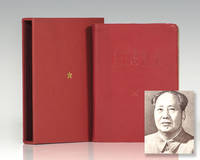
1964100159Beijing: Central Political Department of the Chinese People's Liberation Army 1964. First edition of Quotations from Chairman Mao. Duodecimo in the original iconic red vinyl title to front cover in blind frontispiece portrait of Chairman Mao. With the textual error on pp. 82/83 corrected and Lin Biao's calligraphic endorsement leaf after the frontispiece tipped in from a later printing. In 1972 an edict was issued that Lin's name was to be obliterated from history following disclosures that he had plotted a coup and planned to assassinate Mao; consequently "many surviving copies in the Chinese language have that page legitimately torn away mutilated or censored" Schiller p. 36. In near fine condition. Housed in a custom red slipcase. Printed for the General Political Department of the People's Liberation Army the first edition of Mao's Quotations was issued in two states and bindings: the uncorrected first state text in red vinyl plastic and the corrected second state in paper wrappers. The corrected copies issued in wrappers and intended for high-ranking officers were released first; the uncorrected copies issued in red vinyl and for use by brigade teams were released shortly afterwards as the sturdier binding took longer to manufacture. By the start of the Cultural Revolution in 1966 the red vinyl design had become symbolic of Mao's slogan "The East is Red" and the paper wrappers were discontinued. The year 1966 also "signaled the start of a major translation and publication project when the Little Red Book was issued in over 50 different languages of countries where Socialism might triumph" Schiller p. 55. The book was printed in large quantities until Mao's death in 1976; by the late 1970s however a change of government meant further circulation of the book was discouraged with millions of copies were collected and destroyed. His Little Red Book however sometimes referred to as the "Chinese Bible" "forms a brilliant compilation that is still readable and admired today for its political theories and strategies" ibid. p. 57. Central Political Department of the Chinese People's Liberation Army unknown books
8347Vol. I: Illustrated “title-page†one double-page woodcut with foldouts to form a four-panel diptych with the addition of a “trick super flap†depicting three female genitalia young woman mistress & wife six double-page woodcuts & two single-page woodcuts all color-printed; & three double-page black & white woodcuts. Vol. II: Illustrated “title-page†five double-page woodcuts & two single-page woodcuts all color-printed; & four double-page black & white woodcuts. Vol. III: Illustrated “title-page†four double-page woodcuts & two full-page woodcuts all color-printed; & three black & white double-page woodcuts. All leaves have color-printed borders. .5 1 folding leaf of preface color-printed 13 folding leaves; .5 13 folding leaves; .5 12 folding leaves. Three vols. 8vo orig. decorated semi-stiff patterned boards with color-printed symbols of the moon flowers & snowflakes orig. block-printed title labels on upper covers of Vols. I & II lacking on Vol. III but there is no evidence a label was ever there new stitching. Japan: Preface dated 1850.<br /> <BR> <BR> First edition and very rare; we can find no copy in WorldCat or NIJL. Almost all of the techniques that make Japanese illustrated books so remarkable are utilized here. Finely illustrated and richly colored this late shunga employs bokashi the delicate variation of shading of pigment within the image; blind-embossing; and the very ample use of metallic pigments. The depicted garments are a mixture of extremely complex textures colors and patterns all accentuated by blind-embossing and multiple woodblock impressions.<br /> <BR> <BR> In Vol. I the folding woodcuts — which reveal a man and woman engaging in sex — open to reveal a fine and complex four-panel scene in which we see three couples also having sex: a young couple a man with his mistress and the same man with his wife. On the third panel from the right a hidden “trick†flap is revealed depicting and comparing the genitalia of these three women. This “trick†panel has the title printed with seven kanji characters the first two are indecipherable: “…mitate setsugekka†“…Visual Puns of Snow Moon Flowerâ€.<br /> <BR> <BR> Each volume begins with a finely colored paste-down leaf artistically depicting the themes of snow moon and flower with poems. Facing each of these leaves is a portrait of a woman: mistress young and wife. All the black & white woodcuts also depict men and women engaging in sex and self-pleasuring.<br /> <BR> <BR> Koikawa 1821-1907 was a prolific artist. He illustrated as well as wrote numerous books under various pen names. At the end of the Preface in Vol. I we find “Insuitei†one of his pen names.<br /> <BR> <BR> Fine set with fresh coloring. The four-panel diptych has several small burn holes on the right-hand side. One black & white illustration has been “heightened†with red ink in a very minor way. Slight thumbing and a few minor stains. unknown
1897526<p>A collection of 50 albumen prints from the British Museum Series numerous manuscript captions slight age-related toning photographs mounted to album occasional light marginal foxing not affecting image original maroon cloth with quarter morocco spine retaining studs title gilt to spine slightly rubbed folio London: W.A. Mansell c.1897 </p><p><br /></p><p>The 50 photographs of antiquities in the British Museum covering Greek Roman and Etruscan Statues and Vases including 24 of the Parthenon Frieze. Many of the images are accompanied by manuscript captions. Other photographs include:</p><p>Horse of Selene Ilissos "Colossal Lion" The Piranesi Vase "Marble Vase found in the Villa of Hadrian at Tivoli" "Mercury" "Venus de Medici" "The "Townley" Venus" "Venus Entering Bath" "Apollo as a Player of the Lyre from Cyrene" "Hercules" Hercules found in Hadrian's villa at Tivoli Drum of Sculptured Column from Temple of Diana Artemision Ephesus "Casts from Balustrade of Temple of Wingless Victory - Athens -" Etruscan Sepulchral Monument in terracotta "Thalia"</p><p>T. Aurelius Fulvius Antonius Pius Aurelius Antoni Satyr Apollo Demeter Ceres and Sepulchral Rites at the Tomb of a Hero. </p><br /><p>The Elgin Marbles are a collection of statues and architectural decoration acquired by the Earl of Elgin during his time as Ambassador to the Ottoman Empire. He successfully petitioned the authorities to be able to measure draw and remove figures in various ruins. The most extensive work was on the Parthenon or Temple of Athena but he also received permission to remove sculptural and architectural elements from a number of other ruins including the Acropolis and the Temple of Nike Athena. </p><br /><p>The most famous of the Elgin Marbles are the Parthenon Sculptures a collection of different types of marble architectural decoration on the Parthenon. The Parthenon Frieze 75 metres in length depicts various scenes including the battle between the Lapitas and the Centaurs at the marriage feast of Peirithoos. Elgin originally intended on using the Frieze as decoration in his private home but due to the collapse of his marriage he sold them to the British Museum. There have been debates over the legitimacy of Elgin's excavation. After an investigation from a Parliamentary Select Committee in 1816 Elgin's actions were found to be entirely legal. Since 1983 Greece has formally requested the British Museum to return all the Parthenon Sculptures in the Museum's collection the British Museum states there are no current discussions with the Greek Government on this issue. </p><br /><p>Roger Fenton is one of the most celebrated figures in the history of photography. He was a creative and highly influential photographer in the mediums "golden age" of the 1850s. In his role as the British Museum's first official photographer Fenton demonstrated his sure sense as a 'photo artist'. He was initially engaged to photograph cuneiform tablets but that soon developed into taking pictures of other antiquities. As early as 1852 Fenton received permission from the Trustees to photograph antiquities within the museum establishing a small studio inside the museum the following year. He left in 1854 to serve as a photographer in the Crimean War for which he is most widely known but he was re-appointed on his return in 1856 until the termination of his contract in July 1859. The Trustees decided that photography was not cost effective and after they failed to negotiate the South Kensington Museum now the V&A as an alternative Fenton terminated his association with the British Museum. </p><br />References: The British Museum The Metropolitan Museum of Art Luminous-Lint. W.A. Mansell
1706B6518Paris / probably Amsterdam: Gedrukt tot Parys inde Koninglyke druckery van den klyne Louis Carel Allard. Imprime a l'Imprimerie Royal du petit Louisâ€. Circa 1706. Very rare and desirable overall plates are crisp and clean; corner of title and edges of some plates slightly darkened; corner torn off at plate 13. . Notes: An important work on the War of the Spanish Succession with a collection of prints by Carel Allard or “Petit Louis†ridiculing the “Sun King†or Monarch Louis xiv in eclipse. Many of Allard’s prints initially separately were published in sets of varying combinations – including the present ‘Almanach’. For instance the Rijksmuseum owns a copy of a later 1713 publication entitled 't Lust-Hof van Momus Beplant met de voornaamste Gewassen van Mars in Europa Een opgepronkt met Staat-kundige Zinnebeelden Des Tegenwoordigen Oorlogs’ by Abraham Allard in which most of the prints of the present work are incorportated. Carel Allard known for depicting royalty inspired other later publications such as satirical engravings in the ‘South Sea Bubble’ published approximately a decade later. Muller comments on the rarity of the prints and the present series; only few known copies exist mainly owned by institutions; Muller states: "Their value as expressions of the spirit and life of the common people is inestimable: indeed there is almost no period in our history for which we possess such a rich treasure of prints." <br>While the title states that the publication was printed in Paris researchers claim the place of editing and printing to be Amsterdam that not the royal imprimerie of ‘Petit Louis’ was used but the printing house of Carol Allard in Amsterdam. Moreover it is claimed that Allard edited the work in Amsterdam. <br> Size: Small Folio 317 x206 mm Illustration: Text in Dutch and French.<br>Illustrated with engraved letterpress copper title and eighteen 18 copper engraved plates; of these seven 7 full page with letterpress text and eleven 11 double page; all accompanied by text each in Dutch and all except for the fifth entitled ‘DE FRANSCHE EN SPAANSCHE HUYLEBALKEN’ and the eighteenth entitled ‘HARPAGON den Ouden Schrok EN HARLEKYN Smit’- all in French. Work on the War of the Spanish Succession ridiculing the Sun King. Provenance: Pencilled and ink notations and signature on upper pasted and free endpaper References: Brunet I: 194-195; Cohen: col. 28; Muller F: ‘De Nederlandsche Geschiedenis in Platen - Beredeneerde Beschrijving van Nederlandsche Historieplaten …’ 1863-70 vol.1: xiii-xv; vol 4: 36 3037/3067/ 3068/3082. Pages: Ff: bl. title 7 full page plates 11 double page plates. Category: Book Caricatures; Book Plate Books General; Book Europe Benelux; Gedrukt tot Parys inde Koninglyke druckery van den klyne Louis [Carel Allard]. Imprime a l'Imprimerie Royal du petit Louisâ€. unknown
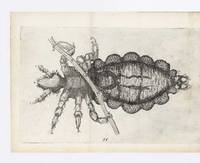
5444Added engraved title & 40 engraved plates three are folding. 1 p.l. 106 pp. one blank leaf. Small 4to cont. English panelled calf corners renewed rebacked some dampstaining in gutter at foot to first ten leaves. Rome: A. de Rubeis 1703. First separate edition originally published as the second part of the author's Observationes circa viventia 1691. Our edition - which is actually the original printing of the second part with a new title-page - is very rare with only one copy located by WorldCat. Buonanni 1738-1725 one of the most learned Jesuits of his time was a pupil of Athanasius Kircher and succeeded his master as teacher of mathematics at the Collegium Romanum. This work is one of the earliest Italian treatises on microscopy. It contains interesting observations on early microscopes and a precise description of Buonanni's own compound microscopes which are illustrated on two plates. The rest of the plates show objects seen through the microscope including a number of illustrations of insects. "The quality of his illustrations of various insects was excellent - particularly those of the fly louse mite flea and mosquito. Indeed his drawings of the Culex pipiens common house mosquito are the best of the seventeenth century."-D.S.B. II p. 591. Very good copy. Duplicate from the British Museum with their duplicate stamp dated 1787. Armorial bookplate of Sir John Ingilby Bart. 1758-1815 M.P. and Fellow of the Royal Society. ❧ Clay & Court The History of the Microscope pp. 84-86. Garrison-Morton 264-1st ed. of 1691. unknown books
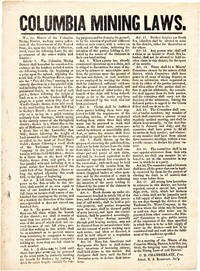
1853WRCAM46036Columbia Ca.: Gazette Print 1853. Broadside 10 3/4 x 8 inches. Printed in three columns. A bit of light foxing mostly in margins. Near fine. In a folding cloth clamshell case spine gilt. A rare broadside printing of the laws of the Columbia Mining District in California in 1853 created and enforced by the miners for their own self-government. The seventeen articles all deal with regulations for mining and claims. The first nine set out rules for making and operating claims. The next three address foreign ownership of claims. Article 10: "None but Americans and Europeans who have or shall declare their intentions of becoming citizens shall hold claims in this district." Article 11: "Neither Asiatics nor South Sea Islanders shall be allowed to mine in this district either for themselves or for others." Article 12 sets out a punishment for any miner who sells a claim to an Asian or a Polynesian. The final five articles set out rules for enforcing the laws including the creation of a Miners Committee and a system of binding arbitration. According to the text the laws were adopted "at a meeting of the Miners of the Columbia Mining District held Oct. 1st 1853." and the laws are signed in print by "C.H. Chamberlain Pres." and "R.A. Robinson Sec'y." <br> <br> "The item is of basic importance.as an example of how the California miners - or men beyond the reach of government anywhere else in our States and Territories for that matter - banded together and enacted and enforced codes of law for their own protection" - Eberstadt. The COLUMBIA GAZETTE which printed this broadside was according to Kemble the second newspaper to operate in Columbia starting operations in the fall of 1852. The first newspaper in the area the COLUMBIA STAR apparently printed only two or three issues in October-November of 1851 before the printing press was destroyed by vandals. <br> <br> Greenwood locates only three copies at the California Historical Society and the Bancroft Library and the Streeter copy which was sold at the Clifford sale in 1994. Rocq lists a copy at the Huntington Library. OCLC adds copies at Yale Library of Congress University of California at San Diego Stanford and DeGolyer Library at Southern Methodist University. A rare and interesting example of the search for order in the tumult of the gold rush. <br> <br> The Streeter copy sold to Howell for $550 in 1968. It later reappeared in the sale of California collector Henry Clifford in 1994. GREENWOOD 381. ROCQ 15427. EBERSTADT 131:105. STREETER SALE 2735. CLIFFORD SALE 26. OCLC 29876358. Gazette Print hardcover books
elala5445Cleveland: The Burrows Brothers Company 1896-1901. First Thwaites Edition Limited to 750 sets. This set bears rubberstamps "Unnumbered set bound from waste sheets for editorial use." “A monumental editorial achievement. Contains all reports official and unofficial made by members of this missionary order on their activities in North America from 1601 to 1791. In all 238 pieces are given in their original French Latin and Italian texts with English translations.†Howes Spanning the years 1632 to 1673 the relations were the regular reports sent back by the priests of the Canadian mission to their superiors in France. Not only do they record the progress of the missions in converting the Canadian aboriginals to Christianity they are also an important source of historical information on the exploration of New France the manners and customs of the natives and the daily life of the French settlers. Thwaites was assisted in the compilation of the Relations by an impressive array of European and American scholars. In the introduction to his volume of Errata and Addenda which was published in 1967 Joseph P.Donnelly highlighted some of the significant aspects of the work: “The identification of persons even very obscure individuals is an extremely valuable editorial contribution. The bibliographical information regarding the heuristics and provenance of material included in the series is of inestimable worth to the historian…An outstanding editorial feature…is the exhaustive two-volume index…â€. This set belonged to Dr. Lorris Elijah Borden 1877-1963 a long-standing associate of the Arctic Institute. Borden was the last surviving member of the 1903-04 Canadian Arctic Expedition in the Neptune under Captain A.P.Low in which he took part as medical officer. This expedition constituted the first significant step towards the assertion of Canadian authority in the eastern Arctic. During that time Borden studied the diseases afflicting the Inuit and gathered a collection of carvings and other artifacts that was gifted together with his notes and diaries to the Public Archives of Canada in 1964 by his widow. The artifacts are now housed in the Canadian Museum of Civilization. TPL 630. Howes J-106. 73 vols. 8vo. 137 of 138 plates maps views portraits facsimiles incl. 3 multi-page facsimile letters; some folding: lacking the map of Huronia in Vol. XXXIV. 4 text illus. untrimmed in original cloth t.e.g. others uncut dampstaining to lower margins covers & spines of Vols. IX X & LVI. dampstain to lower spines & covers of a few other volumes last volume spine faded 1 plate torn in half & crudely repaired - no loss some foxing throughout. bookplate of Dr. L.E.Borden see below. elala5445 Cleveland: The Burrows Brothers Company, 1896-1901 hardcover
15646012<p>8vo. 112 ff pages 2 and 110-112 are blank. Bound in modern paneled calf with gilt-stamped fleurons on front and back covers raised bands. Generally good.<br /></p><p>The first edition of this plague treatise by Paracelsus Theophrastus Bombastus von Hohenheim 1493-1541 the "Luther of Medicine" and one of the key figures in the history of medicine. Written originally in Nördlingen in 1529-1530 it remained unpublished during Paracelsus' lifetime and subsequently taken up and edited for publication by the Paracelsian scholar Adam von Bodenstein 1528-1577. The latter dedicated it to Johann Rudolph Stör von Störenberg Abbot of Murbach and Luders. In addition to the study on pestilence the text includes two short works by Paracelsus: "Vom Preservatiff durch den Schwebel" and "Von der Mummia."</p><p>In the primary tract Paracelsus for the first time presents his complex theory on the origins of the plague which he believed were the result of astrological and corporeal events set in motion by human sins. "This anthropocentric view of an individual disease is in harmony with Paracelsus' whole philosophy and indeed with Renaissance philosophy in general" Pagel p. 179. Paracelsus also postulates the importance of the principle of sulphur the corresponding agent of the planet Mars in pestilence's causation. He believed that sulphur hidden in three minerals—antimony arsenic and marcasite—affected three corresponding organs: the groin the axillae and the ears.</p><p>The chapters on causation are followed by sections on remedies. The doctor must cure the agent causing the disease rather than the symptoms of the disease Paracelsus writes. Humoral pathology and its insistence on diet is of no use. "Paracelsus' plague remedies include sulphur spirit of vitriol sulphur sublimate and metals also—for external treatment of boils—toads and decoctions of beetles designed to remove the evil of magnetic attraction but herbs and drugs as prescribed by Ficino and Agrippa are greatly amplified and still appear in a prominent place" Pagel pp. 180-181 n. 151.</p><p>The editor of this volume Adam von Bodenstein was one of the key figures in the revival of Paracelsian ideas in the German lands in the middle of the sixteenth century. A son of a radical reformer he believed in transmutation of metals into gold and played a key role in the publication of over 80 works by Paracelsus. For his Paracelsianism he was excluded from the faculty and council of Basel University.</p><p>OCLC records US copies at NYAM NLM Wash. U and UMn.</p><p>Karl Sudhoff <i>Bibliographia Paracelsica</i> Berlin 1894 60; Walter Pagel <i>Paracelsus: An Introduction to Philosophical Medicine in the Era of the Renaissance</i> Boston 1982 2nd revised edition; Georgiana D. Hedesan "Alchemy Potency Imagination Paracelsus's Theories of Poison" in John Arrizabalaga Ole Peter Grell Andrew Cunningham eds. <i>It All Depends on the Dose: Poisons and Medicines in European History. The History of Medicine in Context Series</i> New York 2018 pp. 81-102; Peter J. Forshaw "'Paradoxes Absurdities and Madness:' Conflict over Alchemy Magic and Medicine in the Works of Andreas Libavius and Heinrich Khunrath" <i>Early Science and Medicine</i> vol. 13 no. 1 2008 pp. 53-81.</p> Paul Messerschmidt hardcover
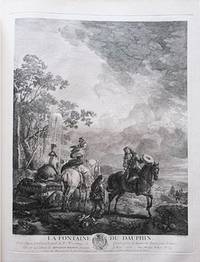
176241877Paris: Chez Moyreau 1762. Folio. 23 1/2 x 19 1/2 inches. Engraved portrait of Moyreau by Nonnette dated 1749 and 100 engraved plates numbered 1-100 with the engraved rococo title being numbered as plate 25. 88 plates engraved by Moyreau and the others by Cochin Chedel etc. The title is engraved by Le Parmentier after J. de la Joue. Included are 5 double page plates and one page with 2 plates on the page. The final 8 plates are numbered in manuscript and the last 2 plates are proofs 'before letters'. Full contemporary calf gilt hinges strengthened<br/> <br/> A rare magnificent collection of engravings showcasing the works of the renowned Dutch Golden Age painter Philips Wouwerman.<br/> <br/> Engraved by master engraver Jean Moyreau the illustrations meticulously reproduce Wouwerman's celebrated equestrian and rural scenes capturing the dynamic compositions intricate details of the originals. Featuring some of the artists finest works carefully selected from the most esteemed collections in Paris and beyond the volume serves as a homage to Wouwerman's enduring artistry.<br/> <br/> Cohen de Ricci 1068; Bulletin Morgand 1889 No. 17315 '1 frontispice et 100 planches; Thiebaud p. 945-946; Brunet V 1480. Chez Moyreau unknown
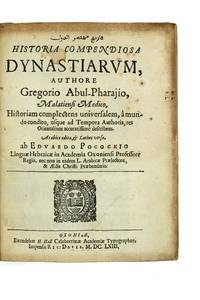
16634120<p>Oxford: H.Hall. Impensis Ric: Davis 1663. First edition thus in the Arabic edition and Latin translation by Edward Pococke. 4to. 203x155mm. pp. 12 368 90 66 5bl 565 2. The final part 565 2 in Arabic paginates from the rear of the book. The two blanks are present. Three parts in one volume i.e. the Latin translation the Supplementum and the Arabic edition each with its own title page. Bound in twentieth century brown full calf by Sangorski and Sutcliffe lettered in gilt to spine. Contemporary manuscript title to fore-edge. Some light fading to the spine slight toning to edges of first and last leaves and a small hole to foot of the final leaf not affecting the text but overall in very good condition throughout. Front pastedown has the bookplate of the Middle East scholar R.M.Burrell. His important library of books on the Middle East was sold by Sotheby's in 1999 this was lot 319. On 17th October 1630 Edward Pococke 1604-1691 arrived in Aleppo as Chaplain of the Levant Company. While there he deepened his study of the languages and culture of the region and began to collect Arabic manuscripts. In 1636 Pococke returned to England at the request of Archbishop Laud who had recently established a Chair of Arabic at Oxford and wanted Pococke to be the first holder of it. One of the manuscripts brought back by Pococke was the al-Mukhtasar fî'l-Duwal 'History of the Dynasties' of Abu'l-Faraj Bar Hebraeus 1226-1286. The lack of material in England on Islamic history and geography meant that Pococke felt unable to prepare his edition and translation and so he secured a sabbatical from Oxford and sailed for Constantinople where he spent the next three years collecting manuscripts. He returned to England shortly before the outbreak of the Civil War and it was only in 1650 that he published extracts from the "History" in his Specimen historiae Arabum which included other material culled from his now extensive collection of manuscripts. Pococke was a Royalist and the years of the Protectorate were hard: he almost lost his professorship and his priestly living. At the Restoration he returned to Oxford and began work on the complete Historia Compendiosa Dynastiarum. Finally in 1663 almost thirty years after Pococke had returned from Aleppo with the manuscript of al-Mukhtasar fî'l-Duwal his far-reaching Historia which opened up Arab history to Western was published and "remained the standard edition until the twentieth century" ODNB.</p> Oxford: H.Hall. Impensis Ric: Davis.
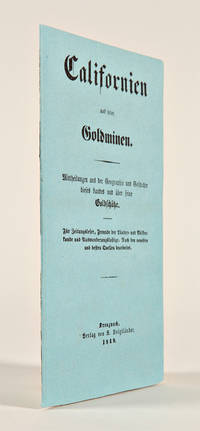
1849WRCAM52151Kreuznach: R. Voigtlander 1849. 32pp. Printed blue wrappers rear wrapper original front wrapper in facsimile. Small corner repairs to rear wrapper. Some foxing two ink stamps on titlepage. Else very good. In a half morocco slipcase and cloth chemise. The first edition of an exceedingly rare Gold Rush pamphlet printed in the hallowed year of that epochal event. "Like many guidebooks for Europeans this pamphlet gives general information on California's physical features history and 'Notes for Emigrants' on the gold discovery. The portion on California's gold riches consists primarily of an article reprinted from the KOELNER ZEITUNG of January 14 1849 which in turn summarizes R.B. Mason and others. The guide mentions the many German settlers in the Sacramento Valley and speaks proudly of Captain Sutter" - Kurutz. <br> <br> Only four institutions worldwide report a copy of this book: the California State Library the University of California at Berkeley Yale and the State Library in Berlin. It is even more difficult to encounter at auction this copy being the only one on record to pass through the rooms. COWAN II p.102. HOWES C43 "aa." KURUTZ 112. SABIN 9984. R. Voigtlander hardcover books
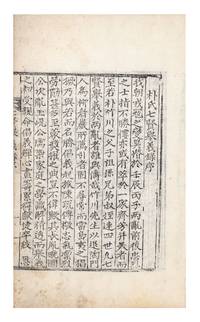
9423Woodblock printed. 57 folding leaves. Two juan in one vol. Large 8vo 313 x 204 mm. orig. semi-stiff yellow patterned wrappers upper wrapper a little soiled. Korea: 1832 or after.<br /> <br> <br> <br /> First edition and very rare; we find no copy in WorldCat. This is the collected poetry and prose by KwÅn 1575-1652 who lived through the tumultuous years of the early 17th century when ChosÅn Korea was twice invaded by the Manchus. KwÅn was from an early age taught by his father KwÅn Tae-gi 權大器 who had studied under one of the most important Neo-Confucian scholars of the ChosÅn period Yi T’oegye æŽé€€æºª Yi Hwang 滉 1501-70. The younger KwÅn passed a lower-level civil service examination and entered officialdom at a low rank. He served in the royal retinue when the court retreated to Ganghwa island during the 1627 Manchu invasion. KwÅn was promoted but retired from office citing illness. After the Manchus invaded the country again in 1636 KwÅn withdrew to a cottage at the foot of a peak of Mount Taebaksan called Chinbong 震峯 “Thunderous Peak†whence the name of his posthumously published oeuvre.<br /> <br> <br> The book contains a Preface written by Yi Ya-sun æŽé‡Žæ·³ 1755-1831 a ninth-generation descendant of Yi T’oegye dated 1825 “fourth Ålyu since the Chongzhen reignâ€. An appendix contains eulogies for KwÅn and an account of KwÅn’s life written by Kim Si-ch’an 金是瓚 dated 1818 “third muin since the Guangde reign period of the August Ming†referencing the reign name of the abortive rebellion by Yang Qilong 楊起隆 1633-80. KwÅn Hun 權勳 a sixth-generation descendant of KwÅn Koeng wrote the colophon dated 1832 “fourth imjin since the first year of Chongzhen.†KwÅn Hun described how “I his unworthy distant descendant with pain and regret carefully searched far and wide to collect the writings bit by bit transcribing them for posterity. The years passed as I was putting them in order.â€<br /> <br> <br> Fine copy. unknown