7 654 résultats
1872ST17640-G121872-1921. 60 different editions in 61 volumes. <br/> Most items in their original publisher's bindings mostly cloth or wrappers and a few in limp suede; one in half morocco. Condition ranging from very good to very fine; many of the cloth items with light shelfwear rubbing to edges mild soiling fraying to head and tail of spine and minor condition issues internally light scattered foxing and browning a handful of items with more noticeable condition issues spine partially lost rubbed joints moderate browning etc. but on the whole an excellent group.<br/> <br/> Amassed over the course of many years by a passionate collector of the Rubaiyat this is a very substantial and wide-ranging group of 60 works that attest to the work's enduring popularity more than 150 years after Edward FitzGerald introduced it to the West. Son of a wealthy Irish landowner FitzGerald had enough money to pursue a rather desultory literary career as a "genteel gipsy" in Terhune's words before beginning to study languages in middle age. He started his translation of the quatrains "rubáiyát" in Persian attributed to "Umar Khayyam" in 1856; according to DNB about half of FitzGerald's final work paraphrases rather than directly translates portions of the 11th century poem while the rest is original verse inspired by Omar. "The result is generally seen as being in some ways an original English poem one that is much better known than Omar's poem is in Persian." DNB In Jewett's opinion it certainly earned FitzGerald "a prominent place among the immortals of English literature." In 1858 FitzGerald submitted 25 of the "less wicked" verses to "Fraser's Magazine" only to be rejected. He had 250 copies published anonymously at his own expense but had no luck selling them. Admitting defeat he gave 200 copies to Quaritch; these sold so poorly that they were relegated to the penny bin where Potter says they were discovered--and soon celebrated--by Dante Gabriel Rossetti and Algernon Swinburne. Those copies that remained unsold when Quaritch moved to Piccadilly in 1860 were either lost or destroyed but by 1861 Rossetti and his Pre-Raphaelite brethren along with Celtic scholar Whitley Stokes were evangelizing for the work embracing the lush lyrical verse that would move English poetry away from Victorian orthodoxy and convention. According to Day by the end of the 19th century "a copy of the 'Rubaiyat' upon an Oxford table was a symbol of sophistication. Today . . . it remains the most popular single poem of the Victorian era." The present collection is especially strong in illustrated editions with more than 25 artists represented including Edmund Dulac Elihu Vedder Willy Pogany Adelaide Hanscom Gilbert James Edmund J. Sullivan Arthur Szyk René Bull and Abanindro Nath Tagore. Notable text editions in this group include a Third Edition of FitzGerald's translation; a First Published American Edition; and a signed and inscribed copy of Eben Francis Thompson's translation. There is also a small group of fine press printings including examples by the Gregynog Press Thomas Mosher and Elbert Hubbard. There are no duplicated editions in this collection and there are no trade paperbacks. A full list of the collection's contents is available upon request. unknown
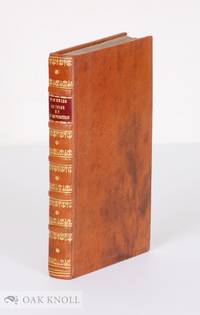
1758141839Paris: J. Barbou 1758. full brown leather border stamped in blind on the front and rear boards gilt ornaments on spine title in second compartment five raised bands all edges stained red marbled endsheets. small 8vo. full brown leather border stamped in blind on the front and rear boards gilt ornaments on spine title in second compartment five raised bands all edges stained red marbled endsheets. 1ff.-92 3 -263 pages. Pour éclaircir quelques traits de l"histoire de l'Imprimerie & prouver que Guttemberg n'en est pas l'Inventeur. Two works bound in one. Very rare first edition Bigmore and Wyman p.228. Private bookplate of Jackson Burke on the verso of the front free endpaper. Contemporary boards with some rubbing to the spine and extremities corners a bit worn gilt on the spine is lightly flaking evidence of bookplate removal to front and rear pastedowns. Else a fine copy of this very scarce work.<BR> <br /> <BR> <br /> Two works bound together. Complete titles are: Dissertation sur l'origine et les progrès de l'art de graver en bois 1758 and De l'origine et des productions de l'imprimerie primitive en taille de bois 1759.<BR> <br /> <BR> <br /> Fournier 1712--1768 was born in Paris and trained as a wood engraver. He later turned to steel engraving. In the first essay Fournier sets out to prove that Gutenberg was not the inventor of the printing press by examining the history of printing. He believes that the technology Gutenberg made popular existed long before the German printer's work. The second volume follows this up with further discussion of the origins of woodcut prints. <BR> <br /> <BR> <br /> Fournier wrongly disputes the dating of Mr. De Bure le Jeune concerning the Gutenberg Bible but he is the first with the help of an observation by Gerard Meerman to note the progressive increase in the number of lines per page in the early stages of Bible production. J. Barbou unknown
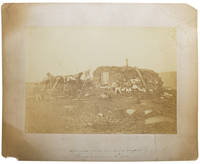
1872303445London 1872. Albumen print measuring 11-5/8 x 16-1/4 in 295 x 412 mm. Laid down on thick cream card with manuscript caption measuring 17 x 21 in. Image slightly faded card chipped with some minor soiling one tear not affecting image. Albumen print measuring 11-5/8 x 16-1/4 in 295 x 412 mm. A rare survival. This image appears in William Bradford's fabled book of photographs Arctic Regions. It was taken by either Dunmore or Critcherson the two professional photographers from Boston who accompanied Bradford on his 1869 expedition to the Arctic on the steamship Panther. It was probably taken at Upernavik a settlement on an island off Greenland's west coast or Godhavn.<br /> <br /> Arctic Regions included 141 albumen prints in addition to Bradford's account of the voyage. The title of the photograph here varies from the printed caption in the book where it reads: "Plate Number: 116 Esquimaux igloe or winter hut made of turf and stones. The entrance is to the left through a door which is about three and a half feet high. The length of the passage is about twelve or fifteen feet and at the farther end is another door through which one almost has to crawl on his hands and knees. After passing through there is then room to stand erect but one is forced to leave very soon owing to the bad air." <br /> <br /> This photograph is slightly larger than the one in the book which is 277 x 365mm. Furthermore the image in the book is cropped closer on the right and left margins. <br /> <br /> The New York Public Library has a folio of 26 images of near identicle size mounted on card. The portfolio was donated to the library in 1892 as part of the Robert Stuart Collection. According to Horch originally all of these images were captioned in manuscript though were later remounted with typed captions as "the original ink-written captions for the photographs had badly faded by 1940." It's interesting that the caption on their duplicate of this image is the same as ours and the image itself has not been cropped. Horch writes that Bradford probably not only selected these images himself but "closely directed the actual taking of the photographs." <br /> <br /> It's entirely likely that Bradford would have had extra prints made to distribute to friends repay favors and most of all to solicit subscribers to what was a very expensive book to publish. Given how it conforms to the examples in the Robert Stuart portfolio this particular image is probably one of them. Horch Frank. "Photographs and Paintings by William Bradford". American Art Journal 5.2 1973: pp 61-70; cf Parr and Badger I p31Prm/photo unknown
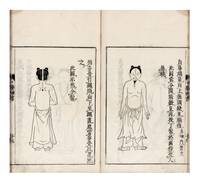
7008Twelve full-page woodcuts & numerous woodcuts in the text. 36 folding leaves. Two parts in one vol. 8vo orig. blue wrappers wrappers rubbed & somewhat wormed orig. block-printed title label on upper cover no longer present modern stitching. “Ichijo-dori†a street in Kyoto: Tomikura Tahei 1690.<br/> <br/> First edition of this early and rare book providing prescriptions for treatments in the different stages of tuberculosis. The author describes ten drugs made from vegetables that give miraculous results in treating the disease. The second part entitled “Mujo Gengen santen shinden gyokudo shoshi chiden shirochu soho†describes the parasitic worms said to grow in the stomach and intestinal system of patients suffering from tuberculosis. The text illustrations depict many of these parasites.<br/> <br/> The text is Chinese with Japanese reading marks presumably compiled in the 14th century by Ge 1305-53 a Yuan dynasty physician and writer. He came from a family of hereditary physicians and wrote a number of books. The Japanese reading marks have been provided by Shuhaku Asai 1643-1705 who was a fellow student with Ippo Okamoto of the prominent doctor Sanpaku Ajioka. <br/> <br/> There are substantial sections on acupuncture and moxibustion several of the full-page woodcuts depict pressure points.<br/> <br/> Very good copy. Minor marginal worming towards end. unknown
1585B6597Paris: Apud Dionysium Duvallium sub Bucephalo in vico Bellouasco; c. April 1585 colophon . A very nice copy of this rarely found work; old minor marginal repair tape of title slight marginal stains and very small in-text and marginal oxidation spots none affecting legibility; light damp staining of the lower margin. Endpapers watermarked. Binding: 17th century mottled calf spine with six 6 raised bands with gilt lettered title on two and remainder of compartments ornamented in floral gilt; all edges speckled red. Notes: This medical work on gynaecology attributed to or by Hippocrates and his school is accompanied by the commentary in French of French Renaissance physician Maurice de La Corde; it is rare with three known exemplars incl. Yale & Oxford. <br> <br> Size: Folio 311x201mm Illustration: Text in Latin and Greek. Text in two columns of Latin and Greek respectively with accompanying Latin commentary in one; except index printed in three columns.<br>Illustrated title depicting determined/ inspired Hippocrates riding on horseback through crises or critical times toward the sun – this with marginal text in Latin and Greek; each major section opens with an elaborate headpiece and initial. <br> References: Pasquale Sfameni in Enciclopedia Italiana 1933; Adams H-615; Choulant 31; Durling 2412. Graesse III 283; Hirsch II 76; Renouard Marques 287; STC French 227. Not in Osler. Pages: Ll: bl. 10 pp. 1-361 6 bl.2. Collation: bl. a1-4 e1-6 A1-Z6 Aa1-Gg6 Hh1-7 bl.2. Category: Book Medical; Book Early Printed 1500; Apud Dionysium Duvallium, sub Bucephalo, in vico Bellouasco; hardcover
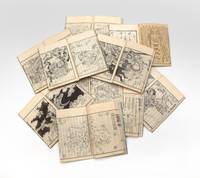
8048Woodcut illus. five are double-page. .5 13 .5 ads; .5 ads 17 .5; .5 ads 14 .5 folding leaves. Three vols. 8vo orig. green patterned semi-stiff wrappers orig. block-printed title labels on upper covers new stitching. Kyoto: Honya Juemon 1789.<br/> <br/> First edition and very rare; this work was written as a result of the devastating Great Kyoto Fire which broke out on 7 March 1788 and lasted several days. It caused serious damage including the destruction of the Imperial Palace and the Nijo-jo Castle. The fire so shocked the bakufu that senior councillor Sadanobu Matsudaira was sent to Kyoto to investigate and consult with the Imperial Court.<br/> <br/> The first woodcut depicts how one can prepare for a quick escape in case of fire. This single-page illustration shows how to leave one’s street clothes at nighttime so that they can be put on quickly for a fast evacuation. The first double-page illustration is a map of Kyoto where the great fire occurred. The following two double-page woodcuts show scenes of the raging fire with citizens fleeing carrying their valuables. The next two-page woodcut shows refugees of all classes on the outskirts of Kyoto moving away from the city. The final double-page woodcut shows survivors beginning to rebuild their houses.<br/> <br/> The text gives detailed instructions on how to prevent fires and in the case of a fire breaking out what to do to contain and extinguish it.<br/> <br/> The block-printed title labels read “Banmin hinoyojin chinki†“Cautionary Instructions on Containing Fires for the Entire Nationâ€.<br/> <br/> Fine copy. Minor mostly marginal worming carefully mended in the first volume. unknown
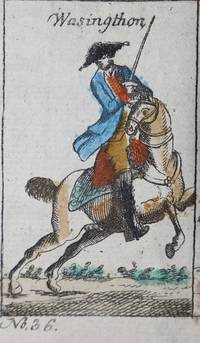
006887Nürnberg: Trautner. Hardcover. Paper pastedown on slightly limp boards. Very Good. Early depiction of General Washington in Germany -- possibly the first such. N.d. circa late 1780s. We can date these generally to the late 1780s because Frederick the Great's death in 1786 is noted but Joseph II is still presented as alive but he died in early 1790. Folio 32 by 20 cm. 33 pages with mounted content including 15 double paged plates measuring 32 by 38.5 cm or thereabouts. The sixteenth plate is double paged half the page height -- this plate was somewhat crudely cut probably in half. In these plates there are about 345 separate images or cells -- the cell count is not hard and fast as there are instances in which two cells can be regarded as a single illustration or cell. The vast majority of the cells or illustrations relate to military men and many of these are equestrian images with the commander or officer mounted on horse. We also find rows of soldiers that can be viewed as if on parade or alternatively like cells in a movie. Military costume and regalia isn't the only subject however. Two of the plates are devoted mostly to the hunt and shooting. In these hunters are shown holding up firearms to various prey. And one plate depicts biblical scenes or subjects. In these plates brief captions can identify the subject. Thus we know that one of the pictures is of Washington who certainly would have been an international celebrity in the late 1780s. The hand-coloring of the prints is a fairly crude stencil and the palette of colors is not extensive. Dominating are blues oranges greens and golds. Not to be slighted is the first page in this album which is an entirely different sort of artwork and seemingly bears no relation to the rest of the contents. This page presents a depiction of Saint Catherine with the saint and her executioner depicted in a printed oval set as a centerpiece surrounded by foliate tracery intricately cut out like lacework. Surrounding all of this is a paper frame all from the same sheet as far as we can discern. The paper and the center oval are mounted onto the album leaf and thus the lacework given the whole thing some dimensionality. The coloring of this specimen of folk art is also richer and more refined than applies to the stenciling of the prints to follow. Scarce -- we could no other examples of Trautner's military prints not to speak of collection of this size on OCLC First Search or elsewhere. Condition: the cover has considerable wear with some crinkling of the paper pastedown some surface loss to the paper and soiling. Spine has a fair amount of paper pastedown loss. The first page with the Saint Catherine artwork has some loss to the tracery but we would also assert that it is remarkable that so much of it has survived intact. The paper framing is considerable soiled with some running of the coloring onto that paper and elsewhere in the artwork. The Trautner prints have light soiling comprised of margin smudging and a light dampstain affecting a few of the prints but overall these read as mostly clean. We noted that the last print is partial. Trautner hardcover
19040009174ABERDEEN WASHINGTON WA. Good. 1904. On offer are three 3 original field books most probably written in 1904 and detailing the rebuilding of the city of Aberdeen Washington after a raging fire destroyed the town. On October 16 1903 a raging fire destroyed 140 buildings in the center of Aberdeen Washington. A city constructed primarily of wood including sidewalks Aberdeen had little chance of stopping the fire once it began to spread. Obviously the city needed to rebuild its streets after the fire. Two people one by the name of Weatherwax and the other by the name of Benn seem to have been hired to do the task. Weatherwax is most probably J.M. Weatherwax or George Weatherwax two men who owned a large lumber company in Aberdeen and Benn is most probably Samuel Benn. The three books are labelled P-138 book 44 P-214 book 105 and P-215 book 106. Each book contains an index at the beginning which lays out what streets in the city are written about. For example book P-215 deals with information on old planks new elevations storm sewers street levels and more on the 20 different street including Michigan Ave Jefferson St. Washington St. and more. The books are excellent artifacts of city construction from the early 20th century containing dozens of pages of detailed schematics drawings charts and figures for the city of Aberdeen in the wake of its destruction. There are approximately 450 handwritten pages over the three books. The books each measure 7 ¼ by 4 ¼ inches. All three show sustained use and strong wear. For the most part the structural integrity is still there however the last book P-215 shows the most wear with parts of the book disconnected from the binding. Two of the books shows evidence of taping to the spine and boards. These books are a fascinating look at the intricacies and details of rebuilding a city after its destruction and an intimate part at the history of Aberdeen Washington a place that Kurt Cobain would eventually call home. Background: On October 16 1903 a fire destroys 140 buildings in the center of Aberdeen. Fed by wood-frame structures wooden sidewalks and sawdust fill the fire rages unchecked until some 20 acres have burned. The fire will spur the city leaders to enact a more stringent fire code. On the morning of October 16 1903 a resident of the Arctic Hotel began making breakfast in his room. An accidental fire started and the room was quickly engulfed in flames killing the lone occupant. Within minutes the three-story frame structure was ablaze and the fire spread to adjoining buildings including the fire station and jail.; Manuscript; 8vo - over 7¾" - 9¾" tall; KEYWORDS: HISTORY OF ABERDEEN WASHINGTON FIELD BOOKS TURN OF THE 20TH CENTURY 1903 ABERDEEN FIRE MILL TOWNS J.M. WEATHERWAX GEORGE WEATHERWAX SAMUEL BENN FIELD BOOKS TOWN REBUILDING FIELD BOOKS SURVEY NOTEBOOKS HAND DRAWN AMERICANA HANDWRITTEN MANUSCRIPT DOCUMENT LETTER AUTOGRAPH WRITER HAND WRITTEN DOCUMENTS SIGNED LETTERS MANUSCRIPTS HISTORICAL HOLOGRAPH KEEPSAKE WRITERS AUTOGRAPHS PERSONAL MEMOIR MEMORIAL ARCHIVE DIARY DIARIES JOURNAL LOG ANTIQUITÉ CONTRAT VÉLIN DOCUMENT MANUSCRIT PAPIER ANTIKE BRIEF PERGAMENT DOKUMENT MANUSKRIPT PAPIER OGGETTO DANTIQUARIATO ATTO VELINA DOCUMENTO MANUSCRITTO CARTA ANTIGÜEDAD HECHO VITELA DOCUMENTO MANUSCRITO PAPEL . hardcover
1837626988Philadelphia: The Liberal Union 1837. xvii 2 20-118 pp. missing page 119 1. Black leather spine with gilt titling and marbled endpapers; "Printed at the Office of the National Laborer". Heavy wear and chipping to spine; boards no longer extant. Front free endpaper and first blank page detached but still extant with some chipping to corners. Some staining to bottom corner at gutter of first few pages. Some mild foxing throughout. Final page 119 no longer extant with bottom quarter of following blank missing as well. Some discoloration smoke to tail of final pages. Gatherings still held together quite securely although with some cocking to the top half of the spine. Appears to be a good candidate for recasing or rebinding with a facsimile copy of the final page. Originally published in eight parts under the title "Equality-- A Political Romance" in the Philadelphia deist magazine "The Temple of Reason" this utopian fantasy is commonly accredited to be the first utopian novel written and published in the United States. According to the historian Richard J. Twomey "Equality." marks a turning point in social critique in how it marks private property itself as the root of "social evil" rather than inherited privilege or property. Faherty and White. This scarce edition of 1837 is preceded only by the 1802 serialization. . Hard Cover. Fair. The Liberal Union Hardcover
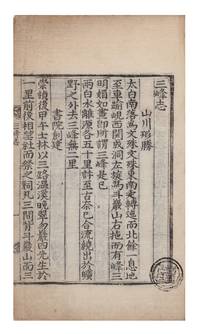
942031 folding leaves. Large 8vo 305 x 190 mm. orig. patterned semi-stiff wrappers wrappers slightly soiled new stitching. Yeongju: 1774.<br /> <BR> <BR> <br /> First edition and very rare of this gazetteer for the Confucian Three Peaks Academy WorldCat 46318280. The word “gazetteer†is used in reference to a genre of East Asian historical and geographical texts generally known in Korea as Åpchi é‚‘å¿— which translates roughly to “local treatises.†The now rare word “gazetteer†is used in analogy with a similar genre that existed in British India. It was not unusual for Korean gazetteers to be published by a local Confucian academy as seems to be the case here. <br /> <BR> <BR> Confucian academies were important centers of intellectual life in ChosÅn Korea. Several of the leading thinkers of the era spent parts of their career teaching at academies thus creating a following. The Three Peaks Academy Sambong sÅwÅn 三峰書院 was founded in the village Valley of Three Peaks sambonggol 三峰谷 in 1654. The colophon explains the genesis of the gazetteer: “The late Mr. Ch’Ål-nam éµå— i.e. Kim Si-hwa é‡‘å§‹éµ 1662-1772 wrote and edited the gazetteer taking note of the geographical features and dates of buildings the positions and names of halls houses ponds and lookouts and recording them for posterity.†Kim Si-hwa furthermore recorded key events in the lives of scholars who had taught at the academy. Kim Wi 金㙔 1709-89 who authored the colophon dated 1774 wrote about the updates that had been made to Kim Si-hwa’s text for our edition. We find no record of an earlier printing; probably Kim Si-hwa’s text was first published in this edition.<br /> <BR> <BR> Nice copy. WorldCat locates only the Berkeley copy.<br /> <BR> <BR> References<br /> <BR> <BR> Digital culture encyclopedia for Yeongju 디지털ì˜ì£¼ë¬¸í™”ëŒ€ì „. http://www.grandculture.net/yeongju <br /> <BR> <BR> Korean Old and Rare Collection Information System í•œêµê³ 문헌종합목ë¡. https://www.nl.go.kr/korcis/index.do<br /> <BR> <BR> PÅk’Ålli taehak Tongasia tosÅgwan sujip Han’guk kojÅnjÅk mongnok 버í´ë¦¬ëŒ€í•™ ë™ì•„시아ë„서관 수집 韓國å¤å…¸ç±ç›®éŒ„. Seoul: KoryÅ taehakkyo minjok munhwa yÅn'guwÅn 2009.<br /> <BR> <BR> “Sambong ha sambong sÅwÅn maÅl ‘Sambonggol’†삼봉三峯 下 삼봉서ì›ä¸‰å³¯æ›¸é™¢ ë§ˆì„ â€˜ì‚¼ë´‰ê³¨ä¸‰å³¯è°·â€™. YÅngju simin sinmun ì˜ì£¼ì‹œë¯¼ì‹ 문 November 26 2018. https://www.yjinews.com/news/articleView.htmlidxno=49174. unknown
8576Many fine black & white double-page & single-page woodcuts throughout. Ten vols. 8vo orig. blue semi-stiff wrappers orig. block-printed title labels on upper covers three labels are somewhat defective new stitching. Osaka: Tenmaya Yasubei; Kyoto: Yoshida Jihei 1835. <br /> <br /> <BR> <BR> with:<br /> <br /> <BR> <BR> — & MATSUKAWA Hanzan; —. Ehon Toyotomi Ryukyu gunki Illustrated Tale of the Ryukyu War. Many fine black & white double-page & single-page woodcuts throughout six in Vol. I are color-printed. Ten vols. 8vo orig. pale blue patterned wrappers orig. block-printed title labels on upper covers new stitching. Osaka: Kawachiya Tobei & Kawachiya Mohei colophon dated 1864; title-page dated 1862.<br /> <BR> <BR> First edition of these finely illustrated stories of the conquest of the Ryukyu kingdom in 1609 by the Shimazu clan of southern Kyushu. The main artist Okada Gyokuzan Issei or Ishida is a rather shadowy figure; he probably studied under the famous Okada Gyokuzan of Osaka but we know very little about him. The second work Ehon Toyotomi Ryukyu gunki has an additional artist Matsukawa Hanzan 1818-82 who studied painting under Suga Shoho and worked in Osaka as a book illustrator.<br /> <BR> <BR> This is a splendid example of an ehon yomihon a type of long novel combining text with frequent illustrations. Our works are finely illustrated throughout with scenes of battles the notable figures in the conquest both winners and losers historical figures scenes of important ceremonies scenes of the extravagant lifestyles of the Ryukyu royal family seen in their gardens famous castles etc. The most useful captions in each woodcut name participants and explain the scene. The woodcuts are clear and impactful; many of the scenes have a pronounced Chinese atmosphere. Several types of battles are shown: conflicts involving cavalry fighting in the water assaults on castles hand to hand combat etc. In the first series Vol. I has a single-page woodcut world map and Vol. III has a fine double-page woodcut map of Ryukyu and its 36 islands. <br /> <BR> <BR> In the first volume of the second series are six full-page woodcut portraits of the heroic leaders of the Shimazu clan’s military forces in full attire with wonderfully delicate color printing.<br /> <BR> <BR> The text furnishes important details on the history of the relationship between Ryukyu and China and Japan; the quantities and types of weapons and number of soldiers drummers and doctors including veterinarians who traveled by ship to Ryukyu; and the major military actions of the conquest. These statistics are broken down by the contributions of men and materiel made by each region of Satsuma. The names of the leaders of each military section are given; we believe this is unique information. Family crests and banner symbols are depicted.<br /> <BR> <BR> Fine and fresh copies. Rare when complete and in excellent condition like our sets; WorldCat lists only the University of Hawaii copies part of the famous Frank Hawley Ryukyu collection. In Vol. 9 of the first series there is misnumbering but the text is absolutely complete and is identical to the set in the National Diet Library. unknown
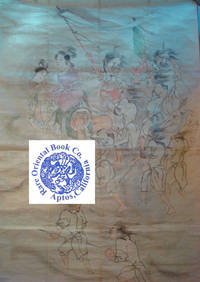
36023801Japan 1860 n.p. Large sheet 96 x 1m 44 cm. gouachevery clean work no worming or other condition issues painted on 16 joined sheets of Washi paper to make one large sheetfine water-color painting. THIS IS AN ORIGINAL PAINTED ART WORK . . . AM ORIGINAL COLOR PAINTING IN GRAND SIZE . . . FROM JAPAN'S OLDEST MYTHOLOGY: . . . THE KOJIKI & NIHON SHOKI PANTHEON . . . THE ORIGINS OF THE EMPEROR . . . OTOHIME GYO RETSU ZU: . . . THE PROCESSION OF OTOHIME DAUGHTER OF THE SEA GOD . . A stunning color painting by Kyosai. Probably done for a temple donation or as an expression of his faith to Japan's historic heroine. . OTOHIME is a goddess in Japanese mythology and is featured in the Kojiki as well as Nihon Shoki. Also known as "Luminous Jewel". A Japanese goddess the beautiful daughter of the sea-king Ryujin. She married Hoori and gave birth to a son after which she turned into a dragon. . Per the Japanese text brushed on the verso upper left corner: "239 ban dated Ansei 7th Kanoe-Saru-doshi 2 gatsu jojun end of February OTOHIME GYO RETSU ZU" . English: "#239 dated Ansei 7th monkey zodiac year end of Feb.: 1860 . PAINTING TITLE PER VERSO: "THE FIGURE OF PRINCESS OTOHIME'S PROCESSION THE DAUGHTER OF THE SEA GOD" . "Toyotama-hime" Japanese for "Lady Bountiful Soul" better known as Otohime is a goddess in Japanese mythology and is featured in the Kojiki as well as Nihon Shoki. She is the beautiful daughter of Ryujin the "God of the Sea." . A STUNNING ORIGINAL POLYCHROME GOUACHE PAINTING: . This original color watercolor painting shows the lively procession of OTOHIME and her hand maid. She is followed by a flag and umbrella bearer. Also following is a man with a pair of deer antlers good omen a man with a small red offering table with peaches the Wind God and his thunder-drum. Another flag bearer his helper followed by two others one holds a staff the other an offering of golden egg. . The items carries are symbolic good fortune and wealth in terms of deer antlers peaches and the golden egg represent ancient Chinese also used by the Japanese of omens of good fortune and good luck. . THE PAINTING: . Per the Japanese brushed text on the verso there is a number found meaning this panel of several was part of a larger work per the chronology found in Clark see below. . This panel of several paintings was part of a restoration of Zojo-ji temple in Shiba. In 1859 KANO Toei & Kyosai "participates in a repair project at the Zojo-ji temple." See Clark. . Although Kyosai had officially left the Kano school in 1854 by participating in the restoration of Tokugawa's family temple in Shiba he was showing loyalty to the Tokugawa family a good reason to volunteer his skills to the temple. It is also noteworthy that his mentor Kano Toei also participated in the restoration and in all likelihood Kyosai joined his master in a sign of respect and loyalty to him. . Based on this chronology it is clear Kyosai was one of the painters who worked at Zojo-ji temple along with his mentor and master teacher Kano Toei. It was not uncommon at this time for schools to volunteer teachers and students to do temple restoration and art work painting replacing or enhancing paintings and large murals. . This item's date matches the restoration dates for the Zojo-ji temple which began in 1859 and continued into 1860. . This panel was unused in the restoration it may have been a precursor to the final painting which was actually used in the restoration project. It matches the scenes found in Zojo-ji temple restoration. The work is the exact style of others painted by Kyosai and his genre. The caricatures of the people in this painting reflect Kyosai's style exactly the theme of his eccentric humor expressing his love for creativity and the joy of painting. . It is entirely within Kyosai's bizarre character to undertake and devote himself to such a project as illustrating the famous myth of OTOHIME in more than 200 deluxe extra-large-size format paintings. . This restoration project could also have been a 'paying job' for Kyosai as at that time he did not seem to be employed but in 1858 he began to design "Kyoga crazy pictures. It was in 1857 he married Okyo the daughter of a Rimpa painter Suzuki Kiitsu but Okyo died in 1859 and he remarried Tose who died in 1860. . It is more than likely Kyosai being a Buddhist he felt it was his religious obligation to do pennants by contributing to and drawing Buddhist or such traditional images as a way to placate the loss of his wife. . THE STORY OF OTOHIME DAUGHTER OF THE SEA GOD: . Because this work was part of the Zojo-ji temple restoration it cannot be considered a commercial painting one that was casually drawn and put on the market for sale. This was part of a commissioned restoration financed by some benefactor to the temple and most likely supported by the Tokugawa family. . ONE OF JAPAN'S EARLIEST AND MOST FAMOUS MYTHS: . The story of OTOHIME DAUGHTER OF THE SEA GOD is one of Japan's oldest and most famous myths known to all Japanese. Treasured as one of the most important in the ancient pantheon it is found in the earliest writing about the origin of Japan and the Emperor in the KOJIKI and the NIHON SHOKI. . This kind of larger paper illustrated story would take months to complete by It would also take devotion to the subject and focus with responsibility to produce a good number of paints daily. This was something Kyosai could and would do ! . THE ARTIST/PAINTER: This work is unsigned which is expected as part of a larger series of paintings. If this was the work of Kyosai it falls entirely within the dates during his period of work produced when he was 29 years old. . The caricature in the faces and fluid bodies in motion the "flowing" style are his. Although there is no signature and it is a true reflection of Kawanabe's work we are attributing it to him. . Another convincing point is that this kind of painting and meticulous style is also found in his famous instructional showing various 'schools' of painting in his KYOSAI GADEN. See below. . WHO WAS KAWANABE GYOSAI/KYOSAI: 1831-1889: Kawanabe Kyosai was a superb artist in the words of a critic "an individualist and an independent perhaps the last virtuoso in traditional Japanese painting". . Living through the Edo period to the Meiji period Kyosai witnessed Japan transform itself from a feudal country into a modern state. Born at Koga he was the son of a Samurai. His first aesthetic shock was at the age of nine when he picked up a human head apart from a corpse in the Kanda river. . After working for a short time as a boy with Utagawa Kuniyoshi he received his artistic training in the Kano school but soon abandoned the formal traditions for the greater freedom of the popular school. During the political ferment which produced and followed the revolution of 1867 Kyosai attained a reputation as a caricaturist. His very long painting on Makimono" scroll The battle of the farts" may be seen as a caricature of this ferment. . He was arrested three times and imprisoned by the authorities of the Shogunate. Soon after the assumption of effective power by the Emperor a great congress of painters and men of letters was held at which Kyosai was present. . He again expressed his opinion of the new movement in a caricature which had a great popular success but also brought him into the hands of the police this time of the opposite party. After this time he changed his name from Kyo crazy or wild to any one of 19 other "Go" studio names he used. However after the police jailed him he avoided use of "Kyo" but returned back to it with three other "GO" that used the same character "Kyo" crazy & wild such as #7 "Baiga Kyosha" #10 "Kyosai #12 Kyosha Gaishi #16 "Shosho Kyosai" Quoted from Roberts below see that reference for more details. . Kyosai is considered by many to be the greatest successor of Hokusai as well as the first political caricaturist of Japan. His work mirrored his life in its wild and undisciplined nature and occasionally reflected his love of drink. . Color photos are posted to our website. . REFERENCE: . More on OTO HIME: heon-org/articles/o/otohime-html KAWANABE Gyosai later known as Kyosai: Is well collected by world museums I GADAN: 1887 4 vol. set: In this work he outlines and exhibits a wide variety of "styles" of painting. In this work there are several examples of this kind or school of painting. Wikipedia stated about this book: "The most important work about Kyosai's art and life was written by himself: Kyosai Gadan or "Kyosai's Treatise on Painting" half autobiography and half painting manual. WESTERN APPRECIATORS: Many westerners came to visit Kyosai and their memoirs about the artist are valuable. The two important ones both rare were: Emile Etienne Guimet Promenades Japonaises Paris 1880. Josiah Conder: "Paintings and Studies by Kawanabe Kyosai" Tokyo 1911. Conder was a serious student of Japanese art; after some initial rejections he was accepted as Kyosai's pupil and accompanied him for ten years until the master's death. Timothy Clark Demon of painting: the art of Kawanabe Kyosai p.186 chronology and the drawing #21 p.58 is very similar to the pose found in our painting of OTOHIME Toyotama-hime both in pose facial quality hair style and the general perspective. ROBERTS Laurance P.: A DICTIONARY OF JAPANESE ARTISTS: PAINTING SCULPTURE CERAMICS PRINTS LACQUER p.100 stated of him: Kyosai ".was marked by a wild eccentric humor.caricatures of full of fantasy and invention." KAWANABE KYOSAI MEMORIAL MUSEUM. KAWANABE KYOSAI DOKU HON. OTOHIME: Nihon Jinmei Daijiten Toyotama-hime. Tokyo: Shogakukan. 2012. . . unknown
15641907280011Genevae : Ex officina Francisci Perrini M.D. LXIIII 1564. First Edition. Hardcover. Good. Calvin's 16th century commentary on the book of Joshua and Beza'z Biography of Calvin Bound in contemporary vellum. Some soiling to cover. Octavo. 32 316 p. Printer's woodcut device on title-page. Slight worming in inner margin towards beginning not affecting text. Bookplate of Duncan Shaw and early inscription of Franciscus Saluardus. Calvin's last work. Includes the Latin translation Theodore de Besze's Life of Calvin. Adams C280. The French edition was printed in 1565. Genevae : Ex officina Francisci Perrini, M.D. LXIIII hardcover
185128441New York: Nagel & Weingaertner 1851. Hand-coloured lithograph after Hanson titled below the image. Expert restoration closing tears. The first America's Cup: a rare hand coloured lithographed view of the winning yacht which gave its name to the cup.<br/> <br/> In 1851 the Royal Yacht Squadron proposed a race around the Isle of Wight. A group of New York Yacht Club members led by Commodore John Cox Stevens built a yacht designed to compete in such races. Designed by Steers and Co. and captained by Richard Brown the yacht America would win the race by eighteen minutes giving its name to one of the oldest and best-known trophies of the sport: the America's Cup. This lithograph and lithographer are not recorded by Harry T. Peters; we find no other extant examples of this rare print.<br/> <br/> For Nagel and Weingaertner see Peters America on Stone pp. 291-294. Nagel & Weingaertner unknown
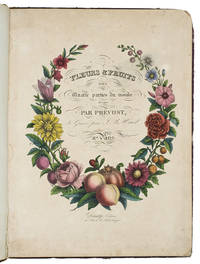
1837ABC_47224Paris 1837. Folio ca. 35 x 26.5 cm. Dauty Contemporary half sheepskin maroon watered silk sides title in gold on the front board. With an engraved title-page and 11 of 23 engraved botanical prints: 4 showing 5 kinds of fruits each 3 showing 9 types of flowers each and 4 showing flower bouquets. All prints are stipple engravings and coloured by a contemporary hand some parts glazed with egg white. 12 ll. Extremely rare botanical print series showing both European and exotic fruits and flowers engraved by Jean-Baptiste Huet the younger 1772-1852 after designs of Benoît-Louis Prévost 1735-1804 or Jean-Louis Prévost 1760-1810. It also includes four plates showing bouquets from Europe America Asia and Africa. Only one complete copy is known at the Bibliothèque nationale de France we have traced no copy in sale or auction records and it is not mentioned in the usual botanical bibliographical works. The BnF copy is described in the Inventaire du fonds français après 1800 where the series consists of 23 prints issued all together under this title. The BnF and the IFF date the work ca. 1837-1839 but it is more likely that it is ca. 1837-1838 as Dauty died in 1838 and he printed at Rue de Bibliothèque no. 16 only in 1827 and 1835-1838. The BnF ascribes the designs for the prints to Benoît-Louis Prévost but Jean-Louis Prévost remains a possibility for he produced another famous print series of flowers and fruits in the same style of stipple engravings Collection des fleurs et fruits 1805.With a contemporary inscription "A M.elle Vincent" on the first free endleaf dedicating it to or belonging to the famous French 19th-century botanical painter Henriette Vincent 1786-1834 who was a student of Gerard van Spaendonck and Pierre-Joseph Redouté. Head and foot of the spine damaged and spine slightly worn boards a little rubbed edges slightly worn corners bumped. Some light browning and foxing throughout title-page a little more browned and with a light marginal water stain. Lacking 12 plates according to IFF. Otherwise in good condition. An extremely rare botanical print series vividly hand-coloured.l BnF FRBNF40503621; IFF Inventaire du fonds français après 1800 Huet p. 518; not in Nissen BBI; Pritzel; Stafleu & Cowan. hardcover
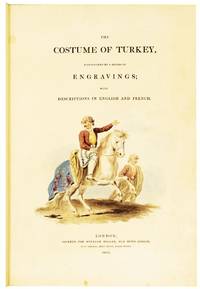
18026160<p>"ONE OF THE BASIC WORKS ON TURKISH COSTUME" ATABEY</p><p>Folio 35 x 24.4 cm. Hand-colored vignette title-page in English followed by title-page in French; preface in English and French 8 pp; table of contents in English and French 2 pp.; and 60 hand-colored stipple engravings many on paper with watermarks dated 1796 after Octavian Dalvimart and engraved by John Dadley or William Poole the title-page vignette by R. Jones; each engraving always printed on the verso with facing description page English on recto and French on verso. Occasional light spotting and off-setting from plates to the facing description; plate 1 and tissue guard bound at the beginning preceding English title-page. Early 20th-century red straight morocco by Bayntun-Rivière their stamp in upper left-hand corner of front flyleaf blind- and gilt-stamped tooling on boards turn-ins and spine marbled endpapers; some rubbing but generally excellent.</p><p>First edition with watermarks dated 1796 of "one of the basic works on Turkish costume which has provided the prototypes for numerous other illustrative material" Atabey. Dalvimart's vivid plates primarily depict the vibrant attire of the ruling classes and their servants but they also showcase traditional garments—especially those worn by women—from the extensive territories of the Ottoman Empire at the time encompassing regions such as Bosnia Albania Greece Syria and Egypt.</p><p>Octavian Dalvimart remains a somewhat enigmatic figure. He appears to have been active as an artist and engraver in England and France in the early 19th century. According to the preface he traveled to Athens in 1797 and Turkey in 1798 where he created the original drawings for the plates consistently sketching from life. The characters are precisely drawn and handsomely depicted in vivid colors. The accompanying descriptive text is sometimes attributed to William Alexander drawing heavily from the published accounts of Turkey by James Dallaway 1797 Baron de Tott who resided in Constantinople for many years until 1790 and other sources. This first edition was followed by subsequent editions in 1818 and 1820.</p><p>Little is known about the two engravers John Dadley 1767–after 1807 who worked in London and William Poole active 1803-1807. R. Jones active early 19th century exhibited at the Royal Academy from 1780 to 1812.<br /><br /> Abbey Travel 370; Atabey 312; Blackmer 444 ca. 1820 impression Colas 782; H. Hiler Bibl. of Costume 1939; Lipperheide 1422; Vinet 2337; Bénézit III p. 317 Dadley III p. 335 Dalvimart and VI p. 95 Jones no entry for Poole.</p> London, Printed for William Miller, Old Bond Street, by T. Bensley, Bolt Court, Fleet Street hardcover
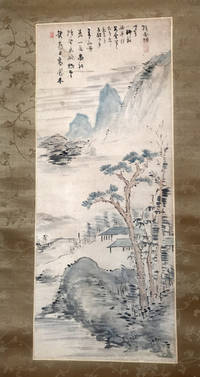
90223Rai KyÅhei é ¼äº¬å¹³ aka ShunsÅ or Manshiro artist. Kakemono 掛ã‘物 - Hanging Scroll Landscape. N.p. n.d. Landscape painting of a mountain scene with pine trees. Hanging scroll kakemono 掛ã‘物 beautifully mounted on brocade with black wooden jiku handles. Image size 44.7x18.4cm with 49.5cm silk fabric at top 26.5cm at bottom and borders of approx 5-5.5cm on either side.<br /> <br /> Rai KyÅhei é ¼äº¬å¹³ c.1756-1834 was an influential Confucian scholar and the uncle of the famous kanshi poet Rai SanyÅ. Sanyo was known for TÅjun KagetsuchÅ å旬花月帖 Journal of Flowers in 100 Days/ A Few Brief Moments Describing Moon and Flowers a collaborative work of poetry with floral and landscape paintings created after a three month walking tour through central Japan with his nephew and mother in the 1820s. The three poets and their entourage were influenced by the lyrical scenes of nature observed in Kyoto and Nara during their travels. This scroll is likely inspired by that period of travel and reflection in nature.<br /> <br /> Slight foxing on the image. Encased in a wooden scroll box 40.7 x 6.4cm with artist’s name brushed on label laid down on end of box. unknown
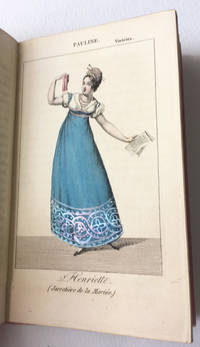
1818Flo136<p>Very rare complete set of all 8 volumes of this review of French theatre in the years 1818-1824.</p><p>All eight years of publication complete with 8 handcolored engraved title pages and over 90 finely handcolored engraved portraits of actors actresses opera singers ballet dancers and comedians in costumes of their famous roles.</p><p>"Very interesting almanac attributed to Charles Malo or Francois-Adolphe Loeve-Weimars giving a summary of Parisian and provincial theaters reviews on the plays and their performers notes on debuts repertoires etc." Grand-Carteret<em> Les almanachs français</em></p><p>Includes portraits of sopranos Mme. Gavaudan and Angelica Catalini tenors Jean-Blaise Martin and Simon Cheard ballet dancers Emilie Bigottini Genevieve Gosselin Antoine Paul and Mlle. Clotilde child actress Leontine Fay actors Francois-Joseph Talma and Charles-Gabriel Potier and many more. Odd volumes turn up occasionally but it is very rare to find the complete set of this intriguing anecdotal overview of Parisian theatre from the first quarter of the 19th century.</p><p>Condition: All volumes in their pastel card slipcases paper bindings holding some spots of foxing to a few plates but overall very good with tissue guards. Complete with all engravings and calendars at end.</p><p>Charles Malo 1790-1871 was a French author editor and translator whose books included a series of gift books for women illustrated by Pancrace Bessa almanacs city guides battlefield guides etc.</p> Louis Janet paperback
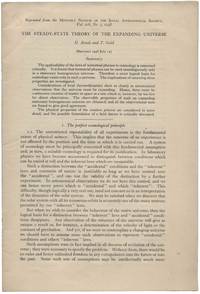
19484162London: Monthly Notices of the Royal Astronomical Society 1948. First edition. First edition the extremely rare offprint of the first published paper to propound the 'steady-state' model of the universe according to which the universe is expanding but unchanging with no beginning or end and in which matter is continually being created throughout space so that its average density remains constant. Hardcover. THE STEADY-STATE MODEL OF THE UNIVERSE. First edition the extremely rare offprint of the first published paper to propound the 'steady-state' model of the universe according to which the universe is expanding but unchanging with no beginning or end and in which matter is continually being created throughout space so that its average density remains constant. Bondi and Gold's Cambridge colleague Fred Hoyle published his own formulation of steady-state theory four months later in the same journal 'A New Model for the Expanding Universe' MNRAS Vol. 108 No. 5 pp. 372-382. Bondi Gold and Hoyle were led to steady state theory because of well-known problems associated with the then current evolving models of the expanding universe: such models predicted a cosmic age that was problematic less than the known age of some stars and they disliked Lemaȋtre's idea of a universe with an explosive beginning. Although the steady-state theory was eventually disproved by the discovery of the cosmic microwave background in the 1960s "Steady state was of enormous importance in the history of astronomy because it turned cosmology into a serious observational part of science by making predictions different from those of an evolutionary universe for which Hoyle coined the name big bang. The predictions included numbers sizes colors and brightnesses of galaxies at large distances compared to those near us" DSB under Gold. In 2014 an unpublished manuscript was discovered probably dating from early 1931 in which Einstein himself considered the possibility of a universe that expands but remains essentially unchanged his 'cosmological constant' being responsible for the continuous creation of matter from empty space O'Raifeartaigh et al. We have located only one other copy of this offprint at the Royal Society in London no copy on OCLC. No copies in auction records.</p> <br /> <p>"To the extent that there existed a standard cosmology in the late 1940s it was the evolutionary universe based on Einstein's field equations of 1917 either in the big bang version or the ever-expanding but no-bang Lemaître-Eddington version. In their discussions of 1946 and 1947 Hoyle Gold and Bondi agreed that an evolutionary universe governed by general relativity was unsatisfactory in whatever version. They concluded that an unchanging yet expanding universe was preferable and for this reason they postulated continual creation of matter to occur throughout space at such a rate that it compensated for the expansion and left the average density of matter constant the idea came from Gold. In early 1948 Gold and Bondi and independently Hoyle worked out their two formulations of the steady state universe.</p> <br /> <p>The theory presented in the 1948 Bondi-Gold paper was deductively founded on what they called the perfect cosmological principle the postulate that the universe is uniform not only spatially but temporally as well: it has always looked the same. This principle they claimed was a fundamental axiom from which physical results should be deduced; if theoretical extrapolations from experiments conflicted with the principle such as did the law of energy conservation they had to be rejected. Bondi and Gold consequently denied that the universe could be described by the energy-conserving theory of general relativity. Moreover they objected that relativistic cosmology was "utterly unsatisfactory" because it covered so many models and was based on so many free parameters that as a whole it could not be falsified observationally. In spite of the qualitative and philosophical flavor of their paper Bondi and Gold could prove that their theory led to a number of definite predictions including a specific rate of matter creation of about 10-43 g/s/cm3. It also followed from their theory that the metric of the steady state universe had to be of the De Sitter type a flat space expanding exponentially" DSB under Bondi.</p> <br /> <p>"There is a charming story not taken seriously by all historians about how steady state theory began. The idea came in 1947 Hoyle claimed when he and his fellow scientists Hermann Bondi and Tommy Gold went to a movie. The three knew each other from shared research on radar during World War II. Hoyle was versatile undisciplined and intuitive; Bondi had a sharp and orderly mathematical mind; Gold's daring physical imagination opened new perspectives. The movie was a ghost story that ended the same way it started. This got the three scientists thinking about a universe that was unchanging yet dynamic. According to Hoyle "One tends to think of unchanging situations as being necessarily static. What the ghost-story film did sharply for all three of us was to remove this wrong notion. One can have unchanging situations that are dynamic as for instance a smoothly flowing river." But how could the universe always look the same if it was always expanding It did not take them long to see a possible answer-matter was continuously being created. Thus new stars and galaxies could form to fill the space left behind as the old ones moved apart.</p> <br /> <p>"To many philosophical minds the steady-state universe proposed by Hoyle Bondi and Gold had a major advantage over the big-bang expanding universe. In their universe the overall density was kept always the same by the continuous creation of matter. In the big-bang universe with its radically changing density various physical laws might not apply the same way at all times. It would be impossible to extrapolate with confidence from the present back to the super-dense origin of the universe.</p> <br /> <p>"Steady-state theory also had an observational advantage over big-bang theory in 1948. The rate of expansion then observed when calculated backward to an initial big bang gave an age for the universe of only a few billion years-well below the known age of the solar system! That was certainly an embarrassment for the big bang theory.</p> <br /> <p>For some time cosmologists had measured ideas against a "cosmological principle" which asserted that the large-scale properties of the universe are independent of the location of the observer. In other words any theory that put we humans at some special place like the center of the universe could be rejected out of hand. Bondi and Gold insisted that the universe is not only homogenous in space but also in time-it looks the same at any place and at any time. They grandly called this the "perfect cosmological principle" and insisted that theory should be deduced from the axiom that we are not at any special place in either space or time.</p> <br /> <p>"Hoyle was less insistent that the perfect cosmological principle was a fundamental axiom. He preferred to have theory follow from a modification he proposed to Einstein's relativistic universe adding the creation of matter. The two different steady-state theories had enough in common however to be considered one for most purposes.</p> <br /> <p>"Much of the later development of steady-state theory came in response to criticism. In Great Britain especially scientists gave considerable attention to elaborating the theory. Their arguments were largely of a philosophical nature with little appeal to observation.</p> <br /> <p>"The cosmological debate acquired religious and political aspects. Pope Pious XII announced in 1952 that big-bang cosmology affirmed the notion of a transcendental creator and was in harmony with Christian dogma. Steady-state theory denying any beginning or end to time was in some minds loosely associated with atheism. Gamow even suggested steady-state theory was attached to the Communist Party line although in fact Soviet astronomers rejected both steady-state and big-bang cosmologies as "idealistic" and unsound. Hoyle himself associated steady state theory with personal freedom and anti-communism.</p> <br /> <p>"Astronomers in the United States found the steady-state theory attractive but they took a pragmatic approach. The rival claims of big-bang and steady-state theory must be settled by observational tests. One test involved the ages of galaxies. In a steady state with continuous creation of matter there would be a mixture of young and old galaxies throughout the universe. In a big bang with only an initial creation galaxies would age with time. And astronomers could look back in time by looking at more distant galaxies for observing a galaxy a billion light-years away meant seeing it in light that had left it a billion years ago. Observations reported in 1948 purported to find that more distant galaxies were indeed older. Score one for the big bang. Bondi and Gold reviewed the data carefully and in 1954 they showed that the reported effect was spurious. Score one for steady state. The age test might be able to distinguish between the rival theories in principle but in practice it could not.</p> <br /> <p>"Another possible test involved the rate of expansion of the universe. In a big bang the expansion rate would slow; in a steady state universe it would remain constant. Data from the Mount Wilson Observatory seemed to favor the big bang but not certainly enough to constitute a crucial test.</p> <br /> <p>"Meanwhile there was a solution to the embarrassing calculation that put the age of a big-bang universe less than the age of the solar system. Walter Baade showed that estimates of the distances to galaxies had mixed together two different types of stars. As a result the size of the universe had been underestimated by about a factor of two. If galaxies were twice as distant as previously thought then calculation with the observed rate of expansion gave an age of the universe twice as great as previously calculated - safely greater than the age of the solar system.</p> <br /> <p>"The most serious challenge to steady-state theory came from the new science of radio astronomy. Fundamental knowledge in the techniques of detecting faint radio astronomy signals advanced greatly during World War II especially with research on radar and especially in England. After the war research programs at Cambridge at Manchester and at Sydney Australia built radio telescopes to detect signals from outer space. They dominated radio astronomy for the next decade.</p> <br /> <p>"The program at Cambridge was led by Martin Ryle who in 1974 would receive the Nobel Prize in physics for his overall contributions to radio astronomy. In 1951 Ryle believed that radio sources were located within our galaxy and hence were of no cosmological interest. But over the next few years he became convinced that most of the radio sources he was detecting were extragalactic. His observations then could be used to test cosmological models. Ryle argued that his survey of almost 2000 radio sources completed in 1955 contradicted steady-state theory because more distant/older sources seemed to be distributed differently from nearby ones. But he overstated the significance of his initial data. Only after more years of work would radio observations argue strongly against steady-state theory" American Institute of Physics ;/a>.</p> <br /> <p>Both Bondi 1919-2005 and Gold 1920-2004 were born into Jewish families in Vienna but left Austria shortly before the Anschluss. Bondi was admitted as a foreign student at Trinity College Cambridge where he arrived in the fall of 1937; Gold became an undergraduate student at Trinity in the following year. In 1940 the British government concerned about possible fifth columnists interned many Austrian and German émigrés as enemy aliens. Thus it was that Bondi and Gold who did not previously know each other met as internees in a camp in Quebec Canada where they soon became close friends. The slightly more senior camp resident Max Perutz organized an informal "school" at which the young students could teach each other. Bondi's extraordinary mathematical skills and Gold's outstanding physical insights soon became obvious and complementary. Bondi and Gold did not return to England until 1942.</p> <br /> <p>Hoyle 1915-2001 entered Emmanuel College Cambridge in 1933 and went on to do graduate work in theoretical physics under Rudolf Peierls and Paul Dirac. In 1939 he secured a fellowship at St. John's College Cambridge. In 1940 the Admiralty the British government department responsible for the Royal Navy recruited Hoyle for theoretical research on radar. As director of the theory division at the radar establishment Hoyle recruited Bondi in June 1942 and on Bondi's advice in October 1942 Hoyle brought in Thomas Gold. Bondi Gold and Hoyle shared a small rented house close to their place of work spending their evenings and weekends debating problems in astrophysics. All three returned to Cambridge in 1945 and from 1947 they started to work together on cosmology.</p> <br /> <p>O'Raifeartaigh et al 'Einstein's steady-state theory: an abandoned model of the cosmos' European Physical Journal 39 353-367. For a very detailed account of the Bondi & Gold and Hoyle papers see Kragh Cosmology and Controversy 1996 pp. 162-201. The Einstein manuscript on a steady-state universe is 'Zum kosmologischen Problem' Albert Einstein Archive Online Archive No. 2-112 <br/> <br/> Offprint from: Monthly Notices of the Royal Astronomical Society Vol. 108 No. 3 1948. 8vo pp. 252-270. Stapled as issued in self-wrappers. / Hardcover. Monthly Notices of the Royal Astronomical Society unknown
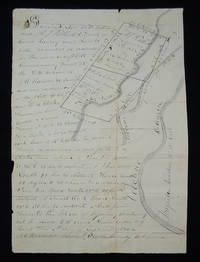
185268368Placer County California 1852. GOLD RUSH. Gold Rush Map Manuscript. Being a Survey for the adjoining plots of land belonging to H.H. Watson and A.J. Polhill. Placer County California: 1852.<br> <br> Two pages on a single sheet 17 1/8 x 10 7/8 in.; 438 x 275 mm. Manuscript document with map dated variously between 4-24 September 1852 and signed by H.H. Watson A.J. Polhill and others. Sheet with some mild staining and ink blots. Some minor chipping at edges and some separations at the creases. Creases reinforced with nearly invisible tape. Overall a very interesting piece of gold rush history. We could not find any other California mine surveys at auction in the past 50 years.<br> <br> "Survey for H.H. Watson and A.J. Polhill. A Tract of land laying near ville bounded as described in the annex plot commencing point as the S.W. corner of J.H. Hancock survey." "Survey made by N.O. Hinman County Surveyor."<br> <br> "In the present survey the tracts of land being issued to Watson and Polhill are bounded on the right by the Volcano Mining Company Ditch and Volcano Canion sic with the Todds sic Valley Company Ditch running through each plot. The Volcano Gold Gravel Mining Company was one of the most extensive gravel mines during the Gold Rush and hundreds of acres of valuable mining lands were drained by its enterprises. Placer County falls in both the Sacramento Valley and Sierra Nevada regions in what is known as the Gold Country. The discovery of gold in this region in 1848 brought tens of thousands of miners from around the world and thousands more settled in the area to provide goods and services to them. The name "Placer" is taken from the Spanish word for gravel or sand deposits containing gold." From Sotheby's.<br> <br> HBS 68368.<br> <br> $3500. Placer County, California unknown
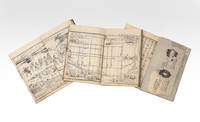
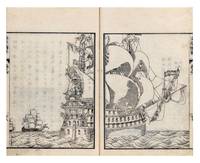
10340Many fine woodcuts throughout. Four parts & appendices in five vols. 8vo orig. semi-stiff wrappers a little frayed old stitching orig. title slips on covers. Tokyo: Yamasakiya Seishichi 山崎屋清七 et al. 1852.<br /> <br> <br> <br /> <br /> First printed edition of this artillery manual from the bakumatsu period. In the early 19th century Japan came under increased pressure from Western nations that wanted access to Japanese ports. “The Shogunate government issued the Order to Drive Away Foreign Ships in 1825 and commanded that foreign ships appearing along the coast of Japan be fired upon so the domains along the coast began building gun batteries and installing cannons. This is when the gun batteries and emplacements were built at Odaiba in Edo Bay and at Uraga Nakaminato Tahara Maiko Dannoura Uwajima Kagoshima and elsewhere. Dutch coastal artillery books were referred to when building these gun batteries†NDL Japan-Netherlands Exchange in the Edo Period online. Our book was published in this historical context.<br /> <br> <br> The book had already been translated by Motoki Masahide 1767-1822 who had left it unpublished at his death manuscript copies exist. Nunokawa TsÅ«boku 布å·é€šç’ž who edited Motoki’s translation and brought it to print in his Preface referenced the order that the domains build coastal defenses as one justification for publication. Motoki had studied not only Dutch but also French Russian and English. He published an English-language primer in 1811 and an English-Japanese dictionary in 1814. <br /> <br> <br> The Dutch original from which the book was translated was titled Het Nieuwe Licht Der Bosschieterye 1699 and was written by Gerrit van der Tollen fl. 1721-23 who worked for the Dutch East India Company.<br /> <br> <br> Our book is richly illustrated with a series of fine single- and double-page woodcuts of many kinds of cannons and mortars cannonballs and Western warships along with diagrams of problems in ballistics. Sections include illustrations and explanations of the structure and dimensions of cannons the measurement of gunpowder and lists of Dutch terms translated into Japanese. Some sections are written in a question-and-answer format “Which countries produce cannons Is there a difference in the making of light and heavy cannonballsâ€. The book begins with a history of artillery a topic that is treated further in the appendices which were not written by Motoki. The appendices treat the history of artillery both in Europe and in China.<br /> <br> <br> Note that Google Books presents the copy at the Bavarian State Library as being published in 1825 but the digitized title page says Kaei mizunoene which corresponds to 1852 and is the same date as seen in our book.<br /> <br> <br> Very fine set.<br /> <br> <br> ⧠Motoki: Christopher Joby The Dutch Language in Japan 1600-1900 Leiden & Boston: 2021 pp. 74 121 186 191 196-97 276 285 & 320. unknown
17161469Haarlem: Weduwe van Hermanus van Hulkenroy 1716. Early 19th-century marbled boards with a paper title label on the spine. 4to. With an etched frontispiece an etching of a mermaid on the title 2 folding etchings 2 full-page etchings and 21 etchings in the text all after Adriaen van Ostade. Further with musical annotation to all songs. First edition of a rare Dutch songbook with songs for farmer's festivals all with musical annotation. The work has been beautifully illustrated with etchings after the famous Dutch painter of country life Adriaen van Ostade 1610-1685. The fine etchings newly made and in reverse present an exemplary survey of Van Ostade's work showing busts of peasants women on their way to the market carrying baskets farmers smoking merry parties dancing in front of the farm a knife-grinder a schoolmaster etc. Together they give a lively impression of country life.The work was published anonymously but has been attributed to either Jan van Gijsen 1668-1722 or Aäron van Hulkenroy 1687-1733. Van Gijsen was a popular author who wrote a large number of occasional poems. His collected works were published at Amsterdam in three volumes in 1707-1711 but the present selection was probably published only once partly with the address of the Widow of Van Hulkenroy and partly with the address of J. van Egmont who had also published the collected works. Aäron van Hulkenroy was the son of publisher Hermanus van Hulkenroy and took over the publishing company after both his parents had passed. He was also a poet who wrote various poetry collections which were always published by his mother or later himself. The present work has been attributed to him because the very first poem on the verso of the half title is signed with his initials.The boards and spine are rubbed with some loss of material at the lower outer corner of the front board. The leaves and plates are somewhat foxed a small tear in the margin of first folding plate has been repaired on the back. Otherwise in good condition.l Goovaerts 1011; Cat. Muziekhist. Museum Scheurleer II p. 92; Scheepers I 284 "Hoogst zeldzaam"; Scheurleer Liedboeken 199 lists both 1716-issues; STCN 154032301; cf. Hollstein XV pp. 1-70 for the etchings; NNBW 8 col. 648 Gijsen and NNBW 4 col. 790 Hulkenroy; not in Arents Tobacco. Weduwe van Hermanus van Hulkenroy, hardcover
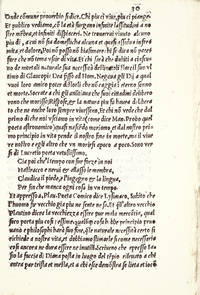
154388<p>8° mm 151x104; cc. 32. Marca tipografica al frontespizio. Margine superiore un poco rifilato. Pergamena posteriore.</p><p>Seconda edizione del dialogo albertiano - meglio conosciuto sotto il titolo di <em>Theogenius</em> - dopo quella che priva di dati tipografici ISTC cataloga come: "Florence 1500" cfr. L.B. Alberti <em>Opere volgari</em> II <em>Rime e trattati morali</em> a cura di C. Grayson Bari 1966 p. 409.</p><p>Il <em>Theogenius</em> rappresenta un capitolo poco noto della fortuna e dell'influsso dell'epicureismo nel Quattrocento. In questo dialogo infatti l'Alberti illustra diversi temi dell'etica epicurea e <strong>traduce alcuni versi del <em>De rerum natura</em> di Lucrezio </strong>S. Gambino <em>Alberti lettore di Lucrezio: motivi lucreziani nel "Theogenius"</em> "Albertiana" IV 2001 pp. 69-84.</p><p>Leon Battista Alberti's <em>Theogenius</em> revived and revised the ancient view developed in the Hellenistic age according to which philosophy aims to form rather than inform people showing them how to cultivate a specific attitude towards existence through a rational comprehension of the nature of humanity and its place in the cosmos. This view of philosophy as a way of life was challenged by the development of scholastic philosophy seen as a body of speculative doctrines and professional skills ancillary to the superior wisdom of theology. Nevertheless it survived thanks to Renaissance humanists like Petrarch Alberti Erasmus and Montaigne. <strong>On the influence of Lucretius on Italian Humanism after Poggio Bracciolini's discovery of the only surviving manuscript of <em>De rerum natura</em> 1417</strong> cf. A. Brown <em>The Return of Lucretius to Renaissance Florence</em> Harvard University Press 2010 and S. Greenblatt <em>The Swerve: How the Renaissance Began</em> London 2011.</p> Appresso Paulo Girardo, [colophon:] per Venturino Rosinello
1759137120Paris: J. Barbou 1759. Full period French binding in Calf five raised bands gilt ornamentation on spine author and title in gilt on red leather spine label in second compartment. 8vo. Full period French binding in Calf five raised bands gilt ornamentation on spine author and title in gilt on red leather spine label in second compartment. 263 pages. First edition Bigmore and Wyman p.228. Minor soiling to the text block else a fine copy.<BR> <br /> <BR> <br /> In this volume Fournier sets out to prove that Gutenberg was not the inventor of the printing press by examining the history of printing. He believes that the technology Gutenberg made popular existed long before the German printer's work. <BR> <br /> <BR> <br /> "Peter Simon Fournier a French engraver and letter-founder was born at Paris 1712 and died 1768. He studied under Colson painter of the Academy of Saint Luc and devoted himself first to the art of wood-engraving; he afterwards as an engraver on steel rendered himself famous in all countries. In some of his works he seeks to prove that Gutenberg is not the inventor of printing and maintains that long before Gutenberg engraving on wood had been employed for printing images and inscriptions; that during his residence in Strasburg Gutenberg attempted the application of this art to the printing of books and that on his return to Mayence he first printed the Donatus and the Catholicon of Johannes de Janua with engraved and solid blocks. Fournier's ingenious theories were ably refuted by Baron Heinecken in his "Idée Générale d'une Collection complette d'Estamples" Leipsic: 1771" Bigmore & Wyman p 229. J. Barbou unknown
192232975-509Moscow and Berlin Gelikon January 1922. Illustrated with 16 photogravures on plates and line illustrations by F. Léger and others. 140 2 publisher's adv. 2 blank pp. 8vo. Orig. illus. wrappers with a Cubist drawing by F. Léger 220 x 160 mm. Moscow and Berlin Gelikon January 1922. First edition of an important work with a strong visual preseentation of Erenburg's text. One of 100 copies of an edition limited to 500 copies. The typography is Futurist amd is stikingly juxtaposed with Leger's illustrations. This rare treatise on contemporary avant-garde art by Erenburg 1891-1967 is not only noteworthy for its typographical experimentation but it defends Contructivism in early art "Oblozhka raboty Fernanda Lezhe" and includes also a penetrating analysis of the "new architecture" which Vladimir E. Tatlin and his work are seen to have generated. Among the artists the Russian critic considers are Léger Lipchitz Lissitzky Picasso Rodchenko Van Doesburg and even from a Charlie Chaplin film. - A very good uncut copy in the original wrappers designed by Léger. - Senkevitch Soviet Architecture 1917-1962 no. 1120; cf. Compton Russian Avent-Garde Books 1917-34 p. 52 & p. 153 no. 64; MoMA no. 401. LITERATURE: RUSSIAN ; ART - GENERAL & APPLIED ; ARCHITECTURE ; Moscow and Berlin, Gelikon unknown