7 654 résultats
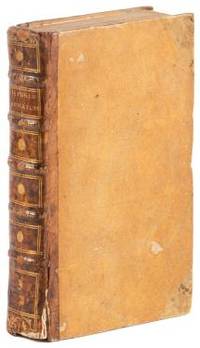
1783B6593Ingoldstad Germany : Anton Attenkhouer c. 1783. . A very good example occasional minor browning. Edition: Second edition of Henrich Palmaz Leveling's German Binding: Full recent panelled calf triple gilt outer borders on speckled natural calf; central blind-stamped green panel; spine raised with five 5 bands; titles on two and four and compartments with central gilt ornament dated. Notes: Text in German. Gothic Script.<br>Second edition of Henrich Palmaz Leveling's German translation or Ingolstadt edition after the first of 1781.<br>This second Ingolstadt edition of only 1500 exemplars features beyond twohundred 200 in-text engravings printed from Vesalius’s original woodblocks; the woodblocks were destroyed during the WWII bombings of Munich. Leveling not only translated this work but introduced updated information often relying on the French Winslow as information source. Size: Folio 396x274mm. Illustration: Illustrated woodcut title depicting the dissection lecture hall; printed title with engraved vignette of the portrait of Heinrich Palmatius Leveling flanked on either side by the staff of Aesculapius and a skeleton respectively; headpieces at 2 A1 Bb1 Xx1 Nnn Yyy2r Ccc1r; and tailpieces at Q1 Bb1 Uu1v Eee2 Mmm2v Yyy1v Bbbb2v Hhhh2v 1v or final leaf; ornamental Gothic initials on title and dedication; in-text partial page illustrations at A1 A2v B1r 3 B2r B2v C1r 2 C1v 2 C2r D1r D1v D2r 2 D2v2 E1r E2v 2 F2r 2 G1r G2r 3G2v 3 H1v2 H2r 3 H2v2 I1r3 I2r 4 I2v3 K1v K2r5 L1v L2r6 L2v3 N1v2 O1v2 Nn1r Qq2r Ss1v2 Ss2v Tt1r8 Uu1r Zz1v 2 Aaa2v Bbb2v 2 Ccc1v Ccc2r Ggg2v Iii2v Lll2v Ooo1v Ppp2r Ppprv Qqq1v Qqq2v Rrr1v2 Rrr2r 2 Sss1v Xxx1v Xxx2v 2 Yyy1r Yyy2r Zzz2r Zzz2v Aaaa1r 2 Aaaa2r Aaaa2v 2; in-text half page illustrations often consisting of multiple illustrations at: A1v A2v F1v9 H1v H2r I2v K1v 5L1r2 M1v2 M2r4 M2v O2r15 Q1r Rr1r Rr1v Rr2v Ss1r Ss2r2 Tt2v Xx1r Zz2r Fff1r Nnn1r Nnn2r Ooo1r Ppp2r Qqq2r Sss2r Ttt1v Uuu1r Uuu2r Xxx2r Yyy2v Cccc1r Cccc2r Cccc2v Dddd1v Dddd2r Eeee1r Eeee2r Ffff1r Gggg2r Gggg2v Hhhh1v; in-text full page illustrations at: F1r N2r13 P1r P1v P2r Bb2r Cc2r Dd2r Ee2r Ff2r Gg2v Jj17r Jj2v Kk2v Ll2v Mm2v Nn2v Oo2r Pp2r Xx2v Zz2v Ccc2v folding Eee2v Fff1v Iii2v Kkk1r Mmm12 folding Ooo2v; <br>Moreover two double-paged woodcuts insert of Adam and Eve at Iiii2v. <br> Volume: Seven books in one volum Provenance: Signature: “H.Linder // 1875†on the margin of the upper free endpaper; Stamp on verso of final leaf: “Henry Linder //SCULPTOR Studio … // NEW-YORK.†Some of Linder’s work 1854-1910 renowned New York sculptor is exhibited at the Smithsonian America References: Choulant-Frank 185; Cushing VI A.15; Heirs of Hippocrates 1042; Osler 573; Waller 5752 Pages: Ll: Bl. 2 ill title printed title with portrait vignette of Leveling dedication 3 x1-xx2 preface x1-2 index; A1-Z2 Aa1 1st book Bb1-T2 U1 2nd book ; Xx1-Eee2 3rd book Fff1-Mmm2 4th book Nnn1-Yyy1 5th book Yyy2-Zzz2 Aaaa1-Bbbb2 6th book Cccc1-Hhhh2 7th book Iiii1-2 2 folding plates- of Adam and Eve Kkkk1-Oooo2 summarische Abhandlung 1-2 1 Index; bl.2. Category: Book Medical; Anton Attenkhouer, unknown
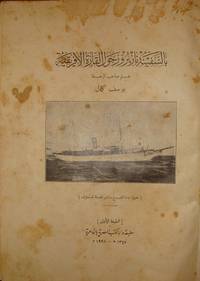
1928000493<p>Bi-l-safÄ«na "NÄz برور" ḥawla al-qÄrra al-ifrÄ«qiyya</p><p>Cairo: DÄr al-Kutub al-Miá¹£riyya 1928.<br />Book. Very Good. Hardcover. First Edition.<br />4to 9¾ × 12 in.<br />Very rare limited edition printed in only 500 copies.<br />Arabic text 424 pages richly illustrated with numerous photographic plates and in-text photographs.<br />The work is divided into three main parts:<br />Part I: Somali territories and British Kenya.<br />Part II: Belgian Congo British Tanganyika Portuguese Angola Victoria Falls the Cape Colony the Canary Islands and the Island of Malta.<br />Part III: Victoria Falls Rhodesia the Kalahari Desert the Cape Territory the Madeira Archipelago the Island of Malta and Marmarica Cyrenaica region.<br />Bound in a contemporary binding.</p><p>Prince YÅ«suf KamÄl was a member of the Egyptian royal family a distinguished patron of the arts and one of the most important collectors of Islamic art and cartography in Egypt during the late 19th and early 20th centuries. He founded the School of Fine Arts in Cairo 1908 and assembled an exceptional collection of manuscripts maps and artworks many of which later entered public institutions. In addition to his patronage he was an accomplished author and translator particularly of geographical and travel literature including accounts of African exploration and voyages.</p><p>For another work by YÅ«suf KamÄl see inventory no. 000454.</p> Dar ul Kutub al- Misriyya hardcover
1650B6295Rome/Romae: Formis Io. Iacobi de Rubei apud templum S. Mariae de Pace. Undated c.1650-latest c.1690 most probably c.1660 c.1675-1677. . Lacks folding double-page plan of the Villa Pamphilia and the first of 5 folding plates “Primusâ€. Otherwise a very good example plates are crisp and clean. . Edition: First and only edition. Italic and Roman type. Tex Binding: Contemporary panelled full burgundy morocco double-gilt filleted; spine with six 6 raised bands gilt lettered title on two with remaining compartments gilt ornamented; all edges gilt; contemporary endpapers with watermark of a fleur-de-lis within two concentric circles. Wide margin paper. Notes: An architectural plate book depicting statues and fountains displayed in Villa Pamphili an important 16th-17th century Roman villa designed by the painter Giovanni Francesco Grimaldi 1606 - 1680 and Alessandro Algardi 1598 - 1654 followed by the construction of the garden layout; …1652-1657. The publication of the present work printed by G.G. de Rossi possibly c.1675-1677 was commissioned by Pamphili’s son and heir Giambattista with the engraver Dominique Barrière documenting the statues placed both in cornices of the villa and the gardens and with further plates included such as some by Giovanni Battista Falda's ‘Le fontane di Roma’ fountains of Rome plus general views of the villa and its gardens.<br> <br>Giovanni Battista Falda c.1643 – 1678 Rome was an Italian architect engraver and artist. He is known for his engravings of both contemporary and antique buildings and structures of Rome. Falda studied and worked under Bernini; his draughtsmanship drew G. G. de Rossi’s attention. He became well-known for his “Le fontane di Roma†Fountains in Rome and “Palazzi di Roma†Palaces of Rome particularly popular with visitors to Rome.<br> <br>Giovanni Giacomo de Rossi Italian engraver and printer active in Rome during the second half of the 17th century. His father Giuseppe de Rossi 1570-1639 was the founder of the most important and active printing press of the 17th century in Rome. The press started in 1633 it was then passed to Giovanni Giacomo and his brother Giandomenico; and later to Lorenzo Filippo. In 1738 it became the “Calcografia Camerale†from 1870-1945 the “Regia Calcograficaâ€; today it is known as the “Calcografia Nazionaleâ€. Here are conserved amongst many others the plates of Giambattista Piranesi 1720-1778. Giovanni Giacomo de Rossi the most involved of all family members who ran the press from 1638-1691 took the company to its height of success. He printed etchings for artists including Giovanni Benedetto Castiglione 1609-1665 Pietro Testa 1612-1650 and Giovan. Francesco Grimaldi 1606–1680.<br> <br>Barrière c.1622–1678 was a French painter and engraver. Barrière was born at Marseilles in about 1622. He spent most of his career in Rome where he engraved a considerable number of plates after Claude and other landscape painters as well as other subjects. They are neatly etched in the manner of Stefano della Bella. He died in Rome in 1678. <br> <br> Size: Folio 434x312mm. Illustration: Fine illustrations of the famous Villa Pamphili the most important architectural constructions of Baroque Rome with its Italian garden and the fine collection of antiquities. <br>Illustrated dedication with head- & tail-vignettes and a large rubricated initial; plus a total of 82 full page and double page oblong folding copper-engraved plates.<br> References: Woodfall G.; British Museum: Catalogue of Maps Prints Drawings Etc. Forming the Geographical and Topographical Collection vol. II p. 146 1829. Rossetti 4827. Cicognara 3911. Berlin Katalog 3491. Kissner 394. Vinciana 4360. Giorgetta F. Hortus libro Category: Book Europe Italy; Book Art Architecture & Design; Book Plate Books General; Formis Io. Iacobi de Rubei, apud templum S. Mariae de Pace. hardcover
1490V68428Venice: Hermann Lichtenstein Coloniensis 1490 7th Sept. Hardcover. Very Good-. Guide Letters in red and blue red and blue markers several hundred . Quarto 244x175mm blindstamped pig spined wooden boards with 2 working clasps oldbut not original ink title to spine on 5 raised double cords repair to foot of spine/ old copper strengthening to lower board insertions of catches/minor worming but not weakening wood or leather inside of covers are part of a Spanish-Latin word list. 1st leaf has old ownership and neat caligraphic title Plura Opuscula St. Thome. Verso=Tabula listing the titles or all the works some damage bottom 7 titles Leaf 2-12 =Life of which first 5 leaves have repairs to foot of page but with loss to only the recto of the first leaf other paper repairs are marginal only and do not affect any print these leaves signed aa in 12's. The 72 Opuscula take up a-x A-Z AA-HH all in 8's except x & HH in 12's as listed on Register on last leaf. Some repairs to later pages of index with the last being mounted but only affecting 2 words of the Register leaf. Some worm holes mostly marginal and some marginal damp marks but the paper is strong and supple. Clean very thick book 436 leaves 872pp Printed in double columns 56 lines to a full column in Gothic letters. Collated complete. Reefernmces: Hain-Cop. 1541 BMC V 358 Proctor 4793 Goff T 258. Hermann Lichtenstein Coloniensis hardcover
8347Vol. I: Illustrated “title-page†one double-page woodcut with foldouts to form a four-panel diptych with the addition of a “trick super flap†depicting three female genitalia young woman mistress & wife six double-page woodcuts & two single-page woodcuts all color-printed; & three double-page black & white woodcuts. Vol. II: Illustrated “title-page†five double-page woodcuts & two single-page woodcuts all color-printed; & four double-page black & white woodcuts. Vol. III: Illustrated “title-page†four double-page woodcuts & two full-page woodcuts all color-printed; & three black & white double-page woodcuts. All leaves have color-printed borders. .5 1 folding leaf of preface color-printed 13 folding leaves; .5 13 folding leaves; .5 12 folding leaves. Three vols. 8vo orig. decorated semi-stiff patterned boards with color-printed symbols of the moon flowers & snowflakes orig. block-printed title labels on upper covers of Vols. I & II lacking on Vol. III but there is no evidence a label was ever there new stitching. Japan: Preface dated 1850.<br /> <BR> <BR> First edition and very rare; we can find no copy in WorldCat or NIJL. Almost all of the techniques that make Japanese illustrated books so remarkable are utilized here. Finely illustrated and richly colored this late shunga employs bokashi the delicate variation of shading of pigment within the image; blind-embossing; and the very ample use of metallic pigments. The depicted garments are a mixture of extremely complex textures colors and patterns all accentuated by blind-embossing and multiple woodblock impressions.<br /> <BR> <BR> In Vol. I the folding woodcuts — which reveal a man and woman engaging in sex — open to reveal a fine and complex four-panel scene in which we see three couples also having sex: a young couple a man with his mistress and the same man with his wife. On the third panel from the right a hidden “trick†flap is revealed depicting and comparing the genitalia of these three women. This “trick†panel has the title printed with seven kanji characters the first two are indecipherable: “…mitate setsugekka†“…Visual Puns of Snow Moon Flowerâ€.<br /> <BR> <BR> Each volume begins with a finely colored paste-down leaf artistically depicting the themes of snow moon and flower with poems. Facing each of these leaves is a portrait of a woman: mistress young and wife. All the black & white woodcuts also depict men and women engaging in sex and self-pleasuring.<br /> <BR> <BR> Koikawa 1821-1907 was a prolific artist. He illustrated as well as wrote numerous books under various pen names. At the end of the Preface in Vol. I we find “Insuitei†one of his pen names.<br /> <BR> <BR> Fine set with fresh coloring. The four-panel diptych has several small burn holes on the right-hand side. One black & white illustration has been “heightened†with red ink in a very minor way. Slight thumbing and a few minor stains. unknown
1897526<p>A collection of 50 albumen prints from the British Museum Series numerous manuscript captions slight age-related toning photographs mounted to album occasional light marginal foxing not affecting image original maroon cloth with quarter morocco spine retaining studs title gilt to spine slightly rubbed folio London: W.A. Mansell c.1897 </p><p><br /></p><p>The 50 photographs of antiquities in the British Museum covering Greek Roman and Etruscan Statues and Vases including 24 of the Parthenon Frieze. Many of the images are accompanied by manuscript captions. Other photographs include:</p><p>Horse of Selene Ilissos "Colossal Lion" The Piranesi Vase "Marble Vase found in the Villa of Hadrian at Tivoli" "Mercury" "Venus de Medici" "The "Townley" Venus" "Venus Entering Bath" "Apollo as a Player of the Lyre from Cyrene" "Hercules" Hercules found in Hadrian's villa at Tivoli Drum of Sculptured Column from Temple of Diana Artemision Ephesus "Casts from Balustrade of Temple of Wingless Victory - Athens -" Etruscan Sepulchral Monument in terracotta "Thalia"</p><p>T. Aurelius Fulvius Antonius Pius Aurelius Antoni Satyr Apollo Demeter Ceres and Sepulchral Rites at the Tomb of a Hero. </p><br /><p>The Elgin Marbles are a collection of statues and architectural decoration acquired by the Earl of Elgin during his time as Ambassador to the Ottoman Empire. He successfully petitioned the authorities to be able to measure draw and remove figures in various ruins. The most extensive work was on the Parthenon or Temple of Athena but he also received permission to remove sculptural and architectural elements from a number of other ruins including the Acropolis and the Temple of Nike Athena. </p><br /><p>The most famous of the Elgin Marbles are the Parthenon Sculptures a collection of different types of marble architectural decoration on the Parthenon. The Parthenon Frieze 75 metres in length depicts various scenes including the battle between the Lapitas and the Centaurs at the marriage feast of Peirithoos. Elgin originally intended on using the Frieze as decoration in his private home but due to the collapse of his marriage he sold them to the British Museum. There have been debates over the legitimacy of Elgin's excavation. After an investigation from a Parliamentary Select Committee in 1816 Elgin's actions were found to be entirely legal. Since 1983 Greece has formally requested the British Museum to return all the Parthenon Sculptures in the Museum's collection the British Museum states there are no current discussions with the Greek Government on this issue. </p><br /><p>Roger Fenton is one of the most celebrated figures in the history of photography. He was a creative and highly influential photographer in the mediums "golden age" of the 1850s. In his role as the British Museum's first official photographer Fenton demonstrated his sure sense as a 'photo artist'. He was initially engaged to photograph cuneiform tablets but that soon developed into taking pictures of other antiquities. As early as 1852 Fenton received permission from the Trustees to photograph antiquities within the museum establishing a small studio inside the museum the following year. He left in 1854 to serve as a photographer in the Crimean War for which he is most widely known but he was re-appointed on his return in 1856 until the termination of his contract in July 1859. The Trustees decided that photography was not cost effective and after they failed to negotiate the South Kensington Museum now the V&A as an alternative Fenton terminated his association with the British Museum. </p><br />References: The British Museum The Metropolitan Museum of Art Luminous-Lint. W.A. Mansell
1706B6518Paris / probably Amsterdam: Gedrukt tot Parys inde Koninglyke druckery van den klyne Louis Carel Allard. Imprime a l'Imprimerie Royal du petit Louisâ€. Circa 1706. Very rare and desirable overall plates are crisp and clean; corner of title and edges of some plates slightly darkened; corner torn off at plate 13. . Notes: An important work on the War of the Spanish Succession with a collection of prints by Carel Allard or “Petit Louis†ridiculing the “Sun King†or Monarch Louis xiv in eclipse. Many of Allard’s prints initially separately were published in sets of varying combinations – including the present ‘Almanach’. For instance the Rijksmuseum owns a copy of a later 1713 publication entitled 't Lust-Hof van Momus Beplant met de voornaamste Gewassen van Mars in Europa Een opgepronkt met Staat-kundige Zinnebeelden Des Tegenwoordigen Oorlogs’ by Abraham Allard in which most of the prints of the present work are incorportated. Carel Allard known for depicting royalty inspired other later publications such as satirical engravings in the ‘South Sea Bubble’ published approximately a decade later. Muller comments on the rarity of the prints and the present series; only few known copies exist mainly owned by institutions; Muller states: "Their value as expressions of the spirit and life of the common people is inestimable: indeed there is almost no period in our history for which we possess such a rich treasure of prints." <br>While the title states that the publication was printed in Paris researchers claim the place of editing and printing to be Amsterdam that not the royal imprimerie of ‘Petit Louis’ was used but the printing house of Carol Allard in Amsterdam. Moreover it is claimed that Allard edited the work in Amsterdam. <br> Size: Small Folio 317 x206 mm Illustration: Text in Dutch and French.<br>Illustrated with engraved letterpress copper title and eighteen 18 copper engraved plates; of these seven 7 full page with letterpress text and eleven 11 double page; all accompanied by text each in Dutch and all except for the fifth entitled ‘DE FRANSCHE EN SPAANSCHE HUYLEBALKEN’ and the eighteenth entitled ‘HARPAGON den Ouden Schrok EN HARLEKYN Smit’- all in French. Work on the War of the Spanish Succession ridiculing the Sun King. Provenance: Pencilled and ink notations and signature on upper pasted and free endpaper References: Brunet I: 194-195; Cohen: col. 28; Muller F: ‘De Nederlandsche Geschiedenis in Platen - Beredeneerde Beschrijving van Nederlandsche Historieplaten …’ 1863-70 vol.1: xiii-xv; vol 4: 36 3037/3067/ 3068/3082. Pages: Ff: bl. title 7 full page plates 11 double page plates. Category: Book Caricatures; Book Plate Books General; Book Europe Benelux; Gedrukt tot Parys inde Koninglyke druckery van den klyne Louis [Carel Allard]. Imprime a l'Imprimerie Royal du petit Louisâ€. unknown
elala5445Cleveland: The Burrows Brothers Company 1896-1901. First Thwaites Edition Limited to 750 sets. This set bears rubberstamps "Unnumbered set bound from waste sheets for editorial use." “A monumental editorial achievement. Contains all reports official and unofficial made by members of this missionary order on their activities in North America from 1601 to 1791. In all 238 pieces are given in their original French Latin and Italian texts with English translations.†Howes Spanning the years 1632 to 1673 the relations were the regular reports sent back by the priests of the Canadian mission to their superiors in France. Not only do they record the progress of the missions in converting the Canadian aboriginals to Christianity they are also an important source of historical information on the exploration of New France the manners and customs of the natives and the daily life of the French settlers. Thwaites was assisted in the compilation of the Relations by an impressive array of European and American scholars. In the introduction to his volume of Errata and Addenda which was published in 1967 Joseph P.Donnelly highlighted some of the significant aspects of the work: “The identification of persons even very obscure individuals is an extremely valuable editorial contribution. The bibliographical information regarding the heuristics and provenance of material included in the series is of inestimable worth to the historian…An outstanding editorial feature…is the exhaustive two-volume index…â€. This set belonged to Dr. Lorris Elijah Borden 1877-1963 a long-standing associate of the Arctic Institute. Borden was the last surviving member of the 1903-04 Canadian Arctic Expedition in the Neptune under Captain A.P.Low in which he took part as medical officer. This expedition constituted the first significant step towards the assertion of Canadian authority in the eastern Arctic. During that time Borden studied the diseases afflicting the Inuit and gathered a collection of carvings and other artifacts that was gifted together with his notes and diaries to the Public Archives of Canada in 1964 by his widow. The artifacts are now housed in the Canadian Museum of Civilization. TPL 630. Howes J-106. 73 vols. 8vo. 137 of 138 plates maps views portraits facsimiles incl. 3 multi-page facsimile letters; some folding: lacking the map of Huronia in Vol. XXXIV. 4 text illus. untrimmed in original cloth t.e.g. others uncut dampstaining to lower margins covers & spines of Vols. IX X & LVI. dampstain to lower spines & covers of a few other volumes last volume spine faded 1 plate torn in half & crudely repaired - no loss some foxing throughout. bookplate of Dr. L.E.Borden see below. elala5445 Cleveland: The Burrows Brothers Company, 1896-1901 hardcover
15646012<p>8vo. 112 ff pages 2 and 110-112 are blank. Bound in modern paneled calf with gilt-stamped fleurons on front and back covers raised bands. Generally good.<br /></p><p>The first edition of this plague treatise by Paracelsus Theophrastus Bombastus von Hohenheim 1493-1541 the "Luther of Medicine" and one of the key figures in the history of medicine. Written originally in Nördlingen in 1529-1530 it remained unpublished during Paracelsus' lifetime and subsequently taken up and edited for publication by the Paracelsian scholar Adam von Bodenstein 1528-1577. The latter dedicated it to Johann Rudolph Stör von Störenberg Abbot of Murbach and Luders. In addition to the study on pestilence the text includes two short works by Paracelsus: "Vom Preservatiff durch den Schwebel" and "Von der Mummia."</p><p>In the primary tract Paracelsus for the first time presents his complex theory on the origins of the plague which he believed were the result of astrological and corporeal events set in motion by human sins. "This anthropocentric view of an individual disease is in harmony with Paracelsus' whole philosophy and indeed with Renaissance philosophy in general" Pagel p. 179. Paracelsus also postulates the importance of the principle of sulphur the corresponding agent of the planet Mars in pestilence's causation. He believed that sulphur hidden in three minerals—antimony arsenic and marcasite—affected three corresponding organs: the groin the axillae and the ears.</p><p>The chapters on causation are followed by sections on remedies. The doctor must cure the agent causing the disease rather than the symptoms of the disease Paracelsus writes. Humoral pathology and its insistence on diet is of no use. "Paracelsus' plague remedies include sulphur spirit of vitriol sulphur sublimate and metals also—for external treatment of boils—toads and decoctions of beetles designed to remove the evil of magnetic attraction but herbs and drugs as prescribed by Ficino and Agrippa are greatly amplified and still appear in a prominent place" Pagel pp. 180-181 n. 151.</p><p>The editor of this volume Adam von Bodenstein was one of the key figures in the revival of Paracelsian ideas in the German lands in the middle of the sixteenth century. A son of a radical reformer he believed in transmutation of metals into gold and played a key role in the publication of over 80 works by Paracelsus. For his Paracelsianism he was excluded from the faculty and council of Basel University.</p><p>OCLC records US copies at NYAM NLM Wash. U and UMn.</p><p>Karl Sudhoff <i>Bibliographia Paracelsica</i> Berlin 1894 60; Walter Pagel <i>Paracelsus: An Introduction to Philosophical Medicine in the Era of the Renaissance</i> Boston 1982 2nd revised edition; Georgiana D. Hedesan "Alchemy Potency Imagination Paracelsus's Theories of Poison" in John Arrizabalaga Ole Peter Grell Andrew Cunningham eds. <i>It All Depends on the Dose: Poisons and Medicines in European History. The History of Medicine in Context Series</i> New York 2018 pp. 81-102; Peter J. Forshaw "'Paradoxes Absurdities and Madness:' Conflict over Alchemy Magic and Medicine in the Works of Andreas Libavius and Heinrich Khunrath" <i>Early Science and Medicine</i> vol. 13 no. 1 2008 pp. 53-81.</p> Paul Messerschmidt hardcover
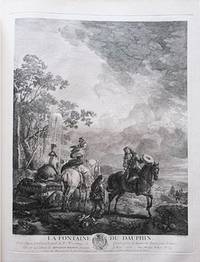
176241877Paris: Chez Moyreau 1762. Folio. 23 1/2 x 19 1/2 inches. Engraved portrait of Moyreau by Nonnette dated 1749 and 100 engraved plates numbered 1-100 with the engraved rococo title being numbered as plate 25. 88 plates engraved by Moyreau and the others by Cochin Chedel etc. The title is engraved by Le Parmentier after J. de la Joue. Included are 5 double page plates and one page with 2 plates on the page. The final 8 plates are numbered in manuscript and the last 2 plates are proofs 'before letters'. Full contemporary calf gilt hinges strengthened<br/> <br/> A rare magnificent collection of engravings showcasing the works of the renowned Dutch Golden Age painter Philips Wouwerman.<br/> <br/> Engraved by master engraver Jean Moyreau the illustrations meticulously reproduce Wouwerman's celebrated equestrian and rural scenes capturing the dynamic compositions intricate details of the originals. Featuring some of the artists finest works carefully selected from the most esteemed collections in Paris and beyond the volume serves as a homage to Wouwerman's enduring artistry.<br/> <br/> Cohen de Ricci 1068; Bulletin Morgand 1889 No. 17315 '1 frontispice et 100 planches; Thiebaud p. 945-946; Brunet V 1480. Chez Moyreau unknown
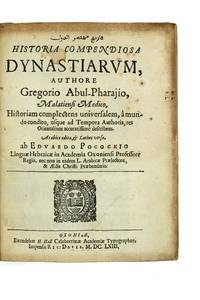
16634120<p>Oxford: H.Hall. Impensis Ric: Davis 1663. First edition thus in the Arabic edition and Latin translation by Edward Pococke. 4to. 203x155mm. pp. 12 368 90 66 5bl 565 2. The final part 565 2 in Arabic paginates from the rear of the book. The two blanks are present. Three parts in one volume i.e. the Latin translation the Supplementum and the Arabic edition each with its own title page. Bound in twentieth century brown full calf by Sangorski and Sutcliffe lettered in gilt to spine. Contemporary manuscript title to fore-edge. Some light fading to the spine slight toning to edges of first and last leaves and a small hole to foot of the final leaf not affecting the text but overall in very good condition throughout. Front pastedown has the bookplate of the Middle East scholar R.M.Burrell. His important library of books on the Middle East was sold by Sotheby's in 1999 this was lot 319. On 17th October 1630 Edward Pococke 1604-1691 arrived in Aleppo as Chaplain of the Levant Company. While there he deepened his study of the languages and culture of the region and began to collect Arabic manuscripts. In 1636 Pococke returned to England at the request of Archbishop Laud who had recently established a Chair of Arabic at Oxford and wanted Pococke to be the first holder of it. One of the manuscripts brought back by Pococke was the al-Mukhtasar fî'l-Duwal 'History of the Dynasties' of Abu'l-Faraj Bar Hebraeus 1226-1286. The lack of material in England on Islamic history and geography meant that Pococke felt unable to prepare his edition and translation and so he secured a sabbatical from Oxford and sailed for Constantinople where he spent the next three years collecting manuscripts. He returned to England shortly before the outbreak of the Civil War and it was only in 1650 that he published extracts from the "History" in his Specimen historiae Arabum which included other material culled from his now extensive collection of manuscripts. Pococke was a Royalist and the years of the Protectorate were hard: he almost lost his professorship and his priestly living. At the Restoration he returned to Oxford and began work on the complete Historia Compendiosa Dynastiarum. Finally in 1663 almost thirty years after Pococke had returned from Aleppo with the manuscript of al-Mukhtasar fî'l-Duwal his far-reaching Historia which opened up Arab history to Western was published and "remained the standard edition until the twentieth century" ODNB.</p> Oxford: H.Hall. Impensis Ric: Davis.
9423Woodblock printed. 57 folding leaves. Two juan in one vol. Large 8vo 313 x 204 mm. orig. semi-stiff yellow patterned wrappers upper wrapper a little soiled. Korea: 1832 or after.<br /> <br> <br> <br /> First edition and very rare; we find no copy in WorldCat. This is the collected poetry and prose by KwÅn 1575-1652 who lived through the tumultuous years of the early 17th century when ChosÅn Korea was twice invaded by the Manchus. KwÅn was from an early age taught by his father KwÅn Tae-gi 權大器 who had studied under one of the most important Neo-Confucian scholars of the ChosÅn period Yi T’oegye æŽé€€æºª Yi Hwang 滉 1501-70. The younger KwÅn passed a lower-level civil service examination and entered officialdom at a low rank. He served in the royal retinue when the court retreated to Ganghwa island during the 1627 Manchu invasion. KwÅn was promoted but retired from office citing illness. After the Manchus invaded the country again in 1636 KwÅn withdrew to a cottage at the foot of a peak of Mount Taebaksan called Chinbong 震峯 “Thunderous Peak†whence the name of his posthumously published oeuvre.<br /> <br> <br> The book contains a Preface written by Yi Ya-sun æŽé‡Žæ·³ 1755-1831 a ninth-generation descendant of Yi T’oegye dated 1825 “fourth Ålyu since the Chongzhen reignâ€. An appendix contains eulogies for KwÅn and an account of KwÅn’s life written by Kim Si-ch’an 金是瓚 dated 1818 “third muin since the Guangde reign period of the August Ming†referencing the reign name of the abortive rebellion by Yang Qilong 楊起隆 1633-80. KwÅn Hun 權勳 a sixth-generation descendant of KwÅn Koeng wrote the colophon dated 1832 “fourth imjin since the first year of Chongzhen.†KwÅn Hun described how “I his unworthy distant descendant with pain and regret carefully searched far and wide to collect the writings bit by bit transcribing them for posterity. The years passed as I was putting them in order.â€<br /> <br> <br> Fine copy. unknown
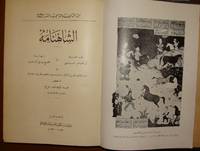
1932000474<p>Cairo: DÄr al-Kutub al-Miá¹£riyya 1932.<br />First edition. Quarto 4to contemporary hardcover binding. Arabic text. Very good condition.<br />This important scholarly Arabic edition of al-ShÄhnÄma comprises two parts bound in one volume. It opens with an extensive 108-page critical introduction by Ê¿Abd al-WahhÄb Ê¿AzzÄm Professor at the Egyptian University followed by the main text in two sections of 389 and 343 pages respectively. The volume is illustrated with several finely reproduced plates of Persian miniature paintings.</p><p>The Arabic text is based on the medieval translation by al-Fatḥ b. Ê¿AlÄ« al-BindÄrÄ« d. 643 AH / 1245 AD one of the earliest and most significant Arabic renderings of FerdowsÄ«'s Persian epic. This edition was carefully collated with the original Persian text with the translation partially completed corrected annotated and critically edited by Ê¿Abd al-WahhÄb Ê¿AzzÄm making it a landmark in modern Arabic–Persian literary scholarship.<br />Printed in a limited edition of 1200 copies only. The Persian source text used for comparison is identified in the editorial apparatus as Inventory no. 000441 a Qajar-period Persian copy printed under the name of AbÅ« al-Fatḥ ShÄh QÄjÄr.<br />A significant modern Arabic edition of one of the greatest monuments of Persian literature combining textual criticism historical scholarship and visual documentation and representing the Egyptian scholarly engagement with classical Persian epic in the early 20th century.</p> Dar ul Kutub al- Misriyya hardcover
160433228-471Leiden Henricus Hondius 1604-1605. Two printed titles with elaborate engr. architectural borders woodcut initials 1 of 2 engr. portrait in the text and 49 engr. plates in vol. 1 33 34 on 1 leaf and 24 engr. plates in vol. 2. Text printed in 2 cols. 9 of 10 unn. leaves; 3 unn. leaves. Oblong folio 280 x 350 mm. 17th cent. marbled boards new endpapers. Leiden Henricus Hondius 1604-1605. First edition of Vredeman's "Perspective" issued by Hondius and printed simultaneously also in French Dutch and German. Present here is the valuable Latin version "the classical language in which Vredeman's architecture is clad and thus becomes timeless in its character" Millard p. 20f. This is one of the most celebrated works on such a subject and was issued by the Flemish born Hendrik Hondius the Elder 1573-1650. The plates for the most part are engraved and a few signed by him after Hans Vredeman. Plate 14 in part 2 is after Paul Vredeman and 4 plates in this part are signed with the monogram DB probably Theodore de Bry or Bartholomaeus Dolendo. The painter and architect Hans or Jan Vredeman de Vries was born 1527 to a German soldier in Leeuwarden Netherlands and probably died in Antwerp 1604. "The King of Architects" Fowler together with Hans van Schille worked at the fortification of the city of Antwerp and also at the triumphal arches built for the entry of the future Philip II into Antwerp in 1549. As a consequence of the religious upheavals of the period Vredeman worked in Hamburg Danzig and Prague before returning to Holland. He wrote and illustrated the present guidebook on perspective for designers painters and architects. It became one of the major books on this subject and through Vredeman de Vries' various publications he is recognised as the "foremost among sixteenth century Netherlandish architectural authors" Millard p. 19. The two volumes illustrate stage perspective interiors furniture palace and garden architecture. Vredeman de Vries was capable of truly artistic landscaping in the Northern Renaissance and served as a model for some patrician gardens in Germany cf. E. Haupt Baukunst der Renaissance in Frankreich und Deutschland 1916. The book includes a number of scenes and projections employ one-and-multi-point perspective. These were essential demonstrations for artists of those days. This work on perspective summarizes Vredeman's knowledge of art science and geometry. This copy has the same collation as the Fowler copy at Johns Hopkins University library which also lacks at the beginning of vol. 1 the leaf A1v with an engraved portrait on left half and a printed poem on right half of this leaf. There are complete copies known but in fact there is no copy of this Latin edition in the holdings of the BL London the Royal Library The Hague Utrecht Dresden Heidelberg Beinecke or Centre d'Architecture at Montreal. The only two but incomplete copies in Austria are in the holdings of the University of Technology Library at Vienna and in the Univ. Libr. Salzburg. The only copy in Switzerland in the holdings of the ETH- Library in Zurich is also incomplete and a mixed-up one 1st part in Latin 2nd part in French. Other incomplete copies are known in the holdings of the Bavarian State Library Munich the V & A Mus. London the Pierpont Morgan Library New York.- Engr. titles slightly frayed at lower margin some foxing otherwise a neat and rare copy. - Cf. Cicognara 867 French ed.; Millard Northern European Books 139 lacking engr. title to part II; Berlin Cat. 4704; Fowler 432 same collation; cf. Nagler I 1757; Borggrefe Heiner. Hans Vredeman 2002. ART - GENERAL & APPLIED ; SCIENCE: ARCHITECTURE ; SCIENCE: GENERAL ; Leiden, Henricus Hondius hardcover
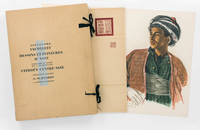
1934122326Paris: Édité sous la direction de Lucien Vogel chez Jules Meynial 1934. First Edition. Paperback. Very Good. Paris Édité sous la direction de Lucien Vogel chez Jules Meynial 1934. A printed box-form thick card portfolio with ribbon ties external dimensions 392 × 290 mm containing a thin volume of text 'Croquis de Route et Notes de Voyage' 36 pages in stab-sewn printed wrappers extensively illustrated and a suite of 50 loose colour plates each printed on a numbered and captioned bifolium. Portfolio tanned bowed and slightly marked with a short split to the foot of the upper joint; ribbon ties frayed; wrappers of the text volume a little creased; plates are generally a little offset onto the conjugate leaf and about a quarter of them have a very short split at the foot of the fold; the first plate is discoloured from contact with the binding of the text volume; these are relatively trifling blemishes that do not detract from what essentially an excellent example of a beautiful publication. Number 117 of 500 copies of the trade edition a further 200 'hors-de-commerce' copies were also printed as well as a deluxe edition of 20 copies. This suite of plates is the lavish pictorial record by the official artist of the Expedition Citroën Centre-Asie colloquially known as the Croisière jaune the Yellow Cruise. Financed by André Citroën and using all-terrain tracked caterpillar-tread vehicles from his factories this trans-Asian motorised expedition covered vast distances in 1931 and 1932. The plates from Iacovleff's striking pastels and watercolours encompass portraits and scenes from Kurdistan to Tonkin by way of Persia Afghanistan Kashmir Mongolia and western China. <p>Provenance: Mary Isobel Barr Smith with a contemporary gift inscription in ink to her 'from Mary Isobel Legoe Christmas 1937'. Mary Isobel Molly Barr Smith 1863-1941 was the wife of Tom Elder Barr Smith 1863-1941 pastoralist and financier; he was the eldest son of Robert Barr Smith 1824-1915. Both were great philanthropists; the library at the University of Adelaide is named the Barr Smith Library in their honour. Molly Legoe was a grand-daughter of Robert Barr Smith; accordingly this portfolio was a Christmas present to her aunt. Édité sous la direction de Lucien Vogel chez Jules Meynial paperback
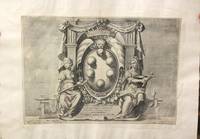
1617B6037Cruger c. 1617. Engravings mounted on watermarked laid paper. Some tears to lower margins not affecting the plates. Staining on one plate. A very good attractive and rare set. Binding: Loose folio in an 18th century wrapper. Notes: c. 1617; exception: one leaf dated 1561 and signed by Antonio Salamanca in Rome. Size: Folio sheets of 405x555m Illustration: Folio set of 14 leaves of copper engravings. References confirm 14 including the tile. Illustrated allegorical title with the Medici arms flanked by female personifications of Justice at left and Faith at right; lettered with a dedication to Cosimo II of Tuscany by Jacobus Chitus with bottom right Teodoro Cruger sculp: 1617 altered in ink to 1618 Florentiae and at lower left five privileges: Cum Privil. S. Pontif S.C. Maiest. Repi. Venet. // M.D. Etrur. Reip Genuens et V.R.Neap. - p. x An.; frontis after self-portrait by Andra Del Sarto; twelve engravings depicting the story of Saint John the Baptist after paintings / frescos and later curtains by Andrea del Sarto at Florence and Franciabigio. References: Hollstein German 6 176 35; Hollstein 33; Le Blanc 1854-1890 2 72 7-20; Virtuelles Kupferstichkabinett 6382 and 6384 mention 14 plates. Pages: Ff: Title; Self-Portrait; 12 engravings. Category: Book Europe Italy; Book Religious Christianity; Book Plate Books General; Cruger unknown
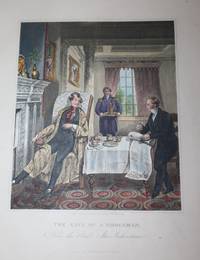
1825007994London: George Henderson. Printed by George Dawe who also was engraver 1825. First Edition. Full Morocco. Near Fine. Suite of nine hand-colored aquatint plates depicting the louche hedonistic and self-destructive life of a young aristocrat. Bound by Riviere & Son in full red morocco with ruled border raised bands other gilt decoration including turn-ins marbled endpapers. N.d. circa 1820s. 4to. 31 by 25 cm. No title page -- this was issued as a suite of plates not in a book form. A blank sheet in front two in back and tissue guards between plates. Each plate is depicting a scene and basically a step in the descent to self-destruction by the young buck aristocrat. Scenes are The Inheritance The First Party The Night House in other words the bordello The Betting Booth at the racetrack The Gambling House The Usurer The Mess Room clearly the dining room of an elite military unit The Duel and finally The Sick Room. We would note that the Usurer has the casual anti-Semitic trope so prevalent throughout history of the hook-nosed lender. The artwork has a pleasant slightly naive quality with the loosest of adherence to perspective. The settings are generally quite resplendent capturing Regency England grandeur perfectly. Scarce. Yale has several copies. Only two other complete sets held by institutions according to OCLC First Search one at Harvard and one somewhat later and published by Tegg at the Art Institute in Chicago. The Henderson version clearly the first was issued without color we would add. The Harvard Hollis catalogue gives no indication whether the copy at Houghton has hand-coloring -- something that Hollis generally will denote if it does. No copies found in commerce on date of this description was prepared. Light wear to binding. Light soiling in the margins of the plates. Pictorial elements consistently bright and attractive. George Henderson. Printed by George Dawe, who also was engraver unknown
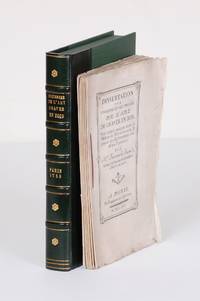
175876869Paris: J. Barbou 1758. unbound cord tied housed in a green half-morocco goat over cloth boards clamshell case spine tooled in gold leaf with title author and date. large 12mo. unbound cord tied housed in a green half-morocco goat over cloth boards clamshell case spine tooled in gold leaf with title author and date. 92 3 pages. Pour éclaircir quelques traits de l"histoire de l'Imprimerie & prouver que Guttemberg n'en est pas l'Inventeur. Very rare first edition Bigmore and Wyman p.227. Unbound textblock lightly soiled with minor creasing at corners. Faint moisture staining throughout with some affecting the text. In this text Fournier sets out to prove that Gutenberg was not the inventor of the printing press by examining the history of printing. He believed that the technology Gutenberg made popular existed long before the German printer's work. Fournier also followed up this text with two additional works which are not present: De l'origine et des productions de l'imprimerie primitive en taille de bois 1759 and Observations sur un ouvrage intitulé Vindiciae Typographicae 1760. These two works provided further discussion of the origins of woodcut prints including a passage refuting popular belief about the origin wood engraving and some ideas for further study. <BR> <br /> <BR> <br /> Fournier 1712--1768 was born in Paris and trained as a wood engraver and type founder being a member of the 18th century dynasty of the well-known Fournier family. He later turned to steel engraving. He published a table of the proportions of the different printing characters whose purpose was to propose for all typefaces a fixed measurement in "typographic points" and a systematic gradation. He worked closely with the collaborators of the Encyclopédie providing the printer Le Breton with all the documentation relating to the typographic foundry and plans for his own instruments as well as providing Diderot with his collection of ancient alphabets. Finally after multiple disputes with his Parisian colleagues he became infamous for the printing of his famous Manuel Typographique 1764 1766 just prior to his death. J. Barbou unknown
1732B5857Amsterdam: Rudolf & Jacob Wetstein and G. Smith c.1732. 3 ff. unnumbered and fully engraved with 6 half page illustrations do according to Brunet account for pp. 265-270. Repaired marginal tear to title to Tome 2 repaired corner tear to 327/8; overall a near fine example of this finely illustrated work with text and plates clean and crisp. . Edition: First Edition Binding: Contemporary decorative calf; expertly rebacked; boards with central gilt medallions; spine with five 5 raised bands flanked by horizontal gilt fillet and decorative rolls with gilt designed corners and centres in compartments and gilt lettered title on morocco label on two; all edges red. Notes: Publius Ovidius Naso or Ovid 43 BC – AD 17/18 was a Roman poet who lived during the reign of Augustus. A contemporary of Virgil and Horace he is often ranked one of the three canonical poets of Latin literature and enjoyed enormous popularity. Augustus sent him into exile where he died. Today he is best known for his Metamorphoses a 15-book continuous mythological narrative written in the meter of epic and for works in elegiac couplets such as Ars Amatoria "The Art of Love" and Fasti. His poetry was much imitated during Late Antiquity and the Middle Ages and greatly influenced Western art and literature. The Metamorphoses remains one of the most important sources of classical mythology. <br>The Metamorphoses Ovid's most ambitious work was written in dactylic hexameter about transformations in Greek and Roman mythology set within a loose mytho-historical framework. The characters in this work undergo many different transformations. Within an extent of nearly 12000 verses almost 250 different myths are mentioned; each myth is set outdoors where the mortals are often vulnerable to external influences. The first book describes the formation of the world the ages of man the flood the story of Daphne's rape by Apollo and Io's by Jupiter; the second Phaethon and the love of Jupiter with Callisto and Europa; the third focuses on the mythology of Thebes with the stories of Cadmus Actaeon and Pentheus; the fourth on three pairs of lovers: Pyramus and Thisbe Salmacis and Hermaphroditus and Perseus and Andromeda; the fifth on the song of the Muses which describes the rape of Proserpina; the sixth on the rivalry between gods and mortals beginning with Arachne and ending with Philomela; the seventh on Medea as well as Cephalus and Procris; the eighth on Daedalus' flight the Calydonian boar hunt and the contrast between pious Baucis and Philemon and the wicked Erysichthon; the ninth on Heracles and the incestuous Byblis; the tenth on stories of doomed love such as Orpheus who sings about Hyacinthus as well as Pygmalion Myrrha and Adonis; the eleventh on marriages of Peleus and Thetis and the love of Ceyx and Alcyone; the twelfth moves from myth to history describing the exploits of Achilles the battle of the centaurs and Iphigeneia; the thirteenth discusses the contest over Achilles' arms and Polyphemus; the fourteenth moves to Italy describing the journey of Aeneas Pomona and Vertumnus and Romulus and the final or fifteenth opens with a philosophical lecture by Pythagoras and the deification of Caesar. The end of the poem praises Augustus and expresses Ovid's belief that his poem has earned him immortality.<br>In analyzing the Metamorphoses scholars have focused on Ovid's organization of his vast body of material. Ovid engages creatively with his predecessors alluding creatively to the full spectrum of classical poetry. <br><br>This 1732 first Amsterdam edition is superbly illustrated employing copper plate engravings attributed to the Dutch: Balthasar Bernaerts engraving c.1711–1737; Jacob Folkema 1692–1767; Wouter Jongman engraving c.1712–1744 Joseph Mulder c.1659/60-; Jan Schenk engraving c.1731–1746; Jan Wandelaar 1690–1759 Philip Van Gunst 1685–1732; the Flemish: Martin Bouche c. 1640–1693 Frederic Bouttats c.1610–1675 Peter Paul Bouche c.1646- and the French: Bernard Picart 1673–1733; after the works of the Dutch: Louis Fabritius Dubourg 1693–1775; Godfried Maes 1649-1700; Jan Punt 1711–1779; Jacob De Wit 1695–1754; the French: Charles LeBrun 1619–1690; Sebastien Leclerc 1637–1714; and the Italians: Giulio Romano 1499–1546; and Pietro Testa 1612–1650. <br> Size: folio 455 x300 mm Illustration: Illustrated with allegorical copper engraved frontispiece by Picart and onehundred twenty-nine 129 copper engravings throughout the text by and after illustrious and notable engravers and artists mostly listed under notes. Illustrations also include two 2 red and black ink printed titles each with a large vignette copper engraving; one 1 copper engraved vignette head piece introducing the dedication to the king; numerous in-text decorative wood-cut head and tail pieces and large thematic or ornamental rubricated initials. The French and Latin texts are in two parallel corresponding columns. Volume: Two tomes in one volume Provenance: watermarked on many leafs including on the 1.free endpaper and dedication to tome 1 as well as title to tome 2: “ BEAVUALS†at centre of leaf. 2.title and final page of tome 1: an upside-down design of a fleur de lis 3.lower free endpaper: “C D“ References: Brunet III: 599; Cohen-de Ricci: 768. Transation: Text in Latin with F Pages: Bl. 2 Frontispiece by Picard bl. Tome I: Red and black ink illustrated title bl. dedication 2 preface 6 1-247 bl. with 69 half page copper engravings. Tome 2: Red and black ink vignette illustrated title bl. 249-264 3 ff. of illustrations 271-524 with 60 half page copper engravings table des matieres 4 bl. 2. Category: Book Classics; Book Europe France; Book Plate Books General; Rudolf & Jacob Wetstein and G. Smith, hardcover
1856B6046St. Petersburg;: Vasily Timm c. 1856 . Title leaf slightly soiled; but overall texts and plates are clean and crisp and in very good condition; tears to leaves # 27 28 29 33 have been expertly repaired. A very attractive example in full contemporary binding. . Edition: First 1856 Edition. Binding: Contemporary quarter morocco over marbled boards; spine with six flat gilt ruled bands forming five blind compartments with gilt lettered title on two and gilt date on four. Notes: Text in Russian. The Russian art periodical publication or gazette of printed collections of lithograph scenes was a chronicle of currents of the life of Russia published by leave of the Royal Family and by the artist himself - painter and draftsman - Georg Wilhelm Timm also known as Vasily Fyodorovich Timm or ВаÑилий Фёдорович Тимм 1820-1895 a Baltic-German painter lithographer and ceramic designer known for his genre and battle scenes; the period extending over 12 years from 1851 to 1862 in St. Petersburg. Having travelled extensively throughout Russia serving as a battle painter during the second phase of the Caucasian War he was chosen in 1852 to accompany the Tsar Nicholas I on a visit to Finland his main task continuing to faithfully share his impressions without criticism or analysis. Later he would make sketches of the Siege of Sevastopol at the height of the Crimean War of 1853-1856. In 1855 this earned him the title "Academician" conferred by the Imperial Academy. In 1860 the collection was compiled and an index of drawings prepared. The publication discontinued in 1862 due to the weakening condition of V.F. Timm's eyes. Scenes from Petersburg life portraits of popular figures reproductions from paintings cartoons etc accompanied by brief explanatory texts had been a great success with the public the complete series of having featured 432 illustrations with Timm referred to as the "Russian Gavarni" having primarily worked with lithography and woodcut engravings. Lithographs were printed in two tones along with a brief explanatory text authored by the Russian publicist and publisher N. I. Grech. and Timm's drawings executed by other artists with lithographs prepared in the workshop of A.E. Münster. <br>As of 2013 publications are estimated at 2-2.5 million rubels; in 2007 a reprint of the collection was made in St. Petersburg including three catalogs and three albums with 432 illustrations; publishers have tried to bring all illustrations as close as possible in color to the originals and leather bindings were chosen with covers gilt embossed.<br> Size: oblong folio 528x352mm. Illustration: Illustrated with 19 full-page 16 half-page and 24 smaller lithographs; and one map. Volume: Text leaves and lithogra Pages: 53 text leaves including one map plus 35 large oblong lithographed leaves. Category: Book Russia; Book Plate Books General; Vasily Timm, hardcover
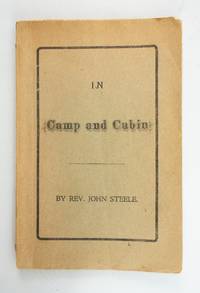
1901ST20777Lodi Wisconsin: J. Steele 1901. FIRST EDITION. 232 x 155 mm. 9 1/8 x 6". 81 pp. <br/> Original green faded to brown printed paper wrappers. Housed in a fine modern caramel-colored morocco clamshell box with gilt lettering on spine. Inside front wrapper with ink signature of M. R. Skinner; occasional pencil underlining in the text. Howes S-924; Graff 3964; Streeter 3027; Wagner-Camp 244 note. Top inch of spine chipped away a little fraying to edges first three leaves with overall browning minor corner creases but QUITE AN EXCELLENT COPY of a very fragile item clean and fresh internally with the insubstantial binding entirely intact against all odds.<br/> <br/> Based on the author's diaries written between September 1850 and July 1853 this work as the introduction tells us lays out events "just as they happened" being "ludicrous solemn serious tragic inexpressibly sad but always interesting." Kurutz calls the book a "detailed and important account of mining life" and notes that Steele "provided important information on mining techniques and laws while laboring in the Coloma District and on the Yuba and Feather rivers." This account includes some fascinating stories about the many hardships and dangers experienced by the author and his associates including nearly constant fatigue and hunger dreadful weather conditions and dicey encounters with desperados dishonest miners and disgruntled frontier men of commerce. John Steele 1832-1905 was only 18 years old when he left his home in Wisconsin for the gold fields of California. After three and a half years of adventuring he returned to the Midwest where he pursued a career in teaching. Steele also volunteered for the Union army during the Civil War and spent the last 30 years of his life as a minister in the Methodist Episcopal Church. The present work was privately printed by the author in a small number of copies and is as expected quite rare on the market now. Besides the present one RBH lists just two other copies sold since 1981 and as of this writing no other dealer seems to be offering one. Furthermore our copy is a remarkably well-preserved survival with its delicate wrappers and text in condition as attractive as one could hope to find. J. Steele unknown
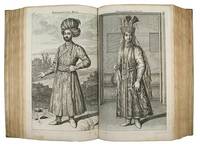
61001Amsterdam R. and G. Wetstein J. Oosterwyk and H. van de Gaete 1714. Folio 33.3 x 21.1 cm. Allegorical frontispiece by Picart dated 1711 title page in red and black; engraved portrait of de Bruyn by G. Kneller vi 472 xii pp.; 260 numbered engraved plates many double folded two large maps and 34 large text engravings not numbered including portraits views etc. Contemporary blind ruled and embossed vellum. Spine with six raised bands title written in ink in a neat contemporary hand. = First edition second issue of one of the most richly illustrated voyages through Russia Persia Iran and adjacent countries and territories made by the Dutch painter Cornelis de Bruin as spelled on title page or de Bruyn as spelled in the portrait 1652-1727. He went by sea from Amsterdam along the coast of Norway above the polar circle to Archangel and travelled southwards by river and overland through Russia and the Caspian Sea to Persia the Gulf and by ship again onward to Batavia now Jakarta Indonesia back to Persia and homewards across the Mediterranean. It is an extensive work important to naval and travel history and includes beautiful large panoramic views of for instance Archangel Moscow and "Spahan" = Isfahan Iran some impressively long when unfolded. The work contains a good deal of zoological illustrations; hence it is recorded in Claus Nissen's Zoologische Buchillustration. Most illustrations are as stated in the title from drawings made on the spot by De Bruin himself. The work was dedicated to Anton Ulrich Duke of Brunswyk and Lunenburg. This edition is identical to the 1711 edition published for the author by Willem and David Goerree. Provenance: armorial bookplate of former private owner David Dunlop "Merito" small pictorial bookplate of E. van Tongeren on front pastedown and one small previous owner's stamp - "A. Noorderbroek Amsterdam" - on the first blank. Old Japanese paper reinforcements to the outer edge of the front flyleaf a few plates may be from another copy same issue tiny weak bookseller's stamp in title page lower margin a pencil annotation below the portrait of De Bruin otherwise clean. In all an excellent copy in a contemporary binding. The plates in a strong impression. Henze I 378; Nissen ZBI 631N; Tiele 207 209. Not in Diba. hardcover
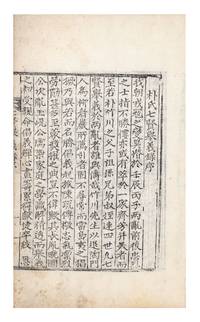
9511Woodblock-printed. 56 folding leaves. Two juan in one vol. Large 8vo 310 x 210 mm. orig. yellow patterned semi-stiff wrappers orig. stitching. YÅngch’Ån: 1854.<br /> <br> <br> <br /> <br /> First edition of this collection including the life and writings of Cho Sang-ch’i or Jo Sang-chi 曺尙治 fl. 1419-55 a prominent official in the early ChosÅn period. From an early age Cho studied “writings on human nature and principle†sÅngni chi sŠ性ç†ä¹‹æ›¸ — that is Neo-Confucianism. As one text on his life put it he “took this Confucian culture of ours as his personal duty.†Cho’s life was tied up with the factional conflicts that saw Sejo’s usurpation of the ChosÅn throne in 1455. Cho was among the “large number†of officials who “viewed the new ruler with distaste on moral grounds†Edward W. Wagner The Literati Purges: Political Conflict in Early Yi Korea p. 9.<br /> <br> <br> After Sejo demoted the previous king giving him the title Prince Nosan and subsequently had him killed Cho “got hold of a stone and neither cutting nor polishing it wrote in his own hand and had it inscribed ‘Here rests Cho Sang-ch’i the exiled Deputy Education Intendant of the court of Nosan’.†As recounted in one of the texts gathered in this collection he thus signaled his opposition to the new king. Cho was posthumously honored in the late 18th century.<br /> <br> <br> The book contains a Prefaces by Pak YÅng-wÅn 朴永元 1791-1854 and Yi Han-Ång æŽæ¼¢è†º 1778-1864 the latter dated 1854 and the colophon by Yi Hwi-ryÅng æŽå½™å¯§ 1788-1861.<br /> <br> <br> Interesting features of our book include the use of the reign of the Korean kings for dating — “kabÅn the sixth year of the reign of the present king Ch’Åljong†上之å…年甲寅 is the date of Yi’s Preface — and the margins that cut through columns where the first character has been raised in deference to the dynasty.<br /> <br> <br> A note toward the end of juan 1 9a says that the two pieces that follow had been missed when the book was “first printed†ch’ogan åˆåˆŠ implying an earlier edition. We are not aware that one is extant however.<br /> <br> <br> Cho SÅg-u is listed as the author in the Korean Old and Rare Collection Information System as well as in the Jangseogak catalogue whence our attribution of authorship.<br /> <br> <br> Fine copy.<br /> <br /> <br> <br> References<br /> <br> <br> Encyclopedia of Korean Culture 한êµë¯¼ì¡±ë¬¸í™”ëŒ€ë°±ê³¼ì‚¬ì „. https://encykorea.aks.ac.kr/ <br /> <br> <br> Digital Jangseogak. https://jsg.aks.ac.kr/ <br /> <br> <br> Korean Old and Rare Collection Information System 한êµê³ 문헌종합목ë¡. unknown
1593CA0273<p><strong>Groundbreaking treatise on exotic botany and tropical medicine</strong></p><p>4586blank leaf pages with numerous woodcut illustrations. Duodecmo 6 1/4 x 3 3/4" octavo bound in quarter leather with five raised spine bands with spine tooled in gilt over brown boards. Translated from the Portuguese into Latin by Carolus Clusius Charles de L'Ecluse. Fourth Edition.<br /><br />Garcia de Orta's groundbreaking treatise on exotic botany and tropical medicine to which are added two other important works on the subject. Orta's contribution comprises pp. 1-2177. It is followed by:<br /><br /><em>Christophori a Costa medici et cheirurgi Aromatum & medicamentorum in Orientali India nascentium</em>. Pp. 225-312. <br /><br /><em>Simplicium medicamentorum ex novo orbe delatorum quorum in medicina usus est historia. descripta à d. Nicolao Monardis.</em> Tertia editio. Pp. 313-4044 <br /><br /><em>Simplicium medicamentorum ex novo orbe delatorum quorum in medicina usus est historia. descripta à d. Nicolao Monardis</em>. Altera editio. Pp. 409-456.<br /><br />Rare combined edition of three major 16th century treatises in the history of botanical and medical knowledge of plants from India and the New World. These Latin editions had all previously been published by Plantin. Garcia da Orta's treatise originally published in 1563 in Goa in Portuguese is the first Indian materia medica written by a European and the first textbook of tropical medicine. The text of Acosta of which L'Ecluse gives an abridgment is a complement to the text of Orta. Finally the Latin translation also abbreviated of the treatises of Nicolas Monardes details the medicines and medicinal herbs of South America and describes their native uses. His text also contains the first representation of tobacco and also that of pepper and even the armadillo. A rare complete copy with the final unpaginated leaves including three privileges the colophon the large printer's device of Plantin and the final blank.<br /><br /><strong>Condition: <br /></strong><br />Some rubbing and wear to covers spine foot chipped; some minor foxing and aging within early ink underlines to the early leaves of the first work else good.</p> Ex officina Plantiniana, apud viduam, & Ioannem Moretum hardcover
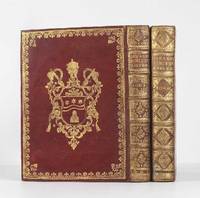
5035Woodcut printer’s device on titles. 4 p.l. xxvii 1 368 pp.; 547 pp. Large 4to cont. Italian red morocco covers of Vol. II a little rubbed sides richly gilt with the arms of Pope Clement XIV in gilt in center of each cover spines richly gilt each tooled slightly differently a.e.g. Faenza: G.A. Archi 1769.<br/> <br/> First edition and a very handsome set with the arms of Pope Clement XIV on covers of the first bio-bibliographical guide to the writers of Ravenna; about 2500 works by more than 600 authors are included. Ginanni 1698-1774 the learned Italian bibliographer and historian was a professor in Florence and then in Ravenna where he developed a great knowledge of Italian history and writers. He formed an important collection of books and medals and was a member of many academic societies. <br/> <br/> Very fine set. Stamp on titles of the Biblioteca Piervissana on titles. From the library of A.R.A. Hobson with bookplate. <br/> <br/> ⧠Besterman 5346. N.B.G. Vol. 20 cols. 570-71. unknown