12 736 résultats
142059aafWinterthur, Steiner, 1802-1804, kl. in-8°, XII + 276 S. / X + 484 S. + 1 Bl. + 4 gestoch. Tafeln und 1 Falttabelle, stellenweise etwas gebräunt oder stockfleckig, Exlibris Peter E. Obergfell, Halblederbände mit Ecken, farbige goldgeprägte Rückenschildchen und etwas dekorativer Rückenvergoldung, Rotschnitt, Ecken des 2. Bandes etwas bestossen, schönes Exemplar.
19365154Lausanne F. Roth et Cie 1936 in-folio en feuilles Lausanne, F. Roth et Cie, 1936. 33,5 x 27 cm, in-folio, 8 ff. n. ch. - planches, en feuilles sous portefeuille de fin papier carton portant au premier plat une large pièce de titre imprimée sur papier vergé gris.
1812AQ30893St. Albans: Shaw Printer 1812. 8pp. Two bilfolia disbound. Priced in manuscript. Together with: Inventory of the Effects of Mr. Charles Williams of St. Albans not included in the printed catalogue of sale. 10th December 1812. Manuscript on paper. Single bifolium An apparently unrecorded auction catalogue annotated by the auctioneer with the prices achieved of the property of a deceased wine merchant including his 'stock in trade' lotted by bin of sherry port rum gin and 'coniac brandy'. The sale realised a total of £268. 4s. 5d. and included 51 lots of his wine stock along with a sequence of empoty casks. The manuscript addendum written on the day after the public auction adds several household as well as '21 Bottles of Currant Wine in 2 Tea Canisters'. Interestingly St. Albans possessed a novel wine licensing system established under the terms of the 1570 wine charter a model not repeated elsewhere. The borough corporation had the power to grant two licences to local vintners in return for an annual endowment of £20 remarkably to be provided to the master of St. Albans grammar school for the maintenance of the institution. We have been unable to trace Charles Williams nor locate any record of his business. However it does not seem unreasonable to assume that he held one of these much sought after licenses; certainly the auction catalogue reveals an extensive stock surely necessitated by the possession of a trade monopoly. . 8vo. Shaw, Printer unknown
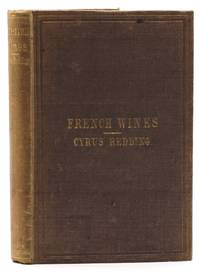
18609560London: Houlston and Wright 1860. Second-hand hardcover. <p>Redding Cyrus. French Wines & Vineyards</p> <p><br /> REDDING Cyrus 1785-1870<br /> <br /> French Wines and Vineyards; and the way to find them.<br /> <br /> London : Houlston and Wright MDCCCLX 1860. First Edition. Printed by H Tuck Aldersgate-Street London.<br /> <br /> Octavo 195x130mm publisher's original claret brown ribbon cloth boards blind ruled border title and spine in gilt pale yellow endpapers xv1240pp : A⸠B-Qâ¸. Board edges and spine lightly sunned corners gently bruised; owner initials to title-page in ink; a few marginal pencil and ink markings not affecting the text; pps 209-232 unopened; bottom edge pps 129-136 mistrimmed not affecting the text; a few folded corners.<br /> <br /> <br /> Redding was a British journalist and writer. Whilst working in Paris he broke the news of Napoleon's defeat at Waterloo. He worked tirelessly for a number of newspapers and magazines including the Monthly and the Metropolitan. His most influential work was his History and Description of Modern Wines 1833 with later editions in 1836 1851 and 1860; the text was based on careful personal observation and gleanings from many sources including Jullien and Chaptal.<br /> <br /> Here Redding provides a more detailed examination solely of the wine trade in France due to the importance and size of the trade with Great Britain which had been recently encouraged by a liberalisation of trade laws and the taxation applied to French wines.  In addition to the expected description of the major producing areas and celebrated vineyards there is a detailed discussion of wine making practices viticulture soils the technical analysis of wine and distillation; comparative measurements taxation and consumer trends.  The major part of the work is devoted to the wines of the Gironde and the greater Bordeaux area. There are also sizeable chapters on Burgundy Champagne and the Loire. There is also a significant amount of statistical information about French wine production alcohol levels pricing and taxation together with a very useful Alphabetical Table of the important French vineyards and their departments as of 1860.<br /> <br /> <br /> Scarce. An excellent copy and a cornerstone of any serious collection on the wines of France. Significant as a detailed record of French wine production and trade before the devastation of phylloxera.<br /> <br /> <br /> § Gabler G35830; Simon BV p.109; Simon BG p.121; Noling p.342; Bitting 391.</p> Houlston and Wright unknown
188074379Marseille: N.p. ca. 1880. A large gathering of plant specimens from the wine growing regions of southwest France. Each specimen is mounted via paper holders to bifoliums measuring 12 1/2 x 20 inches and each specimen within a genus folder containing differing amounts of specimens. Each specimen is named in French on the front of the bifolium and and in much more detail in a small square on the bottom right of the page bearing the specimen .E.g.: Scrofularinees for Scrophulariaceae; In this folder are 3 specimens of species of this genus—— Linaria Cymbalaria; Linaria arvensis; scrofularinee aqua. All data is in French and in manuscript and gives the French translated from the Latin name of the plant the flowering season and the type of habitat and flower color if applicable. There are 15 genus folder bearing 76 actual species specimens. The specimens are on the main very large. All housed in a custom wooden slipcase with extensive brass fittings. Box measures 24 1/2 x 15 1/2 x 6 inches. No specimens broken or missing. Stock paper and chemise by Moullot Fils Ainé Marseilles. A wonderful assemblage.South West France or in French Sud-Ouest is a wine region in France covering several wine-producing areas situated respectively inland from and south of the wine region of Bordeaux. These areas which have a total of 16000 hectares 40000 acres of vineyards consist of several discontinuous wine "islands" throughout the Aquitaine region where Bordeaux region itself is situated and more or less to the west of the Midi-Pyrénées region. Thus South West France covers both the upstream areas around the rivers Dordogne and Garonne which also flow through Bordeaux where they combine to form the Gironde estuary and their tributaries as well as the wine-producing areas of Gascony including Bearn and the Northern Basque Country. However only areas closer to the Atlantic than to the Mediterranean are included in the region with the city of Toulouse being situated roughly halfway between the South West wine region and the Languedoc-Roussillon wine region on the Mediterranean. The brandy-producing region Armagnac is situated within Gascony and the wine region of South West France and some of its grapes are used to make Vin de Pays under the designation Vin de Pays de Côtes de Gascogne or mixed with Armagnac to produce the Mistelle Floc de Gascogne.South West France is a rather heterogeneous region in terms of its wines and how they are marketed. It is rare to see wines being sold as Vins du Sud-Ouest. Rather the smaller areas and individual appellations market their wines under their own smaller umbrella in contrast with common practice in e.g. the Bordeaux region. N.p. unknown
193667419Rheydt:: Hermann Schott Actiengesellschaft September 1936. publisher's boards printed in color. Boards lightly rubbed at edges; title leaf lightly creased; the labels beautiful. Oblong folio. This trade catalogue consists of a title leaf price list and 162 leaves of sample beverage labels printed in gold and colors some embossed four to a page separated into "Deutsche Weine Franz. Weine Likore Spirituosen Rum - Arrak Frucht Etiketten Weinbrand and Sekt. Hermann Schott Actiengesellschaft, hardcover
200413631A Paris, Chez J.N.Barba, libraire, Palais Royal, derrière le théatre-Français, n° 51, 1825 ; in-8, 540-xxviij, plein veau (mors usé, encoche de coiffes et coiffes usées, coins idm.). Rousseurs. Douzième édition, augmentée de 1 100 articles, et ornée de 9 planches pour le service des tables depuis 12 jusqu'a 60 couverts. SUIVIE D'UNE NOTICE SUR LES VINS, par M. Pierhugue, Sommelier du Roi - bon état.
157546402893Burdigalae [Bordeaux], apud Simonem Millangium, [1575-1580] ; in-4, veau fauve, encadrement filet doré, médaillon Renaissance au centre des plats, fleurons dorés au dos. (Reliure de l’époque) 394 ff. non chiffrés, Quelques bois gravés in-texte.C’est la deuxième des très belles et très savantes éditions des oeuvres d’Ausone données par Simon Millanges, le grand imprimeur bordelais. La première est de 1575. Il en publiera une seconde en 1590.La même année 1580 Millanges publie les Essais de Montaigne. En réalité, il s’agit de la remise en vente de l’édition de 1575 avec la 2e partie (commentaires) ajoutée en 1580. Cette édition est donnée par le savant Elie Vinet, avec des commentaires qui occupent la seconde moitié du volume. Un des derniers poètes païens de la fin de l’Empire romain, le Gallo-Romain AUSONIUS est né à Bordeaux vers 309. Il fit une brillante carrière dans l’enseignement et fut le précepteur du fils de Valentinien Ier. Bien que chrétien, son inspiration est toute païenne. Célèbre et comblé d’honneurs, Ausone se tint pourtant à l’écart de la Cour et vécut retiré dans le Bordelais, partageant sa vie entre ses amis, la poésie et les plaisirs champêtres. Ses poèmes chantent souvent la table et surtout le vin, le vin de Bordeaux bien sûr, mais aussi les vins de Moselle et ceux d’Italie.Son chef d’œuvre est “Moselle”, description en 483 hexamètres d’un voyage de Bingen à Trèves.Les pièces relatives à la viticulture bordelaise possèdent une certaine valeur documentaire. La seconde partie du volume (commentaires de Vinet) contient une vue de Bordeaux à pleine page. Brunet signale aussi 2 hors-texte que cet exemplaire ne possède pas mais que ni Adams, ni Desgraves ne mentionnent.Desgraves n°49 - Index aurel. 110.907 - Adams 2282 - Brunet 573 “belle édition estimée pour son commentaire” - Graesse 259 - Exemplaire à grandes marges, dans sa première reliure. Le premier plat est détaché, qq. mouillures d’angle et petits trous de vers marginaux.
In 4° (mm 220x155); cc. nn. 4, pagg. 230, cc. nn. 4 di indice. Pergamena coeva con titolo in oro su tassello al dorso. Capolettera e finalini incisi in silografia, marca editoriale incisa in legno dell'ordine gesuitico.<BR>Prima edizione piuttosto rara di questa nota opera relativa ad esperienze di chimica e fisica, divisa in due parti; riguarda tra i vari argomenti anche il mare e riporta due capitoli, X e XVIIII su vino e birra: "l'aggelarsi del vino e delle parti serose che sono in lui. Separatamente e adunatamente de gli spiriti della cervogia e del vino quando se ne agghiacciano le botti". Il gesuita ferrarese Bartoli (1608-Roma 1685) fu autore di numerose opere di vario genere, dallo scientifico al morale, dallo storico al geografico. Ottimo esemplare con qualche lieve arrossamento della carta.<BR>Piccoli camminamenti di tarlo al piatto inferiore.<BR>Parenti 62, Gamba 1776; Vinciana 1513. <BR>
In 8°, bross. coeva, pp XVI, 618, antiporta inciso raff. laboratorio scientifico, 15 tavole inc. f.t. Prima edizione di rara opera sugli strumenti scientifici in vetro ed attrezzatura per la chimica. L'A. fu ingegnere ed ottico del principe di Condé ed ingegnoso inventore di strumenti in vetro. Nella prefazione vi è un elenco delle sue invenzioni. Es. in barbe. Becker,78; Duncan, 2375; Poggendorff, 431.
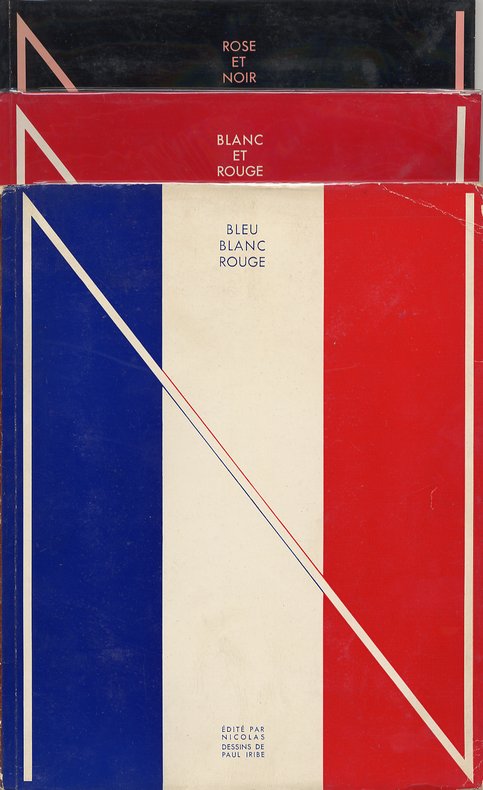
4232Paris, Etablissements Nicolas, 1930, 1931, 1932 ; trois plaquettes petit in-folio.
18151,Reims, F. Michaud 1894, VIII-236 pp., 1 vol. in grand in 4 relié Vingt planches en chromolithographie dessinées d'après nature par Mlle Anna Bauler . Reliure cartonnage toile vert editeur orné d'un pied de vigne et d'un papillon en couleurs sur le premier plat avec le titre dore. Rare et excellente etude de Jolicoeur, secretaire-general de la societe de viticulture de l'arrondissement de Reims, publiee peu apres les ravages catastrophiques du phylloxera au sein des vignobles français, sur les differentes attaques des insectes, champignons et parasites que peut subir la vigne lors de sa croissance. Rare. Très bon état.
In 12° (14,4x9 cm); (8), 287, (7) pp. Legatura coeva in tutto cartoncino rigido con titolo manoscritto al dorso su fascetta in carta. Qualche strofinatura e lieve difetto. Un leggero alone al margine interno del frontespizio dovuta da antica colla. Un piccolissimo ed insignificante tarletto al margine esterno alto di 4 pagine, assolutamente ininfluente. Antica nota settecentesca di possesso privato al recto del frontespizio. Un forellino al margine interno bianco di pagina 239 e per il resto all'interno in più che buone condizioni di conservazione. Rarissima prima ed unica edizione, un solo esemplare censito in ICCU, stampata a Innsbruck da Reisacher, di questo "Thesaurus Sanitatis" nel quale l'autore descrive i rimedi per vivere a lungo ed in modo sano. Chiaramente particolarmente interessante ed importante è la parte dedicata ai consigli dietologici con riferimenti ai cibi ed ai vini, a quanto e cosa mangiare (con descrizione di diversi cibi tipici e del modo di prepararli), in che ordine, da dove prender i cibi ecc. ecc. che rappresenta la parte preponderante dell'opera. Un capitolo dedicato all'influsso degli astri sulla saluta umana ed uno alla possibilità della vita eterna. Vari capitoli sono dedicati alla agli influssi dell'aria sulla salute. Particolarmente interessante è il capitolo nel quale l'autore descrive i migliori luoghi del Tirolo dove soggiornare per vivere più a lungo dove ad esempio dice "Optima vina tibi dabit alba, rubruque coloris Leittach, Traminum, Brixina, Bozen, epam…". Franz Kessler fu un medico svizzero, appartenete a nobile famiglia svizzera originaria dei territori di Hoensax nel Cantone di Uri. Opera rarissima. Krivatsy 13308; IT\ICCU\PUVE\004843.
1885R320119243G.Masson / Feret et Fils / Ulrico Hoepli. 1885. In-Folio. Broché. Etat passable, 1er plat abîmé, Dos abîmé, Intérieur acceptable. XXXVI + 240 pages + 24 planches en noir et blanc (planches collationnées) - dos abîmé, ouvrage désolidarisé - 2ème plat absent - tâches brunes sur le 1er plat - déchirures et coin en pied absent sur le 1er plat - 4 photos disponibles.. . . . Classification Dewey : 634.8-Viticulture, vin
RO80000913Delarue. Sans date. In-16. Broché. Bon état, Tâchée, Coiffe en tête abîmée, Intérieur frais. 144 pages+ ivrogniana 76 pages + Odes d'Anacréon poète grec traduites en vers francais Par Poinsinet de sivry.+ lettres sur la Philotésie ou sur l'ancien usage de se saluer à table et de s'y exciter à boire adressé au Seigneur de Grignon par le Pére Fronteau. 128 pages.1 gravure hors texte.. . . . Classification Dewey : 634.8-Viticulture, vin
1868RO80067615MASSON Victor & Fils / FERET & FILS. 2ème édition. Sept. 1868. In-12. Reliure bradel. Etat passable, Couv. légèrement passée, Dos abîmé, Quelques rousseurs. 471 pages. Nombreuses planches illustrées en noir et blanc. Pièces de titre bordeaux et prune. Titre, filets et fleurons dorés sur demi-veau noir. Cuir détaché du dos et conservé.. . . . Classification Dewey : 634.8-Viticulture, vin
35601339, Leipzig, Avenarius und Mendelssohn, 1851; 2 vol. in-8, cart. percaline brune, plats et dos ornés de rocailles dor. (Rel. de l’époque). XIII pp., 1f., 301 pp., 1f.- 3 ff., 271 pp., 1 p.n.ch.- EDITION ORIGINALE. Selon Harry Schraemli l’ouvrage le plus enrichissant pour l’esprit des gastronomes qui ait jamais été écrit. Le baron Vaerst, qui a fait don à la langue allemande de ce terme de Gastrosophie, est né à Wesel en 1792 et mort en 1855. Elevé à l’école des cadets de Berlin, il entra dans l’armée en 1810, participa aux campagnes de 1812-1815 contre la Russie et la France, puis quitta l’uniforme en 1818 pour voyager dans toute l’Europe. Il s’occupa de presse, dirigea même un théâtre, joua un rôle dans la diplomatie et laissa plusieurs ouvrages sur la cavalerie, les Pyrénées, etc. Cet ami de la table et de la belle vie eut une triste fin. Il mourut aveugle et paralysé. Pour la petite histoire littéraire, rappelons que dans sa jeunesse le fringuant cavalier Von Vaerst avait coutume de picoler avec l’écrivain E.T.A. Hoffmann et qu’il servit de modèle au Frère Sérapion. Dans sa préface, notre aimable baron établit ce qui différencie le gourmand, le gourmet et le gastrosophe. Le volume, rédigé sur un ton à la fois érudit et badin, traite de toutes les espèces de nourritures ( viandes, gibier, volailles, légumes, sel, sauces, poissons, etc.) avec de nombreuses références littéraires, de savoureuses anecdotes, de piquants aphorismes puisés chez divers auteurs : Voltaire, Schlegel, Lichtenberg, mêlés à ceux du baron lui-même. Le tome II traite des boissons : eau, vin, café, thé et divers…et s’achève sur la description d’un repas athénien ( traduit du voyage d’Anacharsis). Drexel 266- Georg 569- Horn 610- Westbury 491- Goedeke XIII,251, 73, 8- Schraemli Schloss Jegenstorf 99- Walterspiel 521- Oberlé 217. Pas dans Vicaire, ni Simon.- Bitting ne cite qu’une réimpression moderne.
Three volumes, complete. SECOND EDITION (first edition 1782, with some copies re-issued with a new title-page in 1783) of this scholarly, encyclopedic, and highly entertaining history of French gastronomy. This edition has been carefully corrected--and much documentation has been added--by Jean-Baptiste-Bonaventure de Roquefort, one of the outstanding scholars of his generation, who specialized in medieval literature and culture. [2] leaves; VI, 448 pp.; [2] leaves; 431 pp.; [2] leaves; 482 pp. The author originally set out to write an extensive work covering all facets of private life in France, but only this first part--which covers everything related to cooking, wine, eating, and hunting--was published. Discusses the origins of cooking tools and techniques, the provenance of all kinds of foods (including, of course, foodstuffs that came from the New World), and much more, including an extensive section on hunting. A classic. PRINTED ON FINE LAID PAPER. 8vo. Attractively bound in contemporary quarter calf and marbled boards. Spines dry and faded, else a fine and bright copy with very large margins and very white paper. Vicaire Gastronomique 510 (Not knowing of this specific edition, but calling the work "Ouvrage tres interessant et tres utile...."); Bitting 280 ("This is one of the finest works upon the social life of the French people...."); Thiebaud 576. A RARE AND IMPORTANT WORK.
283Lyon, Frères Bruyset, 1732 et 1741. 3 vol. in-folio (27. 5x39. 5 et 27 x 41) pleine basane brune, dos à nerfs ornés, étiquettes de titre rouge.
1791EXE-681Dublin, Published by P. Wogan, P. Byrne and others, 1791. In-8°, plein veau raciné, dos lisse titré.
160935601328Lyon, ex officina Hug. A. Porta, sumptibus Sam. Girard, 1609 ; in-4, veau brun, double encadr. Fil. à froid, marque dor. au centre, encadrement de triples filets à froid, fleurons d’angles, tranches rouges. 16 ff. n.ch., 600 pp., 40 ff. n. ch.Édition lyonnaise ornée d’une cinquantaine de beaux bois gravés et de 2 grandes planches dépliantes (plan de Rome et camp militaire). L’auteur, un célèbre historien et antiquaire allemand né à Eisenach (Thuringe), en 1551, enseigna à Ratisbonne . Il mourut au cours d’une épidémie en 1626. Cet ouvrage qui est son travail le plus célèbre a d’abord paru à Bâle en 1583. C’est un traité fort détaillé sur les mœurs des anciens Romains : religion, fêtes, lois, justice, armée, famille. De nombreux chapitres décrivent les mœurs de table, les festins, jeux, saturnales, art de recevoir, repas, boissons, vin.Précieux exemplaire, de la bibliothèque de Philippe BOSQUIER, religieux récollet né à Mons en 1561, auteur de divers ouvrages de piété : Petit Rasoir des ornements mondains (1588), Académie des pécheurs (1596). Bosquier avait longtemps séjourné à Rome où il fut le protégé du Cardinal Baronius. Ceci explique la présence de ce livre dans sa bibliothèque. Il mourut à Avesnes en 1636. Son super-libris doré F. Philippus Bosquierus Caesarimontanus avec la devise Pacem et Veritatem est frappé sur les plats. Ex-libris autographe sur le titre daté de 1612. Ex-libris des Récollets ms. Et imprimé. Charnières restaurées. Joint un portrait gravé de Ph. Bosquier daté de 1619 et signé par Martin Basse (Marten Baes) 21 x 15 cm.
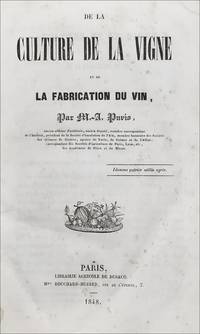
184827<p>Rare collection of treatises on wine making and vine cultivation</p><p>Puvis Marc-Antoine. <em>De la culture de la vigne et de la fabrication du vin / par M.A. Puvis</em>. Paris : Librairie agricole Dusacq Mme Bouchard-Huzard 1848.</p><p>bound with: Puvis Marc-Antoine. <em>Des différens moyens d'amender le sol</em>. Paris : Madame Huzard 1837</p><p>bound with: Thackeray Thomas James<strong>. </strong> <em>Observations sur le fumier de basse-cour les engrais artificiels la construction des granges et le labourage profond<strong>. </strong></em>Paris : A LA LIBRAIRIE AGRICOLE DE Ve BOUCHARD-HUZARD 7 RUE DE L'ÉPRON-ST-ANDRÉ. 1847.</p><p>Extremely rare collection of treatises on wine making and vine cultivation agricultural technique on different ways of fertilizing the soil and on different kinds of natural and artificial fertilizers.</p><p><em>De la culture de la vigne et de la fabrication du vin</em> is the most important opera written by the renowned agronomist and member of parliament Marc-Antoine Puvis 1776-1851 member of the Ain Agricultural Society discussing the importance of wine making and vine cultivation in France the influence of climate and soil different vineyards Côte-d'Or Hermitage influence of the grapes quality on the quality of the wines search for new varieties of vines by the seedlings plantation of the vine size and disbudding proving and uprooting fertilizers and amendments synonymy and variety of grapes.</p><p>The second part pp. 167 to 308 is entirely dedicated to oenology harvesting de-stemming and crushing hydrometer oenometer production of red wines and white wines conservation and clarification of the wines conditioning and improvement bouquet and flavor; comparative analysis of Burgundy wines etc.</p><p>Marc-Antoine Puvis is also the author of the second treatise dealing with different kind of techniques of fertilizing the soil. Among the different techniques an material used to amend the soil he describes liming or treating the soil with lime to reduce acidity and improve fertility or oxygen levels. marling using a friable earthy deposit consisting of clay and calcium carbonate used especially as a fertilizer for soils deficient in lime faluner to amend poor limestone soil with falun a sedimentary rock made up of shells debris the use of ash peat ash kelp sea fertilizer land mix burnt clay or burning the soil</p><p>The third treatise written by Thomas James Thackeray renowned British playwright army officer and agriculturist can be considered a manual on benefits and way of use of different fertilizers as: cattle droppings horse urine cow dung guano peat bran marl salpetre and nitrate of potash sulphate of ammonia etc.</p><p>All the treatise included in the present collection are very rare. In detail:</p><p>Vol 1: Only one copy in Italian Libraries. WoldCat records only 6 other copies; 5 in France and 1 in UK. the copy in Cornell University belongs to a different editio with no date or printing place</p><p>Vol 2: 4 copies worldwide 2 each in France and Switzerland</p><p>Vol 3: 6 copies worldwide 4 in France 1 each in UK and Canada.</p><p>Bibliography: Bourquelot VI. 94. Unkwnown to Vicaire Bitting. Oberlé</p> Bouchard-Huzard
005660Paris, Delalain, De l'Imprimerie de Marchant, 1801. In-8 (203 X 129 mm) demi-cuir de Russie acajou à coins, dos lisse cloisonné de doubles filets dorés, deux volutes dorées en queue, titre doré (Reliure de l'époque) ; (2) ff. de faux-titre et titre, 210 pages, IV pages de table des chapitres, 5 planches dépliantes hors-texte. Une petite épidermure au dos, petits manques de cuir aux coins qui ont été réteintés, plissure à l'angle supérieur droit de 16 feuillets, sans caractère de gravité. Exemplaire relié SANS le tableau dépliant hors-texte qui donne les tarifs de l'eau-de-vie à l'usage du commerce.
in- 12°; pp. 320, (8). Piccolo manuale in cui di ogni singolo alimento, del mondo vegetale e animale, si descrivono i seguenti aspetti: delectus, usus, damna, correctio, gradus, tempus aetas temperamentum, e l’Historia naturalis. Legatura in piena pergamena con titolo manoscritto al dorso. Prima edizione latina.
1904473Editions Masson 1904 format : 27x36 cm, reliures demi-chagrin à coins toutes les planches sont montées sur onglet Tome 5 : 354 pages de texte illustrées de 100 planches pleine page de chromolithographies les 100 dessins sont de J.TRONCY ou de A. KREIDER La plus belle publication viticole jamais publiée très bon état, petites marques de frottements sur le cuir et quelques serpentes absentes ou déchirées