114 507 résultats
178054177Halle, Oels, Breslau, Berlin, Bernstadt, Leipzig, Festenberg und Schmollen, 1776-1780. Deutsche, französische, griechische, lateinische und englische Handschrift auf Papier. 114 Bll. mit ca. 170 Einträgen. Mit eingebundener Gouache auf Seide sowie 2 Aquarellen, 5 Federzeichnungen und 3 Bleistiftzeichnungen. In reich geprägtem hellbraunem Pergamenteinband der Zeit mit Monogramm "G.L.F." und Jahreszahl "1777" auf dem Vorderdeckel. Gestempelte Vorsätze. Qu-8vo. Zusammen mit einem fadengebundenen Heft mit alphabetischem Verzeichnis und fünf weiteren Einträgen. 16 Bll. Qu.-8vo.
160953968Frankfurt, Johann Theobald Schönwetter, 1609. 4to. (16), 48 (recte: 44), 171, (16) pp., final blank page. Title-page with engraved border. With several woodcut illustrations in the text, and 2 folding plates. 17th century full vellum. Marbled endpapers. All edges marbled.
4to. (16), 48 (recte: 44), 171, (16) pp., final blank page. Title-page with engraved border. With several woodcut illustrations in the text, and 2 folding plates. 17th century full vellum. Marbled endpapers. All edges marbled. Rare edition of the extensive commentary on Plutarch's essay "De virtute morali" by the humanist and Duke of Atri, A. M. Acquaviva (1458-1529), first published in 1526. The present edition, published nearly 80 years later, is a reprint of the first, and was edited by the humanist Giulio Belli (1570-1650). Apart from the four-book commentary, which makes up the largest part of the volume, it includes Plutarch's text in Greek type and Latin translation. The majority of the woodcut illustrations accompany the commentary on Plutarch's writings on astronomy (pp. 78-96), displaying the orbits of the sun, moon, Earth, and other planets, as well as the section on Pseudo-Plutarch's "De musica" (pp. 26-77), showing bells and musical scales. Attributed to Plutarch, "De musica" was included in several editions of the "Moralia", a text corpus of 78 essays and speeches ascribed to the first-century Greek scholar. - Handwritten ownership of the Venice senator and collector Giacomo Soranzo (1686-1761), dated 1736, to second flyleaf. His library, comprising 4,000 manuscripts and 20,000 printed books, was dispersed in 1780. The first flyleaf bears a handwritten note of acquisition, dated December 1803, as well as another note in a different handwriting referencing reviews of other works by the editor Belli. - Lower portion of spine somewhat rubbed; covers slightly soiled. Title-page duststained, margins worn, rebacked with paper; upper margins of flyleaves and of 3 first leaves of text flawed, the latter rebacked with paper strips; paper occasionally browned and brownstained; gutter slighlty waterstained in places. A single copy in auction records. Only 12 copies in libraries internationally, none outside of Europe. VD 17, 12:188378T. RISM BVI 64. OCLC 844058263. STC (C17 German) P778. Houzeau/Lancaster 5038. Not in Gregory/Bartlett or Hirsch.
149165634(Köln, Heinrich Quentell, 1491). 4°. 10 nn. Bll. (Got. Typ., 38-39 Zeilen, rubriziert u. mit ausgefüllten Initialspatien), Ldr. d. 20. Jhds. m. goldgepr. Rückenschild.
63018Brescia, Jacobus Britannicus, 5. Januar 1486. 8° (14 x 10,5 cm). Mit zahlr. eingemalten Initialen in Rot. 171 nn. Bll. (ohne das erste weiße; Rom. Type, 26 Zeilen), Späterer Pgmt.-Bd. m. goldgepr. Rückenschild u. dreiseitigem Rotschnitt.
1900201759Braunschweig, Schwetschke & Sohn, 1863-1900. 4°. M. 1 gest. Portr. In 58 (davon 56 uniform geb.) Hldrbdn. Einbde. berieben (wenige auch stärker) u. teilw. leicht fleckig. Klebereste a. Rücken. Teils braunfl. M. mehr. St. bzw. Sign. Bd. 10 in 2 Tln., Bd. 57-59 in 1 zusammen geb. (Corpus Reformatorium 29-87).
57405[Straßburg, Martin Schott], o. J. (um 1485). Fol. 117 nn. Bll. (ohne das letzte weiße; Got. Typ., 2 Kol., 47 Zeilen, Rubriziert u. mit Initialen in Rot), Blindgepr. Schweinsldr.-Bd. d. Zt. über Holzdeckeln m. abgeschrägten Kanten.
14921274Basel, Johann Amerbach, 1492. 8 nn., CIII num. Bll., 1 weißes Bl. Got. Typ. Rubriziert und mit rot eingemalten Initialen. Holzdeckelband der Zeit mit blindgepr. braunem Lederbezug und 6 (von 10) ziselierten Messingbeschlägen.
16650401-23Rom, Typographia Varesii 1665. gr.- 8°. Gest. Frontispiz, Titelbl. mit Holzschnittmarke und Holzschnitt-Wappen verso, 6 Bll., 301 (1) S. (Paginierungsfehler bei S. 237, diese doppelt, statt 235 pag.). 4 Bll. mit 3 gefalteten Tabellen (dav. 1 in Rot und Schwarz) sowie zahlreichen Holzschnitt-Tabellen und Illustrationen im Text. Restaurierter Pgmt.-Bd d. Zeit (mit nicht übereinstimmendem Rückenschildchen, wiederverwendet?) und Resten eines Bibliotheksschildchens. Kapitale etwas berieben, Pergament dort etwas brüchig. Innen nur leicht gebräunt, Frontispiz mit kl. Einriss im unteren Falz u. 2 kl. Wurmlöchlein, sonst gut erhalten. Titelbl. außerhalb des Textes mit kleinem mont. Papierquadrat. Hinterer Spiegel mit mont. Ausschnitten aus Auktionskatalogen. [7 Warenabbildungen]
157927985Paris, Michel Sonnius, 1575-1579. 8 Bde. in 3 und Appendixband. Zus. 9 Bde. in 4. Mit 4 wdh. Druckermarken. Blindgepr. Schweinslederbände der Zeit auf 5 Bünden über Holzdeckeln. Folio (250:370 mm).
In-4°; pp. (8), 190, (6), 191-357, (5), marca tipografica al frontespizio, buon esemplare. Legatura in piena pergamena coeva con tassello Dura opera di critica al De pietati Aristotelis di Fortunio Liceti, scritta nello stesso ambito dell’Accademia patavina da Ferchio, e relativa a una controversia teologica. Matteo Ferchio (1583-1669) filosofo e teologo seguace di Scoto, di origine croata; tenne la cattedra di teologia all’Università di Padova dal 1631.
167533486Rom, Sac. Congreg. de Propaganda Fide, 1675. 248 SS. Mit Druckermarke am Titel verso. Pergamentband des 18. Jhs. 8vo.
8vo. 248 pp. With printer's device on reverse of title page. 18th-century vellum. First Armenian edition of this devotional work, translated into Armenian in 1671 by the grammarian John of Constantinople (1635-91). - Insignificant browning; old shelfmarks to title and half-title (some ink bleeding). Of the utmost rarity. Nersessian 44. Kevorkian 177. Hakob Meghapart 94. OCLC 490245621 (only two copies, both in France).
57359[Straßburg, Johann Grüninger, 1487]. Fol. 1 nn., 88 num., 6 nn. Bll., 1 w. Bl. (Got. Typ., 2 Kol., Rubriziert), Mod. HPgmt. m. durchzogenen Bünden, goldgepr. Rückenschild u. dreiseitigem Rotschnitt.
156730252Wittenberg, Johann Schwertel, 1567. (8), 206 [recte: 208], (28) Bll. (a8, A-Z8, Aa-Ff8, Gg4). Titel sowie das "Calendarium generale" am Schluß in rot und schwarz gedruckt. Mit 3 astronomischen Holzschnittdiagrammen im Text. Halblederband um 1700. Dreiseitiger Rotschnitt. 8vo.
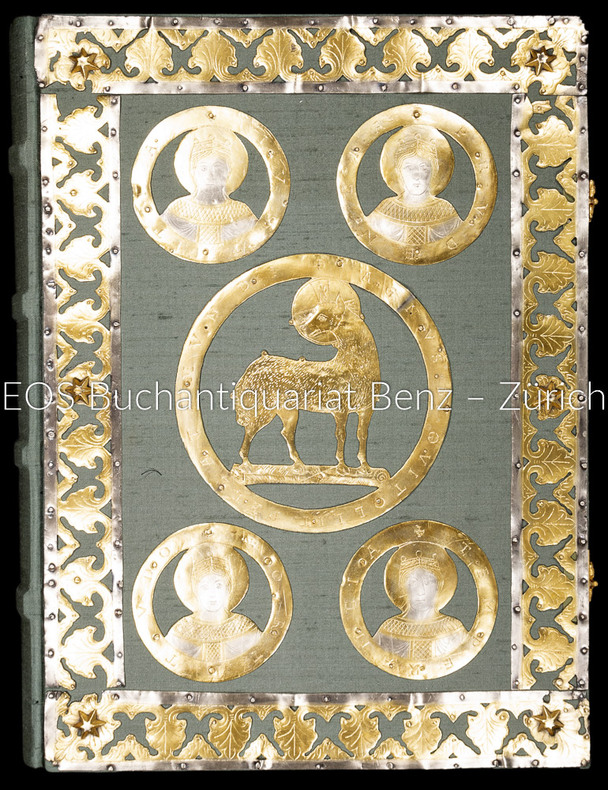
199431128AB2 Bände. Stuttgart und Frankfurt, Verlag Müller und Schindler, S. Fischer 1994. Folio. 203 Blatt mit vielen Initialen und 40 ganzseitigen Miniaturen in Blattgold, 148 Seiten (Kommentar). Seideneinband auf Holzdeckel. Auf dem Vorderdeckel wurde die Goldschmiedearbeit des Original-Buchdeckels mit 23-Karat-Vergoldung kopiert. Mit zwei Schliessen. In schwarzem Samtsack. Halblederband (Kommentar) in Pappschuber.
29532aafAmsterdam, Michel Charles Le Cene, 1741, in-folio, frontispice gravé + 1 f. + 6 p. + 4 p. + 110 p. + 3 ff. + 83 p. (Projet...); XVI + 698 p. + 1 f. + 136 p. (Ancien Testament); 2 ff. + 235 p. (Nouveau Testament), quelques cahiers un peu brunis, solide et élégante reliure en maroquin rouge, dos à nerfs muet, roulettes dorées encadrant les plats, coupes et bordures dorées, tranches dorées, bon exemplaire.
153080143AB(Zürich, Christoph Froschauer d. Ae., 27. August, 1530). 19,8x15 cm. (39) S. Mit zehnzeiliger historisierender Eingangs-Initiale G in Holzschnitt. Blaue Broschur.
61195Venedig, Antonius de Strata, 20. August 1483. 8°. Mit 101 nn. Bll. (ohne das erste weiße; 2 Sp, 42 Z., Got. Typ., mit Initialspatien, Implicit in Rotdruck). Pgmt. d. 19. Jhds. a. 4 Bünden m. etw. Rückenverg., zwei goldgepr. Rückenschildchen u. dreiseitigem Rotschnitt.
25790Leipzig, Verlag von C.G. Naumann, (1888.) Two works in one volume. (8), 144 pp.; (8), 57, (1) pp. 8vo. Contemporary half cloth, spine lettered gilt, marbled boards, corners. First work: Schaberg 56. First edition of the "Twilight of the Gods" and written during an incredibly productive six month period before Nietzsche's collapse in Turin. It was also the last book published during his lifetime. The title refers to an image in the preface: idols "are touched with a hammer and a tuning fork to determine whether they are hollow", which is of course a sarcastic allusion to Wagner, both personally and as a symbol of the German spirit. Nietzsche had 1,000 copies of this work privately printed. Originally to be called "A Psychologist at Leisure," Nietzsche changed the title at the suggestion of his friend, Gast and the book was released a few weeks after Nietzsche collapsed in Turin. The "Idols" that Nietzsche singles out here are those of the philosophers and the moralists. The Preface clearly states that the work at hand is to be "the revaluation of all values". Socrates and Christianity are particular targets although modern Germany and other contemporary ideas are also taken to task in the normally acerbic style of the author. (This book also contains some of Nietzsche's most frequently quoted phrases beginning with Aphorism #8: "What does not kill me only makes me stronger".)Second work: Schaberg 54.First edition, second issue. The book was published on 22 September 1888. Five hundred copies were printed, but 500 additional copies were printed at this time and falsely marked as second edition by the addition of "Zweite Auflage" in the middle of the ornamental rule and the deletion of the publication date. The true second edition of a 1000 copies was printed in October of 1891.The book is a critique of Richard Wagner and the announcement of Nietzsche's rupture with the German artist, who had involved himself too much, in Nietzsche's eyes, in the Völkisch movement and antisemitism. His music is no longer represented as a possible "philosophical affect," and Wagner is ironically compared to Georges Bizet. However, Wagner is presented by Nietzsche as only a particular symptom of a broader "disease" which is affecting Europe, that is nihilism. The book shows Nietzsche as a capable music-critic, and provides the setting for some of his further reflections on the nature of art and on its relationship to the future health of humanity.This work is in sharp contrast with the second part of Nietzsche's The Birth of Tragedy, wherein he praised Wagner as fulfilling a need in music to go beyond the analytic and dispassionate understanding of music. Nietzsche also praised Wagner effusively in his essay 'Wagner at Bayreuth' (part of the Untimely Meditations), but his disillusion with Wagner the composer and the man was first seen in his 1878 work Human, All Too Human. One of the last works that Nietzsche wrote returned to the critical theme of The Case of Wagner. In Nietzsche contra Wagner, Nietzsche pulled together excerpts from his works to show that he consistently had the same thoughts about music, only that he had misapplied them to Wagner in the earliest works. - First and last leaves a bit foxed, some scattered annotations in blue pencil and lead pencil.Provenance: from the library of A. Diepenbrock, with his signature on the first free endpaper (and date Jan. 1889) and second title-page (with the date Sept. 1888.) Alphons Diepenbrock was a Dutch composer, essayist and classicist. Although he showed musical ability he studied classics at the University of Amsterdam, gaining his doctorate cum laude in 1888 with a dissertation in Latin on the life of Seneca. The same year he became a teacher, a job which he held until 1894, when he retired from that position and decided to devote himself to music. As a composer, he had been completely self-taught from an early age. He created a musical idiom which, in a highly personal manner, combined 16th-century polyphony with Wagnerian chromaticism, to which in later years was added the impressionistic refinement that he encountered in Debussy's music. His predominantly vocal output is distinguished by the high quality of the texts used. Apart from the Ancient Greek dramatists and Latin liturgy, he was inspired by, among others, Goethe, Novalis, Vondel, Brentano, Hölderlin, Heine, Nietzsche, Baudelaire and Verlaine. As a conductor, he performed many contemporary works, including Gustav Mahler's Fourth Symphony (at the Concertgebouw) as well as works by Fauré and Debussy. Throughout his life, Diepenbrock continued his interests in the wider cultural sphere, remaining a classics tutor and publishing works on literature, painting, politics, philosophy and religion. Indeed during his lifetime his musical skills were often overlooked. Nonetheless, Diepenbrock was very much a respected figure within musical circles. He counted amongst his friends Mahler, Richard Strauss and Arnold Schoenberg.
'Opera omnia' complete in 28 volumes: 26 volumes + 2 volumes of indices, text in latin, original 1856-1878-edition (except 'Indices'), Editio nova (second edition, the first of which was printed in 1740-1751 in Venice), 27cm., text printed in 2 columns, all vols. including the compendium are uniformely bound (cart.cover with marbled plates, gilt lettering & decorations on leather spines, marbled endpapers) except for the indices (vols.27-28, anastatic reprint of the Paris 1878-edition: Bruxelles, Culture et civilisation, 1963, 29cm., full cloth), few foxing, small library stamp at titlepages, nice set in a beautiful binding, to which is added: 'Summa seu Compendium' by Fr.Noel (complete in 2 volumes, original Migne-edition of 1858), [Opera omnia: cfr. De Backer & Sommervogel, VII col.1680 no.24, Suarez Franciscus S.J., Grenada 1548 - Lisbon 1617 / Compendium: cfr. De Backer & Sommervogel V col.1793 no.12, Franciscus Noel, Hestrud 1651 -Lille 1729], R66464
1856R66464Parisiis [Paris] / Petit-Montrouge, apud Ludovicum Vivès / J.-P. Migne 1856-1878 (1963) / 1858 'Opera omnia' complete in 28 volumes: 26 volumes + 2 volumes of indices, text in latin, original 1856-1878-edition (except 'Indices'), Editio nova (second edition, the first of which was printed in 1740-1751 in Venice), 27cm., text printed in 2 columns, all vols. including the compendium are uniformely bound (cart.cover with marbled plates, gilt lettering & decorations on leather spines, marbled endpapers) except for the indices (vols.27-28, anastatic reprint of the Paris 1878-edition: Bruxelles, Culture et civilisation, 1963, 29cm., full cloth), few foxing, small library stamp at titlepages, nice set in a beautiful binding, to which is added: 'Summa seu Compendium' by Fr.Noel (complete in 2 volumes, original Migne-edition of 1858), [Opera omnia: cfr. De Backer & Sommervogel, VII col.1680 no.24, Suarez Franciscus S.J., Grenada 1548 - Lisbon 1617 / Compendium: cfr. De Backer & Sommervogel V col.1793 no.12, Franciscus Noel, Hestrud 1651 -Lille 1729], R66464
150038134[Leipzig, Martin Landsberg], o. J. (um 1500). 4°. 14 nn. Bll. (Got. Typ., 34 Zeilen), Mod. flex. Pgmt. unter Verwendung alten Materials.
21037o.J. Einbandleder etwas berieben und fleckig, Rücken mit Tüncheresten und altem handschr. Rückenschild, die Deckel zur Hälfte mit neuem Pergamentbezug, Vorsätze ebenfalls fachgerecht erneuert.
1536953165Basel: Froben. 1536. Klein-Oktav, 17,3 cm. (Gegenlager der unteren Schließe fehlt, Einband leicht bestoßen und fleckig, Schnitt fleckig, handschriftliche Besitzvermerke, innen meist dezenter Feuchtigkeitsrand, im Ganzen aber gut erhalten) [10 Warenabbildungen] 940 Seiten, 30 Blatt. Blindgeprägter Schweinsledereinband der Zeit mit zwei Schließen, auf Holzdeckeln mit 3 Bünden,